The blood-drenched money interests of U.S. weapons manufacturers and the military industrial complex win again:
While President Obama has forcefully called out Congress for not passing gun control, the United States has been one of the leading countries blocking a global treaty to regulate the $70 billion international arms trade, torpedoing it last summer and dragging its feet on it this week at the United Nations. While Iran, Syria and North Korea are generating headlines for officially blocking the treaty, less attention has been paid to the role of the U.S. — acceding to pressure from outside groups including the National Rifle Association — in stalling its progress.
In an earlier post ‘The Sandy Hook Massacre and the Merchant$ of Death‘, we talked about the control that the U.S. weapons industry and the military industrial complex(MIC) have over ‘our’ government. The MIC dictates American foreign policy in the interests of not only Big Oil and corporate capitalism, but also the U.S. arms industry which sees big profits in war and strife. Some call this corrupt arrangement the military-industrial-congressional complex or military-industrial-banking complex. Perpetual war has become an integral part of our economy and a majority of our wealthy Congress ‘leaders’ are heavily invested in this war-for-profit machine. Chances are that your 401K, if you still have one, is invested in the MIC one way or another. Here is the latest infographic illustrating our war-based economy:
And the costs keep getting bigger and bigger as the Empire bleeds its citizens dry at home, spreads ill will and animosity abroad, and continues to funnel wealth upward to the oligarch class:
This is why I have said that America is ‘The World’s Most Destabilizing Force‘. Do you really think a “pussy-ass” topic of saving the biosphere will ever be taken seriously? Environmental issues will always be relegated to the back pages when you have savages running the show.
If the supposed “most enlightened” and “advanced” nation on Earth profits from death and destruction and uses Orwellian titles, for example Operation [Iraqi] Freedom, to label their military invasions, then how can we judge the behavior and actions of foreign nations when they are often the blowback from America’s own depravity. A nation using high-tech weapons of war to plunder and murder while hiding behind the façade of democratic institutions and kangaroo courts is still a country of savages and barbarians, no different than Genghis Khan or Attila the Hun.
…Emmy-award winning TV journalist, author and media critic, Danny Schechter turns the cameras on the role of the media. His new film, WMD, is an outspoken assessment of how Pentagon propaganda and media complicity misled the American people…
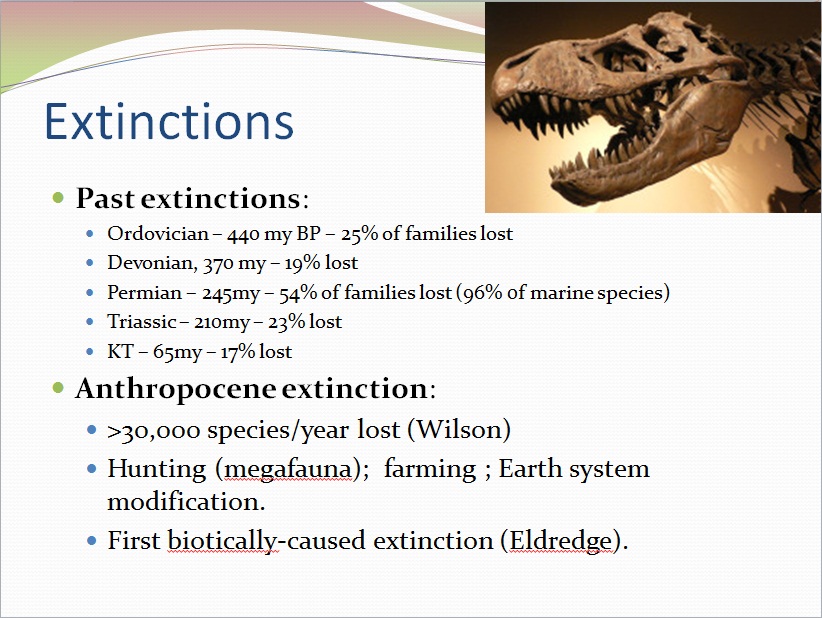
I almost never watch MSM news, but the other day a preview of a show with Dan Rather about the die-off of bees caught my attention. People were horrified that their business would be hurt, profits would be eviscerated, livelihoods would be irreparably damaged. It’s all about the humans and their economy, not the ecological balance of the planet or what humans have done to push all these non-human species into extinction, in turn threatening homo sapiens’ existence.
Everybody’s livelihood is at stake here over a little flying bee.
Mother Nature thinks the same thing of us: “The Earth is being forever defiled by these arrogant, self-centered bastards and all they can think about is their profit margin.”
Guess what. The Earth doesn’t care about human wants or needs. A misused and abused Earth does not consider the inconveniences to the human economy posed by climate chaos and environmental collapse. The other creatures inhabiting this planet are being silently driven off the face of the Earth to make way for humankind’s insatiable appetite for domination and control. A creature which sees itself as a force of nature to be reckoned with, separate and superior to the planet that spawned it, will soon be brought down by such conceit. I hope we can handle being the only thing left on the planet. We can pollinate our own crops like the Chinese, and bring back extinct species at will to be placed in zoos for our amusement. We can geoengineer the Earth ‘s atmosphere to fix what we’ve destroyed in a vain effort to maintain this colossal edifice of industrial civilization. We can genetically modify crops so as to try to adapt to the drastically altered environment we’re handing down to future generations, human and non-human. Better yet, we can genetically modify ourselves to survive within this toxic world we’ve created. There is no fucking end to our God Complex.
Connection with the outside world has been replaced by a virtual world of electronic devices – TV’s, computers, video games, iphones, blackberries, and other assorted digital devices – filling every public and private space with the latest infotainment news and gossip of a throwaway pop culture. The masses watch reality TV shows to escape from their own hollow reality of slave wages, deadend jobs, a collapsing environment, and the faux democracy of corporate rule.
Driven into the military as the only avenue out of poverty, many soldiers commit suicide to escape the clutches of an industrial war machine that chews up foreign countries and cultures in order to extract resources onto the chopping block of the global marketplace. Blood for oil; souls for dollars. The last remaining vestiges of a living planet get pulled into the marketplace to be commodified, priced, and privatized. Damaged soldiers come home to a jobless economy while their leaders who sold them these wars travel the country doing book signings and lauding their war crimes as accomplishments.
How can such a system survive when the only thing it knows how to do is treat everything as inanimate objects whose only real value is to serve the desires of a self-absorbed species? Humans are amusing themselves to death in their fabricated world of alsphalt, concrete, and steel while the real world burns under the slow-motion detonation of climate disruption and mass extinction. The scientists think they can save the world with new technology even while prior technology is ripping the world apart. Rather than add yet another layer of unsustainable complexity, perhaps it’s time to escape this technology trap and simplify our way of life before becoming victims of our own perceived success.
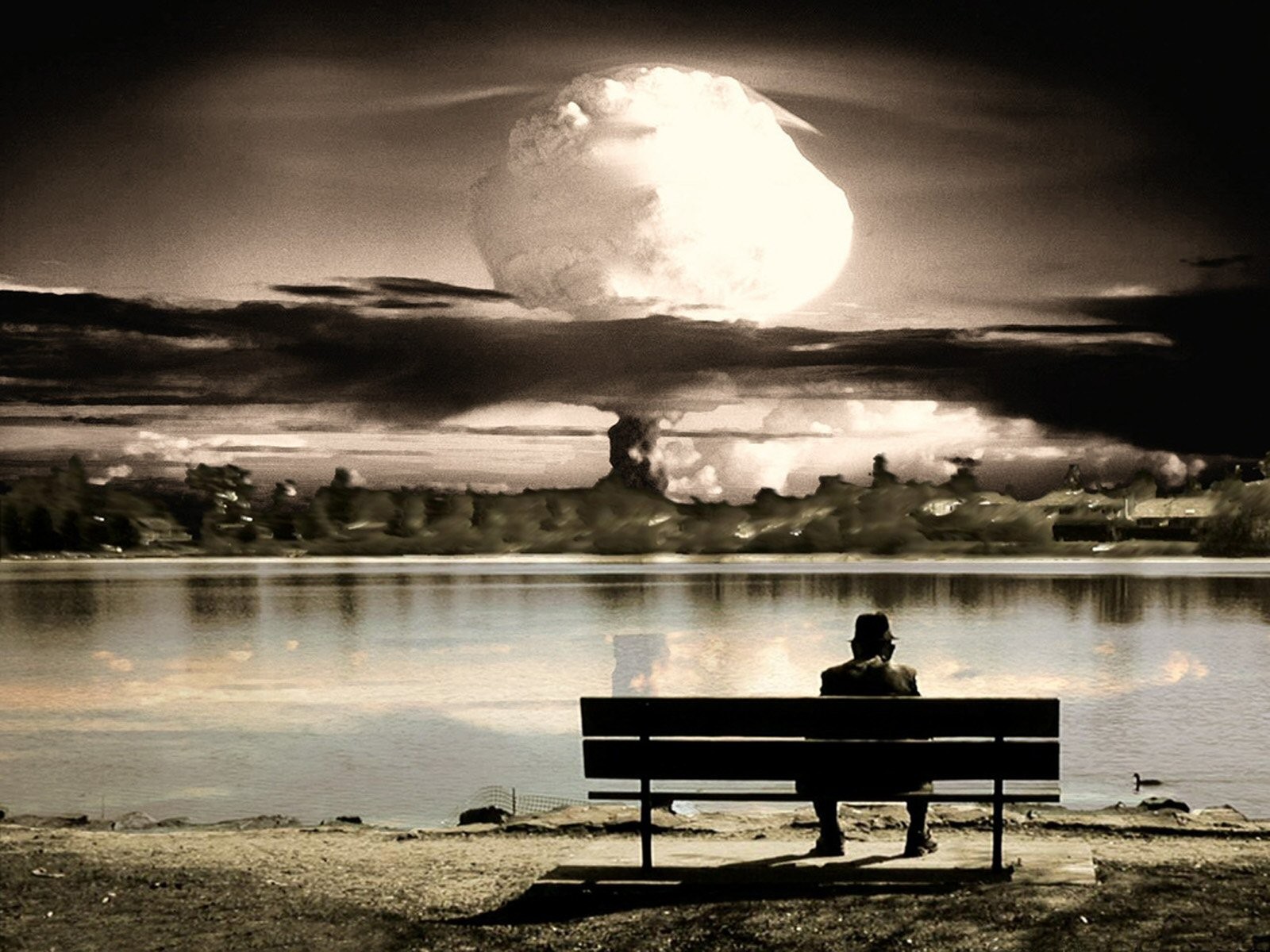
Climate Change is like a slow motion nuclear bomb. Both destroy the world, but one is instantaneous while the other is slow, insidious, and under the radar of everyday human perception.
…Brown hopes to shatter ideological assumptions cultivated during the Cold War by exploring remarkable similarities between the American and Soviet plutonium cities.
Top secret, highly restricted and socially engineered, these government-run communities developed on parallel paths into model cities. Each received awards for planning, community development and education. At the height of Cold War tension, some politicians feared Richland was too “socialisitic”, while some Soviet officials called Cheliabinsk-40 too “materialisitic” and “bourgeois.” Both suffer a deadly legacy of radioactive contamination.
“I will argue that in creating the means to destroy each other, the two cities came to resemble one another,” Brown said…
From the blurb of the book…
I’ll have to do a book review of Plutopia as well. Getting back to my recent obsession with nukes, I also ran across a website called My Nuclear Life which is run by a college student studying environmental health. Her site is a sort of depository for all things nuclear. Here are a few of the interesting images from her vast collection:
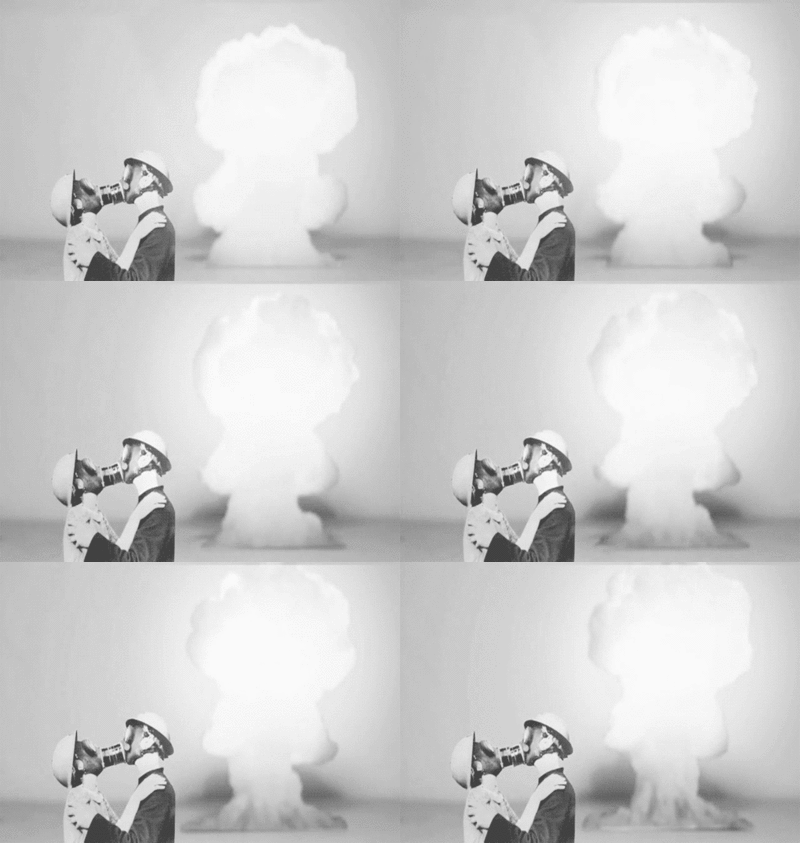
‘Da Bomb’ Hair Style…
Good, wholesome family outing…
‘Till radioactive contamination and death do us part…
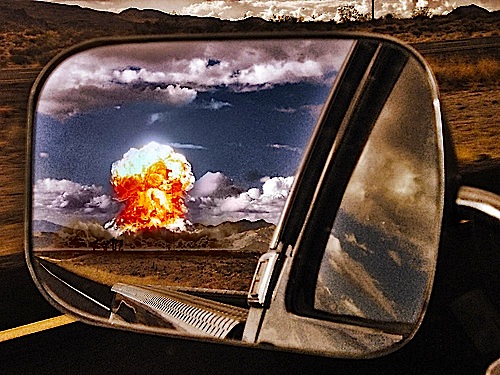
Rear view mirrors are helpful in eliminating ‘nuclear’ blind spots…
Ever since the dawn of the nuclear age, mankind has been living with the ever-present threat of mass annihilation. From the naive ‘duck and cover’ days of the Cold War to the present-day threat of a terrorist cell sneaking a nuke into a city on a truck, perhaps no single invention has affected the psyche of mankind. Nuclear weapons have only been used twice thus far, Hiroshima and Nagasaki. Contrary to the popular myth that the bombing of those two Japanese cities helped end the war, America used the already defeated Japan as a nuclear sacrificial lamb in order to intimidate Russia and limit Soviet expansion into Asia. So we have set the stage whereby any country, if it wants to gain respect and not face the threat of regime change, must strive to join the nuclear club. Nuclear proliferation cannot be stopped when nations see the power and status they can attain by becoming part of the club.
…For nuclear newcomers, the bomb is both a product of and an instrument for nationalist aspirations. Moreover, in this new, dangerously complicated world, nuclear weapons, while they may not be exploded, are assuredly used in many ways: to bluff, to intimidate, to rally the populace, to throw opponents off balance. “Anyone who says that nuclear weapons aren’t usable should take a look at North Korea,” Bracken writes. “Nuclear weapons are used every single day to extort food and oil from the rest of the world to keep the regime going.” Disarmament, he would say, is a sweet fantasy. The best we can hope for is to “manage” the nuclear menagerie — and we cannot be confident of success… –source
Below is a great interactive infographic showing who is in the nuclear club, who has nuclear plants as part of their energy mix, and who has both. As everyone should know, nations striving for nuclear energy also get on the fast track to obtaining nuclear bombs, if they so choose.
click on the image to use the infographic…
Lately, North Korea has once again been using its nukes as a political tool. The public opinion in South Korea has now fully swung toward the belief that they too must acquire the big stick of nukes in order to counter their neighbor’s threats.
…We, the Korean people, have been duped by North Korea for the last 20 to 30 years and it is now time for South Koreans to face the reality and do something that we need to do,” said Chung Mong-joon, a lawmaker in the governing Saenuri (New Frontier) Party and a former presidential conservative candiate. “The nuclear deterrence can be the only answer. We have to have nuclear capability…
…According to a February poll conducted by South Korea’s private think tank, Asan Institute, 66% of South Koreans said they support developing a nuclear weapons program. The poll suggests that just under half of South Koreans in 2012 believed that the United States would provide South Korea with what’s known as the “nuclear umbrella” in the case of a North Korean nuclear attack, indicating a 7% decrease from 2011…
Having 23 commercial reactors in operation makes South Korea one of the world’s top five commercial nuclear powers and gives it the ability to produce uranium or plutonium for nuclear weapons. South Korea could have nukes within 6 months.
We know that despite the setback Iran faced with the Stuxnet virus, it is only a matter of time before it develops nukes as well.
Now we get to the age of resource scarcity and climate destabilization, both of which have proven to be conflict multipliers. The grotesquely named Operation Iraqi Freedom was about nothing more than freeing up that country’s oil resources. Ten years later the country is in ruins, but Big Oil is benefitting (I’m surprised CNN ran this story):
…Oil was not the only goal of the Iraq War, but it was certainly the central one, as top U.S. military and political figures have attested to in the years following the invasion.
“Of course it’s about oil; we can’t really deny that,” said Gen. John Abizaid, former head of U.S. Central Command and Military Operations in Iraq, in 2007. Former Federal Reserve Chairman Alan Greenspan agreed, writing in his memoir, “I am saddened that it is politically inconvenient to acknowledge what everyone knows: the Iraq war is largely about oil.” Then-Sen. and now Defense Secretary Chuck Hagel said the same in 2007: “People say we’re not fighting for oil. Of course we are.”
For the first time in about 30 years, Western oil companies are exploring for and producing oil in Iraq from some of the world’s largest oil fields and reaping enormous profit. And while the U.S. has also maintained a fairly consistent level of Iraq oil imports since the invasion, the benefits are not finding their way through Iraq’s economy or society.
These outcomes were by design, the result of a decade of U.S. government and oil company pressure. In 1998, Kenneth Derr, then CEO of Chevron, said, “Iraq possesses huge reserves of oil and gas-reserves I’d love Chevron to have access to.” Today it does…
…Iraq’s oil production has increased by more than 40% in the past five years to 3 million barrels of oil a day (still below the 1979 high of 3.5 million set by Iraq’s state-owned companies), but a full 80% of this is being exported out of the country while Iraqis struggle to meet basic energy consumption needs. GDP per capita has increased significantly yet remains among the lowest in the world and well below some of Iraq’s other oil-rich neighbors. Basic services such as water and electricity remain luxuries, while 25% of the population lives in poverty…
…a leading coalition of Iraqi civil society groups and trade unions, including oil workers, declared on February 15 that international oil companies have “taken the place of foreign troops in compromising Iraqi sovereignty” and should “set a timetable for withdrawal.”…
In an age of mass delusion, inverted totalitarianism, and scapegoating, will the logic of MAD (mutually assured destruction) be enough to prevent a nuclear war? The energy skeptic sums up the failure of such thinking in the following quote:
And what of the odds even in a world not facing peak everything and climate chaos?
…The inevitability concept can best be understood by analogy to finance. It does not make sense to talk of an interest rate as being high or low, for example 50 percent or 1 percent, without comparing it to specific period of time. An interest rate of 50 percent per year is high. An interest rate of 50 percent per century is low. And the low interest rate of 1 percent per year builds up to a much larger interest rate, say 100 percent, when compounded over a sufficiently long time.
In the same way, it does not make sense to talk about the probability of nuclear war being high or low — for example 10 percent versus 1 percent — without comparing it to a specific period of time — for example, 10 percent per decade or 1 percent per year.
Having gotten the units right, we might argue whether the probability of nuclear war per year was high or low. But it would make no real difference. If the probability is 10 percent per year, then we expect the holocaust to come in about 10 years. If it is 1 percent per year, then we expect it in about 100 years.
The lower probability per year changes the time frame until we expect civilization to be destroyed, but it does not change the inevitability of the ruin. In either scenario, nuclear war is 100 percent certain to occur….
A few noteworthy news stories came across my desk. If anyone still believes the human race will suddenly become endowed with a collective enlightenment to stop throwing its fossil fuel garbage into the air and avert climate chaos, theses recent news articles should put that pipe dream to rest. The first two are further confirmation that we are on a fast track to nowhere with human-induced climate change. 2012 CO2 levels increased by 2.67 parts per million and marked the second biggest jump since records began in 1959, bringing the planet to just under 395 parts per million (ppm). 1998 has the record with a CO2 jump of 2.84 ppm.
A widely reported study recently confirms that the Earth has not been this warm in 11,300 years. See the spike at the end of the graph up above; that’s from man’s frantic industrial activities over the last few hundred years which have actually reversed what should have been a continued cooling trend. Plants are responding to this aberrant spike in global temperature by migrating northward.
Some major institutions of industrial civilization are taking note of this reality while others are not. Firstly, the U.S. military is reaching out to foreign governments in order to prepare for what will be a humanitarian catastrophe:
…when it comes to pragmatic military planning, Locklear said he is increasingly focused on another highly destabilizing force.
“The ice is melting and sea is getting higher,” Locklear said, noting that 80 percent of the world’s population lives within 200 miles of the coast. “I’m into the consequence management side of it. I’m not a scientist, but the island of Tarawa in Kiribati, they’re contemplating moving their entire population to another country because [it] is not going to exist anymore.”
The US military, he said, is beginning to reach out to other armed forces in the region about the issue.
“We have interjected into our multilateral dialogue – even with China and India – the imperative to kind of get military capabilities aligned [for] when the effects of climate change start to impact these massive populations,” he said. “If it goes bad, you could have hundreds of thousands or millions of people displaced and then security will start to crumble pretty quickly.’- source
While on Wall Street, investors are accepting the mindset that climate change is inevitable and instead of investing in “green energy”, they are taking a more catastrophic approach:
Working under the assumption that climate change is inevitable, they’re investing in businesses that will profit as the planet gets hotter. (The World Bank says the earth could warm by 4C by the end of the century.) Their strategies include buying water treatment companies, brokering deals for Australian farmland, and backing a startup that has engineered a mosquito to fight dengue, a disease that’s spreading as the mercury climbs…
…When investors think about global warming, “there is an overemphasis of its negative impacts,” says Michael Richardson, head of business development at Land Commodities, which advises rich individuals and sovereign wealth funds on purchases of Australian farmland. The company’s pitch: The gloomy prospect of hotter temperatures, scarce arable land, and rapidly rising populations will make inland cropland Down Under—far from rising seas yet close to Asia’s hungry customers—more valuable…
To which a reader makes the following comment about this shameless profiting from doom:
…This could be disastrous for the global economy. As Ceres notes, the global economy would be paralyzed without insurance lubricating commerce. And since the insurance industry is also a major institutional investor-to the tune of $5 trillion-bad bets on companies exposed to climate change risk could erode insurers’ own balance sheets and their ability to cope with multiple Sandy’s in the years to come. Not to mention liability from litigation arising from customers such as power plant operators whose emissions contribute to climate change. “A substantial proportion of the revenue generated by insurers is derived from investment returns,” the Ceres report notes. “Just as climate change may substantially increase insured losses, it may also adversely affect the investment performance that insurers rely on to meet their liabilities.’
In his latest post, scientist Brad Jarvis talks about a “hard shutdown” versus a “graceful shutdown” of industrial civilization:
I have not read the book “Lights Out,” but I imagine one of the devastating consequences of a “hard shutdown” would be the loss of energy to nuclear plants and those unspent fuel rods sitting there like ticking time bombs.
U.S. reactors have generated about 65,000 metric tons of spent fuel, of which 75 percent is stored in pools, according to Nuclear Energy Institute data. Spent fuel rods give off about 1 million rems (10,00Sv) of radiation per hour at a distance of one foot — enough radiation to kill people in a matter of seconds. There are more than 30 million such rods in U.S. spent fuel pools. No other nation has generated this much radioactivity from either nuclear power or nuclear weapons production…
Even though they contain some of the largest concentrations of radioactivity on the planet, U.S. spent nuclear fuel pools are mostly contained in ordinary industrial structures designed to merely protect them against the elements. Some are made from materials commonly used to house big-box stores and car dealerships…”
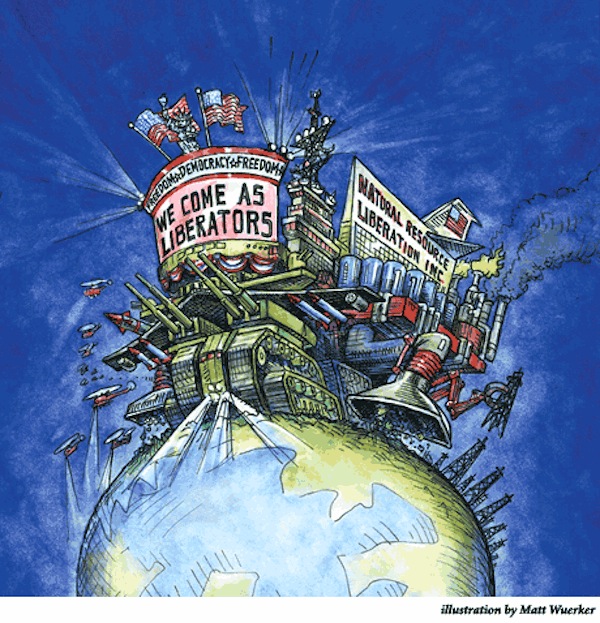
Besides making the occasional video, I will soon be expressing myself in the art of editorial cartoons which is my true passion. I’ve featured some great ones on this blog: David Horsey, Tom Toles, and Matt Wuerker. Editorial cartoons are interesting to me because they can give an entire synopsis in one shot, and if done effectively, they will stick in your mind and make you think about the issue. There’s a reason why despotic governments don’t like articulate cartoonists. Without a doubt, the best editorial cartoonists are some of the most informed people. You have to be knowledgable about world events and issues in order to produce art that will convey meaningful social commentary. So this is something I want to start doing since I do have the artistic skills. Let’s see if I can pull it off.
Agriculture and Climate Change is a blog that I just started following. Last night while on the net I was looking at her collection of editorial cartoons and saw one that pretty much sums up the state of modern industrial civilization’s relationship with the Earth. It’s done by Turkish cartoonist Kürşat Zaman whose work I’ve never seen.
It reminds me a little of an M. Wuerker cartoon from several years ago concerning the resource-sucking war machine of the American Empire:
Has anyone checked their wallet recently? For most, that Ponzi-scheming, resource-plundering American war machine, aka Military Industrial Complex, has relieved you of some major coinage over the years. For others, it has exterminated their country, if not their life.
Back to the Turkish cartoonist Zaman, here is another of his that struck me:
I interpret this one on several different levels. The first message that came to me was America’s prison industrial complex and the fact that America is number one in locking people up:
…According to California Prison Focus, “no other society in human history has imprisoned so many of its own citizens.” The figures show that the United States has locked up more people than any other country: a half million more than China, which has a population five times greater than the U.S. Statistics reveal that the United States holds 25% of the world’s prison population, but only 5% of the world’s people. From less than 300,000 inmates in 1972, the jail population grew to 2 million by the year 2000. In 1990 it was one million. Ten years ago there were only five private prisons in the country, with a population of 2,000 inmates; now, there are 100, with 62,000 inmates. It is expected that by the coming decade, the number will hit 360,000, according to reports…
I also thought about the fact that America is basically an open-air prison with this country having become a pervasive Security and Surveillance State and all branches of its government usurped by elite monied interests. As the corrupt Boss Tweed said in the movie ‘The Gangs of New York’, “The appearance of law must be upheld, especially when it’s being broken.”
My internet is still down, but will hopefully be back up by tomorrow night so I can put out a few posts I was contemplating. In the mean time, an interesting excerpt from a new book by Roberto De Vogli, associate professor in global health at the University of California Davis and University College London.
Excerpt…
And of course it continues today as has been discussed in previous posts on this site. So much for the “free market”.
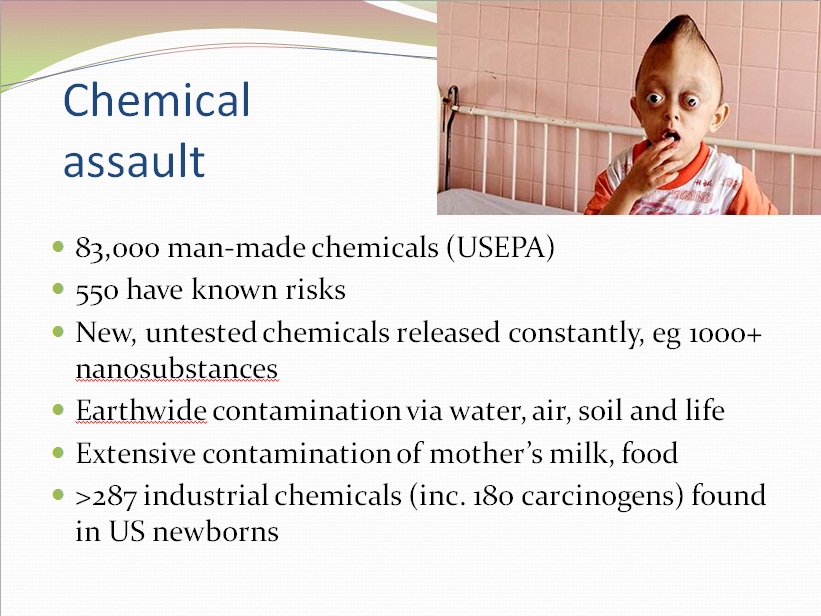
My last post on environmental toxins was inspired from an email I got from Professor Julian Cribb in Australia. Upon closer inspection of his email I see that the attachments have much more interesting information that deserves our attention. I hope my readers will forgive me for having missed this valuable material, but I just came back from the decadence of Sin City on my weekend trip and I’m a little tired.
I hope the good Professor doesn’t mind my posting the attachments at my site. The first concerns environmental toxins and is an extended and more informative version of the brief article that Professor Cribb published in the Canberra Times.
The second attachment is an argument for the renaming of the human species (Homo Sapien) to something more appropriate in order to properly reflect our dysfunctional and self-destructive nature. I believe we’re too full of self-conceit and self-delusion to ever seriously entertain the idea, but it is a good argument to make in light of our impending extinction and the ongoing destruction of the Earth’s habitability for most other organisms. This global apocalypse is being brought to you by the world-wrecking hands of ‘industrial capitalist carbon man’.
Lastly, he sent me an interesting slide show which appears to be the basis for a TV documentary that the Professor is hoping to create in order to explore these unfolding crises leading to mankind’s self-inflicted extinction, an avoidable tragedy if Homo Sapiens lived up to their name of ‘wise man’ – a misnomer if there ever was one.
I look forward to watching this documentary. Luckily, Professor Cribb is trying to get this project done in Australia and not the Banana Republic of America where it would be sacrilege to think that money is an illusion or that all problems cannot be solved by printing more of it.
Hello dominant life form of planet Earth. Yes, that means you Homo Sapiens. I’ve watched as over the millennia you evolved from a primitive ape-like hominid species, surviving purely by instinct, to the technology-wielding, sophisticated-thinking creature of today. Truly, the planet became your smorgasbord and you have partaken freely. As a matter of fact, you have very nearly emptied the planet’s entire refrigerator and cupboards and are now preparing to lick your plate clean. I’ve been throwing up some warning signs, especially this past year, to try to get your attention and perhaps make you reconsider your current omnivorous appetite. After all, you do share the planet with other life forms who have been hoping someone or something will put an end to your callous industrial rampage. I’ve even set in motion a sort of evolutionary check-and-balance, a doomsday device if you will, in the form of atmospheric heat-trapping gases, ensuring your demise just in case you don’t get the message of behavior modification. In other words, your dominant socio-economic paradigm of capitalism is fatally flawed.
Your voracious appetite for the world’s natural resources — fish, timber, potable water, arable land, minerals, et al. — continues unabated. And after consuming them, you leave behind mountains of waste and destruction. Does it always take a crisis before you creatures take action? Instead of waiting until you suffocate to death in a world of hypoxic oceans and dead forests, try listening to those lone voices of dissent screaming for your attention:
Look, I have news for you. The human economy does not take precedence over the Earth’s natural ecological processes which have evolved over millions of years to provide you with clean water, clean air, fertile land, and productive plant and animal life. All of these priceless necessities have been given to you at no charge to your accounting ledger. I guess free lunches are something no human can refuse, but the bill will come due no matter how you try to hide it by pushing it off onto the environment and future generations. In a planet without a stable biosphere, your glimmering metropolises with their megalithic concrete and steel structures reaching heavenward are nothing more than fleeting sand castles to be washed away by the next rogue wave of a surging sea… Sandy was just a warm-up event. Perhaps a new ‘Dust Bowl’ event and heat waves down under demanding a new color code on the weather map and droughts rendering useless a nation’s hydroelectric power will do the trick. I suppose as long as the $tock exchanges of the world are operable, your “business as usual” scheme of perpetual growth and converting all the natural world into capitalist symbols of wealth will carry on its merry way right over the edge of global extinction. And you thought the “fiscal cliff” was something to worry about?
As a mentor and intellectual peer of this site said recently, “tribes and societies that did master effective class consciousness thrived, for a very long time. Those that didn’t, don’t.” At today’s massive scale of production and consumption, the human and environmental exploitation characterized by modern industrial capitalism undermines the long-term existence of mankind along with every other living organism on the planet. Capitalism shoehorns everything into its profit-seeking regime, no matter if that means global genocide on a scale never heretofore seen:
…Actually, the more I reflect on it, the clearer I see the logic, the rationale, behind the bankers’ and the capitalists’ push for privatization. It is not just more profits they are after, not just share price or corporate valuation; no! They are after mass extermination, genocide on a grand scale – of the world’s needy, the under-funded, the unwanted, the uncivilized, the savages and the barbarians, the commies and the Islamists, in short, elimination of all of the Others.
The big boyz have seen all the data and crunched all the numbers, and it is clear to them – the earth is running out of resources, Mars is -50 C all of the time, and we can no longer afford to carry all of this excess baggage here on the planet — all of these miserable, thankless, do-nothing mouths to feed. So the plan is brilliant. You reduce the number from 7+ billion by at least 33% without firing one shot. You simply privatize all natural resources and then price access so that the bottom third of the globe’s population cannot afford it. And so, they die; it will be the biggest die-off of the Anthropocene epoch…
An interesting article came to my attention via a referral from The Big Picture. The economics editor of the Sydney Morning Herald, Ross Gittins, has written an article, The four business gangs that run the US, which is a review of Jeffrey Sachs book, The Price of Civilisation. Sachs should have entitled his book ‘The Price of Capitalism’. In order to protect corporate interests, the exploiters will always use their wealth to bribe the political system (such as campaign contributions and promises of lucrative positions in the private sector after leaving government posts). We are all familiar with feedback loops in terms of climate change,but there also exists one within our socio-economic system which is extremely destructive. I refered to this feedback loop as the government-corporate-lobbyist complex in my postGuns, God, and Greenback$.Sachs describes this pernicious feedback loop, which has accelerated wealth to the top 0.001%, as follows:
Sachs says…
Corporate wealth translates into political power through campaign financing, corporate lobbying and the revolving door of jobs between government and industry; and political power translates into further wealth through tax cuts, deregulation and sweetheart contracts between government and industry. Wealth begets power, and power begets wealth.
Sachs even uses the term corporatocracy to describe the four primary U.S. business sectors which have usurped our government:
1.) Military-Industrial-Complex
Sachs says…
As [President] Eisenhower famously warned in his farewell address in January 1961, the linkage of the military and private industry created a political power so pervasive that America has been condemned to militarisation, useless wars and fiscal waste on a scale of many tens of trillions of dollars since then.
2.) Wall Street-Washington complex
This group, comprised primarily of the big financial corporations (i.e. Goldman Sachs, JP Morgan Chase, Citigroup, Morgan Stanley), systematically worked to “capture” regulation and take control of the money system which, Sachs says, “paved the way for the 2008 financial crisis and the mega-bailouts that followed, through reckless deregulation followed by an almost complete lack of oversight by government”.
3.) Big Oil-transport-military complex
Sachs says…
Since the days of John D. Rockefeller and the Standard Oil Trust a century ago, Big Oil has loomed large in American politics and foreign policy. Big Oil teamed up with the automobile industry to steer America away from mass transit and towards gas-guzzling vehicles driving on a nationally financed highway system.
Now you know why America has a rail system that even the Bulgarians would be ashamed of, as Kunstler is fond of saying. Next time you fill up your tank, think of the perpetual oil wars in the Middle East as an externalized cost of subsidizing America’s car culture. Anita Dancs calculated the cost of securing our liquid fuel addiction back in 2010:
…Put all these numbers in perspective: The price of a barrel of oil consumed in the United States would have to increase by $23.40 to offset military resources expended to secure oil. That translates to an additional 56 cents for a gallon of gas, or three times the federal gas tax that funds road construction.
If $166 billion were spent on other priorities, the Boston public transportation system, the “T,” could have its operating expenses covered, with commuters riding for free. And there would still be money left over for another 100 public transport systems across the United States. Or, we could build and install nearly 50,000 wind turbines. Take your pick.
Sachs also reminds us that “Big Oil has played a notorious role in the fight to keep climate change off the US agenda. Exxon-Mobil, Koch Industries and others in the sector have underwritten a generation of anti-scientific propaganda to confuse the American people.”
4.) Healthcare Complex
Sachs says…
The key to understanding this sector is to note that the government partners with industry to reimburse costs with little systematic oversight and control. Pharmaceutical firms set sky-high prices protected by patent rights; Medicare [for the aged] and Medicaid [for the poor] and private insurers reimburse doctors and hospitals on a cost-plus basis; and the American Medical Association restricts the supply of new doctors through the control of placements at medical schools.
‘The result of this pseudo-market system is sky-high costs, large profits for the private healthcare sector, and no political will to reform.
We are the only industrialized country on Earth without universal healthcare. We pay more than anyone else and get less for the money spent. One of every five or six GDP dollars goes to feed this beast, but our life expectancy doesn’t reflect it:
Sachs says the elite take care of their own and have no concern for the plebs down below:
There is absolutely no economic crisis in corporate America. Consider the pulse of the corporate sector as opposed to the pulse of the employees working in it: corporate profits in 2010 were at an all-time high, chief executive salaries in 2010 rebounded strongly from the financial crisis, Wall Street compensation in 2010 was at an all-time high, several Wall Street firms paid civil penalties for financial abuses, but no senior banker faced any criminal charges, and there were no adverse regulatory measures that would lead to a loss of profits in finance, health care, military supplies and energy.
Ross Gittins concludes his review of Sachs’ book by briefly summarizing the path the elite took to amass their incredible wealth:
The 30-year achievement of the corporatocracy has been the creation of America’s rich and super-rich classes, he says. And we can now see their tools of trade.
It began with globalisation, which pushed up capital income while pushing down wages. These changes were magnified by the tax cuts at the top, which left more take-home pay and the ability to accumulate greater wealth through higher net-of-tax returns to saving.’
Chief executives then helped themselves to their own slice of the corporate sector ownership through outlandish awards of stock options by friendly and often handpicked compensation committees, while the Securities and Exchange Commission looked the other way. It’s not all that hard to do when both political parties are standing in line to do your bidding, Sachs concludes.
There was a comment that Darbikrash made on another website a year ago which pertains to this subject and clearly explains the corrupting influence that money has on government. Here is an excerpt:
















 Collapse of Industrial Civilization