In 2012, I have published 163 blog posts with a few notable contributions by Darbikrash and Kramerfaust. All 163 posts are hyperlinked and listed in chronological order below. The top 10 most-viewed posts for 2012 were:
To recap 2012, I would say it was the year of catastrophic environmental changes with both poles melting, Frankenstorms and global wierding, and severe droughts. We’re following in the steps of most other civilizations through environmental overshoot and destruction of our land-base by industrialization. Climate change is not something humans will be able to adapt to since we have already set into motion a cascade of feedback loops which will raise the global temperature to levels unheard of in the history of mankind. Amazingly, a large percentage of the population still does not believe that climate change is caused by man’s industrial activities over the last couple centuries or that it’s of any consequence. Mass media propaganda has served the interests of the elite well, but to the detriment of us all.
2012 also saw the further rise of the Security and Surveillance State which has strengthened and consolidated the power of corporate rule in America. Grass-roots movements can be preemptively disbanded and discredited through covert intelligence operations that make use of America’s hi-tech monitoring system integrating all electronic communications.
The corporate state knows that the steady deterioration of the economy and the increasingly savage effects of climate change will create widespread social instability. It knows that rage will mount as the elites squander diminishing resources while the poor, as well as the working and middle classes, are driven into destitution. It wants to have the legal measures to keep us cowed, afraid and under control. It does not, I suspect, trust the police to maintain order. And this is why, contravening two centuries of domestic law, it has seized for itself the authority to place the military on city streets and citizens in military detention centers, where they cannot find redress in the courts. The shredding of our liberties is being done in the name of national security and the fight against terrorism. But the NDAA is not about protecting us. It is about protecting the state from us. That is why no one in the executive or legislative branch is going to restore our rights. The new version of the NDAA, like the old ones, provides our masters with the legal shackles to make our resistance impossible. And that is their intention.
You better believe that the financial elite who run this country do have OWS and any other social movement under 24/7 surveillance. Anything that strives to change the status quo of neoliberal capitalism will be undermined and crushed, whether through covert actions or co-optive schemes. Social justice, the environment, and the very habitability of planet earth are not on the agenda of the 1%’ers.
Now we have official confirmation that this indeed was and is the case. Surprise, surprise:
Newly obtained documents confirm that the Federal Bureau of Investigation was monitoring peaceful protesters with the Occupy Wall Street movement before the first OWS demonstrations even began…
…The list of documents, says Verheyden-Hilliard, “is a window into the nationwide scope of the FBI’s surveillance, monitoring, and reporting on peaceful protestors organizing with the Occupy movement.”
“These documents show that the FBI and the Department of Homeland Security are treating protests against the corporate and banking structure of America as potential criminal and terrorist activity,” she writes. “These documents also show these federal agencies functioning as a de facto intelligence arm of Wall Street and Corporate America.
What more proof do you need that we live under a corporatocracy? Since solving dire problems like climate change would require a complete dismantling of the current capitalist system, i.e. an economic system driven by the profit motive is incompatible with ecological sustainability, we can see why the financial and corporate elite would be hostile to a grass-roots movement which seeks social and environmental justice. Such issues don’t compute with the bottom line of corporations or our war-based economy. Interestingly, the only real attention that was given to OWS by those in power was on how their discontent could be co-opted by the status quo:
As I [Glenn Greenwald] noted several weeks ago, White House-aligned groups such as the Center for American Progress have made explicitly clear that they are going to try to convert OWS into a vote-producing arm for the Obama 2012 campaign, and that’s what “Occupy Congress” is designed to achieve.
Of course the Tea Party was never really a threat to Corporate America because it’s what is termed an astroturf group, as was first reported a few years ago by Australian filmmaker Taki Oldham:
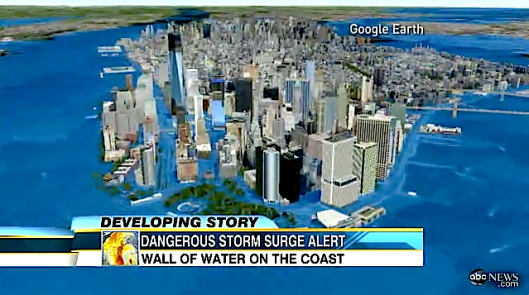
Do you think these free-market idealogues of capitalism are going to clean up the mess left in the wake of climate chaos? Hell no. The unwashed masses are on their own. As long as the elite have the money to insulate themselves from the ravages of our fossil fuel-dependent economy, they will have no real concern for the catastrophes that lie ahead. A case in point is the recent aftermath of the Hurricane Sandy Frankenstorm:
Billionaire David Koch’s prime political organization, Americans for Prosperity (AFP), having failed in its $125 million quest to oust President Barack Obama, is now aiming at a slightly less sophisticated political target: victims of Hurricane Sandy. […]
Earlier this week, AFP, which is chaired by Koch and believed to be financed by several other plutocrats from the New York City region, released a letter warning members of Congress not to vote for the proposed federal aid package for victims of the storm that swept New Jersey, New York City and much of the surrounding area in October. An announcement on the group’s website says that the vote next week for the Sandy aid package will be a “key vote” — meaning senators who support sending money for reconstruction could face an avalanche of attack ads in their next election. Already, opposition to the bill is growing, although it passed one procedural hurdle last [Friday] night. […]
Koch’s top deputy in New Jersey, a surly gentleman named Steve Lonegan, who heads the local AFP state chapter, called the aid package a “disgrace.” “This is not a federal government responsibility,” Lonegan told reporters. “We need to suck it up and be responsible for taking care of ourselves.
‘Change’ will always be an empty campaign slogan when you have a federal government which:
…wastes resources on a multi-trillion dollar Security and Surveillance apparatus to spy on its entire citizenry, in particular OWS protestors, minorities, and government critics/whistleblowers.
…pumps more than half of every tax dollar into the military industrial complex and its war-profiteering cronies who perpetuate our war economy.
…is not alarmed that 50 million Americans are dependent on food stamps while U.S. corporations hoard $22 trillion in secret offshore bank accounts.
…thinks that tax revenues can be maintained while its manufacturing base is off-shored to exploit cheap foreign labor pools.
…uses the growth in corporate profits as the only yardstick for societal well-being.
…marginalizes and prevents the participation of third party candidates within our two-party oligopoly.
…believes that the system described above should be bailed out for its criminal excesses from the billfold of a now beaten-down middle class.
New ‘smile guards’ will soon become mandatory in the work environment of the corporate state:
In my previous ‘arms industry’ posts (Guns, God, and Greenback$ as well as Guns ‘R U.S.), I alluded to the revolving door between the arms industry and the government and the corruption of politics by the money involved therein. In one of the most interesting interviews of 2012 aired today on DemocracyNow, arms industry analyst Andrew Feinstein, author of “The Shadow World: Inside the Global Arms Trade” and a former African National Congress member of Parliament in South Africa, sheds more light and insight on this very subject:
ANDREW FEINSTEIN: …The global arms trade is a $1.74 trillion-a-year business. That’s $250 for every person on the planet. And the profit motive behind the global arms trade is absolutely crucial. This is a business that is about big, big money. The trade contributes around 40 percent of all corruption in all global trade. So its impact on countries, on governments, on ordinary individuals in terms of the economic opportunity costs are absolutely massive.
Now, you will find that many spokespeople for the trade would try to distinguish between the legal or formal trade, on the one hand, and the illegal or illicit trade, on the other. I argue in the book that this distinction is a fallacy, that the boundaries are in fact extremely fuzzy and that the licit and the illicit are very closely intertwined, in addition to which the industry is largely protected because of its very close links to governments, to intelligence agencies, obviously to the military, and to lawmakers. So it is very seldom—even with the inadequate regulations that exist globally around the trade in weapons, it is very, very seldom that people who break those regulations are actually brought to book…
…Now, the situation that pertains at a global or international level has very many similarities with the domestic situation, particularly in the U.S., because let’s—let’s bear in mind while discussing this that the U.S. buys and sells almost as much weaponry as the rest of the world combined. So what happens in the U.S. is going to have enormous impact on the rest of the world. And what happens domestically, in terms of the ownership of weaponry within the U.S., really does, as I say, reflect the global trade in arms, in that we see it’s a $3.5 billion-a-year industry. And here we’re talking about smaller weaponry—about handguns, about assault rifles, semi-automatic weapons, the sorts that are used in the tragedy at Sandy Hook and all of the others that we’ve seen over the years throughout the U.S.
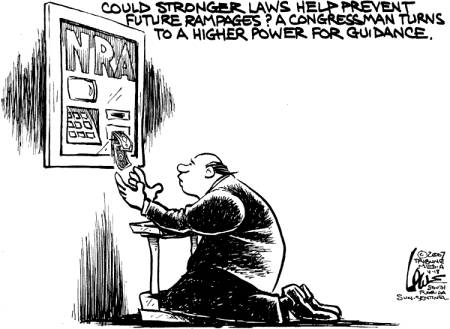
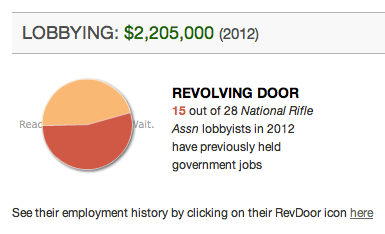
But the NRA, the gun sellers, the gun users seem to be afforded an extraordinary level of protection by government, by law enforcement authorities, just as happens on the global level. And part of this is because of the revolving door of people between, for instance, the NRA and government. Recent figures suggest that 15 of 28 officials in the NRA came from—sorry, lobbyists in the NRA came from important positions within government dealing with some of these same issues, so that the sorts of decisions being made by government are being informed disproportionately by those who want guns to be unregulated, by those who are making massive profits out the suffering of the victims of gun crime…
…let me make another point that I think is absolutely crucial about this and to understand where the NRA is coming from and, unfortunately, where the global trade in arms comes from, as well. And that is the linkages between politics and the gun lobby, and particularly, in terms of those linkages, money. One of the reasons that I focus on the global trade in arms in my work is because I saw, both in the context of South Africa, but also at a global level, the way in which money has come to pollute our politics. And the relationship between defense contractors on an international level and political parties and individual politicians are deep and profound. At a domestic level, the relationships between the NRA and specific elected representatives, not only in terms of money contributed, but also in terms of support given, are, again, profound. And unless we are able to break these linkages between money and politics that so pollute the way we are governed around the world, we will not be able to deal with some of the most intractable problems that face us as human beings —problems of the weaponization of the world, problems of climate change…
…I have not seen anywhere else in the world a gun lobby that has the same level of influence on its own government as the NRA does in the United States. My own assessment of what happened in July with the arms trade treaty is that the NRA, through the words of Mr. LaPierre and others, made clear to the Obama administration that it would make the president’s re-election a lot more difficult if he supported an international arms trade treaty. And I think it’s in that way that the NRA had such direct influence on the U.S. decision to effectively scupper negotiations for what in my opinion wouldn’t have been a strong-enough arms trade treaty, but would have been far better than any form of regulation that we have at the moment. So, yes, I think this is something of a unique situation, where a gun lobby has the extent of influence that it has in the United States of America…
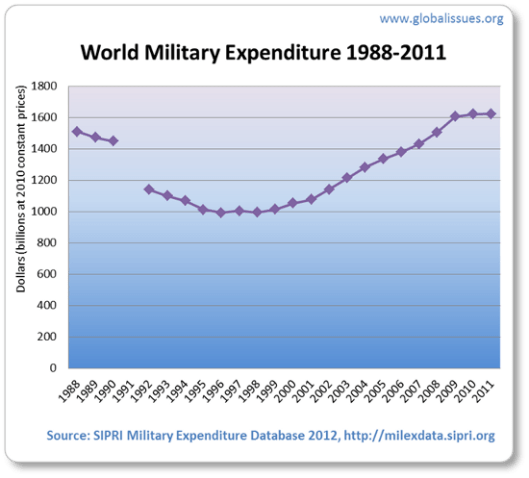
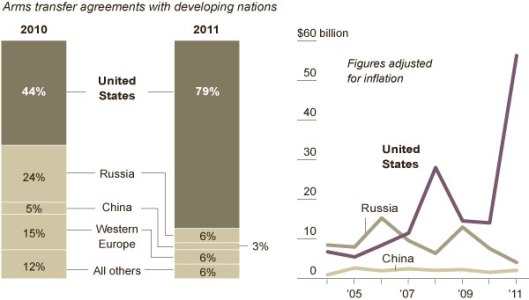
What I find most disturbing is that in an age of resource constraints and austerity measures aimed at the lower class, global sales from the arms industry are booming and that growth is coming primarily from the United States of America (aka ‘Guns ‘R U.S.’):
As was stated by Feinstein, the world-wide anti-corruption body, Transparency International, reports that the arms industry is one of the most corrupt business sectors, accounting for 40-50% of corruption in global trade.
Corruption plays a significant role in influencing arms procurement. But despite repeated scandals, this situation has been largely ignored by governments, NGOs and academics.” ~ Laurence Cockroft, Chairman of Transparency International’s UK chapter.
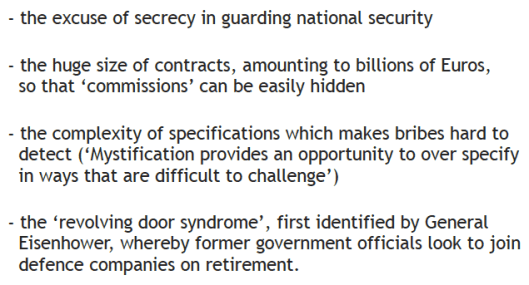
‘Commissions’ are the euphemism for bribes which are paid by manufacturers to governments and average at least 10% of contracts that run in the tens of $billions per year. Some reasons for the rampant corruption in the arms industry:
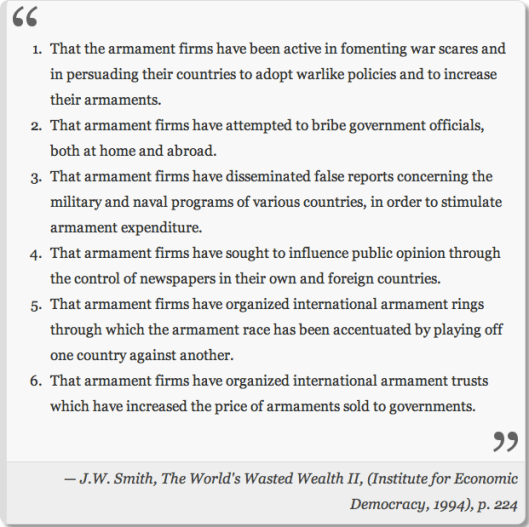
The merchants of death have only grown more powerful in recent times, and their horrific impacts to the well-being of humanity are as true today as they were after World War I when the League of Nations listed six primary criticisms of global arms dealers, as quoted by J.W. Smith:
Stung by the horrors of World War I, world leaders realized that arms merchants had a hand in creating both the climate of fear and the resulting disaster itself.
Americans need to understand that the NRA is very much a part of this global arms trade. If one follows the money, the reasons why the NRA is adamantly opposed to any sort of regulation on guns becomes painfully apparent. While the US domestic arms industry conveniently wraps itself and its profit motive behind the patriotic fervor of the Second Amendment and the colonial ghosts of Founding Fathers, the horrors of the Sandy Hook massacre are blamed on everything under the sun except for that which hides in plain sight — an unregulated, out-of-control global and domestic arms industry.
Obama’s history on gun control has been long on rhetoric and nonexistent on results. Politics was always the primary concern for him. Having studied Obama’s political behavior in Illinois, Ralph Nader said very discerningly in a recent speech that Obama is risk averse. He avoids confrontation with the powerful interests and caves in to their demands. From the too-big-to-fail banks to the for-profit healthcare insurance industry, Obama has shown himself to be a milktoast and socket-puppet of the corporate elite. Wow, what a surprise. Who knew you had to sell your soul to get into the White House? His tear-drenched words aside, Obama’s abysmal record speaks for itself:
…the president received a dismal review from the Brady Center to Prevent Gun Violence, one of the most visible gun-control advocacy groups.
“President Obama’s first-year record on gun violence prevention has been an abject failure,” the group wrote in a 2010 report, adding, “his campaign promises have gone unfulfilled and a year’s worth of opportunities to bring sanity to the gun issue have been lost.”
Should he want to bring forward legislation now, Obama faces a major obstacle: Congress. Even the Democratic-controlled Senate has shown little appetite to touch the controversial issue.
Multiple gun control bills have been introduced in recent years, but not a single one has advanced to a floor vote…. – link
And the ‘MericanPeople don’t wan’t nobody touchin’ their guns. Even after particularly horrific massacres of children, any uptick in favor of gun control quickly dies in the lesion-riddled brain of the United States of Amnesia:
With an economy predicated on growth, we’ll take it anyway we can, i.e. war and military Keynesianism. And the belief that every ‘Merican needs a gun is a part of that militarized American culture. Guns are the norm just like cars and televisions.
Clearly, increased gun availability has not protected America’s civil rights which have been whittled away in the age of the Security and Surveillance State. And it has not prevented the corporate takeover of the government either. I can, however, readily see that the profits of an active gun industry have been protected. This firearms industry then uses those profits to lobby state and federal legislatures for relaxation of restrictions on gun ownership and the de-criminalization of gun use – a familiar refrain in our government-corporate-lobbyist complex.
The NRA has spent 73 times what the leading pro-gun control advocacy organization, the Brady Campaign to Prevent Gun Violence, has spent on lobbying in the 112th Congress ($4.4 million to $60,000, through the second quarter of 2012), and 4,143 times what the Brady Campaign spent on the 2012 election ($24.28 million to $5,816). (One caveat on the data is that the NRA itself does a very poor job of accurately reporting its spending, and we must rely on its self-reports.)
As I pointed out in my last two blog entries, guns are a big and growing business for America, just like the metastatic growth of the military industrial complex over the last half century. The NSSF (the trade association for the gun industry), located just across the highway from Sandy Hook Elementary School in Newtown Connecticut, touts this fact in its 2012 Firearms and Ammunition Industry Economic Impact Report:
…During difficult economic times and high unemployment rates nationally, our industry has grown and created over 26,325 new, well-paying jobs over the past two years. Our industry is proud to be one of the bright spots in this economy.Take a look for yourself and see the impact we have nationally and on your home state.
The Firearms Industry Creates Jobs in America
United States companies that manufacture, distribute and sell sporting firearms, ammunition and supplies are an important part of the country’s economy. Manufacturers of firearms, ammunition and supplies, along with the companies that sell and distribute these products, provide well paying jobs in America and pay significant amounts in tax to the state and Federal governments.
Economic Impact of the Sporting Arms and Ammunition Industry in the U.S.
An Important Part of America’s Economy
Companies in the United States that manufacture, distribute and sell firearms, ammunition and hunting equipment employ as many as 98,752 people in the country and generate an additional 110,998 jobs in supplier and ancillary industries. These include jobs in companies supplying goods and services to manufacturers, distributors and retailers, as well as those that depend on sales to workers in the firearms and ammunition industry. [1]…
So the predictable outcome of a country awash in lethal guns would be more gun deaths. Oh that’s right, the NRA says “guns don’t kill people, people kill people.” Guns are just the handy instrument that is so effective for someone bent on maximum destruction. Is there political will to try to stop the toxic effects of this flourishing gun industry, a by-product of our war economy and militarized society? I doubt it. The sheer number of guns already in circulation will guarantee a continuum of grisly mass murders throughout the country far into the future. And as long as there’s money to be made from guns and weapons, nothing will ever really change:
“America isn’t a country. It’s a business. Now pay me my fucking money.” ~ Killing Them Softly
In the previous post, aubreyenoch commented on the toxic effects of our current socio-economic system, i.e. industrial capitalism. These “off balance liabilities” are a reality which persists despite the standard business-world practice of ignoring them. The last topic was guns; so lets look at how firearms have become an integral part of our economy. Reading the article ‘In America, guns are a boom, regulation a bust‘, we learn that America is driving the production and spread of guns here and abroad as well as propelling the creation of foreign gun industries:
…the Small Arms Survey, or SAS, an independent research group in Geneva, valued global small-arms sales for 2011 at $8.5 billion, more than double its 2006 estimate of $4 billion.
Although the increase partly reflects improved information gathering, the gun trade has undoubtedly expanded in recent years. The report identifies two primary sources: large government purchases for troops in Iraq and Afghanistan and increased spending by U.S. civilians.
Matt Schroeder, who heads the Arms Sales Monitoring Project at the Federation of American Scientists, says the U.S. “appetite for weapons” is one of the world’s largest and most diverse.
“There aren’t a lot of countries that are similar in terms of the quantities demanded and the types that are legally purchased here,” he said.
American small-arms purchases in 2009 accounted for 38 percent of the global total at $1.8 billion, more than 47 other leading importers combined, according to the SAS.
Private citizens provide the main source of demand for small arms around the globe. Of the 650 million firearms owned by civilians worldwide, more than 41 percent are in American hands.
It’s no surprise the United States has by far the highest proportion of guns per person, an estimated 89 civilian firearms per 100 residents…
And contrary to the popular fear by gun zealots that ‘Socialist’ Obama is going to take away their guns, he has not put forward any new gun laws and actually worked to relax regulations on the export of U.S. firearms abroad:
Despite decrying gun violence, however, Obama hasn’t pushed for gun control. His administration is also advocating new regulations that would make it easier to export weapons abroad.
Washington was chiefly responsible for the collapse of talks last summer on a UN arms trade treaty—a reflection of the vast political influence wielded by the U.S. gun lobby, which is spending tens of millions of dollars to ensure the highly lucrative industry keeps expanding…
Gun lobby groups have claimed credit for sinking United Nations negotiations over an international arms trade treaty last summer—when Amnesty International activists handed out bananas in New York’s Times Square, saying treaties regulate the global trade of fruit, but not guns and ammunition.
The talks concluded with no agreement on the draft text after the United States refused to sign, saying it needed more time to review the text.
Jeff Abramson, director of the Control Arms Secretariat, said the U.S. delegation’s actions were especially disappointing because the draft text satisfied all concerns Washington expressed during the negotiations.
“The best conclusion is that the Obama administration made a political decision to not deal with the treaty during an election cycle,” he said.
However, Abramson dismisses the NRA’s claim it “killed” the agreement, saying the strong American gun culture “makes it very difficult to have a rational conversation about regulations, even ones that do not impact U.S. law.”
Marsh agrees politics don’t fully explain the industry’s influence. Although gun owners who rushed out to buy more firearms after Obama’s first election may have contributed to the sales boom, the spending reflects a “much deeper, underlying trend” that dates back to 2001—and which he believes will continue for the foreseeable future.
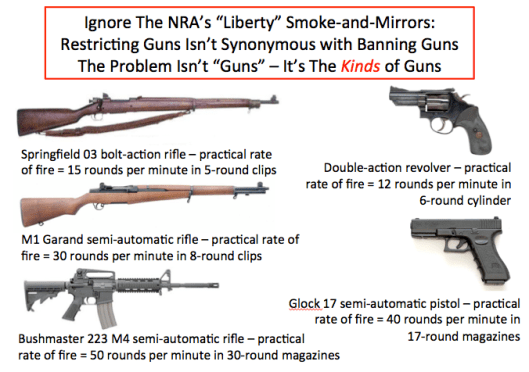
Now let’s look at some of the “off balance liabilities“. The flintlock pistols and muskets of bygone frontier days are a far cry from the firepower of today’s semi-automatic weapons, something the founding fathers did not envision:
In a previous post, New C.I.A.-Commissioned Report on Climate Change Stresses to Civilization, we were given a window into dangers created by human-induced climate change. Now we learn that President Obama has axed that program. Why study the ultimate existential threat to industrial civilization when you can just build more weapons to fight the social instability and wars brought on by abrupt, chaotic and extreme weather patterns. This mindset would be in keeping with the American ruling establishment’s practice of treating the symptoms rather than the root cause – ignoring the fact that we, aka industrial ‘civilized’ humans, are the destabilizing force of the biosphere and the primary cause behind climatic disasters to civilization. We’ve pumped so much CO2 into the atmosphere that it has now gained an intractable foothold as a driving force behind possible runaway climate change.
Excerpt…
CURWOOD:…One of the more startling scientific reports presented at Doha — based, so far, on preliminary data – suggests that emissions from the melting Arctic are heading for a tipping point that could lead to runaway warming...
CURWOOD: Now we understand that the CIA has shut down its center for climate change and security – why did they have the center in the first place, do you think?
ROMM: Well, there has been increasing awareness in the intelligence community and the Pentagon that global warming and climate change was going to have an impact on US national security interests. Whether it is military bases that are seeing sea level rise or countries that are subject to worse droughts and famines, so, you know, I think many countries around the world had come to the view that climate change was going to have a big impact on security.
CURWOOD: Why shut this unit down now?
ROMM: Apparently the unit didn’t have much support when Panetta left and General Petraeus took over at the CIA. Petraeus was very focused on terrorism, and there’s a lot of congressional Republicans, who, you know, deny climate science and therefore attack any action by the federal government to study climate change and its impacts.
CURWOOD: Some suggest that the CIA shutting down its Center for Climate Change and Security is a budget matter. What’s your analysis?
ROMM: Well, I think that everyone knows that budgets are under duress. We have this fiscal cliff, in all likelihood, discretionary spending, even for intelligence, is going to be cut. Some were saying that the CIA was trying to make nice with Congressional Republicans and not continue this center that kind of annoyed them.
I hope that’s not the case, because, this is a matter of pretty basic science and it would be a shame if our intelligence organization, whose job is to sift through the facts and be completely separate from ideological spin, it would be a shame if they were getting pressured to not look at science and facts…
ROMM: Closing the center was absolutely a mistake. If the intelligence apparatus in this country with its $75 billion dollar budget can’t have a small center to study one of the gravest threats facing the world, that’s a pretty sad state of affairs…
~~~~~~~~~~~~~~~~~
That’s a pretty sad state of affairs. The weapons of mass destruction have been in plain site all along…
Listen to the real reasons…
…Our national security has been reduced, in large part, to energy security which has led us to militarizing our access to oil through establishing a military presence across the oil-bearing regions of the world and instigating armed conflict in Iraq and sustaining it in Afghanistan…
In my previous post I quoted Professor Charles Hall’s assertion that the current economic paradigm is ill-equipped to account for and address externalities such as resource depletion and environmental degradation. Peak oil as well as climate change/global warming are just two in a long list of biophysical constraints which neoclassical Keynesian economics, i.e. mainstream economics, overlooks:
…the crisis looming before us is likely to be, if anything, more terrible than the Great Depressions of 1873-93 and 1929-39. The continuing industrialization of agriculture and urbanization of population—by 2010, it is estimated, more than half the earth’s inhabitants lived in cities—has made more and more people dependent upon the market to supply them with food and other necessities of life. The existence on or over the edge of survival experienced today by the urban masses of Cairo, Dhaka, São Paulo, and Mexico City will be echoed in the capitalistically advanced nations, as unemployment and government-dictated austerity afflict more and more people, not just in the developed world’s Rust Belts but in New York, Los Angeles, London, Madrid, and Prague.
Left to its own devices, capitalism promises economic difficulties for decades to come, with increased assaults on the earnings and working conditions of those who are still lucky enough to be wage earners around the world, waves of bankruptcies and business consolidations for capitalist firms, and increasingly serious conflicts among economic entities and even nations over just who is going to pay for all this. Which automobile companies, in which countries, will survive, while others take over their assets and markets? Which financial institutions will be crushed by uncollectible debts, and which will survive to take over larger chunks of the world market for money? What struggles will develop for control of raw materials, such as oil or water for irrigation and drinking, or agricultural land?
Gloomy though such considerations are, they leave out two paradoxically related factors that promise further dire effects for the future of capitalism: the coming decline of oil—the basis of the whole industrial system at present—as a source of energy, and the global warming caused by the consumption of fossil fuels. Even if continuing stagnation should slow greenhouse gas-caused climate change, the damage already done is extremely serious. Elizabeth Kolbert, a journalist not given to exaggeration, called her soberly informative account Field Notes From a Catastrophe. The melting of glaciers threatens not only Swiss views but the drinking supplies of whole populations in such areas as Pakistan and the Andean watersheds; droughts have ravaged Australian and Chinese agriculture for years now, while floods periodically devastate the low-lying South Asian homes of tens of millions of people. The rolling parade of disasters is, unfortunately, only getting started. It will accompany a stagnant economy and only be exacerbated by the increased greenhouse-gas emissions that a return to true prosperity would bring… – essay adapted from Paul Mattick’s book ‘Business as Usual: The Economic Crisis and the Failure of Capitalism‘
The mandatory growth requirement of mainstream economics also precludes the concept of sustainability. I have not yet read the above referenced book ‘Business as Usual: The Economic Crisis and the Failure of Capitalism’, but a prominent socialist speaking of peak oil and global warming in the same paragraph is always intriguing. However, a brief critique of the book by a reader finds that Mattick does not go nearly far enough in incorporating these two realities into his analysis of our current crisis:
All mainstream institutions have subscribed to the near religious belief of the infallibility of the capitalist economy which itself is considered a self-regulating system governed by the “invisible hand” of the free market as explained by Adam Smith in The Wealth of Nations. Market ‘value’ is produced by the optimal use of capital, labor, and production. Mainstream economics operates under the assumption of a world with freely available and unlimited resources. It divides and reduces all resources into units of monetary value, not taking into consideration the value such resources hold in maintaining the ecological balance of the planet.
Isn’t it the height of hypocrisy that those wealthy nations trumpeting the superiority of the free market are also the same countries which dominate global resources and world markets by military superiority as well as the subversive and coercive tactics of their economic hitmen?
…war is integral to imperialism. Imperialism – and especially the imperialist powerhouse, the USA – needs the threat of war to sustain itself: ideologically, militarily, geo-politically and also financially. The arms and defence industry is a major part of the US economy. In 2011, the defence budget was a staggering $698 billion, or 4.8% of the US GDP (link). Add to that the cost of increased security concerns – for example, to combat the ‘terrorist threat’ within imperialist countries – and you have a major chunk of the economy being reliant on the continued existence of enemies within and without.
It’s a form of military Keynesianism to keep a faltering economy going. The further capitalism sinks into decline, the more irrational the drive to war becomes and the more ludicrous are the reasons presented by imperialism (weapons of mass destruction, nuclear capability, etc).
…a very naive view of how the world is run [is to hold the belief that] David Cameron, Barack Obama and Benjamin Netanyahu just ‘happen’ to be spending ‘too much’ on military, which on the surface seems deeply illogical at a time of official austerity. But, of course, the opposite is true: it is their way of staying in power.
Of course, we should fight against such ridiculous spending on increasingly refined machinery to exterminate humanity. But we should be clear why. – link
Moreover, America’s military has become a self-perpetuating industrial complex for profiting from war and instability.
Another problem with the world’s dominant economic system is that GDP is a misguided and inaccurate gauge for measuring the standard of living and well-being of the general populace:
…History shows that democratic forms are no proof against a slide into repressive forms. In Germany in the 1930’s, a declining standard of living contributed to the rise of the Nazi party; Hitler was democratically elected to the office of Chancellor (and then proceeded to establish himself as Fuehrer).
As America’s perpetual-growth economy faces the reality of ecological limits, as climate change imposes costs and decreased well-being on us, as food and energy and other resource prices increase because of the inexorable logic of a declining Energy Return on Energy Invested at the physical foundation of our economy, we face the prospect of a widespread decline in our standard of living. This dynamic lies at the root of this fact: Americans coming of age today are among the first generation who can’t be confident that they will be better off than their parents. By one widely used measure of well-being (the genuine progress indicator, which deducts loss of ecosystem services and other “disamenities” from the national accounts), the American standard of living has flatlined since the 1970s, despite continued strong growth in GDP.
Thus the cautionary lessons from Egypt and Tunisia. GDP is a measure of the commotion of money in an economy, not a measure of delivered well-being. If sustained or rising well-being is what is economically and politically desirable, we should measure it directly, instead of counting on GDP to do the job. And if we accept the idea of popular sovereignty—that governments rule with “the just consent of the governed,” as Jefferson put it in our Declaration of Independence—we must recognize that as the middle class goes, so goes the legitimacy of the regime in power. No system of government—despotic or democratic—fares well when the majority of its citizens experiences a declining standard of living… – link
For those who have not read Darbikrash’s last post, A Nation of Hustlers and Swindlers, it lays bare the big con game of capitalism. Similarly, the mechanic scenes in Oliver Stone’s U-Turn represent, for me, capitalism’s exploitive process of getting something for nothing:
A newly released study commissioned by the C.I.A. entitled Climate and Social Stress: Implications for Security Analysis highlights the vulnerabilities of our globalized economy to climate change. Of particular interest is the section on energy. To summarize:
1.) Oil is the most highly integrated commodity of globalized trade. Its tightly interconnected market was created in the aftermath of the OPEC embargoes of the 1970’s to prevent its manipulation by political actors. Its integration is said to be fully complete to the point that any disruption in the global oil system will cause an economic ripple effect throughout the world. Rapid oil consumption in China and India without a corresponding increase in production has left the oil market extremely tight (i.e. Peak Oil).
2.) Due to the facts stated above, any changes in climate could easily disrupt the world’s energy system. For example:
(a.) Tropical storms and sea-level rise can disrupt production, refining, and transport of petroleum since a large percentage of oil refining and processing are located in coastal areas vulnerable to such storms and floods. This is true in the U.S., Europe, China, and India. An example would be Hurricane Katrina and Rita in 2005 which disrupted oil and gas operations of off-shore rigs, coastal refining, and transport via sea ports and pipelines.
(b) Drought will cause oil refining disruptions since that process requires large amounts of water. If the drought is accompanied by higher temperatures, the scarcity of water will be exacerbated because the oil refineries will require even more cooling by water. A warming planet will also cause infrastructure damage (pipelines and drilling platforms) in Arctic operations due to collapsing earth from the melting of permafrost.
We are entering an era in which not only the global energy system is vulnerable, but the social, agricultural, and technological infrastructure is also at the mercy of climate disruptions. They were all designed around assumptions of moderately stable climate conditions, and as climate exceeds boundary thresholds, these infrastructures will break. As was demonstrated by Hurricane Sandy recently in New York/New Jersey with the power outages, gas shortages, and Nuclear plant shutdowns. The droughts this past summer in the U.S. midwest show the fragility of our food system whose development assumed fairly stable weather patterns and rainfall.
A quote from the study:
…The fundamental science of climate change suggests that continued global warming will increase with frequency or intensity (or both) of a great variety of events that could disrupt societies, including heat waves, extreme precipitation events, floods, droughts, sea-level rise, wildfires, and the spread of infectious diseases. Underpinning many of these extreme events is an acceleration of the global hydrological cycle. For each 1.8° F (1° C) increase in the global mean surface temperature, there is a corresponding 7 percent increase in atmospheric water vapor. Because warm air holds more water vapor than cool air, this leads to more intense precipitation. Essentially, warm air increases evaporation from the ocean and dries out the land surface, providing more moisture to the atmosphere that will rain out downwind. Water vapor is also a powerful naturally occurring greenhouse gas. As such it is the source of a very positive feedback to the coupled climate system that amplifies any external forcing by a factor of approximately 1.6…
We’ve passed a tipping point with the Arctic ice melt which has set off other feedback loops (Arctic amplification, methane release from permafrost melt, loss of the albedo effect, alteration of the Jet Stream, Greenland glacier melt, etc) and tipping points, some of which we are not even aware of, as the study acknowledges:
…there may be other processes in the Earth system, not yet identified, that have tipping points that could lead to abrupt climate change. Because of such gaps in knowledge, the possibility of such events occurring in the next decade or so cannot be totally discounted…
I would say “God help us” if the traditional farming lands -the bread baskets of nations- become dust bowls, but that’s exactly where we are headed with climate change and no miracle is going to fall out of the sky to save us.
Drought Disaster Designations Map (PDF, 504KB) Text-only (accessible) version Map shows designations due to drought across the country under USDA’s amended rule. Any county declared a primary (red) or contiguous (orange) disaster county makes producers in that county eligible for certain emergency aid.
The study talks about what it terms a “cluster of extreme events” resulting from large-scale climate processes, causing catastrophes in separate and distant areas of the globe. Trying to deal with such widespread and seemingly unrelated disruptions would quickly overwhelm the global community’s resources. An example given was in the year 2010 with the massive drought and forest fires in Russia and the epic floods in Pakistan:
…The two events were linked by more than just their proximity in time. The meteorological pattern that lead to the Russian heat wave, in which the large-scale upper-level wind flow developed a strong and persistent ridge, also contributed to the development of the meteorological pattern that resulted in the Pakistani floods —a downstream leading trough (Lau and Kim, 2012). The fact that these two extreme events corresponded in time with each other and with a single larger meteorological pattern was unusual but not totally unexpected. Circulation events like this one, which cause some event clusters, are known to occur but are not well resolved in current climate models…
…If climate events and extremes were independent in a statistical sense, the likelihood of a cluster or a compound event of any size could easily be estimated mathematically. But as the above example makes clear, extreme events in different parts of the world can be driven by common underlying forces and thus have an intrinsic relationship such that when one such event occurs, the likelihood increases that other extreme events linked to them by common causes will also occur. In statistical language, such events are called dependent.
The changing climate zones also enable the spread of tropical diseases and pests. Outbreaks of new virus strains would tax healthcare delivery systems:
…Climate events might also put stress on global health systems in various ways, most of them hard to predict. As discussed in the next chapter, climate change is expected to alter the ranges of disease vectors or pathogens in ways that expose large human populations to diseases to which they have not been previously been exposed. This could lead to a rapidly increasing demand for treatments and supplies that may not have been adequately stockpiled. If such health problems arise in combination with a disruption of supply chains for critical inoculations or medications, the potential for a severe health crisis could grow dramatically. Again, the effects might be felt far from the locations where the climate events occur. Climate events, especially when they occur in clusters, can also stress the capacity of international disaster response and humanitarian relief systems and thus cause harm in places that are not directly affected by the events but that need international assistance for other reasons…
“You can debate the specific contribution of global warming to that storm. But we’re saying climate extremes are going to be more frequent, and this[Hurricane Sandy] was an example of what they could mean. We’re also saying it could get a whole lot worse than that.”
Mr. Steinbruner, the director of the Center for International and Security Studies at the University of Maryland, said that humans are pouring carbon dioxide and other climate-altering gases into the atmosphere at a rate never before seen. “We know there will have to be major climatic adjustments — there’s no uncertainty about that — but we just don’t know the details,” he said. “We do know they will be big.”
The study was released 10 days late: its authors had been scheduled to brief intelligence officials on their findings the day Hurricane Sandy hit the East Coast, but the federal government was shut down because of the storm.
How ironic is that? The authors of this study had to postpone their meeting with U.S. intel authorities because of a climate chaos event.
Here’s what else is ironic…
…as the need for more and better analysis is growing, government resources devoted to them are shrinking. Republicans in Congress objected to the C.I.A.’s creation of a climate change center and tried to deny money for it. The American weather satellite program is losing capability because of years of underfinancing and mismanagement, imperiling the ability to predict and monitor major storms.
Things have been getting quite dark here lately with all the collapse scenarios casting an ever-growing shadow into the increasingly hard-to-believe fairy tale world of carbon man. As Jb said:
…All around me I see people desperately trying to satisfy their self-worth through consumption. I keep telling myself that I should stop trying to explain the connection between petroleum and the mirage of western civilization, but the headlights keep getting bigger and brighter…
So to lift the spirits of myself and other fellow collapsitarians, a few funnies are in order. The first one is billed as “one of the funniest GIF’s you’ll ever see“, and I must admit I busted my gut when I saw it this evening. What with all that Super PAC dark money rounded up by Karl Rove and his plutocratic cronies, King Romney was convinced he had bought his way into the White House:
It makes sense that Mitt Romney and his advisers are still gobsmacked by the fact that they’re not commandeering the West Wing…
…Team Romney has every reason to be shellshocked. Its candidate, after all, resoundingly won the election of the country he was wooing.
Mitt Romney is the president of white male America.
Maybe the group can retreat to a man cave in a Whiter House, with mahogany paneling, brown leather Chesterfields, a moose head over the fireplace, an elevator for the presidential limo, and one of those men’s club signs on the phone that reads: “Telephone Tips: ‘Just Left,’ 25 cents; ‘On His Way,’ 50 cents; ‘Not here,’ $1; ‘Who?’ $5…
…Romney and Tea Party loonies dismissed half the country as chattel and moochers who did not belong in their “traditional” America.
The next one up is a Romanian TV ad for gasoline. Sorry for being sexist, but I thought it was humorous. Apparently French maids are a universal fixture in the male libido. From the Business Insider:
American gasoline brands tend to advertise their products with images of cars driving on the open road, stats about mileage, and CGI animations of pumping pistons.
That wouldn’t fly in Romania, judging by this new ad for Eastern European petrol brand Rompetrol. In the Romanian imagination, Rompetrol unleashes a bevvy of dancing French maids who clean out your firing chambers.
Now you would think that the most powerful four-star bureaucrat and top spy in the American military industrial complex would know that he might come under scrutiny at any time and therefore keep his missile under lock and key, only to be deployed in the proper circumstances. But apparently his trigger is no more restrained than that of America’s bloated and bomb-happy war machine:
The book title is perfect…now that we know the general was “all in” Ms. Broadwell. Kinda casts a questionable light on the objectivity of the author, don’t you think?
Paul Street is one of the more insightful writers I follow and he has a new essay out which lists his version of the top threats to modern civilization. The conspicuous absence of these grave dangers from our political discourse prompts him to start off his article as follows:
The content and character of the 2012 U.S. presidential election does not bode well for the human race and other life on Earth. If the American people do not broaden the sphere of public concerns that matter far beyond the ones being discussed in this the latest big money-big media -major party-narrow spectrum-corporate-managed candidate-centered “electoral extravaganza” (Noam Chomsky’s phrase[2]), then there is not going to be a decent, desirable, or democratic future worth inhabiting. If we accept this and other such periodic U.S. elections as an adequate expression and spectrum of democratic politics and popular voice, we’re done for.
Well Paul, it is all corporate-funded theater and bread & circus for the mesmerized and pacified masses. What more would you expect from a society whose governing institutions and news media have been usurped by the greed of monied interests? Both mainstream parties are on the corporate dole, a situation best summed up by the following comment:
…America’s history has always been about the battle between plutocracy and democracy. Since WWII, we’ve built the military-industrial complex, we’ve allowed campaign funding to reach insane proportions, we’ve introduced the most effective means of propaganda ever created (the TV) into every home, and we’ve de-regulated Wall Street into a behemoth. We’ve allowed the corporate structure to infect our democracy at the deepest levels as well as most people’s personal lives in a fundamental way (health care and pharmaceuticals, banking and debt, the fact that most of the country has to shop at Walmart to be able to break even each paycheck, etc.).
The plutocrats have been routing democracy in a steady succession the past 50+ years. Our democracy is now a hollowed-out shell completely subservient to corporate interests at all levels. This is not crazy liberal talk – it’s simple reality. Citizens United was just the icing on the cake…
Number one on Paul Street’s list cannot be denied – climate change. Here’s what he writes about this civilization-ending problem which has been avoided at all costs by the mainstream media even after the devastation in New York:
Climate change is a threat multiplier. It will make unstable states more unstable, poor nations poorer, inequality more pronounced, and conflict more likely,” Huhne is expected to say in a speech to defence experts. “And the areas of most geopolitical risk are also most at risk of climate change.”
He will warn that climate change risks reversing the progress made in prosperity and democracy since the industrial revolution, arguing that the results of global warming could lead to a return to a “Hobbesian” world in which life is “nasty, brutish and short”.
And the U.S. military already acknowledged the threat of human-induced climate change to the stability of nation states in a 2007 report, National Security and the Threat of Climate Change. In recent years, congressional witnesses speaking on the dangers that climate change poses have been unequivocal in their warnings:
· On October 15, 2009, retired USAF General Charles F. Wald testified before the Senate Foreign Relations Subcommittee, reiterating the CNA finding, saying that “we must… now prepare to respond to the consequences of dramatic population migrations, pandemic health issues and significant food and water shortages due to the possibility of significant climate change” and that “Energy security and a sound response to climate change cannot be achieved by an increased use of fossil fuels.”
· In May, 2009, retired USN Vice Admiral Dennis McGinn in testimony before the Senate Foreign Relations Committee pointed to an “over reliance on fossil fuels” and said that “climate change has the potential to create sustained natural and humanitarian disasters on a scale and at a frequency far beyond those we see today.
So we should expect that a future of unstable climate which increasingly puts our food production in jeopardy will also lead to an increased risk of weapons of mass destruction being used by failing countries – desperate and angry fingers on the trigger of nukes. Homer-Dixon’s scenario on climate change and armed conflict is prescient. An article from 2007 reveals the inevitable truth about the energy-water-food-climate nexus and social breakdown:
…Homer-Dixon was writing more than 15 years ago about climate change leading to a rise in violent conflict and state failure.
Then, his pronouncements found only a small audience, and held little sway in the halls of power in Washington or New York.
Now, he is briefing UN Security Council members about his theories of “synchronous failure”, a much in-demand author of a bestseller warning of impending catastrophe, The Upside of Down.
…Homer-Dixon believes “major volatility” in nation-states and in the international order is the inevitable outcome of climate change. His theory rests on the premise that many nation-states are highly stressed and hopelessly addicted to energy, what he terms the “master resource”.
Climate change will be the factor that pushes many vulnerable states to the edge, and over it.
Some nations will find their resources overwhelmed as they struggle to cope with massive internal movements of people displaced as fertile land becomes unproductive and water shortages emerge.
…a rise in the Earth’s temperature of one to two degrees – will have significant impacts.
He says modern states are in a similar predicament to the declining Roman Empire.
The massive cost to Rome of maintaining and feeding its subjects, bureaucracy, militaries and cities required more and more energy. In the end, the energy could not be found, leading eventually to the collapse of a great empire.
Similarly, a “complex” globalised world is expending more and more energy to underpin societies reliant on relentless economic growth.
In what Homer-Dixon describes as an “astonishing statistic” he notes that the energy consumed in producing and transporting food around the world has risen 80-fold in the past century while the population has quadrupled to 6 billion over the same period.
Using a measure he called the “energy return on investment”, Homer-Dixon finds the search for energy is requiring an ever-increasing amount of resources at a time when demand for it is rising rapidly.
It is a situation that he says is fast becoming unsustainable. Oil will become too expensive, while nuclear energy requires a massive investment in money and energy, just to get it off the ground.
And he notes another dilemma. Fixing the effects of climate change will require massive amounts of energy in itself.
“Building sea barriers, moving huge numbers of people displaced by changing weather, building new infrastructure … all these types of things, the solutions to climate change, require lots and lots of energy.”
And as governments become incapable of discharging their basic responsibilities of statehood, the vacuum will be filled by chaos and conflict…
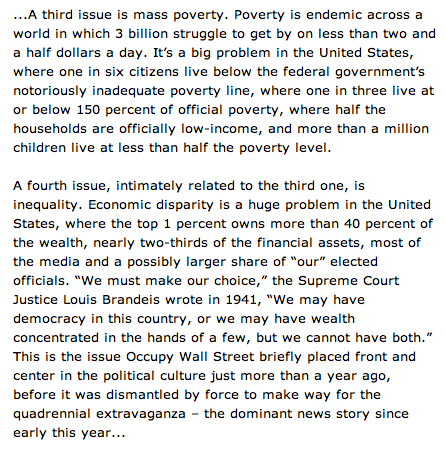
Number three and four on Paul’s list is mass poverty and inequality. He writes:
Perhaps we should mention that mass poverty and inequality stem from unfettered capitalism which has reached its full fruition in the buy-off of our government and the total corruption of regulatory, judicial, and legislative institutions by the profit-driven interests of multinational corporations. The social contract has been broken; the political discourse for the public has degenerated into meaningless wedge issues; and society has been atomized and isolated into ‘individual consumers’, a mere member of a marketing demographic whose only voice is to choose between product X or Y.
Number five on Paul’s list is the likelihood of another epic financial crisis. Our financial system is limping along, but its demise is written in stone. Without cheap energy, the underlying backbone of our economy, our growth-oriented system cannot survive for very much longer. As I said before, money is simply a token of energy exchange and has no intrinsic value of its own. If we now take into account our fossil fuel energy system’s external costs (environmental damage, ill-health costs, climate change destruction, resource wars such as Iraq, etc), then we’d be in debt up to our eyeballs. As I explained in this post, the net benefits of burning fossil fuels will eventually be negated by the net costs.
Number six on Paul’s list is “long-term structural employment and enforced obsolescence of tens of millions of formerly middle and working class Americans.” The worker is disposable, and long-term unemployment is endemic to capitalism. The corporate drive for maximizing profits is the primary goal and thus follows the policy of keeping worker numbers and their wages as low as possible. Automation, outsourcing of jobs, and employing part-time workers are some of the ways corporations suppress labor.
Paul lists number seven as “racism and racial inequality.”:
…Nobody raises a peep about racially disparate mass incarceration or segregated schools or black inner city neighborhoods with unemployment and poverty rates over 40 percent…
Looking back in history to the genocide of Native Americans and now to today with the ‘War on Terror’ and its related racism towards Muslims, the U.S. empire has always demonized anyone who stands in its way. Nationalism, racism and xenophobia always rise in times of economic downturns, no matter the country, when scapegoats are created to vent people’s anger and frustration as well as shift blame. Today is no different:
And the last one is U.S. militarism. I would rank this one much higher on the list and I’ve posted on this subject extensively, but the following video does a nice job of summing things up:




 …pumps more than half of every tax dollar into the military industrial complex and its war-profiteering cronies who perpetuate our war economy.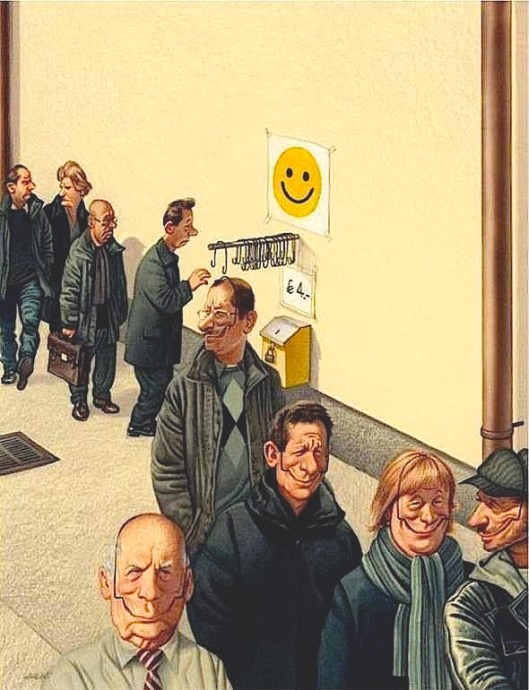

 The merchants of death have only grown more powerful in recent times, and their horrific impacts to the well-being of humanity are as true today as they were after World War I when the League of Nations listed six primary criticisms of global arms dealers, as quoted by J.W. Smith:
 From a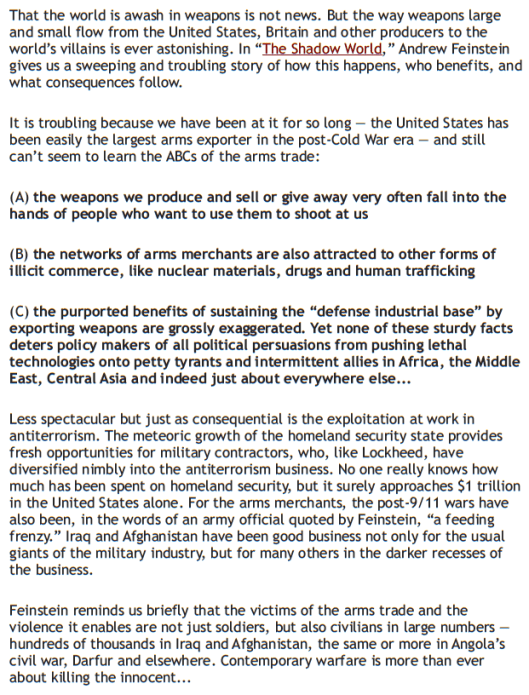









 Collapse of Industrial Civilization