A DJ on the radio mentioned the flooding in England the other day and exclaimed, “The climate is going crazy!”. The shallowness of the conversation and its failure to dig any deeper as to the reasons why the climate is “going crazy” is mirrored in the mainstream media and our society. Real journalism is simply another casualty of our rotting consciousness. Like a leper, those who cannot see or feel are oblivious to their own self-inflicted wounds. The flywheel of industrial civilization continues to spin out of control, taking out chunks of ecological bricks making up a once diverse and vibrant living planet. In some parts of the world, epic drought is desiccating cropland and exposing the cracked surface of lake beds, while on the other side of the globe unceasing rain is causing deluges of biblical proportion. Still other regions are experiencing freak snow and ice storms. The damage is done, but humans will continue to scour the earth for resources to maintain a house whose foundation now rests on the shifting sands of a destabilized biosphere.
If you thought shale gas was a nightmare, you ain’t seen nothing yet. A subterranean world of previously ignored reserves is about to be opened up. These are the vast coal deposits that have proved unreachable by conventional mining, along with gas deposits around them. To the horror of anyone concerned about climate change, modern miners want to set fire to these deep coal seams and capture the gases this creates for industry and power generation.
– Fire in the hole: After fracking comes coal
Weather patterns once held in place by an ice-locked Arctic are unraveling at an unsettling pace, yet industrial man can’t seem to pull himself away from his carbon burning orgy long enough to see that the monkey wrench inside Earth’s intricate and homeostatic climate system is himself. Never in the history of Earth has a single species become a geologic force for mass planet-wide extinction. The worshippers of the “free market” proclaim solutions to climate change will be forthcoming in the form of technology, yet all environmental laws and regulations are simply window dressing around the resource consuming pit of capitalism. Technology cannot replenish depleted resources or restore the relative ecological equilibrium that existed prior to the industrial revolution. Natural law is nonnegotiable and those who transgress it, repeatedly ignoring clear and present warning signs, are doomed to suffer the unforgiving consequences. Modern man will leave behind a toxic and radioactive wasteland for eons.
The corporate state is impotent in the face of the environmental meltdown since its only real purpose appears to be an enabler and enforcer to the plunder of the commons and the concentration of wealth into the most ruthless and greedy hands. There is no escaping this system that is locked into a path of self-destruction except through death, as Kevin Moore describes on this blog:
“…in general terms the purpose of government is:
a) to facilitate the looting-and-polluting of local regions and the planet as a whole in order that a small minority can acquire material wealth and enjoy themselves.
b) to facilitate the transfer of wealth from those lower in the hierarchical system to those near the top.
c) to keep the general populace uninformed and compliant.
d) to provide sufficient ‘trickle down’ for the misinformed and deluded masses to think they are not being exploited.
e) [more recently] to promote the agendas of transnational corporations, which are focused on complete control of populations and resources and maximization of short-term profits.
The purpose of environmental laws is:
1. to facilitate the looting-and-polluting of local regions and the planet as a whole but to limit the impact of severe pollution in specific cases where that pollution would be detrimental to other planet-destroying money-making activities..
2. to provide the pretence that governments care about the welfare of the general populace.
3. to provide looters and polluters with official mandates for looting and polluting, i.e. an environmental impact process having been gone through and ‘no significant impacts identified’, the activity of the looter-and-polluter is given the stamp of approval.
Under such a system it become inevitable that all politicians are, or quickly become, bought-and-paid-for professional liars and that all senior environment officers become lackeys to the system and therefore enemies of the people.
The entire political-economic system of western nations is geared to making everything that matters worse, so everything that matters gets worse.”
These are the unvarnished and stark rules of the game for those who care to know the truth. Becoming fully aware is a hope-destroying and soul-wrenching realization, but the truth is never measured by its popularity and very few ever face and accept it. The welfare and safety of the public and future generations will continue to be sacrificed at the altar of stock markets and mass consumerism. As commenter James says:
“…Murdering extant humans NOW to gain wealth is accepted government policy and in some cases personal policy…”
Nowhere is this more true than in the one country that comprises 5% of the world’s population, but consumes 25% of its resources; others are furiously trying to catch up.
So as the industrial world whistles past the graveyard on its civilization-ending trajectory, we watch the signposts of doom whiz by us each day and wonder what is the point of getting up every morning to participate in this omnicidal culture. With virtually the entire planet having been plotted, demarcated, sold off for exploitation and surveillance by drone, I’m afraid no one is getting out of this trap alive so you might as well learn to respond to current news events with a certain black and morbid humor. We are the pathologists of capitalist industrial civilization, dissecting its potholed road to collapse just as a coroner would conduct the postmortem examination of a morbidly obese person who gorged themself on twinkies and high fructose soft drinks.
Many have used the phrase “the climate is moving to a new normal” or “moving to a new paradigm”. Such phrases give a false sense of security, as if the damage has stopped and the Earth’s systems can now recalibrate to a new settled state, but human forcing of the biosphere by way of GHG emissions continues unabated and in fact has now tripped multiple climate tipping points. There is no “new paradigm”, but an ongoing cascading collapse of all known stability and equilibrium.
When you go into your mindless 9-to-5 job and your micromanaging boss harasses you for petty little things, you’ll think about how meaningless it all is in an age where governments will crumble, billions will starve to death, and the earth will soon become just another lifeless rock floating through space.
“…Run for the hills, pick up your feet and let’s go. We did our jobs, pick up speed now lets move. The trees can’t grow without the sun in their eyes. And we can’t live if we’re too afraid to die….”
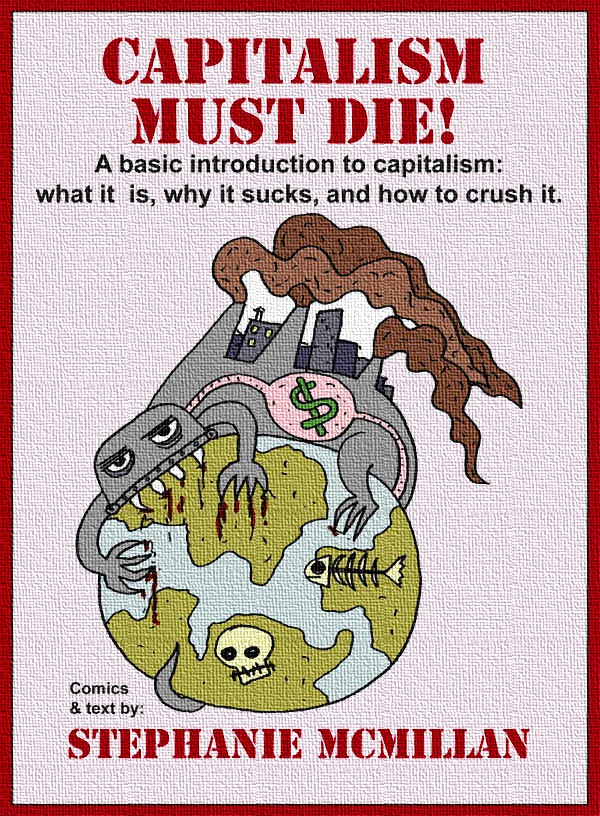
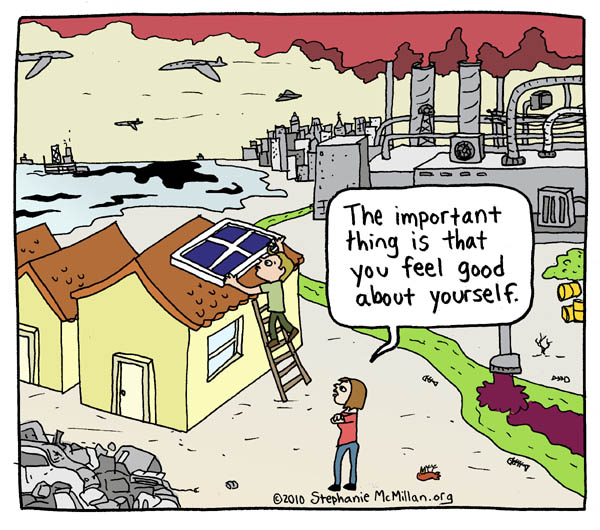
Stephanie McMillan
Stephanie is the award-winning creator of the comics “Minimum Security” and “Code Green.” Her books include “The Beginning of the American Fall,” “As the World Burns,” and “The Knitting Circle Rapist Annihilation Squad.” She is an organizer for the anti-captialist/anti-imperialist group One Struggle (onestruggle.net), and works on the publication project Idees Nouvelles, Idees Proletariennes (koleksyon-inip.org). Her website is here.
“Feel free to download it and share it with others. I want it to be widely distributed and contribute to the fight against capitalism, so I’ve made it “pay anything or nothing” and used a Creative Commons license. I hope it is useful. We really need to bring the system down, or all could soon be lost.” – link
Interview conducted by Derrick Jensen:
Post Script:
I promised a better answer to the first comment Pfgetty2013 made to this post:
“No way are we going to give up capitalism, at least not until most of humanity, and much of the rest of the living world, has died. There simply isn’t another plan that makes sense to the people with the power, or to most of us peons.
Nice to think about though.”
This frame of mind is exemplar of how our current form of civilization – global capitalism(or capitalist industrial civilization, as I like to call it) – ideologically dominates its inhabitants. People cannot even begin to imagine a different way of living because they have been made dependent on the system through dispossession of alternative means of subsistence. The masses have truly been reduced to consumers who are taught not to question the system, but to be obedient and conforming.
The superstructure of global capitalism is supported and protected by its institutions and ideas:
1.) Governments and their legal systems administer and regulate the capitalist process.
2.) The military, police, prison complex, and surveillance apparatus serve to enforce the capitalist process.
3.) The consumer culture only allows pro-market solutions.
These three pillars of the capitalist superstructure are very sophisticated and persuasive in diverting and co-opting discontent into forms that reinforce capitalism’s own institutions. Elections, corporate-funded nonprofits, nongovernmental organizations(NGO’s), community-based organizations(CBO’s), corporate-funded think tanks, etc. reinforce the system of capitalist authority and the illusion of democracy. They make people feel they are making a difference, when in fact the participants are tightening the bonds of their own oppression. Capitalism has been very adept at separating the worker from their environment.
This is why many indigenous societies whose culture and land has been usurped by global capitalism say that they “must first decolonize their minds.”
Archeologists tell us that, even before the Neolithic Era, man used fire to shape the distribution of flora and fauna in local environments. After several hundred thousand years of evolving a greater capacity for high level thinking and social networking, modern man has armed himself with technology giving him the ability to alter the ecosphere globally, and he has done so with devastating results. No place on the planet has escaped the effects of mankind’s activities. Isolated Arctic sea floors have even been found to have bits of plastic debris, and polar bears are becoming the most toxic creatures on Earth.
In the twilight of the Anthropocene Age, the writing on the wall has become painfully clear. The high-tech civilization modern man erected with fossil fuels will likely be undone by its own success. For about the last half million years, CO2 levels fluctuated between 180 and 300 ppm until mankind discovered an energy source that would catapult his numbers and planetary footprint into the stratosphere. CO2 and other polluting greenhouse gasses are breaching levels never before seen in human history and they continue to be spewed into the thin layer of atmosphere that is essential for life on Earth at the rate of nearly 10,000 million metric tons every year. We are the first humans to breathe air with 400 ppm CO2. The last time CO2 levels were this high was during the Pliocene Age when there was no Arctic ice, temperatures were 19°C warmer in the Arctic, average global temperatures were 2° to 3.5°C warmer, and global sea levels were 20 plus meters higher. The climate lag time has decades to catch up to what we have already done, and we’re still forcing the climate system with both feet on the gas pedal. Decades of studies and warnings by scientists have not moved the needle one iota, and unheeded warnings will still be coming as we plummet over the cliff into the mangled pile of corpses below. Living under the oncoming threat of climate chaos is a compounding stressor because it affects the security of food, water, shelter, economy, government, civilization, and the existence of the human species itself. There is no tangible enemy to conquer or sanctuary to escape to. It will turn each of us against each other and goad nations to war. Climate change is a monster of our own creation that mankind refuses to face even as its malignant presence grows stronger and stronger.
The natural carbon cycle has been blown to smithereens. Carbon sinks such as the oceans and forests appear to be reaching capacity as evidenced by the dying coral reefs and the global die-off of forests. Vegetation will cease to act as a sink at 4°C warming, according to recent research. Like a petri dish microbe which has reached the last fatal doubling of its exponential growth cycle, humans have filled the Earth to the brim and triggered the collapse of their own life support system. Over 50% of earth’s ice-free land surface is now occupied by human industry and activity — farms, crops, plantations, strip malls, city sprawl (Hooke et. al. 2012). Nonetheless hope springs eternal; some wishful thinkers say that if we stopped our fossil fuel binge cold turkey right now, then perhaps we could stabilize the damage to 2°-3.5°C warming which would be four to six times the warming the Earth has already experienced in the last century (0.5°C). Yet any prospect of pulling the plug on industrial civilization is more remote than aliens from outer space intervening to save humans from themselves. Coal plants continue to be built at a frantic pace and all the various manufacturing activities of modern-day life continue to churn along from the mass production of plastic novelty trinkets to the construction of behemoth aircraft carriers. With catastrophic damage from climate chaos already happening before our very eyes, I shudder to think what the future holds as we blissfully go about our daily lives damning future generations to a world with average global temperatures of 5°-9°C or greater.
The Earth cares no more for the selfish concerns of humans than for any other living thing which has upset the ecological balance of nature and gone extinct. It cares nothing about the profits calculated by humans with their mountaintop removal for coal, boreal forest clearance for tar sands excavation, or blowouts from deep sea drilling for oil and gas. In the deep time of geologic history, these are all the foolish endeavors of one destructive and unsustainable hominid called Homo economicus. Corporations pay to protect their privilege to pollute through political lobbying and legal bickering, but the laws of nature cannot be altered or bought off. Technology and adaption strategies are based on linear thinking and will ultimately prove to be the futile efforts of an arrogant, out-of-touch and increasingly desperate species. Nature and the laws of physics cannot be compromised by any amount of greenwashing, international ‘Earth Summits’, or eco-friendly product labels. Climate chaos and environmental destruction march onward in full technicolor display as self-serving humans continue to argue, cheat, lie, collude, deceive and stick their collective head in the sand. The victims of industrial pollution will not just be confined to the impoverished Third World, but will grow to encompass the entire human race. And the one country who proclaims itself the “shining city on a hill”, a beacon of democracy, and global leader is herding everyone down the path of climate genocide.
The ecological crisis and social justice issues are intimately intertwined and one could never be solved separately from the other. The cosmology of capitalism demands the objectification and commodification of nature as well as the appropriation and commercialization of all aspects of society. The social-ecological problem of fossil fuel dependency can be clearly seen when an energy company targets a people’s land to be used as a sacrifice zone such as with West Virginia mountaintop coal mining or fracking in Texas. Social and ecological decay will persist and worsen without adopting a way of life that respects both the integrity of the land and rights of people.
“These are sacrifice zones, areas that have been destroyed for quarterly profit. And we’re talking about environmentally destroyed, communities destroyed, human beings destroyed, families destroyed. And because there are no impediments left, these sacrifice zones are just going to spread outward.”
~ Chris Hedges
Each day that passes without a change to the status quo is another upward ratchet in the scale and strength of climate chaos. Each day passes and the same rhetoric of denial and false hope fills the airwaves, TV, and internet. Some conscientious bloggers document the worsening state of the world almost in real time, but they soon come to the realization that our fate seems to be written in stone as if we are following a script with only one ending. The super-organism of capitalist industrial civilization has no national, cultural, or environmental allegiance, and will sacrifice billions of people to keep business-as-usual going.
In a ravaged world, death will be big business.
“In horror of death, I took to the mountains – again and again I meditated on the uncertainty of the hour of death, capturing the fortress of the deathless unending nature of mind. Now all fear of death is over and done.” ~ Milarepa
“When the well’s dry, we know the worth of water.”
~ Benjamin Franklin
From Luke’s Journal:
Date: January 2064
I’ve just returned from a salvaging expedition into the heart of what was known as Los Angeles, a vast megalopolis once teeming with millions of people and home to Hollywood movies and TV, hallucinogens for the masses. It is now known as celluloid cemetery. The air was still this evening and off in the distance I could hear the desperate screams of those who had been exiled from our underground colonies.
I’ve got all the public libraries mapped out on my tracking device so that I can hit them up for rare books not archived on our historical databases. Paper books never died because a lot of data has been lost over the years due to grid failure, floods, fires, and arson. A very well-preserved collection of writings by Benjamin Franklin, a true renaissance man of his time, caught my eye as I rummaged through piles of books strewn knee-deep across the floor. Inside the dusty tome I saw the brief essay ‘Observations Concerning the Increase of Mankind‘and read it on the spot. Franklin says, “But not withstanding this (population) increase, so vast is the Territory of North America, that it will require many ages to settle it fully…” A mere 215 years after those words were published, America officially went into overshoot. Thomas Malthus is said to have credited Franklin for discovering the ‘rule of population growth’ which states that when agriculture increases in arithmetic progression(2, 3, 4, …), the population grows in geometric progression(2, 4, 6, …), eventually outpacing the means to feed everyone. Neither Malthus nor Franklin foresaw the discovery of fossil fuels, which fueled the population explosion, or its horrific side-effect of climate change which would act as a catalyst forthe spread of virulent diseases and pathogens such as the African Flu Pandemic of 2029, otherwise known as The First Great Culling. Two-thirds of the global population were wiped out. Subsequent pandemics of varying origins and lethality picked away at the remaining 2.5 billion, leaving a few hundred million survivors scattered across the globe. The construction of vast subterranean cities began several decades ago once the world knew that industrial civilization would never be able to survive runaway climate change above ground. Today no one is allowed to have more than two children. Population is strictly monitored by the technocracy which severely punishes those who break this law; no one wants to be banished to the outside where life is short and brutal.
Franklin must truly have been rolling in his grave at the end result of his expansionist dreams for America: a pockmarked landscape of fracking wells, oil spills, and toxic waste dumps; a corrupt government of corporate sock-puppets; a military that had become a malevolent industrial complex seeking war for profit and destroying fledgling democracies wherever they appeared; an agricultural system of factory farms and frankenfood; a self-proclaimed “free press” of corporate mouthpieces and shills; and a population of citizens that had been reduced to mindless consumers incapable of critical thought. And I think he would be utterly distraught to find that his name had been reduced to a popular idiom by the dumbed-down masses — “it’s all about the Benjamins.“ Knowing what a grotesque monstrosity this country would become, he surely would not have declared America’s cause to be ‘the cause of all mankind’ — wasteful consumerism, monopoly capitalism, and the tyranny of the corporate state. When he was studying dinosaur bones in northern Kentucky back in the mid 1700’s, I’m sure it never crossed his mind that the human species would soon suffer the same fate, becoming the next hapless victim to sink into a tar pit of its own making. Franklin would have said, “It’s inconceivable such a technologically advanced society as this would not look at the scientific evidence and take action at once to preserve life and liberty.” But after witnessing what an irredeemable abomination his Republic had become, he would most likely say, “My God, the only recourse remaining is to clear the entire system with near-term-extinction.”
Walking with the tortured spirit of Benjamin Franklin along the Beach of Doom where anoxic ocean waves wash plastic debris and dead jellyfish ashore, I explain to him that the seeds of our destruction were planted long ago with the expansionist mindset of the first European settlers. The Indians and buffalo were systematically wiped out, all the virgin forests were chopped down and converted to lumber, and the rest of America was laid wide open for exploitation by the construction of a transcontinental railroad. Technology and the power of fossil fuels only intensified the process; this country never looked back, expanding to foreign shores for control of evermore resources and spreading the same logic and belief system of capitalism throughout every inch of the Earth until there was no place further to go. The system started to cannibalize itself after hitting peak oil, turning inward to burn dirtier, more marginal energy resources and starving the masses whose share of the economic pie kept shrinking while a tiny few gorged themselves on ill-gotten wealth and delusions of grandeur. In its final days, this con game measured everything only with a monetary scale. If there was no profit to be earned, then real solutions to the grave threat of anthropogenic climate change, like “powering down”, were summarily discounted. America and the world had ideologically boxed itself into a death trap called capitalism. No one realized or refused to realize that all the perceived gains in infrastructure, technology, social institutions, and other complexities of industrial civilization would soon fade into oblivion at the hands of an uncaring climate radically and thoughtlessly altered by mankind’s activities. In the end, it was all phantom wealth stolen from nature and built off her back by burning trillions of tons of carbon into the atmosphere. The system’s only available avenue was to rush headlong into the dark void of misery, death, and extinction while spinning quixotic tales of “sustainable growth”, “renewable energy”, and geoengineering fixes. Cooperation on a planetary scale to lower greenhouse gases could never be accomplished under a capitalist system, nor would the arms race amongst nations which requires a constant investment of highly dense energy to develop technologically superior weaponry. After knowing for decades that it was far too late to escape the carnage of climate chaos, those in positions of power felt compelled to ignore the facts and keep the gas pedal pressed to the floor, leading all of humanity over the cliff.
“He cannot complain of a hard sentence, who is made master of his own fate.”
~ Johann Friedrich von Schiller
From a musical perspective, the ‘70’s brought us disco, big hair stadium acts, pretentious prog rock and the first defective strains of punk.
Disco and the big hair crowd were mostly clueless mainstream commercial acts celebrating the soon to come neoliberal tsunami of class warfare that was drawing a bead on middle class America.
Like canaries in a coal mine, the artistic set is often the first to smell a rat, through the visual arts or via music. As there is virtually no revenue stream possible from painting and other visual media, music is often the favored format for counterculture expression -after all you might even get paid.
Cynicism aside, there were but few tuning forks, so-called receivers of early stage temblors, captors of high frequency squeals and squelches beyond the audible range-invisible to most but painfully loud to a few. These savants interpreted these signals into more than just coming of age angst, more than the stick-it-to the-man oeuvre of the day, they put a name and a face to a shiftless, nameless face of unease.
They heard, visualized, and identified it as alienation. The culmination of a multi-decade process where incrementally, the collective human psyche of the American worker be it lower, middle, or upper class was disintegrating as a direct result of the capitalist mode of production.
These early criers were obscure, unwanted, and largely transparent. There is no recording deal for such messages, no decadent hotel parties with televisions being pitched out of windows, just abysmal living conditions, homelessness, and despair.
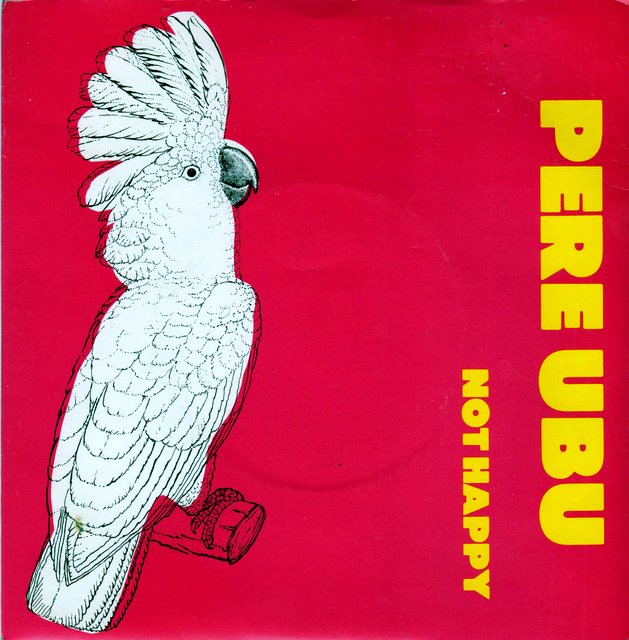
One such musician was a lead vocalist named David Thomas, who headed up a very strange band called Pere Ubu.
Based in Cleveland Ohio in the heart of the rust belt, no one wanted to hear from a backwater band with a sweaty, overweight lead singer who bought his clothes at thrift shops.
The girls won’t touch me Cus I’ve got a misdirection Living at night isn’t helping my complexion The signs all saying it’s a social infection A little bit of fun’s never been an insurrection Mama threw me out till I get some pants that fit She just won’t approve of my strange kind of wit I get so excited, always gotta lose Man that send me off Let them take the cure Don’t need a cure-need a final solution
But they successfully captured the archetypical angst that was to descend on us like a black plague.
Much of today’s angst is focused on the tangible aspects of capital’s invasion of the political economy, the destruction of the environment, loss of civil liberties, and the widening gulf of inequality.
Less mentioned but also noteworthy are the pervasive intangibles as capital metastasizes through the global society.
The class structure of capitalism requires the presence of exploitation to function. This exploitation component is perhaps the singular defining quality separating the simple exchange of commodities, which dates to pre-Roman history, from the capitalist means of production dating back to only the last 400 years or so. The act of exploitation stratifies society into a two tier class structure, exploited and exploiter. This arrangement superseded the feudal class structure, first through the migration path of mercantilism into so-called free market capitalism, and then on to the more fully developed forms such as State capitalism. This migration and sequencing is pre-ordained, it occurs as an easily predictable- and irreversible- set of events baked in to the capitalist mode of production.
It is within this component of exploitation that we find the insidious intangibles of capitalism. We can name these intangibles alienation and appropriation.
To fully appreciate the gravity of these intangibles, and their impact on the individual, we have to reconcile the intrinsic contradictions that are created as artifacts of capitalism.
The first subject is property ownership, which is where the initial elements of fundamental course error are detected on the moral compass.
The groundwork for modern bourgeoisie property ownership was formulated by John Locke (circa 1690) which established that ownership of previously undeclared property could be appropriated for individual ownership by the application of labor.
In other words, if you find vacant and unclaimed land, and improve the land by applying your labor to the land, you are the de facto owner.
Much of the interpretation of Natural Law into the modern theory of property rights was spearheaded by Edmund Burke (circa 1790), often considered the father of modern conservatism. His theories on property ownership were pivotal in assembling the class structure of capitalism.
Burke’s ideas placing property at the base of human development and the development of society were radical and new at the time. Burke believed that property was essential to human life. Because of his conviction that people desire to be ruled and controlled, the division of property formed the basis for social structure, helping develop control within a property-based hierarchy. He viewed the social changes brought on by property as the natural order of events that should be taking place as the human race progressed. With the division of property and the class system, he also believed that it kept the monarch in check to the needs of the classes beneath the monarch. Since property largely aligned or defined divisions of social class, class too was seen as natural—part of a social agreement that the setting of persons into different classes is the mutual benefit of all subjects.
Underpinning these abstract features, Burke laid the groundwork for his contemporaries, among them Adam Smith, and James Wilson of the high court, to advance the notion of the connection between private ownership of land, and the application of labor to secure this land, and the principle (soon to be pushed under the rug) of the potential for over-accumulation.
Supreme Court justice James Wilson, in 1790:
In the opening sentence of “On the History of Property,” he states quite clearly: “Property is the right or lawful power, which a person has to a thing.” He then divides the right into three degrees: possession, the lowest; possession and use; and, possession, use, and disposition – the highest. Further, he states: “Man is intended for action. Useful and skilful industry is the soul of an active life. But industry should have her just reward. That reward is property, for of useful and active industry, property is the natural result.” From this simple reasoning he is able to present the conclusion that exclusive, as opposed to communal property, is to be preferred.
All the early post Enlightenment thinkers acknowledged the potential for over-accumulation by private property ownership. The common explanation for how this would be avoided was to simply limit the amount of property any given individual could own, with a basic stipulation than the land appropriated for example, could be no larger than what one could reasonably work with his own labor, or the labor of his immediate family.
This had the effect of limiting the general land parcel size to the range of 40-80 acres for the average agrarian family, and was the guiding principle well into the 20th century. The Homestead Act, essentially an extension of this 17th century principle finally discontinued in 1976, with some exceptions allowed in Alaska until 1986. This also dovetailed nicely with the notion of Manifest Destiny, whose expansionist horrors were soon to unfold.
The principles laid out here can be summarized as the Workmanship Ideal.
It’s important to consider the theological linkages to the use of Lockean property rights. Under Locke, the religious link to Natural Law was very pronounced, e.g. if you were born with a physical defect, and could not provide labor to improve land, you didn’t get any. Nor were you entitled to subsistence of any kind, but more importantly, as this (condition) was presumably God’s will, this absolved society of any responsibility to provide subsistence for those unable to provide for themselves.
If these themes seem familiar, they are. Much of this was and still is the basis of contemporary conservative thinking today.
If the Workmanship Ideal is then secularized to remove the notion that not all can provide for themselves, physically, and these deficiencies are not due to the will of a supreme being, then we begin to see some cracks in the armor of the basic operating theory of modern property rights.
Secularizing the Workmanship Ideal also introduces some new concepts such as the distinction between labor power and labor. Labor power is a commodity, the labor act itself is transcendental and cannot be commoditized.
But the contradictions really begin to pile up as capitalism begins to develop, as agrarian culture converts to a wage labor society. The wholesale conversion of the 19th century American agrarian lifestyle to a predominantly 20th century wage labor economy is tectonic in magnitude.
A series of property rights concepted in a 17th century world where land was plentiful, and the New World was as close a representation to realizing superabundance as we have known in modernity, was quickly becoming obsolete.
An ownership class soon emerged, ownership of land, factories, and livelihoods. Perhaps the greatest of all swindles of the bourgeois ownership class upon the working class was the expropriation of the Workmanship Ideal.
This is the very centerpiece of contemporary alienation, the removal of the right of the worker to own what he or she creates. Secondarily, the worker loses his or her connection to his work product, in a system of social relations based entirely on anonymous commodity exchange, the worker knows not who uses his work product, nor how it is used, nor does he or she know anything about the production of commodities that he or she may need for subsistence.
A completely anonymous set of social relations wherein the worker is permanently, and deliberately separated from not only any value recognition in production, but also absolved of any responsibility of production.
The logical construct from which to view this phenomena is to consider man in a capitalist society as severed from nature, severed from his work, and severed from other humans insomuch as his principal means of social interaction is the exchange of anonymous commodities.
Alienated man is an abstraction because he has lost touch with all human specificity. He has been reduced to performing undifferentiated work on humanly indistinguishable objects among people deprived of their human variety and compassion. There is little that remains of his relations to his activity, product and fellows which enables us to grasp the peculiar qualities of his species.
So afflicted, we see the way clear for moral disconnection between nature, our fellow citizens, and of course our work. Many of today’s contemporary hobbies are not just diversions or distractions, but (fabricated) mechanisms to reconnect us to the loss of the Workmanship Ideal, through building something tangible (such as woodworking or gardening) that can compensate for the severing effects of fully developed capitalism.
The Lockean notion of property rights is inexorably linked to other key concepts, the division of labor, and accumulation for example. Together, these concepts form a narrative that supports the expansion of capitalist class structure. These are supplemented by Marginalist economic theories of value and commodity exchange that replaced labor based theories of value, an essential diversion which allowed for a pseudo-scientific patina of authenticity.
To keep from dying the worker sells his labor power to live.
This stark realization that the exchange of labor power is virtually the only means of survival is often subconscious, not readily reflected as the true realty of one’s condition. Certainly “shopping” does not connotate the hard scrabble reality of selling labor power for subsistence, one conjures this commodity exchange as advancing one’s social standing through accumulation of goods that attempt to compensate for the severing forces of alienation.
The contradiction of a wage labor economy comes vividly to life, what you work at and what you work for is no longer yours. It is appropriated away from you as an artifact of the wage labor exchange, in addition, you are no longer in charge of your time during this period, you operate solely at and for the direction of others.
Consider the case where you take out a 30 year mortgage on a house for you to live in. You exchange wage labor daily to make the payments, after 30 years of this you take permanent possession of the house from the lien holder, it is finally yours with nothing further due to the lender.
Unfortunately this equity advancing scheme is not available to you at your job. After the same 30 years of service, you are owed nothing- and sent packing. A “retirement” party and a gold watch is all that is left to show for this input. Imagine if the aforementioned home lender kicked you out of the house you made payments on for 30 years at the end of the term, instead of relinquishing the ownership title. This is essentially what happens to the wage laborer- a particularly egregious violation of the Workmanship Ideal.
To add insult to injury, the collapse of late stage capitalism is beginning to take its toll on expectations for retirement. The trope of saving for “the golden years” has instead turned into a horrific nightmare of valueless savings accounts, worthless in the sense of the inability to earn any meaningful interest income for the time when you are too old and unable to exchange wage labor for subsistence.
The side effects of alienation are profound and startling, we can trace many of society’s abominations both directly and indirectly to various aspects of alienation.
Defensive Accumulation
Often the practice of accumulation is described as a greed based attribute of the bourgeoisie, but the working class is forced into the same behavior when faced with the pragmatic terms of the capitalist mode of production.
The prospect of reaching a point in your life where you will be unable to exchange wage labor for commodities is profoundly disturbing. Most elderly would be unwelcome at their children’s homes, as they would no doubt interfere with their offspring’s mad grab for status enhancing commodities. So many are consumed by a (justifiable) paranoia-stricken frenzy to accumulate cash, commodities, and social status, embroiled in a siege mentality to stave off hunger and a barren future of declining health and diminishing purchasing power of a fixed income.
Proletariat Accumulation
The active working class have it no better. The prospects of long-term stability are shattered with the reality of living paycheck to paycheck. Society bemoans “instant gratification” but ignores the impossibility of any type of efficacious planning given the overarching free-for-all employers exhibit to appropriate worker’s labor and profit at all costs. Layoffs and salary freezes are de rigueur, and when you stop making a profit for your boss you stop earning your own living. Such calculus often portends bad behavior, stealing and embezzling for example, but most frequently lesser crimes of omission and dishonest social relations intended as a “go along to get along” strategy. These outcomes are nearly always attributed to poor moral fiber, substandard upbringing- and in general just going to the wrong church. No one wants to talk about the vicious underbelly, the stepping on bodies necessary to rise to the point where you can feed yourself.
If a consistent salary and stable work environment are not forthcoming, what then? Well then we have the big score, the single life changing event to instill stability and harmony, the lottery ticket, the basketball scholarship, closing the “deal of a lifetime”, that promotion to the elite .1%, that ethereal land of milk and honey perhaps best epitomized in the documentary film “Queen of Versailles”. In a most poignant scene, the trailer trash billionaire wife is seen in her 36,000 square foot house, with Bentleys in the garage and dog shit on the carpet, a juxtaposition that graphically illustrates the superficiality of her obscene wealth.
Bourgeois Accumulation
Life ain’t so grand at the top either. Much is made of the sociopathic behavior of the .1%, and this is well deserved. Recently, it is noted that some of these actors exhibit addictive characteristics, in effect, addicted to money. Indeed some, in fact many of the actions of these people can be described as drug seeking behavior, always on the lookout for the next fix or cash infusion. The aforementioned Queen of Versailles (a real person) was dissatisfied with her 36,000 sq. foot manse, so she and her husband commissioned a 92,000 square foot behemoth- the largest single family dwelling in North America. This can only be described as a sickness.
Mystery Train
Everyone must reconcile in their own way these factors. One must consider, in some way, directly or indirectly, how these facts shape current events. When gunmen shoot up school children, when mall shootings occur with increasing and alarming frequency, when workplace shootings and other “random” acts of violence become so common as to elicit not even a vague sense of interest, we have a problem.
In totality we cannot lay all of societies outrageous outbursts at the feet of alienation- but we can lay down a good bit, perhaps the majority. We see the security state girding its collective loins with surveillance capability and (domestic) military firepower. They know what is coming and it is not the Muslims. It is not the invading foreign hordes. It is the disenfranchised factory worker, the déclassé intellectuals, the retirees, and the unemployed who have stepped on one too many bodies to feed their families. The petite bourgeoisie who have one too many trinkets at the expense of their integrity. A rousing, rabid crowd of dangerous souls poisoned to their very cores by an alienating system of exploitation and commodity exchange that defiles and diminishes all those who participate, willing or unwillingly.
“Hey, my name’s Luke. The year is 2060 and I live in what was once called America. As you can see, the ‘developed world’ never was able to kick its fossil fuel habit. They just kept turning to dirtier sources and more extreme processes to burn the stuff, like the liquefaction and gasification of coal. The entire planet became a sacrifice zone for the sake of keeping mega cities lit up and the machinery humming, but ultimately it was death by a thousand cuts. Entropy was the victor. GHG’s continued to rise, warm the planet, and wreak havoc on the biosphere. Cancer and industrial disease spread to every corner of the globe. Weather patterns were drastically altered until the world’s food production was forced to move indoors. Large-scale cloning of animals became common practice in order to feed the several hundred million surviving people. War, drought, floods, fresh water scarcity, and a rash of pandemics crashed the world’s population from a high of 8 billion. The agricultural bread baskets of the world became wastelands of dust and weeds. International cooperation failed and the world’s existing powers scrambled for the last remaining resources. There are none who buy into the propaganda of a “better world” any longer because the stark evidence of what we have done to the planet cannot possibly be hidden from view. There is no utopian sanctuary for anyone to escape to, no matter how many gold coins one has managed hoard. Despite this realization and even after all the geoengineering mishaps, people still cling to the belief of salvation through technology. Everyone lives in fortified bunkers to escape the hot, drying winds that sometimes carry poisonous and toxic clouds. When we do venture out, gas masks are always worn as well as long clothing to protect from the thinning ozone layer. Industrial smoke stacks still belch plumes into the air to keep the underground cities running.”
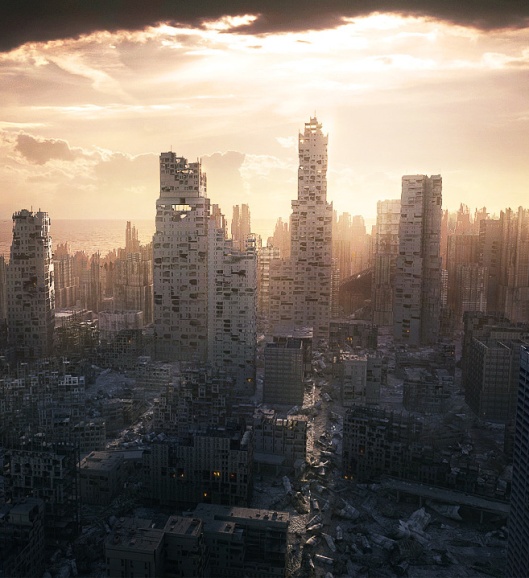
“When above ground, I’ll spend hours walking through the wreckage of industrial civilization, the skeletons of its skyscrapers blotting out the sun like the mythical Redwood trees once did along the west coast. The occasional sound of a steel beam crashing to the ground or a glass window shattering breaks the ghostly silence. These deserted cities are infested with rats the size of small dogs, and the ray of my flashlight is reflected in their staring eyes. The endless and self-defeating rat race of humans has now been replaced by the scurrying, scavenging, and fighting of real rats. I find it amazing that my ancestors spent their entire lives living and working inside these little office cubicles. That was a time when Earth was still green and you could hear the birds chirping and singing outside your window. I’ve got a digital recording of various holographic scenes depicting bygone days of nature that I project inside the confines of my subterranean home, but I’d give my right arm to experience the real thing. To think that people were once surrounded by nature all the time amazes me. Its true value had never really been calculated. Rather, money seems to have been what people were most preoccupied with back then. On one of my excursions I came across a dwelling whose crumbling walls were packed with stacks of moldy paper money. Whoever lived there must have worked an entire lifetime to eke out a savings of that size, stuffing it into every wall cavity like it was insulation. Many thought humans would go extinct long before money would ever cease to exist. I guess they were wrong.”
“They say the people of this country went mad, obsessed with money as it overtook their every thought, decision, and activity. One of America’s forefathers once said, ‘He that is of the opinion money will do everything may well be suspected of doing everything for money.‘ All things were framed within the context of money. Environmental damage was discussed in terms of financial setbacks to the economy. Political leaders made decisions based, first and foremost, on the financial interests of those powerful few who put them in office. Choices on matters involving the well-being of humanity were made solely in the interests of corporations and stockholders. Even as the overwhelming evidence mounted that mankind’s place on earth was becoming evermore tenuous, the money worshippers continued to find ways to profit from calamity and mayhem. Preserving the Earth simply was not profitable, so they let it die. The Arctic melted, so they raided its open waters. The land became parched, so they invested in water rights. CO2 levels skyrocketed, so they put their money into carbon credits. Our continued existence became a crap shoot in the marketplace. The vultures of capitalism were able to profit from the collapse; thusly, such nightmarish and dystopian scenarios as botched geoengineering schemes, a Venus syndrome on earth, and ultimately human extinction were allowed to become sober realities….”
‘No matter what we call it, poison is still poison, death is still death, and industrial civilization is still causing the greatest mass extinction in the history of the planet.’
~ Derrick Jensen
As mankind spirals towards its own self-manufactured demise, I look with a jaundiced eye at daily events in the news and at the bread-and-circus infotainment that fills the American hologram. The mass media is replete with misinformation on the state of the world, so I wasn’t too surprised by the recent words of wisdom(sarcasm) from Kathleen White (Distinguished Senior Fellow-in-Residence & Director, Armstrong Center for Energy & the Environment); nevertheless, I felt compelled to set aside a partially completed essay on capitalism and technology in order to express some of my thoughts about White’s essay on the benefits of fossil fuels to humanity:
“…Fossils fuels also augment food supply. Fertilizer derived from natural gas has increased agricultural productivity by 40-60 percent. According to economist Indur Goklany, without fossil fuels, an area equivalent to U.S., Canada, and India combined would have to be converted into crop land to meet global food demand. Fossil fuel-based fertilizer, pesticides, and mechanized substitutes for animal power have saved vast natural ecosystems from conversion to cropland. And the increased atmospheric concentration of man-made CO2 has enhanced plant growth.”
[You fail to consider that without fossil fuels, mankind would not have been enabled to overpopulate the planet to such a degree as to require so much farmland.You also fail to say that the negatives of climate change swamp (no pun intended) any supposed benefits of a warming planet. As we are already seeing, the effects of epic droughts and floods are wreaking havoc on farmers. Good luck trying to move the agricultural industry northward where the soils are extremely poor. Famine and mass extinction are the inevitable outcome of industrial civilization’s destabilizing activities on the planet.]
“Although combustion of fossil fuels releases pollutants, that environmental damage can, and is, undergoing dramatic reversal far quicker than could the conversion of natural ecosystems to croplands. The prosperity supported by fossil fuel energy allows investment in effective technologies to reduce and eliminate harmful pollution.”
[CO2 and other GHG levels are increasing every year, having gone parabolic in the last 100 years. This reality paints a bleak picture for the future of humanity. Far from being mitigated, environmental damage is accelerating everywhere one looks from the acidification of the oceans to the die-off of forests and jungles. The simple fact is that renewable energy cannot replace fossil fuel based energy at the rate the world is consuming, as European actions have recently indicated. Only a wholesale reconfiguration of the economy and our way of life will enable solutions to the environmental crisis. Rather than taking this courageous and self-reflective approach, society is putting its proverbial head in the sand concerning climate change. The public already finds the subject of climate change difficult enough to understand without having to wade through a constant onslaught of misleading articles such as yours.]
“Renewable energy still provides a sliver of global demand. Despite the billions of dollars in subsidies, retail prices are still 2-3 times higher than fossil fuels. Renewable energy from wind and solar remain diffuse, intermittent and parasitic on fossil fuels for back-up. Nuclear fission provides energy comparable or superior to fossil fuels, but the public remains resistant to broad use.”
[Yes, capitalist industrial civilization cannot be run on renewables so that is why we need to be talking about powering down and living within the carrying capacity of the planet rather than maintaining the status quo. Nuclear has the little problem of making vast swaths of the planet uninhabitable from radiation contamination, as evidenced by such catastrophes as Chernobyl and Fukushima. Nuclear energy also leaves behind tons of radioactive waste that must be stored away for thousands of years. These sort of factors tend to scare the public. With global sea levels rising and storms becoming more destructive, the world’s nuclear plants, which are mostly situated along waterways and oceans for coolant purposes, are in jeopardy. Get it?]
“Energy-dense, abundant, imperishable, versatile, reliable, portable and affordable, fossil fuels provide 85 percent of the world’s energy because they are superior to the current alternatives. And hundreds of millions still await the benefits of affordable energy. Until energy sources comparable or superior to fossil fuels are fully available, policies to reduce emissions of CO2 should proceed with caution lest they prematurely jettison the well-springs of mankind’s greatest advance — the blessings of which literally light up the holiday season.”
[The “well-springs of mankind’s greatest advance” are soon to be jettisoned into the dustbin of history and extinction as we have already tripped multiple tipping points in the earth’s biosphere such as the Polar ice melt and many others. Hundreds of millions will never experience the energy-intensive lifestyles of developed countries since climate chaos will put a halt to human expansion within this century. Fossil fuels have allowed industrial civilization to far overshoot the environment; for the rest of the world to live like Americans, we would need more than 4 Earths.]
Wow, it’s been 3 months since we’ve done one of these, and I think we need a laugh or a chuckle. Quote for the day:
“Society is like a stew. If you don’t stir it up every once in a while then a layer of scum floats to the top.” ~ Edward Abbey
Really, a great rule of thumb:
“Yet another fucking fat joke. I hope this guy never gets elected president, the insults thrown against him would be worse than his economic policies.” – brorack_brobama
Yes, the other bridge scandal. If you don’t understand, read here and here and (h/t Tom) here:
“I think human consciousness is a tragic misstep in evolution. We became too self-aware. Nature created an aspect of nature separate from itself. We are creatures that shouldn’t exist under natural law… The honorable thing for our species to do is to stop reproducing and walk hand in hand, brothers and sisters, into extinction — one last midnight.”
~ Rust Cohle, ‘True Detective‘
Sitting comfortably within their climate-controlled homes and buildings, a tiny percentage of eco-conscience humans watches with morbid fascination as large numbers of animals drop like flies in a bug zapper. In the latest die-off, bats rain down from Australian skies; parrots, kangaroos and emus perish from heat exhaustion. Ominous signs of an unraveling web of life are everywhere to see, but the industrial world has become utterly disconnected from nature and pays little heed to such warnings. Rather, what holds their interest is Chris Christie’s Traffic-Gate. That our fate is bound to the well-being of Earth is a belief lost with the genocide of so many indigenous cultures. Capitalist carbon man resides in a totally fabricated world — he eats food mass-produced from fossil fuel inputs, drinks ‘purified’ water bottled in plastic, and at bedtime drowns out the noise of energy-gluttonous cities with the electronic recordings of ocean waves and forest sounds. But most absurdly, he ‘communes with nature’ through staged wildlife TV shows and eco-trip adventures. Rather than allow poachers and farmers free rein, the capitalists thought it wiser to extract profit out of the Earth’s dying ecosystems by tapping into the “green” industry of eco-tourism, another in a lost list of anthropocentric oxymorons.
Relentless marketing on TV, internet, radio, billboards, print, etc has created an unending cycle of desire and consumption, fueling the trivialization of life that feeds its commodification. The individual is reduced to a “buying unit” by the skyscrapers, institutions, and bureaucracy of capitalism, but in a future world of spent resources and civilization-destroying weather, the market won’t have much use for so many “buying units”. Introspection by many rational, sober, and clear-minded people since the publication of ‘The Limits to Growth’ has not altered the course of history to date; why would I think the human species would suddenly alter their behavior after having tripped so many ecological tipping points and feedback loops? Hindsight is 20/20 only if a lesson was learned the first time.
“…The basic truth between the lines of this press event [National Research Council (NRC) briefing on abrupt climate change] was that we are facing a world that is becoming increasingly hostile to humankind.
We are literally making the planet into a wasteland like this is some post-apocalyptic science fiction story. It is just shocking. And the most horrifying aspect of it all is that we’ve waited to reduce emissions so long that we’re exiting the win-win field of possible climate responses. We’re now headed into a world of lose-lose. That’s the news nobody wants to convey – or hear. But there it is.” – link
The cancer of hyper consumption and economic growth for never-ending profit has trashed the planet, but blind faith in the markets and techno-optimism are the siren’s call beguiling industrial civilization over the cliff. Capitalism likes efficiency; in its quest for greater efficiency, diversity – the essence of life – is being exterminated. Monoculture is death. More biodiversity means more resilience. A recent scientific paper purports to prove this long-held maxim:
“…when a lot of species are interacting and competing in an ecosystem, the ‘average’ interactions that any one species experiences are likely to be weaker than in a simpler, less diverse system. When there are a lot of different niches occupied by different species, we also expect different responses to environmental fluctuations among the community, meaning that some species inherently do better than others depending on the specific disturbance. Species-rich systems also tend to have more of what we call ‘functional redundancy‘, meaning that if one species providing an essential ecosystem function (e.g., like predation) goes extinct, there’s another, similar species ready to take its place…”
Biodiversity loss is not the only aspect of life being degraded. The planet is also losing cultural diversity – languages, crafts, religions, histories, ancient knowledge, etc. are disappearing as globalization reduces all of life to the status of a marketable commodity. Thousands of languages were once spoken in North and South America before the invasion of European powers. It’s interesting to note that in the Ojibwe language, and perhaps in most if not all native languages of North America, there exists no word to describe “greed” or the concept of personal property, but there are endless numbers of verbs to describe “every movement and temperature and visual sense of water.” After a few hundred years of progress, the white man has Wall Street and the natives have gambling casinos.
“In the Seventh Fire prophecy of the Anishnabek, each of the seven fires represent an era in human history. We are now in the time of the Seventh Fire. The task of the people of this age, including the Anishnabek and other red people, the yellow people, the black and the white, is to come together through choosing the road of cooperation. Without this, there will be no Eighth Fire, or future for Natives and others…
…Today, in the age of the Seventh Fire, the races are again faced with a choice. The two roads are the black road of technology and overdevelopment leading to environmental catastrophe, the other is the red road of spirituality and respect for the earth. Together, people of the world have to choose the right road, be of one mind, or the earth cannot survive…” ~ The Seventh Fire (Ojibwe) Prophecy
The “black road of technology and overdevelopment” is paved with the fallout of dead bodies and poisoned landscapes —nuclear meltdowns, oil and chemical spills, factory fires and explosions, etc., but to a very tool-centric species just itching to keep this omnicidal train going, geoengineering looks like the perfect ticket. It promises to allow industrial civilization to continue burning carbon while avoiding the nasty side-effect of catastrophic climate change. Unfortunately, human error and miscalculation, the bane of so many other industrial endeavors, will undoubtedly come into play. The ‘hacking’ of the Earth’s entire climate system represents the peak of hubris for modern man. Describing the conceit of our technological domination of the planet, Clive Hamilton states:
“Pursuing abatement is an admission that industrial society has harmed nature, while engineering the Earth’s climate would be confirmation of our mastery over it — final proof that, whatever minor errors made on the way, human ingenuity and faith in our own abilities will always triumph. Geoengineering promises to turn failure into triumph.”
The Earth’s carbon sinks are filling up and the twin problem of ocean acidification will need a techno-fix too. Complexity begets even more complicated problems. Our culture avoids the simple fact that humanity is vulnerable and dependent on the Earth, that life is fragile and interconnected, and that the importance of Murphy’s law is amplified exponentially when playing GOD with technology. Let’s also hope that the psychological effects of climate change don’t make the nuclear powers lose their cool.
…A warm dry wind is all that breaks the silence
The highways quiet scars across the land
People lie, eyes closed, no longer dreaming
The earth dies screaming…
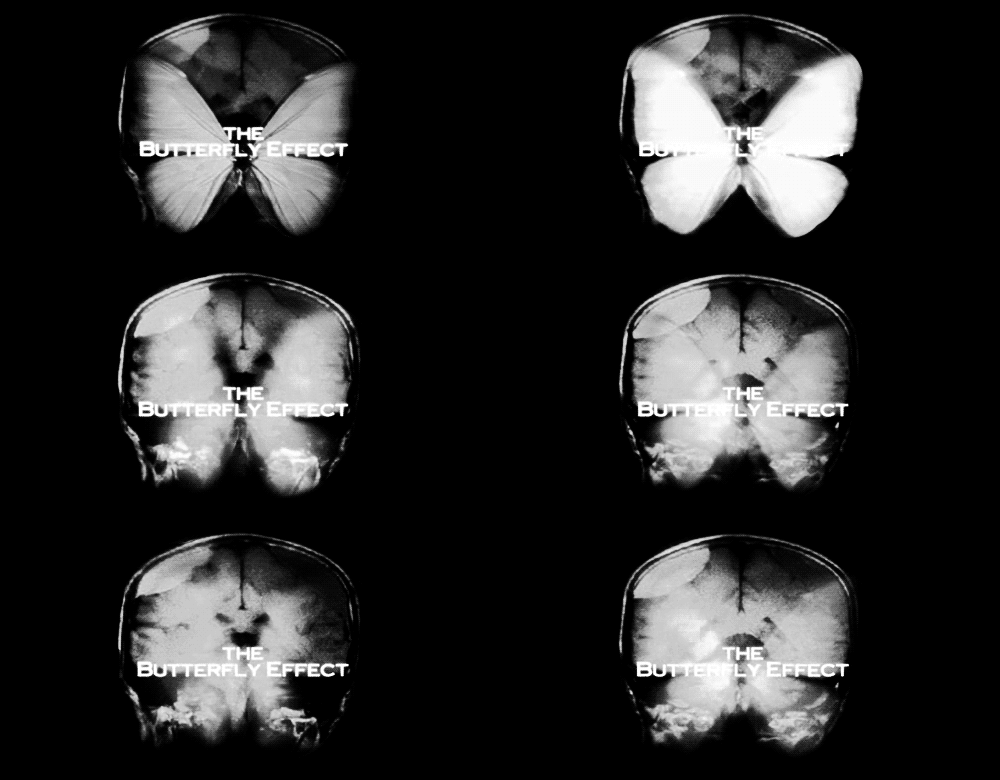
In chaos theory, the butterfly effect is the sensitive dependency on initial conditions in which a small change at one place in a deterministic nonlinear system can result in large differences in a later state. The name of the effect, coined by Edward Lorenz, is derived from the theoretical example of a hurricane’s formation being contingent on whether or not a distant butterfly had flapped its wings several weeks earlier.
In the popular mind, which is arguably more heavily influenced by myth, fiction, and propaganda than by science (especially something as esoteric as chaos theory), the butterfly effect is often understood as a minor disturbance to a timeline resulting in a substantial divergence downstream. It’s an alteration from one likelihood or expectation to another one, typically carrying major impacts. We have no trouble believing in fates and destinies being fundamentally altered by arbitrary choices and happenstances. Hindsight sometimes even affords the opportunity to wonder what might have happened if one had zigged instead of zagged, knowing that every instant has the unbeknowst potential for a life-changing development. (What bus?) The foresight to recognize those linchpin moments escapes us most of the time, but we believe in them nonetheless.
My reason for bringing this up is to make the observation that with the biosphere now manifesting major impacts that are highly discontinuous from the historical record, we don’t really believe in the butterfly effect, or at least ignore/deny it. Minor perturbances, from population pressure to pollution to paving to purported prosperity, are frequently thought to be too tiny to affect something as large as the planet and its finely tuned systems. Yet ripples and eddies have accumulated over time and are now lapping shores like tsunamis, causing the face of the Earth to be quite different from its state, say, 250 years ago, before the fossil fuels era kicked off in earnest.
This week’s biggest news is a good case in point: an artic vortex has brought dangerously low temperatures and wind chills to North America. This phenonenon, where the mass of extremely cold air slides off its normal center at the North Pole, may not be entirely unknown in modern history, but its reappearance this week reminds us that small changes to the systems of the Earth’s thermal regulation can wreak substantial havok. (Please stop reporting the damage in terms of cost in dollars!) Further, in answer to the question, “Are these cold temps due to climate change?” at least this article at Common Dreams answers unequivocally “yes.” It argues that all weather events major and minor are now attributable to climate change because, like the fate or destiny aspect of the butterfly effect, we have embarked on a new timeline that diverges from a calmer, steadier state we might have enjoyed had we not made unwitting, wholesale alterations to the Earth’s climate systems. This is essentially the same argument made by Bill McKibben in The End of Nature way back in 1989, namely, that Nature (capital N) didn’t really exist anymore because humanity’s imprint is now everywhere: in the air, water, and soil. (Incidentally, this is the book that awakened me to ecological issues that in the ensuing 25 years have only grown progressively gloomier and doomier.) Put another way for the entertainment-bred masses, we now have the equivalent of J.J. Abrahm’s reboot of Star Trek TOS with a new timeline, offering the opportunity to depart from canon as desired. The major difference is that, in our reality, we can only project and extrapolate how it would have been had we not messed everything up — except to say that it wouldn’t have been, well, nearly so messed up.
From my home and workplace in Chicago, it’s been curious to see how people have responded to the extreme cold. Fashion has been displaced in favor of function, with men and women on the street mummified under multiple layers to the point they look like the Michelin Man. Traffic (air, train, bus, automobiles) has not ground to a complete halt but it’s been slowed to a crawl, with many cancellations, delays, and accidents. The huddled masses (read: the homeless and unhoused) are congregating unapologeticaly in warming locations (public buildings such as libraries, underground pedways, on public transportation, etc.) to avoid the very real threat of freezing to death. Nonetheless, several freezing deaths have already been reported. School and business closures kept many at home, with many others calling in to complain of their inability to get to work. Four days of snow just prior to the extreme cold snap has everything covered in snow and ice, and plumes of water vapor behind every vehicle and over every building testify to the ongoing maintenance of an inside/outside temperature delta of 80+ deg. F. In addition, everything is encrusted in salt, which inevitably gets tracked indoors.
The look and feel of this experience may not yet be apocalyptic, but the sense of hunkering down to endure, if not survive, is palpable. Most individuals are cooperative and aware of others facing the same difficulties, but there are always a few douchebags arguing and pushing their way forward as though no one else matters. Such idiots turn out to be yet another part of the entire package to be tolerated, though my suspicion is that worsening conditions in repeat events will eventually lead to intolerance, violence, and mayhem. It’s a sneak peek, perhaps, of what many of us expect when collapse of services and utilities, financial institutions, and infrastructure impacts all of us directly, like the weather is impacting us this week.
















 Collapse of Industrial Civilization