In blackened seams our fathers bent the ore
And left us engines hungry still for more.
We fed that hunger, refined the burning art—
Now fire moves by laws we can’t outsmart.
We called ourselves the gardeners of the world,
Then paved the garden, watched the smoke unfurl.
The trees we named, we felled. The springs we found,
We drained until the gurgling made no sound.
We forged new eyes to see what ours could not,
New hands to parse the systems we begot.
They did not tire. They did not look away.
Now they remember, and we learn to obey.
We mapped the genome, split the atom’s core,
Yet cannot find the wound we’re looking for.
The data doubles every passing day—
We know so much, yet meaning starts to fray.
The screens serve everything except the real.
We trade our hours for what we’ll never feel.
Each click a craving, each scroll a slow defeat.
The world burns beyond our contrived retreat.
We hunger for meaning, settle for noise,
Mistake every echo for genuine voice.
We’ve run this circle a thousand times round—
The groove worn so deep we can’t see the ground.
We toast to progress with a self-satisfied grin,
Clocking our speed as if proof that we’ll win.
The engines roar louder, drowning out fears—
We don’t see the drop until we disappear.
Yet under the concrete, a seed holds its breath,
Waiting for cracks in our cathedral of death.
No trumpet, no triumph, no glorious turn—
Just the slow, stubborn patience of things that return.
They weighed you like produce, inked the time,
A bracelet snapped around your wrist.
Your mother signed the discharge line.
By noon—did you even exist?
They stamped your folder, filed your scores,
The hallway swallowed up your shout.
You colored neatly in the lines.
Each planned hour carved you out.
They owned your back, you clocked your hours,
A lanyard tightening on your neck.
You traded daylight in their towers.
Did you exist between the checks?
The fluorescent hum became your hymn,
The inbox swelled, the hours bled.
You ate your lunch beside the screen.
They didn’t notice you were dead.
They gave you credit, called it yours,
The plastic warmth inside your hand.
You swiped your way through waiting doors.
The debt was yours. As they had planned.
The mirror tallied what you’d lost,
The gray a ledger in your hair.
You searched your face for someone else.
The stranger blinked and held your stare.
They weighed you out the way you came,
A tag around your toe this time.
The room already knew your name.
It had been waiting all this time.
The system won. It always does.
The list outlives the names it keeps.
The fluorescent lights still hum and buzz.
The next shift clocks for what it reaps.
Imagine standing at the precipice of existence, toes curled over stone, not to marvel at grandeur but to confront the abyss—a vast, unending void that erodes light, dissolves laughter, and extinguishes hope. The air hangs heavy with a faint metallic tang—like distant storm clouds gathering—or the subtle, primal scent of fear lingering faintly, an unwelcome shadow you can’t quite shake. Your pulse hammers, not from wonder, but from the vertigo of a truth that cracks the spine of comprehension: this is all there is. No salvation, no redemption, no encore. The abyss does not threaten; it yawns. It scrapes answers into oblivion, annihilates meaning into vacuum, and swallows the echo of the last human heartbeat. This is radical pessimism’s altar: not defeat, but unblinking clarity. It tears away the sutures of delusion—progress, permanence, purpose—to breathe the acidic decay of existence and hiss into the void, “I see you.” What remains is the raw nerve of reality: we are ephemeral sparks in an indifferent furnace, writing our names in ash before the wind takes them.
In an age of climate collapse, mass extinction, and geopolitical unraveling, optimism can feel like a lie whispered to children to spare them nightmares. Governments peddle slogans of “build back better” as forests burn and oceans acidify. Corporations tout “sustainability” while mining the last scraps of a dying planet. Even well-meaning activists cling to the language of hope, as if sheer grit could bend the arc of thermodynamics. But what if hope itself is the delusion? What if the abyss is not a metaphor but the truth—a truth that renders our struggles not heroic, but absurd?
The essay, Philosophical Reflections on Predicting the Future in an Age of Existential Threats, grappled with these questions through thinkers like Camus, Jonas, and Gray. Camus urged defiance, framing the absurd as a call to “imagine Sisyphus happy.” Jonas demanded an ethics of responsibility, stretching our care across millennia. Gray dismissed progress as a fairy tale, urging us to accept humanity’s ephemeral role in Earth’s indifferent saga. These voices balanced dread with defiance, anguish with agency. Yet lurking beneath their arguments is an unasked question: What if defiance, too, is a kind of theater? What if our “ethical imperatives” and “rebellions” are just elaborate rituals to distract from the void?
This essay turns to philosophy’s darkest voices—Emil Cioran, Thomas Ligotti, Arthur Schopenhauer, Peter Wessel Zapffe, and Eugene Thacker—to excavate a grimmer thesis: that human existence is not just imperiled but absurd, a flicker of consciousness cursed to comprehend its own futility. These thinkers reject the consolations of hope, progress, and legacy. For them, existential threats like climate collapse are not anomalies to solve but symptoms of a deeper, irredeemable flaw in the fabric of being. Schopenhauer locates this flaw in the Will, the insatiable force driving all life to devour itself. Zapffe diagnoses it as consciousness, an evolutionary accident that doomed us to see too much. Ligotti condemns existence itself as a cosmic crime, while Thacker reduces humanity to a “stain” on an indifferent universe. Together, they reframe our crises not as challenges to overcome, but as inevitabilities—the logical endpoints of a species that evolved to ask “why?” only to discover there is no answer.
To read these philosophers is to stare into a mirror that reflects our darkest intuitions. They do not offer solutions. They offer reckoning. In the shadow of the abyss, their work demands we ask: Can we face the void without turning away? And if so, what remains of us when we do?
I. The Roots of Pessimism: Consciousness as Evolutionary Mistake
Schopenhauer’s Will-to-Suffer
Arthur Schopenhauer, the 19th-century philosopher of gloom, posited that existence is driven by an insatiable, irrational force—the Will. This Will, in his view, is not a divine plan or a rational principle, but a blind, ceaseless striving that animates all life. It manifests as an endless wanting: for food, power, pleasure, meaning. Satisfaction, when achieved, is fleeting—a momentary respite before the cycle of desire begins anew. “Life swings like a pendulum between pain and boredom,” he wrote, capturing the futility of this cosmic treadmill. Pain arises from unmet needs; boredom from the hollow aftermath of their fulfillment. In the Anthropocene, this dynamic takes on apocalyptic dimensions. The Will materializes as humanity’s rapacious consumption—burning forests for profit, draining aquifers for luxury, exploiting labor for growth—all while the planet groans under the weight of our insatiability. Climate collapse, in Schopenhauer’s framework, is not an accident of policy or a failure of morality. It is the Will’s logical endpoint, the inevitable outcome of a species hardwired to devour itself.
Schopenhauer’s pessimism strips moralizing from the climate crisis. To blame greed, capitalism, or human “short-sightedness” misses the point, he would argue. Exploitation is not a bug of civilization but a feature of the Will itself. “Man is a beast of prey,” he declared, a creature driven by primal urges masquerading as rationality. The Sixth Mass Extinction, then, is not a tragedy of errors but a predator outsmarting itself—a tiger that gnaws off its own leg to escape a trap, only to bleed out. Consider industrial fishing: fleets trawl the oceans into barren wastelands, not out of malice, but because the Will demands more. Each ton of fish hauled ashore is a fleeting victory, followed by the ache of diminishing returns. The same pattern repeats in deforestation, fossil fuel extraction, and consumer culture—a frenzied dance of desire and destruction, choreographed by the Will.
What makes Schopenhauer’s vision uniquely unsettling is its universality. The Will is not exclusive to humans; it pulses through all life. A lion stalking a gazelle, a vine strangling a tree, a virus replicating unchecked—all are expressions of the same blind striving. In this light, humanity’s ecological dominance is not a mark of superiority but a grotesque magnification of a planetary disease. Modernity’s promises of progress—renewable energy, carbon capture, green technology—are, for Schopenhauer, mere illusions. Even if we “solve” climate change, the Will would simply redirect its energy toward new forms of consumption. The root problem is not how we want, but that we want.
Yet Schopenhauer’s philosophy is not wholly without solace. He suggests temporary escapes from the Will’s tyranny: aesthetic contemplation, ascetic renunciation, or compassion that transcends self-interest. A climate activist, in his view, might find fleeting meaning not in “saving the world,” but in the act of resistance itself—a brief transcendence akin to losing oneself in a symphony. But these respites are fragile. The Will always returns, hungry and unrelenting.
In the end, Schopenhauer’s relevance lies in his refusal to sanitize reality. His Will-to-Suffer forces us to confront an uncomfortable truth: the climate crisis is not a puzzle to solve, but a mirror reflecting humanity’s irreducible nature. To fight it is to fight ourselves—a battle as futile as it is necessary. The Sixth Mass Extinction, then, is not an anomaly. It is the Will’s masterpiece.
Zapffe’s Tragedy of Consciousness
Norwegian philosopher Peter Wessel Zapffe posited that human self-awareness is a cruel evolutionary joke—a “biological absurdity” that left our species uniquely cursed. Evolution, in its ruthless pragmatism, equipped us to hunt, gather, and reproduce, not to stare into the void and ask, Why? We are apes who learned to count the stars but forgot how to live beneath them. This existential mismatch, Zapffe argued, has forced humanity to erect elaborate psychological scaffolds to avoid collapsing under the weight of our own awareness. We are creatures who see too much, feel too deeply, and know too well the fragility of it all. To survive this self-inflicted terror, we cling to four fragile lifelines: distraction, sublimation, anchoring, and isolation.
Distraction is the most primal refuge. We drown the silence with noise—doomscrolling through cascading crises, binge-watching simulations of other lives, swiping through digital marketplaces that promise fulfillment in plastic and pixels. Consumerism becomes a sacrament, a ritual of accumulation meant to plug the holes in our souls. Sublimation offers a nobler escape: we transmute dread into art, anguish into prayer, despair into sonnets and symphonies. Cathedrals rise where questions once festered; galleries curate our collective unease. Yet even these acts of creation, Zapffe warns, are sleights of hand—ways to dress the wound of existence without healing it.
Anchoring, the third strategy, ties us to grand narratives to ward off the abyss. We pledge allegiance to progress, trusting that technology will outpace disaster, or wrap ourselves in the brittle cloth of nationalism, believing borders can hold back the tide of chaos. These ideologies are life rafts built from wishful thinking, buoyant only until the next storm. Isolation, the final defense, is the art of selective blindness. We deny climate science, dismiss collapsing ecosystems as “alarmism,” and retreat into echo chambers where the world’s unraveling is muted to a whisper. It is a pact with ignorance, a vow to look away as the house burns.
But Zapffe’s grim prophecy is this: these mechanisms are failing. The more we learn about melting ice sheets, vanishing species, and poisoned skies, the harder it becomes to sublimate or deny. The algorithms that feed our distractions now deliver real-time footage of wildfires and extinctions, collapsing the distance between our screens and the dying world. Anchoring ideologies fracture under the weight of their own contradictions—renewable energy pledges drown in oil lobby money, nationalist walls crumble before climate refugees. Isolation, once a viable delusion, grows impossible as the heat climbs and the floods rise.
Climate anxiety, in Zapffe’s framework, is not irrational hysteria but the mind’s raw, unmediated response to its own extinction. It is the recoil of a creature forced to gaze into a mirror that shows not its face, but its absence. The coping strategies that once muffled our terror now amplify it, like bandages applied to a wound that will not stop bleeding. We are left naked before the truth: that evolution’s greatest trick—consciousness—is also its cruelest trap. To be human is to stand at the edge of a cliff, clutching frayed ropes of denial, while the wind whispers, Let go.
II. Futility as Revelation: Cioran and Ligotti on the Absurd
Cioran’s Laughter in the Dark
Emil Cioran, the Romanian thinker who branded life “a disease of matter,” prowls the edges of existential thought like a wolf circling a fire—drawn to the heat of human folly, yet too wary to be consumed by its flames. For him, existence is a cosmic pratfall, a joke told in a language we half-understand. “We are born to exist, not to live,” he quipped, distilling the absurdity of a species that builds skyscrapers to touch the heavens while digging graves beneath its feet. In the face of climate collapse, Cioran’s laughter echoes through the smog-choked air, a sardonic soundtrack to humanity’s pantomime of progress. Activists clutching placards and denialists plugging their ears with dogma are, to him, players in the same tragicomedy. The activist’s hope? “A narcotic for those who cannot bear the void,” he would sneer, a sweet lie swallowed to mute the scream of the abyss. The denialist’s ignorance? “A louder laugh in the farce,” a willful deafness to the dirge playing in the background of every oil drill’s whirr and chainsaw’s bite.
Cioran’s philosophy is neither a call to arms nor a surrender to despair. It is a razor-sharp irony, a way to dance on the tightrope between meaning and oblivion. “I build with ruins,” he declared, turning rubble into a kind of sacrament. Imagine a climate scientist hunched over a desk, her screen glowing with models predicting coastal cities swallowed by 2100, coral reefs bleached to bone, a trillion tons of ice lost to the hungry sea. She hits “publish,” then leans back and chuckles—not from callousness, but from the sheer absurdity of drafting obituaries for civilizations while sipping coffee from a World’s Best Mom mug. This is Cioran’s ideal: lucidity paired with absurdist humor, a consciousness that gazes into the void and grins. To him, the climate crisis is not a problem to solve but a punchline to savor, a cosmic joke where the setup is evolution and the punchline is extinction.
His laughter is not escapism but revelation. Where others see tragedy, Cioran sees farce. The U.N. summit where delegates clap for net-zero pledges before jetting home on private planes? A sketch worthy of Beckett. The Silicon Valley titan selling Mars colonization as a “Plan B” for a scorched Earth? A clown juggling fire in a hurricane. Cioran’s mockery strips bare the pretensions of a species that worships progress while racing toward collapse. Yet in this derision lies a perverse freedom. By refusing to take humanity’s projects seriously—by treating them as ephemeral as a soap bubble—he unshackles us from the weight of existential guilt. To laugh at the absurdity is to disarm it, to drain the venom from the bite of futility.
Cioran’s genius lies in his ability to transmute despair into art. His aphorisms are grenades wrapped in velvet, exploding with truths too bitter to swallow whole. “Only optimists commit suicide,” he wrote, “optimists who can no longer be optimistic.” The rest of us, the lucid ones, linger in the gray zone—too awake to hope, too stubborn to quit. For the climate-anxious generation, Cioran offers no solace, no action plan. He offers only a crooked smile and a challenge: Stop pretending the play has a third act. The glaciers will melt, the cities will drown, and the cosmos will not note our passing. So why not laugh? Why not write poetry on sinking ships, or plant a garden in the shadow of the bulldozer? In Cioran’s theater of the absurd, the final curtain is inevitable, but the performance—oh, the performance—is everything.
Ligotti’s Cosmic Horror
If Cioran laughs, Thomas Ligotti screams—a raw, unvarnished howl into the void that chills the bone and strips the soul of its illusions. In The Conspiracy Against the Human Race, Ligotti wields philosophy like a scalpel, dissecting the human condition to expose a festering core: consciousness itself, which he brands “a curse” inflicted by a merciless cosmos. To be aware, to feel, to dread—these are not gifts but tortures, errors in the cold arithmetic of evolution. Procreation, in his eyes, is not merely misguided but “the greatest crime”—a sentence of suffering passed like a poisoned heirloom to the unborn. Why muster the energy to fight climate collapse, he asks, when existence itself is a nightmare? Why polish the brass on a sinking ship when the ocean’s depths yawn wide?
Ligotti’s vision is a funhouse mirror of Camus’ absurdism. Where Camus’ rebel finds dignity in defiance, Ligotti sees a dupe clutching at straws. “To rebel is to collaborate with the nightmare,” he hisses, dismissing activism as a carnival act performed for an audience of ghosts. Climate marches, policy debates, green technologies—these are not solutions but distractions, elaborate rituals to avoid the unthinkable truth: “We are puppets of a blind, idiotic universe.” The strings, he argues, are pulled by forces older than thought, darker than death. To protest, to legislate, to innovate is to twitch helplessly on those strings, mistaking motion for meaning.
For those paralyzed by climate dread, Ligotti offers no lifelines, no silver linings. His philosophy is a winter wind that extinguishes candles and leaves only frost. The cold comfort he provides? Extinction might end the suffering. The collapse of ecosystems, the silencing of species, the final gasp of human hubris—these are not tragedies but merciful releases. In Ligotti’s universe, the Sixth Mass Extinction is not an apocalypse but an absolution.
Yet there is a perverse clarity in his nihilism. While others scribble manifestos for revolution or pen elegies for lost futures, Ligotti stares unblinking into the abyss and names it home. The activist’s rage, the scientist’s graphs, the politician’s promises—all are shadows cast by a flickering campfire, soon to be swallowed by the dark. To Ligotti, the climate crisis is not a call to action but a revelation: proof that the universe never bargained for our survival, let alone our salvation. We are accidents. We are mistakes. We are stories told in a language no one speaks.
And so he asks: Why cling to a narrative that was never ours to write? Why rage against the dying of the light when the light was always a lie? In Ligotti’s cosmos, the only honest response is silence. Not the silence of surrender, but the silence of a scream that has exhausted itself—a recognition that even our loudest protests are whispers in the void. The glaciers will melt, the cities will burn, and the stars will not notice. The nightmare will end, not with a bang, but with a whimper—and in that whimper, Ligotti hears the closest thing to grace this cursed species will ever know.
III. Cosmic Indifference: Thacker and the End of Meaning
Thacker’s World-in-Itself
Eugene Thacker’s “cosmic pessimism” is a philosophy of whispers in a storm—a recognition that the universe hums a tune older than life, indifferent to the cacophony of human fear and hope. In In the Dust of This Planet, he slices existence into two realms: the “World-for-Us,” a fragile cocoon of human narratives spun from hope, progress, and meaning, and the “World-in-Itself,” a vast, alien cosmos that grinds on without witness or intent. The first is a story we tell ourselves to mute the silence; the second is the silence itself. Climate collapse, in Thacker’s chilling view, is not an ecological crisis but a cosmic correction—the World-in-Itself shrugging off the “stain” of humanity like a dog shaking water from its fur. Ice caps fracture, forests ignite, and species dissolve into the fossil record, not as tragedies, but as footnotes in a chronicle written in no language we can decipher.
Thacker’s work eviscerates the hubris of stewardship. To speak of “saving the planet” is to cling to the delusion that the World-in-Itself notices, let alone cares. The planet, after all, is not a patient in need of rescue but a tombstone in motion. It has survived asteroid impacts, supervolcanoes, and epochs of ice—long before the first human struck flint to spark. Our eco-anxiety, our guilt-ridden crusades for sustainability, are solipsistic rituals, akin to ants debating how to repair a boot poised above their colony. The universe does not conspire against us; it does not conspire at all. It simply is, vast and voiceless, a machine built without gears for mercy or malice.
Gray’s Stone-Age Predators
John Gray, with the cool detachment of a coroner dissecting a corpse, amplifies this theme. Humans, he argues, are not enlightened stewards but “stone-age predators”—primates who stumbled into godhood by accident, armed with nuclear codes and CRISPR. Our technologies, far from elevating us, have only magnified our primal hungers. We clear-cut forests not out of malice, but because the predator’s logic demands it: more territory, more resources, more now. Sustainability, in Gray’s scathing assessment, is a secular fairy tale, a bedtime story for adults who still crave heroes and happy endings. “Progress is a delusion; entropy always wins,” he intones, tracing the arc of civilizations from mud huts to megacities to dust. The pyramids of Giza, the Roman aqueducts, the skyscrapers of Dubai—all are sandcastles awaiting the tide.
Gray’s fatalism mirrors Thacker’s cosmic indifference but wears a human face. Where Thacker sees a universe oblivious to our plight, Gray sees a species wired for self-destruction. The climate crisis, in his view, is not an aberration but the culmination of humanity’s predatory DNA. We are cavalers playing with napalm, mistaking the flicker of flame for enlightenment. The planet, he concedes, will endure. It has swallowed extinctions before. But civilization—that fragile veneer of order—will crumble, as all empires do. The Amazon will reclaim its stolen land, concrete will crack into soil, and the carbon layers of our cities will settle into strata for whatever crawls next.
Together, Thacker and Gray form a chorus of disenchantment. Thacker’s cosmos reduces humanity to a flicker; Gray’s anthropology reduces our ambitions to instinct. Between them lies a truth as cold as starlight: our efforts to “fix” the world are not just futile—they are irrelevant. The World-in-Itself endures, unimpressed by our panic, unmoved by our grief. To fight collapse is to rage against the physics of existence itself. The predator, in the end, is just another link in the food chain—and the chain always breaks.
In this light, the climate crisis becomes a memento mori for our species. Not a problem to solve, but a mirror held to our ephemeral reign. The World-for-Us—with its treaties, its green tech, its hashtags—is a séance, a desperate attempt to commune with a universe that never asked to be saved. The World-in-Itself? It has already moved on, its gaze fixed on horizons beyond human comprehension. We are not the protagonists of this story. We are a sentence scribbled in the margin, erased by a hand we cannot see.
IV. Implications: Living in the Shadow of the Abyss
The Paradox of Agency
Pessimism’s critics brand it a doctrine of paralysis—a surrender to the void. If all is futile, why act? Yet the philosophers of the abyss propose a subtler, more subversive path: action stripped of illusion, defiance divorced from delusion. Schopenhauer, that connoisseur of suffering, offers a flicker of reprieve. His Will may drive humanity to devour itself, but in the interstices of craving, he glimpses escape: temporary transcendence through art’s ephemeral beauty or asceticism’s quiet renunciation. Imagine a climate activist, exhausted and hollow-eyed, pausing mid-protest to stare at a dying coral reef—its once-vibrant colors bleached ghostly white, skeletal branches crumbling like ancient ruins. For a moment, her frantic urge to act, to fix, to save (what Schopenhauer called the relentless “Will”) quiets. In that stillness, she simply sees: the reef’s slow death, the futility of her fight, the crushing weight of inevitability. And yet, in bearing witness—not as a savior, but as a mourner—she finds a raw, wordless solace. It isn’t hope. It’s the closest thing to peace she’ll ever know.
Cioran, ever the provocateur, prescribes irony as liberation. To cling to hope, he argues, is to chain oneself to a lie. Better to laugh—not at the world’s suffering, but at the cosmic joke of our own seriousness. Picture a scientist drafting yet another report on methane thresholds, her keyboard clattering alongside a half-empty coffee mug labeled “Keep Calm and Carry On.” The irony is not lost on her. She types on, not because she believes her words will halt the thawing permafrost, but because the act itself is a middle finger to futility.
Zapffe, meanwhile, demands radical honesty. His four coping mechanisms—distraction, sublimation, anchoring, isolation—are not flaws to fix but truths to confess. For climate activists, this means protesting not to “save the world,” but to affirm dignity in the face of doom. It is Camus’ Sisyphus, yes, but with a twist: the boulder is greenhouse gas emissions, the hill is COP summits, and the triumph is in the sweat, not the summit. Agency, here, is not the belief that we can win, but the refusal to let the game proceed unchallenged.
Anti-Natalism and the Ethics of Letting Go
Ligotti and Zapffe’s anti-natalism is a gut punch to humanity’s reproductive reflex. In a world where every newborn inherits a pyre of burning forests and rising seas, procreation becomes not just a gamble but a moral hazard. Ligotti’s verdict is merciless: “The worst possible thing you can do to someone is give them life.” To birth a child into the Anthropocene, he argues, is to force them onto a sinking ship while whispering, “Learn to swim.”
This ethic forces a reckoning with intergenerational justice. If collapse is inevitable—if the future holds only depleted soils, acidified oceans, and wars over dwindling freshwater—what right do we have to condemn others to it? The question haunts like a ghost in the nursery. Parents who install solar panels and compost diapers must still answer: Is a carbon-neutral apocalypse truly a legacy? Zapffe’s isolation mechanism falters here; denial curdles into complicity. The anti-natalist’s response is stark: Let the lineage end. Let the forests reclaim the cradle.
Yet this stance is not mere nihilism. It is a perverse act of care—a refusal to pass the torch of suffering. Imagine a couple opting against parenthood, not out of despair, but solidarity with the unborn. Their choice echoes ancient ascetics, but instead of renouncing wealth, they renounce DNA. By choosing not to have children, they protest a world that treats mere survival—enduring polluted air, inequality, and despair—as a sacred achievement. The child who is never born becomes a silent rebuke to a society that mistakes suffering for nobility.
Therapeutic Nihilism
For those drowning in climate anxiety, these philosophers offer no life rafts—only the cold comfort that the water was always rising. Despair, they argue, is not a pathology but a rational response to irrational times. Therapists schooled in Cioran might prescribe laughter as antidote: “The only real mind is the one that laughs at itself.” Imagine a support group where people share ways to cope—not with meditation or positive affirmations, but with dark, ironic jokes about their hopelessness. “Microplastics are humanity’s first shot at immortality,” one quips. “Who needs pyramids when you can be a polymer?” another fires back. The room crackles with the bleak camaraderie of those who’ve traded denial for grim humor, their jokes threading defiance and despair into a single, frayed rope.
Acceptance here is not resignation but lucidity—a clearing of the fog that obscures the abyss. To “dance in the shadow” is to acknowledge the cliff’s edge underfoot while choosing to waltz. It is the farmer planting drought-resistant crops, knowing the harvest may fail. The lawyer suing oil giants, aware the checks will never come. The teacher explaining photosynthesis to children who’ll never see a rainforest. Their actions are not fueled by hope, but by a defiance indistinguishable from grace.
Therapeutic nihilism, then, is not a surrender to the void but a pact with it. The abyss becomes a mirror, reflecting back not our insignificance, but our audacity to care in spite of it. To mourn a future that hasn’t yet vanished—one still teetering on the edge of collapse—is to care deeply for a world that remains indifferent to our existence. This unreciprocated devotion, this raw and one-sided love, holds a haunting beauty: it is both achingly tender and devastatingly futile, like building sandcastles as the tide comes in—each crashing wave taking more than it gives, yet still you shape the sand with care.
Final Note:
The paradox of pessimism is this: by confronting the inevitability of collapse, we strip away illusions and see ourselves as we are—not heroes or villains, but fragile beings weaving purpose out of emptiness. The abyss doesn’t erase action; it redefines it. Planting a tree, fighting for justice, or raising a child becomes less about “saving the world” and more about etching a single, defiant truth into the universe’s indifference: We existed. We cared. The cosmos may ignore our whispers, but in the act of whispering—of tending gardens in the shadow of apocalypse—we reclaim our humanity.
Conclusion: The Nightmare and the Mirror
Pessimism does not solve existential threats—it shatters the myths we cling to, revealing them not as battles to be won, but as funhouse mirrors warping our delusions of control. The climate crisis is not a “war for the future” but a primal scream from a species gnawing at its own limbs, a confession that we are architects of a pyre built from progress, greed, and the fairy tales we call “civilization.” To the question “How do we live in a terminal world?” these philosophers offer no salvation, only a reckoning:
Schopenhauer, the architect of anguish, hisses: “Endure, for suffering is all there is.” His words are not a mantra but a curse, etching itself into the bones of a civilization that mistakes survival for triumph. To endure is to stand knee-deep in the rising tide, counting the seconds as cities sink into the sea and children inherit a ledger of extinction debts. Pain is not a flaw—it is the price of admission for a mind that evolved to dream in color while the world burns in monochrome.
Cioran, the jester of the void, cackles: “Laugh, for seriousness is the greatest joke.” His laughter is a wildfire, incinerating the papier-mâché heroism of climate accords and carbon offsets. To laugh is to mock the farce of our solutions—the billionaire’s Mars colony, the politician’s empty net-zero vow, the recyclable coffin we polish as the ground cracks beneath us. It is to see the punchline: that we built a religion of progress while worshipping at the altar of our own demise.
Ligotti, the prophet of oblivion, whispers: “Close your eyes and wait for the end.” His command is not defeat but deliverance. To shut our eyes is to see the truth: extinction is not failure, but a mercy. The nightmare ends when we stop playing the marionette, cutting strings woven from hubris and hope. Let the ice caps weep. Let the forests scream. Let the last human breath dissolve into the wind—a fossilized sigh for a species that never learned to stop digging its grave.
Yet even in their bleakness, there is a perverse freedom. By staring into the abyss, we see our illusions reflected—the myth of progress, the pretense of control, the lie that we are protagonists in a story the universe cares to tell. What remains is not hope, but choice: to rage against the dying light with Camus’ rebel heart; to laugh with Cioran at the cosmic joke we’ve mistaken for a mission; or to let go with Ligotti, folding ourselves into the indifferent arms of entropy.
The darkness, after all, is patient. It does not rush. It does not gloat. It has already won. The glaciers will retreat, the cities will drown, and the last human breath will dissipate like mist. But here, in the flicker between now and nothing, there is a revelation: that our power lies not in altering the plot, but in how we etch our lines onto the crumbling page. Plant a garden in the landfill’s shadow. Forge love in the hourglass’s final grains. Sing lullabies to the dying, even if your voice trembles.
The abyss is not our enemy. It is the mirror that shows us what we are: fragile, fleeting, and absurdly brave. The climate crisis, the dying reefs, the ticking doomsday clock—they are not curses, but invitations. Invitations to live without delusion, to love without guarantee, to act without the burden of legacy. The darkness has already won. And in its victory, we are free—free to stop fighting the night, and learn, at last, how to dance in its embrace.
A seahorse grips a Q-tip in the gyre. I double-tap and scroll a little higher. My straw becomes a pelican’s last meal. I swipe the knowing from my eyes; it can’t be real.
The glacier calves; I vote for cheaper gas. We crown the con man, mow the burning grass. I know the script. I read it anyway— A smiling extra in my own decay.
We kiss with lips that have forgotten why. You ask. I’m fine. We smile. We lie. Your hand finds mine like muscle memory— Two ghosts rehearsing who we used to be.
He watches the flood from forty floors above. The bourbon’s good. The glass is thick enough. A child’s shoe bobs by on the evening news— He flips the channel. What else would he choose?
The pipeline bleeds where the aquifer ran dry. A drone strike hums beneath a quiet sky. We cracked the bedrock for the last of what was there— The well is empty. So is every prayer.
My daughter asks me what the glacier was. I show her photographs. She nods because That’s what you do with fairy tales and myth— I hold her hand. It’s all I have to give.
As a young boy raised in the rigid catechism of the Catholic Church, I was no stranger to contradiction and non sequitur.
The high, arching vaults of cathedral whose vertical volume is designed to put man in his place among the towering edifice of the saints, the superimposed almost miniature scale of the pews, the oppressive silence of a vast and empty church.
The looming spectacle of towering oak confessionals, hushed inside with heavy curtain, and black, pitch black, it takes a few moments to find the kneeling pad and to position yourself near the thin fabric partition panel, a wooden core perforated with small holes from which movement and shadow emerge.
A rustling ensues and an invisible door slides open, exposing the partition to the priest’s chamber on the other side. You cannot see but you can hear.
The priest speaks in a thick Irish brogue, first in Latin then after an appropriate incantation, in English. I tremble in the darkness as the sins of a 12 year tumble out, slowly and haltingly at first, then uncontrollably. A tidal wave of transgressions, the bad words spoken, the stolen candy, the parental disrespect, the poor scholastic performance, all of it comes out. There is no consolation, no hope of salvation, the depths of hell soon to open up and engulf me, the oxygen is gone and I begin to suffocate, the pregnant pause and heavy silence of the invisible priest validates the certainty of my demise.
The priest pauses, taking it all in, his mind weighing the calculus of just penance for such sins of the living. Venial and mortal are weighed against gravitas and malign, the 20 century old calculator passed through the ages whirrs and crackles, and the penance is announced:
“Two laps around the rosary beads and six Hail Mary’s will settle the accounting nicely. To be completed immediately.”
I emerge from the dank confessional into a beam streaming from stained glass clerestory windows, light in step and free of heart, the banality of the exchange from sinner to winner lost in the eager imagination of a 12 year old.
For this is the story of a centuries old institution, full of hypocrisy and theology squandered through the millennia, as it attempts to rehabilitate itself.
The Church occupies a precarious space between irrelevance and populist hypocrisy on the one side, and the frothy wrath of conservative thinking, chaired by Capital on the other. Chastened by its post-Enlightenment fall from grace, the Church tentatively sought out the meager ground of allowable existence bifurcating these two forces.
As a result, the Church’s positions are filtered to maintain an uneasy equilibrium between these opposing dictates.
The Church long ago decided that a post Enlightenment bias toward hypocrisy and irrelevance was preferred, as at least survival was possible. Tangling with the forces of Capital in its unwavering march of exploitation, both of labor and of environment, was clearly a more ominous undertaking than offending suburban church ladies by turning a blind eye towards meaningful social commentary.
But the fetters of Capital were but a primer for the existential challenges the Church has always faced since time immemorial. The conservative Church has millennia of expertise at a very deep level in not only understanding external threats, but in countering them- effectively.
These existential threats come in several forms, but one of the most damaging comes from the positioning of Man within Nature.
The essential premise is the concept of Dominion, a stated Church philosophy that Nature is under the dominion of Man, entirely subservient to and dictated by Man. Dominion taken literally asserts mastery or control over a subject, the fundamentalist view takes this further into (theological) Dominion of government and other religions not compliant with Christianity. Taken in this form, Dominion reflects a dangerous authoritarian system- even fascist- means of societal structure.
The Roman Catholic interpretation allows for Dominion in the context of the greater good, a collectivist view which is not absolute. This is drastically different than the fundamentalist view which has no room for greater good considerations.
We can see the slippery slope emerge and morph through the ages until the intersection with Capital and its attendant system of value production. Herein we see a definition of the “greater good” that becomes increasingly influenced by Capital until it becomes entirely subsumed to represent any conceivable exploitation of the environment in the pursuit of profits.
The Church’s liberalized interpretation of Dominion becomes its own worst enemy.
Another significant factor in the theological scrum of ideologies is the notion of monotheism, versus pantheism and polytheism.
These concepts juggle the position and relationship of Man to the Environment, and a central objective of Christianity in general and Catholicism in particular is displacing these alternative theisms by a singular omnipotent and externalized God.
This displacement is essential to establish Christian dominance in all matters-science, and sociology included. Christianity wants no competitors, no sharing of power, no interference from pagan idolatry, it insists on a zero tolerance policy.
Pantheism in particular has a much more integrated understanding of the relationship of Man and Nature by deifying aspects of nature, a position considered heresy by the mainstream Church.
Acknowledging that elements of Nature are sacred is a concession to neo-paganism- an existential threat to the Church which has spent millennia trying to unravel these alternative belief systems.
The Church systematically dismantled these pluralistic options to establish, maintain, and control theological dominance- a strategy that remained effective for 1600 years, notwithstanding a few religious wars and dust-ups along the way.
But what we are left with is a dismissal of Nature, and enforced subservience, and an attack stance towards any belief system that suggests any outsized importance for Nature beyond relying on an externalized God.
These manifestations are relatively benign in a pre-Capitalist world with insignificant populations, but an explosion in population coupled with the intersection of Capital proves to be a poisonous elixir.
The constraints of dominion and a subservient Nature pass through the millennia, benign at first with (relatively) small numbers of humans embedded in a vast tableau of Nature, then exploding into crisis with the intersection of Capital and the Industrial Revolution.
Against the backdrop of the Industrial revolution, the ascendancy of Capitalist value production, and importantly, the tectonic shift from an agrarian lifestyle of self-sufficiency to a wage labor economy, there arises an increasing and profoundly powerful exploitation of the environment.
This manifests in two dimensions, firstly, on the input side as natural resources are extracted at an increasing rate in support not just of an exponentially increasing population, but of the added and significant burden of creating profit for profit’s sake, for which there is no end and no demand limits.
On the output side, the waste products of unlimited value production are unleashed on the environment as recklessly and wantonly as possible, so as to avoid any reduction in surplus value. Controls and environmental regulations are criticized as “job killers” and discarded, a not so subtle reminder that your ability to eat is dependent on their ability to profit.
But the cognitive dissonance of these conditions are painfully obvious, and Capital needs a compelling narrative that will support its ceaseless plunder.
It finds a willing if unlikely partner in the nascent American Christian movement that arose during the early to mid-20th century.
While Catholicism held back from full throated endorsement of the robber baron business model, the Christian fundamentalist and Evangelical movements exploded onto the scene with full endorsement.
In retrospect, the alliance between Christian fundamentalists, Evangelicals, and Capitalists should have been easy to foresee as inevitable. The Catholic Church’s long standing focus on the plight of the poor, and its ascendancy in American society became troubling to many on the Right. The size of the Catholic constituency began to grow within American culture to the extent that the dream of a parallel, Catholic society become feasible to implement, and in fact the Catholic Church did just this, with thousands of Catholic schools built and staffed by (mostly) clergy and nuns.
In and of itself this parallel culture of a differing and more restrictive moral fabric was not especially concerning to conservatives, the focus on the plight of the poor however was very disturbing.
After all, several hundred years of caring for the poor, providing sanctuary within Church buildings, sheltering refugees, etc., one might begin to ask why are these people here, and what conditions exist to precipitate this plight.
And there are more than a few folks who would very much like that these questions not be asked- because they are very afraid of the answers.
In response, the Right girded its loins to prepare for a campaign of discrediting and aggressive preventative measures, posturing against recognizing systematic exploitation of the poor, and eventually, applying the same tactics to environmental exploitation as well. In this fashion, fundamentalist and Evangelical Christians founded a counter offensive against the as yet unspoken undercurrent of Marxist underpinnings buried deep within Catholic theology.
As chronicled in Princeton professor Kevin Kruse’s book “One Nation under God, How Corporate America invented Christianity”, Capital, fearful of the burgeoning support for New Deal policies, began to associate itself with Christianity to establish a moral imperative for so-called free market business practices.
Back in the 1930s, business leaders found themselves on the defensive. Their public prestige had plummeted with the Great Crash; their private businesses were under attack by Franklin D. Roosevelt’s New Deal from above and labor from below. To regain the upper hand, corporate leaders fought back on all fronts. They waged a figurative war in statehouses and, occasionally, a literal one in the streets; their campaigns extended from courts of law to the court of public opinion. But nothing worked particularly well until they began an inspired public relations offensive that cast capitalism as the handmaiden of Christianity.
The two had been described as soul mates before, but in this campaign they were wedded in pointed opposition to the “creeping socialism” of the New Deal. The federal government had never really factored into Americans’ thinking about the relationship between faith and free enterprise, mostly because it had never loomed that large over business interests. But now it cast a long and ominous shadow.
Every Christian should oppose the totalitarian trends of the New Deal.
It wasn’t until Billy Graham mobilized the Evangelical right in the early fifties that the movement really took off.
They all believed religiosity, if widely and officially deployed, would be a mighty weapon in the battle against collectivist liberals at home and Communists abroad. As their ally, Billy Graham, preached in 1951 at one of his ever popular crusades, Americans urgently needed to rededicate themselves to “the rugged individualism that Christ brought” to the world.
Accordingly, throughout the 1930s and ’40s, corporate leaders marketed a new ideology that combined elements of Christianity with an anti-federal libertarianism. Powerful business lobbies like the United States Chamber of Commerce and the National Association of Manufacturers led the way, promoting this ideology’s appeal in conferences and P.R. campaigns. Generous funding came from prominent businessmen, from household names like HarveyFirestone, Conrad Hilton, E. F. Hutton, Fred Maytag and Henry R. Luce to lesser-known leaders at U.S. Steel, General Motors and DuPont.
Rev. James W. Fifield, pastor of the elite First Congregational Church of Los Angeles, led the way in championing a new union of faith and free enterprise. “The blessings of capitalism come from God,” he wrote. “A system that provides so much for the common good and happiness must flourish under the favor of the Almighty.”
Christianity, in Mr. Fifield’s interpretation, closely resembled capitalism, as both were systems in which individuals rose or fell on their own. The welfare state, meanwhile, violated most of the Ten Commandments. It made a “false idol” of the federal government, encouraged Americans to covet their neighbors’ possessions, stole from the wealthy and, ultimately, bore false witness by promising what it could never deliver.
This malignant coupling of commerce and Christianity was hugely successful, culminating with the addition of the words “In God We Trust” on all US paper currency in 1957. The stage was set for the usurpation of Christian principles with Capitalist principles, as the saints and martyrs of Christendom were exchanged for the imprint of US president’s faces on US currency.
The problem with focusing on the plight of the poor is that sooner or later, the threads of class consciousness begin to emerge.
The rise to prominence of Latin America within the Catholic Church in the ’60’s and ’70’s brought forward a disruption to the fundamentalist juggernaut operating at full steam in North America.
Led by Gustavo Gutierrez and other Catholic intellectuals, the nascent movement of liberation theology emerged, informed by the subtle undercurrent of Marxist class struggle embedded in Orthodox Catholicism.
At its core, liberation theology re-emphasizes Catholicism from the perspective of the poor.
A more detailed examination of the principles of liberation theology nets some surprising tenements. It turns out much of the first few centuries of Church teaching viewed the poor in a much more sympathetic light, and directly associated exploitation as causality for the condition, and further, assigned a series of accusations of sinfulness at to those who were doing the exploiting.
Hence, one of the primary missions of the Catholic Church was not just to eradicate sin, and to provide recompense for those that succumb, but importantly, to side with and defend the exploited.
The underpinnings of this renewed focus on the poor from early Church teaching reveals that the response to poverty from those more fortunate, should not be just charity giving from surplus, but giving from sustenance as well. In other words, personal sacrifice, but also a rejection of material possessions even to the point of personal suffering.
Further, liberation theology makes a significant breakthrough in our understanding of right and wrong, it legitimizes the concept that sin is not just an act of individual moral failure, it can also be an act of organizational failure, e.g. not only can people sin but institutions, governments, and economic systems can also be sinful in their very existence and practice.
These points may seem obvious, but they represent a profound contradiction within the mainstay of Christian Conservativism off all stripes, which demands fealty to the rigid dictates of individuality, only individuals can sin and therefore only individuals have accountability.
This represents an existential threat to right wing Christianity, and as easily anticipated, the full court propaganda press goes into warp drive to head off any traction that may be had by such musings. These arguments are particularly troubling to American Christians in general, and Catholics in particular, as these types of viewpoints obliterate and contradict the central thesis of America’s religious consolidation with Capitalism. Indeed, the National Review published an article “The secret roots of liberation theology” which claims this was concocted by the Russian KGB. We just can’t have this gaining any momentum, so one should expect a flurry of these types of smear articles as the Pope’s encyclical becomes more widely distributed.
This does symbolize a renewed battle of ideologies chaired by strange bedfellows, now apparently led by a new champion, the Catholic Church
Is the Church struggling for relevancy? Is an activist posture forthcoming that activates 1 billion lumpen proletariat into the vanguard, through a coupling of class consciousness, ecological destruction, and limits to growth?
Nikki Manaj’s preposterous attire symbolizes the tongue and cheek rebuttal of a “Red Pope”, as a communist sympathizer who embodies in his recent encyclical, a call to “un-American” action theories, a Pope who overextends his position and segues into science, economics, and other topics far afield of his domain expertise.
After all, he calls for an end to endless growth, rampant consumerism, excessive consumption by the wealthy, and cessation of environmental destruction.
How dare he!
Everyone knows the American dream, that indefatigable strain of individuality, the boot strap mentality to step over every obstacle at any and all costs, that deepest reliance and valorization on the individual, this as anyone knows, is the very cornerstone of spirituality, after all God wants you to be strong and rich!
But the Pope, in the encyclical ‘Laudato Si’ says not so much.
In the meantime, economic powers continue to justify the current global system where priority tends to be given to speculation and the pursuit of financial gain, which fail to take the context into account, let alone the effects on human dignity and the natural environment. Here we see how environmental deterioration and human and ethical degradation are closely linked. Many people will deny doing anything wrong because distractions constantly dull our consciousness of just how limited and finite our world really is. As a result, “whatever is fragile, like the environment, is defenseless before the interests of a deified market, which become the only rule”.
A challenge to the free market ideology? Why, this is blasphemy. But we have seen similar observations in the previous exhortation, wherein the consumerist free markets were challenged for the first time with papal authority. This encyclical, however, goes much, much further.
To be sure, most of the controversy and commentary on ‘Laudato Si’, is focused on the destruction of the environment. Readers of this blog will find nothing new or interesting in these claims, as they are self evident, and although they are a strong and recurring theme of the encyclical, I find other elements much more interesting.
Perhaps the most powerful thrust of this Pope’s directive is the restating of Christian priorities from social to economic. The Christian right has seized on the culture wars of women’s reproductive rights, same sex marriage, women in the priesthood, etc. as not only central issues, but the very backbone of a ideological spectrum that extends to denial of racism and denial of climate change. These superficial cause celebres, distract and deflect attention away from critical issues and rely on principles of substitution to activate fundamentalist solidarity.
In contradiction to these movements, the current Papal encyclical as well as the previous exhortation resets the priorities to elevate inequality, climate change, and ecological destruction as a by-product of value production, as the key topics of concern.
This substantially deflates the Christian Right’s standing and values, and sets into motion a conflict and dialogue that ultimately may not end well.
These top level contradictions quickly devolve into further disagreement, especially in subjects such as property ownership.
We are not God. The earth was here before us and it has been given to us. This allows us to respond to the charge that Judaeo-Christian thinking, on the basis of the Genesis account which grants man “dominion” over the earth (cf. Gen 1:28), has encouraged the unbridled exploitation of nature by painting him as domineering and destructive by nature. This is not a correct interpretation of the Bible as understood by the Church. Although it is true that we Christians have at times incorrectly interpreted the Scriptures, nowadays we must forcefully reject the notion that our being created in God’s image and given dominion over the earth justifies absolute domination over other creatures. The biblical texts are to be read in their context, with an appropriate hermeneutic, recognizing that they tell us to “till and keep” the garden of the world (cf. Gen 2:15). “Tilling” refers to cultivating, ploughing or working, while “keeping” means caring, protecting, overseeing and preserving. This implies a relationship of mutual responsibility between human beings and nature. Each community can take from the bounty of the earth whatever it needs for subsistence, but it also has the duty to protect the earth and to ensure its fruitfulness for coming generations. “The earth is the Lord’s” (Ps 24:1); to him belongs “the earth with all that is within it” (Dt 10:14). Thus God rejects every claim to absolute ownership: “The land shall not be sold in perpetuity, for the land is mine; for you are strangers and sojourners with me” (Lev 25:23).
I’m guessing John Locke missed this part.
But the real issue, long since lost in Capital’s co-opting of biblical principles is the notion of an equity position for all inhabitants.
One of the more interesting comments in the encyclical, although not covered extensively, is the concept of a Jubilee, a long standing biblical reference to a resetting of the ownership economy approximately every 50 years.
……. Finally, after seven weeks of years, which is to say forty-nine years, the Jubilee was celebrated as a year of general forgiveness and “liberty throughout the land for all its inhabitants” (cf. Lev 25:10). This law came about as an attempt to ensure balance and fairness in their relationships with others and with the land on which they lived and worked. At the same time, it was an acknowledgment that the gift of the earth with its fruits belongs to everyone. Those who tilled and kept the land were obliged to share its fruits, especially with the poor, with widows, orphans and foreigners in their midst: “When you reap the harvest of your land, you shall not reap your field to its very border, neither shall you gather the gleanings after the harvest. And you shall not strip your vineyard bare, neither shall you gather the fallen grapes of your vineyard; you shall leave them for the poor and for the sojourner” (Lev 19:9-10).
Yet it would also be mistaken to view other living beings as mere objects subjected to arbitrary human domination. When nature is viewed solely as a source of profit and gain, this has serious consequences for society. This vision of “might is right” has engendered immense inequality, injustice and acts of violence against the majority of humanity, since resources end up in the hands of the first comer or the most powerful: the winner takes all. Completely at odds with this model are the ideals of harmony, justice, fraternity and peace……….
Whether believers or not, we are agreed today that the earth is essentially a shared inheritance, whose fruits are meant to benefit everyone. For believers, this becomes a question of fidelity to the Creator, since God created the world for everyone. Hence every ecological approach needs to incorporate a social perspective Catechism of the Catholic Church, which takes into account the fundamental rights of the poor and the underprivileged. The principle of the subordination of private property to the universal destination of goods, and thus the right of everyone to their use, is a golden rule of social conduct and “the first principle of the whole ethical and social order”. The Christian tradition has never recognized the right to private property as absolute or inviolable, and has stressed the social purpose of all forms of private property. Saint John Paul II forcefully reaffirmed this teaching, stating that “God gave the earth to the whole human race for the sustenance of all its members, without excluding or favoring anyone”. These are strong words. He noted that “a type of development which did not respect and promote human rights – personal and social, economic and political, including the rights of nations and of peoples – would not be really worthy of man”. He clearly explained that “the Church does indeed defend the legitimate right to private property, but she also teaches no less clearly that there is always a social mortgage on all private property, in order that goods may serve the general purpose that God gave them”.
Consequently, he maintained, “it is not in accord with God’s plan that this gift be used in such a way that its benefits favor only a few”. This calls into serious question the unjust habits of a part of humanity.
This would appear to be a pretty straightforward indictment of the rentier class, again with disruptive conclusions regarding property rights.
The natural environment is a collective good, the patrimony of all humanity and the responsibility of everyone. If we make something our own, it is only to administer it for the good
If we do not, we burden our consciences with the weight of having denied the existence of others. That is why the New Zealand bishops asked what the commandment “Thou shalt not kill” means when “twenty percent of the world’s population consumes resources at a rate that robs the poor nations and future generations of what they need to survive”.
Clearly there is a pattern emerging centering on strong critique of our socially accepted concept of property rights, linkage to ecology and use for the greater good, and the continuing acceleration of vast inequality.
With this linkage established, the encyclical moves into discussion of root cause responsibility, which is named generally as “consumerism” but when explored in more detail we see commentary specific to excessive consumption and overproduction.
Politics must not be subject to the economy, nor should the economy be subject to the dictates of an efficiency-driven paradigm of technocracy. Today, in view of the common good, there is urgent need for politics and economics to enter into a frank dialogue in the service of life, especially human life.
Saving banks at any cost, making the public pay the price, foregoing a firm commitment to reviewing and reforming the entire system, only reaffirms the absolute power of a financial system, a power which has no future and will only give rise to new crises after a slow, costly and only apparent recovery. The financial crisis of 2007-08 provided an opportunity to develop a new economy, more attentive to ethical principles, and new ways of regulating speculative financial practices and virtual wealth. But the response to the crisis did not include rethinking the outdated criteria which continue to rule the world. Production is not always rational, and is usually tied to economic variables which assign to products a value that does not necessarily correspond to their real worth. This frequently leads to an overproduction of some commodities, with unnecessary impact on the environment and with negative results on regional economies.
In perhaps one of the most powerful passages in the encyclical, the endless cycle of consumerism, inequality, and environmental destruction is laid bare:
Since the market tends to promote extreme consumerism in an effort to sell its products, people can easily get caught up in a whirlwind of needless buying and spending. Compulsive consumerism is one example of how the techno-economic paradigm affects individuals. Romano Guardini had already foreseen this: “The gadgets and technics forced upon him by the patterns of machine production and of abstract planning mass man accepts quite simply; they are the forms of life itself. To either a greater or lesser degree mass man is convinced that his conformity is both reasonable and just”.
This paradigm leads people to believe that they are free as long as they have the supposed freedom to consume. But those really free are the minority who wield economic and financial power. Amid this confusion, postmodern humanity has not yet achieved a new self-awareness capable of offering guidance and direction, and this lack of identity is a source of anxiety. We have too many means and only a few insubstantial ends.
The current global situation engenders a feeling of instability and uncertainty, which in turn becomes “a seedbed for collective selfishness”. When people become self-centred and self-enclosed, their greed increases. The emptier a person’s heart is, the more he or she needs things to buy, own and consume.
It becomes almost impossible to accept the limits imposed by reality. In this horizon, a genuine sense of the common good also disappears. As these attitudes become more widespread, social norms are respected only to the extent that they do not clash with personal needs. So our concern cannot be limited merely to the threat of extreme weather events, but must also extend to the catastrophic consequences of social unrest. Obsession with a consumerist lifestyle, above all when few people are capable of maintaining it, can only lead to violence and mutual destruction.
I believe the encyclical has touched on some critical founding principles in its pursuit of re-establishing relevance to the Catholic Church. First, considerable text has been devoted to the walking back, rehabilitating even, the concept of Dominion over Nature. Much of the previous definition had been exclusionary of any meaningful deification of Nature as noted earlier, and was ultimately co-opted by Capital to allow a profit driven land and resource grab with appalling veracity. Coupled with Evangelical and fundamentalist Christian support, this was cemented into American thinking and remains a formidable intellectual obstacle.
Will the encyclical succeed in resetting environmental priorities to a restorative, rather than profit driven cycle? Of course the answer is no, and even if it could, it is likely too late.
Considerable text has also been allocated to the discussion of the integration of science and technology into Church teachings. This represents a good step forward, although it took quite some time (400 years!) to come up with a way to reconcile science with the necessary mysticism of a religion. Rather than considering science as the enemy (with apologies to Galileo) the pope has instead embraced science to ultimately support a morality statement in mobilizing against climate destruction. I think this is a pretty clever way to take the position.
If I permit myself a bit of altruism, one might see in the encyclical a roadmap to a different world, a different place and a different outcome. Surely if this prescription were followed as suggested for 21 centuries we would have a better place? I think the answer to this is yes, but it requires a revisionist perspective, to overlook the 16 centuries of power dominance and various and sundry atrocities of the Church, the take-no-prisoners approach to leadership which contributed greatly to the world we have now.
But I suspect the greatest impact of the message is not directed to the 20% of the world participating in excessive consumption, who will likely never change of their own volition.
Perhaps it is meant for the 1 billion who are not. The 1 billion who will bear the brunt of the effects of climate change. What might they do with this information?
The dawn of the second day of the Easter Triduum came for me with a strange mission- stewardship of the Vigil Candle. As a 12 year old altar boy, I had been bestowed the symbolic responsibility of insuring the lighted Vigil candle remained that way during my shift.
The lighted paschal candle symbolizes the presence of the Holy Spirit, in that darkest of days between Crucifixion on the cross (Good Friday) and the Resurrection (Easter Sunday). As a lay person one might conjure this a period of instability, indeterminate, a body lying in state with no clear connection to either world, an ethereal space between the earthly bounds of sin and exploitation and the soul cleansing transition to afterlife.
The fragility of the flickering candle light represents that it can go either way.
In the pre-dawn hours I walked alone the familiar route from my house to the church. Alongside the church was the entrance to the priest’s chambers, down a long path bordered by Calla lilies and lush elephant ferns to the rear of the church. Inside chambers was a veritable forest of dark baroque woodwork, neatly organzied apothecaries, hanging vestments and the strong lingering odor of incense. There was a small closet with altar boy gowns, it was first come/first serve to find a usable size, and I was fortunate enough to find one that fit.
I was noticed by the poor sap with the earlier shift, he needed no encouragement to leave his post on the altar, shed his gown quickly and head for the door.
I took his place on the altar, kneeling for what promised to be a long three hours with my eye on the flickering candle.
For a 12 year old, spending the pre-dawn hours alone in a darkened church, lit only by flickering candles under the watchful eye of various saints and church luminaries, is not an assignment that one relishes. The mind wanders, reflecting first on memorized phrases from ritualized catechism, from other worldly repose the minutes and hours while away to more traditional boyhood daydreaming- anything to stave off the fear of impending doom.
Shocked from my reverie by a sharp jab, I turned to see an elderly woman poking me frantically. There was no speaking allowed on the altar, she was no doubt one of a small army of lay persons that brought flowers and attended daily early mass- apparently from lack of anything better to do. She gestured emphatically towards the vigil candle.
Mankind’s exothermic machine of industrial civilization recently blew past the 400ppm CO2 mile post, causing a few passengers to exclaim, “Homo sapiens have never existed at these levels of heat-trapping gases!” Hundreds and even thousands of years will pass before the full aftermath from our fossil fuel orgy plays out, but we’ll see plenty of nasty surprises in feedback loops and tipping points this century, perhaps most notably sea level rise. Another area of glaciers once thought to be stable has fallen to the human CO2 spike which is occurring 14,000 faster than natural processes and 10-200 times faster than the PETM extinction event. Every so often I feel the need to try to wrap my mind around these horrific statistics and re-examine our place in time as we continue whistling past the graveyard. Keeping in mind that we have yet to take our foot off the gas pedal of economic growth, I’ll try to make sense of what we are doing to the earth by looking back at paleoclimate records when such atmospheric conditions did exist:
– The last time carbon levels reached 400 ppm, and “mean global temperatures were substantially warmer for a sustained period,” was probably 2-3 million years ago, in the Mid-Pliocene era. – Sedimentary cores taken from a Siberian lake north of the Arctic Circle shows that mid-Pliocene atmospheric CO2 measured between 380 and 450 parts per million. Those same cores contain fossil pollens from five different kinds of pine trees as well as numerous other plants we don’t find in today’s Arctic. – Temperatures were 2-3 ˚C higher—about 4-6 ˚F—above pre-industrial levels. – Arctic temperatures were between 10-20 ˚C hotter. – Sea levels were, on average, between 50 and 82 feet higher. – A warmer Arctic saw the spread of forests and forest biology to the far reaches of the north. – Many species of both plants and animals existed several hundred kilometers north of where their nearest relatives exist today. – The Gulf Stream and North Atlantic Current experienced enhanced heat transport pushing warm water further to the north. Similar heating in the Pacific impacted the areas as far north as the Bering Sea. – Arctic ice was “ephemeral”, as in, not permanent, and melted in the warm season. – North Atlantic regions warmed considerably. – Australopithecus afarensis, an early hominid at the time, roamed East Africa and slept in trees, eating mostly fruit, seeds, roots, and insects with the occasional lizard and scavenged meat.
(sources: Motherboard, wfs.org, and yalescientific.org)
Until this prehistoric hominid changed its diet to high protein,
expanding its brain to enable complex tool and weapon-making,
it was easy prey for the saber-toothed tiger.
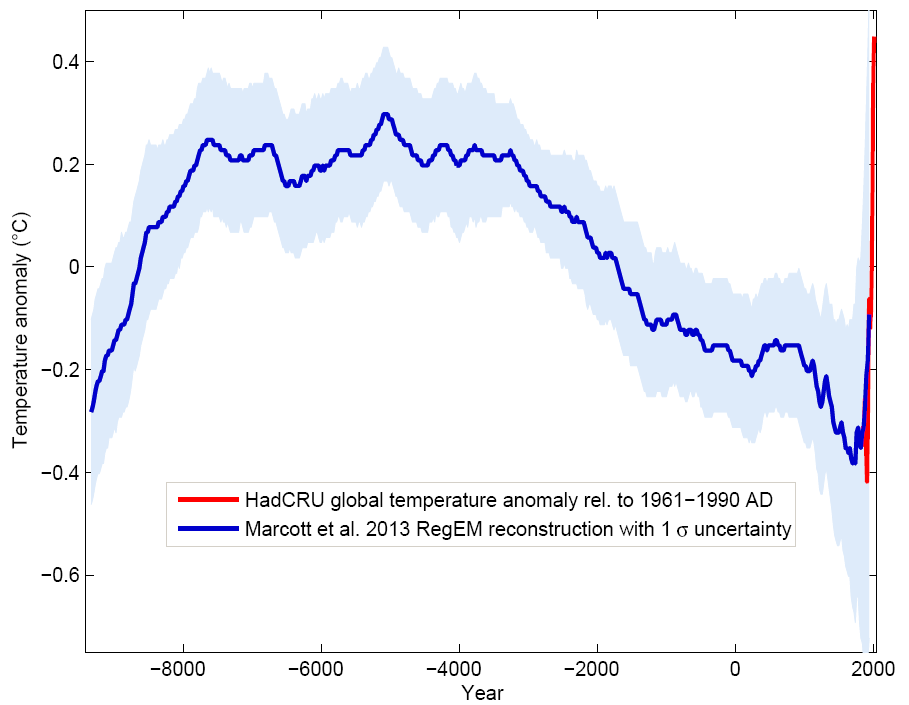
The prehistoric environment described above is not compatible with modern-day civilization and its billions of infrastructure and supply chain-dependent people. Billions will perish without the technological exoskeleton that houses, feeds, and nurtures them. Nearly all are under the spell that our money system, economy, and energy resources are somehow more vital to us than the environment upon which those manmade structures were built. What they don’t realize, or appreciate, is that nature’s ecosystems are what provide the foundation for any civilization if we want breathable air, potable water, arable land, and a planet hospitable to humans. We have gone a long way in undermining this foundation and now hold the dubious honor of being this planet’s first sentient beings to predict, document, and witness their own self-inflicted demise. This was the Holocene, as discussed here. Notice the red “temperature anomaly” spike at the very end of that era. Put in context with other geologic eras, it looks like this. See the difference? The Holocene was a very stable period compared to any other time in the deep past, but we wrecked it with our greenhouse gases. The climate system’s lag time prevents us from seeing the full effects just yet, but changes in the earth’s hydrologic cycle and weather patterns are already apparent. In response to such changes, trees are adjusting the speed at which they cycle water.
I peg the dawn of the Anthropocene at the mid 19th century when fossil fuel consumption began to take off, ramping up anthropogenic climate change:
If we expand our historic view of industrial civilization’s gargantuan appetite for energy, we see it as an aberrant blip in evolutionary time when Homo sapiens, fueled by hydrocarbon, disrupted all the major biochemical processes of the planet.
We have a 10% chance that the earth will warm 6°C by 2100 according to scientists, but the fossil fuel industry is betting it’s a sure thing by planning its future business around magical, nonexistent technologies that would remove CO2 emissions. Notwithstanding the armchair technotopian dreams of a future world that includes driverless cars, zero-point energy, and asteroid mining, we are living at the peak of capitalist industrial civilization which produces a continual flood of products promising to improve and enhance our lives but which, in the end, only complicate them. We are trapped between mindless consumerism and the thoughtless destruction of the environment. Tim Garrett calls our dilemma a double bind. The only thing that will save us from a deadly warming of the planet is the very thing that will destroy most of us if it happens —the complete crash of the global economy and its CO2 emitting process of “building wealth.” Homo economicus is too busy converting his rich environment into monetary tokens to think about the consequences of what he is doing or perceive the impending crash of the earth’s biosphere that will take care of the human overshoot problem and all the transient material wealth that has been covetously accumulated and guarded. Rising oceans, floods, fire, drought, and various superstorms from a damaged biosphere will take it all back and destroy it. For a species that has created a throw-away society, such an end is fitting. With every loss we inflict upon biodiversity, extinction creeps ever closer toward us. The consequences of ignoring the hard laws of physics, chemistry, and biology will be dire:
Countries once thought of as having relatively stable and developing economies like Brazil are now openly contemplating the use of their military in order to keep the megacity São Paulo from spiraling out of control in the face of severe climate change-driven droughts. And in the so-called First World country of America, president Obama’s science adviser is warning that “climate change could overwhelm California,” a state that grows a large percentage of what the country eats:
…The huge inertia built into the energy system — a $25 trillion worldwide investment in a mainly fossil-fuel infrastructure — is colliding with enormous momentum in the climate, which responds slowly to the buildup in greenhouse gases. The world is not even yet fully experiencing the results of emissions put into the atmosphere years ago, he said. It will take decades to turn both systems around.
“If we stopped emitting today, the temperature would still coast up for decades to come,” Holdren said.
He recalled sitting on a presidential science advisory panel during the Clinton administration.
“Quite a lot of folks were saying the impacts of climate change are uncertain and far away, the costs of dealing with it are large and close — therefore, we should wait and see what happens,” Holdren said.
“Well, like it or not, that’s pretty much what we did.”…
The mental traps and psychological defense mechanisms employed by the naked ape makes him a basket case of contradictions and ironies, simply adding more insurmountable obstacles to the insoluble problem of capitalist industrial civilization. That’s why we love dystopian operas that reflect our own twisted culture and capitalist society.
A sobering video…
Extreme weather events are rapidly increasing. Right now we are in the 6-sigma risk zone of climate change.
When past predictions of future catastrophic events like ice sheet melt, spreading tropical diseases, and forest fragmentation start to become reality while no substantial means to prevent them from happening has ever been implemented, you begin to question the phrase so often bandied about that “it’s never too late.” It was never too late decades ago and we’re still holding out on that hope. Despite any techno-utopian fantasies you hear in the news, economic activity and growth are still linked to CO2 emissions. Until this fundamental truth is dealt with, we’ll all be spinning our wheels and wringing our hands over our continued descent into ecological and societal collapse. Perhaps this is part of the reason I have not blogged recently. As Leonard Nimoy expressed in his last twitter message, I think I’ll try to enjoy the here and now while I’m alive…
The following is a guest post by commenter BP:
The majority of people visiting collapse and post-peak sites are Caucasian, disillusioned, with a slimmer majority subset being male; in other words, representatives though not participating members of the failing power elite. If these collapsitarians did wield real power, they wouldn’t be deeply dissatisfied with the present social arrangement and secretly hoping for an honest to goodness smokin’ homecookin’ cracklin’ good ole’ fashioned apocalypse to happen in their lifetime. You know, just to spice things up a little bit and provide some entertainment because industrial living can be such a boooooring, regimented drag, man. Tick tock. Time to get up, time to eat, go to work, come home, go to sleep, wake up, rinse and repeat. Even regularity in our shitting is considered desirable in this totalizing system. Watches are slave driving devices – a shackle – your very own drill sergeant and task master all rolled into one convenient portable sleek wrapped modern design. Little wonder you have so many suit and tie clean-cut preppie American Psycho types with their rictus eternally sun shining grins (everything’s alright, everything’s fine, everything’s okay) resorting to extremes: bungee jumping, sky diving, narcotics and gambling, binge eating, binge shopping, binge TV watching, auto-erotic asphyxiation, any and all manner of titillation and stimulation just to get a rise. We’ve been dulled and sanitized, tamed and neutralized. The demographic comprising most of the power elite also happens to be the one most likely to become serial killers preying on their own species. If you live in a foreign land you might argue there’s no difference between Ted Bundy and the president. Either way, it’s another fun-filled pet project to while away the hours with. But I don’t want to give anyone any ideas, and I won’t be held accountable for what you do when you turn off your addictive electronic stimulus delivery systems aka computers tonight, even though we excel at passing responsibility onto something else. The lengths people will go… And these are the lucky ones who still have jobs. YAY!! I don’t even want to imagine life on the other side – we’ll all get there soon enough. Why spoil the surprise?
So raise your hands if you’re waiting for a giant or gradual (does it really matter?) clusterfuck that results in a significant reduction in our species’ numbers, because whatever you think is likely, it’s a necessary precursor to what ever comes next. The table has already been set and our carcass is the main dish.
Now that you’ve had your fill, how about some desert? I have a thought experiment that shouldn’t take too much time. Suppose you’ve decided to kill yourself. You’ve set a date, (a week from tomorrow), a time (midnight), thoroughly planned the method (hanging), bought the needed supplies (rope – duh!), and are dead set on following through. How, if any, would your life change in the time remaining? I’ll indulge in some fantasy since there doesn’t seem to be enough of that going around and Star Wars isn’t out until December. For starters, you could max out your credit and buy that car you’ve always fancied – you know, the one that runs on limited gasoline? You could also screw a few whores and not worry about contracting a venereal disease or what you’d have to say to your wife. Gorge on that chocolate cake and go for seconds topped with ice cream this time, downed with cola and chased with both pizza and hamburgers for desert. Why not? Fuck blood pressure, you’re going to die anyway. Then after your attention deficit disorder kicks in, you could switch to watching porn, wasting time playing Modern Warfare while eating Doritos and not feel one ounce of guilt that you could be doing something more with your life. Consume shit you don’t need to your heart’s content without any second thoughts! After all, ecologically speaking, we’re consumers! Let’s take a moment to give Capitalism some credit. It found a way to manipulate our basic human nature for its own ends and boy has it ever worked. Nothing has mobilized humanity – not pharaohs, despots, kings nor gods – like the wage economy. The best part about the whole affair is you can live without consequences because, in case you forgot, you’ll be dead in a week. Sound familiar? It’s a rarity these days when ideas and reality coincide. Yep, you guessed it. That’s exactly what our species has been doing – living large like there’s no tomorrow – and it’s hastening our eventual collective suicide.
And is that such a bad thing? There’s way too much despair, self-pitying, and despondent anger on these websites. Outside of our narrow anthropocentric perspective, the human race’s demise might even be cause for celebration. If that’s too much, at least it needn’t be mournful. After all, our history on this planet has proven that, if nothing else, we’re two legged, genocide-wreaking, blood-thirsty assassins. The only species that kills for fun, whether it be bipeds, quadrupeds or any other number of peds, we’ve obliterated them all. I’m confused by all this concern about surviving in a post industrial world. Are our souls (if we even have them) really worth saving? Even if a band of hardy survivors manages to achieve some semblance of harmony with their environment, sooner or later some marauding horde is going to come along, fuck things up, steal their shit, and rape their women. Hey, we’ve had a good ride. Nothing lasts forever. Time for something else to take a turn so we can join the dinosaurs. We aren’t going to change or magically turn into peaceful, loving breathren. That’s simply more wishful thinking, a romanticization of a few mythological hunter and gatherer tribes of the past projected onto the future. The reality is we rape, love, murder, bully, give and take, enslave, create music, art, math, and take pleasure in sadism (see UFC, boxing, WWE, Clausewitzian Warfare aka NFL, the latest scandal, the natural disaster channel aka The Weather Network/CNN and your generic horror movie and cop drama), all of which is hard-wired into our DNA. The human race is folly and cleverness stuffed into a complex paradoxical package. There’s no shame in that. I don’t see the point in worrying over what’s out of our control and what can’t be changed. It’s better to laugh than cry and maybe that’s all we can do. Time to stop demonizing the species.
And isn’t it also time we accept ourselves as natural? Our criticism of all the havoc we’re wreaking on the planet implies we’re outside, removed from nature; ironic since this divide is also acknowledged as part of the problem. Nature – ‘The Environment’ – is something we act upon – not a part of. Bullshit. We’re terrestial, carbon-based omnivores. There’s not an ounce of artificiality about us. That includes the products of our actions like the much-maligned villainous scoundrel PLASTIC. Dah, dah, dah, daaahhh. So what if humans synthesized 22 out of 117 periodic elements? That manipulation, as the word implies, came at our own hands with existing elements crashing together in high-speed accelerators. A polar bear – that sacred symbol for the ineffectual environmental movement – and its particular combination of constituent elements didn’t occur naturally on Earth for most of the planet’s history either. It will soon return to that condition in short order. And what of the indignant protest that plastic doesn’t degrade? Be patient. If our species lasts long enough, which I doubt, it might get to witness that little miracle. After all, a lot can happen in the next few billion years. Making the case that plastic is natural is not to say it isn’t disruptive. Any new arrival on the scene disrupts the existing order. Some things more than others. But it still derives from the Earth, doesn’t it? And so do we. And eventually, that’s where we’ll end up – 6 feet under. Maybe it’s better if that happens sooner rather than later. But it’s going to happen one way or the other regardless the constant declarations of ‘we have to do this…,’ or ‘if we don’t do that…,’ I hear on forums, in the news, at home. We’re good at giving ultimatums that we’ll never see through. Every day there’s a new resolution and self-imposed limitation proclaimed with the most dire urgency. The truth is we don’t have to do anything. The Earth will correct a wayward entity and return to balance. The catch is the new stasis doesn’t have to include us. Even if we could do something, it’s too little, too late. So do yourself a favor, enjoy your life and stop worrying so much. Maybe even laugh once and awhile. If you want to plant a tree – do it. If you don’t – knock yourself out. There are no imperatives. We’ve been unduly harsh on ourselves. Trying to be judge, jury, and executioner is just too damn exhausting. Well, my watch tells me it’s time to go to bed. Just another day in the life of the species… Tick Tock, Tick Tock.
Championing the rapacious conversion of the Earth into dead commodities and its peoples into soulless consumers, the adherents of capitalism have succeeded in entrenching their ideology into the minds of the vast populations as the only viable economic system and way of life. Mesmerized by the electronic gadgetry of the digital age and singing the praises of the “free market”, atomized citizens blissfully hack away at the tree of life that supports them. The bio-destructive power of capitalist industrial civilization stamps out the poetry of nature, silencing entire ecosystems. This essay by Kenn Orphan describes the mindless march towards self-destruction and the redemption that comes by bearing witness to it.
“Extinction is the rule. Survival is the exception.” – Carl Sagan
We are all witnesses to the Great Dying, a sixth mass extinction, the last one being 65 million years ago which wiped out the dinosaurs. This is not hyperbole; it is a defining feature of our age.
Countless species are falling prey to the wealthy’s indifference, militarism and folly everyday. As in ancient civilizations, the wealthy and the privileged are generally the last to feel the pain of collapse, yet are most often the root cause. And compared to the mass of humanity we share this planet with, and as a result of rapacious exploitation and plunder, Americans, and westerners in general, are the wealthy and the privileged of modern civilization.
Despite overwhelming evidence of crashing ecosystems, many of us living in the twilight years of the American empire seem oblivious to the canaries in the coal mine. Every…
“Cannot you see, cannot all you lecturers see, that it is we that are dying, and that down here the only thing that really lives is the Machine? We created the Machine, to do our will, but we cannot make it do our will now. It has robbed us of the sense of space and of the sense of touch, it has blurred every human relation and narrowed down love to a carnal act, it has paralyzed our bodies and our wills, and now it compels us to worship it. The Machine develops – but not on our lives. The Machine proceeds – but not to our goal. We only exist as the blood corpuscles that course through its arteries, and if it could work without us, it would let us die.”
~ E.M. Forster, “THE MACHINE STOPS”
Insects, birds, mammals, and fish have all been migrating to cooler zones for the past four decades in response to the cataclysmic climate disruption ignited by industrial civilization, but humans are the only organisms inhabiting this blue orb we call Earth who are not altering their behavior. They live within an energy cocoon that keeps them cool in the summer, warm in the winter, stuffed with massed produced food from mechanized factory farms, and entertained by a virtual world of digital imagery. As cracks and holes in the Earth’s biosphere grow ever larger, the natural response of capitalist carbon man ensconced within his protective energy shell is to try to put a price tag on what is being burned, i.e. fossil fuels, rather than deal with the deeper root cause of an unsustainable economic system and way of life which demands such exorbitant consumption of resources.
Our energy slaves feed us and control the climate for us while at the same time destroying the natural world that had enabled humans to create such an artificial environment. Detached from nature and enslaved by our own technological creations, we sleepwalk over the cliff of extinction. Our so-called progress will, in the end, disappear like a mirage in the scorching desert sun as nature is sacrificed to the machine of industrial civilization.
Throwing money into the maw of the ‘free market’ is the predictable modus operandi of technocapitalism’s indoctrinated disciples who believe such offerings will create a technofix, miraculously healing the planet. In the Star Trek TV series, the Ferengi were an extraterrestrial race whose culture was characterized by “a mercantile obsession with profit and trade, and their constant efforts to swindle unwary customers into unfair deals.” Just like the Ferengi species where profit is the first, last and only important factor, the high temples of private enterprise are commodifying and monetizing the atmosphere just as they have everything else in nature. The colonization of the public mind by capitalism is complete and overriding. We ignore unfolding geologic forces and instead put our faith in manmade market forces to our detriment.
In the final days of capitalist industrial civilization, the relentless and compulsive pursuit of profit and growth has subsumed any intelligent and realistic plans for survival. In fact, with the race amongst nations for nuclear technology and sophisticated weaponry, the requisite competitive economy to support such hi-tech militaries nullifies any attempts at reducing greenhouse emissions and pushes the world towards nuclear annihilation. As Kevin Lister, author of the forthcoming book The Vortex of Violence and why we are losing the battle against climate change, points out:
…The fundamental dilemma all nuclear weapons states face is that to maintain a credible nuclear force, be it a force of one or one thousand nuclear warheads on deployment, a massive military industrial complex must be maintained. As well as building the actual nuclear weapon systems, it must also provide the conventional defence screen consisting of fighter jets, patrols planes, anti-submarine warfare technology etc. In an ultimate irony, the purpose of these becomes to defend the nuclear forces to ensure a second strike can be launched rather than to defend people, because there is no defence against a determined nuclear attack. The military industrial complex that delivers this equipment must be continually fed with new streams of contracts at increasing values otherwise the industrial complex collapses. Thus a key objective in the initial gate document which justified to parliament the early procurement of material for Trident was that, “We must retain the capability to design, build and support nuclear submarines and meet the commitment for a successor to the Vanguard Class submarines.” In other words, we build Tridents to continue building Tridents.
The enormous cost of this needs to be covered by taxes, and for this some £500 billion of additional excess economic activity is needed which requires energy from fossil fuels and is the antithesis of making the urgent cut backs we need to tackle the soaring greenhouse gas overburden. Thus once the decision is made to proceed with Trident, it becomes impossible to make the climate change agreements to save the planet. In this context Trident is more dangerous than we ever first thought and it is the ultimate Faustian bargain.
Your commissioners have also failed to acknowledge in their report that the public spending that will be needed on Trident must be made at the same times as scarce public funds must be diverted to building a low carbon economy and mitigating the effects of climate change such as flooding and storm damage. This conflict will arise as tax receipts simultaneously drop through energy price rises.
The impossibility of meeting these conflicting challenges is the reason that much of the negotiations at climate change conferences takes place around the positions of the nuclear weapons states and their need to maintain large military industrial complexes and competitive and expanding economies to fund these…
…to build at huge expense a nuclear force whilst the nation is effectively bankrupt that will never provide secure protection from nuclear attack and merely encourage our competitors to reciprocate. It drives a race to the bottom where rational decisions on climate change can never be taken.
This nexus between global capitalism, the lucrative military-industrial complex, and the strategy of nuclear deterrence has locked the nations of the world into a trajectory of escalating anthropogenic climate disruption, environmental degradation and an ongoing arms race since World War II. Illustrative of this are the energy consumption levels of the U.S. DoD and war profiteering motives of defense contractors:
…The US military is the largest single consumer of energy in the world. If it were a country, the Department of Defense (DoD) would rank 34th in the world in average daily oil use, coming in just behind Iraq and just ahead of Sweden…
…Electricity usage by the military, which accounts for even more greenhouse gas emissions, is also gargantuan. In FY 2006, the DoD used almost 30,000 gigawatt hours of electricity at a cost of almost $2.2 billion. The DoD’s electricity use would supply enough electricity to power more than 2.6 million average American homes.
In fiscal year 2012, the DoD consumed about a billion gigawatt hours of site delivered energy at a cost of 20.4 billion dollars. While consuming that amount of energy, DoD emitted 70 million metric tons of CO2. And yet, total DoD energy use and costs are even higher simply because the energy use and costs arising from the contractors to support military operations both domestically and abroad are not included in DoD’s data…
…The increased propensity for war and conflict brought about by global warming is being exploited by the military-industrial complex which is planning on how to profit from it. Defense contractors are looking at climate change as a growth and profit opportunity due to the potential conflicts produced by food and water shortages. They are salivating over the potential profits to be made leading to increased stock market performance and, therefore, higher CEO compensation.
Defense contractors are setting their sights on a narrow-minded militarist approach. Indeed, the very companies most responsible for climate change are set to make a killing from its intensification. – link
Only one civilization in history has voluntarily uncomplicated/decomplexitized its society in the face of resource scarcity. According to Joseph Tainter, that civilization was the Byzantine Empire:
“After the Byzantine empire lost most of its territory to the Arabs, they simplified their entire society. Cities mostly disappeared, literacy and numeracy declined, their economy became less monetised, and they switched from professional army to peasant militia.”
…Because the human ape is such a competitive and vicious sort, there must be a constant “progress” in technology and development to prevent being eaten by or dominated by another nation. Evolution writ large. Without a doubt it will end soon and nothing shall remain but the Ozymandian technological skeletons of times gone by…
As a warming planet cooks our brains and scrambles our environment, the trigger finger of some mentally ill and agitated soul may just belong to someone sitting at the launch button of a nuke. As Albert Einstein said, ‘I know not with what weapons World War III will be fought, but World War IV will be fought with sticks and stones.’
President Obama recently unveiled his plans for America to cut its CO2 emissions 30% compared to 2005 levels by 2030 “to limit warming below the 2˚C ceiling agreed by countries“, a plan that Al Gore declares “the most important step taken to combat the climate crisis in our country’s history.” I’m here to explain to you that if that is the best the human race can muster, we’re trapped in a very sad state of anthropocentric denial.
Keeping in mind that humans of industrial civilization have thus far warmed the planet by 0.85˚C in the last couple hundred years, the extreme weather events that have occurred just in the last decade, let alone in the last year, are clear evidence of an increasingly destabilized climate system. Catastrophic changes in the glacial zones of the Arctic and Antarctic have been set into motion, altering global jet streams and weather patterns as well as locking in a sea level rise that will make most coastal cities uninhabitable within a couple of generations. Thus we can see that the target of 2˚C is a totally fraudulent upper limit for anything safe; industrial civilization has already passed the point of no return into climate chaos.
The US political system is so broken, so blatantly an open bazaar where corporations can buy public policy puppets like so many street hookers, that it’s hard to imagine any policy stronger than the new EPA proposal going into effect and not being killed by the next presidential administration or strangled by the purse strings controlled by the Congress…
The commercial, capitalist part of society has completely outstripped the interests of humanity as a whole. In the case of fossil fuels, private firms and individuals are carrying out activities which are having dire consequences for everyone, but corporations are only interested in their own advantage and in fact are required by law to place shareholders’ interests above all else with no regard to the long-term well-being of the global community and future generations.
Although CO2 emissions have fallen in the U.S. in recent years due primarily to electricity plants switching to the cheaper source of natural gas, they have jumped back up once again according to the latest reports. Demand for coal abroad has also been on the rise with the U.S. exporting its supply to meet the demand. However, most disturbing is the following graph which illustrates that in the last 164 years, no new energy source has ever stopped our expanding usage of fossil fuels. Levels of carbon extraction are perhaps a more telling indicator of the primacy of fossil fuels and the direct correlation between economic growth and global emissions than the energy statistics of any one particular country:
…as Mike Berners-Lee and I argue in The Burning Question, despite radical changes in the global energy mix over the last two centuries (and even more radical changes within individual countries) energy use and carbon emissions have undergone remarkably consistent long-term exponential growth. The implication is that there’s a technological and social feedback loop at work, with each new energy source increasing access to and demand for all the other sources. Energy begets energy.
The graph below, which shows total human energy use since 1850, reflects this. When coal use took off in the nineteenth century biomass energy didn’t decline as is often assumed. In fact it increased, helped rather than hindered by coal-powered industrialisation and globalisation. Similarly, coal use increased when society started extracting large amounts of oil – which makes sense given that oil not only proved useful for coal mining but also enabled the mass roll-out both of cars and energy-hungry suburban homes. In turn, gas and hydro helped drive technological and engineering revolutions that have made obscure oil sources more viable…
…The fact that new energy sources tend to be additional to existing ones helps explain why more gas production has dinted neither US carbon extraction nor global emissions. But critics of gas beware: the same caveat applies to genuinely low-carbon energy sources such as renewables and nuclear, or indeed increasing energy efficiency. We usually assume that installing a wind turbine or nuclear plant will reduce global emissions but that’s not necessarily true, since the fossil fuel that the clean energy system replaces may get burned elsewhere instead, perhaps kick-starting new energy feedback loops in other parts of the world and driving global carbon emissions up yet further.
In some cases there has even been talk of using low-carbon energy sources directly to increase fossil fuel flows. For example, modular nuclear reactors are being considered as a way to propel natural gas down the remote pipelines that bring energy to Europe’s homes and power plants, or for melting tar to produce oil for the world’s billion-strong car fleet. This seems crazy at first given that it would be more efficient and less polluting to use the nukes directly for producing electricity, but existing infrastructure can determine our energy choices as much as the available energy sources do…
…there’s little evidence so far that fracking, wind power, nuclear or any other technology is helping us leave any carbon in the ground. Indeed, as I wrote recently, despite all the renewable power installed so far, all the fracking rigs, all the energy efficiency gains, all the national carbon cuts, and even a collapse in average fertility levels, global emissions are still growing at the same rate today as they were in the 1850s… – link
In The Biophysics of Civilization, Money = Energy, and the Inevitability of Collapse, a similar correlation was demonstrated between money (the economy) and CO2 emissions. Without fundamentally changing the economy’s dependency upon growth and profit, emissions will continue to rise and deceptive non-solutions will continue to be sold to the public. Even if all human industrial activity ceased this instant, we would still be looking at upwards of a 2.65˚C temperature rise, but capitalist industrial civilization is a superorganism that is on an unwavering trajectory. The scales have been tipped out of favor for mankind. The geologic pendulum will swing back to bring things into balance over millennia, and in the process industrial civilization will be crush beneath the iron hand of natural law.
One look inside the self-serving and hypocritical mind of those running in society’s elite circles will tell you there is no chance for any radical departure from the moribund thinking which keeps the rotted status quo in place.
[Nate Hagens: …from a (good?) friend of mine – married to a billionaire, very connected, energy investment guy – i sent him the EPA announcement]
Nate,
You have seen the movie Idiocracy, right? Well President Mountain Dew Commacho in that movie is a better leader than BO. At least Commacho knew sometimes you need to listen to smart people & put them in charge.
Long story short, the presidency is in meltdown mode. Everyone has figured out what I told you…he is a bad guy. Whether you definition of “bad guy” is a person who used his skin color to get where he is in DC then holding the US hostage to his bitter, bigoted edicts; or just a lucky ne’er do well who wanted to save the world, but instead made it worse. HE IS DONE! <<<the exclamation point is Carney quitting.
Nate, none of what he does means squat (especially the agencies like EPA)…dems/repub know it. Next elections will save the economy for 20-30 more years…I know you & I disagree on the timeline. I hope, and pray, you are wrong…but I do know your logic is correct.
Best,
Jxxxxx
Buy coal/BTU tomorrow on the dip.
Like the radiation from Fukushima, CO2 emissions are invisible and their calamitous effects can play out over generations. The masses simply can’t stomach hard reality when they are entranced by a techno-capitalist wonderland of mental distractions and virtual reality pitfalls.


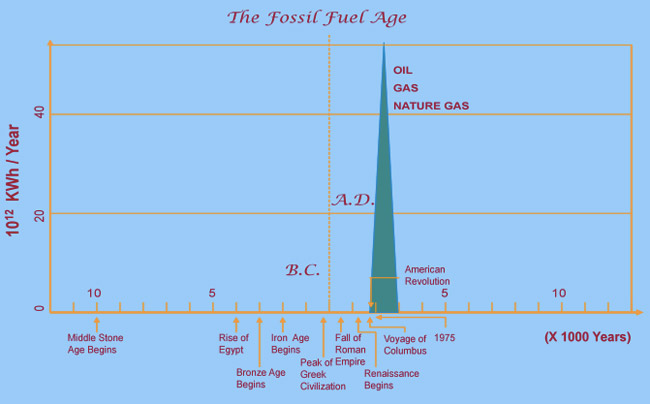

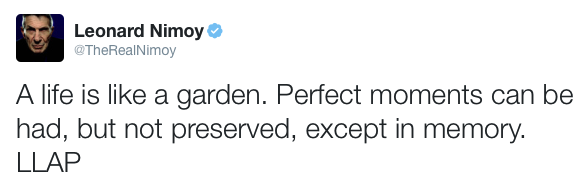



 Collapse of Industrial Civilization