Radioactive Wastelands at the End of the Anthropocene

Tags

, , , , , , , , , , , , , , , , , , , , ,

BeFunky_1301218709698.jpg

A History of Cover-Ups and Ineptitude Leads to Catastrophe

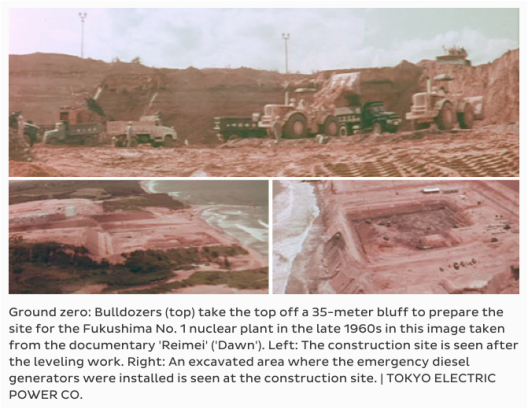
One of the most costly, self-inflicted wounds engineered by techno-capitalist man is the never-ending Fukushima nuclear disaster. The groundwork for epic failure at the Fukushima Daiichi nuclear power plant began in the 1960’s when TEPCO bulldozed 25 meters off of a 35-meter-high hill in order to facilitate the delivery and set up of the plant’s large equipment, which was delivered by boat, as well as to provide easier and cheaper access to seawater used as a coolant pumped through the reactors. TEPCO then dug even further downward another 14 feet to construct the basement where emergency diesel generators would be installed. Decades later a tsunami would easily flood this area, knocking out the emergency electrical back-up generator and making nuclear meltdown a certainty.
Snap 2014-06-13 at 08.48.20In the early 1970’s, several memos circulated within the U.S. Atomic Energy Commission (AEC) expressing concern over design flaws of the Mark I nuclear reactors made by General Electric, the same type installed at the Fukushima No. 1 nuclear plant. Recommendations were made to stop licensing reactors with these faulty designs and the top safety official at the AEC, Jospeh Hendrie, agreed with them but rejected their implementation on the grounds that it could do irreparable damage to the nuclear industry:

“..the acceptance of pressure suppression containment concepts by all elements in the nuclear field, including Regulatory and the ACRS, is firmly embedded in the conventional wisdom. Reversal of this beloved policy, particularly at this time, could well be the end of nuclear power. It would throw into question the continued operation of licensed plants, would make unlicensable the G.E. and Westinghouse ice condensor plants now in review, and would generally create more turmoil than I can stand thinking about.”

The last line of defense in preventing the ionizing alpha, beta and gamma radiation and radioisotopes inside melting fuel rods from spewing out into the environment is the containment vessel. The poor design of the now ruptured Mark 1 containment vessel in Fukushima is most certainly contributing to the ongoing disaster there. The U.S. apparently has 23 reactors just like the ones that melted down in Fukushima as well as the risky storage of spent fuel rods next to the reactor building itself.

When the Tōhoku tsunami struck at Fukushima, reports describe chaos and incompetency as workers had to bring protective gear and manuals from distant buildings as well as borrow equipment from contractors. The failure of the Japanese government and TEPCO to imagine such a catastrophic event and guard against it is highlighted by the fact that this exact scenario was predicted in a Japanese magna comic book.

Years went by with only a few lone voices questioning the safety of the Fukushima nuclear plant such as former engineer Toshio Kimura who worked there:

I asked my boss back in the late ’90s what would happen if a tsunami hit the Fukushima reactors. I said, “Surely a meltdown will happen.” He said, “Kimura, you are right,” but it was made clear that the issue of a big tsunami was taboo. A few years later I quit the company because of its culture of cover-ups…

When officials from the nuclear safety agency or the ministry came to the plant for inspections, they were entertained with drinks the night before. Then they would inspect the plant and give it a hundred per cent pass mark. Then on the way home the inspectors were given beer and snacks and taxi vouchers.

2000px-tepco_logo-svg-trans-9

Run by the Utility Gangs

Entire communities have been bought off by corporate interests to become ruled by what is known as the “nuclear village” in Japan:

Tokyo has been able to essentially buy the support, or at least the silent acquiescence, of communities by showering them with generous subsidies, payouts and jobs. In 2009 alone, Tokyo gave $1.15 billion for public works projects to communities that have electric plants, according to the Ministry of Economy, Trade and Industry. Experts say the majority of that money goes to communities near nuclear plants.

And that is just the tip of the iceberg, experts say, as the communities also receive a host of subsidies, property and income tax revenues, compensation to individuals and even “anonymous” donations to local treasuries that are widely believed to come from plant operators.

Unquestionably, the aid has enriched rural communities that were rapidly losing jobs and people to the cities. With no substantial reserves of oil or coal, Japan relies on nuclear power for the energy needed to drive its economic machine. But critics contend that the largess has also made communities dependent on central government spending — and thus unwilling to rock the boat by pushing for robust safety measures.

In a process that critics have likened to drug addiction, the flow of easy money and higher-paying jobs quickly replaces the communities’ original economic basis, usually farming or fishing.

The Japanese news media, just as in the U.S., has also been corrupted and taken over by monied-interests:

The mainstream media has long been part of the press-club system, which funnels information from official Japan to the public. Critics say the system locks the country’s most influential journalists into a symbiotic relationship with their sources, and discourages them from investigation or independent lines of analysis…

…Japan’s power-supply industry, collectively, is Japan’s biggest advertiser, spending ¥88 billion (more than $1 billion) a year, according to the Nikkei Advertising Research Institute. Tepco’s ¥24.4 billion alone is roughly half what a global firm as large as Toyota spends in a year.

And just like in the U.S., corporations have used “donations” to capture Japan’s political system:

Members of the Liberal Democratic Party, which has ruled Japan since 1955 except for a year in the 1990s and for a three-year period ending in 2012, have been rewarded for their pro-nuclear stance with campaign donations from the ten giant electrical utilities that control around 96 percent of the nation’s power supply.

The largest of these, the Tokyo Electric Power Company or Tepco, formally ended its direct corporate donations in 1974. But it systematically encouraged “voluntary” donations by company executives and managers to a fund-raising entity created by the ruling party, according to a 2011 investigation by Asahi. At least 448 Tepco executives donated roughly $777,000 in total to the entity between 1995 and 2009, according to documents obtained by Asahi and shared with the Center.

Roughly 60 percent of Tepco’s executives participated, a rate similar to that at other utilities. Together, they funded $2.5 million of the party’s expenses, based on today’s exchange rates. A Tepco spokesman told Asahi that the donations were “based on the judgment of the individual and the company is not involved. We do not encourage such donations.”

The culture of complicity between the Japanese nuclear industry and the government is firmly entrenched with generations of high level bureaucrats having landed jobs at Japan’s large utility companies. This revolving door between corporations and the Japanese government mirrors that of the U.S.:

Tepco’s influence has also been enhanced by its enthusiastic participation in revolving door-employment practices similar to those involving bureaucrats and companies in Washington, D.C.

A METI report in 2011, prepared at the insistence of nuclear opponents in Japan’s tiny Communist Party, said for example that between 1960 and 2011, Tepco hired 68 high-level government officials. From 1980 to late 2011, the report said, four former top-level bureaucrats from METI’s own Agency for Natural Resources and Energy became vice presidents at other electric utilities. The practice is known here by the amusing term, amakudari, for appointees who “descended from heaven.”

Tepco officials also regularly move into key regulatory positions, part of a migration known as ama-agari, or “ascent to heaven” that has involved dozens of top utility officials. More than 100 such utility executives between 2001 and 2011 were able to keep drawing an industry paycheck while also working part-time for the government, a practice that is legal here, according to a former member of the Japanese Diet Lower House Economy and Industry Committee, who spoke on background. An official working in the Nuclear Regulation Authority’s research division, in an interview, said on condition of anonymity that the ama-agari system is “like having cops and thieves working in the same police station.”

Perhaps the most significant instance of ama-agari was the Liberal Democratic Party’s appointment in 1998 of Tokio Kano, a longtime Tepco executive, as chairman of the parliamentary committee that oversees METI and as the parliamentary secretary of science and technology. Both are posts crucial to the nuclear energy industry, and Kano used them to advance legislation enabling plutonium-based fuel to be burned in some standard reactors — not just breeders. He also pushed through a law requiring that all spent nuclear fuel be sent to Rokkasho or similar Japanese plants.
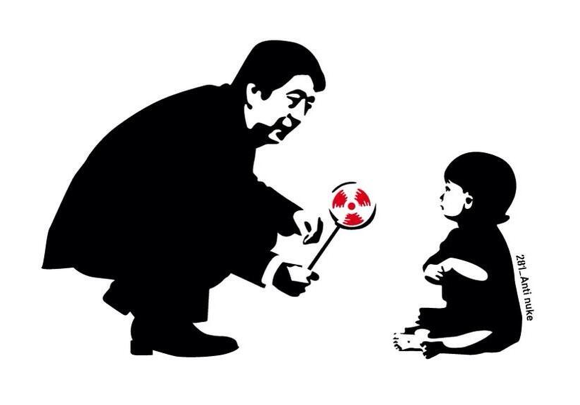
Snap 2014-06-10 at 23.06.53

Corporate Fascism in Japan

Embarrassed by the constant revelations of regulatory and governmental capture by industry, the Japanese government recently passed a state secrets law meant to intimidate and jail those who cast a prying eye into Japan’s corrupt corporatocracy. After the Japanese government restarted its idled nuclear plants last year, those antagonistic towards the nuclear industry were secretly put on a watch list. The ominous experiences of independent investigative reporter Mako Oshidori with Japan’s nuclear industrial complex are reminiscent of the movie Silkwood. She discovered that she was on the government’s watch list and has now noticed an individual closely tracking her every move:

…The list included people with power in the opposition parties, such as the former prime minister Naoto Kan and the politician Ishiro Ozawa, and I was told that my name, Mako Oshidori, was listed alongside these names. A researcher who was given the list and told not to approach anybody on it was friendly with me and told me the list included my name. Soon after that a mysterious man began to follow me. This man appeared to be a member of Public Security Intelligence Agency in the Cabinet Office, which investigates various things. One of my hobbies is taking a candid shot, and I will show you the successful candid shot of this man. 

_

Just as you see here, there was a time period when someone would always be near me, trying to eavesdrop on my conversation with people. As I am a professional entertainer, whoever I am talking to would ask me if the person was my manager. I would say that the person must be one of my groupies, as I have never met the person. Sometimes I would go to Fukushima Prefecture to interview different mothers. We would have meals together and talk somewhere, and when the mothers are leaving the premise to go home, an agent from the Public Security Intelligence Agency would take a photo of each mother and make a note of the license plate number of each car. Afraid of having their photos taken or the license plate numbers recorded, some Fukushima mothers would refused to be interviewed, or they would even refuse to have their stories published. An ex-agent who is knowledgeable about the work of the Public Security Intelligence Agency said that when you are visibly followed, that was meant to intimidate you. If there was one person visible, then there would be ten more. I think that is analogous to cockroaches. So, when you do a little serious investigation about the nuclear accident, you are under various pressure and it makes it more difficult to interview people. There are actually other journalists from major newspapers and television stations, other than me, who have done a lot of investigation about the nuclear accident, but the information doesn’t readily come out. That’s because the pressure is placed on them not to release the information. What I am going to tell you now might surprise you, but the Japanese people are just as surprised when I tell them the same information as it’s something they have never heard of, read in the newspaper, or seen on TV…

Despite the great tragedies with nuclear weaponry and technology that Japan has experienced with Hiroshima and Nagasaki and now Fukushima, these instruments of mayhem and death are ironically becoming a key centerpiece in the Japanese economy with the current right-wing government banking on it as an export cash cow:

Exports of nuclear components and technology, as well as conventional arms, are potentially key elements of “Abenomics” and much is riding on the outcome. In 2013, Abe concluded Japan’s first nuclear reactor export agreement with Turkey for $22 billion and others are pending with Saudi Arabia and the United Arab Emirates, while the prime minister has also lobbied governments in Central Europe, Vietnam and Indonesia. This is a remarkable turnaround from 2011 when the prospects for post-Fukushima Japan relying on nuclear energy, let alone exporting it, looked unlikely.

The seeds for Japan’s nuclear hara-kiri were planted back in the early 1950’s when the American government hatched a propaganda campaign of developing an atoms for peace” mission in Japan to foster pro-nuclear sentiment and help rebuild their economy using such technology. 

The Center for Public Integrity reports that Japan is leading the charge for a new nuclear industry of plutonium-based nuclear fuel with grave implications for spreading this technology and material all over the world. By October of this year, Japan will have finished a $22-billion plutonium factory in Rokkasho which will be able to produce enough plutonium per year to make 2,600 bombs. It appears Japan is lurching towards militarism in an age of end-stage capitalism:

The US-Japan Security Treaty of 1960 stipulates that an attack on Japan will be regarded as an attack on the United States. Prime Minister Abe is seeking to transform Japan’s constitution to permit engagement of the Japanese armed forces in aggressive wars. But it is difficult to imagine a resurgent military posture by Japan without tacit encouragement from Washington.

The highest stage of monopoly capitalism is fascism. The 2008 global economic crisis of capitalism, still unresolved, is forcing ill-advised and counterproductive “austerity measures” on decaying capitalist societies throughout Europe and in Japan, where Prime Minister Abe is restructuring the economy into the very pro-market system which is producing riots throughout Western Europe, as living standards deteriorate drastically, and the income inequality gap becomes an abyss.
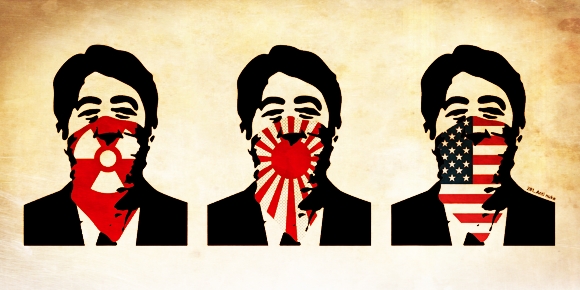
BeFunky_AntiNuke-580.jpg

A Nuclear Bomb Explosion Versus A Nuclear Meltdown

Some ask why Hiroshima and Nagasaki were rebuilt and repopulated so soon after a nuclear bomb blast, yet Fukushima and Chernobyl remain unsafe to inhabit into the indefinite future. The answer lies in the vast difference of irradiating potential between a nuclear bomb and a nuclear reactor.

Nuclear bombs are designed to cause maximum concussive damage within the shortest amount of time by creating as much energy as possible from a runaway nuclear fission reaction. Nuclear reactors on the other hand are designed to create a low-level of energy from a very controlled and sustained nuclear fission reaction. The radioactive isotopes from the fission product mixture of a nuclear bomb are relatively short-lived (<50 years) whereas those from the meltdown of a nuclear reactor are long-lived and must be stored away safely for tens of thousands of years (essentially forever). Approximate half-lives of some of the isotopes in the spent nuclear fuel are:
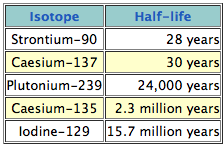
Snap 2014-06-14 at 18.59.27

The nuclear bombs used in World War II were detonated roughly 2,000 feet above ground and their radioisotopes were carried by the wind and dispersed over a very large area. The nuclear bomb called “Little Boy” used over Hiroshima contained only 140 pounds of fissionable material (Uranium-235) and “Fat Man” used over Nagasaki contained just 14 pounds of Plutonium-239. These are minute amounts of radioisotopes when compared to the 180 tons of nuclear fuel at Chernobyl and the staggering 1,600 tons at Fukushima. Explosions and meltdowns at nuclear reactors occur at ground level, creating more radioactive isotopes due to neutron activation with the soils while spreading their radiation across the planet, year after year after year. Today the background radiation in Hiroshima and Nagasaki is said to be the same as the global average anywhere on Earth. Ground zero at Chernobyl and Fukushima won’t be habitable for 20,000 years or longer. Nuclear bombs kill hundreds of thousands of people instantly while a nuclear reactor meltdown kills people over years, decades, and generations.

Not Enough Thumbs to Plug the Nuclear Dyke

The too-big-to-fail TEPCO is now building the Great Ice Wall of Japan to stem the flow of tons of contaminated water that they have been hastily storing in hundreds of haphazardly constructed containers.

“I must say our tank assembly was slipshod work.” ~ TEPCO worker

The “experts” estimate that it will take 40 years to clean up the Fukushima mess. That would put us at the year 2054, a date that many estimate humans may well be extinct or nearly extinct. By then, ocean acidification will have doubled and the global average temperature will have risen by at least 4 to 6.5°C. The world’s oceans will have swelled 2 feet higher. I’m glad to know that the “experts” are taking into account our radically changing planet:

Nuclear plants were originally given a license to operate for 40 years, and in the late 1990s, the NRC began accepting applications to extend those licenses for an additional 20 years. While it’s not clear how many current plants will still be operating in 2100, most facilities store their nuclear waste on-site, where it can continue to emit radiation for thousands of years. There is currently no long-term national storage site for spent nuclear fuel in the U.S., as Congress cut the funding to build such a facility at Nevada’s Yucca Mountain in 2011. While there are no near-term plans to remove nuclear waste from the coastal plants threatened by rising seas, “the expectation is that [waste] won’t remain on-site,” said NRC Senior Public Affairs Officer Roger Hannah.

Despite the increased risk of flooding due to rising sea levels, some plant operators have not factored this into their long-term plans. In 2010, when Florida Power and Light Company applied for a license to build two additional reactors at the Turkey Point Nuclear Generating Station in Homestead, Florida, the NRC asked the plant’s owners to explain “how potential sea-level rise due to potential future climate change is accounted for” in their plans, NRC documents show. The company declined to discuss climate change in its analysis, and used a projection that assumed a constant sea level rise of just 1 foot per century, which is 5.6 feet lower than NOAA’s worst-case projection for 2100.

 Boy, I hope that ice wall works

The risks to the ocean, in particular, are unprecedented because there is good reason to believe that melted fuel residing in, or below, the reactor basements is in direct contact with an underground river running through the site (Nagata, 2013).

A German study modelling the effects of an uncontained core meltdown suggests the Pacific Ocean is imperiled. The “German Risk Study, Phase B” found that a core meltdown accident could result in complete failures of all structural containment, causing melted fuel to exit the reactor foundation within five days (cited in Bayer, Tromm, & Al-Omari 1989). Moreover, the study found that even in the event of an intact building foundation, passing groundwater would be in direct contact with fuel, causing leaching of fission products. Strontium leaches slower than cesium. A follow-up German study, “Dispersion of Radionuclides and Radiation Exposure after Leaching by Groundwater of a Solidified Core-Concrete Melt,” predicted that strontium contamination levels would rise exponentially years after a full melt-through located adjacent to a river (Bayer, Tromm, & Al-Omari, 1989).

The study predicted concentrations of Strontium-90 in river water would spike relatively suddenly, but maintain extraordinarily high levels of contamination for years. Strontium bio-accumulates in the human body, including the brain, and is a known genotoxin. The study’s experimental conditions are roughly similar to Daiichi’s site conditions and strontium levels have been spiking there since the summer of 2013. TEPCO just reported that strontium levels in reactor basement water ranged from 40 million to 500 million becquerels per liter (“TEPCO to Improve,” 2014).

Global Corporatocracy: Privatized Profits and Socialized Losses

Tags

, , , , , , , , , , , , , , , , ,

David Cay Johnston is, as he states, not a socialist, but a capitalist who believes in fair and competitive markets and integrity. My blog concentrates quite a bit on environmental issues and David only passingly mentions the deregulation and rolling back of environmental laws in the interview below, but he has been writing about inequality since the 1960’s and does a great job of describing the “governmental capture” by multinational corporations. An overwhelming proportion of environmental destruction is being caused by these mammoth corporations that are literally a state within a state, so it’s important to make the connection between inequality/political disenfranchisement and the destruction of the environment driven by a “business aristocracy” which has usurped the institutions of society. There can be no social, environmental, and climate justice if there is no government to serve the people. Of particular interest is the interview with Steve Coll and the power that ExxonMobile wields. Three notable examples of government acting as an insurance agency for corporations while leaving a mess for the common people to deal with are the BP oil spill, TEPCO’s Fukushima disaster, and the mortgage crisis created by the Too-Big-To-Fail Banks.

Government rules and policies have been put in place to create the huge wealth gap in America:

– political economy, an amplifying feedback loop where wealth begets access to the rules in politics which begets changes in the rules which reinforce wealth.

– 45 years ago the media was staffed by blue-collar intellectuals. TV news media is now filled with people from wealthy households whose life experience tells them that things are just fine in the world. We’re not hearing about those exploiting the system for their benefit. Very little coverage of poverty as well. The U.S. has the highest % of children who go to bed hungry of any modern country.

– The most important period of determining your lifetime health and well-being is from conception to the first 6 months of life. Little to nonexistent programs and support for mothers and newborn babies in America. Just as the U.S. is neglecting its infrastructure by not maintaining and investing in it, we are also stealing from the future by not nurturing and providing proper care for small children. There will be a price and it will be very high.

– U.S. has been living under Reaganism since 1981 in which we worship money and our measure of the country is money. The purposes of our country were written down for us in the preamble of the Constitution: justice, the general Welfare, common defense, domestic tranquility, liberties. Nothing in the preamble talks about getting rich. That’s a byproduct of these other things, but we have gotten a distorted view of what’s happening and now have 33 years of evidence that Reaganism has made the rich richer at the expense of the 90%. We are mining the 90% to benefit the super-rich rather than creating an economy that benefits everyone.

– The number one driver of this crooked system is campaign finance. There are over 100,000 people in this country whose job it is to mine the public treasury or the rules for their benefit. This corrupt system has to be changed.

– The way we think about this country and its society needs to change. The founders actually wrote a great deal about their concerns over inequality. John Adams, the second President, wrote that his fear was that a business aristocracy would arise to destroy the country, making workers mere wage earners instead of craftsmen owning their own tools. These wage earners, not being truly independent, would be manipulated into voting for policies that would benefit the business aristocracy and we would lose both our liberties and democracy. Adam Smith, in The Theory of Moral Sentiments, talks about inequality being corrosive to the very fabric of society and says that “the greatest corruption of our moral sentiments is the tendency to almost worship the rich and to hold in bad regard people who are poor.” Our politicians reflect this even though many of them will tell you at any moment how religious they are. They obviously have not studied their religious text because if they did they would know that, in the case of the Christians for example, you were required to “give all that thou hast to the poor.”

– Reaganism has led to an enormous concentration of wealth amongst a small minority who cannot possibly consume that wealth and instead are investing it in financial instruments to extract more wealth rather than investing it in the economy. We don’t have to burn more fossil fuels to grow the economy; there are other ways to do that.

– We pay big corporations to not pay their taxes. The way this happens is that corporations are limited in the amount of money they can hold in the U.S., so the corporations get around this by offshoring their money in foreign bank accounts and then turn around and buy U.S. treasuries. The interest they earn from these treasuries will eventually exceed the value of the tax on that money, when and if these corporations decide to bring the money back into the U.S.. This scheme has literally become a profit center for the corporations.

– When this country was founded, there had been only seven corporations in the old british colonial United States at the time of the Declaration of Independence. Six of them were what today we would either call a charity or a utility. The Boston Water Works is a good example; it was the very first one and was essentially a utility. One corporation created in the colony of New Haven was set up solely to make profit. It was such a scandal they had to shut it down within a year and it took ten years to clean up the mess. The founders disliked and distrusted corporations, but they believed in collective bargaining because in 1792, Congress passed the first significant labor law and subsidy law based on a study conducted by Thomas Jefferson. It was to revive and protect the cod fishing industry ravaged by the British Navy. The class of fisherman known as “sharesmen” were able to negotiate with the wealthy ship owners in order to share in the profits. Those ships who participated in sharing their profits with the fishermen were given the subsidy and those who did not were exempt from the subsidy.

– Violent, explosive rise in executive pay which diverts CEOs from the welfare of the company. All large pools of capital that are owned collectively (charitable endowments, pension funds, etc) are systematically being predated. The assets of utility companies are being worn down and stripped.

We now have a government that does not go after people who are engaged in criminal frauds because they are considered so powerful that if they were prosecuted it would “damage the economy”. The government has become an insurance agency for the rich and powerful and the common people pay the premiums.

– We have gotten the results that Mr. Reagan said, if you listen to him carefully in 1980, that we would get which is that those people who are wealth holders would realize the income from that wealth, and they have. The actual tax rates of the people at the very top are 60% lower than what they paid in the 1980’s, but at the same time by getting rid of unions, by having these “free trade deals” which are really deals to drive down the cost of labor, we have driven down the wages and salaries of the vast majority of Americans as well as the environmental conditions (laws to protect the environment). A whole mechanism has been put in place that favors profit over labor and when you look at the data you can see it. The returns to labor in the Fed reserve data show a marked decline and returns to capital have been rising and since 2009 it has skyrocketed. Because labor returns have gone down, there is not enough aggregate demand in the economy for people to buy goods and services. The next thought would be that capitalists would change because people have to be able to buy their goods and services. No, if you are a global capitalist it does not matter. As long as there are no riots in the streets, you can sell your goods in other countries. We have lots of corporations now that are bigger than governments. Steve Coll’s book on ExxonMobile basically describes a private foreign service and a private military:

The scope of the market has become larger than the domain of the sovereignty of nation-states.

– The ultimate solution is very simple: the 90% of Americans who are worse off, who are back to the income level of 1966, can vote in a new government and start with the state legislatures because they are the ones that set the boundaries for the congressional districts but it will take many decades to get to a better path. The fundamental question about this division between the super-rich and everyone else is, “Are we going to revise the rules?” Right now you are seeing the rise of oligarchical thinking such as Tom Perkins saying the number of votes you should have should be based on the amount of money you have. The founders explicitly rejected that kind of thinking.

– This idea that if you make a lot of money, you should pay more in taxes is the most conservative idea in western civilization if your standard is something that’s been tested through time and works which is the classic meaning of conservative. Progressive taxation was invented 2,500 years ago in Athens when they invented democracy. The people of the city-state of Athens concluded that the only way one could become wealthy is by following the rules and laws set down to protect everyone. The infrastructure of Athens, its military, and government services that were provided to benefit everyone meant that those who did become wealthy were expected to bear a greater burden for those costs of society to ensure that Athens would endure. Society made their fortunes possible. This idea has been embraced by every classic worldly philosopher. 

– The game doesn’t just comfortably and stably go on if people don’t become active and we keep driving towards deeper and deeper hollowing out and inequality. Isn’t there a dark scenario here also?  Yes, we’re giving up on democracy and our descendents will read history books that begin with these words: “The United States of America was… ” It became a failed experiment where cynicism is used to mock anyone who is idealistic, a foolish romantic…

– We have governmental capture. We literally have a federal government that responds to the political donor class, which is a narrow group of very wealthy people, in how it taxes, how it doesn’t regulate, how it doesn’t enforce laws, how it makes trade agreements with other countries, and that imbalance should worry us a great deal. What did Plutarch tell us 2,000 years ago? “An imbalance between rich and poor is the most frequent and fatal ailment of all republics.”

PawelKuczynski_27

No Dice — Too Little, Too Late.

Tags

, , , , , , , , , , , , , , , , , , , , , , , ,

Pawe_Kuczy_ski_20

President Obama recently unveiled his plans for America to cut its CO2 emissions 30% compared to 2005 levels by 2030 “to limit warming below the 2˚C ceiling agreed by countries, a plan that Al Gore declares “the most important step taken to combat the climate crisis in our country’s history.” I’m here to explain to you that if that is the best the human race can muster, we’re trapped in a very sad state of anthropocentric denial.

Keeping in mind that humans of industrial civilization have thus far warmed the planet by 0.85˚C in the last couple hundred years, the extreme weather events that have occurred just in the last decade, let alone in the last year, are clear evidence of an increasingly destabilized climate system. Catastrophic changes in the glacial zones of the Arctic and Antarctic have been set into motion, altering global jet streams and weather patterns as well as locking in a sea level rise that will make most coastal cities uninhabitable within a couple of generations. Thus we can see that the target of 2˚C is a totally fraudulent upper limit for anything safe; industrial civilization has already passed the point of no return into climate chaos.

From day one when he entered office, Obama was never anything but a yes man to corporate interests. As far as energy is concerned, Obama is the “clean coal” guy even though there is no such thing. Ethanol from corn is a big joke as well with a net energy of nil. Meanwhile, the increasing price of food does not get figured into the CPI. The Keystone XL pipeline is already approved and being built piece by piece while Democrats and mainstream environmentalists pretend it’s still something under consideration. Obama’s current plans include “an incentive for states to develop regional carbon-trading systems”, despite the fact that such pollution swapping schemes have historically been proven to be rife with fraud and failure. There is no “right price” for carbon. Assisting BP in covering up the largest environmental disaster in American history and allowing fracking consultants to write their environmental impact report are a couple other highlights on Obama’s record that don’t inspire confidence. When it comes to protecting the planet for future generations, both parties in our political duopoly have essentially followed the same omnicidal path. Lou at The Cost of Energy points out:

The US political system is so broken, so blatantly an open bazaar where corporations can buy public policy puppets like so many street hookers, that it’s hard to imagine any policy stronger than the new EPA proposal going into effect and not being killed by the next presidential administration or strangled by the purse strings controlled by the Congress…

Debs

The commercial, capitalist part of society has completely outstripped the interests of humanity as a whole. In the case of fossil fuels, private firms and individuals are carrying out activities which are having dire consequences for everyone, but corporations are only interested in their own advantage and in fact are required by law to place shareholders’ interests above all else with no regard to the long-term well-being of the global community and future generations.

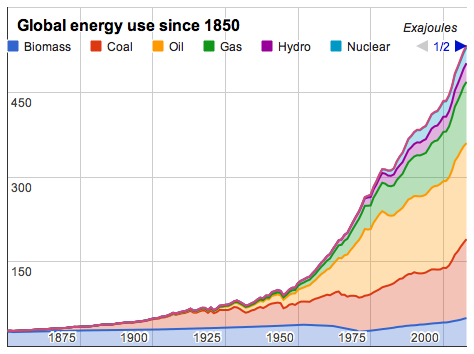
Although CO2 emissions have fallen in the U.S. in recent years due primarily to electricity plants switching to the cheaper source of natural gas, they have jumped back up once again according to the latest reports. Demand for coal abroad has also been on the rise with the U.S. exporting its supply to meet the demand. However, most disturbing is the following graph which illustrates that in the last 164 years, no new energy source has ever stopped our expanding usage of fossil fuels. Levels of carbon extraction are perhaps a more telling indicator of the primacy of fossil fuels and the direct correlation between economic growth and global emissions than the energy statistics of any one particular country:

…as Mike Berners-Lee and I argue in The Burning Question, despite radical changes in the global energy mix over the last two centuries (and even more radical changes within individual countries) energy use and carbon emissions have undergone remarkably consistent long-term exponential growth. The implication is that there’s a technological and social feedback loop at work, with each new energy source increasing access to and demand for all the other sources. Energy begets energy.

The graph below, which shows total human energy use since 1850, reflects this. When coal use took off in the nineteenth century biomass energy didn’t decline as is often assumed. In fact it increased, helped rather than hindered by coal-powered industrialisation and globalisation. Similarly, coal use increased when society started extracting large amounts of oil – which makes sense given that oil not only proved useful for coal mining but also enabled the mass roll-out both of cars and energy-hungry suburban homes. In turn, gas and hydro helped drive technological and engineering revolutions that have made obscure oil sources more viable…

…The fact that new energy sources tend to be additional to existing ones helps explain why more gas production has dinted neither US carbon extraction nor global emissions. But critics of gas beware: the same caveat applies to genuinely low-carbon energy sources such as renewables and nuclear, or indeed increasing energy efficiency. We usually assume that installing a wind turbine or nuclear plant will reduce global emissions but that’s not necessarily true, since the fossil fuel that the clean energy system replaces may get burned elsewhere instead, perhaps kick-starting new energy feedback loops in other parts of the world and driving global carbon emissions up yet further.

In some cases there has even been talk of using low-carbon energy sources directly to increase fossil fuel flows. For example, modular nuclear reactors are being considered as a way to propel natural gas down the remote pipelines that bring energy to Europe’s homes and power plants, or for melting tar to produce oil for the world’s billion-strong car fleet. This seems crazy at first given that it would be more efficient and less polluting to use the nukes directly for producing electricity, but existing infrastructure can determine our energy choices as much as the available energy sources do…

there’s little evidence so far that fracking, wind power, nuclear or any other technology is helping us leave any carbon in the ground. Indeed, as I wrote recently, despite all the renewable power installed so far, all the fracking rigs, all the energy efficiency gains, all the national carbon cuts, and even a collapse in average fertility levels, global emissions are still growing at the same rate today as they were in the 1850s… – link

Snap 2014-06-03 at 01.33.30

In The Biophysics of Civilization, Money = Energy, and the Inevitability of Collapse, a similar correlation was demonstrated between money (the economy) and CO2 emissions. Without fundamentally changing the economy’s dependency upon growth and profit, emissions will continue to rise and deceptive non-solutions will continue to be sold to the public. Even if all human industrial activity ceased this instant, we would still be looking at upwards of a 2.65˚C temperature rise, but capitalist industrial civilization is a superorganism that is on an unwavering trajectory. The scales have been tipped out of favor for mankind. The geologic pendulum will swing back to bring things into balance over millennia, and in the process industrial civilization will be crush beneath the iron hand of natural law.

One look inside the self-serving and hypocritical mind of those running in society’s elite circles will tell you there is no chance for any radical departure from the moribund thinking which keeps the rotted status quo in place.

[Nate Hagens: …from a (good?) friend of mine – married to a billionaire, very connected, energy investment guy – i sent him the EPA announcement]

Nate,

You have seen the movie Idiocracy, right?  Well President Mountain Dew Commacho in that movie is a better leader than BO.  At least Commacho knew sometimes you need to listen to smart people & put them in charge.

Long story short, the presidency is in meltdown mode.  Everyone has figured out what I told you…he is a bad guy.  Whether you definition of “bad guy” is a person who used his skin color to get where he is in DC then holding the US hostage to his bitter, bigoted edicts; or just a lucky ne’er do well who wanted to save the world, but instead made it worse.   HE IS DONE! <<<the exclamation point is Carney quitting.

Nate, none of what he does means squat (especially the agencies like EPA)…dems/repub know it.  Next elections will save the economy for 20-30 more years…I know you & I disagree on the timeline.  I hope, and pray, you are wrong…but I do know your logic is correct.

Best,

Jxxxxx

Buy coal/BTU tomorrow on the dip.

Like the radiation from Fukushima, CO2 emissions are invisible and their calamitous effects can play out over generations. The masses simply can’t stomach hard reality when they are entranced by a techno-capitalist wonderland of mental distractions and virtual reality pitfalls.

148

The Exact Timing of Near-Term Human Extinction Is Academic

Tags

, , , , , , , , , , , , , , ,

This post is in response to Systemic Disorder commenter Palloy who thinks that peak oil will save mankind and that global warming “will not be as bad as +1.5°C.” I want to answer the question of what degree of warming we are already committed to if industrial civilization were to disappear off the face of the Earth right now.

Palloy is overlooking the part that aerosols from industrial activity play in temporarily cooling the planet. James Hansen called this the Faustian Bargain:

…Human activity modifies the impact of the greenhouse effect by the release of airborne particulate pollutants known as aerosols. These include black-carbon soot, organic carbon, sulphates, nitrates, as well as dust from smoke, manufacturing, wind storms, and other sources. Aerosols have a net cooling effect because they reduce the amount of sunlight that reaches the ground and they increase cloud cover. This is popularly known as “global dimming”, because the overall aerosol impact is to mask some of the warming effect of greenhouse gases.

Hansen’s new study estimates this aerosol “dimming” at 1.2 degrees (plus or minus 0.2°), much higher than previously figured. Aerosols are washed out of the atmosphere by rain on average every 10 days, so their cooling effect is only maintained because of continuing human pollution, the principal source of which is the burning of fossil fuels, which also cause a rise in carbon dioxide levels and global warming that lasts for many centuries…

The average global temperature rise thus far is about 0.85°C since the onset of the Industrial Revolution. Once industrial activity ceases and its accompanying aerosols fall out of the atmosphere, the average global temperature will jump to about 2°C, but it won’t simply stop there because Palloy forgets that there is a lag time involved with CO2 emissions. The effects we are feeling now were from our emissions 40 years ago:

…The estimate of 40 years for climate lag, the time between the cause (increased greenhouse gas emissions) and the effect (increased temperatures), has profound negative consequences for humanity. However, if governments can find the will to act, there are positive consequences as well.

With 40 years between cause and effect, it means that average temperatures of the last decade are a result of what we were thoughtlessly putting into the air in the 1960’s. It also means that the true impact of our emissions over the last decade will not be felt until the 2040’s. This thought should send a chill down your spine!…

This “committed warming” of past CO2 emissions whose effect will be manifested in the coming decades is about 0.6 degrees Celsius. Adding up the current warming of 0.85°C from the onset of the Industrial Revolution, the loss of aerosols with global dimming at 1.2°C, and the “committed” temperature rise from the 40-year lag time of CO2 emissions equal to 0.6°C, we get a total of 2.65°C. If all industrial activity stopped right now, we would already be committed to 2.65°C, a global average temperature rise of three times what we are currently experiencing. With all the drought, flooding, hurricanes, landslides, fires, and other manifestations of climate change that we are undergoing now, I shudder to think what the world will be like in 2050 and yet humans continue to burn coal and other fossil fuels at breakneck speed. According to the Climate Accountability Institute, half of all emissions have been produced in the past 25 years.

Now we get to the even more insidious aspects of anthropogenic climate change that very few comprehend. Dozens of self-reinforcing feedback loops have already been triggered, but we’ll discuss only one, the albedo effect, in the loss of our planet’s air conditioners, the Arctic and Antarctic:

(1)   An increase in temperature decreases the area covered by sea ice as it melts leaving a larger area of exposed ocean.
(2)   This decreases the reflection of sunlight as ice is far more reflective than the newly exposed ocean.
(3)   Reduced reflection increases the area’s absorption of heat from the sun.
(4)   This increases the temperature of the area, amplifying the original increase in temperature mentioned in (1).

A recent study calculated that the loss of Arctic ice reflectivity from 1979 to 2011 added an amplifying feedback to human warming equivalent to 25% of the heat captured by CO2 emissions during that same time.

We know that we don’t live in a linear world and that climate change is a non-linear phenomenon. Recent studies on abrupt climate change in Earth’s history reveal that temperatures have changed rapidly by 5°C in just 13 years. With the grand experiment mankind has irrevocably and haphazardly embarked on, the de-thawing of vast stores of permafrost and clathrates measured in the gigatons has commenced, creating the possibility for a sudden catastrophic release of such gases at any time. Methane, for about the first 10 to 20 years of its initial release before it breaks down into CO2, is many fold more potent as a greenhouse gas than carbon dioxide. Humans are too busy calculating everything in terms of economic profit with regards to newly exposed resources and shorter shipping routes in the Arctic to take the time to fathom what damage they have done. Industrial civilization has permanently disrupted the stable period known as the Holocene within which mankind and civilization have been allowed to prosper.

Thus, we can see that the world is changing quickly into an environment that may well be outside the habitability for humans. The timing of human near-term extinction is likely academic.

Apneaman left this message here just a short time ago:

Journalist Dahr Jamail & Professor Peter Wadhams say the resulting release of methane will lead to massive climate disruption, and that we have reached a point of no return.

Update (12-3-2014):

CO2 Takes Just 10 Years to Reach Planet’s Peak Heat (Not 40 Years)

In a study that could have important ramifications on estimating the impacts, costs and benefits of reducing carbon dioxide emissions, new research shows that CO2 brings peak heat within a decade of being emitted, with the effects then lingering 100 years or more into the future…

…The research, published Wednesday in Environmental Research Letters, provides policymakers and economists with a new perspective on how fast human carbon emissions heat the planet. Back-of-the-envelope estimates for how long it takes for a given puff of CO2 to crank up the heat have generally been from 40-50 years. But the new study shows that the timeframe for CO2 emissions to reach their maximum warming potential is likely closer to 10 years….
http://www.climatecentral.org/news/co2-emissions-peak-heat-18394

Staying in the environmental frying pan only gets us hotter

Capitalism, no matter what label is put on it such as “green” capitalism or “inclusive” capitalism, still has the self-destructive characteristics of capitalism embedded within it. The very recent PR campaign orchestrated by the financial elite of the world under the socially responsible-sounding title of “inclusive capitalism” is no exception:

Yesterday’s Conference on Inclusive Capitalism co-hosted by the City of London Corporation and EL Rothschild investment firm, brought together the people who control a third of the world’s liquid assets – the most powerful financial and business elites – to discuss the need for a more socially responsible form of capitalism that benefits everyone, not just a wealthy minority.

Leading financiers referred to statistics on rising global inequalities and the role of banks and corporations in marginalising the majority while accelerating systemic financial risk – vindicating the need for change.

While the self-reflective recognition by global capitalism’s leaders that business-as-usual cannot continue is welcome, sadly the event represented less a meaningful shift of direction than a barely transparent effort to rehabilitate a parasitical economic system on the brink of facing a global uprising.

Central to the proceedings was an undercurrent of elite fear that the increasing disenfranchisement of the vast majority of the planetary population under decades of capitalist business-as-usual could well be its own undoing….

Systemic Disorder has written a clear-minded essay explaining why nothing short of a complete paradigm shift away from capitalism’s inherent growth and profit-maximizing imperatives is needed to save mankind.

Systemic Disorder's avatarSystemic Disorder

Green capitalism is destined to fail: You can’t keep doing the same thing and expect different results. We can’t shop our way out of global warming nor are there technological magic wands that will save us. There is no alternative to a dramatic change in the organization of the global economy and consumption patterns.

Such a change will not come without costs — but the costs of doing nothing, of allowing global warming to precede is far greater. Therefore it is healthy to approach with a dose of skepticism the Intergovernmental Panel on Climate Change (IPCC) report that concludes the annual reduction in “consumption growth” on a global basis would be only 0.06 percent during the course of the 21st century. Almost nothing!

Wahiba Sands, Oman (Photo by Andries Oudshoorn) Wahiba Sands, Oman (Photo by Andries Oudshoorn)

The “Summary for Policymakers” supplement of the IPCC’s Climate Change 2014: Mitigation of Climate Change report, a dense 33-page document…

View original post 2,364 more words

Endlessly Apologizing for a Self-Destructive System

Tags

, , , , , , , , , , , , , , , , , , , , ,

occupytoronto-021

Although I agree with much of what J. H. Kunstler has to say, particularly on his analysis of energy and his critiques of American suburbia, when it comes to his views on the human-made system that is driving this entire train wreck, he gets it dead wrong. Here is a quote from his last blog post:

Now I am, going to reveal to you why it is so difficult to get a live human being on the telephone at these important places: because the more of a racketeering matrix medicine becomes, the more it seeks to evade responsibility for the consequences. That is, the more medicine becomes a criminal enterprise, the less it wants to hear from its client/victims. The same ethos is at work in just about every other realm of corporate enterprise in the USA. Our problem in the USA is not “capitalism,” it’s racketeering. Why we fail to comprehend it is one of the abiding mysteries of contemporary life.

It ought to be self-evident that this could only happen in a profoundly corrupt, dishonest, and degenerate society, because it took the form of a social compact that accepted this sort of behavior as okay…

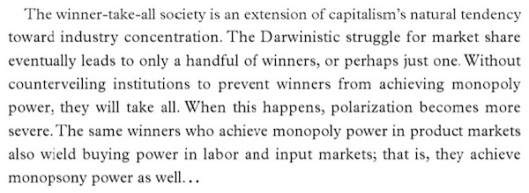
Kunstler is perpetuating a deep-seated myth about capitalism that many in American society repeat. Laying the blame on those victimized by an economic system, which by design exploits, disenfranchises, and discards its subjects, overlooks the fact that the problem is the system itself. Capitalism is not an ethical system, and its overriding force of motivation is always the bottom line. Inequality, conflict, and regulatory corruption are all part and parcel of capitalism. History has borne this out numerous times. Unless someone steps in to break them up, monopolies are the natural result of unbridled capitalism (Mindful Economics, Joel Magnuson):

Winner-take-all

Corporate money greases the wheels of the political system which then passes regulations discouraging competition and favoring large corporations. Regulatory capture is inevitably what happens when successful capitalists amass wealth and buy off the political class whose lifeblood is, after all, money. Under the present system, we will never see a candidate elected to office without a substantial war chest of funds stuffed with corporate ‘donations‘. Government does the bidding of capitalists, not vise versa. We saw this in spades with the election of Obama when all his campaign promises of “hope and change” evaporated into thin air as he filled his cabinet with Wall Street and Goldman Sachs cronies. Who wrote the legislation for Obama’s healthcare reform? — lobbyists for the healthcare industrial complex where, not surprisingly, “the big bucks are currently earned not through the delivery of care, but from overseeing the business of medicine.” The corruption that Kunstler decries is not an aberration of capitalism, but a natural feature of it:

…What chiefly drives this sort of political corruption today is capitalism’s structure. For many capitalist enterprises, competitive and other pressures exist to increase profits, growth rates, and/or market share. Their boards and top managers seek to find cheaper produced inputs and cheaper labor power, to extract more output from their workers, to sell their outputs at the highest possible prices and to find more profitable technologies. The structure provides them with every incentive of financial gain and/or career security and advancement to behave in those ways. Thus, boards and top managers seek the maximum obtainable assistance of government officials in all these areas and also try to pay the least possible portion of their net revenues as taxes. Boards of directors tap their corporations’ profits to corrupt mostly the top echelons of the government bureaucracy, those needed to make advantageous official decisions.

Individual capitalists act to corrupt government officials to serve their enterprise’s needs. Grouped into associations, they do likewise for their industries. When organized as a whole (in “chambers of commerce” or “manufacturers alliances,” etc.), they corrupt to secure their class interests. When such corruption is not secret, capitalists articulate their demands to corrupted officials as “good for the economy or society as a whole.” Such phrases constitute the “appropriate language” that enables officials publicly to disguise and hopefully to legitimate their corrupt acts.

Strict moral codes, regulations and laws have been imposed to prevent individual or grouped capitalists from corrupting government officials. Evidence suggests, however, that neither civic-minded ethics, nor regulations nor laws have come close to ending capitalists’ corruption. Countless government courts, commissions, etc., have hardly ended official complicities in that corruption. Mainstream economics mostly proceeds in its analyses and policy prescriptions as if rampant corruption did not exist. Mass media tend to treat capitalist corruption (at least in their home countries) as exceptional and government efforts to stop it as serious. These, too, are further examples of that “appropriate language” with which modern capitalist societies mask systemic corruption.
~ Richard D Wolff

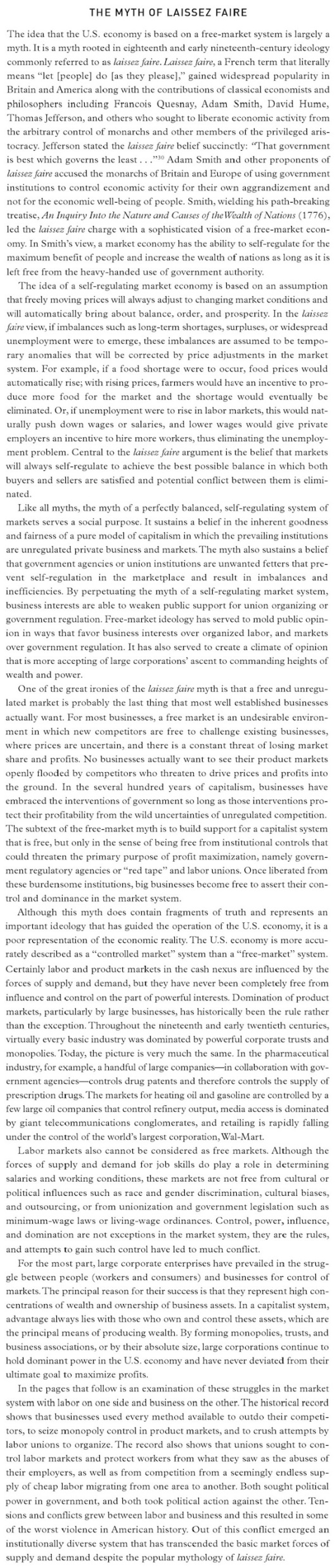
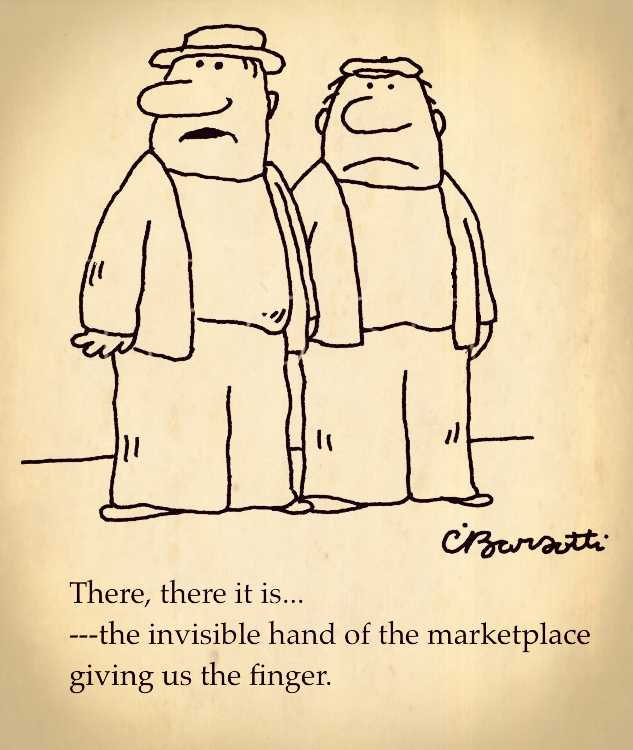
Noam Chomsky uses the acronym RECD (Really Existing Capitalist Democracy, pronounced ‘wrecked‘) to describe the capitalism that exists in the real world, and he doesn’t hold out much hope for civilization surviving it. Any sort of idyllic form of capitalism only exists in people’s heads and is kept alive by the myth of laissez-faire capitalism (Mindful Economics, Joel Magnuson):

Myth of a free market

BeFunky_null_12.jpg

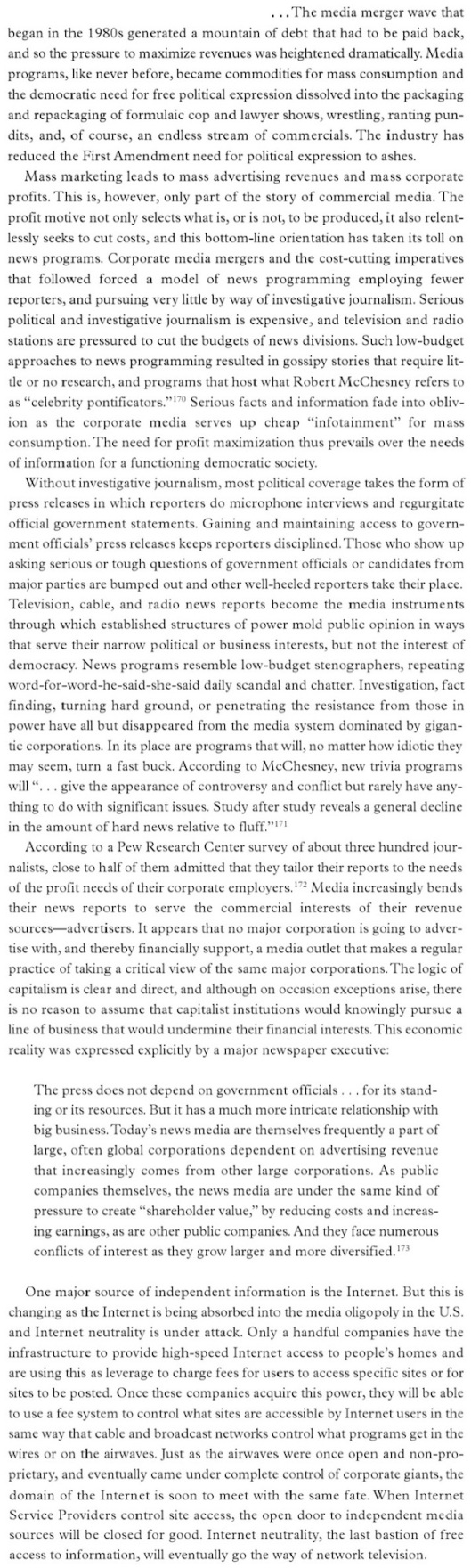
A democracy cannot exist without an informed and intelligent electorate, and when corporations and monied interests intentionally spin the news, the populous are reduced to conspiracy mongers and what Gore Vidal scoffingly called ‘consumer-depositors’ in thrall to the financial elite. Alas, the institution intended to educate the public, aka the Fourth Estate, on matters of vital importance has been thoroughly dismantled and perverted by capitalism. The internet, the last bastion of independent and alternative news, is soon to follow suite (Mindful Economics, Joel Magnuson):

media

If the masses are unable to see through the spin and distortion propagated by a class of greedy parasites, there is one entity that will not suffer the fate of the dispossessed, dying quietly in some dark corner. The Earth is not so forgiving to such continued capitalist assaults, and it’s not fooled by propaganda such as ‘sustainable development’, ‘green growth’, or ‘corporate social responsibility’. Since pre-industrial times, the global temperature has ‘only’ risen 0.85 degrees Celsius (1.5 degrees Fahrenheit), and we can already see the havoc to civilization’s infrastructure that climate chaos is wreaking. With forecasts of average global temperature to be many fold greater by mid century, it would seem that only a miracle will save us.

Systemic Disorder published an important essay yesterday on the systematic destruction of labor rights throughout the world. How long will these myths about capitalism persist until the exploited finally wake up and realize their blood, sweat, and sacrifice are what fills the coffers of the über rich? Many at the bottom of the economic hierarchy bend over backwards to apologize for our current system, calling it everything but capitalism. No matter how often capitalism fails, no matter how many people it kills, it is religiously touted as the only and the best economic system available despite its flaws. Will humans continue to amuse themselves to death, defending a systemically self-destructive system?

We watched the tragedy unfold
We did as we were told
We bought and sold
It was the greatest show on earth
But then it was over
We ohhed and aahed
We drove our racing cars
We ate our last few jars of caviar
And somewhere out there in the stars
A keen-eyed look-out
Spied a flickering light
Our last hurrah

And when they found our shadows
Grouped ’round the TV sets
They ran down every lead
They repeated every test
They checked out all the data on their lists
And then the alien anthropologists
Admitted they were still perplexed
But on eliminating every other reason
For our sad demise
They logged the only explanation left
This species has amused itself to death . . .

Business-As-Usual on a Dying Planet

Tags

, , , , , , , , , , , , , , , , , , , , , ,

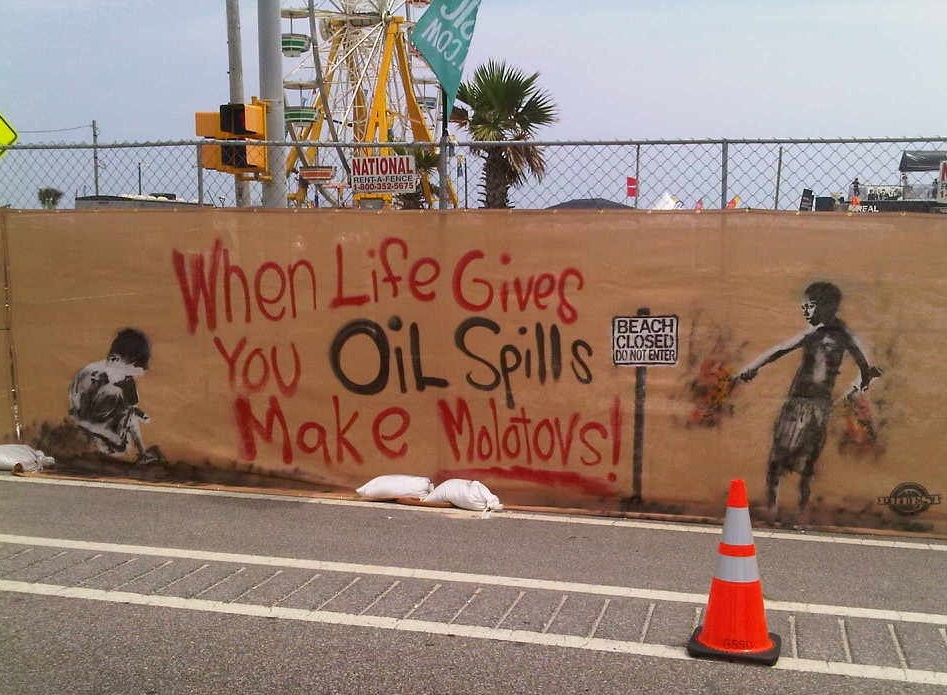
Molotov

A recent investigative piece by Vice on the aftermath of the BP oil spill, America’s most devastating environmental accident to date and the “largest accidental marine oil spill in the history of the petroleum industry”, shows that people are still getting sick and dying in the Gulf region.

Award winning chemist, Dr. Wilma Subra, conducted blood tests on Gulf Coast residents who were symptomatic with new illnesses and found that some of the cancer-causing agents were 65 times the expected level in the victims blood tests. Subra noted that Corexit is in the air, the water and the Gulf resident’s blood.

“There’s a whole population that’s very sick and doesn’t have access to medical care, and that’s what we’ve been trying to work on now, from the very beginning, is getting them medical care so they will get better,” says Subra. “How many people do you think we’re talking about, do we have any guess?” “Hundreds of thousands along the whole coastal area,” Subra says. “Hundreds of thousands of people?” “That are sick, yes.”

It also is likely that the BP cleanup workers are going to suffer the same fate. Listen to what Dr. Wilma Subra had to say about the health of this group.

These findings can leave little doubt that BP’s use of Corexit has seriously compromised the collective life span of Gulf Coast residents. This is a staggering implication for the collective longevity in the Gulf. – link

Nearly 2 millions gallons of Corexit were used to prevent the millions of barrels of leaked oil from hitting shorelines. Where did all that oil go? Once Corexit is dispersed over an oil slick, it causes the spilled oil to break apart and sink to the bottom of the ocean. In the case of the BP oil spill, this toxic material created massive kill zones on the Gulf floor. When oil and Corexit are mixed together, the resultant substance becomes 52 times more toxic and penetrates human skin much easier. The locals don’t eat what they catch, but remember that Obama said it was safe.

Corexit has been banned in 18 countries, including the UK, because “it is a cancerous causing neurotoxin pesticide that is acutely toxic to both human and marine life.” Every time there is a strong storm, the Corexit chemical and oil mixture gets swept up onto shore and enters the water cycle:

As of early October 2013, the United States Environmental Protection Agency (EPA) website specifically stated that the spill should have no effect on drinking water, and that any questions residents might have about their water should be directed to their drinking water provider. The website fails to mention that water from the Gulf, mixed with oil and Corexit could make its way into the ecosystem eventually, washing up onto the Gulf’s shores and seeping insidiously into the ground water. Florida’s ground water aqueduct system provides drinking water to 18 million residents. – link

The happy motoring culture of suburban sprawl, bread & circus infotainment, and celebrity/wealth worship has long since forgotten what has been called “the biggest public health crisis from a chemical poisoning in the history of this country“. Entrapped by poverty and lacking the means to escape the Gulf region,  its residence have become part of the sacrifice zone offered up in the name of profit to the carbon-hungry God of industrial civilization.

None of the locals who took part in the clean-up effort were told of the dangers to their health, nor were they allowed to wear protective gear such as respiratory masks, suits, and gloves because it would have more accurately conveyed to the world the true nature of the disaster. More recently, BP has been accused of hiring internet trolls to threaten critics of its handling of the 2010 disaster. Surely the authorities were aware of the aftermath from the Exxon Valdez accident wherein the same dispersant was used by those clean-up workers who are now nearly all dead at the average age of 51. For BP and the U.S. government, image and corporate interests override the horrific realities of ecocide and corporate manslaughter. Better to sink the oil out of sight and mind in order to maintain the illusion that all is well rather than have a company pay the full cost for its recklessness. All that oil mixed with Corexit is now a 3 to 4 inch toxic layer blanketing the bottom of the Gulf of Mexico, inhibiting its biodegradation by natural oil-consuming bacteria and prolonging the disaster for decades. And BP is once again allowed to bid for U.S. government contracts after having sued the EPA in 2013 to lift the suspension. Of course lots of conspiracy theories surrounded the BP oil spill, but the only real conspiracy here was the government/corporate collusion to hide and minimize the damage, control the public’s perception of the disaster, and protect corporate profits over people and environment — nothing out of the ordinary for the corporatocracy we live under, here or abroad.

It’s not just in the oceans that we have to worry about oil spills. If we look at just one set of data from one inland state, you can get an idea of the staggering scale of the fallout from the oil drenched machine of industrial civilization:

Snap 2014-05-19 at 08.56.37

When you take into account all the global destruction that capitalist industrial civilization has wrought over the last few centuries, you realize no solution will ever be forthcoming from our corporate overlords. The idea of corporate social responsibility (CSR) is simply a PR and marketing ploy. CSR employs ineffective market-based solutions, making it appear that a corporation is addressing a social or environmental problem when in fact it only serves to protect corporate financial interests and shift the blame to the individual and elsewhere. Over decades, corporations have molded society into atomized, uninformed, and passive consumers who parrot the same talking points fed to them from the mainstream media. Those wielding the power in society and leading mankind over a cliff are the same ones that hide behind the moniker of CSR, a smokescreen for continuing the looting and polluting of the planet to the point of ecological collapse.

521622_591434340867473_1869861116_n As the catastrophes of the BP oil spill and Fukushima illustrate, a bankrupt planet is preferable to them over a bankrupt corporation. The Tragedy of the commons, as Noam Chomsky points out, has been perverted and twisted by the widespread adoption of the capitalist ethos. It actually means the opposite of what most have been taught to believe:

…there is another part of Magna Carta which has been forgotten. It had two components. The one is the Charter of Liberties which is being dismantled. The other was called the Charter of the Forests. That called for protection of the commons from the depredations of authority. This is England of course. The commons were the traditional source of sustenance, of food and fuel and welfare as well. They were nurtured and sustained for centuries by traditional societies collectively. They have been steadily dismantled under the capitalist principle that everything has to be privately owned, which brought with it the perverse doctrine of – what is called the tragedy of the commons – a doctrine which holds that collective possessions will be despoiled so therefore everything has to be privately owned. The merest glance at the world shows that the opposite is true. It’s privatization that is destroying the commons. That’s why the indigenous populations of the world are in the lead in trying to save Magna Carta from final destruction by its inheritors…

tumblr_n4jfednib51qjb4vfo1_1280 09-52-16

I’m afraid we are light years away from the Charter of the Forests and any sort of bucolic utopias. As for the future, think moonscapes, tumbleweeds, and the creaking sheet metal of rusted-out cars. The hyper-reality of megacities, with their pulsating neon lights and traffic-filled streets, will fall into silence and decay. Coastal cities will be swallowed up in watery graves. The impotence of man’s technology will become painfully evident as the global-scale geochemical disruptions caused by man quickly unfold, ripping asunder any hold we once had on Earth.

…If modern industrial capitalism were a person, he or she would be on suicide watch. The system that has brought us quantum physics and reality television, modern medicine and the columns of Andrew Bolt is set on a course which, by all the best reckoning, points directly to its doing itself in. If capitalism goes on — everything goes. Climate, coastlines, most living species, food supplies, the great bulk of humanity. And certainly, the preconditions for advanced civilisation, perhaps forever…
~ Renfrey Clarke

Occam’s Razor Dispels Many Outlandish Conspiracy Theories

Tags

, , , , , , , , , , , , , , , ,

8403825949_d8f364c516_z

Occam’s razor, or Ockham’s razor, is a line of reasoning which uses succinctness and simplicity, employing the least assumptions to arrive at the most probable hypothesis that fits the available evidence. In other words, given two equally plausible explanations for a given phenomenon, the one making the fewest assumptions is more likely correct. Its foundation rests on two guiding principle to cut through falsehoods and pseudoscience reasoning:

  1. The Principle of Plurality – Plurality should not be posited without necessity
  2. The Principle of Parsimony – It is pointless to do with more what is done with less

In the search for truth, this tool of reasoning has been used throughout history by scientists and philosophers in the creation of models and theories, by detectives in solving crimes, and by objective researchers in debunking convoluted conspiracy theories. Occam’s razor is embodied by the probability theory which says that “all assumptions introduce possibilities for error and if an assumption does not improve the accuracy of a theory, its only effect is to increase the probability that the overall theory is wrong.” It is a heuristic method to guide scientists in the development of theoretical models. In the case of anthropogenic climate change, it can be applied to show how those who are skeptical about AGW are forced to weave a much more tangled web in order to explain things:

The serious, mainstream science view goes like this:

  1. The greenhouse effect is real. Without it, average surface temperatures would be -15C, not +15C
  2. CO2 is a greenhouse gas
  3. CO2 levels have increased by 41% since pre-industrial times
  4. A 100% increase will cause a 1.2C rise in earth surface temperatures
  5. This rise will in turn cause a 3C (+/- 1.5C) rise in surface temperature.
    Explanatory video on this point here
  6. Any rise above 2C must be avoided

Reasonably simple, given the vast complexity of our planet’s climatic system, and in fact the handful of serious climate scientists on the “sceptic” side agree with points 1-4.

Now here is the climate “sceptic’s” case:

  1. The earth is not warming
  2. If it is warming, it is due to the sun
  3. The warming is due to some kind of natural variation
  4. It’s going to get cooler soon
  5. CO2 is too tiny to make a difference
  6. CO2 will make a difference but there’s nothing we can do about it
  7. We can afford to wait another 10-50 years to see if it is going to get hot then do something about it then
  8. It is going to warm but only a bit
  9. CO2 is good for us
  10. Cloud cover will extend in a warmer planet and cool us down (No it will not)
  11. All models are always wrong
  12. Some models show that the climate will not warm much
  13. It is all a conspiracy by climatologists, Greens, the nuclear industry and the UN
  14. It cannot be happening because it would mean that fossil energy would become unprofitable
  15. It is cold outside today
  16. Heat cannot get into the ocean
  17. And so on
  18. And so forth

What the above shows is that there is an endless complexity to the arguments brought by the “sceptics”, many of them self-contradictory.

They are not trying to present a coherent picture of reality, which is the aim of science. They are merely producing a stream of counter statements. I have been impressed recently that when I try to discuss the one point where agreement exists with a delayer, they rapidly change the subject to find disagreement.

In fact, their case often boils down to a mirror image of the case for man-made global warming. If we say white, they just say black.

I predict therefore that soon “sceptic” blogs will be quoting William of Occam as evidence for the truth of their case.

Another cock-eyed conspiracy theory is chemtrails which astronomer Bob Berman deconstructs using the logic of Occam’s razor:

Some folks regard contrails suspiciously. Apparently, many don’t know what they are. Several websites call the lines chemtrails, and think that the US military is deliberately spraying a substance upon the population.

This is silly for a number of reasons. First, if you’ve ever watched crop dusting you know that chemicals must be released very close to the ground. Released on high, they’d dissipate with the wind and take forever to get down; the concentration on the folks below would be zero. Second, my commercial pilot friends (along with the controllers at the FAA) would all have to go along with the plot, since they’d see the process happening. I’m a pilot and airplane owner myself: It’s NOT happening. Third, what would be the purpose? Some say mind control. But are people acting differently lately? Others say it’s to sow disease. But why would anyone want to do this? Who would go along with it? Finally, some say “chemtrails” are a government project to combat global warming. Nice, but then why should such a laudable effort be kept secret? Other web-based “explanations” involve even wackier stuff like electromagnetic rays.

Logic never placates the truly paranoid, and discussions are rarely satisfying. Those who “believe” WANT to believe, and claim soil tests show that dangerous substances have been found beneath the planes. But again, nothing released from 40,000 feet would ever reach the ground except diluted to zero. And, more to the point, the videos of these supposed “chemtrails” shown on the scare web sites are actually a common type of contrail. The believers claim they’ve only started around 1998 – but I’ve observed those “spreading out” contrails for over 40 years. They’re not new. They’re contrails. No mystery, and nothing sinister here at all.

And yet another imaginative conspiracy, thoroughly debunked by the scientific community, surrounds the terrorist attack of 9/11 in which its die-hard followers believe that elements within the U.S. government planned and executed a controlled demolition of the TWC towers and WTC 7 in order to justify the invasion of Middle East countries and restrict domestic civil liberties. The first obvious question is why would a nefarious group within the government go through the logistical nightmare of crashing airliners into buildings in addition to rigging those buildings beforehand when a massive truck bomb, Timothy McVeigh-style, would have sufficed? Was that elaborate scheme really necessary in order to galvanize the political will to invade a foreign country for oil? And as Noam Chomsky points out in the video below, why implicate nationals from our major ally Saudi Arabia instead of people from the very country the neocons so desperately wanted to invade, Iraq? Perhaps the Bush administration just enjoyed the extra hurdle of fabricating WMD’s because planning and executing such a byzantine maze of deception involving so many people was the best way to keep it all secret and ensure the highest probability of success.

Another article of faith among conspiracy theorists is that the conspiracy would not have to have been very large. In Crossing the Rubicon, Michael Ruppert writes that there didn’t have to be any more than two dozen people with complete foreknowledge of the attacks to orchestrate 9/11, and that they would all be “bound to silence by Draconian secrecy oaths.” But those numbers begin to balloon out of control if all of the people and institutions accused of playing a part in the cover-up are counted. They would have to have included the CIA; the Justice Department; the FAA; NORAD; American and United Airlines; FEMA; Popular Mechanics and other media outlets; state and local law enforcement agencies in Pennsylvania, Virginia, and New York; the National Institute of Standards and Technology; and, finally and perhaps most prominently, the 9/11 Commission. – link

[youtube:www.youtube.com/watch?v=SRV_MsbAZv4]

As more and more people fall off the economic ladder and lose faith in government, their plight will become fertile ground for conspiracy theorists looking to manipulate the anger and desperation of the dispossessed. JFK conspiracists have been around for nearly half a century and I think it’s fair to say that 9/11 conspiracists will have an even longer lifespan, perhaps outliving industrial civilization itself. The maxim of never letting a good crisis go to waste certainly held true for abusive power structures all across the globe after 9/11, but such an atrocity was inevitable due to nearly a century of nurturing and exploiting radical Islamists to serve the interests of the British and American Empires:

…When the Soviet Union invaded Afghanistan in the 1980’s, the West, led by the United States, countered by implementing the “Islam” strategy. The recruiting of Islamic militants from around the world to fight in the “jihad” included the recruitment of Osama bin Laden by Saudi and Pakistani intelligence services. [26]

Ultimately, British strategy manifested or transmogrified into American support for the ‘holy warriors’ against the Soviet invasion. The United States invested massive amounts of armoury, military training and billions of dollars in this enterprise.

Chalmers Johnson defined, ‘blowback’ “as a way of thinking of an individual, a class, a nation or an empire…” when employed in the arena of “international conflicts” this way of thinking, “has a tendency to blow back onto the party releasing it.” [27] The criminal events in New York and Washington almost ten years ago, were partly and clearly a blowback from the “Islam” strategy.

Whereas Britain concocted and propelled the “Islam” option into strategic consideration amongst policy makers during the Cold War period, it was then the United States which was largely seen to “release”, implement and support this policy in Afghanistan in the 1980’s.

In conclusion, it needs to be emphasised that as the provenance of this “Islam” strategy pre-dates the Cold War and even the emergence of the United States as a superpower, there is every reason to believe that it will also outlive a perceived declining United States. We can now see this in Libya where NATO has worked in conjunction with Libyan Islamists to overthrow the Gadhaffi regime. [28]

The inside job of 9/11 was not some fiendishly clever plot by Cheney and a crack team of explosive experts and false flag operatives. It was the net result of decades and decades of colonial rule and the thirst for resources by Western citizens weened on suburban living, gas-guzzling automobiles, fast food, and industrial age values. Much energy and time is wasted on chasing phantom villains, while the real problems pile up around our make-believe world. Looking into history as well as into the mirror might be more productive than a crusade to bring imaginative boogeymen to justice.

tumblr_n3vnfes2R71qbmgeto5_1280

Concocting Conspiracies as the World Burns

Tags

, , , , , , , , , ,

Conspiracy-Theories26

“A society enamoured with conspiracy theory is sliding into barbarity.”
~ David Livingstone Smith

Since Kevin Moore has twice mentioned a supposed “cognitive dissonance” with myself concerning Mike Ruppert over at NBL, I feel I must clarify things and correct him.

If you actually read the post I wrote about Mike Ruppert, then you would know that I was hardly “celebrating” Mike Ruppert’s life and work. Let me quote a line:

“In their search for the truth, perhaps some travel too far down the rabbit hole of civilizational and environmental collapse to ever escape its malignant shadow; it consumes them like a cancer.”

Ruppert was eaten up by his own obsession of finding meaning and truth in a chaotic world. My own thoughts on 9/11 go no further than it being blowback from American foreign policy and bureaucratic incompetence. I have no desire to waste time on wild and improbable conspiracy theories which have already been easily disproved numerous times. Do governments conspire to do underhanded things? Of course they do, but not all events are a government plot nor the handiwork of TPTB. It’s human nature to try to make sense of traumatic events and look for connections and patterns, very often where none exist, in order to manage collective anxiety in the face of uncertainty:

…Hyper-intellectualism is a driver of extreme political movements, too, whose leaders keep their followers riled up by serving them a steady diet of paranoia-inducing conspiracy theories. By “conspiracy theories” I don’t mean the belief that terrible conspiracies exist (they obviously do), but the fiction that attributes all the world’s ills to the secret machinations of an identifiable foe: the Jews, the Templars, the Jesuits, the “bankers,” the blacks, patriarchy, whomever. Anders Behring Breivik, the Norwegian mass murderer, wrote a 1,500-page manifesto that purported to expose the “alien system of beliefs, attitudes and values….that we have come to know as ‘Political Correctness.’” Its proponents, he said, included Islamists, Feminists, Frankfurt School Marxists, and multiculturalists of every stripe, all working together to bring about the collapse of the West…

…A study by scientists at Harvard University and the University of Helsinki, published in the Proceedings of the Royal Society, put his theory to the test and concluded that “behaviours which are, or appear, superstitious are an inevitable feature of adaptive behaviour in all organisms, including ourselves.”

All of us, in other words, are primed to believe evidence that supports our prejudices and predispositions, even when they’re wrong and the evidence for them is dubious or contrived…

The propensity of people to simultaneously believe multiple convoluted and oftentimes contradictory conspiracy theories despite repeated falsification has been empirically explained by University of Kent psychologists Michael J. Wood, Karen M. Douglas and Robbie M. Sutton in a paper entitled “Dead and Alive: Beliefs in Contradictory Conspiracy Theories,” published in the journal Social Psychological and Personality Science. 

Perhaps the most notorious conspiracy theorists are David Icke and Alex Jones, both of whom have built lucrative businesses peddling their views of the world:

icke_time_events

Snap 2014-05-04 at 08.27.28
Unfounded conspiracy theories have led to wars and mass death in the past and it’s my belief that we have to use reason over prejudice and suspicion in order to avoid such tragic outcomes. For example:

Snap 2014-05-04 at 09.15.25 Giving credence to alternative realities, whether it be by techno-utopians who think our technology will save us or business-as-usual proponents who claim that global warming is more beneficial than harmful, is not the aim of this website and I’ve only dabbled in such visions as an allegorical device in some posts. The realities of industrial civilization’s environmental meltdown are frightening enough without diverting our attention and degrading our credibility with outlandish and comical conspiracy theories of a faked lunar landing and controlled demolition of the WTC skyscrapers. Consider that our CO2 emissions will be in the atmosphere for thousands of years. That’s what makes AGW so catastrophic — their effect is essentially forever on a human and civilizational time scale. And climate change’s evil twin of ocean acidification will last for tens of thousands of years. When the cold hard facts are killing us systematically, why deal in fantasy?

[youtube:www.youtube.com/watch?v=MAcFXAtG0cQ]
[youtube:www.youtube.com/watch?v=hJmRbSX8Rqo]

The Dull Static

Tags

, , , , , , , , , , , ,

Originally posted at: Prayforcalamity.com


The flowering dogwoods are in bloom. Along the country lanes, the pink petals have already exploded into ephemeral radiance and begun to wither and fall from the branches of the Jane Magnolia trees. For me this means no longer having the agonizing luxury of hours to sit and write. After six months of bi-weekly essays, I feel I have expressed much of what had become balled up and cluttered in my mind, and now it is time to ruminate in the garden once again.

I named this blog, “Pray for Calamity,” because there are several major crises converging which threaten human civilization, and there are no existing structures capable of mitigating them. Democracy, capitalism, neo-liberal globalization; they are all incapable of undertaking the work necessary to avert cataclysm. The paradigms of thought and approach which are almost hardwired into the modern mind at this point, need to be scrubbed. Of the remaining, solvable ecological crises, which may not include climate change, there is no tool available to attend to them that comes from the conventional tool box of legal, lawful pursuit. These ecological crises, which range from topsoil depletion to tree extinctions to massive die off of oceanic life, cannot be remedied without a fundamental shift in the thinking of the people in the civilized world. If people do not begin to perceive the world as a living entity, interconnected, conscious, and with intrinsic value beyond how it can be carved up and sold, then it is only a matter of time until the human race begins to suffer on a massive scale due to their callous disregard for the other beings with whom they share this planet.

And then there are the political and economic and resource depletion crises as well.

Changing our minds, changing how we think, is physically speaking one of the easiest things we can do. However, when our egos and our identities are wholly interwoven with an idea or an ideology, changing our way of thinking and discarding the old ideas, can be the hardest thing we are asked to undertake. If our physical reality changes, this can create a rip in the threads that stitch our view of ourselves with a dogma or a paradigm. So I await calamity because the egos of the civilized have hardened their hearts and deafened their ears, and until those in the first world middle class feel the gnawing pain of persistent hunger and the fear of deafening uncertainty, they will refuse to consider that maybe everything they have been taught to believe about themselves and their collective destiny, is abjectly wrong.

We’re many generations overdue for a revolution, in our thinking. I’m not talking about blood and violence although I’m afraid thats already happened. I’m talking about a revolution that’s probably the hardest kind, the kind that takes place within the human soul and the human mind. To be able to tear everything down, throw everything out, and start with a completely fresh piece of paper and say, ‘OK, how do we solve this problem?’

Mike Ruppert said that in the documentary “Collapse.” While by no means a perfect man, Mike was a good person, and did his best to tell the truth as he knew it. He shot himself two weeks ago. He left many insights like this one as gifts for us.

People who become aware of the depth of the problems facing humanity at this juncture in time, often seek answers. They want to know what we need to do. Some suggest we need a revolution. Some suggest we need to take to the hills and hide on personal homesteads, to perhaps form communities of these homesteads and just hold on white knuckled through the bottle neck of collapse. Then there is Paul Kingsnorth of the Dark Mountain Project, who speaks of the difference between problems which are to be solved, and predicaments which are to be endured.

What do you do,” he asked, “when you accept that all of these changes are coming, things that you value are going to be lost, things that make you unhappy are going to happen, things that you wanted to achieve you can’t achieve, but you still have to live with it, and there’s still beauty, and there’s still meaning, and there are still things you can do to make the world less bad? And that’s not a series of questions that have any answers other than people’s personal answers to them. Selfishly it’s just a process I’m going through.” He laughed. “It’s extremely narcissistic of me. Rather than just having a personal crisis, I’ve said: ‘Hey! Come share my crisis with me!

Kingsnorth was recently interviewed by the New York Times. As a long time environmental activist who years ago lost faith that there is much we can do to “save the planet,” he decries the false hope sold by mainstream environmentalist groups. With friend Dougald Hine, Kingsnorth wrote the “Uncivilization” manifesto, on which The New York Times writes:

Uncivilization” was firm in its conviction that climate change and other ecological crises are predicaments, and it called for a cadre of like-minded writers to “challenge the stories which underpin our civilization: the myth of progress, the myth of human centrality and the myth of separation from ‘nature.’

On this matter I think Kingsnorth and Hine are right on the mark. We will never weather the predicaments before us, let alone solve what problems remain solvable, if we refuse to take an honest look at who we are, where we are, and just what the hell we are doing. I think this is a meditation that would benefit revolutionaries and those hiding in the hills alike. We must ask if civilization is something we are even interested in continuing. We must ask what it is we value most and whether or not the lifestyles we are cordoned into are even in line with those values. We must ask what it means to be human. And if we are to trust any of our conclusions, we must first find a way to step outside of everything our culture has programmed us to believe.

Civilization is a power structure. It is a rejection of natural law in favor of the control of those high on social hierarchies. Civilization is the domestication of nature and people alike. It is the creation of a once regional, now global farm where the multitudes of humans are livestock, restricted by the borders of various owners, and subjugated and exploited for the extraction of the surplus values generated by their labor. Non human life forms and entire ecosystems are subjugated likewise, and as this control apparatus is now world wide and hell bent on growing in scale year over year, life itself is at risk. Simultaneously, this architecture of domestication and control has blunted the souls of the humans it dominates, and like house pets, the great many people have been declawed and broken. This is the existential portion of the crisis we face. The meaninglessness of life on the inside. The dull static of the best case scenario, where those in the first world yearn for the life of tepid, safe predictability offered by the owner class, should only one produce enough without question or complaint. We are a wretched bunch who fetishize our oppressors and spew vitriol at insurrectionaries who would in trying to shake us loose even for a moment, dare make us late for work.

Navigating circumstances beyond our control in which masters are hostile to us, constantly maneuvering to exert more control over our lives as well as to extract more value from us even in our imprisonment or death; most people are surviving, not thriving. Merely jockeying through a preset condition of work and fee schedules has muted the potential of our species. What has been throttled cannot be measured in discoveries or inventions, but in the satisfaction of individuals and communities to thrive on their own terms. To be fully actualized and autonomous creatures. To witness the assembly line life of modern man is to suffer a snuff film.

If we are to rescue our own hearts and our minds, if we are to save the last embers of burning wildness in our souls and to break the tethers that bind our thinking to suicidal paradigms, then we must uncivilize. Like Buck in “The Call of the Wild,” we must seek to undomesticate ourselves, no only to survive the realities of the world into which we are being thrust, but because to be a house mutt lying bored at master’s feet is to barely exist at all.

So what does any of this really mean? What are the steps, the actions to undertake which will align the force of our arms with the rhythms of our hearts? Do we fight or do we flee? Or do we stand upon the hill and bear witness until the fire consumes us? Or is there perhaps some combination of all; a time for rebellion, a time to tend our gardens, and a time to merely sit and say goodbye?

Certainly, if people seek a recipe for action that can maintain society in a form even remotely similar to its present incarnation, then I offer nothing. If what people desire is a map of the future from which plans can be derived and survival assured, I have none. I think maybe it is time to give up on maps. Maybe it is time to just be in the territory for a while. Maybe it is time to give up on human words and to leave the electronic buzz of the internet and to set foot on soil and rock. If domestication is the product of being in the domicile, in the house, then perhaps what we need is to step outside. If the stories we have been told for generations have poisoned us; if these myths about the greatness of the lines on maps and the men who ruled those patchwork lines have only served to make us slaves to abstractions, engendering in us a self righteousness and a malice towards all that isn’t of our hands and seeding in us a fear of what lies outside comfortable walls, then perhaps it is time to go and to hear some different voices. To hear some new stories. Maybe, lost in the ballad of crowing frogs and moaning trees we can crumple up what is written before us and find a blank piece of paper, and on it we will write of our sadness and our fear. We will admit our weakness in the face of all that we have made and we will scratch out our apologies and our gratitude.

Then we will collect up everything that we think the future needs to be given, and we will carry it within us to barricades and to garden gates, to jail cells and to barn bays and to graves. We will find the fire that will make tomorrow worth struggling towards, in that dark, when we are bent and cold heaps of hungry, smoke smelling bone and sinew beneath taught and blackened skin. The madness of the world will grow raw, and real. Privation and awfulness will bloom, and we will endure it.