Bloodwatch

Tags

, , , , , , , , , , , , , , , ,

When past predictions of future catastrophic events like ice sheet melt, spreading tropical diseases, and forest fragmentation start to become reality while no substantial means to prevent them from happening has ever been implemented, you begin to question the phrase so often bandied about that “it’s never too late.” It was never too late decades ago and we’re still holding out on that hope. Despite any techno-utopian fantasies you hear in the news, economic activity and growth are still linked to CO2 emissions. Until this fundamental truth is dealt with, we’ll all be spinning our wheels and wringing our hands over our continued descent into ecological and societal collapse. Perhaps this is part of the reason I have not blogged recently. As Leonard Nimoy expressed in his last twitter message, I think I’ll try to enjoy the here and now while I’m alive…

Snap 2015-03-27 at 03.44.20

The following is a guest post by commenter BP:

The majority of people visiting collapse and post-peak sites are Caucasian, disillusioned, with a slimmer majority subset being male; in other words, representatives though not participating members of the failing power elite. If these collapsitarians did wield real power, they wouldn’t be deeply dissatisfied with the present social arrangement and secretly hoping for an honest to goodness smokin’ homecookin’ cracklin’ good ole’ fashioned apocalypse to happen in their lifetime. You know, just to spice things up a little bit and provide some entertainment because industrial living can be such a boooooring, regimented drag, man. Tick tock. Time to get up, time to eat, go to work, come home, go to sleep, wake up, rinse and repeat. Even regularity in our shitting is considered desirable in this totalizing system. Watches are slave driving devices – a shackle – your very own drill sergeant and task master all rolled into one convenient portable sleek wrapped modern design. Little wonder you have so many suit and tie clean-cut preppie American Psycho types with their rictus eternally sun shining grins (everything’s alright, everything’s fine, everything’s okay) resorting to extremes: bungee jumping, sky diving, narcotics and gambling, binge eating, binge shopping, binge TV watching, auto-erotic asphyxiation, any and all manner of titillation and stimulation just to get a rise. We’ve been dulled and sanitized, tamed and neutralized. The demographic comprising most of the power elite also happens to be the one most likely to become serial killers preying on their own species. If you live in a foreign land you might argue there’s no difference between Ted Bundy and the president. Either way, it’s another fun-filled pet project to while away the hours with. But I don’t want to give anyone any ideas, and I won’t be held accountable for what you do when you turn off your addictive electronic stimulus delivery systems aka computers tonight, even though we excel at passing responsibility onto something else. The lengths people will go… And these are the lucky ones who still have jobs. YAY!! I don’t even want to imagine life on the other side – we’ll all get there soon enough. Why spoil the surprise?

So raise your hands if you’re waiting for a giant or gradual (does it really matter?) clusterfuck that results in a significant reduction in our species’ numbers, because whatever you think is likely, it’s a necessary precursor to what ever comes next. The table has already been set and our carcass is the main dish.

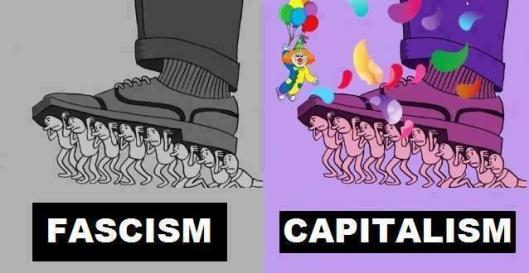
Now that you’ve had your fill, how about some desert? I have a thought experiment that shouldn’t take too much time. Suppose you’ve decided to kill yourself. You’ve set a date, (a week from tomorrow), a time (midnight), thoroughly planned the method (hanging), bought the needed supplies (rope – duh!), and are dead set on following through. How, if any, would your life change in the time remaining? I’ll indulge in some fantasy since there doesn’t seem to be enough of that going around and Star Wars isn’t out until December. For starters, you could max out your credit and buy that car you’ve always fancied – you know, the one that runs on limited gasoline? You could also screw a few whores and not worry about contracting a venereal disease or what you’d have to say to your wife. Gorge on that chocolate cake and go for seconds topped with ice cream this time, downed with cola and chased with both pizza and hamburgers for desert. Why not? Fuck blood pressure, you’re going to die anyway. Then after your attention deficit disorder kicks in, you could switch to watching porn, wasting time playing Modern Warfare while eating Doritos and not feel one ounce of guilt that you could be doing something more with your life. Consume shit you don’t need to your heart’s content without any second thoughts! After all, ecologically speaking, we’re consumers! Let’s take a moment to give Capitalism some credit. It found a way to manipulate our basic human nature for its own ends and boy has it ever worked. Nothing has mobilized humanity – not pharaohs, despots, kings nor gods – like the wage economy. The best part about the whole affair is you can live without consequences because, in case you forgot, you’ll be dead in a week. Sound familiar? It’s a rarity these days when ideas and reality coincide. Yep, you guessed it. That’s exactly what our species has been doing – living large like there’s no tomorrow – and it’s hastening our eventual collective suicide.

And is that such a bad thing? There’s way too much despair, self-pitying, and despondent anger on these websites. Outside of our narrow anthropocentric perspective, the human race’s demise might even be cause for celebration. If that’s too much, at least it needn’t be mournful. After all, our history on this planet has proven that, if nothing else, we’re two legged, genocide-wreaking, blood-thirsty assassins. The only species that kills for fun, whether it be bipeds, quadrupeds or any other number of peds, we’ve obliterated them all. I’m confused by all this concern about surviving in a post industrial world. Are our souls (if we even have them) really worth saving? Even if a band of hardy survivors manages to achieve some semblance of harmony with their environment, sooner or later some marauding horde is going to come along, fuck things up, steal their shit, and rape their women. Hey, we’ve had a good ride. Nothing lasts forever. Time for something else to take a turn so we can join the dinosaurs. We aren’t going to change or magically turn into peaceful, loving breathren. That’s simply more wishful thinking, a romanticization of a few mythological hunter and gatherer tribes of the past projected onto the future. The reality is we rape, love, murder, bully, give and take, enslave, create music, art, math, and take pleasure in sadism (see UFC, boxing, WWE, Clausewitzian Warfare aka NFL, the latest scandal, the natural disaster channel aka The Weather Network/CNN and your generic horror movie and cop drama), all of which is hard-wired into our DNA. The human race is folly and cleverness stuffed into a complex paradoxical package. There’s no shame in that. I don’t see the point in worrying over what’s out of our control and what can’t be changed. It’s better to laugh than cry and maybe that’s all we can do. Time to stop demonizing the species.

And isn’t it also time we accept ourselves as natural? Our criticism of all the havoc we’re wreaking on the planet implies we’re outside, removed from nature; ironic since this divide is also acknowledged as part of the problem. Nature – ‘The Environment’ – is something we act upon – not a part of. Bullshit. We’re terrestial, carbon-based omnivores. There’s not an ounce of artificiality about us. That includes the products of our actions like the much-maligned villainous scoundrel PLASTIC. Dah, dah, dah, daaahhh. So what if humans synthesized 22 out of 117 periodic elements? That manipulation, as the word implies, came at our own hands with existing elements crashing together in high-speed accelerators. A polar bear – that sacred symbol for the ineffectual environmental movement – and its particular combination of constituent elements didn’t occur naturally on Earth for most of the planet’s history either. It will soon return to that condition in short order. And what of the indignant protest that plastic doesn’t degrade? Be patient. If our species lasts long enough, which I doubt, it might get to witness that little miracle. After all, a lot can happen in the next few billion years. Making the case that plastic is natural is not to say it isn’t disruptive. Any new arrival on the scene disrupts the existing order. Some things more than others. But it still derives from the Earth, doesn’t it? And so do we. And eventually, that’s where we’ll end up – 6 feet under. Maybe it’s better if that happens sooner rather than later. But it’s going to happen one way or the other regardless the constant declarations of ‘we have to do this…,’ or ‘if we don’t do that…,’ I hear on forums, in the news, at home. We’re good at giving ultimatums that we’ll never see through. Every day there’s a new resolution and self-imposed limitation proclaimed with the most dire urgency. The truth is we don’t have to do anything. The Earth will correct a wayward entity and return to balance. The catch is the new stasis doesn’t have to include us. Even if we could do something, it’s too little, too late. So do yourself a favor, enjoy your life and stop worrying so much. Maybe even laugh once and awhile. If you want to plant a tree – do it. If you don’t – knock yourself out. There are no imperatives. We’ve been unduly harsh on ourselves. Trying to be judge, jury, and executioner is just too damn exhausting. Well, my watch tells me it’s time to go to bed. Just another day in the life of the species… Tick Tock, Tick Tock.

The Twilight of Our Tale: Part One

Originally posted at Prayforcalamity.com

by TD0S

Part 1

“Protect your spirit, for we are in the place where spirits get eaten.”

John Trudell

Spring is moving in quickly, more quickly than I might necessarily want. My arms are worn enough to keep me from complaining about the break from hauling and splitting firewood, and sleeping the night through instead of waking up at three a.m. to stoke the embers and add more fuel to the stove is a welcome respite. I am quite concerned however, that the season for collecting maple sap may be cut abruptly short. For the best syrup season, night time temperatures need to drop below freezing, and day time temperatures need to rise to just shy of forty degrees Fahrenheit. A week ago, nights were just above zero and days didn’t creep past twenty. This week, nighttime lows hover in the high thirties and the days are approaching sixty. Of course, this could be a fluke, and I don’t want to scream “climate change” with every strange localized weather event, but the songbirds seem to be dropping anchor for the season, and I am recording the details of this winter’s drastic waning in the ledger book of such things in my mind.

The arrival of spring brings for me a surge of energy as I feel life return to the above ground world from the root-balls and burrows where it slumbered during the frigid and dark portion of the year. Spring also brings with it a workload beyond what I ever have time for, so the energy I feel running through my limbs as the sun shines down on my jacketless body is quite a gift. I mention such things because as the days lengthen and grow warmer, I have commitments in the garden and about the homestead that keep me from writing, so this will likely be my last piece for a good while. Such a hiatus comes none to soon, as I feel I am running short on things to say for the present time.

Why do we seek such writing anyway? If you’re like me, you are reading this very piece as you drink your morning coffee or tea. You are mustering the wakefulness required to go about your daily activity, but before you do, you are washing your mind in a bit of confirmation bias concerning the state of the world. Everything is going to hell, and on a daily basis you check in with the news feeds and blogger community to peruse the latest data points that confirm what you already know: climate change is accelerating as superstorms and droughts increase in ferocity. The people in power are still maniacs insistent on walling themselves off from the public with cordons of brutish and overly armed police. People without power are still being brutalized when they stand up for their dignity or merely exist between a capitalist and a resource. Some species went extinct. Some rainforest was clear-cut. Some stretch of ocean was overfished, or used as a radioactive dump-site, or both.

Rise and shine, the world is right where you left it when you went to sleep last night. Now go to work.

A few days ago I asked a young man I know who works as a dishwasher in a deli, “Why do you get up and go to work every day?” He answered, “To pay the bills.” I then asked, “What would happen if you didn’t pay your bills?” “I would be evicted eventually,” he replied. It quickly became evident that I was engaging in an exercise more than I was asking sincere questions, and he quite happily humored me as we ran through the entire sequence of events that would follow his not paying his bills. There are the police who would serve his eviction and the consequences they would face if they refused to do so, the police chief who would fire them, the mayor that would fire him if he didn’t terminate non-compliant police, and on, and on down the line. It wasn’t a new line of thought for him, and after playing the game of hypotheticals, I asked him what was behind this whole machination of human dominoes that forces people to work doing things they hate, like washing dishes in a deli.

He said, “Money. Greed.”

I offered a different possibility. “There is a demon behind all of this, manipulating us. It is an invisible and nameless demon that is trying to eat our souls.”

He laughed. I told him I was serious.

Perhaps you don’t believe in demons. It doesn’t really matter. The point is that no matter how much we know, individually and collectively, no matter how much anger we harbor, no matter how much we hate what it is our bodies and minds are engaged in for hours at a stretch every single day, we still go and do it. Minute by minute, hour by hour, no one is standing there making us do anything. It is all internalized. We are obedient. We are docile. We are domesticated.

Here is where you jump in and interject that bosses and landlords and police and judges all are waiting in the wings to punish disobedience. Of course they are. I don’t disagree. But remember, there are more bosses and landlords and police and judges all waiting behind the first set to make sure they keep to the rules and continue the game of civilization uninterrupted. Though this is obvious I point it out for a reason: there is no one to kill. There is no one person who if eliminated would provide for us the opening we need to stop the insanity of industrial civilization and to build something new, something sane, something with the potential for longevity.

Thinking of such things reminds me of “The Grapes of Wrath.” In the story, Steinbeck writes a scene in which the agents of the landowners come to tell the tenant farming families that they have to leave.

“Sure, cried the tenant men, but it’s our land. We measured it and broke it up. We were born on it, and we got killed on it, died on it. Even if it’s no good, it’s still ours. That’s what makes it ours – being born on it, working it, dying on it. That makes ownership, not a paper with numbers on it.

We’re sorry. It’s not us. It’s the monster. The bank isn’t like a man.

Yes, but the bank is only made of men.

No, you’re wrong there-quite wrong there. The bank is something else than men. It happens that every man in a bank hates what the bank does, and yet the bank does it. The bank is something more than men, I tell you. It’s the monster. Men made it, but they can’t control it.”

The tenant farmers are pushed to anger at the blamelessness and absurdity of their situation.

“We’ll get our guns, like Grampa when the Indians came. What then?

Well-first the sheriff, and then the troops. You’ll be stealing if you try to stay, you’ll be murderers if you kill to stay. The monster isn’t men, but it can make men do what it wants.”

Steinbeck does a masterful job outlining the maddening and perplexing nature of our conundrum; people comprise the system, people act out their roles within the system, but people are not the system. So what the hell is the system? It seems so innocuous. It is rules. It is expectations. It is a series of triggers by which one human action results in an automatic response by another human who is just doing their job, and if they weren’t doing it, someone else would be. Of course, I am not trying to absolve any single person of the responsibility they bear for the actions that they individually engage in. I am however, interested in exploring the construction of the invisible forces that keep all of us participating in a system that we know is toxic to us physically and spiritually, as well as to the living planet at large.

It is so easy to blame the system. It’s just a word, and it is a stand in for the pieces and the whole of everything we see that is wrong with the way human society is behaving. Poverty? Blame the system. War? The system. Racism? The system. But what is the system? If it is just rules, expectations, and essentially stories that we tell each other, then why is the system so hard to change? Why is it so seemingly immutable? Why are we so damn helpless and ineffective at altering something so fragile, so simple, so made up? Could all of us really be so captured by something invented, something spoken into being and jotted down on flimsy pieces of paper? It’s as though we all began playing a game, only to realize that the game was playing us, and once begun there was no way to stop playing, even as we watched our movements destroy the world.

Maybe there is a demon after all. Maybe ignoring the demon, pretending it is not there endangers us further. Maybe the demon is an eater of souls, and its strategy is to diminish our power and our will through mindless labor, through a dulled existence of symbols and static, flashing lights and loud noises, addiction and poisonous food. Maybe for millennia, this demon has been slowly at work, gaining strength and refining its strategy, inserting its desires and ploys into our lives as politics, as capitalism, as war, as revolution, as status, as sex, as culture, as normal, as human nature.

Is it so hard to believe? Look around. Walk through a gas station. Look at the racks full of five hour energy bottles, E Cigarettes, scratch and win lottery tickets, chili cheese flavored corn chips, male enhancement pills, and thirty two ounce aluminum cans full of Monster and malt liquor. Step outside and see the fifty-foot glowing signs advertising Arby’s, Taco Bell, and some nameless pornography and sex toy megastore. Each establishment is serving up a small slice of death, of slavery, of misery. Each storefront and corporate logo is masking a sweatshop, a slaughterhouse, a slave, an oil spill, as another species gone from the Earth forever.

But we don’t believe in demons. We are too rational for that, too objective, too advanced. At least, that is the story we tell ourselves. But then I look around at the tortured landscape and the careless people moving through it who don’t seem to notice that they are traversing a spiritual wasteland, and I have to wonder.

Maybe when we go to the internet in the morning and look for the daily headlines and editorials, we are really looking for a friend, someone of like mind to join us in our knowledge and our fear of the events taking shape all around us that individually we are just too damn small to do anything about. Like office workers who jumped from the upper floors of the burning World Trade Center, we want someone with whom we can hold hands as we take the plunge into a future that has no good outcomes.

Or maybe, we are looking for hope, logging on and scrolling past link, after, link, after link until we find what we have been waiting for; a set of instructions. No more data points, no more statistics and measurements confirming what we already know, but a plan. For God’s sake, the catastrophe is spelled out in neon lights and it howls from a megaphone all day, every day. I have more awareness than my mind can bear, but what the hell am I, are you, supposed to do about it? We are so small. We are just one person. We are already late for work.

Step one: Protect your spirit, for you are in a place where spirits get eaten.

Living in Bizzaro World

Tags

, , , , , , , , , , , , , , , , , , , , , , , , , ,

bizarro

Bizzaro Code: Us do opposite of all Earthly things! Us hate beauty! Us love ugliness! Is big crime to make anything perfect on Bizarro World!”

For the past few days I’ve been nursing a bacterial infection on the dorsal aspect of my left hand with topical cream and oral antibiotics, and my hand appears to be healing quickly. I’m relatively healthy and this is the first time I’ve ever had this sort of thing happen to me. Left untreated, such an infection could fester for months, perhaps developing into an abscess and becoming life threatening. In a world of post-antibiotics, a tiny break in your skin could spell death for you. Despite a recent discovery of a new class of antibiotics, we’re still headed for a post-antibiotic age and unless we reform our system of profit-incentivized healthcare, infectious diseases will have plenty of poverty-stricken hosts within which to flourish and spread throughout the world. The wealthy are not hermetically sealed off from such human disease vectors. Anthropogenic climate disruption is already increasing the expansion of such pathogens and as with everything else connected to this grand climate experiment we’re conducting on ourselves, preparing for the consequences is an afterthought:

“We have to admit we’re not winning the war against emerging diseases,” Brooks says. “We’re not anticipating them. We’re not paying attention to their basic biology, where they might come from and the potential for new pathogens to be introduced.” – Link

Leading UK climate scientist Kevin Anderson has a new lecture out in which he explains how the world can have a 50% chance of staying below a 2ºC world (40% emissions cuts by 2018 from the wealthy, 70% by 2024, and over 90% by 2030.) The global wealthy are those defined as earning $30,000 a year. I posted Kevin Anderson’s video on a thread at Peakoil.com , and vox_mundi replied:

I’ve been following Kevin Anderson since his presentation at the 4 Degrees and Beyond International Climate Conference in 2009 at Oxford.

His points are inarguable – and that was before the positive feedback which we are beginning to see. His analysis is covered in the paper, Beyond Dangerous, and other participants assessments are here.

Whether or not Sao Paulo survives this year is immaterial because climate change is not going to be kind to their part of the planet in the coming decades. Unfortunately, this applies to just about everywhere else.

Vox_mundi is the one helping to keep all of us updated on the water crisis in São Paulo with his postings. The evidence tells me we have breached the tipping point for the desertification of Brazil. One thing to always keep in mind about the 2ºC climate goal is that it’s an arbitrary and politically convenient number set by business-as-usual bureaucrats:

Why was the limit set at 2ºC?
It was pretty much arbitrary, but characterized by policy and political folks as the amount of warming that the scientific community had established would “prevent dangerous” climate impacts. Danger, of course, being a relative concept. Former NASA scientist James Hansen and other researchers have concluded that 2°C of human-made warming would trigger natural feedbacks that could end up doubling that amount of warming. Setting the limit was widely seen, however, as one of the few positive outcomes from the 2009 U.N. climate talks in Copenhagen…
– Link

By all evidence(both scientific and individual observation), climate sensitivity of the Earth is much higher than most know and even a 1ºC rise is too much. The idea that staying at or just below a 2ºC warming can save us from catastrophe is a myth. For those who don’t know, climate sensitivity is:

…defined as how much the average global surface temperature will increase if there is a doubling of greenhouse gases (expressed as carbon dioxide equivalents) in the air, once the planet has had a chance to settle into a new equilibrium after the increase occurs. In other words, it’s a direct measure of how the Earth’s climate will respond to that doubling.

We currently have a CO2e of 484ppm, nearly double that of the pre-industrial levels. As we approach the doubling level of 560ppm, then we can expect an average global increase in temperature of somewhere between “1.5 to 4.5ºC”, according to the latest mainstream research. The argument can therefore be made that we have already triggered the collapse of industrial civilization just by considering only the one global tipping point of climate change out of a total of nine planetary boundaries currently being monitored, four of which we have already crossed.

With the following headlines recurring every year, who are we fooling that these emissions will be reined in within our lifetimes:

Snap 2015-02-22 at 15.19.15 Snap 2015-02-22 at 15.20.04

To deal with the uncomfortable realities of manmade climate change, the Right practice denial of manmade climate change, while the Left employ the psychological process of displacement. Thus, no real solutions will ever come to fruition due to a great degree by these self-defeating mental traps. It’s also easy to forget or overlook these harsh truths when, as Democracy Later tweeted, “It is not necessary to conceal anything from a public insensible to contradiction and narcotized by technological diversions.” 

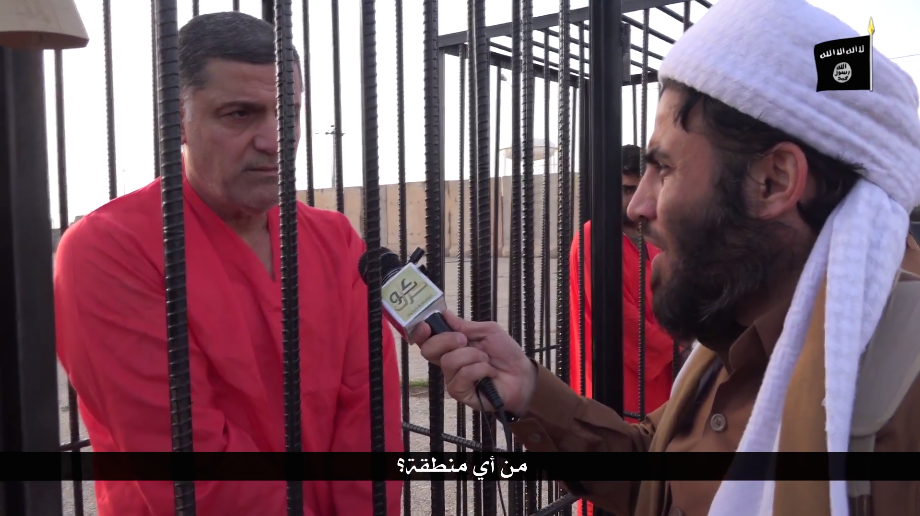
Capitalist industrial civilization has created a real bizarro world for itself from all the geopolitical blowback of resource wars and dark politricks, the entrenched vested interests of the military industrial complex and fossil-fuel conglomerates, the financial chicanery of the wealthy elite, and all the hi-tech gadgetry and weapons in the hands of every virulent extremist. ISIS now appears to even have their own TV show interviewing prisoners in cages before they make another snuff film. The world just seems to be getting more screw-balled by the hour. What the fuck is this?:

Screen Shot 2015-02-22 at 12.59.31 PM

Nafeez Ahmed has an excellent article on the failed state of Yemen and its slow collapse into a post-oil, post-water Mad Max land. Their primary crop is now qat, a mild narcotic plant whose cultivation sucks up even more of their dwindling water aquifers. As someone on Reddit said:

I know its sexier to focus on the collapse of rich states, such as America and various nations in Europe and Asia, but it will most likely be Yemen and other nations that provide a prediction of a future to come. Largely the modern nation or multicultural state will start to break down, beset by escalating crises in disaster, capital, and factional management until civil war breaks out. From that death spiral, who knows how far it will go…

In addition to a perfect storm of ecological and social problems that include overpopulation, resource depletion and climate change, there is also the baggage of imperialist U.S. foreign policies –arming and aiding corrupt and brutal kings/dictators, funding and arming radical extremists like Osama bin Laden’s jihadists in Afghanistan during the 1980’s, etc. in an effort to control global oil supplies and trade routes. In Bizzaro world, don’t expect any leaders of American Empire to touch those root causes with a 10,000 mile remote-controlled drone.

There Will Be Blood

By TDoS
Cross posted from Prayforcalamity.com

“He said that men believe the blood of the slain to be of no consequence but that the wolf knows better. He said that the wolf is a being of great order and that it knows what men do not: that there is no order in this world save that which death has put there.”
― Cormac McCarthy, The Crossing

In Theodore Kacynski’s manifesto, “Industrial Society and Its Future,” he lays out many premises concerning the existence of man in relation to technology and technological societies. One of these premises is that modern people in technological societies are afraid of death because they have never lived. They have not used their bodies, minds, and souls to their full potential, and thus even in old age, feel like they are yet to begin. Kacynski writes about the primitive man who in his sixties, having seen the successful life of his child and feeling the weariness in his muscles and bones, does not fear, but welcomes his turn to sleep. Where these intuitions were passed on, cultures of indigenous peoples were able to form warrior societies whose success rested on the fact that individual braves had no fear of death. They viewed themselves as one with their people and their land, both of which were timeless, granting them strength of conviction when the situation called for it.

When we hear of people dying in our culture, such news is often quickly followed with statements about the unfairness of one dying so young. Even a fifty-year-old heart attack victim will generally be granted laments and declarations that their passing was too early. While of course the loss of a loved one is saddening, there does appear to be a trend throughout this culture that seems to speak of death as if it is not the ultimate outcome of every life. Death, like the environment, is but another inconvenience to be conquered by our cleverness.

In this culture, there is language of “rights” concerning life. It is said that individuals have a “right” to life, meaning then that death is some violation against the individual. There are even those who would like to extend such rights to animals. No one, according to modern people enculturated by the dominant dogmas, is supposed to die. Ever.

Of course, every living being is only so for a limited time. Death and birth are two phases in the same biological process, and where there is the latter, inevitably we will come to the former. What I find so maddening, is that this culture, so lacking in its ability to confront death, let alone to create and support the psychological and emotional infrastructure to deal with death, is such an efficient bringer of death. How a people so vocally dedicated to peace and the preservation of life can then unflinchingly create nuclear and biological weapons, institute economic castes which immiserate the majority to establish the privilege of the minority, and daily exterminate upwards of two hundred species is possibly the grand irony of our time.

The mind reels.

When just last month, the study “Planetary Boundaries: Guiding Human Development on a Changing Planet,” was released, it got a lot of traction across the internet. The study, prepared by eighteen scientists from various international universities, grabbed headlines by claiming that human civilization had crossed four of nine environmental boundaries.

Of course such studies digitally shared from hard drive, to hard drive, to hard drive have never served to accomplish much in the way of real world action towards deindustrialization, and likely this one was and will remain no different. The trend seems to be that alarming data confirming that human industrial civilization is driving the global ecology to ruin, likely even to the near term detriment of this very civilization, only ends up spurring on those who believe that human industrial civilization can be done in a less harmful way, perhaps with the addition of more solar panels or the subtraction of capitalist motives.

Those who dare argue that civilization, and industrial civilization in particular, is the root cause of the destructive habits which are bringing all living beings to a point of potential collapse or extinction, are routinely dismissed as extreme. Such critics, before dismissal, are reminded of the dominant culture’s primary directive; “We cannot go backwards.” Suggestions that we must, in order to maintain a survivable habitat, drastically reduce reliance on industrial methods, products, and infrastructure are waved off as impossible, insane, or even genocidal. Defenders of the dominant culture and systems of industrial civilization claim that such reductions in technological application will axiomatically mean reductions in human population, and thus are off the table. These claimants are either oblivious to the fact that “going forward” with the methods and practices of the dominant culture would be at least equally genocidal, if not more so, or they harbor a quasi religious belief that human invention will save us from every single problem caused by previous scores of human invention. Always ignored is the clear fact that so called “going forward” will mean an increase in human population before the ecosystems which support them collapse, meaning there will be more humans to die when drought, famine, sea level rise, resource scarcity, and every other calamity currently rising to crescendo ultimately manifest in a symphony of systemic failures that existing political, technological, and economic structures are incapable of mitigating.

And then there are the non-human genotypes that most defenders of the dominant culture refuse to ever enter into their calculations.

When someone refuses to acknowledge a solution to a problem because it will indirectly involve death – even when the solution in question is attempting to select fewer deaths sooner as opposed to a great many more deaths later – this person is inserting hidden premises into the discussion, the most obvious of which is that people alive now have the right to exhaust the health of the land which people not yet born will need to rely on in the future. If upon the suggestion that we must globally act to deindustrialize in order to prevent overwhelming climate catastrophe, a person floats the counter argument that such deindustrialization will result in a reduction of currently available medical technologies, and is therefore an unacceptable proposition, this person is inserting into the discussion a premise that the lives of those who would no longer have access to the medical technologies they require are more valuable – this is to say, they have more of a right to survival – than the lives that will be lost – human and non – when industrial civilization fails and brings down with it the functioning ecology of the planet.

Such premises, to me, seem insane. A patent refusal to acknowledge the bare reality that all life, including human life, requires as a foundation a healthy and viable habitat is either obstinacy or a shameful level of ignorance. Claiming that one group of humans has more of a right to survival than others, or that humans have more of a right to survival than the rest of the web of life, is doubly insane.

At the end of it all, defenders of the status quo are not defending life, they are defending lifestyle. Proponents of the dominant culture and its myths of progress are really arguing for their own comfort, of both body and mind. Changing nothing presents no difficult ethical questions or messy physical conflicts. Going forward is the easy choice. This fact alone should ring alarm bells.

Why is death so unacceptable? If we cannot come to grips with death, then we will find ourselves collectively at an impasse where no necessary action will be taken, and industrial civilization will continue unimpeded on its course devouring forests, wiping out species after species, washing away topsoil, and rendering the oceans a lifeless acidic soup of plastics in various stages of photo decay. Somewhere buried in all of this is yet another premise; that to elect the death of even one is unacceptable, but to remain passive while existing systems dole out death to many is forgivable. Human agency seems to be the determining factor. The people who own and operate chemical plants that cause regional cancer clusters in children are forgiven. The death of one million pinpricks is too diffuse to assign blame. On the other hand, to intentionally kill the CEO of such a chemical company would be an outrage. It would be a tragedy. People on TV would say he died too young.

The dominant culture not only protects those high on its hierarchy, blurring lines of responsibility for the actions they take in the name of progress, but it also blinds every day people from the realities of just how it is they come to have the things that they do. Major systems of production and distribution that segregate individuals from the sources of their food, their clothing, the materials that built their homes, the fuels that power their cars and gadgets, create an illusory sense of existence. If a person perceives that food comes from a grocery store, gasoline from a pump, shoes from an online retailer, it is reasonable to believe then that this person’s perceptions have been skewed into believing that nothing must ever die for us to consume whatever we want in whatever quantities we desire. As long as the blood is on someone else’s hands in some other land far from sight, then there is no blood at all. It is this willful blindness to the day to day functioning of industrial civilization on the part of the world’s wealthier populations that allows a people draped in slave made textiles who are kept fed by the mechanistic rape of stolen land powered by stolen oil to stare up with their doe eyes and without a hint of irony ask, “But why do they hate us?”

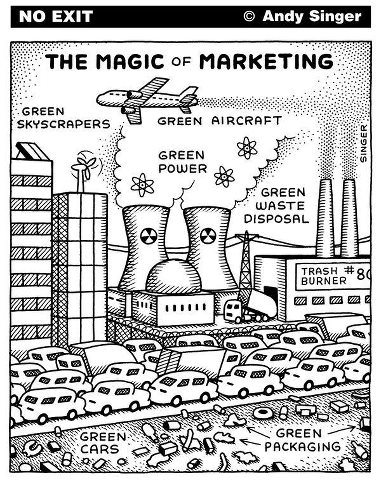
So it is that so often we hear the claims of “green” capitalists who declare we can have our planet and kill it too. We are to shut our eyes and believe that solar panels, electric cars, fair trade mocha lattes, soy burgers, iPads, internet service, and all of the pills and processes in a modern hospital all just manifest from the ether. The rainforests clear cut, the oceanic dead zones caused by agricultural run off, the open pit mines, the oil spills, the nitro-tri-fluoride and other greenhouse gasses, and all of the whips and prods physical and not that herd about the masses of humans who do all the lifting, stitching, assembling, dismembering, and dying to bring such wonders to our shopping carts just don’t add up to dry shit.

That is how the dominant culture deals with death. It hides it. And when it can’t hide it any longer, it calls it “business.”

Various indigenous tribes have been able to maintain steady populations. In fact, for millennia, a handful of commonplace practices aided in keeping a tribe or band’s numbers in check. Breastfeeding infants until they were four years old helped prevent mother’s menstrual cycles from resurging, thereby keeping birth numbers down. The use of abortifactant herbs also helped women in the event of untimely pregnancies. When a group’s population was at a point where another child would bring great hardship, some tribal people would turn to infanticide. Picture the heartbreaking scene, as a mother lays a newborn infant on a cold hillside to freeze as the sun sets on a winter day. On the other end, tribes would at times decide not to work to heal ailing elderly members, and instead would begin ceremonial death rites when an older person fell ill.

This is the cultural imperative I am interested in. The ability of a people to confront the hard reality of their lives, and to make the soul wrenching choices that they must make in order to survive is not present in the civilized paradigm, not when it comes to allowing death. This is a delicate topic, to be sure, but one of necessary import as the world now hosts almost eight billion people, while conversely non-renewable resources are consumed at increasing rates, and the ecology is pushed beyond the breaking point.

Cultures that accept the inevitability of death create ceremonies and social forms for processing death. This is not to suggest that these people do not feel the pain of loss when a loved one passes, but rather to highlight that they develop a maturity surrounding death. They can talk about it. They can incorporate it into their survival strategies. They do not treat it as a cosmic betrayal of the individual’s right to exist for seventy-five years before a midnight expiration in a beach condo in Florida. Most importantly, cultures that make room for death do not become locked into a suicidal social paradigm, refusing to veer in their direction because doing so would result in the death of some, even when going forward would result in the death of all.

In my last essay I spoke of needing a new cultural ethos in order to prevent the wanton annihilation of the Earth’s life giving systems. This psychological and spiritual evolution must include maturity in the matters of death. Culturally, we must not shun death from our view, for when we do, we push his presence beyond sight, but not beyond efficiency. Beyond the hedge where death lurks ignored by modern man, he does his work still, and he plots against those who believe they have banished him with their cleverness. He plans a great party indeed.

My daughter is nearly a year old. She is my connection to the future, as my parents and ancestors are my connection to the past. I love her to my core, each cell in my body resonating with an urge to guard her, protect her, and to see to her survival. I think about the emptiness that would devour me if she were to die, so I do have a sense of the gravity concerning that which I have written. I look at my little girl, and the truth of life comes to me plain as the new day: we cannot banish sorrow. Heartache is the handmaiden of joy. The history of our species is the history of finding the strength to endure when it seems that all is lost, and when we see no reason to go on, feeling that the ground holds us still.

The complex problems we face require sober, adult analysis, but here and now we lack the methods and ceremonies necessary to act as a mature culture. Our unwillingness at all levels to confront uncomfortable realities has made dangerous adolescents of us, as our orgy of consumption and self aggrandizement has pushed the planet to the brink. There are tasks which demand our collective attention, and undertaking them, while necessary, will not be without consequence. There are few good options on the table before us. Meeting such difficult questions head on, with humility and grace, is the mark of greatness.

It is time to ask, “who are we?” and “who do we want to be?” As we stand right now, we are a belligerent cult of ego, drunk on the self, screaming our greatness as we charge forth trampling everything underfoot. We have a lot of work to do, and not nearly enough time to do it. Death rides whether we call for him or not.

Praying to the Gods for Rain

Tags

, , , , , , , , , , , , , , , , , , , , , , ,

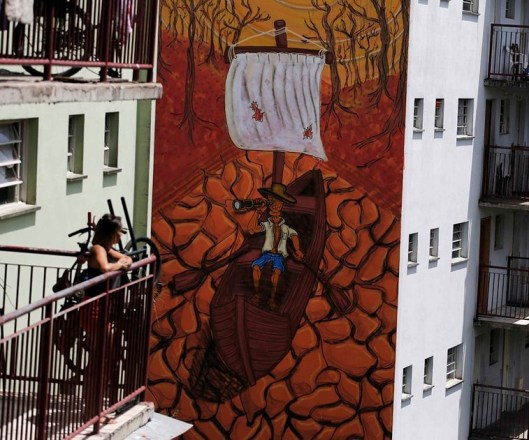
img_pod_2501-brazil-sau-paulo-graffiti-water-shortage-drought--RTR4MRSG

Brazilian graffiti artist Paulo Ito​ in São Paulo

While capitalist carbon man clings to his position atop the billions of energy slaves constructed over shifting sands of geologic time, the stable weather regime of the Holocene is being pulled right out from under our feet. Governments pray to the gods for rain as the Earth’s glaciers melt away and climate chaos unfolds around us:

…In 2015, the party in power, the Workers’ Party (PT), still thinks the divine will provide for everything, making it rain so that hydroelectric plants can generate power for the people. This is not surprising for a government whose minister of science, technology and innovation believes that global warming is a tool used by imperialism to control the poor countries. For the current Government, any intervention by man in nature seems mysterious and unpredictable in its consequences…

What impresses most in government pronouncements is their view of nature as indomitable and wholly unpredictable. Any measure involving future projections is absolutely absurd and unfeasible for the government, which works in cycles of four years (up to the next election). If hydroelectric plants run out of water, we can only pray for rain to restore the dams to their usual levels. If potable water runs out, only nature can replenish the reservoirs. Like tribesmen for whom any human interference in climate is anathema, every solution proposed by the government is an appeal to fortune and divine grace.

…Brazilian politicians should be wary, however. Divine grace periodically answers the call for rain. And with the gift of rain, periodically Brazilian cities are flooded, hundreds die, and thousands are displaced. Even though that happens anually, without fail, the government floods are absolutely unpredictable, too. Well, what can we do? Let’s pray for rain. But not a lot.

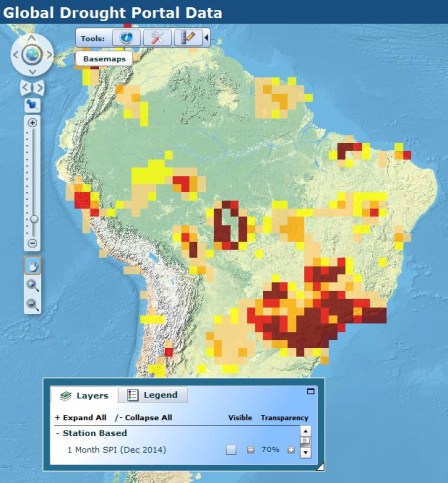
Three primary elements have converged to make the present drought in Brazil the worst in its recorded history, threatening to bring the megacity down:

  • anthropogenic global warming(AGW)
  • rampant deforestation of the Amazon rainforest
  • gross mismanagement of water resources and government corruption

The first factor is planet-wide and beyond the ability of any one state, no matter how powerful, to solve alone. The accelerated warming that is happening twice as fast in the Arctic as any other region is known as Arctic amplification. This runaway warming of the Arctic is a result of the radiative forcing of GHGs, water vapor, and dark aerosol particles combined with increased solar absorption from loss in Arctic albedo. Consequently, the equator-to-pole temperature gradient is being weakened, meridional heat transport is decreasing, and sea levels are rising. These changes are altering the polar jet stream and affecting such things as ocean salinity, currents and oxygen levels. A recent study revealed that within a matter of 100 years, the Earth’s oceans have undergone extensive and abrupt changes in oxygen levels when the ice caps melted in the past. The early phases of a mass extinction level event are taking place right before our eyes, but humans view the world through anthropocentric rose-colored glasses, oblivious to such dangers happening on a time scale of more than a few decades.

Ten years before Jennifer Francis’ work on the effects of climate change to jet stream patterns, scientists had predicted that the loss of Arctic sea ice would warm the oceans and give rise to heated air columns which would act as powerful blocking patterns, altering jet streams and preventing rains from reaching California. The findings of their models are eerily similar to the recent weather phenomenon called the “ridiculously resilient ridge” which has continued to block any significant amount of moisture from reaching California for the past two years. Weather reports from Brazil describe similarly persistent formations of warm air columns:

Similar to last year, a giant dome is now forming over the heartland of Brazil that is blocking moisture out in eerily the same manner as it did a year ago. The reason for this may have little to do with natural occurring weather patterns, but climate change from deforestation from the Amazon, where experts have warned this could be the outcome and that drought could occur with increased frequency. Rather than regular rainfall, the areas directly impacted are getting both extremes with intense drought followed by above average rains and then turning dry again. – Jan 2015

Droughts are persisting in both Brazil and California, as well as many other parts of the world. It has been known for a long time that global warming would result in drought and crop failures, an enormously destabilizing factor to any government. To compound the problem, humans are pumping water from aquifers much faster than natural processes can replenish them. Both El Niño and La Niña weather phenomenon are projected to double in frequency:

…The paradox is that global warming could also increase the intensity of not just hotter-than-usual seasons but also cool or cold episodes that would trigger unusual or extreme weather responses far from the ocean’s cool centre.

So some parts of the world are likely to experience blazing drought, followed by catastrophic floods, while across the ocean, other nations will have torrential rain and then unseasonal drought, every 13 years or so.

Brazil drought as of Dec 2014:

2534

The second factor of deforestation is also planet-wide and its effects are not confined to the area in which it takes place. A recent study indicates that a denuded Amazon will have international ramifications:

The researchers report in the Journal of Climate that an Amazon stripped bare could mean 20 percent less rain for the coastal Northwest and a 50 percent reduction in the Sierra Nevada snowpack, a crucial source of water for cities and farms in California. Previous research has shown that deforestation will likely produce dry air over the Amazon. Using high-resolution climate simulations, the researchers are the first to find that the atmosphere’s normal weather-moving mechanics would create a ripple effect that would move that dry air directly over the western United States from December to February…

…”The big point is that Amazon deforestation will not only affect the Amazon — it will not be contained. It will hit the atmosphere and the atmosphere will carry those responses,” Medvigy said.

“It just so happens that one of the locations feeling that response will be one we care about most agriculturally,” he said. “If you change the snowpack in the Sierra Nevada, where most of the irrigation for California’s Central Valley comes from, then by this study deforestation of the Amazon could have serious consequences for the food supply of the United States.”…

40% of the Amazon has already been clear-cut or degraded to some degree, putting Brazil’s rainmaker well within the tipping point for irreversible die-off as discussed in the prior blog post. Deforestation of Amazonia will lead to desertification of the major agricultural regions in the south-east of Brazil. Speaking of Brazil’s drought counterpart to the north, alarming news was recently reported that California has lost half of its big trees since 1930. The following GIF image spanning the years 2001 through 2013 illustrates deforestation in Latin America(Brazil/Amazon). It was compiled by me from data at Global Forest Watch. The spreading pink color represents tree cover loss:

imageedit_30_3209441348

And a closer look at Amazon deforestation with NASA landsat imaging:

ezgif.com-video-to-gif

Brazil’s leading climate scientist, Dr Antonio Donato Nobre, is calling for a wartime effort to restore the Amazon and reverse the drought effects caused by its deforestation which equates to 184 million football fields worth of rainforest. While I’m not optimistic, small miracles have happened in Brazil such as the replanting of Tijuca Forest by hand. Nonetheless, the devastation wrought by man swamps all his restoration efforts. Virtually all of the Atlantic forests that once extended along the entire Brazilian coastline have been cut down since colonists arrived in the 1500s. Humans are wrecking the Earth in myriad ways, and sea level rise will become the ultimate destroyer:

The third factor of gross mismanagement of water resources and government corruption is truly what exacerbated the drought problem for the city of São Paulo. Since the 1970s, there were professors of ecology and hydrology at São Paulo University and in the government who warned of a future water crisis if steps were not taken to conserve and recycle water as well as plan new infrastructure for adequate water supply, as this article reveals. Some suspect that the problem with São Paulo’s water supply really began when Sabesp, the company that manages the city’s water, was partially privatized in the 1990s (i.e. profits over long-term planning). Sabesp is owned 50.3% by the state and the rest by private investors who have made excellent returns over the years. Investments in infrastructure appear to have been sacrificed for shareholder payouts. With the Cantareira system starting to fail in 2012/13, billions of dollars in dividends were still being paid out to shareholders, yet nothing was done to stop the unfolding collapse of São Paulo’s water system. In fact, government and Sabesp officials continued to deny the seriousness of the problem until just recently when they were planning to scrape the bottom of the Cantareira System for the last drop of brown sludge. Is it any surprise that disaster capitalism had a role in this crisis? An article entitled ‘Cantareira: a new word for when politics is put ahead of public interest‘ sheds light on much of the corruption, mismanagement, and privatization of water:

…São Paulo produces 60% of Brasil’s Ethanol, and Agencia Publica attempted to use a freedom of information request to force SabeSP to reveal details of their contracts of supply with the biggest industrial & agricultural companies in the state. SabeSP have so far refused…

…A United Nations report placed the responsibility for the crisis squarely on Sao Paulo state government & SabeSP’s shoulders, a report which Geraldo Alckmin attempted to make them alter, exonerating his administration, a request they refused...

…Geologists have also been studying plans to open up the enormous Guarani Aquifer to exploitation in order to alleviate the crisis. The World Bank already funded research in the late 1990s on the underground system, during the government of Fernando Henrique Cardoso. Their contract with Brazil to support this research stipulated that any future use as a water resource had to be privatised, but once that contract expired a decade later, Brazil refused to renew on the same terms…

With no time left to properly prepare for a megacity of 20 million people without water, São Paulo’s plan is to divert a river from another area hit by drought and that will take nearly 2 years to complete. The training for riot control that São Paulo’s military police received from the FBI last year may come in handy for more than just the World Cup.

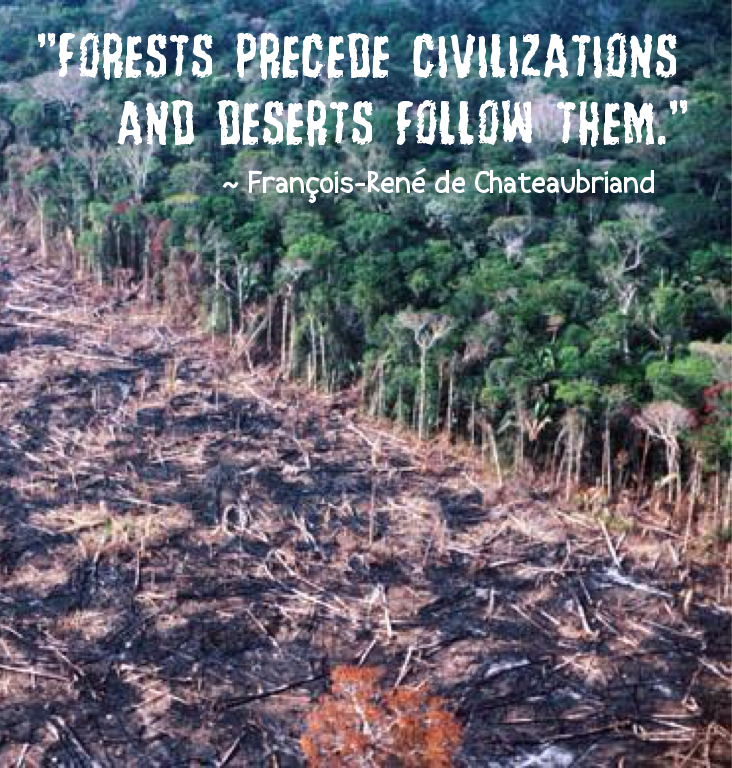
Forests Precede Us, Deserts Follow

Tags

, , , , , , , , , , , , , , , , , , , , , ,

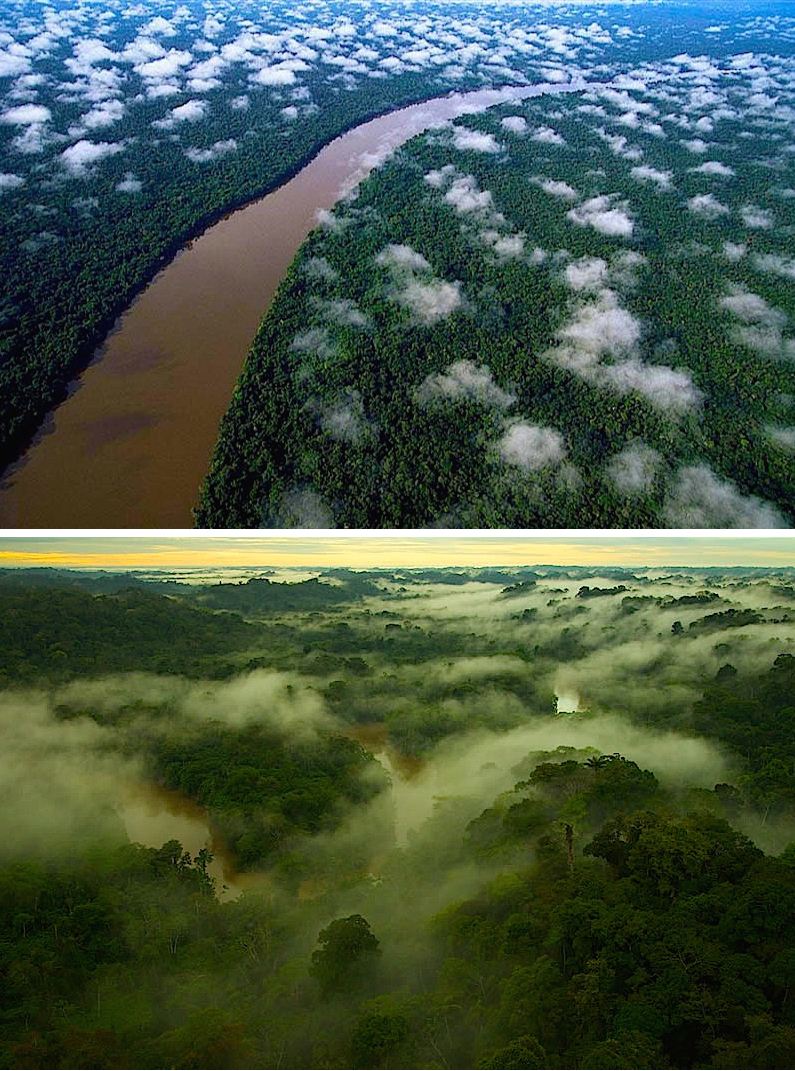
Yasuni_National_Park_Aerial_Tiputini

As Goes the Amazon, So Goes the World

Thought to be up to 100 million years old and home to more species than any other ecosystem on Earth, the Amazon rainforest is a magical place, but your average soft-bellied city dweller of industrial civilization would last no more than a week there, likely succumbing to yellow fever, malaria, flesh-eating parasites, venomous snakes, and an endless array of creepy-crawlies. Nearly one-third of the planet’s biodiversity is found in the Amazon, including ancient indigenous tribes, hundreds of animal species, 16,000 tree species, 2.5 million species of insects, and new discoveries happening all the time. With a treasure trove of medicinal plants, many of which have yet to be discovered, the Amazon is known to many as the world’s largest pharmacy. 70% of all drugs introduced in the U.S. in the last few decades were derived from nature, and 70% of plants identified as containing anti-cancer characteristics are found only in tropical rainforests.

The Amazon discharges one-quarter of the Earth’s freshwater and plays a critical role in the Earth’s carbon cycle and climate, absorbing 1.5 billion tons of carbon every year through photosynthesis. Additionally, the Amazon’s 400 billion trees are responsible for producing 20% of the Earth’s oxygen and generating the region’s heavy rains needed to irrigate crops, fill reservoirs, and generate hydropower. A single large rainforest tree is the equivalent of a standing lake releasing up to 317 quarts (300 liters) of water each day through evapotranspiration (evaporation and plant transpiration). The importance of the Amazon rainforest in regulating not only South America’s climate but also that of the entire world cannot be overestimated. Like the Earth’s cryosphere, the Amazon and other rainforests are essential geographic features of the planet that help regulate the climate and provide habitat for unique wildlife. As with the melting polar regions, the loss of the Amazon to capitalist “resource development” will prove to be a self-destructive act for all of mankind.

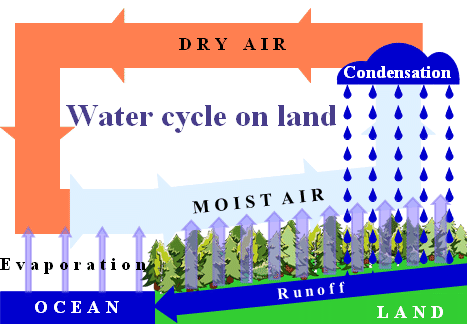
imageedit_37_9661706827 The Biotic Pump Theory

In 2006, two Russian scientists, Victor Gorshkov and Anastassia Makarieva, used basic physics to theorize that condensation from forests, not temperature gradients, is what creates the low atmospheric pressure over land masses necessary for pulling moist air currents from the coasts to the continental interiors. Forests drive the water cycle on land. After two years and major pushback from the established meteorological community, their paper was finally published in the journal Atmospheric Chemistry and Physics and to this day has withstood refutation.

Gorshkov and Makarieva argue that meteorologists have long-missed an important driver of winds: condensation, and most importantly condensation caused by the major evaporation that occurs over forests. While scientists have long noted that deforestation also brings a drop in precipitation, no one could adequately explain the mechanism behind this. But Gorshkov and Makarieva argue that forests drive winds through “persistent condensation,” bringing in rain from the oceans. Put simply: no forests, no rain…

“During condensation water vapor disappears from the gas phase. Air pressure depends on the number of air molecules and is reduced by condensation. Areas with persistent condensation become zones of low pressure that suck in the air from the surrounding regions. Forests ensure both a store and a flux of moisture on land and thus create such persistent low pressure zones on land. This causes moist winds to blow from the ocean to land,” they explain.

Put another way, regions with lots of rainfall “set up a positive feedback in which they bring in moisture from elsewhere,” according to Sheil, who adds that, “Forests maintain the highest evaporation of moisture of any land cover.”…

…if the biotic pump turns out to be true, it would not change the fact that the climate is changing and herculean efforts are needed to mitigate both the causes and the impacts, whether that focuses on greenhouses gas emissions, forests, or, as it happens, both, since forests ability to store carbon is just one of the many services they provide. – Link

A more in-depth explanation of the biotic pump theory can be found in these two videos here and here.

water_cycle_on_land

The biotic pump hypothesis explains what is behind the so-called “flying clouds of the Amazon” which carry moisture inland from the Atlantic ocean until they hit the Andes mountains and turn southward, dumping rain onto central and southern Brazil. Antonion Nobre, Brazil’s top climate scientist, is a proponent of the theory that forests function as biotic pumps for atmospheric moisture.

…As long ago as 2009, Antonio Nobre, one of Brazil’s leading climate scientists, warned that, without the ‘flying rivers’, the area that produces 70% of South America’s GNP would be desert.

In an interview with the journal Valor Economica, he said: “Destroying the Amazon to advance the agricultural frontier is like shooting yourself in the foot. The Amazon is a gigantic hydrological pump that brings the humidity of the Atlantic Ocean into the continent and guarantees the irrigation of the region.”

“Of course, we need agriculture”, he said. “But without trees there would be no water, and without water there is no food.

“A tonne of soy takes several tonnes of water to produce. When we export soy we are exporting fresh water to countries that don’t have this rain and can’t produce. It is the same with cotton, with ethanol. Water is the main agricultural input. If it weren’t, the Sahara would be green, because it has extremely fertile soil.”

Like other climate scientists, Nobre thinks the role of the Amazon rainforest in producing rain has been underestimated. In a single day, the Amazon region evaporates 20 billion tonnes of vapour – more than the 17 million tonnes of water that the Amazon river discharges each day into the Atlantic.Link

In 1980, just 3% of the Amazon rainforest had been cut down, but today the total loss has grown to about 25%, and in the last five months of 2014 the assault on the Amazon has intensified with October registering a staggering increase of 467% in deforestation. Although agriculture and illegal logging constitute the majority of cleared land, a growing percentage over the last 13 years has been for gold mining, a process that is particularly damaging to the environment due to the toxic brew of chemicals left behind. The double whammy of deforestation and anthropogenic global warming continues to weaken the Amazon. Remember that the Amazon suffered two 100-year droughts within 5 years in 2005 and 2010 and failed to recover since then. Other studies have confirmed that the Amazon appears to becoming more unstable in response to the large-scale environmental impact of rising CO2 and the cumulative effects of land degradation by humans. A study that came out just last month indicates a tipping point of 30-50% deforestation of rainforests in the Amazon and Central Africa which could lead to global effects.

…“What this study shows is that there are additional, independent effects of deforestation on climate.”

Lawrence’s report is a peer-reviewed summary of existing research, and she found that deforestation, even at small, localized levels, can change the climate. “Farmers in one place are connected to farmers in another. Countries are connected to each other,” Lawrence said. “We don’t want to wait until the climate system has shifted so we can measure it on the ground.”

She said there is a possible “tipping point” of 30 to 50 percent deforestation for the Amazon and Central Africa. Deforestation beyond that could invite disaster.

“Tropical deforestation on many scales influences local, regional and even global climate. Deforestation-driven changes to water availability and climate variability could have strong implications for agricultural production systems and food security in some regions,” the report says… – Link

If we add up the harmful effects of climate change and deforestation to the Amazon, then the tipping point may have already been breached. According to the Global Risks 2015 report by the World Economic Forum (WEF), water has for the first time displaced all other concerns to become the number one threat:

“Droughts, floods, glacial melt, unpredictable precipitation, runoff, groundwater supplies and water quality will all reflect an increasing instability as long-standing rainfall patterns change and weather extremes increase,” said Ganter.

The interconnecting risks regarding water, food, energy and climate change will be one of the overarching megatrends to shape the world in 2030, according to Ganter. – Link

São Paulo, Brazil: Repeating the Mistakes of the Mayans

2625A wall mural in São Paulo painted by Brazilian artists Mundano and Fel depicting a boat on a cracked riverbed

São Paulo, a megacity of 20 million people in southeastern Brazil, is suffering its worst drought in 84 years since the summer rains failed to materialize a year ago. Only recently did water officials finally admit how serious the crisis was and that they had covertly rationed water by manipulating flow pressure in various parts of the city under the guise of “maintenance work”. Cantareira, the city’s largest water reservoir, is currently down to just 5.4% of its capacity and officials have implemented plans for pumping a third dead volume that represents the “rock bottom” of the reservoir. And this crisis isn’t just confined to São Paulo. Ninety-three other Brazilian cities affecting 3.9 million people are rationing water due to the lack of rain.

As of 1-22-2015:

Snap 2015-01-22 at 06.37.17

Without water to run their hydroelectric power plants which provide 80-90% of the country’s electricity, Brazil has been forced to turn to more expensive and dirtier thermal plants burning natural gas, coal, diesel fuel and biomass. In turn, electricity rates have jumped 60% and Brazil’s CO2 emissions will undoubtedly increase. The rains may come again sporadically but I think the Brazilians have permanently broken the region’s biotic pump. What’s next for the wealthiest city in Latin America? Water wars will likely erupt for the last drop of moisture from a once-magnificent rainforest mowed down for hamburger-cattle, soybeans, and short-term profits.

Keeping the lights on and maintaining this current way of life is becoming increasingly tenuous as capitalist carbon man eats away at the last vestiges of a dying biosphere. Modern-day Brazil and the entire industrialized world are repeating the same mistake made by past civilizations such as the Mayans who cleared their forests for agriculture and development:

In the first study, published Tuesday in the Proceedings of the National Academy of Sciences, researchers from Arizona State University analyzed archaeological data from across the Yucatan to reach a better understanding of the environmental conditions when the area was abandoned. Around this time, they found, severe reductions in rainfall were coupled with a rapid rate of deforestation, as the Mayans burned and chopped down more and more forest to clear land for agriculture. Interestingly, they also required massive amounts of wood to fuel the fires that cooked the lime plaster for their elaborate constructions—experts estimate it would have taken 20 trees to produce a single square meter of cityscape…

…Because cleared land absorbs less solar radiation, less water evaporates from its surface, making clouds and rainfall more scarce. As a result, the rapid deforestation exacerbated an already severe drought—in the simulation, deforestation reduced precipitation by five to 15 percent and was responsible for 60 percent of the total drying that occurred over the course of a century as the Mayan civilization collapsed. The lack of forest cover also contributed to erosion and soil depletion…

…The collapse is especially intriguing because it seemingly occurred at “a time in which developed a sophisticated understanding of their environment, built and sustained intensive production and water systems and withstood at least two long-term episodes of aridity,” says B.L. Turner, the lead author of the ASU study. In other words, the Maya were no fools. They knew their environment and how to survive within it—and still they continued deforesting at a rapid pace, until the local environment was unable to sustain their society.

One of the lessons of these complementary studies, says climate modeler Robert Oglesby of the University of Nebraska, who worked on the second paper, is that our reshaping of the environment can often have unintended consequences—and we may not have any idea of what they are until it’s too late… – Link

One could safely say all human endeavor is at the mercy of the natural world and the vagaries of the weather. The ebb and flow of the mighty Roman Empire, along with its downfall, aligned with shifts in the climate, according to tree ring research:

…When [lead researcher] Büntgen showed the data to historians and archaeologists, they pointed out remarkable consistencies with what we know of past societies. At times of social stability and prosperity, like the rise of the Roman Empire between 300 B.C.E. and 200 C.E., Europe experienced warm, wet summers ideal for agriculture. Similar conditions accompanied the peak years of medieval Europe between 1000 C.E. and 1200 C.E.

The study also showed that climate and catastrophe often line up. In the 3rd century C.E., for example, extended droughts matched the timing of barbarian invasions and political turmoil. Around 1300 C.E., on the other hand, a cold snap combined with wetter summers coincides with widespread famines and plague that wiped out nearly half of Europe’s population by 1347… – Link

Believing that somehow things are different this time around and that our technological prowess will save us, few today pay much attention to the history of man’s folly and the overreach of past civilizations. The brutal reality is that nothing has changed since then except for the epic degree of capitalist carbon man’s hubris and the scale of his overshoot which has now reached global proportions, guaranteeing that no one will be spared, neither rich nor poor, wretched nor innocent. Meanwhile, our fearless leaders took a page out of The Onion the other day and got together to agree that “climate change is real and not a hoax” while inserting the caveat that humans are still not the cause. Did that really just happen?…Don’t let this surreal world get you down. We’re simply spectators observing the tragicomedy of the human race.

On the Supersonic Track to Extinction

Tags

, , , , , , , , , , , , , , , , , , ,

2012_by_Dudek3

Where is the “Misanthropocene” right now in relation to past extinction events? The chart below tells the tale. Notice that our current rise in GHG’s is essentially instantaneous in relation to past warmings which took place over thousands of years. As far as scientists can tell, the current warming from industrial civilization is the most rapid in geologic time. Ice core and marine sediment data in the paleoclimatology archive have revealed brief periods of rapid warming and there is no reason to believe modern man is immune to such catastrophic and abrupt climate events. In fact, we know that the Arctic is already warming twice as fast as anywhere else on the planet. Earth sensitivity to climate change is now thought to be possibly double that of previous estimates. An entirely different planet can result from just a slight change in temperature:

Snap 2015-01-14 at 23.36.48

We’re about halfway towards the same CO2 levels as the Paleocene Thermal Extinction, but our speed of trajectory surpasses even that of the Permian Extinction:

wardco2big

In 2005, Lee R. Kump and fellow scientists published a paper describing what would become known as the Kump hypothesis, implicating hydrogen sulfide (H2S) as the primary culprit in past mass extinctions. According to OSHA, “a level of H2S gas at or above 100 ppm is immediately dangerous to life and health.” Prior to Kump’s study, the working theory had been that some sort of singular, cataclysmic event such as an asteroid strike was to blame for all mass die-offs, but Kump and colleagues proposed that a global warming-induced asphyxiation via hydrogen sulfide gas(H2S) was to blame for snuffing out life under the sea, on the land, and in the air. In past mass extinctions, volcanic eruptions and thawing methane hydrates created greenhouse-gas warmings that culminated in the release of poisonous gas from oxygen-depleted oceans. Humans with their fossil fuel-eating machines are unwittingly producing the same conditions today. The Kump hypothesis (elevated CO2 with lowering O2 levels) is now regarded as the most plausible explanation for the majority of mass extinctions in earth’s history:

Excerpt from Lights Out: How It All EndsSnap 2015-01-14 at 19.58.23

In the short term as both poles completely melt away and the Equator-to-Pole temperature gradient declines, the hydrologic cycle and storms will intensify, jet streams will be altered, global air circulation and ocean currents will be rearranged (especially in northern latitudes), and sea levels will rise. While some local winds will slow down, other areas may actually increase due to local temperature gradients becoming more influential than global ones. New research has indicated early warning signs of a collapse in ocean circulation. When that happens, the oceans ultimately turn into stagnant, anoxic pools belching deadly hydrogen sulfide into the atmosphere.

As others have noted, our energy, transport and building infrastructure was not constructed to withstand a mutated planet blindly molded by over seven billion humans. For example, think of all those massive wind farms rendered useless by alterations in local wind patterns, hydro-power shut down due to devastating droughts, solar farms destroyed by large hail storms, etc.

Many are under the delusion that we’ll be able to turn this process around with “green energy” while ignoring that such technologies are derivatives of fossil fuel or that increased efficiencies will lower our carbon footprint while ignoring Jevons paradox. Countless other self-reinforcing feedbacks loops driving our socioeconomic system come into play as well such as rampant overpopulation (Overpopulation key driver of climate change, mass extinction), chemical pollution (“Every year, up to 400 million tonnes are produced and a thousand new substances concocted“), and capitalism’s inherent growth dynamics:

The monstrous capitalism we see today is the result of capitalism’s inherent growth dynamics. To give one modern-day example, the solar energy industry/movement began with the conception of local, i.e. decentralized, and roof-top solar electricity generation for local consumption. Today we see projects like Desertec (huge solar power plants in the Sahara that would supply 15% of Europe’s total electricity needs) and competition between European and Chinese solar panel producers for larger chunks of the world market.Link

The destructive trend has been inexorably cumulative:

…the central trend is verifiable: mass die-offs are on the rise, increasing by one event per year for the last 70 years.

“While this might not seem like much, one additional mass mortality event per year over 70 years translates into a considerable increase in the number of these events being reported each year,” explained co-author Adam Siepielski, a biologist at the University of San Diego. “Going from one event to 70 each year is a substantial increase, especially given the increased magnitudes of mass mortality events for some of these organisms.” Link

If we shed our anthropocentric blinders, the harsh reality is that nothing of substance is being done to prevent our own extinction, and after looking back at humanity’s track record for slowing down this beast of globalized industrial civilization even one iota, any sane and rational person would have to conclude that there are forces at work well beyond the control of any one group of people, any state, or even any one country. Humans have the dubious honor of being the earth’s first sentient beings to have thoroughly documented their own demise while arguing with each other over whose fault it is. And the longer the Keeling Curve stretches skyward, the greater the odds that we will pull the trigger on a geoengineering scheme to slow down the inevitable:

Do these experts—the top scholars and scientists researching the subject in the world—think we will see geoengineering in our lifetime?

“Let’s see it for ten years,” the emcee said. A few scientists cautiously raised their hands. Twenty and 30 years saw some more converts. When he called out “fifty years,” more than half the room had their hands up.

That, according to the experts, is a 50-50  shot that someone is going to try, this century, to engineer the Earth’s climate. To hack the planet. Link

Techno-capitalist carbon man’s fetish with high-tech gadgetry has already gotten the best of him. Just look at us glued to our iphones, tv’s, internet, and sundry other social media tools. We’re addicted to and dependent on our technology, and the idea of pulling the power plug on this way of life is unthinkable, not to mention fatal, for those raised within its confines.

20131112-163332

“In Earth’s history we see climate changes over time, and we know that some of these climate changes were associated with enormous biological destruction. How could we believe that the same sort of experience moving into the modern-day wouldn’t do the same thing?” ~ Dr. Peter D. Ward

Forbidden Thoughts and Sacred Obligations

Tags

, , , , , , , , , , , , , , , , ,

By TDoS
Originally posted at Prayforcalamity.com

When I was a younger man, I very much wanted to be taken seriously. To be taken seriously was to be asked your opinion. It was to be allowed a seat at the grown-up’s table in politics, economy, and all other matters that intelligent individuals busied themselves with. I wanted to be considered smart by other people who were considered smart. This meant that I had to be skeptical of any claims not supported by the dominant culture, shucking anything deemed mystical or superstitious. To be considered smart meant carrying an attitude of superiority, even open hostility towards anyone who claimed any truth not stamped with approval by the science of the dominant culture. Now I talk to trees.

My younger self would ridicule my present self, haughtily proclaiming the superiority of his well founded, reasonable ideologies. My present self would pity my younger self, and exit the conversation, too tired to expend what little communicative energy I have on someone so seemingly bereft of the ability to even momentarily entertain an idea that ran contrary to their set of inherited cultural dogma.

It is easy now to see that I was in a trap back then. As most young people are, I was attempting to make my way in a culture of accumulation, and thus I had to look and sound the part if I wanted to be accepted into the fold of “productive society.” Since abandoning any ambitions for career I have taken on various forms of employment to get by, and this has meant a lot of work in bars and restaurants. Briefly, I worked in a breakfast cafe in a college town that was home to a popular business school. Working there I would see students, mostly young white men, sitting at tables wearing ties and speaking in the language they were being conditioned to speak. It was strange to witness. I would wonder exactly where the break happened when these young men decided that they wanted to be just like their fathers. They probably wanted to be called “successful” by other people. They probably wanted to be considered smart. This would mean dressing, speaking, acting, thinking and even at their very core believing as their predecessors had initiated them to. They wanted to be taken seriously.

The year two thousand and fourteen was the hottest year ever recorded on planet Earth. Over the course of the year we were bombarded with statistics highlighting the peril of our time: Fifty percent of animal life has been killed over the last forty years, the Antarctic ice sheet melt has passed the point of no return, and coal use is still on the rise globally. Even the timid, watered down, almost entirely feckless mainstream US environmental movement is starting to make a tiny bit of sense, in noting that capitalism has got to go if we are to survive. Of course, much of what these liberal environmentalists are seeking is capitalist reform, but I digress.

The truth of the matter is that of course capitalism has to go in order to preserve the habitability of the planet. That’s just the beginning. All of industrial civilization must go, but because this is a forbidden concept amongst the serious folk who attend conferences, do media junkets, or – I don’t know – hold a senate seat, it will never even reach the table to be laughed at. The maintenance of the dominant culture requires that certain ideas are forbidden. Such restriction of thought is achieved in a myriad of ways, including by what Noam Chomsky termed, the “manufacturing of consent.” By and large, forbidden ideas are boxed out of public discourse by professionals who frame debate very narrowly, permitting only officially acceptable viewpoints, which then filter down to the masses.

We saw this recently with the uprisings in Ferguson, Missouri. The people of that city fought the police, and many of them had no problem declaring complete and utter disdain for the police as an institution. Despite the nearly five hundred Americans killed by police every year, and the untold number of assaults, robberies, frame ups, false arrests, and rapes committed by uniformed police officers, the dialog of so-called serious people is forbidden to ever move to a discussion of self defense against these villains, let alone abolishing them from civic life. Peter Gelderloos mentions this in his quinessential three part essay, Learning from Ferguson.

To allow people to fight back against the police, or to allow discussion of eliminating the police is forbidden because the police are a necessary component of a society of haves and have nots. In fact, I would be willing to bet there is a strong correlation between people who adamantly and unquestioningly support the police, and personal wealth, for the obvious reason that the more you have the more you have to lose. That means being happy that the taxpayers subsidize the jackboots who prevent even a public forum that might hint at discussing a redistribution of wealth.

After the Vietnam War, the propaganda ministers in the state realized that showing dead bodies on TV and in magazines had a demoralizing effect on the general public. Apparently the American population had some level of functioning empathy for other human beings, so broadcasting the corpses of dead US servicemen and even half burnt Vietnamese children soured their taste for carnage. Since realizing this, the US has locked out media that isn’t “embedded” from war zones, and despite the over a million dead in Iraq and Afghanistan, ten years of war haven’t found themselves plastered on the nightly news in any unbecoming fashion, despite the plentiful material. The children born deformed due to depleted uranium poisoning caused by US munitions should have been enough to wrench even the blood thirstiest of hawk bellies in the US, but their visages were never given a chance.

Forbidding an image and forbidding an idea are both attempted for the same reason; control. If you control what people think, you can control how they act. Even the most ardent critics of US policy will proclaim up and down their patriotism, less they be banished from serious forums. Sit and think for a few moments and I imagine you could come up with your own short list of forbidden ideas, never to be discussed, not by serious people. Civilization and its dominant culture have been practicing this tactic of control since inception, and there is an idea that has been so terrifying to the rulers of the civilized world that stamping it out has been an ongoing and bloody task for over ten thousand years. The most forbidden of ideas, is that the Earth is alive.

Serious people are concerned with objectivity. They perceive the universe to be a clockwork machine governed by laws and made of various inert bric-a-brac that can be manipulated to serve their purposes. Whether this manifests as a logging company cutting down a forest for timber, a meat packing concern quickening the rate at which they slaughter cows, or bulldozers scraping away layers of Earth in order to access the bitumen deposits beneath, the source of the thinking is the same.  The land is dead.  Inert.  It is raw material waiting to be put to purpose by human hands.  Further, knowledge and understanding of the universe and its lifeless bodies is to be achieved only through the application of western scientific principles. Anything that cannot be observed and quantified with the five human senses does not exist.

Even things that are alive, like trees and animals can be reduced with a trick of thinking into nothing but their component pieces. Trees don’t have brains, so they cannot think or feel or experience, so they are worthless except as corpses.  Animals may have brains, but those brains lack significant cortex or numbers of neurons, and so they cannot think or feel or experience, so they are worthless except as corpses.  Throughout the history of civilization this rationale has been applied to humans as well.  Whenever anyone is in the way of some expectation of power or wealth, they are reduced to nothingness, just a fleshy sum of their cells with a measly few watts of current surging through them.  Not sophisticated, not refined; much like animals really, and animals are worthless except as corpses, so let the homicide begin.  This mental twisting is the death rite of civilization.  It is the lullaby people in business suits sing so they can stay focused on the cash while they order another chimpanzee vivisected, purchase a new gas lease, or sign off on limited airstrikes over a civilian population.

In my life I have walked through forests clear cut for oil pipelines.  I have driven through the shale plays of West Texas.  I have seen copper mines, and coal mines, and all sorts of other massive holes blasted and scraped into the face of the planet.  Many people have seen these things.  Of course, many people work in these places and on these projects.  The difference is that upon the witnessing I feel something very somber that nags at me from the inside.  It is the feeling that gripped you as a child when you saw someone joyfully inflict pain upon someone helpless or weak while you were powerless to interfere. Because of this feeling I could never participate in ecologically destructive activities.  It would feel wrong, like treachery, like stabbing my mother in the gut for a paycheck.

And I think this feeling matters.  This feeling is part of the foundation of my personal ethos from which my principles blossom.  In short, my feelings of connectivity with the living world create in me a sense of responsibility to protect her, and a refusal to accept harming her for personal gain.  Often I wonder why so few people feel this particular empathy, but then I know the answer.  People have been trained by the dominant culture to think of all of these environmentally degrading activities as harmless.  They have been raised since childhood by people themselves raised since childhood to believe that the Earth is dead.  They have been told by respectable people to believe that forests are not alive and that plants do not feel and that at the end of the day, everything is arbitrary and meaningless.  There is an undercoat of nihilism which makes progress possible.

For generations people have been bullied into believing that the nagging in their conscience is an illusion caused by the brain.  When a forest makes you feel good, it is you fooling yourself. When you feel deep love for a place or for other living beings, it is an illusion, merely a sudden influx of serotonin in some receptor in your gray matter.  And who are you anyway?  Just some cells, some neurons, some electricity.  What is your love?  Your desire?  Your fear?  They are nothing.  Reflexes.  Chemicals.  The aimless, endless spinning of molecules through space and time.  Reduce it all down, break it into pieces.  Scatter them until you feel nothing at all. Now go make some money.  Be productive.  For Christ’s sake, be serious.

My friend is indigenous to the land now called Canada.  I ask him what it means to be a warrior, to have as a component of one’s culture a warrior society.  He points me to talks given by other first nations people which elucidate that in various indigenous languages the word “warrior” is understood differently than it is in English.  It isn’t aggressive, on the offense, macho, seeking to conquer.  To be a warrior is to be a shield bearer, a person who takes very seriously their sacred obligation to maintain the health of the land so that it can be passed on for many generations to come.  The ethos of such people forms their worldview, and this worldview informs their actions.  The end result is a relationship with one’s home that is not about domination and taking, but acting with reciprocity. Such a mindset is a barrier against excess and greed and wanton destruction of the land.

Under the dominant culture, there are no sacred obligations.  We are told from birth that work, production, and the pursuit of material wealth is the path taken by serious people.  Those who rebuff their instruction to accumulate for the sake of accumulation are losers and bums.  If one wants to defend their home, such intuitions are bent to the cause of imperial full spectrum dominance.  Home is converted to country, and the battlefield is determined by a board of directors.  This is not an ethos with a future.  It is a toxic set of ideas and myths that will guide human minds to the edge of the world and then over.  This idea is a parasite, and its hosts are pushing the ecosystems of the Earth to the brink.

My friend tells me about the deal the wolf made with mother Earth:

The wolf signed a contract with Mother Earth. The contract is this. The wolf may compete with all other life for survival. The wolf may not force other life into extinction for the purpose of eliminating competition. The wolf may not damage habitat to eliminate competition. The wolf may not wage war to prevent other life from feeding on the wolf. If the wolf abides by these laws and is able to compete, the wolf will survive in brotherhood with all other life. All life signs this contract, except for a group of humans. Until those people sign on the dotted line they will be doomed. They may already be doomed.

What strikes me about this is that to make a contract with another is to stand as equals.  Speaking of other beings or of the living planet herself as even able to enter into a contract is to grant to them the deference that they exist as you do; alive, dignified, valuable.

The dominant culture never seeks to stand equal with anything.  It seeks only to dominate.  It never presents obligations to its acolytes to defend other beings or the land.  It makes demands of the land.  The stark differences between these two perspectives is striking.  One asks you to be a warrior and to take up a shield in defense of your mother. The other commands you to take up a sword – or a plow, or an axe, or a bulldozer – and to plunge it into her breast.

I am not in any way suggesting that non-native people need to appropriate native culture.  What I am suggesting is that if the ethos of civilization goes unchallenged, then no matter how much awareness is raised and no matter how much people try to convert modern industrial society into a sustainable twin of itself, they will find only failure.  After all, as Terrence McKenna said and I have oft quoted, culture is our operating system, and the dominant culture has a starting point where the land is already dead, so how then can it take us anywhere but to a future where this founding principle is materialized?  Garbage in, garbage out.

How we go about changing the ethics, myths, and founding truths of people trapped in the cage of industrial civilization is not something I have a prescription for.  In “The Road” Cormac McCarthy wrote:

Where you’ve nothing else construct ceremonies out of the air and breathe upon them.

So I walk my land and I talk to the trees. Maybe they can hear me and maybe they can’t.  All of the serious people will laugh at my wasted breath.  Smart people will try to convince me that I am only talking to myself.  And maybe they are right.  Maybe I am a madman babbling over hill and holler.  But I can tell you this much for certain; I will never cut these trees down, and neither will my daughter.  So in the end, who gives a damn?

Spectating at the End of the World

Tags

, , , , , , , , , , , , , , , , , , ,

hourglass2

Front Row Seat to the Eco-Apocalypse

“I fear their euphoria of merchandise will have no end and they will entangle themselves to the point of chaos. They do not seem concerned that they are making us all perish with the epidemic of fumes that escape from all these things…” ~ Davi Kopenawa, Yanomami leader and shaman

Another year has turned over on Earth, home to an exothermic, bipedal omnivore known as capitalist carbon man whose expanding numbers and army of fossil-fueled machinery spans the globe. There’s nothing subtle or restrained about his reign of terror. He pokes and prods the climate change beast while taking for granted the stability of the Holocene, a peculiar aberration in the paleoclimate record. Plotted on a graph, the history of Earth’s climate resembles the jagged teeth of a demonic monster, a volatile creature whose abrupt and catastrophic shifts have wiped landscapes clean of most life. The consequences of burning the equivalent of an olympic sized swimming pool of oil (300,000 liters) per second, year after year, into the atmosphere will ultimately prove lethal to the planet’s habitability. Recently, scientists were surprised to discover a “Delaware-sized methane cloud” hovering over the U.S. southwest, the remnant of “years of intentionally released and errantly leaked natural gas during fossil fuel drilling operations.” No less problematic to the Earth’s homeostasis are the many other destructive habits of capitalist carbon man such as moving ten times more dirt than all natural processes, fixing more nitrogen than all terrestrial bacteria, and producing more sulfate than all ocean phytoplankton.

The exponential melting of Earth’s cryospheric regions is a foreboding harbinger of devastating sea level rise, altering oceanic and jet stream circulation, changing hydrologic cycles, and wholesale disruption of the entire planet’s biospheric system. A brief retrospective of our unfolding environmental meltdown by a major news source concludes that “2014 will likely go down as the year that melting polar ice caps graduated from being a geographic abstraction to a symbol of the irreversible ways we’ve warped the planet.” News reports continue to grow more ominous with recent warnings that the oceans are on the verge of belching their decades of stored heat from human industrial activity. CIVILIZATION is in the process of going ‘poof’ as its leaders play monkey politics and the masses are drowned in a sea of consumerist images. As Dr. McPherson recently pointed out, gallows humor is the 6th stage of grief for coping with a civilization that is blind to its own demise.

c19704e35d1108c4ac877d02c3160943

“Going Green” is a Marketing Slogan and Inverted Totalitarianism is the Most Successful Form of Tyranny

The unsettling truth is that the slogan “going green” has become a marketing ploy to greenwash capitalism and keep business-as-usual going. The speeches of corporate and political leaders are sprinkled with conscious-soothing key words such as “sustainable”, “eco-friendly”, and “2°C climate goal”, but there’s nothing sustainable about globalized techno-capitalism and the target of limiting warming to 2°C is a cruel illusion. So-called “green energy” is severely limited by suitable geography and intermittency of power production. The behemoth Google learned from its own extensive research that “today’s renewable energy technologies won’t save us.” The top business firms appear to be having a problem squaring their green rhetoric with reality, and there seems to be no way to make automobiles truly sustainable. Germany, the poster child for a green economy, is now “burning more coal than at any point since 1990.“:

“We already are on the edge of what is possible,” Mr. Löllgen said in an interview at his Düsseldorf office. “Is it worth it if we as a country succeed in reaching our targets in reducing carbon emissions, but sacrifice good jobs and our industrial base?”

Another misleading headline I get tired of reading states that humans may be headed for a 6th mass extinction. Let’s clarify this statement once and for all by admitting emphatically that we are well in the throes of a mass extinction which will likely include ourselves within this century. By all rational evidence, industrial civilization with its billions of inhabitants cannot survive without fossil fuels. The only way capitalist carbon man will ever be sustainable is as fertilizer beneath the crumbled concrete and asphalt ruins of industrial civilization. Don’t expect any mea culpa from a culture which has been programmed to believe converting all of nature into inanimate symbols of wealth is “progress” and “development”. Not even the dire warnings of esteemed scientists and religious leaders can break the spell cast by capitalism and its definition of progress. Our institutions have become intransigent, petrified monoliths to which all will be sacrificed.

“I think the notions of free will and self-determination have the appearance of reality during a civilization’s gestation and expansion phases, when there is more opportunity and social mobility. As things calcify, instruments becoming institutions that serve their own ends, the facade is harder to maintain. Human existence has always been contingent and constrained by circumstances. These ‘free’ notions are illusions, narrow windows of perception with a limited range of influence during times of transient prosperity.” ~ BP

The term inverted totalitarianism, coined a decade ago by philosopher Sheldon Wolin, describes America’s brand of despotism in which “every natural resource and every living being is commodified and exploited to collapse as the citizenry is lulled and manipulated into surrendering their liberties and their participation in government through excess consumerism and sensationalism.” Opposition to this dominant consumer culture is systematically co-opted and suppressed by the marginalization and alienation of alternative thought. Neoliberal capitalism governs not only states and economies, but extends right down to an individual’s behavior and way of living:

One of the goals of neoliberalism is to foster a population of individuals who will play an active role in their own self-governance by interacting with the market and consumption through calculated acts and investments… sets of rules and conditions are established between institutions, economic and social practices, and patterns of behavior. They generally function outside of conscious awareness and they habitually influence social behavior. Examples of dominant consumer culture discourse include the political linking of consumer sovereignty and choice with freedom, the linking of citizenship and national pride with consumption, the work and spend treadmill that many people choose to pursue, the commercialization of childhood and adolescence, and the celebration of consumer values through the mass media and advertising.
Social Psychology and Theories of Consumer Culture: A Political Economy

Who better to label people as “unpatriotic” if they acknowledge the reality of climate change than the host of TV’s quintessential symbol of capitalism, The Wheel of Fortune? Beneath this digital web of commercials and TV infotainment is the iron fist of militarized local police and the panopticon surveillance state which can quickly stomp out those troublesome malcontents who break free of the American hologram. What better way is there for controlling entire populations than to condition them to enjoy their chains of slavery? America’s form of tyranny, a blend of covert and overt oppression, is the most successful in the history of mankind.

Bt-v8MyIgAA4lVB

None of This Can Really Be Happening, Can It?

With all the disjointed and delusional thinking out there, I feel compelled to write a blog post periodically to get the facts straight and assure myself that what I see and hear every day is really happening. Yes, we really are terraforming the Earth into a barren wasteland while convincing ourselves that it’s worth it for the sake of a cubicle job and life in cookie-cutter suburbia. Yes, we really are ruled by the Washington-Wall Street-Pentagon complex. No, you will never get the raw truth from mainstream news outlets. Yes, I’m getting older and need to exercise more because a sedentary lifestyle is as bad as smoking. Yes, industrial civilization is still on track to collapse within my lifetime. As Robert Crumb’s mystic guru Mr. Natural exclaimed, “The whole universe is completely insane!”

291a5f85066512ef318f433786716315

Finding True North

Tags

, , , ,

By TD0S
Cross Posted from Prayforcalamity.com

—–

One of the great dangers of the life indoors, is the anesthetizing affect it has on a person. When we aren’t out in the world, we aren’t present to watch the dying. Attempting to talk about this via an electronic medium, even via the written word at all, is near futile because it requires the symbolic recreation of the tragedy unfolding around us, and the recreation will never carry the weight or the pain of the real thing.

So it comes down to data points. In essays past and in daily editorials available across the electronic press, we are fed the data points. Topsoil loss, species die off, the toxicity of the oceans, the acceleration of climate change; I can rattle off the data, but who cares? We are inside. Climate controlled. Masters of hundreds of energy slaves all whipped up to provide us with on demand entertainment, comfort, and snack food. We think we are safe inside our house, but the house is an illusion. There is no indoor, outdoor dichotomy. There is a temporary delusion blinding us to the reality of the storm bearing down.

In my previous essay I wrote that we must burn down the collective house that is civilization. We must demolish it thoroughly before the floors buckle and the roof caves in, despite the very real dependence we have developed upon this edifice. A conundrum indeed, but this conundrum is itself the question of our time, and it calls to all of us whether we are ready to square off with its implications or not.

Industrial civilization is destroying the living skin of the planet. Industrial civilization is rendering life on Earth impossible. This is inarguable. The only question then, is what to do. Where do our responsibilities lie, and how can we meet them with dignity, grace, and courage?

What do you value? What do you value the most in this world as you experience it? I think it is imperative that we start with this question because the answer will determine how we perceive our responsibilities as living beings. I refer to this as finding one’s polestar; their true north. Finding our pole star is essential because it is very easy to get entangled in the complexity of our culture, our socialization, our class status, and all of the other baggage we carry from lifetime after lifetime of trauma inflicted by the dominant culture. When we need reorientation, we come about to our true north, and keep from running wayward into the noise and distraction intentionally laid to ensnare the passionate.

My pole star is the healthy, fecund forest. I live in a wooded region, and when I look out my front door I see tree covered ravines. Beech, hickory, oak, maple, all stand stoically about me, their leaves blanketing and feeding the soil. I never feel so honest, so at home, so centered as when I stand in the deep blue dark of night, jacketed in the electric stillness of winter, staring up to the stars that peak through the tangled black fingers of the naked tree boughs. In those moments I feel whole, because I feel like part of a whole. My ancestors call to me from the past as they most certainly stood in the same pose of supplication, lost in wonder, and gratitude, and mystery.

This is where I go when I seek an ethical thread to follow through the spiritual and psychological quagmire of modern industrial civilization. When I look at the activities of humans, I ask what they mean for the forests. Not just my forest home, but for the forest homes of people and beings across the Earth. I ask if new technologies, or policies, or commercial activities will benefit these havens of life and solitude, or if they threaten them. I imagine the creeks and rivers that run through this region like blood in my veins, and usually the answer comes back to me that, no, the grand schemes of civilized man offer nothing good. They seek only to take, never to give back. They promise to dominate and ruin, and that is what they do.

When concrete is laid over what was once a field so that suburbanites can park their vehicles at a new strip of retail stores, the deep roots of plants do not surrender. Look to any patch of asphalt and you will find the rebellion under way. Grass, dock, wild onion, dandelion; they slowly crack and push through the rubble and road surface above them until they find their place in the sunlight once again. When under attack, these plants merely do what they must do to go about the business of living.

What fascinates me is that when hundreds or thousands of enraged people burn down the corporate chain stores that encircle them like army wagons on the frontier, these rioters are condemned. Spokespeople for the status quo feign innocent stupidity and ask, “Why are they burning down their own communities?” as if the concrete that is laid over the poor and working class is somehow their kin. Setting police cruisers and corporate chain stores alight is merely what these people must do to go about the business of living, whether this is consciously perceived or not.

The hierarchy of power that exists in this social paradigm attempts to mystify the public with language of togetherness when it suits them. They speak down to the lower orders as if we are one unit, one family, one tribe, each of us working together for the equal betterment of all. The actions of the powerful betray the truth, that those lower on the social hierarchy will labor, toil, suffer, and die for the comfort, power, and privilege of those at the top.

This is the framework by which responsibility is discussed within our society. If a man robs a store and is sent to prison for it, it is said that he is there to “pay his debt to society.” There are several implications in this statement surrounding the notion that this man was ever part of society to begin with, or that he desires to remain so. Of course, if he was robbing a store to pay his rent, keep the heat on, or feed his family, there will never be statements from the powerful to the effect that society failed this man, this valuable member of our collective, and forced him through circumstance to his act. Society will never pay its debt to this man, or to any man of his social rank. The idea that we are all daily electing to be in one cooperative social structure together is a pure fabrication.

As so often happens, officers of the state apparatus commit egregious violence, whether as police or soldiers, and their personal responsibility is almost never called into question. The only time an individual police officer or soldier is made to fall on their sword, is when their crime is so blatant, so heinous, and so public, that to not punish them would crack the façade of the entire control apparatus. By and large, these officers of the state do violence as a mode of day to day operations, all for the acquisition and maintenance of wealth and power as it exists and is distributed.

However, any actions deemed antagonistic to the structure of power and wealth will be vociferously condemned, and the perpetrators will be held liable for all knock on effects of these actions. For instance, if in an attempt to preserve the health and sanctity of one’s home, a person destroys the power sub station that operates the pumps for a tar sand pipeline that runs under their land, and this outage causes a cascade black out to follow suit, the state will likely hold responsible this person for any deaths or injuries that occur due to the lack of electricity that has resulted. If an old woman on a hospital respirator dies, the person who knocked out the sub station will likely be charged with manslaughter, if not murder. They will be called a terrorist. Anyone whose ideologies are even remotely similar to this person’s will also be labeled a terrorist, worthy of suspicion.

In short, this is the Law. People speak of the Law in moralistic terms, as if the volumes of clumsy codes and commands cobbled together by and for the wealthy were gifted to us by a choir of angels designed on building for us a just and balanced world. Of course, the Law is nothing of the sort. The Law has nothing to do with morals or ethics, as the bulk of the weight of the laws as they exist purpose to extort and exploit the poor for the powerful. Leaning on the law as an ethical or moral litmus is such a high form of laziness and ignorance as to be shameful.

This is the wall that encircles those of us who wish to see an end to the current order of power. We will be held to the highest account for the slightest ill that comes from any of our deeds, and the Law will be invoked in punishing even the most tepid of social activists. Meanwhile, an Airforce technician in a bunker will kill families thousands of miles away with hellfire missiles, and we will never know this person’s name. They will never be condemned for the deaths they directly and intentionally cause. In fact, they will be heralded and rewarded. Their efforts furthered the efforts of the machine of industrial civilization. They are on the team. Doctors designed torture programs for the CIA. Scientists design weaponized viruses. Capitalists pour heavy metals into rivers and continue cutting boreal forest to extract tar sand despite the globally acknowledged threat of climate catastrophe.

These people are all protected. Even attempting to slow them down in their work is a crime. The truth laid bare is that they have a sanctioned right to bring death, and you have no right to try to prevent them, whether violently or not.

It’s not about who you kill, it’s about who you kill for.

The police are on standby in any event, ready to gleefully dole out violence to even the most passive demonstrator. Any flinch, parry, or brush of a hand that can be deemed an attack on the police, of course, will result in charges, possibly felonies. The guardians of power too, are a protected class, so much so that in some places even passively ignoring police is classed as a felony.

The message is clear. This world doesn’t belong to us, but to them. We are a society in name only. Language about unity and country are pap for the masses. Those who don’t swallow it down get the club, or the bullet. But don’t worry, the comments section is still open. Feel free to air your frustrations beneath the article. Hashtag, give-up-already.

In the cold night air my breath is visible. Darkness comes early as we approach the solstice. When I scan over the ridge, I feel a peace in the center of my being. There are those who think this is all that is left. They say that we have already lost the big fights, and now all that remains is to hold close to those you love as the dying picks up speed, and the maniacs in power continue throttling forward.

I cannot help but feel that such placid thoughts, wherever they may be rooted, are an appeasement to the powerful. My blog wouldn’t be named “Pray for Calamity” if I didn’t believe that things would get worse before they got better. But I also know that without question I would die for my family and for our home, and thinking this opens me to the idea that there are so many great places and causes to die for on this planet at this time. Perhaps its time to stop seeing this as an age of impending calamity, but instead to see it as an age of opportunity to banish our fears, cage our egos, and to remember that death comes for us all, and that the greatest shame would be to waste our flesh when there are so many perfect targets for our rage. Perhaps we should begin to recognize this as an age of awakening; a time to reignite an internal fire that an oppressive and abusive culture has devoted so much energy to snuffing out.

So I ask, what is your pole star? What is your true north? What do you know in the center of your being to be good, and right, and true? The dominant culture attempts to bend the mind and break the heart, until all that is left is the fetishization of power. Domesticated, isolated, institutionalized, traumatized people begin to believe that their responsibilities are to the dominant system of buying, selling, killing, producing, and ever increasing efficiency at all of them.

I submit that these are not my responsibilities, and they are not yours. I submit that none of the language they weaponize and fire so readily at dissenting voices is applicable. We are not malcontents, radicals, insurgents, or terrorists. We are dandelions who do not wish to bend to the will of the concrete poured over us.

And when we are ready to remember all of this, we are warriors.