I don’t know how to say what words can’t catch:
The hill has lost its fog, the field its song.
I write to you with hands that lit the match,
And every choice that led me here, all wrong.
I’ve seen the herons leave and not return,
Watched silence settle, reed by patient reed.
No requiem—just absence we don’t mourn,
Starving a need we’ll neither name nor feed.
We paved the meadow where the fox once denned,
Rerouted rivers till they forgot the sea.
We taught our children they need not defend—
The world is endless, bountiful, and free.
Your fever rises and we check our phones,
Scroll past the flood, the fire, the silent reef.
You speak in typhoons, and we throw our stones—
As if your dying were a matter of belief.
Our children ask us what the winter was,
Why photographs show white where now there’s brown.
We practice answers—half-truths, lies—because
The truth would send the whole charade crashing down.
Maybe they’ll do what we could not begin,
Tear down the stories we taught them to believe.
Maybe they’ll build from rubble, ash, and sin—
And find, beneath the loss, a way to grieve.
What can I offer now but open hands,
A voice that shakes, a debt I can’t repay?
I come with nothing, guilty where I stand,
To say your name while you let me stay.
I’ll name the cedar, name the vanished snow,
The salmon climbing water running warm.
I’ll name the silence where the songbirds go,
And hold each name against the coming storm.
So this is all I have: a voice, a name,
The light diminishing, the air gone still.
I will not leave. I will not shift the blame.
I’ll stay until I can’t, and join the hill.
The earth was once a vibrant, thriving place,
With life that flourished in every space.
Rich forests, rivers, gifts bestowed—
A world of wonders in sunlight glowed.
The humming bee, the soaring hawk,
Soft breezes, rivers’ gentle talk,
Wove nature’s song through every land,
All bound together, strand by strand.
But humans came with restless hands,
Unraveling those fragile strands.
They cut the web without a care,
Blind to the beauty woven there.
Birdsong faded, skies grew bare,
No music lingered in the air.
Creatures vanished, one by one,
Their stories lost, their journeys done.
Rivers whispered their last lullaby,
Death’s dust rose beneath a shrinking sky.
The earth grew cold, its heartbeat slowed,
A hollow shell where life once flowed.
The web unraveled, thread by thread,
A tapestry, threadbare and bled.
Yet still they blindly took and claimed,
Destroying all they once had named.
Deaf to the earth’s unheeded cry,
They cut the branch on which they rely.
With greed and pride, they sealed their fate,
Ignoring signs until too late.
Yet roots of hope still thread the earth,
A scattered few may spark rebirth.
If care and courage tend the scarred,
The world may heal, though deeply marred.
The web of life, our fragile shield,
Once torn asunder, no wounds can heal.
With every broken strand, our strength decays—
In nature’s fall, we face our final days.
Nate Hagens’ recent interview of Professor Peter Ward, entitled “Oceans – What’s the Worst that Can Happen?”, serves as a good overview of mankind’s destruction of the marine biosphere and our road to extinction. The title is a rather rhetorical question because very bad things have happened, are already happening, and even worse things are unavoidable and on the horizon despite hopes that humans will run out of ways to extract the dirtiest and most inaccessible fossil fuel deposits. We have seen how inextricably linked economic growth is to rising fossil fuel consumption, no matter the mounting disasters happening before our eyes and the steady stream of dire warnings issued from the scientific community. The most current of such warnings came from the UN last month, and it states that escalating synergies between disasters, economic vulnerabilities and ecosystem failures are increasing the risk of a “global collapse” scenario. Such a catastrophic scenario appears all but inevitable. Constricting fossil fuel consumption is like squeezing a balloon. If one country stops consumption, another takes up the slack. For example, efforts to cripple Russia’s fossil fuel exports for their unwarranted invasion of Ukraine don’t appear to be very effective since China and India have simply stepped in and increased their purchases. Rising oil prices have also more than offset a decline in Russia’s export volumes. Perhaps an unintended consequence of those higher energy prices will be the ripple effect through the economy, making food unaffordable for large swaths of the globe and destabilizing governments.
Getting back to the Peter Ward interview, the professor states matter of factly, “Every time we get into a car, it’s putting more of those CO2 particles into the atmosphere. And if this isn’t collective suicide by Homo sapiens, I don’t know what is.” Unfortunately for us, humans have created an unsustainable civilization supporting billions of people while at the same time destroying the very foundation upon which that system is dependent. Humans are by far outperforming the carbon-spewing volcanoes of past mass extinctions. Nicholas Money, renowned mycologist and author of many books, recently wrote:
Decades ago, Gerald Durrell, the famous conservationist, recognized that “the human race is in the position of a man sawing off the tree branch he is sitting on.” Thirty years after Durrell’s death, the human population has increased by 2 billion and the damage has intensified. The branch will snap now whether we keep sawing or not.
The timeline for extinctions is not known, but, sooner or later, the disappearing mammals will be joined by the other groups of animals. Almost everything will be leaving the metaphorical ark, creeping down the gangplank into oblivion. Millions of other species, seen and unseen, including plants, seaweeds, and fungi will be leaving, too. The tiniest of organisms will inherit the planet, but great gulps of the microbial world will also disappear in the depths of this planetary holocaust…
Exact dates are not known, but mankind’s final fate can be seen scrawled upon the familiar checklist for mass extinctions which we are quickly ticking off, one by one. As Ward points out, every time there has been a major disruption in Earth’s delicate biogeochemical carbon cycle, there has been a mass extinction. Today that disruption is happening on a timescale much faster than at any time in the past, even faster than the asteroid impact that killed off the dinosaurs. During the K-T extinction, the immediate impact of the asteroid killed only the large animals. It took thousands of years for the consequent climate change to kill off smaller organisms. Current trends are exponentially faster, not only with anthropogenic climate disruption incinerating the biosphere within a lifetime but also by a multi-pronged attack from other human activities such as chemical and plastic pollution, the global spread of invasive species, and humanity’s massive overdraw on the planet’s resources.
As pressures on Earth’s land grow and terrestrial resources look increasingly exhausted, governments and corporations are seeing the next big wins on, in and under the high seas. Whether it is mineral exploration, shipping, energy, tourism, desalination, cable laying, bioprospecting or more, ocean-based industries are picking up speed fast.
This “blue acceleration” has many people worried…With the power to profit from remote ocean resources growing rapidly, and the laws that govern their exploitation less than clear, we risk a free-for-all in the deep. “Our society has been based on the degradation of nature, destruction of nature,” says marine ecologist Enric Sala…
The new plunge into the ocean has come about in part because technologies – from ocean drilling and offshore wind turbines to desalination plants and factory trawlers – have made it possible. “A lot of offshore industries were unthinkable even just a few decades ago,” says Jouffray.
And so it goes, Homo sapiens onward march of eating the seed corn and leaving a husk of a planet for future generations …if there are to be any.
Back to Peter Ward and that checklist for mass extinction…The second step after a large release of heat trapping gasses is that Earth’s poles will start warming up much faster than the rest of the globe, melting the polar icecaps and reducing the heat differential between the equator and higher latitudes. A recent study found that the Arctic is heating up as much as seven times faster than the global average. The Antarctic is warming four times faster than the global average. This diminishing heat differential between the higher latitudes and the equator leads to the third step which is that ocean currents and atmospheric jet streams slow down and become stagnant and swampish. As professor Ward points out, swamps have a lot of nasty, toxic aspects to them such as hydrogen sulfide. This has happened to the oceans many times in Earth’s history with deadly consequences, the most recent being the PETM extinction which was associated with the largest deep-sea mass extinction event in the last 93 million years. Less than 5% of sea creatures survived. The oceans became a poisonous and miasmic brew of acidification, hypoxia and sulfide gases. Deep ocean upwellings injected hydrogen sulfide into the atmosphere, laying waste to plants and animals. This killer gas rose to the upper atmosphere and also attacked the ozone layer, allowing deadly ultraviolet radiation from the sun to amplify the destruction of plant and animal life. Fossil spores contained in strata from the PETM extinction show deformities consistent with damage from UV radiation. Major disruptions in the hydrologic cycle occurred with evidence of increased continental runoff. Land suffered extreme precipitation events. Dinoflagellates, tiny organisms that ooze toxins and create deadly algal blooms called ‘red tides’, flourished in the nearly 100°F surface water of the equator. Less than a third of the large animal species made it. Nearly all trees died. No ice existed on the planet during that time. Sea levels were around 300 feet higher than now.
“There is a pressing need to document and predict hypoxic episodes and hotspots of low oxygen in order to take protective actions for aquaculture, put in place precautionary measures for affected fisheries, and monitor the wellbeing of important fish stocks,” Limburg said.
“Without this understanding, we are in the dark about impacts that have large economic-ecological implications.”…
“These problems are getting worse because we are not solving the problems of nutrient run-off and our waters are continuing to warm.
Despite the horrors described thus far, what really scares Professor Ward is sea level rise. Ward believes that the volcano of mankind will sputter out before we reach the levels required for a full-fledged Canfield Ocean, and negative feedback loops in the climate system will pull Earth back from the brink. The “Canfield Ocean”, a sulfidic and partially oxic ocean, existed for more than 40% of Earth history, between the Archean and Ediacaran periods. It would take millennia to reach that state again, but humans are supercharging the process to get there by releasing into the ocean vast quantities of nutrients from agricultural fertilizer, soil erosion, industrial waste and sewage, in addition to the ever-growing release of CO2 and methane emissions. Humans have become a geologic force breaching most if not all of the planetary boundaries that make Earth hospitable for life. The mechanisms required for Earth to return to a dead, toxic planet may have already been irreversibly set into motion.
Getting back to Ward’s fear, the most recent report on sea level rise states that it is accelerating with an increase of one foot expected along U.S. coasts by 2050. And that is only if emissions are curbed now. Otherwise, expect up to 5 feet. The researchers say that one foot of SLR over the next three decades is equal to the total that occurred over the past century. Just one foot of vertical rise in sea level will swallow up 100 feet of shoreline if the slope is just 1% or more, a typical slope for most coastlines. To make matters worse, most coastal cities are sinking at a rate faster than the seas are rising. Thus within the next few decades, we could see several hundred feet of shoreline swallowed up along coasts of America and around the world, creating the largest human migration in history. Ward believes we’ll have six feet of sea level rise by 2080 which will destroy a big percentage of the world’s rice production, primarily through salinization. Rice is the number one food source for a majority of the world population today. Sea level rise alone could devastate global trade, not to mention the inevitable damage to ports from stronger storms. The latest IPCC report made it clear that parts of the planet are fast becoming uninhabitable:
Life in some locations on the planet is rapidly reaching the point where it will be too hot for the species that live there to survive, international climate experts said in a report Monday.
“With climate change, some parts of the planet will become uninhabitable,” said German scientist Hans-Otto Pörtner, co-chair of Working Group II for the Intergovernmental Panel on Climate Change (IPCC), which produced the report released in Berlin…
…Increased heat waves, droughts and floods are already exceeding plants’ and animals’ tolerance thresholds, driving mass mortalities in species such as trees and corals, according to the report…
…Sherilee Harper, a lead author on the North American chapter and an associate professor at the University of Alberta’s public health school, said she was personally struck by the effect climate change already is having on the “physical and mental health of many Americans.”
Peter Ward then brings up something I don’t remember hearing about global warming. The higher temperatures are disrupting the sperm fertility of organisms. Ward says it’s an existential threat to the amount of food we can produce. Recent studies show this to be true and the damage continues across generations:
…according to new research. New findings reveal that heatwaves damage sperm in insects – with negative impacts for fertility across generations. The research team say that male infertility during heatwaves could help to explain why climate change is having such an impact on species populations, including climate-related extinctions in recent years.
Nate and Peter then get into the societal ignorance preventing humans from addressing any serious problem, let alone the existential threat of anthropogenic climate disruption. Peter says, “How could we, as a species, take something as simple as masks and turn it into a political ploy where the level of ignorance will kill you, will kill you?!?” Nate then explains how social media algorithms are set up to highlight the most polarizing content in order to generate more user activity since their business model is based on user engagement. In order to keep users online, the social media platforms are also designed to be very addictive such as with the infinite scroll feature and the “like” button.
In 2017, Facebook’s former president, Sean Parker, said publicly that the company sought to consume users’ time as much as possible, and that the act was “exploiting a vulnerability in human psychology”…”That means that we needed to sort of give you a little dopamine hit every once in a while because someone liked or commented on a photo or a post or whatever… It’s a social validation feedback loop… You’re exploiting a vulnerability in human psychology…” – link
There is no fixing this dysfunctional social media ecosystem because it is operating exactly as intended. Our profit-driven economic system is rooted in inequality, exploitation, dispossession, and environmental destruction. And encouraging the public to turn off the horror show of climate chaos and biodiversity annihilation are essential for this system to continue. Exploiting tribal biases is a good way to keep the plebs fighting amongst themselves as the last dollar is extracted from a dying planet. Nate asks, “If we can’t have a discussion on what’s real or not with COVID, how are we going to have one about the ocean’s ecosystems and Earth systems and our collective future?” Indeed.
“I’m telling you that we’re putting our kids onto a global school bus that will with 98% probability end in a deadly crash.” ~ Hans Joachim Schellnhuber, Director Emeritus of Potsdam Institute
I recently saw the movie ‘Don’t Look Up’ after avoiding it since its release and I must say, that movie mirrors the tragic state of our society to a T. When you see Dr. Randall Mindy (DiCaprio) finally losing his cool, raging against a shallow, celebrity-idolizing, commercialized society on some glib TV talk show, this was not a stretch for the actor (an ardent environmental activist) who simply had to replace the oncoming fictional comet with the asteroid of abrupt climate change currently bearing down on us. At first, no one will listen to the scientist’s warning, not even the President of the United States Janie Orlean (Meryl Streep) who is more worried about her polling numbers and keeping her campaign contributors happy than being bothered by an existential threat to civilization. Once tech guru Peter Isherwell (Mark Rylance) plants a bug in the President’s ear about how the comet could be exploited for its trillions of dollars worth of rare earth minerals, then all bets are off for deflecting the oncoming catastrophe. The creepy Techno-Utopist Isherwell reflects our own society’s blind worship of technology and consumerism as the answer to all its ills, when in reality they are only further alienating us from the natural world that underpins our survival. Throughout the movie, there are beautiful clips of nature that briefly flash across the screen, reminding me of what we are losing in our ongoing sixth mass extinction. Modern man and the havoc he is wreaking on the planet is happening in a microsecond when viewed in geologic time scales, but humans have trouble seeing it because we live an ephemeral existence, easily inured to an ever impoverished world.
Labeling the comet’s collision course with Earth as mere fear-mongering, politicians and TV talking heads manage to politicize the threat amongst the population, hence the title of the movie. Throngs of mindless people attending political rallies while wearing trucker caps with the slogan ‘Don’t Look Up’ reminded me of scenes from the MAGA crowd in thrall to their grift-scheming conman. Those who speak too much about the reality of the approaching comet are ziptied, blinded with a hood over their head, hauled off to an undisclosed location, and compelled to stay quiet by the authorities. In our real world, a fate much worse than that awaits those who oppose fossil fuel companies, miners, loggers, and others who are destroying the planet. Only when the comet and its long tail become clearly visible in the sky do people take the threat seriously, but by then it is too late. Back to reality, there’s no indication that such a tipping point in public consciousness has changed our trajectory towards ecological disintegration and collapse of civilization. Near the end of the movie as the planet-killing comet is colliding with Earth, Dr. Mindy’s family and a few of his colleagues are holding hands at their last supper and Dr. Mindy says, “We really did have everything, didn’t we?” The same can be said of what we are losing in today’s unfolding anthropogenic mass extinction. A thousand species a day, each a product of eons of evolution and designed for a specific purpose, being permanently erased from this planet along with any sort of stable and predictable climate means we are trashing Eden and descending into the hellscape depicted in Bosch’s Garden of Earthly Delights. This most recent study confirms past warnings:
“Drastically increased rates of species extinctions and declining abundances of many animal and plant populations are well documented, yet some deny that these phenomena amount to mass extinction,” said Robert Cowie, lead author of the study, in a press release. “This denial is based on a highly biased assessment of the crisis which focuses on mammals and birds and ignores invertebrates, which of course constitute the great majority of biodiversity.”…“Dedicated conservation biologists and conservation agencies are doing what they can, focused mainly on threatened birds and mammals, among which some species may be saved from the extinction that would otherwise ensue,” the paper said. “But we are pessimistic about the fate of most of the Earth’s biodiversity, much of which is going to vanish without us ever knowing of its existence.”…The researchers write that it is crucial to fight against the crisis and manipulating it is an abrogation of moral responsibility.
Of course the ones in charge, blinded by their greedy dream to profit from an oncoming disaster, surreptitiously escape Earth on a rocket ship, cryogenically preserved until they reach a distant Earth-like planet in the Goldilocks Zone of another solar system. This colonization of some other habitable planet by Earth-bound humans is a fetish amongst techno-optimists and futurists, but it is a pipe-dream not only because it is impossible due to basic biological constraints and technological infeasibility but also for the simple reason that if we cannot keep our house in order here on the planet that gave birth to us, we don’t deserve another chance. And for God’s sake, can Elon Musk stop ranting that humans have to get off Earth because all life will be snuffed out after the sun theoretically expands into a giant red star five billion years from now? Just as in the movie, our tech demigods will lead us over the cliff while planning their own getaway to a private underground bunker or second homes far away in some distant country. It is frightening to think that we are only seeing the beginning of this unfolding global ecological apocalypse that will affect every living thing on Earth. Nearly all past mass extinctions have occurred due to a disruption of the carbon cycle, only now it is happening at a rate of speed multiple times faster than previous ones and with humans serving as the architect of their own demise. In the last 500 million years, across 6 mass extinctions and the countless rise and fall of global temperatures and sea levels, the only time the climate changed faster was 66 million years ago when Earth got hit by a 10km asteroid that killed off 75% of all species. Mass extinction events turn freshwater bodies into toxic soup, and we’re seeing the same thing happen today. But fret not, technology will save us and stock prices are up this week, not to mention that our social media rankings are going gangbusters.
It has been said that when civilizations begin to die, they go insane. Perhaps Stoicism and Buddhism are the most useful philosophies in an age where the future is bleak and no one seems to be facing reality. After half a century of dire warnings from noted scientists, numerous Climate Action Inaction Summits (rigged to fail), revelations of decades-old climate studies from Fossil Fuel Corporations themselves proving all along that they knew, and worsening extreme weather events as well as the planet’s quickly disappearing cryosphere (what happens in the Arctic does not stay in the Arctic), here is where we stand today:
A report published Friday by the International Energy Agency found that global demand for electricity surged 6% in 2021, fueled by a colder winter and the dramatic economic rebound from the pandemic. That drove both prices and carbon emissions to new records.
The growth in demand was particularly intense in China, where it jumped by about 10%…
…Electricity generated by renewables grew by 6% globally last year, while coal-fired generation leaped 9% due to high demand and skyrocketing natural gas prices, which made it look like a more attractive option.
Carbon dioxide emissions from power generation rose 7% as a result, reaching an all-time high after declining the previous two years…
…The IEA found that emissions from the power sector will “remain around the same level from 2021 to 2024,” even though they need to decline “sharply” for the world to limit global warming to 1.5 degrees Celsius and avoid the worst effects of climate change.
As physicist Tim Garrett has pointed out, “Any new energy source adds impetus to the conversion of raw resources into the stuff of civilization, accelerating growth and future demands for all energy types. Renewables add to the consumption, they do not replace.” Also, gains in energy efficiency are simply supplanted by more growth.
Keep in mind that even if we were to magically reduce our CO2 emissions overnight, the opposite of what is happening, we will never again see the climate we grew up in. It is never returning. Realize that the current level of CO2 equivalent GHGs already exceeds 500 ppm. The increased pace of extreme weather events we are now getting from climate change is shocking even those scientists who predicted it. The Arctic is greening with the treeline advancing northward 40 to 50 meters every year from what was once an annual increase of only a few centimeters. Adding yet another pernicious feedback loop to the climate crisis, beavers are moving into the warming Arctic in greater numbers and radically transforming the landscape with their dams, further accelerating the thaw of permafrost that releases methane and carbon dioxide into the atmosphere. A worrying new study shows Earth’s ability to reflect solar radiation is weakening — as the ocean is heating it is failing to generate clouds that reflect back sunlight. Astoundingly, half of that weakening has happened in the last four years:
“The albedo drop was such a surprise to us when we analyzed the last 3 years of data – many scientists hoped that a warmer Earth may lead to more clouds and higher albedo which would then help to moderate warming and balance the climate system But this shows the opposite is true”
If this trend of Earth dimming due to climate change continues, climate models will have to (once more) be significantly revised to include this additional net warming. We are headed for a Miocene climate during which the Antarctic ice volume was half of what it is today and the Arctic Ocean was ice-free in winter. Sea levels were 130 feet or higher and temperatures were about 5 to 8ºC warmer. Our ancestors were apes at that time. The European shoreline was 120 miles inland from today’s coast and dense swamp-forests resembling modern Louisiana clogged coasts and estuaries in Denmark and Germany. Nothing living in its region today is adapted to what will come. Remember those trees in the Pacific Northwest that sizzled in the heatwave of last year’s summer? A new study paints a dire picture for their future, as well as ours:
“By some estimates, it’s probably the largest scorch event in history,” Oregon State University researcher Christopher Still told OPB’s “Think Out Loud” on Monday. “I mean this is a new thing for us to be seeing on Earth, so it’s sort of a dubious milestone.”…
…“If this just keeps going, if these are happening every five or 10 years, it’s gonna be really grim I think for most of the forests of the Pacific Northwest.”
As the saying goes, “Lessons in life will be repeated until they are learned.” And so humans have yet to understand their place in the world, punch drunk on more than a century-long bacchanalia of fossil fuel burning. In the end, nature will put us in our place, and not in a good way. It is interesting to note that right around the peak of industrial civilization’s collapse, humans will have evidently lost their biological ability reproduce due to chemical pollution. We have saturated the Earth with so many and so much chemicals that we have breached another planetary boundary:
The cocktail of chemical pollution that pervades the planet now threatens the stability of global ecosystems upon which humanity depends, scientists have said.
Plastics are of particularly high concern, they said, along with 350,000 synthetic chemicals including pesticides, industrial compounds and antibiotics. Plastic pollution is now found from the summit of Mount Everest to the deepest oceans, and some toxic chemicals, such as PCBs, are long-lasting and widespread.
The study concludes that chemical pollution has crossed a “planetary boundary”, the point at which human-made changes to the Earth push it outside the stable environment of the last 10,000 years.
“There has been a fiftyfold increase in the production of chemicals since 1950 and this is projected to triple again by 2050,” said Patricia Villarrubia-Gómez, a PhD candidate and research assistant at the Stockholm Resilience Centre (SRC) who was part of the study team. “The pace that societies are producing and releasing new chemicals into the environment is not consistent with staying within a safe operating space for humanity.”
Pfft!!! Just another fancy-schmancy warning by some pedantic scientists for the world to ignore. No need to worry, we can live in hermetically sealed bubbles that filter out all that nasty stuff, can’t we? All of our socializing and entertainment take place indoors on digital screens anyway, doesn’t it? But wait, there’s more. The Doomsday Glacier is coming for us. The Thwaites Glacier is the size of Florida and it is cracking apart on the surface and melting from below, loosening its anchor on the undersea mountain that holds it in place. If this glacier goes, it could unleash much more ice from the West Antarctic ice sheet that is held in place behind it, causing an immediate and catastrophic effect (10 feet) of sea level rise. One scientist says it could go within a few years. This development falls in line with what another expert, Professor Harold R. Wanless, had said years ago about sea level rise and climate change—that sea level rise does not happen in a gradual and linear fashion but rather as sudden, large pulses. I blogged about him six years ago, and what he said back then in the context of what is happening now gives me chills:
…Subsequent ice melt was not a gradual acceleration and then deceleration process. Rather it was a series of very rapid pulses of sea level rise followed by pauses. These rapid pulses of rise, from three to thirty feet, were fast enough to leave drowned reefs, sandy barrier islands, tidal inlet deltas, and other coastal deposits abandoned across the continental shelf. That is what happens when climate change warms enough to destabilize some ice sheet sector. It rapidly disintegrates, resulting in a rapid rise.
Just a couple years ago, a study of ancient ice in the West Antarctic Ice Sheet showed that multiple meters of sea level rise occurred from less than 2ºC of warming at the beginning of the last interglacial period. As we are once again witnessing today, the West Antarctic Ice Sheet is highly sensitive to collapse from slight temperature increases.
Circling back to the movie I was discussing earlier, there is a scene in which junior astronomer and Ph.D. student Kate Dibiasky (Jennifer Lawrence) is with a group of disaffected youth who are discussing conspiracy theories regarding the global elite, and Dibiasky says in an exasperated voice, “You guys, the truth is way more depressing. They’re not even smart enough to be as evil as you’re giving them credit for.” Perhaps the truth is even more depressing than that. In the grand scheme of things, free will appears to be nothing more than a figment of our imagination. Like microbes proliferating in a Petri dish and dying off after overshooting their confines, humans are essentially replicating the same process albeit on a planetary scale. Evidently, we are biologically programmed to eventually crash and burn. Just as with all other species, humans have the imperative to expand their numbers, exploiting all resources until stopped by environmental constraints, and those limits to growth are fast approaching as we speak.
“Facts do not cease to exist because they are ignored.” ~ Aldous Huxley
The foundation beneath our house of cards is beginning to buckle and heave. For far too long, humans have poked the sleeping monster of abrupt climate change and it’s starting to awaken. Thus far, nearly a thousand deaths in British Columbia alone are likely attributable to hyperthermia caused by a persistent heat dome that has spiked temperatures to unprecedented levels. Take note that we are seeing these unreal temperature spikes at the end of a cooler La Nina cycle. When these heat domes form during the next warmer El Nino cycle, the results will be disastrous. We have now made such mass casualty events 150 times more likely with our heat-trapping gases which have doubled the earth’s energy imbalance in just the last 15 years. Over a billion sea creatures are estimated to have cooked to death off the western shores of Canada. “Eventually, we just won’t be able to sustain these populations of filter feeders on the shoreline to be anywhere near the extent that we’re used to,” says Chris Harley, a marine biologist at the University of British Columbia. This will have massive effects up and down many ecological networks. Remember last year when Australia’s mega-fires killed or harmed 3 billion animals? I thought that horrific trauma would be mankind’s epiphany on climate change, but it’s clear that as long as there is a dollar to be made there will be justification for genocide and ecocide. The planet’s last remaining natural resources and biodiversity are being liquidated at breakneck speed in order to maintain the colossal enterprise of industrial civilization.
Modern society is more connected than ever digitally, but not emotionally or intimately. Too fragmented and dysfunctional to save itself, we exist not as human beings but as consumers and statistical numbers on a spreadsheet. Thus it is easy to write off the millions of deaths from industrial pollution as a cost of doing business, especially when the rules of the game are written for shareholders far removed from the damage being wrought. Our suicidal march into the abyss seems to be preordained because we have paid no heed to an endless stream of dire scientific reports and warnings that span decades. Like the collapse of the Surfside apartment building in Miami where the residents lived oblivious to warnings signs from decades ago, the collapse of industrial civilization will follow a similar response to anthropogenic climate breakdown. At this late stage, techno-optimists still cling to the belief that somehow we can adapt and thrive in an inhospitable and deteriorating post-Holocene epoch. At the same time, disinformation and propaganda continue to be spread by those who are outright denying the growing existential threat. The end result is the same, no matter which side prevails. Humans can’t even agree on what is reality, so how could they possibly organize a coherent response in time:
There is no escape from this cage modern man has constructed for himself. As lead scientist Dr. Robert Rohde at @BerkeleyEarth points out, 78% of humanity’s energy systems are powered by fossil fuels as of 2020. Oil and gas took 90 years to displace coal as the main energy source, illustrating that transitions take a very long time and ‘renewables’ remain a small fraction of total energy consumed. Scientists are becoming increasingly unnerved:
“We should be alarmed because the IPCC models are just not good enough,” Dame Julia Slingo of the @metoffice says.
“The obvious acceleration of the breakdown of our stable climate simply confirms that – when it comes to the climate emergency – we are in deep, deep s***!” says UCL’s @ProfBillMcGuire. “Many in the climate science community would agree, in private if not in public.”
“It blows my mind that we could get the temperatures that we’re observing here in the Pacific north-west, especially on the west sides of the Cascades that have that proximity to the ocean, that it could get that hot for so many days in a row,” said Nick Bond, Washington state climatologist. “I would have been willing to guess something like that in the middle of the century, in the latter part of the century.”
“The extreme nature of the record, along with others, is a cause for real concern,” says veteran scientist Professor Sir Brian Hoskins. “What the climate models project for the future is what we would get if we are lucky. The models’ behaviour may be too conservative.”
As has been pointed out before, but which is still not accepted let alone understood by the vast majority, is that even if we employed techno-fixes such as Bill Gates’ Solar Radiation Management Company, it would not stop climate change’s evil twin, ocean acidification, which is threatening to collapse the entire marine ecosystem. A recent paper by marine biologists and environmental consultants has warned that human society faces extinction if nothing is done to reverse the destruction of the oceans:
Over the last 70 years since the 1950’s and the production of toxic forever chemicals and plastic, more than 50% of all marine life, including plants and animals under 1 mm in size, have been lost from the world’s oceans, and that decline continues at a rate of 1% year on year…Over the next 25 years, pH will continue to drop from pH8.04 to pH7.95, and carbonate-based life forms will simply dissolve. This will result with an estimated 80% to 90% loss of all remaining marine life when compared to the 1950’s. Becoming carbon neutral will not stop the pH from dropping to 7.95, and even in the unlikely event of the world achieving Net Zero by 2030 it will not stop the pH dropping to less than pH7.95. Coupled with the micro-plastic and toxic chemical stressors on marine life, the GOES team believe there will be a trophic cascade collapse of the entire marine ecosystem.
Adding to this warning is another recent study showing that freshwater lakes are losing oxygen at a rate 9.3 times that of the oceans:
That matters, because not only do we get much of our drinking water from lakes and use them for recreational activities, but they support an extensive variety of species. “These substantial declines in oxygen potentially threaten biodiversity, especially the more oxygen-sensitive species,”…Rose identified a second problem too: Deep water is becoming less clear because of a host of factors including erosion, algal growth, and fertilizer runoff from nearby agricultural fields and residential developments. Murkier waters make plants less likely to survive, which means less photosynthesis and less oxygen down below. And that, of course, is bad news for the lakes’ creatures. “Just like humans, every complex life form on the planet depends on oxygen,” Rose says. “In water, that’s in the dissolved form.”
There was a study a few years ago which concluded that deoxygenation of the world’s waters from a warming world is what really drove the end-Permian mass extinction. The lead author is quoted as saying:
“This study shows that we’re on that same road toward extinction, and the question is how far down it we go.”
Keep in mind that we don’t have to reach the same elevated levels of CO2 in past geologic extinction events for things to get really nasty, causing modern civilization to crumble. Remember also that the Anthropocene Extinction has multiple prongs such as chemical and plastic pollution, deforestation, and other manmade pressures on the environment that did not exist in Earth’s history. According to paleontologist Dr. Peter Ward, all major extinctions occurred when CO2 levels exceeded 1000ppm. Past extinction events took hundreds of thousands to millions of years to play out, but our current rate of change is 25,000 times faster than the last known event (Paleocene Thermal Extinction) which took a million years for CO2 to increase by 100ppm. We are on track to reach 1000ppm within a century, but we’ll never get there of our own volition because our civilization will be toast long before then; however, once tipping points in the climate system are breached, positive feedback loops will have been set in motion that will propel CO2 levels upward beyond our control. For instance, the Amazon is now emitting more carbon than it is absorbing. In an interview four years ago, Dr Ward gave this warning:
“…we really are going to have unintended consequences and much more rapid heating than even the models say — for the simple reason that the [IPCC] models are highly conservative, too conservative.”
You may be asking yourself when humans will finally wise up and end this madness. Henri L Vichier-Guerre, a reader of this blog, recently posted a quote from a very good book entitled Requiem for a Species: Why We Resist the Truth About Climate Change by Clive Hamilton in 2010:
…even with the most optimistic set of assumptions – the ending of deforestation, a halving of emissions associated with food production, global emissions peaking in 2020 and then falling by 3 per cent a year for a few decades – we have no chance of preventing emissions rising well above a number of critical tipping points that will spark uncontrollable climate change. The Earth’s climate would enter a chaotic era lasting thousands of years before natural processes eventually establish some sort of equilibrium. Whether human beings would still be a force on the planet, or even survive, is a moot point. One thing seems certain: there will be far fewer of us.
As Henri L Vichier-Guerre points out, none of those optimistic things have happened in the intervening years. On the contrary, the ecological destruction has accelerated and the chances of anyone at all surviving grows more remote with each passing year. Henri goes on to quote the following on why no one in any significant seat of power is talking about our impending doom:
Not everyone believes we should be completely forthright with the general public about the depths of our crisis, including many of those in our Government.
Because it’s far too late to do anything to mitigate the crisis.
Far too late to avoid a global environmental, ecological and economic catastrophe.
This may go some way to explaining why the general public is still not being told the truth by Governments around the world.
It may go some way to explaining why many of the super-rich have already set up lavish underground ‘doomsday bunkers’ where they and their families can bug out when the shit hits the fan.
We have plenty of bread and circus distractions to keep us preoccupied until the very end. Television did not get its name ‘The Boob Tube’ for nothing. Now we have the infinite scroll of websites to hypnotize and control the masses. Click that ‘Like’ button. Sophisticated social media algorithms feed you what you want to see and hear 24/7. Cognitive biases are reinforced and facts no longer matter in a world suffering from severe truth decay. Aldous Huxley’s vision of a world driven by absolute consumerism that sacrifices human values and controls the masses with a non-stop supply of diversions via mindless entertainment and sensorial stimulation has become a dystopic reality. Just as in his book, it’s all happening in broad daylight with the tacit acceptance of everyone as we watch the world burn.
“My early death by fossil fuel reflects what we are doing to ourselves.”
~ David Buckel
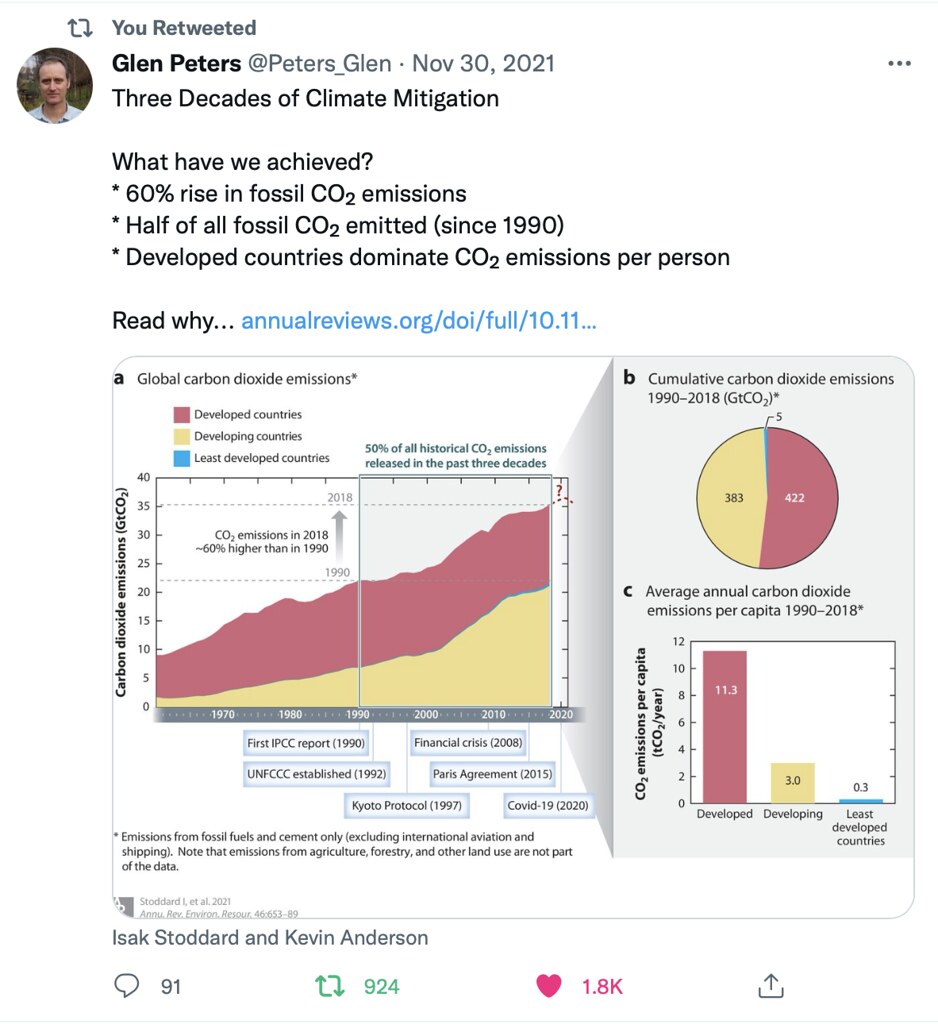
Today’s global consumption of fossil fuels now stands at roughly five times what it was in the 1950s, and one-and-half times that of the 1980s when the science of global warming had already been confirmed and accepted by governments with the implication that there was an urgent need to act. Tomes of scientific studies have been logged in the last several decades documenting the deteriorating biospheric health, yet nothing substantive has been done to curtail it. More CO2 has been emitted since the inception of the UN Climate Change Convention in 1992 than in all previous human history. CO2 emissions are 55% higher today than in 1990. Despite 20 international conferences on fossil fuel use reduction and an international treaty that entered into force in 1994, manmade greenhouse gases have risen inexorably. If it has not dawned on you by now, our economic and political systems are ill-equipped to deal with this existential threat. Existing international agreements are toothless because they have no verification or enforcement and do not require anything remotely close to what is needed to avoid catastrophe. The 20 warmest years on record have been in the past 22 years, with the top four in the past four years, according to the World Meteorological Organization (WMO). Ice loss from Antarctica has sextupled since the 1970s and Greenland’s pace of ice loss has increased fourfold since 2003. The Arctic ocean has lost 95% of its old ice and total volume of ice in September, the lowest ice month of the year, has declined by 78% between 1979 and 2012. With grim implications for the future, Earth’s air conditioner —the cryosphere— is melting away.
An article from a few months ago lays bare the reality that throughout the past two hundred years and with recent “alternative” or “renewable” energy sources, humans have only added to the total energy they consume without ever having displaced the old, polluting ones. An alternative energy outlook report by Wood Mackenzie foresees that even in a carbon-constrained future, fossil fuels would still make up 77% of global energy consumption in 2040. The world economy remains hopelessly tethered to fossil fuels. We are kidding ourselves if we think there will be any sort of orderly transition to sustainability with which modern civilization appears to be wholly incompatible. We are, as Nate Hagens says, energy blind.
Modern civilization has become so intertwined with petroleum-based products that their remnants are now found in our excrement. It seems no living thing can escape microplastics, not even the eggs of remote Arctic birds. This should come as no surprise if you look at the scale of the problem. Plastic production has grown from 2 million metric tons in 1950 to roughly 400 million metric tons today(more than 99% of plastics made today are with fossil fuels and only a tiny fraction of it recycled). There are five massive oceanic gyres filled with pelagic plastics, chemical sludge and other human detritus; one of the these gyres, named the Great Pacific Garbage Patch, is three times the size of France and growing exponentially. The health and environmental effects are grim; organized society may not even be around to examine the long-term effects of these persistent synthetic materials:
“Health problems associated with plastics throughout the lifecycle includes numerous forms of cancers, diabetes, several organ malfunctions, impact on eyes, skin and other sensory organs, birth defects” and many other impacts, said David Azoulay, a report author and managing attorney at the Center for International Environmental Law…”And those are only the human health costs, they do not mention impacts on climate, impacts on fisheries or farmland productivity.”
Making things more efficient and convenient has its limits, but humans keep trying to beat the consequences of Earth’s dwindling natural resources while ignoring the environmental costs. Jevons paradox be damned! To make matters worse, the fossil fuel industry has employed a well-financed and highly effective global disinformation campaign to confuse and sow doubt in the public mind about the reality of climate change. And to top it all off, we have a leader who reinforces the ignorance of climate change deniers:
It’s a cruel irony that this President’s emergency declaration for building a border wall comes at a time when migration from Latin America is near a 40-year low and the majority of those now seeking asylum are families fleeing climate change-related disasters. This President and the craven politicians who line up behind him are an abomination! At a time when compassion, cooperation, and scientific reasoning are needed to deal with the multiple crises we face, politicians are instead conjuring up xenophobia, racism, and conspiracy theories. As inequality grows and the once-stable climate continues to unravel, expect the super-rich to barricade themselves behind heavily fortified mansions while treating climate refugees and the most vulnerable among us with extreme prejudice. A new study shows increasingly severe weather events are fueling the number of ‘food shocks’ around the world and jeopardizing global security:
These “food shocks” —or, sudden losses to food production— are hitting local communities hard, in addition to impacting the global economy, with long-term implications. “Critically, shock frequency has increased through time on land and sea at a global scale,” the study notes. “Geopolitical and extreme-weather events were the main shock drivers identified, but with considerable differences across sectors.”
Douglas Theobald, in his study at Brandeis University, calculated that there is less than a 1 in 102,860 chance that all life did not arise from a common ancestor. In other words, humans are related to all life on Earth and share much of their DNA with other organisms. Despite earning the title of ‘superpredator‘, humans are dependent on intact and functioning ecosystems. Our chances for long-term survival are ultimately tied to the health of the planet, yet we are carrying out ecocide on a planetary scale. Being a mere 0.01% of all life on Earth, humans have managed to destroy 50% of wild animals in just the last fifty years and 83% since the dawn of civilization around 3,000 B.C.. Who knows how many plant species have gone extinct:
Hawaii is losing plant species at the rate of one per year, when it should be roughly one every 10,000 years. “We have a term called ‘plant-blindness’… People simply don’t see them; they view greenery as an indistinguishable mass, rather than as thousands of genetically separate and fragile individuals…”
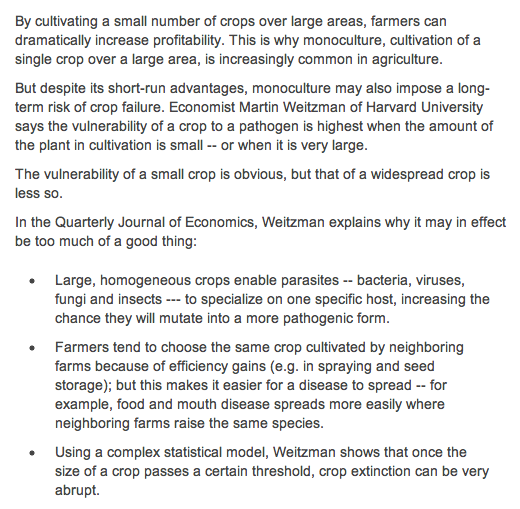
The bedrock of our food, clean water and energy is biodiversity, but its loss now rivals the impacts of climate change. Without biodiversity, our food sources, both plants and animals, will succumb to diseases. Microbes and hundreds of different life forms interact to make soils fertile. Without them, soils will be barren and unable to support life. Monocultures can only be held together through artificial means(fossil fuels, inorganic fertilizer and toxic pesticides) and are highly vulnerable to diseases, yet industrial monoculture farming continues to dominate the globe. Most Worrisome are the recent studies indicating that biodiversity loss raises the risk of ‘extinction cascades’. Insect numbers, the base of the terrestrial food chain, are in steep decline and starfish, a common keystone species in coastal ecosystems, are facing extinction due to some sort of wasting disease likely caused by climate change:
“Many of these outbreaks are heat sensitive. In the lab, sea stars got sick sooner and died faster in warmer water… A warming ocean could increase the impact of infectious diseases like this one…We could be watching the extinction of what was a common species just 5 years ago.”
And here is Professor Stephen Williams discussing the recent mass death of Australia’s flying fox bats in which 30,000 —a third of their remaining population— died in a single extreme heat wave:
“A lot of tropical species are much closer to the edge of the tolerances, so they very much are the ‘canary in the coalmine’ for the world in what’s going to start happening with climate change…The fact that we’re now seeing things endangered occur in places that you would’ve thought to be pretty secure, that’s the scary bit…I suspect the next wave of extinctions is going to be mostly due to extreme events — extreme climate events like heatwaves.”
These disturbing headlines indicate to me that the Sixth Mass Extinction is gathering pace and the real stock market underlying our very existence and survival is crashing before our eyes!!! Four of the last five mass extinction events were preceded by a disruption of the carbon cycle. When renowned paleoclimatologist Lee Kump was asked whether comparisons to today’s global warming and that of past mass extinctions are really appropriate, he ominously said, “Well, the rate at which we’re injecting CO2 into the atmosphere today, according to our best estimates, is ten times faster than it was during the End-Permian. And rates matter. So today we’re creating a very difficult environment for life to adapt, and we’re imposing that change maybe ten times faster than the worst events in Earth’s history.” Humans are recreating the past extinction known as The Great Dying at a much faster pace and at many more human-forced levels that leave no ecosystem on Earth intact.
By orders of magnitude, the human endeavor has grown much too large for the Earth to support; climate change, plastic pollution, and biodiversity loss are just a few of the symptoms of this global ecological overshoot. The people who have studied this problem for years and from every angle have come to the same conclusion —technology simply won’t save us, but that won’t stop humans from experimenting. By far the most effective way to reduce future emissions and resource consumption is to reduce human birth rates, yet the global population is still increasing at about 90 million people per year despite the geographic shift in fertility rates.
Humans recognized decades ago the threats they are now facing, yet nothing was done due to political inaction and industry malfeasance which continues to this very day. The scientists who wrote The Limits to Growth decades ago were expecting our political institutions to take action back in the 1970s, but they were met with ridicule and now we stand at the doorstep of modern civilization’s collapse. Political inaction and regulatory capture by the fossil fuel industry appear to be intractable barriers that have condemned the human race to a hellish future. Anyone waiting for some sort of seminal climate change event that is going to galvanize the world’s leaders into action will be tragically disappointed. If seeing the world’s coral reefs dying, its glaciers disappearing, permafrost melting, and the steady uptick in extreme weather and wildfire events does not spur them to action, it is much too late to hope that any single event will ever do so. The time to act would have been before we were seeing all these environmental degradations and tipping points, not afterward. There is no way to put the CO2 genie back in the bottle. The Earth cannot even begin to reach a new climate state until humans stop emitting the roughly 40 to 50 gigatonnes of CO2 per annum and stop altering and destroying global ecosystems. This fact is our daily nightmare.
A myth that many uninformed people hold is that biospheric health will quickly bounce back after we humans get our act together. Nothing could be further from the truth. Much of the damage we are already seeing is irreversible on human time scales. Positive feedbacks were already occurring at less than 1°C of warming. Many carbon sinks are on the verge of becoming or have already become carbon sources. As we race toward a nightmarish future with no realistic way to stop, we leave behind a “forever legacy” that will haunt mankind for the rest of eternity.
“I think human consciousness is a tragic misstep in evolution. We became too self-aware. Nature created an aspect of nature separate from itself. We are creatures that shouldn’t exist under natural law… The honorable thing for our species to do is to stop reproducing and walk hand in hand, brothers and sisters, into extinction — one last midnight.”
~ Rust Cohle, ‘True Detective‘
Sitting comfortably within their climate-controlled homes and buildings, a tiny percentage of eco-conscience humans watches with morbid fascination as large numbers of animals drop like flies in a bug zapper. In the latest die-off, bats rain down from Australian skies; parrots, kangaroos and emus perish from heat exhaustion. Ominous signs of an unraveling web of life are everywhere to see, but the industrial world has become utterly disconnected from nature and pays little heed to such warnings. Rather, what holds their interest is Chris Christie’s Traffic-Gate. That our fate is bound to the well-being of Earth is a belief lost with the genocide of so many indigenous cultures. Capitalist carbon man resides in a totally fabricated world — he eats food mass-produced from fossil fuel inputs, drinks ‘purified’ water bottled in plastic, and at bedtime drowns out the noise of energy-gluttonous cities with the electronic recordings of ocean waves and forest sounds. But most absurdly, he ‘communes with nature’ through staged wildlife TV shows and eco-trip adventures. Rather than allow poachers and farmers free rein, the capitalists thought it wiser to extract profit out of the Earth’s dying ecosystems by tapping into the “green” industry of eco-tourism, another in a lost list of anthropocentric oxymorons.
Relentless marketing on TV, internet, radio, billboards, print, etc has created an unending cycle of desire and consumption, fueling the trivialization of life that feeds its commodification. The individual is reduced to a “buying unit” by the skyscrapers, institutions, and bureaucracy of capitalism, but in a future world of spent resources and civilization-destroying weather, the market won’t have much use for so many “buying units”. Introspection by many rational, sober, and clear-minded people since the publication of ‘The Limits to Growth’ has not altered the course of history to date; why would I think the human species would suddenly alter their behavior after having tripped so many ecological tipping points and feedback loops? Hindsight is 20/20 only if a lesson was learned the first time.
“…The basic truth between the lines of this press event [National Research Council (NRC) briefing on abrupt climate change] was that we are facing a world that is becoming increasingly hostile to humankind.
We are literally making the planet into a wasteland like this is some post-apocalyptic science fiction story. It is just shocking. And the most horrifying aspect of it all is that we’ve waited to reduce emissions so long that we’re exiting the win-win field of possible climate responses. We’re now headed into a world of lose-lose. That’s the news nobody wants to convey – or hear. But there it is.” – link
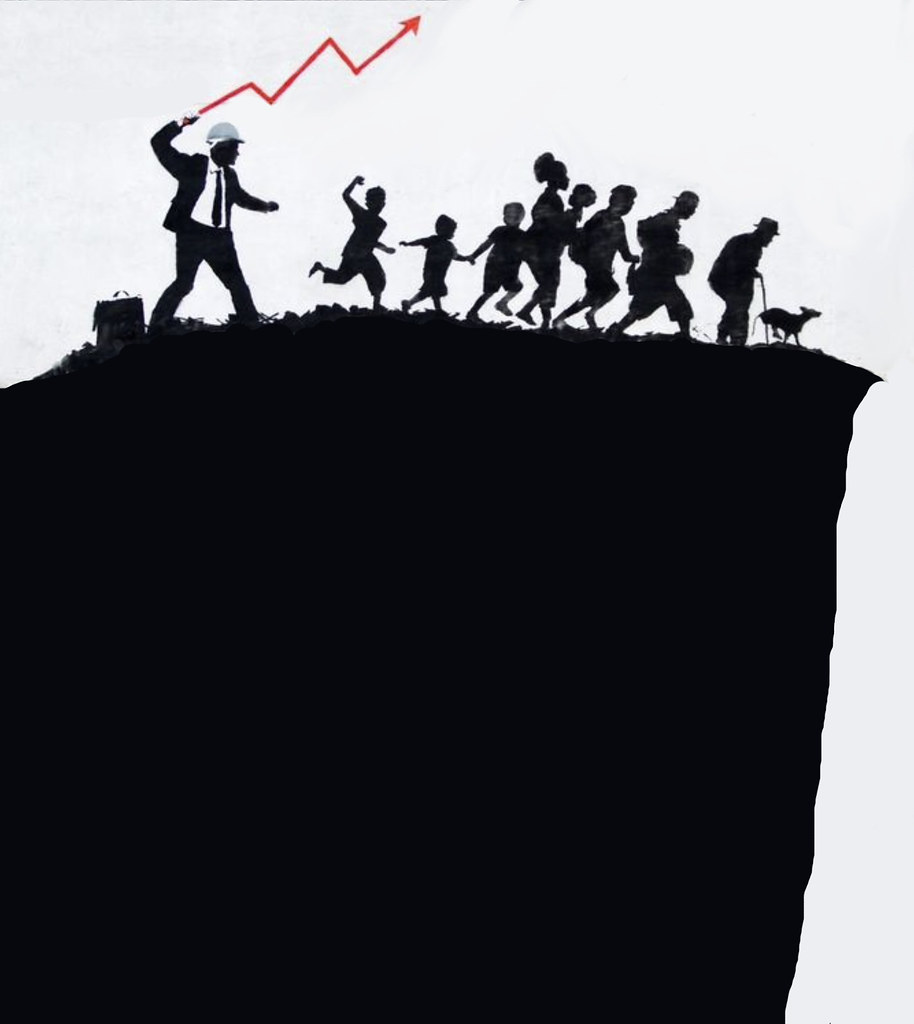
The cancer of hyper consumption and economic growth for never-ending profit has trashed the planet, but blind faith in the markets and techno-optimism are the siren’s call beguiling industrial civilization over the cliff. Capitalism likes efficiency; in its quest for greater efficiency, diversity – the essence of life – is being exterminated. Monoculture is death. More biodiversity means more resilience. A recent scientific paper purports to prove this long-held maxim:
“…when a lot of species are interacting and competing in an ecosystem, the ‘average’ interactions that any one species experiences are likely to be weaker than in a simpler, less diverse system. When there are a lot of different niches occupied by different species, we also expect different responses to environmental fluctuations among the community, meaning that some species inherently do better than others depending on the specific disturbance. Species-rich systems also tend to have more of what we call ‘functional redundancy‘, meaning that if one species providing an essential ecosystem function (e.g., like predation) goes extinct, there’s another, similar species ready to take its place…”
Biodiversity loss is not the only aspect of life being degraded. The planet is also losing cultural diversity – languages, crafts, religions, histories, ancient knowledge, etc. are disappearing as globalization reduces all of life to the status of a marketable commodity. Thousands of languages were once spoken in North and South America before the invasion of European powers. It’s interesting to note that in the Ojibwe language, and perhaps in most if not all native languages of North America, there exists no word to describe “greed” or the concept of personal property, but there are endless numbers of verbs to describe “every movement and temperature and visual sense of water.” After a few hundred years of progress, the white man has Wall Street and the natives have gambling casinos.
“In the Seventh Fire prophecy of the Anishnabek, each of the seven fires represent an era in human history. We are now in the time of the Seventh Fire. The task of the people of this age, including the Anishnabek and other red people, the yellow people, the black and the white, is to come together through choosing the road of cooperation. Without this, there will be no Eighth Fire, or future for Natives and others…
…Today, in the age of the Seventh Fire, the races are again faced with a choice. The two roads are the black road of technology and overdevelopment leading to environmental catastrophe, the other is the red road of spirituality and respect for the earth. Together, people of the world have to choose the right road, be of one mind, or the earth cannot survive…” ~ The Seventh Fire (Ojibwe) Prophecy
The “black road of technology and overdevelopment” is paved with the fallout of dead bodies and poisoned landscapes —nuclear meltdowns, oil and chemical spills, factory fires and explosions, etc., but to a very tool-centric species just itching to keep this omnicidal train going, geoengineering looks like the perfect ticket. It promises to allow industrial civilization to continue burning carbon while avoiding the nasty side-effect of catastrophic climate change. Unfortunately, human error and miscalculation, the bane of so many other industrial endeavors, will undoubtedly come into play. The ‘hacking’ of the Earth’s entire climate system represents the peak of hubris for modern man. Describing the conceit of our technological domination of the planet, Clive Hamilton states:
“Pursuing abatement is an admission that industrial society has harmed nature, while engineering the Earth’s climate would be confirmation of our mastery over it — final proof that, whatever minor errors made on the way, human ingenuity and faith in our own abilities will always triumph. Geoengineering promises to turn failure into triumph.”
The Earth’s carbon sinks are filling up and the twin problem of ocean acidification will need a techno-fix too. Complexity begets even more complicated problems. Our culture avoids the simple fact that humanity is vulnerable and dependent on the Earth, that life is fragile and interconnected, and that the importance of Murphy’s law is amplified exponentially when playing GOD with technology. Let’s also hope that the psychological effects of climate change don’t make the nuclear powers lose their cool.
…A warm dry wind is all that breaks the silence
The highways quiet scars across the land
People lie, eyes closed, no longer dreaming
The earth dies screaming…
Perhaps the most critical area in which industrial civilization has disconnected itself from nature is food production. Ask a city dweller where his food comes from and he’ll give you the name of a grocery store chain. Of course they know the food is produced somewhere outside the concrete jungle, but exactly where, by whom, and how are questions no one asks. And for the masses who are busy eking out a living on the treadmill of capitalism, the convenience of “fast food” often trumps all other considerations. The giant food manufacturers have spent considerable time tinkering with the three ingredients of sugar, salt, and fat in their processed food so as to reach a “bliss-point” for hooking the “consumer”. Thus in the process of commodifying, commercializing, and mass marketing our meals, we have lost the connection to nature fostered by food grown on a small-scale, sustainable manner. Nature Deficit Disorder appears to be rampant. As S. Roy Kaufman explains, industrialized food production has destroyed the human bond to the land:
Is “economy of scale and efficiency” really the best thing to pursue on the only planet humans have to live on? It turns out that in our quest to feed the most people at the lowest price, we have externalized a lot of costs which are now coming back to bite us in the ass. For example, bee pollination is priceless, but we are killing these insects off with our chemical pesticides and herbicides. The same goes for other plants, animals, and microbes which support the natural processes required to keep the land productive. As these creatures disappear from the landscape, we lose known and unknown ‘environmental services’ beneficial to man and the ecosystem. Industrial farming is a heavy user of CO2-emitting fossil fuels and contributes to a large percentage of the global warming we are experiencing. Biodiversity loss and destruction of crop yields are an inevitable consequence of a warming planet, even right down to the soil microbes. Pesticide and fertilizer run-off is polluting streams and rivers as well as creating massive dead zones in the ocean.
In the past century alone, over 50 per cent of the world’s wetlands have been lostbecause of the demands of agriculture. And of the more than 3500 species currently under threat worldwide, 25 per cent are fish and amphibians. – link
Industrial agriculture destroys biodiversity not only because it wipes out entire ecosystems and habitats, but because it favors genetically engineered monocultures. The following pictograph is a shocking illustration of how industrial agriculture has reduced the variety of foods we eat over the last century:
…Over the past hundred years, the variety of seeds planted has dwindled from hundreds to just a handful. Animal diversity is suffering a similar fate. Large commercial farms that focus on specific animals or plants to maximize yields and profits have caused the variety in our food supply to plummet.
Today, only 30 crops provide 95 percent of our food, and only four crops (maize, wheat, rice and potato) account for 60 percent of what we eat. We’ve lost three-quarters of the genetic diversity of crops in only 100 years. Now 1,500 of the 7,600 animal breeds are at risk of extinction.
Why should we care? Well, we need biodiversity to grow food, or in other words, to survive….
The Achilles’ heel of our monoculture crops is that they are vulnerable to small environmental changes. Dependency on such genetically uniform crops leaves modern society in danger of famine due to crop failure:
The lessons of the 1972 epidemic of ‘corn leaf blight’ have still not been learnt. The Committee on Genetic Vulnerability of Major Crops at the US National Research Council at the time posed the question: “How uniform genetically are other crops upon which the nation depends, and how vulnerable, therefore, are they to epidemics? The answer is that most major crops are ‘impressively genetically uniform and thus vulnerable and results from government legislative and economic policy’. – link
Another problem of the industrial agriculture complex has been the overuse of herbicides and pesticides to control weeds, insects, and viruses in order to maximize crop yield. It worked for a while but over the last couple decades the pests and pathogens have evolved to become immune to our chemicals:











 Collapse of Industrial Civilization