My internet is still down, but will hopefully be back up by tomorrow night so I can put out a few posts I was contemplating. In the mean time, an interesting excerpt from a new book by Roberto De Vogli, associate professor in global health at the University of California Davis and University College London.
Excerpt…
And of course it continues today as has been discussed in previous posts on this site. So much for the “free market”.
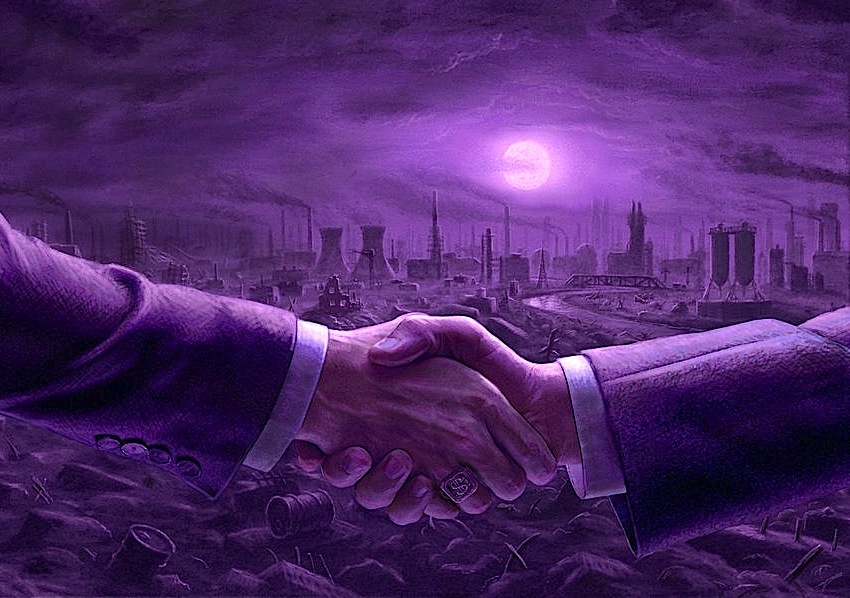
In order to understand why the world is locked into a blind stampede over a cliff, you have to understand how the world runs, i.e. its socio-economic system. A large percentage of the population doesn’t understand that the world is ruled by multinational corporations or that the citizenry are simply disposable pawns with no voice in their fate.
The capital that flows around the world, betting on essential staples of life and demanding that barbaric austerity measures be imposed upon the masses, is an entity of its own. It’s a massively destructive force that enslaves people and rips apart the environment. In the Banana Republic of America where a once thriving middle class was sold down the river, nearly half of workers will have a budget of $5 per day when they reach retirement age. Maybe McDonald’s will create a 99 cent meal to cash in on that starving demographic. Oh, they already have…
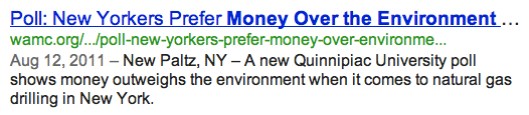
As far as the environment goes, it is a doormat for the creation of money:
When you have such an immovable supersystem of puppet governments and marauding transnational corporations running the show, radical movements questioning and trying to change the status quo are easily co-opted or crushed, a recent example being the Occupy movement. In a world where extinction of the human species is guaranteed by climate chaos and the myriad of other crises created by industrial capitalism, a slow and incremental regimen of change is not what is needed to stave off collapse. Unfortunately, the entrenched interests of the financial elite and the nation-states they control won’t allow for any sort of abrupt and profound transformation. As Professor Julian Cribb has correctly identified, a culture of money worship and the mass delusion of money’s illusory value is at the heart of the global crisis. The high priests of money are protected at the expense of all else:
Show me a democracy that has an impoverished public life and I will show you one dominated by oligarchs and plutocrats driven by profit maximization that will do anything to get over. Gangster activity is what it is. Scandal after scandal and when you get caught, you PAY MONEY, you don’t go to jail. Plutocrats wage class war, getting away with CRIMES (mortgage fraud, market manipulation, insider trading, securities fraud) every day. But get caught with a bag of weed in the hood and you are in the system, for LIFE. ~ Cornell West
For humans living under such a capitalist society, money determines whether you can eat or not, whether you have shelter or not, whether you can clothe yourself or not, or whether you can afford medical treatment or not. Quite literally, if you have no money in a capitalist society, you die. Money in today’s globalized capitalist system is everything.
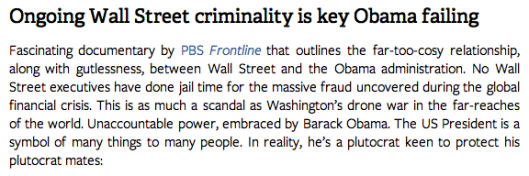
When President Obama speaks about confronting climate change, he does so with the mindset of keeping the current capitalist power structure in place. Because of this self-defeating approach, everything he says is rendered useless rhetoric.
Putting aside the gross social inequalities and injustices of our current system, you tell me how we can avert disaster with the following realities:
Without changing the socio-economic system under which we live, no real solutions for the multiple civilization-ending crises we face can be properly addressed. There is an expiration date for this unending conversion of the natural world into fake symbols of wealth hoarded and squandered by a greedy few…
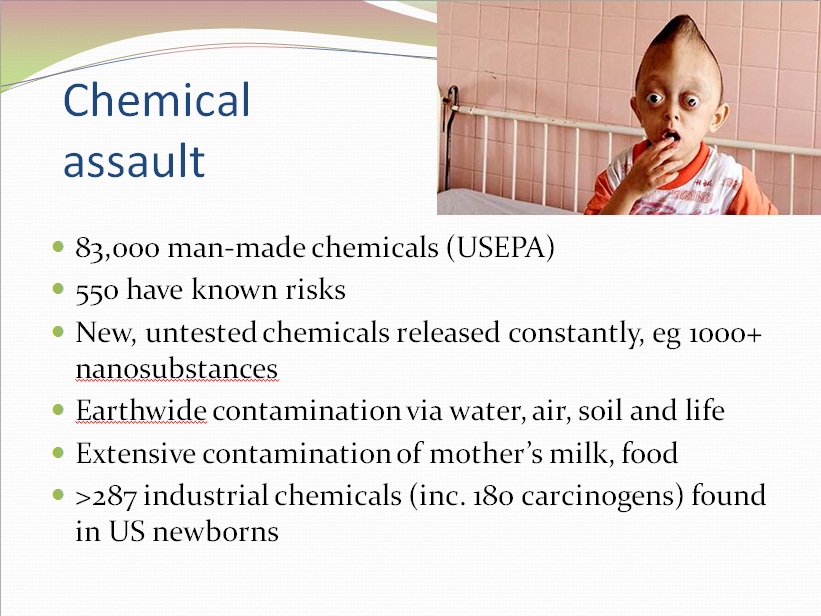
My last post on environmental toxins was inspired from an email I got from Professor Julian Cribb in Australia. Upon closer inspection of his email I see that the attachments have much more interesting information that deserves our attention. I hope my readers will forgive me for having missed this valuable material, but I just came back from the decadence of Sin City on my weekend trip and I’m a little tired.
I hope the good Professor doesn’t mind my posting the attachments at my site. The first concerns environmental toxins and is an extended and more informative version of the brief article that Professor Cribb published in the Canberra Times.
The second attachment is an argument for the renaming of the human species (Homo Sapien) to something more appropriate in order to properly reflect our dysfunctional and self-destructive nature. I believe we’re too full of self-conceit and self-delusion to ever seriously entertain the idea, but it is a good argument to make in light of our impending extinction and the ongoing destruction of the Earth’s habitability for most other organisms. This global apocalypse is being brought to you by the world-wrecking hands of ‘industrial capitalist carbon man’.
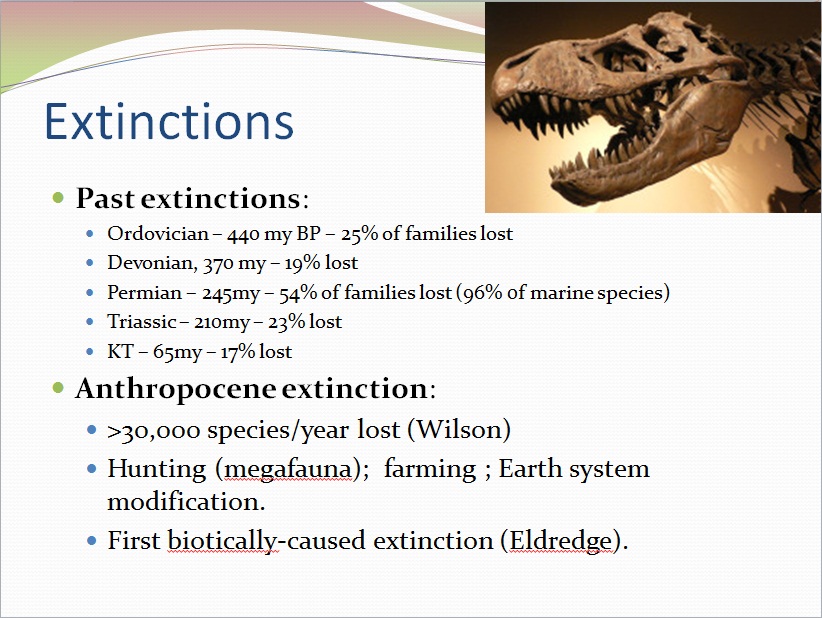
Lastly, he sent me an interesting slide show which appears to be the basis for a TV documentary that the Professor is hoping to create in order to explore these unfolding crises leading to mankind’s self-inflicted extinction, an avoidable tragedy if Homo Sapiens lived up to their name of ‘wise man’ – a misnomer if there ever was one.
I look forward to watching this documentary. Luckily, Professor Cribb is trying to get this project done in Australia and not the Banana Republic of America where it would be sacrilege to think that money is an illusion or that all problems cannot be solved by printing more of it.
It’s actually pretty fun, you’ve got the guns with Santa and everything and you get to hold them, just a fun family event,” said Scott Daugherty after taking a family photo with Santa as well.
This is the third year the gun club has offered this “Santa and machine guns” photo opportunity.
While some people find the idea of posing with Santa and guns inappropriate, the line out the gun club’s door proves gun aficionados love it.
“We got here about an hour early to make sure because last year the line was really crazy and we decided not to stay, so we figured we better come early this year, we were about third or fourth in line and we’re off to breakfast and ready to ship these pictures off to our family,” said a woman by the name of Abby on her way out.
Such a yuletide family event by Pax Americana in its twilight years:
I had to go back and look up the definition(wikipedia) of Christmas after seeing those photos. I have to wonder if this gun culture is reinforced by a country whose economy revolves around war and the militarization of our society. Maybe a previous President had a point when he said:
“We cannot be both the world’s leading champion of peace and the world’s leading supplier of the weapons of war.
Chart of Smith & Wesson revenues:
I’m sure this year will break records for gun sales. Oh, it already did:
And you think this species has a chance at long-term survival?
I was going to post on that capitalism article I mentioned in my previous blog entry, but this video I was making on child labor took on a life of its own and demanded my entire Sunday.
Human rights organizations have documented child labor in USA. According to a 2009 petition by Human Rights Watch: “Hundreds of thousands of children are employed as farmworkers in the United States, often working 10 or more hours a day. They are often exposed to dangerous pesticides, experience high rates of injury, and suffer fatalities at five times the rate of other working youth. Their long hours contribute to alarming drop-out rates. Government statistics show that barely half ever finish high school. According to the National Safety Council, agriculture is the second most dangerous occupation in the United States. However, current US child labor laws allow child farmworkers to work longer hours, at younger ages, and under more hazardous conditions than other working youths. While children in other sectors must be 12 to be employed and cannot work more than 3 hours on a school day, in agriculture, children can work at age 12 for unlimited hours before and after school.” They would work two to three jobs depending on their age.
Wrapping your head around the seemingly unstoppable upward march of CO2 emissions is like trying to comprehend all those zeros in the expanding global debt bubble; both are so far beyond human scale that people cannot put them into a frame of reference or perspective. They have taken on a life of their own, a force of nature that defies all attempts to control and subdue them. Brian Merchant takes a stab at trying to frame the CO2 numbers behind industrial civilization’s conundrum of catastrophic climate change:
And 2012 is on track for another 2.6 percent increase. Why can’t we stop it? Perhaps the problem is structural and embedded in our economic system.
In a recent interview, dissident Julian Assange commented on the degree of intertwinement between government and corporations, i.e. fascism or more aptly called inverted totalitarianism in our times. Regulatory capture, the revolving corporate/government door, and K Street lobbying(legalized bribery) are examples of the monied interest$ of capitali$m having taken over government.
There’s not a barrier anymore between corporate surveillance, on the one hand, and government surveillance, on the other. You know, Facebook is based—has its servers based in the United States. Gmail, as General Petraeus found out, has its servers based in the United States. And the interplay between U.S. intelligence agencies and other Western intelligence agencies and any intelligence agencies that can hack this is fluid. So, we’re in a—if we look back to what’s a earlier example of the worst penetration by an intelligence apparatus of a society, which is perhaps East Germany, where up to 10 percent of people over their lifetime had been an informer at one stage or another, in Iceland we have 88 percent penetration of Iceland by Facebook. Eighty-eight percent of people are there on Facebook informing on their friends and their movements and the nature of their relationships—and for free. They’re not even being paid money. They’re not even being directly coerced to do it. They’re doing it for social credits to avoid the feeling of exclusion. But people should understand what is really going on. I don’t believe people are doing this or would do it if they truly understood what was going on, that they are doing hundreds of billions of hours of free work for the Central Intelligence Agency, for the FBI, and for all allied agencies and all countries that can ask for favors to get hold of that information.
William Binney, the former chief of research, the National Security Agency’s signals intelligence division, describes this situation thatwe are in now as “turnkey totalitarianism,” that the whole system of totalitarianism has been built—the car, the engine has been built—and it’s just a matter of turning the key. And actually, when we look to see some of the crackdowns on WikiLeaks and the grand jury process and targeted assassinations and so on, actually it’s arguable that key has already been partly turned. The assassinations that occur extrajudicially, the renditions that occur, they don’t occur in isolation. They occur as a result of the information that has been sucked in through this giant signals interception machinery.
Corporations are the ultimate expression of capitalism. Libertarians decry that what we have is not capitalism, but a corrupted form of it, aka crony capitalism. The opposite is true – unfettered, unregulated capitalism is the purest form of this profit-driven system where economic activity is structured around the accumulation of capital. This is what we get when economic power(money) inevitably usurps all branches of government. Corporate greenwashing, carbon credit schemes, privatization of the commons, and externalizing environmental costs are examples of capitalism’s incompatibility with sustainability and its inability to deal with the degradation of the planet. Corporate power rules the world and it’s what is destroying the planet:
Ecocide is permitted (as genocide was in Nazi Germany) by the government and, by dint of the global reach of modern-day transnational business, every government in the world. Corporate ecocide has now reached a point where we stand on the brink of collapse of our ecosystems, triggering the death of many millions in the face of human aggravated cataclysmic tragedies. Over the passage of time, tyranny revisits. Tyranny is the cruel, unacceptable, or arbitrary use of power that is oblivious to consequence. Whilst the use of coal stations may not be deemed an intentional cruelty, it is certainly an unacceptable use of corporate power. Our governments collude by encouraging excess emissions, contrary to their UNFCCC commitment to stabilize “greenhouse gas concentrations in the atmosphere at a level that would prevent dangerous anthropogenic interference with the climate system.”60 years ago the tyranny was Nazism. Today it is pursuit of profit without moral compass or responsibility.
…There are several points to make in response to the belief that capitalism is compatible with a flourishing environment. Firstly, environmental activism can’t alter capitalism’s integral growth dynamic, it’s “grow or die” impulse, as the social ecologist Murray Bookchin put it. As a result the best environmentalism can do is ameliorate the worst effects. “Things getting worse at a slower rate”, is how the late environmental activist, Donella Meadows, described the situation.
Secondly, in the low or no growth world we are entering, environmental priorities are being sacrificed to meet the short-term need to revive growth. “We can’t be ambivalent about growth,” is how the UK government’s “planning” minister, Greg Clark, justified reducing regulations to make it much easier to approve building development in the countryside.
Thirdly, many polluting practices in western countries that have become culturally unacceptable have been exported to poorer countries, where people have less power to make their objections count.
Lastly, the experience of the 21st century has shown that when environmental activism directly confronts huge capitalist industries like oil, automobiles and mining, it does not win. The 1987 Montreal Protocol was the last successful international agreement to change capitalist behaviour. The protocol called for strict restrictions on chemicals that deplete the ozone layer (chlorofluorcarbons) and the results have been impressive. But, says Schweickart, the industries affected had substitutes to hand, and the protocol “should not lull us into thinking capitalism can accommodate all sensible environmental solutions.”…
…The consequence of the conflict between environmental sanity and profit has been that many capitalist countries – most notably the US – have been unable to change course to ameliorate climate change. Not only this, a political culture has developed that denies the existence of climate change even when its effects become harder and harder to ignore.
Of course the prospects of thinking outside-of-the-box on economic and foreign policy issues has always been heresy. As long as we think we can fix the ecological problem with the same tools that caused the problem, we can expect the Eco-Apocalypse, a tragedy of the commons on a global scale, to unfold as predicted:
Zizek:…………… the global capitalist system is approaching an apocalyptic zero-point. Its ‘four riders of the apocalypse’ are comprised by the ecological crisis, the consequences of the biogenetic revolution, imbalances within the system itself (problems with intellectual property; forthcoming struggles over raw materials, food and water), and the explosive growth of social divisions and exclusions.
Gail from Wit’s End referred me to Guy McPherson’s presentation above. I just finished watching it a few minutes ago. Here are my thoughts on the talk.
This is the big wild card which may well bring everything down since the IPCC assessments and climate models either don’t factor in these feedback effects or, if they do, don’t do it with much accuracy. For example, the Arctic is melting three times faster than predicted and that will have implications for the entire planet. The Arctic melt, as well as Greenland melt, makes all global climate change predictions unreliable. Another example just came across the news today:
Doha, Nov 27 (Prensa Latina) The rapid increase in temperature in the Arctic has caused a loss of ice in the subsoil of the region, a fact that should be considered in climate models, experts said today. If the “permafrost” melts, it will free all the carbon accumulated for centuries, said Kevin Schaefer, of the United Nations Environment Programme (UNEP) at the 18th Conference on Climate Change held in Doha, Qatar.
“Once it starts happening, the process is irreversible. There is no way to recapture the carbon released. And the process wil continue for centuries, due to the organic matter being very cold and descomposing slowly”, said the scientist.
This excess of carbon released into the atmosphere was never included in the projections of global warming, which is why the UNEP recommends that the Intergovernmental Group of Experts on the Evolution of the Climate specifically take into account the growing impact of permafrost thawing on global warming…
All of these uncertainties should give everyone pause because it means that the most dire predictions could very well be correct, as Guy points out in his talk.
Towards the end of the video, the camera spanned the auditorium and I could see all the empty seats. There were perhaps a few dozen people in attendance of Guy’s talk. That’s a sad commentary on society, but it also points to something else – catastrophe fatigue or the normalization of catastrophe. The slow and steady stream of doomsday news along with the popularizing of such themes in mainstream entertainment and pop culture has served to desensitize people to catastrophe and violence:
Guy doesn’t really talk explicitly about the link between capitalism and the environmental crisis. He should. Capitalism feeds off of crisis. As they say, capitalism is crisis. It is the primary root cause of the civilization-ending eco-collapse we are facing:
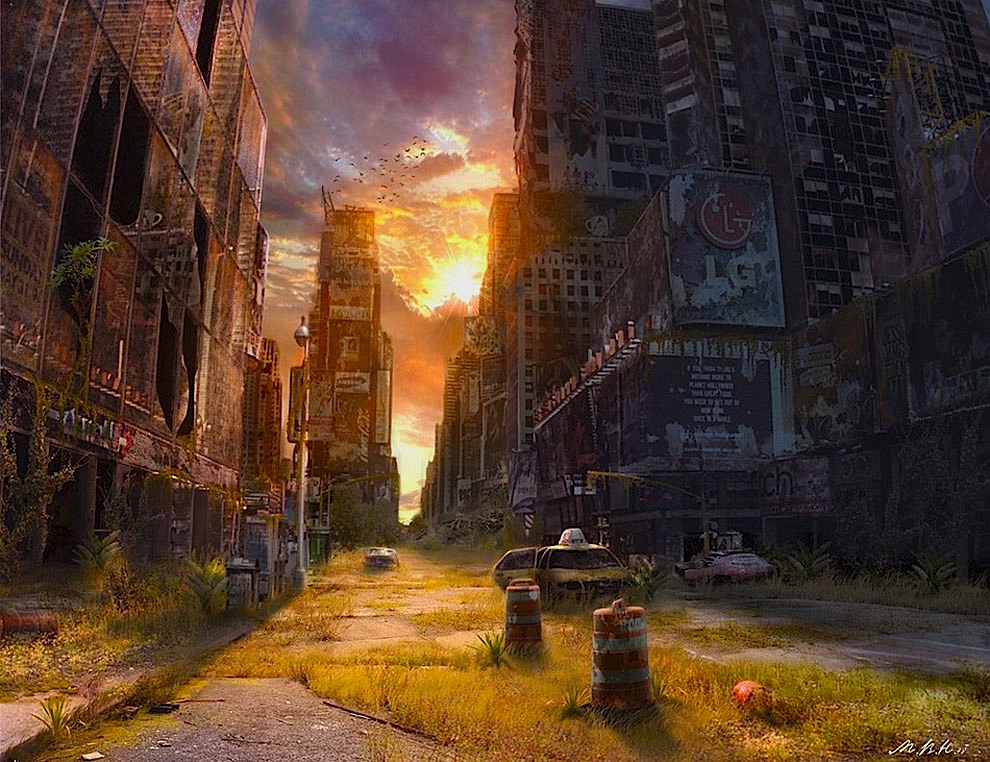
I thought I’d post a few pictures of what the world will look like before the end of this century. Artists have the intuitive imagination to conjure up such visions the general public can only imagine through Hollywood zombie flicks which seem to be all the rage these days. Why do I feel this vision is inevitable? Just look at the daily news to see what I mean:
It used to be that the mentally insane, flailing their arms and talking to invisible people in the streets, were the ones ranting and raving about the end of the world, but now it’s scientists who, in an attempt not to offend the beliefs of the scientific illiterati and free-market faithful, downplay their findings as much as possible. Optimism bias infects even the scientific community.
…we are the most tragic species. We not only destroy all of the world around us, we are aware of doing it but unable to stop ourselves. We have faith and hope that things will get better, that we can turn around at the last second what we’ve screwed up over years and decades. Which of course is nothing but an excuse to keep on screwing up. All courtesy of our optimism bias.
What better exemplifies the delusional optimism of man than the belief that he could hide out in a bunker to survive the ravages of a nuclear war? I’ll tell you what tops that fantasy – the belief that man can continue to do what he has done and expect the planet to unfailingly absorb all the environmental assaults we can throw at it via the endless growth of capitalist production and consumption. The planet is not some massive ShamWow towelette for man’s nonstop flow of excrement.
Of all the findings in the 2012 edition of the World Energy Outlook, the one that merits the greatest international attention is the one that received the least. Even if governments take vigorous steps to curb greenhouse gas emissions, the report concluded, the continuing increase in fossil fuel consumption will result in “a long-term average global temperature increase of 3.6 degrees C.”
This should stop everyone in their tracks. Most scientists believe that an increase of 2 degrees Celsius is about all the planet can accommodate without unimaginably catastrophic consequences: sea-level increases that will wipe out many coastal cities, persistent droughts that will destroy farmland on which hundreds of millions of people depend for their survival, the collapse of vital ecosystems, and far more. An increase of 3.6 degrees C essentially suggests the end of human civilization as we know it.
To put this in context, human activity has already warmed the planet by about 0.8 degrees C — enough to produce severe droughts around the world, trigger or intensify intense storms like Hurricane Sandy, and drastically reduce the Arctic ice cap. “Given those impacts,” writes noted environmental author and activist Bill McKibben, “many scientists have come to think that two degrees is far too lenient a target.” Among those cited by McKibben is Kerry Emanuel of MIT, a leading authority on hurricanes. “Any number much above one degree involves a gamble,” Emanuel writes, “and the odds become less and less favorable as the temperature goes up.” Thomas Lovejoy, once the World Bank’s chief biodiversity adviser, puts it this way: “If we’re seeing what we’re seeing today at 0.8 degrees Celsius, two degrees is simply too much.”
At this point, it’s hard even to imagine what a planet that’s 3.6 degrees C hotter would be like, though some climate-change scholars and prophets — like former Vice President Al Gore in An Inconvenient Truth — have tried. In all likelihood, the Greenland and Antarctica ice sheets would melt entirely, raising sea levels by several dozen feet and completely inundating coastal cities like New York and Shanghai. Large parts of Africa, Central Asia, the Middle East, and the American Southwest would be rendered uninhabitable thanks to lack of water and desertification, while wildfires of a sort that we can’t imagine today would consume the parched forests of the temperate latitudes.
In a report that leads with the “good news” of impending U.S. oil supremacy, to calmly suggest that the world is headed for that 3.6 degree C mark is like placing a thermonuclear bomb in a gaudily-wrapped Christmas present. In fact, the “good news” is really the bad news: the energy industry’s ability to boost production of oil, coal, and natural gas in North America is feeding a global surge in demand for these commodities, ensuring ever higher levels of carbon emissions. As long as these trends persist — and the IEA report provides no evidence that they will be reversed in the coming years — we are all in a race to see who gets to the Apocalypse first.
Enjoy industrial civilization’s fossil fuel blow-out sale while it lasts. This is a one-time-only, circus-like ‘liquidation event’. Everything must be commodified regardless of ecological loss or intrinsic value to the web of life. The Human species won’t want to miss these deals! There will be no returns or exchanges available as we are going out of business for good due to bankruptcy proceedings with Mother Earth. All life forms and resources on the planet must go!!!
In my previous post I quoted Professor Charles Hall’s assertion that the current economic paradigm is ill-equipped to account for and address externalities such as resource depletion and environmental degradation. Peak oil as well as climate change/global warming are just two in a long list of biophysical constraints which neoclassical Keynesian economics, i.e. mainstream economics, overlooks:
…the crisis looming before us is likely to be, if anything, more terrible than the Great Depressions of 1873-93 and 1929-39. The continuing industrialization of agriculture and urbanization of population—by 2010, it is estimated, more than half the earth’s inhabitants lived in cities—has made more and more people dependent upon the market to supply them with food and other necessities of life. The existence on or over the edge of survival experienced today by the urban masses of Cairo, Dhaka, São Paulo, and Mexico City will be echoed in the capitalistically advanced nations, as unemployment and government-dictated austerity afflict more and more people, not just in the developed world’s Rust Belts but in New York, Los Angeles, London, Madrid, and Prague.
Left to its own devices, capitalism promises economic difficulties for decades to come, with increased assaults on the earnings and working conditions of those who are still lucky enough to be wage earners around the world, waves of bankruptcies and business consolidations for capitalist firms, and increasingly serious conflicts among economic entities and even nations over just who is going to pay for all this. Which automobile companies, in which countries, will survive, while others take over their assets and markets? Which financial institutions will be crushed by uncollectible debts, and which will survive to take over larger chunks of the world market for money? What struggles will develop for control of raw materials, such as oil or water for irrigation and drinking, or agricultural land?
Gloomy though such considerations are, they leave out two paradoxically related factors that promise further dire effects for the future of capitalism: the coming decline of oil—the basis of the whole industrial system at present—as a source of energy, and the global warming caused by the consumption of fossil fuels. Even if continuing stagnation should slow greenhouse gas-caused climate change, the damage already done is extremely serious. Elizabeth Kolbert, a journalist not given to exaggeration, called her soberly informative account Field Notes From a Catastrophe. The melting of glaciers threatens not only Swiss views but the drinking supplies of whole populations in such areas as Pakistan and the Andean watersheds; droughts have ravaged Australian and Chinese agriculture for years now, while floods periodically devastate the low-lying South Asian homes of tens of millions of people. The rolling parade of disasters is, unfortunately, only getting started. It will accompany a stagnant economy and only be exacerbated by the increased greenhouse-gas emissions that a return to true prosperity would bring… – essay adapted from Paul Mattick’s book ‘Business as Usual: The Economic Crisis and the Failure of Capitalism‘
The mandatory growth requirement of mainstream economics also precludes the concept of sustainability. I have not yet read the above referenced book ‘Business as Usual: The Economic Crisis and the Failure of Capitalism’, but a prominent socialist speaking of peak oil and global warming in the same paragraph is always intriguing. However, a brief critique of the book by a reader finds that Mattick does not go nearly far enough in incorporating these two realities into his analysis of our current crisis:
All mainstream institutions have subscribed to the near religious belief of the infallibility of the capitalist economy which itself is considered a self-regulating system governed by the “invisible hand” of the free market as explained by Adam Smith in The Wealth of Nations. Market ‘value’ is produced by the optimal use of capital, labor, and production. Mainstream economics operates under the assumption of a world with freely available and unlimited resources. It divides and reduces all resources into units of monetary value, not taking into consideration the value such resources hold in maintaining the ecological balance of the planet.
Isn’t it the height of hypocrisy that those wealthy nations trumpeting the superiority of the free market are also the same countries which dominate global resources and world markets by military superiority as well as the subversive and coercive tactics of their economic hitmen?
…war is integral to imperialism. Imperialism – and especially the imperialist powerhouse, the USA – needs the threat of war to sustain itself: ideologically, militarily, geo-politically and also financially. The arms and defence industry is a major part of the US economy. In 2011, the defence budget was a staggering $698 billion, or 4.8% of the US GDP (link). Add to that the cost of increased security concerns – for example, to combat the ‘terrorist threat’ within imperialist countries – and you have a major chunk of the economy being reliant on the continued existence of enemies within and without.
It’s a form of military Keynesianism to keep a faltering economy going. The further capitalism sinks into decline, the more irrational the drive to war becomes and the more ludicrous are the reasons presented by imperialism (weapons of mass destruction, nuclear capability, etc).
…a very naive view of how the world is run [is to hold the belief that] David Cameron, Barack Obama and Benjamin Netanyahu just ‘happen’ to be spending ‘too much’ on military, which on the surface seems deeply illogical at a time of official austerity. But, of course, the opposite is true: it is their way of staying in power.
Of course, we should fight against such ridiculous spending on increasingly refined machinery to exterminate humanity. But we should be clear why. – link
Moreover, America’s military has become a self-perpetuating industrial complex for profiting from war and instability.
Another problem with the world’s dominant economic system is that GDP is a misguided and inaccurate gauge for measuring the standard of living and well-being of the general populace:
…History shows that democratic forms are no proof against a slide into repressive forms. In Germany in the 1930’s, a declining standard of living contributed to the rise of the Nazi party; Hitler was democratically elected to the office of Chancellor (and then proceeded to establish himself as Fuehrer).
As America’s perpetual-growth economy faces the reality of ecological limits, as climate change imposes costs and decreased well-being on us, as food and energy and other resource prices increase because of the inexorable logic of a declining Energy Return on Energy Invested at the physical foundation of our economy, we face the prospect of a widespread decline in our standard of living. This dynamic lies at the root of this fact: Americans coming of age today are among the first generation who can’t be confident that they will be better off than their parents. By one widely used measure of well-being (the genuine progress indicator, which deducts loss of ecosystem services and other “disamenities” from the national accounts), the American standard of living has flatlined since the 1970s, despite continued strong growth in GDP.
Thus the cautionary lessons from Egypt and Tunisia. GDP is a measure of the commotion of money in an economy, not a measure of delivered well-being. If sustained or rising well-being is what is economically and politically desirable, we should measure it directly, instead of counting on GDP to do the job. And if we accept the idea of popular sovereignty—that governments rule with “the just consent of the governed,” as Jefferson put it in our Declaration of Independence—we must recognize that as the middle class goes, so goes the legitimacy of the regime in power. No system of government—despotic or democratic—fares well when the majority of its citizens experiences a declining standard of living… – link
For those who have not read Darbikrash’s last post, A Nation of Hustlers and Swindlers, it lays bare the big con game of capitalism. Similarly, the mechanic scenes in Oliver Stone’s U-Turn represent, for me, capitalism’s exploitive process of getting something for nothing:













 Collapse of Industrial Civilization