Tomorrow is Thanksgiving, a holiday created from romanticized myths about grand and cordial feasts between pilgrims and the indigenous people whose lives, land, and culture would soon be exterminated from coast to coast. Truth be told, Thanksgiving sprang from the imaginative mind of Sarah Josepha Hale, an author and editor who campaigned for nearly two decades to make it a national holiday before winning over President Lincoln who made it official in 1863. Some historians believe Lincoln used the creation of Thanksgiving as propaganda during the Civil War to paint Northerners as the true founders of the nation whose cause in the war was virtuous and just. In her writings, Hale also pushed the delusional belief that the “United States government was founded without bloodshed.”
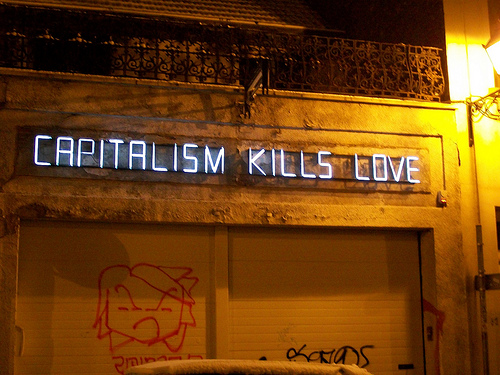
Today the holiday has become fully merged into the capitalist superstructure as a time to binge on turkey, mashed potatoes, stuffing, cranberry sauce and puddings just before camping outside consumerist temples for the true day of worship… Black Friday. Riots and mob violence are generally tolerated on Black Friday since it is the key event kicking off the holiday shopping season and driving up corporate profits. Protests and riots for social justice and equality are seen as threats to the capitalist status quo and are systematically undermined, quelled, and co-opted. As I explained in a previous post, the events in Ferguson dominating the headlines are rooted in our socio-economic system.
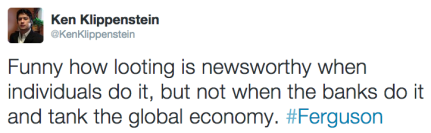
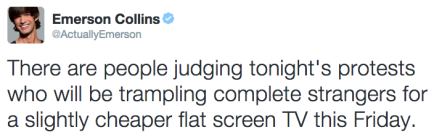
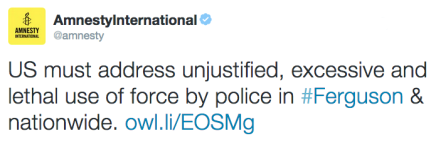
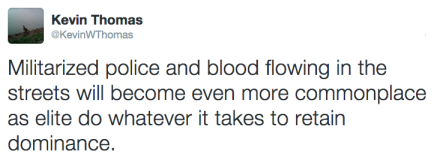
A few recent thoughts on Twitter about Ferguson and the state of the “civilized” world…
We could go into great detail about each of the above comments, supporting them with a multitude of facts and references, but I think they speak for themselves and summarize quite well the disintegrating social fabric in America and across the world. Compounding the problem of our sociopathic and sclerotic economic system are the environmental crises of climate change, ocean acidification, resource depletion, and overpopulation, none of which can be successfully dealt with unless we address the system that underlies them all, i.e. capitalism and its energy-intensive way of life. The facts tell us it’s much too late to do anything to save ourselves, but this hopeless mindset only serves to empower those at the top who continue to profit from this corrupt and self-destructive system. It’s past time to step outside our comfort zone and do something to try and save a piece of the web of life fast disappearing before our eyes.
The following poem by William S. Burroughs resonates with what has gone horribly wrong in America and perhaps what has always been wrong.
Another election cycle passes and the American people responded with the lowest voter turnout since WWII. The staged events of today’s political rallies will soon be composed solely of people paid off with corporate bribes to wave flags and chant slogans. As ever more corporate money floods into the faux democratic process, participation by the average citizenry has plummeted. Americans are now more disillusioned with the charade of “American democracy” than at any time in history:
Confidence in Congress as an institution is at 7%, the lowest measurement in history and lower than any other institution tested, including organized labor, banks and big business. Views of the honesty and ethics of members of Congress are at 8% on average, one percentage point above lobbyists, but one point below car salesmen… – link
We are also undoubtedly becoming more callous and insensitive to our fellow-man when a 90-year-old gentleman is arrested for feeding the homeless from a church kitchen. In fact, we’ve lost all our humanity and exchanged it for the almighty dollar. Neoliberal capitalism has permeated very aspect of social and civic life, creating a new epitaph for the demise of such a mean-spirited culture —‘death by dollars’.
You Are What You Eat
I just became aware of Dr. Suzanne de la Monte’s studies on the food industry’s use of sugar in all its products in order to fabricate a consumer “bliss point” for maximizing sales. Capitalist industrial civilization has bred a morbidly obese creature conditioned to overeat processed food spiked with sugar, fat, and salt. A high-fructose diet has undoubtedly turned the cognitive skills of many into mush. John Oliver recently used a clip from her work in his takedown of the sugar industry:
“De la Monte has done her research by feeding healthy rats the equivalent of a North American diet, complete with all the sugars and fat. All her rats ended up demented.” – from the documentary The Secrets of Sugar
The IPCC stated back in 2007 that emissions would have to peak in 2015 to avoid a rise of 2°C, but since that is not going to happen, they are putting their hopes in technology that could pull CO2 out of the atmosphere while conceding that such techniques are “uncertain” and “limited”. Mankind’s grave is already deep enough, yet we keep digging. Just as China’s coal consumption has registered a drop for the first time this century, India has announced it will pick up the slack by planning to double its coal production to meet the country’s soaring energy demand. Poland has rejected the IPCC target of zero emissions by 2100. In the U.S., new data has revealed that climate change has become the most politically divisive issue in the U.S.
According to energy expert Nate Hagens, modern-day carbon man’s metabolic energy consumption makes each of us a 30-ton primate. It appears the Pavlovian conditioning of modern man to energy dense fossil fuels and capitalist wealth have irrevocably hacked and rewired his brain’s reward system. The autopsy results for the age of the Anthropocene will read: “fossil fuel overdose” and “suicide by CO2”.
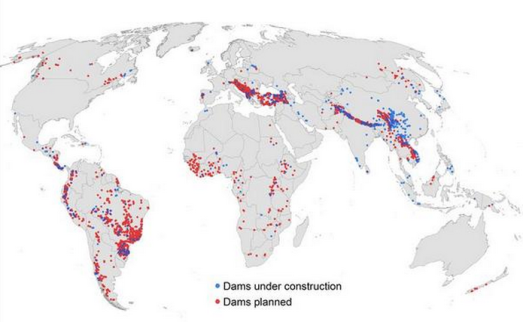
…In 2012 study, researchers in Singapore found that greenhouse gas emissions from hydropower reservoirs globally are likely greater than previously estimated, warning that “rapid hydropower development and increasing carbon emissions from hydroelectric reservoirs to the atmosphere should not be downplayed.”
Those researchers suggest all large reservoirs globally could emit up to 104 teragrams of methane annually. By comparison, NASA estimates that global methane emissions associated with burning fossil fuels totals between 80 and 120 teragrams annually…
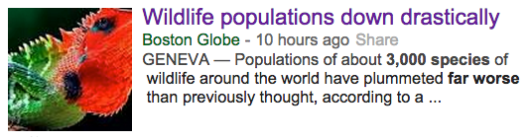
The WWF(World Wildlife Fund) released its biennial ‘Living Planet Report’ which some on Twitter are calling the ‘Dead Planet Report’. The silence of mass extinction draws ever nearer…
The report writers, based on data kept by the Zoological Society of London, studied 10,380 populations of 3,038 species of amphibians, birds, fish, mammals and reptiles from 1970 to 2010. Over these four decades, the average decline of these vertebrate species was 52 per cent – all in less than two human generations.
Amongst freshwater species the population decline was a staggering 76 per cent, owing to habitat loss, land fragmentation, pollution and invasive species.
In the same period terrestrial species declined by 39 per cent through unsustainable land use and increased poaching, often spurred on by wildlife crime syndicates.
Marine species declined also by 39 per cent, to include large migratory seabirds, many shark species and also sea turtles.
A major contributory factor to marine loss of life was through by catching (accidentally catching, in certain fish net sizes, species which were of no market value and then casting these dead fish overboard), illegal fishing and overfishing of the same fishing grounds.
Currently we need a 50 per cent bigger Earth to allow the regeneration of the natural resources we consume…
…By 2050, we will have an extra 2.4 billion people in our world, with urban populations increasing from 3.6 billion in 2011 to 6.3 billion. In 1970, there were only two megacities (over 10 million people) – New York and Tokyo; in 2014 there are 28 such cities – 16 in Asia, three each in Europe and Africa, four in Latin America and two in North America, all totalling 12 per cent of the world’s urban population.
The United Nations (UN) predicts that in 2025, there will be 37 megacities with eight new ones in Asia. Also in the pipeline are meta-cities – conurbations of over 20 million people – through the amalgamation of megacities…
…The report interestingly mentions that the diversity of human languages in our world is strongly correlated to areas of high plant diversity. Some linguists have predicted that 90 per cent of the world’s languages will expire by the end of this century…
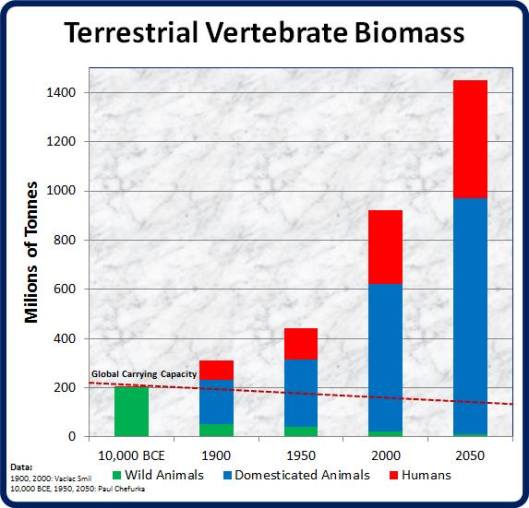
Here is an interesting graph created by Paul Chefurka which shows that the combined biomass of humans with their farm animals exceeds the natural carrying capacity of the earth sevenfold:
In the graphic, the “wild animal” biomass doesn’t include insects, bacteria, or marine organisms.
I used three data sources to develop the chart: a paper by world-respected ecological scientist Vaclav Smil, called “Harvesting the Biosphere”, linked below; world population estimates from the Wikipedia articleof the same name; and the UN’s Medium Fertility variant for the human population in 2050 (9.6 billion).
The definition I used for Global Carrying Capacity is, “The biomass the planet can support without the assistance of human technology or fossil fuels.” The impact of human activity has gradually eroded the Earth’s carrying capacity over time, which is why I show the red dotted line sloping down to the right. The degree of erosion is very hard to estimate. My guess is that we may have lost around 25% by this point, some of which would of course be naturally regenerated over time in the absence of human activity. Any biomass above that dotted line has to be supported by human technology and energy supplies (which at this point are mostly from fossil fuels).
The conclusion is that we have been living in the midst of an accelerating Global Mass Extinction Event for over 100 years already. Unfortunately we’ve been too fixated on human issues like economics and politics to even notice, let alone realize what it means. Those who did realize the significance, both to wildlife and the human species, have been powerless to act in the face of economics and politics.
Paul gives the following further explanation for the graph:
The definition one uses for “carrying capacity” is so loose as to make it quite arbitrary. Here’s the definition I used: “The global carrying capacity is the total biomass of the organisms under consideration that the planet can support without the assistance of technology or fossil fuels.”
Accordingly, I estimated the carrying capacity in this case as being about the same as the world’s wild animal biomass in 10,000 BCE, with the assumption that the unassisted carrying capacity of the world would have been fully utilized at that point. I estimated the wild animal biomass in 10,000 BCE as being somewhat less than the combined wild and domestic animal biomass in 1900, per Smil. I made it lower in order to account for the technological intensification of farming already well under way by that time.
The slope of the carrying capacity line is arbitrary, because it’s impossible to determine how much we have actually eroded the world’s unassisted carrying capacity. We just know that we have. I chose the slope to correspond to my belief that we’ve eroded it by about 25% at this point. The actual slope is therefore somewhat editorial.
The Dalai Lama says, “Affection, a sense of community and a sense of concern for others are not some kind of luxury. They’re about the survival of humanity,” but the socio-economic system that rules the world is characterized by hyper-individualism and self-interest devoid of moral constraints. A system that enshrines greed and mocks equity and the public good will never be able to find a solution to the tragedy of privatizing the commons.
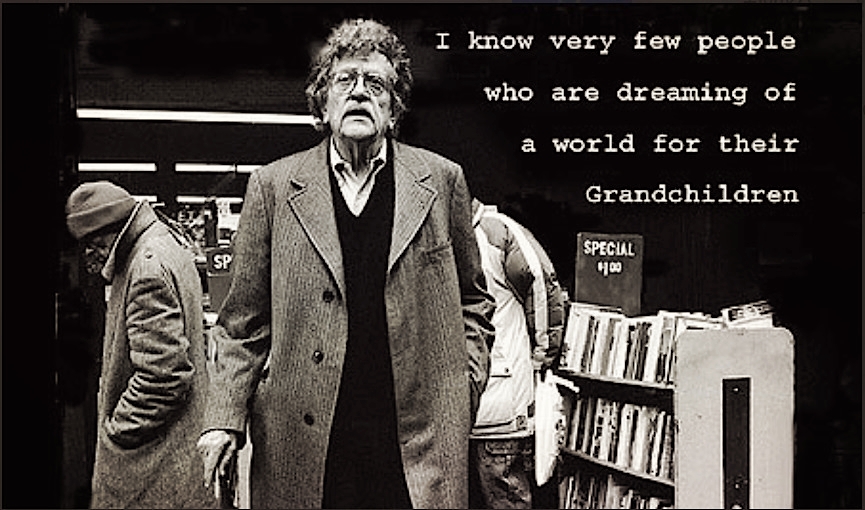
All lights are about to go out. No more electricity. All forms of transportation are about to stop, and the planet Earth will soon have a crust of skulls and bones and dead machinery. And nobody can do a thing about it. It’s too late in the game. Don’t spoil the party, but here’s the truth: We have squandered our planet’s resources, including air and water, as though there were no tomorrow, so now there isn’t going to be one.
~ Kurt Vonnegut
In the movie Nightcrawler, Lou Bloom is a member of today’s lost generation of unemployed youths and he ekes out an existence by cannibalizing L.A.’s infrastructure for scrap metal money. After watching a stringer journalist film a car crash, the wheels in Lou’s head start turning and he immediately recognizes an opportunity. He immerses himself in the lucrative business of vulture journalism where stories are marketable only if the victims are white and live in affluent neighborhoods. Fear of urban crime creeping into the suburbs is what really sells. Lou’s gravitation towards the world of sensationalized, ratings-driven mainstream news seems a natural development for someone able to dehumanize and objectify people for the sake of a story. In fact, Lou becomes an artist of the macabre like photographers Arthur ‘Weegee’ Fellig or Enrique Metinides, using the camera to capture tragedy and death in the most visually arresting way possible. He quickly rises to the top of the field while rationalizing his cutthroat behavior with the platitudes of corporate self-help books and entrepreneurial manuals.
Gyllenhaal’s dramatic weight loss for the role of Lou was a brilliant move that renders the actor unrecognizable and gives him the look of a half-starved animal desperate for his next meal. The hungry coyotes that prowl the L.A. suburbs at night served as animal symbolism for Gyllenhaal’s portrayal of the cunning Lou who sees the corpses of his fellow human beings as merely stepping-stones to success. Halloween was a fitting day for the debut of a movie featuring such a protagonist whose ruthless drive to get to the top and whose only consideration is the bottom line are the real horrors of today’s institutionalized greed.
Lou could be considered a ‘disruptor‘ in L.A.’s market of freelance video journalism. He views everything solely in terms of his sociopathic business plan to expand and grow at any cost. For him, human relationships exist merely for economic gain. With consummate skill, he is able to warp anyone’s moral compass, twisting people’s own weaknesses against them in order to gain leverage for what he wants. Joe Loder (Bill Paxton), the leading competitor in the nightcrawler industry, falls prey to Lou in what could sardonically be called a ‘hostile takeover’.
The young homeless man named Rick (Riz Ahmed), whom Lou recruits as his hapless assistant and intern at the slave wage of $30 per night, meets a similar fate when he tries to negotiate for a higher wage. The darkly humorous relationship between these two serves as satirical commentary on today’s exploitive labor practices by corporations such as unpaid internships and the financial bondage of visa workers. Human resources, like other “resources,” are disposable inputs.
Nina Romina (Rene Russo) is the news director of a local TV station to whom Lou sells his gruesome work. Like his other victims, Lou identifies her most vulnerable insecurities and uses them to worm his way higher up in the ranks of shock-and-awe TV news. A mutually parasitic relationship develops between the two as Nina demands more eye-popping footage to boost her station’s rating and secure her job while Lou is more than happy to provide it no matter what ethical boundaries are crossed. At some point, the tail begins to wag the dog and news becomes a staged event created for mass consumption by a TV audience eager for the next lurid spectacle.
Below is a fascinating interview with the movie’s director Dan Gilroy who discusses the messages the story makes about capitalism and modern society.
Some quotes from the director:
“…maybe the problem isn’t just Lou… The problem might be a society that creates a Lou and rewards Lou…”
“Every scene in Nightcrawler is ultimately a transaction. I’m very interested in the economic aspects of it, what it says about capitalism. I believe that Lou moves through a landscape of a world of transactions. I believe that’s the world we’re increasingly living in. I believe it’s a much more dog-eat-dog world. I believe that people are much more aware that whatever safety net we thought was there is really not there. What used to be a domestic competition is now a global competition. People are willing to do your job for a fraction of what you do.”
“I believe that Lou is representative of our times. And I believe the Lous are increasingly being rewarded… If you came back ten years in the film, Lou would probably be running a major company. I feel a lot of the people in the boardroom have sociopathic behavior and are being rewarded for it. They are making choices that are affecting tens of thousands of people’s lives. They are putting people out on the street… What Lou does would serve him very well in the boardroom… He’s a uber-capitalist. He’s a hyper-capitalist… The thing about hyper-capitalism is that everything becomes bottom line. Hyper-capitalism to me almost becomes the jungle. It’s the strong will consume the weak.”
“If Nightcrawler shows anything, it’s that the world we live in is a very hard-edged place where people do not take into account human dignity… Look what we’ve come to.”
The following video message is from Dr. Erik Pianka, an esteemed American biologist, one of the world’s most accomplished field ecologists, and author of the classic 1983 book Evolutionary Ecology. This video was made roughly four years ago. Not much has changed in the interim other than everything getting progressively worse —more people, more cars, more garbage landfills, more greenhouse gas emissions, more ocean acidification, more extinctions, etc…
To save the habitability of the Earth, many enlightened environmentalists and thinkers have proposed a radical but simple solution which calls for a reconfiguration of modern society into a much lower energy-intensive way of life with food production localized and resources socialized —just the opposite of what is now happening in our no-holds-barred global capitalist system. However, the time for a transition was decades ago before we had gone so far into overshoot that world powers are now scrambling to lay claim to the melting Arctic, carving up Africa for its land and water while unleashing a pandemic, and contaminating the dwindling aquifers with fracking waste. Our so-called leaders are too busy constructing an omnipresent spying Panopticon to bother noticing the gathering storm of climatic hellfire and brimstone. When harsh reality finally assert itself, such human folly will have created unfathomable catastrophes.
Farming is never going to go back, regardless of how much rain we get next year, to the way it was in the ’70s and ’80s. It’s a long-term era of scarcity.
California is much bigger than it was when these reservoirs were built, 40 or 50 years ago. There’s more water going to cities and the environment now. That boom era of California farming, I think everyone recognizes, is just a thing of the past.
They used to flood-irrigate everything here. When I was a kid, growing up, you’d walk outside in the middle of summer, six or seven months since the last rain, and it would be humid outside because there’d be so much irrigation going on. You hardly ever see anything flood-irrigated anymore. That time, that’s just not coming back.
The solution is not the techno-utopian fantasy of cold fusion. Even if cold fusion was a realistic possibility, the creation of unlimited amounts of ultra-cheap energy wielded in the hands of techno-capitalist man would surely spell disaster for any last vestiges of life that might have survived the omnicide of capitalist industrial civilization and the age of fossil fuels. A good steward of the Earth’s resources and web of life would never have perpetuated the 6th mass extinction and defiled the planet that gave birth to his kind while arrogantly naming himself Homo sapiens (Latin: “Wise man”).
Capitalist carbon man acted like a bull in a china shop, throwing his weight around and blindly destroying everything in his path. Now he wants to invent even more disruptive tools with which to save himself from the very techno-nightmare that he has already created? He treated the biosphere like a buyosphere, and money was his God. His epitaph was inscribed long ago by Oscar Wilde who perceptively said, “They know the price of everything and the value of nothing.”
Tragically, humans had their chance in a magnificent paradise and they blew it in spades.
Over the ages, a number of empires have exploited and looted the resource-rich lands of Africa. At its height, the Roman Empire stretched from Scotland in the northern hemisphere to the deserts of Africa in the south. The Romans stripped their North African territory of its trees, making it their breadbasket of grain production. Originating in central Africa, malaria was likely spread to the center of the Roman Empire on their cargo ships. Passengers on their boats could have carried malaria in their bloodstream before becoming symptomatic, and water barrels on board could have harbored mosquito larvae. In fact, the DNA work of Dr. Robert Sallares has proven that the most lethal form of malaria helped topple ancient Rome. Fast forwarding to today, the blow-back from industrial agriculture and transnational corporate land grabs in Africa has now reached the shores of the hegemonic American Empire in the form of a deadly tropical disease called Ebola.
The Roman Empire seized fertile African land by brute force, but in modern times capitalist industrial civilization takes over Third World countries with the stroke of a pen. Structural adjustment loans by such tools of western power as the IMF and World Bank are signed requiring privatization of the economy and government cuts in social spending. Vast tracks of forests are cleared for mining or monoculture crop production such as palm oil. Subsistence farmers are dispossessed of their ancestral lands and forced to migrate to cities in search of work. Deprived of adequate healthcare and the opportunity to earn a livable wage, these urban poor live in squalor and are driven to hunt in the surrounding forests for a cheap source of protein known as bushmeat. Fruit bats, a keystone environmental species, have been identified as an Ebola virus host that has spread the disease through bushmeat consumption, habitat destruction, and human encroachment. Thus the neoliberal agenda of ‘developed’ nations has acted to create the atmosphere from which this pandemic arose.
Due to the long history of exploitation by outside powers, native Africans are justifiably wary and prone to conspiracy theories involving intervention by Western institutions as well as their own governments which have been, to a great degree, corrupted by the resource curse. These unpleasant facts are, of course, never mentioned by the MSM because it might spark a flicker of moral compunction in the ‘developed’ world which has ended up with so much of Africa’s wealth in the form of rare earth minerals used inside electronic devices, gold and diamonds in jewelry, or petrol pumped into vehicles. The horrific realities behind conflict minerals are always kept out of sight and out of mind by the next consumer diversion.
The following video is a brilliant lecture by Rob Wallace, evolutionary biologist and public health phylogeographer, discussing the epidemiologic links between the current Ebola outbreak and the socioeconomic policies of capitalist industrial civilization.
“Pathogens routinely trace society’s inequalities and expropriations like water traces cracks in ice… Ebola represents such a case. The shifts in land use in the Guinean region where the new strain apparently emerged are connected to the kinds of neoliberal structural adjustments that, alongside divesting public health infrastructure, open domestic food production to global circuits of capital… [The corporate agribusiness land acquisitions in Africa] are markers of a complex policy-driven faith change in agroecology…that undergirds Ebola’s emergence here.” ~ Rob Wallace
In biology there is a phenomenon known as the Allee effect which occurs when a species declines to a critical population threshold, becoming too spread out over a large area to find a mate for reproduction and thereby making a crash to extinction all but inevitable. The Allee effect applies to infectious diseases as well, and if you can knock down an outbreak below an infection threshold through such methods as vaccinations or proper sanitation, then the outbreak can burn out on its own. However, as Rob Wallace wryly states, “…structural problems can render emergency responses null and void, no matter how much Bill Gates pays out.” In other words, we may have destroyed the ecosystem’s natural ability to keep such pathogens in check and from expanding out of control in the future:
“…commoditizing the forest and neoliberal dispossession may have lowered the region’s ecosystemic threshold to a point that no emergency intervention can drive the pathogen population low enough to burn out on its own. The pathogen will continue to circulate with the potential to explode. In short, neoliberalism’s shifts aren’t just a background upon which such emergencies take place. It is the emergency as much as the virus itself. And history has demonstrated this time and again. Faith changes and social organization, for better and for worse, change epidemiologies. Domesticated livestock served as sources for human diphtheria, influenza, measles, mumps, plague, pertussis, rotavirus, tuberculosis, sleeping sickness, etc. Ecological changes brought about upon landscapes by human intervention selected for spill-overs of cholera from algae, malaria from birds, and dengue fever and yellow fever from wild primates… We can pretend otherwise for Ebola, but in protecting the rationals for institutions and policies that likely brought about such outbreaks, if as byproducts of a greater economy alone, we will surely only compound the problem. If not by Ebola this year, then perhaps something else next.”
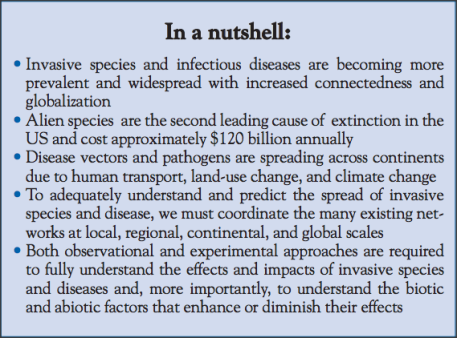
In addition to the ecosystemic impact of industrial agriculture and global circuits of capital, our highly mobile society and the consequent climate disruption from fossil-fueled globalization have worked to propel the spread of invasive species, diseases, and pathogens:
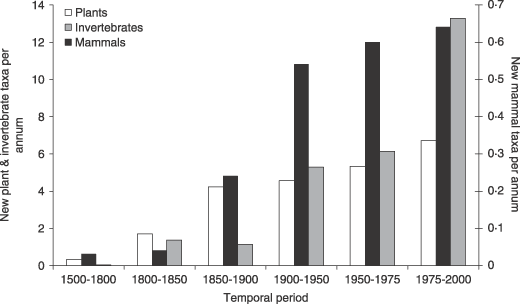
The following graph show the increase of invasive species since 1500 with an explosion in the last 100 years:
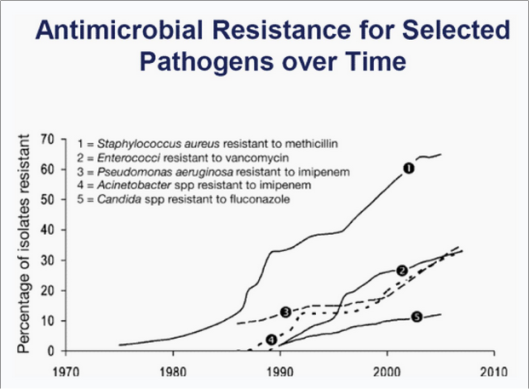
Below is a chart showing the increase in bacterial resistance for selected pathogens. “For example, Staphylococcus aureus resistant to methicillin has increased almost 70% since about 1975.” The dawning of an antibiotic apocalypse is upon us:
“FRONTLINE investigates the widespread use of antibiotics in food animals and whether it is fueling the growing crisis of antibiotic resistance in people. Plus an exclusive interview with the family of a young man who died in a superbug outbreak that swept through a hospital at the National Institutes of Health.”
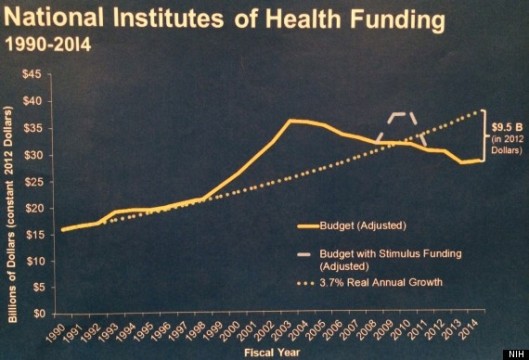
Amplifying what some call peak antibiotics is the fact that in our capitalist economy, the perverse incentive for monetary profit discourages pharmaceutical companies from developing new antibiotics; there is no market for curing… only prolonging:
…Ebola emerged 40 years ago, and, Dr. Chan said, there were no vaccines or other remedies because it has traditionally been confined to poor African countries. A profit-driven pharmaceutical industry had no incentive to make products for countries that could not pay, she said.
The risks of neglecting health care in developing countries are global, Dr. Chan said, adding that “when a deadly and dreaded virus hits the destitute and spirals out of control, the whole world is put at risk.”… – link
The fragmented and “crapified” nature of America’s for-profit healthcare system has also factored into the fumbled response to Ebola’s invasion into America, as Yves Smith at Naked Capitalism explained recently:
…the statistics say compared to other developed countries, US processes and outcomes are at best mediocre using the best of some admittedly flawed metrics (look here), yet our costs are much higher than those of comparable countries. Furthermore, on Health Care Renewal we have been connecting the dots among severe problems with cost, quality and access on one hand, and huge problems with concentration and abuse of power, enabled by leadership of health care organizations that is ill-informed, incompetent, unsympathetic or hostile to health care professionals’ values, self-interested, conflicted, dishonest, or even corrupt and governance that fails to foster transparency, accountability, ethics and honesty…
…The US health care system is now heavily commercialized. Health care corporations, including pharmaceutical and biotechnology companies, are often lead by generic managers who subscribe to the business school dogma of the “shareholder value theory,” which seems to translate into putting short-term revenues ahead of all other goals. Thus they have been“financialized.” At least in the pharmaceutical and biotechnology sector, such financialization appears to now be global…
…from 1983 to 2000, the number of managers working in the US health care system grew 726%, while the number of physicians grew 39%, so the manager/physician ratio went from roughly one to six to one to one (see 2005 post here). As we noted here, the growth continued, so there are now 10 managers for every US physician…
There is little wonder why the Ebola outbreak caught the WHO so flat footed as they spent months making mealy mouthed statements but never coordinating an effective response. The Gates foundation is the WHO boss, not governments, and if they weren’t demanding action, then the desperate people affected by Ebola weren’t going to get any…
…The Bill and Melinda Gates Foundation has pledged an additional $50 million to fight the current Ebola epidemic but that too is problematic, as Director General Chan describes. “When there’s an event, we have money. Then after that, the money stops coming in, then all the staff you recruited to do the response, you have to terminate their contracts.” The WHO should not be lurching from crisis to crisis, SARS, MERS, or H1N1 influenza based on the whims of philanthropy. The principles of public health should be carried out by knowledgeable medical professionals who are not dependent upon rich people for their jobs.
The Gates are not alone in using their deep pockets to confound what should be publicly held responsibilities. Facebook founder Mark Zuckerberg announced that he was contributing $25 million to fight Ebola. His donation will go to the Centers for Disease Control Foundation. Most Americans are probably unaware that such a foundation even exists. Yet there it is, run by a mostly corporate board which will inevitably interfere with the public good…
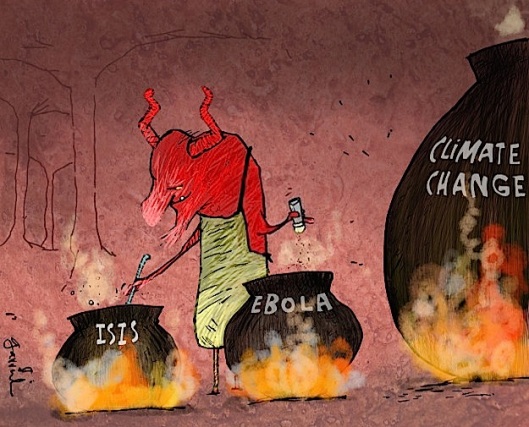
Essentially, both ISIS and the Ebola pandemic are crises of the corporate state’s own making. Vast sums of money have flowed into America’s war machine to fight the terrorist threat of ISIS, yet the specter of a global pandemic has elicited a much more belated and tepid reaction from the leaders of our brave new privatized and financialized system of government. As with climate change, it has become clear once again that the health of the world and its people cannot be trusted with these adherents of neoliberal capitalism, and as I stated in a previous blog post, the conspiracy is systemic and legalized. The virus of capitalist industrial civilization appears to be on an unstoppable trajectory of burning itself out within our children’s lifetime.
“It was a nice run for the biosphere, but it finally came down with a lethal disease, homeostasis lost, the pyramid of life reduced to the pancake of life.” ~ James
Championing the rapacious conversion of the Earth into dead commodities and its peoples into soulless consumers, the adherents of capitalism have succeeded in entrenching their ideology into the minds of the vast populations as the only viable economic system and way of life. Mesmerized by the electronic gadgetry of the digital age and singing the praises of the “free market”, atomized citizens blissfully hack away at the tree of life that supports them. The bio-destructive power of capitalist industrial civilization stamps out the poetry of nature, silencing entire ecosystems. This essay by Kenn Orphan describes the mindless march towards self-destruction and the redemption that comes by bearing witness to it.
“Extinction is the rule. Survival is the exception.” – Carl Sagan
We are all witnesses to the Great Dying, a sixth mass extinction, the last one being 65 million years ago which wiped out the dinosaurs. This is not hyperbole; it is a defining feature of our age.
Countless species are falling prey to the wealthy’s indifference, militarism and folly everyday. As in ancient civilizations, the wealthy and the privileged are generally the last to feel the pain of collapse, yet are most often the root cause. And compared to the mass of humanity we share this planet with, and as a result of rapacious exploitation and plunder, Americans, and westerners in general, are the wealthy and the privileged of modern civilization.
Despite overwhelming evidence of crashing ecosystems, many of us living in the twilight years of the American empire seem oblivious to the canaries in the coal mine. Every…
Who’s got a hand on the crackdown? Who’s got the word on the double talk? Hands on the wheel in a flash of steel We got a secret letter with a government seal …… Nerves are pinched but the heads are calm The cargo’s all loaded and the red light’s on Check the map, you navigator sap Or we’ll all end up with our heads in our lap
Only with capitalism does commodity exchange become the universal source of social interaction through the commodification of labor power, value then becomes the defining principle of social reproduction.
There are many criticisms against Capitalism, but not much in the way of concrete alternatives. I’ve just finished reading Professor Peter Hudis’ book “The Alternative to Capitalism”, and while he does not offer much specificity in the way of concrete alternatives, he does offer a useful and provocative analysis of Marx’s theories pertaining to what might come next. The book is unique in that it distills down and interprets thousands of pages of Marx’s writing into a handful of useful conclusions that illustrate what Marx envisioned in a post Capitalist society.
Below is a recent podcast in which Professor Hudis is interviewed, and this gives a quick overview of the concepts and conclusions of his vision of a post Capitalist society.
The central argument in Hudis’ reading of Marx is that any Post Capitalist society that is to succeed must at first recognize, then dismantle, the system of value production. This differs significantly from conventional anti-capitalist thinking which suggests that the capitalist mode of production and the system of private property ownership are principally responsible for the contradictions and subsequent failures in Capitalism.
Additionally, he points out that Marx expressly disagreed with the popularized notion that to achieve this, the ownership of the means of production must transfer to the State. Marx was very clear that ownership of the means of production must not belong to the Capitalist, nor the State, rather, to those in the involved with the actual production process.
Hudis suggests that these palliative measures are not only misplaced, but wrong.
To dive further into what is being said here, some discussion of the meaning of the phrase value production is in order.
Value production in a capitalist society means that all social relations are governed by the drive to augment and increase value, with no regard for human needs or capacities.
This suggests (and Hudis does a good supporting his thesis with an academically rigorous approach in his book) that the essence of the perpetually expanding nature of Capital, the expansion that consumes resources and poisons the planet, stems from this fundamental conclusion.
Value is not material wealth, it is wealth computed in terms of money. As Hudis points out, once such a system of value production becomes the dominant form of social relations, the drive to constantly increase value becomes unstoppable.
Drilling deeper into the construct of value production, what comes forward is that one of the key contributors to this unstoppable force is the notion of socially necessary labor time. On this subject, it becomes evident that not even the Capitalists themselves have control of the system, as even they are not able to manage the forces that control production. Time becomes inverted, the predicate becomes the subject, and the whole process leads to the incredulous discovery that the products we produce control all of human relations.
And it was always supposed to be the other way around.
The concept of socially necessary labor time dictates several key factors, principally, that goods are produced in accordance with average labor inputs, and any production labor in excess of the social average is wasted and deemed not useful. This means that Capitalists that engage in production are not in control of their exchange values, this is communicated by the market and discovered when goods reach the point of sale. It is then that the Capitalist determines if his goods are competitively priced, and if he can monetize his exchange value. If another firm has produced the same commodity using less labor (or cheaper labor) at the same quality, then the original capitalist will not be able to monetize his surplus value.
This uncertainty, coupled with the intrinsic self expansive nature of Capital, sets into motion a destructive and unstoppable cycle of ever decreasing inputs of labor time.
Time, in the pursuit of commodity production, becomes our master, we work longer, faster, to achieve the same standard of living.
These factors were not present in pre-capitalist societies. And Hudis argues that they cannot be present in any post Capitalist society either. These conditions of value production in general, and of socially necessary labor time in particular are unique to Capitalism.
We see in the news today disturbing events, loss of personal liberties, privacy issues, destruction of the planet and wanton disregard for resource depletion- it is hard to know which bogey to fear first and foremost.
Most disturbing to me is the almost footnoted mention in the news media of the egregious tax avoidance strategies being employed by large multi-nationals. Companies like Tesla are now dictating terms and conditions which they will require to build production factories in a specific state. They are in effect competitively bidding individual states against each other to maximize the tax deferments and various other concessions as a condition of doing business.
Tesla has negotiated approximately $1.25 Bn dollars worth of concessions, and some analysts are claiming the return on investment for the number of jobs created is a fiction.
Additionally, these tactics are by no means limited to inside the US, there is a battle royale raging in countries like Ireland, where Apple has effectively negotiated terms that reduce their effective tax liabilities to around 2%. By their own admission, there is ‘no scientific or numerical basis’ for their arguments, meaning they just drove the best bargain they thought they could get away with, and Ireland signed up- not wanting to risk the ~6,000 jobs that Apple has in Cork County.
While many are content to lament the State’s complicity in the machinations of Capital, these events indicate something new and much more dangerous- Capital is now overtly dictating terms to the State and holding monopoly power over the State to insure conditions of production that are favorable to Capital. Again, the predicate becomes the subject, as we see an inversion of the production relations. This is very dangerous.
Next we can envision corporate sanctioned labor camps for those deemed unemployable, subsuming the State unemployment programs with privatized “camps” as an extension of the massive prison system- with better wall colors and more frequent conjugal visits.
Social relations will be transformed to support only matters of production relations, education further diluted to rote training farms, subsidized and wholly captured by the large multi-nationals, and hard wired to provide curriculum and performance standards beholden only to their interests.
The hand maidens of Capital have successfully employed an “Arsonists in Fire Chief Hats” strategy wherein they have systematically dismantled any regulatory components of the State, and then cry foul when the hobbled remains proves ineffective at its intended role.
The only logical conclusion in this outcome is of course further privatization, drowning government in the proverbial bathtub so that Capital may advance beyond its perch as owner of all assets into its newly expanded role as owner of all labor.
The linear thinking that has dominated Western civilization since the Enlightenment has become a death trap for mankind in the 21st century. The dynamic system of the Earth’s biosphere with its many interconnected parts interacting in complex and unpredictable ways is clashing with modern man’s linear, sequential, and reductionist frame of thought for solving problems. Technical fixes only act as bandaids to the inherent flaws of global techno-capitalism. Time lags and feedbacks set in motion by industrial civilization’s rampant consumption of natural resources will extend over centuries and into deep geologic time. Ignoring the various environmental and social warnings at our own peril, we neither fully understand nor comprehend the consequences of our unsustainable way of life. The laws of physics and chemistry are indifferent to such human tragedy.
Institutional changes required to deal with complicated problems such as climate change move at a sloth’s pace, and the transition to new energy sources has proven historically to be a long, drawn-out process spanning decades. Never mind the fact that so-called ‘green energy’ cannot support the current mode of living nor the overpopulated state of the planet. In other words, our current socio-economic system is unsalvageable.
After one accepts, at least on a subconscious level, these realities, is it then any wonder that nihilism is on the rise? What is more nihilistic than the view that our fate is the end result of the “evolutionary success of an exceptionally rapacious primate”, that “human intelligence is a lethal mutation”(Ernst Mayr), and that industrial civilization is a cancerous growth? I would qualify such thinking by stating that intelligence without wisdom brings destruction. Wisdom is not a genetic trait and has little to do with intelligence. Wisdom is attained through life experience and conscious choice.
…Shanghai can come as a rude surprise. In spite of its nominally communist system, it is the most go-go, unfettered, money and status mad, materialistic place on earth. Its skyline alone is confirmation that money talks loudest. In no other city could you build the world’s largest, tallest and ominously curved phallus—stick it right up into the clouds like a giant “FUCK YOU!” to the world and not have trouble with the NIMBYs…
Billions clamoring for an American level of consumption appears to be the real weapon of mass destruction on the planet. Capitalism shows no sign of stopping its downward spiral into barbarism:
The dilemma of progress, as captured neatly by the authors of The Axemaker’s Gift(1995), is that the human species’ very success in exploiting its natural environment and dominating others of their kind (the two go hand in hand), and generally fulfilling its aspirations (and its aspirations, unlike those of all other animals, seem to have no limits) has directly led to its self-destruction. The linear march of progress, on this view, has been from human life in caves only minimally taxing its environment, to life as tribes and agriculturalists exploiting it just a bit more, to modern life. And what is modernity but the triangle of secular science, corporate-capitalism, and nation-states – all made possible by the human ability to create large, secular, result-oriented organizations? In this inexorable story of progress, nature (as well as human lifestyles friendlier to it) have been the losers. ~ Dr. Ovamir Anjum
Dennis Meadows, one of the authors of the prophetic book The Limits to Growth, says that because capitalist industries and the political-legal framework supporting them are so powerful and entrenched, humanity will not evolve through proactive change, but will stumble into multiple unfolding crises as it clings to failing policies and ideologies of promoting material growth at the expense of all else. If we look at current news, this is clearly what is happening:
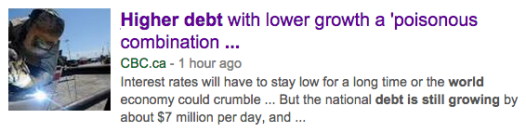
Global debt is still soaring:
…Overall, the world’s total debt load has risen from 160 per cent of national income in 2001 to almost 200 per cent after the crisis struck in 2009.
But contrary to all the talk of “deleveraging” that ratio has actually increased since the financial crisis, and was up to 215 per cent globally last year. Put another way, the world owed a collective $70 trillion US before the last recession. But today that figure is up to $100 trillion.
“Contrary to widely held beliefs, the world has not yet begun to delever and the global debt to GDP ratio is still growing, breaking new highs,” the report reads…
The cognitive dissonance between our fossil fuel use and the collapsing environment continues:
Global overpopulation shows no signs of stopping:
The Wealth Gap continues to grow:
The most striking finding in the new Survey of Consumer Finances may be the degree to which wealth is being concentrated in the hands of a small portion of the population.
That trend isn’t new. “Many other studies have also shown the lasting effects of the recession and documented rising income disparity in the United States,” writes Reuters.
But the SCF shows that the wealth gap continues to grow. The share of wealth belonging to the richest 3 percent of Americans was:
44.8 percent in 1989.
51.8 percent in 2007.
54.4 percent in 2013.
And the 6th extinction is far worse than we realize:
These are just a few of the realities once we scrape away the greenwashing, political spin, and optimism bias humans are prone to, but let’s not get “lost in a roman wilderness of pain.” Check back with me next year and the story will be much the same as humans accept higher poverty rates, a steeper Keeling Curve, and lower biodiversity levels as the new normal. There’s a name for this gradual adaptation of humans to a worsening environment —environmental generational amnesia. We really won’t know what we’ve been missing until everything is far too gone to support another generation of humans.
To the extent that we depend on prosthetic devices to keep ourselves and the biosphere alive, we will render everything fragile. To the extent that we banish the rest of life, we will impoverish our own species for all time. And if we should surrender our genetic nature to machine-aided ratiocination, and our ethics and art and our very meaning to a habit of careless discursion in the name of progress, imagining ourselves godlike and absolved from our ancient heritage, we will become nothing.
~ Edward O. Wilson, Consilience; Chapter 12: ‘What Does It All Mean?’
From its inception, capitalism paved a one-way path to annihilation, predicated as it was on unmitigated growth, the extraction of finite resources, the exaltation of individualism over communal ties, and the maximization of profit at the expense of the environment and society. The capitalist world was, as one author described so bleakly, ”dominated by the concerns of trade and Realpolitik rather than by human rights and spreading democracy”; it was a ”civilization influenced by the impersonal, bottom-line values of the corporations.” Capitalist industrial civilization was built on burning the organic remains of ancient organisms, but at the cost of destroying the stable climatic conditions which supported its very construction. The thirst for fossil fuels by our globalized, high-energy economy spurred increased technological development to extract the more difficult-to-reach reserves, but this frantic grasp for what was left only served to hasten the malignant transformation of Earth into an alien world.
The Fossil Fuel Age did not end for lack of fossil fuels, but because there was no place left to store its CO2 waste. Earth’s overwhelmed carbon sinks became carbon sources. Humans with their hubristic technological overreach had been living on borrowed time for a long time; techno-fixes were not able to artificially expand the carrying capacity of the planet any longer. The climax of the ecological crisis had arrived.
The ruling class tried to hold things together for as long as they could by printing money, propping up markets, militarizing domestic law enforcement, and orchestrating thinly veiled resource wars in the name of fighting terrorism, but the crisis of capitalism was intertwined with the ecological crisis and could never be solved by those whose jobs and social standing depended on protecting the status quo. All the corporate PR, greenwashing, political promises, cultural myths, and anthropocentrism could not hide the harsh Malthusian reality of ecological overshoot. As crime sky-rocketed and social unrest boiled over into rioting and looting, the elite retreated behind walled fortresses secured by armed guards, but the great unwinding of industrial civilization was already well underway. This evil genie was never going back in the bottle.
The melting of the glacial poles meant that global weather patterns and jet streams were irrevocably altered. Consequently, extreme floods and drought wreaked havoc on agriculture. Sea levels also rose much faster than predicted, inundating coastal cities and salinating farmland. Currency markets collapsed, cell phones went silent, transportation systems ground to a halt, and grocery shelves went bare. The disintegration of globalized trade, the dissolution of nation states, and the exhaustion of the biosphere brought forth a new dark age. Deadly microbes and pathogens that had lain dormant or been restricted to certain outlying areas of the planet were now free to migrate and proliferate in new regions. This opened the door for a string of global pandemics that the world had never seen before. Pestilence and famine whittled the population down to under a billion within a few decades.
Entropic Wastelands
The electric glow of the world’s cities was blotted out; the stars and moon were the only sources of illumination in the pitch black of night. A ghostly silence replaced the hustle and bustle of people and machinery that once animated the city. Time was no longer measured with the hands of a clock, but by the rise and fall of the sun and the changing of the seasons. A carpet of overgrown grass, weeds, bramble, and trees silently overtook the crumbling city, uprooting and splitting concrete and asphalt. Skyscrapers, once the temples of corporate power and wealth, were now nothing more than monstrous sundials casting their long shadows across the decaying wastelands. Never again would there be such a complex, globe-spanning civilization on Earth.
Haunted for millenia by the legacy of mankind’s fossil fuel binge, roving bands of human survivors were condemned to wander this angry Earth. Only the most physically and mentally fit were able to eke out an existence in an increasingly inhospitable world to pass through the evolutionary bottleneck. They huddled together at night around bonfires and fed the flames with old office furniture and business papers from abandoned buildings. Without electricity, modern medicine, and sanitation systems, life became a short and brutal affair. Nature’s primal forces could no longer be disregarded; their harsh reality sharpened all the senses. Nearly all the technology that had enslaved and anesthetized modern man for so long was now of no use in this neo-medieval world. Megacities were reduced to entropic wastelands, their detritus scavenged by these post-apocalyptic tribes.
Like a rocket disintegrating in mid-flight, capitalist industrial civilization rushed headlong into oblivion, always believing human ingenuity and free markets would solve the mounting number of crises. It turned out humans were extraordinarily clever at deceiving others and, in turn, equally clever at deceiving themselves. They burned the devil’s excrement, split atoms to play with lethal radiation, and tinkered with the building blocks of life, but they never heeded numerous warnings against such folly. Like Icarus who, flying too close to the sun, forgot that his wings were made of wax, humans ignored their earthly origins, believing too much in their own technological infallibility.
A passage from The World Without Us:
There Will Come Soft Rains
There will come soft rains and the smell of the ground,
And swallows circling with their shimmering sound;
And frogs in the pools singing at night,
And wild plum trees in tremulous white;
Robins will wear their feathery fire,
Whistling their whims on a low fence-wire;
And not one will know of the war, not one
Will care at last when it is done.
Not one would mind, neither bird nor tree,
If mankind perished utterly;
And Spring herself, when she woke at dawn
Would scarcely know that we were gone.
At some point in your life you realize that you’re running out of time, that your health and energy level are slipping, and that your time here on Earth is extremely fragile and transient. You begin to question and re-evaluate what’s important to you. Most still go to their grave with the belief that life will go on for their descendants in a world of never-ending technological “advancements” and improvements in society. A few reading this blog understand the myth of human progress and that mankind is sleepwalking towards a very dark fate. How could there be any other outcome when we have never really heeded the precautionary principle of environmentalism and, in fact, flagrantly disregarded it? Occasionally a scientist will candidly speak the truth. Recently, Jason Box did just that when he tweeted “we’re f’d” if just a small fraction of floor carbon is released from the Arctic. Some of us realize what dire straits we are in and all we can really do is watch with a sort of morbid fascination as this dystopian future unfolds before our eyes. A “grim meathook future” is the inevitable result of a society that worships money, materialism, militarism, and technology.
For an articulate and heartfelt expression of the angst of the modern age, I highly recommend reading the blog post Everyone I know is brokenhearted. The author, Josh Ellis, doesn’t mention climate change at all, but he does hit on every other aspect of capitalist industrial civilization and its soul-crushing, alienating culture. Judging from the number of Facebook “likes”, now at 21K and counting, he has really struck a nerve with people. Perhaps it’s fitting and somewhat ironic that Josh has spent much time in the desert megacity of Las Vegas, the ultimate man-made mirage of capitalist decadence.
All the genuinely smart, talented, funny people I know seem to be miserable these days. You feel it on Twitter more than Facebook, because Facebook is where you go to do your performance art where you pretend to be a hip, urbane person with the most awesomest friends and the best relationships and the very best lunches ever. Facebook is surface; Twitter is subtext, and judging by what I’ve seen, the subtext is aching sadness.
I’m not immune to this. I don’t remember ever feeling this miserable and depressed in my life, this sense of futility that makes you wish you’d simply go numb and not care anymore. I think a lot about killing myself these days. Don’t worry, I’m not going to do it and this isn’t a cry for help. But I wake up and think: fuck, more of this? Really? How much more? And is it really worth it?
In my case, much of it stems from my divorce and the collapse of the next relationship I had. But that’s not really the cause. I think that those relationships were bulwarks, charms against the dark I’ve felt growing in this world for a long time now. When I was in love, the world outside didn’t matter so much. But without it, there is nothing keeping the wolf from the door…

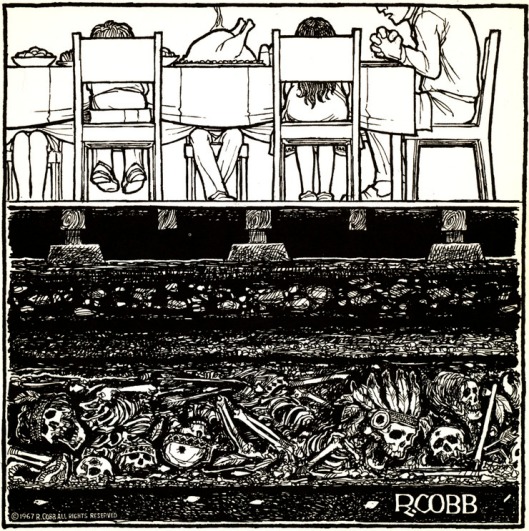 Tomorrow is Thanksgiving, a holiday created from romanticized myths about grand and cordial feasts between pilgrims and the indigenous people whose lives, land, and culture would soon be exterminated from coast to coast. Truth be told, Thanksgiving sprang from the imaginative mind of Sarah Josepha Hale, an author and editor who campaigned for nearly two decades to make it a national holiday before winning over President Lincoln who made it official in 1863. Some historians believe Lincoln used the creation of Thanksgiving as propaganda during the Civil War to paint Northerners as the true founders of the nation whose cause in the war was virtuous and just. In her writings, Hale also pushed the delusional belief that the “United States government was founded without bloodshed.”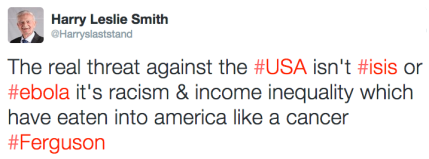














 Collapse of Industrial Civilization