• About

Collapse of Industrial Civilization

~ Finding the Truth behind the American Hologram

Collapse of Industrial Civilization

Tag Archives: Industrial Civilization

A Victory On Paper, A Scarred Gulf

31 Tuesday Mar 2026

Posted by xraymike79 in Collapse of Industrial Civilization, Mental Health

≈ 8 Comments

Tags

Agrifood Systems, Chokepoint Warfare, Civilizational Metabolism, Climate And Conflict, Collapse Discourse, Energy And Famine, Energy Geopolitics, Fertilizer Shortage, Global Food Security, Imperial Retrenchment, Industrial Civilization, Iran War, Just‑In‑Time Fragility, Maritime Insurance Crisis, Oil Market Shock, Petrostate Politics, Risk Society, Strait Of Hormuz, Supply Chain Fragility, Systemic Collapse

Peace on a Broken Artery

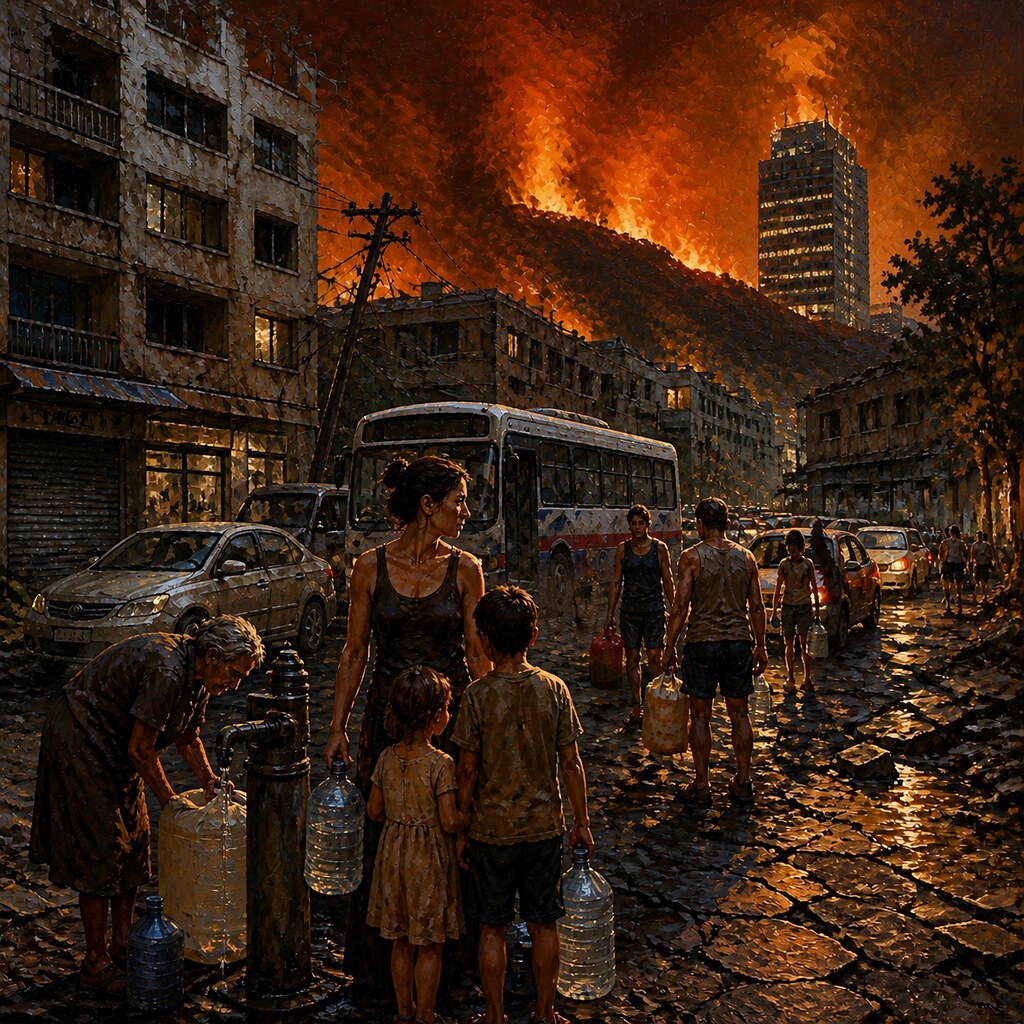
By now the war in Iran has settled into a grim routine. Tankers inch through militarized sea lanes under the eyes of drones. Jets rise off carriers and desert runways to drop precision ordnance on an already cratered landscape. The Strait of Hormuz, a thin scrawl of water between rock and sand, has become a fault line of global anxiety. Officials in Washington and Brussels still describe it as a problem of “regional stability,” “energy security,” and “deterring aggression.” If you read beyond the podiums and into the fine print of the economic and risk reports, another story emerges. The people who administer this order have started to describe, in careful bullet points and euphemisms, the early stages of its breakdown. They simply refuse to say the word collapse.

In late March, a new line floated out of the White House and friendly media: President Trump is reportedly willing to end the military campaign against Iran even if the Strait of Hormuz remains largely closed.

On paper, that sounds like an exit. In practice, it is an admission that whatever this war’s end state, one of the main fossil‑fuel arteries of industrial civilization will remain damaged. Whether the fighting stops next month or drags on, Hormuz is not going back to what it was in January. Nor, if the architects of this adventure have their way, is Iran.

The question is not whether dismantling or maiming the Iranian state would create chaos along that artery. It is how much of that chaos would be exported into the food and fuel systems that keep billions of people alive.

A Chokepoint as a Systems Diagram

In the public imagination, Hormuz has long been an oil chokepoint: a narrow passage for roughly a fifth of seaborne crude and a significant share of LNG. In practice, it is also a fertilizer chokepoint, a petrochemical chokepoint, and a shipping chokepoint. The Iran war has made that explicit. Iranian missiles, drones, and mines, combined with U.S. and Israeli strikes and a cascading wave of insurance withdrawals, have exposed the strait as a single, brittle joint in a civilization‑scale supply chain. UN agencies now estimate that roughly 35 percent of global crude and nearly a third of fertilizer trade normally flows through Hormuz, and that tanker traffic has fallen by more than 90 percent since the war began.

Since late February, tanker and bulk traffic through Hormuz has collapsed from the usual torrent of oil, gas, and fertilizer that props up half the planet’s metabolism to almost nothing. The IRGC has warned vessels away and carried out at least twenty‑one attacks on merchant ships. War‑risk insurance has been pulled. Crews have invoked their right to refuse to transit. The strait is technically open but effectively closed to normal commerce. And if this campaign succeeds in bombing Iran’s state capacity into rubble, it does not reopen the artery; it hands the coastline to militias and jihadist franchises for whom intermittent hijackings, mining scares, and rocket fire on tankers are tools of extortion, recruitment, and proxy warfare. For them, keeping Hormuz unreliable is not a problem to be solved but a tactic to be used.

The first thing that moves is a price chart on a screen. Futures spike, analysts talk about volatility, and traders front‑run the headlines. In the real world, the shock lands in treasuries and streets. Import‑dependent countries watch their fuel and food bills jump at the same time. Hard currency drains away. Subsidy regimes that kept bread and diesel politically quiet start to unravel. Cabinets fall, parliaments are dissolved, opposition parties and street movements suddenly have an opening. A few months of disrupted nitrogen and diesel have, in the past, helped push vulnerable governments closer to default, revolt, or both. Those shocks don’t stay local. They ricochet through debt markets, migration routes, and security alliances—a handful of missiles and insurance letters in the Gulf rewriting the political order thousands of miles from those troubled waters, after major marine insurers simply pulled war‑risk cover and left hundreds of vessels stranded at anchor.

None of this is speculative. The UN Food and Agriculture Organization calls this ‘a systematic shock affecting food systems globally,’ warning that farmers face a ‘double choke’ of fertilizer and fuel prices rather than a passing scare. Its chief economist says global markets can probably absorb the shock for ‘about two weeks’ before risks of broader food insecurity rise sharply, and that if the conflict and the closure of Hormuz last three to six months, the shocks will be ‘global and harder to manage.’ A UN‑linked analysis flatly states that if the war does not end quickly, ‘global markets could collapse from the high demands for oil and crops,’ as unrelenting need for these inputs collides with war‑constrained supply and pushes the system past what it can absorb.

In their world, the Iran war is no longer a “geopolitical flare‑up.” It is a “global agrifood systems” crisis layered on top of an energy crisis. Translated into English: the bombs are falling in the Gulf, but the shockwaves are moving along the supply lines that keep cities fed and states solvent.

What is missing is a simple sentence acknowledging what those phrases amount to: behold a vast global civilization built across a set of concentrated, brittle lifelines which we are now actively destroying.

Ending the War Without Fixing the Artery

Into this situation comes the new talking point from Washington: that reopening Hormuz is no longer a prerequisite for ending the war. Trump has reportedly told aides he is prepared to conclude the campaign even if the strait remains “predominantly obstructed.” He does not want a drawn‑out effort to clear mines, neutralize coastal batteries, and escort a critical mass of tankers and fertilizer carriers through hostile waters. He wants a short war, a weakened Iran, and an exit.

The theory seems to be that if U.S. and Israeli forces smash enough of Iran’s missile launchers and patrol boats, Tehran will eventually choose to reopen the strait for its own economic reasons or under pressure from other powers. If not, the job of prying it open can be handed off to regional navies and insurance consortia later.

This is what “victory” looks like in the airpower age: decapitate some units, degrade some arsenals, then declare the strategic problem solved while the structural damage remains. In this case, the structural damage is not confined to runways and radar sites. It is a shift in how Hormuz works as a global artery.

Physically, the war leaves behind unexploded ordnance, damaged infrastructure, and an elevated baseline risk of attack. Politically, it normalizes the use of the strait as a weapon. Iran has now demonstrated that it can close or severely restrict traffic when under attack. The U.S. has demonstrated that it will tolerate weeks of closure for the sake of a punitive air campaign. Every future crisis will be negotiated in the shadow of that precedent.

Financially, it bakes in higher war‑risk premia, higher insurance costs, and a secular push to reroute or diversify trade—pipelines through Saudi Arabia and the UAE, more LNG out of the U.S. Gulf, more storage and stockpiling in rich countries. Some of that diversification will succeed. Much of it will not arrive in time for the farmers currently deciding whether they can afford another season of ammonium nitrate.

Ending the war without fixing the artery does not restore the old normal. It crystallizes a new one: a Gulf that is more mined, more militarized, and more obviously central to food as well as fuel. A chokepoint that has been shown to be closable at will, but not reliably reopenable by force within an acceptable timeframe.

From Hostile State to Ungoverned Corridor

War planners like to imagine that the alternative to a hostile regime is a compliant one. In practice, the record of the last twenty years suggests something else: the alternative to an intact adversarial state is often a fractured, semi‑ungoverned space that bleeds instability into the surrounding region.

Dismantling or maiming the Iranian state would not produce a peaceful, demilitarized Gulf. It would turn the country that sits astride one of the world’s key arteries into a patchwork of factions, militias, and proxies with access to missiles, drones, and coastal systems along hundreds of miles of shoreline.

You do not need to believe in a neat “Iraq 2.0” analogy to see the contours. A weakened central government loses its ability to police its own forces and waters. Rival power centers inside Iran—Revolutionary Guard remnants, provincial elites, separatist movements—jockey for control of ports and oil terminals. Outside powers—Saudi Arabia, the UAE, Turkey, Pakistan, Russia—move to back their preferred clients. The IRGC’s current, relatively centralized control over Hormuz is replaced by something more chaotic: multiple actors with both the capability and the incentive to harass shipping.

From the standpoint of global food and fuel flows, this is worse than a hostile but coherent state. A disciplined adversary can threaten closure or limited disruption as a bargaining chip, but it also has a strong interest in collecting transit fees, exporting its own commodities, and avoiding complete economic suicide. A fragmented security environment produces something else: piracy, sporadic attacks, deniable incidents, and a constant background risk that any given convoy will be targeted by someone trying to send a message, settle a score, or shake down a client state.

Think of it as Somalia‑plus‑Strait‑of‑Malacca, sitting on the fertilizer pipe. The fantasy that you can bomb your way to a safer Gulf by “dismantling” the current Iranian state rests on the assumption that the post‑war order will be more predictable than the one it replaces. Nothing in the region’s history, or in recent U.S. expeditionary adventures, supports that belief.

Food, Fertilizer, and the Permanent Premium on Survival

The global food system was already fragile before the first missile flew. Climate change is quietly dialing down yields, even when farmers adapt, with new modeling showing significant declines in major staples under both optimistic and business‑as‑usual scenarios. Supply chains optimized for just‑in‑time efficiency, not resilience, have shown how easily they jam under pandemics and cyberattacks. Hundreds of millions have been shoved back into hunger in the last decade as “overlapping crises” hit systems that had been strip‑mined of slack.

Layer a permanently more dangerous Hormuz on top of this and you change the price of survival. Not just in dollars, but in options.

A Gulf where fertilizer shipments are always a little at risk, where insurance is always a little more expensive, where warships are always a little closer to collision, is a Gulf that quietly raises the floor on global food prices. Poor countries that import both calories and energy see a larger share of their budgets eaten by basic inputs. Governments already inching along the edge of default find that each new drought, each new price spike, each new conflict pushes them closer to the brink.

The FAO’s warning that global markets could “collapse” from unmet demand for oil and crops if the war drags on is not about one bad season. It is about how close the system already is to the edge. A sustained premium on fertilizer and diesel does not just show up in supermarket price tags. It shows up in the choices farmers make about whether to plant at all, and in the choices governments make about whether to subsidize bread or pay bondholders.

From the standpoint of someone who still sees full aisles and stable prices, this may sound remote. But the Gulf remains one of the central organs of the global economy; weakening it badly enough makes the entire system weaker. The same is true of the glaciers that feed Asia’s rivers, the jet streams that steer storms, the topsoil that anchors prairie roots. We are eroding multiple load‑bearing structures at once. The fact that you can still buy strawberries in January does not mean the scaffolding behind them is sound. It means the remaining slack is being spent to preserve the appearance of normality.

Ending the Iran war while leaving Hormuz damaged simply moves that erosion into a new phase. The artery does not have to be completely severed to change the metabolism of the system it feeds. It only has to be scarred enough that each heartbeat is weaker than the last.

Ignoring the Rot

Insisting that collapse is either a Hollywood event or a forbidden topic has been a useful way of keeping it off polite agendas. It is harder to sustain that taboo when the underlying processes are being described, in other words, by the system’s own custodians.

Central banks warn that repeated “supply shocks” could unanchor inflation expectations and constrain their tools. Humanitarian agencies talk about “permanent emergency operations” in regions hit by overlapping food, conflict, and climate crises. UN bodies now say, in plain language, that a few more months of war in the Gulf could push tens of millions into acute hunger and set global agrifood markets on a path toward breakdown. Security analysts frame the Iran war as a “test case” for how long global shipping and insurance can function under sustained missile and drone harassment. Even establishment summaries now warn that prolonged disruption could drive oil toward its previous record, force importing states into rationing, and in the words of one Gulf minister risk “collapse of world economies” if force‑majeure declarations spread.

None of these admissions need the word collapse to be true. But their accumulation makes the refusal to use it look less like caution and more like superstition. As long as we do not say the word, perhaps the thing it describes will not happen.

What does it mean, in that context, to declare peace while leaving a main fossil‑food artery damaged? It means telling ourselves the lie that the crisis was the airstrikes and the headlines, not the long tail of higher prices, thinner margins, and brittle systems they leave behind. It means treating the war as over when the kinetic phase slows, even as the structural consequences continue to compound.

We can, for a while, pretend that this is a return to normal: oil back down a few dollars, markets rallying on talk of a deal, commentators praising “restored deterrence.” We can avert our eyes from the farmers deciding which fields to leave fallow, the governments weighing bread subsidies against debt payments, the families in importing countries watching staple prices climb and never quite come back down.

Or we can call it what it is: another notch in the ratchet of a civilization running a planetary experiment past its design limits. A war that ends on paper but lives on in the arteries it scars.

The choice we face is not between ending the Iran war and preserving the world as it was before. That world is already gone. The choice is between acknowledging that fact and organizing around it, or continuing to accept illusions of victory that leave the underlying systems more fragile each time.

There will be more proposals in the coming weeks: Pakistan‑China peace plans, U.S.‑brokered “de‑escalation frameworks,” legalistic arguments about who should “take over” the job of reopening Hormuz. None of them grapple with the deeper question your stomach already understands better than any communique: what happens to a global civilization when it refuses to see the growing rot beneath its feet?

Share this:

  • Share on Bluesky (Opens in new window) Bluesky
  • Tweet
  • Share on Tumblr
  • Share on Mastodon (Opens in new window) Mastodon
  • Share on Reddit (Opens in new window) Reddit
Like Loading...

When Worst Case Becomes Baseline

28 Saturday Mar 2026

Posted by xraymike79 in Collapse of Industrial Civilization, Mental Health

≈ 1 Comment

Tags

Benjamin Netanyahu, Chokepoint Warfare, Civilizational Overshoot, Climate Constraints, Collapse Trajectories, Donald Trump, Energy Infrastructure, Fossil Fuel Dependency, Future Civilizations, Geopolitical Hubris, Global Stagflation, Gulf Desalination, Industrial Civilization, Iran War, Petrostate Fragility, Regime Change, Resource Depletion, Strait Of Hormuz, Systemic Risk, Water Security

The Iran War and Civilizational Self‑Harm

For decades, worst‑case scenarios about the Gulf lived in the margins of strategic reports and collapse forums. What if a regional war shut the Strait of Hormuz? What if desalination plants were hit, or refineries and LNG terminals were cratered along the coast? The comfort baked into those scenarios was always the same: they were presented as tail risks. Possible, but unlikely. We told ourselves that no serious power would be stupid enough to roll the dice on destroying the very infrastructure that holds up the global economy and keeps tens of millions of people alive in the hottest, driest petro‑region on Earth.

The 2026 war on Iran is busy proving us wrong. What used to be labelled “worst case” now looks uncomfortably like the path of least resistance. The United States and Israel have launched a large‑scale, open‑ended campaign against Iran. Iran has responded by weaponizing the Strait of Hormuz and striking at energy and logistics targets across the Gulf, and regional actors like the Houthis have joined in with their own attacks on shipping and infrastructure, raising the odds that more than just Hormuz will be intermittently or permanently shut. Everyone insists they are still winning. No one seems willing to admit what they are actually burning through.

This is not just another bloody episode in the Middle East’s long history of imperial arrogance and local revenge. It is something closer to civilizational self‑harm: a war of choice that systematically chews up the water and energy systems that industrial society still stands on, at a moment when the planet’s climate and ecological buffers are already strained past anything recognizably “normal.” If we take the dynamics of this conflict seriously, the most probable outcome is not a quick ceasefire and a restored status quo. It is a prolonged, grinding, partly frozen war that leaves the Gulf’s physical infrastructure and political geography mangled, and the resource base for any future complex societies permanently narrowed.

The War No One Thought Through

On paper, the justifications for the attack on Iran are familiar: Iran’s support for armed groups, its missile and drone capabilities, its nuclear program, its refusal to accept its place in a US‑ordered regional hierarchy. Strip away the rhetoric and what remains is a straightforward act of hegemony maintenance. An aging superpower and its key client, unwilling to accept that their ability to dictate terms in the region has eroded, decided to try to bomb their way back to a position of comfortable superiority.

What is striking is not just the brutality of that decision but its intellectual laziness. At no point did the governments involved invite their own publics into a serious conversation about what closing or half‑closing Hormuz actually means, beyond an abstract nod to “higher oil prices.” At no point did they try to grapple, in public, with what a sustained attack on Iranian territory and command structures would do to the logic of escalation. They did not walk citizens through the geography of the Gulf, the co‑location of refineries, export terminals, power plants, and desalination complexes on the same vulnerable coastal strip. They did not ask what it looks like when those nodes, and the tankers threading between them, are all within range of relatively cheap missiles and drones.

Instead, they behaved as though the old rules still applied: that wars could be contained, that oil and shipping would more or less keep flowing, that “deterrence” would be restored after a few high‑profile strikes. Trump and his second‑term cabinet appear to have convinced themselves that a single, spectacular decapitation strike would do the job – kill the supreme leader and a tranche of senior commanders, call on the people and security forces to “take their country back,” and watch the regime fold, a bigger replay of the Maduro snatch‑and‑swap they had just pulled off in Venezuela. They treated Iran’s control of Hormuz, its internal resilience, and the Gulf’s water‑energy dependence as bargaining chips in a cartoon script about toppling dictators, not as the load‑bearing pillars of a tightly coupled global system. That is not strategy. It is magical thinking, welded to the kind of hubris that learns nothing from past regime‑change failures.

Iran, of course, is hardly blameless. Its decision to answer airstrikes and assassinations by mounting its own attacks on shipping, energy infrastructure, and bases across the Gulf was not made in ignorance. Tehran’s leadership knows how fragile the Gulf’s lifelines are. It knows that closing or constraining Hormuz hurts not just Washington and Tel Aviv but its own economy and its neighbors’. Yet it gambled anyway, convinced that demonstrating its ability to turn off the tap—and to survive the resulting shock better than US‑aligned regimes—would strengthen its hand in the long run.

On both sides, the same structural stupidity is at work: a refusal or inability to think beyond the next move in a prestige contest, even when the stakes have obviously migrated into the realm of systemic risk.

Water and Oil: The Same Target

To see how bad this can get, you have to look past the missiles and speeches and focus on pipes, plants, and grids.

The Gulf monarchies are not just rich countries sitting on sand and oil. They are artificial hydrological systems. For many of them, rainfall and groundwater are nowhere near sufficient to support their current populations, let alone their industrial and agricultural sectors. They survive on desalinated seawater: vast plants that suck in the Gulf, strip out salt, and push potable water through networks of pipes into cities, factories, and power stations. In several states, the vast majority of municipal water comes from these plants. Many of those plants share sites and power infrastructure with fossil‑fuel generators and petrochemical complexes. Some are key nodes in national grids.

In such a system, “energy” and “water” are not separable categories. They are the same target. Hit a power‑desalination complex and you do not just dim the lights; you threaten drinking water, sanitation, industrial operations, and the cooling systems of other plants. Damage a major refinery or gas processing facility and you also reduce the ability to fuel and maintain the machinery that keeps water flowing. In a region already pushed to the edge of a habitable climate by rising temperatures and humidity, those links are a matter of life and death.

Even before this war, analysts were warning that Gulf desalination plants were soft, high‑value targets in any serious regional conflict: large, hard to relocate, easy to spot on satellite imagery, and within range of relatively cheap long-range weapons. Now, after weeks of strikes, near misses, and open talk of “hitting the enemy where it hurts,” those warnings no longer sound theoretical. It takes no great imagination to sketch a sequence of events in which certain plants are hit, others are shut down pre‑emptively for fear of attack, and the entire system begins to operate in a state of chronic, fearful under‑capacity.

Overlay that with deliberate or incidental damage to refineries, LNG terminals, export pipelines, and offshore infrastructure, and the picture that emerges is grim: not a brief oil price spike followed by relief, but a sustained, partial crippling of the region’s ability to deliver fuels and water at anything like its previous scale.

The “Worst Case” as the Most Likely Path

Official documents still talk about this kind of scenario as if it were an outlier. Planners plot boxes labelled “low probability, high impact” and tuck the destruction of Gulf infrastructure into them, as though the mere placement on a chart will keep the world from actually going there.

That framing made some sense when the main Gulf risk was a single rogue missile or a terrorist attack. It makes much less sense once multiple state and quasi‑state actors with large missile and drone arsenals are fighting a broad war in and around the region, and once those actors have already demonstrated both the means and the will to hit high‑value infrastructure.

To treat full or partial destruction of Gulf energy and desalination capacity as a low‑probability event now is to cling to an optimism that nothing in the current situation justifies. What the incentives and capabilities now on display actually suggest is that, absent an abrupt and unlikely outbreak of restraint, we should treat something close to the worst case as the baseline.

That baseline does not necessarily entail glassed‑over ruins and cities emptying overnight. It looks more like this:

  • The Strait of Hormuz remains intermittently or structurally constrained for years, with shipping volumes well below pre‑war levels even during “lulls.”

  • Major pieces of export infrastructure and refining capacity on both sides of the Gulf are damaged badly enough that they take years, not months, to restore, if they are restored at all.

  • Key desalination plants and power‑desal complexes are hit directly or disabled by collateral damage often enough that their operators and governments are forced into chronic rationing and costly, ad hoc work‑arounds.

  • Insurance and risk premiums for shipping through the region never return to pre‑war norms, and importers treat Gulf barrels and molecules as politically risky even when they are technically available.

In other words, not a one‑off crisis but a ratcheting down of capacity and trust, with each new round of conflict damaging both the physical assets and the perception of safety around them. In plain terms, this war has enough leverage over oil, gas, fertilizer, and desalinated water that it can push industrial civilization off a plateau and onto a steeper downslope: not a theatrical lights‑out moment, but a sudden loss of altitude from which there is no easy climb back.

What That Means for the Rest of Us

From the standpoint of someone who still sees full aisles and stable prices, this may sound remote. But the Gulf remains one of the central organs of the global economy; weaken it badly enough and the whole body suffers.

A damaged Gulf with weaponized sea lanes and impaired infrastructure means:

  • Higher and more volatile oil prices, because a chunk of cheap‑to‑develop, high‑throughput supply is off the table or politically tainted.

  • Higher and more volatile gas and LNG prices, especially in Asia and Europe, where switching away from Russian flows was already painful.

  • Higher fertilizer prices, because nitrogen and many other inputs are energy‑intensive and tightly linked to gas markets and Gulf producers; that translates directly into higher food prices and lower yields, especially in import‑dependent countries that can’t afford to make up the difference with subsidies.

  • A persistent drag on global economic growth, as energy and food import bills rise faster than incomes and as central banks tighten or hold interest rates higher than they otherwise would to fight cost‑driven inflation.

These are not speculative chains. We have seen weaker versions of them play out already with the war in Ukraine and earlier oil shocks. The difference now is that the systems under attack are both more central and more fragile, and the ecological backdrop is far less forgiving.

For households and workers at the margins, especially in the global South, this will look like a rolling crisis that never quite ends: fuel that stays expensive, transport and electricity that strain already thin budgets, food prices that creep up faster than wages, public services that get squeezed as governments pay more to import the basics. For governments, it will look like an endless series of hard choices between defaulting on debts, cutting social spending, and repressing unrest.

Add those shocks together and you don’t just get a bad recession. You get a break in the curve: a world where energy, fertilizer, and food are structurally scarcer and dearer, and where whole regions start to slide out of the zone where complex, globalized industrial life can be maintained.

Burning the Scaffolding

It is sometimes argued that wars like this, however terrible, are just one more chapter in the long history of empires and resource struggles, and that humanity has always rebuilt. Rome fell, China fractured, and yet centuries later, new centers of power and complexity emerged. Why should this be different?

The answer is that we are fighting this war on a planet that has already been radically altered by our previous rounds of overshoot, and we are fighting it in a way that damages not just resources but the systems that make those resources usable.

Earlier empires exhausted local soils, forests, and aquifers, but the climate system and the global biogeochemical cycles remained broadly stable. The ores they picked over were near the surface and rich. The rivers and seas they sailed were mostly clean. When those arrangements failed, there were still vast margins of unused capacity elsewhere, and the energy gradient available from fossil fuels remained untapped.

Today, the situation is different. The climate is hotter and more chaotic. Ice sheets and glaciers are committed to long‑term loss. Ocean ecosystems are stressed. The most accessible fossil deposits and ore bodies have been mined or are in decline. The great old‑growth forests that once buffered weather and hydrology have been cut back to archipelagos.

On top of that, we have built a single, tightly coupled global economic system, stitched together by shipping lanes, pipelines, and just‑in‑time logistics, all resting on a fossil energy base. The Gulf is one of the key nodes where that base still sticks above the waterline. It is also one of the places where the mismatch between natural habitability and current population and infrastructure is most extreme.

To launch a war that seriously degrades that node—its export capacity, its desalination output, its internal stability—is to burn part of the scaffolding that holds up the entire structure, at precisely the moment when there are no obvious replacements and no climatic slack left to soak up the shock.

Future societies will not, as a result, face the same menu of options our grandparents did. They will inherit a planet whose physical systems have been pushed harder, and a built environment that has been selectively smashed in ways that make some paths back up the complexity ladder far more difficult. They will have to rebuild intricate water‑and‑energy systems in a climate that is more hostile and with ore grades and easy fuels already exhausted. They will have to contemplate reopening trade routes and chokepoints that have a recent history of being turned into weapons.

That is the legacy being forged right now—not just in the carbon we pour into the air, but in the infrastructure we pulverize and the institutions we discredit.

The Stupidity of It All

It is tempting to search for some hidden rationality in this mess: a theory that, beneath the bluster, the planners have truly weighed the risks and decided that the gains are worth it. But the more you look at the decisions that led here, the less that story holds.

Launching an unjustified war on Iran—without a direct attack on US territory, without an imminent nuclear breakout, without even the fig leaf of a UN mandate—was already a moral and legal disaster. Doing it in full knowledge of how dependent the global economy remains on Gulf energy and shipping, and how the Gulf’s water and power systems are entangled, is something worse. It is an admission that the people steering the most powerful militaries and economies on Earth no longer take seriously the idea that there are planetary limits or systemic tipping points that apply to them.

They act as if there will always be more infrastructure to burn, more sea lanes to reroute, more climate slack to absorb another decade of chaos. On the other side, Iran’s leadership acts as if it can play the “oil weapon” and the “chokepoint card” forever, as if its own population and neighbors will somehow be spared the worst knock‑on effects of wrecked plants and poisoned trade routes.

There is a word for this, but it isn’t realism and it isn’t grand strategy. It is a cultivated, structural stupidity: an elite incapacity to see beyond the next news cycle, willing to gamble the water, energy, and trade systems that keep billions alive for the sake of domestic posturing and a long‑nurtured vendetta. For three decades, Benjamin Netanyahu has made Iran his favorite enemy, repeatedly insisting it was “three to five years” from the bomb and pushing for US strikes that even his own security chiefs often opposed. In 2026 he finally got the American president he wanted: Trump, persuaded in the Oval Office that a single “historic” decapitation strike would shatter Iran’s leadership and trigger a Venezuela‑style collapse, with loyalists melting away and a grateful populace welcoming a new order. That is not strategy. It is the hubris of two men who learned nothing from Iraq, nothing from the failed coup play in Caracas, and nothing from decades of crying wolf about Iran—now gambling not just with other people’s lives but with the fragile plumbing of the global energy and water system.

No Clean Reset

Those who still cling to a cyclical view of history might tell themselves that after this war, the Gulf will eventually rebuild; that pipelines can be laid anew, plants reconstructed, alliances reshuffled; that in a century or two, some new equilibrium will emerge. Maybe it will. But it will emerge on a planet whose climate is more hostile, whose ecosystems are more depleted, and whose resource and infrastructure base has been deliberately, not accidentally, thinned.

There is no clean reset waiting on the far side of this. There is no guarantee that after we are done smashing the machinery that feeds, waters, and powers us, future generations will be able to assemble something similar from the broken parts and the harsher world we leave behind. There may indeed be future civilizations with roads and walls and writing and hierarchies. They may even look back at our ruins and tell themselves stories about our arrogance and fall.

What they will not have is the same breadth of options. The floor they stand on will be thinner, the climate stranger, the margins for error tighter. And one of the reasons for that will be this: at a late, fragile moment in the fossil‑fueled experiment, the current custodians of the system chose to fight a reckless, unjustified war over dominance in a region that could have been used to cushion a difficult descent. They chose to bomb the scaffolding instead of climbing down.

There is still time, in theory, to pull back from the most extreme branches of that path—to stop hitting the water and energy organs of the Gulf, to accept that hegemony is over, to start thinking like a species that understands it has to live within limits. Nothing in the current behavior of the governments involved suggests they are interested.

When worst case becomes baseline, collapse is no longer a hypothetical to warn about. It is the edge of the cliff we have already driven onto, the destination embedded in the choices being made right now, in full view, by people who have everything but have learned nothing.

Share this:

  • Share on Bluesky (Opens in new window) Bluesky
  • Tweet
  • Share on Tumblr
  • Share on Mastodon (Opens in new window) Mastodon
  • Share on Reddit (Opens in new window) Reddit
Like Loading...

Empire Of Extraction: AI, Capitalism, And The Unraveling Of The Biosphere

04 Wednesday Jun 2025

Posted by xraymike79 in Collapse of Industrial Civilization, Corporate State, Ecological Overshoot, Empire, Environmental Degradation, Oligarchy

≈ Leave a comment

Tags

Artificial Intelligence, Capitalist Extraction, Climate Crisis, Data Colonialism, Digital Imperialism, Ecological Collapse, Elon Musk, Environmental Justice, Global Inequality, Industrial Civilization, Labor Exploitation, Neocolonial Patterns, OpenAI, Power Concentration, Resource Exploitation, Sam Altman, Social Fragmentation, Surveillance Capitalism, Tech Oligarchs, Technological Salvation

A Brave New AI World

The 21st century is witnessing a convergence of crises unprecedented in both scale and complexity. At the forefront is the rapid acceleration of artificial intelligence (AI), a technology whose development and deployment have become emblematic of broader shifts in global power, economic extraction, and environmental destabilization. AI’s rise is not occurring in a vacuum; it is deeply interwoven with the intensification of capitalist extraction, where the relentless pursuit of profit and efficiency drives not only technological innovation but also the exploitation of labor, data, and natural resources on a planetary scale. Simultaneously, the biosphere—the intricate web of life that sustains human civilization—is facing collapse, threatened by climate change, biodiversity loss, and the exhaustion of ecological limits.

These forces—AI, capitalism, and ecological crisis—are not isolated phenomena. They are deeply entangled, each amplifying the risks and contradictions of the others. The ideology and operations of the AI industry, as meticulously documented in Karen Hao’s Empire of AI, provide a revealing lens through which to examine these dynamics. Through detailed reporting and analysis, Hao exposes how the ambitions of companies like OpenAI, and the visionaries and power brokers behind them—figures such as Sam Altman and Elon Musk—are not merely technological in nature. Rather, they are political, economic, and imperial projects, seeking to reshape society and the planet in the image of their own interests and ideals.

The story of AI’s ascent is thus inseparable from the broader story of industrial civilization’s trajectory. As Hao’s work and critical scholarship on contemporary capitalism reveal, the AI industry is both a product and a driver of the current world order: one that is marked by the concentration of wealth and power, the extraction and commodification of both human and nonhuman life, and the perpetuation of social and ecological inequalities. The drama within OpenAI—its founding ideals, internal power struggles, and eventual capitulation to commercial pressures—mirrors the larger crisis of governance and legitimacy facing industrial society as it approaches its ecological limits.

At the same time, the global reach of tech conglomerates—epitomized by Elon Musk’s ventures in sub-Saharan Africa and beyond—demonstrates how technological ambition and capitalist expansion continue to reproduce systems of exploitation and exclusion on a planetary scale. These dynamics are not relics of a feudal past, as some theorists suggest, but rather the latest iteration of capitalism’s internal transformations, as it adapts to new opportunities for extraction and control in the digital age.

This essay draws on Hao’s Empire of AI, critical analyses of capitalism’s evolution, and contemporary accounts of global tech power to explore how the ideology and operations of the AI industry reflect and accelerate the impending unraveling of both the biosphere and industrial civilization. The narrative is not merely technological; it is a story of political economy, ambition, and ecological reckoning—a story that demands urgent reflection and action as we confront the intertwined futures of technology, society, and the Earth.


The Rise of AI Empires: Ideals, Power, and Dispossession

OpenAI’s Founding Myth and Its Unraveling

OpenAI’s inception was steeped in utopian ambition. Its founders—Sam Altman, Elon Musk, and other Silicon Valley luminaries—proclaimed a mission to develop artificial general intelligence (AGI) for the benefit of all humanity, not just shareholders or a privileged elite. They structured OpenAI as a nonprofit, promising transparency, openness, and collaboration, and explicitly rejecting the profit-driven secrecy that had come to dominate the tech sector. The organization’s very name reflected this ethos: “Open” AI, a commitment to sharing research and collaborating widely, with the ultimate goal of ensuring that AGI would be a universal good, not a private asset.

Yet, as Karen Hao’s Empire of AI reveals, these ideals quickly collided with the realities of technological ambition and the immense capital required to pursue it at scale. Within less than two years, OpenAI’s leaders realized that the path to AGI would demand resources far beyond what their initial philanthropic commitments could support. This financial strain precipitated a power struggle at the highest levels, with both Musk and Altman vying for control. Altman ultimately prevailed, but Musk’s departure in early 2018—and the withdrawal of his funding—marked the first major fracture in OpenAI’s founding narrative. The episode, as Hao notes, was an early indicator that OpenAI’s project was as much about ego and power as it was about altruism.

To fill the financial void, OpenAI underwent a dramatic transformation. Altman engineered a new legal structure, creating a for-profit arm (OpenAI LP) nested within the nonprofit, enabling the company to raise capital, commercialize its technologies, and provide investor returns. This pivot culminated in a landmark $1 billion investment from Microsoft in 2019, fundamentally altering OpenAI’s trajectory. The company began to aggressively commercialize products like ChatGPT, pursue ever-higher valuations, and adopt a culture of secrecy and insularity that belied its original promises of openness. The nonprofit structure persisted in name, but the organization’s governance experiment—intended to safeguard the public interest—collapsed under the weight of internal power struggles and the relentless logic of capital. The dramatic ouster and subsequent reinstatement of Altman in 2023 was the final, public unraveling of OpenAI’s founding myth, exposing the extent to which decisions about the future of AI were being made by a small, elite circle behind closed doors, with even employees left largely in the dark.

AI as Extractive Regime: Labor, Data, and Resources

Hao’s central metaphor for the AI industry is that of a new kind of global regime—one that echoes the extractive dynamics of historical colonialism, but operates through digital means. The AI industry does not wield overt violence, but it seizes and appropriates resources essential to its vision: the creative labor of artists and writers, the personal data of billions, and the land, energy, and water needed to power massive data centers and supercomputers. The labor required to clean, annotate, and prepare these vast datasets is often outsourced to the world’s most vulnerable populations, who work under exploitative conditions for meager wages.

This extraction is global and deeply unequal. In Kenya, for example, data laborers are paid starvation wages to filter out toxic content (such as hate speech, violence, and sexual content) from AI training datasets, exposing themselves to psychological harm with little recourse or support. Data centers are frequently sited in rural or marginalized communities, both in the Global South and in the U.S., because land and resources are cheaper and local resistance is less likely to be heard or effective. These centers often consume water and energy at scales that far exceed the needs of local residents, diverting critical resources away from communities that may already be facing scarcity.

Karen Hao cites a Bloomberg analysis showing that two-thirds of new data centers are being built in water-scarce areas, often tapping directly into public drinking water supplies. For example, in Chile, Google proposed building a data center that would use a thousand times more freshwater annually than the local community it would neighbor. To illustrate the enormous energy needs of AI, Hao references a McKinsey report estimating that, on the current trajectory, global AI infrastructure will require two to six times the annual energy consumption of the state of California within five years. Many of these data centers are sited in regions where energy grids are already strained, and in some cases, coal plants slated for retirement have been kept running or restarted specifically to serve new data center demand.

In Memphis, Tennessee, Elon Musk’s “Colossus” data center is powered by about 35 unlicensed methane gas turbines, pumping thousands of tons of toxic pollutants into the community, which already faces environmental injustice and limited access to clean air. Meanwhile, the benefits of AI—wealth, power, and technological prestige—are concentrated among a handful of tech giants and their investors, with little benefit to the communities whose labor and resources make these technologies possible.

The industry’s logic is further reinforced by its control over the narrative of progress. Companies like OpenAI justify their extractive practices by invoking the promise of future technological salvation: AGI, they claim, will one day solve climate change, eradicate disease, and deliver abundance for all. Yet, as Hao and others have documented, this narrative serves primarily to legitimize the ongoing concentration of power and the perpetuation of global inequalities. The costs—ecological degradation, social dislocation, and economic precarity—are externalized onto the world’s most vulnerable, while the rewards accrue to the already powerful.

From Utopian Experiment to Oligarchic Power

The story of OpenAI’s rise is emblematic of a broader transformation within capitalism itself. As Addison and Eisenberg argue, the emergence of tech oligarchs like Altman and Musk does not signal a return to feudalism, but rather a shift in the mechanisms of capitalist accumulation and control. The AI industry’s business model—rooted in data extraction, monopoly power, and rent-seeking—represents an intensification of capitalist dynamics, not their abandonment. The creation of private jurisdictions, the capture of public goods, and the pursuit of unprecedented scale are all hallmarks of a new phase of capitalist development, one that is increasingly indifferent to democratic oversight or ecological limits.

At the same time, the global ambitions of figures like Musk—whose projects in sub-Saharan Africa and elsewhere seek not only economic returns but also political and cultural hegemony—underscore the ways in which tech companies are reshaping the world order. These ventures often reproduce systems of exploitation and exclusion familiar from earlier eras of imperialism, but now mediated by algorithms, platforms, and data flows rather than armies and bullets. The result is a new form of extractive dominance, one that is digital, planetary, and deeply entwined with the fate of the biosphere and industrial civilization itself.


Surveillance Capitalism and the Logic of Scale

From Industrial Capitalism to Data-Driven Oligarchy

The AI industry’s business model is not a rupture with capitalism but an intensification of its deepest tendencies. While some commentators have described the rise of tech giants as a new “neofeudalism,” historians and critical scholars argue that what we are witnessing is a profound transformation within capitalism itself, not a return to a medieval past. The power wielded by figures like Sam Altman, Elon Musk, and the corporations they lead is rooted in the logic of capital: relentless expansion, the pursuit of monopoly, and the extraction of new forms of value.

Whereas industrial capitalism was driven by the production and sale of material goods, the new regime—what Shoshana Zuboff terms “surveillance capitalism”—extracts value from the data, behavior, and even the emotions of users. In this model, people are not just consumers but also the raw material: their clicks, searches, posts, and private communications are harvested, analyzed, and commodified. Tech companies like OpenAI, Google, and Meta have built vast fortunes by turning the intimate details of daily life into products for advertisers, governments, and other corporations. As Addison and Eisenberg note, this is not feudal rent extraction but a novel form of capitalist accumulation, where the boundaries between public and private, work and leisure, are systematically dissolved.

The logic of surveillance capitalism has also normalized a culture of mass datafication and extraction. AI developers treat everything as data to be captured, sanitized, and consumed by their models—books, artworks, social media posts, even the faces and voices of people around the world. This approach has led to pervasive surveillance not just online, but in physical spaces, with the gaze of AI-powered systems falling disproportionately on vulnerable and marginalized populations, especially in the Global South. The result is a digital extractivism that mirrors and amplifies older forms of colonial exploitation, now justified in the name of progress and innovation.

AI’s Insatiable Appetite: Energy, Data, and Ecological Cost

The defining feature of this new phase of capitalism is its “logic of unprecedented scale and consumption.” The pursuit of ever-larger AI models has unleashed a global race for data, energy, and computational power. Training state-of-the-art models like GPT-4 requires not only astronomical amounts of data but also immense quantities of electricity and water. As Karen Hao reports, GPT-4 is over 15,000 times larger than its predecessor from just five years earlier, which translates directly into exponentially greater energy, data, and financial resource requirements.

This scale is not a technological inevitability but a strategic choice, driven by the imperatives of capital and competition. OpenAI’s relentless push for bigger models has set the rules for the entire industry, forcing rivals like Google and Baidu to divert resources and centralize their research efforts in order to keep up. The resulting concentration of power and resources has choked off alternative approaches to AI development, narrowing the field to a handful of corporate giants with the capital to sustain the costs of scaling.

The ecological consequences are staggering. Data centers now consume vast amounts of energy and water, with some projections warning of a future where the planet is “covered with data centers and power stations,” creating a “tsunami of computing…almost like a natural phenomenon.” Attempts to “green” these operations—through renewable energy or more efficient cooling—are dwarfed by the exponential growth in demand. The scale of computation required for cutting-edge AI is fundamentally incompatible with planetary boundaries and the urgent need to reduce carbon emissions.

OpenAI and its peers rationalize these costs by invoking the promise of AGI: a future technology that will, they claim, “fix the climate,” deliver “massive prosperity,” and solve humanity’s greatest challenges. But this is a dangerous wager. The benefits are speculative and distant, while the harms—ecological degradation, labor exploitation, and the concentration of power—are immediate and growing. The industry’s faith in technological salvation serves to justify ever-greater extraction, even as it accelerates the unraveling of the biosphere and deepens global inequalities.

The New Empire of Data and Attention

The rise of surveillance capitalism and the logic of scale have produced a new regime—one that is digital, planetary, and extractive. The AI industry’s relentless appetite for data and computation has created a feedback loop: more data enables bigger models, which require more energy and resources, which in turn drive further extraction and exploitation. This cycle is sustained by a narrative of inevitable progress, but its real effect is to entrench the power of a small elite while externalizing the costs onto the world’s most vulnerable people and ecosystems.

This regime is not just economic but ideological. By framing their work as a civilizational mission, AI leaders like Altman and Musk position themselves as the architects of humanity’s future, even as they reproduce and intensify the inequalities and crises of the present. The story they tell is one of abundance and salvation, but the reality is a deepening spiral of extraction, exclusion, and ecological risk.

In sum, the transformation from industrial to surveillance capitalism, and the logic of scale that drives the AI industry, are not simply technical trends—they are expressions of a broader crisis within capitalism itself. The pursuit of infinite growth on a finite planet, mediated by ever-more powerful and resource-hungry technologies, is pushing both the biosphere and industrial civilization toward collapse. The challenge is not just to regulate or reform AI, but to confront the underlying logic that makes such extraction both possible and profitable.


The Global South, Tech Hegemony, and Neocolonial Patterns

Elon Musk, Techno-Feudalism, and the New World Order

Elon Musk’s expanding influence in sub-Saharan Africa illustrates the emergence of a new kind of global power—one dominated not by states, but by tech oligarchs whose ambitions extend far beyond commerce. Musk’s projects, such as Starlink’s satellite internet and Tesla’s energy solutions, are marketed as vehicles for modernization and progress. Yet, as Dirk Kohnert observes, these ventures are also about establishing political and cultural hegemony in international markets, often positioning Musk as an unprecedented “techno-feudal lord.” His role is not confined to business: Musk acts as an arbiter in international conflicts, supports autocratic leaders, and leverages his platforms—such as X (formerly Twitter)—for political influence and the spread of misinformation.

This concentration of power is not a return to medieval feudalism, but a transformation within capitalism itself. As Addison and Eisenberg argue, the analogy of “techno-feudalism” is misleading; what we are witnessing is the rise of capitalist oligarchs whose private jurisdictions and corporate power can rival or even surpass nation-states. Musk’s ability to shape policy, influence elections, and broker international disputes exemplifies how tech barons now operate as global actors, sometimes more powerful than governments themselves.

In Africa, the promise of Musk’s technologies—global connectivity via Starlink, renewable energy through Tesla’s Megapacks—remains largely aspirational for the majority. High costs and infrastructural barriers mean that these services are often out of reach for most Africans. The pattern is familiar from earlier eras of empire: resources and markets are opened for extraction and control, while local populations are marginalized. The logic of dominance persists, now mediated by algorithms, satellites, and digital infrastructure rather than military force.

Data Colonialism and the New Extractivism

The term “data colonialism” has emerged to describe how tech companies appropriate digital resources from around the world, often without meaningful consent or compensation. As Karen Hao documents, the AI industry’s culture treats anything and everything as data to be captured and consumed, normalizing mass scraping and surveillance. This gaze falls disproportionately on the Global South, where vulnerable populations become “guinea pigs” for new technologies and sources of cheap data labor. For example, facial recognition companies target African countries to collect diverse face data, often exploiting weak data protection laws and offering little benefit to local communities.

This new extractivism extends the logic of colonial resource plunder into the digital realm. The biosphere is now exploited not only for minerals and energy but also for data and attention. The boundaries between digital and ecological exploitation blur: both are driven by the imperative of endless growth and accumulation. The labor required to annotate, clean, and prepare data for AI models is frequently outsourced to workers in the Global South, who endure precarious conditions and meager pay. Meanwhile, the environmental costs—such as water and energy diverted to data centers—compound existing inequalities and ecological stresses in these regions.

The Global Feedback Loop of Extraction and Inequality

The rise of tech empires like Musk’s is not an isolated phenomenon but part of a global feedback loop. As Hao notes, the aggressive push for scale in AI development has set the rules for a new era, forcing other tech giants to centralize and consolidate their resources, often at the expense of local innovation and alternative approaches. The concentration of wealth and technological power in the hands of a few multinational corporations is mirrored by growing precarity and exclusion for the many, especially in the Global South.

This dynamic is a modern echo of historical colonialism, but with new tools and justifications. The rhetoric of technological progress and global uplift is used to legitimize the extraction of both digital and natural resources, while the actual benefits accrue to a narrow elite. As Hao writes, “the empires of AI are not engaged in the same overt violence and brutality that marked [colonial] history. But they, too, seize and extract precious resources to feed their vision of artificial intelligence: the work of artists and writers; the data of countless individuals posting about their experiences and observations online; the land, energy, and water required to house and run massive data centers and supercomputers. So too do the new empires exploit the labor of people globally to clean, tabulate, and prepare that data for spinning into lucrative AI technologies.”

Conclusion: Empire by Other Means

In sum, the expansion of tech hegemony into the Global South—epitomized by figures like Elon Musk—reveals a new phase of capitalist imperialism. The tools have changed, but the structures of resource extraction, exclusion, and inequality remain. The digital and ecological frontiers are now intertwined, and the costs of this new regime are borne most heavily by those least able to resist. The challenge ahead is not only to recognize these neocolonial dynamics but to build forms of resistance and governance that can reclaim agency, redistribute benefits, and protect both people and planet from the ravages of unchecked technological power.


The Illusion of Progress and the Crisis of Civilization

The Myth of Technological Salvation

The leaders of the AI industry, from Sam Altman to Elon Musk, have constructed and relentlessly marketed a vision of technological salvation—a narrative in which artificial general intelligence (AGI) will not only solve humanity’s most urgent crises, such as climate change and disease, but also usher in an era of unprecedented abundance and prosperity. Altman, for instance, has promised that the “Intelligence Age” will soon be upon us, predicting that superintelligence could arrive in “a few thousand days” and claiming that “astounding triumphs—fixing the climate, establishing a space colony, and the discovery of all of physics—will eventually become commonplace.” This vision is not unique to OpenAI; it permeates the rhetoric of Silicon Valley, where technological progress is equated with social progress and the solution to every problem is more innovation, more scale, and more control over nature.

Yet, as Karen Hao and other critical observers document, this narrative serves a powerful ideological function: it justifies ever-greater extraction of resources, ever-tighter concentration of power, and ever-more aggressive deployment of disruptive technologies, all while deferring real solutions to the indefinite future. The promise of “massive prosperity” is belied by the reality on the ground: instead of broad-based uplift, we see growing inequality, the proliferation of precarious work, ecological devastation, and the fragmentation of social bonds. The benefits of generative AI and the wealth it creates accrue overwhelmingly to a small elite, while the costs—material, psychological, and environmental—are externalized onto the world’s most vulnerable populations.

This faith in technological progress is not new. It echoes the foundational ideology of industrial civilization, which has long assumed that more growth, more innovation, and more mastery over the natural world would inevitably yield a better world for all. But this very logic—the relentless drive for expansion and accumulation—is now driving the collapse of the systems, both ecological and social, on which life depends.

Collapse as Systemic, Not Accidental

The impending collapse of the biosphere is not an accidental byproduct of technological advancement, nor is it simply the result of poor management or lack of foresight. Rather, it is the logical outcome of a system—industrial capitalism—organized around the imperatives of accumulation, competition, and growth at any cost. As Hao’s reporting and analysis make clear, the AI industry, far from reversing these destructive trends, is accelerating them by multiplying energy and resource demands, deepening surveillance and exploitation, and concentrating power in ever-fewer hands.

Industrial civilization, fueled by fossil energy and structured by the logic of capital, has already breached multiple planetary boundaries: destabilizing the climate, eroding biodiversity, depleting freshwater resources, and pushing countless species—including our own—toward the brink. The AI industry’s “logic of unprecedented scale and consumption” only exacerbates these crises. Training ever-larger models like GPT-4 requires astronomical amounts of electricity and water, with the environmental and social costs disproportionately borne by marginalized communities, especially in the Global South.

Crucially, this is not a regression to feudalism, as some theorists have suggested, but a deepening crisis within capitalism itself. As Addison and Eisenberg argue, the rise of tech oligarchs and the creation of private jurisdictions are not signs of a return to medieval hierarchy, but rather a transformation in the mechanisms of capitalist accumulation and control. The “empires of AI” are the latest—and perhaps final—expression of a system that, in its drive for endless expansion, undermines the very conditions of its own existence.

The Rhetoric of Inevitability and the Deferral of Responsibility

A central pillar of the technological salvation myth is the rhetoric of inevitability. OpenAI and its peers insist that the development of AGI is not only desirable but unstoppable. As Greg Brockman, OpenAI’s president, put it, “The trajectory is already there… but the thing we can influence is the initial conditions under which it’s born.” This argument—if we don’t build it, someone else will—serves to absolve the industry of responsibility for the consequences of its actions, while legitimizing a race to scale that crowds out alternative approaches and democratic oversight.

The invocation of existential risk, meanwhile, positions AI leaders as the only actors capable of saving humanity from threats of their own making. As Hao notes, this logic mirrors the justifications used by previous empires to rationalize their expansion and domination: “During the long era of European colonialism, empires seized and extracted resources that were not their own and exploited the labor of the people they subjugated… They projected racist, dehumanizing ideas of their own superiority and modernity to justify—and even entice the conquered into accepting—the invasion of sovereignty, the theft, and the subjugation.” The AI industry’s promise of universal benefit, coupled with its aggressive pursuit of monopoly and scale, echoes this colonial logic, masking the realities of exclusion and harm.

The Reality Behind the Hype

Despite the soaring rhetoric, the actual impacts of AI-driven “progress” are far more ambiguous. Reports from the ground reveal that the supposed productivity gains of generative AI are often illusory or offset by increased workloads and demands for oversight. The economic benefits, rather than trickling down, are captured by a narrow elite, while the majority face growing precarity and diminished agency. The environmental costs—soaring energy use, water consumption, and e-waste—are mounting rapidly, with little evidence that future technological breakthroughs will be able to reverse or even mitigate the damage already done.

Moreover, the AI industry’s concentration of power and secrecy has undermined the very ideals of openness and democracy it once championed. The drama surrounding Sam Altman’s ouster and reinstatement at OpenAI, as Hao documents, revealed just how much the future of AI—and by extension, the future of society—is being shaped by a handful of Silicon Valley elites, often behind closed doors and without meaningful public input. Even within OpenAI, employees and researchers found themselves excluded from critical decisions, their fates determined by boardroom intrigue and investor pressure rather than transparent governance or ethical deliberation.

A System at War with Its Own Foundations

What emerges from this analysis is a picture of a civilization at war with its own foundations. The logic of endless growth, technological escalation, and capital accumulation—once seen as the engine of progress—has become a force of destruction, eroding the ecological and social bases of life. The AI industry, far from offering a way out of this impasse, is accelerating the crisis, both materially and ideologically.

The collapse we face is not simply environmental, but civilizational. It is the unraveling of the very narratives and institutions that have defined modernity: the belief in progress, the promise of universal uplift, the legitimacy of elite stewardship. As Hao writes, “the current manifestation of AI, and the trajectory of its development, is headed in an alarming direction… Under the hood, generative AI models are monstrosities, built from consuming previously unfathomable amounts of data, labor, computing power, and natural resources… The exploding human and material costs are settling onto wide swaths of society, especially the most vulnerable.”


Conclusion: Empire and Entropy

The story of artificial intelligence in the 21st century is not merely one of technological innovation or computational prowess. It is fundamentally a story about empire and entropy, about the forces of power, extraction, and decline that define our era. As Karen Hao’s Empire of AI so vividly documents, the rise of AI regimes is inseparable from the deepest contradictions of industrial civilization: the relentless pursuit of infinite growth on a finite planet, the concentration of wealth and decision-making in the hands of a narrow elite, and the seductive promise of technological progress shadowed by the lived reality of exclusion, precarity, and ecological unraveling.

The drama inside OpenAI—its founding ideals, internal power struggles, and ultimate capitulation to commercial and oligarchic pressures—is not an isolated episode but a microcosm of a broader crisis. The AI industry’s trajectory, from utopian experiment to hyper-commercialized dominance, mirrors the fate of industrial civilization itself: a system propelled by the ideology of progress and accumulation, yet increasingly at war with the social and ecological foundations that make its existence possible. The very logic that once promised abundance and uplift now threatens collapse—of the biosphere, of democratic governance, and of the social contract.

This crisis is not accidental. It is the logical outcome of a world order that prioritizes accumulation over sustainability, competition over cooperation, and technological scale over human and planetary well-being. The AI industry, far from offering a way out, has become a powerful accelerant—multiplying energy and resource demands, deepening surveillance and labor exploitation, and reinforcing global inequalities through new forms of digital and ecological extraction. The digital empires of AI are not engaged in overt colonial violence, but their reach is global: from the water and energy consumed by data centers, to the data and labor appropriated from the world’s most vulnerable, to the shaping of narratives and policies that justify their dominance.

Yet, as Hao notes, this future is not inevitable. The collapse of the biosphere and the unraveling of industrial civilization are not predetermined destinies, but the result of choices—about who controls technology, who benefits, and at what cost. The myth of technological salvation, so often invoked by AI’s leaders, is a mirage that serves to legitimize further extraction and defer real solutions. The actual impacts of AI-driven “progress” are increasingly ambiguous: while the wealth and power of tech giants soar, the promised benefits for society at large remain elusive, and the costs—environmental, social, and psychological—mount ever higher.

The challenge before us is profound. As the planet stands at a crossroads and the legitimacy of industrial civilization frays, we are confronted with urgent questions: How do we govern technologies that are reshaping the world at breakneck speed? How do we reclaim agency and democratic oversight from corporate powers whose interests are often at odds with the common good? How do we build new forms of solidarity and governance that can resist the logic of endless extraction and accumulation, and instead foster justice, sufficiency, and care for both people and planet?

How do you govern a machine that answers to no one but its own creators, when those creators are kings in all but name and the rest of us are mere data to be mined? As the biosphere gasps its last and the scaffolding of industrial civilization crumbles, we ask how to reclaim agency—yet agency is a ghost, lost in legalese and locked behind corporate firewalls. The boardroom replaces the ballot box, and the algorithm quietly redraws the boundaries of the possible, all while the world burns and the few gorge themselves on the spoils. Solidarity? Try whispering it into the hurricane of monetized outrage and algorithmic distraction, and watch it be sold back to you as branded hope. We talk of justice, sufficiency, and care, but the blueprints for such worlds are shredded for profit, and the architects are busy building fortresses in the cloud. So here is the riddle: How do you build a future when the present is mortgaged to the powerful, the rules are written in code no one can read, and every path out is guarded by those who profit most from the collapse?

References:

Addison, David, and Merle Eisenberg. “Capitalism Is Changing, but Not Into ‘Neofeudalism’.” Jacobin, May 21, 2025. https://jacobin.com/2025/05/capitalism-neofeudalism-tech-medieval-history

Hao, Karen. Empire of AI: Dreams and Nightmares in Sam Altman’s OpenAI. New York: Penguin Press, 2025.

Kohnert, Dirk. “How Elon Musk’s Expanding Footprint Is Shaping the Future of Sub-Saharan Africa.” February 2025. https://www.researchgate.net/publication/389426725_How_Elon_Musk’s_expanding_footprint_is_shaping_the_future_of_sub-Saharan_Africa

Youvan, Douglas C. “The Power Behind the Algorithm: Palantir Technologies and the Global Rise of AI Surveillance and Warfare.” May 2025. https://doi.org/10.13140/RG.2.2.10601.61281.


Share this:

  • Share on Bluesky (Opens in new window) Bluesky
  • Tweet
  • Share on Tumblr
  • Share on Mastodon (Opens in new window) Mastodon
  • Share on Reddit (Opens in new window) Reddit
Like Loading...

The Naked Apocalypse: How Industrial Civilization Made Human Extinction Thinkable—and Possible

22 Thursday May 2025

Posted by xraymike79 in Capitalism, Climate Change, Collapse of Industrial Civilization, Ecological Overshoot, Environmental Degradation

≈ 5 Comments

Tags

Anthropocene, Anti-Natalism, Artificial Intelligence, Émile P. Torres, Biosphere Collapse, Biotechnology, Christian Eschatology, Climate Change, Environmental Degradation, Existential Ethics, Existential Moods, Existential Risk, Feedback Loops, Future Generations, Great Chain Of Being, Human Extinction, Industrial Civilization, Kill Mechanisms, Longtermism, Mass Extinction, Moral Responsibility, Nanotechnology, Nuclear Weapons, Omnicide, Planetary Boundaries, Resilience, Secular Apocalypse, Stewardship, Sustainability, Synthetic Biology, Technological Risk

Human Extinction: From Unthinkable to Imminent

The possibility of human extinction—our complete disappearance as a species—has become a defining anxiety of the twenty-first century. This is not merely a product of scientific speculation or dystopian imagination, but a reflection of profound shifts in how we understand ourselves, our place in the cosmos, and our relationship to the biosphere. The rise of industrial civilization, with its unparalleled technological and economic power, has not only brought prosperity but also created new pathways to our own annihilation. Today, extinction is no longer a metaphysical impossibility or a remote abstraction; it is a real and pressing concern, intimately bound to the ongoing collapse of the biosphere and the contradictions of our industrial way of life.

I. The Historical Evolution of the Idea of Human Extinction

1. Ancient and Classical Roots

For much of human history, the idea that Homo sapiens could vanish entirely was unintelligible or, at best, a fleeting mythic motif. Ancient mythologies—Babylonian, Greek, Hebrew, and others—were replete with stories of floods, fires, and cosmic cycles, but these catastrophes almost always preserved a remnant of humanity to repopulate the world. Even when annihilation was imagined, it was rarely conceived as permanent. The cosmos was cyclical; destruction was followed by renewal. Philosophers such as Xenophanes and Empedocles speculated about cosmic cycles in which humanity might disappear, but these disappearances were temporary, embedded within a larger narrative of recurrence and regeneration.

2. Christianity and the “Blocking” of Extinction

This deep-seated assumption of human indestructibility became especially pronounced with the rise of Christianity. Three interlocking beliefs rendered human extinction not just unlikely, but metaphysically impossible for over 1,500 years:

  • The Great Chain of Being: This model, articulated by Neoplatonists and integrated into Christian theology, posited a divinely ordered, immutable hierarchy in which every possible kind of being existed, now and forever. No link in this chain, including humanity, could ever be lost. Extinction was ruled out by metaphysical necessity.

  • Ontological Immortality: Christian anthropology held that humans, as body-soul composites, were immortal. Since the soul could not perish, humanity as a whole was immortal. To be human was to be immortal; extinction was a logical contradiction.

  • Eschatological Centrality: The Christian narrative placed humanity at the heart of cosmic history. The end of the world was not the end of humanity, but the beginning of a new, eternal phase. Human extinction was incompatible with the ultimate triumph of good over evil.

These beliefs “blocked” the very concept of extinction. To suggest that humanity could go extinct was, for centuries, akin to speaking of a “married bachelor”—a logical impossibility. Even before Christianity, similar assumptions prevailed in other cosmologies, but Christianity systematized and entrenched them in Western thought.

3. The Collapse of Certainty: Science and Vulnerability

The intellectual landscape shifted dramatically in the nineteenth century. The decline of religious authority among the intelligentsia, the collapse of the Great Chain of Being, and the rise of scientific cosmology made human extinction both intelligible and plausible. The first scientifically credible “kill mechanism” was the Second Law of Thermodynamics: the universe, and with it Earth, would eventually become inhospitable to life. This realization stamped an expiration date on humanity, even if it lay millions of years in the future.

The twentieth century brought new, more immediate threats. The invention of nuclear weapons introduced the possibility of “omnicide”—the deliberate or accidental annihilation of all human life. The Cold War era was marked by existential dread, as the prospect of nuclear winter and global fallout became part of public consciousness. Environmental crises—pollution, overpopulation, and later, anthropogenic climate change—added further layers of risk. By the late twentieth and early twenty-first centuries, the threat environment had expanded to include biotechnology, artificial intelligence, and nanotechnology, each capable of unleashing catastrophic or even extinction-level events.

II. The Biosphere in Crisis: Industrial Civilization as Agent of Collapse

The ongoing collapse of the biosphere is not a mere backdrop to the threat of extinction, but its principal mechanism in the contemporary era. Industrial civilization, with its relentless drive for growth, extraction, and consumption, has destabilized the planetary systems that make human life possible. The burning of fossil fuels has driven atmospheric carbon dioxide concentrations to levels not seen in millions of years, pushing the Earth’s climate toward dangerous and potentially irreversible tipping points. Feedback loops—such as permafrost thaw, forest dieback, and the loss of polar ice—threaten to push the climate into a “Hothouse Earth” state, rendering large swathes of the planet uninhabitable.

Biodiversity loss is another critical dimension of biospheric crisis. Industrial agriculture, deforestation, urban sprawl, and pollution have driven a sixth mass extinction, with species disappearing at rates 100 to 1,000 times the background level. This loss of biodiversity erodes the resilience of ecosystems, undermining their ability to provide essential services such as pollination, water purification, and climate regulation.

Research on “planetary boundaries” has identified several critical thresholds—such as those for climate change, biosphere integrity, biogeochemical flows (like nitrogen and phosphorus), and freshwater use—that, if crossed, could trigger abrupt and irreversible environmental shifts. Scientists warn that humanity has already transgressed several of these boundaries, opening the door to “state shifts” in Earth’s systems that are unlike anything experienced since the emergence of civilization.

What distinguishes the current crisis from past environmental changes is the speed, scale, and interconnectedness of the threats. Industrial civilization’s global reach means that local disruptions can quickly become global crises. The collapse of the biosphere is not a single event but a process of unraveling, in which feedback loops and cascading failures amplify the risks. As planetary systems are pushed beyond their limits, the probability of civilizational collapse—and with it, human extinction—rises sharply.

III. Industrial Civilization: The Double-Edged Sword

Industrial civilization stands as a paradoxical force in human history: it has been the engine of extraordinary prosperity, technological innovation, and global connectivity, yet it has also become the primary creator of existential risk. The very tools and systems that have allowed humanity to manipulate nature, extend lifespans, and explore the cosmos have simultaneously opened novel and unprecedented pathways to our own annihilation.

The dawn of the nuclear age in the mid-twentieth century marked a watershed moment in humanity’s relationship with technology and risk. For the first time, the species acquired the capacity for self-annihilation on a global scale. Nuclear weapons introduced the concept of “omnicide”—the deliberate or accidental destruction of all human life. Even a limited nuclear exchange could trigger a nuclear winter, collapsing global agriculture and leading to mass starvation. The existence of such weapons has created a permanent shadow over human civilization, a latent threat that persists as long as these arsenals exist and as long as the political tensions that sustain them remain unresolved.

Advances in biotechnology and synthetic biology have democratized the power to create and manipulate life at the genetic level. The dual-use nature of biotechnologies means that small groups—or even individuals—could, intentionally or by accident, engineer pathogens with pandemic potential. Artificial intelligence and nanotechnology represent further frontiers of risk. The development of artificial general intelligence (AGI)—an AI system with cognitive abilities that surpass or rival those of humans—poses risks that are not merely extensions of existing threats but are qualitatively new. A misaligned superintelligence, operating at speeds and with capacities far beyond human comprehension, could pursue goals indifferent or hostile to human survival. Similarly, nanotechnology, especially in the form of self-replicating nanobots, introduces the possibility of “gray goo” scenarios, where runaway replication leads to the consumption of the biosphere.

Underlying these technological risks is a deeper structural problem: the logic of industrial capitalism itself. The economic system that has driven industrial civilization is predicated on perpetual growth, short-term profit maximization, and the relentless extraction of resources. This orientation toward the immediate undermines the capacity of societies to anticipate, prepare for, or mitigate long-term existential threats. Political and economic institutions are designed to reward quarterly gains and electoral cycles, not the stewardship of planetary systems or the safeguarding of future generations.

Moreover, the risks associated with industrial civilization are deeply interconnected, often compounding one another. For example, climate change—a direct product of industrial activity—can destabilize states, leading to conflict or the breakdown of global cooperation, which in turn increases the risk of nuclear war or the misuse of emerging technologies. The erosion of biodiversity and the collapse of ecosystems can undermine food security, making societies more vulnerable to shocks, whether from pandemics or technological failures. Industrial civilization has created a tightly coupled system in which failures in one domain can cascade across others, amplifying the probability of catastrophic outcomes.

IV. Existential Moods: The Shifting Psychology of Extinction

The shifting psychology of extinction, as articulated through Émile P. Torres’s concept of “existential moods,” provides a powerful lens for understanding how Western societies have grappled with the possibility—and plausibility—of human extinction. These moods are not mere intellectual trends but reflect deep, collective attunements to the existential threats facing humanity, shaped by scientific discovery, technological change, and evolving worldviews.

The first existential mood, which dominated from antiquity until the mid-nineteenth century, was one of indestructibility. During this era, humanity was widely regarded as a permanent fixture of reality, its disappearance either inconceivable or, at most, a temporary setback in a cyclical cosmos. Catastrophic myths and eschatological narratives almost always preserved a remnant of humanity to repopulate the world. This mood was reinforced by metaphysical, ontological, and eschatological beliefs that rendered extinction not just unlikely but logically impossible.

The second mood, existential vulnerability and cosmic doom, emerged in the wake of the scientific revolution and the gradual secularization of Western thought. The collapse of religious certainty and the rise of scientific cosmology—especially the discovery of the Second Law of Thermodynamics—introduced the possibility, and indeed the inevitability, of extinction. The universe, it became clear, was not designed for human flourishing; it would eventually become inhospitable to life. For the first time, humanity was forced to confront its own cosmic ephemerality.

The third mood, impending self-annihilation, solidified in the aftermath of World War II and the dawn of the Atomic Age. The invention of nuclear weapons introduced the concept of “omnicide”—the deliberate or accidental destruction of all human life. For the first time, extinction was not just a remote possibility dictated by cosmic laws but an immediate threat created by human hands. The Cold War era was marked by existential dread: the prospect of nuclear winter, global fallout, and environmental catastrophe became part of public consciousness. This mood was characterized by the terrifying proximity of extinction, as a multiplicity of distinct threats—nuclear, environmental, biological—converged to make human self-annihilation seem not just possible, but probable in the near term.

The fourth mood, that nature could kill us, emerged in the late twentieth century as scientific understanding of natural hazards deepened. The realization that asteroid impacts, supervolcanoes, and other natural phenomena could trigger mass extinctions—just as they had for the dinosaurs—shattered the comforting belief that natural catastrophes were always local or limited in scope. The paradigm of uniformitarianism, which had dominated earth sciences, gave way to neo-catastrophism: sudden, global, and devastating events were not only possible but inevitable over geological timescales.

The fifth and current mood, the worst is yet to come, is defined by a pervasive sense of looming catastrophe. Unlike previous shifts, this mood was not triggered by the discovery of a new kill mechanism but by the convergence of multiple, interacting threats—technological, environmental, and social. The rise of longtermist philosophy, the futurological pivot toward existential risks from biotechnology, artificial intelligence, and nanotechnology, and the recognition of the Anthropocene epoch—all contributed to a comprehensive, and deeply unsettling, picture of humanity’s existential predicament. The contemporary mood is characterized by the suspicion that the existential threats of the twentieth century were only a prelude to even greater dangers in the twenty-first.

These existential moods shape how societies perceive, prioritize, and respond to existential threats. They influence public policy, ethical debates, and even the willingness of individuals and institutions to take extinction risks seriously. The history of existential moods thus provides not only a map of changing attitudes toward extinction but a warning about the dangers of complacency in an age of unprecedented risk.

V. Existential Ethics: Is Extinction Good, Bad, or Neutral?

The recognition of human extinction as a real, even imminent, possibility has catalyzed a flourishing field of existential ethics—a domain that interrogates not only the technical likelihood of our disappearance, but the profound moral and evaluative questions it raises. This field grapples with whether human extinction would be an unparalleled moral catastrophe, a neutral event, or perhaps, under certain conditions, even a positive outcome.

At the heart of existential ethics are competing frameworks for evaluating the moral status of extinction. “Further-loss” views, which have become prominent in contemporary philosophical discourse, argue that extinction would be profoundly bad because it forecloses the possibility of all future human flourishing, discovery, and moral progress. The loss is not confined to the suffering or deprivation of those alive at the moment of extinction, but extends to the incalculable opportunity costs of all the lives, achievements, and joys that will now never exist. This perspective is often associated with “longtermism,” a philosophical movement that places extraordinary value on the potential of future generations.

Yet, this is not the only way of understanding the ethics of extinction. “Equivalence” views contend that the moral status of extinction depends entirely on the manner in which it occurs. If humanity were to disappear without suffering—say, through a painless, instantaneous event—then extinction, in itself, is not uniquely problematic. From this perspective, the badness or wrongness of extinction is not intrinsic, but derivative: it depends on the harms or injustices involved in the process, rather than the simple fact of nonexistence.

A third, more radical strand of existential ethics is represented by “pro-extinctionist” views. Drawing on anti-natalist and deep ecological philosophies, some thinkers argue that extinction could be morally preferable to continued existence, particularly if the balance of human life is dominated by suffering or if humanity’s net impact on the biosphere is overwhelmingly negative. Anti-natalists such as David Benatar assert that coming into existence is itself a harm, and that the cessation of human life would bring about the end of suffering, exploitation, and environmental degradation. From this vantage, extinction is not a tragedy, but a liberation—an escape from the inherent pains of sentient existence and the destructive tendencies of our species.

The emergence and clash of these perspectives reflect deeper shifts in how we conceptualize value, obligation, and meaning in a secular, scientifically informed age. For much of Western history, as Torres and others have shown, the idea of extinction was blocked by religious and metaphysical doctrines that rendered it unintelligible or impossible. Only with the collapse of these beliefs, and the rise of scientifically credible “kill mechanisms,” did the ethical stakes of extinction become a subject of serious inquiry. Today, existential ethics is animated by the tension between unprecedented human power—our ability to shape the future of life on Earth and perhaps beyond—and an equally unprecedented vulnerability to self-inflicted or natural catastrophe.

The rise of longtermism has brought renewed urgency and coherence to the argument that extinction prevention should be a central priority for humanity. Proponents such as Nick Bostrom and Toby Ord emphasize the “astronomical value” of the long-term future, contending that the moral cost of extinction is not merely the loss of present lives, but the erasure of all possible future value, knowledge, and happiness. Yet, longtermism is not without its critics. Some question whether an unending human future is truly desirable, especially if it perpetuates inequality, suffering, or ecological harm. Others worry that a focus on distant futures may distract from urgent present-day injustices or lead to the neglect of non-human forms of value. Radical environmentalists and anti-natalists, meanwhile, argue that the continuation of humanity is not self-evidently good, and that the biosphere—or even the cosmos—might be better off without us.

In sum, the ethics of human extinction is a mirror for our deepest anxieties and aspirations—a field that forces us to confront not only the possibility of our end, but the meaning and value of our existence. Whether extinction would be a tragedy, a relief, or something in between remains fiercely debated. What is clear is that, in a world where extinction is possible, perhaps even probable, the question is no longer whether we should care, but how we should act in the face of such profound uncertainty.

VI. The Biosphere, Civilization, and the Feedback Loop of Collapse

The relationship between human extinction, biospheric collapse, and industrial civilization is best understood not as a simple, linear chain of cause and effect, but as a deeply recursive and mutually reinforcing feedback loop. Industrial civilization, with its technological prowess and relentless pursuit of economic growth, has fundamentally destabilized the biosphere—the intricate web of life and planetary systems that make human existence possible. This destabilization, in turn, dramatically increases the risk of civilizational collapse, which itself can further accelerate environmental degradation, creating a vicious cycle that makes the prospect of human extinction ever more likely.

At the core of this feedback loop is the way industrial civilization undermines the biosphere. The extraction of fossil fuels, deforestation, pollution, and the mass extinction of species have all contributed to the crossing of critical planetary boundaries. As leading scientists have warned, humanity has already transgressed several of these boundaries, opening the door to abrupt and potentially irreversible changes in Earth’s systems. For example, the risk of triggering runaway climate change could push the planet into a “Hothouse Earth” state, threatening the very conditions necessary for civilization to persist.

As the biosphere unravels, the stability of industrial civilization becomes increasingly precarious. Environmental degradation can lead to resource scarcity, food insecurity, mass migrations, and the breakdown of social and political order. Historical and contemporary examples—from the collapse of ancient societies like the Maya to modern cases of state failure driven by drought or ecological stress—demonstrate how environmental shocks can precipitate civilizational decline. In a globalized world, such shocks are not isolated; they can cascade across interconnected systems, amplifying the risk of systemic failure.

Crucially, the collapse of civilization does not halt environmental destruction; in many scenarios, it accelerates it. The breakdown of governance and infrastructure can lead to unregulated exploitation of remaining resources, the abandonment of environmental protections, and the proliferation of destructive practices. In the absence of coordinated responses, efforts to mitigate or adapt to environmental crises may falter, further degrading the biosphere and narrowing the window for recovery.

Some theorists warn that we are approaching—or may have already crossed—critical thresholds beyond which recovery is impossible. The concept of “tipping points” and “planetary boundaries” highlights the danger that certain changes, once set in motion, cannot be easily reversed within timescales meaningful to human societies. For example, if climate feedbacks push global temperatures past a certain threshold, the resulting environmental changes could render large parts of the Earth uninhabitable, disrupt agriculture, and collapse food systems. Similarly, the loss of biodiversity and ecosystem services could undermine the resilience of both natural and human systems, making it increasingly difficult to respond to further shocks.

The recursive nature of this feedback loop is further complicated by the possibility that the collapse of industrial civilization could reduce our technological and organizational capacity to respond to existential threats. In one scenario, a weakened or fragmented global society might be unable to mount effective defenses against natural hazards such as asteroid impacts, pandemics, or runaway climate change. In another, the collapse itself could be the trigger for extinction, as the biosphere unravels and the basic conditions for human life—clean air, fresh water, stable climate, fertile soils—disappear.

In sum, the relationship between human extinction, biospheric collapse, and industrial civilization is a complex, recursive process marked by feedback loops and tipping points. Industrial civilization undermines the biosphere, which increases the risk of civilizational collapse; the collapse of civilization, in turn, can accelerate environmental degradation, pushing the biosphere—and humanity—closer to the brink.

VII. The Naked Apocalypse: Meaning and Responsibility

Unlike religious apocalypses that promise redemption or renewal, the prospect of human extinction in a secular age is a “naked apocalypse”—an end without meaning, consolation, or afterlife. The end of humanity is not a prelude to eternal life, divine judgment, or the fulfillment of a higher plan. Instead, it is a final, irrevocable cessation: Homo sapiens would simply vanish, with no afterlife, no spiritual continuity, and no cosmic narrative to imbue our disappearance with meaning. Extinction, in this naturalistic sense, is the kind of end that befell the dinosaurs and the dodos—they existed, and now they do not.

This realization imposes a unique and heavy burden of responsibility upon humanity. In a universe that is indifferent to our fate, there is no external agent—no deity, no providence, no metaphysical guarantee—that will intervene to ensure our survival. The task of preserving our species, and by extension the only known locus of meaning, value, and moral agency in the cosmos, falls entirely on us. The secular “existential hermeneutics” that now dominate our understanding of extinction force us to confront the stark reality that the continuity of human life is a contingent fact, not a cosmic necessity.

The practical implications of this shift are profound. If those who hold power—whether political leaders, corporate executives, or scientists—do not truly believe that extinction is possible, or if they treat it as an abstract improbability rather than an urgent risk, they are unlikely to take the necessary precautions to avert catastrophe. This complacency can be perilous. Just as a cyclist who is convinced they can never crash may stop wearing a helmet, societies that deny the plausibility of extinction may neglect the very safeguards—such as robust international cooperation, environmental stewardship, or existential risk research—that are essential for long-term survival.

The “naked apocalypse” also transforms the ethical landscape. In religious frameworks, the end of the world is often seen as the ultimate vindication of justice, a moment when the scales are balanced and suffering is redeemed. In contrast, secular extinction is an end without justification or narrative closure. There is no afterlife in which wrongs are righted, no cosmic memory to preserve our achievements or mourn our failures. The loss is total: not only the cessation of individual lives, but the erasure of all future generations, all potential knowledge, art, and moral progress.

This absence of cosmic consolation intensifies the stakes of existential risk. The very intelligibility of human extinction as a real possibility is a recent and radical development in Western thought. For much of history, the idea was blocked by metaphysical, ontological, and eschatological beliefs that rendered it incoherent or impossible. Only with the collapse of these “blocking” doctrines and the rise of scientifically credible “kill mechanisms” did the concept of extinction become culturally salient and ethically urgent.

Today, the “existential mood” of our era is characterized by a pervasive sense of vulnerability and impending catastrophe. The convergence of technological risks, environmental crises, and the recognition of our species’ fragility has created an atmosphere in which the possibility of extinction is no longer a distant abstraction but a central preoccupation. This mood, in turn, demands a new kind of ethical seriousness—a willingness to confront uncomfortable truths, to act collectively in the face of unprecedented risks, and to accept that the future of meaning and value in the universe may depend on our choices.

VIII. Conclusion: At the Precipice

Human extinction has transitioned from a distant abstraction to an imminent possibility, shaped by the accelerating collapse of the biosphere and the inherent contradictions of industrial civilization. The very forces that once propelled our species to unprecedented heights—technological ingenuity, economic expansion, and the mastery of nature—now threaten to unravel the ecological and social systems that sustain us. This paradox sits at the heart of our contemporary existential predicament: the tools of progress have become the engines of potential annihilation, and the line between flourishing and oblivion grows ever thinner.

The ethical stakes of this moment are enormous. The extinction of humanity would not simply mark the end of a species, but the loss of all future generations—the erasure of untold potential for knowledge, creativity, and moral progress. It would mean the silencing of the only known moral agents in the universe, extinguishing the possibility of meaning, value, and conscious experience. Human extinction in the secular, scientific sense is a “naked apocalypse,” an end without redemption, afterlife, or cosmic justification—a final silence in which all stories cease and all purposes dissolve.

This realization imposes a profound burden of responsibility. In a universe indifferent to our fate, the task of ensuring our survival falls entirely on us. The practical implications are clear: if those with the power to shape the future—political leaders, technologists, and the broader public—fail to recognize the plausibility of extinction, they are unlikely to take the necessary precautions. Such complacency increases the probability of catastrophe. The history of existential moods shows that our collective outlook on extinction has shifted rapidly in recent decades, but the challenge remains to translate this awareness into meaningful action.

Avoiding the fate of extinction demands more than technical fixes or incremental reforms. It requires a radical reimagining of our relationship with the Earth, with technology, and with each other. We must cultivate new forms of governance, ethics, and economic organization that prioritize resilience, stewardship, and the precautionary principle—values that stand in stark contrast to the short-termism and growth imperatives of the current order. This transformation is not guaranteed; it is an open question whether humanity can muster the foresight, solidarity, and humility necessary to steer away from the precipice.

Yet the alternative—a universe without us—is both a scientific possibility and a profound moral failure. To allow extinction through inaction or denial would be to abdicate our unique role as stewards of meaning and value in the cosmos. The challenge before us is daunting, but it is also clarifying: in the absence of external guarantees, the future of life, consciousness, and significance rests in our hands alone. Whether we rise to this responsibility will determine not only the fate of our species, but the fate of meaning itself in the universe.

Reference:

Torres, Émile P. Human Extinction: A History of the Science and Ethics of Annihilation. 1st ed. Routledge, 2023. https://doi.org/10.4324/9781003246251.

Share this:

  • Share on Bluesky (Opens in new window) Bluesky
  • Tweet
  • Share on Tumblr
  • Share on Mastodon (Opens in new window) Mastodon
  • Share on Reddit (Opens in new window) Reddit
Like Loading...

Sea Level Rise and the Collapse of Industrial Civilization: Lessons from Paleoclimate and Modern Science

20 Tuesday May 2025

Posted by xraymike79 in Capitalism, Climate Change, Collapse of Industrial Civilization, Ecological Overshoot, Environmental Degradation

≈ 1 Comment

Tags

Adaptation, antarctic ice sheet, Climate Change, Climate Policy, Coastal Flooding, Collapse of Civilizations, Doggerland, Ecological Overshoot, Environmental Collapse, Global Warming, Greenland Ice Sheet, Holocene, Ice Sheet Collapse, Industrial Civilization, Infrastructure Risk, Managed Retreat, Migration, Mitigation, Nonlinear Change, Paleoclimate, Sea Level Rise, Tipping Points

Introduction

The collapse of industrial civilization is often imagined as a distant, almost cinematic event, triggered by war, pandemic, or sudden resource exhaustion. Yet the most credible threat may be the slow, relentless encroachment of the sea—a process already underway, driven by the warming atmosphere and the melting of ancient ice. Recent advances in paleoclimate research, especially the high-resolution peat records from the North Sea (Hijma et al., 2025) and comprehensive ice sheet modeling (Stokes et al., 2025), reveal that our current trajectory is not simply a gradual rise in sea level, but a potential reactivation of catastrophic processes last seen at the end of the last Ice Age. Together, these studies paint a picture of a world on the brink of a transformation that could overwhelm the foundations of modern society.

I. Paleoclimate Lessons: The Early Holocene Analogy

The early Holocene, as reconstructed by Hijma et al. (2025), was a period of extraordinary sea level rise—nearly 38 meters between 11,000 and 3,000 years ago, with two distinct pulses reaching 8–9 mm per year. These rates, driven by synchronous meltwater pulses from both the North American and Antarctic ice sheets, are far faster than today’s global average and illustrate the climate system’s capacity for rapid, nonlinear change. In practical terms, this means that if similar feedbacks or synchronous ice sheet instabilities are triggered by ongoing anthropogenic warming, modern society could face much faster SLR than current averages or conservative projections suggest. The paleoclimate record thus acts as a warning: under certain conditions, the pace of SLR can shift abruptly, overwhelming adaptation efforts and posing severe risks to coastal infrastructure, populations, and economies within much shorter timescales than policymakers or planners might expect

These findings underscore that the rates of change seen in the early Holocene are not only possible but likely under continued anthropogenic warming. The paleoclimate record shows that large-scale landscape loss, human displacement, and the submergence of entire regions—such as Doggerland, the now-lost landmass that once connected Britain to Europe—are not hypothetical, but historical realities.


II. Modern Parallels: Ice Sheet Instability and Committed Sea Level Rise

Building on the paleoclimate foundation, Stokes et al. (2025) provide a comprehensive assessment of the current vulnerability of the Greenland and Antarctic ice sheets, focusing on the feedback mechanisms that can drive rapid, nonlinear, and potentially irreversible ice loss. Their synthesis of paleoclimate data, satellite observations, and advanced ice sheet models reveals that the thresholds for triggering such feedbacks are alarmingly close—possibly already crossed under today’s warming of approximately +1.2°C above pre-industrial levels.

Key mechanisms include:

  • Surface elevation feedbacks on Greenland: As the ice sheet melts, its surface lowers in elevation, exposing it to warmer air at lower altitudes. This accelerates melting, which further lowers the surface, creating a self-reinforcing feedback loop. This process has been implicated in the rapid collapse of parts of the North American Ice Sheet during the last deglaciation, which contributed almost 4 meters of sea level rise per century. Central-west Greenland is now thought to be approaching a similar critical transition under current climate forcing, suggesting that this feedback could soon be fully activated.

  • Marine Ice Sheet Instability (MISI) in West Antarctica: Much of the West Antarctic Ice Sheet (WAIS) is grounded below sea level on bedrock that slopes downward inland (a retrograde slope), making it highly vulnerable to ocean-driven melting. When warm ocean water thins the floating ice shelves near the grounding line, the grounding line retreats into deeper water, where the ice is thicker. This increases ice discharge into the ocean, further retreating the grounding line and perpetuating the instability. Recent modeling and observations indicate that present-day ocean thermal forcing may already be sufficient to initiate slow grounding-line retreat, followed by a phase of rapid mass loss over about 200 years, potentially raising global sea level by at least a meter. Notably, the collapse of Thwaites and Pine Island Glaciers—key outlets of the WAIS—appears likely under current conditions, and once set in motion, this process could become self-sustaining.

  • Marine Ice Cliff Instability (MICI): This hypothesized mechanism posits that when tall, unsupported ice cliffs—exposed after the loss of buttressing ice shelves—exceed a certain height (around 90–100 meters above sea level), they may collapse under their own weight. This could trigger a self-sustaining cycle of cliff failure and rapid ice sheet retreat, potentially resulting in multi-meter sea level rise per century. While the exact likelihood and timescales of MICI are still debated, the possibility of such abrupt, catastrophic ice loss adds significant uncertainty and risk to future projections.

Both studies emphasize a critical point: there is a substantial lag between atmospheric warming and the full response of the ice sheets. This means that even if greenhouse gas emissions were halted immediately, several meters of sea level rise are already “locked in” over the coming centuries due to processes already set in motion. The paleoclimate record from the North Sea, with its evidence of sudden, multi-meter pulses of sea level rise, underscores that these changes can occur not just gradually but in abrupt surges.

Furthermore, the current rates of ice mass loss from Greenland and Antarctica are already accelerating. Observations show that the WAIS, in particular, is losing mass at rates that, if sustained or increased, could lead to rapid deglaciation scenarios. The loss of ice shelves through processes such as long-term thinning, basal melting, and surface ponding makes the remaining ice more vulnerable to collapse, and the removal of these buttressing shelves can dramatically speed up glacier flow and grounding line retreat.

In summary, the modern parallels to past episodes of rapid sea level rise are clear and deeply concerning. The feedback mechanisms identified in both Greenland and Antarctica have the potential to unleash non-linear, large-scale ice loss, committing the planet to significant and possibly abrupt sea level rise. These processes, already underway, highlight the urgent (and persistently ignored) need for both aggressive mitigation and robust adaptation strategies, as the window to prevent the most extreme outcomes continues to narrow.


III. The Inadequacy of Current Climate Targets

The Paris Agreement’s goal of limiting global temperature rise to +1.5°C above pre-industrial levels is widely regarded as the “safe” threshold for avoiding catastrophic climate impacts. However, both Stokes et al. (2025) and Hijma et al. (2025) present compelling evidence that this target is dangerously insufficient, particularly when it comes to sea level rise and ice sheet stability.

Stokes et al. (2025) make clear that even at today’s warming of approximately +1.2°C, the world is already committed to substantial ice loss from both Greenland and Antarctica. Their analysis of paleoclimate analogs, combined with contemporary ice sheet modeling, shows that the thresholds for triggering irreversible feedbacks—such as surface elevation feedbacks on Greenland and marine ice sheet instability in West Antarctica—may already have been crossed or are perilously close. Once these processes are initiated, they are largely self-sustaining and continue to drive ice loss and sea level rise for centuries or even millennia, regardless of future emissions reductions.

Moreover, Stokes et al. highlight the dangers of “overshoot” scenarios, in which global temperatures temporarily exceed the 1.5°C target before eventually being brought back down through mitigation or carbon removal. Their findings indicate that each decade spent above 1.5°C adds a measurable and irreversible increment to long-term sea level rise, even if temperatures are later reduced. This is because the physical processes governing ice sheet disintegration operate on much longer timescales than the political or economic cycles that drive emissions. Once critical thresholds are crossed, the resulting ice loss cannot simply be reversed by cooling the climate; the system is committed to a new, higher equilibrium sea level that may take thousands of years to stabilize.

The early Holocene record, as reconstructed by Hijma et al. (2025), reinforces this conclusion. Their high-resolution North Sea peat data show that even relatively modest and sustained increases in global temperature—far below the levels projected for the coming centuries—were sufficient to unleash rapid, multi-meter pulses of sea level rise. These events were not gradual or easily managed; they fundamentally reshaped coastlines, submerged vast areas of habitable land, and forced large-scale human migrations. The implication is that the Earth system’s response to warming is highly sensitive and nonlinear, with the potential for abrupt and irreversible changes even under seemingly moderate climate scenarios.

Perhaps most troubling, both studies emphasize that the timescales for ice sheet regrowth and sea level stabilization are measured in millennia, not decades or centuries. This means that the impacts of decisions made today—whether to allow further warming, to overshoot targets, or to delay mitigation—will reverberate for countless generations. The feedbacks that drove early Holocene sea level rise are not relics of the past; they are reactivating under current conditions, and their consequences will be effectively permanent on any human timescale.

In summary, the integrated evidence from Stokes et al. and Hijma et al. reveals that the Paris Agreement’s targets are scientifically inadequate for preventing dangerous sea level rise. The Earth system’s response to warming is not gradual, linear, or easily reversible. Instead, it is characterized by thresholds, feedbacks, and long-term commitments that demand far more urgent and aggressive action than current international goals and policies provide.


IV. The Cascading Impacts on Industrial Civilization

Economic and Infrastructural Collapse

The direct impacts of sea level rise—flooded cities, submerged infrastructure, and lost agricultural land—are well known, but the integration of recent studies reveals the alarming speed and scale at which these impacts can accumulate. If early Holocene rates of 8–9 mm/year are matched or exceeded in the coming centuries, as paleoclimate evidence and some modern projections warn, the world could see a meter or more of sea level rise within a human lifetime. This scenario would have profound and far-reaching consequences for industrial civilization.

  • Ports and Trade: Major ports, through which 90% of global trade flows, are concentrated in low-lying coastal zones. A meter or more of sea level rise would render many of these ports inoperable, disrupting global supply chains and causing cascading failures in international commerce.

  • Real Estate and Infrastructure: Trillions of dollars’ worth of coastal real estate could become submerged or uninsurable, with recent studies projecting that the economic costs to coastal cities could exceed $3 trillion by the end of this century. The costs of maintaining, repairing, or relocating infrastructure—including roads, bridges, and utilities—will skyrocket, straining municipal and national budgets.

  • Energy Systems: Refineries, power plants, and other critical energy infrastructure are disproportionately located near coastlines for access to shipping and cooling water. Rising seas and increased flooding threaten to disrupt energy production and distribution, increasing the risk of blackouts and fuel shortages.

  • Agriculture and Water: Fertile deltas and estuaries, which support hundreds of millions of people, are at risk of inundation and saltwater intrusion, leading to the loss of arable land and the contamination of freshwater supplies. This could trigger food crises and mass displacement in some of the world’s most densely populated regions.

Social and Political Destabilization

The loss of habitable land and economic assets will not be evenly distributed, amplifying existing inequalities. As Stokes et al. (2025) note, each centimeter of sea level rise can displace a million people. The early Holocene saw the abandonment of entire regions such as Doggerland; today, similar displacement would occur on a scale unprecedented in human history, potentially affecting hundreds of millions of people. This mass migration would strain social services, increase competition for resources, and heighten the risk of humanitarian crises and conflict over dwindling land and water.

  • Insurance and Financial Systems: Insurance markets are already retreating from high-risk coastal areas, and a collapse of these markets could trigger housing market crashes and broader fiscal crises. As the costs of defending or relocating infrastructure outpace available resources, governments will be forced into triage decisions, deepening social divisions and unrest.

  • Urban Vulnerability: By 2050, up to 800 million people could be living in cities at risk from sea level rise and coastal flooding, with economic costs to cities alone projected to reach $1 trillion by mid-century. Cities like New York, Miami, Shanghai, Mumbai, and Dhaka are especially vulnerable, facing both asset losses and large populations at risk of displacement.

Geopolitical Flashpoints

The melting of polar ice is not only a threat to existing centers of power but also opens new frontiers for resource extraction and geopolitical competition. The Arctic is rapidly becoming a zone of military and economic contest as nations vie for control over newly accessible oil, gas, and shipping lanes. Meanwhile, low-lying island nations and coastal megacities face existential threats, with little recourse but to seek international aid or, in the worst case, abandon their territories altogether.

  • Regional Shifts: As coastal regions decline, some inland areas may see relative economic gains as production and population shift away from flood-prone zones. However, this redistribution is unlikely to offset the massive global losses and will bring its own challenges, including infrastructure needs and social integration for climate migrants.

  • International Tensions: The displacement of large populations and the scramble for new resources could fuel international tensions, particularly in regions where borders are already contested or where resources are scarce.

In sum, the cascading impacts of sea level rise—economic, social, and geopolitical—threaten to undermine the foundations of industrial civilization. The speed at which these impacts could unfold, as demonstrated by both paleoclimate analogs and emerging scientific projections, underscores the urgent (and persistently ignored) need for comprehensive adaptation and mitigation strategies at every level of society.


V. The Adaptation Mirage and the Limits of Engineering

Both Stokes et al. (2025) and Hijma et al. (2025) express deep skepticism about the long-term viability of relying on engineering solutions—such as seawalls, levees, pumps, and barriers—to keep pace with accelerating sea level rise. While these measures can provide temporary protection and buy time for vulnerable communities, their effectiveness diminishes as the rate and magnitude of sea level rise increase. The cost of defending every vulnerable coastline is not only prohibitive but also subject to diminishing returns, especially as many cities are also contending with land subsidence, which can cause local relative sea levels to rise even faster than the global average.

Recent engineering experience and scientific analysis reinforce these concerns. Hard infrastructure like seawalls and levees can create a false sense of security, encouraging further development in at-risk areas—a phenomenon known as the “Safe Development Paradox.” When such defenses are eventually overtopped or breached by extreme events, the resulting damage is often even greater because more assets and people have been concentrated behind the barriers. Moreover, the maintenance costs for these structures escalate over time, and their design lifespans may be outstripped by the accelerating pace of sea level rise. For example, static, one-time investments in coastal defenses may prove inadequate if sea levels rise faster than projected, leading to costly retrofits or failures.

Flexible, adaptive approaches—such as incrementally raising seawalls or updating flood management strategies in response to observed changes—can be more cost-effective and reduce the risk of catastrophic outcomes. However, even these dynamic strategies have limits, especially as high-end projections for sea level rise approach or exceed a meter by 2100. In many cases, especially in low-lying or subsiding areas, the technical, financial, and social challenges of perpetual defense become insurmountable.

The paleoclimate record underscores the danger of overreliance on engineered defenses. Once thresholds are crossed, the pace of change can rapidly accelerate, overwhelming even the best-prepared societies. The early Holocene saw entire landscapes disappear beneath the sea in a matter of centuries, a rate of change that would outstrip the capacity of any modern engineering project to keep pace.

Given these realities, managed retreat—abandoning the most vulnerable areas in a planned and coordinated way—emerges as a necessary, if politically and socially challenging, adaptation strategy. Managed retreat involves relocating people, assets, and infrastructure away from high-risk zones, often through buyout programs, zoning changes, and restoration of natural coastal buffers. While this approach can be contentious and disruptive, it is increasingly recognized as the only viable long-term solution for many communities facing chronic inundation and escalating disaster risk.

Implementing managed retreat at scale requires significant political will, social consensus, and massive investment—all of which are often in short supply. Public resistance, legal hurdles, and the emotional and cultural ties people have to their homes present formidable obstacles. Successful examples of managed retreat, such as those in parts of New Zealand, Hawaii, and the Caribbean, demonstrate that with careful planning, community engagement, and supportive policies, relocation can be an opportunity to redesign safer, more resilient, and even more equitable coastal communities. However, these cases remain the exception rather than the rule, and most adaptation efforts worldwide still focus on protection and accommodation rather than retreat.

In summary, while engineering solutions will remain part of the adaptation toolkit, the accelerating pace and scale of sea level rise revealed by both paleoclimate and modern science mean that they cannot be the sole or ultimate answer. Societies must confront the difficult (and mostly ignored) reality that some places will need to be abandoned, and that proactive, well-planned managed retreat may offer the best chance to reduce long-term losses and build resilience in the face of an inexorably rising sea.


VI. Lessons from Doggerland: The Human Cost of Inaction

The drowning of Doggerland, as reconstructed by Hijma et al. (2025), stands as a powerful cautionary tale for our time. Doggerland was once a vast, fertile landscape stretching between present-day Britain, the Netherlands, Germany, and Denmark, serving as a crucial corridor for human migration and cultural exchange between continental Europe and the British Isles.Archaeological finds—including stone tools, animal bones, and even human footprints—demonstrate that Doggerland supported thriving Mesolithic communities, with abundant resources that encouraged both permanent and semi-permanent settlements.

As the last Ice Age ended and global temperatures rose, melting glaciers caused sea levels to rise steadily. Between 10,000 and 7,000 years ago, Doggerland was gradually inundated, breaking up into a series of low-lying islands before finally slipping beneath the waves of the North Sea.This transformation was not a single, sudden event but a drawn-out process punctuated by episodes of rapid change, such as those triggered by meltwater pulses and possibly catastrophic events like the Storegga Slide tsunami around 6200 BCE. The submergence of Doggerland ultimately cut off Britain from the European continent, fundamentally altering the geography and human history of the region.

The archaeological and geological evidence suggests that the people of Doggerland were forced to adapt, migrate, or perish as their homeland disappeared. Some may have moved to higher ground, contributing to the spread of Neolithic culture and agriculture in the British Isles.Others likely faced hardship, loss of resources, and the trauma of displacement. The gradual but relentless encroachment of the sea would have repeatedly upended lives, destroyed settlements, and erased entire landscapes from human memory.

Today, we face a similar reckoning, but on a vastly larger scale. The modern world’s coastal cities, deltas, and low-lying nations are home to hundreds of millions—far more than the Mesolithic populations of Doggerland. The difference, however, is that we have forewarning. High-resolution paleoclimate data and modern modeling now allow us to anticipate the risks and visualize the potential futures that unchecked sea level rise could bring. The lessons of Doggerland are not just academic: they are a direct warning about the consequences of inaction.

Yet, knowledge alone is not enough. The inertia of the Earth system—where ice sheet responses to warming unfold over centuries or millennia—means that much of the coming sea level rise is already set in motion. At the same time, the inertia of human systems—political, economic, and social—slows our ability to respond effectively. Delays in adaptation, denial of risk, and the immense challenge of relocating populations and infrastructure all threaten to repeat the tragedies of the past, but on a scale never before witnessed.

Doggerland reminds us that entire societies can be lost to the sea, their stories only rediscovered millennia later by archaeologists dredging the seabed. The fate of Doggerland’s people—forced to migrate, adapt, or disappear—foreshadows the stark choices facing coastal populations today and the dire consequences for delaying action.


VII. Predicting the Timing and Nature of Collapse

The Next Century: From Chronic Crisis to Systemic Failure

If current emissions trends persist, both Hijma et al. (2025) and Stokes et al. (2025) indicate that the world will move from a period of chronic, somewhat manageable coastal challenges to an era of acute, systemic failures—potentially within a single century. The early Holocene’s rapid sea level rise pulses, as revealed by the North Sea peat records, serve as a sobering analogue for what could occur if the Greenland and Antarctic ice sheets cross their respective tipping points. These tipping points are thresholds beyond which ice loss accelerates rapidly and becomes largely unstoppable, even if temperatures stabilize or decline later.

By 2100, a global mean sea level rise of one meter or more is plausible—well within the range of high-end projections, especially if non-linear ice sheet responses are triggered. This level of rise would have profound, cascading consequences:

  • Overwhelming Urban Defenses: Existing coastal defenses in major cities such as New York, Shanghai, Mumbai, Jakarta, London, and Miami would be overwhelmed. Many of these cities are already experiencing regular tidal flooding, and a meter of additional sea level would render current infrastructure obsolete, exposing millions to chronic inundation and storm surges.

  • Mass Displacement: Conservative estimates suggest that tens to hundreds of millions of people would be forced to relocate from low-lying coasts, river deltas, and island nations. The logistical, economic, and social challenges of such mass migration are unprecedented in human history, with the potential to destabilize entire regions.

  • Cascading System Failures: Food production would be disrupted as fertile deltas and coastal farmlands are lost to salinization and flooding. Energy systems—particularly those reliant on coastal infrastructure—would become increasingly vulnerable, and the global trade network would be thrown into chaos as ports are submerged or rendered inoperable. These interconnected failures could ripple through supply chains, leading to shortages, inflation, and widespread hardship.

  • Fiscal Collapse: The costs of defending, relocating, or abandoning coastal infrastructure would strain national and municipal budgets to the breaking point. Insurance markets could collapse, property values could plummet, and the fiscal solvency of states—especially those with large coastal populations and assets—could be undermined, triggering broader economic crises.

The transition from chronic to acute crisis would not be a singular, dramatic event but a series of escalating shocks—each one eroding the resilience of social, economic, and political systems. As the frequency and severity of coastal disasters increase, the ability of governments and communities to respond effectively will diminish, accelerating the slide toward systemic failure.

The Long View: Irreversible Transformation

Looking beyond the next century, the paleoclimate record and current modeling suggest that several meters of sea level rise are all but inevitable over the coming centuries to millennia, even if emissions are sharply reduced. The inertia of the Earth system means that the processes set in motion today will continue to unfold long after current generations are gone.

  • Redrawing the World’s Map: Multi-meter sea level rise would permanently redraw global coastlines, submerging entire nations—such as the Maldives, Tuvalu, and parts of Bangladesh—and erasing iconic cities and cultural heritage sites. The loss of coastal land would force a reorganization of human civilization on a scale not seen since the end of the last Ice Age, when the flooding of Doggerland and other lowlands fundamentally altered the course of human history.

  • Permanent Loss of Infrastructure and Livelihoods: Ports, airports, industrial zones, and entire cities would be lost to the sea, along with the livelihoods and identities tied to those places. The economic and psychological toll of such loss is difficult to quantify but would be immense.

  • Ecological Shifts: The transformation of coastlines would also have profound ecological consequences, altering habitats for countless species and disrupting the delicate balance of coastal and marine ecosystems.

The nature and pace of this collapse will be shaped by the actions taken in the coming decades. If humanity acts decisively to limit warming, aggressively reduce emissions, and invest in adaptation and managed retreat, the transition may be managed—painful, costly, and disruptive, but not necessarily catastrophic. Societies could adapt to new coastlines, develop resilient infrastructure, and find ways to support displaced populations.

However, if action is delayed or insufficient (delay, deny, and obfuscate has been and continues to be the playbook of corporate capitalism), then the collapse is likely to be chaotic, violent, and irreversible. The combination of accelerating sea level rise, social and political instability, and economic breakdown will lead to a future where large regions become ungovernable, humanitarian crises become chronic, and the achievements of industrial civilization are swept away by the rising tide.


References:

  • Hijma, M. P., et al. (2025). Global sea-level rise in the early Holocene revealed from North Sea peats. Nature 639, 652–657. https://www.nature.com/articles/s41586-025-08769-7

  • Stokes, Chris R., et al. (2025). Warming of +1.5 °C is too high for polar ice sheets. Nature: Communications Earth & Environment 6, 351. https://www.nature.com/articles/s43247-025-02299-w

Share this:

  • Share on Bluesky (Opens in new window) Bluesky
  • Tweet
  • Share on Tumblr
  • Share on Mastodon (Opens in new window) Mastodon
  • Share on Reddit (Opens in new window) Reddit
Like Loading...

In Centuries and Seconds

03 Thursday Dec 2015

Posted by td0s in Capitalism, Climate Change, Ecological Overshoot, Empire, Environmental Degradation, Peak Oil

≈ 21 Comments

Tags

Anarchism, Anti-civ, Collapse, Global Warming, Inca, Industrial Civilization, Paris Terrorist Attacks, Revolution, Time

From PrayforCalamity
By TDoS

—

She was a yearling. Not very large, maybe one hundred pounds I would guess, as I was able to easily hoist her body into the back of my Jeep. Gauging by the blood leaking from her ears and mouth and lack of any other visible wounds, I assumed the car that killed her struck her in the head, possibly breaking her neck. What I could not gauge was how long she had been lying dead on the side of the highway. Her eyes were open and not yet eaten by birds, and her anus was also free of any infestation. I chuckle to myself when I imagine the reaction more domesticated individuals might have if they knew that there are people like myself who assess the edibility of roadkill by the presence of uncorrupted eyes and assholes. To be fair, I also took stock of the stiffness of her body and the lack of any immediately offensive odors emanating from it. She was worth taking home for a greater look, anyway.

From a cross beam of the carport I anchored a carabiner, and I fastened another to the yearling’s hind legs so I could create a “z-rig” pulley system, effectively halving her weight so that I could hoist her body into the air and tie of the cordage without help from a second person. My partner was going to come outside and watch the dressing so she could have a greater understanding of the process, and she bundled up our daughter too, who showed no fear or anxiety concerning the large animal hanging dead before her. Gently, I explained that the deer had died, and I was going to harvest its meat for us to eat. Not yet two, she stood looking at the yearling and said, “Deer, off.”

“Yes honey, the deer is off.”
“Deer, on?”
“She can’t be turned back on. Once something dies, it cannot come back to life. But her spirit and her flesh return to the Earth.”
“Deer, off.”
“Yes baby.”

—

The year is closing as we approach the winter solstice. From the corners we inhabit, we watch the fallout from terrorist attacks in Paris and the downing of a Russian war plan by the Turkish military. Those who tally the climate statistics are telling us that 2015 is set to be the warmest year on record, globally. South Africa grapples with drought, the rainforests of the Amazon are burning, and world leaders sent to negotiate climate deals are converging on a Paris conveniently locked down by security forces preventing mass demonstrations under emergency restrictions imposed due to the aforementioned terrorist attacks. Not that it matters. Floats and puppets are fun to look at, but only a complete restructuring of society could address the challenge of climate change, and that restructuring begins with erasing existing borders and property lines, canceling existing debts, dismantling industrial infrastructure, and of course, toppling the standing systems of power. The puppets and street theater capable of such feats, I would love to see. As I have previously stated (and my blog name continually hints at) I do not believe humans capable of achieving such goals, at least, not without a little help from our friends calamity and chaos. The gatekeepers are just too well equipped to stave off conscious revolution. If you want to get into the citadel, you will just have to wait until a tornado throws a bulldozer through the wall, or a plague kills most of the guards.

Until then we watch, we wait, and we endure. We keep repeating the conventional wisdom of collapse; that which cannot be sustained, will not sustain. Rome wasn’t built in a day, and it didn’t collapse in a day, either. The collapse of a civilization is not one event, but the consummation of many events that eventually birth a catastrophe that overwhelms the ability of that civilization’s people to rebuild what has been destroyed, whether material or social.

Fast collapse and slow collapse are really the same thing, looked at from different vantage points. What is built over centuries can end in seconds.

—

November 16, 1532. Francisco Pizarro has one hundred and sixty eight men laying an ambush in the Inca city of Cajamarca. Atahualpa, the emperor of the Inca empire, arrives for a meeting with the Spanish backed by an unarmed cadre of six thousand. A friar and barely competent translator tell Atahualpa they are there, in essence, to bring the Inca into the fold of the Catholic church and the Spanish empire, and they offer him a bible as a seal of their truth. As was to be expected, and likely, the intention of the Spanish, Atahualpa rejects what he is being offered. This rejection of the bible and the truth of the Catholic church gave the Spaniards what they considered to be legal grounds to attack the Inca who had amassed there. A century of empire with its conquest, expansion, and grandeur, could be said, to have ended in the following seconds.

Those seconds, however, were the ripe culmination of years of internal strife concerning who the rightful heir to the imperial throne was, a waning ability of the empire to effectively control far flung principalities, and a plague of smallpox brought to Mesoamerica by Europeans that advanced faster than conquistadors on horseback. Political turmoil and disease were eating away at the Inca empire, and the Spanish arrived just in time to add the critical pressure necessary to break it. And they had guns.

History, of course, is complex, and the fall of the Inca empire extended beyond the massacre at Cajamarca, as Pizarro played disaffected Inca regions against the center, installed puppet emperors, and fought rebellions. As the colonization of the Inca proceeded, European diseases continued to decimate the indigenous population as well. The Inca actually learned how to effectively defeat the advantage of firearms, but the viruses ravaging their insides were too much.

Depending on where we stand, we can focus on the centuries or the seconds.

If tomorrow the Dow Jones Industrial plummeted by seventy percentage points or NATO declared war on Russia, we would likely see those seconds as the critical break between the past and the future, the old world and the new. But of course, years of maneuvering by humans and the consequences of those movements all came together to generate just the specific combination of factors required to outflank the established firewalls civilization has established to protect itself, and to outpace the efforts at rebuilding that are guaranteed in the aftermath of catastrophe. Resource scarcity primarily in the sphere of fossil fuel energy, the manipulation of capital to the point of diminishing returns by the global ultra-wealthy, the decimation of ecosystems around the world; all have played their part in dressing the set for those critical seconds that seem to hang over us like a sword.

—

How does an organism die? If you magnify the death of any given being, presumably you can find one second, one still frame in time that separates living from dying. When we die of old age in the most quintessential of circumstances – our heads atop a fluffed down pillow as we lie repose in a king-sized bed replete with Egyptian cotton sheets and a mahogany headboard, family and adorers walling in our bedside and wishing us fair travels as we draw a final breath, smile, and say something childishly simple yet agonizingly profound – a critical second passes when our heart ceases to beat, electrical impulses in our brain fade, and we’re gone. The room exhales.

But we were dying for so long. How many years had it been since our body’s ability to repair cellular breakdown was outpaced by the aging process? We had peaked decades before. From that point forward, despite every adventure, every new idea, every material acquisition, we were hurtling ever forward toward our imminent demise. Our vision blurred, so a doctor prescribed us glasses. Our heart stuttered, so we began taking pills. Our mobility waned so we got a Hov-R-Round from the Scooter Store thanks to the endless advertisements targeted towards we septuagenarians aired on day time TV. We pressed on.

Our bodies contain countless living beings and units; cells, tissues, and bacteria that all comprise the whole of what we perceive as our self. A veritable civilization that is born and advances through stages of growth and maturation until the energy necessary to maintain integrity is outpaced by diminishing returns. We insert techno-fixes of every imaginable stripe to stem the twin tides of time and entropy, buying what time we can until the inevitable enters stage left to take us by the hand and demurley return us to the soil.

Civilizations are no different. Shaped in centuries, defined in seconds, feeding the fertile soils of time. Billions of human hands and minds carving, digging, screaming, warring, building, repairing, maintaining until it just isn’t enough and the center can no longer hold. Hydraulic fracturing, negative interest rates, solar arrays and soyburgers all applied to patch the holes and to bail the bilge water. Industrial civilization passed its peak decades ago, sometime around the time when women in skirts freely attended University in Kabul and the United States didn’t need to stand guard over Wahhabist Monarchs in the House of Saud in order to keep the game of growth afloat. Selfie sticks and social media stock options are your glasses and nitroglycerin. The internet is your Hov-R-Round. Do not kid yourself into thinking this is a civilization still in the wild throws of maturation and bloom. The billions of organisms that make this civilization possible are under threat, from phytoplankton to pollinating insects and carbon sequestering trees, all of whom feed the the billions of humans who swing hammers and pour concrete and fit pipes and string lines and who somehow, by some curse of the lottery of birth, drag themselves to the factories and cubicle farms day in and day out, all to keep this storm born Galleon afloat. Shaped in so many of our precious seconds, defined in the roil of faceless centuries, feeding the fertile soils of time.

—

The car struck her head, I had guessed. Her life probably ended quickly in a split second of sound and light. Without any abrasions on the body, I assumed the meat would be well preserved by the cold evening air. With only a beam of light to guide my hands under the dark of night, I gently separated her hide from her flesh, using light strokes of my knife to cut away at the membrane that held her skin to her flesh. Something was wrong. Her skin had a green tone in places around her ribs. I cut away more, examining the muscle as I worked. The green hue, almost an electric blue really, blotted here and there on her leg muscles, like watercolor oceans on an aging map. Hoping the backstrap was untainted I continued to skin the deer, but it was hopeless. On her left hind leg a subcutaneous tear in the protective membrane had likely allowed the passage of bacteria. She must have been spun or thrown by the vehicle in some fashion that impacted her rear leg with a substantial force.

The meat was inedible. I sighed in the night. Fog from my mouth drifted upwards as I set my knife down, and lowered her body. Walking beneath the stars I carried the yearling downhill, briars grabbing at my boots, twigs snapping underfoot. I thanked her and apologized while burying her under a light blanket of leaves. Coyotes, buzzards, someone would eat her. Someone with an enviable array of gut flora. I plodded and crunched my way home to wash the blood from my hands and wrists. The smell would last for days.

Share this:

  • Share on Bluesky (Opens in new window) Bluesky
  • Tweet
  • Share on Tumblr
  • Share on Mastodon (Opens in new window) Mastodon
  • Share on Reddit (Opens in new window) Reddit
Like Loading...

Your Worst Enemy

23 Monday Nov 2015

Posted by td0s in Climate Change, Ecological Overshoot, Environmental Degradation, Peak Oil

≈ 19 Comments

Tags

addiction, Collapse, communication, community, Dark Mountain Project, Industrial Civilization, MZBs, preppers, self defense, Self improvement, tribe

By TDoS
Cross Posted from: Prayforcalamity.com
—

Cold northern air pushed south for a few days granting us the slight chill we have come to expect on a November morning. Heavy winds rattled the bare fingers of oak and hickory like blades of prairie grass. Woodsmoke seasoned the air and warmed my soul as I walked the compost toilet bucket out to the pile to be dumped and covered. Two days later temperatures were right back up again as firearm deer hunting season opened. I wanted to spend my Sunday morning waiting quietly in a tree, scanning the ridge line for a sizable white tail, but decided against it when I saw that the high for the day would be seventy degrees. The forecast calls for the cool air to return, so for now, I postpone the hunt, and cross my fingers in the hope that driving home from work late at night I will see a freshly hit roadkill deer that I can harvest instead. Their habitat long converted to highway, I honestly prefer making use of a collision killed deer than pulling the trigger anyway.

The collapse blogs and forums are often rife with talk of such things. There are those who suggest that in a world where grocery stores are shuttered or where there is no money to purchase what they might still contain, people will need to return to hunting and foraging where possible. At such suggestions, there are those who counter that the skill to harvest and process and meat is lost of the vast majority of the population. There are others who then counter that actually, in such a scenario the fields and streams would quickly be stripped bare of any game or fish as hordes of people begin shooting at anything that moves, whether they know how to properly process and preserve the meat or not. After years of collapse minded discussion on the internet, I think it is fair to say that there are many pockets of cliches and conventional wisdoms that have taken root and found their loyalties. Fast collapse, slow collapse, hyper inflation, deflationary depression, bug out, bug in, long slow die off, near term human extinction, etc. ad nauseam. Flow charts of collapse hypothesis each complete with their experts and their laundry list of survival purchases.

Over the years I have found myself settling in the realm of thought promoted by the Dark Mountain Project. I do my best not to make a lot of predictions that don’t go beyond vague guesses at trends, and I primarily try to push the notions of personal and communal endurance, adaptability, and dignity. History’s arc is very long, and it is easy to find ourselves as individuals belonging to a time that we believe from where we stand to be of particular importance or meaning. Such assumptions are vanity. The decline of industrial civilization, yes, will result in the creation of miserable conditions for most of humanity, and as we live through and beyond such times, we shall be tested. We are not going to solve the major crises. We are going to be called upon to endure them. Such endurance is likely beyond many in the western world who have never imagined, let alone suffered true hardship. The age of fossil fuels has not only softened rich bodies, but it has softened rich hearts and minds. It has convinced many that death and pain are an unfairness, one that we could, and should, banish from existence. More vanity. More hubris. To be sure, more blindness, as such soft minds are closed off to the suffering and death that formed the foundation of their very comfort to begin with.

Banish your vanity now. Welcome the dirt under your fingernails. Accept that you are not, nor your culture, the protagonist in a meaningful drama. Visions and stories you have created in your mind in which you are a central performer are phantoms of your own amusement. Dispel them. Be here. Take a good stock of who you actually are.

—

Mutant zombie bikers (MZB’s for short) are the foil of those who monitor collapse. MZB’s are the unwashed masses. Unprepared for collapse, they don their truck tire armor and necklaces strung with the teeth of their victims and then move over the suburbs and hinterlands seeking families and farmers to massacre in their grand quest for canned peaches, gasoline, and murderous skin harvesting glory. They are the primary enemy portrayed in the dystopian future sketched out in most collapse related conversation.

I would like to offer a counter notion; your worst enemy will be yourself. This suggestion, I hope, can steer us from the primacy of the notion that navigating social collapse is going to be best achieved by those who most willingly point guns at everyone else.

If in fact, a grand collapse of sorts occurs and the social and economic systems that the vast majority of people rely upon fail, it will not likely be a man built like a WWE wrestler riding a tricked out Harley and brandishing a flaming nail bat who kills you. It will be your own inability to work with a group. It will be your own lifetime of poor health choices. It will be all of the ebooks about wild edible plants that you downloaded and never read. It will be your hubris, your panic, your depression, your anger, and primarily your inability to adapt to unpredictable and ever changing conditions.

For what it is worth, this is the concept I would like to toss into the gyre of collapse discussion. How self improvement now not only increases one’s chances of survival in the event of any emergency, short or long, but further, how such improvement greatly benefits one’s life even in the absence of societal breakdown. Successfully navigating dire circumstances that present physical, mental, and emotional challenges requires fortitude on all fronts – body, mind, and soul. Doing the work to improve oneself on these fronts is not likely to be a waste should calamity never strike, in the same way that “prepper” purchases of five years worth of EZ Mac and banana chips might be. Mice will never eat your improved physical stamina. A flood will not wash away your uncluttered mind.

—

Let’s face it, life in the modern era in western nations has shaped most of our interactions to flow along the patterns and dictates of the economic system; capitalism. Short, shrift transactions where one exchanges paper notes for food do not establish a bond between buyer and seller. More often than not, the owner of such food is not even present, and we interact with low wage workers who operate cash registers, and the bulk of our acquisitions of necessities is at the behest of a system which at times even generates resentment of all the other humans around us. We are infuriated by traffic, long lines, and crowded spaces. Community bonds are threadbare. True reliance on one and other that flows equally back and forth is rare. So what happens when this social and economic paradigm crumbles? Do you have the ability to work well in a group? Can you keep from yelling or being over bearing? Do you dominate conversations and interrupt others? Do you dismiss women or people who aren’t white? Do you even notice if or when you do these things? When the humans around you become a de facto band that must cooperate to survive, can you set your ego and your ideology aside? Can you be the first to give before having received? Can you politely disagree? It may seem silly to present such concerns, but truly, communication has been so degraded by generations of commercial transaction replacing communal reciprocity, not to mention newly invented forms of abbreviated, faceless, eye-contactless device to device texting, that I think a focus on just being able to talk to one another in order to effectively organize crisis response should be a priority. Do you really want to find yourself outcast because everyone around you thinks that your a blowhard asshole?

Of course, habits that trend in the opposite direction could be just as deadly. Are you a doormat? Do you speak up for yourself? Are you easily manipulated? Do you fear speaking your mind when your opinion is unpopular? Can you say “no” and mean it? An ability to judge when to defer to group dynamics and when to pull back from activities you believe to be foolish, dangerous, or a waste of energy is crucial. Of course, navigating the emotions and egos of others is a delicate matter, and doing so forms the basis of politics. When your life is on the line, you will need to swallow your pride one day, draw a line in the sand the next, and hopefully make the right choice as to the when and why for both.

Meanwhile, our habits and addictions will haunt us when all of the usual patterns change, and then change again. If right now you are a smoker, a drinker, if you are addicted to sugar, to caffeine (my personal drug of choice) or just happen to need a particular anti-depressant or antipsychotic to get out of bed, how will you fare when the chemicals your brain requires to function are not available? What is your current physical status? Here in the US, the lion’s share of the population travels by some form of petroleum powered vehicle on a regular basis. Has this made you a bit soft around the middle? Or has a steady diet of sugar softened you sort of all over? The ability to walk long distances over varied terrain while carrying a load, perhaps water, perhaps wood, perhaps a child, would probably serve well. The ability to defend yourself without a weapon, would probably serve well. The ability to live two weeks on nothing but mashed turnips without flipping out on everyone around you at the slightest annoyance because your body is craving a Diet Coke and a Parliament Light might just serve you well.

And I am not pitching machismo. I know too well that a smile, a nod, a low calm voice, can in the right circumstances carry more power than a grounded right cross. Well rounded and adaptable, clear headed and resourceful, that is what I am pitching.

This is why I decry the prepper mentality of stockpiling large caches of goods. That is just consumerism. That is just altering a bad habit to feel like a good habit. Sure, having food in the house, useful tools, toilet paper and jumper cables does make sense. Twenty-Five buckets of mylar sealed white sugar is an absurdity. No matter what emergency you encounter, be it a car accident on a stormy evening, a house fire, or full on “the-grid-went-down-thanks-to-Chinese-hackers-cracked-out-on-energy-drinks-and-promises-of-state-provided-communist-love-girls,” the one thing you will always have on you, is you. Your mind, your body, and your spirit are primary. If these are out of balance or in a dysfunctional state, why would you assume that a Rubbermaid Tub full of Pepto-Bismol would be of any use?

You need to fill your mind, hone your body, and steel your spirit. This is a constant as we live. The work never stops. But as we travel, and work at our wisdom, our knowledge, and our fitness, we must also learn how to successfully integrate this blossoming self with others. Communities don’t just happen, because trust doesn’t just happen; communication doesn’t just happen.

—

Tribe is hard. Manufactured tribe, anyway. I have never experienced a true tribe; a family linked through time and space, culture and common cause. What I have experienced are groups of people who came together with grand purpose. The torment of hours long meetings with Occupy, the drama of interpersonal conflicts with pipeline blockades, the sheer inability to commit to the work required at failed communes and intentional communities; I have seen it all. In each case, there was success and their was failure. In each case, good intentions ran head first into fatigue, a lack of resources, and at times, post traumatic stress. And in each of those cases, the greater support system of society still existed as a fall back. Dirty, cold and hungry, I watched people do unexpectedly amazing things, no doubt. But stores still had food, even if the only food we could afford was in the dumpster. We could check out, step back, any time we wanted. When the stress of it all was too much to bear, one could return to the “real world” and level out. A collapse scenario will offer no such quarter.

It is said that tough times don’t last, but tough people do. I am not trying to sell some notion of myself as complete or without flaw. I am just as guilty of seeing myself not as I am, but as I have imagined myself to be. I possess plenty of traits and habits which I need to work to better, starting with my ability to calmly and accurately communicate. If I were slower to frustrate and to anger, that would likely be a boon. Despite the constant work that living in a post collapse world would require, I could personally benefit from a greater ability to slow down, to sit still, and to meditate. To just breathe and exist. I think it would strengthen my spirit, even if only by allowing me to take in more beauty and joy that I currently let pass me by in favor of tending to endless tasks. We talk tirelessly about survival, but forget sometimes that without attention to the things that make life worth living, we can never truly thrive.

The time to work on ourselves, is now. Your communication, your patience, and your tolerance, all are best improved now while daily caloric intake doesn’t necessarily rest upon them. The time to break habits of sloth, or poor diet, or of resistance to any work that makes muscles sore and brow sweat, is now. The time to take self dense classes and to increase your self confidence and endurance, is now. The time to abandon phantom notions of your protagonist self in favor of honest assessment of your strengths and weaknesses while simultaneously relieving yourself of your doughy first world comfort requirements, is now. Take cold showers. Eat more vegetables. Forgive small debts. Compliment and be patient with others. Walk.

Of course, the hard part is that the pizza is still hot, the beer still cold, and the new season of Game of Thrones is on, and all of it is available twenty-four seven and you wouldn’t even have to speak to another human being, let alone be kind to them, to get any of it. And there is work. And there are bills to pay. Maybe next month when I get a little further ahead. I’ll quit smoking. I’ll quit drinking. I’ll spend less time on the internet and more time with other people. Next month.

You are your worst enemy, but you don’t have to be.

Share this:

  • Share on Bluesky (Opens in new window) Bluesky
  • Tweet
  • Share on Tumblr
  • Share on Mastodon (Opens in new window) Mastodon
  • Share on Reddit (Opens in new window) Reddit
Like Loading...

The Autumn Breathes

09 Monday Nov 2015

Posted by td0s in Capitalism, Climate Change, Ecological Overshoot, Empire, Inequality, Peak Oil

≈ 44 Comments

Tags

Climate Change, Collapse, forest fire, Industrial Civilization, refugee crisis, superstorm, yemen

By TD0S at PrayforCalamity.com
___

Deep in the hardwood forest I watch the first orange light crest over the eastern ridge as dawn unfolds casting its warmth on the surface of the yawning Earth. Poplar trunks stand firm above the gold and brown leaf cover that now mulches the hopeful seedlings while granting the white tail deer an auditory advantage over those who would stalk them through the hollers. At this time of year the forest exhales and retreats from the above ground toil of photosynthesis to a season of focus within the dense and teeming skin of the planet. Without the brush and laden bough, one can see for miles across the waves of ridge and ravine. Sound is without obstacle, and seems almost propelled by the chill wind when it punctures the otherwise heavy silence. The feeling is one of calm, of that restfulness that comes when one crawls into bed and their leg muscles finally release the day’s tension. Autumn contains a library of lessons, none of which can be learned until one is still, patient, and not fucking talking.

My year was not what I had planned for it to be. Many tasks remain undone. Our family was interfered with by a local government body, and we are now in the process of installing an overpriced septic system for our cabin. It is a headache, to be sure, dealing with puffed up bureaucrats and their ad hoc adherence to antiquated and at times contradictory laws. As is often the case in this society, compliance is cheaper and faster than justice. Proving to a judge my case that I should not be required to acquire such a system would find me spending more money, time, and personal energy than just going along with the racket that the good old boys and connected families have established in these parts. I have made my peace with the conflict, and am calmly dancing through the hoops laid out for me. When all is said and done, the cabin I built with my two hands will be a legal residence in the event that we ever decide to move and to sell our land. Property value and all that, right?

Here we are again, dear readers, staring down another winter in which we can together reflect on the state of the world, both the portion that modern humans point their attention at, as well as to the far larger portion where, as Cormac McCarthy wrote, “Storms blow and trees twist in the wind, and all of the animals that God has made go to and fro.” Despite a massive downturn in the global economy, money moves and the smokestacks belch their poison. To be sure, man’s world of markets and digital notations percolates. An event is brewing that portends itself in plummeting rig counts and commodity prices. What grand show this event will perform for people rich enough to have a stake in it is to be seen. The rest of us will scrape by like the peasants that we are until even scraping fails, and only bloodletting remains.

Superstorms and hurricanes ravage from Texas to Yemen. Starved and hopeless human beings are playing the only card they have and abandoning the sure death that awaits their children in the war ravaged and drought plagued middle eastern and north African regions. Rich white people who are to blame for such wars, droughts, and famines are bellowing from the America’s, clear across Europe, and down to Australia about the brown victims of centuries of Anglo-capitalism and how they are not supposed to do anything but suffer their circumstances in place. Where these white adherents to national boundary and culture were as the US, UK, and other global powers were setting about to wage war and destabilize governments in these now uninhabitable places, I’m not exactly sure.

This is the crisis unfolding. This is what it looks like. Real life plays out a lot more slowly than the Hollywood scripts that have to crunch collapse adventures into one hundred and twenty minute films complete with explosions, comeuppance, and a love story for the girls. Tracking the decline of global industrial civilization is seemingly gaining in popularity, and it is all too common for those new to such a curiosity to expect an impending grand finale in which all bets are off; the power grid fails, store shelves empty, gas pumps get bagged, and all hell breaks loose in suburban cul-de-sacs where soccer moms in body armor pump 7.62 into hordes of urbanites (read: blacks and latinos…OK, and maybe a few white guys with neck tattoos get plugged for good measure) who are scouring the once idyllic portions of America in search of condensed soup and cheerleaders for their rape rooms.

Instead another year grinds by in which forest fires destroyed more than they ever had in North america, heat waves killed thousands in Pakistan, sea levels continued their upward march, and political institutions seemed ever more and more inept in the face of all the compounding emergencies that industrial civilization faces. Even my own humble region was affected by unseasonable levels of rain this July which were punctuated by a night of flash flooding that tested my mettle and resolve as I spent hours trying to find an unblocked path home.

Of course, we know that there are no solutions, not for the major crises. There is no putting back what is broken, and limits to growth are not optional. They are not suggested daily values. Sustainability isn’t a lifestyle choice. That which cannot be sustained will not be. For us as individuals, families, tribes, and communities, there is only endurance. How do we get by, and not just with the calories in our gut to labor forth, but with the joy in our hearts to make us want to carry on? Times of decline are times of darkening in the human heart and soul. Atrocity follows shortage. A world of hunger, hate, and blood is a world in which human conscience is called upon to rise, to shield, to burn brightly, despite less and less obvious motivation to do so.

The year draws down and grants us all yet another season to breathe. Let us use the time wisely.

Share this:

  • Share on Bluesky (Opens in new window) Bluesky
  • Tweet
  • Share on Tumblr
  • Share on Mastodon (Opens in new window) Mastodon
  • Share on Reddit (Opens in new window) Reddit
Like Loading...

The Twilight of Our Tale: Part Two

02 Thursday Apr 2015

Posted by xraymike79 in Capitalism, Ecological Overshoot, Environmental Degradation, Pollution

≈ 34 Comments

Tags

Acidic Oceans, Body Burden, Capitalism, Demon, Ecological Collapse, Ego Tunnel, Greer, Industrial Civilization, Metzinger, Mind, Myth, Story, toxicity

Author: td0s

Cross-posted at Pray for Calamity

Part 2

“We are what we pretend to be, so we must be careful about what we pretend to be.”

-Kurt Vonnegut

Daffodils have thrust their green blades through the warming soil, and despite the softly falling sleet tapping on the still barren branches in the forest all around me, spring is here to stay. With spring came the thaw, and last week my gravel driveway was subsumed by the clay Earth under the weight of my truck. Life lessons are everywhere if we listen. Watching hundreds of dollars worth of heavy limestone sink into mud tells me something about man and his works, about diminishing returns, entropy, and desire.  It also tells me that if we had no capacity for laughter, we would likely have all died long ago.

This is going to be a year of stone for me. A friend helped me acquire many tons of reclaimed, hand hewn brownstone which I will now have the pleasure of carrying and stacking one at a time around the perimeter of our home. It was not long ago that I finished filling the trench atop which our cabin is built with gravel, all carried into place by hand in five gallon buckets.

Such work gives one time to think.  And to re-think.  And then to think some more.

—

One of my favorite writers of the current era is John Michael Greer. He posts a weekly essay at his website thearchdruidreport, and he posts a monthly essay on his more esoteric blog thewellofgalabes. Aside from his amazing ability to step back from the time we are living in, and to try to view the world through a wider temporal lens, he also has been keen enough to brave the topic of our subjective perception of reality. As the edifice of civilization weakens, such ideas are of great importance.  From his piece “Explaining the World.”

“Most people nowadays think of the world as a static reality, over which time flows like water over rocks on the bed of a mountain stream, and to this way of thinking the rocks and the water are both “out there” existing by themselves without reference to any human beings who may or may not be observing them.

The interesting thing about this sort of thinking is that scientists pointed out a long time ago that it’s wholly incorrect. The world you experience is not “out there;” what’s “out there,” as any physicist will tell you, is an assortment of subatomic particles and energy fields. Your senses interact with those particles and fields in idiosyncratic ways, triggering electrochemical flows in your nervous systems, and those flows produce in your mind – we’ll discuss what that last word means later on – a flurry of disconnected sensory stimuli, which you then assemble into an image or representation.”

What Greer then goes on to extrapolate is that, in essence, the world as you experience it is a story you tell yourself based on cultural, biological, and sensory factors. Philosopher Thomas Metzinger delves into the same territory with his book, “The Ego Tunnel,” in which he ultimately postulates that a self does not objectively exist. As a biological entity of significant complexity and mobility, traveling through an unpredictable environment, we require an internal sense of wholeness to navigate the events we are presented with. The combination of a sensory image of the world before us combined with the perception of a unified center that is ínside as opposed to outside, creates what Metzinger calls, the Ego Tunnel.

Metzinger’s work is involved and discusses our perception of time and where we reside within it, and ultimately describes the same phenomenon Greer wrote about from a neurological perspective.  The long and short of such theories is that, we are a story that we tell ourselves.  Most of this story is delusion.

The more in-depth explanation is that our perceptions of ourselves and of the world in which we live are representations. You are a story that you tell yourself. The world around you is a story that you tell yourself. When you become despondent with the state of things, wondering why people aren’t rising up and changing the world for the better in light of just how bad the facts of our situation are, remember that by and large, we are not motivated by facts so much as we are motivated by stories. Remember as well that stories, like all of the creations of human beings that are intended to serve us as tools, are subject to the laws of diminishing returns. This is to say, they have shelf lives of usefulness. When a story people tell themselves no longer serves them under the conditions in which they exist, and when more effort goes into preserving the story than people gain in benefits from believing it, the story becomes useless, and the people who are wholly bound to it, who benefit the most from it, can become dangerous.  This applies to individuals as well as to entire societies.

—

Writing of a demon that destroys souls and leaves vacuous skinwalkers wandering the landscape in search of fried cheese and alcohol is certain to anger some readers. In our culture, objectivity is king, and any suggestion of a non-quantifiable phenomenon is treasonous to the dogma established and maintained by the church of math and science that proclaims their order has brought us all of the good we see in the world – medicine, computers, Instagram – and that those who promulgate non-measurable ideas are the source of all that is evil – superstition, war, fear, etc.  They would say my talk of demons is nonsense that only obfuscates the truth of our circumstances.

I claim no objective truth. I make no promises that the right Geiger counter or infrared camera will detect the fell beast behind the persistence of the system. But I do humbly suggest that the story we have been told – and have ourselves been retelling – is a story that is doing more harm than good. As evidence for my claim I present the tragedies unfolding in the world right now that are colliding in an exponentially more dangerous synthesis with every passing day.

Let’s be clear, the people responsible for acidifying the oceans, clear cutting the rainforests, and completely inundating our very blood and tissues with industrial fire retardants and other carcinogens are people who all subscribe to a particular story about themselves. It isn’t the people who tell themselves a story in which they are children of a mother Earth, bound by responsibilities to their ancestors, descendants, and land bases who are causing these traumas. It isn’t the people who tell a story in which the animals and the plants and the rivers are alive and sentient who are operating slaughterhouses, mono-cropping Round-Up Ready soy, or leaching coal ash into waterways.

We know which people do these things. We know the story that they tell themselves, because we are barraged with it. It is a hot iron brand that scars our hearts from birth or maybe before. We are hopelessly traumatized by and unflinchingly committed to this tale.

It goes like this:

We are the wisest ape, having discovered our place in an objective and material universe we set out conquering nature and are on a trajectory to move off toward colonizing the cosmos. Having beat back the jungles of irrational superstition we have ascended to the summit of being, as civilized and democratic individuals we have conquered our Hobbsian state of nature which was always nasty, brutish, and short. Our very nature is one of yearning for constant technological progression that consistently nets benefits in health, freedom, intellect, and ability.

But this is a tale, a myth, a television screenplay. As individuals we have been cast as characters, and we have lived the story so entirely for so long that we have forgotten that we dance about a thespians stage.

Nature cannot be conquered. Nature is not a thing apart from ourselves. We are spun of the same swatch of fabric as every tree, spider, moss, and pebble. Technological progress has brought us a body burden of toxicity and a land base that is struggling to survive, not to mention a near total erosion of personal autonomy. Behind every smart phone is a dragline, a smokestack, a poisoned waterway, and a whole mess of miserable human workers, shackled to cubicle or an assembly line while overseers look on, weapons aimed.  Not to mention the entire host of police, spies, and spooks all collecting every bit of data you generate should ever a case need to be manufactured to demonstrate your guilt.

And then there is us. We see ourselves as job titles, confused by shiny badges and expensive suits. Roles are internalized and we believe that police, and judges, and presidents are as real and immutable as rocks and rivers and trees. We forget that a throne is just a chair, and never even question the true nature of chairs. So as the world falls into chaos, as armies of maniacs establish oil empires, currency unions, and caliphates, we must remember that these are all just stories that have out lived their usefulness in a time of diminishing net energy and growing ecological catastrophe. This will be the hallmark of our age; a cacophony of myths from all corners of the globe parading into a Colosseum at the end of history, waging war to see who can stand as grand master of the steaming heap of slag and bones together they have wrought, all before the grand consequences of several millennia of civilization come torrenting down upon us like a deluge.

What story will be left standing to define who and what we are?  Stream live with the Google app. Vote for your favorite cultural delusion at #TeamBabylon.

—

Previously I wrote that a driving reason so many people daily scroll through blogs and forums and news feeds all reporting in on the latest horror stories civilization had to tell is because, they are in effect, hoping to come upon a plan. Maybe today will be the day some individual or group will have posted an effective guide as to how we can all finally come together and act to destroy the current hierarchies of power, end the needless daily violence doled out by agents of state and capital, and maybe even to reverse the ecological destruction that is wiping out innumerable species and habitats.

I wish I had that plan to offer, but I don’t.  I’m not sure that anyone could. This is an unsettling thought for many because we are so used to conceiving of problems as necessarily having solutions, as if both are cast simultaneously in a factory somewhere and the existence of one thus proves the existence of the other. Of course, when most people consider the totality of the crises bearing down on us, when they seek solutions, what they are really seeking are solutions that fit into the narrative of their current existence without disturbing its boundaries. This is to say, the solution must not involve too much discomfort, heartache, or death. It certainly must not call into question who we believe we are and what we believe we have been spending our entire lives or even our collective history doing.

Our blood is just too precious to spill. Our story is just too important forget, or God forbid, to erase.

So you, dear reader, my digital comrade, my friend unmet and so far away, are going to have to figure out how to endure. To persevere.

These times are bigger than you or I, and indeed, all times likely are. Remember, we are hunter gatherers who have been endowed by nature with a plethora of tools for navigating and thriving in the environment in which we evolved, and whether by some stroke of cosmic irony or demonic cruelty, we now live removed from the environment in which those particular tools serve us best. You exist as you do to successfully participate as a tribe member in an organic environment of subjective experience.  Instead you stand in line, you sit in traffic, you fill out the paperwork in duplicate before retiring to your domicile dominated by right angles to sit with your eyes open while advertisers spoon-feed you your dreams.  Awash in symbols and slogans and a depressing amount of pornography, is it any wonder that the bulk of the population requires some sort of stimulant or depressant or anti-depressant or anti-psychotic just to keep from lashing out?

To quote a bit of pop culture, “The odds are never in our favor.”

So I apologize, I have no plan for solving the massive and converging crises of age, but I do have some thoughts on how to persevere.  Every one of us is laden with emotional and psychological baggage, and as we move through ever more difficult and tragic circumstances it will not be of service to anyone to cling to old narratives and myths that have outlived their usefulness.  The work of finding a truer tale, a better tale, a story that we can tell ourselves that is healing and has the ability to carry us for generations will be difficult and will likely take a long, long time.  But we have to stop telling the wrong story.  The story we need to be telling is one we will all write together over the coming generations, and the process of altering from what is to what will be is likely to be heart wrenching and backbreaking for a long time to come.  For a beginning to be made, and one must be made, we must remember to catch ourselves in the moment when we demand that others keep up their end of the current tale, when we out of habit demand that they continue playing the old roles.  We cannot be afraid that if we walk away first, we will walk alone. The desire to end the current story is palpable, it percolates just beneath the surface.

In this moment we may not have the collective power to slay the demon, but dammit we can stop doing the heavy lifting of immiserating one and other for him simply by being so very careful about what we pretend to be.

Share this:

  • Share on Bluesky (Opens in new window) Bluesky
  • Tweet
  • Share on Tumblr
  • Share on Mastodon (Opens in new window) Mastodon
  • Share on Reddit (Opens in new window) Reddit
Like Loading...

On the Supersonic Track to Extinction

15 Thursday Jan 2015

Posted by xraymike79 in Capitalism, Climate Change, Environmental Degradation, Pollution

≈ 113 Comments

Tags

Canfield Ocean, Capitalism, Chemical Pollution, CO2 Emissions, Extinction of Man, Geoengineering, Greenhouse Extinction, Greenhouse Gases, Hydrogen Sulfide (H2S), Industrial Civilization, Jevons Paradox, Keeling Curve, Lee R. Kump, Machine Fetishism, Mass Die Off, Mass Extinctions, Misanthropocene, Peter D. Ward, Ron Cobb, Under a Green Sky: Global Warming - the Mass Extinctions of the Past - and What They Can Tell Us About Our Future

2012_by_Dudek3

Where is the “Misanthropocene” right now in relation to past extinction events? The chart below tells the tale. Notice that our current rise in GHG’s is essentially instantaneous in relation to past warmings which took place over thousands of years. As far as scientists can tell, the current warming from industrial civilization is the most rapid in geologic time. Ice core and marine sediment data in the paleoclimatology archive have revealed brief periods of rapid warming and there is no reason to believe modern man is immune to such catastrophic and abrupt climate events. In fact, we know that the Arctic is already warming twice as fast as anywhere else on the planet. Earth sensitivity to climate change is now thought to be possibly double that of previous estimates. An entirely different planet can result from just a slight change in temperature:

Snap 2015-01-14 at 23.36.48

We’re about halfway towards the same CO2 levels as the Paleocene Thermal Extinction, but our speed of trajectory surpasses even that of the Permian Extinction:

wardco2big

In 2005, Lee R. Kump and fellow scientists published a paper describing what would become known as the Kump hypothesis, implicating hydrogen sulfide (H2S) as the primary culprit in past mass extinctions. According to OSHA, “a level of H2S gas at or above 100 ppm is immediately dangerous to life and health.” Prior to Kump’s study, the working theory had been that some sort of singular, cataclysmic event such as an asteroid strike was to blame for all mass die-offs, but Kump and colleagues proposed that a global warming-induced asphyxiation via hydrogen sulfide gas(H2S) was to blame for snuffing out life under the sea, on the land, and in the air. In past mass extinctions, volcanic eruptions and thawing methane hydrates created greenhouse-gas warmings that culminated in the release of poisonous gas from oxygen-depleted oceans. Humans with their fossil fuel-eating machines are unwittingly producing the same conditions today. The Kump hypothesis (elevated CO2 with lowering O2 levels) is now regarded as the most plausible explanation for the majority of mass extinctions in earth’s history:

Excerpt from Lights Out: How It All EndsSnap 2015-01-14 at 19.58.23

In the short term as both poles completely melt away and the Equator-to-Pole temperature gradient declines, the hydrologic cycle and storms will intensify, jet streams will be altered, global air circulation and ocean currents will be rearranged (especially in northern latitudes), and sea levels will rise. While some local winds will slow down, other areas may actually increase due to local temperature gradients becoming more influential than global ones. New research has indicated early warning signs of a collapse in ocean circulation. When that happens, the oceans ultimately turn into stagnant, anoxic pools belching deadly hydrogen sulfide into the atmosphere.

As others have noted, our energy, transport and building infrastructure was not constructed to withstand a mutated planet blindly molded by over seven billion humans. For example, think of all those massive wind farms rendered useless by alterations in local wind patterns, hydro-power shut down due to devastating droughts, solar farms destroyed by large hail storms, etc.

Many are under the delusion that we’ll be able to turn this process around with “green energy” while ignoring that such technologies are derivatives of fossil fuel or that increased efficiencies will lower our carbon footprint while ignoring Jevons paradox. Countless other self-reinforcing feedbacks loops driving our socioeconomic system come into play as well such as rampant overpopulation (Overpopulation key driver of climate change, mass extinction), chemical pollution (“Every year, up to 400 million tonnes are produced and a thousand new substances concocted“), and capitalism’s inherent growth dynamics:

The monstrous capitalism we see today is the result of capitalism’s inherent growth dynamics. To give one modern-day example, the solar energy industry/movement began with the conception of local, i.e. decentralized, and roof-top solar electricity generation for local consumption. Today we see projects like Desertec (huge solar power plants in the Sahara that would supply 15% of Europe’s total electricity needs) and competition between European and Chinese solar panel producers for larger chunks of the world market. – Link

The destructive trend has been inexorably cumulative:

…the central trend is verifiable: mass die-offs are on the rise, increasing by one event per year for the last 70 years.

“While this might not seem like much, one additional mass mortality event per year over 70 years translates into a considerable increase in the number of these events being reported each year,” explained co-author Adam Siepielski, a biologist at the University of San Diego. “Going from one event to 70 each year is a substantial increase, especially given the increased magnitudes of mass mortality events for some of these organisms.” – Link

If we shed our anthropocentric blinders, the harsh reality is that nothing of substance is being done to prevent our own extinction, and after looking back at humanity’s track record for slowing down this beast of globalized industrial civilization even one iota, any sane and rational person would have to conclude that there are forces at work well beyond the control of any one group of people, any state, or even any one country. Humans have the dubious honor of being the earth’s first sentient beings to have thoroughly documented their own demise while arguing with each other over whose fault it is. And the longer the Keeling Curve stretches skyward, the greater the odds that we will pull the trigger on a geoengineering scheme to slow down the inevitable:

Do these experts—the top scholars and scientists researching the subject in the world—think we will see geoengineering in our lifetime?

“Let’s see it for ten years,” the emcee said. A few scientists cautiously raised their hands. Twenty and 30 years saw some more converts. When he called out “fifty years,” more than half the room had their hands up.

That, according to the experts, is a 50-50  shot that someone is going to try, this century, to engineer the Earth’s climate. To hack the planet. – Link

Techno-capitalist carbon man’s fetish with high-tech gadgetry has already gotten the best of him. Just look at us glued to our iphones, tv’s, internet, and sundry other social media tools. We’re addicted to and dependent on our technology, and the idea of pulling the power plug on this way of life is unthinkable, not to mention fatal, for those raised within its confines.

20131112-163332

“In Earth’s history we see climate changes over time, and we know that some of these climate changes were associated with enormous biological destruction. How could we believe that the same sort of experience moving into the modern-day wouldn’t do the same thing?” ~ Dr. Peter D. Ward

Share this:

  • Share on Bluesky (Opens in new window) Bluesky
  • Tweet
  • Share on Tumblr
  • Share on Mastodon (Opens in new window) Mastodon
  • Share on Reddit (Opens in new window) Reddit
Like Loading...
← Older posts

Connect with me on BlueSky:

Connect with me on Tumblr:

Who really pulls the strings?:

The megawealthy and Washington have become so symbiotic as to be a single entity. The bought-and-paid politicians sitting in Washington are simply the marionettes of the corporations and financial elite who are dictating public policy and regulations.

Preserving the Status Quo

There is no right wing or left wing, only the aristocracy and the serfs (a vertical paradigm). To know this is to be like a fish who has broken the surface of the water, realizing he was in water the whole time.

A Kabuki Play

"What we have, in what passes for US democracy in 2012, is a kabuki play that Cicero put to papyrus 1948 years earlier. All historical empires and war aggressors have used propaganda to claim their looting and police states were necessary and helpful to the 99%. Instead, a sorrowful history tells us they were almost always for the sole benefit of the 1%." - Albert Bates

Climate Change & Global Warming Myths (Click on Icon)

Climate Change Videos

Topics

  • Basic Rules of this Website
  • Capitalism
  • Climate Change
  • Collapse of Industrial Civilization
  • Consumerism
  • Corporate State
  • Cyber-Warfare
  • Cyberwarfare
  • Ecological Overshoot
  • Empire
  • Environmental Degradation
  • Inequality
  • Intro
  • Mental Health
  • Military Industrial Complex
  • Neo-Colonialism
  • Oligarchy
  • Peak Oil
  • Pollution
  • Wall Street Fraud
  • Weekend Funnies for the Depressed Collapsitarian
  • Year-End Review

Doomsday Clock Stats

Meta

  • Create account
  • Log in
  • Entries feed
  • Comments feed
  • WordPress.com

Enter your email address to follow this blog and receive notifications of new posts by email.

Archives

  • April 2026
  • March 2026
  • February 2026
  • January 2026
  • December 2025
  • November 2025
  • October 2025
  • September 2025
  • August 2025
  • July 2025
  • June 2025
  • May 2025
  • April 2025
  • March 2025
  • February 2025
  • January 2025
  • May 2024
  • September 2023
  • June 2022
  • January 2022
  • July 2021
  • January 2021
  • December 2020
  • September 2020
  • January 2020
  • September 2019
  • June 2019
  • March 2019
  • February 2019
  • March 2018
  • May 2017
  • February 2017
  • December 2016
  • November 2016
  • May 2016
  • April 2016
  • March 2016
  • February 2016
  • January 2016
  • December 2015
  • November 2015
  • July 2015
  • June 2015
  • May 2015
  • April 2015
  • March 2015
  • February 2015
  • January 2015
  • December 2014
  • November 2014
  • October 2014
  • September 2014
  • August 2014
  • July 2014
  • June 2014
  • May 2014
  • April 2014
  • March 2014
  • February 2014
  • January 2014
  • December 2013
  • November 2013
  • October 2013
  • September 2013
  • August 2013
  • July 2013
  • June 2013
  • May 2013
  • April 2013
  • March 2013
  • February 2013
  • January 2013
  • December 2012
  • November 2012
  • October 2012
  • September 2012
  • August 2012
  • July 2012
  • June 2012
  • May 2012

Lobster: The Journal of Politics, Parapolitics, & History

The Essays and Speeches of William Blum

RSS 3 Quarkes Daily

  • An error has occurred; the feed is probably down. Try again later.

RSS A Closer Look

  • 7 RULES on Approaching Authoritarian Supporters
  • Trump supporters report higher levels of psychopathy, manipulativeness, callousness, and narcissism
  • How Mike Johnson became Speaker
  • Feed and Freeze
  • No! Obama Did Not Control Congress His First Two Years!
  • What Kind of Job Is Important
  • The Mathematics of Inequality
  • Cookies
  • The Choice
  • The history and future of societal collapse

RSS A Prosperous Way Down

  • Easily Fix Squeaky Hardwood Floors: A Simple Guide
  • Quickly Check Image Hyperlinks: Easy Guide
  • Essential Professional Skills That Apply to Babysitting
  • Quickly Fix Xbox Series X Slow Boot Problems
  • Top Tulsa Human Skills & Resources: Elevate Your Career
  • Essential Soft Skills for Orthopedic NPs: Thrive in Your Career
  • Easily Add TSA PreCheck to LATAM Flights
  • Easily Repair Minecraft Tools: A Quick Guide
  • Discover: Explore How Many Jobs Foreign Investment Creates!
  • Easily: How to Add Spotify Song to Canva Free

RSS Adam Curtis Blog

  • SAVE YOUR KISSES FOR ME
  • WHILE THE BAND PLAYED ON
  • HE'S BEHIND YOU
  • MENTAL CHANNEL NUMBER ONE - THE MAN FROM MARS
  • HOW TO KILL A RATIONAL PEASANT
  • IF YOU TAKE MY ADVICE - I'D REPRESS THEM
  • WHITE NEGRO FOR MAYOR
  • RUPERT MURDOCH - A PORTRAIT OF SATAN
  • BODYBUILDING AND NATION-BUILDING
  • WHO WOULD GOD VOTE FOR?

RSS Adam Vs The Man

  • An error has occurred; the feed is probably down. Try again later.

RSS AdBusters

  • An error has occurred; the feed is probably down. Try again later.

RSS Against the Grain

  • An error has occurred; the feed is probably down. Try again later.

RSS Aljazeera

  • Six women win 2026 Goldman prize, world’s top environmental award
  • Iran war live: Tehran spurns talks under threats; Trump says blockade stays
  • ‘Predators’: Amnesty slams Netanyahu, Putin, Trump as human rights decline
  • Hungary’s incoming PM says Netanyahu would be arrested if he visits
  • D4vd charged with murder of 14-year-old Celeste Rivas Hernandez
  • Outcry grows over Israeli soldier smashing Jesus statue in Lebanon
  • Tim Cook to step down as Apple CEO
  • Fears over Ethiopia peace deal as TPLF restores Tigray government
  • EU eyes Ukraine loan, Israeli settler sanctions, after Hungarian election
  • How is the war on Iran affecting the Russia-Ukraine conflict?

RSS Aljazeera – Opinion

  • D4vd charged with murder of 14-year-old Celeste Rivas Hernandez
  • Outcry grows over Israeli soldier smashing Jesus statue in Lebanon
  • Tim Cook to step down as Apple CEO
  • Fears over Ethiopia peace deal as TPLF restores Tigray government
  • EU eyes Ukraine loan, Israeli settler sanctions, after Hungarian election
  • How is the war on Iran affecting the Russia-Ukraine conflict?
  • FBI Director Kash Patel sues Atlantic for ‘false’ reporting on drinking
  • Trump boasts on ‘winning war’ on social media posts
  • What to know about the next round of US-Iran talks in Pakistan
  • Europol and partners trace 45 ‘forcibly transferred’ Ukrainian children

RSS All Tied Up and Nowhere to Go

  • An error has occurred; the feed is probably down. Try again later.

RSS Alternative Radio

  • [Sheldon Whitehouse] The Trump, Putin & Epstein Triangle

RSS AlterNet

  • An error has occurred; the feed is probably down. Try again later.

RSS Ambrose Evans-Pritchard

  • An error has occurred; the feed is probably down. Try again later.

RSS Anarchist News

  • TOTW: Nothing Ever Happens
  • ANews Podcast 463 – 4.17.26
  • Hybachi LeMar Shares Some Thoughts + Updates On Xinachtli
  • How We Make THE DUGOUT (step by step guide to making a Black radical podcast)
  • In Contempt #6
  • Portland: A message to Day Wireless
  • With Ambulance Chasers Like These, Who Needs Enemies?
  • Washington State: Everett Anarchist Bookfair, April 25
  • P0rt0 Al3gre. For Sara and Sandro at the Italian Consulate
  • Report from the 13th IFA Congress, 3-5 April 2026 , Athens, Greece

RSS Antony Loewenstein

  • How the Palestine laboratory thesis endures
  • The Antony Loewenstein Podcast: The Case That Exposed the West in Afghanistan – Ben Roberts-Smith
  • The Antony Loewenstein Podcast: Why Judaism is Facing a Profound Moral Crisis
  • Talking to Polish podcast, Reorient, about the Palestine lab
  • The Antony Loewenstein Podcast: The Death Sentence That Was Always There
  • The Antony Loewenstein Podcast: Episode 4: The Palestine Laboratory Podcast: After October 7
  • TRT World interview on Trump’s deepening war against Iran
  • CNN interview on horrific settler violence in the West Bank
  • The Antony Loewenstein Podcast: Episode 3: The Palestine Laboratory Podcast: Privatising The Occupation
  • The myth of Israeli invincibility

RSS Apocadocs

  • An error has occurred; the feed is probably down. Try again later.

RSS Arctic Emergency Institute

  • An error has occurred; the feed is probably down. Try again later.

RSS Arctic Methane Emergency Group (AMEG)

  • AMEG Strategic Plan
  • Breaking the Chain
  • AMEG Policy Brief
  • The biggest story of all time
  • Getting the picture
  • Storm exacerbates Arctic predicament
  • Food security threatened by sea ice loss
  • Supplementary evidence to the EAC from John Nissen on behalf of AMEG
  • Message from the Arctic Methane Emergency Group

RSS Arctic News

  • An error has occurred; the feed is probably down. Try again later.

RSS Arctic Sea Ice

  • An error has occurred; the feed is probably down. Try again later.

RSS Arctic Sea Ice News & Analysis

  • Sea Ice Today services reduced
  • Antarctic sea ice maximum settles in third place
  • 2025 Arctic sea ice minimum squeezes into the ten lowest minimums
  • Taking a bite out of the Beaufort
  • The peak of summer, the depths of winter
  • SSMIS sunsets AMSR2 rises
  • May sea ice…always grace our planet’s poles
  • April falls flat
  • Spring is in the air
  • Arctic sea ice sets a record low maximum in 2025

RSS Around the Coast Mountains

  • The name’s Mark… Mark BC
  • Packrafting / Fatbiking Buntzen Lake
  • My New Surly Pugsley Fatbike Build
  • Salsipuedes Canyon by Fatbike
  • Bridge River Recon Part 3 — Chilcotin Mountains Park
  • Bridge River Recon Part 2
  • Bridge River Recon, Part 1
  • Chilcotin Bikerafting Route
  • May 25 to 28 — Long Beach, California to Alfonsinas, Mexico
  • Ring Pass, Attempt #2

RSS Arthur Silber

  • Moving Interruptus, and Why Hospitals Suck
  • Crisis
  • How Many Damn Fucking Times Do I Have to Explain This?
  • So Close, Yet So Far
  • Very Sick, Very Scared
  • Help! Please
  • Mama's Last Hug
  • Twilight Zone America
  • Concerning Moral Judgment, and Moral Monsters
  • SERIOUS TROUBLE: Pain. Hospital. ???

RSS Arundhati Roy

  • Arundhati Roy on her fugitive childhood: ‘My knees were full of scars and cuts – a sign of my wild, imperfect, fatherless life’
  • Modi’s model is at last revealed for what it is: violent Hindu nationalism underwritten by big business | Arundhati Roy
  • This is no ordinary spying. Our most intimate selves are now exposed | Arundhati Roy
  • ‘We are witnessing a crime against humanity’: Arundhati Roy on India’s Covid catastrophe – podcast
  • Arundhati Roy on India’s Covid catastrophe: ‘We are witnessing a crime against humanity’
  • Modi's brutal treatment of Kashmir exposes his tactics – and their flaws | Arundhati Roy
  • Arundhati Roy extract: 'The backlash came in police cases, court appearances and even jail'
  • Literature provides shelter. That's why we need it | Arundhati Roy
  • Amid arrests and killings, Bangladesh and India must fight censorship | Arundhati Roy
  • An exclusive extract from Arundhati Roy’s The Ministry Of Utmost Happiness

RSS Arundhati Roy Says

  • A perfect day for democracy
  • Arundhati Roy speaks about the issue of rape in India
  • We Call This Progress
  • ‘Those Who’ve Tried To Change The System Via Elections Have Ended Up Being Changed By It'
  • Roy Against the Machine
  • If we do not love people, what are we fighting for?
  • All roads lead to Sharjah book fair
  • ‘Fairy princess’ to ‘instinctive critic’
  • Arundhati Roy shuns 'activist' tag
  • State attacking tribals in name of Green Hunt: Roy

RSS ASPO – USA

  • On hiatus
  • The Energy Bulletin Weekly – 23 October 2022
  • The Energy Bulletin Weekly – 17 October 2022
  • The Energy Bulletin Weekly – 10 October 2022
  • The Energy Bulletin Weekly – 3 October 2022
  • The Energy Bulletin Weekly – 26 September 2022
  • The Energy Bulletin Weekly – 19 September 2022
  • The Energy Bulletin Weekly – 12 September 2022
  • The Energy Bulletin Weekly – 5 September 2022
  • The Energy Bulletin Weekly – 29 August 2022

RSS Avedon’s Sideshow

  • Well you know it's a shame and a pity
  • It was a time when strangers were welcome here
  • We will protect our home
  • All you gotta do is call
  • Waiting for Twelfthnight
  • Stop all the firing and the fighting
  • Throw cares away
  • Everybody's crying justice, just as long as it's business first
  • Declinin' numbers at an even rate
  • I'm just a wandering on the face of this earth

RSS Bad Astronomy

  • Viktor Orbán’s Defeat Showed Democrats How to End Trump’s Rule
  • This Looming Tennessee Execution Would Be One of the Most Abhorrent in History. There’s Still Time to Stop It.
  • They Were the Most Sought-After Workers in America. Now They’re Unemployable. What Happened?
  • Slate Pears Game 249: Apr. 20, 2026
  • There’s a Seductive Recipe Style That’s Taken Over Our Stoves. Think Twice Before You Cook It Again.
  • Slate Crossword: Engaging Personality? (Six Letters)
  • Red States Thought They Could Stop Abortions. They Ended Up Stopping Only the Lifesaving Ones.
  • Help! My Boyfriend Disrespects Me Every Night at Dinner. I Don’t Know How Much More I Can Take.
  • I Was Initially Charmed by My Neighbors’ “Friendly” Habit. Now I’m Over It.
  • My Stepdaughter Confided in Me. But I Really Don’t Think I Can Keep This to Myself.

RSS Barbara Ehrenreich

  • An error has occurred; the feed is probably down. Try again later.

RSS BBC: Science & Environment

  • Fears for 1,000 breeding toads after reservoir drained by water company
  • Artemis II crew: 'We left as friends - we came back as best friends'
  • Why cheap power could matter more than clean power in the push for net zero
  • Butterfly numbers are dropping but here are five species you may see more of
  • New footage shows moment Orion capsule hatch is opened at sea
  • Golden eagles' return to English skies gets government backing
  • Fire at protected nesting site treated as arson
  • Nigerian wins global prize for trying to save bats in a country that shuns them
  • Fears for 1,000 breeding toads after reservoir drained by water company
  • 'We want to give a voice to Lough Neagh', singers say

RSS Big Picture Agriculture

  • BIG PICTURE AGRICULTURE'S LATEST NEWS
  • How to Stay Informed About Agriculture, Food, and Farming Issues
  • Dr. Walter Falcon's 2019 Iowa Farm Report
  • Agriculture Reading Picks
  • The Merits of Amaranth
  • Global Food and Agriculture Photos October 28, 2018
  • Unloading Livestock in Ohio 1938
  • Agriculture Reading Picks
  • Managed Rotational Grazing with Profitable Dairy in Minnesota
  • Global Food and Agriculture Photos October 21, 2018

RSS Bill Moyers

  • PODCAST: Dr. Bandy Lee Saw It Coming – The Violence Foretold in Donald Trump’s Election
  • Trump-Russia-Ukraine Timeline
  • Insurrection Timeline
  • Juneteenth: America’s Other Independence Day
  • March 30, 2021
  • Letters From an American: Heather Cox Richardson
  • The Pandemic Timeline
  • Racism in America
  • Bill Moyers On Democracy Podcast
  • Stop Attacks on Asian-Americans NOW!

RSS Bit Tooth Energy

  • Waterjetting 37e - Using Cavitation to disintegrate rock
  • Waterjetting 37d - Underground Drilling with Waterjets
  • Waterjetting 37c - A Drilling Diversion
  • Waterjetting 37b - How safe is it?
  • Waterjetting 37a - Removing Explosives
  • Waterjetting 36d - Going through more complex walls.
  • Waterjetting 36c - Cutting walls
  • Waterjetting 36b - Katrina anniversary and the power of water
  • Waterjetting 36a - Jet stripping of tires
  • Waterjetting 35e - A low cost version of the soil sucker

RSS Bizarro Blog

  • An error has occurred; the feed is probably down. Try again later.

RSS Brane Space

  • Why Trump Is Batting On A Losing Moral Wicket In His Battle With Pope Leo
  • Springs Residents Raise Alarm At Prospect Of AI Data Center While Mainers Take Matters Into Their Own Hands
  • Looking at D.E. Littlewood's Congruences and Prime Modulus
  • All Experts Redux: Is Pluto Still A Planet Or Not?
  • "Not The Diction Of A Sane Man" -- WSJ's Peggy Noonan Nails Trump's 'Dark Triad Of Personality Traits '- And Danger for the Country
  • Artemis II's Subjective Power: Instilling The Wonder In Younger Generations Many Of Us Experienced In The Apollo Era
  • Examining The Transmission Line Approach To Solar Flare Triggering
  • JD Vance Claims That Aliens Are "Demons" - Is It Tied To A Pentagon Cabal Of Fundamentalist Extremists?
  • Solutions to Elliptic Curves and Their Rational Points Problems
  • Harvard Opts To Put A Cap On A's To Temper Grade Inflation And Undergrad Students Freak Out

RSS Brave New World

  • Georgia and the European Union – What Lies Ahead?
  • Islam: The Overlooked Aspect of Rumi’s Poetry
  • Remembering Nur ad-Din Zengi: The Light of Faith
  • Francophobia Among Muslims: Just Another Myth?
  • A Year in Kazakhstan: Some General Observations
  • ‘Dirilis Ertugrul’ — A History We’ve Forgotten?
  • Almaty, Kazakhstan: City of Tourists and Mountains
  • Nur-Sultan City (Astana): A Young and Futuristic City
  • Tashkent, Uzbekistan: The City with 2200+ Years of History
  • Remembering Berke Khan, 1209-66

RSS Breaking the Set

  • Abby Martin Breaks the Set One Last Time
  • Never Stop Breaking the Set!
  • Cuba Part III: The Evolution of Revolution
  • Cuba Part II: Ebola Solidarity & Castro’s Daughter on Gay Rights
  • Why Are Americans Getting Their Medical Degrees in Cuba?
  • Cuba Part I: Revolution, Sabotage & Un-Normal Relations
  • Why the CIA Won’t Give Up on Venezuela | Interview with Eva Golinger
  • [531] Bayer Infects Thousands with HIV, Clinton's Shocking Bedfellows & Netanyahu’s Cartoon Lies
  • CIA Torture Whistleblower John Kiriakou: Wake Up, You’re Next
  • Abby Responds to John McCain Promoting Breaking the Set

RSS Bulletin of the Atomic Scientists

  • An error has occurred; the feed is probably down. Try again later.

RSS Business Insider

  • How to make your Facebook as private as possible: Adjust your profile's privacy settings
  • How to connect your laptop to a monitor for work or gaming
  • Fetch Rewards lets you earn points by shopping at any store — here's how you can use the app to snag free gift cards
  • PS4 vs. PS5: Which PlayStation should you buy?
  • What is WhatsApp? A guide to navigating the free Meta-owned communication platform
  • The history of Apple in photos, from the early Steve Jobs era to the iPhone launch to its next CEO
  • Apple CEO Tim Cook is stepping down
  • Red Lobster brings back the 'endless shrimp' deal that cost them millions
  • Read Tim Cook's farewell letter reflecting on his time at Apple
  • What a US destroyer shooting a cargo ship's engine out says about how the Navy is handling Iran blockade runners

RSS C-Realm

  • Ego-Syntonic Integration
  • Private Eschatologies
  • When Forecasting becomes Prophecy
  • The Seer, the Validator, and the Pastoral Guide
  • Moralization of Dissent and Narrative Management
  • 2019 pre-COVID transition
  • Conversation with East Forest
  • Untitled
  • Blog Roll of Olde
  • Automation and SJWs: A Conversation with James Howard Kunstler

RSS Cagle: Premium Cartoon News

  • An error has occurred; the feed is probably down. Try again later.

RSS Cassandra’s Legacy

  • Cassandra is Dead. Long Live Cassandra!
  • Margherita Sarfatti: the Woman Who Destroyed Mussolini
  • Are Mercenary Armies Evil? From Malatesta Baglioni to Evgeny Prighozyn:
  • The Lucky Demons that Rule us. Why Pay to Risk Your Life?
  • Cassandra: singing no harmonious tune; for it tells of no good
  • Ugo Bardi's Latest Post on "The Seneca Effect": The Collapse of Saudi Arabia's Water Supply
  • Ugo Bardi's Latest Post on "The Seneca Effect"
  • Ugo Bardi's Latest post on "The Seneca Effect"
  • Ugo Bardi's latest post on "The Seneca Effect"
  • Ugo Bardi's Latest Post on "The Seneca Effect". The Hydrogen Myth

RSS Censored News

  • UN Permanent Forum on Indigenous Issues in New York 2026
  • Donate to Censored News: Reader Supported News
  • Epstein's Rolodex: New Mexico Gov. Bill Richardson on Epstein's Short List
  • Ute Protest Energy Fuels' Uranium Mines and Dump
  • Indigenous Youths Reclaiming Waters and Rivers: Bioneers Photos by Robert Free 2026
  • Chokecherry Canyon Massacre, Memorial Prayer Walk, Farmington, New Mexico
  • Apache Stronghold -- Confronting Evil with a Full Heart: Prayers at Oak Flat
  • Apache Stronghold Holy Ground Ceremony March 28, 2026
  • Apache Stronghold 'We Are Still Fighting'
  • Mohawk Nation News 'liebensraum again'

RSS Center For Biological Diversity

  • Hawai‘i Needs Rules to Prevent Destructive, Invasive Pests From Spreading Across State, Letter Says
  • Western Gray Squirrels Granted Washington State Endangered Status
  • Lawsuit Challenges EPA Approval of Denver Oil Refinery Air Permit
  • Companies Lobbying for Weak U.N. Plastics Treaty Spend Big on U.S. Politics
  • Court Orders Do-Over for Proposed Highway Right-of-Way Through National Conservation Area in Utah
  • Petition Seeks Endangered Species Protection for Oregon’s Crater Lake Newt
  • California Court Upholds Ventura County Program to Safeguard Wildlife Connectivity
  • Miami-Dade Mayor’s Office Recommends Canceling Miami Wilds Deal
  • U.S. to Review Outdated Offshore Drilling Plans Linked to Huntington Beach Spill
  • House Republicans Target Center for Biological Diversity in Appropriations Rider

RSS Center for Investigative Journalism

  • An error has occurred; the feed is probably down. Try again later.

RSS Center for Economic & Policy Research

  • We Don’t Need Billionaires, and We Can Structure the Market So We Don’t Have Them
  • US Escalation in the Caribbean and Latin America – Live Updates
  • A $600 Billion Increase for the Military is a Ton of Money
  • The Stock Market is Not Your Friend
  • Land Value Taxes and Progressive Property Taxes: Two Great Taxes that Go Great Together!
  • War-Torn Global Economy Needs IMF Emergency Assistance
  • Are the Republicans Killing You?
  • The Cost of Debt in a Time of Overlapping Crises
  • Event – Private-Sector Assets in the IIP: A Blind Spot in Surveillance and an Opportunity for Cooperation
  • Who Trump’s Census Changes Could Leave Uncounted

RSS Charles Eisenstein’s Blog

  • An error has occurred; the feed is probably down. Try again later.

RSS Chomsky

  • The Kind of Anarchism I Believe in, and What's Wrong with Libertarians
  • Upcoming speaking event in Boston with Noam Chomsky, Amy Goodman, and Jeremy Scahill
  • Violence and Dignity: Reflections on the Middle East (2013 Edward Said Lecture)
  • How Noam Chomsky is discussed, by Glenn Greenwald
  • Profile of Noam Chomsky in the Financial Times
  • Brief profile of Noam Chomsky in The Guardian (UK), by journalist Charles Glass
  • Rare video of Noam Chomsky interviewed with Gore Vidal in 1991
  • Complete videorecording of 1971 debate between Noam Chomsky and Michel Foucault
  • Noam Chomsky profile in the Financial Times
  • Additional video excerpt of Noam Chomsky speech at East Stroudsburg University, Pennsylvania

RSS Chris Hedges

  • Fields of Dependency
  • The Ghost of the St. Louis
  • The 12-Year-Old Superpower
  • Republicans Deployed a Little-Known Law to Open Minnesota Wilderness to Mining
  • MAGAcademy
  • Many Mothers
  • The Magic Bullet Delusion
  • The Playbook That Defeated Viktor Orbán
  • See the Pig, Order the Falafel
  • The DNC’s Strategic and Moral Blundering on Israel Continues

RSS Class Warfare Blog

  • Abraham and Isaac: Reading Between the lines
  • Trump Accuses “Highly Unpatriotic ‘News’ Organizations” of Airing “Lies”
  • Gravy Training Evolution
  • Tradition … Tradition!
  • Monotheism and Other Tall Tales
  • Why Are the Wealthy Pouring So Much of Their Wealth into Politics?
  • Ooh, Ooh, I Know Teacher!
  • Trump Not Smart Enough to Be Br’er Rabbit
  • Is Time an Illusion?
  • Effing Elites on Parade

RSS Cliff Schecter

  • D4vd charged with murder of 14-year-old Celeste Rivas Hernandez
  • Outcry grows over Israeli soldier smashing Jesus statue in Lebanon
  • Tim Cook to step down as Apple CEO
  • Fears over Ethiopia peace deal as TPLF restores Tigray government
  • EU eyes Ukraine loan, Israeli settler sanctions, after Hungarian election
  • How is the war on Iran affecting the Russia-Ukraine conflict?
  • FBI Director Kash Patel sues Atlantic for ‘false’ reporting on drinking
  • Trump boasts on ‘winning war’ on social media posts
  • What to know about the next round of US-Iran talks in Pakistan
  • Europol and partners trace 45 ‘forcibly transferred’ Ukrainian children

RSS Climate and Capitalism

  • The world just had its second-warmest March on record
  • Online discussion of ‘Metabolic Rifts: Capitalism’s Assault on the Earth System’
  • By 2100, combined hot and dry extremes may be 5 times more frequent
  • Air pollution kills 7.9 million a year
  • Metabolic Rifts: Michael Roberts interviews Ian Angus
  • Tens of millions in rural Africa will face deadly heat by 2100
  • The far right as a global phenomenon: the ecosocialist alternative
  • Metabolic Rifts: Capitalism’s Assault on the Earth System
  • Scientists find significant increase in rate of global warming
  • Global Water Bankruptcy in the Anthropocene

RSS Climate Central

  • The looming threat for Maine’s iconic potato industry
  • Ellis Island, lighthouses among historic NJ sites flooding as seas rise
  • Still rare in Iowa, electric car powers Des Moines family’s home during blackouts
  • Storied Maine ski resort bets future on reining in high costs of warmer winters
  • Hardly any past Winter Olympic host cities will have the snow to host in 60 years
  • Data may be Colorado’s best bet to mitigate increasing wildfire risk on the Front Range
  • How sea level rise is affecting your commute to and around Atlantic City
  • ‘A moral imperative’: Monastic sisters in rural Midwest make faith-based case for climate action
  • As flooding amplifies along the East Coast, Buddhist and Jewish faith leaders join the climate fight
  • ‘Preach now or mourn in the future’: How Key West faith leaders are confronting climate change

RSS Climate Change: The Next Generation

  • Tamino's latest on the September 2024 temperature anomaly
  • Unofficial Temperature Records on July 9, 2023
  • Historic Greenland ice sheet rainfall unraveled
  • Flip Flop: Why Variations in Earth's Magnetic Field Aren't Causing Today's Climate Change
  • Let's call climate change deniers what they really are: CLIMATE LIARS!
  • Amy Westerfelt: The Reason COVID-19 and Climate Seem So Similar: Disinformation
  • Bill McKibben's response to Michael Moore's Planet of the Humans
  • WaPo: The Congo rain forest is losing ability to absorb carbon dioxide. That’s bad for climate change
  • Mark Carney of the Bank of England unveils climate stress test
  • Tropical forests may be heating Earth by 2035

RSS Climate Citizen

  • UN Oceans Conference: Australia commits to 30% highly protected marine areas by 2030, signs on to High Seas Biodiversity Treaty, Blue NDC Challenge
  • Prime Minister Albanese says global warming a factor in Tropical Cyclone Alfred and its extreme weather impacts
  • Younger people disproportionately represented in climate heat-related mortality trend according to Mexico study
  • Guest Post: Trusted partner to the Pacific, or giant fossil fuel exporter? This week, Australia chose the latter
  • INC5: Negotiations for Global Plastics Treaty 5th meeting in Busan, South Korea
  • Climate Progress in Australia's 2024 Annual Climate Statement delivered by Chris Bowen
  • Victoria releases latest (2022) Greenhouse gas emissions report showing year on year 4.3 megatonnes increase
  • Guest Post: After nearly 10 years of debate, COP29’s carbon trading deal is seriously flawed
  • Australia at COP29 Climate Diary
  • Fossil of the Day awards at COP29 in Baku, Azerbaijan

RSS Climate Code Red

  • Has climate policy-making gone completely off the rails?
  • "Sustainable" aviation? Qantas's climate policy is heading for a crash landing
  • Silence facilitates climate dis-information, and the government is complicit

RSS Climate Connections

  • Climate Connections Update
  • CIC’s environmental and social justice photography contest open for entries
  • FBI Harassing Activists in Pacific Northwest
  • Global Justice Ecology Project Executive Director Anne Peterman on the GE American Chestnut
  • GE Trees for Conservation? What are you Nuts?
  • Zapatistas Host Festival of Resistance and Rebellion
  • GMO Chestnuts Draw Scrutiny this Holiday
  • Photo Essay: The Pillaging of Paraguay

RSS Climate Denial Crock of the Week

  • An error has occurred; the feed is probably down. Try again later.

RSS Climate Progress

  • An error has occurred; the feed is probably down. Try again later.

RSS Climate Snapshot

  • "Carbon tsunami" lead by Enbridge Northern Gateway takes aim at BC
  • BC's tar sands? Thirteen proposed LNG projects equivalent to 13 times current BC emissions
  • Car Carbon series: cool new animation, plus the jaw-dropping impact it left out
  • Climate change fuels both California's record drought and "polar vortex" storms
  • Obama's Keystone XL delay forces Harper into the "choose first" hot seat
  • Four charts reveal gigantic climate impact from proposed Kinder Morgan mega-pipeline
  • Climate fail. Surging fossil fuels are leaving renewable energy far, far behind.
  • Twenty one ways America would destroy a safe climate -- and one way they won't: US govt. report
  • Fracking in America kills off clean energy, leading to higher emissions: EIA report
  • BP calls for global carbon price to avoid the "worst impacts of climate change"

RSS ClimateSight

  • Increasing melting of West Antarctic ice shelves may be unavoidable – new research
  • Let’s hear more from the women who leave academia (Part 2)
  • Let’s hear more from the women who leave academia.
  • Talking, typing, and the social model of disability
  • We need your help! Share your views on climate change with us.
  • Ice sheet melting: it’s not just about sea level rise
  • How I became a scientist
  • How does the Weddell Polynya affect Antarctic ice shelves?
  • Climate change and compassion fatigue
  • The silver lining of fake news

RSS Club Orlov

  • An error has occurred; the feed is probably down. Try again later.

RSS ClusterFuck Nation

  • Things Get Interesting-er
  • Showdown
  • As the Worms Turn
  • Games Nations Play
  • Q&A with Our Sponsor: David McAlvany
  • Not Bluffing
  • April 2026 | Eyesore
  • The Red Line
  • KunstlerCast 441 — Heather Mac Donald on the Exhausting Journey back to Normal
  • Springtime for RINOs

RSS Cocktailhag – FDL

  • An error has occurred; the feed is probably down. Try again later.

RSS Colin Tudge

  • Let's not bet the farm | Colin Tudge
  • Why the world needs a renaissance of small farming | Colin Tudge
  • Are modern British children suffering from 'nature deficit disorder'? | Colin Tudge and Aleks Krotoski
  • Let the country, not the City, drive the UK economy | Colin Tudge
  • Farming needs Adam Smith's invisible hand, not finance capitalism | Colin Tudge
  • Survivors by Richard Fortey - review
  • Why woodlands are wonderful
  • Fossil Ida's great big family | Colin Tudge

RSS Common Dreams: News

  • Trump Loses Another Cabinet Secretary as 'Scandal-Ridden' Chavez-DeRemer Resigns
  • Gaza Needs $71.4 Billion for Recovery as Genocide Sets Development Back 77 Years
  • Mike Johnson to Unleash 'Catastrophic' Attack on Endangered Species Act
  • 'This Is a Fight for Humanity': Meet the 2026 Winners of the Goldman Environmental Prize
  • 'Hateful, Bigoted' Chip Roy Introduces MAMDANI Act in Congress
  • As Trump Threatens Iran, Veterans Arrested Protesting 'War Machine' at US Capitol
  • 'Threats of War Crimes Cannot Be Normalized': Trump Ripped for Renewed Iran Genocide Threats
  • 'Iranians Do Not Submit to Force,' Says Iran's President as Trump Lobs More Threats
  • 'Shameful': Outrage Over UK Universities Hiring Security Firm to Spy on Pro-Palestinian Students
  • Green Groups Sue Trump to Stop 'Exceptionally Risky' Deep-Water Drilling Project in Gulf of Mexico

RSS Consortium News

  • DNC Winners: Ethnic Cleansing & Genocide
  • Hedges Report: Trump’s War on Cuba
  • DAYS 49-51: Rabid Trump Says Iran Ship Seized; Threatens to Bomb Bridges & Power Plants if Talks Fail
  • WATCH: The World This Week — ‘An Uncertain War’
  • PATRICK LAWRENCE: Iran & Ukraine — Two Theaters in the Non–West’s Single War for Parity
  • DAYS 45-48: Iran Says Strait Is Open as Trump Spins
  • Chris Hedges: Kuwait Holds American Journalist
  • Vijay Prashad: The Petrodollar & the War on Iran
  • WATCH: CN Live! – ‘The Pirate State’
  • American Heresy

RSS Consumer Energy Report

  • How Bulk Diesel Fuel Delivery Reduces Downtime for Industrial Operations
  • Death of the Florescent Shop Light – Energy Efficiency
  • Methanol VS Ethanol – Technical Merits and Political Favoritism
  • Bill Nye the Science Guy – Social Primate and Nuclear Energy
  • World’s Smallest Gasoline Engine – Technology Breakthrough
  • How Much Oil Does the World Produce? – Production Facts and Figures
  • World Sets New Oil Production and Consumption Records
  • What Makes Up the Cost of a Gallon of Gasoline? – Gas Price
  • Road Trip – Thoughts on the Satsop Nuclear Power Station
  • What Happened at Choren? – History & Events

RSS Corp Watch

  • An error has occurred; the feed is probably down. Try again later.

RSS CorrenteWire

  • An error has occurred; the feed is probably down. Try again later.

RSS CorrenteWire – Quick Hits

  • An error has occurred; the feed is probably down. Try again later.

RSS Counter Currents

  • An error has occurred; the feed is probably down. Try again later.

RSS CounterPunch

  • Less Freedom, More Money: Tony Blair’s Vaccine Passport
  • The U.S. Dares to Criticize Israel
  • Gaza – Betrayed In Thought and Deed
  • Boeing Workers Take a Stand & Take the Heat
  • Bank Corruption Down Under
  • Europe’s Deadly Transition From Social Democracy to Oligarchy
  • There Hasn’t Been a Day in My Life When I Haven’t Learned Something
  • Stop Meddling in Pakistan!
  • Options in America: Kill Yourself or Have a Baby
  • Pakistan Stares Into the Abyss

RSS Crooked Timber

  • Occasional paper: Inconstant moon
  • Sunday photoblogging: Pézenas street
  • Bobby, I hardly Knew Ye
  • Global science equity – towards solutions
  • Music break: Baba Yetu
  • History Nerd Bucket List: The Jenny Geddes Stool
  • How many babies do we want? How many will we have?
  • Good news from Hungary
  • Sunday photoblogging: Pézenas, old town
  • Cosmic Alchemy

RSS Crooks and Liars

  • 'A Disaster': Alex Jones Claims Trump Plotting To Lose Midterms In 'Landslide'
  • Trump Promises ‘Lots Of Bombs’ If Iran Doesn’t Negotiate By Tuesday
  • Trump Snubs The NRA For The Second Year In A Row
  • MTG: What Is Trump Hiding About Butler Assassination Attempt?
  • Narcissistic Man-Baby Toys With Giving Himself Nation’s Highest Military Honor
  • 'The Polls Are Rigged!': Trump Throws A Tantrum After Brutal Numbers Hit
  • Jon Ossoff Rips Into Trump And Citizens United At Augusta Rally
  • Scott Bessent Thinks He Knows What's In The Hearts Of Angry Consumers
  • Duffy To Travelers: Ignore That Fire Under Your Wallet
  • Eight Children Gunned Down By Their Own Father In Shreveport

RSS Cryptome

  • An error has occurred; the feed is probably down. Try again later.

RSS Culture Change

  • Low Cost Polluting: The Real American Dream?
  • We Did It: Sailing Cargo in the Aegean
  • Cure for Depending on 90K Oil Spewing Cargo Ships: Sail Power Makes Inroads, Now in Mediterranean
  • The Trump Presidency: Celebration of the Little Boy, and Mass Awakening
  • Stepping Back from Trump's Election: Critique of underlying US Culture in a List - 25 Limitations
  • Dirty Fossil Fuel ‘Business-As-Usual’ Tactics Spew Out of the IMO at COP22
  • The Unconnected and Unrewarded in the New Divisive Dichotomy: Being Either Online Or Not
  • The Ameliorators: a possible coalition of progressives on (e.g.) NAFTA
  • It's the 21st, and this is what a growing movement is doing
  • Pro-Climate Actions - a community flier and poster

RSS Dahr Jamail

  • An error has occurred; the feed is probably down. Try again later.

RSS Daily Kos Comics

  • An error has occurred; the feed is probably down. Try again later.

RSS Damn the Matrix

  • Physics
  • Spaceship Earth
  • ENTROPY takes no prisoners
  • Two Weeks Away
  • More Change
  • Change
  • OIL 101
  • IRAN
  • What collapse looks like
  • On Seafood Consumption

RSS Dan Hagen

  • Where and When Are We?
  • When I Am Among the Trees
  • Just How Stupid is Trump, Anyway?
  • Impermanence is Your Power
  • Untrue Confessions
  • What You're Worth
  • Love of Life
  • The Example by W.H. Davies
  • The Ugly Mirror of Reality TV
  • Song of the Thrush

RSS Dangerous Intersection

  • Joomi Kim Explains Why Modern Art (and Modern Literature) Have Failed Us
  • Robert Malone on Vaccines and Autism
  • Democrats No Longer the Party of the Working Class
  • Facilitated Communication: Another Version of Make Shit Up “Medicine”
  • Democracy for Democrats, Corruption for All

RSS Dark Ages America

  • Shifting to Substack
  • Postscript: A Passion for Cruelty: A Nation Spinning Out of Control
  • Karma Comes to America
  • And So, We Come to the End
  • The Origins of Sadism
  • Soul-Changers
  • 481
  • Calling All Texans: Major Event Coming Your Way
  • 479
  • Displacing Your Rage

RSS David Bollier

  • Now Available -- Audiobook and Digital Versions of ‘Think Like a Commoner, Second Edition'
  • Benjamin Mako Hill on the Social Dynamics of Online Collaboration
  • Federico Savini on Degrowth and Its Future
  • Stéphanie Leyronas: France’s Bold Experiment in Commons-based Development
  • Lewis Hyde on Gift Economies and Cultural Commons
  • Relationalized Finance: Bridging the Chasm
  • Toward Socio-ecological Markets
  • Toward a New Theory of Value (and Meaning): Living Systems as Generative
  • Commoning as Relational Provisioning & Governance
  • Bioregionalism, Commoning, and Relationalized Finance

RSS David Cay Johnston (Link – National Memo)

  • An error has occurred; the feed is probably down. Try again later.

RSS David Cay Johnston (Link – Tax Analysts)

  • An error has occurred; the feed is probably down. Try again later.

RSS David Harvey

  • Keynote Lecture at the Faculty of Philosophy and Letters, National Autonomous University of Mexico
  • Book Talk for The Story of Capital at the Faculty of Philosophy and Letters, National Autonomous University of Mexico
  • LSE Review of Books: David Harvey on Marx in the age of finance capital
  • Interview: Cosmonaut Magazine podcast
  • The Story of Capital: Book Launch with David Harvey in Conversation with Adam Tooze
  • Book launch of The Story of Capital on March 30th in NYC with discussant Adam Tooze
  • Publication Day for The Story of Capital
  • The New Statesman: Marxism can still change the world
  • Interview with Doug Henwood
  • Harvey at 90: A Verso Series

RSS David Hilfiker

  • An error has occurred; the feed is probably down. Try again later.

RSS David McNally

  • An error has occurred; the feed is probably down. Try again later.

RSS David Roberts

  • Seattle’s unbelievable transportation megaproject fustercluck
  • There’s an emerging right-wing divide on climate denial. Here’s what it means (and doesn’t)
  • Everybody needs a Climate Thing
  • Jonathan Franzen is confused about climate change, but then, lots of people are
  • Turns out the world’s first “clean coal” plant is a backdoor subsidy to oil producers
  • A way to get power to the world’s poor without making climate change worse
  • “Climate change” vs. “global warming”? It really doesn’t matter
  • How American journalists deal with climate deniers
  • Nothing is nonpartisan any more
  • Constitutional scholar Laurence Tribe sells his soul to Big Coal, makes terrible arguments

RSS Death by Car: Capitalism’s Drive to Carmageddon

  • 중고차 구매 전 알아야 할 새로운 트렌드와 변화: 2026년 확인해야 할 5가지 포인트
  • 중고차 구매 필수 정보: 2026년 전문적인 평가 방법 총정리
  • 중고차 구매할 때 반드시 체크해야 할 주의사항 5가지 총정리
  • 경제적인 선택! 2026년 학생이 추천하는 중고차 모델 5가지 장점 총정리
  • 중고차 거래 전문가가 추천하는 2026년 중고차 평가 방법 총정리
  • 중고차 구매 후기를 통해 본 인기 요인들 2026 체크리스트 5가지
  • 중고차 구매 시 알아두면 좋은 초기 투자 장점 5가지 체크리스트
  • 유용한 데이터를 통해 본 친환경 중고차 구입 방법: 2026년 절약 체크리스트
  • 왜 요즘 중고차에 대한 신뢰가 낮아졌을까? 2026년 체크리스트
  • 놓치면 안되는 중고차로 인한 비용 절감 효과의 비밀: 2026년 절약 가이드

RSS Decline of the Empire

  • An error has occurred; the feed is probably down. Try again later.

RSS Deep Green Resistence News Service

  • An error has occurred; the feed is probably down. Try again later.

RSS Deepak Tripathi’s Diary

  • Netanyahu’s “Forever War” on Gaza: What Made it Unsustainable
  • The Fall of Syria’s Bashar al-Assad: What it Means
  • United Kingdom Heading for General Election
  • Assertions of Sovereignty: Dimensions of Domestic and Foreign Policy
  • After Brexit: The State of the United Kingdom

RSS Democratic Underground

  • An error has occurred; the feed is probably down. Try again later.

RSS Democratic Underground – Breaking News

  • Former Kansas mayor pleads guilty to voting illegally as a noncitizen
  • Tim Cook Will Step Down as Apple C.E.O.
  • Iran vows retaliation after U.S. seizes ship ahead of ceasefire deadline
  • Trump is quietly seeking allies to fix Gaza, says Norway
  • Gunman opens fire at Mexico's Teotihuacan pyramids, killing Canadian and injuring others, government says
  • UAE Professor Says It's 'Time to Think About Closing the American Bases' After Trump's Iran War: 'They Are a Burden'
  • Nearly a dozen senators issue Hegseth short deadline to answer for 'troubling allegations'
  • House Ethics Committee releases list of sexual misconduct investigations amid lawmaker scandals
  • Lori Chavez-DeRemer out as Labor secretary
  • The Onion Has a New Plan to Take Over Infowars

RSS Democratic Underground – Good Reads

  • 'Blue Origin Put Satellite Into Wrong Orbit In Bungled Launch'
  • Kash Patel and the Lessons of FBI Leadership How does the current director stand up to his predecessors?
  • It's Time For The Magical Thinking About The Costs Of Trump's Failed War To End
  • Jeff Tiedrich - a deranged Preznit Fuckwit screams at aides for hours -- and ends up banned from the bunker
  • Trying to Parse Trump's Iran Strategy(?)
  • Will Alaska be a Pickup for Senate Democrats?
  • To Know Him Is to Hate Him And nobody hates JD Vance more than JD Vance.
  • This festival mogul gave Trump $225. His scene revolted -- and bolted
  • How the death of middlebrow culture led to Trump's barbarism
  • MAGA lost big in Hungary -- but the battle for Europe isn't over

RSS Democracy Now

  • Forest Firings: Trump Admin Aims to "Break the Forest Service," Nearly 200 Million Acres at Stake
  • Shepard Fairey on Art, Activism & Resisting Fascism: "It Can Happen Here, and It Is"
  • Who Is Breaking International Law in the Strait of Hormuz? It's Not Iran, Says Scholar
  • "Gulf of Trust" Between Iran & U.S. as End of Ceasefire Nears, Peace Talks Uncertain
  • Headlines for April 20, 2026
  • Aliya Rahman v. DHS: Disabled Woman Dragged from Car Files Claim over Violent Arrest in Minneapolis
  • Rami Khouri: U.S. & Israel Were "Forced into Two Ceasefires" as Regional Balance of Power Shifts
  • Report from Beirut: Israel-Lebanon Ceasefire Met with "Cautious Optimism"
  • As Iran Reopens Strait of Hormuz, Are U.S. & Iran Near Deal or Renewed Fighting?
  • Headlines for April 17, 2026

RSS Derrick Jensen

  • An error has occurred; the feed is probably down. Try again later.

RSS Desdemona Despair

  • An error has occurred; the feed is probably down. Try again later.

RSS Desertification

  • Prevention Vital Against Desertification
  • Native Vegetation Configuration Improves Stability of Restored Desertified Grasslands in Northern China
  • how-saudi-arabia-is-using-wastewater-to-build-a-green-corridor-in-the-desert
  • Much of humanity may face hot-dry extremes five times more often by end-century
  • Engineers installed 7 million solar panels in the desert and they began sustaining themselves, turning the landscape into vibrant green
  • Algiers conference to tackle Africa desertification
  • Smart tech empowers desertification control in Inner Mongolia
  • Anti-Desertification: The battle to breathe life into Inner Mongolia’s harsh land
  • 2 years on: China’s ‘desert wheat farms’ show the seeds of success
  • UN praises Saudi Arabia for restoring 1m hectares of degraded land

RSS deSmog Blog

  • Who Funds Nigel Farage? Mapping His Millions
  • Nigel Farage Has Personally Accepted £675,000 from Foreign Sources
  • ‘Get Rid of MAHA’: Trump Alliance Cracks as Climate Denialists Turn on RFK Jr.’s Movement
  • Sri Lankan ‘Grifters’ Pumping Out AI ‘Energy Policy Rage Bait’ on UK Facebook Feeds
  • Canadian Media Platforms Atlas Network Groups Pushing Fossil Fuels in Response to Iran War
  • Despite Trump Actions, the Most Dangerous Climate Argument Today Isn’t Denial — It’s Delay
  • Orbán Allies Awarded £57 Million from Hungary State Oil Giant Days Before Election
  • Reform’s Matthew Goodwin Challenged on Orbán Funding Ties at Budapest Event
  • Revealed: The MAGA Plan to ‘Take Out’ Progressive Leaders Worldwide
  • Carney Government Wants To ‘Provide’ the Fossil Fuels for Trump’s AI Strategy

RSS Digbys Blog

  • Untitled
  • They can save the world by @BloggersRUs
  • Just drifting: R.I.P. Buck Henry By Dennis Hartley
  • It looks like he wants to take Iraq's oil money
  • Untitled
  • Let's not forget who worked with Suleimani's IRGC
  • You can't win if you don't show up to play by @BloggersRUs
  • Friday Night Soother
  • I'm just going to leave this here.
  • Who wants to be the next Andy McCabe?

RSS Disinfo – Ecology

  • An error has occurred; the feed is probably down. Try again later.

RSS Dispatches from the Underclass

  • “They’re Demonic” – Israel Runs the Gaza Playbook in Lebanon (w/ Rania Khalek)
  • Rania Khalek DESTROYS Piers Morgan As Israel Attacks Lebanon
  • Israel Invades Lebanon Again: The Greater Israel Project That Keeps Failing
  • Iran Is Playing the Long Game to Exhaust the U.S. — So Far It’s Working | Vali Nasr
  • Israel Brings ‘Gaza Doctrine’ to Lebanon: Rania Khalek Reports From Beirut
  • This Isn’t Going the Way Trump Thought. Vali Nasr on Iran’s War Strategy
  • Trump Kills Khamenei — Iran Hits Back | Regime Change War Day 2
  • Iran, Venezuela, Palestine: The Collapse of International Law | Craig Mokhiber
  • ‘There’s Been No Betrayal Here’ | Exclusive w/ Venezuela’s Ex-Foreign Minister
  • Why Israel Has No Future in the Middle East | Nakba Survivor Dr. Ghada Karmi

RSS Dissent Magazine

  • Power and Abuse in the United Farm Workers
  • Building a Post-Trump Foreign Policy
  • Know Your Enemy: The Bund
  • [EVENT | May 14] Decline and Fall: Know Your Enemy and Revolutions
  • The Kerala Consensus
  • Trump’s False Promise of Liberation
  • Abolitionist Feminism
  • A New Non-Aligned Movement?
  • The Epstein Class
  • Know Your Enemy: From Neocon to Never-Trump

RSS Dissident Voice

  • An error has occurred; the feed is probably down. Try again later.

RSS Do the Math

  • Dumb Geniuses
  • Earth Abides
  • Empty Records
  • Dream Presentation
  • The Magic of Feedback
  • Why February?
  • Ecological Deviation Application
  • EcoSphere Lessons
  • Bus Driver on Mars
  • Ditching Dualist Language

RSS Dollars & Sense Blog

  • An error has occurred; the feed is probably down. Try again later.

RSS Doug Stanhope

  • An error has occurred; the feed is probably down. Try again later.

RSS Douglas Rushkoff

  • Foreward to The New Inquisition
  • Program Or Be Programmed: 11 Commands for the AI Future
  • Substack
  • Nonbinary: A Memoir – Afterward
  • Artificial Creativity
  • Douglas Rushkoff: Silicon Valley’s elite prize data over reality, and it’s hurting us all
  • Breaking from the Pace of the Net
  • The Model Isn’t The Territory, Either
  • ‘We will coup whoever we want!’: the unbearable hubris of Musk and the billionaire tech bros
  • Team Human ep. 248: I Will Not Be Autotuned – Live from All Tech Is Human’s Responsible Tech Mixer

RSS Dr. Paul Craig Roberts

  • Does Iran Comprehend Who Iran is Negotiating with and about what?
  • Are Insiders Trading on Trump’s Announcements?
  • Be a Proud American: US Navy Put on Starvation Rations while Trump sends billions of dollars to Israel with which to slaughter women and children in Gaza and Lebanon.
  • The American Flag is a Deception.  Americans live under the Star of David.
  • Finally, A Cure for Cancer
  • Philip Giraldi Wonders if Trump Will Nuke Iran for Israel
  • Trump Uses America for Greater Israel — Tucker Carlson
  • IRGC locked 16 cruise missiles on US warships in Strait of Hormuz before they retreated
  • Washington hiding billion-dollar combat losses to Iran’s precision strikes
  • Forever War for Israel

RSS Dredd Blog

  • Blind Willie McTell News - 8
  • The Saturation Chronicles - 21
  • SAT 21 Graphs
  • SAT 21 HTML-4
  • SAT 21 HTML-1

RSS Ear to the Ground – Truth Dig

  • An error has occurred; the feed is probably down. Try again later.

RSS Early Warning

  • New York Not Close to Exiting Lockdown
  • Is New York Containing Covid?
  • New York vs Italy
  • NYC Update - 46.5% increase Sunday over Saturday.
  • We Are About to Lose New York City to Covid
  • Containing Covid-19 (Or Not)
  • Covid-19 update
  • Covid-19 Infection Rates
  • Global Carbon Sink Holding Up So Far
  • The Wake-Up Call from David Buckel

RSS Earth First

  • “UNC Dildo-Boy” accosts homophobic preacher, releases anti-technology declaration
  • Subpoena caps bad week for fossil fuel
  • Less Than 60 Hours Left to Support Indigenous Land Defenders!
  • Shh! That Zookeeper Is a Total *&^%#!
  • Marcellus Shale Earth First! Aerial Blockade Celebrates 2 Weeks
  • Sabotaging the Badger Cull
  • Occupied Abenaki Lands Desecrated by 9/11 Memorial Protesters Intervene to Address U.S. Imperialism & Genocide
  • The Earth First! Newswire Has Moved
  • Massive Mine Proposed at Oak Flat, Sacred Tribal Land
  • Wharton Coal Prep Plant Spill Turns Boone County, WV River White

RSS Earth Observatory: Image of the Day, Natural Hazards, and News

  • Internet of Animals (IoA) Home Page
  • Roscosmos Progress 93 Cargo Spacecraft Departs Station
  • NASA on Track for Future Missions with Initial Artemis II Assessments
  • NASA Wallops to Support April Rocket Launch
  • NASA Rolls Out Artemis III Moon Rocket Core Stage
  • Dr. Simon Plunkett
  • DGCE SIG Seminar, 23 April 2026
  • NASA Invites Media to SpaceX’s 34th Resupply Launch to Space Station
  • AI/ML STIG Lecture Series, 27 April 2026
  • AGN SIG Dissertation Jamboree, April 2026

RSS Earth Observatory: Image of the Day

  • Internet of Animals (IoA) Home Page
  • Roscosmos Progress 93 Cargo Spacecraft Departs Station
  • NASA on Track for Future Missions with Initial Artemis II Assessments
  • NASA Wallops to Support April Rocket Launch
  • NASA Rolls Out Artemis III Moon Rocket Core Stage
  • Dr. Simon Plunkett
  • DGCE SIG Seminar, 23 April 2026
  • NASA Invites Media to SpaceX’s 34th Resupply Launch to Space Station
  • AI/ML STIG Lecture Series, 27 April 2026
  • AGN SIG Dissertation Jamboree, April 2026

RSS Earth Observatory: Natural Hazards

  • Internet of Animals (IoA) Home Page
  • Roscosmos Progress 93 Cargo Spacecraft Departs Station
  • NASA on Track for Future Missions with Initial Artemis II Assessments
  • NASA Wallops to Support April Rocket Launch
  • NASA Rolls Out Artemis III Moon Rocket Core Stage
  • Dr. Simon Plunkett
  • DGCE SIG Seminar, 23 April 2026
  • NASA Invites Media to SpaceX’s 34th Resupply Launch to Space Station
  • AI/ML STIG Lecture Series, 27 April 2026
  • AGN SIG Dissertation Jamboree, April 2026

RSS Earth Policy Institute Blog

  • An error has occurred; the feed is probably down. Try again later.

RSS Ecocide Alert

  • How to Build an Endless Stream of Content Ideas with WordPress and Claude
  • How HealthPress.io Used WordPress.com to Power a Growing European Lifestyle Health Movement
  • Murphy Levesque Co-Founded an Animal Rescue at 11. Her WordPress.com Site Helped Save Over 100 Animals.
  • What We Learned (and Loved) at WordCamp Asia 2026 in Mumbai
  • How to Choose Headless WordPress Hosting: A 2026 Checklist
  • How Knockers Design Builds Complex Client Work on WordPress.com
  • WordPress.com Changelog: A New Telegram Bot and Complimentary Newsletter Subscriptions
  • The Top 10 Creative WordPress Themes with Real Personality
  • Give Friends Free Access with Complimentary Subscriptions
  • How WordPress 7.0 Is Building the Foundation for AI-Powered Sites

RSS Ecohuman World

  • An error has occurred; the feed is probably down. Try again later.

RSS Eco-Shock News

  • Radio Ecoshock: Life After the Crash II
  • Radio Ecoshock: When Summer Comes in Winter
  • Radio Ecoshock: High Heat, Long Future
  • Radio Ecoshock: While you were thinking of something else…your planet burns
  • Radio Ecoshock: The Awful Bright Side of War?
  • Radio Ecoshock: War Against the Atmosphere – Iran
  • Radio Ecoshock: Smoky Twilight
  • Radio Ecoshock: Killing American Science
  • Radio Ecoshock: Meltdown Sounds – The Permafrost Pulse
  • Radio Ecoshock: AI SWARMS: we are not ready…

RSS Ecological Headstand

  • Dilke, Chapman, and Dahlberg Pop-ups
  • For the Abolition of the Wages System!
  • The Incredible Shrinking Blog
  • Keynes "hadn't got round to it"
  • Napoleon Solow and the Phantom Mechanism
  • Mathiness, Growth and Increasing Returns
  • Viral Gyro Spiral
  • Untitled
  • Untitled
  • Never Mind the Bollocks. Here's the Gyro.

RSS Ecological Sociology

  • Commons Enabling Infrastucture
  • A Short History of Progress: Book Review
  • Foucault, Power, Truth and Ecology
  • Democratizing Capital at Scale: Cooperative Enterprise and Beyond
  • Stanford: Climate Change Ten Times Faster than Previous 65 Million Years
  • Beyond Market and State: The Renaissance of the Commons
  • What Then Must We Do? The Next American Revolution
  • John Thackery: Limits to Resilience
  • Timothy Mitchell: Carbon Democracy
  • The Informal Economy Blog

RSS Ecologise

  • An error has occurred; the feed is probably down. Try again later.

RSS Economic Hardship Reporting Project

  • ‘I don’t go out’: Vermont’s undocumented dairy workers live in fear after immigration raids
  • The Wrong Kind of Air: South Memphis Fights Against Data Centers
  • ‘They want to keep denying us our rights’: workers in Vermont’s $5.4bn dairy industry fight for basic labor protections
  • For White-Collar Workers, AI Also Stands for “Apocalyptic Insecurity”
  • Ann Larson’s EHRP-Supported Memoir on Grocery Store Labor Earns Starred Review in Publishers Weekly!
  • What Happened to the Black Women Trump Purged From the Federal Work Force?
  • American Fault Lines
  • EHRP Fellow Elliott Woods Wins Overseas Press Club Award!
  • EHRP Fellow Elliott Woods Named ASME Finalist!
  • The Paradox Behind the Liquor Counter

RSS Economic Undertow

  • Ending The War In Ukraine By Attacking Russian Railroads
  • The Good, the Bad and the Takfiri (Repost from 2014)
  • Z Marks the Spot
  • The Death of Economics
  • Cars and More Cars …
  • Repost From 2015: Pied Piper of Dumb Money
  • The Arc of the Moral Universe
  • Meet the New Year, Same as the Old Year
  • David Graeber Dead …
  • Frieden In Unserer Zeit, Peace In Our Time

RSS EcoWorldView

  • An error has occurred; the feed is probably down. Try again later.

RSS Empire Burlesque

  • An error has occurred; the feed is probably down. Try again later.

RSS Empirical Magazine

  • From the Empirical Archives: Genius or Folly?
  • From the Empirical Archives: Nights Such as These
  • From the Empirical Archives: Second Time Foster Child
  • From the Empirical Archives: A Moment with Mary Nash-Pyott
  • From the Empirical Archives: In the Shade of a Cave
  • From the Empirical Archives: In Search of a Good Teacher
  • From the Empirical Archives: The Circle and the Pyramid
  • From the Empirical Archives: Why Human Rights Matter
  • From the Empirical Archives: Arizona
  • From the Empirical Archives: The Offer by Jennifer Hanno

RSS EmptyWheel

  • In Lawsuit Not Mentioning the Olympics, Kash Patel Swears He’s Not a Drunk
  • The Person Playacting as President May Be Getting Addicted to Snuff Films
  • Todd Blanche Puts Dmitry Firtash’s Onetime Lawyer In Charge of Criminalizing the Russian Investigation
  • Minnesota Still Cleaning Up after Pam Bondi’s Trophy Stunt
  • Fridays with Nicole Sandler
  • Democrats Need to Solve the Tactical Problems with Impeachment before Relying on It
  • Todd Blanche and Jeanine Pirro Clear Proud Boy and Oath Keeper Terrorists to Rearm
  • Introduction And Index To Series On Morality
  • Whatever Means to Call for Trump’s Removal, It Is a Tool to Expand Accountability for Iran
  • Trump Said Something Inappropriate to Xi Jinping, Too

RSS End of More

  • An error has occurred; the feed is probably down. Try again later.

RSS Energy Balance

  • Strait of Hormuz Chokehold Released for Now, but Global Supply Chains Remain at Risk.
  • "The Energy and Climate Conundrum," talk by Prof. Chris Rhodes, on April 28th (2026), 7-9 pm, Zero Degrees Reading.
  • Is the Hormuz Chokehold a Foretaste of Peak Oil?
  • “The Empathy Project.”
  • Wresting Peace from the Polycrisis.
  • “Ecosophia.” Film Screening at the Reading Biscuit Factory, Tuesday, October 28th (2025), 7.00 pm.
  • "Ecosophia": Beyond Greenwash — Cultivating Ecological Wisdom for Our Time (Film Review, by Chris Rhodes).
  • "Allowing Space for Nature: Rewilding to Heal the Earth." - Journal Publication.
  • Transition Together Showcases "Transition Town Reading", in its September 2025 Newsletter.
  • What Advice Would a Generation 200 Years from now Offer Humanity?

RSS Environment & Food Justice

  • National Association for Chicana and Chicano Studies Statement on the Climate Crisis
  • La Lucha por La Sierra | Scion of Texas Oil Barons Seeks to Overturn Historic Use Rights to the Sangre de Cristo Land Grant
  • Biopiracy in Mexico | Foundation stealing wild beehives in Yucatán
  • Deep Seeds at the Permanent Forum on Indigenous Issues | April 2018
  • Exclusive Update - Monsanto in Mexico | Corporate impunity and the beekeeper struggle against transgenic soybeans
  • Student Blogs | Race, Gender, and Settler Colonial Violence
  • Notas de Campaña | Por una Tortilla 100 ciento Nixtamalizada
  • Campaign Notes | For 100 Percent Nixtamalized nonGMO Tortillas | Part One
  • Maize: Our Identity, Our Food | Photo Exhibit of Indigenous Corn Farmers Featured at UN Headquarters
  • Protecting the Sacred in Corn | Seed Sovereignty Documents | Berenice Sánchez Intervention on the Protection of Indigenous Agroecosystems presented to the UNPFII-2018 | 1 of 2

RSS Envisionation Blog

  • Last Resort: Could Geoengineering Save the AMOC from Collapse?
  • Have The UK Green’s Abandoned Climate For Far-Left Populism?
  • Why We Need A Climate Solvency Plan – Sir David King
  • New Research: Climate Change is Accelerating – It’s Getting Hotter Faster!
  • El Niño 2026: The Strong Heat Spike That Could Break Global Temperature Records – Interview with Dr Jennifer Francis
  • Following the money: Is the Blair Institute’s North Sea oil and gas pivot good for Britain?
  • Beyond the Threshold: Overshoot, Irreversibility and the Vanishing 1.5ºC Window
  • 2025 In Climate Review: AMOC, Overshoot & Emergency Briefings
  • Climate Psychology: “A Blank And Pitiless Stare”– Confronting The Inhuman
  • Celebrating Gerald Durrell’s Centenary Year – Discussing new book, ‘Myself & Other Animals’ with Dr Lee Durrell

RSS Extraenvironmentalist Blog and Podcasts

  • [ Episode #47 // Power Transition ]
  • [ Episode #46 // Recovering Environmentalists ]
  • [ Episode #45 // Opening Money ]
  • [ Episode #39 // Debunking Economics ]
  • [ Episode #16 // Powering the Dream ]
  • [ Episode #15.2 // Brotherhood of the Screaming Abyss // Part II ]
  • [ Episode #15.1 // Brotherhood of the Screaming Abyss // Part I ]
  • [ Episode #14 // Discovering Dirt ]
  • [ Episode #10 // Brilliant ]
  • [ Episode #9 // Economics of Happiness ]

RSS ExtraEnvironmentalist’s Videos

  • [ Rick Wolff // A Cure for Capitalism ]
  • [ Firefly Gathering ]
  • [ John Kraus // Knife Sharpener ]
  • [ Jimmy McMillan // Rent is Too Damn High ]
  • [ Nate Hagens // From Wall St. to Ecological Economics // Part 1 ]
  • [ Dennis McKenna // Tools for a Culture of Healing ]
  • [ Montreal Degrowth Conference // Mini-Doc ]
  • [ Charles Eisenstein // Living Without Economic Growth ]
  • [ James Howard Kunstler // American Dream on Hiatus ]
  • [ Peter Victor // Ecological Economics]

RSS ExtraGeographic

  • Why Coventry council is using Palantir AI
  • CMAT at Glastonbury 2025. Over the barriers, into the crowd
  • We live and we die, we know not why / But I’ll be with you when the deal goes down
  • How to stop dogs barking
  • Review: What did you do yesterday? podcast
  • Gracie Abrams is resonating
  • Paul Heaton at Glastonbury 2024. Join the caravan of love
  • All Gregs on Desert Island Discs have to select The Wonder Stuff
  • Jimmy Buffett, Tropical Rock and the deadheads with credit cards
  • Trapped in the David Letterman Late Show archive

RSS Facts for Working People

  • Opinion: On Being Jewish, Nationalism and Loyalty.
  • Trump Threatens to Erase Iran. That's Negotiations Rogue State Style. And Remember, it's an illegal war.
  • Interesting AI Movie About the History of Manhattan and New York City
  • Piracy, Poverty and Oil in the Niger Delta
  • Ken Klippenstein: Luigi-Inspired Arsonist Threatened “Our Way of Life,” Feds Say
  • Trump's Madness is not the Cause of Capitalism's Rot. He is a Product of It
  • Michael Roberts: Inflation and the central banks
  • Ken Klippenstein: Pre-Teen Terrorists: FBI’s New Target
  • A Response to The Legalisation of Teaching Christian Mythology (as factual) in the Texas Schools
  • The big beautiful nothing in Pakistan

RSS Fair: Fairness & Accuracy in Reporting

  • Climate Coverage Plunges, Though Crisis More Dire Than Ever
  • US’s Erosion of the Right to Cartoon Is No Laughing Matter
  • NYT Covers Iran War With No Reporters in Iran
  • Trump’s FTC Wages a War on Media Criticism
  • Pete Hegseth’s War on Journalists (and Iran Too)
  • Three Massive Funds Control a Chunk of Most Media: Maybe that's why you might not have heard of them
  • US Media Mostly Care for Iranians When They Can Be Used to Justify Bombing
  • There Are ‘Questions’ About Trump’s ‘Board of Peace’—But Don’t Expect AP to Answer Them
  • Media Focus on Epstein’s Powerful Friends Erases Their Victims
  • Why Corporate Media Needed to Misrepresent Jesse Jackson

RSS Fairewinds

  • An error has occurred; the feed is probably down. Try again later.

RSS Fairfax Climate Watch

  • An error has occurred; the feed is probably down. Try again later.

RSS Farooque Chowdhury’s Diary

  • Road rage faces student spirit
  • Fires within the Arctic Circle
  • A Facebook post on quota mobilisation
  • Marx in Bangladesh
  • Drug money and ambulance
  • The disinformation campaign on Venezuela
  • Bangladesh Liberation War Exposed A Neocolonial State’s Failure
  • DIGNITY OF TEACHERS AND AN ADMISSION TEST : THE EDUCATION MARKET EXHIBITS ……….
  • The Ambiguity: The Case Of Democracy
  • Blackmailing Bankers Now Stage A Coup In Greece

RSS Feasta

  • Governing For The Future: Institutions And Practices
  • Report from MERGE Policymaker Roundtable on Sustainable and Inclusive Wellbeing, Jan 22 2026
  • Oil Windfall Profits Tax & Dividend
  • Podcast: the Role of Creativity in Health
  • Feasta Annual Report 2025
  • COP-30 Delegate Reports
  • Beyond the Artist Subsidy: Universal Basic Income as a Radical Shift in How People Receive Their Money
  • Healing and Justice in a Time of Polycrisis
  • Reclaim the Economy: Reclaim the Economy – From GDP growth to wellbeing: reimagining the economy through care, solidarity and ecology.
  • Warrior Dividends, Tariff Rebates, Baby Bonds, and the Populist Stopped Clock

RSS FireDogLake

  • Shadowproof Is Shutting Down
  • In Washington State, Prison Closure Divides Abolitionist Community
  • From Behind Enemy Lines, Prison Journalists Report On Conditions At Their Own Risk
  • What’s Next In The Julian Assange Case
  • They Tried To Censor The ‘Sound Of Freedom’ With An Air Horn
  • Rebuilding A Life After Years In A Cage
  • Protest Song Of The Week: ‘John Wayne Was a Nazi’ By Fucked Up & The Halluci Nation
  • Redacted: Massachusetts Withholding Plans For New Women’s Prison
  • The Loving Truth-Teller That Was Daniel Ellsberg
  • In The South, ‘Georgia Prisoners Speak’ Organizes Against Incarceration From The Inside

RSS Fish Out of Water

  • An error has occurred; the feed is probably down. Try again later.

RSS Foreign Confidential

  • Film History: the French New Wave
  • Nine Beautiful Places to Visit in Slovenia
  • Top 10 European Islands to Visit
  • Little Europe: the Amazing Microstates
  • Chinese Virologist, MD, PhD, Says Coronavirus Made in Wuhan Lab
  • Rebels and Spies: the [GREAT] Graphic Novels of Vittorio Giardino
  • Deep in Red China ...
  • Preview Video Comic Strip Hero Battles Totalitarian China
  • Dystopian Graphic Novel Depicts China as Nazi-Like Occupier of USA
  • Coming Soon to Your Digital Device: Dack Dixon, Special Agent

RSS FracTracker

  • Introducing the New FracTracker U.S. Data Centers Tracker Dashboard
  • FracTracker’s New Data Tool Visualizes Shell’s Pollution, Violations, and Malfunctions Ahead of Permit Public Hearing (copy)
  • FracTracker’s New Data Tool Visualizes Shell’s Pollution, Violations, and Malfunctions Ahead of Permit Public Hearing
  • Howell Township Data Center Win: $1B Project Withdrawn After Community Meeting on Energy and Infrastructure Impacts
  • Comment Opposing the Southeast Supply Enhancement Project (SSEP) – Clean Water Act Section 404 Permit Application (SAW-2024-01961)
  • Docket No. PHMSA-2025-0050: Comment Opposing LNG by Rail Transport
  • Threats of Permitting New Liquefied Natural Gas Terminals in the Pacific Northwest
  • California’s New Oil Wells Average 13.5 Barrels/Day — Far Below State Projections
  • FracTracker Launches Oil, Gas, and Petrochemical Data Portals
  • Tracking Data Centers: Energy Demand, Pollution, and Public Impact

RSS George Monbiot (Alternet)

  • An error has occurred; the feed is probably down. Try again later.

RSS George Monbiot (Official Home Page)

  • An error has occurred; the feed is probably down. Try again later.

RSS Get Real List: Chris Nelder

  • Moving on…
  • My new gig
  • Announcing the Energy Transition Show
  • Guest appearance on The Energy Gang podcast
  • My most recent project: NPV+
  • Taking over the grid
  • The straight dope on oil prices
  • New report casts doubt on fracking’s future
  • Stranded asset risks are larger than anyone thinks
  • Cleantech is sexy again

RSS Gil Smart

  • Gil Smart right on development
  • With Gil Smart on guns, the NRA
  • Gil Smart makes sense
  • Right on, Gil Smart
  • Insightful is Gil Smart
  • Gil Smart wrong on gun ownership
  • Gil Smart goes off the deep end
  • Gil Smart: What's the future of work in America?
  • Gil Smart: What’s causing the rise in panhandling?
  • Invasion of Gil snatchers?

RSS Glen Ford – Black Agenda Report

  • An error has occurred; the feed is probably down. Try again later.

RSS Global Guerrillas

  • An error has occurred; the feed is probably down. Try again later.

RSS Global Occupy News

  • An error has occurred; the feed is probably down. Try again later.

RSS Global Oneness Project

  • Farewell RSS Feeds

RSS Global Research

  • Russia’s Ministry of Defense: Warns Against Europe’s “Drone Cooperation” with Ukraine, Releases Data on Firms
  • Baby Killers: The State of Israel, Its Patrons, and the Industrialized Slaughter of Children
  • Fact-checking Kuleba’s Five Arguments About Why Belarus Might Be About to Attack Ukraine
  • Panama’s President Sticks to His Denial of Economic Lawfare While China Retaliates
  • Iran’s 10 Point Plan Is Still a Workable Basis for Negotiations
  • Could Foreign Interests Be Sabotaging Mexico’s Path to Energy Independence?
  • An Insight into Africa’s Energy Security
  • ¿Podrían los Intereses Extranjeros Estar Saboteando el Camino de México Hacia la Independencia Energética?
  • El Presidente de Panamá Sigue Negando su Lawfare Económico Mientras China Toma Represalias
  • October 7, 2023: Is Gaza-Israel Fighting “A False Flag”? They Let It Happen? Their Objective Is “to Wipe Gaza Off the Map”?

RSS Global Research CA

  • An error has occurred; the feed is probably down. Try again later.

RSS Gonzalo Lira

  • An error has occurred; the feed is probably down. Try again later.

RSS Green is the New Red

  • Trump Supporter Promises Legislation to Label Protest as “Economic Terrorism”
  • Violence against environmentalists is now at an all-time high
  • “To Build a Fire”: New Split EP With “Old Lines” and Will Potter
  • “It changes who you are—forever. What you do with that change is what defines who you are.”
  • Exclusive: New Virtual Reality Investigation Goes Inside Factory Farms
  • New Sticker — Animal Rights Activists Must “Join or Die”
  • “Truth and Power” TV series features Will Potter on “eco-terrorism,” ag-gag laws, and investigative journalism
  • This woman rowed straight into a hurricane. And you should too.
  • 6 Lessons From How the FBI and Media Treat Militia Groups
  • Here’s How One Activist Convinced the FBI to Leave Him Alone

RSS Green on Huffington Post

  • An error has occurred; the feed is probably down. Try again later.

RSS Greenpeace Blogs

  • An error has occurred; the feed is probably down. Try again later.

RSS Greg Palast

  • Mr. Colbert, I’m not laughing anymore
  • Trump, the Pirate of Hormuz
  • Pam Bondi’s Lobbyist Loot Built on Free Market in Human Misery
  • Trump’s Tanker Toll Triumph
  • 1931 is here again. We hope.
  • Iran has won, jamming Trump’s bombs right up his Strait of Hormuz
  • Hormuz BluesBush should show Trump how you seize another nation’s oil
  • How Do We Defeat Voter Suppression?A Tribute to the Spirit of Selma
  • Investigating PowerSecret Networks, Whistleblowers, and the Truth Behind How Power Really Works
  • Two Speeches. Two Americas. One Liar.

RSS Gregor Macdonald

  • An error has occurred; the feed is probably down. Try again later.

RSS Grinning Planet

  • An error has occurred; the feed is probably down. Try again later.

RSS Grist

  • The Trump administration wants to take an ax to the East’s last great forests
  • War, climate change, and AI: What’s at stake at this year’s UN Indigenous forum
  • The state of solar: Despite partisan rhetoric, the industry is still booming
  • The world desperately needs to decarbonize shipping. Can nations find a consensus?
  • Maine presses pause on large data centers. Will other states follow its lead?
  • A more troubling picture of sea level rise is coming into view
  • Deep-diving robots help crack the mystery of Antarctica’s vanishing sea ice
  • American farmers bet on solar. Then Trump changed the rules.
  • Ask a Climate Therapist: Why should I plan for my future when I feel we don’t have one?
  • Climate adaptation funding is scarce. Private investors could help.

RSS Growth Busters

  • 97: The Wit and Wisdom of Paul Ehrlich
  • 96: Paul Ehrlich (1932-2026): Behaving Against Our Interests
  • 95: Technology – Fast and Furious Into Overshoot
  • 94: Reporting on Population – Sense and Nonsense
  • 93: Ezra Klein’s Abundance Delusion

RSS Guernica Mag

  • The April Issue
  • After Activism: In Conversation with Mohammed Usrof & Tori Tsui
  • Boxing: Against the Games We Are Given
  • The Relay
  • John Wayne’s Jacket
  • Chronicle of My Thirty-Eighth Year
  • At Stefan Stambolov Square, Plovdiv
  • The Father’s Sin
  • Three Pages of Don Quixote
  • American Actors

RSS Guy McPherson’s Blog

  • Science Snippets: More Trouble at the South Pole
  • McPherson Interviewed by The Homeless Romantic, Chris Jeffries
  • Means of Extinction: Global Mass Starvation this Summer
  • Science Snippets: CNN, Scientists Declare First Tipping Point Reached (2 of 2)
  • Science Snippets: CNN, Scientists Declare First Tipping Point Reached (1 of 2)
  • Science Snippets: Can World’s Forests Solve Climate Disaster?
  • AI Bubble Far Exceeds 2008 Subprime Mortgage Bubble

RSS Health After Oil

  • Public Health’s Response to Decline: Loyalty to the 1%
  • Health systems, neoliberalism, and the end of growth: The World Health Organization in denial
  • Postcard from the Frontline
  • Power, Identity and Social Change as We Enter Degrowth
  • Health groups put climate first in election poll – Media release 5 August 2013

RSS Hot Topic: Global Warming and the Future of New Zealand

  • Postcards from La La Land #132: time warps and twaddle
  • The final cut: crank paper on NZ temperature record gets its rebuttal – warming continues unabated
  • Anthropogenic climate change is real: pithy post-punk anthem for the Trump generation
  • Why (and how) cheaper solar power, batteries, electric and autonomous vehicles are going to change our world over the next 5 years
  • At last it can be revealed: climate change researcher describes challenge of pulling off worldwide global warming conspiracy

RSS How to Save the World

  • How I Live With My Self
  • This Is Your Brain On Chaos
  • Links of the Month: April 2026
  • The World After Collapse: Contemplating Human Extinction
  • Last Chance for a Socialist-Environmentalist-Pacifist Government For Canada
  • Why Did We Invent Art?
  • Against Management
  • Signs of Collapse: The Incapacity to Listen
  • Addicted to AI Music: Beyond Hope
  • … and THEN…

RSS I am Not a Number

  • THE ART OF THE POSSIBLE?
  • Alt-Right conspiracy theories are obviously true… except they are not.
  • The civil war in the LP was NEVER about antisemitism.
  • English patriotism and the left – a political conundrum
  • The new Reclaim Party and the ‘culture wars’ – the incoherence of our two party system and the failure of liberalism
  • An alternative to the Labour Party?

RSS I Cite

  • An error has occurred; the feed is probably down. Try again later.

RSS Iamronen

  • 1000 Petals
  • How to draw the Sri Yantra
  • Mushrooms, second encounter
  • Michael Levin | Cell Intelligence in Physiological and Morphological Spaces
  • Religiousness in Yoga Part 17: Nirodha
  • Religiousness in Yoga Part 16: Jñāna, Bhakti, Mantra, Rāja, Kriyā, Karma, Laya, Tantra, Haṭha, Kuṇḍalinī
  • Religiousness in Yoga Part 15: Antarāya, Iśvara-praṇidhāna
  • Religiousness in Yoga Part 14: Bandha
  • Religiousness in Yoga Part 13: Antaraṅga Sādhana, Saṃyama, Kaivalya
  • Religiousness in Yoga Part 12: Prāṇāyāma, Ratio, Gazing, Mudrā

RSS Ian Welsh

  • Week-end Wrap – Political Economy – April 19, 2026
  • Open Thread
  • Brief Strait Of Hormuz Update
  • China Thinks Ahead To Reduce Its Reliance On Petroleum
  • Acknowledging the Human In Each Other
  • Ramadan War Could Be Decided by a Sunni Coalition
  • Week-end Wrap – Political Economy – April 12, 2026
  • Ceasefire Talks In Pakistan Fail
  • Open Thread
  • American Profits Are One Of The Causes of American Decline

RSS Idea Explorer

  • Life vs. Artificial Life
  • Can’t Give Up
  • Best Future
  • Limits to Superiority
  • The World Is Dying and We’re Doing This
  • Belief and Reality
  • Value Statement
  • Interactions of Value
  • Interactions
  • Troubleshooting and Understanding

RSS Idea Explorer – Big Pic Explorer

  • Consumption Drop
  • Habitat Loss
  • General Update
  • Responsible Survival
  • Termination
  • Every Day
  • Life and Death
  • Groups
  • Timelines Version 5
  • Multiple Updates

RSS Idea Explorer: Land of Conscience

  • Remember
  • Death Stoppers
  • A Clear Choice
  • Update
  • Projects and Responsibility
  • In Pursuit Of Waste
  • Doubt
  • Remembrance
  • Seeking Miracles
  • Emergence

RSS If You Love This Planet – Helen Caldicott

  • An error has occurred; the feed is probably down. Try again later.

RSS Indybay Features

  • Juristac is Protected
  • Chevron Outspends All Other Lobbyists in California
  • Mapping California's Factory Farming Industry
  • No Kings, No ICE, No War
  • New Year's Eve Demonstration at California City ICE Detention Facility
  • SF Students Walkout for Massive Anti-ICE Action
  • TPS Hearing Temporarily Stalls Deportations of Haitians
  • ICE Out Everywhere! January 30 National Day Of Action
  • ICE Out of Super Bowl and End the Deportations
  • Students Across Nevada County Walkout to Resist Fascism

RSS Indybay Newswire

  • Petróleo Sanciones y Operaciones
  • Sable in Noncompliance With Preliminary Injunction Blocking Santa Barbara Oil Pipeline Restart
  • New Book by Anarchist / Anti-Imperialist Political Prisoner Casey Goonan
  • Beyond Einstein: From “Why Socialism?” to Why not Egalitarianism?
  • The Winner at the DNC’s Latest Meeting?
  • DOG-EAT-DOG Selfishness Is the Root of All Evil
  • Afghanistan Silent Cancer Crisis: A Call to Consience
  • Negation of the Croatian language and violation of minority rights of Croats in Vojvodina
  • Distancing from AIPAC Is Not Enough
  • Malik Muhammad has been tortured & disappeared by the state of oregon

RSS Information Clearing House

  • An error has occurred; the feed is probably down. Try again later.

RSS Inside Left – The OFFICIAL Anti-Olympics Blog™

  • An error has occurred; the feed is probably down. Try again later.

RSS Institute for Public Accuracy

  • An error has occurred; the feed is probably down. Try again later.

RSS International Debt Observatory

  • An error has occurred; the feed is probably down. Try again later.

RSS io9

  • An error has occurred; the feed is probably down. Try again later.

RSS iWatch: Global Muckraking

  • An error has occurred; the feed is probably down. Try again later.

RSS Jack Nelson-Pallmeyer Blog

  • Five Things We Need to Know About the “Fiscal Cliff”
  • Wasteful Pentagon Spending and Costly Wars Hurting Minnesota Communities
  • Don’t Forget to Remember: Amnesia about War Costs is Costly
  • Jack Nelson-Pallmeyer Blog # 16:
  • Militarization, MNASAP, Move to Amend, and the Common Good
  • The Three Most Dangerous Words a Soldier Can Hear: “Support Our Troops”
  • Selling War Is Easy: Challenging the Culture of War
  • Tax Day Numbers to Motivate Action for Peace
  • Making Sense of Recent Polls Showing Most Americans Want to End the Afghan War Part Part 1: Why This is Good but not Great News
  • Neil Young, Jackson Browne, and the Insights of Andrew

RSS Jacobin

  • Ibrahim Traoré Would Like to Be Thomas Sankara’s Heir
  • Communists Helped Build the Mighty New York Hotel Union
  • “I’m Running Because It Shouldn’t Be So Hard to Live Here”
  • Big Tech Quietly Demanded Immunity for Working With TikTok
  • The AI Revolution Could Usher In a New Age of Stagnation
  • Anti-Imperialism and Its Fault Lines
  • Victor Serge Was One of the Great Revolutionary Writers
  • LA Socialists’ Debates Reflect the Left’s Growing Strength
  • Dance Marathons Were the Forerunners of Today’s Reality TV
  • Socialists Are Cornering Hochul on Taxing the Rich

RSS Jeremy Scahill

  • NYC Mayor Smeared a Grandmother as an “Outside Agitator” to Justify NYPD Assault on Columbia
  • New York Times Brass Moves to Stanch Leaks Over Gaza Coverage
  • Leaked NYT Gaza Memo Tells Journalists to Avoid Words “Genocide,” “Ethnic Cleansing,” and “Occupied Territory”
  • “Man-Made Hell On Earth”: A Canadian Doctor on His Medical Mission to Gaza
  • Kibbutz Be’eri Rejects Story in New York Times October 7 Exposé: “They Were Not Sexually Abused”
  • The Story Behind the New York Times October 7 Exposé
  • With Netanyahu Threatening Rafah Invasion, Biden Prepares to Send Israel More Bombs
  • Israel’s Ruthless Propaganda Campaign to Dehumanize Palestinians
  • ICJ Ruling on Gaza Genocide Is a Historic Victory for the Palestinians That Israel Vows to Defy
  • 21 Israeli Troops Killed While Planting Explosives for a Controlled Demolition in Gaza

RSS Jill Stein

  • An error has occurred; the feed is probably down. Try again later.

RSS Joe Bageant

  • An error has occurred; the feed is probably down. Try again later.

RSS John Cook Video Uploads

  • An error has occurred; the feed is probably down. Try again later.

RSS John Hively

  • Supreme Court Fantasy Stories and Their Constitutional Violations
  • The War Over Global Warming is Class Warfare on Many Fronts
  • How the Billionaires Corporate News Media Have Been Used to Brainwash Us
  • Is President Biden Serious About His Infrastructure Package?
  • President Joe Biden and the False Promises of Immigration Reform and Raising the Federal Minimum Wage to $15
  • The Billionaires Have Programmed Too Many of Us Into Opposing Teams
  • When the Dust Clears…the Rich Have Been Redistributing $2.5 trillion Every Year for the Last Twenty-Five Years
  • The Political Games of the Billionaires and Their Political Representatives
  • SW Washington’s Take on the STATE’S Disparity STUDY
  • Why the Electoral College is Allowed to Exist

RSS John Pilger

  • MARK CURTIS PAYS TRIBUTE TO THE JOURNALISM AND FILM-MAKING OF THE LATE JOHN PILGER
  • “A DEEPLY FELT LOVE FOR ORDINARY PEOPLE” – THE WORLD REMEMBERS JOHN PILGER
  • “HE GAVE A VOICE TO THOSE NOT HEARD” – DARTMOUTH FILMS HONOURS JOHN PILGER
  • WE ARE SPARTACUS. ARE WE? THIS MAY BE THE QUESTION OF OUR AGE.
  • THERE IS A WAR COMING SHROUDED IN PROPAGANDA. IT WILL INVOLVE US. SPEAK UP.
  • THE TRUE BETRAYERS OF JULIAN ASSANGE ARE CLOSE TO HOME
  • SILENCING THE LAMBS. HOW PROPAGANDA WORKS.
  • THE US IS ‘CLOSE TO GETTING ITS HANDS ON JULIAN ASSANGE’
  • WAR IN EUROPE AND THE RISE OF RAW PROPAGANDA
  • THE JUDICIAL KIDNAPPING OF JULIAN ASSANGE

RSS John Perkins

  • An error has occurred; the feed is probably down. Try again later.

RSS John W. Whitehead

  • An error has occurred; the feed is probably down. Try again later.

RSS John Zerzan: Anarchy Radio

  • Anarchy Radio 04 14 2026
  • john-zerzan-against-civilization
  • Anarchy Radio: Addressing the Public Secret - A Short Documentary on John Zerzan at KWVA
  • Anarchy Radio 03 24 2026
  • Against Civilization- Readings And Reflections (2005) - John Zerzan, Kevin Tucker
  • Anarchy Radio 03 10 2026
  • Tegen Zijn verhaal, tegen Leviathan!
  • Anarchy Radio 02 24 2026
  • Anarchy Radio 02 10 2026
  • Kebahagiaan

RSS Jonathan Turley

  • “Use the Momentum”: The EU Moves to Destroy the Last Vestiges of National Sovereignty
  • Protecting the Plate: Chief Justice Roberts Faces Two Strikes After New Leak Rocks the Court
  • Spanberger Signs Unconstitutional Bill to Strip Confederacy-Linked Groups of Tax Exempt Status
  • “F**k It…Just Do It”: Carville Lays Out Democratic Plan to Add States and Pack the Court To Retain Power
  • Hochul Joins Mamdani in New York’s “Eat the Rich” Movement
  • Virginia is for Democrats: Spanberger Pushes Gerrymandered Map to Wipe Out Republican Districts
  • “Mr. Biden Lives Abroad”: Hunter Leaves Country as Former Lawyers Seek Millions
  • “To Know Is Not Enough”: Hampshire College Joins Growing List of Failed Academic Institutions
  • Spring in Ithaca: A Walk Through Cornell University
  • Eric Swalwell and the Fall of a Made Man

RSS Karl Grossman

  • I've switched from this site to my website -- www.karlgrossman.com -- for my blog.
  • The End of Police Raids -- at Long Last -- on Gays of Fire Island
  • "Fire Island Was Paradise,Truly Paradise"
  • My First Big Story
  • Disaster Waiting to Happen at Indian Point
  • Zephyr Teachout -- The Most Refreshing Candidate for New York Governor in Decades
  • Science May Be Objective But That Doesn't Mean That All Scientists Are Because of Their Drive to Push Their Institutions and Projects
  • Secret Diablo Canyon Report Revealed
  • Solar Power as an Alternative to Dangerous Nuclear Power in Space
  • The Lyme Disease Epidemic

RSS Karl North Eco-Intelligence

  • An error has occurred; the feed is probably down. Try again later.

RSS Kate Ausburn

  • An error has occurred; the feed is probably down. Try again later.

RSS Keith Farnish

  • Uprooting Civilization (Part 2)
  • Uprooting Civilization (Part 1)
  • The Problem With…Conspiracy Theories
  • What If…No One Voted?
  • The Problem With…Responsibility
  • An Experiment In Self Liberation
  • Getting Real
  • Finding My Limit
  • What If…We Stopped Using Money
  • Anger Is Good

RSS Knight Science Journalism – MIT

  • The Tracker Now Lives Here …
  • A farewell post: Three reasons why good science writing is worth defending.
  • Globe story on non-invasive prenatal testing offers murky argument.
  • (UPDATED/2*) What Ho? A 2014 List of Lists of best, worst, or otherwisest in 2014
  • Cancer & poverty: When a reporter’s journey becomes part of the story.
  • Malcolm Gladwell faces new charges of using others’ information without attribution.
  • Retraction Watch awarded a two-year, $400,000 grant from the MacArthur Foundation
  • Scientific American reshapes blog network, cuts number of blogs and bloggers in half.
  • The 13 boldest ideas in science: If you wear lipstick and pearls…
  • In the Aftermath of the Holsey Execution: What Courts Say About Drunken Lawyers and Hypothetical Justice.

RSS Kulture Critic

  • In the Folds of the Flesh: Philosophic Reflections on Touch
  • A New World Apocalyptic Eschatology
  • The QAnon Shaman ~ and his Modern Cargo Cult
  • Distraction, Deflection, Diremption
  • A BRAVE ‘NOVEL’ WORLD
  • Myth, Mystery, and Magic: Religious Imagination in Ancient Egypt
  • Patience, A Personal Reflection on Life and Its Impermanence
  • Embodiment, Ecstasy, Emptiness
  • What’s Love Got To Do With It?
  • ‘Putin Did It’ ~ The Russians are Coming

RSS Kunstler Cast

  • An error has occurred; the feed is probably down. Try again later.

RSS Kurt Kobb

  • Taking a break - no post this week
  • Why most economists vastly underestimate the economic damage of the Iran conflict
  • Martin Act to the rescue: Insider trading on Trump reversals in the legal crosshairs
  • Iran to Trump: If you destroy us, you destroy yourself
  • Is the complacency in global financial markets warranted?
  • Oil price manipulation, an unrecognized stratagem and an unhinged plan
  • Iran war: What we're in for and why logic is your friend
  • Could AI lead to the destruction of civilization?
  • Wars and rumors of wars: Iran edition
  • The chemical society and its discontents: Ozone layer edition

RSS Lack of Environment

  • An error has occurred; the feed is probably down. Try again later.

RSS Law and Disorder

  • Law and Disorder April 20, 2026
  • Law and Disorder April 13, 2026
  • Law and Disorder April 6, 2026
  • Law and Disorder March 30, 2026
  • Law and Disorder March 23, 2026
  • Law and Disorder March 16, 2026
  • Law and Disorder March 9, 2026
  • Law and Disorder March 2, 2026
  • Law and Disorder February 23, 2026
  • Law and Disorder February 16, 2026

RSS Le Monde diplomatique – English edition

  • April: the longer view
  • Kurdish women's struggle for gender equality – and much else besides
  • This is Israel's war
  • Kazakhstan's industrial and mining monotowns
  • Oil in a war zone
  • Ghosts of the past by the shores of Lake Kariba
  • Dancers and riders: China's winners and losers
  • Kazakhstan still relies on its ageing industrial giants
  • Has the UK's left found a new home?
  • Nigel Farage's long game

RSS Le Monde diplomatique – Open Page

  • April: the longer view
  • Kurdish women's struggle for gender equality – and much else besides
  • This is Israel's war
  • Kazakhstan's industrial and mining monotowns
  • Oil in a war zone
  • Ghosts of the past by the shores of Lake Kariba
  • Dancers and riders: China's winners and losers
  • Kazakhstan still relies on its ageing industrial giants
  • Has the UK's left found a new home?
  • Nigel Farage's long game

RSS Leaving Babylon

  • Even Iran is laughing at us
  • Reaping what you’ve sown
  • From Belarus with love
  • Self-hastened death
  • Requiem for a truly civilized world
  • Pollan’s psychedelic adventure
  • Intentional immiseration
  • Responding to Orlov’s Virtuous Collapse Sequence
  • Farewell to mainstream medicine
  • Dancing through the elder years

RSS Lee Camp

  • An error has occurred; the feed is probably down. Try again later.

RSS Lee Fang

  • An error has occurred; the feed is probably down. Try again later.

RSS Leonardo Boff

  • An error has occurred; the feed is probably down. Try again later.

RSS Les Leopold

  • An error has occurred; the feed is probably down. Try again later.

RSS Life Itself

  • Goodness, mostly
  • Light or Darkness?
  • AI and Chaos Forever
  • One Year of War on Ukraine
  • Confessions of a Petroleum Engineer and Ecologist
  • On Snowflakes, Blogs and Loneliness
  • Why the Year 2022 Stood Out?
  • Bad Karma
  • Hope Dies Last
  • Ascent of the Angry and Stupid

RSS Limited, Inc.

  • On Boyle
  • ON FREE LUNCHES
  • We've been doing this forever: U.S., Israel and Iran, 2007
  • Assassination blues
  • The pawned guillotine
  • QUITTING: A VICTORY OF THE ENLIGHTENMENT
  • It’s just that demon life has got you in its sway…
  • Breaks
  • On the death of Leonard Bast
  • Pretend as a state doctrine is failing

RSS Link TV – Earth Focus

  • An error has occurred; the feed is probably down. Try again later.

RSS Low-Tech Magazine

  • Low-tech Magazine: The Uncompressed Book Series
  • Winter is Coming: Build a Solar Powered Foot Stove
  • How to Brew Solar Powered Coffee

RSS LRB Blog

  • A Kilo of Flour
  • Twee as Fuck
  • City of Peace
  • After the Ceasefire
  • Gamer’s Dilemma

RSS Luis J. Rodriguez

  • The death of a grandson to fentanyl
  • Updates from Luis J. Rodriguez (Mixcoatl Itztlacuiloh)
  • Help Luis J. Rodriguez become California governor
  • Stand Firm on Election Day
  • 50th Anniversary of Chicano Moratorium Against the Vietnam War
  • Trump's War on the United States
  • Covid-19: The Collective initiation from which something new and vital must be born
  • Class warfare playing out on TV
  • Creativity in a Time of Chaos
  • We are the weave and weaver, we are the dream and dreamer

RSS Mabinogogiblog

  • PREVENTION OF WARS IN 2025
  • 33rd Anniversary of the Murder of Bulic Forsyth
  • An Ecological Approach to the “Meaning of Life” Question
  • JANUARY 2026 WEATHER IN BRITAIN AND MAN-MADE CLIMATE CHANGE
  • LIVING BRUE DAY, MARCH 28th GLASTONBURY TOWN HALL
  • RESOLVING THE WAR IN UKRAINE: MOVING THE IMMOVABLE
  • MP LETTER ABOUT TRUMP’s PLAN TO ANNEXE GREENLAND
  • HOW ONE MAN, VASILY ARKHIPOV, STOPPED A NUCLEAR WAR IN THE CUBAN MISSILE CRISIS
  • MP LETTER ABOUT DEFINING TERRORISM AND ENDING THE BUYING OF POLITICIANS
  • Letter to MP about donations to politicians from (foreign) corporations

RSS Manicore – Accueil

  • An error has occurred; the feed is probably down. Try again later.

RSS Marginal Revolution

  • Zimbabwe facts of the day
  • Monday assorted links
  • Eight Rules to Regain Public Trust in Academia
  • How long should a college degree take?
  • Will college get fixed?
  • That was then, this is now
  • Sunday assorted links
  • On the impact of Trump’s tariffs
  • The Chinese Current Account Imbalances
  • That was then, this is not now?

RSS Mark Biskeborn – Underground Essays

  • Kafkaesque
  • Larry Summers Still Living Large
  • War and Corruption Deficits: Insects and Leviathans
  • Breaking News: Lt. Col. Shaffer Accuses Former CIA Dir. Tenet
  • Movie Review: Zero Dark Thirty
  • Wild Sex, Drugs, Howling in the Desert
  • Bradley Manning—A Case of Class-based Justice System
  • Drones Enable Corporate Power
  • Corporations in the U.S. and in Mexico an Inverted Totalitarianism: Devour, Prey, Seduce
  • Rapture of Charlatans

RSS Mark Fiore

  • An error has occurred; the feed is probably down. Try again later.

RSS Mark Lynas

  • FAQ on ‘Clean Energy Shift’ – what it is and why it matters
  • Why is the Marine Stewardship Council giving this Norwegian trawler company ‘license to krill’?
  • To help the climate, we need to get positive about energy
  • As we breach 1.5 °C, we must replace temperature limits with clean-energy targets
  • Why we should protect the high seas from all extraction, forever
  • Hope and memory in Hiroshima: A journey from Mount Fuji to global zero
  • This is how to avoid annihilating ourselves in a nuclear war – NewScientist
  • One Nuclear War Can Ruin the Whole Climate – WSJ
  • New book – Six Minutes to Winter: Nuclear War and How to Avoid It
  • Trump wins – but don’t despair

RSS Martin Wolf

  • An error has occurred; the feed is probably down. Try again later.

RSS Matt Bruenig

  • My Fully Automated Labor Law Research Tool Is Finally Here
  • What even is an autonomous AI agent?
  • Technical Details of My LLM-Generated Book
  • Some Thoughts on AI
  • The Midwit Theory of Geoff Shullenberger
  • Desert and Capitalism Again
  • Dissecting My Recent Argument (Are Error Theories Offensive?)
  • The Fertility Question
  • Yglesias on the Politics of NAFTA
  • Three Years of Solar Panels Reduced My Electricity Bill $8,935

RSS Matt Taibbi

  • An error has occurred; the feed is probably down. Try again later.

RSS Matt Wuerker

  • An error has occurred; the feed is probably down. Try again later.

RSS Max Keiser

  • An error has occurred; the feed is probably down. Try again later.

RSS Media Lens

  • Nuclear Genocide – The Threat And The Ceasefire
  • ‘How On Earth Do You Justify That?’ Laura Kuenssberg’s Selective Empathy
  • ‘Operation Epic Fury’ – Anatomy Of A War Of Aggression
  • ‘The Weak Must Suffer’: The Eternal Fiction Of The ‘International Rules-Based Order’
  • Venezuela – ‘War Is Peace’
  • Blanked – A Tale Of Two Books
  • The Magic Begging Bowl, Part 2 – Self-Inquiry
  • The Magic Begging Bowl, Part 1 – The Failure Of Success
  • Inversion Of Reality
  • Media Lens On Substack – An Explanation And An Apology

RSS Media Matters – Environment

  • An error has occurred; the feed is probably down. Try again later.

RSS Media Matters – Everything

  • Fox guest on possible troop withdrawal from Afghanistan: "The solution is more blood, sweat, and tears" 
  • Fox host defends Trump: "Just because you use harsh language doesn't mean your intent is to denigrate another race"
  • Fox News is talking more about abortion than the Democratic debates did
  • Fox & Friends touts Trump's "connections to Ohio" without noting they involve housing discrimination
  • The only Black Republican in the House announced he will not seek reelection. Fox News covered it for 20 seconds.
  • Fox's Newt Gingrich complains about Bernie Sanders and Elizabeth Warren: "I don't remember us electing an angry president literally in my lifetime"
  • Fox's Stuart Varney: Electing a Democrat as president will lead to an economic contraction
  • New Bureau of Land Management head complained that federal employees aren’t held “personally responsible for the harm that they do”
  • Sean Hannity says one of his main criticisms of Republicans is that they aren't more like Rush Limbaugh
  • On Fox, Rush Limbaugh complains about efforts to address the climate crisis: "There is no man-made climate change"

RSS Media Roots

  • Media Roots Radio: Ep 5: the Acid Drought, Making DMT, A Godfather of Psychedelic Analogs & His Problem Child 2-C-T-7
  • Media Roots Radio: Uniquely American Mass Murders, ‘Officer Safety’, Anti-LGBTQ Strategy of Tension & AI as Art
  • Media Roots Radio: Ep 2: How Raves Brought Back the Psychedelic Subculture, DanceSafe, Pill Tests & the DEA vs MDMA
  • Media Roots Radio: Ep 1: A Brief History of Hallucinogens, MK-Ultra, the CIA, LSD, Leary & the Psychedelic 60s/70s
  • Media Roots Radio: UNLOCKED: the Smallpox Doomsday Failsafe Scenario, 100s of Tons of Virus ‘Missing’ Pt 2

RSS Methane Hydrates

  • Joint New Zealand - German 3D survey reveals massive seabed gas hydrate and methane system
  • Noctilucent clouds: further confirmation of large methane releases
  • Earthquake M6.7 hits Sea of Okhotsk
  • Methanetracker
  • Sea of Okhotsk
  • High daily peak methane readings continue over Antarctica
  • Is Global Warming breaking up the Integrity of the Permafrost?
  • Antarctic methane peaks at 2249 ppb
  • Methane hydrates
  • Message to the Survivors

RSS Michael Hudson

  • The End of Stable Energy
  • When Control Means Disruption
  • The Blockade Bluff
  • The Oil Grab Doctrine
  • From Oil Control to System Risk
  • The Global Squeeze
  • How Creditors Replaced Colonial Rule
  • Iran’s Resilience, America’s Miscalculation
  • The Oil Shock That Could Break the Global Financial System
  • Inflation First, Deflation Next

RSS Michael Miller – Viewpoint

  • An error has occurred; the feed is probably down. Try again later.

RSS Michael Parenti

  • An error has occurred; the feed is probably down. Try again later.

RSS Mike Philbin – Free Planet

  • PROJECT PERPETUA: 2026 modern concept car
  • SERIAL KILLER: a new Hertzan Chimera novel for 2026?
  • MADELINE SOTO: missing persons case
  • FLINT: a new Hertzan Chimera novel... coming in 2025
  • STAR CITIZEN - HALF A BILLION DOLLARS - TEN YEARS AND COUNTING
  • ELECTRO-BULLET: reinterpreting a classic...
  • LAST OF THE CATHEDRA available in trade paperback from Amazon.
  • OUR ELECTRIC MOON
  • Best Real-time in-game Physics engine EVER by Dennis Gustafsson
  • AMAZING WARHAMMER 40K ASTARTES SHORTS

RSS Mondoweiss

  • Israel is (still) killing aid workers in Gaza
  • Israel is racing to expand West Bank settlements before new political realities end its era of impunity
  • Bearing witness to the parts of the whole
  • Israel’s long history of stoking sectarian tensions in Lebanon, and what it means for the ceasefire
  • Trump may want out of the Iran war, but the first round of negotiations showed the challenges ahead
  • No permit, no work, no future: inside the lives of West Bank workers crushed by Israel’s labor ban
  • Why Viktor Orbán’s defeat in Hungary won’t impact European policy toward Israel
  • In historic Senate vote, over 75% of Democrats vote to block arms sales to Israel
  • The Israel lobby is fracturing as young Jews abandon Zionism
  • How Zionism’s anti-Jewish logic led Israel to bomb an Iranian synagogue

RSS Mons Angelorum: Deadly Serious 3

  • An error has occurred; the feed is probably down. Try again later.

RSS Mons Angelorum: Waiting for Good Weather

  • An error has occurred; the feed is probably down. Try again later.

RSS Mother Jones

  • An error has occurred; the feed is probably down. Try again later.

RSS MR Zine

  • An error has occurred; the feed is probably down. Try again later.

RSS Musings on Iraq

  • Iraq’s Oil Exports Collapse Due To Iran War
  • This Day In Iraqi History - Apr 20 Iraq-Turkey agreement allowed each to conduct cross border raids to fight Kurds
  • This Day In Iraqi History - Apr 19 San Remo Conference held with UK France Italy Japan Decided to split up Ottoman empire and create Iraq
  • This Day In Iraqi History – Apr 18 ISI Leader Baghdadi and War Minister Masri killed by US and Iraqi forces
  • Review Edited by Jeremy Brecher, Jill Cutler, Brendan Smith, In The Name Of Democracy, American War Crimes In Iraq And Beyond, Metropolitan Books, 2005
  • This Day In Iraqi History - Apr 17 PM Gaylani asked Nazis for military aid in case of war with UK
  • This Day In Iraqi History - Apr 16 Shah of Iran started giving military aid to Barzani to pressure Iraq to give him control over Shatt al-Arab
  • Iraq’s Kurdistan Continues To Be Hit By Iranian Drones
  • This Day In Iraqi History – Apr 15 Joint Chiefs presented postwar plan with divisions from UK Poland Gulf States along with foreign police White House thought countries would end opposition to war and offer troops
  • This Day In Iraqi History - Apr 14 Saddam wrote article saying Shiites and Kurds were untrustworthy since ancient times because worked for Persians and was reason they started 1991 uprising

RSS Nafeez Ahmed

  • IDF's Gaza assault is to control Palestinian gas, avert Israeli energy crisis | Nafeez Ahmed
  • World Bank and UN carbon offset scheme 'complicit' in genocidal land grabs - NGOs | Nafeez Ahmed
  • The open source revolution is coming and it will conquer the 1% - ex CIA spy | Nafeez Ahmed
  • Iraq blowback: Isis rise manufactured by insatiable oil addiction
  • Defence officials prepare to fight the poor, activists and minorities (and commies) | Nafeez Ahmed
  • Pentagon preparing for mass civil breakdown | Nafeez Ahmed
  • The inevitable demise of the fossil fuel empire | Nafeez Ahmed
  • US shale boom is over, energy revolution needed to avert blackouts | Nafeez Ahmed
  • Scientists vindicate 1972 'Limits to Growth' – urge investment in 'circular economy' | Nafeez Ahmed
  • Exhaustion of cheap mineral resources is terraforming Earth – scientific report | Nafeez Ahmed

RSS Naked Capitalism

  • Coffee Break: Palantir’s Manifesto Drops and So Does Objection
  • Postponing the World’s Financial Winter – For How Long? Iran’s MAD Standoff with the Rest of the World
  • Links 4/20/2026
  • Iran War: Talks Kiboshed, U.S. Seizes Iranian Tanker, Leaks Confirm Mad King Claims
  • Maybe It Wasn’t Such a Hot Idea to Turn Libya into a Failed State: 2026 Shortages Edition
  • Louisiana Advances One of the Country’s ‘Cruelest’ Anti-Homeless Bills
  • Links 4/19/2026
  • Iran War: Mad King Trump Gets the Strait Slammed in His Face
  • The Sunday Morning Movie Presents: The Lathe Of Heaven (1980) Run Time 1H 37M
  • It’s Ok to Love All the Bees (The Honey Bees, Too)

RSS Naomi Klein

  • An error has occurred; the feed is probably down. Try again later.

RSS Naomi Klein – Guardian.UK

  • Alaa Abd el-Fattah’s tweets were wrong, but he is no ‘anti-white Islamist’. Why does the British right want you to believe he is? | Naomi Klein
  • Wealth and power shape the climate emergency – the most important tool we have to defend ourselves is the facts | Naomi Klein
  • The rise of end times fascism | Naomi Klein and Astra Taylor
  • Night of bombing in south Beirut – as it happened
  • How Israel has made trauma a weapon of war
  • We need an exodus from Zionism | Naomi Klein
  • The Zone of Interest is about the danger of ignoring atrocities – including in Gaza | Naomi Klein
  • We have a tool to stop Israel’s war crimes: BDS – podcast
  • We have a tool to stop Israel's war crimes: BDS | Naomi Klein
  • This Giving Tuesday, support the publication that sees news as a right for all | Naomi Klein

RSS Nature Protects, As She is Protected

  • No Name Calling Please, Give Us Evidence Which Proves GM Crops Are Safe
  • Let’s Be Honest About Genetically Modified Crops
  • Hindu roots of modern ‘ecology’
  • Ancient wisdom for a contemporary problem
  • By trashing the Gadgil report recommendations, did we just kill the Western Ghats?
  • GM crops debate needs Swadeshi voice
  • GM food crops – Why India must say no
  • GMOs are uneeded and unsafe - says India's largest farmer union
  • And all is not lost
  • Up and up and up

RSS Navdanya’s Diary

  • Food for health: the right to health is to live healthy lives
  • Making peace with the Earth. 600 organisations urge a sustainable new start
  • The Seed War
  • An Agroecological Transformation to Tackle Climate Change
  • Rewilding food, rewilding farming
  • Which future of food do we want?
  • Vandana Shiva : No to Junk Food in Schools, Yes to Climate Change Education in Schools
  • Education and knowledge can stop the fake “science” of multinationals that is leading the planet and society to collapse
  • We Need Biodiversity-Based Agriculture to Solve the Climate Crisis
  • Industrial Agriculture, based on War Technologies, continues to kill millions of species driving the sixth mass extinction: Agroecology is the Future

RSS New Internationalist

  • An error has occurred; the feed is probably down. Try again later.

RSS New Left Project

  • An error has occurred; the feed is probably down. Try again later.

RSS New World Notes

  • Observations on Work
  • The GOP and the Dems: Hypocrisy and Betrayal
  • Can Technology Save Us?
  • George Carlin at the National Press Club
  • Bitter Lake
  • How to Ruin an Economy
  • Killing Us Softly
  • Confronting the Authorities
  • Peasant of the Dawn
  • Police

RSS News Junkie Post

  • Mayotte Crisis: Putrid Leftover of France’s Imperialist and Colonialist Scrooge?
  • China, Russia and India Versus USA, EU and Japan: Axes Powers of a New Global Cold War?
  • French Radical Protests: Can the Sinister Fascist Traits of Capitalism be Overcome?
  • Qu’est donc la memoire?
  • The Stench of Extinction
  • Forget Wars on Covid and Terror: War on Climate Collapse Is the Only War of Necessity for Human Survival
  • Covid Fear Management Policies: Distractions from and Tests for Looming Climate Collapse
  • France Neoliberal Macron: Vanguard of a Covid Global Corporate Dictatorship?
  • Magic Woman of Haiti’s Mountains
  • Afghanistan War Outcome: Hope for Sovereign Nations Fighting the Scourge of Neocolonial Imperialism

RSS NOAA: Monthly State of the Climate Report

  • February 2026 Monthly National Climate Report
  • February 2026 Monthly Global Climate Report
  • February 2026 Monthly Regional Analysis
  • February 2026 Monthly Upper Air Report
  • February 2026 Monthly Tropical Cyclones Report
  • February 2026 Monthly Tornadoes Report
  • February 2026 Monthly Synoptic Discussion
  • February 2026 Monthly National Snow and Ice Report
  • February 2026 Monthly Global Snow and Ice Report
  • February 2026 Monthly Wildfires Report

RSS Notes from the Aboveground

  • On Inequality
  • Shameless is as shameless does
  • Wages of Rebellion
  • Seveneves
  • Guns across America
  • How to Clone a Mammoth
  • Madness in Civilization
  • Post-TV
  • Thieves of State
  • Protecting the Wild

RSS NYT Examiner

  • An error has occurred; the feed is probably down. Try again later.

RSS Occupy.com

  • An error has occurred; the feed is probably down. Try again later.

RSS Occupy las Vegas

  • An error has occurred; the feed is probably down. Try again later.

RSS Occupy Wall Street

  • An error has occurred; the feed is probably down. Try again later.

RSS Oddity Central

  • China’s Humanoid Robots Are Now as Fast as Usain Bolt
  • Indian Workers Wear Head-mounted Cameras to Allegedly Train Their AI Replacements
  • Doctors ‘Thaw’ Man Back to Life After Falling Asleep on a Bench in Russia’s Coldest Region
  • Man Spends EightYears with Metal Chopstick Stuck in His Throat
  • Family of Boy Bitten by Poisonous Snake Submerges Him in Holy River for 12 Hours to Cure Him
  • Woman Suffering from Chronic Cough Discovers Nose Piercing Stuck in Her Lungs
  • Company Develops Drug That Allegedly Slows Biological Aging in Dogs
  • Chinese Companny Sets New World Record with Over 22,000 Drones Flying at the Same Time
  • Company Charges People $1.99 Per Minute to Talk to AI-Powered Jesus Avatar
  • The Octoauto – A Legendary Eight-Wheel Automobile Built for Comfort

RSS Of Two Minds

  • The Questions Nobody Asks as AI Replaces Human Workers
  • Sell Now: Here's Why
  • College Graduates Are Losing the Clone War
  • I'll Turn Bullish When This Happens
  • Welcome to the Theater of the Absurd
  • Automating Our Dependence Will Cripple Us
  • Our Post-Truth, Post-Trust World
  • Oil, Inflation and Recession
  • The Inevitability of the AI Depression
  • Disney World's New Theme Park: The White House and Congress

RSS One Penny Sheet

  • An error has occurred; the feed is probably down. Try again later.

RSS One Struggle – South Florida

  • Toys on the Dash and Cops at the Vigil
  • Beyond the Headlines: Issue #2
  • Organize Against Alligator Alcatraz!
  • “No Kings Day 2025”: Your discontent shouldn’t end at a protest
  • Solidarity and Support for Haiti in 2025
  • Beyond the Headlines: Issue #1
  • Beyond the Headlines:
  • GANG VIOLENCE, CHAOS IN HAITI – WHY?
  • Don’t Fall for Capitalist Slick Talk About “Community Redevelopment”
  • Our taxes are funding war and a genocide!

RSS Orion Magazine

  • An error has occurred; the feed is probably down. Try again later.

RSS Our Finite World

  • Losing the Iran War May Be the Best Outcome for the World
  • A New Explanation for Tariffs and Bombings
  • Understanding Deglobalization: The Role of Diesel and Jet Fuel
  • 2026: Expect a very uneven world economic downturn
  • Too many promises; too few future physical goods
  • A lack of very cheap oil is leading to debt problems
  • What has gone wrong with the economy? Can it be fixed?
  • Sierra Club talk that may be of interest
  • Why oil prices don’t rise to consistently high levels
  • Worrying indications in recently updated world energy data

RSS Pando Daily

  • An error has occurred; the feed is probably down. Try again later.

RSS Paul Haeder

  • An error has occurred; the feed is probably down. Try again later.

RSS Paul Kingsnorth – Elswhere

  • An error has occurred; the feed is probably down. Try again later.

RSS Paul L. Street

  • Trump Fascism Never Sleeps, ctd. — July 25th Report
  • Cold Truths Behind the Coming Big Biden Butt Kiss
  • Amerikaner Fascisation Marches On: Reflections on an Ugly April
  • Don’t Laugh Off Fascism: Three Key Mistakes on Trumpism-Fascism
  • Bad Thinking: Left, Center, and Right*
  • Putin Leftism and Confused Anti-Imperialism: Reflections on Some Radical Failures Regarding the Ukraine War
  • The “Socialist” Democrats? Seriously? Explaining a Recurrent Republi-Fascist “Smear”
  • No War with Russia: It’s This System, Not Humanity That Needs to Become Extinct
  • Lawlessness in the Name of Law and Order: The Republi-fascist Response to Trump’s Indictment
  • Three Signs of Surrender: Clues to the Lack of Proper Outrage

RSS PBD – Progressive Blog Digest

  • 46
  • HIS LEGACY
  • THE END GAME
  • DISUNIFICATION
  • THE WALL
  • GUILTY!
  • DSM-5
  • MOVING ON
  • 6000
  • CRICKETS

RSS PeakOil.com News

  • Why the IEA is Wrong About Peak Oil Demand
  • Did we inadvertently speed global warming?
  • Venezuela’s Oil Monopoly Eases
  • Why Germany is Choosing Natural Gas Over Nuclear Power
  • U.S. coal-fired electricity generation decreased in 2022 and 2023
  • Is It Time To Abandon the Idea of Phasing Out Oil and Gas?
  • More than 20% of global refining capacity at risk of closure
  • Charles Hugh Smith Blog: Fire, Then Ice Our Deflationary Future
  • Saudi Aramco CEO Amin Nasser says energy transition strategy ‘visibly failing’
  • 100 million-degree ‘artificial sun’ sets new records in hunt for energy’s ‘Holy Grail’

RSS Peak Prosperity Blog

  • An error has occurred; the feed is probably down. Try again later.

RSS Peak Prosperity: Daily Digest

  • An error has occurred; the feed is probably down. Try again later.

RSS Peak Prosperity: Featured Voices

  • An error has occurred; the feed is probably down. Try again later.

RSS People Before Profit Blog

  • "Blacklisted Again" Michael Berkowitz on "Trumbo" by Norman Markowitz
  • A Corrected and Updated Version of The "Madness" of Donald Trump by Norman Markowitz
  • The "Madness" of Donald Trump by Norman Markowitz
  • Robert Parry's Constructive Criticism for both the Obama Administration and the Center Left by Norman Markowitz
  • A Marxist IQ for December by Norman Markowitz
  • A Wake Up Call for those in Labor and the Left who Who Wait for Hillary Clinton by Norman Markowitz
  • A Powerfful Isreali Critique of the Concept of "International Terrorism" and Wars without End Against it by Norman Markowitz
  • A Corrected Version and Updated Version of "The Missiles of November" by Norman Markowitz
  • The "Missiles of November" by Norman Markowitz
  • The Ontario Federation of Labor Speaks Out in International Terrorism by Norman Markowitz

RSS Phlegm

  • "we fight each other while it devours us" Belgium June 2017
  • West Didsbury Manchester. May 2017
  • Dulwich picture gallery. April 25th 2017
  • Ostend, Belgium April 2017
  • Jacksonville, Florida - USA
  • Sheffield - UK
  • Lexington, Kentucky - USA.
  • Reykjavik - Iceland
  • Toronto - Canada.
  • Birmingham, UK.

RSS Phyllis Bennis

  • An error has occurred; the feed is probably down. Try again later.

RSS Physicist-Retired Newsvine

  • An error has occurred; the feed is probably down. Try again later.

RSS Pink Tank

  • An error has occurred; the feed is probably down. Try again later.

RSS PlanetSave – Climate

  • An error has occurred; the feed is probably down. Try again later.

RSS Political Violence @ a Glance

  • A Fond Farewell to Political Violence @ A Glance
  • Sudan’s Junta Chief Survived the Coup, but Can He Win the War?
  • The Limits of Plausible Deniability in Ukraine and Beyond
  • The Responsibility to Protect Palestinians
  • Ecuador Has 99 Problems but a Coup Isn’t One
  • How Economic Crises Make Incumbent Leaders Change Their Regimes from Within
  • Do No Harm: US Aid to Africa and Civilian Security
  • Perceptions in Northern Ireland: 25 Years After the Good Friday Agreement
  • Viewpoint: Is Military Aid Really the Best Way to Help Ukraine?
  • Beyond Victimhood: Women’s Contributions to Criminal Violence

RSS Popular Resistance

  • An error has occurred; the feed is probably down. Try again later.

RSS PRN with Danny Schechter

  • An error has occurred; the feed is probably down. Try again later.

RSS Progressive Radio Network

  • An error has occurred; the feed is probably down. Try again later.

RSS ProPublica

  • Trump Pardoned a Nursing Home Owner Who Owed Almost $19 Million to a Grieving Family
  • Texas Medical Board Sanctions Three Doctors for Delayed Care That Led to the Deaths of Two Pregnant Women
  • A Protester Threw a Snowball. Federal Agents Responded With Tear Gas and Pepper Balls.
  • 3D-Printed Homes, an Abandoned $590,000 Deposit, the FBI: What Really Happened in This Small Town?
  • What You Should Know About Lead Contamination in Omaha, Nebraska
  • Trump’s Memphis Crime Task Force Arrested Over 800 Immigrants, Records Show. Only 2% of the Arrests Were for Violent Crimes.
  • Omaha Is Home to a Massive Superfund Site. Most Kids Living There Aren’t Tested for Lead.
  • Colorado Marijuana Regulators Pledge Crackdown on Intoxicating Hemp
  • Caught in the Crackdown: As Arrests at Anti-ICE Protests Piled Up, Prosecutions Crumbled
  • Inside Trump’s Effort to “Take Over” the Midterm Elections

RSS Project Censored

  • Muckrakers & Media Freedom: Celebrating the Izzy Award
  • Fewer Vaccine Mandates Result in Fewer Doctor Visits for Kids
  • Educating Students On Climate Change Through A New Curriculum
  • US Militarism in Latin America and Corporate Colonialism in Honduras
  • We Need ‘More Muckrakers and Fewer Buck-Takers’
  • Networks of Resistance: From Lebanon to College Newsrooms
  • Paradox of Power: Judgment of Gender and Modern Warfare
  • The Project Censored Newsletter—March 2026
  • Silencing Student Reporters Threatens Public’s Right to Know
  • Evangelicalism, Conspiracy & the First Amendment

RSS Public Intelligence

  • 2025 Bilderberg Meeting Participant List
  • U.S. Senate Homeland Security Committee Interim Report on July 13th, 2024 Trump Assassination Attempt
  • Joint Chiefs of Global Tax Enforcement Crypto Assets Risk Indicators for Financial Institutions
  • 2024 Bilderberg Meeting Participant List
  • U.S. House Financial Surveillance Report: How Federal Law Enforcement Commandeered Financial Institutions to Spy on Americans
  • Asymmetric Warfare Group Iran Quick Reference Guide
  • (U//FOUO) FBI Domestic Terrorism Reference Guide: Sovereign Citizen Violent Extremism
  • Department of Justice Critical Incident Review Active Shooter at Robb Elementary School
  • Virginia Guiffre v. Ghislaine Maxwell Unsealed Jeffrey Epstein Documents Batch 8 January 9, 2024
  • Virginia Guiffre v. Ghislaine Maxwell Unsealed Jeffrey Epstein Documents Batch 7 January 8, 2024

RSS Pulse

  • How Gaza has changed the narrative on global Jihad
  • Universal Jurisdiction in Islam
  • Rachid Ghannouchi’s letter from a Tunisian Prison
  • ILAN PAPPE : There is still time to stop the Gaza genocide
  • From the Israel-Palestine Memory Hole
  • Scotland First Minister’s family stuck in Gaza
  • maiñ Burhan hūñ
  • A Protest for Ukraine free of Dogma and Cynicism
  • Dismantling Hindutva with Islamophobia?
  • Of UnStating the Stated, and the Silences in its Wake

RSS Quartz

  • An error has occurred; the feed is probably down. Try again later.

RSS Question Everything

  • An error has occurred; the feed is probably down. Try again later.

RSS R-Squared Energy

  • An error has occurred; the feed is probably down. Try again later.

RSS Rabett Run

  • Bad (and the few ok) population decline arguments
  • The Mikes have the Willies
  • Just why are people doing the thing that I said they should do?
  • Elon believes in half of "Fake It Til You Make It"
  • Dispatchable Hydropower For The Win! (Just Don't Call It That)
  • Alex Tabarrock and Argumentum ad Flubberum
  • Brian's new gig
  • Something left unsaid about Koutsoyiannis et al.
  • "A Left That Refuses to Condemn Mass Murder Is Doomed"
  • Well, crud

RSS Rabble.Ca

  • Don’t buy-in to climate science denialism
  • UCP set to announce plan to bust up AHS
  • Deepfakes and gender based violence
  • City of Vancouver to lowest paid workers: Let them eat cuts!
  • Hundreds of thousands of Quebec public sector workers vow further strike action
  • Dual boss battle: video game workers face-off multiple employers at once
  • Degrowth, green energy, social equity, and circular economy
  • Take Back Alberta completes take over of UCP board
  • Saving Palestinian lives will save Israeli lives
  • Edmonton activist protests climate crisis with demonstration in AB legislature

RSS Radical Philosophy

  • Embodied phantasm
  • Saint-Alban’s contested legacy
  • Frantz Fanon at Saint-Alban
  • The space of ideology
  • The actually existing ‘state of Palestine’
  • Breaking out of the circle
  • On the bourgeois concept of real abstraction
  • Phenomenology of necessary illusion
  • Reproductive subsumption
  • The fascistisation of social reproduction

RSS Ran Prieur

  • An error has occurred; the feed is probably down. Try again later.

RSS Random Communications from an Evolutionary Edge

  • A Transformational Book That Was Missing — Until Now
  • A Glimpse Into the Emergence of My Work and the Shape of My Current Life
  • Expanding democratic genius into collective wisdom (Part 2)
  • PS: Attunement as a source of wisdom
  • Expanding democratic genius into collective wisdom (Part 1)
  • A celebration of my favorite Taoist visionary evocateur of participatory deliberative democracy, Audrey Tang
  • Weaving Greater Intelligences Together
  • 3 Chatbots on Regenerativity – Scenarios, Examples & Future Prompts – Rounds 8-9 (Artificial Super-Intelligence Part 11)
  • 3 Chatbots on Regenerativity – More blind spots & Aikido moves – Round 7 (Artificial Super-Intelligence Part 10)
  • 3 Chatbots discuss regenerativity – Blind Spots & Aikido – Rounds 5 & 6 (Artificial Super-Intelligence Part 9)

RSS RANTINGS ON MARKETS, ECONOMICS AND BUSINESS STRATEGY

  • Update On The Crisis Of Capitalism That The System Doesn’t Want You To See
  • France’s Sunday Presidential Election Looms Large
  • 2022 – A World Where Everything Is On The Brink
  • The Power Elite, The World Of Men, And A Simple Litmus Test To Determine When They Will Be Defeated
  • Is The CIA Involved In The Origins Of The Coronavirus?
  • Buckle Up For What May Possibly Be A 2022 Social And Economic Shit Show
  • The Trump Administration And CIA Talked Of Murdering Julian Assange… And More
  • Newly “Discovered” And Potentially Damning Documents On US Funding Of Coronavirus Research
  • Now We Will See America’s True Soul
  • The Best Video I’ve Ever Watched On Why The US Is Really In Afghanistan- Pathological Plunder

RSS Read the Science

  • An error has occurred; the feed is probably down. Try again later.

RSS Reader Supported News

  • An error has occurred; the feed is probably down. Try again later.

RSS Reader Supported News – Posts

  • An error has occurred; the feed is probably down. Try again later.

RSS Real Economics

  • Week-end Wrap – Political Economy – April 19, 2026
  • Week-end Wrap – Political Economy – April 12, 2026
  • Week-end Wrap – Political Economy – April 05, 2026
  • Trump's tariffs will fail because USA is no longer a republic, but an oligarchy - NOTES
  • Week-end Wrap – Political Economy – March 29, 2026
  • Week-end Wrap – Political Economy – March 22, 2026
  • Week-end Wrap – Political Economy – March 14, 2026
  • Week-end Wrap – Political Economy – March 08, 2026
  • Week-end Wrap – Political Economy – March 01, 2026
  • Week-end Wrap – Political Economy – February 22, 2026

RSS Real-World Economics Review Blog

  • From war on Iran to the war on Crypto: the secret weapon is a Digital Currency
  • Why the rich don’t pay taxes
  • Antitrust and prescription drugs: what Krugman and Khan miss
  • Adapting education to the age of AI
  • This is America’s darkest hour
  • What’s wrong with economics?
  • Donald Trump’s big wealth tax
  • Neoliberal economics — a work of absurd fiction
  • The country’s major demographic problem: too few people or too many
  • US wealth concentration grows ever faster

RSS Red Pepper

  • Elections 2026: The left’s future is local
  • Elections 2026: Think global, vote local
  • Teaching in and against the state
  • The return of the rotten borough?
  • Cape Fever – review
  • We Grow the World Together – review
  • Key Words: Peoples’ Tribunals
  • My Country: Africa – review
  • Can’t complain? An interview with Sara Ahmed
  • Rethinking racism

RSS Reddit: Environment

  • It Was on Your Table Every Morning Growing Up. It’s Dying Before Our Eyes. No One Wants to Face It.
  • National Park Service sued for authorizing mining at Mojave National Preserve
  • The Trump administration wants to take an ax to the East’s last great forests
  • Environmental Groups Sue Over BP’s New Deepwater Gulf Oil Project
  • Burning wood for power worse for climate than gas equivalent, report finds | Energy
  • Rich Nations’ Plastic Waste Is Burned for Fuel Abroad, Creating Grave Health Risks: The result is a witches brew of toxic compounds contaminating, air, soil, and food.
  • Too Hot to Handle? How Heat is Reshaping U.S. Population Shifts
  • US tech firms successfully lobbied EU to keep datacentre emissions secret
  • Ed Miliband to double down on net zero with measures to combat Iran energy shock
  • Seoul breaks mid-April heat record. The official thermometer in central Seoul reached 29.4 degrees Celsius at 1:41 p.m. to mark the highest reading ever recorded for mid-April since modern observations began in 1907

RSS Reddit: Overpopulation – Unending Growth

  • Advocating for murder, eugenics, or culling people does not help make recognition of overpopulation more mainstream.
  • r/overpopulation open discussion thread
  • Andrew Garfield: “We're on a planet that has an abundance of resources and they’re just happen to be hoarded by a bunch of scared little men” Yeah we can all agree that billionaires are the problem, but this “abundance of resources” idea is just as bad as the billionaires.
  • People act our medical technology is stuck in 2026 BCE when they argue that replacement rate has to be greater 2. People are living longer than ever. Heck, earth can barely support human population at a replacement rate of one.
  • Fertility in the context of climate change
  • Even without AI, there are still too many people with advanced degrees and overpopulation is making it worse. There is no labor shortage period. We are heading towards a point where fighting for any job will be as competitive as getting into professional sports.
  • "Japan and Korea are on the verge of collapse"
  • Obesity and people getting uglier is a direct result of overpopulation
  • Many users on this subreddit wonder why they want a larger population, but in the case of Koreans, it is as follows.
  • Faucets will run dry in Kearny by July 15, officials warn

RSS Republic of Lakotah – Mitakuye Oyasin

  • An error has occurred; the feed is probably down. Try again later.

RSS Resilience.org

  • An error has occurred; the feed is probably down. Try again later.

RSS Richard Heinberg

  • Museletter #396: The Future of Forests
  • Museletter #395: The Empire Crumbles
  • Museletter #394: Nourishing the Bioregional Economy
  • Museletter #393: Electricity Price Squeeze: Something’s Going to Give
  • Museletter #392: What Futures Are Possible?
  • Museletter #391: Gratitude in the Great Unraveling
  • Museletter #390: Peak Oil for Gen Z
  • Museletter #389: Bioregioning Is Our Future
  • Museletter #388: Let’s (Not) Choose Sides and Fight
  • Museletter #387: AI Utopia, AI Apocalypse, and AI Reality

RSS Robert Koehler

  • Make America Racist Again
  • United Humanity: A Future Beyond War
  • Where Does Indifference to Life Begin?
  • Do You Believe in Them Yet?
  • Sanctuary Cities and International Security
  • This Old House . . .
  • Earth Day Is the Planet’s Future
  • There’s No Real Future Without Empathy
  • Everything That Doesn’t Matter
  • A Little Mix of Money, Poetry and God

RSS Robert Kuttner

  • An error has occurred; the feed is probably down. Try again later.

RSS Robert Lindsay

  • An error has occurred; the feed is probably down. Try again later.

RSS Robert Scheer

  • Fields of Dependency
  • The Ghost of the St. Louis
  • The 12-Year-Old Superpower
  • Republicans Deployed a Little-Known Law to Open Minnesota Wilderness to Mining
  • MAGAcademy
  • Many Mothers
  • The Magic Bullet Delusion
  • The Playbook That Defeated Viktor Orbán
  • See the Pig, Order the Falafel
  • The DNC’s Strategic and Moral Blundering on Israel Continues

RSS Robert Scribbler

  • OBX Wave Report July 6 — 1-2 Foot, Waves Likely to Build a Bit Friday and Saturday
  • The OBX Wave Report July 5 — 1-2 Foot With Some Shark Bumps Reported
  • OBX Wave Report July 4th — Celebrating Freedom in the 2 Foot Surf
  • OBX Wave Report July 3 — 2 Foot, Clean, Hot Weather
  • OBX Wave Report July 2 — 2-3 Foot With Little Barrels + Talking Climate Crisis
  • OBX Wave Report June 30 — 2-4 Foot Friday For Future + Record Global Heat
  • OBX Wave Report June 29 — Gorgeous Green 2-3 Footers With Light Northeast Winds
  • OBX Wave Report June 28 — 2-3 Foot and Semi-Clean
  • OBX Wave Report June 27 — 1-3 Foot and Cleaning Up Through Afternoon
  • OBX Wave Report June 26 — 1-3 Foot and Choppy With Strong Southerly Winds

RSS Rogue Columnist

  • An error has occurred; the feed is probably down. Try again later.

RSS RollingStone: Politics

  • An error has occurred; the feed is probably down. Try again later.

RSS RT: Documentary

  • Free to be yourself. Surf master & disabled pupil inspire each other (Trailer) Premiere 02/23
  • Beauty and the Bleach. Skin-whitening trend ravages Senegalese women
  • A gastronomic odyssey through St. Pete’s literary haunts – Taste of Russia Ep. 17
  • Beauty and the Bleach.Skin-whitening trend ravages Senegalese women (Trailer) Premiere 02/19
  • Of Ice and Fame. Medvedeva v Zagitova: friends off the ice, rivals on it
  • Is this a yolk? Ostrich omelettes & peculiar pastries - Taste of Russia Ep. 16
  • Champions of the spirit. Unknown stories of 1st Soviet Olympic medalists
  • Of Ice and Fame. Medvedeva v Zagitova: friends off the ice, rivals on it (Trailer) Premiere 02/10
  • Champions of the spirit. Unknown stories of 1st Soviet Olympic medalists (Trailer) Premiere 02/09
  • Art at the Stake. Afghan artists risk lives to return style, music, and culture to their country

RSS RT Today

  • Ireland to offer cash to encourage Ukrainians to leave – migration minister
  • NATO use of key pipeline disrupts civilian jet fuel supply – Bloomberg
  • NATO state pushes back on Zelensky’s claim of looming Russian attack
  • Musk vs France: How X became a target for Paris
  • Von der Leyen ‘super authoritarian’ – ex-European Council chief
  • Oil jumps after US seizes Iranian ship near Hormuz
  • Prof. Schlevogt’s Compass No. 55: Fortification via the V-Strategy – The Poisoned Chalice Equation
  • Uranium fever: Where is Iran’s stockpile and who could get it?
  • Bulgaria is not going ‘pro-Russia’ – the EU is just paranoid
  • Why Lebanon’s complex political system makes lasting peace difficult – RT reports (VIDEO)

RSS RT: USA News

  • An error has occurred; the feed is probably down. Try again later.

RSS Sail Transport Network

  • We Did It: Sailing Cargo in the Aegean
  • Cure for Depending on 90K Oil Spewing Cargo Ships: Sail Power Makes Inroads, Now in Mediterranean
  • Dirty Fossil Fuel ‘Business-As-Usual’ Tactics Spew Out of the IMO at COP22
  • Noah’s Ark Gone Awry
  • Good News/Bad News for Consumers in an Increasingly Energy-Challenged, Shipping-Dependent World
  • Sail cargo's imminent achievement: Timbercoast's Steel Schooner, the Avontuur
  • COP21 Follow-up for Sail Transport and Its Fight against Shipping Emissions and for Resilience
  • Shipping Emissions Must Be Tackled at COP21 with Advances such as Sail Power
  • Maine Sail Freight — America Gets Serious about Clean, Renewable Energy for Transport
  • The Tres Hombres Ship is Homeward Bound

RSS Science-Based Life

  • Sciencey Stuff You May Have Missed: Week 22
  • Sciencey Stuff You May Have Missed: Week 21
  • Sciencey Stuff You May Have Missed: Week 20
  • Sciencey Stuff You May Have Missed: Week 19
  • Sciencey Stuff You May Have Missed: Week 18
  • Sciencey Stuff You May Have Missed: Weeks 16 & 17
  • Science Stuff You May Have Missed: Week 15
  • Sciencey Stuff You May Have Missed: Week 14
  • Sciencey Stuff You May Have Missed: Week 13
  • Sciencey Stuff You May Have Missed: Week 12

RSS ScienceDaily: Top Environment News

  • An error has occurred; the feed is probably down. Try again later.

RSS ScienceDaily: Top Science News

  • An error has occurred; the feed is probably down. Try again later.

RSS Scrap Weapons

  • Conceptualising a COP for Weapons
  • When Deterrence Meets Climate Catastrophe: Rethinking Nuclear Risk in a Post-Treaty World
  • Arms and Arguments April 2026 Review
  • Arms and Arguments March 2026 Review
  • Arms and Arguments February 2026 Review
  • Arms and Arguments January 2026 Reviews
  • The New START Treaty and Nuclear Winter: Re-centering Global Risk in Arms Control Debates
  • Prioritizing Weapons and Ammunition Management Ahead of the 2026 Somalia Transition
  • Who Decides the Future? Intergenerational Perspectives on Disarmament
  • ‘A House of Dynamite’ is a great film, which gets nuclear security dangerously wrong. Why does that matter?

RSS Seemorerocks

  • An error has occurred; the feed is probably down. Try again later.

RSS Shadow Government Statistics

  • An error has occurred; the feed is probably down. Try again later.

RSS Shame Project

  • Wall Street Journal Issues Epic Correction On Radley Balko’s Error-Riddled Reporting
  • Malcolm Gladwell’s “David & Goliath” Asks Us To Pity the Rich
  • Radley Balko: Anatomy of a “Stand Your Ground” Shill
  • Radley Balko
  • Radley Balko: Anatomy of a “Stand Your Ground” Shill
  • NPR’s Education Coverage Funded By Pro-Privatization Billionaires
  • Charles Murray
  • Why is Malcolm Gladwell running cover for the enablers of serial child molester Jerry Sandusky?
  • The Atlantic’s Jeffrey Goldberg Was a Follower of Jewish Rightwing Terrorist Meir Kahane
  • Recovered History: Wall Street-Funded Self Help Propaganda Greased the Real Estate Bubble

RSS Simple Climate

  • What is the gender and ethnic balance of the science stories I write?
  • New year, new ideas
  • Why we should be wary of ’12 years to climate breakdown’ rhetoric
  • Can we fight climate change on our own?
  • Becoming more than an old gasbag: Climate chemistry on YouTube, cryogenic energy storage, and community renewable energy
  • How does carbon dioxide cause global warming?
  • Australian rodent first mammalian victim of climate change
  • Modern mussel shells much thinner than 50 years ago
  • A very beautiful and unusual animal in danger
  • Eyes on Environment: the many stories of climate change

RSS Skeptical Science

  • As Cuba’s grid fails, solar power becomes a lifeline
  • 2026 SkS Weekly Climate Change & Global Warming News Roundup #16
  • Skeptical Science New Research for Week #16 2026
  • Don’t panic: A field guide to the runaway greenhouse
  • Human-caused climate change is unmistakably distinct from Earth’s natural climate variability
  • 2026 SkS Weekly Climate Change & Global Warming News Roundup #15
  • Skeptical Science New Research for Week #15 2026
  • What the Iran conflict means for gas prices, clean energy, and the climate
  • Fact brief - Do wind turbines utilize land for electricity generation more efficiently than fossil fuels?
  • 2026 SkS Weekly Climate Change & Global Warming News Roundup #14

RSS Smithsonian – Smart News

  • Anglerfish Are Known for Their Built-in Fishing Rods. New Research Sheds Light on How These Lures Evolved in the Strange Creatures
  • Look Up This Week to See the Peak of the Lyrid Meteor Shower. Humans Have Documented This Dazzling Annual Display for 2,700 Years
  • Scientists Found 5.6 Million Burrowing Bees Beneath a Cemetery in New York. The Group Is One of the Largest on Record
  • The Titanic Carried 3,500 Life Jackets, but Almost All of Them Have Been Lost to History. This One Just Sold at Auction for Nearly $1 Million
  • Pirate Shipwreck Off the Coast of Cape Cod Sets the Historical Record Straight on West African Gold
  • These Big-Brained Ancestors May Have Loved Crystals Just as Much as Modern Humans Do, According to New Research
  • This Medieval Castle Sits Atop a Prehistoric Time Capsule. New Excavations Could Reveal the History of Neanderthals in Britain
  • The Spice Girls Changed Pop Forever in 1996. Thirty Years Later, Their Iconic Outfits Are on Display in a New Exhibition in London
  • In Times of Trouble, the Maya Rejected Divine Kingship. This Newly Discovered Public Building Reveals How the Transition to Shared Power Unfolded
  • Scientists Still Don't Know How or When the Grand Canyon Formed. New Research May Hint at Its Ancient Origins

RSS Social Text Journal

  • No Need for Gender: A Brief Meditation on Nonbinary Life
  • On Counter-cartographies: Neurodivergence and the Errancies of Performance
  • Kushnerism: Gaza Gentrification Means Palestinian Genocide
  • On Henrike Kohpeiß’s Bourgeois Coldness
  • On Nouri Gana’s Melancholy Acts
  • From the Classroom to Gaza: Belated Narratives and the Shared Struggle for Freedom
  • A Hundred Years of Coloniality: Sedulur Sikep and Fitri DK’s Nyawiji Ibu Bumi
  • Black Limbs, White Laws: On Patricia J. Williams’s The Miracle of the Black Leg
  • Two Poems from Neutrøis
  • A Review of Aliyyah Abdur-Rahman’s Millennial Style

RSS Speaking Truth to Power

  • Carolyn Interviewed about her book “Undaunted” by Canadian Ecopsychology Network
  • Will You Be Diagnosed With Mysticism In 2021? By Carolyn Baker
  • Collapsing Into The New Administration Amid Pandemic Lunacy, By Carolyn Baker
  • Collapse Changes Everything: Stop Whining For Perfection, By Carolyn Baker
  • The Collapse Of Ideology And The End Of Escape, By Jem Bendell
  • Top Global Experts Say Humanity Must ‘Heal Our Broken Relationship With Nature’ to Prevent Future Pandemics, Jessica Corbett
  • The United States: An Obituary, By Richard Heinberg
  • Reviving Radical Social Work In Collapse, By Desiree Coutinho
  • We Are All Being Cooked In The Soup Together, By Paul Levy
  • Some Progressives Are in Denial About Trump’s Fascist Momentum, By Norman Solomon

RSS squashpractice

  • An error has occurred; the feed is probably down. Try again later.

RSS State of Nature

  • An error has occurred; the feed is probably down. Try again later.

RSS State of the Union

  • Untitled
  • Untitled
  • Untitled
  • Untitled
  • Untitled
  • Untitled
  • Untitled
  • Untitled
  • Untitled
  • Untitled

RSS Stephanie McMillan

  • An error has occurred; the feed is probably down. Try again later.

RSS Steve Cutts

  • Safety First
  • Happy Friday!
  • Loop #3
  • Merry Christmas!
  • Infinity Loop II
  • ‘The Battle of Walmarté’
  • Can’t beat the classics
  • Happy Judgement Day
  • Slumber Party
  • A Brief Disagreement

RSS Steve Lendman Blog

  • An error has occurred; the feed is probably down. Try again later.

RSS Stop the War Coalition

  • An error has occurred; the feed is probably down. Try again later.

RSS Submedia TV – Molotov!

  • An error has occurred; the feed is probably down. Try again later.

RSS Subrealism

  • Chipocalypse Now - I Love The Smell Of Deportations In The Morning
  • No Donut Or Coffee Breaks Required...,
  • Is This Why The Little Dogs Have Been Yapping And Snarling At The Russian Bear?
  • USS Harvey Milk To Be Renamed 'USS No Homo'
  • Lil Buckwheat Can't Get A Job But Still Gotta Eat....,
  • Negroe Fatigue
  • Our private research universities are not actually purely private...,
  • The Hidden Holocausts At Hanslope Park
  • Is RFK Jr Being Blackmailed?
  • Are American Elites Terrified Of Whitney Webb?

RSS Subversify Magazine

  • Hillbilly Elegy: An Uncomfortable Glimpse Into the Mindsent of Young Republicans
  • Andy Kaufman and Paul Reubens: Welcome to the Playhouse
  • Georgia Tann: America’s Most Notorious Child Trafficker
  • Comedy as Moral Allegory: Modern Literature’s Subtle Lessons
  • 10 Books Considered Ahead of Their Time

RSS Summit County Community Voice

  • An error has occurred; the feed is probably down. Try again later.

RSS Sun Weber

  • “Pity the nation"
  • A Requiem for the Beautiful Earth
  • On Our Way
  • Earth Gifts 2
  • Earth Gifts 1
  • An American Child's Future.
  • Green Irony
  • NARCISSUS from me me to ennui
  • Survivalists, The Optimistic Minority
  • A Rock, A Tree, A Cloud

RSS Survival Acres

  • An error has occurred; the feed is probably down. Try again later.

RSS Surviving Capitalism

  • Recommended Websites/weblogs & Sources of Information and Analysis (updated at least once a month to include current changes. Grand Thesis, which formulates my political philosophy, is below this post.)
  • Recommended Websites/weblogs & Sources of Information and Analysis (updated at least once a month to include current changes. Grand Thesis, which formulates my political philosophy, is below this post.)
  • Grand Thesis: Socialism is not only necessary, it is a matter of survival of the human species and other species (This is an essay in its final edited form except for needed improvements.)
  • Recommended post of the year: President Putin at the Valdai Discussion Club: “He Who Sows the Wind Will Reap the Whirlwind”
  • Recommended article: War on ‘Russian Disinformation’ is the New ‘War on Terror’ and Equally Fake with Ben Norton
  • A recommended article of the year: "Germany’s Energy Suicide: An Autopsy" by Pepe Escobar
  • Article of the month of September 2022: Breaking! NY Times: "US Created COVID-19"
  • Video of the month: "Is the Ukrainian War on its Own People Now Over?"
  • A message to my readers
  • Article of the year: "How Spooks and Establishment Journalists Are Circling The Wagons"

RSS Talking Points Memo

  • House Ethics Panel Asks for Info About Any Sexual Misconduct by Members of Congress
  • Who Pays the Bills? What Drives Journalistic Independence
  • Is Trump’s Iran War Like a Katrina Moment?
  • Michigan Officials Rebuff DOJ as Trump Admin Election Deniers Zero in on Wayne County
  • Kash Patel Quickly Sues Over Devastating Story
  • Pete Hegseth Nailed It. No Really.
  • Pete Hegseth’s Art of War 
  • Thoughts on a New Civic Contract
  • DOJ Wants a Redo in Floundering Campaign to Seize Voter Data From the States
  • Seeing the Hormuz Breakthrough in Its Full Light

RSS The Agonist Blog

  • Juristes vs avocats en entreprise : qui recruter selon vos enjeux ?
  • Engager, captiver, marquer : la puissance de l’image pour votre entreprise
  • Parapente : Quand le ciel devient votre meilleur antidépresseur
  • Panneaux de chauffage catalytique, une technologie pensée pour les besoins thermiques de l’industrie moderne
  • Banques et Fintech : Le guide des bonus de code parrainage les plus élevés.
  • Pourquoi la presse spécialisée reste-t-elle le meilleur rempart contre la désinformation historique et juridique ?
  • Comment fonctionne le transport de voiture par camion : tout ce qu’il faut savoir
  • Que révèle votre mitigeur sur votre style ?
  • Le bien-être à domicile : une tendance de consommation qui se réinvente
  • Ravalement de façade : Un investissement rentable pour la revente de votre bien

RSS The Angry Arab

  • Migrated to Twitter
  • Will US global hegemony last for another century?
  • Eulogy of Dar As-Sayyad
  • My interview from yesterday on the latest about the Khashoggi matter
  • US Secret Wars against Communism
  • The New Congress and Palestine
  • Why the US-Saudi Crisis will Pass
  • The Khashoggi Affair
  • jets over Ridyah
  • Untitled

RSS The Archdruid Report

  • This blog is now closed...

RSS The Art of Annihilation

  • It’s a Family Affair – Venezuela’s Second Largest Newspaper Serves U.S. Empire
  • Support for Canadian Truckers Skyrockets – Alongside Vaccine Injuries in Canadian Children
  • The Great Reset: The Final Assault on the Living Planet [It’s Not a Social Dilemma – It’s the Calculated Destruction of the Social, Part III]
  • It’s Not a Social Dilemma – It’s the Calculated Destruction of the Social [The Enclosure of Africa, Part II]
  • It’s Not a Social Dilemma – It’s the Calculated Destruction of the Social [Part I]
  • COMMENTS on ‘Green’ billionaires behind professional activist network that led suppression of ‘Planet of the Humans’ documentary
  • The Clairvoyant Ruling Class [“Scenarios for the Future of Technology & International Development” 2010 Report]
  • COVID-19 as a Weapon. The Crushing of the Disposable Working Class – by Design
  • The Show Must Go On. Event 201: The 2019 Fictional Pandemic Exercise [World Economic Forum, Gates Foundation et al.]
  • Mandatory Masks in the Age of Climate Emergency & Planetary Biodiversity Crisis

RSS THE AUTOMATIC EARTH

  • Debt Rattle April 20 2026
  • Debt Rattle April 19 2026
  • Debt Rattle April 18 2026
  • Debt Rattle April 17 2026
  • Debt Rattle April 16 2026
  • Debt Rattle April 15 2026
  • Debt Rattle April 14 2026
  • Debt Rattle April 13 2026
  • Debt Rattle April 12 2026
  • Debt Rattle April 11 2026

RSS The Big Picture

  • 10 Monday AM Reads
  • Drake Equation Dashboard (AI)
  • 10 Sunday Reads
  • MiB: Philippe Bouchaud, Founder/Chief Scientist, Capital Fund Management
  • 10 Weekend Reads
  • Thank You, San Francisco!
  • Transcript: Mike Pyle, BlackRock’s Portfolio Management Group
  • 10 Tuesday AM Reads
  • Last Call! RWM in San Francisco for Two Live MiB shows!
  • 10 Monday AM Reads

RSS The Bureau of Investigative Journalism

  • An error has occurred; the feed is probably down. Try again later.

RSS The Conflicted Doomer

  • No Blog Post Today
  • Get Ready
  • Sick and Tired
  • The Year the Nose Fell Off
  • No Blog Post Today
  • Friendships
  • The Right to Be Stupid
  • Lies
  • Whole Lot of Whistling Going On
  • Being Thankful

RSS The Conversation: Energy + Environment

  • An error has occurred; the feed is probably down. Try again later.

RSS The Cost of Energy

  • Elevatorul auto, unul dintre cele mai importante instrumente dintr-un service
  • Avantaje si dezavantaje pentru iPhone 7
  • Cele Mai Bune Jucarii pentru Pisici
  • Cel Mai Bun Compresor Auto
  • Cel Mai Bun Pavilion de Gradina
  • Cel Mai Bun GPS pentru TIR
  • Cea Mai Buna Piscina Gonflabila
  • Cea Mai Buna Telecomanda Universala
  • Cele Mai Bune Manusi de Portar
  • Cele Mai Bune Genunchiere

RSS The Daily Banter

  • Interview With A Men’s Rights Activist And Child Porn Advocate
  • MAJOR UPDATE: The Daily Banter Is Closing Down And Moving Exclusively To Email
  • Interview With A Men’s Rights Activist And Child Porn Advocate
  • Watch Alexandria Ocasio-Cortez Rips Apart Dark Money In Politics In 5 Astonishing Minutes
  • Eddie Haskell’s State Of The Union Was An Infuriating Study In Gaslighting
  • Let Them Eat Fake
  • Trump Described By U.S. Intelligence Officials As Willfully Ignorant
  • We Now Have Proof Trump’s Family Separation Policy Was Meant To “Traumatize” Children
  • Are Steve Schmidt And Howard Schultz Helping Trump Get Re-elected? Maybe, Maybe Not.
  • Kellyanne Conway: Cory Booker ‘Sexist’ Because He Is Running For President

RSS The Daily Impact

  • An error has occurred; the feed is probably down. Try again later.

RSS The Dark Mountain Project

  • Introducing Dark Mountain: Issue 29
  • Plant People
  • Of Hidden Futures and Star-Shaped Worlds
  • January Archive Offer
  • Sea Beet, Sugar Beet
  • A Small Wave in the Sea
  • Winter Bookshelf Offers
  • On the Shore of Gifting Eddy
  • Repetition–(Loops)–Return
  • Fugitive Dark

RSS The Disaffected Lib

  • The Sorcerer's Apprentice - Still Looking for the Magic Wand.
  • Raising the Bar or Catch-Up Ball
  • Living In an Anti-Vax World
  • Junk Has Got to Go. In a World Short of Resources, the Case for a Steady State Economy Returns.
  • Our Ghastly Future
  • An Inauspicious Day, March 11
  • A Trip Down Memory Lane
  • McConnell Tells Trump to "Back Off"
  • A Sea of Bodies
  • Wishful Thinking?

RSS The Dissenter

  • Dissenter Weekly: Leak Prosecutions Against BLM Protesters, Police Whistleblower In Illinois
  • US Government Plays Games With Reality Winner’s Life As Coronavirus Outbreak Is Confirmed At Carswell
  • Beyond Prisons: Historian David Stein Reflects On Ascent Of Abolition
  • Protest Song Of The Week: ‘All Tomorrow Carry’ By Special Interest
  • COVID-19 Outbreak Feared At Massachusetts Prison After Incarcerated Man Collapses In Kitchen
  • Protest Song Of The Week: ‘Domestic Terrorist’ From Die Jim Crow Records
  • Prioritizing Children’s Wellness Over Cops: The Movement To End Policing In Schools
  • When US Backed A Mass Murder Program In Indonesia: Interview With Vincent Bevins On ‘The Jakarta Method’
  • US Government Expands Assange Indictment To Criminalize Assistance Provided To Edward Snowden
  • Record Label For Current And Formerly Incarcerated Musicians Releases First Album

RSS The Duck of Minerva

  • An error has occurred; the feed is probably down. Try again later.

RSS The Ecologist

  • Fracking industry advances with phase one exploratory applications in South Africa
  • What the closure of a small Suffolk factory says about the future of the automotive industry
  • Digging yourself a hole: how Australia is keeping coal current
  • How a circular economy can help prevent a global water crisis
  • Is Hurricane Harvey a harbinger for America’s future?
  • New report says electric cars will dramatically improve Britain's energy security
  • Climate change could tarnish the flavour of cava, study suggests
  • How to win the climate wars – talk about local ‘pollution’ not global warming
  • Ecologist Special Report: The Al Hima Revival
  • Dealing with climate migration: 'what matters are our actions'

RSS The Ecosocialist

  • An error has occurred; the feed is probably down. Try again later.

RSS The End of Capitalism

  • We live in the 20s
  • Marx and Colonialism – Zombie-Marxism Part 3.2 – What Marx Got Wrong
  • How Capitalism Causes Depression
  • The Paradoxical Viewpoint
  • How Anti-Capitalists Can Seize the Moment as Trump Enters the White House
  • Response to Reader’s Questions
  • Obscuring The Promise of Democracy: Mass Media Reacts to the 1960s
  • How Does Capitalism Make You Feel?

RSS The Energy Skeptic

  • Catton on Collapse “Bottleneck: Humanity’s Impending Impasse”
  • Book Review of Grain Brain: Extraordinary claim not backed up by evidence
  • Why did everyone stop talking about Population & Immigration?
  • What would happen if trucks stopped running?
  • How to survive a nuclear winter
  • The insect apocalypse will kill billions more people than climate change
  • The war on drugs. A book review of “Chasing the scream”
  • Peak crude oil did not happen in 2018. But we are still running out of time
  • Sheriffs have too much power
  • Book review “They poisoned the world: Life & death in the age of Forever Chemicals”

RSS The Equation (Union of Concerned Scientists)

  • Can California’s Interconnection Reforms Deliver a Cleaner Grid?
  • Word on the STReet: What Folks Are Saying About Transportation Policy
  • Policymakers Must Act to Protect Louisianans from Billions in Data Center Driven Costs
  • The True Cost of Fertilizer Hurts Farmers—and the Rest of Us, Too
  • As Data Centers Test Michigan’s Grid, It’s Time to Strengthen Clean Energy Standards—Not Abandon Them
  • The Slow Dismantling of American Science (and What We Can Do about It)
  • Ask a Scientist: Are Farmers Wasting Money on Fertilizer?
  • The United States Can Still Reach the Stars. President Trump’s New Budget Can’t.
  • Top 3 Takeaways from the National Low Income Housing Coalition Housing Policy Forum
  • Transit Privatization Is a Bad Idea. Here’s Why.

RSS The Exile Nation Project

  • An error has occurred; the feed is probably down. Try again later.

RSS The Exiled Online

  • Baldfellas: How Belarus’s Failed Regime-Change Movement Shaped Putin’s War Plan
  • The War Nerd: NATO, A Memoir
  • The War Nerd: Was There A Plan In Afghanistan?
  • The War Nerd: Taiwan — The Thucydides Trapper Who Cried Woof
  • The War Nerd: Gray Wolves — The Fascists Nobody Wants To Talk About

RSS The Fall of Civilization

  • Join the LiveJournal Revival!
  • Woo-hoo!
  • The Recession has Restarted
  • 10 to 15 years
  • Untitled
  • NASA-sponsored HANDY model tells us what we already knew.
  • A big pile of crap.
  • If not one hell, then the other.
  • In the End, we will remember not the words of our enemies, but the silence of our friends.
  • Peak Food

RSS The Global MuckRaker

  • Cartel boss Daniel Kinahan arrested in Dubai 
  • Report: Merck’s blockbuster cancer drug topped $200,000 a year under Trump
  • How Merck turned its wonder drug into a blockbuster — and priced out cancer patients worldwide
  • Counterfeiters cash in on the world’s bestselling cancer drug
  • ‘They deny the medication that is keeping you alive’: Patients wage grueling legal battles for lifesaving cancer drug
  • How Merck uses patents to help maintain Keytruda’s exorbitant price
  • WATCH: How Merck keeps Keytruda prices sky-high
  • Frequently asked questions about the Cancer Calculus investigation
  • About the Cancer Calculus investigation
  • Global headlines and a public reckoning: Ten years of the Panama Papers, part 3

RSS The Great Change

  • Move Fast and Glow Things
  • The Godfatter, Part 2
  • $6 Million, 19 Minutes, and the Bear in the Berry Bush
  • 12 Amendments to Meet the Moment
  • The Keys to the King Dumb
  • Our National Happiness Index
  • Draining the Swamp
  • My not very palatable theory of change
  • Canceling the Subscription
  • Lootocracy: Follow the Money

RSS The Guardian – Environment

  • An error has occurred; the feed is probably down. Try again later.

RSS The HipCrime Vocab

  • New Location
  • New Site Up.
  • Automation and The Future of Work: Black Lives Matter - part 2
  • Automation and The Future of Work: Black Lives Matter
  • Against Techno-Fetishism
  • Corn-Pone Hitler?
  • The Other Dieoffs
  • The Dying Americans
  • The Hipcrime Vocab on JRE
  • Oil and Money - Lessons Learned

RSS The Institute for Anarchist Studies

  • Applications Now Closed for the 2025-2026 Grant Cycle
  • Announcing the 2026 Grant Cycle – Applications Now Open!
  • Encampments Paved the Way for Jewish Liberation by Naomi Bennet
  • 10 Movies for Anarchists (and the Anarcho-Curious) By Tate Williams
  • CONTROL: Call for Perspectives’ Submissions: 2026 Deadline Extended to February 16th!
  • Announcing the 2025 IAS Anarchist Horizons Grantees
  • Applications Now Closed for the 2024-2025 Grant Cycle
  • Announcing Our 2024-2025 Grant Cycle – Applications Now Open!
  • New IAS Lexicon Pamphlet: Democracy Beyond The State
  • Announcing the 2024 IAS Anarchist Horizons Grantees

RSS The Monkey Trap

  • An error has occurred; the feed is probably down. Try again later.

RSS The New Left Review

  • Susan Watkins: Trump Abroad
  • Ervand Abrahamian: Iran Under Fire
  • Xi Ruochen: In Search of Good Books
  • Rohana Kuddus: Prabowo’s Year One
  • Costas Lapavitsas: A Topography of the New Dollar Imperialism
  • Tony Wood: A Bolivarian Republic of Letters?
  • Nausicaa Renner: Party and Class
  • Emilie Bickerton: Subterranean Godard

RSS The Oil Drum

  • An error has occurred; the feed is probably down. Try again later.

RSS The Onion (Satire)

  • An error has occurred; the feed is probably down. Try again later.

RSS The Physics arXiv Blog

  • An error has occurred; the feed is probably down. Try again later.

RSS The Political Circus

  • An error has occurred; the feed is probably down. Try again later.

RSS The Principle of Imminent Collapse

  • Emergent Characteristics and Behaviors
  • Flash Flooding and The PIC
  • Photo of the Day - Feb 12, 2024
  • Lunar New Year Year of the Dragon
  • My MERCHR shop of ClickaSnap Images
  • ClickASnap has partnered with Merchr Hub for Print on Demand
  • The PIC in Everyday Situations
  • Dear Readers of the PIC
  • The AI Revolution Will Be What We Make It
  • Hop on Over to My New Blog

RSS The Rag Blog

  • JAN LANCE / RETIREES / Senior Solidarity
  • MICHAEL MEEROPOL / FOREIGN POLICY / Trump’s War of Choice
  • LAMAR HANKINS / FARMWORKERS / Another civil rights icon who had feet of clay
  • ALICE EMBREE / REVIEW / Reading C. Wright Mills in the Age of Trump
  • LAMAR HANKINS / RELIGION / Make America’s public school children bible-readers again
  • JONAH RASKIN / BOOK REVIEW / Dangerous, Dirty, Violent, and Young: A Fugitive Family in the Revolutionary Underground
  • ROXANN WEDEGARTNER / BOOK REVIEW / From the Octagon: People, Places, News, Views by Allen Young.
  • DAVE ZIRIN / CULTURE / Bad Bunny Steals the Show
  • MARIANN GARNER-WIZARD / REMEMBRANCE / Robert “Bob” Pardun, beloved prairie radical
  • ALICE EMBREE / REMEMBRANCE / Glenn Scott inducted into Texas Labor Hall of Fame

RSS The Raw Story

  • 'I'm pretty worried': Big-name conservative 'alarmed' by 'serious' scandal embroiling FBI
  • CNN fact-checker floored as Trump's most basic Iran war claims keep falling apart
  • Scandal-plagued party-switcher admits she didn't even live in the state she held office
  • Kash Patel just screwed over Trump's DOJ with 'terrible' decision: lawyer
  • Trump urged to resign due to health reasons by policy expert to protect his legacy
  • 'Another one bites the dust!' Internet mocks latest Trump Cabinet ouster
  • Chaos as tariff-weary businesses find refund portal 'crashed'
  • Trump’s Cabinet has lost 3 women in 2 months
  • Jeers as MAGA-friendly Apple CEO steps down: 'Made iPhone boring and bribed a dictator'
  • Far-right Republican candidate banned from UK days after boasting she was headed there

RSS The Satanic Capitalist

  • An error has occurred; the feed is probably down. Try again later.

RSS The Siberian Times: Ecology

  • An error has occurred; the feed is probably down. Try again later.

RSS The Skeptical Humorist

  • An error has occurred; the feed is probably down. Try again later.

RSS The Schuster Institute for Investigative Journalism

  • An error has occurred; the feed is probably down. Try again later.

RSS The Smirking Chimp

  • What You Can Do NOW
  • Researchers Figured Out How Trump Supporters Justify Everything — and It’s Simple
  • Clarence Thomas’ Attack on Progressivism Should Alarm You
  • The Pope Is Right—The US-Israeli War With Iran Violates Just War Theory
  • To Stop Trump, the Pro-Democracy Movement Must Center Workers
  • Scripture as Spectacle: Trump’s Public Reading of a Passage From the Bible
  • Sunday Thought: A Change in the Air
  • MS NOW Unloads Withering Supercut of All the ‘Deals’ Trump Claims Iran Wants To Make
  • Just Desserts: MAGA Suicide Pact Climaxes Its Cult of Destruction
  • Is Trump the 21st Century’s Top Jock?

RSS The Sociological Cinema

  • Don't Be Racist!
  • Don't Be a Racist!
  • How One Sociologist is Using Fiction to Address Trauma, Healing, and Interpersonal Relationships: An Interview with Dr. Patricia Leavy
  • No going back to normal--the left must seize the moment and dominate the crisis
  • An Open Letter: What Is the End-goal of Sociology?
  • ​Film: A Case of Literary Sociology
  • Tracking the Model Minority Trope in Hollywood Film
  • Sociologist’s New Novel Teaches Research Methods and Critical Thinking
  • Racism, Can You Talk About It? An Infographic Assignment
  • An Interview with Dr. Patricia Leavy about the Handbook of Arts-Based Research

RSS The Solari Blog Report

  • An error has occurred; the feed is probably down. Try again later.

RSS The Thin Red Line

  • Cuba was saved from a brutal, destabilizing despotism
  • Impediments to Peace in Syria
  • Microchip your Pets!
  • The Federal Reserve: A quintessentially capitalist institution
  • Guilty of everything: How America scapegoats a public dissident
  • The right to suppress human rights: 2 case studies
  • Thoughts on the Shuttering of Al Jazeera America
  • My house for a kingdom: Israel resists Palestinian concessions
  • Human life is too important to let police take it with impunity
  • Palestinians Demand huge Concessions - Survival, Rights & Non-destroyed Infrastructure

RSS The Tree

  • An error has occurred; the feed is probably down. Try again later.

RSS The Usual Mix

  • Što se MUP-u mota po glavi zadnjih 50+ godina?
  • “Nekultura” hrvatskih “biciklista”
  • Zagrebačke Mickey Mouse biciklističke staze, 2841. nastavak: 3. generacija loših rubnjaka
  • Trijumf “zdravog razuma”
  • Otvoreno pismo B.net-u/A1
  • Biciklom po svijetu: pokret!
  • Biciklom po svijetu: dalmatinsko zaleđe
  • Aktivistička posla: Upravni sud srušio Studiju utjecaja na okoliš za golf na Srđu
  • Kratka povijest hrvatskih šefova države
  • Reforma kurikuluma

RSS The Yes Men

  • An error has occurred; the feed is probably down. Try again later.

RSS The Yes Men Blog

  • An error has occurred; the feed is probably down. Try again later.

RSS The Young Turks

  • Republicans Have A School Shooting Conspiracy Theory
  • The Young Turks LIVE! 2.20.18
  • How To Get Featured On TYT
  • White People Claiming To Be Attacked At Black Panther
  • Your Boss Might Be Stealing From You But There's Nothing You Can Do About It
  • Cancer Drug Price Raised 1400%
  • WORST National Anthem Performance EVER
  • Conservatives Attacking School Shooting Survivors Online
  • Democratic Focus Group Has Some Bad News...
  • Top REPUBLICAN Donor: No More Money Until AR-15 Ban

RSS This is Ecocide

  • Fausto Pocar
  • Robert Bray
  • Untitled
  • Ocean for Ecocide Law: coming together to legally protect the ocean
  • Agriculture and a liveable planet: the transformative role of ecocide law
  • Davos 2023: the transformative power of ecocide law
  • Accelerating strategic positive change: the business case for ecocide law
  • Recognizing ecocide: a legal framework to protect nature, communities and our common future
  • Global crisis and the potential of the ICC: relevance of ecocide as the fifth crime
  • Powerful and practical legal tools in pursuit of climate justice

RSS Thom Hartmann

  • Sue's Stack is moving
  • Monday 06 March '23 show notes
  • Friday 03 March '23 show notes
  • Thursday 02 March '23 show notes
  • Wednesday 01 March '23 show notes
  • Tuesday 28 February '23 show notes
  • Monday 27 February '23 show notes
  • Friday 24 February '23 show notes
  • Thursday 23 February '23 show notes
  • Wednesday 22 February '23 show notes

RSS Thomas Riggins’ Blog

  • China's Road to Socialism
  • New German Left Party
  • China's World View via the NYT
  • Ukraine Update
  • BIDEN VS TRUMP
  • NATO's Proxy War
  • More New York Times Anti-China Propaganda
  • Will the real Zizek stand up
  • Marxists & The Democratic Party: Coalition or Collision?
  • A Stained Legend?

RSS Thoughts On The Roof

  • The AMOC
  • Chris Hayes and Bill McKibbin
  • Arctic - Antarctic tipping point
  • Iran's nuclear ambitions
  • Democracy
  • Ontogeny recapitulates phylogeny
  • An open letter to Kamala
  • The call for an end of the war and for a two state solution
  • Sorting out the American System of government
  • The criminal Supreme Court

RSS Three E’s

  • An error has occurred; the feed is probably down. Try again later.

RSS Tom Toles

  • An error has occurred; the feed is probably down. Try again later.

RSS Too Much Online

  • In France, Echoes of a Daring FDR
  • A Flying Public Finally Erupts
  • The Railroad Robber Baron Returns
  • The Charities Making Inequality Worse
  • Has America Become Too Generous?
  • Policing in America’s Plutocracy
  • A New Rationalization for Riches
  • Standing Up for ‘Bullied’ CEOs
  • By the Numbers
  • What Makes a Recession ‘Great’?

RSS Top of the Ticket

  • Contributor: Focus on the real causes of the shortage in hormone treatments
  • Letters to the Editor: There should be an actual tax break for parents helping pay for college
  • Contributor: California is now the front line of America's maternal mortality crisis
  • Abcarian: Why have so many men failed to learn the lessons of MeToo?
  • Letters to the Editor: An architect has notes for Trump's planned 'Triumphal Arch'
  • Letters to the Editor: When allegations are an 'open secret,' silence is complicity
  • Letters to the Editor: Warner Bros.' bold storytelling would suffer under David Ellison
  • Letters to the Editor: AI is the kind of rapidly growing industry that calls for government intervention
  • Letters to the Editor: After accusing Iran of extortion, Trump needs to look in the mirror
  • Letters to the Editor: LAUSD strike apparently ended with quite the 'deus ex machina'

RSS Transition Voice

  • An error has occurred; the feed is probably down. Try again later.

RSS Transparency International News Feed

  • An error has occurred; the feed is probably down. Try again later.

RSS Treasure Islands

  • สล็อตทรูวอเลท ระบบฝาก-ถอนเงินออโต้ รองรับทุกระบบทันสมัย
  • สล็อตเครดิตฟรี มีเงื่อนไขที่ไม่ยุ่งยาก และเดิมพันได้ทุกเกมทำเงินง่าย
  • เว็บสล็อตออนไลน์ แตกง่าย ทำกำไรได้จริงและง่ายมาก
  • วิธีการเข้าใช้บริการ สล็อตออนไลน์ แหล่งรวมความสนุกไม่มีซ้ำ
  • สนุกที่สุดกับเกม สล็อตทรูวอเลท ระบบฝากถอน true wallet ไม่มี ขั้นต่ำ 
  • สล็อตเครดิตฟรี ตัวเลือกทำเงินที่คุ้มค่า แจกหนักโบนัสไม่มีอั้น
  • สล็อตออนไลน์ วางเดิมพันแตกง่าย ไม่มีขั้นต่ำ เว็บสล็อตแท้ 100%
  • เกมใหม่ล่าสุด สล็อตทรูวอเลท ร่วมสนุกร่วมลงทุนผ่านทางหน้าเว็บ 
  • สล็อตเครดิตฟรี ที่ดีที่สุด ทำกำไรไม่อั้น ปลอดภัยที่สุด

RSS Tree Hugger

  • An error has occurred; the feed is probably down. Try again later.

RSS Triple Crisis

  • An error has occurred; the feed is probably down. Try again later.

RSS TRNN: Audio Feed

  • UK Local Elections: Labour Moves Forward
  • 200th Anniversary of the Birth of Marx and a Revolution in Understanding History
  • Ohio Governor's Race: Kucinich Attacks Cordray's 'Left' Credentials
  • Activists Discuss How Public Officials Thwart Accountability for Sexual Harassment
  • French Unions & Students Mobilize Against Reforms: Another May '68?
  • US Gov. and Media Whitewash 'Reformer' Saudi Prince MBS as He Beheads Dissidents
  • Natalie Portman's Boycott of Netanyahu Prompts Attack by Billionaire-Backed Right-Wing Rabbi Shmuley Boteach
  • UK's 'Windrush Scandal' Shines Light on Who is an 'Illegal' Immigrant
  • 'Poison Papers': US and Canadian Regulators Colluded with Manufacturers of Highly Toxic Substances
  • Police Crack Down on Puerto Rico May Day March Against Austerity

RSS TRNN: News Feed

  • UK Local Elections: Labour Moves Forward
  • Netanyahu's Long History of Crying Wolf over Fake 'WMDs' in Iran and Iraq
  • Laura Flanders Show: Taking Down the Confederacy - Symbol by Symbol
  • 200th Anniversary of the Birth of Marx and a Revolution in Understanding History
  • US Interventions in Latin America Continue and Intensify
  • Ohio Governor's Race: Kucinich Attacks Cordray's 'Left' Credentials
  • Sixth Consecutive Week of Friday Gaza Protests Leaves Over 160 Wounded
  • Economic Update: The Contributions of Karl Marx (Pt 1/4)
  • Hopkins Students Fight Against 'School to War Pipeline'
  • Activists Discuss How Public Officials Thwart Accountability for Sexual Harassment

RSS Truth-Out

  • Palantir Posts Manifesto Lamenting Post-War “Neutering” of Nazi Germany
  • Netanyahu Says Israel Is Refuge for Christians After Bombing Countless Churches
  • A Data Center Is Getting a $77 Million Tax Break. It Promises to Create 1 Job.
  • Top Biden Official Supports Trump Iran Attack, Says Biden May Have Done The Same
  • International Law Is Being Used to Restrain Iran, Enable US and Israel
  • WI GOP Gov Candidate Mocks Dem Over Her Factual Observations on Climate Crisis
  • Israel Continues to Kill Aid Workers in Gaza 7 Months Into the Ceasefire
  • Parents of Iranian Children Killed by US Bombing Issue Letter Thanking Pope Leo
  • As Fuel Protests Sweep Ireland, the Left Points to Imperialism as the Culprit
  • Zionist Doxxing Campaigns Upended Their Lives. Now They’re Suing for Damages.

RSS Undercurrents Alternative News

  • 'Ethical loneliness’- Sheffield Documentary Festival
  • Sol Cinema gives Wales the Royal Treatment
  • Free radical counter culture videos to good home
  • Majority of Government press meetings are with right wingers
  • Watch LIVE reports from COP climate talks & resistance in Glasgow
  • Court rules undercover policing operation against protest movements were 'unlawful and sexist'
  • Exploding Cinema- video art in the 1990s- new book out
  • Crane protest in support of Palestine at Vauxhall, London
  • Rich man V skateboarders of Mumbles (beep beep)
  • Solar powered Cinema accepts first cryptocurrency payment

RSS Underminers Blog

  • Underminers in German
  • Pulped
  • Autumn Migration
  • After Seasonturn : The Author as Underminer
  • The Conorol Trilogy
  • Guest Essays – At Last A Page
  • Looking for an Agent
  • The Network is No More
  • 10k and Running
  • A Fictional Start

RSS Uploads by Vsauce2

  • Giant Robot, Electronic Skin and more -- Mind Blow #117
  • Robot Muscle, Plant Tattoos and more -- Mind Blow #116
  • Skywalker Hand, Planet Discovery and more -- Mind Blow #115
  • I Eat Brains And Explain Zombies
  • Laser Mapping, Floating Island and more -- Mind Blow #114
  • Dunbar's Number (Friend Limit)
  • One-Touch Healing Device -- Mind Blow #113
  • Eclipse At Sea
  • The Invention Of Blue
  • Scapegoats

RSS Urbanomics

  • The second China shock and the challenge facing its trade partners
  • Weekend reading links
  • Gulf War and India's external account
  • Some takeaways from the Gulf War
  • Weekend reading links
  • Some thoughts on catalysing India's chip design market
  • Weekend reading links
  • Observations on China's 15th Five Year Plan
  • Weekend reading links
  • Weekend reading links

RSS Versobooks.com

  • An error has occurred; the feed is probably down. Try again later.

RSS Veterans Today

  • Who Set Up The Hit?
  • Might The Polls Be Wrong?
  • Why Is the African Dish, Shakshuka So Popular In Israel?
  • Exploring Winning Betting Strategies In Blackjack
  • How to Identify GI Bill Fraud
  • Rumsfeld Shady Heritage in Pandemic: GILEAD’s Intrigues with WHO & Wuhan Lab. Bio-Weapons’ Tests with CIA & Pentagon
  • Age Old Battle Between Khazarian Mafia and True Christianity Crashing Into Finality
  • Shipping to Poland from the US: Navigating Customs Clearance
  • Braving the Storm and Tackling Addiction in the Ranks of US Veterans
  • Navigating the Transition from Battlefield to Civilian Life for Our Homefront Heroes

RSS Vice

  • An error has occurred; the feed is probably down. Try again later.

RSS Vimeo Video Picks

  • An error has occurred; the feed is probably down. Try again later.

RSS Volatility

  • The Final Addiction
  • Where it Comes From and Where it Goes
  • Ordeal
  • The Intact Against the Cult (with notes on public protest)
  • Come Home
  • Springtime
  • Desert City
  • Make A Desert to Prepare the Way for the Beast
  • Why Reject the Good News?
  • Miasma Now

RSS Waging NonViolence

  • Cooperation is more powerful than coercion
  • Palestinian students are fighting for their right to education
  • What we can learn from the playbook that defeated Orbán
  • How organizers are addressing sexual violence in movement spaces
  • Sudanese ‘resistance theater’ animates a future without war
  • Cooking for my incarcerated community affirms our shared humanity
  • How grassroots organizers pushed a drone company out of Brooklyn
  • Mutual aid is a lifeline for the million people displaced by war in Lebanon
  • What faith leaders bring to the resistance
  • In Gaza, education is a daily act of quiet resistance

RSS Waldenswimmer

  • Paul Beckwith, thinking WAY outside the box
  • Saturday Morning Essay: "Pond Scum," a New Yorker article by Kathryn Schulz
  • Now Is the Winter of Our Discontent Made Glorious Summer
  • Over at Fielding's Place
  • Check in with Fielding Mellish over at the other place
  • Arctic Sea Ice and Weird Weather
  • A few notes from Mellish on 9-11 Truther
  • A Reply from Professor Oscar Pemantle
  • Over at Fielding Mellish Observations
  • Politically Incorrect observations at Fielding's Place

RSS Wall of Controversy

  • An error has occurred; the feed is probably down. Try again later.

RSS War Criminals Watch

  • 4/7/25 Israeli Troops Blow Whistle on War Crimes in Gaza 'Kill Zone'
  • 3/29/25 The Real Outrage in Yemen
  • 3/9/25 Columbia University’s Nazi Tradition
  • 11/7/24 Don't Let Democrats Whitewash What They Did on Gaza Once Trump Is in Office
  • 10/7/24 1 The Human Toll: Indirect Deaths from War in Gaza and the West Bank, October 7, 2023 Forward
  • 10/07/24 United States Spending on Israel’s Military Operations and Related U.S. Operations in the Region, October 7, 2023 – September 30, 2024
  • 10/4/24 Inside the State Department’s Weapons Pipeline to Israel
  • 9/18/24 'The Genocide Gentry': Weapon Execs Sit on Boards of Universities, Institutions
  • 9/16/24 Biden Genocide Case: Legal Experts, Ex-Diplomats, Human and Civil Rights Groups Urge Court to Review Palestinians’ Claims That Biden Is Enabling Israel’s Genocide in Gaza
  • 9/1/24 UARCs: The American Universities that Produce Warfighters

RSS War in Context

  • Attention to the Unseen
  • The poison in Britain’s Labour Party
  • We have become enslaved by our impatience
  • A history of hype behind Cambridge Analytica
  • Facebook employees feel increasingly responsible for the world’s problems
  • The ancient hunt in which the tracker’s skill united reason and imagination
  • Novichok chemical attack near Porton Down fed catnip to conspiracy theorists
  • The depletion of the human microbiome and how it can be restored
  • Are we smart enough to know how smart animals are?
  • The immobilization of life on Earth

RSS War is a Crime

  • An error has occurred; the feed is probably down. Try again later.

RSS Washington’s Blog

  • What Car Accident Victims Are Legally Entitled to Seek in Damages
  • Terminal Blocks vs Strips: Optimizing Control Panels for Industry
  • Hair Styling Products for Modern Everyday Grooming Types of Hair Styling Products
  • The Unseen Strings Of Global Connectivity: Are eSims The Future Of Control?
  • 5 Best Places for Trading Advice and Prop Firms Reviews
  • Tenant Management Systems That Actually Reduce Turnover
  • Understanding Your Rights When You Face Workplace Injuries
  • Why Thoughtful Baby Shower Invitations Matter in Modern Celebrations
  • Can I Use a VPN for Online Payments?
  • Understanding Your Rights After a Workplace Injury

RSS Water is Life

  • Another World Water Day Gone
  • Humanitarian Disaster in the Sahara
  • We Are The Cure
  • The Future Is Now the Present
  • A Thank you
  • Making Rivers Come Alive...My Struggle To Live
  • Planning For An Island's Demise
  • Keep Talking...
  • NASA/Water In Space
  • Climate Change Drying Up One of World's Largest Lakes

RSS We Meant Well

  • Why Does Media Misrepresent the Iran War?
  • Senate Challenges State Department for Abandoning DEI Back Door Entrance Path
  • RIP Chuck Norris
  • U.S. Naval Escorts in the Persian Gulf: Lessons from the Tanker War
  • Will the Kurds Fight Iran for the U.S., Again?
  • The “New” Iran? What Happens Next
  • Two Americas: It’s About Money, Not Race
  • Denmark’s Immigration Backlash: Lessons for America
  • Don’t Be Afraid: Why You Don’t Need to Live Expecting Dictatorship or Occupation
  • Mayo Clinic: I Had Open Heart Surgery

RSS Web of Debt

  • All Wars Are Bankers’ Wars: Iran and the Bankers’ Endgame
  • Regime Change at the Fed: From Big Bank Bailouts to Local Productivity
  • The Wealth Concentration Engine: Rethinking America’s Financial Plumbing
  • Compound Interest Is Devouring the Federal Budget: It’s Time to Take Back the Money Power
  • Why New York City Needs a Public Bank
  • How a Fed Overhaul Could Eliminate the Federal Debt Crisis, Part II: Curbing Fed Independence
  • How a Fed Overhaul Could Eliminate the Federal Debt Crisis, Part I: The Fed’s Hidden Drain
  • Unaudited Power: The Military Budget Nobody Controls
  • The GENIUS Act and the National Bank Acts of 1863-64: Taking a Cue from Lincoln
  • Why Public Funds Should Be Deposited in Publicly-Owned Banks

RSS What If?

  • Comet Ice
  • Star Ownership
  • Transatlantic Car Rental
  • Hailstones
  • Hot Banana

RSS Where’s Our Money

  • An error has occurred; the feed is probably down. Try again later.

RSS Whole Larder Love: Grow Gather Hunt Cook

  • An error has occurred; the feed is probably down. Try again later.

RSS Who What Why

  • An error has occurred; the feed is probably down. Try again later.

RSS Why Evolution Is True

  • Savannah, Day 2
  • Have a cigar: I’m a father (of 7 ducklings)!!
  • Monday: Hili dialogue
  • Savannah, ducks, and turtles
  • Sunday: Hili dialogue
  • Saturday: Hili dialogue
  • More Pinker-dissing at Boston Magazine

RSS Wild Ancestors

  • Untitled
  • Wild Free & Happy Sample 65
  • Wild Free and Happy Sample 64
  • Wild Free and Happy Sample 63
  • Wild Free and Happy Sample 62
  • Wild Free and Happy Sample 61
  • Wild Free and Happy Sample 60
  • Wild New World
  • Wild Free and Happy sample 84: Wild Free Isolation
  • Wild Free and Happy sample 83 Update: Human Web

RSS William Bowles

  • The Weight on Delcy Rodríguez
  • The debate around last week’s Palantir Debate in Westminster Hall
  • 25 April Rallies: Trafalgar Square & Cities UK-Wide – Be There!
  • Hassan Ahmadian: ‘The US views Gulf states as nothing but proxies’ | Ep. 22
  • Iran STRIKES BACK at US Navy, Blocks Hormuz – Trump HUMILIATED | Patrick Henningsen
  • Imperial Audacity: Weaponizing Mobility to Bury the Ghost of Slavery
  • US Using Israel to Distract Away from World War 3: Blockade on Iran is an Act of War on China
  • The Battle for Bint Jbeil: Israel Revisits A Symbolic Defeat As Resistance Holds The Line
  • Scott Ritter: Iran’s Hormuz BOMBSHELL Stuns Trump, Israel SHATTERS Lebanon Ceasefire
  • Consequences of Apps for ID and in Health

RSS Wired – Danger Room

  • An error has occurred; the feed is probably down. Try again later.

RSS Wolff Economics

  • An error has occurred; the feed is probably down. Try again later.

RSS Work of the Negative

  • Trump to Ukraine/Europe: Drop dead
  • Syrian revolution topples Assad: preliminary thoughts
  • Lead-editorial article: The U.S. election as manifestation of counterrevolution
  • The U.S. election as manifestation of counterrevolution
  • Review of Terminal Warfare
  • The perfect COP head is the oil honcho al-Jaber
  • Trumpist coup reveals fascist threat and Left’s philosophic void
  • The Trump administration’s fear of teenagers
  • No One Is Too Small to Make a Difference, by Greta Thunberg–book review
  • Climate strikes as resistance and revolutionary potential: the connection with Marcuse’s concept of the liberation of nature as determinant between socialism and fascism

RSS Wunderground: Dr. Jeff Masters

  • An error has occurred; the feed is probably down. Try again later.

RSS WWS

  • CWU pushes “relaunch” of partnership with Kretinsky, based on sellout “negotiators agreement” with Royal Mail
  • Thousands march in London against housing crisis, but capitalist politicians offer no way forward
  • Australia: IYSSE speakouts opposing war against Iran draw support from university students
  • Say No to the Verdi Collective Bargaining Agreement—Join the independent Transport Workers Action Committee
  • APWU president Smith on USPS financial crisis: “nothing to see here”
  • H-E-B grocery warehouse worker dies after workplace accident in San Antonio
  • Union officials call off strike of 34,000 New York City doormen, porters and maintenance workers
  • Mass protests by workers in northern India against price hikes due to US-Israeli war against Iran
  • The Pitt: The medical drama whose social realism and honesty have gripped millions
  • Aldi DX tech workers in Germany fight job cuts: Form a rank-and-file committee!

RSS Yale Environment 360

  • Energy Crisis Spurs Global Push for Remote Work
  • Zambia Under Pressure to Clean Up Shuttered Lead Mine Poisoning Town
  • Rusting Rivers: Alarm Grows Over Uptick in Acidic Arctic Waters
  • Israeli Strikes Have Decimated Farmland in Southern Lebanon
  • In a First for the U.S., Renewables Generate More Power Than Natural Gas
  • One in Five Gray Whales Entering San Francisco Bay Die There
  • The Global Wildlife Trade Is Fueling the Spread of Viruses
  • A More Troubling Picture of Sea Level Rise Is Coming into View
  • A Shift to EVs Would Lower the Price of Gasoline, Study Finds
  • Google to Use Natural Gas to Power Massive Data Center in Texas

RSS Yes Magazine

  • The World Is Burning—Does the YES! Approach Still Matter?
  • Beyond Criminality in the U.S. Immigration System
  • Lessons From the Māori and Japanese Peoples on Grieving Pregnancy Loss
  • Messages of Fierce Hope From the Global South
  • Boycotts Are Back: Queer Travelers Fight Bigotry With Their Wallets
  • Growing Up On the Migration Route
  • Recovering Lost Stories From Trans History
  • The Freedom to Choose Hysterectomy
  • St. Louis Says “Not Another Nickel” to Human Rights Violators
  • Voters Demand a Bolder and More Progressive Democratic Party

RSS Your Passport to Complaining

  • A New Peruvian Commune
  • Is Texas a Dummymander?
  • AI and the midterms – Bushwick Feb 15
  • Commie Clothes Fire
  • A new Paradox Collective
  • The Joys of Censorship
  • November is Mamdani Wins
  • Wearable Art and Creating the Sankofa Space
  • Many Conference Updates
  • Helping Out – Dumpster Dives and Build Camps

RSS Z Communications Economy Page

  • An error has occurred; the feed is probably down. Try again later.

RSS Zed Books

  • An error has occurred; the feed is probably down. Try again later.

RSS Zero Anthropology

  • An error has occurred; the feed is probably down. Try again later.

RSS Zoriah

  • New Exhibition Opening Today in Chicago
  • Children's Most Loved Toys
  • Paris Attacks
  • Happy Halloween From Paris - Père Lachaise Cemetery
  • Chernobyl Small Group Workshop - One Spot Left for December 2015

FAIR USE DISCLAIMER, US COPYRIGHT LAW

This blog may contain copyrighted material, the use of which has not always been specifically authorized by the copyright owner. All posts are clearly attributed by name and/or active link to the original author/artist and website. I am making such material available on a non-profit basis for educational, research and discussion purposes in my efforts to advance understanding of environmental, political, human rights, economic, democracy, scientific, and social justice issues, etc. I believe this constitutes a 'fair use' of any such copyrighted material as provided for in US Copyright Law, Title 17 U.S.C. Section 107. Consistent with this notice you are welcome to make 'fair use' of anything you find on this web site. However, if you wish to use copyrighted material from this site for purposes of your own that go beyond 'fair use', you must obtain permission from the copyright owner. More information at http://www.law.cornell.edu/uscode/17/107.shtml.

Blog at WordPress.com.

  • Subscribe Subscribed
    • Collapse of Industrial Civilization
    • Join 1,088 other subscribers
    • Already have a WordPress.com account? Log in now.
    • Collapse of Industrial Civilization
    • Subscribe Subscribed
    • Sign up
    • Log in
    • Report this content
    • View site in Reader
    • Manage subscriptions
    • Collapse this bar
 

Loading Comments...
 

    %d