What had been designed to be our servants became our masters, then our owners and gods, and finally our destroyer….
Some days I wake up and despise the monotony and pettiness of this culture and its followers: its celebrity worship, its staged news reporting, its chameleon politicians, its conniving marketers of consumerism, its cookie-cutter neighborhoods, its push-button surveillance state, and its clueless masses all working together to create the illusion of normalcy. Everyone goes along with this mindless program like obedient slaves, afraid of the social stigma attached to questioning any radical deviation from what constitutes normal. God forbid anyone openly discusses the cliff we are fast approaching, its sheer drop-off and craggy rocks below coming more clearly into view. One last scramble for the last bit of habitable land at the poles will be the inevitable end game as atmospheric warming catches up to the glacial melt and sea level rise humans have set into motion. In light of all the scientific evidence accumulated over decades, mankind has known for some time that a radical reconfiguration of our socio-economic system was the only way to avoid collapse, as described beautifully back in 2008 by a longtime blogger who has been writing for nearly a decade:
There can be no “soft-landing” for a species adding another million of itself every 4 and a half days to consume and convert into more and more human flesh what little remains of the planet’s tattered web of life. Worshiping paper symbols of wealth as the only measurement of social and environmental worth, our species has monetized and misunderstood nature, ignoring its true incalculable value. Surely something is amiss when the financial interests of the insecticide industry trump the health of humans and the survival of pollinators. Examining the root cause of such corrosive effects in our economic system, i.e. capitalism, is nearly as taboo as mentioning the collapse of modern civilization. The culturally Pavlovianresponses to any such criticism directed at capitalism or the unsustainability of industrial civilization is to argue for the rehabilitation of capitalism into something less destructive and tout humanity’s unfailing ability to adapt to any situation. Reinforced by past successes such as the Green Revolution, robotic exploration of distant planets, and Moore’s Law of technological advancement, the marriage of capitalism and technology has created a mindset which takes for granted the belief that the marketplace will create a hi-tech fix to any and all problems. Little green aliens, paranormal experiences, and techno-utopian futures seem to be more socially acceptable subjects for discussion rather than the collapse of a way-of-life that requires several more Earths if everyone were to live like Americans. Perhaps that is why we get technotopian books like this one:
The myth of progress is central to corporate ideologies of materialism, modernism, and technocapitalism. The mythical quality of technological progress was expressed most succinctly in GE’s slogan from the 1950’s: “Progress is our most important product.”
There are reportedly hundreds of Transhumanist-affiliated groups(life extensionists, techno-optimists, Singularitarians, biohackers, roboticists, AI proponents, and futurists) in the world with the largest, the Singularity Network, claiming 10,000 members. Few in our society can imagine this planet exhausted of its resources, inhospitable to agriculture, and devoid of all its keystone species, but such a world is fast becoming reality as industrial civilization steamrolls the planet under the direction of technocapitalism. Millions of factories continue to spit out products by the ton to be shipped to every corner of the globe. The ravenous hordes struggling for a higher standard of living never think twice about the energy and eco-social damage tied to these consumer products that magically appear on store shelves.
“A transhuman future is a day-dream and we are rapidly running out of the luxury of being able to do nothing about the very real problems that face us now. A transhuman future is a nightmare of the electric sheep.”
~ Dr. Paul Willis
The boundaries of a finite planet have been temporarily extended by technology, giving mankind a false sense of power over his environment, but technological complexity is not immune to the law of diminishing returns; the problems are overwhelming the solutions:
“…Technology cannot bring back a concentrated resource deposit like soil, phosphates and fossil fuels that have been dispersed and converted so completely that no amount of energy can get them back. The links in the technological evolutionary chain have been successful so far, but all it takes is a single broken link that will drop us into the waste heap of failed evolution. The next link of the chain always exists in the imaginations of men, technological wonders to carry us forward, but malignant growth, the kind sponsored by corporate, banking and Wall St. entities, will guarantee the current technological link is our last one…”
For a culture that lives for today and ignores the consequences of tomorrow, the show must go on even as cracks and weaknesses in this false façade become more evident day by day. Omar N. Bradley may have been thinking about weapons of mass destruction when he made an observation about mankind’s tools of self-destruction, but he could not have been more prescient in the broader sense of technology’s reach into our lives when he said, “If we continue to develop our technology without wisdom or prudence, our servant may prove to be our executioner.”
As in previous fallen civilizations, today’s elite are more out of touch with our precarious position than most realize, and they will try to cling to their wealth and social status despite how much blood flows in the streets as the masses bear the brunt of collapse first –poverty, disease, war, starvation, etc., but ultimately no one can run from the death of the Earth’s oceans, the spread of novel diseases, and the die-off of trees. Those now deciding how our technologic scalpels will be wielded are not institutions looking out for the greater good of humanity, but by the ultra wealthy for their own personal financial enrichment and narcissistic interests:
“For better or worse,” said Steven A. Edwards, a policy analyst at the American Association for the Advancement of Science, “the practice of science in the 21st century is becoming shaped less by national priorities or by peer-review groups and more by the particular preferences of individuals with huge amounts of money…
…that personal setting of priorities is precisely what troubles some in the science establishment. Many of the patrons, they say, are ignoring basic research — the kind that investigates the riddles of nature and has produced centuries of breakthroughs, even whole industries — for a jumble of popular, feel-good fields like environmental studies and space exploration…
..the rise of science philanthropy may simply help “rich fields, universities and individuals to get richer.” The new patrons are responsible for one of the most striking trends on these campuses: the rise of privately financed institutes, the new temples of science philanthropy.
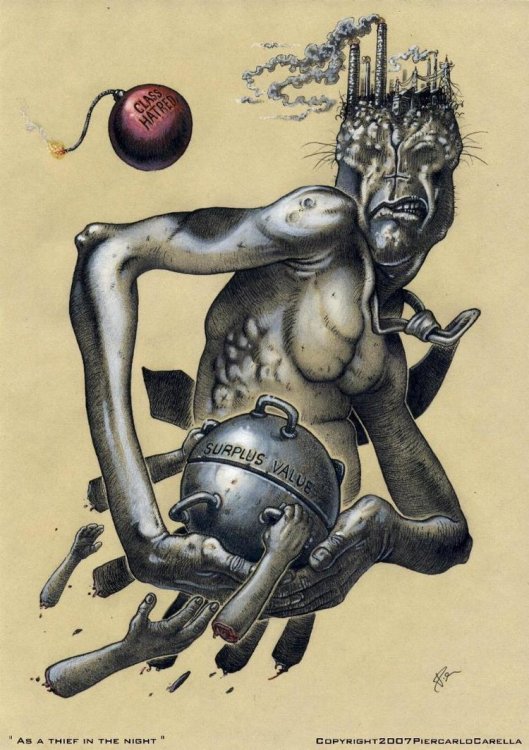
This privatization of science is just one more aspect of capitalism’s usurpation and corruption of the body politic.
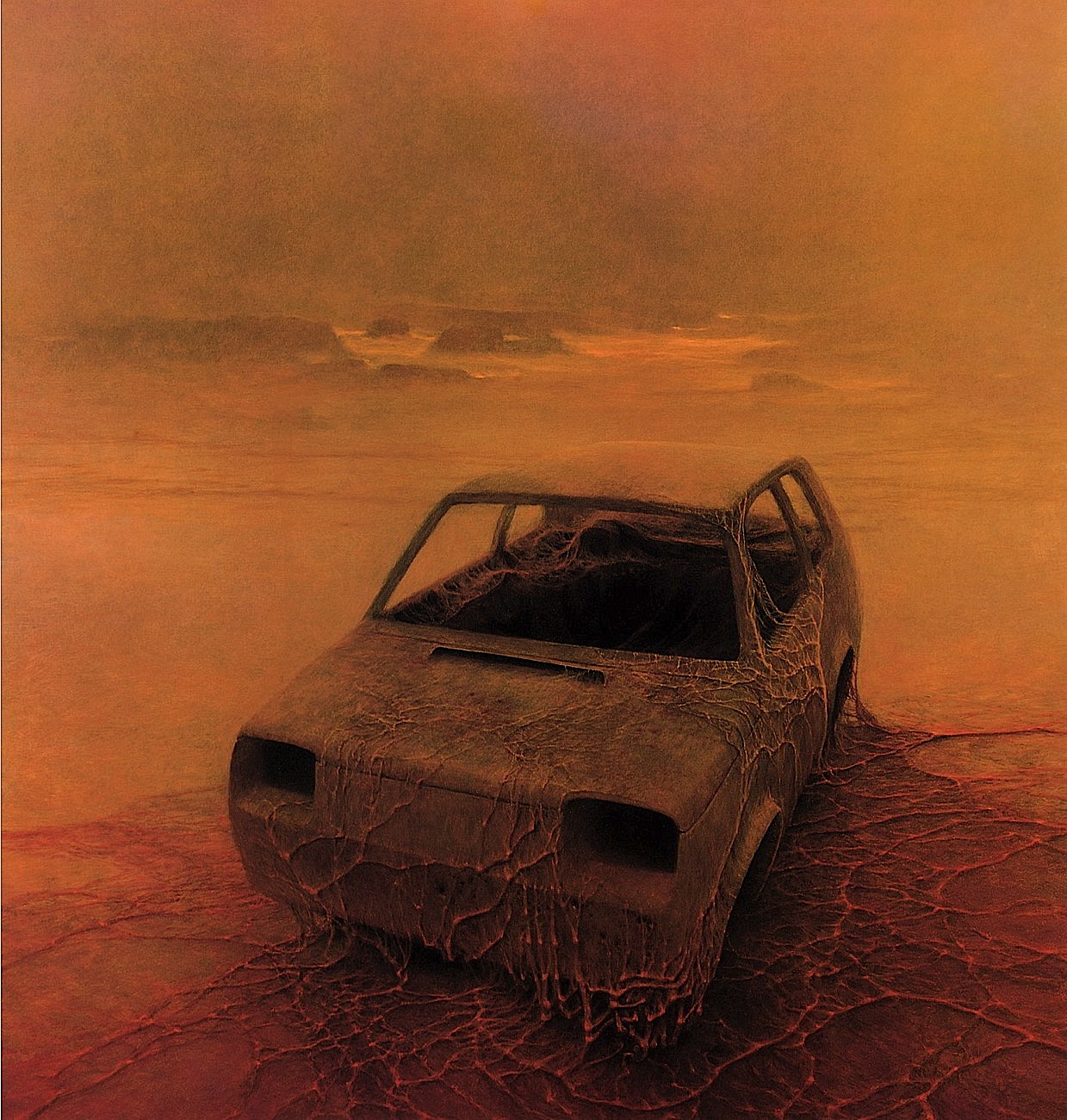
The art in this blog post is from Polish artist Zdzislaw Beksiński whose intricately detailed paintings of apocalyptic landscapes, mutated and deformed humans, and surreal images were said to be inspired from his nightmares. He never gave titles to his paintings and signed them on the back. It is said he would often wake up in the middle of night to paint his dark visions. In 2005 he was found dead lying on the floor of his Warsaw flat in a pool of blood, stabbed 17 times.
Perhaps the greatest nightmare of modern man is the fact that he is at the mercy of an ever-expanding industrial civilization running on autopilot, as Zygmunt Bauman described, with no realistic way to stop its onslaught of toxic waste, greenhouse gas emissions, deforestation, and numerous other ecocidal features. I can see this horror when I look at much of Beksiński’s work, but I also see nature reclaiming the battlefield after man has defeated himself.
To a great degree, humans are their own worst enemy, prisoners of their flawed cerebral wiring with its neuroses, blind spots, and cognitive biases, but the real enemy is the omnicidal juggernaut our numbers have created; its base urges can’t be contained.
“Life is tragic and absurd and none of it has any purpose at all. Science has killed religion, there’s no hope for the future with seven billion of us on the planet, and the only thing you can do is to laugh in the face of it all.”
~ TC Boyle
This past Thursday night I went to a reading by author T.C. Boyle at Northern Arizona University’s Cline Library. Outside the entrance of the auditorium were a couple of tables lined with signed copies of his numerous novels and collections of short stories and manned by a few young people, perhaps college students, taking people’s money. I had already bought a copy of T.C. Boyle Stories at the local bookstore before coming and read a few of the short stories before the auditorium doors opened. I seldom go to such events, but what had first caught my eye were the titles of some of his books, one of which is A friend of the Earth whose premise is rather dystopic.
While waiting in line for the event, I opened up my book and read “The Extinction Tales” from the author’s first volume of short stories. The title of this particular short story states exactly what it’s about, taking the reader across continents and centuries from the massacre of the passenger pigeon to the genocide of the aboriginal Tasmanians. A couple of modern-day vignettes serve as the bookends to this vast sweep of history, at the beginning the hunting skills of a lighthouse caretaker’s pet cat snuff out the remaining population of the island’s unique bird species and at the end a man is haunted by the death of his father whose funeral he neglected to attend.
The doors opened and perhaps 100 to 200 people filled the seats. After a few fawning introductions by a couple of NAU faculty members, Tom Coraghessan Boyle took the lectern. Tall and lanky with a goatee, wearing red sneakers, and dressed in black with the glowing cat eyes of a printed t-shirt peaking through his opened sports jacket, he appeared more hipster than a sixty-something tenured English professor, but spoke as eloquently and articulately as one would expect.
He read two stories, but the second one resonated with me the most. “The Relive Box” is an allegorical tale of a middle-aged single father who becomes obsessed with the latest hi-tech escapism device which mentally transports people back to any specified time in their life by reading their memories. He’s stuck reliving various moments of his past while his present life falls apart. The ‘here and now’ simply becomes lifeless space and time to be filled by the ‘relive box’.
The parallels with today’s addiction to computers, video games, iPhones, and social media are obvious; our inseparable relationship with technology has made us virtual cyborgs. Our enslavement to technology extends to a societal level with the wide-held assumption that geoengineering and adaptive technologies will evolve in time to spare us from the worst of a collapsing environment, allowing business-as-usual to continue no matter how dire current scientific reports and future projections may be. Unarmed by a blind faith in technology, industrial civilization barrels headlong into a world growing more violent and unstable by the day. Technocapitalists live by the sword of technology and will die by it as well.
In the words of David Simon, “There are now two Americas. My country is a horror show.”
Technology is no different in capitalism’s overriding dependency on the successful accumulation of capital:
The system within which institutions, cultures, and people operate determines its policies, beliefs, and behaviors. Those operating within a capitalist system conform to the dictates of corporations. Capitalism cannot be reformed and its resiliency to stay afloat during environmental collapse is remarkable:
Nonetheless, in the final analysis, our entire way of life based on fossil fuels and infinite growth on a planet of finite resources is untenable…
“A small minority — people who are at the margins of the system and who are thus able to observe it as if from outside, who are not tied into any of the major influence groups, and who have learned to seek out alternative sources of information and think critically — will gradually come to the conclusion that the entire system of industrial civilization is inherently unsustainable.”
~ Richard Heinberg, Powerdown: Options and Actions for a Post-Carbon World
A “post-carbon world” may very well not include people, but building an alternative system demands that we believe a post-collapse world does include survivors.
While the false debate continues in mostly right-wing circles that today’s Capitalism is some aberrant form of “true” Capitalism, the end game and final victory of Capital continues to play out with multinational corporations becoming the ‘winner take all’ in their complete takeover of the world’s economies and governments. As discussed before, the TTIP and TPP are the latest maneuvers in this corporate grab for power, wealth, and resources. Any last vestiges of environmental protection, worker rights, and sovereignty will be shredded. No illusions of democracy should be maintained in a world of corporate feudalism where gross social inequality will have become irreversible and the will of common people smothered by the abuses of great wealth:
“[The TTIP] proposes to establish a Regulatory Co-operation Council combining US and EU regulatory agencies with the purpose of working towards deeper ‘regulatory co-operation and increased compatibility for future and existing regulatory measures’. For example, health and safety regulations and food standards between the US and the EU will be made ‘compatible’, or more simply put, downgraded or removed.
The TTIP and TPP are intended to include investor-state dispute settlement clauses. When a corporation considers its expected future profits are being harmed by a government it can lodge a case before these tribunals consisting of three lawyers who represent corporate interests. These lawyers have no conflict of interest restrictions on their operations. There are no limits on the awards that can be claimed against governments and very limited rights of appeal for governments. Even if a government wins a case it must pay the tribunal’s costs and legal fees – averaging $9m a case. UNCTAD reports a tenfold increase in such cases since 2000. Any health or environmental policy that conflicted with corporate interests would be subjected to these extra-judicial tribunals. Tribunals are currently organised under World Bank and United Nations rules. The compensation is taken from the taxpayers.
Of the world’s ten biggest law firms, ranked by revenue, four are British and six are US. A golden age for corporate lawyers beckons! ConDem Coalition government Minister without Portfolio Ken Clarke explained, ‘Investor protection is a standard part of free-trade agreements – it was designed to support businesses investing in countries where the rule of law is unpredictable, to say the least.’
Legalised plunder
The following are just a few of the cases that corporations have brought to the investor-state dispute settlement tribunals: …” – link
The PR machine continues to churn out lies even under the glaring reality of today’s obscene wealth disparity. One particular study, entitled Your Fate? Thank Your Ancestors, was discussed in the New York Times recently, proclaiming that an individual’s path to success or failure in any society is foreordained in their genetic make-up and family lineage. Of course genes do play a part in the intelligence, talents, and behavior of every individual, but this particular meme is based on the myth that people in present day capitalist economies live and operate within “modern meritocracy societies” wherein everyone has the freedom and opportunity to develop and utilize the full potential of their talents. As one commenter at the New York Times rightly stated:
“This [study] appears to be one of a growing number arguing for the inherent superiority of some people over others while strenuously avoiding terms like superiority. The claim that some are born to lead and rule and others to be ruled over is as old as human civilization.”
Such propaganda serves the purpose of those at the top of the capitalist social hierarchy, allowing them to justify capitalism’s grotesque social inequality while at the same time preaching to the masses that their poor standing in society is a result of their genetic heritage and not the result of a structurally unjust and undemocratic system. In other words, those at the top deserve to be there and so do those at the bottom.
Many people remain under the spell of the American Dream which promises they can rise to the top of this corrupt system or at least receive the trickle down benefits it claims to offer, but the stark reality of shrinking wages and pensions, persistent unemployment, and rising costs of bare necessities prove otherwise. It’s known as “the meritocracy myth” and one book with that title, written by two professors, explains that a person’s social status is based more on factors such as class structure, politics, and race rather than on individual merit and initiative. Their major arguments are summarized below:
“Factors associated with Individual “Merit”
1.) Money makes money.
Sources of revenue that are unrelated to jobs, such as income from capital gains, dividends, interest payments, government subsidies as well as appreciating assets of wealth such as businesses, real estate, and stocks are predominantly owned by a small fraction of society’s upper echelon. This maldistribution of wealth illustrates that America is not a “middle class society”, but one of the haves and have-nots where wealth is concentrated at the very top of the system.
“…the shape of the distribution of merit resembles a “bell curve” with small numbers of incompetent people at the lower end, most people of average abilities in the middle and small numbers of talented people at the upper end. The highly skewed distribution of economic outcomes, however, appears quite in excess of any reasonable distribution of merit. Something that is distributed “normally” cannot be the direct and proportional cause of something with such skewed distributions…”
“Most experts point out, for instance, that ‘intelligence,’ as measured by IQ tests, is partially a reflection of inherent intellectual capacity and partially a reflection of environmental influences. It is the combination of capacity and experience that determines ‘intelligence.’ Even allowing for this ‘environmental’ caveat, IQ scores only account for about 10% of the variance in income differences among individuals (Fisher et al. 1996). Since wealth is less tied to achievement than income, the amount of influence of intelligence on wealth is much less. Other purportedly innate ‘talents’ cannot be separated from experience, since any ‘talent’ must be displayed to be recognized and labeled as such (Chambliss 1989). There is no way to determine for certain, for instance, how many potential world-class violinists there are in the general population but who have never once picked up a violin. Such ‘talents’ do not spontaneously erupt but must be identified and cultivated.”
3.) Hard work does not necessarily equate to economic success.
“Applying talents is also necessary. Working hard is often seen in this context as part of the merit formula. Heads nod in acknowledgment whenever hard work is mentioned in conjunction with economic success. Rarely is this assumption questioned. But what exactly do we mean by hard work? Does it mean the number of hours expended in the effort to achieve a goal? Does it mean the amount of energy or sheer physical exertion expended in the completion of tasks? Neither of these measures of “hard” work is directly associated with economic success. In fact, those who work the most hours and expend the most effort (at least physically) are often the most poorly paid in society. By contrast, the really big money in America comes not from working at all but from owning, which requires no expenditure of effort, either physical or mental. In short, working hard is not in and of itself directly related to the amount of income and wealth that individuals have.”
4.) Mental Attitude
“According to the culture of poverty argument, people are poor because of deviant or pathological values that are then passed on from one generation to the next, creating a “vicious cycle of poverty.” According to this perspective, poor people are viewed as anti-work, anti-family, anti-school, and anti-success. Recent evidence reported in this journal (Wynn, 2003) and elsewhere (Barnes, Gould ;1999, Wilson, 1996), however, indicates that poor people appear to value work, family, school, and achievement as much as other Americans. Instead of having “deviant” or “pathological” values, the evidence suggests that poor people adjust their ambitions and outlooks according to realistic assessments of their more limited life chances.
An example of such an adjustment is the supposed “present-orientation” of the poor. According to the culture of poverty theory, poor people are “present-oriented” and are unable to “defer gratification.” Present orientation may encourage young adults to drop out of school to take low wage jobs instead staying in school to increase future earning potential. However, the present orientation of the poor can be an “effect” of poverty rather than a “cause.” That is, if you are desperately poor, you may be forced to be present oriented. If you do not know where your next meal is coming from, you essentially have no choice but to be focused on immediate needs first and foremost. By contrast, the rich and middle class can “afford” to be more future oriented since their immediate needs are secure. Similarly, the poor may report more modest ambitions than the affluent, not because they are unmotivated, but because of a realistic assessment of limited life chances. In this sense, observed differences in outlooks between the poor and the more affluent are more likely a reflection of fundamentally different life circumstances than fundamentally different attitudes or values.”
5.) Moral character and integrity
“Although ‘honesty may be the best policy’ in terms of how one should conduct oneself in relations with others, there is little evidence that the economically successful are more honest than the less successful. The recent spate of alleged corporate ethics scandals at such corporations as Enron, WorldCom, Arthur Andersen, Adelphia, Bristol-Myers Squibb, Duke Energy, Global Crossing, Xerox as well as recent allegations of misconduct in the vast mutual funds industry reveal how corporate executives often enrich themselves through less than honest means. White-collar crime in the form of insider trading, embezzlement, tax fraud, insurance fraud and the like is hardly evidence of honesty and virtue in practice. And neither is the extensive and sometimes highly lucrative so-called ‘irregular’ or ‘under the table’ economy—much of it related to vice in the form of drug trafficking, gambling, pornography, loan sharking, or smuggling. Clearly, wealth alone is not a reflection of moral superiority. To get ahead in America, it no doubt helps to be bright, shrewd, to work hard, and to have the right combination of attitudes that maximize success within given fields of endeavor. Playing by the rules, however, probably works to suppress prospects for economic success since those who play by the rules are more restricted in their opportunities to attain wealth and income than those who choose to ignore the rules.”
Nonmerit Barriers to Mobility
1.) The effects of initial class placement at birth on future life chances.
“…those born into great wealth start far ahead of those born to poor parents, who have a huge deficit to overcome if they are to catch up. Indeed, of all the factors that we might consider, where we start out in life has the greatest effect on where we end up. In the race to get ahead, the effects of inheritance come first and merit second, not the other way around.
Inheritance provides numerous cumulative nonmerit advantages that are available in varying degrees to all those born into at least some relative advantage, excluding only those at the very bottom of the system. Included among these nonmerit advantages are high standards of living from birth, inter vivos gifts (gifts between the living) such as infusions of cash and property bestowed by parents on their children at critical junctures in the life course (going to college, getting married, buying a home, having children, starting a business, etc.), insulation from downward mobility (family safety nets which prevent children from skidding in times of personal crises, setbacks, or as the result of personal failures), access to educational opportunities as well as other opportunities to acquire personal merit or to have merit identified and cultivated, better health care and consequently longer and healthier lives (which increases earning power and the ability to accumulate assets during the life course).
Another advantage of inheritance is access to high-powered forms of social and cultural capital. Social capital is one’s ‘social resources’ and refers to essentially to the value of whom you know. Cultural capital is one’s cultural resources and refers essentially to the social value of what you know. Everyone has friends, but those born into privilege have friends in high places with resources and power. Everyone possesses culture—bodies of knowledge and information needed to navigate through social space. Full acceptance into the highest social circles, however, requires knowledge of the ways of life of a particular group…”
2.) Bad Luck
“Bad luck can take many forms but two very common forms of bad luck are to be laid off from a job that you are good at or to spend many years preparing for a job for which demand either never materializes or declines. In looking at jobs and job opportunities, Americans tend to focus on the ‘supply’ side of markets for labor; that is, the pool of available people in the labor force. Much less attention is paid to the ‘demand’ side, or the number and types of jobs available. In the race to get ahead, it is possible and all too common for meritorious individuals to be ‘all dressed up with no place to go.’ For the past twenty years, the ‘growth’ jobs in America have disproportionately been in the low wage service sector of the economy. At the same time, more Americans are getting more education, especially higher education. Simply put, these trends are running in opposite directions: the economy is not producing as many high-powered jobs as the society is producing highly qualified people to fill them (Collins 1979, Livingstone 1998).
In addition to the number and types of jobs available, the locations of jobs both geographically and within different sectors of the economy also represent non-merit factors in the prospects for employment. For instance, a janitor who works for a large corporation New York City may get paid much more for doing essentially the same job as a janitor who works for a small family business in a small town in Mississippi. These effects are independent of the demands of the jobs or the qualifications or merit of the individuals holding them. Differences in benefits and wages between such jobs are often substantial and may mean the difference between a secure existence and poverty… rates of poverty in the United States continue to vary by region and locations within regions suggesting that geography is still a major factor in the distribution of economic opportunity.”
3.) Education
“…those with more education, on average, have higher income and wealth. Education is thus often seen as the primary means of upward social mobility. In this context, education is widely perceived as a gatekeeper institution which sifts and sorts individuals according to individual merit. Grades, credits, diplomas, degrees, and certificates are clearly “earned,” not purchased or appropriated. But, as much research has demonstrated, educational opportunity is not equally distributed in the population (Bowles and Gintis 1976, 2002, Bourdieu and Passeron 1990, Aschaffenburg and Maas 1997, Kozol, 1991, Sacks, 2003, Ballantine 2001). Upper class children tend to get upper class educations (e.g. at elite private prep schools and ivy league colleges), middle class children tend to get middle class educations (e.g. at public schools and public universities), and working class people tend to get working class educations (e.g. public schools and technical or community colleges), and poor people tend to get poor educations (e.g. inner city schools that have high drop out rates and usually no higher education). Educational attainment clearly depends on family economic standing and is not simply a major independent cause of it. The quality of schools and the quality of educational opportunity vary according to where one lives, and where one lives depend on familial economic resources and race. Most public schools, for instance, are supported by local property taxes. The tax base is higher in wealthy communities and proportionally lower in poorer areas. These discrepancies give rise to the perpetual parental scramble to locate in communities and neighborhoods that have reputations for “good schools,” since parents want to provide every possible advantage to their children that they can afford. To the extent that parents are actually successful in passing on such advantages, educational attainment is primarily a reflection of family income. In sum, it is important to recognize that individual achievement occurs within a context of unequal educational opportunity.”
4.) Loss of Self-Employment Opportunities and the Offshoring of Jobs
“…self-employment is popularly perceived as a major route to upward mobility. Opportunities to get ahead on the basis of being self-employed or striking out on one’s own to start a new business, however, have sharply declined. In colonial times, about three-fourths of the non-slave American population was self- employed most as small family farmers. Today, only seven percent of the labor force is self-employed (U.S. Census Bureau 2002). The “family farm,” in particular, is on the brink of statistical extinction. As self-employment has declined, the size and dominance of corporations has increased. This leaves many fewer opportunities for “self-made” individuals to enter existing markets or to establish new ones. America has witnessed the sharp decline of “mom and pop” stores, restaurants, and retail shops and the concomitant rise of Wal-Marts, Holiday Inns, and McDonalds. As more Americans work for someone else in increasingly bureaucratized settings, the prospects of rapid “rags to riches” mobility decline.
In addition to the decline of self-employment, manufacturing has also experienced drastic workforce reduction as production facilities have increasingly moved to foreign countries in efforts to reduce costs of production. This is a significant trend since the United States became a world power based on its industrial strength, which supported a large and relatively prosperous working and middle class. Some service jobs, such as customer service and computer programming, are also being moved to foreign countries in increasing numbers. All of these trends are occurring quite independent of the merit of individuals but nevertheless profoundly impact the opportunities of individuals to get ahead…”
5.) Discrimination
“Discrimination not only suppresses merit; it is the antithesis of merit. Race and sex discrimination have been the most pervasive forms of discrimination in America, [but others include] sexual orientation, religion, age, physical disability (unrelated to job performance), physical appearance…”
In addition to the worsening inequality endemic to the system, the social fabric of society will be torn apart by a world now in the throes of multiple ecological crises. The availability and affordability of food and water will be magnified by anthropogenic climate change as the agricultural regions of an overpopulated world are ravaged by drought, flood, and fire. Infrastructure will begin to fail more frequently as extreme weather begins to rack up damage. The aloof elite, who ensconce themselves behind gated walls and the luxury that their wealth buys, will fan the flames of resentment and civil unrest in a desperate population scrambling just for the necessities of life. The cultural myths of capitalism are fraying and the collapse of industrial civilization, unable to change its omnicidal course for sundry reasons, is seemingly written in stone.
A DJ on the radio mentioned the flooding in England the other day and exclaimed, “The climate is going crazy!”. The shallowness of the conversation and its failure to dig any deeper as to the reasons why the climate is “going crazy” is mirrored in the mainstream media and our society. Real journalism is simply another casualty of our rotting consciousness. Like a leper, those who cannot see or feel are oblivious to their own self-inflicted wounds. The flywheel of industrial civilization continues to spin out of control, taking out chunks of ecological bricks making up a once diverse and vibrant living planet. In some parts of the world, epic drought is desiccating cropland and exposing the cracked surface of lake beds, while on the other side of the globe unceasing rain is causing deluges of biblical proportion. Still other regions are experiencing freak snow and ice storms. The damage is done, but humans will continue to scour the earth for resources to maintain a house whose foundation now rests on the shifting sands of a destabilized biosphere.
If you thought shale gas was a nightmare, you ain’t seen nothing yet. A subterranean world of previously ignored reserves is about to be opened up. These are the vast coal deposits that have proved unreachable by conventional mining, along with gas deposits around them. To the horror of anyone concerned about climate change, modern miners want to set fire to these deep coal seams and capture the gases this creates for industry and power generation.
– Fire in the hole: After fracking comes coal
Weather patterns once held in place by an ice-locked Arctic are unraveling at an unsettling pace, yet industrial man can’t seem to pull himself away from his carbon burning orgy long enough to see that the monkey wrench inside Earth’s intricate and homeostatic climate system is himself. Never in the history of Earth has a single species become a geologic force for mass planet-wide extinction. The worshippers of the “free market” proclaim solutions to climate change will be forthcoming in the form of technology, yet all environmental laws and regulations are simply window dressing around the resource consuming pit of capitalism. Technology cannot replenish depleted resources or restore the relative ecological equilibrium that existed prior to the industrial revolution. Natural law is nonnegotiable and those who transgress it, repeatedly ignoring clear and present warning signs, are doomed to suffer the unforgiving consequences. Modern man will leave behind a toxic and radioactive wasteland for eons.
The corporate state is impotent in the face of the environmental meltdown since its only real purpose appears to be an enabler and enforcer to the plunder of the commons and the concentration of wealth into the most ruthless and greedy hands. There is no escaping this system that is locked into a path of self-destruction except through death, as Kevin Moore describes on this blog:
“…in general terms the purpose of government is:
a) to facilitate the looting-and-polluting of local regions and the planet as a whole in order that a small minority can acquire material wealth and enjoy themselves.
b) to facilitate the transfer of wealth from those lower in the hierarchical system to those near the top.
c) to keep the general populace uninformed and compliant.
d) to provide sufficient ‘trickle down’ for the misinformed and deluded masses to think they are not being exploited.
e) [more recently] to promote the agendas of transnational corporations, which are focused on complete control of populations and resources and maximization of short-term profits.
The purpose of environmental laws is:
1. to facilitate the looting-and-polluting of local regions and the planet as a whole but to limit the impact of severe pollution in specific cases where that pollution would be detrimental to other planet-destroying money-making activities..
2. to provide the pretence that governments care about the welfare of the general populace.
3. to provide looters and polluters with official mandates for looting and polluting, i.e. an environmental impact process having been gone through and ‘no significant impacts identified’, the activity of the looter-and-polluter is given the stamp of approval.
Under such a system it become inevitable that all politicians are, or quickly become, bought-and-paid-for professional liars and that all senior environment officers become lackeys to the system and therefore enemies of the people.
The entire political-economic system of western nations is geared to making everything that matters worse, so everything that matters gets worse.”
These are the unvarnished and stark rules of the game for those who care to know the truth. Becoming fully aware is a hope-destroying and soul-wrenching realization, but the truth is never measured by its popularity and very few ever face and accept it. The welfare and safety of the public and future generations will continue to be sacrificed at the altar of stock markets and mass consumerism. As commenter James says:
“…Murdering extant humans NOW to gain wealth is accepted government policy and in some cases personal policy…”
Nowhere is this more true than in the one country that comprises 5% of the world’s population, but consumes 25% of its resources; others are furiously trying to catch up.
So as the industrial world whistles past the graveyard on its civilization-ending trajectory, we watch the signposts of doom whiz by us each day and wonder what is the point of getting up every morning to participate in this omnicidal culture. With virtually the entire planet having been plotted, demarcated, sold off for exploitation and surveillance by drone, I’m afraid no one is getting out of this trap alive so you might as well learn to respond to current news events with a certain black and morbid humor. We are the pathologists of capitalist industrial civilization, dissecting its potholed road to collapse just as a coroner would conduct the postmortem examination of a morbidly obese person who gorged themself on twinkies and high fructose soft drinks.
Many have used the phrase “the climate is moving to a new normal” or “moving to a new paradigm”. Such phrases give a false sense of security, as if the damage has stopped and the Earth’s systems can now recalibrate to a new settled state, but human forcing of the biosphere by way of GHG emissions continues unabated and in fact has now tripped multiple climate tipping points. There is no “new paradigm”, but an ongoing cascading collapse of all known stability and equilibrium.
When you go into your mindless 9-to-5 job and your micromanaging boss harasses you for petty little things, you’ll think about how meaningless it all is in an age where governments will crumble, billions will starve to death, and the earth will soon become just another lifeless rock floating through space.
“…Run for the hills, pick up your feet and let’s go. We did our jobs, pick up speed now lets move. The trees can’t grow without the sun in their eyes. And we can’t live if we’re too afraid to die….”
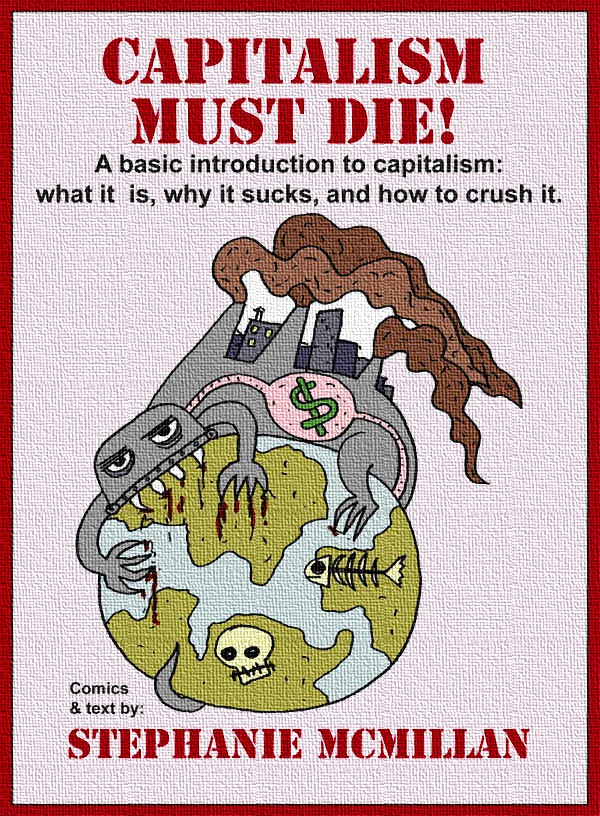
Stephanie McMillan
Stephanie is the award-winning creator of the comics “Minimum Security” and “Code Green.” Her books include “The Beginning of the American Fall,” “As the World Burns,” and “The Knitting Circle Rapist Annihilation Squad.” She is an organizer for the anti-captialist/anti-imperialist group One Struggle (onestruggle.net), and works on the publication project Idees Nouvelles, Idees Proletariennes (koleksyon-inip.org). Her website is here.
“Feel free to download it and share it with others. I want it to be widely distributed and contribute to the fight against capitalism, so I’ve made it “pay anything or nothing” and used a Creative Commons license. I hope it is useful. We really need to bring the system down, or all could soon be lost.” – link
Interview conducted by Derrick Jensen:
Post Script:
I promised a better answer to the first comment Pfgetty2013 made to this post:
“No way are we going to give up capitalism, at least not until most of humanity, and much of the rest of the living world, has died. There simply isn’t another plan that makes sense to the people with the power, or to most of us peons.
Nice to think about though.”
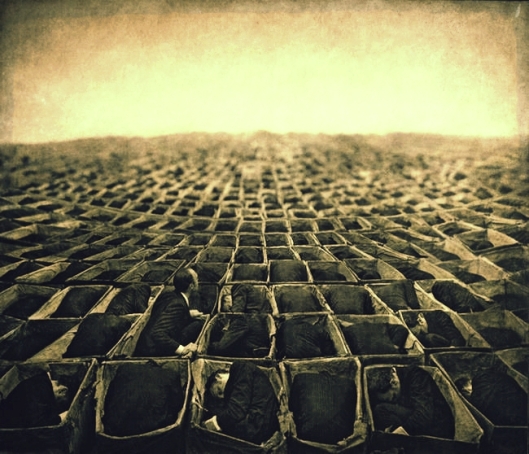
This frame of mind is exemplar of how our current form of civilization – global capitalism(or capitalist industrial civilization, as I like to call it) – ideologically dominates its inhabitants. People cannot even begin to imagine a different way of living because they have been made dependent on the system through dispossession of alternative means of subsistence. The masses have truly been reduced to consumers who are taught not to question the system, but to be obedient and conforming.
The superstructure of global capitalism is supported and protected by its institutions and ideas:
1.) Governments and their legal systems administer and regulate the capitalist process.
2.) The military, police, prison complex, and surveillance apparatus serve to enforce the capitalist process.
3.) The consumer culture only allows pro-market solutions.
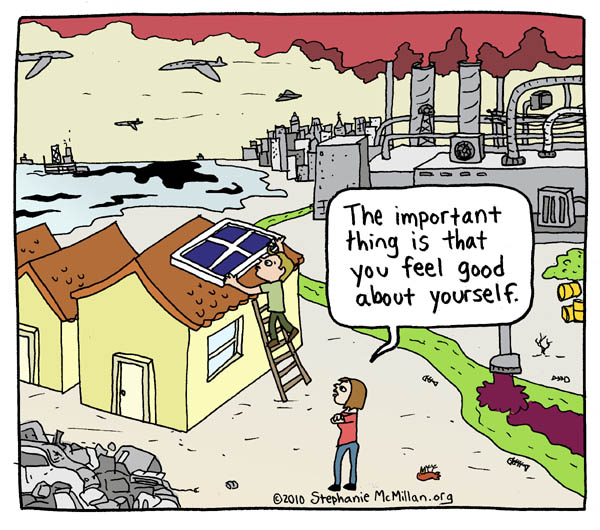
These three pillars of the capitalist superstructure are very sophisticated and persuasive in diverting and co-opting discontent into forms that reinforce capitalism’s own institutions. Elections, corporate-funded nonprofits, nongovernmental organizations(NGO’s), community-based organizations(CBO’s), corporate-funded think tanks, etc. reinforce the system of capitalist authority and the illusion of democracy. They make people feel they are making a difference, when in fact the participants are tightening the bonds of their own oppression. Capitalism has been very adept at separating the worker from their environment.
This is why many indigenous societies whose culture and land has been usurped by global capitalism say that they “must first decolonize their minds.”
Archeologists tell us that, even before the Neolithic Era, man used fire to shape the distribution of flora and fauna in local environments. After several hundred thousand years of evolving a greater capacity for high level thinking and social networking, modern man has armed himself with technology giving him the ability to alter the ecosphere globally, and he has done so with devastating results. No place on the planet has escaped the effects of mankind’s activities. Isolated Arctic sea floors have even been found to have bits of plastic debris, and polar bears are becoming the most toxic creatures on Earth.
In the twilight of the Anthropocene Age, the writing on the wall has become painfully clear. The high-tech civilization modern man erected with fossil fuels will likely be undone by its own success. For about the last half million years, CO2 levels fluctuated between 180 and 300 ppm until mankind discovered an energy source that would catapult his numbers and planetary footprint into the stratosphere. CO2 and other polluting greenhouse gasses are breaching levels never before seen in human history and they continue to be spewed into the thin layer of atmosphere that is essential for life on Earth at the rate of nearly 10,000 million metric tons every year. We are the first humans to breathe air with 400 ppm CO2. The last time CO2 levels were this high was during the Pliocene Age when there was no Arctic ice, temperatures were 19°C warmer in the Arctic, average global temperatures were 2° to 3.5°C warmer, and global sea levels were 20 plus meters higher. The climate lag time has decades to catch up to what we have already done, and we’re still forcing the climate system with both feet on the gas pedal. Decades of studies and warnings by scientists have not moved the needle one iota, and unheeded warnings will still be coming as we plummet over the cliff into the mangled pile of corpses below. Living under the oncoming threat of climate chaos is a compounding stressor because it affects the security of food, water, shelter, economy, government, civilization, and the existence of the human species itself. There is no tangible enemy to conquer or sanctuary to escape to. It will turn each of us against each other and goad nations to war. Climate change is a monster of our own creation that mankind refuses to face even as its malignant presence grows stronger and stronger.
The natural carbon cycle has been blown to smithereens. Carbon sinks such as the oceans and forests appear to be reaching capacity as evidenced by the dying coral reefs and the global die-off of forests. Vegetation will cease to act as a sink at 4°C warming, according to recent research. Like a petri dish microbe which has reached the last fatal doubling of its exponential growth cycle, humans have filled the Earth to the brim and triggered the collapse of their own life support system. Over 50% of earth’s ice-free land surface is now occupied by human industry and activity — farms, crops, plantations, strip malls, city sprawl (Hooke et. al. 2012). Nonetheless hope springs eternal; some wishful thinkers say that if we stopped our fossil fuel binge cold turkey right now, then perhaps we could stabilize the damage to 2°-3.5°C warming which would be four to six times the warming the Earth has already experienced in the last century (0.5°C). Yet any prospect of pulling the plug on industrial civilization is more remote than aliens from outer space intervening to save humans from themselves. Coal plants continue to be built at a frantic pace and all the various manufacturing activities of modern-day life continue to churn along from the mass production of plastic novelty trinkets to the construction of behemoth aircraft carriers. With catastrophic damage from climate chaos already happening before our very eyes, I shudder to think what the future holds as we blissfully go about our daily lives damning future generations to a world with average global temperatures of 5°-9°C or greater.
The Earth cares no more for the selfish concerns of humans than for any other living thing which has upset the ecological balance of nature and gone extinct. It cares nothing about the profits calculated by humans with their mountaintop removal for coal, boreal forest clearance for tar sands excavation, or blowouts from deep sea drilling for oil and gas. In the deep time of geologic history, these are all the foolish endeavors of one destructive and unsustainable hominid called Homo economicus. Corporations pay to protect their privilege to pollute through political lobbying and legal bickering, but the laws of nature cannot be altered or bought off. Technology and adaption strategies are based on linear thinking and will ultimately prove to be the futile efforts of an arrogant, out-of-touch and increasingly desperate species. Nature and the laws of physics cannot be compromised by any amount of greenwashing, international ‘Earth Summits’, or eco-friendly product labels. Climate chaos and environmental destruction march onward in full technicolor display as self-serving humans continue to argue, cheat, lie, collude, deceive and stick their collective head in the sand. The victims of industrial pollution will not just be confined to the impoverished Third World, but will grow to encompass the entire human race. And the one country who proclaims itself the “shining city on a hill”, a beacon of democracy, and global leader is herding everyone down the path of climate genocide.
The ecological crisis and social justice issues are intimately intertwined and one could never be solved separately from the other. The cosmology of capitalism demands the objectification and commodification of nature as well as the appropriation and commercialization of all aspects of society. The social-ecological problem of fossil fuel dependency can be clearly seen when an energy company targets a people’s land to be used as a sacrifice zone such as with West Virginia mountaintop coal mining or fracking in Texas. Social and ecological decay will persist and worsen without adopting a way of life that respects both the integrity of the land and rights of people.
“These are sacrifice zones, areas that have been destroyed for quarterly profit. And we’re talking about environmentally destroyed, communities destroyed, human beings destroyed, families destroyed. And because there are no impediments left, these sacrifice zones are just going to spread outward.”
~ Chris Hedges
Each day that passes without a change to the status quo is another upward ratchet in the scale and strength of climate chaos. Each day passes and the same rhetoric of denial and false hope fills the airwaves, TV, and internet. Some conscientious bloggers document the worsening state of the world almost in real time, but they soon come to the realization that our fate seems to be written in stone as if we are following a script with only one ending. The super-organism of capitalist industrial civilization has no national, cultural, or environmental allegiance, and will sacrifice billions of people to keep business-as-usual going.
In a ravaged world, death will be big business.
“In horror of death, I took to the mountains – again and again I meditated on the uncertainty of the hour of death, capturing the fortress of the deathless unending nature of mind. Now all fear of death is over and done.” ~ Milarepa
Once in a while in that vast nothingness of the internet I’ll happen across a blog from someone who has something of substance to say. I have also learned that Dmitry Orlov is likely discontinuing any more ‘collapsitarian’ blog posts. Probably not a good subject to dwell on when you have an infant son. In ‘Dmitry flicks it in‘, Harry Willis reminds us that America has been the epicenter of capitalism, always for sale to the highest bidder and now home to a new growth industry – Doomsaying:
[Excerpt]
“…David Halberstam’s book The Fifties was, I think, very enlightening in this regard. We are the home of the chain hotel (Holiday Inn), the chain restaurant (McDonald’s and all its followers), the Big Box stores (Wal-Mart, CostCo), the mega-hardware store (Home Depot, Lowe’s), the strip mall, the suburban housing tract, and most importantly, the concept that corporate power should be concentrated in huge holding companies that own very diverse and large businesses. On this latter point, whether Americans realize it or not, every meal they eat out, every processed food they buy at the market, every sundry (detergent, household necessities) they purchase wherever, every drug and almost everything else they routinely buy is sold to them by about 10 huge holding companies. And all communications are essentially owned by 6 large corporations, so everything you ingest with your ears and eyes is also owned by a corporate cartel.
These huge companies are multinational in character, with much of their business (and payroll) located overseas. They are nominally American, but the sinking mass of the American middle and lower classes here are more or less of marginal relevance to them, and only to the extent that Americans form part of their customer base. The American booboisie needs to be manipulated because the U.S.A. is still nominally a democracy, de jure, although de facto it is what Sheldon Wolin calls an “inverted totalitarian state,” one where the government is owned by Big Business. We are not going to “vote” our way out of this situation, as Russell Brand, among numerous others (including Dmitry Orlov, most definitely) seems to get.
America is a corporate headquarters and tax haven which executes its business plans by means of a huge standing army, which does not often just stand around. We got this way because (a) power always tends to concentrate in fewer and fewer hands, even in a liberal democracy, since as money aggregates it can get rid of legal impediments such as high taxation and anti-trust laws, and (b) because America was the most innovative and naturally-blessed (our peerless real estate) nation on Earth. We also benefitted mightily from intellectual immigration to this country, made possible by the double-digit IQs in charge of Nazi Germany.
I don’t think the United States is going to collapse in the sense that the Collapsarian community talks and writes about. For one thing, the emphasis is too much on Peak Oil. I’ve written before that I think Peak Oil represents a kind of deus ex machina for anti-American wish fulfillment. Some sensitive souls, such as James Kunstler, Dmitry Orlov and many others, are so appalled by the grisly ugliness of the American crapscape, with its chain everything and grotesque proliferation of hideous suburban grids, that they long for some way to predict confidently that it must fall of its own weight. That’s where Peak Oil comes in: you posit that an economy runs on cheap energy, especially petroleum in the American economy, and this gives you a means of assuring everyone that it will all be over soon and an anodyne vision of Norman Rockwell’s neighborhoods will materialize peacefully out of the formless void.
No, I don’t think so. The lower 90% of the American populace has no way to go but down, until it reaches a rough parity with the hard-working masses in Asia who, after all, have many of the same employers as the Americans. The American multi-nationals are indifferent to the fate of their so-called “countrymen,” indifferent to the environment (mountain top removal, fracking, pesticide and fertilizer flushes into the Gulf and oceans, plastic waste, soil erosion, CO2 emissions) and essentially react only when conditions become so dire that the American “platform” is threatened. We’re inflating bubbles again through money printing to retard this natural contraction, and when the bubbles pop (again), we’ll have nother “crisis” which will in fact simply be another step-phase down after the gooey soap is cleaned up. I think that’s how we’ll get there, in a ratchet fashion. We will even adapt to oil high prices, as in fact Americans have done since the 2008 financial crisis began. Americans drive 3% fewer miles now per year than they did 5 years ago, despite increases in population and the “recovery.” Gasoline usage is way down, as people shift to fuel-efficient cars and just leave the car keys on the table in the hallway. Or by the oil can fire under the bridge.
The dramatic immiseration of the American people (thanks, Rob Urie) since 2008 has made catastrophe prediction and doomsaying one of America’s chief growth industries, and many, many writers and speakers have gotten in on the act. But it’s not especially lucrative. Owning one of the Big Corporations is better for that, so the doomsayers drop out and flick it in. It’s always nice to go over to Mom’s house.”
Economic and cultural coercion are readily apparent in our society. And if those don’t work, the corporate state also has policies of overt force – military and law enforcement. You could call this arrangement an ‘open air prison’ or the more apt phrase for America would be ‘inverted totalitarianism’ in which the prisoners aren’t fully aware of their own shackles, transfixed as they are by mass media manipulation, the consumer culture, and the trappings of our high-energy way of life. Is there any wonder that a post apocalyptic scenario holds a certain amount of perverse romanticism for those yearning to escape capitalist modernity?
In an era of end-stage capitalism where life has become a sordid grab for dollars while the world lives on the edge of financial and ecological collapse, it comes as no surprise that America would be captivated by the story of a struggling school teacher going for the ‘American dream’ by crook or by hook. A tourist mystique has even been created in this show’s filming location of Albuquerque. The premise for this darkly comic tale is an all too familiar one for the average American family – the threat of bankrupting medical bills. Recently diagnosed with stage-three lung cancer and now at the end of his financial rope, Walter descends into the seedy world of illicit drugs in an attempt to save his family from economic ruin. Walter’s predicament represents the dilemma of most Americans who live quiet lives of desperation, just one paycheck away from hunger and homelessness. Ironically, the drug that Walter and his reluctant partner Jesse Pinkman wind up producing is also the drug of choice for many chained to the hamster wheel of capitalism:
“…the rise of meth coincided with the rise of low-paying low-skilled service work, where people had to work multiple menial jobs to earn the same amount they used to earn in one manufacturing job, or other good-paying low-skilled position.
The CDC notes that some meth users rely on it to get “increased energy to work multiple jobs.” Researchers at Indiana University and at the Universities of Colorado and Kentucky have found that, “The long hours and tedious work in oil fields, agriculture, construction, ancillary health care and fast food restaurants may be more tolerable on methamphetamine. Users report using meth to provide the energy to work multiple jobs or be a good mother.”
Guides to identifying and treating meth addiction, like Herbert Covey’s “The Methamphetamine Crisis,” tell readers to look out for, “workaholics or low-income adults who use it to stay awake and perform in multiple jobs. Working low-income individuals find meth attractive because they must work several jobs or long hours to support themselves or their families. They find that higher energy and alertness (ability to stay awake for prolonged periods) helps them cope with the demands of multiple jobs.”
This holds up if you look at places where meth use is highest. Hawaii’s heavy rate of meth use has been attributed to its high cost of living and service-based economy. “If you’re doing mind-numbing, repetitive work, this enables you to overcome both the painful tedium of the boredom as well as increase concentration and safety,” Dr. William Haning, a psychiatry professor at the University of Hawaii, once told the Maui News…“
From his former business partners at Grey Matter Technologies who stole his ideas and became incredibly wealthy to the demeaning work he endures at his car wash moonlighting job, the elusive ‘American dream’ has haunted Walter White. At first his scheme is to generate just enough cash to cover his medical expenses and secure a modicum of financial security for his family, but in a society whose primary metric of self-worth is the number of dollars one can accumulate, Walter quickly transforms into a cutthroat businessman bent on building an empire. His metamorphosis from a meek, mild-mannered family man to a Machiavellian drug kingpin is quite astonishing. Walter rationalizes and euphemizes his manufacture of the insidious drug meth by referring to it as his “product”, following strict steps to create “the highest quality product to perform as advertised.” “The chemistry must be respected,” proclaims Walter.
In this world of hyper-exploitive capitalism, ‘staying in the game’ involves making choices that seldom include moral concerns. As the dead bodies continue to pile up around Walter’s drug operation, the more callous and psychopathic he becomes. Warren Buffet, the poster child for Capitalism, has praised the business acumen of the show’s main character while even tweeting a picture of himself as Walter White. Replace Walt’s blue crystal with iPhones or any other mass-produced product and the basic business model is eerily the same. The Economist even published an essay illustrating how ‘Breaking Bad’ was a “first-rate primer on business“:
“…Mr White’s biggest failing is also a common one in business: hubris. The more successful he becomes, the more invulnerable he feels. The more rules he breaks, the more righteous he feels. And the more wealth he accumulates, the more he wants. An impressive volume of social-science studies suggests that leaders are more willing to break the rules than followers. There is no shortage of corporate examples, from Enron to Olympus, to illustrate this. Walter White is a thoroughly odd character: Mr Chips turned Scarface, as the show’s creator, Vince Gilligan, puts it. But he also holds a worrying mirror to the business world….“
Walter seals his own fate when he proclaims “there’s no stopping this train.” The accumulation of money becomes the “be-all and the end-all” for Walt’s existence, but for all the mountains of cash piling up in duffel bags, crawl spaces, storage units, and 55-gallon barrels, Walter and his family are unable to make much use of it and in fact are plagued by it. In the end, the money becomes a curse, destroying the very thing it was supposed to save… Walt and his family.
Another irony among many is that the bruised and battered psyche of Jesse Pinkman, the drug addict ostracized by his well-to-do suburbanite parents, serves as the moral compass in a world of lies, deceit, and betrayal. Despite the fact that Walter and Jesse are producing one of the most destructive drugs in history, outright murder was never in their plans. Walter becomes inured to the killings, but Jesse is unable to cope. He sees their ill-gotten gains as “blood money” and gets rid of his share by tossing it all over a neighborhood. It’s quite fitting then that in the final conclusion Jesse ends up as the sole survivor of this trip through hell.
Interestingly, those who are masters at getting away with their crimes are the ones hiding in plain sight who have ingratiated themselves with law enforcement and other institutions of society. Behind the clean-cut and bespectacled mask of Gustavo “Gus” Fring lurks a cold-blooded drug lord whose meth superlab sits beneath the façade of an industrial laundry business. The distribution network of the drug is integrated into Fring’s fast food chicken chain. Gus Fring is a perfect representative for the psychopathic elite in our society who hide behind the phony rhetoric of PR firms, lobbyists, and dark money politics. I see an analogy with the toxicity of meth and the climate change wrought by fossil fuels. Industrial civilization’s addiction to fossil fuels is similar to the feeling of unlimited energy that a meth addict gets, but the downside is that both kill. For the psychopaths at the helm of industrial civilization, business-as-usual must be protected even as we race toward extinction. To quote a reader of this blog:
“…steady or rising coal and gas consumption in advanced countries (all countries, really), in the face of all this ecocide (not that so many actually consider it to be in their face) illustrates the inability of either producer or consumer to dial back within the confines of our system–a polygamy of empire and finance and thermodynamics. …we can’t get off the train…not in one piece anyhow.”
Walter White’s self-destructive end seems to be as tragic and foolish as the one capitalist industrial civilization is hurtling towards, or perhaps it’s simply the inevitable course of events governing all of life:
“As many of you know, I have a background as a chemistry teacher. I’ve come to realize that much of what I teach my students applies not only to what goes on in the classroom, but in life also. It’s not as crazy as it sounds. You see, technically, chemistry is the study of matter, but I prefer to see it as the study of change: Electrons change their energy levels. Molecules change their bonds. Elements combine and change into compounds. But that’s all of life, right? It’s the constant, it’s the cycle. It’s solution, dissolution. Just over and over and over. It is growth, then decay, then transformation. It’s fascinating really. It’s a shame so many of us never take time to consider its implications.” ~ Walter White
The question of whether the human species is smarter than yeast is answered daily as the ecocidal and homicidal activities of industrial civilization continue apace. I learned a few days ago that September 2013 was the warmest in recorded history, and this morning I read that 2012 was a record breaker for GHG emissions:
“The laws of physics and chemistry are not negotiable,” said Michel Jarraud.
“Greenhouse gases are what they are, the laws of physics show they can only contribute to warming the system, but parts of this heat may go in different places like the oceans for some periods of time,” he said.
This view was echoed by Prof Piers Forster from the University of Leeds.
“For the past decade or so the oceans have been sucking up this extra heat, meaning that surface temperatures have only increased slowly.
“Don’t expect this state of affairs to continue though, the extra heat will eventually come out and bite us, so expect strong warming over the coming decades.”
Speaking candidly about the prospects of the industrialized world being able to reduce its GHG emissions and avoid catastrophic warming, the only three living diplomats responsible for leading past and present UN global warming talks had this to say:
“‘There is nothing that can be agreed in 2015 that would be consistent with the 2 degrees,’ said Yvo de Boer, who was UNFCCC executive secretary in 2009, when attempts to reach a deal at a summit in Copenhagen crumbled with a rift between industrialized and developing nations. ‘The only way that a 2015 agreement can achieve a 2-degree goal is to shut down the whole global economy.’”
Another study explains that not even the supposed eco-friendly state of California is likely to meet its GHG reduction targets by 2050. So you see, the ‘radical ecoterrorists’ were right all along. Industrial civilization has to go, or we go. The improbable list of actions needed to preserve any semblance of humanity was recently laid out by George Mobus. But as you know, even if we stopped everything right now, there is still a lot of pent-up manmade global warming in the pipeline from past industrial activity that will wreak havoc for millennia to come, as Robert Scribbler points out:
“…we’ve already released enough greenhouse gasses to at least return Earth to climates not seen in 3.6 million years. In this respect, the Baffin Island study adds to research conducted at Lake El’gygytgyn showing that levels of CO2 comparable to those seen today resulted in Arctic temperatures 8 degrees Celsius hotter during the deep past…
…Most likely, we are headed to at least the temperatures last seen during the Pliocene, in which global averages ranged 2-3 degrees Celsius hotter than the present and during which oceans were 25-75 feet higher. Unfortunately, these are the long-term consequences we have probably already locked in. But without rapid reductions in carbon emissions to near zero over the coming decades, we can expect far, far worse outcomes.”
Russia recently answered the concerns of environmentalists over Gazprom’s drilling plans in the Arctic by summarily arresting numerous members of Greenpeace and charging them with piracy. This is a high-profile case illustrating that ecocide is embedded and enforced within the system of capitalist industrial civilization. A further example of the system’s omnicidal nature is the construction of nuclear-powered ice-breaker ships by Russia to plow through the waters of the Arctic:
“Russia has started building the world’s largest universal nuclear-powered icebreaker capable of navigating in the Arctic and in the shallow waters of Siberian rivers. The unique vessel will further increase Russia’s dominance in the region…
…Powered by two “RITM-200” pressurized water reactors the “Arctic” is being built to generate 175MWe. Its efficiency and power allows the new model to crack ice fields 3 meters thick…”
Then you have Canada racing towards eco-apocalypse with its tar sands, and America exporting its coal into the maws of China and elsewhere as well as fracking the countryside into toxic wastelands, but of course the disease has spread globally. As Michael T. Klare clearly stated after weighing the PR propaganda with observable reality:
“…The result is indisputable: humanity is not entering a period that will be dominated by renewables. Instead, it is pioneering the third great carbon era, the Age of Unconventional Oil and Gas….”
Delicate ecosystems are ground up into commercialized and commodified pulp and fed into the machine of capitalism, lost forever in the fumes of our consumptive madness. A rash of mass wildlife deaths is occurring this year to further evidence the fact that industrial man is pushing the planet to the brink. It appears we may be reaching more tipping points in ecological breakdown:
Robert MacNeil once observed, “Television is the soma of Aldous Huxley’s Brave New World.” Our global self-destruction is not visible to the Television-hypnotised masses when they look out their window, but for the few environmentally conscious beings amongst us, the destruction is as personal and painful as wartime torture. How depressive it is to see the natural world being chewed up and spit out at such an alarming rate. We are part of the environment and its death is humanity’s suicide. Some hope for a super-Carrington event that would leave the machine dead in its tracks, but then there is the problem of those hundreds of nuclear plants scattered around the world like the bomb-rigged vest of a terrorist.
A sociopathic economic system that crushes democracy, decency, and justice in the name of growth and profits has led to the catastrophe we now see unfolding. When the masses are dumbed-down to mere ‘consumers’ and powerless to make meaningful change, then those sociopaths at the helm of the ship are free to pull us all down into the black hole of war, famine, disease, and extinction.
They were called ‘consumers’. Their every behavior became just another stream of data to be tracked, recorded, quantified, and analyzed by corporations for their vast, profit-seeking conveyor belt of production, distribution and marketing to a sea of mouths. The machine was global and its hungry tentacles wrapped the Earth. Wherever it turned its covetous eyes, the Earth shook and its creatures large and small fled for cover. Government and corporate rule were fully enmeshed and the birth of a worldwide surveillance state was born. All mass communication systems were controlled and grassroot uprisings within the Empire’s homeland could be cut off at the knees before they ever gained traction. Protection of the homeland from terrorism was the initial excuse by which the fascist state expanded its power. Knowledge is power; foreign countries and governments could be manipulated from a distance. Privacy was a quaint relic of a bygone era. With the awareness that Big Brother was watching, few voiced their true opinions. The charade of democracy played on as the consumers retreated into their fabricated world of digital screens and commercialization.
“[Citizens became] one-dimensional idiots; consuming pointlessly, obsessing about lifestyle, gawping at celebrities, gazing blankly at moronic TV game shows, forever grasping towards the next, vacuous, artificial ‘want’ created by Global Gobble Corporation.” ~ Philip Mirowski
The captains of industry were happy with their scheme of manipulating markets, printing fiat money, continuously uprooting industry to cheaper labor pools abroad, keeping well oiled the wheels of the military industrial complex by waging war-for-profit wherever possible, and ravaging the Earth for every last bit of ancient carbon and minerals. Vast sums of money were spent on public relations and greenwashing in order to ensure the unwashed masses would stay ignorant and subservient to the looting and destruction of society and the environment. The elite were quickly turning the Earth into a death trap for all living things, and few noticed or cared. As long as cheap, mass produced, nutrient-poor food was on tap to fill the stomachs of the teeming masses, revolt and bloodshed were averted. The elite, however, could see the writing on the wall. Plans were drawn up to use force when the inevitable time arose that fuel, food, and water became scarce. The heavy stick of Empire so often used to smash swarthy radicals abroad would, in due time, be turned inward on the homeland.
“The Will To Extermination is the very core of the Dark Side. It has been ignored at humanity’s own peril.” ~ Patrice Ayme
“Our technological abilities have made us tremendously successful animals, but also tremendously dangerous ones, glorified apes with nuclear capabilities. We tend to overexploit or destroy our resources, drastically modify or pollute our environments, overpopulate the planet, and wage war on our fellow inhabitants, all of which threaten our long-term viability as a species. Is self-induced extinction the ultimate fate of intelligent, tool-using organisms like ourselves? Are we smart, but not smart enough?”
~ Kathy D. Schick and Nicholas Toth
“This is what I recently learned from my friend, Professor Bill Rees:
During individual development, repeated sensory experiences and cultural norms literally shape the human brain’s synaptic circuitry in patterns that reflect and embed those experiences. Patterned thinking acquires a physical presence in the brain.
Subsequently, people seek out compatible experiences and, “when faced with information that does not agree with their [preformed] internal structures, they deny, discredit, reinterpret or forget that information.” (Brain and Culture, Bruce E. Wexler, The MIT Press, 2006).
Most people are genuinely unable to face the truth. Based on this premise, most if not all human civilizations have been built.
“The masses have never thirsted after truth. They turn aside from evidence that is not to their taste, preferring to deify error…” (Gustave le Bon, 1896).
~ Tadeusz (Tad) Patzek









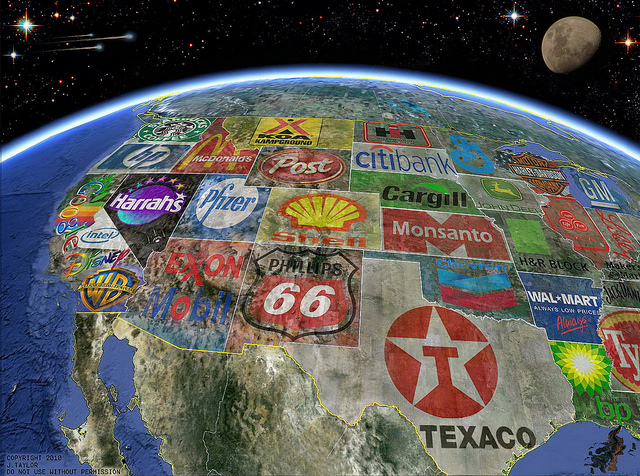





 Collapse of Industrial Civilization