The following video message is from Dr. Erik Pianka, an esteemed American biologist, one of the world’s most accomplished field ecologists, and author of the classic 1983 book Evolutionary Ecology. This video was made roughly four years ago. Not much has changed in the interim other than everything getting progressively worse —more people, more cars, more garbage landfills, more greenhouse gas emissions, more ocean acidification, more extinctions, etc…
To save the habitability of the Earth, many enlightened environmentalists and thinkers have proposed a radical but simple solution which calls for a reconfiguration of modern society into a much lower energy-intensive way of life with food production localized and resources socialized —just the opposite of what is now happening in our no-holds-barred global capitalist system. However, the time for a transition was decades ago before we had gone so far into overshoot that world powers are now scrambling to lay claim to the melting Arctic, carving up Africa for its land and water while unleashing a pandemic, and contaminating the dwindling aquifers with fracking waste. Our so-called leaders are too busy constructing an omnipresent spying Panopticon to bother noticing the gathering storm of climatic hellfire and brimstone. When harsh reality finally assert itself, such human folly will have created unfathomable catastrophes.
Farming is never going to go back, regardless of how much rain we get next year, to the way it was in the ’70s and ’80s. It’s a long-term era of scarcity.
California is much bigger than it was when these reservoirs were built, 40 or 50 years ago. There’s more water going to cities and the environment now. That boom era of California farming, I think everyone recognizes, is just a thing of the past.
They used to flood-irrigate everything here. When I was a kid, growing up, you’d walk outside in the middle of summer, six or seven months since the last rain, and it would be humid outside because there’d be so much irrigation going on. You hardly ever see anything flood-irrigated anymore. That time, that’s just not coming back.
The solution is not the techno-utopian fantasy of cold fusion. Even if cold fusion was a realistic possibility, the creation of unlimited amounts of ultra-cheap energy wielded in the hands of techno-capitalist man would surely spell disaster for any last vestiges of life that might have survived the omnicide of capitalist industrial civilization and the age of fossil fuels. A good steward of the Earth’s resources and web of life would never have perpetuated the 6th mass extinction and defiled the planet that gave birth to his kind while arrogantly naming himself Homo sapiens (Latin: “Wise man”).
Capitalist carbon man acted like a bull in a china shop, throwing his weight around and blindly destroying everything in his path. Now he wants to invent even more disruptive tools with which to save himself from the very techno-nightmare that he has already created? He treated the biosphere like a buyosphere, and money was his God. His epitaph was inscribed long ago by Oscar Wilde who perceptively said, “They know the price of everything and the value of nothing.”
Tragically, humans had their chance in a magnificent paradise and they blew it in spades.
No matter if the weekend has arrived or not, when I feel like life has become a grotesque parody of itself then it’s time for another installment of ‘Weekend Funnies for the Depressed Collapsitarian’…
“Chinese People will not be stopped by anything. If pollution ruins a river, we will build a new river. If pollution destroys a mountain, we will build a new mountain. At long last, the world cannot ignore our growing prosperity.”
The power of positive thinking for the cancer man can be applied to Homo Economicus and his refusal to change his ways in spite of the collapsing biosphere… “It took inner strength to ignore all those climate scientists.”
Debate: ‘Are Violent Video Games Adequately Preparing Children For The Apocalypse’… “They are going to need the more practical skills like how to build a shelter from abandoned cars or how to get drinking water by collecting the morning dew in human skulls.”
Over the ages, a number of empires have exploited and looted the resource-rich lands of Africa. At its height, the Roman Empire stretched from Scotland in the northern hemisphere to the deserts of Africa in the south. The Romans stripped their North African territory of its trees, making it their breadbasket of grain production. Originating in central Africa, malaria was likely spread to the center of the Roman Empire on their cargo ships. Passengers on their boats could have carried malaria in their bloodstream before becoming symptomatic, and water barrels on board could have harbored mosquito larvae. In fact, the DNA work of Dr. Robert Sallares has proven that the most lethal form of malaria helped topple ancient Rome. Fast forwarding to today, the blow-back from industrial agriculture and transnational corporate land grabs in Africa has now reached the shores of the hegemonic American Empire in the form of a deadly tropical disease called Ebola.
The Roman Empire seized fertile African land by brute force, but in modern times capitalist industrial civilization takes over Third World countries with the stroke of a pen. Structural adjustment loans by such tools of western power as the IMF and World Bank are signed requiring privatization of the economy and government cuts in social spending. Vast tracks of forests are cleared for mining or monoculture crop production such as palm oil. Subsistence farmers are dispossessed of their ancestral lands and forced to migrate to cities in search of work. Deprived of adequate healthcare and the opportunity to earn a livable wage, these urban poor live in squalor and are driven to hunt in the surrounding forests for a cheap source of protein known as bushmeat. Fruit bats, a keystone environmental species, have been identified as an Ebola virus host that has spread the disease through bushmeat consumption, habitat destruction, and human encroachment. Thus the neoliberal agenda of ‘developed’ nations has acted to create the atmosphere from which this pandemic arose.
Due to the long history of exploitation by outside powers, native Africans are justifiably wary and prone to conspiracy theories involving intervention by Western institutions as well as their own governments which have been, to a great degree, corrupted by the resource curse. These unpleasant facts are, of course, never mentioned by the MSM because it might spark a flicker of moral compunction in the ‘developed’ world which has ended up with so much of Africa’s wealth in the form of rare earth minerals used inside electronic devices, gold and diamonds in jewelry, or petrol pumped into vehicles. The horrific realities behind conflict minerals are always kept out of sight and out of mind by the next consumer diversion.
The following video is a brilliant lecture by Rob Wallace, evolutionary biologist and public health phylogeographer, discussing the epidemiologic links between the current Ebola outbreak and the socioeconomic policies of capitalist industrial civilization.
“Pathogens routinely trace society’s inequalities and expropriations like water traces cracks in ice… Ebola represents such a case. The shifts in land use in the Guinean region where the new strain apparently emerged are connected to the kinds of neoliberal structural adjustments that, alongside divesting public health infrastructure, open domestic food production to global circuits of capital… [The corporate agribusiness land acquisitions in Africa] are markers of a complex policy-driven faith change in agroecology…that undergirds Ebola’s emergence here.” ~ Rob Wallace
In biology there is a phenomenon known as the Allee effect which occurs when a species declines to a critical population threshold, becoming too spread out over a large area to find a mate for reproduction and thereby making a crash to extinction all but inevitable. The Allee effect applies to infectious diseases as well, and if you can knock down an outbreak below an infection threshold through such methods as vaccinations or proper sanitation, then the outbreak can burn out on its own. However, as Rob Wallace wryly states, “…structural problems can render emergency responses null and void, no matter how much Bill Gates pays out.” In other words, we may have destroyed the ecosystem’s natural ability to keep such pathogens in check and from expanding out of control in the future:
“…commoditizing the forest and neoliberal dispossession may have lowered the region’s ecosystemic threshold to a point that no emergency intervention can drive the pathogen population low enough to burn out on its own. The pathogen will continue to circulate with the potential to explode. In short, neoliberalism’s shifts aren’t just a background upon which such emergencies take place. It is the emergency as much as the virus itself. And history has demonstrated this time and again. Faith changes and social organization, for better and for worse, change epidemiologies. Domesticated livestock served as sources for human diphtheria, influenza, measles, mumps, plague, pertussis, rotavirus, tuberculosis, sleeping sickness, etc. Ecological changes brought about upon landscapes by human intervention selected for spill-overs of cholera from algae, malaria from birds, and dengue fever and yellow fever from wild primates… We can pretend otherwise for Ebola, but in protecting the rationals for institutions and policies that likely brought about such outbreaks, if as byproducts of a greater economy alone, we will surely only compound the problem. If not by Ebola this year, then perhaps something else next.”
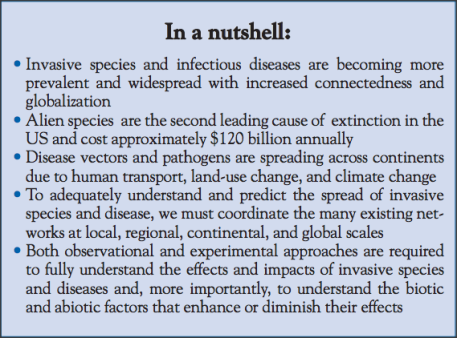
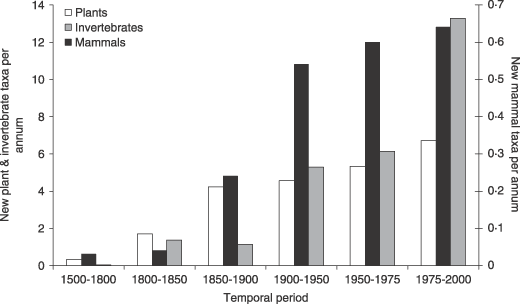
In addition to the ecosystemic impact of industrial agriculture and global circuits of capital, our highly mobile society and the consequent climate disruption from fossil-fueled globalization have worked to propel the spread of invasive species, diseases, and pathogens:
The following graph show the increase of invasive species since 1500 with an explosion in the last 100 years:
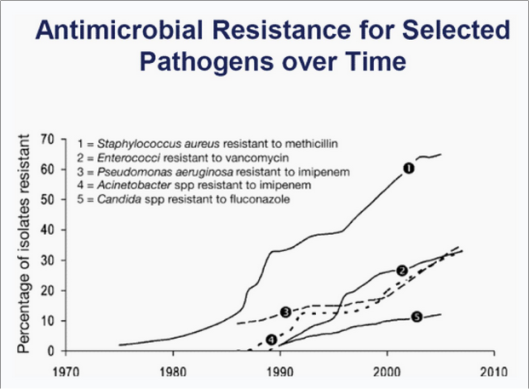
Below is a chart showing the increase in bacterial resistance for selected pathogens. “For example, Staphylococcus aureus resistant to methicillin has increased almost 70% since about 1975.” The dawning of an antibiotic apocalypse is upon us:
“FRONTLINE investigates the widespread use of antibiotics in food animals and whether it is fueling the growing crisis of antibiotic resistance in people. Plus an exclusive interview with the family of a young man who died in a superbug outbreak that swept through a hospital at the National Institutes of Health.”
Amplifying what some call peak antibiotics is the fact that in our capitalist economy, the perverse incentive for monetary profit discourages pharmaceutical companies from developing new antibiotics; there is no market for curing… only prolonging:
…Ebola emerged 40 years ago, and, Dr. Chan said, there were no vaccines or other remedies because it has traditionally been confined to poor African countries. A profit-driven pharmaceutical industry had no incentive to make products for countries that could not pay, she said.
The risks of neglecting health care in developing countries are global, Dr. Chan said, adding that “when a deadly and dreaded virus hits the destitute and spirals out of control, the whole world is put at risk.”… – link
The fragmented and “crapified” nature of America’s for-profit healthcare system has also factored into the fumbled response to Ebola’s invasion into America, as Yves Smith at Naked Capitalism explained recently:
…the statistics say compared to other developed countries, US processes and outcomes are at best mediocre using the best of some admittedly flawed metrics (look here), yet our costs are much higher than those of comparable countries. Furthermore, on Health Care Renewal we have been connecting the dots among severe problems with cost, quality and access on one hand, and huge problems with concentration and abuse of power, enabled by leadership of health care organizations that is ill-informed, incompetent, unsympathetic or hostile to health care professionals’ values, self-interested, conflicted, dishonest, or even corrupt and governance that fails to foster transparency, accountability, ethics and honesty…
…The US health care system is now heavily commercialized. Health care corporations, including pharmaceutical and biotechnology companies, are often lead by generic managers who subscribe to the business school dogma of the “shareholder value theory,” which seems to translate into putting short-term revenues ahead of all other goals. Thus they have been“financialized.” At least in the pharmaceutical and biotechnology sector, such financialization appears to now be global…
…from 1983 to 2000, the number of managers working in the US health care system grew 726%, while the number of physicians grew 39%, so the manager/physician ratio went from roughly one to six to one to one (see 2005 post here). As we noted here, the growth continued, so there are now 10 managers for every US physician…
There is little wonder why the Ebola outbreak caught the WHO so flat footed as they spent months making mealy mouthed statements but never coordinating an effective response. The Gates foundation is the WHO boss, not governments, and if they weren’t demanding action, then the desperate people affected by Ebola weren’t going to get any…
…The Bill and Melinda Gates Foundation has pledged an additional $50 million to fight the current Ebola epidemic but that too is problematic, as Director General Chan describes. “When there’s an event, we have money. Then after that, the money stops coming in, then all the staff you recruited to do the response, you have to terminate their contracts.” The WHO should not be lurching from crisis to crisis, SARS, MERS, or H1N1 influenza based on the whims of philanthropy. The principles of public health should be carried out by knowledgeable medical professionals who are not dependent upon rich people for their jobs.
The Gates are not alone in using their deep pockets to confound what should be publicly held responsibilities. Facebook founder Mark Zuckerberg announced that he was contributing $25 million to fight Ebola. His donation will go to the Centers for Disease Control Foundation. Most Americans are probably unaware that such a foundation even exists. Yet there it is, run by a mostly corporate board which will inevitably interfere with the public good…
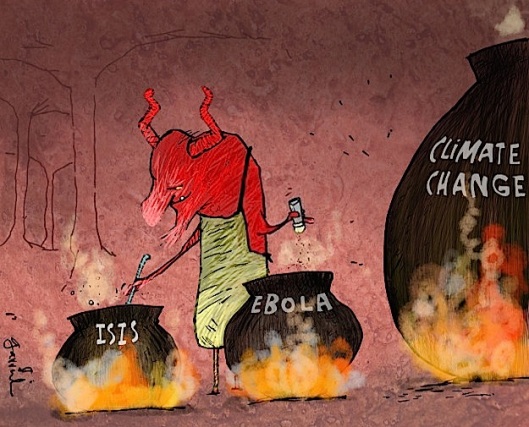
Essentially, both ISIS and the Ebola pandemic are crises of the corporate state’s own making. Vast sums of money have flowed into America’s war machine to fight the terrorist threat of ISIS, yet the specter of a global pandemic has elicited a much more belated and tepid reaction from the leaders of our brave new privatized and financialized system of government. As with climate change, it has become clear once again that the health of the world and its people cannot be trusted with these adherents of neoliberal capitalism, and as I stated in a previous blog post, the conspiracy is systemic and legalized. The virus of capitalist industrial civilization appears to be on an unstoppable trajectory of burning itself out within our children’s lifetime.
“It was a nice run for the biosphere, but it finally came down with a lethal disease, homeostasis lost, the pyramid of life reduced to the pancake of life.” ~ James
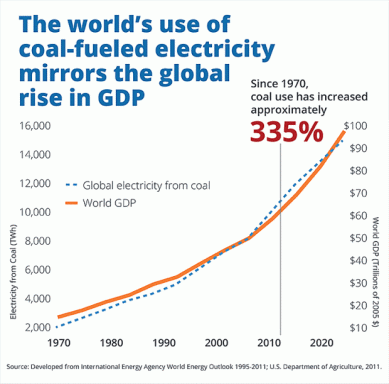
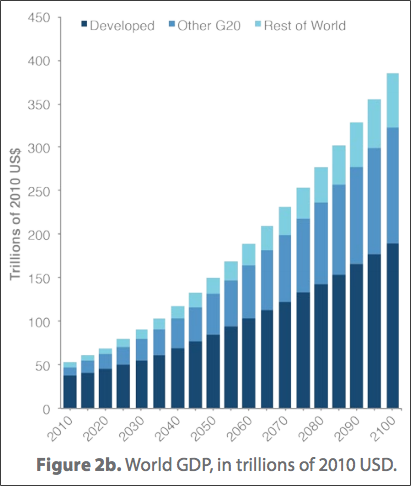
Two recent pieces of scientific evidence really hammer home the predicament of modern industrial civilization, and they have to do with the fact that our globalized, just-in-time economic model is hopelessly wed to carbon-based energy. Once one understands this, then there can be no delusions about why we are on such a catastrophic trajectory of greenhouse gas emissions. As was explained in a previous post, GDP is fundamentally and directly linked to CO2 emissions. Below, two graphs(click to go to source) illustrate this fact:
It’s not really about evil fossil fuel companies, although they do certainly exert enormous political clout and do conspire to protect their business model by doing such things as spreading doubt on climate change science, but as with all corporations, externalizing social and environmental costs is endemic to the profit system and the coercive forces of competition in capitalist markets.
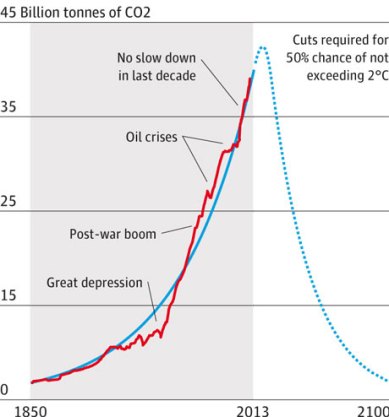
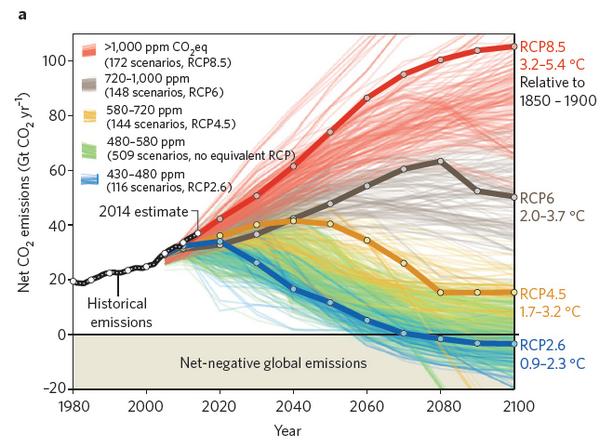
Firstly, there is the graph submitted by Professor Jonathan Overpeck, a climate scientist for the past 30 years, Professor of Geosciences and Atmospheric Sciences, and Co-Director Institute of the Environment, Univ. of Arizona:
This clearly shows we are firmly on track for hitting 3.2-5.4°C warming by the end of the century or sooner. This kind of rapid warming is incompatible with most life on Earth. To get an idea of what the world will be like at 3°C once lag time catches up to real time, we can look back 3 million years ago in the Pliocene Era when CO2 levels were similar to today and temperatures were 3°C warmer:
The northern hemisphere was free of glaciers and icesheets, beech trees grew in the Transantarctic mountains, sea levels were 25 metres higher [Climate Dynamics, 26, 249-365], and atmospheric carbon dioxide levels were 360-400 ppm, very similar to today. There are also strong indications that during the Pliocene, permanent El Nino conditions prevailed. Hansen says that rapid warming today is already heating up the western Pacific Ocean, a basis for a coming period of ‘super El Ninos’ [Proc. Nat. Acad. Sci., 103, 39, 14288-93]…
…The collapse of the Amazon is part of the reversal of the carbon cycle projected to happen around 3 degrees, a view confirmed by a range of researchers using carbon coupled climate models. Vast amounts of dead vegetation stored in the soil – more than double the entire carbon content of the atmosphere – will be broken down by bacteria as soil warms. The generally accepted estimate is that the soil carbon reservoir contains some 1600 gigatonnes, more than double the entire carbon content of the atmosphere…
…Three degrees would likely see increasing areas of the planet being rendered essentially uninhabitable by drought and heat. Rainfall in Mexico and central America is projected to fall 50 per central. Southern Africa would be exposed to perennial drought, a huge expanse centred on Botswana could see a remobilisation of old sand dunes [Nature, 435, 1218-21], much as is projected to happen earlier in the US west. The Rockies would be snowless and the Colorado river will fail half the time. Drought intensity in Australia could triple, according to the CSIRO, which also predicts days in NSW above 35 degrees will increase 2 to 7 times.
With extreme weather continuing to bite – hurricanes may increase in power by half a category above today’s top-level Category Five – world food supplies will be critically endangered. This could mean hundreds of millions – or even billions – of refugees moving out from areas of famine and drought in the sub-tropics towards the mid-latitudes. As the Himalayan ice sheet relentlessly melts with rising temperatures, the long-term water flows into Asia’s great rivers and breadbasket valleys — the Indus, Ganges and Brahmaputra, the Mekong, Yangtse and Yellow rivers — will fall dramatically. If global temperatures rise by three degrees, and that’s becoming the un-official target for western governments, water flow in the Indus is predicted to drop by 90 per cent by 2100. The lives of two billion people are at stake.
As the Arctic continue to warm, melting permafrost in the boreal forests and further north in the Arctic tundra is now starting to melt, triggering the release of methane, a greenhouse gas twenty times more powerful than CO2, from thick layers of thawing peat. The West Siberian bog is estimated to contain 70 billion tonnes of CO2. Prof. Sergei Kirpotin, a botanist at Russia’s Tomsk State University, says: “There’s a critical barrier… Once global warming pushes the melting process past that line, it begins to perpetuate itself.” The West Antarctic ice sheet would likely to irreversibly melt.
At 5-6°C:
Five degrees
• Five degrees of warming occurred during the Eocene, 55 million years ago: breadfruit trees grew on the coast of Greenland, while the Arctic Ocean saw water temperatures of 20C within 200km of the North Pole itself. There was no ice at either pole; forests were probably growing in central Antarctica.
• The Eocene greenhouse event was likely caused by methane hydrates (an ice-like combination of methane and water) bursting into the atmosphere from the seabed in an immense “ocean burp”, sparking a surge in global temperatures. Today vast amounts of these same methane hydrates still sit on subsea continental shelves.
• The early Eocene greenhouse took at least 10,000 years to come about. Today we could accomplish the same feat in less than a century.
Six degrees
• At the end of the Permian period, 251 million years ago, up to 95% of species were extinct as a result of a super-greenhouse event, resulting in a temperatures rise by six degrees, perhaps because of an even bigger methane belch than happened 200 million years later in the Eocene.
• One scientific paper investigating “kill mechanisms” during the end-Permian suggests that methane hydrate explosions “could destroy terrestrial life almost entirely”. Acting much like today’s fuel-air explosives (or “vacuum bombs”), major oceanic methane eruptions could release energy equivalent to 10,000 times the world’s stockpile of nuclear weapons.
Another valuable website worth reading describes, degree by degree, the changes that will happen to the Earth from anthropogenic global warming. Due to the unpredictable nature of the internet and web pages disappearing, I have saved that essay as an entire screenshot here.
Keep in mind that the IPCC, an institution that has consistently underestimated the effects of anthropogenic climate change, states that in order to stay below 2°C of warming, emissions will have to be 40-70% lower than they were in 2010 by 2050 and at zero by the end of the century, “or could possibly even require taking carbon dioxide out of the atmosphere, a controversial proposition.” As the Keeling Curve grows ever steeper year after year, the Hail Mary of a techno-fix inevitably becomes the only option left. However, concomitant with the CO2 problem is the acidification of the oceans which will require a miracle solution as well. As was explained in a previous post, if all emissions stopped yesterday, we would still be locked into a warming of 2.65°C.
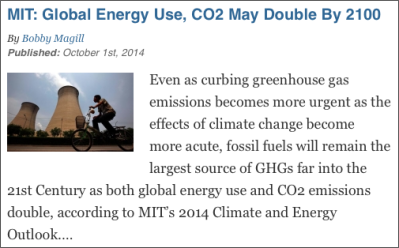
The second important piece of information is a recent MIT study:
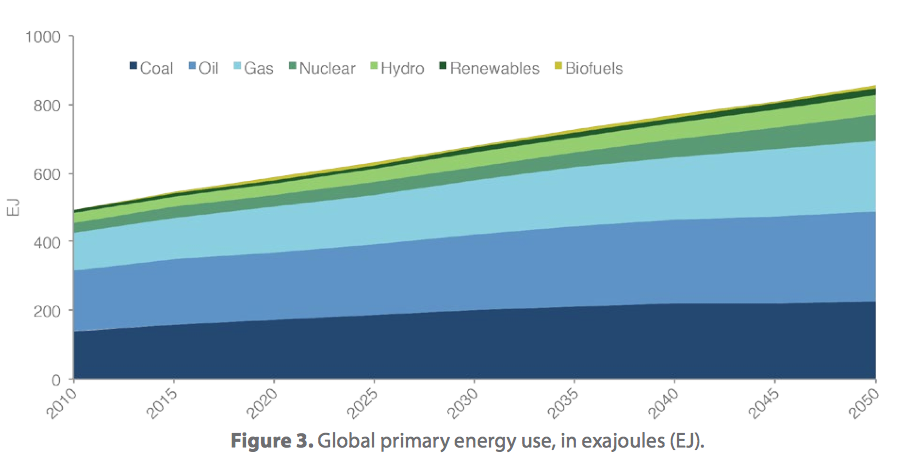
Above graph, from MIT’s Climate and Energy Outlook 2014, shows a drastic rise in global energy consumption by fuel type.
If CO2 levels were to double to 800ppm:
If carbon dioxide levels reach 800 ppm, ocean pH is projected to drop another .3 to .4 units (Today we have measured a decline of .1 pH units from 8.2 to 8.1 in the last century) – one of the scenarios projected by the Intergovernmental Panel on Climate Change by 2100 –raising levels of hydrogen ion, H +, 100 to 150 percent (Orr et al., 2005). As this happens and it will take “tens of thousands of years” for the chemistry of the oceans to return to pre-industrial levels, at least that is what the Royal Society of Britain proclaims. – link
We’re already seeing massive die-offs of oysters and scallops from an acidification (PH-decline) of 0.1PH, but what would happen at a drop of 0.3-0.4 units(150+% more acidic than at the beginning of the industrial revolution)?:
“…we found that reef development ceased below pH level 7.7… Ultimately, what we observed was that the diversity of reefs progressively declines with increasing CO2. At concentrations similar to those predicted for the end of this century at a ‘business as usual’ emissions scenario, the “coral reef” observed was depauperate and lacked the structural complexity of present healthy tropical coral reefs. These changes are simply due to ocean acidification, i.e., even without the projected +2°C warming of the oceans associated with rising greenhouse gases. The 0.5° warming we have already observed in the tropics in the last 50 years has already caused mass coral bleaching events and declining coral calcification.” – link
…The authors of the report, released today from the Third Symposium on the Ocean in a High-CO2 World, review the current science on the effects on marine organisms, and write that there is a “medium confidence” level that shellfish harvests will decline. There is also a medium confidence level that economic damage will result from impacts on coral reefs, with tourism, food and shoreline protection suffering. The size of this is unclear but one estimate is for $1 trillion in damage from coral loss alone.
How larger species will fare as oceans acidify is less clear. The report gives only a “low confidence” rating to the idea that top predators and fin fish catches will be reduced. But any losses in this area could hit hard the 540 million people whose livelihoods depend on such fisheries.
Scientists also have a “very high confidence” that the ocean’s capacity to take up carbon decreases as waters acidify. So even larger cuts in human greenhouse gas emissions than currently envisaged may be needed to meet targets set to limit global warming as a result, the authors write….
…The report authors also say that the acidity of the oceans could increase by 170% by the end of the century, corresponding to a drop in surface ocean pH by 0.32. This occurs under a pessimistic scenario of high human emissions. Since the industrial revolution, surface ocean pH has dropped from 8.2 to 8.1. As pH is a logarithmic scale, the increase in acidity since the industrial revolution could reach around 170% under this scenario.
Under lower-emissions scenarios, this decrease would be around 0.07. But current emissions show no sign of dropping to those necessary to achieve such a goal, cautions Riebesell.
“If you look at current trajectories we’re no way below the [high emissions scenario],” Riebesell says. “Of course we hope the human race is smart enough to learn at some point and turn the wheel round.” – link
As long as the shelves in the local grocery store are filled with relatively cheap food, the television is broadcasting the usual “bread and circus”, water is flowing from the faucet, and other creature comforts of industrial civilization are on tap, homo economicus will blithely ride into the dark future of mass extinction, tectonic shifts of the biosphere, and the collapse of an unsustainable lifestyle.
CNN is running a program of their newscasters’ family roots. Why do I feel like this is a slick PR campaign to put a main street face on the mainstream media? Sorry, but I still don’t trust them and we’re still on track for the collapse of modern civilization despite all their smug smiles.
Championing the rapacious conversion of the Earth into dead commodities and its peoples into soulless consumers, the adherents of capitalism have succeeded in entrenching their ideology into the minds of the vast populations as the only viable economic system and way of life. Mesmerized by the electronic gadgetry of the digital age and singing the praises of the “free market”, atomized citizens blissfully hack away at the tree of life that supports them. The bio-destructive power of capitalist industrial civilization stamps out the poetry of nature, silencing entire ecosystems. This essay by Kenn Orphan describes the mindless march towards self-destruction and the redemption that comes by bearing witness to it.
“Extinction is the rule. Survival is the exception.” – Carl Sagan
We are all witnesses to the Great Dying, a sixth mass extinction, the last one being 65 million years ago which wiped out the dinosaurs. This is not hyperbole; it is a defining feature of our age.
Countless species are falling prey to the wealthy’s indifference, militarism and folly everyday. As in ancient civilizations, the wealthy and the privileged are generally the last to feel the pain of collapse, yet are most often the root cause. And compared to the mass of humanity we share this planet with, and as a result of rapacious exploitation and plunder, Americans, and westerners in general, are the wealthy and the privileged of modern civilization.
Despite overwhelming evidence of crashing ecosystems, many of us living in the twilight years of the American empire seem oblivious to the canaries in the coal mine. Every…
Who’s got a hand on the crackdown? Who’s got the word on the double talk? Hands on the wheel in a flash of steel We got a secret letter with a government seal …… Nerves are pinched but the heads are calm The cargo’s all loaded and the red light’s on Check the map, you navigator sap Or we’ll all end up with our heads in our lap
Only with capitalism does commodity exchange become the universal source of social interaction through the commodification of labor power, value then becomes the defining principle of social reproduction.
There are many criticisms against Capitalism, but not much in the way of concrete alternatives. I’ve just finished reading Professor Peter Hudis’ book “The Alternative to Capitalism”, and while he does not offer much specificity in the way of concrete alternatives, he does offer a useful and provocative analysis of Marx’s theories pertaining to what might come next. The book is unique in that it distills down and interprets thousands of pages of Marx’s writing into a handful of useful conclusions that illustrate what Marx envisioned in a post Capitalist society.
Below is a recent podcast in which Professor Hudis is interviewed, and this gives a quick overview of the concepts and conclusions of his vision of a post Capitalist society.
The central argument in Hudis’ reading of Marx is that any Post Capitalist society that is to succeed must at first recognize, then dismantle, the system of value production. This differs significantly from conventional anti-capitalist thinking which suggests that the capitalist mode of production and the system of private property ownership are principally responsible for the contradictions and subsequent failures in Capitalism.
Additionally, he points out that Marx expressly disagreed with the popularized notion that to achieve this, the ownership of the means of production must transfer to the State. Marx was very clear that ownership of the means of production must not belong to the Capitalist, nor the State, rather, to those in the involved with the actual production process.
Hudis suggests that these palliative measures are not only misplaced, but wrong.
To dive further into what is being said here, some discussion of the meaning of the phrase value production is in order.
Value production in a capitalist society means that all social relations are governed by the drive to augment and increase value, with no regard for human needs or capacities.
This suggests (and Hudis does a good supporting his thesis with an academically rigorous approach in his book) that the essence of the perpetually expanding nature of Capital, the expansion that consumes resources and poisons the planet, stems from this fundamental conclusion.
Value is not material wealth, it is wealth computed in terms of money. As Hudis points out, once such a system of value production becomes the dominant form of social relations, the drive to constantly increase value becomes unstoppable.
Drilling deeper into the construct of value production, what comes forward is that one of the key contributors to this unstoppable force is the notion of socially necessary labor time. On this subject, it becomes evident that not even the Capitalists themselves have control of the system, as even they are not able to manage the forces that control production. Time becomes inverted, the predicate becomes the subject, and the whole process leads to the incredulous discovery that the products we produce control all of human relations.
And it was always supposed to be the other way around.
The concept of socially necessary labor time dictates several key factors, principally, that goods are produced in accordance with average labor inputs, and any production labor in excess of the social average is wasted and deemed not useful. This means that Capitalists that engage in production are not in control of their exchange values, this is communicated by the market and discovered when goods reach the point of sale. It is then that the Capitalist determines if his goods are competitively priced, and if he can monetize his exchange value. If another firm has produced the same commodity using less labor (or cheaper labor) at the same quality, then the original capitalist will not be able to monetize his surplus value.
This uncertainty, coupled with the intrinsic self expansive nature of Capital, sets into motion a destructive and unstoppable cycle of ever decreasing inputs of labor time.
Time, in the pursuit of commodity production, becomes our master, we work longer, faster, to achieve the same standard of living.
These factors were not present in pre-capitalist societies. And Hudis argues that they cannot be present in any post Capitalist society either. These conditions of value production in general, and of socially necessary labor time in particular are unique to Capitalism.
We see in the news today disturbing events, loss of personal liberties, privacy issues, destruction of the planet and wanton disregard for resource depletion- it is hard to know which bogey to fear first and foremost.
Most disturbing to me is the almost footnoted mention in the news media of the egregious tax avoidance strategies being employed by large multi-nationals. Companies like Tesla are now dictating terms and conditions which they will require to build production factories in a specific state. They are in effect competitively bidding individual states against each other to maximize the tax deferments and various other concessions as a condition of doing business.
Tesla has negotiated approximately $1.25 Bn dollars worth of concessions, and some analysts are claiming the return on investment for the number of jobs created is a fiction.
Additionally, these tactics are by no means limited to inside the US, there is a battle royale raging in countries like Ireland, where Apple has effectively negotiated terms that reduce their effective tax liabilities to around 2%. By their own admission, there is ‘no scientific or numerical basis’ for their arguments, meaning they just drove the best bargain they thought they could get away with, and Ireland signed up- not wanting to risk the ~6,000 jobs that Apple has in Cork County.
While many are content to lament the State’s complicity in the machinations of Capital, these events indicate something new and much more dangerous- Capital is now overtly dictating terms to the State and holding monopoly power over the State to insure conditions of production that are favorable to Capital. Again, the predicate becomes the subject, as we see an inversion of the production relations. This is very dangerous.
Next we can envision corporate sanctioned labor camps for those deemed unemployable, subsuming the State unemployment programs with privatized “camps” as an extension of the massive prison system- with better wall colors and more frequent conjugal visits.
Social relations will be transformed to support only matters of production relations, education further diluted to rote training farms, subsidized and wholly captured by the large multi-nationals, and hard wired to provide curriculum and performance standards beholden only to their interests.
The hand maidens of Capital have successfully employed an “Arsonists in Fire Chief Hats” strategy wherein they have systematically dismantled any regulatory components of the State, and then cry foul when the hobbled remains proves ineffective at its intended role.
The only logical conclusion in this outcome is of course further privatization, drowning government in the proverbial bathtub so that Capital may advance beyond its perch as owner of all assets into its newly expanded role as owner of all labor.












 Collapse of Industrial Civilization

