It’s actually pretty fun, you’ve got the guns with Santa and everything and you get to hold them, just a fun family event,” said Scott Daugherty after taking a family photo with Santa as well.
This is the third year the gun club has offered this “Santa and machine guns” photo opportunity.
While some people find the idea of posing with Santa and guns inappropriate, the line out the gun club’s door proves gun aficionados love it.
“We got here about an hour early to make sure because last year the line was really crazy and we decided not to stay, so we figured we better come early this year, we were about third or fourth in line and we’re off to breakfast and ready to ship these pictures off to our family,” said a woman by the name of Abby on her way out.
Such a yuletide family event by Pax Americana in its twilight years:
I had to go back and look up the definition(wikipedia) of Christmas after seeing those photos. I have to wonder if this gun culture is reinforced by a country whose economy revolves around war and the militarization of our society. Maybe a previous President had a point when he said:
“We cannot be both the world’s leading champion of peace and the world’s leading supplier of the weapons of war.
Chart of Smith & Wesson revenues:
I’m sure this year will break records for gun sales. Oh, it already did:
And you think this species has a chance at long-term survival?
I was going to post on that capitalism article I mentioned in my previous blog entry, but this video I was making on child labor took on a life of its own and demanded my entire Sunday.
Human rights organizations have documented child labor in USA. According to a 2009 petition by Human Rights Watch: “Hundreds of thousands of children are employed as farmworkers in the United States, often working 10 or more hours a day. They are often exposed to dangerous pesticides, experience high rates of injury, and suffer fatalities at five times the rate of other working youth. Their long hours contribute to alarming drop-out rates. Government statistics show that barely half ever finish high school. According to the National Safety Council, agriculture is the second most dangerous occupation in the United States. However, current US child labor laws allow child farmworkers to work longer hours, at younger ages, and under more hazardous conditions than other working youths. While children in other sectors must be 12 to be employed and cannot work more than 3 hours on a school day, in agriculture, children can work at age 12 for unlimited hours before and after school.” They would work two to three jobs depending on their age.
Zobama and Zomney had lunch Thursday afternoon to compare notes on how best to accelerate the growth of our death-dealing economy and bring on the Eco-Apocalypse of the planet. Their plans suffered a small setback in 2008 when the speculator vultures and moneychanger vampires over-engorged themselves on the working stiffs whose blood supply is still critically low.
The success thus far on the progress of zombification of the planet was discussed, with lavish praise going to the fossil fuel industry for their superb job in keeping the working stiffs hopelessly addicted to the ancient black elixir and hopelessly confused about the end results of such an addiction.
Both agreed that soon the living arrangements on the planet will be perfect for zombies and the few remaining humans will quickly fall prey to a lifeless and uninhabitable environment suitable only for the ranks of the undead.
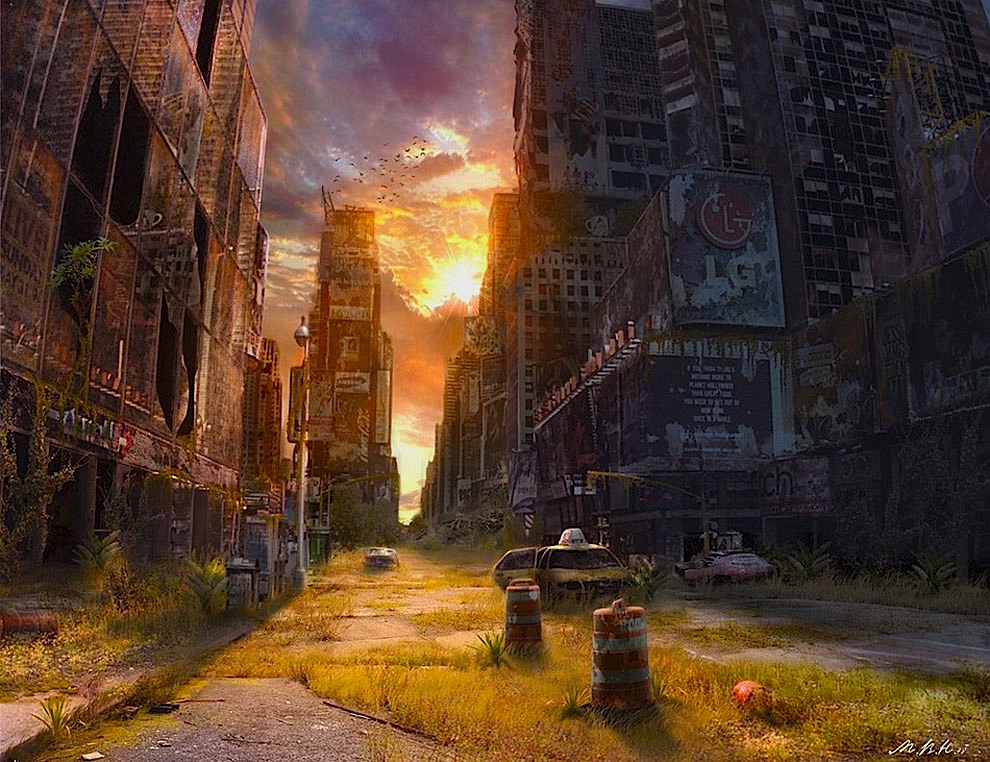
I thought I’d post a few pictures of what the world will look like before the end of this century. Artists have the intuitive imagination to conjure up such visions the general public can only imagine through Hollywood zombie flicks which seem to be all the rage these days. Why do I feel this vision is inevitable? Just look at the daily news to see what I mean:
It used to be that the mentally insane, flailing their arms and talking to invisible people in the streets, were the ones ranting and raving about the end of the world, but now it’s scientists who, in an attempt not to offend the beliefs of the scientific illiterati and free-market faithful, downplay their findings as much as possible. Optimism bias infects even the scientific community.
…we are the most tragic species. We not only destroy all of the world around us, we are aware of doing it but unable to stop ourselves. We have faith and hope that things will get better, that we can turn around at the last second what we’ve screwed up over years and decades. Which of course is nothing but an excuse to keep on screwing up. All courtesy of our optimism bias.
What better exemplifies the delusional optimism of man than the belief that he could hide out in a bunker to survive the ravages of a nuclear war? I’ll tell you what tops that fantasy – the belief that man can continue to do what he has done and expect the planet to unfailingly absorb all the environmental assaults we can throw at it via the endless growth of capitalist production and consumption. The planet is not some massive ShamWow towelette for man’s nonstop flow of excrement.
Of all the findings in the 2012 edition of the World Energy Outlook, the one that merits the greatest international attention is the one that received the least. Even if governments take vigorous steps to curb greenhouse gas emissions, the report concluded, the continuing increase in fossil fuel consumption will result in “a long-term average global temperature increase of 3.6 degrees C.”
This should stop everyone in their tracks. Most scientists believe that an increase of 2 degrees Celsius is about all the planet can accommodate without unimaginably catastrophic consequences: sea-level increases that will wipe out many coastal cities, persistent droughts that will destroy farmland on which hundreds of millions of people depend for their survival, the collapse of vital ecosystems, and far more. An increase of 3.6 degrees C essentially suggests the end of human civilization as we know it.
To put this in context, human activity has already warmed the planet by about 0.8 degrees C — enough to produce severe droughts around the world, trigger or intensify intense storms like Hurricane Sandy, and drastically reduce the Arctic ice cap. “Given those impacts,” writes noted environmental author and activist Bill McKibben, “many scientists have come to think that two degrees is far too lenient a target.” Among those cited by McKibben is Kerry Emanuel of MIT, a leading authority on hurricanes. “Any number much above one degree involves a gamble,” Emanuel writes, “and the odds become less and less favorable as the temperature goes up.” Thomas Lovejoy, once the World Bank’s chief biodiversity adviser, puts it this way: “If we’re seeing what we’re seeing today at 0.8 degrees Celsius, two degrees is simply too much.”
At this point, it’s hard even to imagine what a planet that’s 3.6 degrees C hotter would be like, though some climate-change scholars and prophets — like former Vice President Al Gore in An Inconvenient Truth — have tried. In all likelihood, the Greenland and Antarctica ice sheets would melt entirely, raising sea levels by several dozen feet and completely inundating coastal cities like New York and Shanghai. Large parts of Africa, Central Asia, the Middle East, and the American Southwest would be rendered uninhabitable thanks to lack of water and desertification, while wildfires of a sort that we can’t imagine today would consume the parched forests of the temperate latitudes.
In a report that leads with the “good news” of impending U.S. oil supremacy, to calmly suggest that the world is headed for that 3.6 degree C mark is like placing a thermonuclear bomb in a gaudily-wrapped Christmas present. In fact, the “good news” is really the bad news: the energy industry’s ability to boost production of oil, coal, and natural gas in North America is feeding a global surge in demand for these commodities, ensuring ever higher levels of carbon emissions. As long as these trends persist — and the IEA report provides no evidence that they will be reversed in the coming years — we are all in a race to see who gets to the Apocalypse first.
Enjoy industrial civilization’s fossil fuel blow-out sale while it lasts. This is a one-time-only, circus-like ‘liquidation event’. Everything must be commodified regardless of ecological loss or intrinsic value to the web of life. The Human species won’t want to miss these deals! There will be no returns or exchanges available as we are going out of business for good due to bankruptcy proceedings with Mother Earth. All life forms and resources on the planet must go!!!
A newly released study commissioned by the C.I.A. entitled Climate and Social Stress: Implications for Security Analysis highlights the vulnerabilities of our globalized economy to climate change. Of particular interest is the section on energy. To summarize:
1.) Oil is the most highly integrated commodity of globalized trade. Its tightly interconnected market was created in the aftermath of the OPEC embargoes of the 1970’s to prevent its manipulation by political actors. Its integration is said to be fully complete to the point that any disruption in the global oil system will cause an economic ripple effect throughout the world. Rapid oil consumption in China and India without a corresponding increase in production has left the oil market extremely tight (i.e. Peak Oil).
2.) Due to the facts stated above, any changes in climate could easily disrupt the world’s energy system. For example:
(a.) Tropical storms and sea-level rise can disrupt production, refining, and transport of petroleum since a large percentage of oil refining and processing are located in coastal areas vulnerable to such storms and floods. This is true in the U.S., Europe, China, and India. An example would be Hurricane Katrina and Rita in 2005 which disrupted oil and gas operations of off-shore rigs, coastal refining, and transport via sea ports and pipelines.
(b) Drought will cause oil refining disruptions since that process requires large amounts of water. If the drought is accompanied by higher temperatures, the scarcity of water will be exacerbated because the oil refineries will require even more cooling by water. A warming planet will also cause infrastructure damage (pipelines and drilling platforms) in Arctic operations due to collapsing earth from the melting of permafrost.
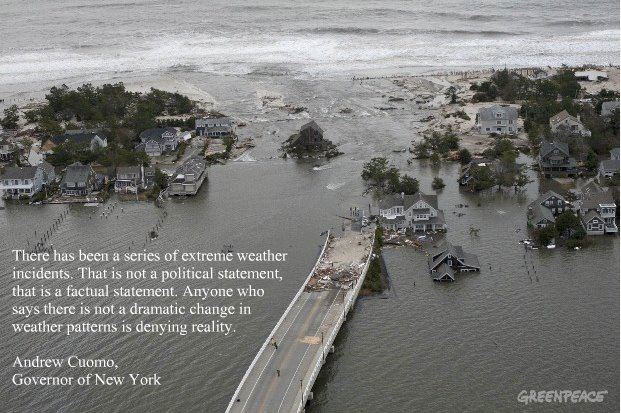
We are entering an era in which not only the global energy system is vulnerable, but the social, agricultural, and technological infrastructure is also at the mercy of climate disruptions. They were all designed around assumptions of moderately stable climate conditions, and as climate exceeds boundary thresholds, these infrastructures will break. As was demonstrated by Hurricane Sandy recently in New York/New Jersey with the power outages, gas shortages, and Nuclear plant shutdowns. The droughts this past summer in the U.S. midwest show the fragility of our food system whose development assumed fairly stable weather patterns and rainfall.
A quote from the study:
…The fundamental science of climate change suggests that continued global warming will increase with frequency or intensity (or both) of a great variety of events that could disrupt societies, including heat waves, extreme precipitation events, floods, droughts, sea-level rise, wildfires, and the spread of infectious diseases. Underpinning many of these extreme events is an acceleration of the global hydrological cycle. For each 1.8° F (1° C) increase in the global mean surface temperature, there is a corresponding 7 percent increase in atmospheric water vapor. Because warm air holds more water vapor than cool air, this leads to more intense precipitation. Essentially, warm air increases evaporation from the ocean and dries out the land surface, providing more moisture to the atmosphere that will rain out downwind. Water vapor is also a powerful naturally occurring greenhouse gas. As such it is the source of a very positive feedback to the coupled climate system that amplifies any external forcing by a factor of approximately 1.6…
We’ve passed a tipping point with the Arctic ice melt which has set off other feedback loops (Arctic amplification, methane release from permafrost melt, loss of the albedo effect, alteration of the Jet Stream, Greenland glacier melt, etc) and tipping points, some of which we are not even aware of, as the study acknowledges:
…there may be other processes in the Earth system, not yet identified, that have tipping points that could lead to abrupt climate change. Because of such gaps in knowledge, the possibility of such events occurring in the next decade or so cannot be totally discounted…
I would say “God help us” if the traditional farming lands -the bread baskets of nations- become dust bowls, but that’s exactly where we are headed with climate change and no miracle is going to fall out of the sky to save us.
Drought Disaster Designations Map (PDF, 504KB) Text-only (accessible) version Map shows designations due to drought across the country under USDA’s amended rule. Any county declared a primary (red) or contiguous (orange) disaster county makes producers in that county eligible for certain emergency aid.
The study talks about what it terms a “cluster of extreme events” resulting from large-scale climate processes, causing catastrophes in separate and distant areas of the globe. Trying to deal with such widespread and seemingly unrelated disruptions would quickly overwhelm the global community’s resources. An example given was in the year 2010 with the massive drought and forest fires in Russia and the epic floods in Pakistan:
…The two events were linked by more than just their proximity in time. The meteorological pattern that lead to the Russian heat wave, in which the large-scale upper-level wind flow developed a strong and persistent ridge, also contributed to the development of the meteorological pattern that resulted in the Pakistani floods —a downstream leading trough (Lau and Kim, 2012). The fact that these two extreme events corresponded in time with each other and with a single larger meteorological pattern was unusual but not totally unexpected. Circulation events like this one, which cause some event clusters, are known to occur but are not well resolved in current climate models…
…If climate events and extremes were independent in a statistical sense, the likelihood of a cluster or a compound event of any size could easily be estimated mathematically. But as the above example makes clear, extreme events in different parts of the world can be driven by common underlying forces and thus have an intrinsic relationship such that when one such event occurs, the likelihood increases that other extreme events linked to them by common causes will also occur. In statistical language, such events are called dependent.
The changing climate zones also enable the spread of tropical diseases and pests. Outbreaks of new virus strains would tax healthcare delivery systems:
…Climate events might also put stress on global health systems in various ways, most of them hard to predict. As discussed in the next chapter, climate change is expected to alter the ranges of disease vectors or pathogens in ways that expose large human populations to diseases to which they have not been previously been exposed. This could lead to a rapidly increasing demand for treatments and supplies that may not have been adequately stockpiled. If such health problems arise in combination with a disruption of supply chains for critical inoculations or medications, the potential for a severe health crisis could grow dramatically. Again, the effects might be felt far from the locations where the climate events occur. Climate events, especially when they occur in clusters, can also stress the capacity of international disaster response and humanitarian relief systems and thus cause harm in places that are not directly affected by the events but that need international assistance for other reasons…
“You can debate the specific contribution of global warming to that storm. But we’re saying climate extremes are going to be more frequent, and this[Hurricane Sandy] was an example of what they could mean. We’re also saying it could get a whole lot worse than that.”
Mr. Steinbruner, the director of the Center for International and Security Studies at the University of Maryland, said that humans are pouring carbon dioxide and other climate-altering gases into the atmosphere at a rate never before seen. “We know there will have to be major climatic adjustments — there’s no uncertainty about that — but we just don’t know the details,” he said. “We do know they will be big.”
The study was released 10 days late: its authors had been scheduled to brief intelligence officials on their findings the day Hurricane Sandy hit the East Coast, but the federal government was shut down because of the storm.
How ironic is that? The authors of this study had to postpone their meeting with U.S. intel authorities because of a climate chaos event.
Here’s what else is ironic…
…as the need for more and better analysis is growing, government resources devoted to them are shrinking. Republicans in Congress objected to the C.I.A.’s creation of a climate change center and tried to deny money for it. The American weather satellite program is losing capability because of years of underfinancing and mismanagement, imperiling the ability to predict and monitor major storms.
I mentioned biologist Ernst Mayr in my last post and his views on man’s higher intelligence which, according to Mayr, is an extremely rare happenstance and not at all favored by natural selection; it is therefore a “lethal mutation”. It appears our “highly intelligent” species is bereft of the wisdom necessary to fully appreciate the consequences of our technological prowess, the ramification of which are truly global and are most certainly leading to our demise. Rather than fix the root causes of climate change, what do we do? We discuss building sea walls and bioengineering our way out of this mess. That’s insane linear thinking.
There was a debate in the mid 1990’s between Ernst Mayr and Carl Sagan concerning the probability of extraterrestrial life. In that exchange Mayr explains why the likelihood of higher intelligence is so rare.
Here is an excerpt:
…Adaptations that are favored by selection, such as eyes or bioluminescence, originate in evolution scores of times independently. High intelligence has originated only once, in human beings. I can think of only two possible reasons for this rarity. One is that high intelligence is not at all favored by natural selection, contrary to what we would expect. In fact, all the other kinds of living organisms, millions of species, get along fine without high intelligence. The other possible reason for the rarity of intelligence is that it is extraordinarily difficult to acquire. Some grade of intelligence is found only among warm-blooded animals (birds and mammals), not surprisingly so because brains have extremely high energy requirements. But it is still a very big step from “some intelligence” to “high intelligence.” The hominid lineage separated from the chimpanzee lineage about 5 million years ago, but the big brain of modern man was acquired less than 300,000 years ago. As one scientist has suggested (Stanley 1992), it required complete emancipation from arboreal life to make the arms of the mothers available to carry the helpless babies during the final stages of brain growth. Thus, a large brain, permitting high intelligence, developed in less than the last 6 percent of the life on the hominid line. It seems that it requires a complex combination of rare, favorable circumstances to produce high intelligence…
Our fossil fuel-driven technology coupled with an economic model of unlimited production has had unintended consequences, as pointed out by this blogger:
…Our needs went from necessity to contentment to luxury to superfluousness. For example, we needed efficient means of communication. We had the telephone. It improved and became more and more efficient in the form of better and better mobile phones. Today, we are wallowing in the quagmire of mobile phones discarded sooner than they are bought because our superfluousness makes our phones outdated too soon. The same is the case with a lot of other things like cars, TV, computer, and so on.
The impact of such discarded things or things sold secondhand on the environment is tremendous. Chomsky calls the impact an ‘externality.’ The impact is external and we are not aware of it directly. The impact caused by the ever-increasing number of vehicles on the environment is not known to us when we go to buy yet another new car for another member of the family. Even the transaction of a secondhand mobile phone has certain externalities. A lot of our activities today are marked by externalities.
The aggregate of such externalities will be the root cause of the extinction of mankind…
We will never solve the problem of our economy’s negative environmental externalities because accounting for such costs would destroy the system. However, the destructiveness of those very externalities will solve this problem for us by ending the existence of industrial civilization. To put it another way, the cost of giving up fossil fuels is exorbitant, but the cost of not doing so means the permanent end of mankind’s reign over the planet.
Without a doubt, we’ve become an arrogant species who thinks of itself as a force of nature to be reckoned with. Unfortunately for us, the real world of biophysical sciences says that we are not above the laws of the natural world and we’ll be dealt with accordingly. When organisms cannot adapt to their environments, they go extinct. When the activities of man alter the favorable atmospheric conditions for his existence, then he suffers the same fate of every life form that has disappeared from the face of the Earth. Intelligence served man well in his primitive state, offering flexibility against changing conditions, but on today’s technological scale that encompasses the entire planet, it’s cumulative effect has been to destroy.
According to Mayr, intelligence is a double-edged sword, serving as a tool for our survival or rapidly carrying out our own annihilation. Higher intelligence, As Mayr said, is a “lethal mutation”.
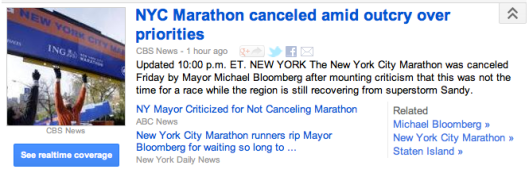
A nice example of the disconnection from reality that the elite reside within was exhibited this past weekend between NY Mayor Bloomberg and the survivors of the recent apocalyptic manifestation of human-induced climate change. Apparently the New York climate refugees that Sandy left in its wake felt that diverting much-needed resources to a marathon run was a little heartless and misappropriated as far as priorities were concerned:
What’s wrong with these people? Don’t they know that acknowledging the historic and unprecedented nature of such monster storms will disrupt this big fossil fuel-burning party we have going on here at planet Earth. For Christ’s sake, these new Frankenstorms are just the free market’s way of weeding out the wheat from the chaff. So what if the sea levels are rising faster than expected?!? If you can’t afford a walled fortress that can withstand future climate chaos along with the sky-high insurance premiums that go along with living in such vulnerable seaside spots, then move inland along with the rest of the uncompetitive and undeserving peons. In such a dog-eat-dog world, the wealthy will retreat behind their strongholds, complete with small farms and an army of private security guards to fend off the starving masses.
Some people like to comfort us with the idea that the economy will collapse long before we humans can continue burning all that coal and other carbon energy into the atmosphere. I guess such bloggers forget about all those pesky feedback loops and ecological tipping points we have already unleashed which will come to fruition no matter what we do at this point, or the fact that global dimming by sun-blocking aerosols is masking an additional 2 degrees of warming by some estimates. That kind of thinking – expecting a complete economic collapse to avoid the worst of what is already in the climate change pipeline – is just as hopelessly delusional as those who put their faith in a techno-fix like geoengineering or believe that God would not allow humans to destroy themselves.
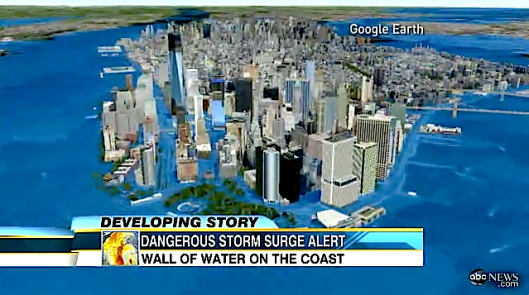
Rising sea levels, monster storms, hordes of fleeing climate refugees, crop-destroying droughts and floods, hellacious forest fires, dying ocean sea life, rogue geoengineering projects, and distraught scientists – the beginnings of these are all taking shape as climate change starts to kick into gear, putting into question the future of the human race. Ten years earlier, the effects of a storm like that of Sandy were foretold in a report entitled “Nation Under Siege” by Architecture 2030, a “non-profit, non-partisan and independent organization, established in response to the climate change crisis by architect Edward Mazria in 2002.” As Inside Climate News reports, the most disturbing part in this study is a 3-D map of New York (pictured below), illustrating the effects of a 3-meter (9.8-foot) rise in sea level: “Lower Manhattan, the East Village neighborhood and the FDR Drive underwater. That’s exactly what Sandy’s 3-meter storm surge delivered.”
In a recent post, I mentioned that one of the world’s premier insurers, Munich Re, was pricing in the rise of climate change disasters. Speaking from an Australian perspective, a very astute and sobering comment was made on this very subject of the insurance industry and climate change damage. Note that in addition to the ineffective carbon trading scheme, this is the best response we are likely to ever get from our ‘free market capitalist system’ (bold emphasis is mine):
We can take it as a given that nothing of scale will be done about climate issues until the bells toll at a deafening level. Sort of like a heavy cigarette smoker puffing his life away in spite of getting a clear diagnosis of very ill-health.
Meanwhile the insurers, Swiss Re(the big one), and Munich Re, set their numbers folk on the problem and come up with a price(premium) for geographically weak areas around the planet. The price for living in say, flood prone Manhattan, will be determined by these numbers. Fire risk, no problem, theft, no problem – but acts of nature, well the historical data is on our side, to a degree where no one can dispute it, as is the call of the world’s foremost climate experts, which governments ought not argue with. Consequently the premium for flood and tempest will be high – Indeed very high. Do you want this element of our insurance coverage? – and by all means try another insurer. They will tell you the same thing. A bit like going to bat for a fair priced earthquake cover in Christchurch at the moment, let alone in the decades to come.
As a result governments, both local and Federal, will have to become insurers of last resort – putting them in position where they too can face bankruptcy, like all of the other insurers who failed to crunch the numbers.
More than likely this is how the business-as-usual world, will approach the climate problem.
Structurally it is already happening in Australia in a quiet way, where CSIRO (Commonwealth Scientific and Industrial Research Organisation) have passed their climate models over to state governments, who in turn have passed the buck to local councils about the risks of rubber stamping building permits in storm and tempest prone coastal areas. Ergo, rate hungry local shires can be bankrupted in a trice from several directions. For one, the landowners claim they trusted the shire permit system – yet the insurers(if they take on the bet), have a clear path to recover their losses. Given that shires defied expert opinion from the country’s foremost climate authority, insofar as they were handed their projections, yet ignored them.
On the one hand some commentators might take these real world scenarios as leading indicators of how we are traveling in the climate fix – but the reality suggests they are trailing indicators at best. An after-the-event pricing for climate problems.
As for a global fix on climate – well insurers are leaving politicians in their wake. Coming up with real world pricing models, and all that.
As for the unwashed millions around the world – well there’s no money in them.
An interesting adjunct to this may be found in Australia’s refugee policy, where currently it appears to be suffering quite some stress. Yet it fails to include climate refugees in the decades to come. Say Bangladesh, where a small rise in sea level will have twenty million people on the move – begging questions from the UN – how many millions will Australia take.
Ian Angus observes on the website Climate and Capitalism that the masses will be left to fend for themselves like the survivors of Katrina:
As Naomi Klein wrote in the same year, in The Shock Doctrine, “It’s easy to imagine a future in which growing numbers of cities have their frail and long-neglected infrastructures knocked out by disasters and then are left to rot, their core services never repaired or rehabilitated. The well-off, meanwhile, will withdraw into gated communities, their needs met by privatized providers. ”
In short, now we all live in New Orleans.
Though the cost of Sandy to the Northeast is a small fraction of the total cost incurred by Katrina, this time climate change hit the seat of power and money in America rather than the poverty-stricken plebs of New Orleans who were quickly written off.
Even further back than the above study was one done ten years ago entitled “The Metro East Coast: Climate Change and a Global City.” One of the authors of that report and a senior research scientist at NASA Goddard Institute for Space Studies who heads the Climate Impacts Group is Cynthia Rosenzweig. She was on Democracy Now yesterday speaking about the forewarnings New York had been given:
CYNTHIA ROSENZWEIG: New York City—when we started over 10 years ago, we really started looking at New York City. New York City is actually—our estuary is shaped like a funnel. And hurricane winds and storms go counterclockwise, as we all know now. And when we have that arm, that strong arm of the storms, coming around, slamming right into our—the cone of our—the funnel of our estuary, we said over—over 10 years ago, we showed the maps of how vulnerable Lower Manhattan, Long Beach, parts of Staten Island, the low-lying areas—we’ve been telling people for over 10 years that these are the areas that we need to protect. We need to plan and protect them.
We’re also vulnerable because we have so much infrastructure. And, you see, we can’t think about our infrastructure in silos. “Oh, here’s the transportation system. Here’s the power. Here’s the water.” All of those three are interdependent. And we know now so strongly that when one goes out, especially the power, there’s cascading effects throughout all the systems…
Writing on Dissident Voice, Robert Hunziker comments on another Democracy Now interview from this week concerning the vulnerabilities of New York:
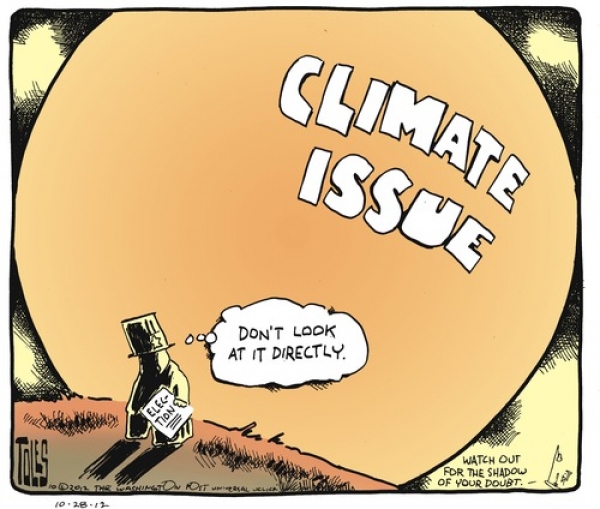
Here are a few pictorial commentaries from the net on Sandy:
And a perverse reaction from the barbarians at a Romney rally when a climate activist tries to break the silence on climate change:
No, it’s not dystopian fiction anymore; it’s terrifyingly real. Time to contemplate our existence on this little blue orb and decide what’s worth fighting for.
Halloween is around the corner and it’s become a bit of escapism for me from the real monsters sitting at our doorstep. When I was a kid I never had any idea or warning from my peers that everyday life would be wrought with so many bloodcurdling terrors. Such realities as climate change and ocean acidification are ever-present boogeymen slowly and methodically stalking us. Compounding the fear was the revelation that the cause of such civilization-ending phenomena stemmed from our exploitation of energy sources serving as the very foundation for our economy. We were killing ourselves and no one could stop it! This is a scenario more frightening than anything dreamed up in a Hollywood horror movie.
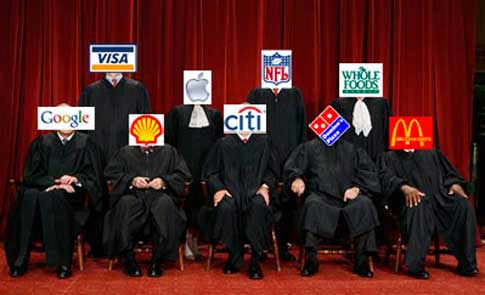
Delving deeper into these subjects only brings more unease as we learn that our self-inflicted eco-collapse is happening concurrently with the depletion of our carbon-based energy sources. Good God! Our food supply is at risk! We’re running straight for a cliff! Surely if we turn on the television set we will be greeted with warnings of our impending calamity, and our leaders will be doing everything in their power to save us. Holy Christ! Television has devolved into a mere propaganda tool of corporations! The politicians are whores to big business! The democratic process and elections are no more than an ultra-expensive ‘reality tv’ series funded by monied interests! The Supreme Court, along with all other mainstream institutions, has become a puppet of the corporatocracy.
Well then certainly the captains of industry will be intelligent enough to steer us away from this approaching doom. For the love of God! They are corrupted as well! The masses are simply pawns in their game of profit accumulation and market domination! The purpose of the Security and Surveillance State is to protect the interests of the elite and crush dissent! The Earth is just another planet to be commoditized by the ‘Free Market’, a force looked upon as more tangible and important than anything in nature! We’ve constructed a dual reality in which money is more important than air, water, and soil! God help us!!!
My last hope is that I can talk to people about all this scary stuff and maybe get some consolation. For the love of God! They all think I’m a doomsday nut and don’t want to hear about any of it! They say that I’ll be locked up in a mental institution if I keep talking about such crazy things, or I’ll get caught up in the net of Homeland Security for rocking the boat! Everyone is going about their daily lives as if none of what I point out is real and that things will go on as they have in perpetuity! “Technology will solve everything,” they say. “Don’t worry about it!”
You see, I wasn’t kidding about the frights of Halloween being pretty lame when compared to what’s confronting us in the world of globalized industrial civilization.
The following excerpt is from a recent U.N. assessment on the state of the world and food production. It’s not a pretty picture, but despite alarm bells ringing, our trajectory of ecological collapse is still firmly on track…
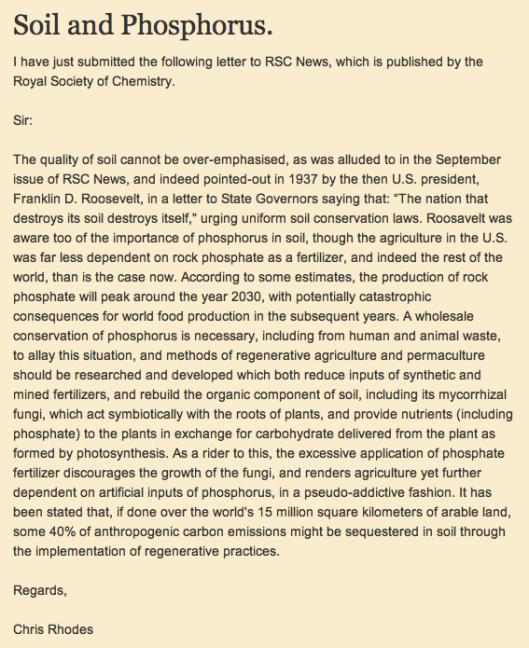
Click to go to full letter:
The human rights of people and well-being of the planet first? Don’t make me laugh. There’s that oxymoron again – sustainable development. Given the track record of the U.N. on solving problems, rest assured there won’t be any radical ideas coming out of that institution that might threaten capitalism’s death grip on the planet. If there’s no money to be made, resource to be exploited, or economic growth to be had, then it won’t get done. Period.
…From the UK Guardian article discussing the above U.N. assessment:
…Failing harvests in the US, Ukraine and other countries this year have eroded reserves to their lowest level since 1974. The US, which has experienced record heatwaves and droughts in 2012, now holds in reserve a historically low 6.5% of the maize that it expects to consume in the next year, says the UN.
“We’ve not been producing as much as we are consuming. That is why stocks are being run down. Supplies are now very tight across the world and reserves are at a very low level, leaving no room for unexpected events next year,” said Abdolreza Abbassian, a senior economist with the UNFood and Agriculture Organisation (FAO). With foodconsumption exceeding the amount grown for six of the past 11 years, countries have run down reserves from an average of 107 days of consumption 10 years ago to under 74 days recently…
…In a shocking new assessment of the prospects of meeting food needs, Lester Brown, president of the Earth policy research centre in Washington, says that the climate is no longer reliable and the demands for food are growing so fast that a breakdown is inevitable, unless urgent action is taken.
“Food shortages undermined earlier civilisations. We are on the same path. Each country is now fending for itself. The world is living one year to the next,” he writes in a new book.
According to Brown, we are seeing the start of a food supply breakdown with a dash by speculators to “grab” millions of square miles of cheap farmland, the doubling of international food prices in a decade, and the dramatic rundown of countries’ food reserves.
This year, for the sixth time in 11 years, the world will consume more food than it produces, largely because of extreme weather in the US and other major food-exporting countries. Oxfam last week said that the price of key staples, including wheat and rice, may double in the next 20 years, threatening disastrous consequences for poor people who spend a large proportion of their income on food…
…“The geopolitics of food is fast overshadowing the geopolitics of oil.”
…“The situation we are in is not temporary. These things will happen all the time. Climate is in a state of flux and there is no normal any more.
“We are beginning a new chapter. We will see food unrest in many more places.
“Armed aggression is no longer the principal threat to our future. The overriding threats to this century are climate change, population growth, spreading water shortages and rising food prices,” Brown says.
Further reading…
Food prices from 1990 to the present…
And an open letter(10-12-2012) by Professor Christopher Rhodes on our looming problem of Peak Phosphorus…
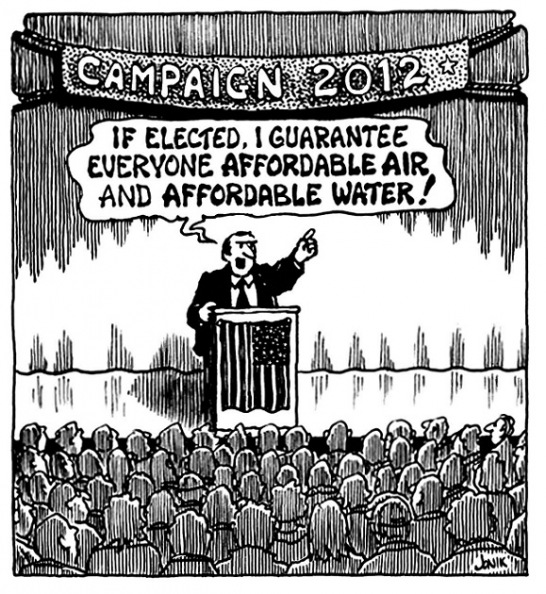
Our politicians should be running on a platform of issues concerning basic survival at this point.














 Collapse of Industrial Civilization