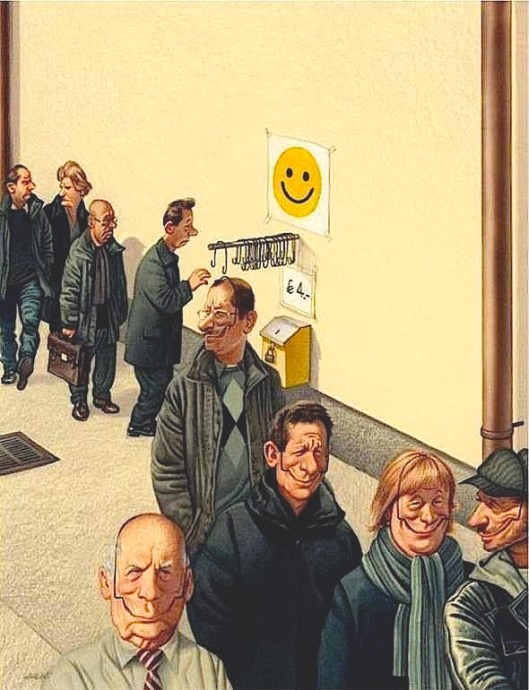
The Sequester has been the big topic in the news as of late. What it amounts to is austerity for the masses in America. Obama created this stealth austerity maneuver with his newly appointed Secretary of Treasury, Wall Street shark Jacob Lew:
…President Obama and a host of administration spokespersons have condemned the Sequestration, explaining how it will cause catastrophic damage to hundreds of vital government services. Those of us who teach economics, however, always stress “revealed preferences” – it’s not what you say that matters, it’s what you do that matters. Obama has revealed his preference by refusing to sponsor, or even support, a clean bill that would kill the sequestration threat to our Nation. Instead, he has nominated Jacob Lew, the author of the Sequestration provision, as his principal economic advisor. Lew is one of the strongest proponents of austerity and what he and Obama call the “Grand Bargain” – which would inflict large cuts in social programs and the safety net and some increases in revenues. Obama has made clear that he hopes this Grand Betrayal (my phrase) will be his legacy. Obama and Lew do not want to remove the Sequester because they view it as creating the leverage – over progressives – essential to induce them to vote for the Grand Betrayal…
In a rare case of truth-telling, a San Francisco news station spells out exactly what this stealth austerity is intended to do – strip away what is left of the social safety net and the remnants of the New Deal:
So while the financial elite are protected by wealth security insurance programs, aka quantitative easing and endless bailouts, the carcass of Main Street is picked clean by various asset grabs. Conservatives are correct in that you cannot have endless growth of debt and spending, but their demand of government cuts as the way to bring back growth and renew the economy will not work. It will serve only to further push down an already devastated middle class, hastening America’s fall into a barbaric neo-feudal society in a world of resource-scarcity and environmental devastation.
…It follows that neoliberal leaders of governments and their corporate masters view the ongoing economic contraction as a temporary deviation from the “natural” pattern of wealth accumulation-to-elites-trickle down-to-the-masses economics made possible by constant growth. Therefore, economic elites see an “opportunity” to use austerity as a cover to increase upward wealth transfer.[xi] A bonus is to accomplish the long-standing atavistic goal of rolling back[xii] the gains of the New Deal and Great Society.[xiii] Hence the massive governmental and corporate propaganda assaults on Social Security, Medicare and Medicaid –and other social benefits programs- as “Entitlements” that allegedly weaken the collective moral character, fiscal integrity and work ethic of the nation. The central premise of this attack -which is arrantly false yet widely disseminated without skepticism by mainstream media- is that these entitlements[xiv] for the “Lesser People”[xv]place the United States government at high risk of debt[xvi] default[xvii] or bankruptcy.[xviii]
Sixty years ago Karl Polanyi anticipated the present crisis when he wrote that belief in “free market forces” –a dogma at the core of neoliberalism[xix]– is a direct threat to the “natural environment…[which also] would result in the demolition of society.”[xx]…
…It is vital to remember that on the whole, they do not yet understand why modern societies -right now- are entering a post-growth world, which augers a context where government public policy –if it overcomes neoliberalism,[xxxv] which is not guaranteed- faces the central challenge of justly divvying up a shrinking economic pie. (Remember that almost every public health lecture, article and discussion in the United States ends with some variation of this exhortation: “We’re the wealthiest and greatest nation on earth. We’ve got the technology, know-how and resources to do the job; we just need the determination to commit them…”)
Neoliberal governments are blind to the emerging world of degrowth and continue apace facilitating the 1% to impoverish and cannibalize widening segments of the 99%, in essence producing more and more socioeconomically and politically superfluous people in the process. Neoliberalism can only operate in a social world where as the economy contracts -for thermodynamic reasons- wealth and other economic benefits continue to flow upwards, while the costs and burdens fall upon those outside the tiny elite economic… – source
In other words, capitalism is cannibalizing itself – eating the underclass and environment to keep this unchecked growth of wealth accumulation intact for the upper class, as scientist Brad Jarvis also explains:
The big news of the week was, of course, the “sequester,” one of several attempts by radical government-haters to open the door to unrestrained pillage of nature and society; it will cut back on many of the means we currently have for limiting and adapting to environmental damage. The scale of that environmental damage includes, of course, more than climate change: recent research shows that wild bees are more critical to our food supply than honeybees, and being wiped out by the top mechanism of extinction, habitat loss…
…I recalled something I learned a few years ago about what is perhaps the key driver of business operation, pursuit of profit. Profit must continuously increase, preferably at an exponential rate, for a business to be considered successful. There are several ways to do so: add value to what you produce, increase demand for what you’re already making, and reduce costs. The first two approaches increase consumption if the business can provide supply to meet demand, which is bad enough in a resource-constrained world. The last approach, however, is the most damaging when applied exponentially, because there is always a minimum cost required – you can’t get something for nothing – and if you’re “successful,” you are likely just good at forcing someone else to eat that cost. Many of the mechanisms directly causing unhealthy income and social inequality in this country and elsewhere may be directly tied to the application of this approach, but it has even more far-ranging effects. Because business is the most powerful human enterprise, society and the planet’s other species are effectively being forced to give more than they can afford and still survive. We are all dying as a result. – source
What else can I say, but that we will eventually have to eat the rich.
Jim Jarmusch’s 1986 masterpiece “Down by Law” with its rolling panorama of bleak pre-Katrina Louisiana, and distant, blank character stares suggesting inchoate malaise, effectively captured the unarticulated angst of the ascendant Reagan generation.
Like canaries in a coal mine, Jarmusch and other artists of the era anticipated the contemporary assault on class consciousness with pinpoint precision-decades in advance of the more cognitive punditry in evidence today.
This brings us to an interesting development in today’s post crash histrionics, which provides a conveniently compact diorama on display for all to view and interpret. We begin with what is intuitively obvious to any who care to observe, and that is the dynamic change in the character of the residential real estate market in most parts of the country, but especially evident in those areas hardest hit by the bursting bubble of speculative real estate.
This can be nicely cataloged by examining the infill areas of Southern California know as the “Inland Empire”.
Pre-2008 crash, these areas offered semi-affordable buying opportunities for homeowners priced out of the highly desirable coastal California markets, as well as respite for inner city residents looking to escape gang violence. Properties could be had for 1/3-1/2 of the price of a comparable dwelling in the more desirable areas near the coast and employment centers, but in return a 30-50 mile one way commute was extracted as compensation. In the era of $2/gal gas, this was deemed acceptable, especially as around the water cooler scuttlebutt yielded the notion that such a property could be bought and sold at a 50% profit 3 years later, with the proceeds used to buy a house closer to the employment centers thereby rendering the commute temporary.
This became a de rigueur business plan of many lower middle class workers, who one must acknowledge otherwise had a 1 in 10,000 chance in aggregating enough savings to achieve even a modicum of survivability in retirement.
I would make the case that the motivations were at the very least in line with the conventional bourgeoisie wisdom of bootstrapping one self’s upward in the social mobility chain by taking on some risk and making investments to better one’s life standing.
This explanation of course runs afoul of the current bourgeoisie narrative, which seeks to demonize those that participated in such shenanigans as irresponsible slobs and layabouts, lying on loan applications in a blatant attempt to defraud the salt of the earth folks in the financial industry of their hard earned capital. Because to concede that these people were simply following the time tried examples set forth by their more well endowed peers would be to point out structural cracks in a system that is perennially corrupt and unworkable.
So it goes something like this, if I do it and succeed, I shall be valorized, if you do the same thing and fail, it’s because you’re a dishonest layabout gaming the system.
OK, so now here is where it gets interesting.
The combination of rising gasoline prices, massive job losses and a real estate market in free fall meant that the “Inland Empire” was to become a major epicenter in residential foreclosures. To add insult to injury, the daily commutes to employment centers had become traffic nightmares, with a typical 40 mile commute taking 2 hours each way, so naturally private companies put in toll roads and toll lanes on state owned freeways and charged substantial toll fees to avoid this congestion.
As is well documented today, when 15 homes in a tract of 40 homes goes into foreclosure, no one else can sell their home either.
So guess what happens? Groups of institutionalized investors swoop in to buy these properties for pennies on the dollar, paying for them in cash as no realistic mechanism for property appraisal exists when such a large percentage of homes are in foreclosure.
All this anguish comes in pursuit of a modest home in the exurb of San Bernardino County, the epicenter of the Southern California housing crash. Plummeting values here sparked a vicious wave of foreclosures.
But it’s precisely because prices fell so far here that Sepe can’t buy a house now. In a sharp irony, many would-be homeowners in hard-hit markets can’t compete with a flood of all-cash offers from investors, some backed by Wall Street war chests.
So they’re missing out on the only upside of the real estate crash: historically low prices and interest rates.
The repeated rejections come despite Sepe’s solid qualifications: a stable job as a cell tower technician and a pre-approved home loan. He watches as houses hit the market, then get scooped up within an hour. He offered a battle metaphor to describe his plight.
“I am this little country,” he said. “And it’s like this huge country is coming and attacking my country, and I can’t win.”
No one thinks to consider this effect in terms of class consciousness, as the investors are of course valorized and the free market is commended for saving the real estate world in general, and those hapless former homeowners in particular. It is important to realize what is happening here, before our very eyes, and that is a.) the erasing and transference of an entire generation of home owners into permanent renters, and b.) the beginning of capital consolidation into the rentier class, effective displacing mom and pop rental property owners by big investment conglomerates like Blackstone Group and Oaktree Capital Management.
San Bernardino County, as well as two of its largest cities, Ontario and Fontana, stirred a national controversy when it recently considered — then shelved — a plan to use eminent domain to seize and restructure underwater mortgages. In a testament to the lasting effects of the crash, about 40% of borrowers in the region still owe more on their properties than they’re worth, according to mortgage tracking firm CoreLogic.
But a turnaround is well underway, thanks in part to deep-pocketed investors snapping up bargains with cash. The housing supply is now so tight that it’s common for home shoppers to put in 20 or 30 offers before securing a house, real estate agents say.
Aware of the destructive dynamic and further slide down the slope of income inequality, the county (with support from the State under Jerry Brown) put forth a proposal to seize the blighted properties under eminent domain laws, and then once owned by the county, to issue a county bond to provide funds at below market rates to loan back to the foreclosed homeowners allowing them to keep their homes.
Note the issue here is not so much below market loan rates, but availability of a lender (the county) to fill in for private mortgages, who will not loan under any circumstances into these blighted neighborhoods.
But of course this well meaning effort was drowned in the bathtub by the small gubymint crowd, you can well imagine the hew and cry of the conservative bourgeoisie when faced with such an obvious interference in the “free market”. Imagine the perceived travesty of a government entity intervening to prohibit free market evangelists from extracting their pound of flesh and smashing down an entire generation of the middle class back to the stone age and, I hope it goes without saying, perpetually converting these hapless suckers into a permanent revenue stream while they pay rent.
Private equity groups, including Oaktree Capital Management and Blackstone Group, have formed or partnered with companies dedicated to buying single-family homes. Unlike the flippers made famous by the housing boom, these institutional investors are in it for the long haul. They’re buying homes in bulk, then renting and holding them to reap long-term price appreciation.
Some of these private equity giants and Wall Street firms have employed former homebuilding pros and partnered with big apartment managers. Their plan is to transform the single-family home rental business, once a largely mom-and-pop affair, into a full-scale industry.
The Santa Monica real estate investment firm Colony Capital, founded by Tom Barrack, last year won an auction by the federal government to purchase 970 foreclosed homes in California, Arizona and Nevada from mortgage titan Fannie Mae for $176 million. Most of the California properties were in the Inland Empire.
Carrington Mortgage Holdings, based in Aliso Viejo, has partnered with Oaktree to buy and rent out single-family homes. Carrington spokesman Rick Sharga acknowledged that cash buyers have an advantage. But he said competition has helped revive a depressed market.
As promised, this neatly packaged diorama shows the full circle of exploitation and alienation of a full blown class war, in one easy to grasp trajectory:
– Financial capital consolidates and exploits the residential home mortgage market, securitizing these lousy loans for huge profits.
– When the boom goes bust, the same actors campaign aggressively to prohibit any mortgage relief, forcing widespread bankruptcies and foreclosures.
– The marketing arm of the financial capitalist spends tens of millions of dollars socializing the idea that these homeowners were and are morally deficient, and deserve no recourse. They are to be punished for their transgressions.
– These same financial capitalists with prey now firmly trapped then look for ways to further exploit their captives, and find examples in privatizing freeway systems to extract more revenue from commuters trapped in gridlock.
– The conservative and tea party fanatics interrupt their sheet-less Klan party long enough to advance the popular notion that further deregulation is needed, and demonize any government participation that might circumvent capital’s relentless desire to crush all but the few. In their capable hands, it becomes fashionable to decry government of any kind with a full throated call of Statism, and a groundswell is created to “restore liberty” and allow unfettered capitalism to thrive.
– Having discouraged any state intervention by conflating ideological association to diminished freedom, the mark is ready for the takedown. Large groups of investors swoop in with pennies-on-the-dollar all cash purchases of distressed properties en masse, displacing large segments of the population, and sometimes even renting the properties back to the original homeowner.
The upshot of this large scale displacement by capital effectively unwinds 70 years of New Deal and post WWII governance. State encouragement of home ownership was thought to be a useful means to ensure “skin in the game” for the working class, as in encouraging home ownership, labor strikes were thought to be less likely to occur with heady financial commitments hanging overhead, as well as community ties, might discourage labor activism.
They were right.
So this leaves a vulnerability and an internal contradiction, as large groups of former homeowners become permanent renters, they are disinclined to invest in the community, local economic spending goes way down (what renter will invest in the property?) impacting local business, and property crimes go way up as alienation and other side effects of visible and blatant exploitation percolate to the surface for the working class. Ironically, the size and magnitude of police state intervention will rise significantly as compared to the aborted eminent domain intervention, as now the upper middle class and general bourgeoisie will demand increased police (State) action to knock down property crimes and lawless behavior. Think police checkpoints and constant aerial drone surveillance of these communities.
The other effect as mentioned is the consolidation of the rentier class, wherein these large investment groups begin to “brand” the single family residence as part of a larger portfolio of related revenue streams, e.g. grouping big box stores nearby corporate owned rental developments in backdoor revenue sharing arrangements, eventually degrading to a truck system to more efficiently extract any remaining surplus from the working class. This large scale consolidation will bring the capitalist death spiral to small scale rentiers who own only a few rental properties, they will face exclusionary tactics wherein associated mercantilist outlets will give discounts to large company renters, but not to renters of the small independently owned properties. Further, the coercive laws of competition will be brought to bear on the independents, wherein access to community pools and other trinkets will be offered free or nearly free by the large corporate rent factories, and marketed as “lifestyle” destinations with corporate parties for renters only extending into the domain of social reproduction.
The demise of the independent rentier, or more aptly, the petite bourgeoisie, will follow almost as quickly as the former homeowner himself.
In order to understand why the world is locked into a blind stampede over a cliff, you have to understand how the world runs, i.e. its socio-economic system. A large percentage of the population doesn’t understand that the world is ruled by multinational corporations or that the citizenry are simply disposable pawns with no voice in their fate.
The capital that flows around the world, betting on essential staples of life and demanding that barbaric austerity measures be imposed upon the masses, is an entity of its own. It’s a massively destructive force that enslaves people and rips apart the environment. In the Banana Republic of America where a once thriving middle class was sold down the river, nearly half of workers will have a budget of $5 per day when they reach retirement age. Maybe McDonald’s will create a 99 cent meal to cash in on that starving demographic. Oh, they already have…
As far as the environment goes, it is a doormat for the creation of money:
When you have such an immovable supersystem of puppet governments and marauding transnational corporations running the show, radical movements questioning and trying to change the status quo are easily co-opted or crushed, a recent example being the Occupy movement. In a world where extinction of the human species is guaranteed by climate chaos and the myriad of other crises created by industrial capitalism, a slow and incremental regimen of change is not what is needed to stave off collapse. Unfortunately, the entrenched interests of the financial elite and the nation-states they control won’t allow for any sort of abrupt and profound transformation. As Professor Julian Cribb has correctly identified, a culture of money worship and the mass delusion of money’s illusory value is at the heart of the global crisis. The high priests of money are protected at the expense of all else:
Show me a democracy that has an impoverished public life and I will show you one dominated by oligarchs and plutocrats driven by profit maximization that will do anything to get over. Gangster activity is what it is. Scandal after scandal and when you get caught, you PAY MONEY, you don’t go to jail. Plutocrats wage class war, getting away with CRIMES (mortgage fraud, market manipulation, insider trading, securities fraud) every day. But get caught with a bag of weed in the hood and you are in the system, for LIFE. ~ Cornell West
For humans living under such a capitalist society, money determines whether you can eat or not, whether you have shelter or not, whether you can clothe yourself or not, or whether you can afford medical treatment or not. Quite literally, if you have no money in a capitalist society, you die. Money in today’s globalized capitalist system is everything.
When President Obama speaks about confronting climate change, he does so with the mindset of keeping the current capitalist power structure in place. Because of this self-defeating approach, everything he says is rendered useless rhetoric.
Putting aside the gross social inequalities and injustices of our current system, you tell me how we can avert disaster with the following realities:
Without changing the socio-economic system under which we live, no real solutions for the multiple civilization-ending crises we face can be properly addressed. There is an expiration date for this unending conversion of the natural world into fake symbols of wealth hoarded and squandered by a greedy few…
In my last post I juxtaposed the absurdity of the President speaking about the moral imperative of gun control, all the while the deadly effects of climate change have steadily mounted, promising to wipe modern civilization off the face of the Earth by the end of this century. Similarly, another insidious and seemingly invisible danger lurks all around us, constituting a much greater threat than firearms or numerous other dangers that society sees fit to launch high-profile campaigns against. Professor Paul P. Elrich has warned of man-made environmental toxins and their long-term effects:
We don’t know nearly enough about most of them [man-made chemicals] or how they might affect our health in the long-term, especially mixed together. There may be surprises ahead that we won’t like,’ said Professor Ehrlich… According to Professor Ehrlich, global toxification ranks with climate disruption and acute biodiversity loss as one of the world’s most serious environmental problems.
The Earth is a closed system and within that system 30 >400 million tonnes of man-made chemicals are produced annually by the chemical industry whose size is expected to triple by 2050. According to a study by Onstot and others, everyone alive today carries traces of 700 chemicals which have become ubiquitous in the environment and whose effects are poorly understood. Industrial capitalism’s dehumanizing fetish for technology along with its overriding concern for protecting profits has unleashed a growing flood of toxic pollutants into the biosphere.
Between 1930 and 2000 global production of man-made chemicals increased from 1 million to 400 million tonnes annually. – link
This toxic soup has been created in just the last 100 years and has embedded its poisonous fingerprints into the biological make-up of all living things on the planet. An article sent to me by Professor Julian Cribb provides some shocking numbers that describe the extent of industrial civilization’s toxic accumulation in the environment:
…The US Centres for Disease Control and Prevention, in a regular survey, finds certain industrial ”chemicals of concern” in the blood of 90 per cent to 100 per cent of the American population. The Environmental Working Group, a US non-government organisation, in independent tests reported the finding of 414 industrial toxins in 186 people ranging in age from newborns to grandparents. In a further disturbing piece of research it found 212 substances, including dioxins, flame retardants and known carcinogens, in the blood of newborn babies, who had been contaminated while in the womb. Tests from China to America to Europe have discovered industrial toxins in the breast milk of nursing mothers.
Groundbreaking Australian research has found even when dead and buried, people release their toxins back into groundwater and the environment, giving them back to future generations…
Just as the fossil fuel industry funds groups to confuse the public on climate science, so too does the chemical manufacturing industry hide behind the mantle of manufactured scientific uncertainty. What good is a system that hides the truth and circumvents government regulation, endangering and killing people so as to protect the agenda of profit-seeking corporations? Any social good touted by industry is negated or severely diminished from the environmental degradation and the damage to public health/safety of these unregulated chemicals. Increased cancer rates/deaths, multi-generational birth defects, and a collapsing environment unfit for human or animal habitation is not “progress” or “advancement”. As Chris Hedges would say, it’s the myth of human progress. Rachel Carson, author of Silent Spring, wrote about capitalism’s inability to self-regulate in the interests of public safety:
When a scientific society acknowledges a trade organization as a ‘sustaining associate,’ whose voice do we hear when that society speaks—that of science or that of industry? This is an era of specialists, each of whom sees his own problem and is unaware of or intolerant of the larger frame into which it fits. It is also an era dominated by industry, in which the right to make a dollar at whatever cost is seldom challenged. When the public protests, confronted with some obvious evidence of damaging results of pesticide applications, it is fed little tranquilizing pills of half truth…
…The major chemical companies are pouring money into universities to support research on insecticides. This creates attractive fellowships for graduate students and attractive staff positions. Biological-control studies, on the other hand, are never so endowed – for the simple reason that they do not promise anyone the fortunes that are made in the chemical industry. This explains the otherwise mystifying fact that certain outstanding entomologists are among the leading advocates of chemical control. Inquiry into the background of some of these men reveals their entire research program is supported by the chemical industry. Can we ever expect them to bite the hand that feeds them?…
At the rate we are fouling the Earth, trying to cover up our mess is becoming increasingly difficult:
I mentioned earlier that I’d talk about my reading list. I’ve got a few books I’ll review for this site. The one I’m reading currently is about how the U.S. Southwest, where I live, will be affected by anthropogenic climate change. The book is ‘A Great Aridness‘ by William deBuys.
A few excerpts from the intro:
As deBuys mentions in his intro, the housing market in the Southwest, in particular Phoenix, took a hit in 2008 but is expected to get back on the [population] growth track in the near future.
I will go so far as to say that not only growth but capitalism itself may be in part dependent on a growing population,” Pacific Investment Management Co.’s Bill Gross wrote. – link
Capitalism is fueled by population growth. More people = more consumption = increased GDP and tax revenues.
Elliott D. Pollack, CEO of the economic and real estate consulting firm Elliott D. Pollack & Co., said Arizona’s economic growth depended on adding 100,000 people every year. The population boom fueled growth in “people–serving” jobs, such as doctors, real estate agents and salespeople, he said.
Pollack said he doesn’t expect Arizona to return to the job growth of 2007, just before the crash, until 2015.
“It will be almost a lost decade,” he said. – link
The following satellite pictures tell the tale of the exploding population in Phoenix, even coining a new phrase to describe such explosive growth suburbs as “Boomburbs“…
In the early twentieth century, when big American cities spawned satellite cities, those satellites were often downscaled mimics of the cities they surrounded. Like New York City, for example, its suburb Newark, New Jersey, had its own downtown. In the second half of the twentieth century, however, a different kind of satellite city emerged: a populous suburb with no central business core. “Boomburbs”—suburbs with populations of 100,000 or more that have maintained double-digit growth over decades—are primarily a phenomenon of the southern and western United States….
…Like much of the American Southwest, southern Arizona is arid, and agriculture depends on irrigation. As a result, cultivated fields—rectangles of green and brown—contrast with the pale tan of the naturally bare desert soil. In the 1989 image, most of the land east of Chandler is agricultural. Between 1989 and 2009, however, most of the fields give way to the blue-gray colors of buildings and pavement. In 2009, only a small number of agricultural fields remain, mostly east and south of Route 202. Because many of the United States’ boomburbs occur in the arid Southwest, planning for their water needs is particularly challenging for metropolitan and municipal governments. – link
Getting back to the book’s theme of climate change and the U.S. Southwest, a ballooning population is running headlong into a future characterized by a “new form of desertification… [brought on by] industrial society’s abuse of the atmosphere.” Radical transformation of our corporate-monopolized economy is the only way that climate change can effectively be dealt with. This would, however, appear all but impossible when any form of true government oversight and responsiveness to the citizens has been thoroughly corrupted and sidelined by corporate interests. According to a review in Truth-Out, deBuys illustrates in detail how corporate power is preventing any such changes:
…Of all his stories documenting the choppy and chaotic effects of global warming in the Southwest, especially the rising temperatures and the plagues of droughts, fires, and bark beetles killing thousands of acres of forest trees, I found the natural history and political drama of Mount Graham the most compelling. This is an example where political corruption and higher temperatures collude in unleashing the decline and fall of the Southwest…
…DeBuys sums up both the science and the biopolitics (ruthless politics) sealing our fate. He sees the triumph of corporate power as a resurrection of the 1520 Requerimiento, Spain’s legal justification for the enslavement and murder of the resisting indigenous people to clear the way for Spanish plunder and political control in the Southwest and Latin America. Indeed, the Requerimiento marked “the momentum of Spain’s imperial impulse,” no different than “the momentum of contemporary climate change today.”
The connection of past colonialism with its present variety, triggering and making global warming possible, is an insight into and a lesson on how the future is likely to be…
There are two major differences between the avarice of the Gilded Age Robber Barons and that of today’s all-powerful multinational corporations. Firstly, the corporations of today are much more omnipotent and control society through a form of despotic rule called ‘inverted totalitarianism‘. As Montana Governor Brian Schweitzer exclaimed last summer, “They were pikers compared to what we’re doing now.” Secondly, an egregious wealth gap and the political disenfranchisement of the worker do characterize both periods, but now the world must contend with climate chaos along with a host of other environmental problems, any one of which can bring down modern civilization.
I wanted to comment on XrayMike’s excellent and provocative post “Earth to Humans”, as well as some of the follow up comments, but the response got a little lengthy so I am guest posting my remarks.
This linkage between capitalism and the economy, labor exploitation, environmental sustainability, population growth and various and sundry other issues is so complex that it defies deterministic explanation.
Attempts to assign single variable responsibility to any culture, economic system or similar set of circumstances are inherently flawed. These phenomena are overdetermined, which is to say that they contain dialectic influence between each other, which is in effect multi-variable causality. Very difficult to resolve, and there are but two fields that can do this (dynamic, non linear interactions), mathematics and philosophy. It is interesting that the field of philosophy was the first to resolve these methods, in the absence of mathematical tools.
Dialectic philosophy can mean many things, but in this context it is the ever changing relationship of causality between a political economy and the environment, population growth, and resources.
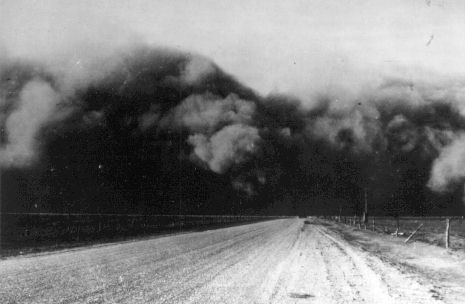
To cite an example, I’m reminded of an excellent PBS special that I saw a few months ago, “The Dust Bowl” which provides ample (and contemporary) illustration of the interaction between capitalism and the environment.
The Dust Bowl was the worst man made environmental disaster in recorded history, and illustrates the nebulous and overdetermined link between population, capitalism, and the political economy.
Hard on the heels of the Great Depression, the ‘30’s brought the convergence of several influential factors to the travesty of population settlement in the American Great Plains. Fueled with the intoxicant of Manifest Destiny, the dynamics of the era were remarkable, as simultaneously and with varying degrees of import, we saw the following:
1.) A ceaseless expansion of population from the East and South westward into the Plains and onwards to the Pacific. There were many factors contributing to this westward expansion, but central was the fresh memory of the Mexican-American war, the ongoing dispute over the Oregon border with the British empire, and other land grab type concerns on the part of the US Government. By now the native Americans were suitably marginalized by the offshoot of Manifest Destiny, namely, the machinations of Accumulation by Dispossession, the time honored means to justify a good old fashioned land grab. What was left was a State sponsored occupation of these territories under the Lockean theory of ownership by virtue of land cultivation.
2.) To accomplish this, we had a series of “Homestead Acts”, legislation which essentially gave away land parcels in the Great Plain regions ranging from 160 acres (circa 1860) initially, then gradually expanded to 640 acres (circa 1930). Basically free land for any who might ask. These were typically settled by families, who raised sufficient numbers of children to work the land plots as productive farms, it being key to the number of family members relative to the size of the plot. These small independent farms were decidedly non-capitalist, although they did contain internally, strong elements of class structure, mostly feudal class. This arrangement (homesteading) was preferred by the capitalists of the North, as they were concerned about the Southern states rampant success with large scale plantations using slaves, (circa 1860) as the Northerners (with the Industrial Revolution now underway) could not compete with free slave labor. They knew full well in a few decades time that these independent homesteaders would be subsumed into the capitalist mode of production with the emergence of new factories and the spectre of large scale competition from massive factory farms, ultimately rendering the small family farmer obsolete.
3.) What these farmers did not know was that the arid land in the Great Plains had evolved over the centuries to include a ground cover of prairie grass, a drought tolerant plant that covered the vast majority of this enormous land mass East of the Rockies.
4.) At the same time, Industrialization of the Northern states and Great Lakes regions began to take hold to a very significant scale, and the transition to mechanized farming was begun in earnest. Companies like John Deere, Caterpillar, and many others began where Eli Whitney had left off, and brought massive mechanization to the farm business. Capital again plays a multi-faceted role, exhibiting it’s curious ability to simultaneously fund the enormous factories (modes of production, including entire supply chains) and at the same time to fund the customer base as well. And the customer base was the small 160 acre farmer run by a traditional family. So how does this work, how does a dirt poor farmer obtain a piece of capital equipment? Why he borrows the money of course, and this era has the interesting attribute of the emergence of a third arm of Capitalism, the Money Lending Capitalist, to the retail farm sector. They borrow the money using the Government supplied Homestead Act land as collateral. The same money lending capitalists also lent money to the John Deere’s of the world to expand the mode of production, and lending to large scale factory farmers at the same time. But perhaps most interesting to me anyway, was the legacy of farm equipment manufacturer John Deere, who during this period filled the role of Money Lending Capitalists, as they built scores of community based local dealerships and get this, gave out the tractors to whoever wanted one (for a small monthly payment of course). This circular monetary flow is a critical illustration to how capital works, funding both expansive modes of production, as well as the customer base. It also illustrates the ingrained tension between separate money lending capitalists (such as banks) and industrial capitalists, (in this case John Deere) as Deere wanted desperately to control the financing of their equipment, using both the machines and the land as collateral. How can you lose?
The irony though is how the recipients of these “factory” loans from John Deere perceived the fleecing of their surplus value, unlike the banks which were largely reviled during and after the Great Depression, especially by the farm community, the reputation of John Deere rose like a shooting star, with it’s fanatical customer base ever grateful for the “neighborly” largesse the corporation showed, even as it was repossessing failed farms. Those suckers never knew what hit them.
5.) If this was not enough, the world was undergoing a massive shortage of wheat production, largely due to the loss of Russian wheat farming, which was having a few problems of its own what with Stalin’s antics. At the time, Russia was the largest producer of wheat in the world, and this capacity suddenly went off line. This prompted a near panic in the ‘30’s, with the US government facing the very real possibility that it could not access sufficient wheat to feed its population, and as such offered incentives to homesteaders to grow wheat with highly subsidized wheat pricing.
Hopefully the point is made that these five factors combine simultaneously to unleash a set of conditions that results in the worst man made environmental disaster ever recorded. No one single factor is to blame, rather the interaction at precisely the right time and exactly the right proportion was needed to create this disastrous result. Dialectic reasoning allows one to consider these multiple factors that are constantly interacting and changing, and to assess the system as a whole, as well as to derive meaning.
The small farmer, flush with opportunity to provide for his family and at the same time to raise his standard of living significantly, went with the program and borrowed money to buy farm equipment. At the turn of the last century, these types of purchases were made by collective, as any fool knew that a small farmer did not need expensive capital equipment that was used 2 weeks a year for harvest and then sat idle for the remainder. These machines were shared, and where possible, harvests were time phased to allow a harvester or combine for example, to serve a number of nearby farms. One of the key attributes of the early and mid 20th century was the atomization of collective groups into individual consumers, effectively turning them away from collective sharing into not just stand alone consumers, but consumers competing with each other (for status) as well as capitalist aspirations. (A Dodge in every garage)
What with all these new tractors, what is one to do but to start tearing up the ground and plant, you guessed it, wheat. So all that centuries old prairie grass was quickly dispensed with, and one got about the business of rutting up the earth as fast as possible to plant wheat in order to get some of the subsidized wheat pricing in order to buy some consumer goods. At first, it was a “bumper” crop, so named as the bounty was often so large as to weigh down the bumper of the vehicle when it went to market.
Now all that was missing was an inflection point, and this came in the form of a massive drought which commenced in 1930 and lasted for more than a decade. Now that the prairie grass was removed by damaging farming practices (largely by tractor) over millions and millions of acres of land, there was no ability to retain any moisture, nor to hold and maintain topsoil.
And then the winds began.
In November, 1933, the Great Plains were besieged with truly incomprehensible wind storms that lifted up the newly exposed top soil and blew it hundreds, and in some cases thousands of miles. This went on with great frequency, often several times a week for 5, 6 , 7 years. The clouds were truly frightening and the dust permeated every pore of a house, caused massive lung infections and death (mostly of children), and resulted in the slaughter of millions of cattle as they had no food to eat. Large trenches were dug in farm fields, starving cattle herded into the trenches and shot to death by the hundreds of thousands. It was common to run a rope from the kitchen porch to the barn, as during the daytime dust storms it was impossible to see the “arm in front of your face” and people could get lost and die in their own backyard. The density of the black was described as “two midnights in a jug” hence the title of this post.
So how does one interpret this calamity? Is this a natural result of population growth, a symbol of man’s disrespect for the environment, a reveal of the vagaries of capitalism, or as some might say, an example of government intervention gone wrong. All have credible narratives around them, but the right answer is neither in the singular, the right answer considers that these effects occurred in synchronization with each other, and all had varying degrees of causality. All the listed factors are contributors, as well as some not listed.
But the illustrative lesson of the Dust Bowl may be distilled down to several key contributors, one of which might be the notion that man acting in his own best interests does not in fact benefit society as a whole. If farmers all around you practice destructive farming, and you do not, you are affected, and so are other non participants. These types of discussions lead to a thought domain characterized by John Rawls (Theory of Justice) and Robert Nozick’s (Anarchy, State, and Utopia) wherein the principle of side rights of the individual is broached effectively.
This type of thinking is an essential step to recognizing that governance and political philosophy have moved on substantially from Adam Smith’s Wealth of Nations. Particularly, the realization that “side rights” or the influence of a neighbor reducing your utility while in pursuit of his so called “liberty” is an intellectual dead end and is contradictory to the principle of any meaningful freedom. So is the prospect of being forced to sell your labor power for sustenance, to those that would exploit you- the very antithesis of freedom. Modern conservatives do not acknowledge side rights, principally because they are stuck with a paradigm where ostensibly the government is to blame for all that is wrong.
In fact, the opposite is often the case, and history illustrates many examples where government intervention, central planning, and other types of consolidated (as in not local) government edicts were essential to provide corrective action. We can again look to the Dust Bowl for evidence, as we have another contemporary example. These settlers were fiercely independent and reliably self sufficient, every bit what the modern libertarian would strive for, yet only with substantial government intervention were the ravages of the Dust Bowl finally mitigated through, among other initiatives, government demonstrated upgraded farming practices that rectified the environmental damage precluding it from happening again. After nearly a decade of this self realized environmental disaster, the settlers were, literally, begging for government support and guidance to get back on their feet.
This also occurred in the late 19th century, with the start of the Progressive Era and the time of the Robber Barons, wherein the population begged and demanded that the capitalists of the day be brought to heel. This worked until the ‘20’s and the Gilded Age, when Capital shed the chains of progressive influence, and once again blew the place up with the 1929 Crash, which brings us full circle back to the Dust Bowl.
Yes, everyone will die, every empire will fall, every monetary system will collapse, and ultimately we will in fact consume all of the finite resources on our planet. To this ultimate end, no one can offer a panacea, not Marxism, not Communism, and certainly not Capitalism, all will ultimately collapse if for nothing else but lack of resources. But it is our lot to Reason, it is human to better oneself.
We have been infected with a malaise that has altered our very DNA, it has damaged our ability to reason, it has blinded us to the contradictions that are self evident, it has promoted false consciousness, and it has denied the very discussion of alternatives.
Why, then, are radicals so hesitant to talk about what a different system might look like? One of the oldest and most influential objections to such talk comes from Marx, with his oft-quoted scorn toward utopian “recipes” for the “cookshops of the future.” The moral of the quote, supposedly, is that a future society must emerge from the spontaneous dynamics of history, not from the isolated imaginings of some scribbler. This isn’t without some irony, since two years later Marx the scribbler wrote his own little cookshop recipe in his Critique of the Gotha Program — it involved labor tokens, storehouses of goods, and an accounting system to determine how much workers would get paid.
As it happens, Marx’s comment was a riposte to a negative review he’d received in a Paris newspaper run by devotees of the philosopher Auguste Comte, criticizing Marx for offering no concrete alternative to the social system he condemned. (That’s why, in the original quote, he asks wryly if the recipes the reviewers had hoped to see happened to be “Comtist” ones.) To grasp the context, you have to understand that like many utopian writers of the era, Comte proffered scenarios for a future society that were marked by an almost deranged grandiosity, featuring precise and fantastically detailed instructions on practically every facet of daily life. It was this obsessive kind of future-painting that Marx was really taking aim at.
(…)
Maybe the most fundamental reason the Left has been suspicious of such visions is that they have so often been presented as historical endpoints – and endpoints will always be disappointing. The notion that history will reach some final destination where social conflict will disappear and politics come to a close has been a misguided fantasy on the Left since its genesis. Scenarios for the future must never be thought of as final, or even irreversible; rather than regard them as blueprints for some future destination, it would be better to see them simply as maps sketching possible routes out of a maze. Once we exit the labyrinth, it’s up to us to decide what to do next.
There is much ongoing dialogue on how to fold some of the more contemporary concepts of political philosophy into actionable lifestyle choices, and I am a big fan of these types of discussions- even if they do turn circular (which they often do). But nevertheless, initiatives like Richard Wolf’s worker funded exchanges wherein surplus value is distributed to workers, and managers are elected democratically, and (as in the excerpt above) centrally planned command economies are hybridized by using free market demand signals to inform production volumes and regional needs. Reintroducing class consciousness as a repetitive topic of discussion reinforcing where and when exploitation occurs is another example.
The major impediment of any refined approach to political philosophy is not so much what we don’t know, it’s discarding the nonsense that we do know.
I think the circumstances on Easter Island although not capitalistic, were similar to what happened in the Dust Bowl, one factor was inadequate and (at times) inappropriate command level decisions. I think if you trace most of the pre-capitalist failures of societal endeavors you will find similar themes, improper or missing command authority, reliance on principles of self liberty over common good, lack of class consciousness, etc.
Capitalism just adds rocket fuel to a fire that is already smoldering.
Dissecting some recent New York Time’s propagandist cheerleading on the fiscal cliff deal as “progressive taxation”, Yves Smith calls it as it is – ‘A Big Lie’. Her article appears in the NYT Examiner which is a site dedicated to analyzing the corporate spin of the New York Times.
When you have an economic system that rewards those who can most effectively exploit society and the environment, then psychopaths invariably rise to the top of the socio-economic heap. That’s why Obama has no hesitation in carrying out extrajudicial assassinations, or that former Countrywide CEO Angelo Mozilo lead the charge on profiteering from sub-prime mortgages, or that BP CEO Tony Hayward can set off an epic ecocide in the Gulf of Mexico and call it “tiny” and then complain that he “wants his life back.” The book ‘The Wisdom of Psychopaths: What Saints, Spies, and Serial Killers Can Teach Us About Success’ lists the top four jobs for psychopaths as:
1. CEO
2. Lawyer
3. Media (TV/radio)
4. Salesperson
I can’t believe that politicians didn’t even make it into the top ten.
Politicians are more likely than people in the general population to be sociopaths,” says clinical psychologist and author Dr. Martha Stout…”I think you would find no expert in the field of sociopathy/psychopathy/antisocial personality disorder who would dispute this,” Stout continued. “That a small minority of human beings literally have no conscience was and is a bitter pill for our society to swallow — but it does explain a great many things, shamelessly deceitful political behavior being one.” – link
But since America is a corporation or corporatocracy, essentially captured 100% by business interests, you can interchange the number one spot of CEO for the POTUS. Corporations write the legislation through bought-off politicians, control public opinion through mainstream media and policy institutions, degrade the education system into a conveyor belt of unthinking corporate drones for a life of corporate consumerism, and manipulate society through all other levers of power while crushing any uprisings with its panoptic security/surveillance apparatus.
In the video below, Chris Hedges talks about sacrifice zones like mountain top removal for coal in West Virginia, but knowing what we know about the state of the biosphere, in particular climate change and ocean acidification, we can say that the entire planet will soon be one big sacrifice zone. The “rapacious, immoral elites” are on track to take the entire planet down. What makes this oppressive system so immovable is that everyone is a participant, whether by choice or not.
An interesting article came to my attention via a referral from The Big Picture. The economics editor of the Sydney Morning Herald, Ross Gittins, has written an article, The four business gangs that run the US, which is a review of Jeffrey Sachs book, The Price of Civilisation. Sachs should have entitled his book ‘The Price of Capitalism’. In order to protect corporate interests, the exploiters will always use their wealth to bribe the political system (such as campaign contributions and promises of lucrative positions in the private sector after leaving government posts). We are all familiar with feedback loops in terms of climate change,but there also exists one within our socio-economic system which is extremely destructive. I refered to this feedback loop as the government-corporate-lobbyist complex in my postGuns, God, and Greenback$.Sachs describes this pernicious feedback loop, which has accelerated wealth to the top 0.001%, as follows:
Sachs says…
Corporate wealth translates into political power through campaign financing, corporate lobbying and the revolving door of jobs between government and industry; and political power translates into further wealth through tax cuts, deregulation and sweetheart contracts between government and industry. Wealth begets power, and power begets wealth.
Sachs even uses the term corporatocracy to describe the four primary U.S. business sectors which have usurped our government:
1.) Military-Industrial-Complex
Sachs says…
As [President] Eisenhower famously warned in his farewell address in January 1961, the linkage of the military and private industry created a political power so pervasive that America has been condemned to militarisation, useless wars and fiscal waste on a scale of many tens of trillions of dollars since then.
2.) Wall Street-Washington complex
This group, comprised primarily of the big financial corporations (i.e. Goldman Sachs, JP Morgan Chase, Citigroup, Morgan Stanley), systematically worked to “capture” regulation and take control of the money system which, Sachs says, “paved the way for the 2008 financial crisis and the mega-bailouts that followed, through reckless deregulation followed by an almost complete lack of oversight by government”.
3.) Big Oil-transport-military complex
Sachs says…
Since the days of John D. Rockefeller and the Standard Oil Trust a century ago, Big Oil has loomed large in American politics and foreign policy. Big Oil teamed up with the automobile industry to steer America away from mass transit and towards gas-guzzling vehicles driving on a nationally financed highway system.
Now you know why America has a rail system that even the Bulgarians would be ashamed of, as Kunstler is fond of saying. Next time you fill up your tank, think of the perpetual oil wars in the Middle East as an externalized cost of subsidizing America’s car culture. Anita Dancs calculated the cost of securing our liquid fuel addiction back in 2010:
…Put all these numbers in perspective: The price of a barrel of oil consumed in the United States would have to increase by $23.40 to offset military resources expended to secure oil. That translates to an additional 56 cents for a gallon of gas, or three times the federal gas tax that funds road construction.
If $166 billion were spent on other priorities, the Boston public transportation system, the “T,” could have its operating expenses covered, with commuters riding for free. And there would still be money left over for another 100 public transport systems across the United States. Or, we could build and install nearly 50,000 wind turbines. Take your pick.
Sachs also reminds us that “Big Oil has played a notorious role in the fight to keep climate change off the US agenda. Exxon-Mobil, Koch Industries and others in the sector have underwritten a generation of anti-scientific propaganda to confuse the American people.”
4.) Healthcare Complex
Sachs says…
The key to understanding this sector is to note that the government partners with industry to reimburse costs with little systematic oversight and control. Pharmaceutical firms set sky-high prices protected by patent rights; Medicare [for the aged] and Medicaid [for the poor] and private insurers reimburse doctors and hospitals on a cost-plus basis; and the American Medical Association restricts the supply of new doctors through the control of placements at medical schools.
‘The result of this pseudo-market system is sky-high costs, large profits for the private healthcare sector, and no political will to reform.
We are the only industrialized country on Earth without universal healthcare. We pay more than anyone else and get less for the money spent. One of every five or six GDP dollars goes to feed this beast, but our life expectancy doesn’t reflect it:
Sachs says the elite take care of their own and have no concern for the plebs down below:
There is absolutely no economic crisis in corporate America. Consider the pulse of the corporate sector as opposed to the pulse of the employees working in it: corporate profits in 2010 were at an all-time high, chief executive salaries in 2010 rebounded strongly from the financial crisis, Wall Street compensation in 2010 was at an all-time high, several Wall Street firms paid civil penalties for financial abuses, but no senior banker faced any criminal charges, and there were no adverse regulatory measures that would lead to a loss of profits in finance, health care, military supplies and energy.
Ross Gittins concludes his review of Sachs’ book by briefly summarizing the path the elite took to amass their incredible wealth:
The 30-year achievement of the corporatocracy has been the creation of America’s rich and super-rich classes, he says. And we can now see their tools of trade.
It began with globalisation, which pushed up capital income while pushing down wages. These changes were magnified by the tax cuts at the top, which left more take-home pay and the ability to accumulate greater wealth through higher net-of-tax returns to saving.’
Chief executives then helped themselves to their own slice of the corporate sector ownership through outlandish awards of stock options by friendly and often handpicked compensation committees, while the Securities and Exchange Commission looked the other way. It’s not all that hard to do when both political parties are standing in line to do your bidding, Sachs concludes.
There was a comment that Darbikrash made on another website a year ago which pertains to this subject and clearly explains the corrupting influence that money has on government. Here is an excerpt:
You better believe that the financial elite who run this country do have OWS and any other social movement under 24/7 surveillance. Anything that strives to change the status quo of neoliberal capitalism will be undermined and crushed, whether through covert actions or co-optive schemes. Social justice, the environment, and the very habitability of planet earth are not on the agenda of the 1%’ers.
Now we have official confirmation that this indeed was and is the case. Surprise, surprise:
Newly obtained documents confirm that the Federal Bureau of Investigation was monitoring peaceful protesters with the Occupy Wall Street movement before the first OWS demonstrations even began…
…The list of documents, says Verheyden-Hilliard, “is a window into the nationwide scope of the FBI’s surveillance, monitoring, and reporting on peaceful protestors organizing with the Occupy movement.”
“These documents show that the FBI and the Department of Homeland Security are treating protests against the corporate and banking structure of America as potential criminal and terrorist activity,” she writes. “These documents also show these federal agencies functioning as a de facto intelligence arm of Wall Street and Corporate America.
What more proof do you need that we live under a corporatocracy? Since solving dire problems like climate change would require a complete dismantling of the current capitalist system, i.e. an economic system driven by the profit motive is incompatible with ecological sustainability, we can see why the financial and corporate elite would be hostile to a grass-roots movement which seeks social and environmental justice. Such issues don’t compute with the bottom line of corporations or our war-based economy. Interestingly, the only real attention that was given to OWS by those in power was on how their discontent could be co-opted by the status quo:
As I [Glenn Greenwald] noted several weeks ago, White House-aligned groups such as the Center for American Progress have made explicitly clear that they are going to try to convert OWS into a vote-producing arm for the Obama 2012 campaign, and that’s what “Occupy Congress” is designed to achieve.
Of course the Tea Party was never really a threat to Corporate America because it’s what is termed an astroturf group, as was first reported a few years ago by Australian filmmaker Taki Oldham:
Do you think these free-market idealogues of capitalism are going to clean up the mess left in the wake of climate chaos? Hell no. The unwashed masses are on their own. As long as the elite have the money to insulate themselves from the ravages of our fossil fuel-dependent economy, they will have no real concern for the catastrophes that lie ahead. A case in point is the recent aftermath of the Hurricane Sandy Frankenstorm:
Billionaire David Koch’s prime political organization, Americans for Prosperity (AFP), having failed in its $125 million quest to oust President Barack Obama, is now aiming at a slightly less sophisticated political target: victims of Hurricane Sandy. […]
Earlier this week, AFP, which is chaired by Koch and believed to be financed by several other plutocrats from the New York City region, released a letter warning members of Congress not to vote for the proposed federal aid package for victims of the storm that swept New Jersey, New York City and much of the surrounding area in October. An announcement on the group’s website says that the vote next week for the Sandy aid package will be a “key vote” — meaning senators who support sending money for reconstruction could face an avalanche of attack ads in their next election. Already, opposition to the bill is growing, although it passed one procedural hurdle last [Friday] night. […]
Koch’s top deputy in New Jersey, a surly gentleman named Steve Lonegan, who heads the local AFP state chapter, called the aid package a “disgrace.” “This is not a federal government responsibility,” Lonegan told reporters. “We need to suck it up and be responsible for taking care of ourselves.
‘Change’ will always be an empty campaign slogan when you have a federal government which:
…wastes resources on a multi-trillion dollar Security and Surveillance apparatus to spy on its entire citizenry, in particular OWS protestors, minorities, and government critics/whistleblowers.
…pumps more than half of every tax dollar into the military industrial complex and its war-profiteering cronies who perpetuate our war economy.
…is not alarmed that 50 million Americans are dependent on food stamps while U.S. corporations hoard $22 trillion in secret offshore bank accounts.
…thinks that tax revenues can be maintained while its manufacturing base is off-shored to exploit cheap foreign labor pools.
…uses the growth in corporate profits as the only yardstick for societal well-being.
…marginalizes and prevents the participation of third party candidates within our two-party oligopoly.
…believes that the system described above should be bailed out for its criminal excesses from the billfold of a now beaten-down middle class.
New ‘smile guards’ will soon become mandatory in the work environment of the corporate state:











 …pumps more than half of every tax dollar into the military industrial complex and its war-profiteering cronies who perpetuate our war economy.