In my post ‘Eat the Rich‘, reader Aptitude Design posted a video that deserves a place of its own. The video illustrates the shocking disparity of wealth(as of 2009) in America compared what the general population thinks is the current situation and what they believe the ideal situation would be. And the gross inequality is continuing to get even worse:
I notice the Koch brothers are tied for 6th place. These are the people who control government legislation and regulation. The lust for profits perverts everything from the food we eat (Salt, Sugar, Fat) to the choices made on energy policy. You could say that the fate of mankind on planet Earth is at the whim of capital accumulation and those few at the top of that heap.
The blurring of the line that separates profit from state,” I wrote, “has had a far more devastating effect on American values — indeed, on the very notion that anything besides a good financial buzz even has value — than the blurring of that more famously wobbly line that separates church from state.”
I fear this isn’t simply about occasional and inevitable corruption, but the righteous, for-profit gaming of a broken social system in the name of a privatized world. The driving force is privatization, and it seizes on divisive, us-vs.-them “ideals” as moral pretexts for intensifying the profitable breakup of the human commons — that which belongs to all of us, such as “human rights” and “justice.“
~Robert Koehler
The Separation of Profit and State
While I take some time off to recuperate from the stomach flu, chew on this video:
The Sequester has been the big topic in the news as of late. What it amounts to is austerity for the masses in America. Obama created this stealth austerity maneuver with his newly appointed Secretary of Treasury, Wall Street shark Jacob Lew:
…President Obama and a host of administration spokespersons have condemned the Sequestration, explaining how it will cause catastrophic damage to hundreds of vital government services. Those of us who teach economics, however, always stress “revealed preferences” – it’s not what you say that matters, it’s what you do that matters. Obama has revealed his preference by refusing to sponsor, or even support, a clean bill that would kill the sequestration threat to our Nation. Instead, he has nominated Jacob Lew, the author of the Sequestration provision, as his principal economic advisor. Lew is one of the strongest proponents of austerity and what he and Obama call the “Grand Bargain” – which would inflict large cuts in social programs and the safety net and some increases in revenues. Obama has made clear that he hopes this Grand Betrayal (my phrase) will be his legacy. Obama and Lew do not want to remove the Sequester because they view it as creating the leverage – over progressives – essential to induce them to vote for the Grand Betrayal…
In a rare case of truth-telling, a San Francisco news station spells out exactly what this stealth austerity is intended to do – strip away what is left of the social safety net and the remnants of the New Deal:
So while the financial elite are protected by wealth security insurance programs, aka quantitative easing and endless bailouts, the carcass of Main Street is picked clean by various asset grabs. Conservatives are correct in that you cannot have endless growth of debt and spending, but their demand of government cuts as the way to bring back growth and renew the economy will not work. It will serve only to further push down an already devastated middle class, hastening America’s fall into a barbaric neo-feudal society in a world of resource-scarcity and environmental devastation.
…It follows that neoliberal leaders of governments and their corporate masters view the ongoing economic contraction as a temporary deviation from the “natural” pattern of wealth accumulation-to-elites-trickle down-to-the-masses economics made possible by constant growth. Therefore, economic elites see an “opportunity” to use austerity as a cover to increase upward wealth transfer.[xi] A bonus is to accomplish the long-standing atavistic goal of rolling back[xii] the gains of the New Deal and Great Society.[xiii] Hence the massive governmental and corporate propaganda assaults on Social Security, Medicare and Medicaid –and other social benefits programs- as “Entitlements” that allegedly weaken the collective moral character, fiscal integrity and work ethic of the nation. The central premise of this attack -which is arrantly false yet widely disseminated without skepticism by mainstream media- is that these entitlements[xiv] for the “Lesser People”[xv]place the United States government at high risk of debt[xvi] default[xvii] or bankruptcy.[xviii]
Sixty years ago Karl Polanyi anticipated the present crisis when he wrote that belief in “free market forces” –a dogma at the core of neoliberalism[xix]– is a direct threat to the “natural environment…[which also] would result in the demolition of society.”[xx]…
…It is vital to remember that on the whole, they do not yet understand why modern societies -right now- are entering a post-growth world, which augers a context where government public policy –if it overcomes neoliberalism,[xxxv] which is not guaranteed- faces the central challenge of justly divvying up a shrinking economic pie. (Remember that almost every public health lecture, article and discussion in the United States ends with some variation of this exhortation: “We’re the wealthiest and greatest nation on earth. We’ve got the technology, know-how and resources to do the job; we just need the determination to commit them…”)
Neoliberal governments are blind to the emerging world of degrowth and continue apace facilitating the 1% to impoverish and cannibalize widening segments of the 99%, in essence producing more and more socioeconomically and politically superfluous people in the process. Neoliberalism can only operate in a social world where as the economy contracts -for thermodynamic reasons- wealth and other economic benefits continue to flow upwards, while the costs and burdens fall upon those outside the tiny elite economic… – source
In other words, capitalism is cannibalizing itself – eating the underclass and environment to keep this unchecked growth of wealth accumulation intact for the upper class, as scientist Brad Jarvis also explains:
The big news of the week was, of course, the “sequester,” one of several attempts by radical government-haters to open the door to unrestrained pillage of nature and society; it will cut back on many of the means we currently have for limiting and adapting to environmental damage. The scale of that environmental damage includes, of course, more than climate change: recent research shows that wild bees are more critical to our food supply than honeybees, and being wiped out by the top mechanism of extinction, habitat loss…
…I recalled something I learned a few years ago about what is perhaps the key driver of business operation, pursuit of profit. Profit must continuously increase, preferably at an exponential rate, for a business to be considered successful. There are several ways to do so: add value to what you produce, increase demand for what you’re already making, and reduce costs. The first two approaches increase consumption if the business can provide supply to meet demand, which is bad enough in a resource-constrained world. The last approach, however, is the most damaging when applied exponentially, because there is always a minimum cost required – you can’t get something for nothing – and if you’re “successful,” you are likely just good at forcing someone else to eat that cost. Many of the mechanisms directly causing unhealthy income and social inequality in this country and elsewhere may be directly tied to the application of this approach, but it has even more far-ranging effects. Because business is the most powerful human enterprise, society and the planet’s other species are effectively being forced to give more than they can afford and still survive. We are all dying as a result. – source
What else can I say, but that we will eventually have to eat the rich.
In order to understand why the world is locked into a blind stampede over a cliff, you have to understand how the world runs, i.e. its socio-economic system. A large percentage of the population doesn’t understand that the world is ruled by multinational corporations or that the citizenry are simply disposable pawns with no voice in their fate.
The capital that flows around the world, betting on essential staples of life and demanding that barbaric austerity measures be imposed upon the masses, is an entity of its own. It’s a massively destructive force that enslaves people and rips apart the environment. In the Banana Republic of America where a once thriving middle class was sold down the river, nearly half of workers will have a budget of $5 per day when they reach retirement age. Maybe McDonald’s will create a 99 cent meal to cash in on that starving demographic. Oh, they already have…
As far as the environment goes, it is a doormat for the creation of money:
When you have such an immovable supersystem of puppet governments and marauding transnational corporations running the show, radical movements questioning and trying to change the status quo are easily co-opted or crushed, a recent example being the Occupy movement. In a world where extinction of the human species is guaranteed by climate chaos and the myriad of other crises created by industrial capitalism, a slow and incremental regimen of change is not what is needed to stave off collapse. Unfortunately, the entrenched interests of the financial elite and the nation-states they control won’t allow for any sort of abrupt and profound transformation. As Professor Julian Cribb has correctly identified, a culture of money worship and the mass delusion of money’s illusory value is at the heart of the global crisis. The high priests of money are protected at the expense of all else:
Show me a democracy that has an impoverished public life and I will show you one dominated by oligarchs and plutocrats driven by profit maximization that will do anything to get over. Gangster activity is what it is. Scandal after scandal and when you get caught, you PAY MONEY, you don’t go to jail. Plutocrats wage class war, getting away with CRIMES (mortgage fraud, market manipulation, insider trading, securities fraud) every day. But get caught with a bag of weed in the hood and you are in the system, for LIFE. ~ Cornell West
For humans living under such a capitalist society, money determines whether you can eat or not, whether you have shelter or not, whether you can clothe yourself or not, or whether you can afford medical treatment or not. Quite literally, if you have no money in a capitalist society, you die. Money in today’s globalized capitalist system is everything.
When President Obama speaks about confronting climate change, he does so with the mindset of keeping the current capitalist power structure in place. Because of this self-defeating approach, everything he says is rendered useless rhetoric.
Putting aside the gross social inequalities and injustices of our current system, you tell me how we can avert disaster with the following realities:
Without changing the socio-economic system under which we live, no real solutions for the multiple civilization-ending crises we face can be properly addressed. There is an expiration date for this unending conversion of the natural world into fake symbols of wealth hoarded and squandered by a greedy few…
I wanted to comment on XrayMike’s excellent and provocative post “Earth to Humans”, as well as some of the follow up comments, but the response got a little lengthy so I am guest posting my remarks.
This linkage between capitalism and the economy, labor exploitation, environmental sustainability, population growth and various and sundry other issues is so complex that it defies deterministic explanation.
Attempts to assign single variable responsibility to any culture, economic system or similar set of circumstances are inherently flawed. These phenomena are overdetermined, which is to say that they contain dialectic influence between each other, which is in effect multi-variable causality. Very difficult to resolve, and there are but two fields that can do this (dynamic, non linear interactions), mathematics and philosophy. It is interesting that the field of philosophy was the first to resolve these methods, in the absence of mathematical tools.
Dialectic philosophy can mean many things, but in this context it is the ever changing relationship of causality between a political economy and the environment, population growth, and resources.
To cite an example, I’m reminded of an excellent PBS special that I saw a few months ago, “The Dust Bowl” which provides ample (and contemporary) illustration of the interaction between capitalism and the environment.
The Dust Bowl was the worst man made environmental disaster in recorded history, and illustrates the nebulous and overdetermined link between population, capitalism, and the political economy.
Hard on the heels of the Great Depression, the ‘30’s brought the convergence of several influential factors to the travesty of population settlement in the American Great Plains. Fueled with the intoxicant of Manifest Destiny, the dynamics of the era were remarkable, as simultaneously and with varying degrees of import, we saw the following:
1.) A ceaseless expansion of population from the East and South westward into the Plains and onwards to the Pacific. There were many factors contributing to this westward expansion, but central was the fresh memory of the Mexican-American war, the ongoing dispute over the Oregon border with the British empire, and other land grab type concerns on the part of the US Government. By now the native Americans were suitably marginalized by the offshoot of Manifest Destiny, namely, the machinations of Accumulation by Dispossession, the time honored means to justify a good old fashioned land grab. What was left was a State sponsored occupation of these territories under the Lockean theory of ownership by virtue of land cultivation.
2.) To accomplish this, we had a series of “Homestead Acts”, legislation which essentially gave away land parcels in the Great Plain regions ranging from 160 acres (circa 1860) initially, then gradually expanded to 640 acres (circa 1930). Basically free land for any who might ask. These were typically settled by families, who raised sufficient numbers of children to work the land plots as productive farms, it being key to the number of family members relative to the size of the plot. These small independent farms were decidedly non-capitalist, although they did contain internally, strong elements of class structure, mostly feudal class. This arrangement (homesteading) was preferred by the capitalists of the North, as they were concerned about the Southern states rampant success with large scale plantations using slaves, (circa 1860) as the Northerners (with the Industrial Revolution now underway) could not compete with free slave labor. They knew full well in a few decades time that these independent homesteaders would be subsumed into the capitalist mode of production with the emergence of new factories and the spectre of large scale competition from massive factory farms, ultimately rendering the small family farmer obsolete.
3.) What these farmers did not know was that the arid land in the Great Plains had evolved over the centuries to include a ground cover of prairie grass, a drought tolerant plant that covered the vast majority of this enormous land mass East of the Rockies.
4.) At the same time, Industrialization of the Northern states and Great Lakes regions began to take hold to a very significant scale, and the transition to mechanized farming was begun in earnest. Companies like John Deere, Caterpillar, and many others began where Eli Whitney had left off, and brought massive mechanization to the farm business. Capital again plays a multi-faceted role, exhibiting it’s curious ability to simultaneously fund the enormous factories (modes of production, including entire supply chains) and at the same time to fund the customer base as well. And the customer base was the small 160 acre farmer run by a traditional family. So how does this work, how does a dirt poor farmer obtain a piece of capital equipment? Why he borrows the money of course, and this era has the interesting attribute of the emergence of a third arm of Capitalism, the Money Lending Capitalist, to the retail farm sector. They borrow the money using the Government supplied Homestead Act land as collateral. The same money lending capitalists also lent money to the John Deere’s of the world to expand the mode of production, and lending to large scale factory farmers at the same time. But perhaps most interesting to me anyway, was the legacy of farm equipment manufacturer John Deere, who during this period filled the role of Money Lending Capitalists, as they built scores of community based local dealerships and get this, gave out the tractors to whoever wanted one (for a small monthly payment of course). This circular monetary flow is a critical illustration to how capital works, funding both expansive modes of production, as well as the customer base. It also illustrates the ingrained tension between separate money lending capitalists (such as banks) and industrial capitalists, (in this case John Deere) as Deere wanted desperately to control the financing of their equipment, using both the machines and the land as collateral. How can you lose?
The irony though is how the recipients of these “factory” loans from John Deere perceived the fleecing of their surplus value, unlike the banks which were largely reviled during and after the Great Depression, especially by the farm community, the reputation of John Deere rose like a shooting star, with it’s fanatical customer base ever grateful for the “neighborly” largesse the corporation showed, even as it was repossessing failed farms. Those suckers never knew what hit them.
5.) If this was not enough, the world was undergoing a massive shortage of wheat production, largely due to the loss of Russian wheat farming, which was having a few problems of its own what with Stalin’s antics. At the time, Russia was the largest producer of wheat in the world, and this capacity suddenly went off line. This prompted a near panic in the ‘30’s, with the US government facing the very real possibility that it could not access sufficient wheat to feed its population, and as such offered incentives to homesteaders to grow wheat with highly subsidized wheat pricing.
Hopefully the point is made that these five factors combine simultaneously to unleash a set of conditions that results in the worst man made environmental disaster ever recorded. No one single factor is to blame, rather the interaction at precisely the right time and exactly the right proportion was needed to create this disastrous result. Dialectic reasoning allows one to consider these multiple factors that are constantly interacting and changing, and to assess the system as a whole, as well as to derive meaning.
The small farmer, flush with opportunity to provide for his family and at the same time to raise his standard of living significantly, went with the program and borrowed money to buy farm equipment. At the turn of the last century, these types of purchases were made by collective, as any fool knew that a small farmer did not need expensive capital equipment that was used 2 weeks a year for harvest and then sat idle for the remainder. These machines were shared, and where possible, harvests were time phased to allow a harvester or combine for example, to serve a number of nearby farms. One of the key attributes of the early and mid 20th century was the atomization of collective groups into individual consumers, effectively turning them away from collective sharing into not just stand alone consumers, but consumers competing with each other (for status) as well as capitalist aspirations. (A Dodge in every garage)
What with all these new tractors, what is one to do but to start tearing up the ground and plant, you guessed it, wheat. So all that centuries old prairie grass was quickly dispensed with, and one got about the business of rutting up the earth as fast as possible to plant wheat in order to get some of the subsidized wheat pricing in order to buy some consumer goods. At first, it was a “bumper” crop, so named as the bounty was often so large as to weigh down the bumper of the vehicle when it went to market.
Now all that was missing was an inflection point, and this came in the form of a massive drought which commenced in 1930 and lasted for more than a decade. Now that the prairie grass was removed by damaging farming practices (largely by tractor) over millions and millions of acres of land, there was no ability to retain any moisture, nor to hold and maintain topsoil.
And then the winds began.
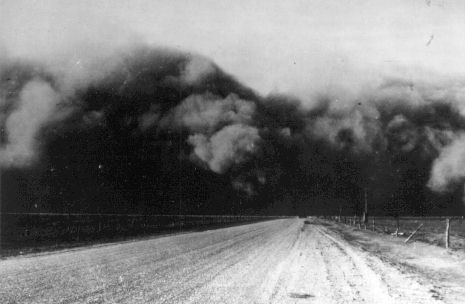
In November, 1933, the Great Plains were besieged with truly incomprehensible wind storms that lifted up the newly exposed top soil and blew it hundreds, and in some cases thousands of miles. This went on with great frequency, often several times a week for 5, 6 , 7 years. The clouds were truly frightening and the dust permeated every pore of a house, caused massive lung infections and death (mostly of children), and resulted in the slaughter of millions of cattle as they had no food to eat. Large trenches were dug in farm fields, starving cattle herded into the trenches and shot to death by the hundreds of thousands. It was common to run a rope from the kitchen porch to the barn, as during the daytime dust storms it was impossible to see the “arm in front of your face” and people could get lost and die in their own backyard. The density of the black was described as “two midnights in a jug” hence the title of this post.
So how does one interpret this calamity? Is this a natural result of population growth, a symbol of man’s disrespect for the environment, a reveal of the vagaries of capitalism, or as some might say, an example of government intervention gone wrong. All have credible narratives around them, but the right answer is neither in the singular, the right answer considers that these effects occurred in synchronization with each other, and all had varying degrees of causality. All the listed factors are contributors, as well as some not listed.
But the illustrative lesson of the Dust Bowl may be distilled down to several key contributors, one of which might be the notion that man acting in his own best interests does not in fact benefit society as a whole. If farmers all around you practice destructive farming, and you do not, you are affected, and so are other non participants. These types of discussions lead to a thought domain characterized by John Rawls (Theory of Justice) and Robert Nozick’s (Anarchy, State, and Utopia) wherein the principle of side rights of the individual is broached effectively.
This type of thinking is an essential step to recognizing that governance and political philosophy have moved on substantially from Adam Smith’s Wealth of Nations. Particularly, the realization that “side rights” or the influence of a neighbor reducing your utility while in pursuit of his so called “liberty” is an intellectual dead end and is contradictory to the principle of any meaningful freedom. So is the prospect of being forced to sell your labor power for sustenance, to those that would exploit you- the very antithesis of freedom. Modern conservatives do not acknowledge side rights, principally because they are stuck with a paradigm where ostensibly the government is to blame for all that is wrong.
In fact, the opposite is often the case, and history illustrates many examples where government intervention, central planning, and other types of consolidated (as in not local) government edicts were essential to provide corrective action. We can again look to the Dust Bowl for evidence, as we have another contemporary example. These settlers were fiercely independent and reliably self sufficient, every bit what the modern libertarian would strive for, yet only with substantial government intervention were the ravages of the Dust Bowl finally mitigated through, among other initiatives, government demonstrated upgraded farming practices that rectified the environmental damage precluding it from happening again. After nearly a decade of this self realized environmental disaster, the settlers were, literally, begging for government support and guidance to get back on their feet.
This also occurred in the late 19th century, with the start of the Progressive Era and the time of the Robber Barons, wherein the population begged and demanded that the capitalists of the day be brought to heel. This worked until the ‘20’s and the Gilded Age, when Capital shed the chains of progressive influence, and once again blew the place up with the 1929 Crash, which brings us full circle back to the Dust Bowl.
Yes, everyone will die, every empire will fall, every monetary system will collapse, and ultimately we will in fact consume all of the finite resources on our planet. To this ultimate end, no one can offer a panacea, not Marxism, not Communism, and certainly not Capitalism, all will ultimately collapse if for nothing else but lack of resources. But it is our lot to Reason, it is human to better oneself.
We have been infected with a malaise that has altered our very DNA, it has damaged our ability to reason, it has blinded us to the contradictions that are self evident, it has promoted false consciousness, and it has denied the very discussion of alternatives.
Why, then, are radicals so hesitant to talk about what a different system might look like? One of the oldest and most influential objections to such talk comes from Marx, with his oft-quoted scorn toward utopian “recipes” for the “cookshops of the future.” The moral of the quote, supposedly, is that a future society must emerge from the spontaneous dynamics of history, not from the isolated imaginings of some scribbler. This isn’t without some irony, since two years later Marx the scribbler wrote his own little cookshop recipe in his Critique of the Gotha Program — it involved labor tokens, storehouses of goods, and an accounting system to determine how much workers would get paid.
As it happens, Marx’s comment was a riposte to a negative review he’d received in a Paris newspaper run by devotees of the philosopher Auguste Comte, criticizing Marx for offering no concrete alternative to the social system he condemned. (That’s why, in the original quote, he asks wryly if the recipes the reviewers had hoped to see happened to be “Comtist” ones.) To grasp the context, you have to understand that like many utopian writers of the era, Comte proffered scenarios for a future society that were marked by an almost deranged grandiosity, featuring precise and fantastically detailed instructions on practically every facet of daily life. It was this obsessive kind of future-painting that Marx was really taking aim at.
(…)
Maybe the most fundamental reason the Left has been suspicious of such visions is that they have so often been presented as historical endpoints – and endpoints will always be disappointing. The notion that history will reach some final destination where social conflict will disappear and politics come to a close has been a misguided fantasy on the Left since its genesis. Scenarios for the future must never be thought of as final, or even irreversible; rather than regard them as blueprints for some future destination, it would be better to see them simply as maps sketching possible routes out of a maze. Once we exit the labyrinth, it’s up to us to decide what to do next.
There is much ongoing dialogue on how to fold some of the more contemporary concepts of political philosophy into actionable lifestyle choices, and I am a big fan of these types of discussions- even if they do turn circular (which they often do). But nevertheless, initiatives like Richard Wolf’s worker funded exchanges wherein surplus value is distributed to workers, and managers are elected democratically, and (as in the excerpt above) centrally planned command economies are hybridized by using free market demand signals to inform production volumes and regional needs. Reintroducing class consciousness as a repetitive topic of discussion reinforcing where and when exploitation occurs is another example.
The major impediment of any refined approach to political philosophy is not so much what we don’t know, it’s discarding the nonsense that we do know.
I think the circumstances on Easter Island although not capitalistic, were similar to what happened in the Dust Bowl, one factor was inadequate and (at times) inappropriate command level decisions. I think if you trace most of the pre-capitalist failures of societal endeavors you will find similar themes, improper or missing command authority, reliance on principles of self liberty over common good, lack of class consciousness, etc.
Capitalism just adds rocket fuel to a fire that is already smoldering.
Hello dominant life form of planet Earth. Yes, that means you Homo Sapiens. I’ve watched as over the millennia you evolved from a primitive ape-like hominid species, surviving purely by instinct, to the technology-wielding, sophisticated-thinking creature of today. Truly, the planet became your smorgasbord and you have partaken freely. As a matter of fact, you have very nearly emptied the planet’s entire refrigerator and cupboards and are now preparing to lick your plate clean. I’ve been throwing up some warning signs, especially this past year, to try to get your attention and perhaps make you reconsider your current omnivorous appetite. After all, you do share the planet with other life forms who have been hoping someone or something will put an end to your callous industrial rampage. I’ve even set in motion a sort of evolutionary check-and-balance, a doomsday device if you will, in the form of atmospheric heat-trapping gases, ensuring your demise just in case you don’t get the message of behavior modification. In other words, your dominant socio-economic paradigm of capitalism is fatally flawed.
Your voracious appetite for the world’s natural resources — fish, timber, potable water, arable land, minerals, et al. — continues unabated. And after consuming them, you leave behind mountains of waste and destruction. Does it always take a crisis before you creatures take action? Instead of waiting until you suffocate to death in a world of hypoxic oceans and dead forests, try listening to those lone voices of dissent screaming for your attention:
Look, I have news for you. The human economy does not take precedence over the Earth’s natural ecological processes which have evolved over millions of years to provide you with clean water, clean air, fertile land, and productive plant and animal life. All of these priceless necessities have been given to you at no charge to your accounting ledger. I guess free lunches are something no human can refuse, but the bill will come due no matter how you try to hide it by pushing it off onto the environment and future generations. In a planet without a stable biosphere, your glimmering metropolises with their megalithic concrete and steel structures reaching heavenward are nothing more than fleeting sand castles to be washed away by the next rogue wave of a surging sea… Sandy was just a warm-up event. Perhaps a new ‘Dust Bowl’ event and heat waves down under demanding a new color code on the weather map and droughts rendering useless a nation’s hydroelectric power will do the trick. I suppose as long as the $tock exchanges of the world are operable, your “business as usual” scheme of perpetual growth and converting all the natural world into capitalist symbols of wealth will carry on its merry way right over the edge of global extinction. And you thought the “fiscal cliff” was something to worry about?
As a mentor and intellectual peer of this site said recently, “tribes and societies that did master effective class consciousness thrived, for a very long time. Those that didn’t, don’t.” At today’s massive scale of production and consumption, the human and environmental exploitation characterized by modern industrial capitalism undermines the long-term existence of mankind along with every other living organism on the planet. Capitalism shoehorns everything into its profit-seeking regime, no matter if that means global genocide on a scale never heretofore seen:
…Actually, the more I reflect on it, the clearer I see the logic, the rationale, behind the bankers’ and the capitalists’ push for privatization. It is not just more profits they are after, not just share price or corporate valuation; no! They are after mass extermination, genocide on a grand scale – of the world’s needy, the under-funded, the unwanted, the uncivilized, the savages and the barbarians, the commies and the Islamists, in short, elimination of all of the Others.
The big boyz have seen all the data and crunched all the numbers, and it is clear to them – the earth is running out of resources, Mars is -50 C all of the time, and we can no longer afford to carry all of this excess baggage here on the planet — all of these miserable, thankless, do-nothing mouths to feed. So the plan is brilliant. You reduce the number from 7+ billion by at least 33% without firing one shot. You simply privatize all natural resources and then price access so that the bottom third of the globe’s population cannot afford it. And so, they die; it will be the biggest die-off of the Anthropocene epoch…
Wrapping your head around the seemingly unstoppable upward march of CO2 emissions is like trying to comprehend all those zeros in the expanding global debt bubble; both are so far beyond human scale that people cannot put them into a frame of reference or perspective. They have taken on a life of their own, a force of nature that defies all attempts to control and subdue them. Brian Merchant takes a stab at trying to frame the CO2 numbers behind industrial civilization’s conundrum of catastrophic climate change:
And 2012 is on track for another 2.6 percent increase. Why can’t we stop it? Perhaps the problem is structural and embedded in our economic system.
In a recent interview, dissident Julian Assange commented on the degree of intertwinement between government and corporations, i.e. fascism or more aptly called inverted totalitarianism in our times. Regulatory capture, the revolving corporate/government door, and K Street lobbying(legalized bribery) are examples of the monied interest$ of capitali$m having taken over government.
There’s not a barrier anymore between corporate surveillance, on the one hand, and government surveillance, on the other. You know, Facebook is based—has its servers based in the United States. Gmail, as General Petraeus found out, has its servers based in the United States. And the interplay between U.S. intelligence agencies and other Western intelligence agencies and any intelligence agencies that can hack this is fluid. So, we’re in a—if we look back to what’s a earlier example of the worst penetration by an intelligence apparatus of a society, which is perhaps East Germany, where up to 10 percent of people over their lifetime had been an informer at one stage or another, in Iceland we have 88 percent penetration of Iceland by Facebook. Eighty-eight percent of people are there on Facebook informing on their friends and their movements and the nature of their relationships—and for free. They’re not even being paid money. They’re not even being directly coerced to do it. They’re doing it for social credits to avoid the feeling of exclusion. But people should understand what is really going on. I don’t believe people are doing this or would do it if they truly understood what was going on, that they are doing hundreds of billions of hours of free work for the Central Intelligence Agency, for the FBI, and for all allied agencies and all countries that can ask for favors to get hold of that information.
William Binney, the former chief of research, the National Security Agency’s signals intelligence division, describes this situation thatwe are in now as “turnkey totalitarianism,” that the whole system of totalitarianism has been built—the car, the engine has been built—and it’s just a matter of turning the key. And actually, when we look to see some of the crackdowns on WikiLeaks and the grand jury process and targeted assassinations and so on, actually it’s arguable that key has already been partly turned. The assassinations that occur extrajudicially, the renditions that occur, they don’t occur in isolation. They occur as a result of the information that has been sucked in through this giant signals interception machinery.
Corporations are the ultimate expression of capitalism. Libertarians decry that what we have is not capitalism, but a corrupted form of it, aka crony capitalism. The opposite is true – unfettered, unregulated capitalism is the purest form of this profit-driven system where economic activity is structured around the accumulation of capital. This is what we get when economic power(money) inevitably usurps all branches of government. Corporate greenwashing, carbon credit schemes, privatization of the commons, and externalizing environmental costs are examples of capitalism’s incompatibility with sustainability and its inability to deal with the degradation of the planet. Corporate power rules the world and it’s what is destroying the planet:
Ecocide is permitted (as genocide was in Nazi Germany) by the government and, by dint of the global reach of modern-day transnational business, every government in the world. Corporate ecocide has now reached a point where we stand on the brink of collapse of our ecosystems, triggering the death of many millions in the face of human aggravated cataclysmic tragedies. Over the passage of time, tyranny revisits. Tyranny is the cruel, unacceptable, or arbitrary use of power that is oblivious to consequence. Whilst the use of coal stations may not be deemed an intentional cruelty, it is certainly an unacceptable use of corporate power. Our governments collude by encouraging excess emissions, contrary to their UNFCCC commitment to stabilize “greenhouse gas concentrations in the atmosphere at a level that would prevent dangerous anthropogenic interference with the climate system.”60 years ago the tyranny was Nazism. Today it is pursuit of profit without moral compass or responsibility.
…There are several points to make in response to the belief that capitalism is compatible with a flourishing environment. Firstly, environmental activism can’t alter capitalism’s integral growth dynamic, it’s “grow or die” impulse, as the social ecologist Murray Bookchin put it. As a result the best environmentalism can do is ameliorate the worst effects. “Things getting worse at a slower rate”, is how the late environmental activist, Donella Meadows, described the situation.
Secondly, in the low or no growth world we are entering, environmental priorities are being sacrificed to meet the short-term need to revive growth. “We can’t be ambivalent about growth,” is how the UK government’s “planning” minister, Greg Clark, justified reducing regulations to make it much easier to approve building development in the countryside.
Thirdly, many polluting practices in western countries that have become culturally unacceptable have been exported to poorer countries, where people have less power to make their objections count.
Lastly, the experience of the 21st century has shown that when environmental activism directly confronts huge capitalist industries like oil, automobiles and mining, it does not win. The 1987 Montreal Protocol was the last successful international agreement to change capitalist behaviour. The protocol called for strict restrictions on chemicals that deplete the ozone layer (chlorofluorcarbons) and the results have been impressive. But, says Schweickart, the industries affected had substitutes to hand, and the protocol “should not lull us into thinking capitalism can accommodate all sensible environmental solutions.”…
…The consequence of the conflict between environmental sanity and profit has been that many capitalist countries – most notably the US – have been unable to change course to ameliorate climate change. Not only this, a political culture has developed that denies the existence of climate change even when its effects become harder and harder to ignore.
Of course the prospects of thinking outside-of-the-box on economic and foreign policy issues has always been heresy. As long as we think we can fix the ecological problem with the same tools that caused the problem, we can expect the Eco-Apocalypse, a tragedy of the commons on a global scale, to unfold as predicted:
Zizek:…………… the global capitalist system is approaching an apocalyptic zero-point. Its ‘four riders of the apocalypse’ are comprised by the ecological crisis, the consequences of the biogenetic revolution, imbalances within the system itself (problems with intellectual property; forthcoming struggles over raw materials, food and water), and the explosive growth of social divisions and exclusions.
…So, with the most recent BLS data, 20% of the popular vote would be less than 48 million people. Of course, let’s be frank. Neither political party wants every American to vote. Voter suppression in both parties is as American as apple pie. The Republicans don’t want all of those people they have thrown under the bus to come to the polls. And, the Democrats don’t want all of those voters showing up that they endlessly lie to with empty promises. If one person-one vote democracy was really an intent under a system controlled by political parties, money couldn’t buy a politician, we would have a national voting day where everyone had the day off, we would have a system that truly educates people on issues rather than one of demagogy and lies, we would provide free public transportation to those unable to get to the polls themselves and numerous other incentives for people to vote. The smaller the turnout, the more the status quo benefits in a system of looting, pillaging, exploitation and corruption. Or so their perception goes… – link
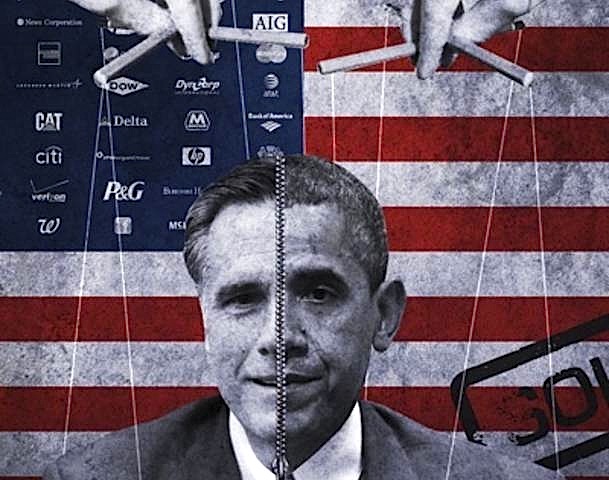
One thing is certain – both corporate puppets support the system that is killing you:
Post Script:
An important point was brought up by Alex Smith of EcoShock Radio about the numbers in this post. The list of top campaign contributors by Opensecrets does not include the dark world of Super PACs and other tax-exempt groups which can shield the identity of their donors – a billion spent on the presidential race. See the comments section of this post for further details.
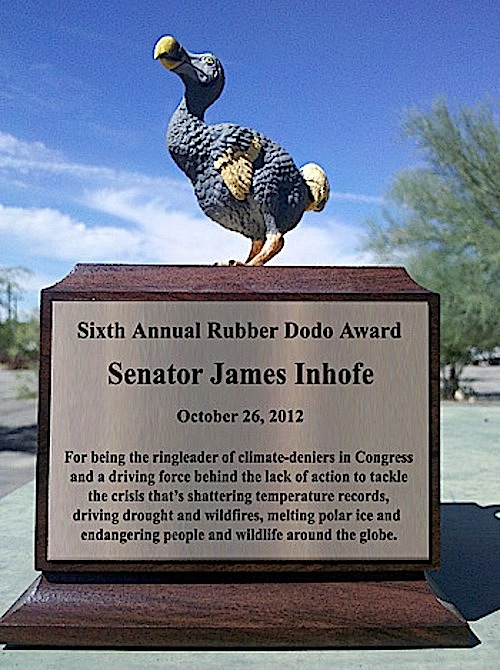
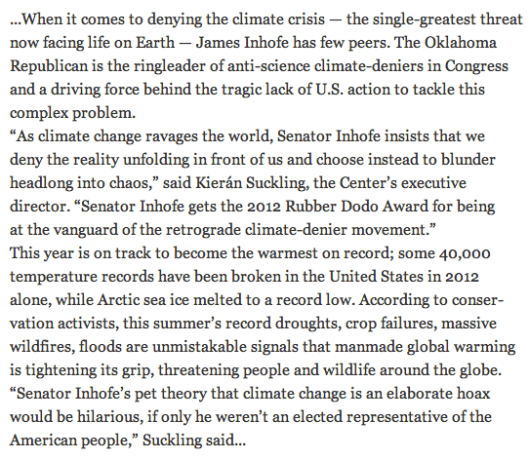
I heard about this dubious award via Your Medieval Future. Why did it take so long for this guy to get the award?…
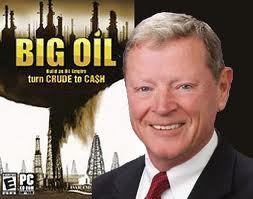
And here is Senator Inhofe’s politically polarizing response, spoken like a true anti-science zealot and mouthpiece for the fossil fuel industry:
I am truly honored that yet another radical environmental group has given me an award for my efforts to put a stop to President Obama’s far-left global warming agenda,” Senator Inhofe said. “The Center for Biological Diversity should be pleased to know that my award will have a prominent place in my office, along with all the others I have been proud to receive over the years. As the top Republican on the Senate Committee on Environment and Public Works, I have worked every day to expose the radical left’s extremist agenda aimed at ending American production of oil, gas, and coal because of the devastating consequences it will have on the American people.
Despite the fact that some of us are intelligent enough to see the coming collapse from unmitigated depletion of the earth’s non-renewable resources, overpopulation, climate disruption from the massive burning of fossil fuels worldwide, the human-induced 6th mass extinction, CO2-acidification of the oceans, and the resultant destruction of our modern industrial agriculture base, we are all lumped into the category of ‘radical left extremists‘ for recognizing such scientific realities. In Inhofe’s world, there is no environmental crisis and humans can adapt to whatever toxic sludge pile industrial civilization creates out of the planet. In a world where the true conservatives are those who want to keep the planet habitable for humans, people like Senator Inhofe will ensure that we all face the same fate as that of the extinct Dodo bird.
At a time where one of the few job choices for the youth of this country is to either flip hamburgers at a greasy spoon or line up as cannon fodder in oil wars, you have to wonder if the American dream has not become an American nightmare. Corporations enjoy record profits and little to no taxes while the next generation is kicked to the curb…
Sadly, suicide is the avenue many young people take to escape this parasitic and cut-throat political economy of ours. Yes, we eat our own young by way of the for-profit college industrial-complex.
Student loans can’t be discharged in bankruptcy. Credit card debt has even led to some untimely deaths. Why are we condemning our young people?
This week’s credit check: The average undergraduate student graduates college with $4,100 in credit card debt and $19,300 in student loans. Suicide is the second leading cause of death among college students…
President Obama’s recent budget proposal included ending an experiment that gave out Pell Grants for summer courses and eliminating a subsidy for paying interest on student loans for current grad students. That looks mild, of course, compared to what the GOP proposes to do — cut the maximum grant payment by $845, end funding to other aid programs, kill AmeriCorps entirely, and slash billions from agencies that support academic research.
But as explained in “Up to Our Eyeballs“, the cuts to grants isn’t exactly new. Grants have been declining over the last thirty years as loans came to replace them in financing college educations. Two-thirds of financing used to come from grants, in fact, and now two-thirds comes from loans — which is to say, taking on debt. The book notes, “The maximum [Pell Grant] award today covers about one-third the average expense of tuition and fees at a four-year private college, and only 22 percent of all grant recipients actually get the maximum.” Meanwhile, tuition is climbing — it rose 122% at public universities from 1986 to 2006. The average graduate leaves college with $19,300 in student loan debt, up from $9,250 about ten years ago.
And now loan defaults are on the rise. A new federal analysis shows that about one-quarter of students who took out loans to attend for-profit college defaulted within three years of starting repayment. That rate is also up for public colleges — at 11%, up 10% from the previous report — and private nonprofit colleges — at 8%, up from about 7%. This may come as little surprise with an unemployment rate of 9%. Indeed, while in some ways college graduates are better off than those without a degree, they’ve still seen the highest percentage increase in unemployment. It can be hard to keep up with loan payments when you can’t find a job. And unlike most forms of debt, student loan debt is with you forever — you can’t discharge it in bankruptcy. In fact, “Up to Our Eyeballs” notes that about 9% of Americas aged 45-64 still have student loan debt.
That’s all bad enough, but going to college also opens up another Pandora’s box of debt: credit card offers. Students graduated college with an average of $4,100 in credit card debt in 2008 and half of all undergraduates had four or more cards. In the 2006 movie Maxed Out, mothers Trisha and Jeanne recount how both of their children went off to school and were hit with tons of card offers — even though neither student had much income or any credit history. Neither parent had any idea what was going on, but eventually one of them had racked up 12 different cards and the other was behind on the very first card she got. In the end, both children killed themselves out of the desperation of not being able to pay off their debts. Suicide is disturbingly common among this age group: it is the second leading cause of death among those aged 15-24, and the rate has increased 200% for this group over the past 50 years. The reasons are complex and varied, but one cause can be financial strain…
We live in the age of bubbles. Condemning our children to suffocating debt right off the bat with little prospect of meaningful employment is another sign of a society that it morally and ethically bankrupt.
The Student Loan Bubble:
“Since 2009 student loans (non revolving consumer loans) have increased from 100 billion to 450 billion. The green dashed line shows where this debt should be based on the historical trend line and as shown below the student debt held by the US Federal government has ballooned in the past few years. This is what a bubble looks like.” – link
With all of the other problems we are leaving the next generation(climate change, an oligarchic economy, peak oil, the sixth mass extinction, etc), you would think that we would at least try to help them out in their education, but if we really cared about them and the future, then we would not be carrying along with business-as-usual, our heads planted firmly in the sand, while the very habitability of the planet hangs in the balance.
The youth are on their own. Climate change has become a campaign slogan, nothing more…
I was doing a little net surfing this morning and wondered what my buddy Jeremy Scahill has been up to. Shoot, it’s been 6 months since I’ve seen an article from him. A recent video of him reaffirms why I like him so much…
We live in this culture where we have this reality television which has become the real world, and what’s being done with our dollars, and with our soldiers, and in foreign countries in our name has become page seven. ~ Jeremy Scahill
He still has a sense of humor too.
Concerning those debates, which in this day and age are only another reality TV production brought to you by Wall Street, Democracy Now had a truly jaw-dropping show on the corporate takeover of the political debates over the last couple of decades. Secret agreements were formed between the two parties which framed the “debates” so that only predetermined, soft-ball questions would be asked and no third party candidates would be allowed to participate. When you watch a “presidential debate”, what you are seeing is pure fluff and staged answers. You might as well be hearing ventriloquist voices emanating from manikins. And to top it all off, one of the primary corporate sponsors of the debates is Anheuser-Busch. How fitting… Bud Light and cheesy made-for-TV “reality” shows constitute the method by which the American sheeple choose their ‘leaders’. I don’t know whether to laugh or cry.
I urge you to watch this interview. It explains a lot about the development of the modern American Cororatocracy and the dumbing down of its population of “consumers”.
Here is George Farah’s Website (click the pic to go there):

















 Collapse of Industrial Civilization