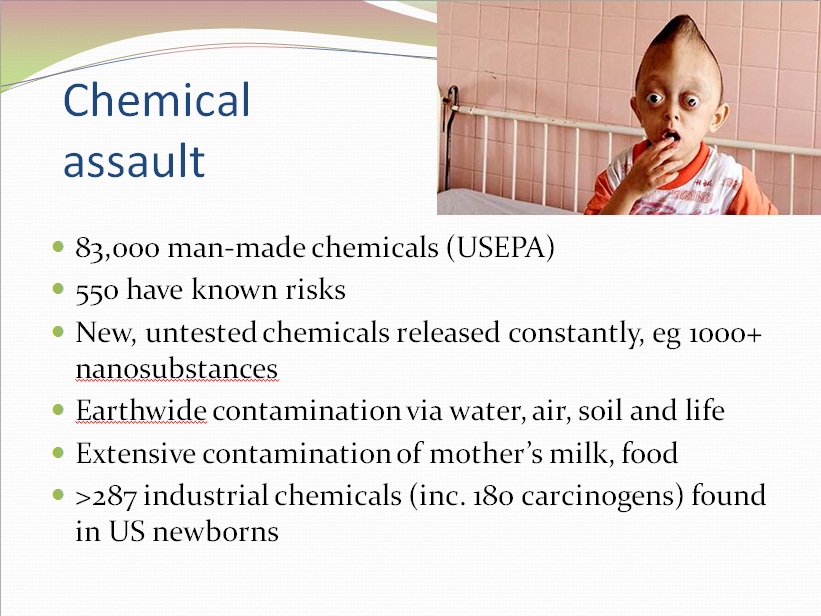
My last post on environmental toxins was inspired from an email I got from Professor Julian Cribb in Australia. Upon closer inspection of his email I see that the attachments have much more interesting information that deserves our attention. I hope my readers will forgive me for having missed this valuable material, but I just came back from the decadence of Sin City on my weekend trip and I’m a little tired.
I hope the good Professor doesn’t mind my posting the attachments at my site. The first concerns environmental toxins and is an extended and more informative version of the brief article that Professor Cribb published in the Canberra Times.
The second attachment is an argument for the renaming of the human species (Homo Sapien) to something more appropriate in order to properly reflect our dysfunctional and self-destructive nature. I believe we’re too full of self-conceit and self-delusion to ever seriously entertain the idea, but it is a good argument to make in light of our impending extinction and the ongoing destruction of the Earth’s habitability for most other organisms. This global apocalypse is being brought to you by the world-wrecking hands of ‘industrial capitalist carbon man’.
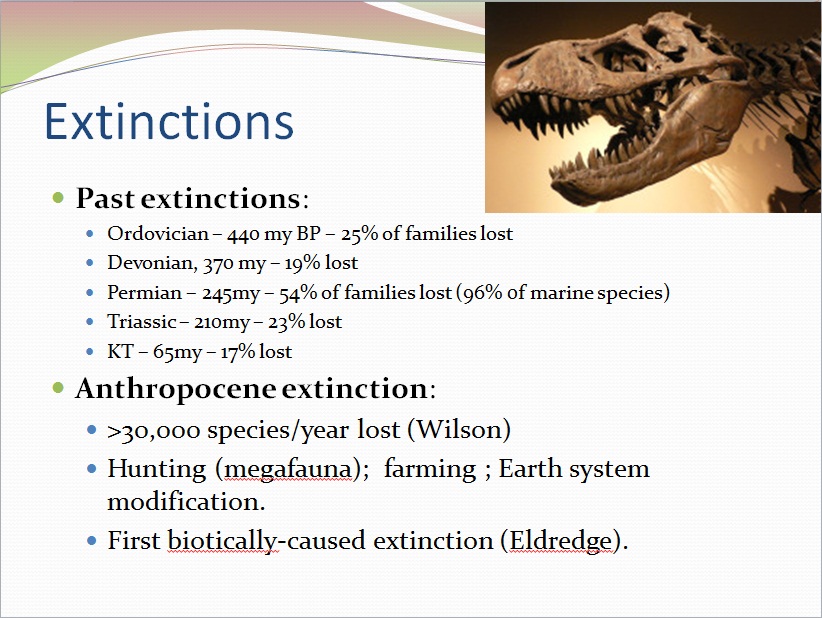
Lastly, he sent me an interesting slide show which appears to be the basis for a TV documentary that the Professor is hoping to create in order to explore these unfolding crises leading to mankind’s self-inflicted extinction, an avoidable tragedy if Homo Sapiens lived up to their name of ‘wise man’ – a misnomer if there ever was one.
I look forward to watching this documentary. Luckily, Professor Cribb is trying to get this project done in Australia and not the Banana Republic of America where it would be sacrilege to think that money is an illusion or that all problems cannot be solved by printing more of it.
In this post I want to elaborate more on DK’s comment from my last entry:
…Pre-capitalist tribes had examples of both success and failure, perhaps equal measure of both. The key principle to these types of cultures succeeding is the principle of superabundance. There is strong correlation to the disappearance of superabundance and destructive tendencies…
In his essay ‘Are Wars Inevitable?‘, William T. Hathaway explains that modern research has shown that scarcity of resources acts as a trigger for social strife and that violence and war is NOT a genetic predisposition of humans:
…research, however, led to a key discovery: The chimps who invaded their neighbors were suffering from shrinking territory and food sources. They were struggling for survival. Groups with adequate resources didn’t raid other colonies. The aggression wasn’t a behavioral constant but was caused by the stress they were under. Their genes gave them the capacity for violence, but the stress factor had to be there to trigger it into combat. This new research showed that war is not inevitable but rather a function of the stress a society is under. Our biological nature doesn’t force us to war, it just gives us the potential for it. Without stress to provoke it, violence can remain one of the many unexpressed capacities our human evolution has given us. Studies by professors Douglas Fry, Frans de Waal, and Robert Sapolsky present the evidence for this.
Militarists point to history and say it’s just one war after another. But that’s the history only of our patriarchal civilization. The early matriarchal civilization of south-eastern Europe enjoyed centuries of peace. UCLA anthropologist Marija Gimbutas describes the archeological research in The Civilization of the Goddess. No trace of warfare has been found in excavations of the Minoan, Harappa, and Caral cultures. Many of the Pacific islands were pacifistic. The ancient Vedic civilization of India had meditation techniques that preserved the peace, and those are being revived today to reduce stress in society...
Now DK goes on to say that in the absence of plentiful resources, the only logical and sane option is to give up our current exploitive and pathological economic model of capitalism and replace it with something that reflects today’s reality of rampant resource depletion and environmental collapse. Modern weapons of war are infinitely more destructive and, in and of themselves, pose a danger to all of mankind and global civilization; hence the need to get rid of capitalism is even more imperative:
…When superabundance is (inevitably) rendered invalid, it must be supplanted by a means to re-appropriate surplus in a fair and equitable manner- devoid of exploitation and informed by tangible limits, such as those posed by the environment and population limits. Such a system is not compatible with profit seeking, as many in the environmental movement are now discovering- nor has it ever been put successfully into practice.
One could say that mankind’s ability or inability to successfully transition away from the self-destructive nature of capitalism will determine the fate of the whole human species. Tragedy of the commons, as I said previously, is on a global scale now. Hathaway goes on to elaborate a little on capitalism’s dog-eat-dog tendencies and the need to move away from this paradigm:
Our society, though, has a deeply entrenched assumption that stress is essential to life. Many of our social and economic structures are based on conflict. Capitalism’s need for continually expanding profits generates stress in all of us. We’ve been indoctrinated to think this is normal and natural, but it’s really pathological. It damages life in ways we can barely perceive because they’re so built into us…
…We can create a society that meets human needs and distributes the world’s resources more evenly… But that’s going to take basic changes…
These changes threaten the power holders of our society. Since capitalism is a predatory social and economic system, predatory personalities rise to power. They view the world through a lens of aggression. But it’s not merely a view. They really are surrounded by enemies. So they believe this false axiom they are propagating that wars are inevitable.
In the past their predecessors defended their power by propagating other nonsense: kings had a divine right to rule over us, Blacks were inferior to Whites, women should obey men. We’ve outgrown those humbugs, and we can outgrow this one.
Of course, as Gail of ‘Wit’s End’ pointed out, we will inevitably need to address the problem of overpopulation:
…although once upon a time some tribes (arguably) may have lived cooperatively and harmoniously (although the opposite is certainly more common) the only reason they could do so is because their numbers were so low and food was plentiful and relatively easy to obtain. Once human population outstrips resources, things get ugly no matter what social or cultural system is in place. And I don’t know of a place where human population didn’t eventually overrun the environment, with the possible exception of cultures that practiced infanticide, or had the ability to export people willing to emigrate.
It seems to me the problem is that we have filled every corner of the globe that is remotely habitable, and then some, and yet our population and levels of consumption continue to increase. There is no place left to emigrate to. It can’t last.
Resource constraints(i.e. peak oil, peak fertilizer, peak water) on our fossil fuel based agricultural system as well as environmental degradation(i.e. climate change and ocean acidification) are going to cause an epic population crash during this century before we have time, or for that matter the cooperation and agreement, to implement any sort of voluntary population reduction.
As far as implementing this egalitarian distribution model, I also agree that the odds of that happening are slim to none, as DK said:
…Such a system[egalitarian and respective of resource limits] is not compatible with profit seeking, as many in the environmental movement are now discovering – nor has it ever been put successfully into practice.
Nor is it likely to be.
Unfortunately, the world’s stockpile of thermonuclear weapons may not stay on the shelf forever, especially in a world where the Four Horsemen of Industrial Civilization are quickly converging: Climate Change, Peak Net Energy, Ocean Acidification, and Peak Water. I’m not saying we shouldn’t try everything we can to stop what seems to be our inevitable fate; I’m just saying that the prognosis is grim.
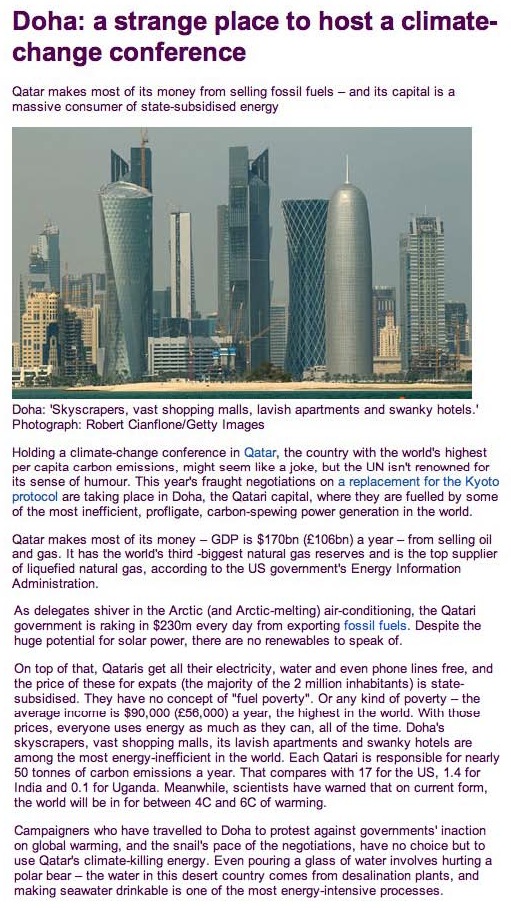
If you’re not really going to do anything about our omnicidal alteration of the planet, then it would make sense that you would host such a climate talk charade in the most profligate, fossil-fuel dealing, energy-gorging city on the planet – another irony for the ages as this blog below points out. Isn’t that like holding an alcoholics anonymous meeting inside a liquor store?
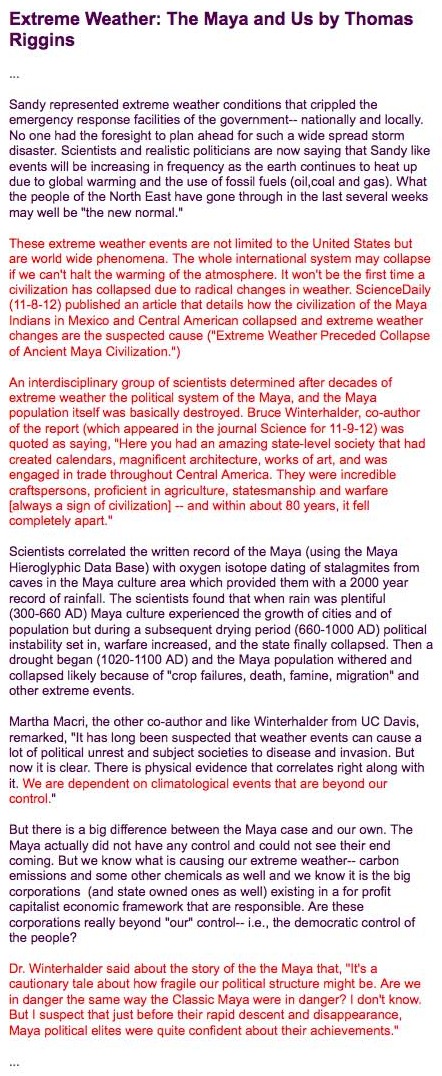
In Guy McPherson’s talk which was the subject of my last post, he said that those living in the inner part of the American Empire, the Great Plain States, would be in a whole lot of trouble in the coming decades. To elaborate on that statement, read the article below to see how things are literally fading away, soon to give new meaning to the term “dry county” (emphasis in red by the energy skeptic):
And history repeats itself, despite all our fancy techno-gadgetry and state-of-the-art instruments giving us unparalleled warning signs of our impending demise. The ApocoDocs recently quipped something to the effect of, “If we can foresee the collapse, then we can prevent it. Right? RIGHT!”
When you have at your disposal all the tools and knowledge to avert your own death, but collectively choose not to utilize them, that just makes it all the more tragic:
Now if that story doesn’t illustrate to you the ingrained, institutionalized insanity of the people running the show, I don’t know what will. I told you in a previous post they think the planet is one big ShamWow towelette for man’s endless flow of waste. A commenter on the above story gives a laundry list of examples illustrating how humans are complete failures at managing waste, concluding with the following statement:
…Unfortunately, industrial humans have always “managed” their wastes by throwing it away. This works well in a world with low population, or with a largely poor population that can’t object to living in someone else’s toilet. In the modern world, though, “away” is going away. (It’s worth noting that it does NOT have to be this way. Current conditions pertain because it is convenient/profitable, not because responsible waste management is impossible. But that’s another topic entirely.)
Hofmeister is proposing that we apply the same approach that we use for other industrial wastes – one which is failing, which preferentially exploits the poor, and is damaging our planetary life support system – to CO2. This is not a recipe for success or even survival – this is apologia for continuing business as usual.
A newly released study commissioned by the C.I.A. entitled Climate and Social Stress: Implications for Security Analysis highlights the vulnerabilities of our globalized economy to climate change. Of particular interest is the section on energy. To summarize:
1.) Oil is the most highly integrated commodity of globalized trade. Its tightly interconnected market was created in the aftermath of the OPEC embargoes of the 1970’s to prevent its manipulation by political actors. Its integration is said to be fully complete to the point that any disruption in the global oil system will cause an economic ripple effect throughout the world. Rapid oil consumption in China and India without a corresponding increase in production has left the oil market extremely tight (i.e. Peak Oil).
2.) Due to the facts stated above, any changes in climate could easily disrupt the world’s energy system. For example:
(a.) Tropical storms and sea-level rise can disrupt production, refining, and transport of petroleum since a large percentage of oil refining and processing are located in coastal areas vulnerable to such storms and floods. This is true in the U.S., Europe, China, and India. An example would be Hurricane Katrina and Rita in 2005 which disrupted oil and gas operations of off-shore rigs, coastal refining, and transport via sea ports and pipelines.
(b) Drought will cause oil refining disruptions since that process requires large amounts of water. If the drought is accompanied by higher temperatures, the scarcity of water will be exacerbated because the oil refineries will require even more cooling by water. A warming planet will also cause infrastructure damage (pipelines and drilling platforms) in Arctic operations due to collapsing earth from the melting of permafrost.
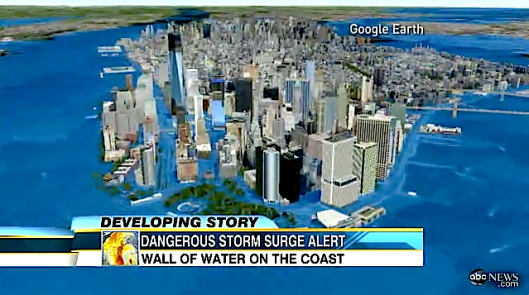
We are entering an era in which not only the global energy system is vulnerable, but the social, agricultural, and technological infrastructure is also at the mercy of climate disruptions. They were all designed around assumptions of moderately stable climate conditions, and as climate exceeds boundary thresholds, these infrastructures will break. As was demonstrated by Hurricane Sandy recently in New York/New Jersey with the power outages, gas shortages, and Nuclear plant shutdowns. The droughts this past summer in the U.S. midwest show the fragility of our food system whose development assumed fairly stable weather patterns and rainfall.
A quote from the study:
…The fundamental science of climate change suggests that continued global warming will increase with frequency or intensity (or both) of a great variety of events that could disrupt societies, including heat waves, extreme precipitation events, floods, droughts, sea-level rise, wildfires, and the spread of infectious diseases. Underpinning many of these extreme events is an acceleration of the global hydrological cycle. For each 1.8° F (1° C) increase in the global mean surface temperature, there is a corresponding 7 percent increase in atmospheric water vapor. Because warm air holds more water vapor than cool air, this leads to more intense precipitation. Essentially, warm air increases evaporation from the ocean and dries out the land surface, providing more moisture to the atmosphere that will rain out downwind. Water vapor is also a powerful naturally occurring greenhouse gas. As such it is the source of a very positive feedback to the coupled climate system that amplifies any external forcing by a factor of approximately 1.6…
We’ve passed a tipping point with the Arctic ice melt which has set off other feedback loops (Arctic amplification, methane release from permafrost melt, loss of the albedo effect, alteration of the Jet Stream, Greenland glacier melt, etc) and tipping points, some of which we are not even aware of, as the study acknowledges:
…there may be other processes in the Earth system, not yet identified, that have tipping points that could lead to abrupt climate change. Because of such gaps in knowledge, the possibility of such events occurring in the next decade or so cannot be totally discounted…
I would say “God help us” if the traditional farming lands -the bread baskets of nations- become dust bowls, but that’s exactly where we are headed with climate change and no miracle is going to fall out of the sky to save us.
Drought Disaster Designations Map (PDF, 504KB) Text-only (accessible) version Map shows designations due to drought across the country under USDA’s amended rule. Any county declared a primary (red) or contiguous (orange) disaster county makes producers in that county eligible for certain emergency aid.
The study talks about what it terms a “cluster of extreme events” resulting from large-scale climate processes, causing catastrophes in separate and distant areas of the globe. Trying to deal with such widespread and seemingly unrelated disruptions would quickly overwhelm the global community’s resources. An example given was in the year 2010 with the massive drought and forest fires in Russia and the epic floods in Pakistan:
…The two events were linked by more than just their proximity in time. The meteorological pattern that lead to the Russian heat wave, in which the large-scale upper-level wind flow developed a strong and persistent ridge, also contributed to the development of the meteorological pattern that resulted in the Pakistani floods —a downstream leading trough (Lau and Kim, 2012). The fact that these two extreme events corresponded in time with each other and with a single larger meteorological pattern was unusual but not totally unexpected. Circulation events like this one, which cause some event clusters, are known to occur but are not well resolved in current climate models…
…If climate events and extremes were independent in a statistical sense, the likelihood of a cluster or a compound event of any size could easily be estimated mathematically. But as the above example makes clear, extreme events in different parts of the world can be driven by common underlying forces and thus have an intrinsic relationship such that when one such event occurs, the likelihood increases that other extreme events linked to them by common causes will also occur. In statistical language, such events are called dependent.
The changing climate zones also enable the spread of tropical diseases and pests. Outbreaks of new virus strains would tax healthcare delivery systems:
…Climate events might also put stress on global health systems in various ways, most of them hard to predict. As discussed in the next chapter, climate change is expected to alter the ranges of disease vectors or pathogens in ways that expose large human populations to diseases to which they have not been previously been exposed. This could lead to a rapidly increasing demand for treatments and supplies that may not have been adequately stockpiled. If such health problems arise in combination with a disruption of supply chains for critical inoculations or medications, the potential for a severe health crisis could grow dramatically. Again, the effects might be felt far from the locations where the climate events occur. Climate events, especially when they occur in clusters, can also stress the capacity of international disaster response and humanitarian relief systems and thus cause harm in places that are not directly affected by the events but that need international assistance for other reasons…
“You can debate the specific contribution of global warming to that storm. But we’re saying climate extremes are going to be more frequent, and this[Hurricane Sandy] was an example of what they could mean. We’re also saying it could get a whole lot worse than that.”
Mr. Steinbruner, the director of the Center for International and Security Studies at the University of Maryland, said that humans are pouring carbon dioxide and other climate-altering gases into the atmosphere at a rate never before seen. “We know there will have to be major climatic adjustments — there’s no uncertainty about that — but we just don’t know the details,” he said. “We do know they will be big.”
The study was released 10 days late: its authors had been scheduled to brief intelligence officials on their findings the day Hurricane Sandy hit the East Coast, but the federal government was shut down because of the storm.
How ironic is that? The authors of this study had to postpone their meeting with U.S. intel authorities because of a climate chaos event.
Here’s what else is ironic…
…as the need for more and better analysis is growing, government resources devoted to them are shrinking. Republicans in Congress objected to the C.I.A.’s creation of a climate change center and tried to deny money for it. The American weather satellite program is losing capability because of years of underfinancing and mismanagement, imperiling the ability to predict and monitor major storms.
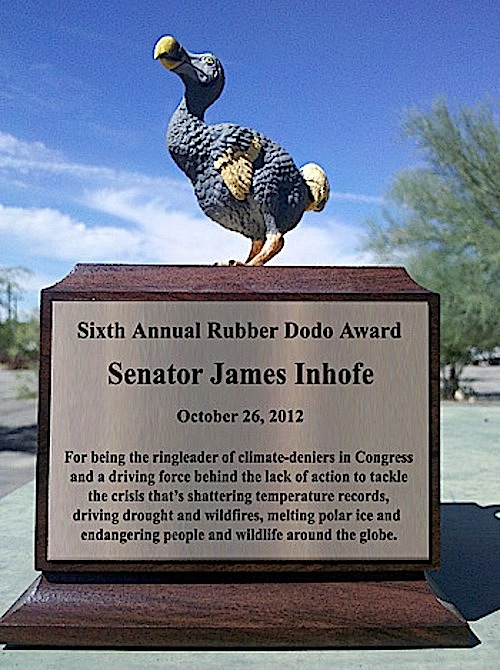
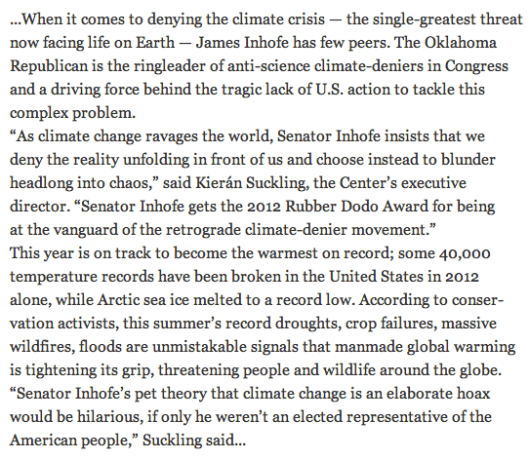
I heard about this dubious award via Your Medieval Future. Why did it take so long for this guy to get the award?…
And here is Senator Inhofe’s politically polarizing response, spoken like a true anti-science zealot and mouthpiece for the fossil fuel industry:
I am truly honored that yet another radical environmental group has given me an award for my efforts to put a stop to President Obama’s far-left global warming agenda,” Senator Inhofe said. “The Center for Biological Diversity should be pleased to know that my award will have a prominent place in my office, along with all the others I have been proud to receive over the years. As the top Republican on the Senate Committee on Environment and Public Works, I have worked every day to expose the radical left’s extremist agenda aimed at ending American production of oil, gas, and coal because of the devastating consequences it will have on the American people.
Despite the fact that some of us are intelligent enough to see the coming collapse from unmitigated depletion of the earth’s non-renewable resources, overpopulation, climate disruption from the massive burning of fossil fuels worldwide, the human-induced 6th mass extinction, CO2-acidification of the oceans, and the resultant destruction of our modern industrial agriculture base, we are all lumped into the category of ‘radical left extremists‘ for recognizing such scientific realities. In Inhofe’s world, there is no environmental crisis and humans can adapt to whatever toxic sludge pile industrial civilization creates out of the planet. In a world where the true conservatives are those who want to keep the planet habitable for humans, people like Senator Inhofe will ensure that we all face the same fate as that of the extinct Dodo bird.
The following excerpt is from a recent U.N. assessment on the state of the world and food production. It’s not a pretty picture, but despite alarm bells ringing, our trajectory of ecological collapse is still firmly on track…
Click to go to full letter:
The human rights of people and well-being of the planet first? Don’t make me laugh. There’s that oxymoron again – sustainable development. Given the track record of the U.N. on solving problems, rest assured there won’t be any radical ideas coming out of that institution that might threaten capitalism’s death grip on the planet. If there’s no money to be made, resource to be exploited, or economic growth to be had, then it won’t get done. Period.
…From the UK Guardian article discussing the above U.N. assessment:
…Failing harvests in the US, Ukraine and other countries this year have eroded reserves to their lowest level since 1974. The US, which has experienced record heatwaves and droughts in 2012, now holds in reserve a historically low 6.5% of the maize that it expects to consume in the next year, says the UN.
“We’ve not been producing as much as we are consuming. That is why stocks are being run down. Supplies are now very tight across the world and reserves are at a very low level, leaving no room for unexpected events next year,” said Abdolreza Abbassian, a senior economist with the UNFood and Agriculture Organisation (FAO). With foodconsumption exceeding the amount grown for six of the past 11 years, countries have run down reserves from an average of 107 days of consumption 10 years ago to under 74 days recently…
…In a shocking new assessment of the prospects of meeting food needs, Lester Brown, president of the Earth policy research centre in Washington, says that the climate is no longer reliable and the demands for food are growing so fast that a breakdown is inevitable, unless urgent action is taken.
“Food shortages undermined earlier civilisations. We are on the same path. Each country is now fending for itself. The world is living one year to the next,” he writes in a new book.
According to Brown, we are seeing the start of a food supply breakdown with a dash by speculators to “grab” millions of square miles of cheap farmland, the doubling of international food prices in a decade, and the dramatic rundown of countries’ food reserves.
This year, for the sixth time in 11 years, the world will consume more food than it produces, largely because of extreme weather in the US and other major food-exporting countries. Oxfam last week said that the price of key staples, including wheat and rice, may double in the next 20 years, threatening disastrous consequences for poor people who spend a large proportion of their income on food…
…“The geopolitics of food is fast overshadowing the geopolitics of oil.”
…“The situation we are in is not temporary. These things will happen all the time. Climate is in a state of flux and there is no normal any more.
“We are beginning a new chapter. We will see food unrest in many more places.
“Armed aggression is no longer the principal threat to our future. The overriding threats to this century are climate change, population growth, spreading water shortages and rising food prices,” Brown says.
Further reading…
Food prices from 1990 to the present…
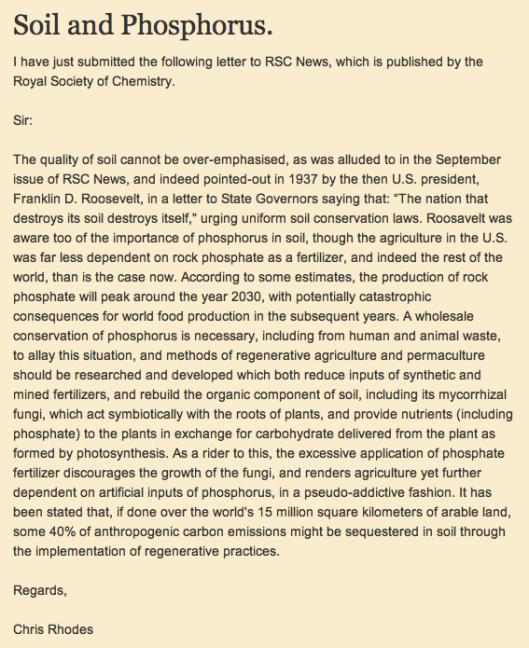
And an open letter(10-12-2012) by Professor Christopher Rhodes on our looming problem of Peak Phosphorus…
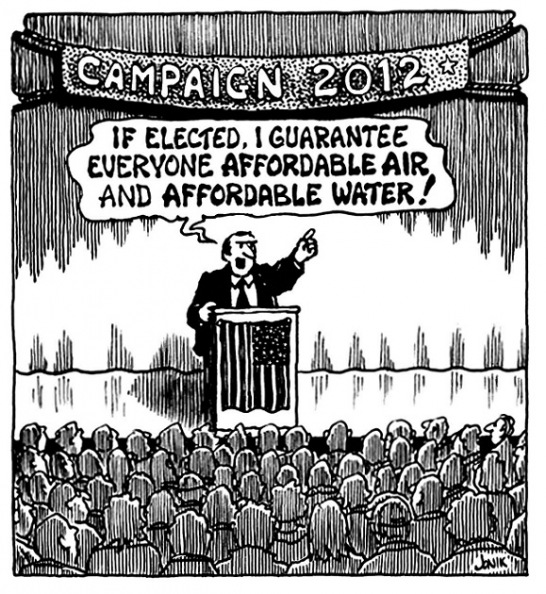
Our politicians should be running on a platform of issues concerning basic survival at this point.
Apocalyptic headlines seem to be daily occurrences now. Here’s just a few headlines that grabbed my attention over the last week(click on them to go to the original article):
Form the article:
Why do we care?,’’ Abdalati, an ice scientist, asked. ‘‘This ice has been an important factor in determining the climate and weather conditions under which modern civilization has evolved.’’
Scientists sometimes call the Arctic the world’s refrigerator and this is like leaving the fridge door open, Scambos said.
‘‘This is kind of a knob on global weather,’’ Wagner said. ‘‘We don’t know the impact yet of fiddling with it.
When people in my house leave the fridge door open, I get pissed and close it. The electric bill goes up due to an overworked fridge trying to cool the food. The Earth, unfortunately, has no ability to shut the door that the human species has permanently torn off its hinges, irreparably destroying the thermostat. On the other hand, the Earth doesn’t really care that we have doomed ourselves to extinction.
Back in 2009, a Lieutenant Vasquez of the U.S. Navy made the following comments which sum up how industrial civilization is perpetuating its own demise:
“It makes me uneasy anyway to think that we’re going to let a trend caused by global warming – the melting of the ice – allow us to explore and exploit more fossil fuels, which led to the warming in the first place.
“That seems wrong-headed to me, but nevertheless it’s likely to happen and there’s already a debate about exactly who’s got the rights to the minerals and the oil that’s there under the Arctic continental shelf, and how to go about exploiting it.
“It’s unfortunate, from a broader view, understanding the science of what the future holds, but I think it’s inevitable because oil and gas are going to be extremely valuable in the coming century as supplies dwindle.”
~~~~~~
From the article:
Tree-ring chronologies from long-term climate records show the western U.S. drought is already the most severe of the past 800 years. It will exceed the 1930s-era Dust Bowl with more consecutive dry years.
Less rainfall is expected in the U.S. West in each of the next 80 years than the annual average level during the drought of 2000 through 2004, the op-ed continues. Schwalm (an earth scientist), Williams (a geographer) and Schaefer (a National Snow and Ice Data Center scientist) analyzed that extreme drought in a new study in the journal Nature Geoscience.
Climatologists say we will experience reduced agricultural productivity, scarcer water resources and carbon sequestration (plants turning carbon into oxygen). The climatologists previously reported in a scientific journal that drought already has halved the amount of carbon dioxide they normally photosynthesize.
OK, that’s enough to scare any of us who studied biology out of our wits. But there’s more.
Major river basins show flow reductions of 5 to 50 percent. Western crop yields are down by 13 percent, with many local cases of crop failure….
Right now we are living in the glory days known as the “wet years”. Our descendants, if there are any, will look back in anger at their forefather’s myopic and self-destructive worship of economic growth and profit at the altar of an economic system they proclaimed to be the greatest the world has ever seen – capitalism. As has been said by a few wise people, “We can either save ourselves, or we can save capitalism.”
…Climate change is projected to increase the frequency, intensity, and duration of droughts, with impacts on many sectors, in particular food, water, health and energy,” WMO secretary general Michel Jarraud said. “We need to move away from a piecemeal, crisis-driven approach and develop integrated risk-based national drought policies.”
Mannava V K Sivakumar, director of WMO’s climate prediction and adaptation branch, says only Australia has a national policy toward drought and the advantage of a policy – rather than a disaster management, which some countries have – is that national action is required no matter who is in political power.
Australia’s government says its 2004 policy is no longer sufficient to deal with climate change, however, and over the past two years it has tried a pilot programme in western parts of the country aimed at shifting from a crisis-oriented approach to risk management.
Sivakumar said the agency is also encouraging more continuing support especially for “the poorest of the poor”, small farmers whose daily wages determine whether they and their families will eat on any given day.
If you’ve been paying attention, our system of transnational capitalism and globalization has ushered in a global land grab which I blogged about here. From where I’m sitting, there appears to be no concern for what’s really sustainable or socially just, but what the monied interests can steal from the weakest and most impoverished living on our planet.
Leading water scientists have issued one of the sternest warnings yet about global food supplies, saying that the world’s population may have to switch almost completely to a vegetarian diet over the next 40 years to avoid catastrophic shortages.
Humans derive about 20% of their protein from animal-based products now, but this may need to drop to just 5% to feed the extra 2 billion people expected to be alive by 2050, according to research by some of the world’s leading water scientists.
“There will not be enough water available on current croplands to produce food for the expected 9 billion population in 2050 if we follow current trends and changes towards diets common in western nations,” the report by Malik Falkenmark and colleagues at the Stockholm International Water Institute (SIWI) said….
…”Nine hundred million people already go hungry and 2 billion people are malnourished in spite of the fact that per capita food production continues to increase,” they said. “With 70% of all available water being in agriculture, growing more food to feed an additional 2 billion people by 2050 will place greater pressure on available water and land.
As George Dvorsky points out: “…it’s not enough for the researchers to suggest that switching to a non-meat based diet is the solution. Agriculture in general takes a tremendous toll on the environment and is a major contributor to the ongoing depletion of water reserves. It’s estimated, for example, that in the US, withdrawn surface water and groundwater use for crop irrigation exceeds that for livestock by about a ratio of 60:1. The issue, therefore, would seem to be one about the production of potable water and the development of more sustainable agricultural techniques…”
But I really don’t think we’ll be able to pack in a few more billion people on this planet at our current rate of destruction. Cannibalism might be how some get their allowance of meat in the future.
~~~~~~
from the article:
Life in the world’s oceans faces far greater change and risk of large-scale extinctions than at any previous time in human history, a team of the world’s leading marine scientists has warned.
The researchers from Australia, the US, Canada, Germany, Panama, Norway and the UK have compared events which drove massive extinctions of sea life in the past with what is observed to be taking place in the seas and oceans globally today.
Three of the five largest extinctions of the past 500 million years were associated with global warming and acidification of the oceans – trends which also apply today, the scientists say in a new article in the journal Trends in Ecology and Evolution.
Other extinctions were driven by loss of oxygen from seawaters, pollution, habitat loss and pressure from human hunting and fishing – or a combination of these factors….
…“It is very useful to look back in time – because if you forget your history, you’re liable to repeat it.”…
…“We need to understand that the oceans aren’t just a big dumping ground for human waste, contaminants and CO2 – a place we can afford to ignore or overexploit. They are closely linked to our own survival, wellbeing and prosperity as well as that of life on Earth in general.
“Even though we cannot easily see what is going on underwater, we need to recognise that the influence of 7 billion humans is now so great it governs the fate of life in the oceans. And we need to start taking responsibility for that.”…
…we need to stop releasing the CO2 that drives these massive extinction events, curb the polluted and nutrient-rich runoff from the land that is causing ocean ‘dead zones’, manage our fisheries more sustainably, and protect their habitat better….
I recall a quote from Philippe Cousteau Jr., the grandson of world-renowned environmentalist Jacques Cousteau:
“I could cut my leg off, I could cut my arm off, I could gouge my eye out, I’d still probably survive, but not very well, and that’s what we’re doing to the ocean.
“It’s the life support system of this planet. We’ve been dumping in it, we’ve been polluting it, we’ve been destroying it for decades, and we’re essentially maiming ourselves… It’s not a question of whether the oceans can take anymore. The ocean can’t take any more. They couldn’t take any more fifty years ago.
”The question is, ‘when are we going to stop?”
Yes, that is the question of the ages. And the answer is that we won’t stop until our economic system collapses.
~~~~~~
…And the above article near my own stomping grounds. You know things are going haywire when flood insurance is needed for a suburban neighborhood located in the desert.
I mentioned in my last post “Things are Heating Up for Heads on a Pike” that Las Vegas is building another straw below the existing water intake pipes which are in danger of going dry due to a sinking water line in the Colorado River and Lake Mead. Since Vegas gets 90% of its drinking water from the river, its evaporation and depletion puts in jeopardy not only that city but also the 38 million people in the Southwest dependent on the river. If you read the article I linked to, then you’ll know Vegas has been plagued by all sorts of problems like cave-ins and floodings in the construction of this new, longer straw to suck out what remains of a river in critical condition from severe drought and over-usage, both of which are exacerbated by global warming:
The Lake Mead surface level has dropped about 100 feet in elevation since the lake was full in 2000, bureau spokeswoman Rose Davis said. It is about half-full today — displaying a distinctive white mineral “bathtub ring” between the low and high water lines. – source
———————
…water authority General Manager Pat Mulroy has described the third intake project as a race against time. The problem is there is nothing very speedy about construction on this scale.
The finished, 20-foot diameter intake pipe will allow the authority to draw up to 1.2 billion gallons of water a day from Lake Mead even if the surface drops another 90 feet.
It also will give the authority access to the deepest part of the lake, where the coolest, cleanest water is found. – source
The German-buit machine used to dig this new water intake looks like something out of a science fiction movie, over 600 feet long and costing $25 million:
The $25 million tunnel boring machine was designed and built in Germany specifically for the third intake project.
“It’s the BMW of TBMs,” McDonald joked.
The machine crossed the globe on a container ship. It took 61 tractor-trailers to deliver it in pieces from the Port of Long Beach, Calif., to the job site at Lake Mead.
Fully assembled, the machine is the length of two football fields and weighs more than three Boeing 747 jetliners. The cutter head, a ridged platter 231/2 feet tall and studded with disks made from a special alloy, weighs 150 tons all by itself. – source
This project doesn’t come cheap at a cost of $800 million dollars. Now I find it rather humorous when the Vegas customers get their new water bills, causing them to fly off the handle and grab a pitch fork:
A couple of weeks ago, the Las Vegas Valley Water District got an earful from customers about a steep rate hike on businesses.
On Thursday, it was the Southern Nevada Water Authority’s turn.
A handful of angry business owners and residents attacked the rate increase during the authority board’s monthly meeting, and many more people have called and sent letters about their ballooning bills.
The barrage of complaints and concerns prompted Clark County Commissioner Steve Sisolak to issue an unusual apology of sorts: He didn’t understand what he was voting for when he voted for the rate hike earlier this year.
“I was under a totally different impression when we passed this increase,” Sisolak said.
He said he had no idea that the new infrastructure surcharge he helped approve would boost the monthly bills for some businesses, churches and nonprofits by 200 percent or more. He thought most people would have to pay a flat monthly increase of about $5.
If he didn’t know then, he certainly does now…
…Sisolak and others are trying to speed up a planned review of the charge, which was originally supposed to be done as part of a larger planning process over the next year and half by a new citizens committee being assembled.
Sisolak said some water customers may not be able to wait that long.
“What I’m hearing from the business community is they’re not going to make it 18 to 20 months,” he said.
McAnallen said something needs to be done. The business owners he is talking to can scarcely afford the current surcharge, which is slated to last for the next three years. If no other solution is found by 2016, the charge will have to be doubled to cover the authority’s debt load, he said.
Authority officials have acknowledged that the surcharge affects businesses more than residents, but they said the new fee is necessary to pay down roughly $2.5 billion in construction debt and finish funding an $800 million intake being built to keep water flowing to the valley even if Lake Mead continues to shrink.
Such projects used to be paid for with the spoils of growth, namely connection charges from new homes and commercial buildings. When growth stopped, so did the water authority’s primary source of construction money.
It’s not just business owners who are complaining about the surcharge.
While the average single-family home saw its bill go up by about $5, some older homes with larger lots and water lines took a bigger hit.
Lifelong Las Vegas resident Mary Joy Alderman lives in a 60-year-old downtown home that sits on an acre of land served by a 1-inch water meter. She said her bill just jumped to about $36 though she has slashed her monthly water use to around 1,000 gallons – less than a tenth of what the average home consumes – and doesn’t water her landscaping at all…
Did you read that:
“Such projects used to be paid for with the spoils of growth, namely connection charges from new homes and commercial buildings. When growth stopped, so did the water authority’s primary source of construction money.”
Now this falls in line with the analysis that suburbia is one giant Ponzi scheme, as argued here.
Now I want to go back and talk also about one of those heads that belongs on a pike. One of the major problems facing industrial civilization and mankind is the failure to be honest with ourselves. And that problem is compounded when you are not given the facts of your predicament. The captains of industry who benefit from business-as-usual like to keep the public in the dark and brain-washed about free-market capitalism, a dogma that has brought the planet to its knees and the continued existence of the Homo-Sapien species into question. Gina Rinehart, the richest woman in the world, is a case in point:
Addressing a libertarian think-tank in Perth last July, the British climate change sceptic Christopher Monckton urged Australians to create a home-grown version of Rupert Murdoch’s Fox News. The “super-rich”, he said, should invest in the media, install like-minded commentators and give the country “a proper dose of free-market thinking.
Lord Monckton’s visit was part-funded by one of his biggest Australian fans, Gina Rinehart, the multi-billionaire iron ore magnate. A year on, Ms Rinehart – the country’s wealthiest individual – is on the verge of becoming its newest media mogul, a prospect that is sending a chill through newsrooms, boardrooms and the corridors of government…
…Rinehart never gives interviews. But her values – pro-free market, cheap foreign labour and tax concessions for mining, and anti-government regulation, red tape and climate change science – are well known…
“She regards journalists as either socialists or communists,” says Paul Barry, an investigative journalist and author. “Not only does she know nothing about the media business, but she doesn’t understand or sympathise with the media.
“I think she would be considerably worse than Rupert Murdoch as a proprietor, not least because she’s coming into a newspaper [group] with an entirely opposite stance to the one she would like it to take.”
This lady’s mindset sounds almost cartoonish in its prejudice and ideological bent. Firstly, she can’t possibly understand what freedom of the press means other that the dictate of ‘freedom to buy the press’ and convert it into a mouthpiece for her wealth-extraction agenda. Secondly, Mrs Rinehart and her ilk don’t acknowledge the reality that capitalism cannot exist without the ability to pollute freely and externalize as much costs as possible onto the environment and communities in which she does not reside. But as I said in Tuesday’s post, the über wealthy will not be spared from escalating climate chaos. Thirdly, capitalism cannot exist without cheap and plentiful fossil fuels of which we are starting to scrape the bottom of the barrel as evidenced by more extreme and environmentally destructive measures such as tar sands, deep-sea drilling and gas fracking. Fourthly, capitalism depends on infinite growth to survive, as explained here. Euan Mearns talked about the death of capitalism recently at the 2012 ASPO meeting. Jeremy Grantham also sees the problems with capitalismcoming down to debt, politics, environmental damage, and inhumanity.
Capitalism ultimately leads to barbarism and heads on a pike for those not willing to face harsh certainties.
I posted a snarky comment over at the Rogue Columnist, but I’m really beginning to think that it’s not far off from what will be a reality in the not too distant future. Read just the following two articles to see what I mean. The estimates of water loss to the Colorado River will be much greater than predicted in my post “When The River Runs Dry“. Las Vegas is already frantically constructing another straw at a lower height to capture water from the river.
…The heat in Colorado is one ingredient that along with unusually dry conditions and strong winds is creating one of the worst wildfire seasons on record in the Rocky Mountain State. The High Park Fire has already burned 83,000 acres, making it one of the largest fires in state history. More than 1,800 personnel are currently battling the blaze, which has already cost at least $31.5 million, according to a U.S. Forest Service website. Another wildfire began on Tuesday and threatened the city of Boulder, causing staff at the National Center for Atmospheric Research to be evacuated.
According to a recent Climate Central analysis, Colorado was the 20th-fastest warming state between 1970 and 2011, with average temperatures increasing by about 0.5°F per decade. Arizona, which is also grappling with hot weather and wildfires, was the fastest-warming state, with an increase of about 0.6°F per decade.
The heat is not just affecting the West, however. The High Plains and even the South have been sweating it out under a dome of high pressure, which is causing a broad area of sinking air. As air sinks it warms, and this also inhibits the formation of showers and thunderstorms that could offer some heat relief.
During the June 18-to-24 period, 731 daily high temperature records and 798 daily warm low temperature records were set or tied in the U.S., compared to 154 record cold daily high temperatures and 131 record cold daily low temperature records, according to the National Climatic Data Center.
Between June 19-25, there were 14 all-time high temperature records set or tied, along with two all-time overnight warm low temperature records. There were no all-time cold temperature records set or tied during the same period.
In a long-term trend that demonstrates the effects of a warming climate, daily record-high temperatures have recently been outpacing daily record-lows by an average of 2-to-1, and this imbalance is expected to grow as the climate continues to warm. According to a 2009 study, if the climate were not warming, this ratio would be expected to be even. Other studies have shown that climate change increases the odds of extreme heat events and may make them warmer and longer lasting.
Bill Deger, a meteorologist for AccuWeather in State College, Pa., posted a comprehensive rundown of some of the more noteworthy heat records in the West and the High Plains.
“A couple of 113-degree readings in Kansas on Monday nearly claimed the top spot for the hottest temperature on planet earth. Only six other observing stations in the Middle East were hotter on Monday, with Makkah, Saudi Arabia, leading the pack at a blistering 117,” Deger noted. “A cooperative weather station near Tribune, Kan., which set an all-time record high of 109 on Sunday, turned around and beat the new record by a full 2 degrees on Monday.”
Deger wrote that Galveston, Texas had its earliest 100-degree day in any calendar year since at least 1875.
The heat is slowly building east, and records may fall during the next few days in cities such as Chicago, St. Louis, and Kansas City. The heat wave should reach the Mid-Atlantic states by the end of the week as well…
And new research on soil erosion and the dying forests in the Southwest…
(June 27, 2012) — New research concludes that a one-two punch of drought and mountain pine beetle attacks are the primary forces that have killed more than 2.5 million acres of pinyon pine and juniper trees in the American Southwest during the past 15 years, setting the stage for further ecological disruption.
The widespread dieback of these tree species is a special concern, scientists say, because they are some of the last trees that can hold together a fragile ecosystem, nourish other plant and animal species, and prevent serious soil erosion.
The major form of soil erosion in this region is wind erosion. Dust blowing from eroded hills can cover snowpacks, cause them to absorb heat from the sun and melt more quickly, and further reduce critically-short water supplies in the Colorado River basin.
The findings were published in the journal Ecohydrology by scientists from the College of Forestry at Oregon State University and the Conservation Biology Institute in Oregon. NASA supported the work.
“Pinyon pine and juniper are naturally drought-resistant, so when these tree species die from lack of water, it means something pretty serious is happening,” said Wendy Peterman, an OSU doctoral student and soil scientist with the Conservation Biology Institute. “They are the last bastion, the last trees standing and in some cases the only thing still holding soils in place.”
“These areas could ultimately turn from forests to grasslands, and in the meantime people are getting pretty desperate about these soil erosion issues,” she said. “And anything that further reduces flows in the Colorado River is also a significant concern.”
I’ve been at this blogging for about six weeks now, reading and researching industrial civilization’s demise. The more one goes back and looks at the wholesale destruction we have done and continue to do to this planet, and in turn ourselves, the more you come to realize how blind and foolish we have been. Entire ecosystems have been wiped off the face of the earth and whole environmental systems altered beyond their normal evolution. In place of forests, jungles, and deserts, we have constructed vast tracts of monoculture industrial farming, endless vistas of cookie cutter suburbia, thousands upon thousands of miles of asphalt roads, parking lots, and concrete paths, and cathedral-like malls for the citizenry to partake in the consumption of goods made by someone we’ll never meet and shipped from lands we may never visit.
What underpinned the creation of this entire edifice of modern man in less than two centuries? The power to transform the earth in our image came from cheap, energy-dense fossil fuel, i.e. oil. So highly dense in energy is oil that just one barrel of it equates to the labor of one man working forty hours a week for twelve years. Was all of this frenetic, ant-like labor worth it if, at the end of the day, we find that all of that effort to be for nought, cleared away by an escalating, civilization-ending climate chaos? It seems that we went to a party and drank so much of the intoxicating drinks offered to us that we ended up killing ourselves from the overdose and subsequent poisoning. For those sitting at the top of the capitalist hierarchy, do they not fully understand that a world thrown out of balance will not spare the elite sitting behind their barb-wire walled and guarded mansions? Is the desperate clawing at low EROEI fossil fuel sources worth the expense of further, unmitigated environmental destruction just to eke out a few more decades of what is inevitably a self-destructive system? What will we be left with but a completely poisoned and pillaged planet with no resources left to construct an alternative that might replace the current bankrupt system.
Right now we are in the intoxication phase, blind to the self-imposed eradication that comprises our present course in energy policy. So blind are the elite that they are willing to lie and propagandize in order to make sure the plans go forth. Having poisoned the biosphere, oceans, and land, the only place left seems to be deep beneath the ground beyond everyone’s sight where the remaining life-giving reservoirs of water rest.



















 Collapse of Industrial Civilization