My last post on environmental toxins was inspired from an email I got from Professor Julian Cribb in Australia. Upon closer inspection of his email I see that the attachments have much more interesting information that deserves our attention. I hope my readers will forgive me for having missed this valuable material, but I just came back from the decadence of Sin City on my weekend trip and I’m a little tired.
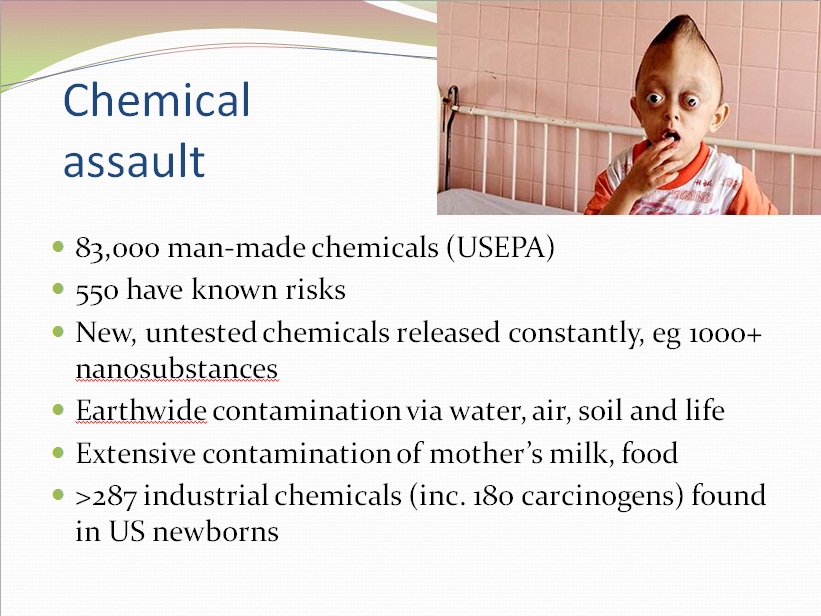
I hope the good Professor doesn’t mind my posting the attachments at my site. The first concerns environmental toxins and is an extended and more informative version of the brief article that Professor Cribb published in the Canberra Times.
The second attachment is an argument for the renaming of the human species (Homo Sapien) to something more appropriate in order to properly reflect our dysfunctional and self-destructive nature. I believe we’re too full of self-conceit and self-delusion to ever seriously entertain the idea, but it is a good argument to make in light of our impending extinction and the ongoing destruction of the Earth’s habitability for most other organisms. This global apocalypse is being brought to you by the world-wrecking hands of ‘industrial capitalist carbon man’.
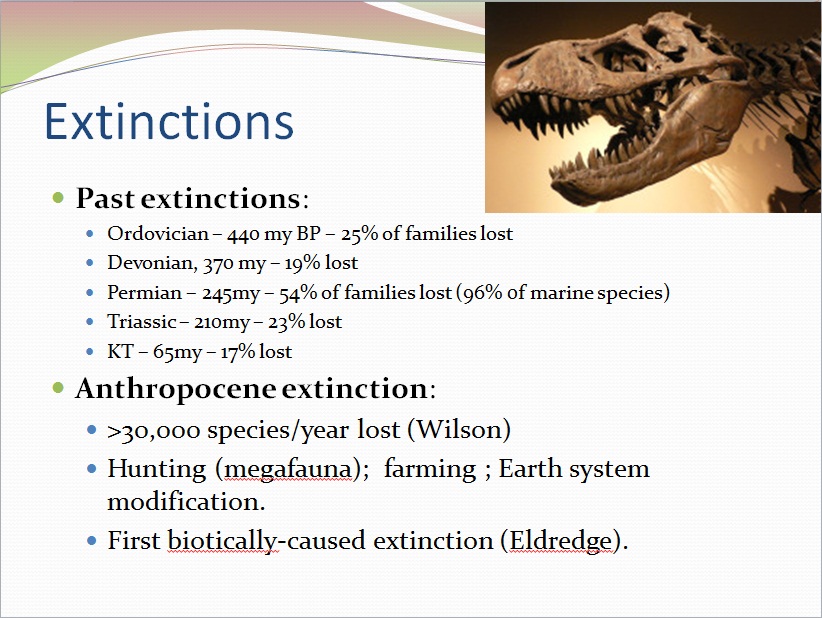
Lastly, he sent me an interesting slide show which appears to be the basis for a TV documentary that the Professor is hoping to create in order to explore these unfolding crises leading to mankind’s self-inflicted extinction, an avoidable tragedy if Homo Sapiens lived up to their name of ‘wise man’ – a misnomer if there ever was one.
I look forward to watching this documentary. Luckily, Professor Cribb is trying to get this project done in Australia and not the Banana Republic of America where it would be sacrilege to think that money is an illusion or that all problems cannot be solved by printing more of it.
Hello dominant life form of planet Earth. Yes, that means you Homo Sapiens. I’ve watched as over the millennia you evolved from a primitive ape-like hominid species, surviving purely by instinct, to the technology-wielding, sophisticated-thinking creature of today. Truly, the planet became your smorgasbord and you have partaken freely. As a matter of fact, you have very nearly emptied the planet’s entire refrigerator and cupboards and are now preparing to lick your plate clean. I’ve been throwing up some warning signs, especially this past year, to try to get your attention and perhaps make you reconsider your current omnivorous appetite. After all, you do share the planet with other life forms who have been hoping someone or something will put an end to your callous industrial rampage. I’ve even set in motion a sort of evolutionary check-and-balance, a doomsday device if you will, in the form of atmospheric heat-trapping gases, ensuring your demise just in case you don’t get the message of behavior modification. In other words, your dominant socio-economic paradigm of capitalism is fatally flawed.
Your voracious appetite for the world’s natural resources — fish, timber, potable water, arable land, minerals, et al. — continues unabated. And after consuming them, you leave behind mountains of waste and destruction. Does it always take a crisis before you creatures take action? Instead of waiting until you suffocate to death in a world of hypoxic oceans and dead forests, try listening to those lone voices of dissent screaming for your attention:
Look, I have news for you. The human economy does not take precedence over the Earth’s natural ecological processes which have evolved over millions of years to provide you with clean water, clean air, fertile land, and productive plant and animal life. All of these priceless necessities have been given to you at no charge to your accounting ledger. I guess free lunches are something no human can refuse, but the bill will come due no matter how you try to hide it by pushing it off onto the environment and future generations. In a planet without a stable biosphere, your glimmering metropolises with their megalithic concrete and steel structures reaching heavenward are nothing more than fleeting sand castles to be washed away by the next rogue wave of a surging sea… Sandy was just a warm-up event. Perhaps a new ‘Dust Bowl’ event and heat waves down under demanding a new color code on the weather map and droughts rendering useless a nation’s hydroelectric power will do the trick. I suppose as long as the $tock exchanges of the world are operable, your “business as usual” scheme of perpetual growth and converting all the natural world into capitalist symbols of wealth will carry on its merry way right over the edge of global extinction. And you thought the “fiscal cliff” was something to worry about?
As a mentor and intellectual peer of this site said recently, “tribes and societies that did master effective class consciousness thrived, for a very long time. Those that didn’t, don’t.” At today’s massive scale of production and consumption, the human and environmental exploitation characterized by modern industrial capitalism undermines the long-term existence of mankind along with every other living organism on the planet. Capitalism shoehorns everything into its profit-seeking regime, no matter if that means global genocide on a scale never heretofore seen:
…Actually, the more I reflect on it, the clearer I see the logic, the rationale, behind the bankers’ and the capitalists’ push for privatization. It is not just more profits they are after, not just share price or corporate valuation; no! They are after mass extermination, genocide on a grand scale – of the world’s needy, the under-funded, the unwanted, the uncivilized, the savages and the barbarians, the commies and the Islamists, in short, elimination of all of the Others.
The big boyz have seen all the data and crunched all the numbers, and it is clear to them – the earth is running out of resources, Mars is -50 C all of the time, and we can no longer afford to carry all of this excess baggage here on the planet — all of these miserable, thankless, do-nothing mouths to feed. So the plan is brilliant. You reduce the number from 7+ billion by at least 33% without firing one shot. You simply privatize all natural resources and then price access so that the bottom third of the globe’s population cannot afford it. And so, they die; it will be the biggest die-off of the Anthropocene epoch…
As I’ve explained in the past, my peculiar work routine really makes this site a sort of biweekly affair. So in keeping with that loose schedule, I’ll be taking the next several days off and will post again in earnest after Christmas. In the meantime, I’ll be partaking in the traditional family yuletide activities such as drinking funky-tasting eggnog and cruising through the neighborhood to take in all the lit up decorations like inflatable Walmart snowmen and Santas. Notwithstanding everything I’ve blogged about here, the world’s not coming to an end, right? Putin apparently had a 4 hour news conference which included this very subject:
So all these observable facts that we’ve been documenting here are just our own personal viewpoint of the world and certainly not the perspective held by the vast majority of the population, including world dictators leaders. We should just take a ‘glass is half full’ point of view, shouldn’t we?:
1.) Peak Oil? Not a problem… We’ve got more fossil fuels to exploit as revealed by the melting Arctic. And of course we can always fall back on our seemingly endless supply of coal:
2.) Overpopulation? Not a problem. Endocrine disrupting chemicals and other stressors of industrial civilization are decimating the sperm count of the global male population:
3.) Climate Change? The top minds of science are right on top of this one. Who said you can’t put Humpty Dumpty back together again:
4.) And the most dire threat of all… The Fiscal Cliff. Are you kidding? The bankers and corporate elite already have that one solved. Three for them and none for you:
…Over 20 million Americans live in extreme poverty – with cash incomes as low as $10,000 a year for a family of four. Is it any wonder that the US has the third highest poverty rate out of 30 leading industrial nations?
The problem is exacerbated by decades of economic and political policies that have resulted in a massive shift of national wealth from working people to the corporate boardrooms and the yacht owners. One result: real wage growth for workers has stagnated for 30 years; median household income has steadily fallen since the Wall Street produced economic crash of 2008. Much of the limited job growth since then has been in the lowest wage sectors, primarily food service and retail.
Sadly, the issue remained almost as invisible on the 2012 campaign trail as it was when Harrington shocked the nation in 1962. But it is not a surprise to nurses who, every day, see the faces of poverty and the suffering of families left behind – even as corporate profits once again soar and the parties and good times are back on Wall Street…
Well, we can always take up dumpster diving in the wealthy neighborhoods. I hear they “throw a lot of good shit away.”
Have a merry Christmas and don’t let the bastards wear you down!!!
In this post I want to elaborate more on DK’s comment from my last entry:
…Pre-capitalist tribes had examples of both success and failure, perhaps equal measure of both. The key principle to these types of cultures succeeding is the principle of superabundance. There is strong correlation to the disappearance of superabundance and destructive tendencies…
In his essay ‘Are Wars Inevitable?‘, William T. Hathaway explains that modern research has shown that scarcity of resources acts as a trigger for social strife and that violence and war is NOT a genetic predisposition of humans:
…research, however, led to a key discovery: The chimps who invaded their neighbors were suffering from shrinking territory and food sources. They were struggling for survival. Groups with adequate resources didn’t raid other colonies. The aggression wasn’t a behavioral constant but was caused by the stress they were under. Their genes gave them the capacity for violence, but the stress factor had to be there to trigger it into combat. This new research showed that war is not inevitable but rather a function of the stress a society is under. Our biological nature doesn’t force us to war, it just gives us the potential for it. Without stress to provoke it, violence can remain one of the many unexpressed capacities our human evolution has given us. Studies by professors Douglas Fry, Frans de Waal, and Robert Sapolsky present the evidence for this.
Militarists point to history and say it’s just one war after another. But that’s the history only of our patriarchal civilization. The early matriarchal civilization of south-eastern Europe enjoyed centuries of peace. UCLA anthropologist Marija Gimbutas describes the archeological research in The Civilization of the Goddess. No trace of warfare has been found in excavations of the Minoan, Harappa, and Caral cultures. Many of the Pacific islands were pacifistic. The ancient Vedic civilization of India had meditation techniques that preserved the peace, and those are being revived today to reduce stress in society...
Now DK goes on to say that in the absence of plentiful resources, the only logical and sane option is to give up our current exploitive and pathological economic model of capitalism and replace it with something that reflects today’s reality of rampant resource depletion and environmental collapse. Modern weapons of war are infinitely more destructive and, in and of themselves, pose a danger to all of mankind and global civilization; hence the need to get rid of capitalism is even more imperative:
…When superabundance is (inevitably) rendered invalid, it must be supplanted by a means to re-appropriate surplus in a fair and equitable manner- devoid of exploitation and informed by tangible limits, such as those posed by the environment and population limits. Such a system is not compatible with profit seeking, as many in the environmental movement are now discovering- nor has it ever been put successfully into practice.
One could say that mankind’s ability or inability to successfully transition away from the self-destructive nature of capitalism will determine the fate of the whole human species. Tragedy of the commons, as I said previously, is on a global scale now. Hathaway goes on to elaborate a little on capitalism’s dog-eat-dog tendencies and the need to move away from this paradigm:
Our society, though, has a deeply entrenched assumption that stress is essential to life. Many of our social and economic structures are based on conflict. Capitalism’s need for continually expanding profits generates stress in all of us. We’ve been indoctrinated to think this is normal and natural, but it’s really pathological. It damages life in ways we can barely perceive because they’re so built into us…
…We can create a society that meets human needs and distributes the world’s resources more evenly… But that’s going to take basic changes…
These changes threaten the power holders of our society. Since capitalism is a predatory social and economic system, predatory personalities rise to power. They view the world through a lens of aggression. But it’s not merely a view. They really are surrounded by enemies. So they believe this false axiom they are propagating that wars are inevitable.
In the past their predecessors defended their power by propagating other nonsense: kings had a divine right to rule over us, Blacks were inferior to Whites, women should obey men. We’ve outgrown those humbugs, and we can outgrow this one.
Of course, as Gail of ‘Wit’s End’ pointed out, we will inevitably need to address the problem of overpopulation:
…although once upon a time some tribes (arguably) may have lived cooperatively and harmoniously (although the opposite is certainly more common) the only reason they could do so is because their numbers were so low and food was plentiful and relatively easy to obtain. Once human population outstrips resources, things get ugly no matter what social or cultural system is in place. And I don’t know of a place where human population didn’t eventually overrun the environment, with the possible exception of cultures that practiced infanticide, or had the ability to export people willing to emigrate.
It seems to me the problem is that we have filled every corner of the globe that is remotely habitable, and then some, and yet our population and levels of consumption continue to increase. There is no place left to emigrate to. It can’t last.
Resource constraints(i.e. peak oil, peak fertilizer, peak water) on our fossil fuel based agricultural system as well as environmental degradation(i.e. climate change and ocean acidification) are going to cause an epic population crash during this century before we have time, or for that matter the cooperation and agreement, to implement any sort of voluntary population reduction.
As far as implementing this egalitarian distribution model, I also agree that the odds of that happening are slim to none, as DK said:
…Such a system[egalitarian and respective of resource limits] is not compatible with profit seeking, as many in the environmental movement are now discovering – nor has it ever been put successfully into practice.
Nor is it likely to be.
Unfortunately, the world’s stockpile of thermonuclear weapons may not stay on the shelf forever, especially in a world where the Four Horsemen of Industrial Civilization are quickly converging: Climate Change, Peak Net Energy, Ocean Acidification, and Peak Water. I’m not saying we shouldn’t try everything we can to stop what seems to be our inevitable fate; I’m just saying that the prognosis is grim.
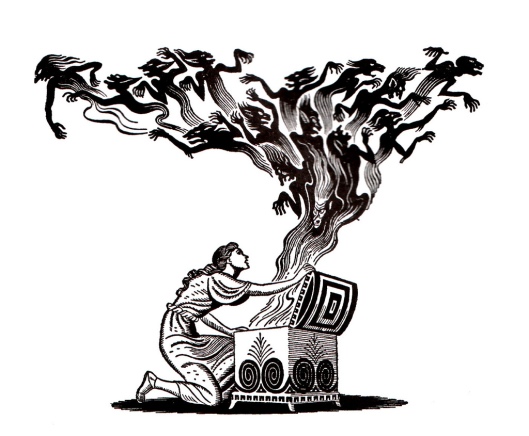
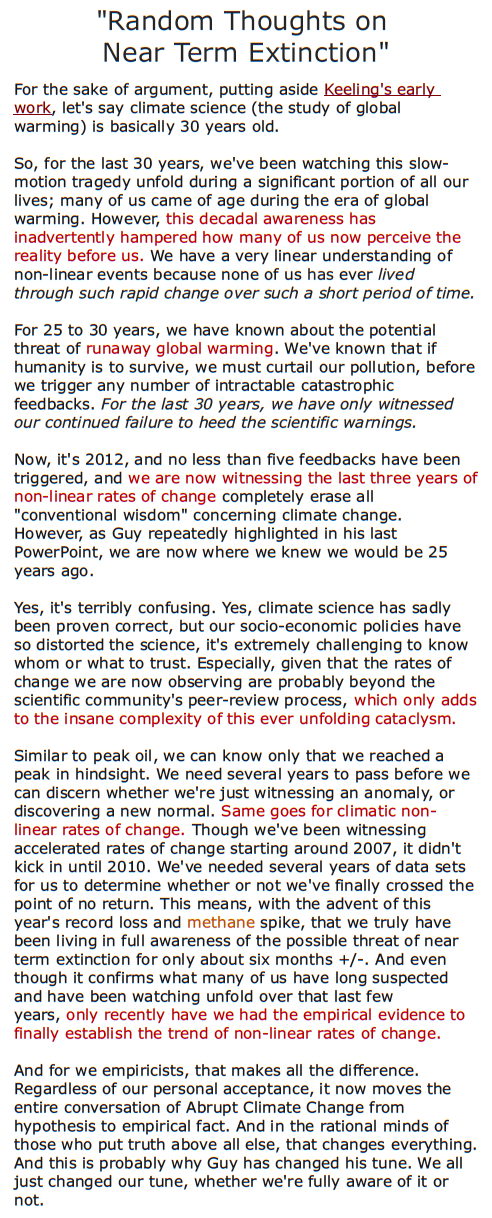
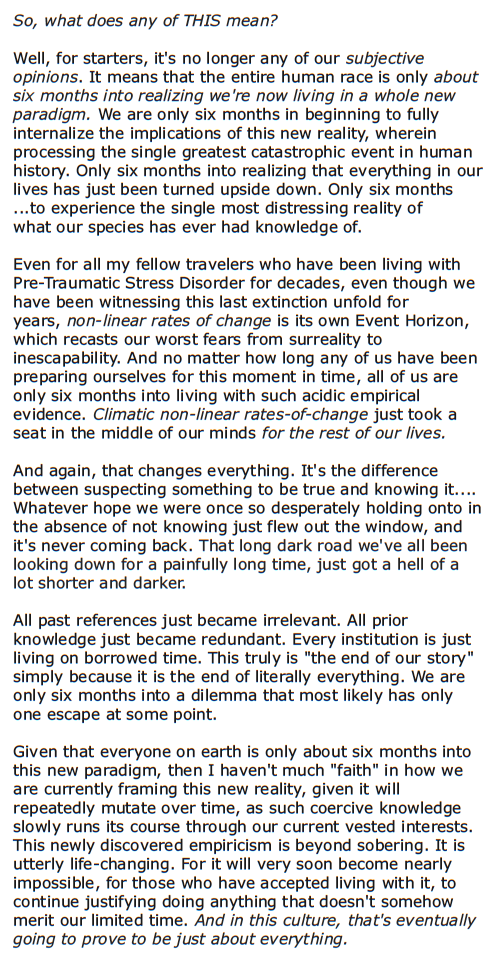
The following thoughts were emailed to me by Adam at speciesurvivalibrary and they appeared as a comment on the message board of Nature Bats Last dated November 28. The readers “found it quite moving”, as did I. Therefore, I compiled a video at the end to go along with Daniel’s articulate and resonating words. The scientific confirmations this year of the havoc industrial civilization has wrought to our one and only home have truly been life-altering for me, forcing me to question and re-evaluate everything. For those who have begun to internalize the cold reality of what lies in the not too distant future for mankind, the proverbial rug has been pulled out from under your world. We have unleashed Pandora’s box and the demons are methodically throwing off balance and unravelling the world we once knew, shattering the illusion of man’s dominion over nature.
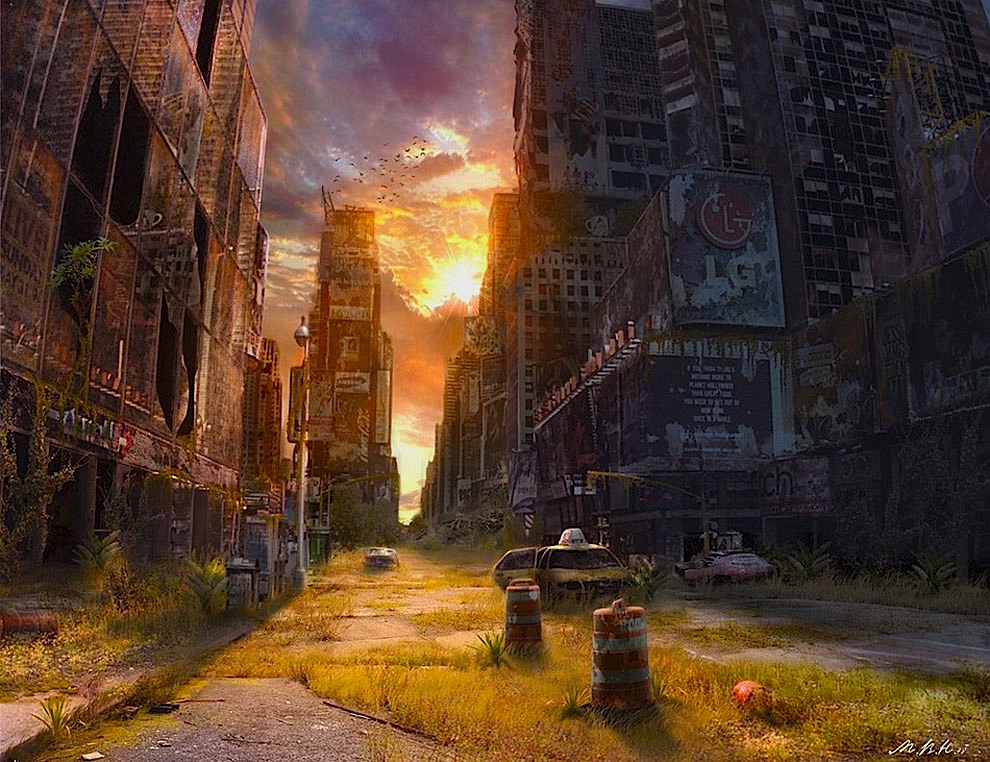
I thought I’d post a few pictures of what the world will look like before the end of this century. Artists have the intuitive imagination to conjure up such visions the general public can only imagine through Hollywood zombie flicks which seem to be all the rage these days. Why do I feel this vision is inevitable? Just look at the daily news to see what I mean:
It used to be that the mentally insane, flailing their arms and talking to invisible people in the streets, were the ones ranting and raving about the end of the world, but now it’s scientists who, in an attempt not to offend the beliefs of the scientific illiterati and free-market faithful, downplay their findings as much as possible. Optimism bias infects even the scientific community.
…we are the most tragic species. We not only destroy all of the world around us, we are aware of doing it but unable to stop ourselves. We have faith and hope that things will get better, that we can turn around at the last second what we’ve screwed up over years and decades. Which of course is nothing but an excuse to keep on screwing up. All courtesy of our optimism bias.
What better exemplifies the delusional optimism of man than the belief that he could hide out in a bunker to survive the ravages of a nuclear war? I’ll tell you what tops that fantasy – the belief that man can continue to do what he has done and expect the planet to unfailingly absorb all the environmental assaults we can throw at it via the endless growth of capitalist production and consumption. The planet is not some massive ShamWow towelette for man’s nonstop flow of excrement.
Of all the findings in the 2012 edition of the World Energy Outlook, the one that merits the greatest international attention is the one that received the least. Even if governments take vigorous steps to curb greenhouse gas emissions, the report concluded, the continuing increase in fossil fuel consumption will result in “a long-term average global temperature increase of 3.6 degrees C.”
This should stop everyone in their tracks. Most scientists believe that an increase of 2 degrees Celsius is about all the planet can accommodate without unimaginably catastrophic consequences: sea-level increases that will wipe out many coastal cities, persistent droughts that will destroy farmland on which hundreds of millions of people depend for their survival, the collapse of vital ecosystems, and far more. An increase of 3.6 degrees C essentially suggests the end of human civilization as we know it.
To put this in context, human activity has already warmed the planet by about 0.8 degrees C — enough to produce severe droughts around the world, trigger or intensify intense storms like Hurricane Sandy, and drastically reduce the Arctic ice cap. “Given those impacts,” writes noted environmental author and activist Bill McKibben, “many scientists have come to think that two degrees is far too lenient a target.” Among those cited by McKibben is Kerry Emanuel of MIT, a leading authority on hurricanes. “Any number much above one degree involves a gamble,” Emanuel writes, “and the odds become less and less favorable as the temperature goes up.” Thomas Lovejoy, once the World Bank’s chief biodiversity adviser, puts it this way: “If we’re seeing what we’re seeing today at 0.8 degrees Celsius, two degrees is simply too much.”
At this point, it’s hard even to imagine what a planet that’s 3.6 degrees C hotter would be like, though some climate-change scholars and prophets — like former Vice President Al Gore in An Inconvenient Truth — have tried. In all likelihood, the Greenland and Antarctica ice sheets would melt entirely, raising sea levels by several dozen feet and completely inundating coastal cities like New York and Shanghai. Large parts of Africa, Central Asia, the Middle East, and the American Southwest would be rendered uninhabitable thanks to lack of water and desertification, while wildfires of a sort that we can’t imagine today would consume the parched forests of the temperate latitudes.
In a report that leads with the “good news” of impending U.S. oil supremacy, to calmly suggest that the world is headed for that 3.6 degree C mark is like placing a thermonuclear bomb in a gaudily-wrapped Christmas present. In fact, the “good news” is really the bad news: the energy industry’s ability to boost production of oil, coal, and natural gas in North America is feeding a global surge in demand for these commodities, ensuring ever higher levels of carbon emissions. As long as these trends persist — and the IEA report provides no evidence that they will be reversed in the coming years — we are all in a race to see who gets to the Apocalypse first.
Enjoy industrial civilization’s fossil fuel blow-out sale while it lasts. This is a one-time-only, circus-like ‘liquidation event’. Everything must be commodified regardless of ecological loss or intrinsic value to the web of life. The Human species won’t want to miss these deals! There will be no returns or exchanges available as we are going out of business for good due to bankruptcy proceedings with Mother Earth. All life forms and resources on the planet must go!!!
In my previous post I quoted Professor Charles Hall’s assertion that the current economic paradigm is ill-equipped to account for and address externalities such as resource depletion and environmental degradation. Peak oil as well as climate change/global warming are just two in a long list of biophysical constraints which neoclassical Keynesian economics, i.e. mainstream economics, overlooks:
…the crisis looming before us is likely to be, if anything, more terrible than the Great Depressions of 1873-93 and 1929-39. The continuing industrialization of agriculture and urbanization of population—by 2010, it is estimated, more than half the earth’s inhabitants lived in cities—has made more and more people dependent upon the market to supply them with food and other necessities of life. The existence on or over the edge of survival experienced today by the urban masses of Cairo, Dhaka, São Paulo, and Mexico City will be echoed in the capitalistically advanced nations, as unemployment and government-dictated austerity afflict more and more people, not just in the developed world’s Rust Belts but in New York, Los Angeles, London, Madrid, and Prague.
Left to its own devices, capitalism promises economic difficulties for decades to come, with increased assaults on the earnings and working conditions of those who are still lucky enough to be wage earners around the world, waves of bankruptcies and business consolidations for capitalist firms, and increasingly serious conflicts among economic entities and even nations over just who is going to pay for all this. Which automobile companies, in which countries, will survive, while others take over their assets and markets? Which financial institutions will be crushed by uncollectible debts, and which will survive to take over larger chunks of the world market for money? What struggles will develop for control of raw materials, such as oil or water for irrigation and drinking, or agricultural land?
Gloomy though such considerations are, they leave out two paradoxically related factors that promise further dire effects for the future of capitalism: the coming decline of oil—the basis of the whole industrial system at present—as a source of energy, and the global warming caused by the consumption of fossil fuels. Even if continuing stagnation should slow greenhouse gas-caused climate change, the damage already done is extremely serious. Elizabeth Kolbert, a journalist not given to exaggeration, called her soberly informative account Field Notes From a Catastrophe. The melting of glaciers threatens not only Swiss views but the drinking supplies of whole populations in such areas as Pakistan and the Andean watersheds; droughts have ravaged Australian and Chinese agriculture for years now, while floods periodically devastate the low-lying South Asian homes of tens of millions of people. The rolling parade of disasters is, unfortunately, only getting started. It will accompany a stagnant economy and only be exacerbated by the increased greenhouse-gas emissions that a return to true prosperity would bring… – essay adapted from Paul Mattick’s book ‘Business as Usual: The Economic Crisis and the Failure of Capitalism‘
The mandatory growth requirement of mainstream economics also precludes the concept of sustainability. I have not yet read the above referenced book ‘Business as Usual: The Economic Crisis and the Failure of Capitalism’, but a prominent socialist speaking of peak oil and global warming in the same paragraph is always intriguing. However, a brief critique of the book by a reader finds that Mattick does not go nearly far enough in incorporating these two realities into his analysis of our current crisis:
All mainstream institutions have subscribed to the near religious belief of the infallibility of the capitalist economy which itself is considered a self-regulating system governed by the “invisible hand” of the free market as explained by Adam Smith in The Wealth of Nations. Market ‘value’ is produced by the optimal use of capital, labor, and production. Mainstream economics operates under the assumption of a world with freely available and unlimited resources. It divides and reduces all resources into units of monetary value, not taking into consideration the value such resources hold in maintaining the ecological balance of the planet.
Isn’t it the height of hypocrisy that those wealthy nations trumpeting the superiority of the free market are also the same countries which dominate global resources and world markets by military superiority as well as the subversive and coercive tactics of their economic hitmen?
…war is integral to imperialism. Imperialism – and especially the imperialist powerhouse, the USA – needs the threat of war to sustain itself: ideologically, militarily, geo-politically and also financially. The arms and defence industry is a major part of the US economy. In 2011, the defence budget was a staggering $698 billion, or 4.8% of the US GDP (link). Add to that the cost of increased security concerns – for example, to combat the ‘terrorist threat’ within imperialist countries – and you have a major chunk of the economy being reliant on the continued existence of enemies within and without.
It’s a form of military Keynesianism to keep a faltering economy going. The further capitalism sinks into decline, the more irrational the drive to war becomes and the more ludicrous are the reasons presented by imperialism (weapons of mass destruction, nuclear capability, etc).
…a very naive view of how the world is run [is to hold the belief that] David Cameron, Barack Obama and Benjamin Netanyahu just ‘happen’ to be spending ‘too much’ on military, which on the surface seems deeply illogical at a time of official austerity. But, of course, the opposite is true: it is their way of staying in power.
Of course, we should fight against such ridiculous spending on increasingly refined machinery to exterminate humanity. But we should be clear why. – link
Moreover, America’s military has become a self-perpetuating industrial complex for profiting from war and instability.
Another problem with the world’s dominant economic system is that GDP is a misguided and inaccurate gauge for measuring the standard of living and well-being of the general populace:
…History shows that democratic forms are no proof against a slide into repressive forms. In Germany in the 1930’s, a declining standard of living contributed to the rise of the Nazi party; Hitler was democratically elected to the office of Chancellor (and then proceeded to establish himself as Fuehrer).
As America’s perpetual-growth economy faces the reality of ecological limits, as climate change imposes costs and decreased well-being on us, as food and energy and other resource prices increase because of the inexorable logic of a declining Energy Return on Energy Invested at the physical foundation of our economy, we face the prospect of a widespread decline in our standard of living. This dynamic lies at the root of this fact: Americans coming of age today are among the first generation who can’t be confident that they will be better off than their parents. By one widely used measure of well-being (the genuine progress indicator, which deducts loss of ecosystem services and other “disamenities” from the national accounts), the American standard of living has flatlined since the 1970s, despite continued strong growth in GDP.
Thus the cautionary lessons from Egypt and Tunisia. GDP is a measure of the commotion of money in an economy, not a measure of delivered well-being. If sustained or rising well-being is what is economically and politically desirable, we should measure it directly, instead of counting on GDP to do the job. And if we accept the idea of popular sovereignty—that governments rule with “the just consent of the governed,” as Jefferson put it in our Declaration of Independence—we must recognize that as the middle class goes, so goes the legitimacy of the regime in power. No system of government—despotic or democratic—fares well when the majority of its citizens experiences a declining standard of living… – link
For those who have not read Darbikrash’s last post, A Nation of Hustlers and Swindlers, it lays bare the big con game of capitalism. Similarly, the mechanic scenes in Oliver Stone’s U-Turn represent, for me, capitalism’s exploitive process of getting something for nothing:
This will be my last post until after Thanksgiving break.
I featured Professor Charles Hall in EROEI and the Collapse of Empires and here he is again with another interesting talk on energy and EROEI to clear away all the bullshit headlines about America becoming the “New Saudi Arabia”. Our economy simply cannot grow anymore without energy inputs that have a high EROEI. Of course you also have to take into account the environmental externalities of fossil fuels which are writing the epitaph on our tombstones – “Homo Sapiens had more fossil fuels than brains. Mother Nature tried to warn them, but their addiction was too strong and their propaganda too pervasive.”
…Many experts now believe that, absent the discoveries of numerous new giant oilfields or breakthroughs in development of alternative fuels, oil demand will persistently push global prices to unaffordable levels, shackling economic growth indefinitely.
Even if discoveries somehow keep pace with demand, extracting oil from increasingly harsh conditions, such as beneath the Arctic Ocean or other deep ocean waters, will put upward pressure on prices.
Despite the potentially huge economic consequences, no full-scale, multinational energy conservation effort has been launched to buy time for development of alternatives, such as electric cars, that would ease pressure on oil supplies and prices.
When oil prices eclipsed $100 a barrel in 2011 and early this year, they were edging toward the “breaking point” – the threshold where economies can no longer expand, said Charles Hall, a professor in the School of Environmental Sciences and Forestry of the State University of New York. Hall, a co-author of the book “Energy and the Wealth of Nations: Understanding the Biophysical Economy,” said that the economy has stalled in the past when U.S. energy costs have approached 13 percent of the gross domestic product.
Annual global expenditures on raw energy have climbed to an estimated $8 trillion to $9 trillion, exceeding 10 percent of the $70 trillion world gross domestic product. Those figures, however, omit the succession of price up-charges along the manufacturing, marketing and delivery chain for energy-related components of goods and services.
“I don’t think the economy is ever going to grow again . . . not on a sustained basis,” Hall said in an interview…
…“The first half of the age of oil saw this rampant expansion of industry, transportation, trade, agriculture,” said Colin Campbell, an 81-year-old retired Irish petroleum geologist who founded the peak oil movement. “The population went up six times in parallel over 100 to 150 years . . . triggered by the cheap, easy energy that made everything possible.
“Now we face the second half, which is about to dawn, which just undermines this whole world system under which we’re now living,” he said. “Naturally, no one wants to admit that.”... – link
…Also, the elite don’t want to admit that the game they control is over. Capitalism is finished. We won’t have to fret about what will replace this economic system which people believe is irreplaceable because the system is self-destructing and taking all of us with it.
And about those environmental externalities that are sealing our fate in the annals of extinct species…
In a devastating speech at Bristol University Tuesday November 6th, 2012, Dr. Kevin Anderson accused too many climate scientists of keeping quiet about the unrealistic assessments put out by governments, and our awful odds of reaching global warming far above the proposed 2 degree safe point.
In fact, says Anderson, we are almost guaranteed to reach 4 degrees of warming, as early as 2050, and may soar far beyond that – beyond the point which agriculture, the ecosystem, and industrial civilization can survive.
All this comes from one of the world’s top climate scientists, plugged in to the latest research and numbers. Kevin Anderson is from the UK’s premier climate modeling institution, the Tyndall Centre for Climate Change Research, and the University of Manchester. He delivered the speech “Real Clothes for the Emperor, Facing the Challenges of Climate Change” at the Cabot Institute of the University of Bristol in Britain.
His estimates are backed up by recent reports from the International Energy Agency, and now the global accounting firm PricewaterhouseCoopers. I also quote from Joe Romm’s blog at thinkprogress.org, and a comment by Lewis Cleverdon from Wales, in the Transition blog at transitionculture.org. – link
Did anyone really think there would be no consequences for this?:
I mentioned biologist Ernst Mayr in my last post and his views on man’s higher intelligence which, according to Mayr, is an extremely rare happenstance and not at all favored by natural selection; it is therefore a “lethal mutation”. It appears our “highly intelligent” species is bereft of the wisdom necessary to fully appreciate the consequences of our technological prowess, the ramification of which are truly global and are most certainly leading to our demise. Rather than fix the root causes of climate change, what do we do? We discuss building sea walls and bioengineering our way out of this mess. That’s insane linear thinking.
There was a debate in the mid 1990’s between Ernst Mayr and Carl Sagan concerning the probability of extraterrestrial life. In that exchange Mayr explains why the likelihood of higher intelligence is so rare.
Here is an excerpt:
…Adaptations that are favored by selection, such as eyes or bioluminescence, originate in evolution scores of times independently. High intelligence has originated only once, in human beings. I can think of only two possible reasons for this rarity. One is that high intelligence is not at all favored by natural selection, contrary to what we would expect. In fact, all the other kinds of living organisms, millions of species, get along fine without high intelligence. The other possible reason for the rarity of intelligence is that it is extraordinarily difficult to acquire. Some grade of intelligence is found only among warm-blooded animals (birds and mammals), not surprisingly so because brains have extremely high energy requirements. But it is still a very big step from “some intelligence” to “high intelligence.” The hominid lineage separated from the chimpanzee lineage about 5 million years ago, but the big brain of modern man was acquired less than 300,000 years ago. As one scientist has suggested (Stanley 1992), it required complete emancipation from arboreal life to make the arms of the mothers available to carry the helpless babies during the final stages of brain growth. Thus, a large brain, permitting high intelligence, developed in less than the last 6 percent of the life on the hominid line. It seems that it requires a complex combination of rare, favorable circumstances to produce high intelligence…
Our fossil fuel-driven technology coupled with an economic model of unlimited production has had unintended consequences, as pointed out by this blogger:
…Our needs went from necessity to contentment to luxury to superfluousness. For example, we needed efficient means of communication. We had the telephone. It improved and became more and more efficient in the form of better and better mobile phones. Today, we are wallowing in the quagmire of mobile phones discarded sooner than they are bought because our superfluousness makes our phones outdated too soon. The same is the case with a lot of other things like cars, TV, computer, and so on.
The impact of such discarded things or things sold secondhand on the environment is tremendous. Chomsky calls the impact an ‘externality.’ The impact is external and we are not aware of it directly. The impact caused by the ever-increasing number of vehicles on the environment is not known to us when we go to buy yet another new car for another member of the family. Even the transaction of a secondhand mobile phone has certain externalities. A lot of our activities today are marked by externalities.
The aggregate of such externalities will be the root cause of the extinction of mankind…
We will never solve the problem of our economy’s negative environmental externalities because accounting for such costs would destroy the system. However, the destructiveness of those very externalities will solve this problem for us by ending the existence of industrial civilization. To put it another way, the cost of giving up fossil fuels is exorbitant, but the cost of not doing so means the permanent end of mankind’s reign over the planet.
Without a doubt, we’ve become an arrogant species who thinks of itself as a force of nature to be reckoned with. Unfortunately for us, the real world of biophysical sciences says that we are not above the laws of the natural world and we’ll be dealt with accordingly. When organisms cannot adapt to their environments, they go extinct. When the activities of man alter the favorable atmospheric conditions for his existence, then he suffers the same fate of every life form that has disappeared from the face of the Earth. Intelligence served man well in his primitive state, offering flexibility against changing conditions, but on today’s technological scale that encompasses the entire planet, it’s cumulative effect has been to destroy.
According to Mayr, intelligence is a double-edged sword, serving as a tool for our survival or rapidly carrying out our own annihilation. Higher intelligence, As Mayr said, is a “lethal mutation”.
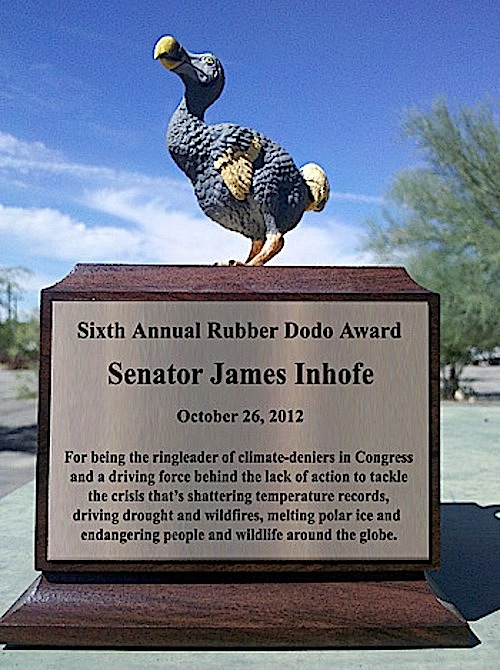
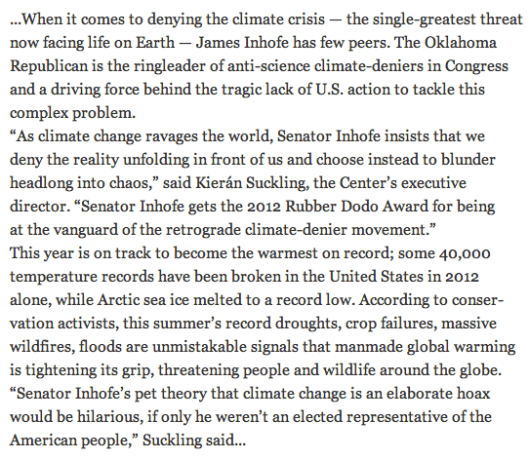
I heard about this dubious award via Your Medieval Future. Why did it take so long for this guy to get the award?…
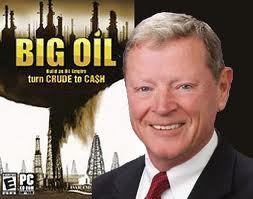
And here is Senator Inhofe’s politically polarizing response, spoken like a true anti-science zealot and mouthpiece for the fossil fuel industry:
I am truly honored that yet another radical environmental group has given me an award for my efforts to put a stop to President Obama’s far-left global warming agenda,” Senator Inhofe said. “The Center for Biological Diversity should be pleased to know that my award will have a prominent place in my office, along with all the others I have been proud to receive over the years. As the top Republican on the Senate Committee on Environment and Public Works, I have worked every day to expose the radical left’s extremist agenda aimed at ending American production of oil, gas, and coal because of the devastating consequences it will have on the American people.
Despite the fact that some of us are intelligent enough to see the coming collapse from unmitigated depletion of the earth’s non-renewable resources, overpopulation, climate disruption from the massive burning of fossil fuels worldwide, the human-induced 6th mass extinction, CO2-acidification of the oceans, and the resultant destruction of our modern industrial agriculture base, we are all lumped into the category of ‘radical left extremists‘ for recognizing such scientific realities. In Inhofe’s world, there is no environmental crisis and humans can adapt to whatever toxic sludge pile industrial civilization creates out of the planet. In a world where the true conservatives are those who want to keep the planet habitable for humans, people like Senator Inhofe will ensure that we all face the same fate as that of the extinct Dodo bird.












 Collapse of Industrial Civilization