Upon this fragile orb we stride,
With dreams too vast for earth to hide.
We steal from children’s futures yet unborn,
Ignoring limits, though wisely forewarned.
Fevered minds cast our fate in tools of steel,
Ghost slaves of ancient sunlight at the wheel.
Each phantom gain, each scheming, anxious art,
Drains Earth’s vital core—tears the living world apart.
Once we believed in endless, golden days,
That myth of growth, that gilded phase.
But every acre bent to human desire
Extracts a price—a debt never to expire.
The web of life, fragile, finely spun,
Connects all beings, weaving us one.
Yet in our frenzy to rule and subjugate,
We rend the ties no mortal hand can recreate.
When fields lie fallow, forests rise anew,
Old roots give way as young shoots push through.
Yet in each spiral’s turn, ghosts of plenty haunt the air,
Eden’s lost abundance lingers—an ache beyond despair.
We are, in every age, both cause and effect,
Bound by habits of hubris, hope, and blind neglect.
Our engines, born of dreams that never tire,
Hurl us past earth’s limits, into our own pyre.
To truly cherish life, we must accept the end
Of all those dreams that sought to make the cosmos bend.
Let us find dignity in what endures and gently stays—
And seek a deeper wisdom earned through humbler ways.
Hope endures where conscience lights the dark,
In hands that mend, in voices that embark.
If we reclaim the art of learning to give more than take,
A gentler world, restored, may finally awake.
We crafted our reign from self-spun lies,
Blind architects of our self-inflicted demise.
We chased illusions, truths never revealed.
Our species lost, its fate forever sealed.
So build your monuments in shifting sand,
Unwitting masons of ruin, proud and grand.
We scorned the bounds that might have let us last—
Now dust consumes the excess of our past.
Beneath the silent ruins, time’s vast hand
Unweaves the visions dreamt in every land.
A city’s heart, once vibrant, now lies bare—
Its towers fallen to complexity’s snare.
We build from questions, restless and deep,
Inscribing fragile order where mysteries sleep.
From shifting wants, we claim what cannot remain,
And conjure worlds no wisdom can sustain.
Each golden age, beneath its gilded dome,
Is cursed by the fault lines hidden in its home.
For every rise in structure, art, and scheme
Gives birth to tensions that unravel what we dream.
Complexity, that double-edged, dazzling lure,
Draws from us labors none can long endure:
To feed the center’s ever-hungrier pyre,
We chase shrinking margins, seeking heights still higher.
Diminished now, the promised gains decay,
As costs eclipse the progress of our day;
What once was wealth dissolves to needs unmet,
And faith in kings drowns in shadows of debt.
The sacred center, source of law and peace,
Grows dim as promised blessings slowly cease.
Does order bind us for the common good,
Or veil the few where shadowed powers stood?
So, in the end, the threads of order wear thin—
From unity to fragments, kin against kin.
The walls dissolve; the world grows small once more,
And those once held at bay, reclaim our shore.
In the fall, silence settles on temples of old.
From the ash of ruin, a harsher order takes hold.
Hunger claws through ash, old ties torn away—
The cycle turns, while dusk replaces day.
We sift the dust for lessons from our downfall,
But carve out new empires mirroring it all.
Each warning etched in ruin, we choose to ignore:
The future’s foundations rest on the dead once more.
What scaffold now for dreams, when earth rejects mankind,
When the seasons fracture, and the old ways unwind?
No seed takes root in soil stripped of design,
And all that we tend is surrendered to time.
The earth was once a vibrant, thriving place,
With life that flourished in every space.
Rich forests, rivers, gifts bestowed—
A world of wonders in sunlight glowed.
The humming bee, the soaring hawk,
Soft breezes, rivers’ gentle talk,
Wove nature’s song through every land,
All bound together, strand by strand.
But humans came with restless hands,
Unraveling those fragile strands.
They cut the web without a care,
Blind to the beauty woven there.
Birdsong faded, skies grew bare,
No music lingered in the air.
Creatures vanished, one by one,
Their stories lost, their journeys done.
Rivers whispered their last lullaby,
Death’s dust rose beneath a shrinking sky.
The earth grew cold, its heartbeat slowed,
A hollow shell where life once flowed.
The web unraveled, thread by thread,
A tapestry, threadbare and bled.
Yet still they blindly took and claimed,
Destroying all they once had named.
Deaf to the earth’s unheeded cry,
They cut the branch on which they rely.
With greed and pride, they sealed their fate,
Ignoring signs until too late.
Yet roots of hope still thread the earth,
A scattered few may spark rebirth.
If care and courage tend the scarred,
The world may heal, though deeply marred.
The web of life, our fragile shield,
Once torn asunder, no wounds can heal.
With every broken strand, our strength decays—
In nature’s fall, we face our final days.
We startle at the snake but sleep through rising seas.
Ten thousand years of flinching wired us for these:
The pounce, the blade, the winter’s famine at the door—
Not the graph, the decimal, the threat too slow to roar.
We liquidate the ancient, call the residue GDP,
And chart the slow subtraction, extinction as legacy.
Each quarter posts its numbers; the trajectory is clear.
We read the projections, shrug, and shelve them til next year.
The fix is always coming, one more decade down the line—
Fusion, carbon capture, water turning into wine.
We forge our children’s signatures on debts we won’t repay,
And genuflect to blueprints we abandoned to decay.
We sand the edges off the graphs until the future’s sound,
While senators hold hearings in a slowly flooding town.
The science fills the record. The record gathers dust.
The resolutions bind us all to nothing we can trust.
We keep the facts that soothe us, cremate the ones that sting,
Then wonder why the other side hears violence when we sing.
No villain strikes the match that lights the final fire—
Just billions stoking comfort on a slowly building pyre.
We hang the bones of empires in museums, under glass,
And swear their brittle hubris is a course we’ll always pass.
We quiz our kids on Carthage, make them memorize the date—
Then build the same foundations and expect a different fate.
And so it ends the way it does for every rising ape,
Convinced until the final hour we’d somehow find escape.
We knew enough to see it coming, not enough to stop.
The last one out—kill the lights, and let the curtain drop.
The fox sleeps where the permafrost held when your father was a boy.
The sparrows chase a warmth that isn’t there—spring’s shattered joy.
The salmon circle water that’s too warm to let them spawn.
The animals don’t argue. They just leave, or they are gone.
The raven remembers when the glacier spoke in groans and cracks.
It nested in the old growth once, before they cleared the tracts.
Now it roosts on power lines and waits for us to pass.
It has no word for what we’ve done—but knows we will not last.
We knew it in our bodies first—the summers that wouldn’t break,
The springs that came with fever, the winters that wouldn’t take.
We named it weather, named it fluke, named it chance, named it grace.
We made our peace with what we’d done. The raven held its gaze.
The power grid went down in June and didn’t come back on.
The highways buckled in the heat; the maps we trusted, gone.
The raven sat on the dead stoplight, watching the cars stand still.
We’d built a world that needed cold. The heat crept in to kill.
The last road sign fell years ago. The river moved the bridge.
The deer walk through the living rooms along the broken ridge.
The raven perches on a roof that’s slowly giving way.
There’s no one left to name the loss. The deer don’t look away.
The raven will be here when all we built has blown away.
It circles where the cities were, and lands where concrete lay.
The earth will grow its silence back, slow root and patient vine.
We were not meant to keep it. It was never ours by design.
Where forests stood, we raised our steel instead, And fed the furnaces with ancient dead. We burned a million years to feed the fire And named the rising smoke our own empire.
We stood like gods atop the world we’d claimed While glaciers cracked and forests died unnamed. The warnings came; we drowned them out with trade And sold tomorrow for the deals we made.
We broke the mountains open for their ore And left them gutted, hollow to the core. The tides returned our plastic to the shore, Bleached coral paved the ashen ocean floor.
The rivers thickened, poisoned vein by vein, The harvests blackened under acid rain. What evolution built across the ages We struck from life like words from burning pages.
The few grew fat on what the many lost, And never paused to calculate the cost. Their towers climbed as water tables fell— They built their heaven on the road to hell.
The towers leaned like drunks against the sky, Too tired to stand, too stubborn yet to die. Where traffic screamed, green fingers split the stone— The wind moved through the ruins we had sown.
And still she stirs, life pushing through the scars, Green tendrils breaching rusted iron bars. She will not mourn the ones who would not bend— We lit the fire and authored our own end.
A footnote in the earth’s long-written tome: A species rose, then burned its only home. The stars won’t mourn, the galaxies won’t care— We flared and vanished into thinning air.
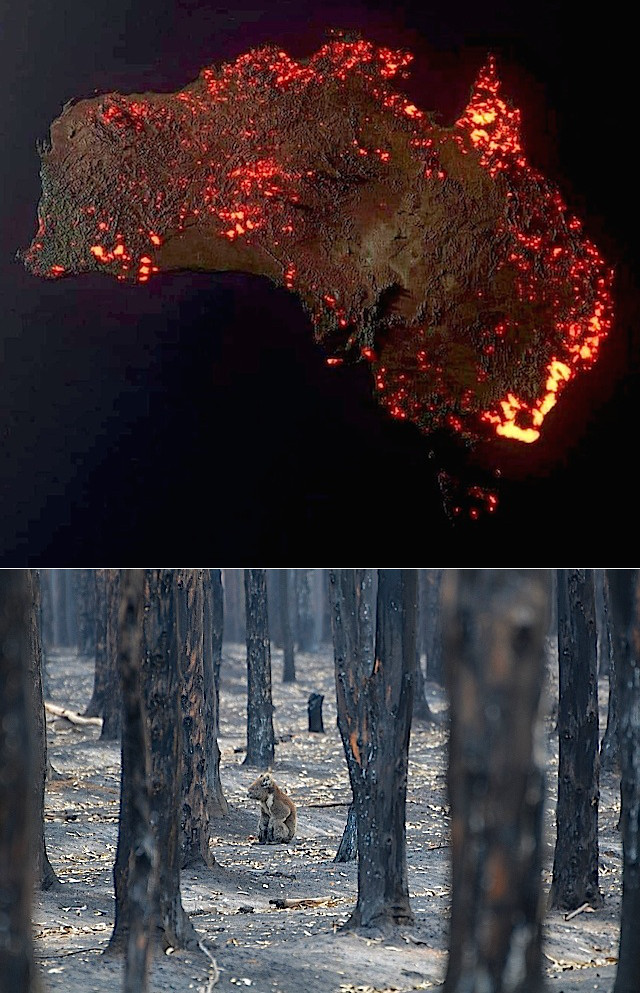
“3D visualization” of the Australian fires by Anthony Hearsey, compiled from NASA satellite data collected across the span of a month/an injured koala bear sits alone on the ‘apocalyptic’ Kangaroo Island
The year is 2020 and climate change-related disasters are in full swing while at the same time, the most influential country in the world is under the leadership of someone who calls scientists “foolish fortune tellers.” Australia, another country being led to its slaughter by the willfully and criminally ignorant, is literally going up in flames as we speak. Its rich millennia-old evolutionary legacy is disappearing before our eyes. The pictures of charred kangaroo corpses entangled in barbed wire fences and koala bears curled up in the fetal position as they tried to flee the fires are gut-wrenching and should be a wake-up call to our leaders. The platypus, another of the country’s iconic creatures, is dying off in drought-stricken cesspools. To make matters worse, recent heavy rains are causing massive fish kills as bushfire ash washes into rivers. More than a billion creatures(excluding frogs, insects, other invertebrates, or livestock) are estimated to have perished, and the wildlife that do manage to survive the country’s apocalyptic conditions are now at risk of starvation. Scientists fear these fires are causing the extinction of entire species of insects which play a vital role in “processing waste, pollination, providing nutrition for other species, and myriad other ecological functions.” While warming at twice the global rate from humanity’s fossil fuel binge, Australia continues to be the biggest net exporter of coal in the world, thus fueling its own conflagration.
The Australian mega-fires are not a one-off, but just the latest manifestation of an increasingly disrupted global climate system. Australia’s fate was predicted by scientists many years ago. The forever legacy of greenhouse gas emissions means the dust won’s settle in any time scale appreciable to humans. Sea levels will continue to rise for millennia, droughts and storms will grow in frequency and intensity, thousand-year rains will become common occurrences, entire ecosystems will unravel, and the human experiment will undoubtedly come to an end. To quote an Australian on Reddit:
This is what disturbs me about my countrymen. This is not just a one-off terrible event, this is a permanent step down, a large nail in our collective coffin. Long before we recover from this, we will suffer it again, and again. Those poor animals. Worse than being glorified, or not televised, our collapse is being looked at without seeing. It is misunderstood and denied.
For those not from here I’d say that one can’t overstate what is happening here, it is truly awful. We will never recover.
Australia’s annual fire season is only at its midpoint, yet the massive pulse of carbon from these bushfires is now estimated at 900 million tons —double the country’s annual emissions. As horrific as the fires have made life on land, what’s happening in Australia’s oceans out of site and mind is equally disturbing, but of course this is not confined to Australia. Scientists have found that a ‘heat blob’ in the north Pacific ocean killed a million seabirds and wiped out 100 million cod.
We are destroying the life support systems to which all creatures, including man, are dependent, yet it does not appear that any climate disaster no matter how catastrophic will alter mankind’s tragic path to extinction. Wiping out an entire continent’s flora and fauna does not register on the Stock Market. No number of five-alarm fire warnings planet Earth sends will be heeded by this cabon-fueled corporate kleptocracy which carries us all toward a very dark future. Why would we expect any differently from an economic paradigm that tolerates no disruption as it plunders the planet in search of the almighty dollar? A report from two years ago called Australia’s extinction crisis a “national disgrace” and described its institutions tasked with protecting threatened plants and animals as “broken”. We see today that nothing has changed to prevent Australia’s natural treasures from disappearing into the black void of the Anthropocene extinction, never to be seen or heard from again. In fact, current assessments show extinction rates are accelerating:
Nature is in ‘unprecedented’ decline. A substantial proportion of assessed species are threatened with extinction and overall trends are deteriorating, with extinction rates increasing sharply in the past century.
This decline is a direct result of human activity, the most devastating being changes in land and sea use, including natural habitat destruction.
Since 1980, greenhouse gas emissions have doubled, raising average global temperatures by at least 0.7 degrees Celsius. 75% of fossil fuel burning and anthropogenic CO2 emissions in the atmosphere has occurred since 1970; their effects are just beginning to be felt.
In the near future, climate change is expected to surpass the impacts of land and sea use change as well as other drivers(direct exploitation of organisms, pollution, invasive alien species).
Increased human population and per capita consumption is a key driver of the above.
By destroying the foundations of Earth’s interconnected web of life, we are threatening our own health and existence.
I am loath to repeat these numbers because no price can be placed on intact ecosystems, but the economic costs of this year’s fire season in Australia are estimated to be approaching $100 billion, the costliest natural disaster in that country’s history. And in the U.S., the last decade has been ‘unprecedented‘:
The U.S. billion-dollar disaster damage costs over the last decade (2010-2019) were also historically large, exceeding $800 billion from 119 separate billion-dollar events. After adjusting for inflation, the U.S. experienced more than twice the number of billion-dollar disasters during the 2010s than the 2000s decade: 119 versus 59…Clearly, the historically large U.S. losses from hurricanes and wildfires over the last few years have further skewed the total distribution of extreme weather costs. This increase reflects a combination of increased exposure, vulnerability and the fact the climate change is playing an increasing role in the frequency of some types of extremes that lead to billion-dollar disasters.
The finance industry is starting to see that climate change is an existential crisis, yet offer no alternative to their ideological stalemate of infinite growth on a finite planet. In fact, they believe that the personal sacrifices needed to halt greenhouse gas emissions will create a public backlash towards such efforts. In other words, business-as-usual will rule the day until the hard laws of physics, chemistry, and biology make our bubble economy impossible. We’re undergoing that process right now as anthropogenic climate disruption returns planet Earth to the chaotic climatic conditions of the Pleistocene —a time in which organized societies and agriculture will be impossible. Water shortages, degraded soils, and loss of pollinators will only compound the problem. No amount of accounting tricks will bring back the habitability of the planet.
Cheap and abundant fossil fuels have given us modern science and technology which have allowed humans to feel detached and independent from nature, but when this civilization inevitably collapses we will once again be at the mercy of the natural world. If we have destroyed the biosphere and set in motion a mass extinction event at a time when we strongly need to rely on nature, then our prospects for survival are very grim indeed! Yet another study released this week shows that Earth’s biodiversity is crashing under a perfect storm of global warming, extreme weather events, and human activity. Collapse of industrial civilization and its vast amount of specialization along with a simultaneous planet-wide ecological collapse can very easily lead to human extinction. It’s not hard to imagine a Third World War being ignited by deteriorating environmental conditions and resource depletion as nations fall under the sway of propaganda from demagogues inciting fear, hatred, and violence.
With Earth Overshoot Day arriving ever earlier each year, we have arrived at the last stage of global civilization’s doubling time. The next twenty years will be the final tick of the clock in which our mass resource extraction, consumption, and waste irreparably damage the planet’s regenerative abilities and life support systems. Decades of greenwashing, empty rhetoric, and regulatory capture by the fossil fuel industry have brought us to this precipice:
As you can see, any mitigation efforts at this late date rely heavily on the fantasy of carbon capture with nonexistent technologies that, truthfully, will never scale up to the enormous problem. To some degree or another, we are all in denial of what is unfolding in our final century as we go about our daily lives within a set of living arrangements completely incompatible to the survival of our descendants. Everyone is riding the peak of industrial civilization as we watch the world fall apart on our smart phones and LED TVs. In the meantime, the nightly news drones on about hyperpartisan politics and economic growth. That barely a vague mention is made in the news cycle of the most important story in mankind’s history tells you all you need to know about who controls mass media and why the story of our imminent demise will remain buried.
Our fossil record will be comprised mainly of plastics, radioactive waste, and billions of human bones and that of our domesticated animals. The remnants of wild animals will be extremely rare since we have supplanted them with our livestock. All civilizations, especially complex ones, eventually collapse. Ours, like many before, will be undone by overshoot of the environment’s carrying capacity, albeit this time on a planetary scale and with no second chance for a do-over.
When a 16-year-old girl named Greta Thunberg spoke with trembling anger of the unspeakable crimes today’s adults are committing against her and future generations, a chill ran down my spine. She will be alive to see the pulses of rapid sea level rise, the unraveling of industrial agriculture, the mass migration of hundreds of millions of climate refugees, and the disintegration of Earth’s biosphere. Today’s world with the ever-worsening breakdown of the biosphere is much more dangerous than during the Cold War when the threat of imminent nuclear annihilation hung in the air like the sword of Damocles, as expressed by President Kennedy: “Every man, woman and child lives under a nuclear sword of Damocles, hanging by the slenderest of threads, capable of being cut at any moment by accident or miscalculation or by madness.” Not only does the threat of nuclear war persist, the sword of abrupt climate breakdown now looms ever larger as governments are rendered impotent.
Scientists and the Red Cross recently warned the world is currently suffering at least one climate catastrophe per week and nearly two million people per week are needing humanitarian assistance. A UN global assessment confirms the planet is currently experiencing 2,500 conflicts over fossil fuel, water, food and land — conflicts directly related to the ongoing collapse of the earth’s biodiversity. No civilization in history has faced a complete reshuffling of the planet’s biosphere, let alone the ecological armageddon brought on by a Pandora’s box of pollutants from industrial civilization. Microplastics are literally raining from the sky. Irrevocably out-of-step with the natural world, modern civilization is destroying its host ecosystem by altering the geochemistry of the planet. A mass extinction event unlike any in Earth’s history is underway. Even if a small fraction of the global population survives this overshoot, it will take 10 million years for biodiversity to bounce back. Since atmospheric CO2 will ultimately be drawn down through a very slow natural process called sedimentation, the Earth will not reach pre-industrial CO2 levels againfor more than 100,000 years. The last time CO2 levels were this high was 3 millions years ago during the Pliocene when temperatures were 3-4°C(5-7°F) higher globally than today, and sea levels were 15-20 meters(50-65 feet) higher. It was too warm for glacial ice sheets to even exist in the northern hemisphere.
At 412 ppm and rising, experts said temperature rises of 3-4C are likely now locked in.
What does any honest scientist have to say about mankind’s prospects in a 4°C world:
“We have already observed impacts of climate change on agriculture. We have assessed the amount of climate change we can adapt to. There’s a lot we can’t adapt to even at 2C. At 4C the impacts are very high and we cannot adapt to them.” Rachel Warren, University of East Anglia
“Thinking through the implications of 4 degrees of warming shows that the impacts are so significant that the only real adaptation strategy is to avoid that at all cost because of the pain and suffering that is going to cost.” Prof. Neil Adger, University of Exeter
“…there is also no certainty that adaptation to a 4°C world is possible. A 4°C world is likely to be one in which communities, cities and countries would experience severe disruptions, damage, and dislocation, with many of these risks spread unequally. It is likely that the poor will suffer most and the global community could become more fractured, and unequal than today. The projected 4°C warming simply must not be allowed to occur.” World Bank report (2012) Turn down the heat: why a 4°C warmer world must be avoided
“If we don’t reduce greenhouse gas emissions and ultimately stabilize CO2 — and we also have to draw down a lot of carbon out of the atmosphere. If we don’t achieve that, there’s no real prospect for a stable society or even a governable society…” Jason Box, Prof in glaciology at the Geological Survey of Denmark and Greenland
People are completely oblivious to our dependence on the complex adaptive systems that allow humans to exist and persist. To be clear, when the global temperature rises by 4°C within this century it will be faster than the blink of a geological eye, and we, along with 80% or more of the planet’s species are finished. 96% of all marine species and more than two-thirds of terrestrial species perished during the Great Dying at the Permian-Triassic interface. Global mean temperature at that time rose an estimated 5-8°C over a timespan of 3,000-20,000 years. A 4°C rise over just two centuries will be a rate of warming 15 to 100 times faster than that past extinction event. At this speed of warming, regions would experience temperature spikes of 10-15 degrees above normal in some months. Ecosystems would implode and the services they provide that sustain us would be obliterated. Virtually every vertebrate species on Earth would disappear, along with most plants and many invertebrates.
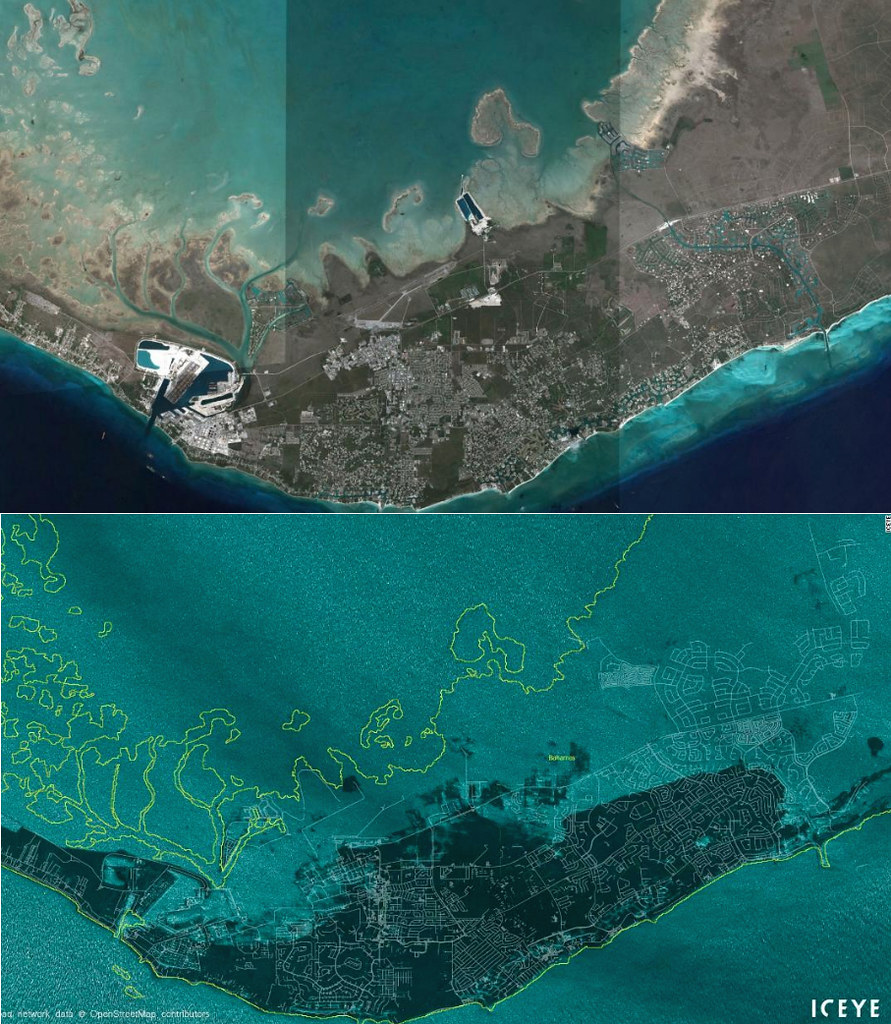
At just 1°C of warming we are already seeing major ecosystems such as coral reefs unraveling. Hurricanes so powerful that they require a new category now barrel across the Atlantic ocean and completely decimate islands; the cataclysmic Storms of our Grandchildren that Hansen warned about have only just begun. Arctic permafrost melt has already exceeded 2090 projections. It was economist William Nordhaus that set the 2°C warming target in 1975, not scientists. What did he get for this dangerous speculation, divorced from empirics? The Nobel, naturally. These days he is saying 3.5°C is just fine. John Kerry says we cannot leave the climate emergency in the hands of the neanderthals in power, but I dare say that anyone promoting mainstream economic theory is guilty of omnicide. Capitalism’s “extractivism” has turned the entire planet into a sacrifice zone.
Grand Bahama island before/after Hurricane Dorian made landfall, Sept 1, 2019
The rise of political ‘populism’ and the election of reactionary politicians in the U.S. and abroad has thrown yet another monkey wrench into any possibility of tackling the climate crisis. The demagogic Trump administration is simply burying any scientific evidence and ignoring its government’s own research on such things as the recent surge in climate refugees from Latin America due to climate-induced food insecurity. Russia and Brazil have both encouraged and precipitated the wildfire infernos raging in their countries. The catastrophe unfolding in the Amazon is a direct result of President Bolsonaro’s neoliberal policies designed to plunder the Amazon much like Trump’s dismantling of the EPA and deregulation of corporations. Both ignore the science of climate change and the reality of ecological collapse. In the case of Russia’s Putin, it was a cold economic calculus: “If the cost of putting out these remote fires is greater than the profit that could be made from selling the timber, they can decide to let it burn.”
And then there’s the global debt bomb of $250 trillion waiting to explode, not to mention the $200-250 trillion global carbon debt which increases by 16 trillion every year. Meanwhile, banks are quietly shielding themselves from climate catastrophe at taxpayers’ expense by shifting risky coastal mortgages off their books and onto the federal government’s Fannie and Freddie programs. Just as the U.S. government is leaving vulnerable countries to fend for themselves, so are private institutions unloading the risks onto the public. For those at the very top of our economic pyramid scheme who control public policy, dwindling resources will be kept first and foremost for them while everyone else is treated as collateral damage. This dereliction of responsibility, this cutting and running, is how the deteriorating conditions of the world are being handled. Throughout history, society’s elite have shown the same arrogance and hubris in the face of impending calamity. For example, the Fall of the Roman Empire:
If you read the chronicles of the early 5th century AD, you get the impression of total mayhem, with barbarian armies crisscrossing Europe and few, if any, Roman nobles and commanders trying to defend the Empire. Most of them seemed to be maneuvering to find a safe place where they could find safety for themselves. We don’t know what was the final destiny of Rutilius Namatianus but, since he had the time to finish his poem, we may imagine that he could build himself a castle in Southern France and his descendants may have become feudal lords. But not everyone made it. For instance, Paulinus of Pella, another rich Roman, contemporary of Namatianus, desperately tried to hold on his possessions in Europe, eventually considering himself happy just for having been able of surviving to old age.
We see a pattern here: when the rich Romans saw that things were going really out of control, they scrambled to save themselves while, at the same time, denying that things were so bad as they looked. We can see that clearly in Namatianus’ poem: he never ever hints that Rome was doomed. At most, he says, it was a temporary setback and soon Rome will be great again.
Thunberg’s speech alluded to such behavior by the polluting nations:
For more than 30 years, the science has been crystal clear. How dare you continue to look away and come here saying that you’re doing enough, when the politics and solutions needed are still nowhere in sight. You say you hear us and that you understand the urgency. But no matter how sad and angry I am, I do not want to believe that. Because if you really understood the situation and still kept on failing to act, then you would be evil. And that I refuse to believe.
Yes, Greta, they are evil; they have access to every expert on the seriousness of the crisis and they are building walls and saving their own skin while continuing business-as-usual. Lest we forget, the fossil fuel industry’s own scientists accurately predicted the life-threatening effects of its product decades ago and not only did they do nothing to stop it, they funded and orchestrated a vast network of climate denial propaganda which continues to this day and have raced to exploit even more fossil fuels from the melting Arctic. When you consider that billions of people are going to die as a result, their actions become by far the greatest crimes against humanity ever committed. Make no mistake, our society is trading a livable planet for an unsustainable way of life that is irreparably depleting finite resources and altering the earth for eons, making it uninhabitable for organized human societies. Each day of business-as-usual further degrades the planet’s biodiversity.
“As the temperature rises, the patricians will seek refuge as polar migrants, or set sail on heavily armed ocean liners. Millions more will live in underground cities, anywhere to escape the sun. Dazzling reports of new methods for sopping up the gigatons of carbon dioxide will create ripples of enthusiasm and then fade in the next news cycle. Fisheries and agriculture will collapse, drugs will provide little solace, and everyone will curl up in a foetal position in the end, like the ash-entombed victims at Pompeii, whimpering in the inescapable heat. The likelihood of this outcome increases as the years pass and the smoke rises.”
~ Nicholas P. Money, THE SELFISH APE: Human Nature and Our Path to Extinction
"The latest climate simulation models are projecting temperature increases of up to 7°C by the end of this century. Unless you have a magical faith in technology, then that level of temperature rise signifies the potential end of our species…"https://t.co/kdldvQXGCapic.twitter.com/a5DUZOXOG9
Civilizations are living organisms striving to survive and develop through predictable stages of birth, growth, maturation, decline and death. An often overlooked factor in the success or failure of civilizations are cultural memes—the knowledge, beliefs, and behaviors passed down from generation to generation. Cultural memes are a much more significant driver of human evolution than genetic evolution. Entire civilizations have been weeded out when their belief system proved maladaptive to a changing environment. One such cultural meme holding sway over today’s governments, institutions, and society is our economic system of capitalism. The pillars of capitalism represent a belief system so ingrained in today’s culture that they form a sort of cargo cult amongst its adherents.Cargo cults are any of the various Melanesian religious groups which focused on obtaining material wealth(manufactured Western goods that came on cargo ships) through magical thinking, religious rituals and practices. Today the term “cargo cult” is used to describe a wide variety of phenomena that involve superficial imitation of a process or system in order to fabricate a successful outcome without even the basic understanding of its mechanism.
The tenets of capitalism are ritually followed in the proclaimed belief that “a rising tide lifts all boats”, i.e. so-called improvements in the general economy will benefit all participants in that economy. Centuries of unbridled capitalism have demonstrated beyond any doubt that it does not lift all boats. A new study finds that half of Americans are “shut off from economic growth”. The rules of the game are so stacked against the masses that this week a professor said “only all-out thermonuclear war might fundamentally reset the existing distribution of resources.” Capitalism’s imperative for expansion, growing profit levels, and efficiency has ultimately dehumanized our culture. Not even when our basic life support systems are being torn asunder do the vast majority question the path we are on. We are all a captive audience to the system and those few dissident voices are snuffed out under the wheels of “progress”.
Truth be told, the corporate elite have long written off all those people living hand to mouth. Trump’s pick for Labor Secretary said, unlike workers, machines are “always polite, they always upsell, they never take a vacation, they never show up late, there’s never a slip-and-fall, or an age, sex, or race discrimination case.” Massive global unemployment resulting from the automation revolution has not yet been addressed by governments. Roughly half of all jobs in the U.S. are at risk of automation and two-thirds in the developing countries. This is all coming at a time when humans are fast destroying the ecosystems underpinning the very foundation upon which human civilization has developed over thousands of years. Mass migration of climate refugees will only further destabilize governments, stoke ethnic and cultural tensions, and give rise to fascist political movements. No conspiracy is needed to exterminate the “useless eaters”, just allow mother nature to take its course and climate change will be killing billions by mid century. Those in military planning know this and periodically express their fear of what is coming, but business-as-usual rolls on.
Capitalism’s constant impetus to shift costs, risks, and burdens off industry and onto the environment and society carries on under the guise of “being more competitive”. It’s a way of externalizing costs to maximize profit and if these costs were truly taken into account, none of the world’s top industries would be profitable(Interestingly, the link to this study has been scrubbed from the internet). It’s the height of magical thinking to put so much faith in some mystical “invisible hand of the free market” to solve existential threats such as an ever-widening wealth gap and the wholesale destruction of planetary life-support systems. There is no benevolent “invisible hand” turning individual self-interest into the common good. The primary mandate of capitalism is to protect and grow capital. The “invisible hand” is just a bunch of people scrambling to make as much money as possible, not caring or oblivious to those they hurt in the process. Fuck the invisible hand of the market. The invisible hand of mother nature will punish those who squander Earth’s rich but finite resources.
it’s been clear for some time that we have past the point of no return, triggering multiple tipping points in Earth’s living systems. New findings are continually confirming scientists’ worst nightmares. A key glacier in the Antarctic that holds back 10 feet of sea level rise was just described as breaking apart from the inside out. In other grim news, the long feared carbon bomb has now been quantified and is projected to release the emissions equivalent of an industrial country like the U.S. in the next few decades, prompting researchers to say that “climate change may be considerably more rapid than we thought it was.” Biodiversity loss is another critical threshold we have breeched: “New research shows that local extinctions have already occurred in 47% of the 976 plant and animal species studied.” A new study also reveals that the planet’s tallest animal is facing extinction after its numbers have plummeted in recent years, with the ominous warning that “many species are slipping away before we can even describe them.” Forests are being wiped out by armies of invasive insects. Because of a rapidly changing climate and the vast scale of the problem, the idea that reforestation will somehow save us is a pipe dream. Those forests won’t stay healthy enough to serve as carbon sinks and besides, seven times Earth’s land area would need to be in cultivation in order to reduce the planet’s atmospheric CO2 level down to 350ppm.
Note that the Permian Mass extinction is estimated to have happened anywhere over the course of 200,000 years to 15 million years. The current 6th mass extinction is happening orders of magnitude faster due to a multitude of factors including deforestation, habitat fragmentation, chemical pollution, poaching, etc., making this current disaster very unique in Earth’s history:
The team of geologists and biologists say that our current extinction crisis is unique in Earth’s history due to four characteristics: the spread of non-native species around the world; a single species (us) taking over a significant percentage of the world’s primary production; human actions increasingly directing evolution; and the rise of something called the technosphere. – Link
Perhaps the fate of humans was written in stone once we stood upright and developed tools. To a large degree, modern technology has been an expression of the energy-dense hydrocarbon fuels we discovered and are not willingly giving up anytime soon. Once fossil fuels ignited the Industrial Revolution and the Haber–Bosch process unleashed the human population bomb, nothing could stop the deadly carbon consumption feedback loop, not even decades of scientific warnings.
From a throwback to our primate ancestors, modern humans have been hard-wired to ignore threats that are not immediate or local; global ecological overshoot(of which climate is just one aspect) is imperceptible to the real-time cognitive processing of humans and represents the ultimate under-the-radar threat able to undermine our reasoning and response:
Psychological concepts of how we view the world around us, including ‘creeping normalcy’ or ‘landscape amnesia’, block day-to-day comprehension of what accelerating human activities represent—whether it is human population, the number of dammed rivers, forest destruction, or the impact of motor car emissions in a timespan that is geologically brief. Creeping normalcy refers to slow trends concealed in noisy fluctuations that people get used to without comment, while landscape amnesia describes forgetting how different the landscape looked 20–50 years ago (Diamond 2005: 425).
In his study of how societies fail, biogeographer Jared Diamond calls global warming a pre-eminent example of a ‘slow trend concealed by wide up and down fluctuations’ (2005: 425). He likens the denial of climate change impacts by leading politicians, including former US president George W. Bush (and his contemporary John Howard in Australia), in the late 1990s and early 2000s to the elite of ‘the medieval Greenlanders [who] had similar difficulties recognizing that their climate was gradually becoming colder, and the Maya and Anasazi (in Central and North America) [who] had trouble discerning that theirs was becoming drier’ (2005: 425). – link
We evolved to react to imminent dangers, not slow-rolling and seemingly invisible catastrophes as an unintended consequence of our cushy lifestyle. From lofty corporate boardrooms to the filthy streets of skid row, the mass of humanity is following the same biological script of overshoot and collapse seen in every organism from bacteria to reindeer herds. Fossil fuels only enabled the destruction to multiply a million-fold, culminating in one final and spectacular explosion of human activity that will leave the planet nearly barren for eons.
Open-ended growth appears to be inherent in nature, all the way from the DNA to the arthropods to mammals, including humans. Open-ended growth is the psychology of a cancer cell. I am not sure I know of a species which has learnt how to limit its own growth. Unfortunately species which transcend their environmental resources can hardly survive – the final arbiter of the climate impasse will be nature itself. ~ Andrew Glikson, Earth and paleo-climate scientist, Australian National University
The beauty and wonder of this planet is being trashed by a naked ape whose cleverness in tool-building has far outstripped his ability to handle it in any restrained or judicious manner. Nature’s rich book of life is being pancaked into a cheap, crumpled comic book.
Add in the development of mass consumerism, planned obsolescence, and the hypnosis of corporate-sponsored TV and you have a passive, malleable population happily marching towards the slaughterhouse. It’s fitting, then, that the masses would be swindled by a megalomaniac bankruptcy artist who dabbled in Reality TV. Every one of Trump’s cabinet picks is a big middle finger in the faces of those who fell for his pseudo-populist rhetoric: billionaires, Wall Street sharks, Goldman Sachs alumni, and hardcore laissez-faire capitalists chomping at the bit to deregulate, monetize, and privatize every last bit of what remains. The allure of capitalism has always been that you’re just one lucky break away from becoming one of those fat cats, if only someone would give you a chance. A prescient observation by Ugo Bardi from earlier this year:
Trump is a symptom of the ongoing breakdown of the social pact…capitalizing on this breakdown by…playing on the attempt of the white (former) middle class to maintain at least some of its previous prosperity and privileges. Trump is…an unavoidable consequence of resource depletion. – Link
The bottom line is that a swing towards authoritarianism happens when resources become scarce. Climate change is simply a symptom of humans overshooting the planet’s carrying capacity. Free market ideologues are nearly always climate ‘skeptics’ because acknowledging the reality of human-induced climate change would be an admission that industry must be curtailed or controlled. Left-leaning people nearly always accept the science because it goes along with their criticisms of capitalism which externalizes social and environmental costs for the benefit of just a few at the top of the economic hierarchy. Thus we see parasitic Trump surrounding himself with right-wing, climate denying, fossil fuel corporatists and insiders who will be doing everything in their power to dismantle health and environmental regulations including privatizing social services which are barriers to capitalist expansion.
To be blunt, our chance of developing a sustainable culture passed us by a long time ago. People will try to adapt until they cannot, and myths will be created to explain away harsh realities. A dystopic future in all its horrific glory has arrived: baked-in biospheric collapse, the inherent and irreconcilable contradictions of techno-capitalism, a dysfunctional political system unable to come to terms with root causes, and the cognitive dissonance of the masses blind to the bigger picture. Our numbers are not a safeguard from extinction.
Mankind’s exothermic machine of industrial civilization recently blew past the 400ppm CO2 mile post, causing a few passengers to exclaim, “Homo sapiens have never existed at these levels of heat-trapping gases!” Hundreds and even thousands of years will pass before the full aftermath from our fossil fuel orgy plays out, but we’ll see plenty of nasty surprises in feedback loops and tipping points this century, perhaps most notably sea level rise. Another area of glaciers once thought to be stable has fallen to the human CO2 spike which is occurring 14,000 faster than natural processes and 10-200 times faster than the PETM extinction event. Every so often I feel the need to try to wrap my mind around these horrific statistics and re-examine our place in time as we continue whistling past the graveyard. Keeping in mind that we have yet to take our foot off the gas pedal of economic growth, I’ll try to make sense of what we are doing to the earth by looking back at paleoclimate records when such atmospheric conditions did exist:
– The last time carbon levels reached 400 ppm, and “mean global temperatures were substantially warmer for a sustained period,” was probably 2-3 million years ago, in the Mid-Pliocene era. – Sedimentary cores taken from a Siberian lake north of the Arctic Circle shows that mid-Pliocene atmospheric CO2 measured between 380 and 450 parts per million. Those same cores contain fossil pollens from five different kinds of pine trees as well as numerous other plants we don’t find in today’s Arctic. – Temperatures were 2-3 ˚C higher—about 4-6 ˚F—above pre-industrial levels. – Arctic temperatures were between 10-20 ˚C hotter. – Sea levels were, on average, between 50 and 82 feet higher. – A warmer Arctic saw the spread of forests and forest biology to the far reaches of the north. – Many species of both plants and animals existed several hundred kilometers north of where their nearest relatives exist today. – The Gulf Stream and North Atlantic Current experienced enhanced heat transport pushing warm water further to the north. Similar heating in the Pacific impacted the areas as far north as the Bering Sea. – Arctic ice was “ephemeral”, as in, not permanent, and melted in the warm season. – North Atlantic regions warmed considerably. – Australopithecus afarensis, an early hominid at the time, roamed East Africa and slept in trees, eating mostly fruit, seeds, roots, and insects with the occasional lizard and scavenged meat.
(sources: Motherboard, wfs.org, and yalescientific.org)
Until this prehistoric hominid changed its diet to high protein,
expanding its brain to enable complex tool and weapon-making,
it was easy prey for the saber-toothed tiger.
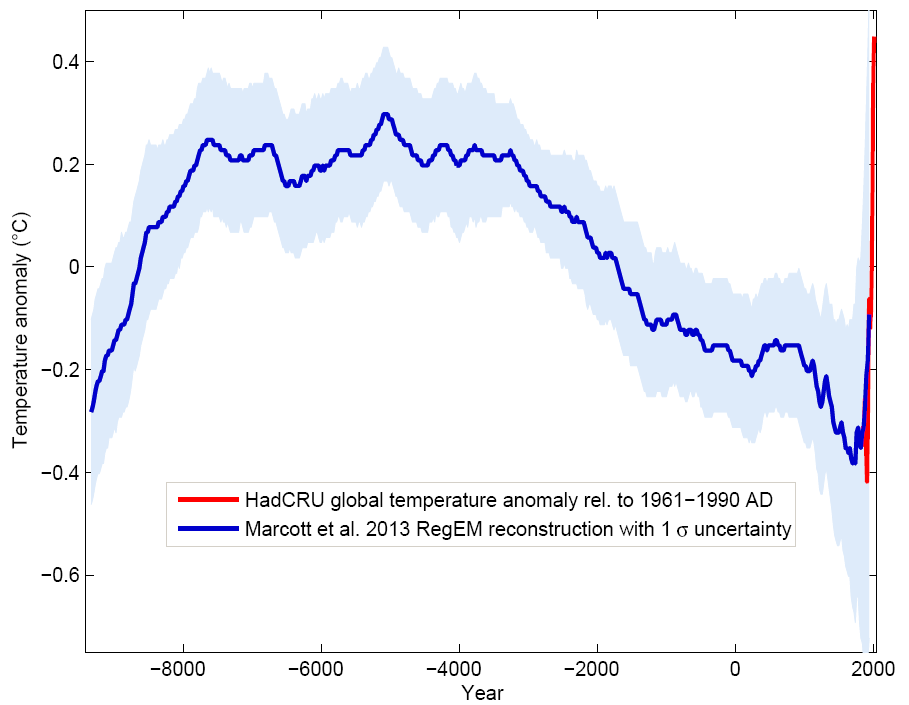
The prehistoric environment described above is not compatible with modern-day civilization and its billions of infrastructure and supply chain-dependent people. Billions will perish without the technological exoskeleton that houses, feeds, and nurtures them. Nearly all are under the spell that our money system, economy, and energy resources are somehow more vital to us than the environment upon which those manmade structures were built. What they don’t realize, or appreciate, is that nature’s ecosystems are what provide the foundation for any civilization if we want breathable air, potable water, arable land, and a planet hospitable to humans. We have gone a long way in undermining this foundation and now hold the dubious honor of being this planet’s first sentient beings to predict, document, and witness their own self-inflicted demise. This was the Holocene, as discussed here. Notice the red “temperature anomaly” spike at the very end of that era. Put in context with other geologic eras, it looks like this. See the difference? The Holocene was a very stable period compared to any other time in the deep past, but we wrecked it with our greenhouse gases. The climate system’s lag time prevents us from seeing the full effects just yet, but changes in the earth’s hydrologic cycle and weather patterns are already apparent. In response to such changes, trees are adjusting the speed at which they cycle water.
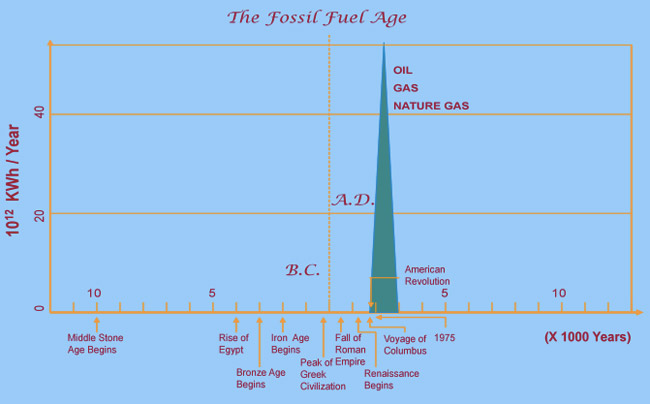
I peg the dawn of the Anthropocene at the mid 19th century when fossil fuel consumption began to take off, ramping up anthropogenic climate change:
If we expand our historic view of industrial civilization’s gargantuan appetite for energy, we see it as an aberrant blip in evolutionary time when Homo sapiens, fueled by hydrocarbon, disrupted all the major biochemical processes of the planet.
We have a 10% chance that the earth will warm 6°C by 2100 according to scientists, but the fossil fuel industry is betting it’s a sure thing by planning its future business around magical, nonexistent technologies that would remove CO2 emissions. Notwithstanding the armchair technotopian dreams of a future world that includes driverless cars, zero-point energy, and asteroid mining, we are living at the peak of capitalist industrial civilization which produces a continual flood of products promising to improve and enhance our lives but which, in the end, only complicate them. We are trapped between mindless consumerism and the thoughtless destruction of the environment. Tim Garrett calls our dilemma a double bind. The only thing that will save us from a deadly warming of the planet is the very thing that will destroy most of us if it happens —the complete crash of the global economy and its CO2 emitting process of “building wealth.” Homo economicus is too busy converting his rich environment into monetary tokens to think about the consequences of what he is doing or perceive the impending crash of the earth’s biosphere that will take care of the human overshoot problem and all the transient material wealth that has been covetously accumulated and guarded. Rising oceans, floods, fire, drought, and various superstorms from a damaged biosphere will take it all back and destroy it. For a species that has created a throw-away society, such an end is fitting. With every loss we inflict upon biodiversity, extinction creeps ever closer toward us. The consequences of ignoring the hard laws of physics, chemistry, and biology will be dire:
Countries once thought of as having relatively stable and developing economies like Brazil are now openly contemplating the use of their military in order to keep the megacity São Paulo from spiraling out of control in the face of severe climate change-driven droughts. And in the so-called First World country of America, president Obama’s science adviser is warning that “climate change could overwhelm California,” a state that grows a large percentage of what the country eats:
…The huge inertia built into the energy system — a $25 trillion worldwide investment in a mainly fossil-fuel infrastructure — is colliding with enormous momentum in the climate, which responds slowly to the buildup in greenhouse gases. The world is not even yet fully experiencing the results of emissions put into the atmosphere years ago, he said. It will take decades to turn both systems around.
“If we stopped emitting today, the temperature would still coast up for decades to come,” Holdren said.
He recalled sitting on a presidential science advisory panel during the Clinton administration.
“Quite a lot of folks were saying the impacts of climate change are uncertain and far away, the costs of dealing with it are large and close — therefore, we should wait and see what happens,” Holdren said.
“Well, like it or not, that’s pretty much what we did.”…
The mental traps and psychological defense mechanisms employed by the naked ape makes him a basket case of contradictions and ironies, simply adding more insurmountable obstacles to the insoluble problem of capitalist industrial civilization. That’s why we love dystopian operas that reflect our own twisted culture and capitalist society.
A sobering video…
Extreme weather events are rapidly increasing. Right now we are in the 6-sigma risk zone of climate change.







 Collapse of Industrial Civilization