My internet is still down, but will hopefully be back up by tomorrow night so I can put out a few posts I was contemplating. In the mean time, an interesting excerpt from a new book by Roberto De Vogli, associate professor in global health at the University of California Davis and University College London.
Excerpt…
And of course it continues today as has been discussed in previous posts on this site. So much for the “free market”.
In order to understand why the world is locked into a blind stampede over a cliff, you have to understand how the world runs, i.e. its socio-economic system. A large percentage of the population doesn’t understand that the world is ruled by multinational corporations or that the citizenry are simply disposable pawns with no voice in their fate.
The capital that flows around the world, betting on essential staples of life and demanding that barbaric austerity measures be imposed upon the masses, is an entity of its own. It’s a massively destructive force that enslaves people and rips apart the environment. In the Banana Republic of America where a once thriving middle class was sold down the river, nearly half of workers will have a budget of $5 per day when they reach retirement age. Maybe McDonald’s will create a 99 cent meal to cash in on that starving demographic. Oh, they already have…
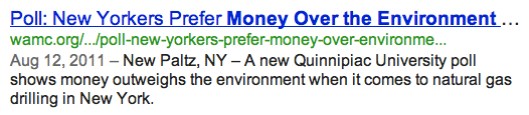
As far as the environment goes, it is a doormat for the creation of money:
When you have such an immovable supersystem of puppet governments and marauding transnational corporations running the show, radical movements questioning and trying to change the status quo are easily co-opted or crushed, a recent example being the Occupy movement. In a world where extinction of the human species is guaranteed by climate chaos and the myriad of other crises created by industrial capitalism, a slow and incremental regimen of change is not what is needed to stave off collapse. Unfortunately, the entrenched interests of the financial elite and the nation-states they control won’t allow for any sort of abrupt and profound transformation. As Professor Julian Cribb has correctly identified, a culture of money worship and the mass delusion of money’s illusory value is at the heart of the global crisis. The high priests of money are protected at the expense of all else:
Show me a democracy that has an impoverished public life and I will show you one dominated by oligarchs and plutocrats driven by profit maximization that will do anything to get over. Gangster activity is what it is. Scandal after scandal and when you get caught, you PAY MONEY, you don’t go to jail. Plutocrats wage class war, getting away with CRIMES (mortgage fraud, market manipulation, insider trading, securities fraud) every day. But get caught with a bag of weed in the hood and you are in the system, for LIFE. ~ Cornell West
For humans living under such a capitalist society, money determines whether you can eat or not, whether you have shelter or not, whether you can clothe yourself or not, or whether you can afford medical treatment or not. Quite literally, if you have no money in a capitalist society, you die. Money in today’s globalized capitalist system is everything.
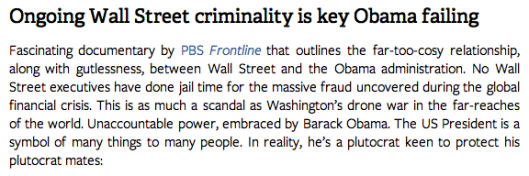
When President Obama speaks about confronting climate change, he does so with the mindset of keeping the current capitalist power structure in place. Because of this self-defeating approach, everything he says is rendered useless rhetoric.
Putting aside the gross social inequalities and injustices of our current system, you tell me how we can avert disaster with the following realities:
Without changing the socio-economic system under which we live, no real solutions for the multiple civilization-ending crises we face can be properly addressed. There is an expiration date for this unending conversion of the natural world into fake symbols of wealth hoarded and squandered by a greedy few…
Thanks Mike. There is a very significant – and most likely suppressed, ignored, or flippantly dismissed source of scientific literature. Very few Americans are prepared to learn much from indigenous (read: backward) peoples. The first citation is my favorite and I was first alerted to it by Vandana Shiva since much of this literature has so far focused on India but I know of other examples from Africa, the Middle East, and native North and South America. It is a fairly standard and widely accepted fact among ethnobotany experts. I’ve attached one pdf for your perusal:
That said, share these citations with your reader. (if you do not have access) I can track down my pdf copies and email them to you, but it’ll have to wait till I get back to my campus computer; I don’t think I have any of those sources at home.
Best regards, and keep sharing as much of my work as you see fit; nice blog by the way! If you all need anything else, please let me know…
I [also] wanted to explain what I know about Zapotec women’s use of plants and herbs for various treatments because some of the abortifacients have other applications.
The Zapotecs use several tall weedy shrubs to small trees, prototypically Solanum lanceolatum, sosa and/or berenjena. yàg-guièdz-zân [`tree/shrub´ + `disease´ + `child birth´], are included here. The fruits are yellow to orange when mature; the name refers to the use of the plant as medicine to treat post-partum weakness and pain; for example, a woman in labor is referred to as mén̲w-zân(`person´ + `childbirth´), disease is guièdz; the woman is bathed in an infusion of the leaves, beginning 15 days after the birth.
It also works as an abortifacient if you drink as tea: three tablespoons three times (se friega `it scours´ the uterus). It is also used to treat wounds and cáncer, i.e., a badly infected wound. In that case, boil, use the whole plant; mix with gordolobo (Gnaphalium spp., Asteraceae) and hierba de cáncer (blàg-chòg, prototypically Tournefortia spp., Boraginaceae) or with canfor; also for swelling (guì); wash with the infusion; it is “hot” (nzæ̌æ); two widely recognized varieties are “smooth” yàg-guièdz-zân-zhǐil and “spiny” yàg-guièdz-zân-guièts. The smooth variety is the best medicine; a very large and very spiny variety grows in neighboring communities, but is not named and is not used as medicine. I hope that is not too much detail, but you did ask.
Devon G. Peña, Ph.D. 2013 NACCS Scholar Professor American Ethnic Studies, Anthropology, and Program on the Environment University of Washington EMAIL| dpena@uw.edu UW OFFICE| 206-543-1507 MOBILE| 206-228-4876 NGO WEBSITE| The Acequia Institute BLOGS| Environmental and Food Justice and History and Politics of Mexican Immigration
“Memory is a moral obligation, all the time.” – J. Derrida
Native cultures appear to have much more knowledge than ‘techno-fix carbon man’ gives them credit for.
Hello dominant life form of planet Earth. Yes, that means you Homo Sapiens. I’ve watched as over the millennia you evolved from a primitive ape-like hominid species, surviving purely by instinct, to the technology-wielding, sophisticated-thinking creature of today. Truly, the planet became your smorgasbord and you have partaken freely. As a matter of fact, you have very nearly emptied the planet’s entire refrigerator and cupboards and are now preparing to lick your plate clean. I’ve been throwing up some warning signs, especially this past year, to try to get your attention and perhaps make you reconsider your current omnivorous appetite. After all, you do share the planet with other life forms who have been hoping someone or something will put an end to your callous industrial rampage. I’ve even set in motion a sort of evolutionary check-and-balance, a doomsday device if you will, in the form of atmospheric heat-trapping gases, ensuring your demise just in case you don’t get the message of behavior modification. In other words, your dominant socio-economic paradigm of capitalism is fatally flawed.
Your voracious appetite for the world’s natural resources — fish, timber, potable water, arable land, minerals, et al. — continues unabated. And after consuming them, you leave behind mountains of waste and destruction. Does it always take a crisis before you creatures take action? Instead of waiting until you suffocate to death in a world of hypoxic oceans and dead forests, try listening to those lone voices of dissent screaming for your attention:
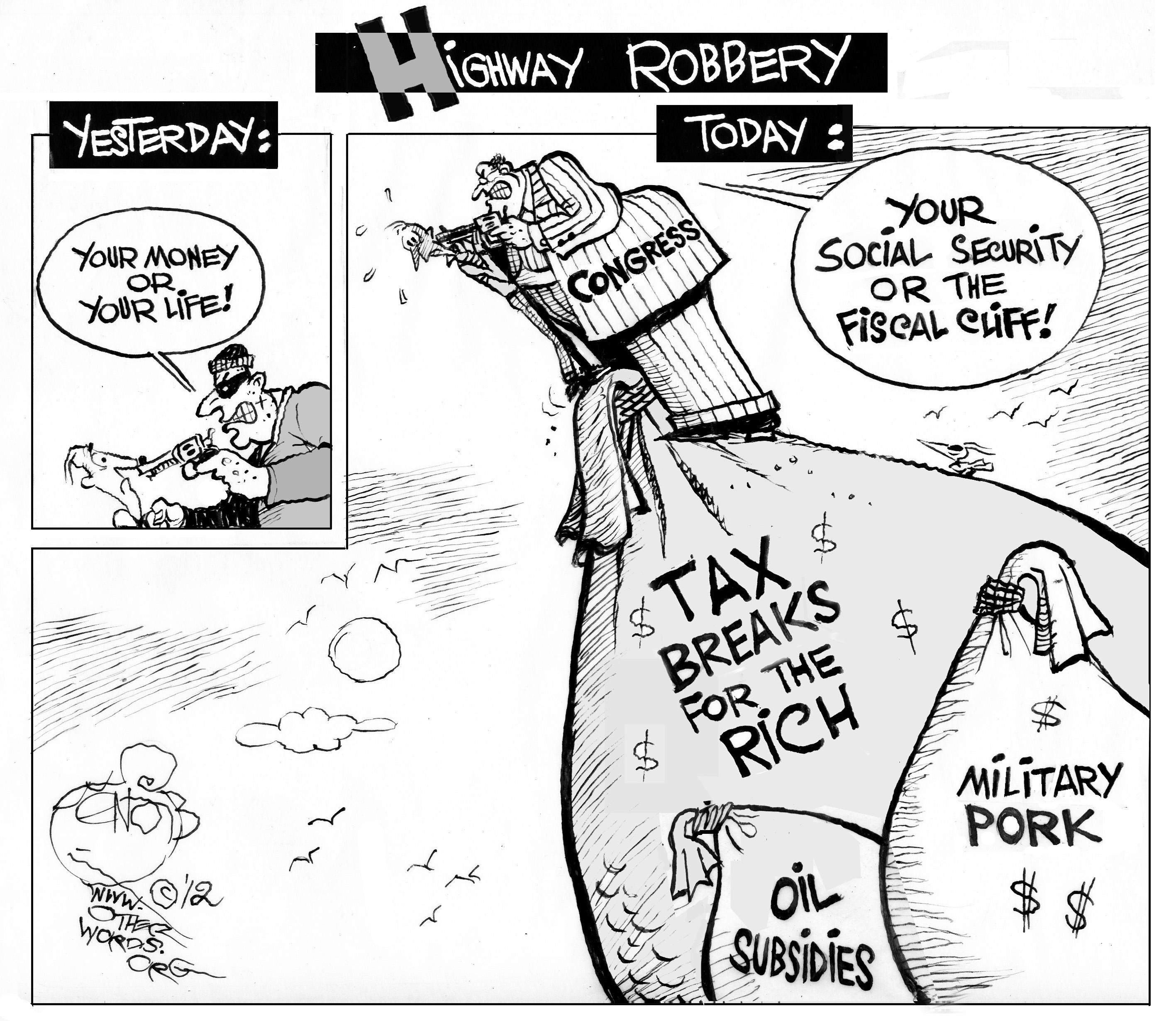
Look, I have news for you. The human economy does not take precedence over the Earth’s natural ecological processes which have evolved over millions of years to provide you with clean water, clean air, fertile land, and productive plant and animal life. All of these priceless necessities have been given to you at no charge to your accounting ledger. I guess free lunches are something no human can refuse, but the bill will come due no matter how you try to hide it by pushing it off onto the environment and future generations. In a planet without a stable biosphere, your glimmering metropolises with their megalithic concrete and steel structures reaching heavenward are nothing more than fleeting sand castles to be washed away by the next rogue wave of a surging sea… Sandy was just a warm-up event. Perhaps a new ‘Dust Bowl’ event and heat waves down under demanding a new color code on the weather map and droughts rendering useless a nation’s hydroelectric power will do the trick. I suppose as long as the $tock exchanges of the world are operable, your “business as usual” scheme of perpetual growth and converting all the natural world into capitalist symbols of wealth will carry on its merry way right over the edge of global extinction. And you thought the “fiscal cliff” was something to worry about?
As a mentor and intellectual peer of this site said recently, “tribes and societies that did master effective class consciousness thrived, for a very long time. Those that didn’t, don’t.” At today’s massive scale of production and consumption, the human and environmental exploitation characterized by modern industrial capitalism undermines the long-term existence of mankind along with every other living organism on the planet. Capitalism shoehorns everything into its profit-seeking regime, no matter if that means global genocide on a scale never heretofore seen:
…Actually, the more I reflect on it, the clearer I see the logic, the rationale, behind the bankers’ and the capitalists’ push for privatization. It is not just more profits they are after, not just share price or corporate valuation; no! They are after mass extermination, genocide on a grand scale – of the world’s needy, the under-funded, the unwanted, the uncivilized, the savages and the barbarians, the commies and the Islamists, in short, elimination of all of the Others.
The big boyz have seen all the data and crunched all the numbers, and it is clear to them – the earth is running out of resources, Mars is -50 C all of the time, and we can no longer afford to carry all of this excess baggage here on the planet — all of these miserable, thankless, do-nothing mouths to feed. So the plan is brilliant. You reduce the number from 7+ billion by at least 33% without firing one shot. You simply privatize all natural resources and then price access so that the bottom third of the globe’s population cannot afford it. And so, they die; it will be the biggest die-off of the Anthropocene epoch…
Dissecting some recent New York Time’s propagandist cheerleading on the fiscal cliff deal as “progressive taxation”, Yves Smith calls it as it is – ‘A Big Lie’. Her article appears in the NYT Examiner which is a site dedicated to analyzing the corporate spin of the New York Times.
When you have an economic system that rewards those who can most effectively exploit society and the environment, then psychopaths invariably rise to the top of the socio-economic heap. That’s why Obama has no hesitation in carrying out extrajudicial assassinations, or that former Countrywide CEO Angelo Mozilo lead the charge on profiteering from sub-prime mortgages, or that BP CEO Tony Hayward can set off an epic ecocide in the Gulf of Mexico and call it “tiny” and then complain that he “wants his life back.” The book ‘The Wisdom of Psychopaths: What Saints, Spies, and Serial Killers Can Teach Us About Success’ lists the top four jobs for psychopaths as:
1. CEO
2. Lawyer
3. Media (TV/radio)
4. Salesperson
I can’t believe that politicians didn’t even make it into the top ten.
Politicians are more likely than people in the general population to be sociopaths,” says clinical psychologist and author Dr. Martha Stout…”I think you would find no expert in the field of sociopathy/psychopathy/antisocial personality disorder who would dispute this,” Stout continued. “That a small minority of human beings literally have no conscience was and is a bitter pill for our society to swallow — but it does explain a great many things, shamelessly deceitful political behavior being one.” – link
But since America is a corporation or corporatocracy, essentially captured 100% by business interests, you can interchange the number one spot of CEO for the POTUS. Corporations write the legislation through bought-off politicians, control public opinion through mainstream media and policy institutions, degrade the education system into a conveyor belt of unthinking corporate drones for a life of corporate consumerism, and manipulate society through all other levers of power while crushing any uprisings with its panoptic security/surveillance apparatus.
In the video below, Chris Hedges talks about sacrifice zones like mountain top removal for coal in West Virginia, but knowing what we know about the state of the biosphere, in particular climate change and ocean acidification, we can say that the entire planet will soon be one big sacrifice zone. The “rapacious, immoral elites” are on track to take the entire planet down. What makes this oppressive system so immovable is that everyone is a participant, whether by choice or not.
While many liberal blogs were celebrating what looked on the surface to be an Obama victory of raising taxes on the über wealthy, they apparently did not notice what was being slipped up their behind.
For starters, the payroll tax, which was lowered in 2011 from 6.2% down to 4.2% in an effort to breathe some life into a moribund middle class, has jumped back up by 2% to its original rate. 160 million American workers will now shell out another $35 to $180 per week depending on their income level. The payroll tax is capped for incomes greater than $113,000 at $2,274. This means that it’s a regressive tax –anyone making over $113,00 will pay less as a percentage of their income, while for everyone else the tax is a net increase of 2%.
So while the plebs are scrounging around to pay that extra tribute to the Empire, our corporate overlords have extracted more blood from the serfs:
The “fiscal cliff” legislation passed this week included $76 billion in special-interest tax credits for the likes of General Electric, Hollywood and even Captain Morgan. But these subsidies weren’t the fruit of eleventh-hour lobbying conducted on the cliff’s edge — they were crafted back in August in a Senate committee, and they sat dormant until the White House reportedly insisted on them this week…
In late July, Finance Chairman Max Baucus announced the committee would soon convene to craft a bill extending many expiring tax credits. This attracted lobbyists like a raw steak attracts wolves. …
General Electric and Citigroup, for instance, hired Breaux and Lott to extend a tax provision that allows multinational corporations to defer U.S. taxes by moving profits into offshore financial subsidiaries. This provision — known as the “active financing exception” — is the main tool GE uses to avoid nearly all U.S. corporate income tax.
Corporations also got another legalized tax avoidance here:
As part of the fiscal cliff deal, Congress also extended another little-known tax break that benefits large multinationals selling products through overseas affiliates. This “pass-through” exemption permits a U.S.-based company to set up a new corporation in a tax haven like the Cayman Islands and sell it a patent owned by the U.S. parent company. Royalties on overseas licensing of that patent would then route to the tax-sheltered firm, instead of the U.S. parent company. The Joint Committee on Taxation says the two-year cost of extending this shelter is $1.5 billion.
The financial services industry, whose leaders had earlier joined a group of other corporate executives pushing for a “fair” solution to the fiscal crisis, is one of the primary beneficiaries of special-interest tax breaks. The active-financing exception, for example, permits banks like Morgan Stanley to avoid the 35 percent U.S. corporate tax rate on interest income from money lent overseas. A handful of other U.S.-based multinational companies with financing arms, such as Ford Motor Co. and General Electric, also use that exemption to lower their tax bills…
…[T]he “active financing” exception … permits businesses earning interest on overseas lending to defer U.S. taxes on that income indefinitely…
Vampire-squid Goldman Sachs and too-crooked-to-fail Bank of America also get tax breaks for moving into the new World Trade Center that replaced the pre-9/11 one:
…This tax provision was created to help revitalize Lower Manhattan’s small businesses but instead helped out these two mega-bailed-out banks and helped to subsidize the construction of luxury apartments. Goldman Sachs alone was reported to have received $1.6 billion in tax-free financing of its new building…
There are many more corporate giveaways in the fiscal spiked dildo that was rammed into Main Street, but you get the idea. America is just one big plantation for our corporate masters to harvest from on a perpetual basis. Yves Smith has a post discussing the permanent cementing-in of a class structure composed of the ‘have all’ and ‘have nothing’:
…The newest chat, with economist James Henry, focuses on how the deal on estate taxes allows the rich to pass on wealth to their children, allowing inequality to persist across generations. And he reminds us that a lot of Congressmen are rich enough that this provision will benefit their families…
I could not have summed up the situation better than the first commenter:
In their mad dash to cling to a sinking ship’s last remaining point above water, the callus elite won’t hesitate to trample all over women and children. In a world of ‘peak everything’ and a dying biosphere, the venal nature of man will surely surface in spades.
An interesting article came to my attention via a referral from The Big Picture. The economics editor of the Sydney Morning Herald, Ross Gittins, has written an article, The four business gangs that run the US, which is a review of Jeffrey Sachs book, The Price of Civilisation. Sachs should have entitled his book ‘The Price of Capitalism’. In order to protect corporate interests, the exploiters will always use their wealth to bribe the political system (such as campaign contributions and promises of lucrative positions in the private sector after leaving government posts). We are all familiar with feedback loops in terms of climate change,but there also exists one within our socio-economic system which is extremely destructive. I refered to this feedback loop as the government-corporate-lobbyist complex in my postGuns, God, and Greenback$.Sachs describes this pernicious feedback loop, which has accelerated wealth to the top 0.001%, as follows:
Sachs says…
Corporate wealth translates into political power through campaign financing, corporate lobbying and the revolving door of jobs between government and industry; and political power translates into further wealth through tax cuts, deregulation and sweetheart contracts between government and industry. Wealth begets power, and power begets wealth.
Sachs even uses the term corporatocracy to describe the four primary U.S. business sectors which have usurped our government:
1.) Military-Industrial-Complex
Sachs says…
As [President] Eisenhower famously warned in his farewell address in January 1961, the linkage of the military and private industry created a political power so pervasive that America has been condemned to militarisation, useless wars and fiscal waste on a scale of many tens of trillions of dollars since then.
2.) Wall Street-Washington complex
This group, comprised primarily of the big financial corporations (i.e. Goldman Sachs, JP Morgan Chase, Citigroup, Morgan Stanley), systematically worked to “capture” regulation and take control of the money system which, Sachs says, “paved the way for the 2008 financial crisis and the mega-bailouts that followed, through reckless deregulation followed by an almost complete lack of oversight by government”.
3.) Big Oil-transport-military complex
Sachs says…
Since the days of John D. Rockefeller and the Standard Oil Trust a century ago, Big Oil has loomed large in American politics and foreign policy. Big Oil teamed up with the automobile industry to steer America away from mass transit and towards gas-guzzling vehicles driving on a nationally financed highway system.
Now you know why America has a rail system that even the Bulgarians would be ashamed of, as Kunstler is fond of saying. Next time you fill up your tank, think of the perpetual oil wars in the Middle East as an externalized cost of subsidizing America’s car culture. Anita Dancs calculated the cost of securing our liquid fuel addiction back in 2010:
…Put all these numbers in perspective: The price of a barrel of oil consumed in the United States would have to increase by $23.40 to offset military resources expended to secure oil. That translates to an additional 56 cents for a gallon of gas, or three times the federal gas tax that funds road construction.
If $166 billion were spent on other priorities, the Boston public transportation system, the “T,” could have its operating expenses covered, with commuters riding for free. And there would still be money left over for another 100 public transport systems across the United States. Or, we could build and install nearly 50,000 wind turbines. Take your pick.
Sachs also reminds us that “Big Oil has played a notorious role in the fight to keep climate change off the US agenda. Exxon-Mobil, Koch Industries and others in the sector have underwritten a generation of anti-scientific propaganda to confuse the American people.”
4.) Healthcare Complex
Sachs says…
The key to understanding this sector is to note that the government partners with industry to reimburse costs with little systematic oversight and control. Pharmaceutical firms set sky-high prices protected by patent rights; Medicare [for the aged] and Medicaid [for the poor] and private insurers reimburse doctors and hospitals on a cost-plus basis; and the American Medical Association restricts the supply of new doctors through the control of placements at medical schools.
‘The result of this pseudo-market system is sky-high costs, large profits for the private healthcare sector, and no political will to reform.
We are the only industrialized country on Earth without universal healthcare. We pay more than anyone else and get less for the money spent. One of every five or six GDP dollars goes to feed this beast, but our life expectancy doesn’t reflect it:
Sachs says the elite take care of their own and have no concern for the plebs down below:
There is absolutely no economic crisis in corporate America. Consider the pulse of the corporate sector as opposed to the pulse of the employees working in it: corporate profits in 2010 were at an all-time high, chief executive salaries in 2010 rebounded strongly from the financial crisis, Wall Street compensation in 2010 was at an all-time high, several Wall Street firms paid civil penalties for financial abuses, but no senior banker faced any criminal charges, and there were no adverse regulatory measures that would lead to a loss of profits in finance, health care, military supplies and energy.
Ross Gittins concludes his review of Sachs’ book by briefly summarizing the path the elite took to amass their incredible wealth:
The 30-year achievement of the corporatocracy has been the creation of America’s rich and super-rich classes, he says. And we can now see their tools of trade.
It began with globalisation, which pushed up capital income while pushing down wages. These changes were magnified by the tax cuts at the top, which left more take-home pay and the ability to accumulate greater wealth through higher net-of-tax returns to saving.’
Chief executives then helped themselves to their own slice of the corporate sector ownership through outlandish awards of stock options by friendly and often handpicked compensation committees, while the Securities and Exchange Commission looked the other way. It’s not all that hard to do when both political parties are standing in line to do your bidding, Sachs concludes.
There was a comment that Darbikrash made on another website a year ago which pertains to this subject and clearly explains the corrupting influence that money has on government. Here is an excerpt:
You better believe that the financial elite who run this country do have OWS and any other social movement under 24/7 surveillance. Anything that strives to change the status quo of neoliberal capitalism will be undermined and crushed, whether through covert actions or co-optive schemes. Social justice, the environment, and the very habitability of planet earth are not on the agenda of the 1%’ers.
Now we have official confirmation that this indeed was and is the case. Surprise, surprise:
Newly obtained documents confirm that the Federal Bureau of Investigation was monitoring peaceful protesters with the Occupy Wall Street movement before the first OWS demonstrations even began…
…The list of documents, says Verheyden-Hilliard, “is a window into the nationwide scope of the FBI’s surveillance, monitoring, and reporting on peaceful protestors organizing with the Occupy movement.”
“These documents show that the FBI and the Department of Homeland Security are treating protests against the corporate and banking structure of America as potential criminal and terrorist activity,” she writes. “These documents also show these federal agencies functioning as a de facto intelligence arm of Wall Street and Corporate America.
What more proof do you need that we live under a corporatocracy? Since solving dire problems like climate change would require a complete dismantling of the current capitalist system, i.e. an economic system driven by the profit motive is incompatible with ecological sustainability, we can see why the financial and corporate elite would be hostile to a grass-roots movement which seeks social and environmental justice. Such issues don’t compute with the bottom line of corporations or our war-based economy. Interestingly, the only real attention that was given to OWS by those in power was on how their discontent could be co-opted by the status quo:
As I [Glenn Greenwald] noted several weeks ago, White House-aligned groups such as the Center for American Progress have made explicitly clear that they are going to try to convert OWS into a vote-producing arm for the Obama 2012 campaign, and that’s what “Occupy Congress” is designed to achieve.
Of course the Tea Party was never really a threat to Corporate America because it’s what is termed an astroturf group, as was first reported a few years ago by Australian filmmaker Taki Oldham:
Do you think these free-market idealogues of capitalism are going to clean up the mess left in the wake of climate chaos? Hell no. The unwashed masses are on their own. As long as the elite have the money to insulate themselves from the ravages of our fossil fuel-dependent economy, they will have no real concern for the catastrophes that lie ahead. A case in point is the recent aftermath of the Hurricane Sandy Frankenstorm:
Billionaire David Koch’s prime political organization, Americans for Prosperity (AFP), having failed in its $125 million quest to oust President Barack Obama, is now aiming at a slightly less sophisticated political target: victims of Hurricane Sandy. […]
Earlier this week, AFP, which is chaired by Koch and believed to be financed by several other plutocrats from the New York City region, released a letter warning members of Congress not to vote for the proposed federal aid package for victims of the storm that swept New Jersey, New York City and much of the surrounding area in October. An announcement on the group’s website says that the vote next week for the Sandy aid package will be a “key vote” — meaning senators who support sending money for reconstruction could face an avalanche of attack ads in their next election. Already, opposition to the bill is growing, although it passed one procedural hurdle last [Friday] night. […]
Koch’s top deputy in New Jersey, a surly gentleman named Steve Lonegan, who heads the local AFP state chapter, called the aid package a “disgrace.” “This is not a federal government responsibility,” Lonegan told reporters. “We need to suck it up and be responsible for taking care of ourselves.
‘Change’ will always be an empty campaign slogan when you have a federal government which:
…wastes resources on a multi-trillion dollar Security and Surveillance apparatus to spy on its entire citizenry, in particular OWS protestors, minorities, and government critics/whistleblowers.
…pumps more than half of every tax dollar into the military industrial complex and its war-profiteering cronies who perpetuate our war economy.
…is not alarmed that 50 million Americans are dependent on food stamps while U.S. corporations hoard $22 trillion in secret offshore bank accounts.
…thinks that tax revenues can be maintained while its manufacturing base is off-shored to exploit cheap foreign labor pools.
…uses the growth in corporate profits as the only yardstick for societal well-being.
…marginalizes and prevents the participation of third party candidates within our two-party oligopoly.
…believes that the system described above should be bailed out for its criminal excesses from the billfold of a now beaten-down middle class.
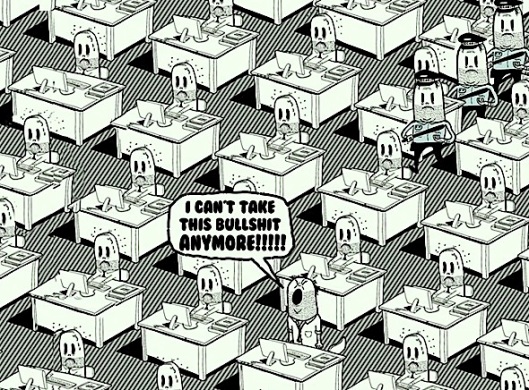
New ‘smile guards’ will soon become mandatory in the work environment of the corporate state:
In my previous ‘arms industry’ posts (Guns, God, and Greenback$ as well as Guns ‘R U.S.), I alluded to the revolving door between the arms industry and the government and the corruption of politics by the money involved therein. In one of the most interesting interviews of 2012 aired today on DemocracyNow, arms industry analyst Andrew Feinstein, author of “The Shadow World: Inside the Global Arms Trade” and a former African National Congress member of Parliament in South Africa, sheds more light and insight on this very subject:
ANDREW FEINSTEIN: …The global arms trade is a $1.74 trillion-a-year business. That’s $250 for every person on the planet. And the profit motive behind the global arms trade is absolutely crucial. This is a business that is about big, big money. The trade contributes around 40 percent of all corruption in all global trade. So its impact on countries, on governments, on ordinary individuals in terms of the economic opportunity costs are absolutely massive.
Now, you will find that many spokespeople for the trade would try to distinguish between the legal or formal trade, on the one hand, and the illegal or illicit trade, on the other. I argue in the book that this distinction is a fallacy, that the boundaries are in fact extremely fuzzy and that the licit and the illicit are very closely intertwined, in addition to which the industry is largely protected because of its very close links to governments, to intelligence agencies, obviously to the military, and to lawmakers. So it is very seldom—even with the inadequate regulations that exist globally around the trade in weapons, it is very, very seldom that people who break those regulations are actually brought to book…
…Now, the situation that pertains at a global or international level has very many similarities with the domestic situation, particularly in the U.S., because let’s—let’s bear in mind while discussing this that the U.S. buys and sells almost as much weaponry as the rest of the world combined. So what happens in the U.S. is going to have enormous impact on the rest of the world. And what happens domestically, in terms of the ownership of weaponry within the U.S., really does, as I say, reflect the global trade in arms, in that we see it’s a $3.5 billion-a-year industry. And here we’re talking about smaller weaponry—about handguns, about assault rifles, semi-automatic weapons, the sorts that are used in the tragedy at Sandy Hook and all of the others that we’ve seen over the years throughout the U.S.
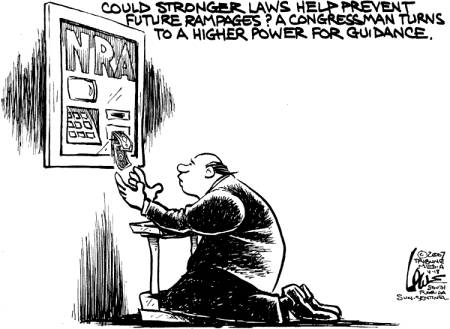
But the NRA, the gun sellers, the gun users seem to be afforded an extraordinary level of protection by government, by law enforcement authorities, just as happens on the global level. And part of this is because of the revolving door of people between, for instance, the NRA and government. Recent figures suggest that 15 of 28 officials in the NRA came from—sorry, lobbyists in the NRA came from important positions within government dealing with some of these same issues, so that the sorts of decisions being made by government are being informed disproportionately by those who want guns to be unregulated, by those who are making massive profits out the suffering of the victims of gun crime…
…let me make another point that I think is absolutely crucial about this and to understand where the NRA is coming from and, unfortunately, where the global trade in arms comes from, as well. And that is the linkages between politics and the gun lobby, and particularly, in terms of those linkages, money. One of the reasons that I focus on the global trade in arms in my work is because I saw, both in the context of South Africa, but also at a global level, the way in which money has come to pollute our politics. And the relationship between defense contractors on an international level and political parties and individual politicians are deep and profound. At a domestic level, the relationships between the NRA and specific elected representatives, not only in terms of money contributed, but also in terms of support given, are, again, profound. And unless we are able to break these linkages between money and politics that so pollute the way we are governed around the world, we will not be able to deal with some of the most intractable problems that face us as human beings —problems of the weaponization of the world, problems of climate change…
…I have not seen anywhere else in the world a gun lobby that has the same level of influence on its own government as the NRA does in the United States. My own assessment of what happened in July with the arms trade treaty is that the NRA, through the words of Mr. LaPierre and others, made clear to the Obama administration that it would make the president’s re-election a lot more difficult if he supported an international arms trade treaty. And I think it’s in that way that the NRA had such direct influence on the U.S. decision to effectively scupper negotiations for what in my opinion wouldn’t have been a strong-enough arms trade treaty, but would have been far better than any form of regulation that we have at the moment. So, yes, I think this is something of a unique situation, where a gun lobby has the extent of influence that it has in the United States of America…
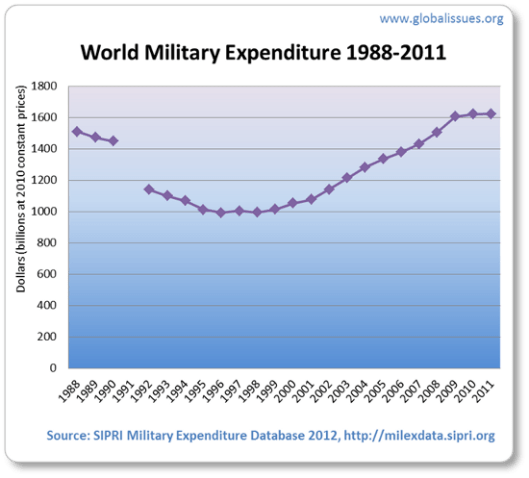
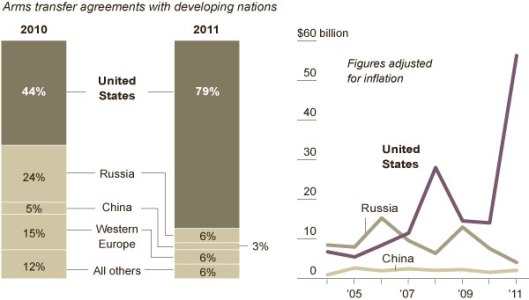
What I find most disturbing is that in an age of resource constraints and austerity measures aimed at the lower class, global sales from the arms industry are booming and that growth is coming primarily from the United States of America (aka ‘Guns ‘R U.S.’):
As was stated by Feinstein, the world-wide anti-corruption body, Transparency International, reports that the arms industry is one of the most corrupt business sectors, accounting for 40-50% of corruption in global trade.
Corruption plays a significant role in influencing arms procurement. But despite repeated scandals, this situation has been largely ignored by governments, NGOs and academics.” ~ Laurence Cockroft, Chairman of Transparency International’s UK chapter.
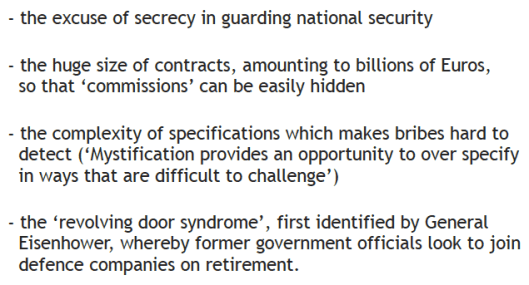
‘Commissions’ are the euphemism for bribes which are paid by manufacturers to governments and average at least 10% of contracts that run in the tens of $billions per year. Some reasons for the rampant corruption in the arms industry:
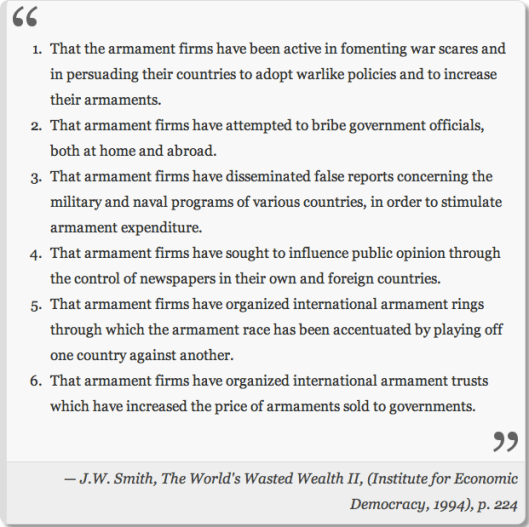
The merchants of death have only grown more powerful in recent times, and their horrific impacts to the well-being of humanity are as true today as they were after World War I when the League of Nations listed six primary criticisms of global arms dealers, as quoted by J.W. Smith:
Stung by the horrors of World War I, world leaders realized that arms merchants had a hand in creating both the climate of fear and the resulting disaster itself.
Americans need to understand that the NRA is very much a part of this global arms trade. If one follows the money, the reasons why the NRA is adamantly opposed to any sort of regulation on guns becomes painfully apparent. While the US domestic arms industry conveniently wraps itself and its profit motive behind the patriotic fervor of the Second Amendment and the colonial ghosts of Founding Fathers, the horrors of the Sandy Hook massacre are blamed on everything under the sun except for that which hides in plain sight — an unregulated, out-of-control global and domestic arms industry.
Wrapping your head around the seemingly unstoppable upward march of CO2 emissions is like trying to comprehend all those zeros in the expanding global debt bubble; both are so far beyond human scale that people cannot put them into a frame of reference or perspective. They have taken on a life of their own, a force of nature that defies all attempts to control and subdue them. Brian Merchant takes a stab at trying to frame the CO2 numbers behind industrial civilization’s conundrum of catastrophic climate change:
And 2012 is on track for another 2.6 percent increase. Why can’t we stop it? Perhaps the problem is structural and embedded in our economic system.
In a recent interview, dissident Julian Assange commented on the degree of intertwinement between government and corporations, i.e. fascism or more aptly called inverted totalitarianism in our times. Regulatory capture, the revolving corporate/government door, and K Street lobbying(legalized bribery) are examples of the monied interest$ of capitali$m having taken over government.
There’s not a barrier anymore between corporate surveillance, on the one hand, and government surveillance, on the other. You know, Facebook is based—has its servers based in the United States. Gmail, as General Petraeus found out, has its servers based in the United States. And the interplay between U.S. intelligence agencies and other Western intelligence agencies and any intelligence agencies that can hack this is fluid. So, we’re in a—if we look back to what’s a earlier example of the worst penetration by an intelligence apparatus of a society, which is perhaps East Germany, where up to 10 percent of people over their lifetime had been an informer at one stage or another, in Iceland we have 88 percent penetration of Iceland by Facebook. Eighty-eight percent of people are there on Facebook informing on their friends and their movements and the nature of their relationships—and for free. They’re not even being paid money. They’re not even being directly coerced to do it. They’re doing it for social credits to avoid the feeling of exclusion. But people should understand what is really going on. I don’t believe people are doing this or would do it if they truly understood what was going on, that they are doing hundreds of billions of hours of free work for the Central Intelligence Agency, for the FBI, and for all allied agencies and all countries that can ask for favors to get hold of that information.
William Binney, the former chief of research, the National Security Agency’s signals intelligence division, describes this situation thatwe are in now as “turnkey totalitarianism,” that the whole system of totalitarianism has been built—the car, the engine has been built—and it’s just a matter of turning the key. And actually, when we look to see some of the crackdowns on WikiLeaks and the grand jury process and targeted assassinations and so on, actually it’s arguable that key has already been partly turned. The assassinations that occur extrajudicially, the renditions that occur, they don’t occur in isolation. They occur as a result of the information that has been sucked in through this giant signals interception machinery.
Corporations are the ultimate expression of capitalism. Libertarians decry that what we have is not capitalism, but a corrupted form of it, aka crony capitalism. The opposite is true – unfettered, unregulated capitalism is the purest form of this profit-driven system where economic activity is structured around the accumulation of capital. This is what we get when economic power(money) inevitably usurps all branches of government. Corporate greenwashing, carbon credit schemes, privatization of the commons, and externalizing environmental costs are examples of capitalism’s incompatibility with sustainability and its inability to deal with the degradation of the planet. Corporate power rules the world and it’s what is destroying the planet:
Ecocide is permitted (as genocide was in Nazi Germany) by the government and, by dint of the global reach of modern-day transnational business, every government in the world. Corporate ecocide has now reached a point where we stand on the brink of collapse of our ecosystems, triggering the death of many millions in the face of human aggravated cataclysmic tragedies. Over the passage of time, tyranny revisits. Tyranny is the cruel, unacceptable, or arbitrary use of power that is oblivious to consequence. Whilst the use of coal stations may not be deemed an intentional cruelty, it is certainly an unacceptable use of corporate power. Our governments collude by encouraging excess emissions, contrary to their UNFCCC commitment to stabilize “greenhouse gas concentrations in the atmosphere at a level that would prevent dangerous anthropogenic interference with the climate system.”60 years ago the tyranny was Nazism. Today it is pursuit of profit without moral compass or responsibility.
…There are several points to make in response to the belief that capitalism is compatible with a flourishing environment. Firstly, environmental activism can’t alter capitalism’s integral growth dynamic, it’s “grow or die” impulse, as the social ecologist Murray Bookchin put it. As a result the best environmentalism can do is ameliorate the worst effects. “Things getting worse at a slower rate”, is how the late environmental activist, Donella Meadows, described the situation.
Secondly, in the low or no growth world we are entering, environmental priorities are being sacrificed to meet the short-term need to revive growth. “We can’t be ambivalent about growth,” is how the UK government’s “planning” minister, Greg Clark, justified reducing regulations to make it much easier to approve building development in the countryside.
Thirdly, many polluting practices in western countries that have become culturally unacceptable have been exported to poorer countries, where people have less power to make their objections count.
Lastly, the experience of the 21st century has shown that when environmental activism directly confronts huge capitalist industries like oil, automobiles and mining, it does not win. The 1987 Montreal Protocol was the last successful international agreement to change capitalist behaviour. The protocol called for strict restrictions on chemicals that deplete the ozone layer (chlorofluorcarbons) and the results have been impressive. But, says Schweickart, the industries affected had substitutes to hand, and the protocol “should not lull us into thinking capitalism can accommodate all sensible environmental solutions.”…
…The consequence of the conflict between environmental sanity and profit has been that many capitalist countries – most notably the US – have been unable to change course to ameliorate climate change. Not only this, a political culture has developed that denies the existence of climate change even when its effects become harder and harder to ignore.
Of course the prospects of thinking outside-of-the-box on economic and foreign policy issues has always been heresy. As long as we think we can fix the ecological problem with the same tools that caused the problem, we can expect the Eco-Apocalypse, a tragedy of the commons on a global scale, to unfold as predicted:
Zizek:…………… the global capitalist system is approaching an apocalyptic zero-point. Its ‘four riders of the apocalypse’ are comprised by the ecological crisis, the consequences of the biogenetic revolution, imbalances within the system itself (problems with intellectual property; forthcoming struggles over raw materials, food and water), and the explosive growth of social divisions and exclusions.











 …pumps more than half of every tax dollar into the military industrial complex and its war-profiteering cronies who perpetuate our war economy.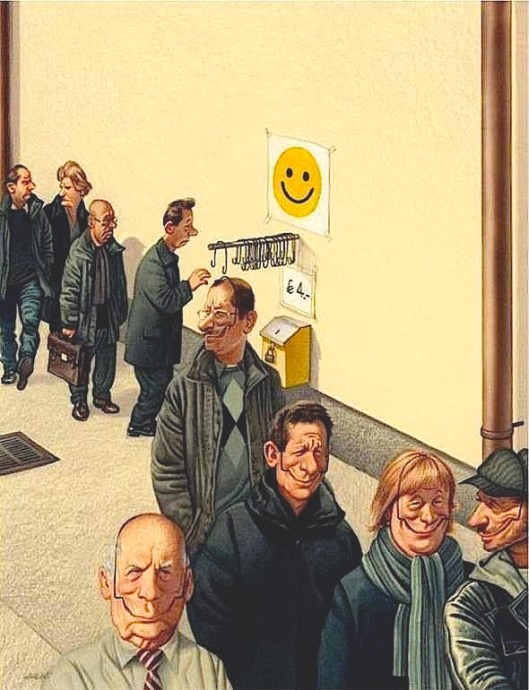

 The merchants of death have only grown more powerful in recent times, and their horrific impacts to the well-being of humanity are as true today as they were after World War I when the League of Nations listed six primary criticisms of global arms dealers, as quoted by J.W. Smith:
 From a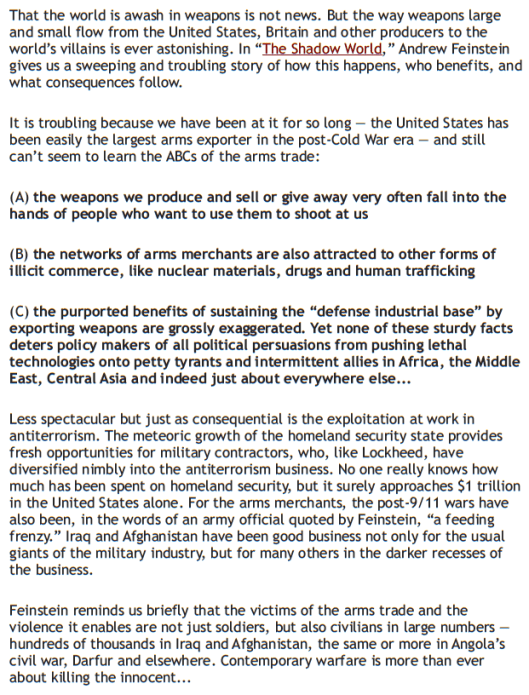


 Collapse of Industrial Civilization