The Middle East is on the frontline of the multi-pronged crisis of overpopulation, resource depletion, and climate change. Fault lines in that region are widening as climate change exacerbates crop-destroying droughts, peak oil starves economies, and stressed populations scramble to survive. Advanced industrialized countries are buffered from the same fate only temporarily by their military and economic might. The oil-cursed Middle East also suffers from being in the crosshairs of industrial civilization’s insatiable appetite for the black stuff. Since the peak of conventional oil in 2005, the industrial world has not only turned to harder to extract and environmentally damaging unconventional sources of oil, but has also ramped up military intervention in order to keep the energy flowing. Access to resources has always been an underlying factor in all wars, but as climate change, resource depletion, and social disintegration escalate, the grip on foreign energy deposits by western powers becomes increasingly tenuous. Climate Change multiplies threats. Militarism and climate change feed off and drive each other:
The war machine of the American Empire is the single largest consumer of fossil fuels on the planet.
Our priorities are overwhelmingly skewed toward militarism in order to maintain the unsustainable, while the real threat of climate change grows ever stronger:
In the meantime, the false hope of technology maintains the illusion that our current way of life is inalienable. The industrialized monoculture farming that feeds the masses will quickly fade as synthetic fertilizers become too expensive to artificially replenish nutrient-depleted soils. Pesticides and antibiotics are losing their effectiveness as natural selection breeds super weeds and drug-resistant pathogens. Fresh water is also being sacrificed for fracking, tar sands production, and mountaintop mining. We appear to be systematically destroying any basis for future civilizations as we burn through what is left. “Forests precede mankind; deserts follow.”
Severe land degradation is now affecting 168 countries across the world, according to new research released by the UN Desertification Convention (UNCCD).
The figure, based on submissions from countries to the UN, is a marked increase on the last analysis in the mid-1990s, which estimated 110 states were at risk.
In an economic analysis published last week the Convention also warns land degradation is now costing US$490 billion per year and wiping out an area three times the size of Switzerland on an annual basis. – link
No techno-fix chicanery will bring back the melting polar caps or stop the series of runaway feedbacks loops unleashed from industrial civilization’s fatal attraction to fossil fuels. Our eyes simply don’t appreciate the full scale of climatic change now underway, eroding mankind’s food production, infrastructure, and socio-economic stability, in addition to degrading nature’s ecological resilience and biological diversity, both of which underpin all of mankind’s activities. The megatons of greenhouse gases expelled into the atmosphere by industrial activity everyday are as invisible to humans as the mountains of toxic plastic waste filling up the world’s oceans. Out of sight, out of mind until the effects become too obvious to ignore and too late to change. Overpopulation continues unabated and is in fact encouraged by the imperatives of economic growth; the environmental pressures are ignored as resources are methodically stripped and depleted to unrecoverable levels.
Despite the ingenuity and intelligence of the human race, we appear subject to the same rudimentary biological urges of the lowest single-celled organism which, if given favorable conditions, will uncontrollably multiply its numbers deep into overshoot territory until its food source is exhausted, finally extinguishing itself in a mass die-off. Environmental laws and initiatives appear to be no more than slight speed bumps in our one-way road to extinction. All this talk about curbing GHG’s, “going green”, and “saving the planet” are mere window dressings for our motorized hearse. Nice accoutrements, but the destination is still a grave.
On the eve of what could be WWIII and the further barbarization of the Middle East at the hands of the American Empire and its vassal states, I think it’s important we look behind the wall of pro-war corporate media and understand what the facts on the ground really are. The following essay is a reblog from a website I just discovered and it gets into the nitty-gritty of the blowback from America’s perverse foreign policy in regards to Syria. When a nation supports democracy in name only and crawls in bed with terrorists to carry out regime change, then an entire region eventually becomes destabilized and thrown back into the hands of those dark forces which America purports to be fighting against in its so-called “global war on terror”. In reality, the American corporate state would rather have foreign nations with brutal dictators installed who will carry out America’s bidding rather than a democracy which looks after the best interests of the local people. Why else would the U.S. have overthrown Prime Minister Mossadeq of Iran or become the strongman for the corrupt House of Saud if not for the black oily stuff to which we are so addicted? When it is said that “women are literally blacked-out in the public sphere” in Saudi Arabia, the connotations are quite literal. Below is a picture taken by a friend who has worked in Saudi Arabia. It depicts a department store advertisement display which has been altered to conform to their brutally misogynistic society.
‘Humanitarian concerns’ and ‘social justice issues’ are merely empty rhetoric used by our sociopathic leaders as cover for protecting the grossly unjust social hierarchy of global capitalism. Some call this “corporate feudalism” while others say it is endemic to capitalism. One only has to look at the growing global wealth disparity to know this is true. The elite are drooling for war while the world races towards catastrophic resource depletion, environmental apocalypse, collapse of industrial civilization, and a new Dark Age.
One important issue that was missing from his talk (and is missing in almost all discussions on Syria) is the threat to the rights of women if the Assad regime falls. This is no small issue. One thing that surprised me during my visit to Syria is how Western it was compared to other Arab and Muslim countries in the region. Women’s dress is not restricted in Syria and they play a very important public role in society when compared to other Arab countries. Muslim fundamentalists and suicide bombers in Syria do have a Sharia Law agenda that they want to impose on the country. This is not theory. All one has to do is look to neighboring Iraq to see the deterioration of women’s rights in the post-Saddam era. Women used to wear miniskirts, show their hair and walk without fear in Baghdad. Now the situation has completely reversed. Women are forced to cover and are expected to stay at home. If they do not abide by this social practice, they are publicly shamed, and, in more extreme forms of Sharia justice, are raped and murdered.
An Iraqi friend told me that when he returned to Baghdad after the war he was stunned that women were no longer even comfortable speaking to him in public for fear of being thought of as whores. His experience of the status of women in public before the war was the polar opposite of the reality that one is now faced with in Iraq.
One should also note that the situation in neighboring Turkey has taken a turn for the worse in recent years under the Sunni AKP government. The rate of violence against women has sky-rocketed. Wives, fiancés and girlfriends have been murdered by their male partners at a rate that is 1400 percent higher than 7 years ago. This is the same AKP government that is supplying their Sunni rebel ‘brothers’ in Syria with weapons.
There is a severe lack of discourse about what the consequences are for women if and when the Assad regime falls in Syria. It is clear why the Muslim extremists working in concert with Al-Qaeda in Syria do not talk about women in their fight for ‘democracy’. Women for them are marginal, servile and functional creatures who are to be neither seen nor heard in public life.
Christians, Kurds and Minorities
In the question and answer period after Mr. Landis’ you will note that there is a Syrian Christian man asking a question about the rights and status of Christians in Syria after a Sunni extremist takeover of the country. He is very concerned about this issue and he has good reason to be. Since the beginning of the so-called ‘revolution’ there have been many incidents of rebels killing Christians and bombing churches all over Syria. The chant of the fighters has been: “The Alawite and Christians to Beirut!” The intentions can’t be made any clearer. Nobody will be safe in Syria after Assad except orthodox Sunni Muslims. Mr. Landis made this very clear to the Christian man when he said that the solution for Turkey was ethnic cleansing. The reason there is no problem in Turkey with Christians is because there are no more Christians. They used to be 20% of the population. Those who were not killed or deported were forced to convert to Islam. All that is left of Christianity in Turkey are ancient Christian sites that are advertised to attract tourists to the country. Istanbul, which is still the seat of the Eastern Orthodox Church, barely tolerates what is left of the Christian community there. The Church has virtually no sovereignty and is at the mercy of the government and its flock has dwindled to almost nothing, when compared to its vibrant past.
If ethnic cleansing and forced conversion has been Turkey’s solution for diversity, take a look at the other country that is supplying weapons and Islamist fighters to topple Assad: Saudi Arabia. There is no country in the world that is as intolerant and anti-democratic as Saudi Arabia. Churches are illegal in that country. Women are literally blacked-out in the public sphere in dress. Saudi is also the only country in the world where women are not allowed to drive. Women are subservient to men in the name of extreme Islam and Bedouin tradition. If Turkey and Saudi are the main suppliers of weapons and training of the rebels in Syria, one needs to reflect on what kind of culture is intended to be put in place after the fall of the secular and tolerant regime that is currently hanging on to power.
The Kurdish issue is an extremely volatile issue in Syria. Assad extended greater freedoms and autonomy to the Kurds via political reforms passed after the initial protests had begun. The Kurdish leadership in Syria has already openly stated that if Syria is attacked by Turkey, they will fight on the side of Assad. This issue presents potentially grave consequences of blowback for Turkey. In recent days the Turkish Prime Minister stated that Turkey may need to invade northeastern Syria to crush the Kurds there if they get too powerful. This would mean that Turkey would be fighting its war with the Kurds on three fronts. It is already battling a guerrilla insurgency within its borders and regularly attacks Kurds in northern Iraq…. Read the entire essay
His essay describes one way in which to find inner peace in a world of upheaval. Contemplating the world’s problems is maddening. Those delving into and obsessing over the subject of modern civilization’s collapse take on a sort of burden like that of the Greek mythological figure Atlas who carried the weight of the world on his shoulders as punishment. But we’re mere mortals, not Gods. Thus we must find methods with which to build our mental and emotional strength for weathering the coming chaos…
There’s all kinds of takes on philosophy. Nobody can say any one take is the right or the wrong. It’s a bit like music. You choose what appeals. Some stuff gets very popular and everybody tends to agree on the greats.
Along comes Derrida. Odd little fellow from the outside. Says something like, ‘Hang on, all philosophy is words. Are words ‘truth’ ? Of course not.’ Created something of an uproar at the time, the idea that Western philosophy is Logocentric, weighted towards words, which means it’s missing all the stuff that can’t be put into words. Like love, etc.
But this idea goes straight back to the earliest Buddhist recorded teachings, 2,200 years ago, 300 years after he died, written down in the Pali Canon, where the Buddha is interrogated, by Vachagotta and says that the truth that is most important cannot be put into words.
“Vaccha, this teaching … is profound, subtle, hard to see, hard to comprehend, beyond the sphere of mere logic, to be understood only by the wise.”
Derrida’s radical philosophy was part of the wellspring of the movement called postmodernism.
I’m going to shorthand my take on what that means, by saying we are story-telling animals, and that we construct both ourselves, as individual identities, and our cultures, and ‘the world’ as, or, out of, our stories, which are constantly on-going and in flux.
You can picture it this way. Neuro-chemistry, flashes of electrical activity in my brain synapses, forming word sequences, translated into finger movements on the keyboard, into symbols on the screen, into electrons down the wires, through the cables, to your screen, into your optical nerves, into your brain, the story moves and flows, just as it did, tens of thousands of years ago, as I sat across the campfire from you, relating my tale as you gazed into the embers, sound vibrations in air, beneath the vault of the starry night sky.
For those of us on the cutting edge of the doom story, we are expecting things to get extremely nasty. Some of the smartest people I know of, are expecting most of us, if not all of us, to die. If this comes as a shock to you, dear reader, perhaps you have not been paying close attention. Most people have not been paying much attention. Anyway, soon, seems likely, it’ll be impossible not to pay attention. So what happens then ?
The way I see it, all we have, is stories, all we are, are stories. Yes, there is more. All the ‘stuff’. The empirical measurable tangible tactile solid and not so solid material world.
Science can tell us stories about that. And then there is the other ‘stuff’, the spiritual stuff, that elusive, ethereal, contentious region, the numinous, the non-physical realities.
Here is where things have to get personal. What happens when disaster strikes ?
You see, it’s no good having facts and figures and making glib statements, and it’s no good saying you belong to a religion. Nothing is any good at all, is it, you only know what is any good, when the disaster actually happens.
I lived for some years on a street with a little shop across the road, where I used to go at least once a week to buy a few items. The woman who ran it made very little money and worked very long hours. One morning early, she was weeping. I asked what was the matter. Her two teenage nieces had been burned to death in a car crash on the motorway.
She composed herself, she carried on running the shop with quiet dignity, seven days a week, 7 a.m. until 7 p.m.
Most people reading this are probably Americans, a country with a history of a couple of centuries. China has a continuous history of several thousand years. Long ago, in the 700’s perhaps 36 million people died in war and famine, perhaps 15% of the population. Such events have recurred, again and again. Maybe there’s a reason they have recipes for duck feet soup and hundred year old eggs.
The Taoists have survived through countless appalling catastrophes where they have watched the empire collapse and the population crash. Bodhidharma brought Buddhism to China, and Buddhism and Taoism survived side by side for the last fifteen hundred years or so. For Westerners, these are quite strange belief systems, because they are quite unlike the three Abrahmic religions. What both of them have done is collected techniques that help a person to survive and cope with disaster. They learned what worked, and they learned it the hard way, and they kept the good bits. Western people, in general, know nothing about this. For all I know, modern Chinese people don’t either, because as far as I can tell, they are busy emulating Western culture.
I am by no means an expert, I know for sure there are people who know much more than I do, but I have had some very good teachers, and I have been studying a long time on my own. I have endured great suffering and faced periods of great adversity. There’s ways to deal with these things and to prevail. You can tap into absolutely astonishing sources of power that are completely unrecognised and unknown to Western culture and medicine.
We can hope for the best, of course, that the future is not as black as it looks. But the wise prepare for the worst, and the worst case is that there will be the nightmare scenario.
The kindest, softest, gentlest, the middle class civilised ones with nice manners, the decent considerate children from good homes, the girls who burst into tears if someone is angry with them, the boys who blush if you shout at them, the whole generation that has never seen a dead person. The period of my own lifetime, for Europeans, has probably been the easiest, most comfortable and prosperous episode in the entire history of the human species, abundant food, adequate health care, orderly justice, endless entertainment and access to education.
You see, the emotional trauma, the shock, the impacts upon the feelings of a total upheaval if and when this all comes to a gruesome end, are going to devastate the population. What can be done about this?
…I think it is important for everyone to listen to this tape, that’s why I decided to share it, as we appear not to have learned enough, yet, from the mistakes of the past.
There is nothing to be seen here, no photos, no motion pictures, no multimedia presentations, only sounds you can listen to.
Sounds of death, destruction, pain, fear, hate…
Fascism typically trains a class of brutalised thugs, attack dogs, that it releases upon the citizenry to terrify them into compliance. Decent people only need to see one mutilated beaten corpse to be shocked into submission. How to teach people to expect this, to be resilient, to bounce over the impacts, to be able to make autonomous decisions ?
Perhaps the easiest introduction, concerning Taoist philosophy and zen for Westerners, is Alan Watts. There’s plenty of his videos on youtube.
My basic thesis is this. You train yourself, gently but persistently and regularly. Your inner being, that is. You do this with determination and with discipline. It’s not a shallow or a frivolous thing, you treat it with all the seriousness that you can muster. It doesn’t need much time or very much effort. Say, fifteen minutes a day. Twice a day perhaps.
Here is a video of a qi gong exercise.
You can think of this as what you see, a physical display, but you can also think of it as what you don’t see. That is, that we are, or have, an invisible energy field. Consider Leonardo’s Vitruvian Man as cosmografia del minor mondo, cosmography of the microcosm.
The energy field is, partly at least, an electrical field that can be detected by standard instruments, I believe that the heart pulse can be detected from many metres distance.
But it must also be a qi field, which is much more mysterious and not understood, and little research has been done.
However, one can speculate, that certain movements are configuring or tuning this field, and altering its properties. One can further speculate that the ‘being’ that you are, that is, the Subtle Body, is changed.
So, the thesis is, that when the shocks start happening, words are no use. Ideas are no use. There is no instruction manual on the shelf that you can grab with a chapter ‘What to do in a crisis’ that you can quickly read up on, that tells you ‘how to be’. What you need is inner strength that goes much deeper than verbal intellectual knowledge. That’s what this Subtle Body thing is about.
So, you train yourself, and then wherever you are, and whatever is happening around you, internally, you are secure, you have a refuge, you have a resource, you have a place to turn, and as you learn, you discover how to heal yourself, and all manner of rewarding experiences, so that life becomes very rich and fulfilling, whatever the circumstances.
This is not something for the faint hearted. But it is not something for the brutalised either.
It’s not about being macho and tough. We are human beings, and as such, we can all be broken, because there’s limits to what the physical body can withstand. And there’s limits to what the inner being, emotionally, mentally, spiritually, psychologically, can endure.
I do happen to know something about this, so I can speak from first hand direct personal experience. I’m not bullshitting you. There is a way to deal with this, an art, a skill, and once you catch on to what it is, it becomes rather interesting, and there’s a positive feedback, ‘aha !’ moments, and you want more… damn thing takes on a life of its own. Effortlessly… Wu wei.
There is a choice to be made. If we extend the trends of what we see happening into the future, then it looks very clear, to me at least, that we are plunging into a mass extinction event, and that, en masse, there is not the political will or the leadership or the public awareness and insight to take any effective action to avoid this disaster. Imo, it is already too late, because so many of the causes have time lags before the full effects become apparent.
So the choice is, give in to the fear, apprehension, despair, anxiety, anger, and all the other responses that we see every day on NBL[Nature Bats Last], discussion of suicide and resignation and so forth.
Or, recognise that the Sun rises every morning, and each moment is a precious gift, and that life always was, always has been, always is, temporary. You are always falling towards the Abyss. There is a way to make the most of this, to be the most that you are. It’s not the way that most Westerners tend to think it is. Nothing dramatic. Something quiet and subtle that you do inside yourself. It’s not well-understood by science, but you don’t need to understand how it works to be able to do it.
This approach doesn’t care what your religion or beliefs or ideas are, because it’s not about words, it’s deeper, it’s more like eating or sex, closer to physical biology, more sensual, but it’s a bridge, it’s linked to the conscious mind, it’s not unconscious like the digestive system. The key seems to be the breath, which is both unconscious, on autopilot, like heart beat, but always available for conscious control if one wills it.
Ho hum, another war looks to be in the offing. Another chance for the geopolitical chess players and war profiteers of Empire to crank up the blood-soaked wheels of America’s military industrial complex. And yet another distraction to be played up by the corporate media for the unwashed masses. The myth of American exceptionalism seems to be wearing very thin these days with every metric of living standards collapsing well below other so-called developed nations. But now we have “humanitarian wars” to justify the bombing and killing. The ways in which mankind can twist logic and meaning to serve an ulterior motive is endless, but to my jaundiced eyes this Syria strike is just another rerun in the story of overextended and exhausted Empires.
While such human tragedies occupy our time, the foundation of anytype of viable civilization continues to crumble. My doctor asked me the other day if I had experienced any bouts of depression in the last 6 months, and I replied, “After I stopped reading the news my spirits lifted. To be informed and aware carries the heavy burden of sadness and depression.” With a slight snicker he replied, “There’s some truth to that.” He didn’t get it.
From an article today in the San Francisco Chronicle:
A new epoch?
..So complete is human domination of earth that scientists use the term “Anthropocene” to describe a new geological epoch.
The most obvious sign is climate change. People have altered the composition of the atmosphere by burning fossil fuels. But other human impacts, widely discussed by scientists, seldom reach the political arena.
Residues from 100 million tons of synthetic chemical compounds produced each year are so pervasive that they commonly appear in polar bear tissues, whale blubber and the umbilical cords of babies.
Each year, humans appropriate up to 40 percent of the earth’s biomass, the product of photosynthesis, earth’s basic energy conversion necessary to all life.
Humans have converted more than 40 percent of the earth’s land to cities or farms. Roads and structures fragment most of the rest.
Humans appropriate more than half the world’s fresh water. Ancient aquifers in the world’s bread baskets, including the Ogallala in the Great Plains, are being drained.
Only 2 percent of major U.S. rivers run unimpeded. California’s Sacramento-San Joaquin River Delta has been entirely re-engineered. The last time the Colorado River reached the Sea of Cortez was in 1998. The Nile, Indus and Ganges rivers have been reduced to a trickle.
Humans surpass nature as a source of nitrogen emissions, altering the planet’s nitrogen cycle.
A quarter of known mammal species, 43 percent of amphibians, 29 percent of reptiles and 14 percent of birds and elephants may be extinct within a decade.
A third of world fisheries are exhausted or degraded. Forty percent of coral reefs and a third of mangroves have been degraded. Most species of predator fish are in decline.
Ocean acidification, a product of fossil fuel burning, is dissolving calcifying plankton at the base of the food chain.
A garbage gyre at least twice the size of Texas swirls in the Pacific Ocean.
“We’re changing the ability of the planet to provide food and water,” Harte said.
Even scientists who doubt ecological collapse, such as Michele Marvier, chair of environmental studies at Santa Clara University, acknowledge that “humans dominate every flux and cycle of the planet’s ecology and geochemistry.”…
The conniving little games of corporate states and petty dictators continue to play out as our global ship sinks quickly into the dustbin of history. The unwashed masses will continue to be kept busy on the hamster wheel of “modern progress”, an overpowering and die-hard myth. The infinitely small percentage of people who are fully aware of our dilemma may continue to wring their hands in despair and self-torment while others lecture us with overly analytical psychobabble, but for myself, I have decided to embrace what is inevitable and savor each day as it comes like the last sand granules of a depleting hourglass.
I was reading about the creepy Corporate State incident with David Miranda, and what particularly gave me pause was the following excerpt: “They even asked me about the protests in Brazil, why people were unhappy and who I knew in the government,” said Miranda.
This tells me that the power elite are all on edge right now. Brazil was supposed to be one of the BRIC countries that “benefited” from economic growth in recent times, yet the social unrest is not confined to the backwaters of America’s Empire in the oil-cursed Middle East. The cost of daily essentials is becoming too much for the average person in Brazil.
Numerous environmental and socio-economic tipping points are converging, inevitably leading to social disintegration on a global scale. And it doesn’t help that neoliberal capitalism is accumulating the global wealth into fewer and fewer hands. This situation is what I was referring to in my previous post when I called it a “deadly game of musical chairs.”
Having conquered every last inch of Earth, humans now dream of spilling their burgeoning numbers out into distant planets, even whilst our own blue orb reels from climate chaos and our ever-growing consumption. Every iota of nature is now at the whim of the free market which sees no other path than to convert everything into a profit scheme. Thus a deadly game of musical chairs will be played out in the last days of capitalist industrial civilization as the foreign lands and water reservoirs of indigenous people are stolen to feed the mouths and gas tanks of cash-paying consumers in the First World. As the industrial world clamors for the last pockets of high-density energy sources to feed its energy-starved economic machine, desperate governments and businesses will continue to cut their country’s social safety net, throwing more and more people to the wolves. If you happen to live in a so-called developed country, you will have to run faster and faster on the cutthroat treadmill of the free market in order to stay afloat, lest you fall into the same boat as those of the malnourished and starving Third World. Wary of growing instability, governments will continue to strengthen their security and surveillance apparatus to control the growing unrest. For many, the confines of a prison cell may become the only place that a meal and secure place to sleep can be found. The last remaining chairs of this perverse game will be saved for the cosseted elite who sit at the top of the capitalist pyramid scheme. This social system may seem savage and ‘uncivilized’, but little has changed since the brutal reign of medieval kings up to today’s rule of international bankers and corporate overlords…
…The laws of survival for them are the same now as they were in mediaeval times, when eating above subsistence level was a privilege of those with the means to pay for it… The market economics of the Middle Ages has been brought into the twenty-first century, its brutal indifference unchanged in 500 years…
Thus we are headed for a modern Dark Age: a tyrannical corporate state wielding overwhelming fire power and surveillance capabilities, a collapsing biosphere with unpredictable weather patterns and superstorms, and a blissfully ignorant population eager to find a scapegoat. The time to avert disaster was decades ago, yet the public believes technology is a source of energy as well as a solution to every conceivable problem, that economic growth is a prerequisite to living on Earth, and that anthropocentric climate change is still debatable, if not an outright lie. Our house is on fire and we’re still watching TV. The exit doors have all been super-glued shut with hopium and MSM propaganda. There is no place to run; the deathtrap is foolproof.
Reality filtered through the most effective propagandist tool in history, i.e. the television, has made even climate change a boring non-event for the masses awash in disaster flicks and Hollywood CGI effects.
Some have predicted that we will embrace theocracy as our world falls apart and the myths of modern life can no longer be maintained. The wrath of climate chaos could be interpreted and used as a sign of retribution from God; some already declare such disasters as divine vengeance:
In the absence of government, bishops ruled for decades and even centuries during the Middle Ages with religion as the law and morality system. It’s highly conceivable that the surviving populations will fall back on this authority when governments lose legitimacy, providing that the climate does not spiral too far out of control and allows some humans to reorganize into post-industrial communities. Of course there are other manmade booby traps lying in wait around the globe, as explained by a Guardian reader:
“A sudden cessation of industrial activity, besides financial collapse and the end of a regular and plentiful food supply, will affect every industry from nuclear and chemical to oil and electrical. Deep-sea oil wells, left to themselves when workers desert them to return home to their distressed families, will eventually escape into the oceans. With no-one willing or able to plug them, entire oil-fields will vent until depleted. Nuclear power stations, already the repository of all the nuclear waste of decades of power production will eventually meltdown and every molecule of radioactivity will ultimately escape into the biosphere, irradiating the entire planet to one degree or another while leaving much of it uninhabitable for hundreds of thousands of years. Poisoned water sources, from chemical leaks and spills as well as polluted underground aquifers created from frenetic and frantic fracking will add to the mess. Returning to even a medieval style of living will be impossible.”
When entire civilizations crumble, megalomaniacs come out of the woodwork to institute their warped agendas and visions of how the world should be. The luxuries and wealth of today’s corporate elite will simply be transferred to this new circle of self-proclaimed holy leaders – televangelists of the post-apocalyptic world. With electricity in short supply, low-tech forms of punishment such as execution by the wheel, quartering, and of course hanging would come back into fashion. Human muscle would make a comeback in a post-fossil fuel world. Given enough time and with the absence of our fossil fuel servants, large-scale human slavery would likely become acceptable again. If you think about it, the wage slaves of today toiling away in mindless, soul-crushing corporate slots are not that far off from forced labor in a rock quarry.
In the mean time, we’ll all be a captive audience to the onslaught of geoengineering schemes soon to commence once governments of the world figure out that food does not grow very well in a destabilized climate and that the 99% will not go quietly into the dark night of ecological overshoot. In a future of catastrophic sea level rise, the phrase “a rising tide lifts all boats” will not apply.
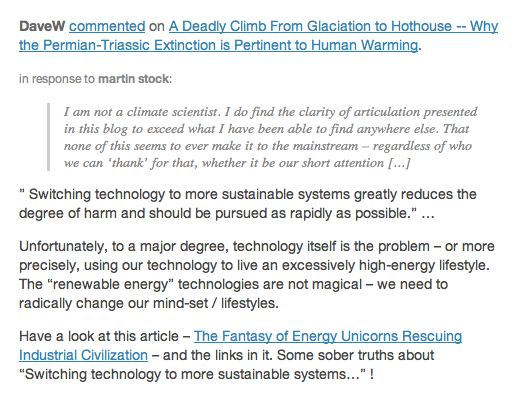
I was poking through my email looking for a reference article on China’s plundering of the oceans when I came across some comments made recently over at Scribbler’s site. Now before I get into a discussion on these comments, I need to say that I am not anti-technology per se, but there are very serious problems with technology as it’s utilized in the current socio-economic paradigm we have – capitalist industrial civilization. We have become a society in which techno-optimism is dangerously ingrained in our thinking and culture, especially in the United States. I just discovered the work of Dr. Michael Huesemann by way of an excellent interview he did on this subject. His book Techno-Fix: Why Technology Won’t Save Us Or the Environmentcame out just last year. I’m going to break down the Huesemann interview in a later post with all the salient points he makes.
Now to get to the comments, the first one sets a dire but realistic tone…
Viewed from a purely biological perspective, humans are following the optimal foraging theory whereby an organism exploits sources of food with the highest energy content first. In terms of humans and industrial civilization, the most energy dense source right now is fossil fuels. This partially explains why we see the following news-bite:
One of the big problems with so-called renewable energies is that, as I pointed out in the last post, intermittent and diffuse energy sources cannot support the current energy-intensive, high consumption way of life promoted and exercised by capitalist industrial civilization. This isn’t a matter of politics, it’s a matter of physics.
Yes there are too many of us. Just as with any organism which has overshot the carrying capacity of its environment, there will be no soft landing for humans when the laws of ecological balance cull our numbers. Modern man has dominated the Earth to the point of altering the biosphere on a planetary scale, destroying the once stable climate which allowed our clever (not wise) species to proliferate. Did humans think they could continue to rack up an ecological debt without consequences? Governments can print money, but the Earth cannot print forests, arable soil, healthy oceans, and clean air.
Rather than seek solutions to the root of the problem – our unsustainable mode of living and exploitive socio-economic system, techno-optimists will look to geoengineering for a fix which, even if such a “solution” would initially appear to “work”, will inevitably have unforeseen side-effects. Then other techno-fixes will be deployed to fix those unintended consequences, and so on.
So Scribbler responds to the above comment:
When, pray tell, are we going to suddenly be gifted with a sustainable system with which to apply our technology? From where I’m sitting, just the opposite is occurring. Governments are becoming more corrupt and totalitarian, printing money with abandon and hardening their surveillance state apparatus. The global human population is exceeding the growth estimates of the United Nations. Extreme weather events are accelerating. And yet business-as-usual persists with the requisite talk of growth and expansion in every economic periodical and newscast. Albedo management? What the hell is that – installing millions of snow-making machines in the Arctic? Since when has anyone on this site ceded to a “defacto business as usual mindset”? We’ve talked of nothing but changing the mindset of a system hellbent on converting every last bit of nature into digits on an accounting ledger for Wall Street.
Then the following comment:
Dave, you’re harassing a techno-optimist monkey in his self-imposed cage of normalcy bias and delusion. Don’t do that. He’ll just sling shit at you, as we’ll see:
He finds the reports “radically too pessimistic”. Did he check the backgrounds of those people behind the reports? Sorry, but I’ll take their decades of experience and education over Scribbler’s childlike foot-stomping of the bad news being too scary for his delicate ears to bear. And the cheap name-calling of “modern incarnation of Ludditism” is simply a scapegoat for avoiding root causes, as Dr. Huesemann explains:
Labels like Luddite distract from an objective and scientific examination of technologies and modern societies… What Luddites did in the past is irrelevant to our critical analysis of technologies today. Many technologies facilitate exploitation by creating a safe distance between exploiter and exploited…
To clarify for Scribbler what my previous post was about since he evidently did not read it or comprehend it, the post was not about saying that all energy technologies are bad, but an explanation of their limitations due to the reality of EROEI and the laws of Physics. As Kevin Moore noted, “Geochemistry overrides ideology.”
Now having said all of the above, I appreciate Scribbler’s climate tracking expertise and hope he continues his writings.
Through my experience on this website I’ve learned that the pro-fossil fuel/climate change skeptics share something in common with the pro-renewable energy/climate change realists. Neither wants industrial civilization to fade away. This is the fatal flaw shared by both – that industrial civilization with all its toxic trappings of materialism, instant gratification, and objectification of nature can continue with perhaps a few tweaks and modifications here and there. Nothing that the capitalist free market cannot correct, right? Others even fantasize with the idea that there will be some sort of a post-crisis prosperity. So-called “renewable energies” fit nicely into the greenwashing of capitalist industrial civilization. Ignoring the fact that abrupt climate change is well under way with multiple extinction-causing feedback loops having already been set into motion, the right course of action would have been a rapid downsizing and simplification of our mode of living:
We would also have to ignore the reality of the corporate state’s all-pervasive power. With its techniques of inverted totalitarianism, the corporate state has extinguished everything but the façade of democracy. Serving as the corporate mouthpiece, the mainstream media frames public discourse on socio-economic issues in very oversimplified terms while lumping the population into a very stark, cartoon-like dichotomy of Left versus Right. Thus there is never a substantive debate about our predicament; the dominant paradigm is never questioned except in small and obscure circles whose views never see the light of day. Refusing to acknowledge that fossil fuels are causing planetary ecocide and that renewable energy will not, by any stretch of the imagination, meet the high energy consumption levels of consumer capitalism are both fatal flaws of thinking. Neither group will admit that the root cause of the disease is our way of living. To do so would undercut their belief system, the principal tenants of which are that mankind’s superior adaptive capabilities and technological innovations will carry us through. Self-delusion on such a massive scale results in strange conspiracy thinking to emerge such as the following right-wing tripe:
Never mind that our government has become nothing more than a feeding trough and revolving door for corporations seeking market control and revenue streams. The people truly latched to the teat of government are those with the money to hire armies of lobbyists, bribe officials with lucrative private sector positions, ‘buy’ government contracts and game the system fully in their favor.
The Fantasy of Energy Unicorns Rescuing Industrial Civilization
The second law of thermodynamics states that energy flows or dissipates from concentrated forms to diffuse forms. Fossil fuels are very concentrated forms of energy, but renewables like wind and solar are very diffuse and intermittent energies. According to leading energy experts like Professor Charles Hall, the EROEI of renewable energy continues to be too low when compared with fossil fuels. Thus in the free market system, the lowest-priced energy (with environmental costs externalized) will always win out and be utilized.
“2013 EIA new plant capital costs of various energy technologies and
pumped storage for balancing intermittent renewables”
As Ted Trainer has shown, claims of renewables running the industrialized world are numerous and avoid any critical evaluation of their claims:
…Unfortunately people working on renewable energy technologies tend not to throw critical light on the difficulties and limits. They typically make enthusiastic claims regarding the potential of their specific technologies.
There are now several impressive reports claiming that renewable can meet world energy demand, and almost no literature questioning the claim…” – link
“..Trainer’s general point on technology is that the extent of ecological overshoot is already so great that technology alone will never be able to solve the ecological crises of our age, certainly not in a world based on economic growth and with a growing global population… – link
Trainer and other analysts identify several factors that limit large-scale renewable energy projects:
– Transmission losses: Distant solar thermal, photovoltaic farms, and wind farms must transmit their generated energy through long distance high-voltage direct current cables. The best places for harnessing wind power are usually in remote locations far from populated areas, but solar lends itself more to a model of decentralized electricity generation which can avoid transmission losses and the high cost of transmission lines.
– Embodied Energy Costs: The energy to produce the steel, mine the minerals and raw material, and manufacture the wind turbines and solar panels, then deliver and install them, and later repair and maintain them, finally disposing of them. In a recent study, Charles Hall and Pedro Prieto have found that such costs have been unaccounted for in the estimates of solar PV’s EROEI. Spain’s boom and subsequent bust in solar energy production was found to have generated an abysmal EROEI of 2.45 thermal units of energy output for 1 thermal unit invested, as poor as biofuels.
Just to make the silicon used to trap the sun’s rays on manufactured wafers requires the melting of silica rock at 3,000 Fahrenheit (1,649 Celsius). And the electricity of coal-fired plants or ultrapurified hydrogen obtained from fossil sources provide the heat to do that. It also takes a fantastic amount of oil to make concrete, glass and steel for solar modules…
…Prieto calculates, for example, that to replace all electricity made by nuclear and fossil fuels in Spain would take a solar module complex covering 6,000 sq. km of the country at the cost the entire Spanish budget (1.2 billion Euros in 2007). It would also require the equivalent of 300 billion car batteries to store the energy for night-time use.
Prieto is not alone in reaching such sobering conclusions. A 2013 Stanford University report, for example, calculated that global photovoltaic industry now requires more electricity to make silicon wafers and solar troughs than it actually produces in return. Since 2000 the industry consumed 75 per cent more energy than it put onto the grid and all during its manufacturing and installation process.
Moreover it won’t pay off this energy debt or energy consumed in its construction until 2016. As a consequence, ramping up of industrial solar production produces more greenhouse gases than it saves for nearly a decade… – link
– Plant Lifetime: 20 years is estimated for wind (Sharman, 2012) and 35 years for photovoltaic. To quote Kevin Moore, “Gaia pulverises everything in the long-term and converts it all into sediment (except certain partially degraded plastics, which seem destined to drift in the oceans for eternity).” Another factor perhaps not discussed much is the effect climate change will have on the variability and volatility of weather patterns where solar, wind, and other renewable energy projects are constructed. Wind, cloud, and rain patterns will be altered, rendering energy plants ill-suited to their originally targeted sites. The world’s energy infrastructure will be increasingly vulnerable to the ravages of climate chaos with more intense flooding, droughts, and shifting weather patterns. Hydroelectric power, solar farms, nuclear plants, and biofuel plantations are dependant on water to run and cool the turbines, clean the solar panels and mirrors, mine the uranium as well as cool the reactor core and spent fuel rods, and grow the biomass. Hotter temperatures will tax the electric grid because of increased electricity demand for cooling in the summer, reduction in the performance and capacity of transformers and above-ground transmission lines, and infrastructure damage from wildfires. Sea level rise will also wreak havoc with coastal erosion, storm surges and flooding.
Many traditional cultures regard the heart, situated at the center of the torso, as the body’s principal organ, having special processing powers directed to emotion. A heart-felt sensation is regarded as irreducible truth because emotions can’t be wrong. Indeed, the passions, as emotions are also called in their extremity, are something to be harnessed as motivation, at least until they run afoul and have to be restrained. For instance, a charismatic can inspire or inflame the passions and lead people along unwise paths.
In the modern industrial world, however, the eye and the perceptual faculty it provides has usurped the heart as the principal organ, at least in terms of cognition (ignoring the fact that the brain is the actual processor). The primacy of vision can even be seen (read: understood) in terms used to describe two major eras in Western history: The Dark Ages and The Enlightenment. Such visual metaphors stretch much further back in time, but the emergence from darkness into the light — the overarching story of modernity, religious salvation, and techno-utopianism — is clearly a central feature of Western thinking. For example, in the late 18th century, the U.S. incorporated symbology tracing back to Egyptian antiquity, namely, The Eye of Providence, into the Great Seal of the United States, which even now is displayed on currency shown at left (detail from the one dollar bill). It is noteworthy that, similar to emotional emanations of the heart, the eye is depicted with rays or beams shooting out in all directions, suggesting its other name, The All-Seeing Eye, its view being omnidirectional. That the function of the eye could be understood as both a receiver/processor and projector was apparently well-known long before modern physics revealed that the observer influences the observed by the mere act of observation.
Another version, one of many, actually, can be seen at right. Think of the eye’s function as the light on a miner’s hat, illuminating whatever the wearer brings into view. Much more than the heart, which is responsive and far less prone to intentional direction, the eye can cast its view upon whatever one elects at any moment, bringing the observed into awareness, into the mind, and into focus. (It’s no surprise then that poor eyesight — poor focus — makes for fuzzy thinking. Those who can’t see well uncorrected have diminished powers of observation.) This metaphor may be more accurate than the all-seeing eye for an important reason: a large percentage of information gathered by the eye is discarded. The eye’s narrow point of focus is a relatively small portion of the entire visual field; the rest is peripheral. If this were not so, conscious awareness would be subject to stimulus overload from just one perceptual channel. Other senses compete for attention (especially kinethesia), further limiting what can be brought into conscious awareness at any one time. This limitation is sometimes called the bandwidth of consciousness, a sort of built-in bottleneck.
Another telling expression of the eye’s power of projection is found in the superhero genre, where good guys and bad guys alike frequently possess the ability to shoot lasers, x-rays, or power rays from their eyes. Everyone has experienced the similar if less hoary effect of a withering look (or the hairy eyeball), which may signal an underlying emotional state but is understood more commonly as an aggressive or intimidating behavior. With superpower eyebeams, eyelines drawn into illustrations connecting the viewers to objects of interest (familiar dotted lines used to track the viewer’s gaze) are thus amplified into beams of intense destructive power. The source of the power is unclear, as with most superpowers, but the fact that it is delivered by a look is an indication of the mythical power behind the eyes, which is known poetically as the window to the soul.
It is not a difficult stretch to suggest that directionality, whether omnidirectional or pinpoint, also brings the world into being in the sense meant by New Age gurus and adherents to theories of quantum reality. At a more mundane level, each of us pursues interests that appeal to us and gain familiarity and expertise accordingly. Subjects that sustain one’s interest and focus are often later distorted through professional bias and cherry-picking support, as when a religious person turns to scripture for justification or a scientist relies solely on data to substantiate an argument or theory. This is also what’s meant by the old saw that to someone holding a hammer, everything begins to look like a nail to be pounded down. After a fashion, tools of thought can become weapons.
One could easily dismiss all this as mere perspectival diversity, where some interpret the world in one fashion while others take different approaches. However, I intuit that something deeper is going on, namely, that a sort of blindness develops when one learns how to see the world primarily or even exclusively from one perspective. Everything can’t be illuminated at once, so where one turns one’s attention and the habits of mind that develop from focused expertise can render the viewer/thinker fundamentally blind to other valid interpretations. More specifically, to the capitalist, the wholesale commodification of human activity as well as the world’s resources makes it so that the only possible view is in terms of money and/or profits. Such folks aren’t starry-eyed dreamers, they’re dollar-eyed gluttons. And to them, collateral effects such as increasing class tensions, social upheaval (and eventual regime/institutional collapse), pollution, resource degradation (e.g., overfishing or soil depletion), and climate change lie outside their scope/view, making denial easy to assert without lying outright. This doesn’t excuse conscientious blindness to reality, but if one is ever dumbfounded that others can’t see what seems glaringly obvious, this explanation might being to shed some light on why.
Addendum: Even in the portion of the blogosphere taking collapse as its subject, bloggers adopt highly idiosyncratic approaches that fit their styles, interests, and expertise. For an incomplete survey, let me summarize a few. (I could be wrong about some of these. Don’t hesitate to correct me.)
At The Collapse of Industrial Civilization, the focus seems to be chronicling the onset of collapse with copious citation of news reports and other blog entries. The news is sometimes cited as support when a summary or report of a scientific finding, but more often, the news is soundly derided because journalists in the MSM are obviously carrying water for the military-industrial-corporate complex.
At The Spiral Staircase, though not solely a doomblog, the focus lies with causes and available responses (even if only in attitude) related to the culture surrounding or giving rise to eventual collapse.
At Clusterfuck Nation, the focus is on exposing corruption at the heart of empire, with a healthy self-awareness on the part of the blogger and reticence to engage commentators in dialogue.
At now-defunct Deer Hunting with Jesus, the approach was a wickedly colorful combination of memoir and explanation of the redneck perspective, which accounts for a surprising percentage of the population that barely had a voice in the conversation until Joe Bageant appeared.
At Dark Ages America, the focus is chronicling the waning of empire, with special attention paid to the utter stupidity of the American public and mining cultural history for reasons how Americans in particular got to be such corrupt and incompetent buffoons.
At Nature Bats Last, with diverse content, many guest bloggers, and a robust commentariat, the focus is wide-angle, with the result that NBL is often in the vanguard with respect to recognizing developments and drawing sound conclusions.
At How to Save the World, the focus has shifted from organizing grass-roots, transitional, and intentional communities to a full-on retreat into inner life following the recognition that absolutely nothing is going to prepare us for or stem the tide coming in.
At TomDispatch.com, the focus lies with nonmainstream reporting on mostly American politics and society.
At TruthDig, commondreams, and elsewhere, (specifically) Chris Hedges reports primarily on political and military corruption and scandal.
At Club Orlov, the focus lies with comparisons to previous regime collapses and prepping.
At The Automatic Earth, the focus lies with financial analysis in light of anticipated upheavals.
There are many other blogs and bloggers who go unmentioned, but it’s clear that a huge amount of information is out there, hand-picked and curated from a variety of perspectives. In addition, the comments section behind each, if not populated by trolls and deniers, are often as worthwhile as the posts themselves. An odd sense of community comes from connecting (virtually) with others who share a perspective that still eludes the so-called great unwashed masses, who are still gorging themselves (typically through debt spending) on the bounty of the modern age. Whether by innate character or conditioning, some of us never required much by way of convincing. The science and larger historical trajectory becomes fundamentally clear upon even modest inquiry. Chronicling our descent only reinforces conclusions reached intellectually, namely, that the path before us is unavoidable. Dissenters may assert that conclusion is pessimistic, defeatist, fatalistic, or nihilistic (is there a continuum for negativity?), but with so much going wrong with the world, evidence overwhelms denial.
In keeping with what I said earlier, I’m taking a break for a couple weeks from in-depth blogging, but until then I will post or reblog articles that happen to catch my eye.
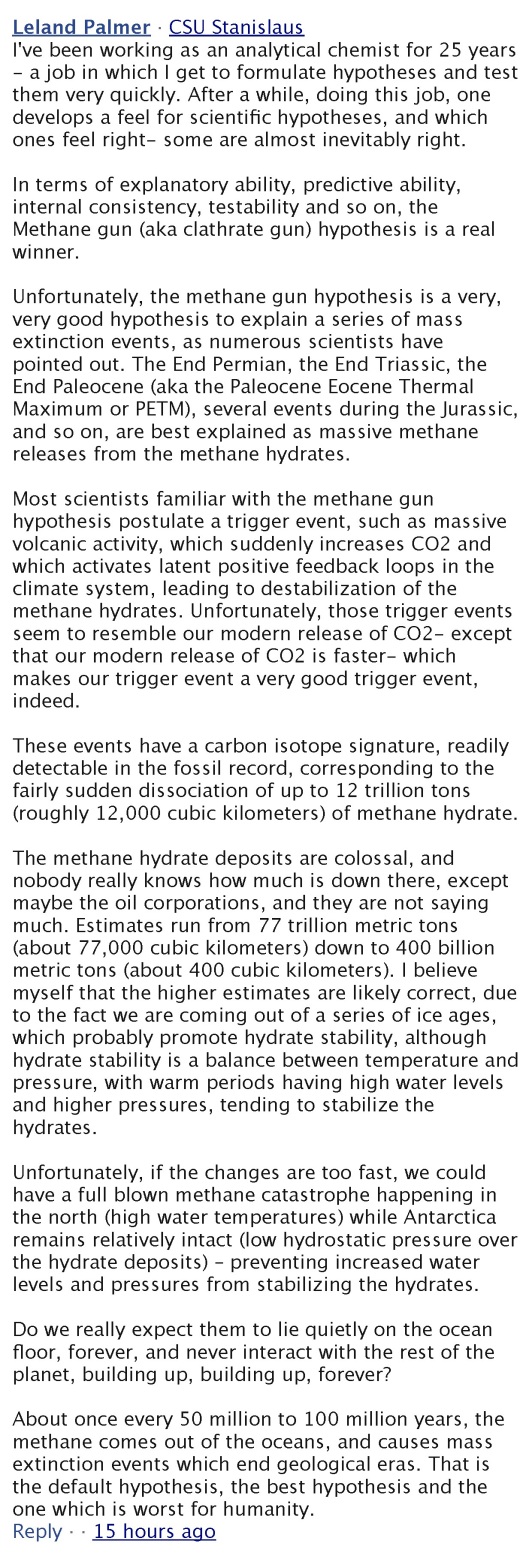
Has mankind triggered the trip switch for his own extinction? Looking at just the headlines below and the comment from the Chemist, I would say the answer is a resounding “Yes!” This conclusion brings me no pleasure, but immeasurable depths of angst and depression. The so-called “doomers” are perhaps the most humanistic amongst the population. They see things as they are, not what people hope them to be or what many idealize industrial civilization to be. Nothing hides under the Sun.

 The Middle East is on the frontline of the multi-pronged crisis of overpopulation, resource depletion, and climate change. Fault lines in that region are widening as climate change exacerbates crop-destroying droughts, peak oil starves economies, and stressed populations scramble to survive. Advanced industrialized countries are buffered from the same fate only temporarily by their military and economic might. The oil-cursed Middle East also suffers from being in the crosshairs of industrial civilization’s insatiable appetite for the black stuff. Since the peak of conventional oil in 2005, the industrial world has not only turned to harder to extract and environmentally damaging unconventional sources of oil, but has also ramped up military intervention in order to keep the energy flowing. Access to resources has always been an underlying factor in all wars, but as climate change, resource depletion, and social disintegration escalate, the grip on foreign energy deposits by western powers becomes increasingly tenuous. Climate Change multiplies threats. Militarism and climate change feed off and drive each other:







 Another telling expression of the eye’s power of projection is found in the superhero genre, where good guys and bad guys alike frequently possess the ability to shoot lasers, x-rays, or power rays from their eyes. Everyone has experienced the similar if less hoary effect of a withering look (or the hairy eyeball), which may signal an underlying emotional state but is understood more commonly as an aggressive or intimidating behavior. With superpower eyebeams, eyelines drawn into illustrations connecting the viewers to objects of interest (familiar dotted lines used to track the viewer’s gaze) are thus amplified into beams of intense destructive power. The source of the power is unclear, as with most superpowers, but the fact that it is delivered by a look is an indication of the mythical power behind the eyes, which is known poetically as the window to the soul.


 Collapse of Industrial Civilization