Corporate Occupied Planet

Tags

, , , , , , , , , , , , , , , , , , , , , ,

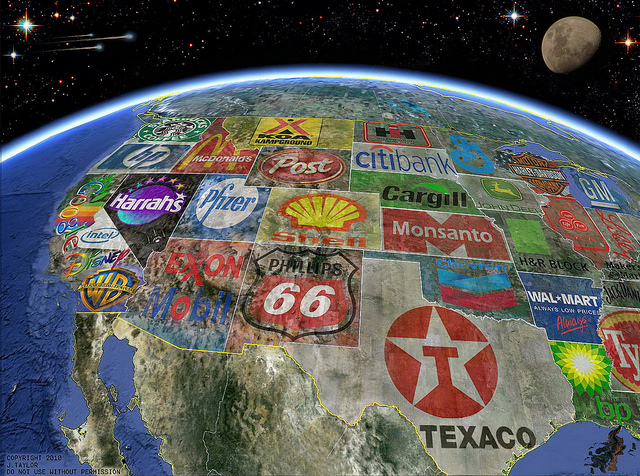
corp_map_of_usa

Once in a while in that vast nothingness of the internet I’ll happen across a blog from someone who has something of substance to say. I have also learned that Dmitry Orlov is likely discontinuing any more ‘collapsitarian’ blog posts. Probably not a good subject to dwell on when you have an infant son. In ‘Dmitry flicks it in‘, Harry Willis reminds us that America has been the epicenter of capitalism, always for sale to the highest bidder and now home to a new growth industry – Doomsaying:

[Excerpt]

“…David Halberstam’s book The Fifties was, I think, very enlightening in this regard. We are the home of the chain hotel (Holiday Inn), the chain restaurant (McDonald’s and all its followers), the Big Box stores (Wal-Mart, CostCo), the mega-hardware store (Home Depot, Lowe’s), the strip mall, the suburban housing tract, and most importantly, the concept that corporate power should be concentrated in huge holding companies that own very diverse and large businesses.  On this latter point, whether Americans realize it or not, every meal they eat out, every processed food they buy at the market, every sundry (detergent, household necessities) they purchase wherever, every drug and almost everything else they routinely buy is sold to them by about 10 huge holding companies.  And all communications are essentially owned by 6 large corporations, so everything you ingest with your ears and eyes is also owned by a corporate cartel.

These huge companies are multinational in character,  with much of their business (and payroll) located overseas.  They are nominally American, but the sinking mass of the American middle and lower classes here are more or less of marginal relevance to them, and only to the extent that Americans form part of their customer base.  The American booboisie needs to be manipulated because the U.S.A. is still nominally a democracy, de jure, although de facto it is what Sheldon Wolin calls an “inverted totalitarian state,” one where the government is owned by Big Business.  We are not going to “vote” our way out of this situation, as Russell Brand, among numerous others (including Dmitry Orlov, most definitely) seems to get.

America is a corporate headquarters and tax haven which executes its business plans by means of a huge standing army, which does not often just stand around.  We got this way because (a) power always tends to concentrate in fewer and fewer hands, even in a liberal democracy, since as money aggregates it can get rid of legal impediments such as high taxation and anti-trust laws, and (b) because America was the most innovative and naturally-blessed (our peerless real estate) nation on Earth.  We also benefitted mightily from intellectual immigration to this country, made possible by the double-digit IQs in charge of Nazi Germany.

I don’t think the United States is going to collapse in the sense that the Collapsarian community talks and writes about.  For one thing, the emphasis is too much on Peak Oil.  I’ve written before that I think Peak Oil represents a kind of deus ex machina for anti-American wish fulfillment.  Some sensitive souls, such as James Kunstler, Dmitry Orlov and many others, are so appalled by the grisly ugliness of the American crapscape, with its chain everything and grotesque proliferation of hideous suburban grids, that they long for some way to predict confidently that it must fall of its own weight. That’s where Peak Oil comes in: you posit that an economy runs on cheap energy, especially petroleum in the American economy, and this gives you a means of assuring everyone that it will all be over soon and an anodyne vision of Norman Rockwell’s neighborhoods will materialize peacefully out of the formless void.

No, I don’t think so.  The lower 90% of the American populace has no way to go but down, until it reaches a rough parity with the hard-working masses in Asia who, after all, have many of the same employers as the Americans.  The American multi-nationals are indifferent to the fate of their so-called “countrymen,” indifferent to the environment (mountain top removal, fracking, pesticide and fertilizer flushes into the Gulf and oceans, plastic waste, soil erosion, CO2 emissions) and essentially react only when conditions become so dire that the American “platform” is threatened.  We’re inflating bubbles again through money printing to retard this natural contraction, and when the bubbles pop (again), we’ll have nother “crisis” which will in fact simply be another step-phase down after the gooey soap is cleaned up.  I think that’s how we’ll get there, in a ratchet fashion.  We will even adapt to oil high prices, as in fact Americans have done since the 2008 financial crisis began.  Americans drive 3% fewer miles now per year than they did 5 years ago, despite increases in population and the “recovery.”  Gasoline usage is way down, as people shift to fuel-efficient cars and just leave the car keys on the table in the hallway.  Or by the oil can fire under the bridge.

The dramatic immiseration of the American people (thanks, Rob Urie) since 2008 has made catastrophe prediction and doomsaying one of America’s chief growth industries, and many, many writers and speakers have gotten in on the act.  But it’s not especially lucrative.  Owning one of the Big Corporations is better for that, so the doomsayers drop out and flick it in.  It’s always nice to go over to Mom’s house.”

Economic and cultural coercion are readily apparent in our society. And if those don’t work, the corporate state also has policies of overt force – military and law enforcement. You could call this arrangement an ‘open air prison’ or the more apt phrase for America would be ‘inverted totalitarianism’ in which the prisoners aren’t fully aware of their own shackles, transfixed as they are by mass media manipulation, the consumer culture, and the trappings of our high-energy way of life. Is there any wonder that a post apocalyptic scenario holds a certain amount of perverse romanticism for those yearning to escape capitalist modernity?

hopeforabettertomorrow

“There’s no stopping this train.”

Tags

, , , , , , , , , , , , , , , , , , , , , , ,

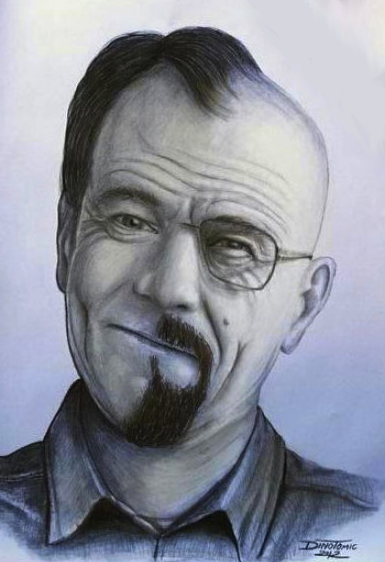
american-breaking-gothic-breaking-bad-33126796-900-1072In an era of end-stage capitalism where life has become a sordid grab for dollars while the world lives on the edge of financial and ecological collapse, it comes as no surprise that America would be captivated by the story of a struggling school teacher going for the ‘American dream’ by crook or by hook. A tourist mystique has even been created in this show’s filming location of Albuquerque. The premise for this darkly comic tale is an all too familiar one for the average American family – the threat of bankrupting medical bills. Recently diagnosed with stage-three lung cancer and now at the end of his financial rope, Walter descends into the seedy world of illicit drugs in an attempt to save his family from economic ruin. Walter’s predicament represents the dilemma of most Americans who live quiet lives of desperation, just one paycheck away from hunger and homelessness. Ironically, the drug that Walter and his reluctant partner Jesse Pinkman wind up producing is also the drug of choice for many chained to the hamster wheel of capitalism:

…the rise of meth coincided with the rise of low-paying low-skilled service work, where people had to work multiple menial jobs to earn the same amount they used to earn in one manufacturing job, or other good-paying low-skilled position.

The CDC notes that some meth users rely on it to get “increased energy to work multiple jobs.” Researchers at Indiana University and at the Universities of Colorado and Kentucky have found that, “The long hours and tedious work in oil fields, agriculture, construction, ancillary health care and fast food restaurants may be more tolerable on methamphetamine. Users report using meth to provide the energy to work multiple jobs or be a good mother.”

Guides to identifying and treating meth addiction, like Herbert Covey’s “The Methamphetamine Crisis,” tell readers to look out for, “workaholics or low-income adults who use it to stay awake and perform in multiple jobs. Working low-income individuals find meth attractive because they must work several jobs or long hours to support themselves or their families. They find that higher energy and alertness (ability to stay awake for prolonged periods) helps them cope with the demands of multiple jobs.”

This holds up if you look at places where meth use is highest. Hawaii’s heavy rate of meth use has been attributed to its high cost of living and service-based economy. “If you’re doing mind-numbing, repetitive work, this enables you to overcome both the painful tedium of the boredom as well as increase concentration and safety,” Dr. William Haning, a psychiatry professor at the University of Hawaii, once told the Maui News…

From his former business partners at Grey Matter Technologies who stole his ideas and became incredibly wealthy to the demeaning work he endures at his car wash moonlighting job, the elusive ‘American dream’ has haunted Walter White. At first his scheme is to generate just enough cash to cover his medical expenses and secure a modicum of financial security for his family, but in a society whose primary metric of self-worth is the number of dollars one can accumulate, Walter quickly transforms into a cutthroat businessman bent on building an empire. His metamorphosis from a meek, mild-mannered family man to a Machiavellian drug kingpin is quite astonishing. Walter rationalizes and euphemizes his manufacture of the insidious drug meth by referring to it as his “product”, following strict steps to create “the highest quality product to perform as advertised.” “The chemistry must be respected,” proclaims Walter.

Snap 2013-11-28 at 09.02.11

In this world of hyper-exploitive capitalism, ‘staying in the game’ involves making choices that seldom include moral concerns. As the dead bodies continue to pile up around Walter’s drug operation, the more callous and psychopathic he becomes. Warren Buffet, the poster child for Capitalism, has praised the business acumen of the show’s main character while even tweeting a picture of himself as Walter White. Replace Walt’s blue crystal with iPhones or any other mass-produced product and the basic business model is eerily the same. The Economist even published an essay illustrating how ‘Breaking Bad’ was a “first-rate primer on business“:

…Mr White’s biggest failing is also a common one in business: hubris. The more successful he becomes, the more invulnerable he feels. The more rules he breaks, the more righteous he feels. And the more wealth he accumulates, the more he wants. An impressive volume of social-science studies suggests that leaders are more willing to break the rules than followers. There is no shortage of corporate examples, from Enron to Olympus, to illustrate this. Walter White is a thoroughly odd character: Mr Chips turned Scarface, as the show’s creator, Vince Gilligan, puts it. But he also holds a worrying mirror to the business world….

Walter seals his own fate when he proclaims “there’s no stopping this train.” The accumulation of money becomes the “be-all and the end-all” for Walt’s existence, but for all the mountains of cash piling up in duffel bags, crawl spaces, storage units, and 55-gallon barrels, Walter and his family are unable to make much use of it and in fact are plagued by it. In the end, the money becomes a curse, destroying the very thing it was supposed to save… Walt and his family.

Walter White Meth Labs

Another irony among many is that the bruised and battered psyche of Jesse Pinkman, the drug addict ostracized by his well-to-do suburbanite parents, serves as the moral compass in a world of lies, deceit, and betrayal. Despite the fact that Walter and Jesse are producing one of the most destructive drugs in history, outright murder was never in their plans. Walter becomes inured to the killings, but Jesse is unable to cope. He sees their ill-gotten gains as “blood money” and gets rid of his share by tossing it all over a neighborhood. It’s quite fitting then that in the final conclusion Jesse ends up as the sole survivor of this trip through hell.

Interestingly, those who are masters at getting away with their crimes are the ones hiding in plain sight who have ingratiated themselves with law enforcement and other institutions of society. Behind the clean-cut and bespectacled mask of Gustavo “Gus” Fring lurks a cold-blooded drug lord whose meth superlab sits beneath the façade of an industrial laundry business. The distribution network of the drug is integrated into Fring’s fast food chicken chain. Gus Fring is a perfect representative for the psychopathic elite in our society who hide behind the phony rhetoric of PR firms, lobbyists, and dark money politics. I see an analogy with the toxicity of meth and the climate change wrought by fossil fuels. Industrial civilization’s addiction to fossil fuels is similar to the feeling of unlimited energy that a meth addict gets, but the downside is that both kill. For the psychopaths at the helm of industrial civilization, business-as-usual must be protected even as we race toward extinction. To quote a reader of this blog:

“…steady or rising coal and gas consumption in advanced countries (all countries, really), in the face of all this ecocide (not that so many actually consider it to be in their face) illustrates the inability of either producer or consumer to dial back within the confines of our system–a polygamy of empire and finance and thermodynamics. …we can’t get off the train…not in one piece anyhow.”

Walter White’s self-destructive end seems to be as tragic and foolish as the one capitalist industrial civilization is hurtling towards, or perhaps it’s simply the inevitable course of events governing all of life:

“As many of you know, I have a background as a chemistry teacher. I’ve come to realize that much of what I teach my students applies not only to what goes on in the classroom, but in life also. It’s not as crazy as it sounds. You see, technically, chemistry is the study of matter, but I prefer to see it as the study of change: Electrons change their energy levels. Molecules change their bonds. Elements combine and change into compounds. But that’s all of life, right? It’s the constant, it’s the cycle. It’s solution, dissolution. Just over and over and over. It is growth, then decay, then transformation. It’s fascinating really. It’s a shame so many of us never take time to consider its implications.” ~ Walter White

Living Double Lives

Tags

, , , , , , , , , , , , , , ,

Amazon deforestation:Amazon+deforestation+1984+-+2012.+Save+the+trees+Landsat+imagery_75f1ef_4683919

“The parasite, as any other living thing, aims to reproduce as much as possible, and therefore, exploiting its environment as much as possible. This does not mean that the further exploitation of the host will help to achieve reproductive success of the parasite.”
~ Claude Combes, L’Art d’Être Parasite (loosely translated from french)

The question has been propounded and answered numerous times: “Are we (humans) any smarter than yeast?” The reluctant answer is usually, “No, not really.” Sure, yeast (pl.) possess no consciousness or awareness so far as we can tell, but that may not be a good measure of smarts, it turns out. The salient point of comparison is that yeast consume their environment/habitat/medium until it’s overpopulated and depleted, at which point they die en masse. We’re doing the very same, though it’s taking a long time and we’re not quite done yet. Maybe ionizing radiation from nuclear Armageddon of one sort or another (who’s still watching Fukushima?) will get us before we destroy our own habitat with pollution and anthropogenic climate change (not that nuclear fallout isn’t also destroying our habitat), maybe not. Identical result either way.

A master narrative to explain everything eludes us. True believers are probably content with the idea that god’s will reigns supreme and that, in all his benevolence, he will continue to provide. That’s a comforting fable many have chased into their graves. Those of us bent toward a system of belief based more on evidence see a different future, not so much potential as inevitable.

I realized recently that many of us live double lives: (1) the one we present to our families, friends, acquaintances, colleagues, employers, etc. who have not yet countenanced the idea of collapse honestly for a variety of reasons and (2) the one we sense deep down and are compelled out of a mixture of grief, horror, despair, and commiseration to share in venues like this one. But there’s another kind of dual life that interests me: the life of the body vs. the life of the mind.

Living in Our Bodies

I’ve written before about satiety signals, which basically says that, like yeast, we can’t stop the habit of endless, needless, mindless consumption. We’re insatiable. From there, it may be worth noting the five basic life functions (recycling content from this post):

    • growth — living beings grow and develop
    • respiration — they breathe and respire
    • reproduction — they reproduce offspring
    • nutrition — they eat food
    • excretion — they eliminate wastes from the body

A more fully elaborated list goes like this:

    • obtaining and changing materials into forms an organism can use
    • taking in food from the environment
    • breakdown of complex food materials into forms the organism can use
    • elimination of indigestible material
    • process by which substances are taken into the cells of an organism
    • process by which materials are distributed (moved) throughout the organism
    • release of chemical energy from certain nutrients
    • chemical combination of simple substances to form complex substances
    • incorporation of materials into the body of an organism
    • increase in size
    • process by which cells become specialized for specific functions
    • removal of metabolic wastes
    • process by which organisms maintain a stable internal environment
    • process by which organisms produce new organisms of their own kind
    • the sum total of all the chemical reactions occurring within the cells of an organism

We live to eat, reproduce, and eventually die — all basic functions of the body. In our current ‘Age of Abundance’, those of use hanging out on computers probably have our life-preserving bodily needs met and aren’t scrambling to stave off dehydration and starvation the way those living at the edges do. We easily forget, then, that our bodies fail rather quickly without continued inputs: in a couple minutes without air, in a few days without water, and in a few weeks without food. Thus, when fed and clothed and housed satisfactorily (not that we stop consuming there), we easily lose touch with the life of the body and believe — mistakenly, comically, tragically, take your pick — that we can live in our heads.

Living in Our Heads

As a social species, humans also have certain psychosocial needs that must be met. Failures tend not to be as immediately obvious as when bodily needs go unmet, but results are no less dramatic: individuals run off the rails (drug- and alcohol-related self-destruction, psychosis, violent rampages, suicide, etc.) and societies (if you recognize human collectives as a superorganism) become embroiled in madness. When exactly society/civilization first went mad is probably a matter of opinion (some might suggest, for instance, the French Terror), but in the modern industrial era, I suggest that World War One is the conflict that broke us psychologically. We’ve never really recovered. Follow-on wars (World War Two, the Cold War, the Korean War, the Vietnam War, Afghanistan and Iraq (undeclared), and the so-called War on Terror) have all consumed the energies and economies of the world’s superpowers without entirely clear benefits, except perhaps for WWII, which at least ended the Holocaust and for a time stopped Fascism.

Wholesomeness is not a term one could use fairly to describe the attributes of modern American culture, not anymore (if indeed ever). We now live in a Society of Spectacle, and electronics in particular enable omnipresent connection to a firehose-style information feed: pure, indiscriminate volume pointed at everyone all the time. And if ever there were an embodiment of a bottomless pit, an insatiable appetite, our consumption of information is it. Seriously, how many broadcast and cable channels are there, all competing at the juvenile game of made-you-look? Even those of us here at Collapse have what might be called a “spectacular” view of the proceedings.

The Compulsive Explainer has an interesting albeit brief post called “Information Overload as an Addiction” suggesting that our preoccupation with entertainment, especially the electronic sorts (radio, cinema, television, Internet), is for the masses equivalent to giving away one’s mind. Information insatiability has become an addiction, and like political junkies, the media-saturated middle mind of the masses cannot perceive reality through what’s projected by the media at the bidding of cultural, corporate, and political leaders who would keep us calmed and buying. Instead, we live (temporarily) within a giant fiction, a phantasmagoria if you will, nearly a virtual reality, from which there is scarcely an escape even for those who can see the bubble (always from the inside, of course — after all, we’re on computers). While the story continues to be spun, our attention is riveted and our compliance coerced. But never fear: the life of the body will triumph eventually, though only in the negative sense.

Disillusioned in Dismayland

Tags

, , , , , , , , , , , , , , , , , , , , , , , , ,

original

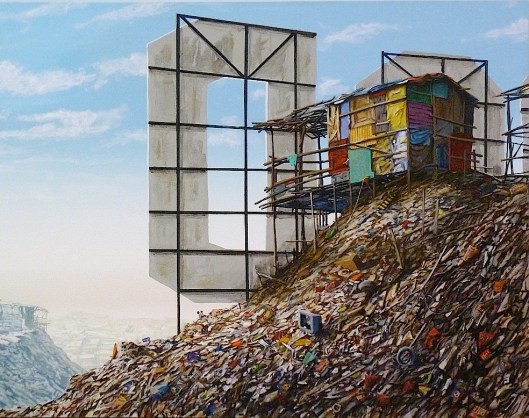
Capitalism has, throughout its history, built itself off the backs of the weak through dispossession, slavery, colonialism, technology and military power. Protecting the capitalist system into the 21st century, U.S. military served as the all-powerful proxy force of the global corporate elite. In the waning days of modern-day civilization, transnational corporations found even more ways to amass power and squeeze out every last penny from the Earth to the gods of capital. In the name of ‘free trade’, secretive agreements with alphabet soup-acronyms like TTP and TPIP were concocted to protect and expand profits as well as investor returns at the expense of all else, including the sovereignty of nations and the very habitability of the planet. Corporations became the new kings and queens, tsars and tsaritsas, bishops and popes. The last grab for what was left could now be done more swiftly while circumventing the laws of nations. 

…Capitalism has an inbuilt wondrous capacity of resurrection and regeneration; though this is capacity of a kind shared with parasites – organisms that feed on other organisms, belonging to other species. After a complete or near-complete exhaustion of one host organism, a parasite tends and manages to find another, that would supply it with life juices for a successive, albeit also limited, stretch of time.

A hundred years ago Rosa Luxemburg grasped that secret of the eerie, phoenix-like ability of capitalism to rise, repeatedly, from the ashes; an ability that leaves behind a track of devastation – the history of capitalism is marked by the graves of living organisms sucked of their life juices to exhaustion…” ~ Zygmunt Bauman

In a world of finite resources controlled by a tiny capitalist class, there would eventually only be two classes remaining – the über-wealthy or global elite and the vast underclass of disposable workers who eked out a subsistence existence. The wealth of society continued to be funneled upwards to the corporate overlords by way of deregulation, privatization, low or nonexistent tax rates, control of the legal system, and the cutting away of any last scraps of a social safety net.

Preoccupied by their digital screen devices and satiated on mass-produced junk food, the plebs never really noticed they were living in an open-air prison. In the meantime, the walls of a police state rose up to protect the sociopathic elite. As long as the ‘consumers’ were kept in a continual state of ‘amusement madness’ and on the treadmill of work exhaustion, there would be no time for contemplating the reality of climate change, the ever-widening wealth gap, the rise of a corporate fascist state, or the disappearance of the natural world.

Living in an age of advertisement, we are perpetually disillusioned. The perfect life is spread before us every day, but it changes and withers at a touch.
~ J. B. Priestley

hollywood_cliff

This Ponzi scheme economy was so entrenched in the psyche of the general populace that essentially none questioned its validity, even in the face of increasingly chaotic weather and rising seas, mountains of toxic waste, lifeless oceans, epidemic industrial disease, and grotesque wealth maldistribution. The right to seek profit trumped the health and safety of humans, the stability of the environment, and the legal recourse of governments on behalf of their citizens. National borders were effectively erased and a global corporatocracy now ruled the planet. Ironically, the one world government feared by so many right-wing conspiracists had become reality without any protest from them.

Acid rain and erratic weather, the unintended consequences of half-baked geoengineering fixes, forced most food production into industrial greenhouses. Due to the chemical pollution levels in the environment, all water had to be treated before it was used for anything, and gas masks became ‘everyday outdoor wear’ like hats and umbrellas. Most stayed indoors to escape such hazards, immersing themselves in the artificial environments of virtual reality software. Zoos became the only sanctuaries for wildlife, their sperm safely kept frozen for the day humans might want to de-extinctify them. National parks were privatized and plastered with corporate logos. The ranks of the homeless and destitute swelled, but most soon found themselves living inside the cell of a private, for-profit prison where they toiled away as cheap labor contracted by the corporations. Such crises were always looked upon as business opportunities, a niche to fill in the profit-seeking mind of homo economicus. Commodification and commercialization of everything became completely normalized.

20130207-214730

Taken to the extreme and turned into a rigid belief system, all ideologies can become dangerous. When the ethics of a society bow to laissez-faire capitalism, life in the U$A becomes a cruel joke:

Need I go further? The day that the movie ‘Idiocracy’ is looked upon as genius and prophetic, civilization will have become a parody of itself. I think that day has arrived.

Our Consumptive Madness

Tags

, , , , , , , , , , , , , , , , , , , , , , , , , , , ,

Snap 2013-11-06 at 14.31.28

The question of whether the human species is smarter than yeast is answered daily as the ecocidal and homicidal activities of industrial civilization continue apace. I learned a few days ago that September 2013 was the warmest in recorded history, and this morning I read that 2012 was a record breaker for GHG emissions:

“The laws of physics and chemistry are not negotiable,” said Michel Jarraud.

“Greenhouse gases are what they are, the laws of physics show they can only contribute to warming the system, but parts of this heat may go in different places like the oceans for some periods of time,” he said.

This view was echoed by Prof Piers Forster from the University of Leeds.

“For the past decade or so the oceans have been sucking up this extra heat, meaning that surface temperatures have only increased slowly.

“Don’t expect this state of affairs to continue though, the extra heat will eventually come out and bite us, so expect strong warming over the coming decades.”

Speaking candidly about the prospects of the industrialized world being able to reduce its GHG emissions and avoid catastrophic warming, the only three living diplomats responsible for leading past and present UN global warming talks had this to say:

“‘There is nothing that can be agreed in 2015 that would be consistent with the 2 degrees,’ said Yvo de Boer, who was UNFCCC executive secretary in 2009, when attempts to reach a deal at a summit in Copenhagen crumbled with a rift between industrialized and developing nations.The only way that a 2015 agreement can achieve a 2-degree goal is to shut down the whole global economy.’”

Another study explains that not even the supposed eco-friendly state of California is likely to meet its GHG reduction targets by 2050. So you see, the ‘radical ecoterrorists’ were right all along. Industrial civilization has to go, or we go. The improbable list of actions needed to preserve any semblance of humanity was recently laid out by George Mobus. But as you know, even if we stopped everything right now, there is still a lot of pent-up manmade global warming in the pipeline from past industrial activity that will wreak havoc for millennia to come, as Robert Scribbler points out:

“…we’ve already released enough greenhouse gasses to at least return Earth to climates not seen in 3.6 million years. In this respect, the Baffin Island study adds to research conducted at Lake El’gygytgyn showing that levels of CO2 comparable to those seen today resulted in Arctic temperatures 8 degrees Celsius hotter during the deep past…

…Most likely, we are headed to at least the temperatures last seen during the Pliocene, in which global averages ranged 2-3 degrees Celsius hotter than the present and during which oceans were 25-75 feet higher. Unfortunately, these are the long-term consequences we have probably already locked in. But without rapid reductions in carbon emissions to near zero over the coming decades, we can expect far, far worse outcomes.”

Russia recently answered the concerns of environmentalists over Gazprom’s drilling plans in the Arctic by summarily arresting numerous members of Greenpeace and charging them with piracy. This is a high-profile case illustrating that ecocide is embedded and enforced within the system of capitalist industrial civilization. A further example of the system’s omnicidal nature is the construction of nuclear-powered ice-breaker ships by Russia to plow through the waters of the Arctic:

“Russia has started building the world’s largest universal nuclear-powered icebreaker capable of navigating in the Arctic and in the shallow waters of Siberian rivers. The unique vessel will further increase Russia’s dominance in the region…

…Powered by two “RITM-200” pressurized water reactors the “Arctic” is being built to generate 175MWe. Its efficiency and power allows the new model to crack ice fields 3 meters thick…”

Then you have Canada racing towards eco-apocalypse with its tar sands, and America exporting its coal into the maws of China and elsewhere as well as fracking the countryside into toxic wastelands, but of course the disease has spread globally. As Michael T. Klare clearly stated after weighing the PR propaganda with observable reality:

“…The result is indisputable: humanity is not entering a period that will be dominated by renewables.  Instead, it is pioneering the third great carbon era, the Age of Unconventional Oil and Gas….”

Delicate ecosystems are ground up into commercialized and commodified pulp and fed into the machine of capitalism, lost forever in the fumes of our consumptive madness. A rash of mass wildlife deaths is occurring this year to further evidence the fact that industrial man is pushing the planet to the brink. It appears we may be reaching more tipping points in ecological breakdown:

Snap 2013-11-06 at 11.43.12

Also…

and…

Snap 2013-11-06 at 11.58.16

Robert MacNeil once observed, “Television is the soma of Aldous Huxley’s Brave New World.” Our global self-destruction is not visible to the Television-hypnotised masses when they look out their window, but for the few environmentally conscious beings amongst us, the destruction is as personal and painful as wartime torture. How depressive it is to see the natural world being chewed up and spit out at such an alarming rate. We are part of the environment and its death is humanity’s suicide. Some hope for a super-Carrington event that would leave the machine dead in its tracks, but then there is the problem of those hundreds of nuclear plants scattered around the world like the bomb-rigged vest of a terrorist.

A sociopathic economic system that crushes democracy, decency, and justice in the name of growth and profits has led to the catastrophe we now see unfolding. When the masses are dumbed-down to mere ‘consumers’ and powerless to make meaningful change, then those sociopaths at the helm of the ship are free to pull us all down into the black hole of war, famine, disease, and extinction.

Citizen 3-141-592-653-5

Tags

, , , , , , , , , , , , , , , , , , , , , , , , , , , , , ,

dystopian_future_01_by_demonicclone-d4mcu2e

They were called ‘consumers’. Their every behavior became just another stream of data to be tracked, recorded, quantified, and analyzed by corporations for their vast, profit-seeking conveyor belt of production, distribution and marketing to a sea of mouths. The machine was global and its hungry tentacles wrapped the Earth. Wherever it turned its covetous eyes, the Earth shook and its creatures large and small fled for cover. Government and corporate rule were fully enmeshed and the birth of a worldwide surveillance state was born. All mass communication systems were controlled and grassroot uprisings within the Empire’s homeland could be cut off at the knees before they ever gained traction. Protection of the homeland from terrorism was the initial excuse by which the fascist state expanded its power. Knowledge is power; foreign countries and governments could be manipulated from a distance. Privacy was a quaint relic of a bygone era. With the awareness that Big Brother was watching, few voiced their true opinions. The charade of democracy played on as the consumers retreated into their fabricated world of digital screens and commercialization.

“[Citizens became] one-dimensional idiots; consuming pointlessly, obsessing about lifestyle, gawping at celebrities, gazing blankly at moronic TV game shows, forever grasping towards the next, vacuous, artificial ‘want’ created by Global Gobble Corporation.” Philip Mirowski

Lipton_LG_Surveillance

The captains of industry were happy with their scheme of manipulating markets, printing fiat money, continuously uprooting industry to cheaper labor pools abroad, keeping well oiled the wheels of the military industrial complex by waging war-for-profit wherever possible, and ravaging the Earth for every last bit of ancient carbon and minerals. Vast sums of money were spent on public relations and greenwashing in order to ensure the unwashed masses would stay ignorant and subservient to the looting and destruction of society and the environment. The elite were quickly turning the Earth into a death trap for all living things, and few noticed or cared. As long as cheap, mass produced, nutrient-poor food was on tap to fill the stomachs of the teeming masses, revolt and bloodshed were averted. The elite, however, could see the writing on the wall. Plans were drawn up to use force when the inevitable time arose that fuel, food, and water became scarce. The heavy stick of Empire so often used to smash swarthy radicals abroad would, in due time, be turned inward on the homeland.

laurie_lipton1

“The Will To Extermination is the very core of the Dark Side. It has been ignored at humanity’s own peril.” ~ Patrice Ayme

“Our technological abilities have made us tremendously successful animals, but also tremendously dangerous ones, glorified apes with nuclear capabilities. We tend to overexploit or destroy our resources, drastically modify or pollute our environments, overpopulate the planet, and wage war on our fellow inhabitants, all of which threaten our long-term viability as a species. Is self-induced extinction the ultimate fate of intelligent, tool-using organisms like ourselves? Are we smart, but not smart enough?”
Kathy D. Schick and Nicholas Toth

“This is what I recently learned from my friend, Professor Bill Rees:
During individual development, repeated sensory experiences and cultural norms literally shape the human brain’s synaptic circuitry in patterns that reflect and embed those experiences. Patterned thinking acquires a physical presence in the brain.
Subsequently, people seek out compatible experiences and, “when faced with information that does not agree with their [preformed] internal structures, they deny, discredit, reinterpret or forget that information.”
(Brain and Culture, Bruce E. Wexler, The MIT Press, 2006).
Most people are genuinely unable to face the truth. Based on this premise, most if not all human civilizations have been built.
“The masses have never thirsted after truth. They turn aside from evidence that is not to their taste, preferring to deify error…”
(Gustave le Bon, 1896).
Tadeusz (Tad) Patzek

It Only Happens in the Movies

Tags

, , , , , , , , , , , , , , , , , , , , , , , , , , , ,

tumblr_mhrehrSUR81qj73e2o1_500-8787

In spite of their own economic and scientific data overwhelmingly pointing towards a very bleak future, the experts in their various chosen fields appear to be happy-faced optimists about the world our descendants will inherit. So says columnist Charlie Smith:

Snap 2013-10-28 at 21.53.31

He concludes his essay with the following remarks:

“…I confess that I’m troubled by all the optimism I encounter from leading thinkers on inequality, climate change, overpopulation, and oil depletion.

Adding up all the variables, I’ve concluded that more global food shortages and increased famine are inevitable. Despite this, our premier plans to build a new bridge to Delta that will result in the loss of some of Canada’s finest farmland.

Having a cheery disposition may make someone sound more pleasant in radio and television interviews.

It might even enhance a person’s likelihood of obtaining book contracts, becoming a media or entertainment executive, or getting elected to high public office.

But it has a way of sugar-coating problems, diminishing the sense of urgency that we should all be feeling about these crises.”

The apocalypse has been commodified as a Hollywood thriller to be viewed in the comfort of a movie theater or living room sofa. Faith in technology, normalcy bias, sunken costs, and the mass propaganda of vested interests are just a few of the human blinders preventing any change from the status quo. To say that there is no future for the human species would be to admit that we are all living in a fictitious construct whose time is quickly running out. Who openly discusses such things in their place of work? I would wager to say that the answer is zero. In his essay ‘The Convergence of Crisis‘, Simon Hasleton writes:

“…There is, also, a sense in which denial should be seen as a psychological defense operating on the personal level. AGW presents an immense challenge to our lives: to our health and safety and the survival of our grandchildren, and their grandchildren. How will we handle it, when the water fails or the crops fail and the food reserves are empty as the population passes the nine million mark? When  when Amsterdam or Kolkata are inundated? When (as in Texas) temperature pushes into the high 30s, for weeks on end? This is the future AGW promises. And there doesn’t seem to be anything we can do about it, so we blank it out, or prefer the trivia of the tabloids, or retreat into a blinkered concentration on the immediacy of everyday concerns….”

There is no escaping the capitalist system which now encompasses the entire world. Who is stopping the Brazilians from clearing the Amazon just as America and Europe slashed and burned their own virgin forests to make way for cities, highways, railroads, farms, etc.? Who is stopping China from burning through the world’s remaining fossil fuel? This is how industrial civilization defines “progress”. Our next step is to try to control the climate through seeding the atmosphere and other geoengineering experiments. Aside from nuclear weapons and their evil counterpart, nuclear energy, I can’t imagine a more dangerous and hubristic scheme. Charlie Smith has an article on that subject as well, entitled ‘Eric Schlosser raises alarm in Vancouver about nuclear weapons and nuclear power‘:

“…Schlosser also told the audience that his research into nuclear weapons has strengthened his opposition to nuclear energy. He cited the research of Charles Perrow, who examined the partial meltdown of the Three Mile Island nuclear-power plant in 1979.

This helped Schlosser understand how a seemingly minor event—a dropped socket in a missile silo in Damascus, Arkansas in 1980—nearly caused an explosion that could have killed millions of people.

These are complex technological systems,” Schlosser said. “Again and again, we find ourselves inadequate to manage them.

His biggest concern is that the waste from nuclear reactors remains deadly for tens of thousands of years. He said that it’s “highly irresponsible for us to be creating poisons that future generations might suffer from“.

There has never been a central storage facility created in the United States, which means that the waste remains at the nuclear-reactor sites.

“And these reactor sites were never designed to store nuclear waste in the way it’s being stored,” he said. “They are huge targets, potential targets, for terrorists. But they are also at enormous risk in a natural disaster, in earthquakes, things like that. And a lot of these nuclear reactors are near large urban areas…”

He didn’t mention that all nuclear plants are built on the shores of lakes, rivers, and oceans in order to satisfy their cooling water needs. Not such a great idea in a future that includes the ravages of climate chaos – sea level rise, shrinking and flooding rivers, and violent storms. Sea level rise will also increase the damage from earthquakes as this 2014 study for the city of Berkley, CA mentions:

“…Like regions across the globe, the San Francisco Bay Area is experiencing and will continue to increasingly experience the impacts of the changing climate. By 2100, average temperatures in the San Francisco Bay Area will increase up to 11° F. In 2100, Berkeley will have 6-10 additional heat waves each year, which will disproportionately impact the elderly, children under five, and the low-income community members.

Climate change will also cause additional extreme rainfall events, which will lead to more flooding. San Francisco Bay sea-levels will rise up to 55” by 2100, impacting infrastructure and community members in west Berkeley. Climate change impacts will also exacerbate the natural hazards of concern outlined in this plan. Rising sea levels will increase Berkeley’s exposure to earthquake liquefaction, tsunami inundation, and flooding. Increases in precipitation and severe storms will make flooding more frequent, and will increase the landslide risk in the hills. California’s water security will be reduced, and drought will become a more persistent issue….”

How does San Francisco adapt to an 11°F increase in average temperature? It doesn’t. It will be a ghost city by then; the human population will have crashed and be well on its way to the black void of extinction. The city officials of Berkley have not figured that out yet since climate change is a newly added threat to their plans:

“…Climate change is a newly-introduced hazard of concern for the 2014 plan. The climate change section describes the anticipated impacts to Berkeley from climate change. It also outlines how climate change exacerbates other hazards identified in this plan. The City discusses potential impacts from sea-level rise on Berkeley’s western coast, and maps areas in Berkeley that are vulnerable in 55-inch sea-level rise…”

Modern industrial civilization with its exploding human population is protected from the laws of nature only for as long as resources are plentiful and the climate remains stable. Technology cannot be created and supported without inexpensive and highly concentrated energy. Technology is simply a byproduct of human ingenuity and energy expenditure. For over four billion years everything on Earth has evolved and adapted, most recently under the benevolence of the Holocene climate. The current climate catastrophe is a manmade disruption that is several orders of magnitude greater than the average rate of change over the last 300 millenia.

The primary problem with most ‘news’ today is that its filtered through corporate gatekeepers. Another problem with the ‘news’ is that its fragmented and does not connect all the dots to give a person the full picture. As Neil Postman said, “The whole problem with news on television comes down to this: all the words uttered in an hour of news coverage could be printed on a page of a newspaper. And the world cannot be understood in one page.” So let’s connect some dots, courtesy of Robert Callaghan:

FUN WITH NUMBERS:
The acidity of the oceans will more than double in the next 40 years. This rate is 10 times faster than 55 million years ago when a mass extinction of marine life occurred. It is also faster than during 4 of earth’s biggest mass extinction events during the last 300 hundred million years — faster than even the great Permian mass extinction event where 95% of life on earth vanished 250 million years ago. The oceans are now 30% more acidic than in pre-industrial times. In less than 40 years they will be 60% more acidic than then.
http://en.wikipedia.org/wiki/Ocean_acidification

http://thinkprogress.org/climate/2013/05/08/1976351/acidification-arctic/
http://www.earth.columbia.edu/articles/view/2951
http://readthescience.com/2012/09/17/climate-change-book-review-under-a-green-sky/

When ice ages come and go the planet can change temperature 5°C in as little as 5,000 years. 50 times slower than what we are doing to earth now. In the past, a 5°C change normally takes 20,000 years, we are going to do 5°C in 50-100 years, 200 times faster.
http://earthobservatory.nasa.gov/Features/GlobalWarming/page3.php
http://oceanservice.noaa.gov/education/pd/climate/factsheets/iscurrent.pdf

Climate change is happening 100 times faster than in the past.
http://www.scientificamerican.com/article.cfm?id=todays-climate-change-proves-much-faster-than-changes-in-past-65-million-years

By 2025, humans will impact 50% of earth’s biosphere. This will cause a planetary ecological state shift leading to a mass extinction event that is unstoppable and irreversible once started.

http://www.ecoshock.info/2012/06/planet-shift-no-return.html

Why does nobody talk about the thousands of 1-kilometer wide bubbling methane seabeds recorded in 2011.
http://www.independent.co.uk/news/science/vast-methane-plumes-seen-in-arctic-ocean-as-sea-ice-retreats-6276278.html

Only 1% of methane needs to be released to cause total disaster.
Peter Wadhams interview.

Natalia Shakhova interview:
Do you believe scientists
who spent 30 years in the arctic,
or do you believe scientists
who spent 30 years at their computer?

And the latest on the methane monster:

Snap 2013-10-29 at 08.22.37

Extinction is a taboo word – bad for busine$$ and a real downer for everyone involved. Best to keep to the cultural storyline that such horrible things only happen on the silver screen with the aid of expensive CGI effects.

Snap 2013-10-29 at 00.35.31

History Has Gone Vertical

Tags

, , , , , , , , , , , , , , , , ,

This blog is cross-posted at The Spiral Staircase. Feel free to comment here or there.

tumblr_m2h7qcdd0t1rtpz27o1_500

To orient oneself in life, a person chooses from among myriad narratives, typically assembling a hodgepodge worldview out of diverse parts. According to Oswald Spengler, cultural artifacts (e.g., the arts, humanities, and sciences) arise “needing the guidance of inspiration and … developing under great conventions of form.” The very same can be said of our origin and orientation stories, ancient or contemporary. Narratives intertwine and need not necessarily be discrete, mutually exclusive, or competing, even though that’s what’s often implied by time-worn tensions underlying science vs. religion, sometimes understood more philosophically as logos vs. mythos. Indeed, they cohere despite conflicts of logic and their being ahistorical. The power of subscription and consensus overcomes all objections.

If a master narrative exists, it ought to be simply reality obtained, though that is probably visible to only a small percentage of people able to apprehend the world clearly. For the rest, scales not yet having fallen from the eyes, the considerable benefit of hindsight can help clarify the view, but only if one has sufficient nerve to behold it honestly. Instead, our dominant inspirational narratives promulgate a wide variety of incompletely fulfilled hopes and desires. Few such promises bear much resemblance to reality, those of economists, politicians, and clerics demonstrating the most striking discontinuities from the actuality experienced by ordinary folks. A Chris Hedges article at TruthDig.com called “The Folly of Empire” discusses this departure from reality in his characteristically erudite style (apologies for the long nested quote):

… absurd promises of hope and glory are endlessly served up by the entertainment industry, the political and economic elite, the class of courtiers who pose as journalists, self-help gurus like Oprah and religious belief systems that assure followers that God will always protect them. It is collective self-delusion, a retreat into magical thinking. “The American citizen thus lives in a world where fantasy is more real than reality, where the image has more dignity than the original,” Daniel J. Boorstin wrote in his book The Image: A Guide to Pseudo-Events in America. “We hardly dare face our bewilderment, because our ambiguous experience is so pleasantly iridescent, and the solace of belief in contrived reality is so thoroughly real. We have become eager accessories in the great hoaxes of the age. These are the hoaxes we play on ourselves.”

I don’t usually lump into the mix entertainers, sports figures, gurus hawking self-help books and programs, or media pundits offering half-baked analyses because only idiots expect truth from them, but perhaps I should include them considering their stranglehold on the public’s wasted attention. Most of today’s media-driven narratives rely on conventions, gestures, and rhetoric that are notoriously predigested and therefore immediately swallowed by the guffawing crowd, disinviting additional analysis or careful consideration. This bears a curious family resemblance with intellectual conditions that sparked the Reformation. Further, because such mediated (or should I say medieval?) content is composed largely of fiction, pageantry, and untethered conjecture, no time is needed for the narrative to actualize. Hope functions in the present tense and requires no closure.

Perhaps the quintessential inspirational narrative was trotted out by the Obama campaign back in 2008, which relied on promises (empty, we later found out) to fulfill everyone’s desire for a better life, calling on hope and change to achieve those promises. Another religious hope narrative promises to enhance one’s afterlife, earned in earthly realms through achievements in social justice and the judgment of posterity. Both adopt time-honored conventions and are part of what is described in Morris Berman’s book Wandering God as the ascent tradition. Significant among those conventions is orientation along a vertical axis as seen, for instance, in easy acceptance of the legitimacy of hierarchy (and therefore egregious power, wealth, and class stratification and imbalance) and a longing for transfiguration, transcendence, and communion with god (or the gods) above.

Looking back across history, evidence of “progress” and growth is legion. However, most of those achievements are demographic, material, and technological, each having their unique and unintended blowback. What’s notably lacking as we sally forth into the 21st century is the ability to transcend our own base nature, which is characterized by corruption, violence, stupidity, short-term gratification, and inability to achieve the utopian dreams that populate the minds of many despots. So that same history is marked by downturns and setbacks. One might even say that the overall upward trend of history is pockmarked by periodic scars. Still, nothing just yet has stalled the hubris of history rising (unless domestic peak oil in the 1970s and global peak oil a few years back prove to have been among the first of a series of turning points). And judging from blog traffic and commentary, the steady stream of negative assessments in scientific literature, and news reports telling of weather and ecological calamities with increasing frequency and severity, awareness is beginning to dawn on even the most congenital optimists (plus some fools and the average ignoramus) that what goes up must eventually come down. Since history has gone vertical, hard limits must eventually assert themselves.

The plethora of charts, tables, graphs, and infographics that evidence not just rising trends but verticality is frankly astonishing. Sometimes a gradually ascending slope is observable within a short timeframe, such as receding glacial ice documented in Chasing Ice. Other times it takes long traces of historical, evolutionary, or even geological time to observe. Even short timeframes often conceal effects that lie handily beyond normal perception, but we luckily have scientists trained to recognize short- and long-term trends. Too bad they’re uniformly ignored and/or pilloried by a public spoon fed the blandishments of corporate marketing and political propaganda. Typically, ascending curves (whether geometric, logarithmic, or exponential) don’t appear to be walls (limits) when viewed from the far left or from within a narrow time band, meaning microscopically close. Zoom out or to the right, however, and the trend pointed into the stratosphere is readily apparent, such as in the following video (animation) of CO2 concentrations in the atmosphere:

Similar x-y coordinate graphs showing, for instance, energy use per capita and human population growth demonstrate the same trajectory but at much briefer durations. Trendlines are mathematical abstractions, like fiat currency being printed into existence. At some point, gravity takes hold and drags everything back to earth (reality), though that eventuality can be forestalled for a surprisingly long time. The return trip down various vertical trends is approaching ever more quickly as lift skyward fizzles like an Icarus nightmare. Or in the case of atmospheric carbon, we can’t stop the rising trend we unwittingly initiated from blowing through the roof and rendering the earth uninhabitable.

It’s often said there is no such thing as an atheist in a foxhole. Presented with the likelihood or certainty of battlefield death, holdouts succumb and cash the eternal-life insurance card of a last-minute profession of faith. Same as death-bed conversions. Thousands of years of philosophy and religion might prepare us to face our inevitable demise if we bothered to learn anything worthwhile besides how to make money, and yet in all our frailty, many of us cannot accept that our final departure is merely a fact of life, not a gateway or journey to somewhere else. (Um, opinions vary on this, obviously.) The final departure of Homo sapiens sapiens is even harder to contemplate.

So what foxhole moment awaits us? Here’s one: the Intergovernmental Panel on Climate Change (IPCC) released in late September 2013 a publication by Working Group I of the Fifth Assessment Report, which presents the underlying physical science behind climate change (used to be called global warming). The IPCC website states that “The Fifth Assessment Report (AR5) is being released in four parts between September 2013 and November 2014. It will be the most comprehensive assessment of scientific knowledge on climate change since 2007 when Fourth Assessment Report (AR4) was released.” Preparation of these reports has been ongoing for decades already, and the difficulty of their assemblage assures that they’re already out of date at the time they’re released. Being the work of governments, AR5 is also reputed to be remarkably conservative in its conclusions, as contrasted with prophesying near-term human extinction (NTE or NTHE) as those of us unconstrained by geopolitics have begun to do (mostly taking our cues from Guy McPherson of Nature Bats Last). That’s not a gambit for attention, BTW. It’s about a soul-destroying a realization as there is, and no one comes to admit it easily.

The likelihood of anyone plunging into the 2216 pages of this first of four parts of AR5 is, well, dismal. One could easily level the accusation that the IPCC is burying its findings behind pages and pages (and pages) of prefatory material; acknowledgements; missing or incomplete figures, tables, and citations (to be inserted when?); technical and executive summaries; glossaries; references; and dry obfuscation. That’s not really the case, though; the data and discussion are abundant and available for anyone capable of deciphering it. Technical and scientific analysis and discussion is exactly what Working Group I delivers in these chapters:

  1. Introduction
  2. Observations: Atmosphere and Surface
  3. Observations: Ocean
  4. Observations: Cryosphere
  5. Information from Paleoclimate Archives
  6. Carbon and Other Biogeochemical Cycles
  7. Clouds and Aerosols
  8. Anthropogenic and Natural Radiative Forcing
  9. Evaluation of Climate Models
  10. Detection and Attribution of Climate Change: from Global to Regional
  11. Near-term Climate Change: Projections and Predictability
  12. Long-term Climate Change: Projections, Commitments and Irreversibility
  13. Sea Level Change
  14. Climate Phenomena and their Relevance for Future Regional Climate Change

I downloaded the report and sought something succinct to quote, such as an answer to the question “Just how fucked are we, anyway?” but the technical summaries proceed with this sort of dry, useless, blank, uninformative text:

The primary purpose of this Technical Summary is to provide the link between the complete assessment of the multiple lines of independent evidence presented in the 14 chapters of the main report and the highly condensed summary prepared as the WGI Summary for Policymakers. The Technical Summary thus serves as a starting point for those readers who seek the full information on more specific topics covered by this assessment. This purpose is facilitated by including pointers to the chapters and sections where the full assessment can be found. Policy-relevant topics, which cut across many chapters and involve many interlinked processes in the climate system, are presented here as Thematic Focus Elements, allowing rapid access of this information.

The WGI Summary for Policymakers is not contained within the larger report but both can be found at this link. It’s unclear how much of the report was used in preparation of this story at National Geographic, but the story provides five takeaways from WGI:

    • On the extreme weather front, the report concludes it is “very likely” that cold days and nights have decreased, while warm days and nights have increased, since 1950 …
    • The oceans have warmed with “virtual certainty,” the report concludes, at a rate of about 0.2 degrees Fahrenheit (0.11 Celsius) per decade since 1970 in the upper 246 feet (75 meters) of surface water …
    • What about those polar bears? Sea ice (as well as glaciers and ice sheets) has declined overall since 1970 …
    • Sea level rise has happened, and will happen in the future, as a result of global warming, the report finds …
    • More than half of the global warming observed since 1950 has a human cause, largely from the greenhouse gas effects of gases such as carbon dioxide emitted from burning fossil fuels ….

The ellipses indicate brief discussion behind each takeaway. The conclusions are hedged, of course, relying on observations of what’s happened so far and omitting extrapolation of trends that go vertical. Even the three levels of confidence communicate not certainty of our fate (exact details TBD) but hope that projections are subject to change or we can do something to reverse things or at least forestall the worst. Like IPCC, National Geographic is yet to have its foxhole moment even though the evidence is staring them ghoulishly in the face. If one is at all engaged in this subject, I suppose it makes sense to stay hunched in the hole chain-smoking cigarettes and making do with what meager rations and sleep are available. My sneaking suspicion is that the go order will come quickly enough to catch lots of shivering, quivering, wavering souls before they get to their last eternal hope. In the meantime, the fat lady is singing, the coal-mine canary has expired, pigs are flying, and hell has frozen over. We’re vertical against the wall, facing the firing squad, and what’s left to do, though no one knows just quite when, is to get horizontal.

Last Man on Earth

Tags

, , , , , , , , , , , , , , , , , , , , , ,

cambio-tecnolc3b3gico

An achieved goal of capitalist industrial civilization was the systematic reduction of nature to a simple component of the economy. Landscapes of rivers, lakes, forests, and meadows were replaced by the concrete, steel, and asphalt of cityscapes. The build-up of toxic wastes and byproducts of industrial civilization were seen merely as external problems to be solved via engineering and technology. In the grand narrative of material progress, industrial man put himself at the center of the universe, the lead actor and hero who would always survive and triumph. He saw no problem with the complete subjugation of the wilderness, taking more from the land than was given back, and reducing biodiversity to a shell of its former self in the name of economic growth. The dominant mindset was summed up thusly…

“…nature is a malignant force with useful aspects that must be harnessed, and useless, harmful ones that must be shorn of their power. They spend their energy adapting nature to their purposes, instead of themselves to her demands. They destroy pests of crops and men, they build dykes and great dams to avert floods, and they level hills in one spot and pile them up in another. Their premise is that nature will destroy them unless they prevent it…” ~ Clyde Kluckhohn

In the collective consciousness of industrial civilization, man was exempt from falling victim to the 6th mass extinction. The future narrative of people in the modern age never included:

    • …that they would be among the last humans to walk the Earth.
    • …that their children would not live long enough to grow old.
    • …that all cultural, artistic, and scientific achievements of the human species would soon be forgotten in time, no longer practiced and appreciated.

Cocooned away from the elements as they were, few city dwellers noticed the creeping deterioration of the planet’s biosphere. Their artificial world, filled with the digital screens of computers, televisions, electronic billboards, and sundry other micro-computer devices, kept the public preoccupied with a constant stream of infotainment, celebrity gossip, sports, and political spectacles. The popular line of thought was that the natural world was too resilient to collapse from man’s activities; periodic efforts of environmental remediation would be all that was needed to keep business-as-usual afloat. Generational amnesia cast a false sense of security over the unwashed masses. Rivers and streams, once teeming with fish and aquatic life, were now laden with toxins, heavy metals, and plastics. Moose and bison no longer roamed the fragmented wilderness; the remaining few were set aside for bioengineering experiments in a last-ditch effort to save them. The whole web of life with all its keystone species from microbes and insects to large terrestrial and aquatic mammals was unravelling. Pests, viruses, and pathogens ran rampant in the new disorder of the planet. Scientists talked of tipping points, but no one really knew when such red lines in biospheric stability would be crossed or if they had already been breached. Like a runaway freight train, industrial civilization had indeed passed many tipping points long ago. Few thought there would be such an abrupt downward spiral, seemingly without warning. The first law of thermodynamics was being realized on a system-wide scale.

tumblr_mifvgqbZIu1qmvy8zo1_500

Modern man was thought to have been infinitely adaptive and clever, but the linear-thinking that dominated the culture was riddled with too many blind-spots to prevent its inevitable downfall. As long as the same economic system and mode of living persisted, no amount of new technology would solve the root problems. Since the mid 1970’s, the industrialized world had been living beyond the total carrying capacity of the Earth for decades and even created a day to recognize the transgression which would arrive a few days earlier each year. Various reports of imminent catastrophe were published, but to no avail. Everyone had their mental crutch to fool themselves into believing that the day of reckoning would never come. Some, like the fanatical zealots of religion, rejoiced that the end was upon us while others were paralyzed with fear and despair. The all-pervasive mainstream cult of money worship, consumption, and economic growth gave rise to other doomsday cults who heralded the end of time.

Mother nature took no prisoners; there was no escaping her ironclad laws. Mass starvation, war, and pestilence rapidly whittled the human population down to small pockets of survivors, but then even those few post-apocalyptic tribes soon declined and disappeared until the day arrived that only one human walked the Earth. One lone human survivor out of the billions that once were.

Snap 2013-10-18 at 14.36.42

He survived the pandemic that wiped out roughly three-quarters of the global population. He survived the nuclear meltdown and craziness of the food wars and nuclear terrorism. And thus far he survived climate chaos by constantly moving. MRE’s were mass-produced for the general public and stored in most cities when the agricultural system started to show signs of imminent collapse. Even after all these years, the last human still found these warehouses of preserved food to be an invaluable source of sustenance, supplementing his diet with the occasional cockroach, rat, or wild pig.

How did the last man on Earth spend his time when not scavenging for food, water, and other essentials? He was on a search to find other humans of course. How could he have known that he was the sole survivor? Without electricity, there no longer existed any sort of global communication system. The one solar-powered/hand crank shortwave radio he had in his backpack had yet to pick up any signals, but he would religiously take it out every night to scan the frequencies for an hour or two. To break the deathly silence of the world, he would occasionally play the assorted music files that were on his wind-up mp3 player. He especially loved their sound inside the expansive corridors of old libraries he visited during his trek across the continent. With his life always in jeopardy, he found that a good book was the best form of escapism; compromising his health and safety with mind/mood-altering drugs was not an option in a world devoid of hospitals and medicine. And sex? Well, you’ll have to use your imagination for that. He certainly did. Such solitude, a prison cell of solitary confinement spanning the entire planet, would have driven most to madness and suicide, but he handled the loneliness day by day and with stoicism.

09-michal_karcz

In his early years, he experienced a taste of working at a 9-5 job, driving a car and flying on jumbo jets, but he didn’t miss any of it really. He had been one of those who had read extensively about the unsustainability of the global economy and about the nature of ecological overshoot and collapse, and he had prepared for it. He held no illusions of a new civilization being reborn out of the ashes of capitalist industrial civilization. Capitalism, he knew, held too tight of a grip on modern man, and the psychological barriers of the masses prevented them from seeing the end of everything concerning the human experience …forever. As the weeks, months, and years passed by and he grew older, he began to reconcile with the idea that he was very likely the last person left alive. No need to leave any more messages on roof tops, in vacant parking lots, or over the empty airwaves. No one was listening. No one was coming. There really was no prospect of growing old gracefully in this new reality. He had yet to find some small pocket of unpolluted land that did not register on his Geiger counter. So he made a pact with himself and the pistol he carried that when his health and strength no longer allowed him to eke out an existence, he would not be alive when the wild dogs came for him.

Civilizations die from suicide, not by murder.”

~ Arnold J. Toynbee

How Big is Your Prison Cell?

Tags

, , , , , , , , , , , , , , ,

fdd6bbdb9e13032615137

Author: ulvfugl

Over at Nature Bats Last, my favourite virtual park bench to watch the virtual pigeons, the talk is of hospice. Life is a terminal disease.

I suppose there’s not a lot of difference between hospice and death row.
Degrees of freedom. How big is your prison cell ?

What’s the company like ? Do you get any choice ? What about the visitors ? Are they friends, priests, nurses, jailers, torturers ?

I have to say, for a man of my disposition, my own cell, here, is perfection.

Long ago and far away, in another lifetime, I did a course in kitchen design.
I found it fascinating and enjoyed it very much. Efficient use of work space. Sink. Work top. Storage. Things you use most often, nearest.

Later, I discovered Permaculture. Much the same idea, really, but working with the natural physical environment.

Design your prison cell. Oh, but you cannot, because you have no freedom to choose, because it’s not yours, you don’t own it… Ha !

That’s a problem isn’t it. Property and ownership. On a crowded island, a crowded continent, a crowded planet.

“The first person who, having enclosed a plot of land, took it into his head to say this is mine and found people simple enough to believe him was the true founder of civil society. What crimes, wars, murders, what miseries and horrors would the human race have been spared, had some one pulled up the stakes or filled in the ditch and cried out to his fellow men: “Do not listen to this imposter. You are lost if you forget that the fruits of the earth belong to all and the earth to no one!”
Jean-Jacques RousseauThe Social Contract and The Discourses

Freedom to choose. Property. These barriers that we collide with when we desire to design our lives, the space between birth and death.

Used to be, long ago, you could just walk off into the desert, or into the forest, or into the mountains, and get away from it all, and find a place where you could settle yourself down and be undisturbed. But that’s not so easy anymore, at least, not where I live, and then what do you eat ?

When I was 20 I had a vision, with my wife, to find a ruin, some abandoned old farm in the mountains, where I could set up some home and make an anarchist commune. I found a couple with two kids, beatniks, about 15 years older; they were right into the idea. We had a good try but it didn’t work out.
We learned some of the reasons why it is hard to succeed.

Took me a lot of trying and a lot of failing to get what I got. The perfect prison cell.

People think I’m crazy. They are right. Depends what you mean by ‘crazy’, of course. You have to be crazy. You see, most people try things, twice or ten times, and fail, and give up, and say it’s impossible. But some things aren’t like that. You have to try 999 times and fail every time. And then the 1000th time, you make it. And only a crazy person discovers that, because everybody who wasn’t crazy gave up long ago.

But, you see, it really might be impossible. What if you have to try all your life to find that it was impossible ??

That’s circus people. They have to be crazy. Special sort of ambition to do something really peculiar. I knew some once. Not a proper circus, a really silly circus. All they had was a lama, and a sheep and a goat. And the guy could walk along a tightrope. A low one, about six foot off the ground. But if you can do it, doesn’t really matter about the height. It’s about the falling off.

So they were determined to have a circus for a livelihood. With one fucking lama that they decorated. And a sheep and a goat that they trained to go around in circles in a tent. And the guy walked along the tightrope. And twenty people would pay and wonder why these crazy people were doing this.

Point is, they were designing their own lives. They were AMAZING. You just wanted to help them because they were crazy. The crazy was contagious. In a good way. Two girls were identical twins, impossible to tell which was which; that was crazy in itself.

So, you find a place. Like designing a kitchen, the sleeping place is the centre. Or maybe, if you’re into Bodhidharma, your meditation place. Then comes the things you use and need most often, nearest. Then, like a spider in the middle of its web, you need strands that connect out into the world.

People are very different. Depends upon what your personality is like, what your desires are, what you require to be satisfied. Design the structure around you; design yourself to fit the structure. Build in the right habits, the rituals, the efficient and effective functioning. Remember, its death row. Nobody gets out alive. What’s worth caring about, what’s not ? Music !

I have a field which I’ve left for the grass to grow long. This is so it can be a refuge for the linnets. They are just small brownish song birds. They are somewhat endangered but not dramatically so; average little birds, so to speak, nothing spectacular or flamboyant, not the ‘most’ anything; finch family, thought to originate some time in the Middle Miocene, 10 to 20 million years ago. From what I gather, skeletons of these small song birds are rarely well-preserved in the fossil record, so it’s a patchy picture and much is guesswork.

The linnets are some of the company I have here, in my cell on death row.

http://www.birdcare.com/bin/showsonb?linnet

http://www.rspb.org.uk/wildlife/birdguide/name/l/linnet/index.aspx

http://blx1.bto.org/birdtrends/species.jsp?&s=linne

In 1963, someone called Robert F. Stroud died. He had spent 54 years in solitary confinement in a prison cell. It states on the cover of the book he wrote that no man in the history of the world spent more time alone. I don’t know if his record has been broken since then. America seems so perverse and sadistic these days, it wouldn’t surprise me.

Anyway, Stroud spent his time researching bird diseases and became one of the world’s greatest bird pathologists. See. You’ve got to be crazy. He couldn’t design his cell at all. It was not his property. He had no freedom. But he could design himself. He wrote this incredible book Stroud’s Digest on the Diseases of Birds. Made a life for himself. Didn’t let the fuckers destroy him.
I think most people have got more options, bigger cells.

If you look at the previous mass extinction events, a few species made it through. My thinking is, try to save something for as long as possible.
Could be the linnets, this time. Who knows ? Nobody else seems to care.
But it’s just my version of the crazy circus…

Birds are much smarter than most people realise or appreciate:

“Birds appear to offer, in their behavior, neurophysiology, and neuroanatomy a striking case of parallel evolution of consciousness. Evidence of near human-like levels of consciousness has been most dramatically observed in African grey parrots. Mammalian and avian emotional networks and cognitive microcircuitries appear to be far more homologous than previously thought. Moreover, certain species of birds have been found to exhibit neural sleep patterns similar to those of mammals, including REM sleep and, as was demonstrated in zebra finches, neurophysiological patterns, previously thought to require a mammalian neocortex. Magpies in particular have been shown to exhibit striking similarities to humans, great apes, dolphins, and elephants in studies of mirror self-recognition.”
http://fcmconference.org/img/CambridgeDeclarationOnConsciousness.pdf

So, as far as I am concerned, on any sane scale of values, those circus people and the linnets are worth more than all the wankers on Wall Street and in the City of London put together. Because when it really comes down to it, freedom has, as Stroud discovered, to do with what’s inside you, not what’s outside.

Be realistic. Demand the impossible. Insist that you get it.