I’m middle-aged and my nine-to-five work routine keeps the financial wolves at bay; as with most Americans, I’m dependent on every paycheck. Being fully aware of mankind’s global ecological overshoot definitely puts an extra twist into my daily outlook when I head off for work. How long will my job be around as the pressures of peak oil and climate change mount? Of course we’re all riding the crest of the largest bubble in history, i.e. human overpopulation, where enough people are added each day to fill a large city with every single inhabitant becoming a new source of pollution and CO2 emissions. This past year seems to be a real seminal point in the breakdown of modern agriculture with several major breadbasket regions getting hit hard by record drought such as California and Brazil. There is no adapting to this kind of extreme weather in which snowpack, seasonal rain showers, and aquifers dry up and then when moisture does come, it’s delivered in torrential floods. And yet a sea of hungry mouths continue to arrive each day. Very few of these new parents are aware of the inevitable mass starvation on the horizon. How could they know when unending economic growth is demanded by their governments, environmentalists and investigative journalists are treated as terrorists, and truth-tellers are silenced? So our predicament will be handled in the most ad hoc and chaotic manner, think Katrina or Fukushima. We were all born into this dysfunctional, irredeemable system, and there’s no escaping the long arm of industrial civilization…
“The problem was you had to keep choosing between one evil or another, and no matter what you chose, they sliced a little bit more off you, until there was nothing left. At the age of 25 most people were finished. A whole god-damned nation of assholes driving automobiles, eating, having babies, doing everything in the worst way possible, like voting for the presidential candidates who reminded them most of themselves.”
~ Charles Bukowski, Ham on Rye
The gears of the corporate state continue to grind onward while the plastic people go about their artificial lives oblivious to the strange rattling in the engine compartment. There really is no “carefree living” these days while you wish you could ‘unknow’ the dark thoughts of the wicked that is coming. No one or no thing is coming to save us.
Per the optimal foraging theory, humans are only following basic biological urges by burning the most optimal and high EROEI energy sources available to them – fossil fuels. The situation is complicated further by all the numerous mental traps humans subconsciously employ to avoid uncomfortable truths. Infighting between vested interests jockying to protect their slice of the pie is yet another gremlin in the engine. I really find little comfort in the thought that no matter how much damage we humans exact on the environment, life will eventually return to the planet. This seems to absolve us from acting as the so-called sentient and wise beings we claim to be. We might as well drop the pretenses and acknowledge the self-inflicted damage wrought by our technocapitalism. Its insidious mechanisms are busy digging a mass grave for everyone:
Philosopher Peter Lamborn Wilson called it the Technopathocracy of modern society. This dehumanizing system we live under offers the illusion of choice while also inculcating into the populace its antisocial nature, for instance cutthroat competition as “normal” and “healthy”. What the psychopathic elite deem as positive values becomes normalized:
While we’re on the subject of technology, a few interesting factoids on E-waste:
It represents 2 percent of America’s trash in landfills, but equals 70 percent of overall toxic waste.
20 to 50 million metric tons of e-waste are disposed worldwide every year.
Only 12.5 percent of e-waste is currently recycled
80 to 85 percent of electronic products were discarded in landfills or incinerators, which can release certain toxics into the air.
It takes 539 pounds of fossil fuel, 48 pounds of chemicals, and 1.5 tons of water to manufacture one computer and monitor
“[It] is the world’s fastest growing waste stream, rising by 3 to 5 per cent every year, due to the decreased lifespan of the average computer from six years to two,” says Wong.
“In countries such as Australia the disposal of e-waste in landfills generates a potent leachate, which has high concentrations of flame retardant chemicals and heavy metals. These can migrate through soils and groundwater and eventually reach people.”
Wong says developed countries often send e-waste to developing countries in Asia and Africa for recycling, taking advantage of these countries’ lower cost of labour and lower environmental regulation.
But, he says, in these countries e-waste is processed to remove precious materials such as gold, silver and platinum, under “extremely primitive conditions”, leading to extensive pollution of air, water, food and people.
“The toxic chemicals generated through open burning of e-waste include PCDD, PBDEs, PAHs, PCBs and heavy metals,” says Wong. “[These] have given rise to serious environmental contamination.”
“Some of these toxic chemicals are known to build up in fish especially, which may then be traded locally and around the world.”
Wong says that science has now clearly demonstrated the risk of these toxic chemicals being passed on to the next generation, while babies are still in the womb, or in their mother’s milk.
“At the same time these e-waste contaminated sites are extremely hard to clean up due to the complex chemical mixtures they contain,” he says.
E-waste is simply one more positive feedback loop in our technocapitalist system that is overwhelming the planet like plastic waste in the oceans and GHG’s in the atmosphere. Mathematician Eric Schechter succinctly explains a few major flaws in capitalism which guarantee our own death by ecocide if the system is allowed to continue on its course:
“We must overthrow the system before ecocide kills us all. And if we throw out the plutocracy without changing our culture, the culture will just generate a new plutocracy. All parts of the system are interconnected, so we must change every aspect of our lives — in effect, we are part of what we must overthrow; we must change ourselves.”
Some Major Flaws of Capitalism:
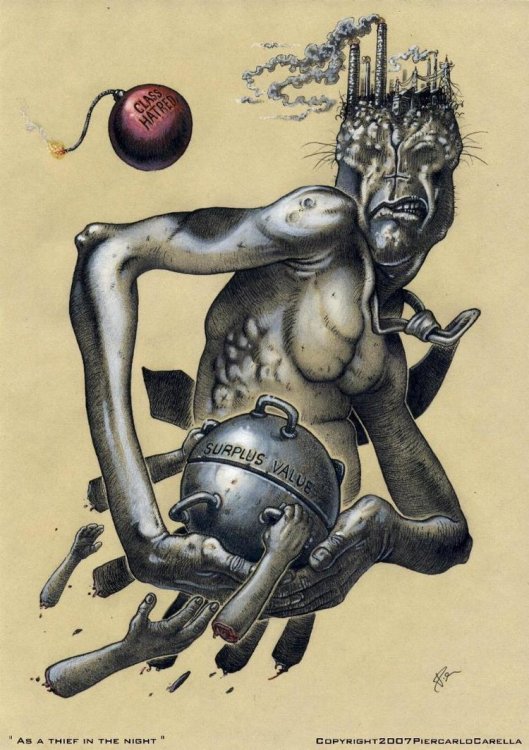
If we were all valued members of the economy, rising productivity would theoretically make us all affluent, but under capitalism, just the opposite happens. The benefits of increased productivity are pocketed by the handful of people who control the workplace — the owners, the management executives, etc. Workers are seen as expendable tools.
Market fundamentalists claim that everyone profits from a “voluntary trade,” because they exchange something they value less for something they value more. But it doesn’t really work out that way. The wealthy keep the much larger portion of the profit S-P, and the poor’s portion will be just barely enough for survival. The wealthy get wealthier, because they have the bargaining power and only engage in deals that make them wealthier; they decline any other deals.
Greed is built into the system. A corporation is compelled, both by competition and by its legal charter, to maximize profits by any means available, disregarding or even concealing harm to workers, consumers, and the rest of the world. Fines for breaking rules generally are smaller than the profits obtained from such misbehavior, and so such fines are simply viewed as a part of the normal cost of doing business. Any CEO who finds scruples is quickly fired and replaced. Externalized costs are omitted from our measurements and calculations. We are taught to see our interests as separate, and the well-being of the community is not the responsibility of anyone in particular. The commons gets privatized and plundered, and as a result the ecosystem is dying.
The accumulation of capital corrupts all levers of government. Once upon a time, some of us believed that the market could be regulated and kept moral by government. But we were mistaken — it’s inevitable that the wealthy will capture the government. After all, wealth can be used for influence.
So as long as the system stays intact, we’re all along for the suicide ride over the cliff. Certainly anyone who is half awake can see that despite all the Rio Earth Summits and talk of “going green” over the last several decades, our path to the graveyard is all but written in stone. The human species will snuff itself out with the help of a socio-economic ideology that all the brainwashed people worship.
Sit back and enjoy the ride…
“Capitalism has survived communism. Now, it eats away at itself.”
~ Charles Bukowski, The Captain is Out to Lunch and the Sailors
Have Taken Over the Ship
This website got an interesting comment in the ‘About’ section from a well-educated fellow who works in the technology sector of the economy. His credentials are impressive. I did some checking to see if he really was who I thought he was and it definitely appears so. His IP address takes me directly to the Science Applications International Corporation(SAIC). SAIC is a major defense contractor with “friends in high places”, having received numerous no-bid contracts from the government. Its top personnel move freely within the government/corporate revolving door. A noteworthy fact in their history is that they were “instrumental” in fabricating the myth that Saddam had weapons of mass destruction and they pushed war as the only option. SAIC was the contractor that waisted hundreds of millions of taxpayer dollars on the failed Trailblazer project which was an attempt to create a system that would spy on cell phone, internet, and other electronic communications. Needless to say, they have an extensive and dark history:
Additional information on SAIC is here. Now that I’ve gotten that introduction out of the way, let’s look at the message from Tihamer Toth-Fejel:
Tihamer,
I’m happy you got a chuckle out of this website. We here at CoIC try to deal with the angst of the collapse of industrial civilization by treating the situation with gallows humor. Yes the Roman Empire did take some time to collapse, but I’m very confident that we don’t have the luxury of “hundreds of years” to see modern civilization disappear into the dustbin of history. The reasons for such an accelerated crash have been documented here and elsewhere numerous times. You only have to read The Limits to Growth to know much of what was accurately predicted decades ago. Collapse doesn’t happen overnight, but occurs in pulses and waves. Nothing as large and extensive as modern civilization will simply disappear overnight and no one here pushes such a theory. Ecologic overshoot is not a hard concept to understand and mankind is subject to it just as any other organism, although we have proven very adept at ‘extending and pretending’ our overexpansion. Cognitive biases are “an inevitable feature of adaptive behavior in all organisms, including ourselves.” Perhaps mankind can exhibit a collective free will and turn this ship around, but I highly doubt it. Our political system is beholden to Wall Street money and everything in Washington is predicated on the short-term election cycle. The same goes for our economy which needs constant growth and quarterly profits at the expense of a habitable planet. Dealing with climate change interferes with profits, so the capitalists feel better when they bury their heads in the sand. Unfortunately, humans did not evolve to deal with seemingly invisible, long-term, existential threats such as climate change and ocean acidification, many of their effects being nonlinear and complex.
Concerning your second point, I am indeed using the internet to write about the collapse of industrial civilization. What is your point? I think you are implying that I am anti-technology, encouraging mankind to live in caves. If you read my core beliefs for this site, you’ll find your answer; nonetheless, we do recognize the rule that technology is a byproduct of available energy resources, and at the rate that humanity is exhausting the plant, animal, and mineral wealth of this planet, I’m not sure what pixy dust the techno-optimists think is going to maintain our current set of unsustainable living arrangements. Perhaps you can tell us. And if humans were able to bend the laws of physics and create some new energy source, we would still be in trouble due to overpopulation and our enormous consumption of natural resources. I think Brutus had it right when he called humans “locusts” stripping the land bare.
On your third point, yes planet Earth will eventually die… in about five billion years when our sun becomes a red giant, maybe. Does this inevitability give us the green light to exterminate everything within a mere century? This would be somewhat analogous to a three-year-old committing suicide because they have come to the realization that they only have roughly 80 more years to live. And what about future generations? Is that even a consideration in your thinking? Perhaps you could even expand your thinking to include this planet’s myriad other life-forms whose biological functions support a vast web of life that makes our very own existence possible. Humans are currently overseeing the 6th mass extinction which will likely take us all down as well, but I’m sure you are well aware of this crisis and are working diligently on some sort of techno-fix for it. Your last sentence implies that you are a person of the anti-environmental, right-wing persuasion who sees those concerned about the habitability of the planet as eco-terrorists. This is a predictable viewpoint from someone who is an apparent contractor for the DoD and servant of the corporatocracy, but I assure you that future biospheric events will change the minds of even the most greeny-hating, military-industrial-complex loving demagogues on the planet.
While the false debate continues in mostly right-wing circles that today’s Capitalism is some aberrant form of “true” Capitalism, the end game and final victory of Capital continues to play out with multinational corporations becoming the ‘winner take all’ in their complete takeover of the world’s economies and governments. As discussed before, the TTIP and TPP are the latest maneuvers in this corporate grab for power, wealth, and resources. Any last vestiges of environmental protection, worker rights, and sovereignty will be shredded. No illusions of democracy should be maintained in a world of corporate feudalism where gross social inequality will have become irreversible and the will of common people smothered by the abuses of great wealth:
“[The TTIP] proposes to establish a Regulatory Co-operation Council combining US and EU regulatory agencies with the purpose of working towards deeper ‘regulatory co-operation and increased compatibility for future and existing regulatory measures’. For example, health and safety regulations and food standards between the US and the EU will be made ‘compatible’, or more simply put, downgraded or removed.
The TTIP and TPP are intended to include investor-state dispute settlement clauses. When a corporation considers its expected future profits are being harmed by a government it can lodge a case before these tribunals consisting of three lawyers who represent corporate interests. These lawyers have no conflict of interest restrictions on their operations. There are no limits on the awards that can be claimed against governments and very limited rights of appeal for governments. Even if a government wins a case it must pay the tribunal’s costs and legal fees – averaging $9m a case. UNCTAD reports a tenfold increase in such cases since 2000. Any health or environmental policy that conflicted with corporate interests would be subjected to these extra-judicial tribunals. Tribunals are currently organised under World Bank and United Nations rules. The compensation is taken from the taxpayers.
Of the world’s ten biggest law firms, ranked by revenue, four are British and six are US. A golden age for corporate lawyers beckons! ConDem Coalition government Minister without Portfolio Ken Clarke explained, ‘Investor protection is a standard part of free-trade agreements – it was designed to support businesses investing in countries where the rule of law is unpredictable, to say the least.’
Legalised plunder
The following are just a few of the cases that corporations have brought to the investor-state dispute settlement tribunals: …” – link
The PR machine continues to churn out lies even under the glaring reality of today’s obscene wealth disparity. One particular study, entitled Your Fate? Thank Your Ancestors, was discussed in the New York Times recently, proclaiming that an individual’s path to success or failure in any society is foreordained in their genetic make-up and family lineage. Of course genes do play a part in the intelligence, talents, and behavior of every individual, but this particular meme is based on the myth that people in present day capitalist economies live and operate within “modern meritocracy societies” wherein everyone has the freedom and opportunity to develop and utilize the full potential of their talents. As one commenter at the New York Times rightly stated:
“This [study] appears to be one of a growing number arguing for the inherent superiority of some people over others while strenuously avoiding terms like superiority. The claim that some are born to lead and rule and others to be ruled over is as old as human civilization.”
Such propaganda serves the purpose of those at the top of the capitalist social hierarchy, allowing them to justify capitalism’s grotesque social inequality while at the same time preaching to the masses that their poor standing in society is a result of their genetic heritage and not the result of a structurally unjust and undemocratic system. In other words, those at the top deserve to be there and so do those at the bottom.
Many people remain under the spell of the American Dream which promises they can rise to the top of this corrupt system or at least receive the trickle down benefits it claims to offer, but the stark reality of shrinking wages and pensions, persistent unemployment, and rising costs of bare necessities prove otherwise. It’s known as “the meritocracy myth” and one book with that title, written by two professors, explains that a person’s social status is based more on factors such as class structure, politics, and race rather than on individual merit and initiative. Their major arguments are summarized below:
“Factors associated with Individual “Merit”
1.) Money makes money.
Sources of revenue that are unrelated to jobs, such as income from capital gains, dividends, interest payments, government subsidies as well as appreciating assets of wealth such as businesses, real estate, and stocks are predominantly owned by a small fraction of society’s upper echelon. This maldistribution of wealth illustrates that America is not a “middle class society”, but one of the haves and have-nots where wealth is concentrated at the very top of the system.
“…the shape of the distribution of merit resembles a “bell curve” with small numbers of incompetent people at the lower end, most people of average abilities in the middle and small numbers of talented people at the upper end. The highly skewed distribution of economic outcomes, however, appears quite in excess of any reasonable distribution of merit. Something that is distributed “normally” cannot be the direct and proportional cause of something with such skewed distributions…”
“Most experts point out, for instance, that ‘intelligence,’ as measured by IQ tests, is partially a reflection of inherent intellectual capacity and partially a reflection of environmental influences. It is the combination of capacity and experience that determines ‘intelligence.’ Even allowing for this ‘environmental’ caveat, IQ scores only account for about 10% of the variance in income differences among individuals (Fisher et al. 1996). Since wealth is less tied to achievement than income, the amount of influence of intelligence on wealth is much less. Other purportedly innate ‘talents’ cannot be separated from experience, since any ‘talent’ must be displayed to be recognized and labeled as such (Chambliss 1989). There is no way to determine for certain, for instance, how many potential world-class violinists there are in the general population but who have never once picked up a violin. Such ‘talents’ do not spontaneously erupt but must be identified and cultivated.”
3.) Hard work does not necessarily equate to economic success.
“Applying talents is also necessary. Working hard is often seen in this context as part of the merit formula. Heads nod in acknowledgment whenever hard work is mentioned in conjunction with economic success. Rarely is this assumption questioned. But what exactly do we mean by hard work? Does it mean the number of hours expended in the effort to achieve a goal? Does it mean the amount of energy or sheer physical exertion expended in the completion of tasks? Neither of these measures of “hard” work is directly associated with economic success. In fact, those who work the most hours and expend the most effort (at least physically) are often the most poorly paid in society. By contrast, the really big money in America comes not from working at all but from owning, which requires no expenditure of effort, either physical or mental. In short, working hard is not in and of itself directly related to the amount of income and wealth that individuals have.”
4.) Mental Attitude
“According to the culture of poverty argument, people are poor because of deviant or pathological values that are then passed on from one generation to the next, creating a “vicious cycle of poverty.” According to this perspective, poor people are viewed as anti-work, anti-family, anti-school, and anti-success. Recent evidence reported in this journal (Wynn, 2003) and elsewhere (Barnes, Gould ;1999, Wilson, 1996), however, indicates that poor people appear to value work, family, school, and achievement as much as other Americans. Instead of having “deviant” or “pathological” values, the evidence suggests that poor people adjust their ambitions and outlooks according to realistic assessments of their more limited life chances.
An example of such an adjustment is the supposed “present-orientation” of the poor. According to the culture of poverty theory, poor people are “present-oriented” and are unable to “defer gratification.” Present orientation may encourage young adults to drop out of school to take low wage jobs instead staying in school to increase future earning potential. However, the present orientation of the poor can be an “effect” of poverty rather than a “cause.” That is, if you are desperately poor, you may be forced to be present oriented. If you do not know where your next meal is coming from, you essentially have no choice but to be focused on immediate needs first and foremost. By contrast, the rich and middle class can “afford” to be more future oriented since their immediate needs are secure. Similarly, the poor may report more modest ambitions than the affluent, not because they are unmotivated, but because of a realistic assessment of limited life chances. In this sense, observed differences in outlooks between the poor and the more affluent are more likely a reflection of fundamentally different life circumstances than fundamentally different attitudes or values.”
5.) Moral character and integrity
“Although ‘honesty may be the best policy’ in terms of how one should conduct oneself in relations with others, there is little evidence that the economically successful are more honest than the less successful. The recent spate of alleged corporate ethics scandals at such corporations as Enron, WorldCom, Arthur Andersen, Adelphia, Bristol-Myers Squibb, Duke Energy, Global Crossing, Xerox as well as recent allegations of misconduct in the vast mutual funds industry reveal how corporate executives often enrich themselves through less than honest means. White-collar crime in the form of insider trading, embezzlement, tax fraud, insurance fraud and the like is hardly evidence of honesty and virtue in practice. And neither is the extensive and sometimes highly lucrative so-called ‘irregular’ or ‘under the table’ economy—much of it related to vice in the form of drug trafficking, gambling, pornography, loan sharking, or smuggling. Clearly, wealth alone is not a reflection of moral superiority. To get ahead in America, it no doubt helps to be bright, shrewd, to work hard, and to have the right combination of attitudes that maximize success within given fields of endeavor. Playing by the rules, however, probably works to suppress prospects for economic success since those who play by the rules are more restricted in their opportunities to attain wealth and income than those who choose to ignore the rules.”
Nonmerit Barriers to Mobility
1.) The effects of initial class placement at birth on future life chances.
“…those born into great wealth start far ahead of those born to poor parents, who have a huge deficit to overcome if they are to catch up. Indeed, of all the factors that we might consider, where we start out in life has the greatest effect on where we end up. In the race to get ahead, the effects of inheritance come first and merit second, not the other way around.
Inheritance provides numerous cumulative nonmerit advantages that are available in varying degrees to all those born into at least some relative advantage, excluding only those at the very bottom of the system. Included among these nonmerit advantages are high standards of living from birth, inter vivos gifts (gifts between the living) such as infusions of cash and property bestowed by parents on their children at critical junctures in the life course (going to college, getting married, buying a home, having children, starting a business, etc.), insulation from downward mobility (family safety nets which prevent children from skidding in times of personal crises, setbacks, or as the result of personal failures), access to educational opportunities as well as other opportunities to acquire personal merit or to have merit identified and cultivated, better health care and consequently longer and healthier lives (which increases earning power and the ability to accumulate assets during the life course).
Another advantage of inheritance is access to high-powered forms of social and cultural capital. Social capital is one’s ‘social resources’ and refers to essentially to the value of whom you know. Cultural capital is one’s cultural resources and refers essentially to the social value of what you know. Everyone has friends, but those born into privilege have friends in high places with resources and power. Everyone possesses culture—bodies of knowledge and information needed to navigate through social space. Full acceptance into the highest social circles, however, requires knowledge of the ways of life of a particular group…”
2.) Bad Luck
“Bad luck can take many forms but two very common forms of bad luck are to be laid off from a job that you are good at or to spend many years preparing for a job for which demand either never materializes or declines. In looking at jobs and job opportunities, Americans tend to focus on the ‘supply’ side of markets for labor; that is, the pool of available people in the labor force. Much less attention is paid to the ‘demand’ side, or the number and types of jobs available. In the race to get ahead, it is possible and all too common for meritorious individuals to be ‘all dressed up with no place to go.’ For the past twenty years, the ‘growth’ jobs in America have disproportionately been in the low wage service sector of the economy. At the same time, more Americans are getting more education, especially higher education. Simply put, these trends are running in opposite directions: the economy is not producing as many high-powered jobs as the society is producing highly qualified people to fill them (Collins 1979, Livingstone 1998).
In addition to the number and types of jobs available, the locations of jobs both geographically and within different sectors of the economy also represent non-merit factors in the prospects for employment. For instance, a janitor who works for a large corporation New York City may get paid much more for doing essentially the same job as a janitor who works for a small family business in a small town in Mississippi. These effects are independent of the demands of the jobs or the qualifications or merit of the individuals holding them. Differences in benefits and wages between such jobs are often substantial and may mean the difference between a secure existence and poverty… rates of poverty in the United States continue to vary by region and locations within regions suggesting that geography is still a major factor in the distribution of economic opportunity.”
3.) Education
“…those with more education, on average, have higher income and wealth. Education is thus often seen as the primary means of upward social mobility. In this context, education is widely perceived as a gatekeeper institution which sifts and sorts individuals according to individual merit. Grades, credits, diplomas, degrees, and certificates are clearly “earned,” not purchased or appropriated. But, as much research has demonstrated, educational opportunity is not equally distributed in the population (Bowles and Gintis 1976, 2002, Bourdieu and Passeron 1990, Aschaffenburg and Maas 1997, Kozol, 1991, Sacks, 2003, Ballantine 2001). Upper class children tend to get upper class educations (e.g. at elite private prep schools and ivy league colleges), middle class children tend to get middle class educations (e.g. at public schools and public universities), and working class people tend to get working class educations (e.g. public schools and technical or community colleges), and poor people tend to get poor educations (e.g. inner city schools that have high drop out rates and usually no higher education). Educational attainment clearly depends on family economic standing and is not simply a major independent cause of it. The quality of schools and the quality of educational opportunity vary according to where one lives, and where one lives depend on familial economic resources and race. Most public schools, for instance, are supported by local property taxes. The tax base is higher in wealthy communities and proportionally lower in poorer areas. These discrepancies give rise to the perpetual parental scramble to locate in communities and neighborhoods that have reputations for “good schools,” since parents want to provide every possible advantage to their children that they can afford. To the extent that parents are actually successful in passing on such advantages, educational attainment is primarily a reflection of family income. In sum, it is important to recognize that individual achievement occurs within a context of unequal educational opportunity.”
4.) Loss of Self-Employment Opportunities and the Offshoring of Jobs
“…self-employment is popularly perceived as a major route to upward mobility. Opportunities to get ahead on the basis of being self-employed or striking out on one’s own to start a new business, however, have sharply declined. In colonial times, about three-fourths of the non-slave American population was self- employed most as small family farmers. Today, only seven percent of the labor force is self-employed (U.S. Census Bureau 2002). The “family farm,” in particular, is on the brink of statistical extinction. As self-employment has declined, the size and dominance of corporations has increased. This leaves many fewer opportunities for “self-made” individuals to enter existing markets or to establish new ones. America has witnessed the sharp decline of “mom and pop” stores, restaurants, and retail shops and the concomitant rise of Wal-Marts, Holiday Inns, and McDonalds. As more Americans work for someone else in increasingly bureaucratized settings, the prospects of rapid “rags to riches” mobility decline.
In addition to the decline of self-employment, manufacturing has also experienced drastic workforce reduction as production facilities have increasingly moved to foreign countries in efforts to reduce costs of production. This is a significant trend since the United States became a world power based on its industrial strength, which supported a large and relatively prosperous working and middle class. Some service jobs, such as customer service and computer programming, are also being moved to foreign countries in increasing numbers. All of these trends are occurring quite independent of the merit of individuals but nevertheless profoundly impact the opportunities of individuals to get ahead…”
5.) Discrimination
“Discrimination not only suppresses merit; it is the antithesis of merit. Race and sex discrimination have been the most pervasive forms of discrimination in America, [but others include] sexual orientation, religion, age, physical disability (unrelated to job performance), physical appearance…”
In addition to the worsening inequality endemic to the system, the social fabric of society will be torn apart by a world now in the throes of multiple ecological crises. The availability and affordability of food and water will be magnified by anthropogenic climate change as the agricultural regions of an overpopulated world are ravaged by drought, flood, and fire. Infrastructure will begin to fail more frequently as extreme weather begins to rack up damage. The aloof elite, who ensconce themselves behind gated walls and the luxury that their wealth buys, will fan the flames of resentment and civil unrest in a desperate population scrambling just for the necessities of life. The cultural myths of capitalism are fraying and the collapse of industrial civilization, unable to change its omnicidal course for sundry reasons, is seemingly written in stone.
One of the many recurring themes and ideas that appear at The Spiral Staircase is that the essential form taken by consciousness is story or narrative. Story enables us to orient ourselves in the world and make it somewhat intelligible. It should not be overlooked that it is we who tell ourselves stories, narrating life as we go via the inner voice no less than attending to the great stories that inform culture. The Bible is one such story (or collection of stories), though its message is interpreted with a scandalously high degree of controversy. (I’m especially intrigued by Paula Hay’s thesis over at Mythodrome that the story of The Fall is really about the loss of animism, not a literal expulsion from the Garden of Eden. The Tao Te Ching and the Qur’an are similar, one might even say, competing stories from other world cultures.) Story has taken on many forms throughout history, beginning with oral tradition. Setting epics in song and/or verse made them memorable, since fixed written forms came rather late in history (conceived in terms of tens of thousands of years). The appearance of books eroded oral tradition gradually, and the transition of the book into an everyday object after the invention of the printing press eventually helped undermine the authority of the Medieval Church, which housed libraries and trained clerics in the philosophical, ecclesiastical, and scientific (as it was then understood) interpretation of texts. Story continued its development in the Romantic novel and serial fiction, which attracted a mass audience. Today, however, with literacy in decline, cinema and television are the dominant forms of story.
Many categories, types, and genres of story have evolved in fiction. Considering that story arcs typically progress from calm to conflict to resolution, the nature of conflict and the roles we are asked to assume through identification with characters (often archetypal) are a subtly effective vehicle for learning and mind control. Those whose minds have been most deeply and successfully infiltrated are often the same who argue vociferously in defense of a given story, no matter the evidence, with arguments playing out in political spheres and mass media alike. In addition to lighter fare such as RomComs and coming-of-age stories, both of which define not-yet-fully-formed characters through their solidifying relationships, we get hero/antihero/superhero, war, and dystopian tales, where characters tend to be chiseled in place, mostly unchanging as action and events around them take center stage. It is significant that in such tales of conflict, antagonists typically appear from outside: political opponents, foreigners and terrorists, aliens (from space), and faceless, nameless threats such as infectious disease that one might poetically regard as destiny or fate. They threaten to invade, transform, and destroy existing society, which must be defended at all cost even though, ironically, no one believes on a moment’s contemplation it’s really worth saving. Exceptionally, the antagonist is one of us, but an aberrant, outlying example of us, such as a domestic terrorist or serial killer. And while plenty of jokes and memes float around in public that we are often our own worst enemies, becoming the monsters we aim to defeat, stories that identify our full, true threat to ourselves and the rest of creation precisely because of who we are and how we now live are relatively few.
In light of the story of industrial collapse, probably the biggest, baddest story of all time but which is only told and understood in fleeting glimpses, it occurred to me that at least two shows found in cinema and TV have gotten their basic stories mostly correct: The Matrix (predominantly the first film) and The Terminator (the TV show to a greater degree than the movie franchise). In both, a very few possess the truth: knowledge of our enslavement (actual or prospective) to machines of our own invention. Characters in the matrix may feel a sense of unease, of the projected reality being somehow off, but only a few take the notorious red pill and face reality in all its abject despair while most prefer the blue pill (or more accurately, no pill) and the blissful ignorance of illusion. Traveling back and forth between realities (one known to be quite false), the ultrachic glamor and superhero antics of the false reality are far, far more appealing than the dull, cold, grey reality without makeup, costumes, and enhanced fighting skills. Everyone behaves in the false reality with cool, almost emotionless confidence, whereas in the other reality everyone is strained to the breaking point by continuous stress at the threat of annihilation. In Terminator world, time travel enables a few to come back from the future, in the process spilling the beans about what happens after the Singularity, namely, that machines go on a rampage to kill humanity. The dominant emotion of the few initiates is again stress, which manifests as bunker mentality and constant battle readiness. Casualties are not limited to frayed nerves and strained civility, though; plenty of innocent bystanders die alongside those fighting to survive or forestall the future.
Those are only stories, reflections of our preoccupations and diversions from the truth available to witness without needing a red pill. But reality is nonetheless a bitter pill to swallow, so few who become aware of the option to square up to it vs. ignore it really want the truth. I judge that most are still blissfully unaware an option exists, though evidence and supporting stories are everywhere to be found. For those of us unable to pretend or unknow what we now know, the appearance of stress, paranoia, self-abnegation, infighting, gallows humor, and nihilism run parallel to character traits in the Matrix and Terminator worlds. Through story, reconfigured as entertainment, we may indeed be working through some of our psychological issues. And we experience some of the same coming together and tearing apart that inevitably accompany the great events of history. But unlike the childish teaser in this CBS News story that the apocalypse has a date, the machinations of history, like death and extinction, are not strictly events but processes. The process we initiated unwittingly but then ignored is beginning its final crescendo. Stories we tell ourselves conventionally end with triumphal resolution, flatly ignoring the destruction left in their wake. I warn: do not look for triumph in the story of industrial collapse except in those tiny, anonymous moments of grace where suffering ends.
A DJ on the radio mentioned the flooding in England the other day and exclaimed, “The climate is going crazy!”. The shallowness of the conversation and its failure to dig any deeper as to the reasons why the climate is “going crazy” is mirrored in the mainstream media and our society. Real journalism is simply another casualty of our rotting consciousness. Like a leper, those who cannot see or feel are oblivious to their own self-inflicted wounds. The flywheel of industrial civilization continues to spin out of control, taking out chunks of ecological bricks making up a once diverse and vibrant living planet. In some parts of the world, epic drought is desiccating cropland and exposing the cracked surface of lake beds, while on the other side of the globe unceasing rain is causing deluges of biblical proportion. Still other regions are experiencing freak snow and ice storms. The damage is done, but humans will continue to scour the earth for resources to maintain a house whose foundation now rests on the shifting sands of a destabilized biosphere.
If you thought shale gas was a nightmare, you ain’t seen nothing yet. A subterranean world of previously ignored reserves is about to be opened up. These are the vast coal deposits that have proved unreachable by conventional mining, along with gas deposits around them. To the horror of anyone concerned about climate change, modern miners want to set fire to these deep coal seams and capture the gases this creates for industry and power generation.
– Fire in the hole: After fracking comes coal
Weather patterns once held in place by an ice-locked Arctic are unraveling at an unsettling pace, yet industrial man can’t seem to pull himself away from his carbon burning orgy long enough to see that the monkey wrench inside Earth’s intricate and homeostatic climate system is himself. Never in the history of Earth has a single species become a geologic force for mass planet-wide extinction. The worshippers of the “free market” proclaim solutions to climate change will be forthcoming in the form of technology, yet all environmental laws and regulations are simply window dressing around the resource consuming pit of capitalism. Technology cannot replenish depleted resources or restore the relative ecological equilibrium that existed prior to the industrial revolution. Natural law is nonnegotiable and those who transgress it, repeatedly ignoring clear and present warning signs, are doomed to suffer the unforgiving consequences. Modern man will leave behind a toxic and radioactive wasteland for eons.
The corporate state is impotent in the face of the environmental meltdown since its only real purpose appears to be an enabler and enforcer to the plunder of the commons and the concentration of wealth into the most ruthless and greedy hands. There is no escaping this system that is locked into a path of self-destruction except through death, as Kevin Moore describes on this blog:
“…in general terms the purpose of government is:
a) to facilitate the looting-and-polluting of local regions and the planet as a whole in order that a small minority can acquire material wealth and enjoy themselves.
b) to facilitate the transfer of wealth from those lower in the hierarchical system to those near the top.
c) to keep the general populace uninformed and compliant.
d) to provide sufficient ‘trickle down’ for the misinformed and deluded masses to think they are not being exploited.
e) [more recently] to promote the agendas of transnational corporations, which are focused on complete control of populations and resources and maximization of short-term profits.
The purpose of environmental laws is:
1. to facilitate the looting-and-polluting of local regions and the planet as a whole but to limit the impact of severe pollution in specific cases where that pollution would be detrimental to other planet-destroying money-making activities..
2. to provide the pretence that governments care about the welfare of the general populace.
3. to provide looters and polluters with official mandates for looting and polluting, i.e. an environmental impact process having been gone through and ‘no significant impacts identified’, the activity of the looter-and-polluter is given the stamp of approval.
Under such a system it become inevitable that all politicians are, or quickly become, bought-and-paid-for professional liars and that all senior environment officers become lackeys to the system and therefore enemies of the people.
The entire political-economic system of western nations is geared to making everything that matters worse, so everything that matters gets worse.”
These are the unvarnished and stark rules of the game for those who care to know the truth. Becoming fully aware is a hope-destroying and soul-wrenching realization, but the truth is never measured by its popularity and very few ever face and accept it. The welfare and safety of the public and future generations will continue to be sacrificed at the altar of stock markets and mass consumerism. As commenter James says:
“…Murdering extant humans NOW to gain wealth is accepted government policy and in some cases personal policy…”
Nowhere is this more true than in the one country that comprises 5% of the world’s population, but consumes 25% of its resources; others are furiously trying to catch up.
So as the industrial world whistles past the graveyard on its civilization-ending trajectory, we watch the signposts of doom whiz by us each day and wonder what is the point of getting up every morning to participate in this omnicidal culture. With virtually the entire planet having been plotted, demarcated, sold off for exploitation and surveillance by drone, I’m afraid no one is getting out of this trap alive so you might as well learn to respond to current news events with a certain black and morbid humor. We are the pathologists of capitalist industrial civilization, dissecting its potholed road to collapse just as a coroner would conduct the postmortem examination of a morbidly obese person who gorged themself on twinkies and high fructose soft drinks.
Many have used the phrase “the climate is moving to a new normal” or “moving to a new paradigm”. Such phrases give a false sense of security, as if the damage has stopped and the Earth’s systems can now recalibrate to a new settled state, but human forcing of the biosphere by way of GHG emissions continues unabated and in fact has now tripped multiple climate tipping points. There is no “new paradigm”, but an ongoing cascading collapse of all known stability and equilibrium.
When you go into your mindless 9-to-5 job and your micromanaging boss harasses you for petty little things, you’ll think about how meaningless it all is in an age where governments will crumble, billions will starve to death, and the earth will soon become just another lifeless rock floating through space.
“…Run for the hills, pick up your feet and let’s go. We did our jobs, pick up speed now lets move. The trees can’t grow without the sun in their eyes. And we can’t live if we’re too afraid to die….”
Archeologists tell us that, even before the Neolithic Era, man used fire to shape the distribution of flora and fauna in local environments. After several hundred thousand years of evolving a greater capacity for high level thinking and social networking, modern man has armed himself with technology giving him the ability to alter the ecosphere globally, and he has done so with devastating results. No place on the planet has escaped the effects of mankind’s activities. Isolated Arctic sea floors have even been found to have bits of plastic debris, and polar bears are becoming the most toxic creatures on Earth.
In the twilight of the Anthropocene Age, the writing on the wall has become painfully clear. The high-tech civilization modern man erected with fossil fuels will likely be undone by its own success. For about the last half million years, CO2 levels fluctuated between 180 and 300 ppm until mankind discovered an energy source that would catapult his numbers and planetary footprint into the stratosphere. CO2 and other polluting greenhouse gasses are breaching levels never before seen in human history and they continue to be spewed into the thin layer of atmosphere that is essential for life on Earth at the rate of nearly 10,000 million metric tons every year. We are the first humans to breathe air with 400 ppm CO2. The last time CO2 levels were this high was during the Pliocene Age when there was no Arctic ice, temperatures were 19°C warmer in the Arctic, average global temperatures were 2° to 3.5°C warmer, and global sea levels were 20 plus meters higher. The climate lag time has decades to catch up to what we have already done, and we’re still forcing the climate system with both feet on the gas pedal. Decades of studies and warnings by scientists have not moved the needle one iota, and unheeded warnings will still be coming as we plummet over the cliff into the mangled pile of corpses below. Living under the oncoming threat of climate chaos is a compounding stressor because it affects the security of food, water, shelter, economy, government, civilization, and the existence of the human species itself. There is no tangible enemy to conquer or sanctuary to escape to. It will turn each of us against each other and goad nations to war. Climate change is a monster of our own creation that mankind refuses to face even as its malignant presence grows stronger and stronger.
The natural carbon cycle has been blown to smithereens. Carbon sinks such as the oceans and forests appear to be reaching capacity as evidenced by the dying coral reefs and the global die-off of forests. Vegetation will cease to act as a sink at 4°C warming, according to recent research. Like a petri dish microbe which has reached the last fatal doubling of its exponential growth cycle, humans have filled the Earth to the brim and triggered the collapse of their own life support system. Over 50% of earth’s ice-free land surface is now occupied by human industry and activity — farms, crops, plantations, strip malls, city sprawl (Hooke et. al. 2012). Nonetheless hope springs eternal; some wishful thinkers say that if we stopped our fossil fuel binge cold turkey right now, then perhaps we could stabilize the damage to 2°-3.5°C warming which would be four to six times the warming the Earth has already experienced in the last century (0.5°C). Yet any prospect of pulling the plug on industrial civilization is more remote than aliens from outer space intervening to save humans from themselves. Coal plants continue to be built at a frantic pace and all the various manufacturing activities of modern-day life continue to churn along from the mass production of plastic novelty trinkets to the construction of behemoth aircraft carriers. With catastrophic damage from climate chaos already happening before our very eyes, I shudder to think what the future holds as we blissfully go about our daily lives damning future generations to a world with average global temperatures of 5°-9°C or greater.
The Earth cares no more for the selfish concerns of humans than for any other living thing which has upset the ecological balance of nature and gone extinct. It cares nothing about the profits calculated by humans with their mountaintop removal for coal, boreal forest clearance for tar sands excavation, or blowouts from deep sea drilling for oil and gas. In the deep time of geologic history, these are all the foolish endeavors of one destructive and unsustainable hominid called Homo economicus. Corporations pay to protect their privilege to pollute through political lobbying and legal bickering, but the laws of nature cannot be altered or bought off. Technology and adaption strategies are based on linear thinking and will ultimately prove to be the futile efforts of an arrogant, out-of-touch and increasingly desperate species. Nature and the laws of physics cannot be compromised by any amount of greenwashing, international ‘Earth Summits’, or eco-friendly product labels. Climate chaos and environmental destruction march onward in full technicolor display as self-serving humans continue to argue, cheat, lie, collude, deceive and stick their collective head in the sand. The victims of industrial pollution will not just be confined to the impoverished Third World, but will grow to encompass the entire human race. And the one country who proclaims itself the “shining city on a hill”, a beacon of democracy, and global leader is herding everyone down the path of climate genocide.
The ecological crisis and social justice issues are intimately intertwined and one could never be solved separately from the other. The cosmology of capitalism demands the objectification and commodification of nature as well as the appropriation and commercialization of all aspects of society. The social-ecological problem of fossil fuel dependency can be clearly seen when an energy company targets a people’s land to be used as a sacrifice zone such as with West Virginia mountaintop coal mining or fracking in Texas. Social and ecological decay will persist and worsen without adopting a way of life that respects both the integrity of the land and rights of people.
“These are sacrifice zones, areas that have been destroyed for quarterly profit. And we’re talking about environmentally destroyed, communities destroyed, human beings destroyed, families destroyed. And because there are no impediments left, these sacrifice zones are just going to spread outward.”
~ Chris Hedges
Each day that passes without a change to the status quo is another upward ratchet in the scale and strength of climate chaos. Each day passes and the same rhetoric of denial and false hope fills the airwaves, TV, and internet. Some conscientious bloggers document the worsening state of the world almost in real time, but they soon come to the realization that our fate seems to be written in stone as if we are following a script with only one ending. The super-organism of capitalist industrial civilization has no national, cultural, or environmental allegiance, and will sacrifice billions of people to keep business-as-usual going.
In a ravaged world, death will be big business.
“In horror of death, I took to the mountains – again and again I meditated on the uncertainty of the hour of death, capturing the fortress of the deathless unending nature of mind. Now all fear of death is over and done.” ~ Milarepa
“When the well’s dry, we know the worth of water.”
~ Benjamin Franklin
From Luke’s Journal:
Date: January 2064
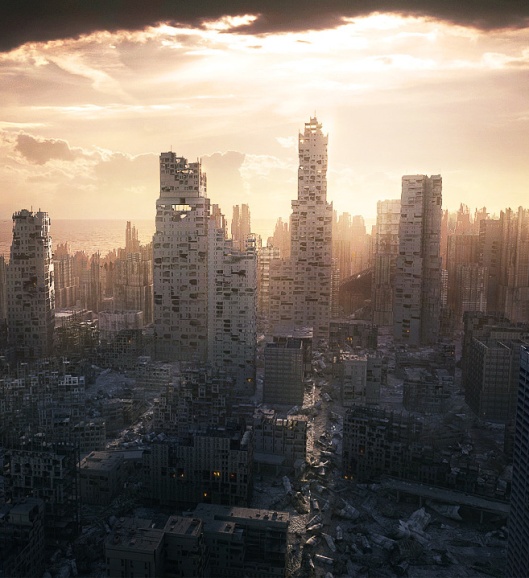
I’ve just returned from a salvaging expedition into the heart of what was known as Los Angeles, a vast megalopolis once teeming with millions of people and home to Hollywood movies and TV, hallucinogens for the masses. It is now known as celluloid cemetery. The air was still this evening and off in the distance I could hear the desperate screams of those who had been exiled from our underground colonies.
I’ve got all the public libraries mapped out on my tracking device so that I can hit them up for rare books not archived on our historical databases. Paper books never died because a lot of data has been lost over the years due to grid failure, floods, fires, and arson. A very well-preserved collection of writings by Benjamin Franklin, a true renaissance man of his time, caught my eye as I rummaged through piles of books strewn knee-deep across the floor. Inside the dusty tome I saw the brief essay ‘Observations Concerning the Increase of Mankind‘and read it on the spot. Franklin says, “But not withstanding this (population) increase, so vast is the Territory of North America, that it will require many ages to settle it fully…” A mere 215 years after those words were published, America officially went into overshoot. Thomas Malthus is said to have credited Franklin for discovering the ‘rule of population growth’ which states that when agriculture increases in arithmetic progression(2, 3, 4, …), the population grows in geometric progression(2, 4, 6, …), eventually outpacing the means to feed everyone. Neither Malthus nor Franklin foresaw the discovery of fossil fuels, which fueled the population explosion, or its horrific side-effect of climate change which would act as a catalyst forthe spread of virulent diseases and pathogens such as the African Flu Pandemic of 2029, otherwise known as The First Great Culling. Two-thirds of the global population were wiped out. Subsequent pandemics of varying origins and lethality picked away at the remaining 2.5 billion, leaving a few hundred million survivors scattered across the globe. The construction of vast subterranean cities began several decades ago once the world knew that industrial civilization would never be able to survive runaway climate change above ground. Today no one is allowed to have more than two children. Population is strictly monitored by the technocracy which severely punishes those who break this law; no one wants to be banished to the outside where life is short and brutal.
Franklin must truly have been rolling in his grave at the end result of his expansionist dreams for America: a pockmarked landscape of fracking wells, oil spills, and toxic waste dumps; a corrupt government of corporate sock-puppets; a military that had become a malevolent industrial complex seeking war for profit and destroying fledgling democracies wherever they appeared; an agricultural system of factory farms and frankenfood; a self-proclaimed “free press” of corporate mouthpieces and shills; and a population of citizens that had been reduced to mindless consumers incapable of critical thought. And I think he would be utterly distraught to find that his name had been reduced to a popular idiom by the dumbed-down masses — “it’s all about the Benjamins.“ Knowing what a grotesque monstrosity this country would become, he surely would not have declared America’s cause to be ‘the cause of all mankind’ — wasteful consumerism, monopoly capitalism, and the tyranny of the corporate state. When he was studying dinosaur bones in northern Kentucky back in the mid 1700’s, I’m sure it never crossed his mind that the human species would soon suffer the same fate, becoming the next hapless victim to sink into a tar pit of its own making. Franklin would have said, “It’s inconceivable such a technologically advanced society as this would not look at the scientific evidence and take action at once to preserve life and liberty.” But after witnessing what an irredeemable abomination his Republic had become, he would most likely say, “My God, the only recourse remaining is to clear the entire system with near-term-extinction.”
Walking with the tortured spirit of Benjamin Franklin along the Beach of Doom where anoxic ocean waves wash plastic debris and dead jellyfish ashore, I explain to him that the seeds of our destruction were planted long ago with the expansionist mindset of the first European settlers. The Indians and buffalo were systematically wiped out, all the virgin forests were chopped down and converted to lumber, and the rest of America was laid wide open for exploitation by the construction of a transcontinental railroad. Technology and the power of fossil fuels only intensified the process; this country never looked back, expanding to foreign shores for control of evermore resources and spreading the same logic and belief system of capitalism throughout every inch of the Earth until there was no place further to go. The system started to cannibalize itself after hitting peak oil, turning inward to burn dirtier, more marginal energy resources and starving the masses whose share of the economic pie kept shrinking while a tiny few gorged themselves on ill-gotten wealth and delusions of grandeur. In its final days, this con game measured everything only with a monetary scale. If there was no profit to be earned, then real solutions to the grave threat of anthropogenic climate change, like “powering down”, were summarily discounted. America and the world had ideologically boxed itself into a death trap called capitalism. No one realized or refused to realize that all the perceived gains in infrastructure, technology, social institutions, and other complexities of industrial civilization would soon fade into oblivion at the hands of an uncaring climate radically and thoughtlessly altered by mankind’s activities. In the end, it was all phantom wealth stolen from nature and built off her back by burning trillions of tons of carbon into the atmosphere. The system’s only available avenue was to rush headlong into the dark void of misery, death, and extinction while spinning quixotic tales of “sustainable growth”, “renewable energy”, and geoengineering fixes. Cooperation on a planetary scale to lower greenhouse gases could never be accomplished under a capitalist system, nor would the arms race amongst nations which requires a constant investment of highly dense energy to develop technologically superior weaponry. After knowing for decades that it was far too late to escape the carnage of climate chaos, those in positions of power felt compelled to ignore the facts and keep the gas pedal pressed to the floor, leading all of humanity over the cliff.
“He cannot complain of a hard sentence, who is made master of his own fate.”
~ Johann Friedrich von Schiller
“Hey, my name’s Luke. The year is 2060 and I live in what was once called America. As you can see, the ‘developed world’ never was able to kick its fossil fuel habit. They just kept turning to dirtier sources and more extreme processes to burn the stuff, like the liquefaction and gasification of coal. The entire planet became a sacrifice zone for the sake of keeping mega cities lit up and the machinery humming, but ultimately it was death by a thousand cuts. Entropy was the victor. GHG’s continued to rise, warm the planet, and wreak havoc on the biosphere. Cancer and industrial disease spread to every corner of the globe. Weather patterns were drastically altered until the world’s food production was forced to move indoors. Large-scale cloning of animals became common practice in order to feed the several hundred million surviving people. War, drought, floods, fresh water scarcity, and a rash of pandemics crashed the world’s population from a high of 8 billion. The agricultural bread baskets of the world became wastelands of dust and weeds. International cooperation failed and the world’s existing powers scrambled for the last remaining resources. There are none who buy into the propaganda of a “better world” any longer because the stark evidence of what we have done to the planet cannot possibly be hidden from view. There is no utopian sanctuary for anyone to escape to, no matter how many gold coins one has managed hoard. Despite this realization and even after all the geoengineering mishaps, people still cling to the belief of salvation through technology. Everyone lives in fortified bunkers to escape the hot, drying winds that sometimes carry poisonous and toxic clouds. When we do venture out, gas masks are always worn as well as long clothing to protect from the thinning ozone layer. Industrial smoke stacks still belch plumes into the air to keep the underground cities running.”
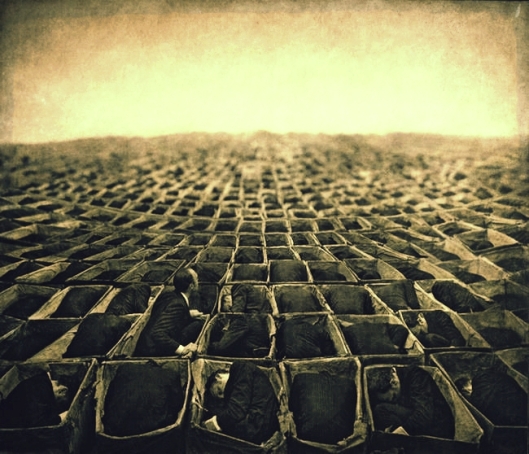
“When above ground, I’ll spend hours walking through the wreckage of industrial civilization, the skeletons of its skyscrapers blotting out the sun like the mythical Redwood trees once did along the west coast. The occasional sound of a steel beam crashing to the ground or a glass window shattering breaks the ghostly silence. These deserted cities are infested with rats the size of small dogs, and the ray of my flashlight is reflected in their staring eyes. The endless and self-defeating rat race of humans has now been replaced by the scurrying, scavenging, and fighting of real rats. I find it amazing that my ancestors spent their entire lives living and working inside these little office cubicles. That was a time when Earth was still green and you could hear the birds chirping and singing outside your window. I’ve got a digital recording of various holographic scenes depicting bygone days of nature that I project inside the confines of my subterranean home, but I’d give my right arm to experience the real thing. To think that people were once surrounded by nature all the time amazes me. Its true value had never really been calculated. Rather, money seems to have been what people were most preoccupied with back then. On one of my excursions I came across a dwelling whose crumbling walls were packed with stacks of moldy paper money. Whoever lived there must have worked an entire lifetime to eke out a savings of that size, stuffing it into every wall cavity like it was insulation. Many thought humans would go extinct long before money would ever cease to exist. I guess they were wrong.”
“They say the people of this country went mad, obsessed with money as it overtook their every thought, decision, and activity. One of America’s forefathers once said, ‘He that is of the opinion money will do everything may well be suspected of doing everything for money.‘ All things were framed within the context of money. Environmental damage was discussed in terms of financial setbacks to the economy. Political leaders made decisions based, first and foremost, on the financial interests of those powerful few who put them in office. Choices on matters involving the well-being of humanity were made solely in the interests of corporations and stockholders. Even as the overwhelming evidence mounted that mankind’s place on earth was becoming evermore tenuous, the money worshippers continued to find ways to profit from calamity and mayhem. Preserving the Earth simply was not profitable, so they let it die. The Arctic melted, so they raided its open waters. The land became parched, so they invested in water rights. CO2 levels skyrocketed, so they put their money into carbon credits. Our continued existence became a crap shoot in the marketplace. The vultures of capitalism were able to profit from the collapse; thusly, such nightmarish and dystopian scenarios as botched geoengineering schemes, a Venus syndrome on earth, and ultimately human extinction were allowed to become sober realities….”
‘No matter what we call it, poison is still poison, death is still death, and industrial civilization is still causing the greatest mass extinction in the history of the planet.’
~ Derrick Jensen
As mankind spirals towards its own self-manufactured demise, I look with a jaundiced eye at daily events in the news and at the bread-and-circus infotainment that fills the American hologram. The mass media is replete with misinformation on the state of the world, so I wasn’t too surprised by the recent words of wisdom(sarcasm) from Kathleen White (Distinguished Senior Fellow-in-Residence & Director, Armstrong Center for Energy & the Environment); nevertheless, I felt compelled to set aside a partially completed essay on capitalism and technology in order to express some of my thoughts about White’s essay on the benefits of fossil fuels to humanity:
“…Fossils fuels also augment food supply. Fertilizer derived from natural gas has increased agricultural productivity by 40-60 percent. According to economist Indur Goklany, without fossil fuels, an area equivalent to U.S., Canada, and India combined would have to be converted into crop land to meet global food demand. Fossil fuel-based fertilizer, pesticides, and mechanized substitutes for animal power have saved vast natural ecosystems from conversion to cropland. And the increased atmospheric concentration of man-made CO2 has enhanced plant growth.”
[You fail to consider that without fossil fuels, mankind would not have been enabled to overpopulate the planet to such a degree as to require so much farmland.You also fail to say that the negatives of climate change swamp (no pun intended) any supposed benefits of a warming planet. As we are already seeing, the effects of epic droughts and floods are wreaking havoc on farmers. Good luck trying to move the agricultural industry northward where the soils are extremely poor. Famine and mass extinction are the inevitable outcome of industrial civilization’s destabilizing activities on the planet.]
“Although combustion of fossil fuels releases pollutants, that environmental damage can, and is, undergoing dramatic reversal far quicker than could the conversion of natural ecosystems to croplands. The prosperity supported by fossil fuel energy allows investment in effective technologies to reduce and eliminate harmful pollution.”
[CO2 and other GHG levels are increasing every year, having gone parabolic in the last 100 years. This reality paints a bleak picture for the future of humanity. Far from being mitigated, environmental damage is accelerating everywhere one looks from the acidification of the oceans to the die-off of forests and jungles. The simple fact is that renewable energy cannot replace fossil fuel based energy at the rate the world is consuming, as European actions have recently indicated. Only a wholesale reconfiguration of the economy and our way of life will enable solutions to the environmental crisis. Rather than taking this courageous and self-reflective approach, society is putting its proverbial head in the sand concerning climate change. The public already finds the subject of climate change difficult enough to understand without having to wade through a constant onslaught of misleading articles such as yours.]
“Renewable energy still provides a sliver of global demand. Despite the billions of dollars in subsidies, retail prices are still 2-3 times higher than fossil fuels. Renewable energy from wind and solar remain diffuse, intermittent and parasitic on fossil fuels for back-up. Nuclear fission provides energy comparable or superior to fossil fuels, but the public remains resistant to broad use.”
[Yes, capitalist industrial civilization cannot be run on renewables so that is why we need to be talking about powering down and living within the carrying capacity of the planet rather than maintaining the status quo. Nuclear has the little problem of making vast swaths of the planet uninhabitable from radiation contamination, as evidenced by such catastrophes as Chernobyl and Fukushima. Nuclear energy also leaves behind tons of radioactive waste that must be stored away for thousands of years. These sort of factors tend to scare the public. With global sea levels rising and storms becoming more destructive, the world’s nuclear plants, which are mostly situated along waterways and oceans for coolant purposes, are in jeopardy. Get it?]
“Energy-dense, abundant, imperishable, versatile, reliable, portable and affordable, fossil fuels provide 85 percent of the world’s energy because they are superior to the current alternatives. And hundreds of millions still await the benefits of affordable energy. Until energy sources comparable or superior to fossil fuels are fully available, policies to reduce emissions of CO2 should proceed with caution lest they prematurely jettison the well-springs of mankind’s greatest advance — the blessings of which literally light up the holiday season.”
[The “well-springs of mankind’s greatest advance” are soon to be jettisoned into the dustbin of history and extinction as we have already tripped multiple tipping points in the earth’s biosphere such as the Polar ice melt and many others. Hundreds of millions will never experience the energy-intensive lifestyles of developed countries since climate chaos will put a halt to human expansion within this century. Fossil fuels have allowed industrial civilization to far overshoot the environment; for the rest of the world to live like Americans, we would need more than 4 Earths.]














 Collapse of Industrial Civilization