They built the chamber from tile and steel,
And whispered lies of cleansing showers,
Where innocence was made to kneel,
Devotion to the Reich’s dark powers.
The chamber’s walls were blizzard and snow,
In Stalin’s gulags, hope misled,
Where Marx’s dream died in woe
For orders scrawled, lives were shed.
The chamber became Tiananmen Square,
Where freedom’s anthem dared to run,
A storm of bullets split the air,
And dreams fell silent, every one.
The chamber’s roof was a mushroom cloud,
A physics riddle coldly solved,
Where the rising sun lay in its shroud,
As human flesh and life dissolved.
The chamber rose, twin towers of pride,
Where traders’ dreams and fortunes flew,
With burning jet fuel trapped inside,
While choking dust erased the view.
The chamber lay in Singur’s field,
Where progress came with gun and fire.
At Nandigram, the steadfast kneeled
To feed a corporate funeral pyre.
The chamber now is sand and stone,
Where drones sing out a deadly tune,
A crowded strip where bombs are thrown
Beneath an unforgiving Gazan moon.
Gas chambers may fall as bombs from the sky,
Or bullets, or edicts in boardrooms pristine,
Yet the chamber endures—where the helpless still die,
As we polish the brass on our killing machine.
We call ourselves enlightened, just, humane—
Yet chambers are born anew with each war.
So long as men draw profit from pain,
The promise of peace will linger at the door.
So pray, when next we speak of peace or war,
Recall how all our poisons taste the same;
For each new chamber, dressed in reasons, lore—
Is just another mask for murder’s name.
He counted the dead by their boots, not their names.
Their mothers would never pronounce them the same.
Forty-three soldiers. A child with no shoes.
He smoked while perfecting the art of bad news.
He walked until the road forgot his feet.
A column passed him, shuffling through the heat.
One looked at him. He looked back, cold and gray.
He signed their death like any other day.
His wife stopped asking where he went at night.
His daughter flinched whenever he held her tight.
His hands smelled of metal. No one would say.
Home learned to be quiet in a careful way.
The war ended with singing and lights in the square.
He watched from a window like he wasn’t there.
His daughter ran outside to join the crowd.
She didn’t wave to him. He was almost proud.
A boy lay flat beside the garden wall.
He played at dying, waiting for the call.
He saw the soldier watching. Grinned and stood.
“I got three enemies—killed them like you would.”
He didn’t answer. Turned and walked inside.
The boy kept playing: shoot, kill, hide.
He closed the shutters. Poured himself a drink.
He sat until the room began to sink.
His hands began to shake around the glass.
The room was still. The shaking wouldn’t pass.
He gripped the table. Steadied. Breathed. And then
His men shuffled through the room again.
His wife came down and stood without a word.
She’d lived with this for years. She’d seen and heard.
She didn’t touch him. Threw his drink away.
They didn’t speak. What was there left to say?
He stood at last. The chair scraped on the floor.
He walked past her and through the open door.
The street was pale. The last lamp flickered out.
His shadow vanished down an unknown route.
The column shuffled on. He joined the count.
No one said his name or looked about.
Forty-four soldiers. A child with no shoes.
The dead don’t speak. The dead don’t get to choose.
He wore his ribbons, bore their praise,
Smiled through the crowd’s empty gaze.
But sand still grinds behind his eyes—
A child’s shoe burning where she lies.
Some nights he leaves his body and soul,
Floats where the dead consume him whole.
Their silent faces never part—
A spectator to his own dark heart.
He came back home to his wife’s stare,
She kissed a stranger standing there.
The kids asked why he screamed at night—
He learned to say he was alright.
One night he made a list of names.
The men in suits who lit the flames.
He traced their addresses in red—
He had new orders in his head.
He found them in their gated homes,
Behind their walls of glass and chrome.
One by one he carved their life—
The wars came home. He was the knife.
But in the silence after death,
He heard a question on his breath:
“Does vengeance cleanse, or sow the seed—
The monster you swore to never feed?”
They found the knife but not the man.
He vanished like the war began—
No grave, no name, no final stand,
Just grains of rumor in the sand.
Another climate conference has once again come and gone, echoing hollow promises and ugly unspoken realities. I won’t waste anyone’s time analyzing the verbiage of this so-called agreement which failed to even mention the term fossil fuels, probably at the behest of those who financed the entire farce, i.e. the carbon-extraction companies. Suffice it to say that countries were approving fossil fuel exploration projects before the ink of the global climate agreement had fully dried. As long as corporations are able to push environmental and social costs off their balance sheets and onto the backs of the weak and defenseless, dirty coal will be burnt and the cheapest slave labor will be employed. Questioning root causes like our inherently unsustainable way of life is still very much taboo and will remain so even after our descendants are sifting through the wreckage. Sure, mainstream publications have expanded their coverage of man-made climate change and global warming, but these existential threats to life on Earth remain an enigma to the vast majority, a footnote in some obscure textbook.
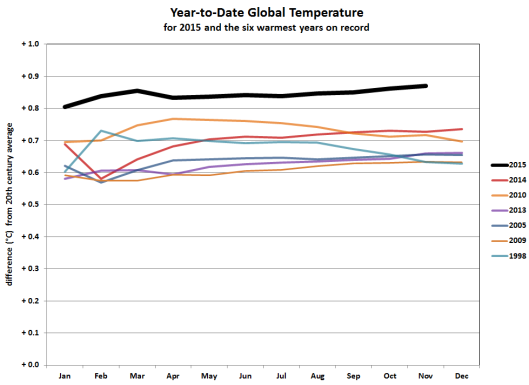
Retailers on the East Coast talk about a crisis for winter clothing sales because the weather has been too unseasonably warm to attract buyers, but nary a mention of man’s role in influencing these abnormal events, such as a super El Niño amplified by global warming. As the developed world continues to roll the climate chaos dice, we now face a higher chance of turbo-charged El Niños every 4 to 12 years and all the destruction that they bring —mass coral bleaching events, die-offs of marine mammals, record flooding and drought, crop failure and famine, refugee crises, etc. This year’s El Niño is on track to becoming the strongest on record with meteorologist Eric Holthaus exclaiming, “Our planet’s climate has undergone a step-change this year.”:
This climate “step-change” may also be indicative of a considerable underestimation of the Earth’s climate sensitivity. What should be painfully obvious by now is that the carbon footprint for everyone will have to decrease dramatically and quickly in order to slow emissions. In other words, the world’s richest will have to radically alter their lifestyles. That’s never going to happen in any variant of capitalism, a system so entrenched that it is inconceivable to imagine anything substantially different taking its place. Instead we get things like corporate greenwashing, carbon trading, decades of climate conferences, First World offshoring of manufacturing emissions into the Third World, and out-and-out fraud like the VW auto emissions scandal. The problem has been identified for nearly half a century, yet we continue to deceive ourselves with half-baked solutions and hypocritical indignation. The inertia of the system is simply too great and the dominant culture has a tendency to kill the messenger of bad news, so there is a strong incentive to sugarcoat things, but a deus ex machina is nowhere on the horizon. We’ll only change in response to the hard realities from an increasingly inhospitable planet. Sunken costs and material incentives built into our socio-economic system prevent radical change and fetishize the myth of the easy techno-fix, a yet-to-be-invented technology that will magically sustain modern civilization while at the same time keep the wolves of ecological collapse at bay. Even more delusional, a prominent tech magnate has urged humanity to pursue interstellar colonization before we render the Earth uninhabitable, but as an internet commenter quipped, “A post-nuclear war, global warming-baked and hyper polluted Earth will still be paradise compared to Mars.” Some technophiles admit the future actually looks rather grim:
…But the most worrisome threats are not merely anthropogenic, they’re technogenic. They arise from the fact that advanced technologies are (a) dual-use in nature, meaning that they can be employed for both benevolent and nefarious purposes; (b) becoming more powerful, thereby enabling humans to manipulate and rearrange the physical world in new ways; and (c) in some cases, becoming more accessible to small groups, including, at the limit, single individuals…
Just as technology is not neutral, so too is the economic system driving this technology. The institution of capitalism, which has been copied and exported all over the world since WW II, has established widespread acceptance for the condition of mass production, mass consumption, and waste at an ever accelerating rate, pushing the world deeper and deeper into ecological crisis. For example, the ubiquity of plastics now exhibits itself as microscopic pieces on every beach in the world and in our dinner with trillions more pieces in the oceans than previously thought. Scientists estimate that nearly all sea birds will be ingesting some sort of plastic by 2050. In spite of this growing evidence of a plasticised planet, the production of plastics has only increased while recycling remains an effort in futility:
For more than 50 years, global production of plastic has continued to rise. Some 299 million tons of plastics were produced in 2013, representing a 3.9 percent increase over 2012’s output. With a market driven by consumerism and convenience, along with the comparatively low price of plastic materials, demand for plastic is growing. Recovery and recycling, however, remain insufficient, and millions of tons of plastics end up in landfills and oceans each year – link
There’s no going back from this global complexity trap we’ve built around ourselves. All those bits of plastic will end up in the sedimentary layer of the Anthropocene along with elevated concentrations of CO2, radionuclides from nuclear fallout and waste, as well as novel metals and pollutants never before seen. Once underway, mass extinctions cannot be reversed, especially when driven by over seven billion pleasure-seeking, individualistic “consumers”. Materialism and greed, we are told, are natural human instincts, and they are all too eagerly rewarded by an economic system which reduces everything to a financial object and monetizes every aspect of the natural world. Today’s environmentalism is, as Derrick Jensen pointed out, similar to the palliative care given to prisoners in Nazi Germany death camps. The emaciated ecological ghosts of so many species are right before us, yet nearly everyone is blind to the unfolding catastrophe of the 6th mass extinction:
…we lose a huge chunk of the world’s diversity that will never come back. We lose the potential for communication with other lifeforms, with the only remaining ones eventually whittled down to domesticated animals or weed species that thrive in civilized man’s destructive footsteps. The conversation of life itself is turning into small talk, but the only recognition that seems to be made by this culture is how [biodiversity loss] “reduces carbon storage”. How trees and animals can provide “ecosystem services”, as if they existed for nothing more than to continue the existence of the mad king ape. – pathofraven
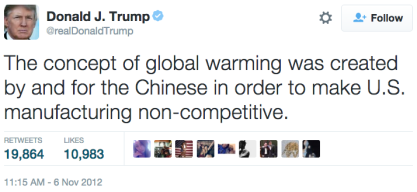
Yes, we are pretty far gone when a four minute comedy routine makes more sense than anything broadcasted on the evening news. Corporate mass media-controlled public debates have degenerated into infomercial sound bites. In a society where success is measured by the key metrics of money and profit, it should be no surprise that a wealthy, xenophobic businessman is able to garner mass appeal by hogging publicity and playing on the fears and base desires of the populus. “Make America Great Again” is a catchy slogan for a society ignorant of the collapsing world around them and oblivious to the over-consumptive, profligate way of life that is proving to be their undoing. For a celebrity-obsessed culture whose world is falling apart, the next logical choice for its leader would seem to be a reality TV show star who says he can restore the illusion of the American dream and build a great wall to keep all the riff-raff out.
A fascist right-wing administration might just provide that extra push that takes us all over the edge into collapse. With the Presidency largely serving as a figurehead position for the Deep State, I’m not convinced a different candidate would make a measurable difference in the grand scheme of things anyway. Our “democracy” is, after all, just one more illusion in a bread-and-circus election cycle:
“Today, we must look to the city of Las Vegas, Nevada, as a metaphor of our national character and aspiration, its symbol a thirty-foot-high cardboard picture of a slot machine and a chorus girl. For Las Vegas is a city entirely devoted to the idea of entertainment, and as such proclaims the spirit of a culture in which all public discourse increasingly takes the form of entertainment. Our politics, religion, news, athletics, education and commerce have been transformed into congenial adjuncts of show business, largely without protest or even much popular notice. The result is that we are a people on the verge of amusing ourselves to death.” – Neil Postman, Amusing Ourselves to Death: Public Discourse in the Age of Show Business
So while terrorism takes center stage in the overstretched Empire of Amnesia, remember this simple fact: 303 Americans were killed in terrorist attacks worldwide in the last decade while 320,523 Americans were killed because of gun violence in that same time period. Random mass shootings, capitalism’s “free market” genocides, the disruption of the Holocene’s stable climate regime by anthropogenic climate disruption, tipping points in the earth’s biosphere, terminal industrial disease, and many other things come to mind that pose a much bigger danger to the average American, but the War on Terror, conceived as open-ended, serves as a conveniently omnipresent boogieman for jerking the chain of the taxpayer and justifying the growth of an intrusive security state. What better way to control the masses as the wheels continue coming off the global economy and the biosphere becomes evermore threadbare. The rich will retreat into their luxury spider holes until the coast is clear.
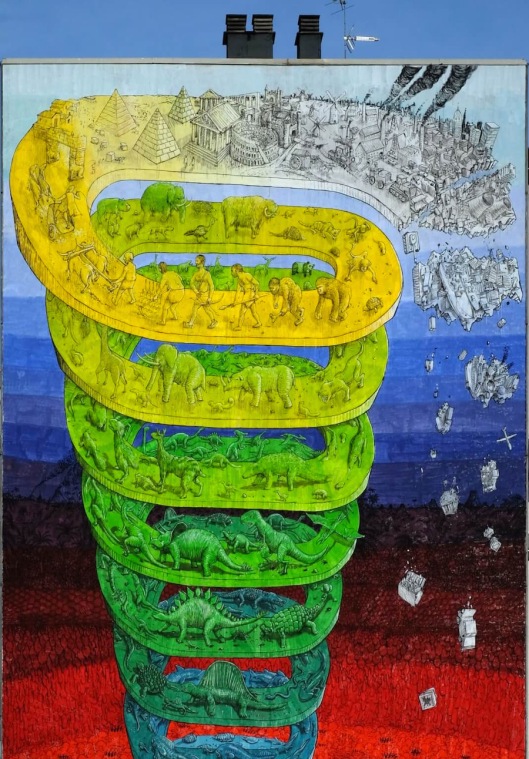
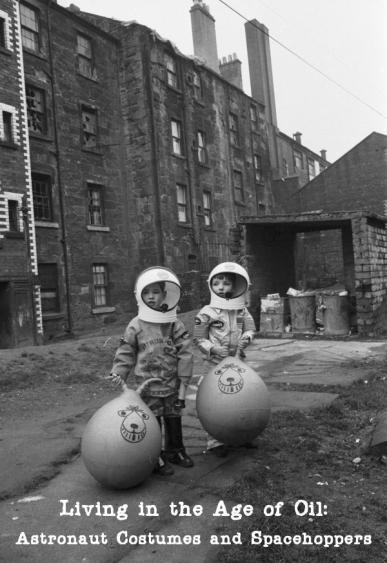
But how can we define an oil age? It has been about 150 years since the first deep oilwells were sunk, and just over 200 years since the viable steam engine was developed. The two are linked, because the steam engine made deep drilling of oilwells possible and gave us access to a hundred million years worth of fossilized sunlight. Perhaps we have not strictly had an oil age, but rather the first and only age where we enjoy vast amounts of surplus energy that we have extracted from hydrocarbon fuels, of which oil is the most energy dense. It has brought us material wealth, and the means to indulge in wholesale killing of each other and all other species. It gave excesses of food and a population that consumed that food and grew to five or six times the sustainable level of the planet. In the timespan of human existence, the ascendance of modern industrialised man has been a short flash of light and heat that has briefly lifted us out of the mire of the middle ages, but at a considerable cost to the environment.
Our mistake has been to think of that elevation as both divine and permanent. That certainty of permanence explains the mad scramble to come up with ‘alternatives’ and ‘renewables’ in the last decade or two. Something to keep current politicians in office and the masses pacified. It is important that we accept the seductive indoctrination that prayers will be answered and technology will continue to deliver all that can be imagined. The majority have come to believe in the economics of cornucopianism, where wishing for something will make it happen, while ignoring the reality that everything we have is derived from finite hydrocarbon fuels. If we spend enough money, alternatives will always be found to sustain our lifestyle. They won’t of course, and the conflicts that have been fought over oil are proof that they won’t. The pivot of world oil economy is Saudi Arabia, (the concept of ‘Saudi America’ is too ludicrous for discussion here), but that fantasy land of sand dunes and tall towers is being encircled by fanatics who know that when the jugular of global oil is cut, the industrial complexity of the developed west will die.
When (not if) that happens, we might be lucky to hold onto an existence akin to that of the 14th century, which is what the religious zealots want to inflict on all of us. If we’re unlucky, then we must expect something that will be much darker and as yet inadmissible to modern minds that do not have the scope to deal with its implications. That infers an unpleasant imagery of pre-history that we prefer to ignore. Understandably, most think the same way; this is why we cling to the comforting promise of ‘infinite growth’. The alternative is just too awful. Instead we have been encouraged to believe that we can do without oil and not only still run around on wheels, but have a purpose for doing so. And by some means yet to be invented, keep our wings as well.
Our oil age will not end through lack of it, but by fighting over what’s left. So choose your luck‐factor and take that thought where you will, you are on your own with it. Many reasons are given for starting wars, but ultimately there is only one: the pursuit of (energy) resources. Human greed drove improvements in weaponry, and the means of destruction and acquisition became more deadly over thousands of years even though there was more than enough for everyone. The input of oil was the game changer of warfare; history over the last century has shown that conflict was not diminished, but amplified, by the prosperity and technology created by oil. Since the 1860s when black gold gushed from the earth, the economic and political thinking of the pre‐oil era was seamlessly grafted onto the industrial potential of the 19th century, thereby enabling Rockefeller, Ford, Carnegie, Vanderbilt and many others to accumulate fabulous wealth. Their business acumen was undeniable, but none of it could have been brought into existence without energy-rich oil. The use of fossil fuels in our military machines industrialised our methods of killing while at the same time becoming synonymous with progress and commerce. War became a business, the purpose of which was the acquisition of more energy in the pursuit of profit. Battlefield deaths on an industrial scale were an unlisted debit on balance sheets.
WWI started with the muscle power of horses and ended with tanks, demonstrating the murderous scope of mechanized warfare. Recognizing the critical value of oil and its sources, leaders carved up the Middle East to ensure its supply. An exercise in map making in the 1920s by the English and French civil servants Sykes and Picot set the scene for carnage that has raged throughout the Middle East ever since. Arbitrary lines in the sand were drawn, artificial oil states in the Persian Gulf region were created without regard to tribal affiliations, and a quarrelsome orphan Israel was dumped into the lap of unwilling Bedouins. As the quantity of oil there became apparent, all the major nations were drawn into the race for it because those who controlled this key resource were certain to subjugate those who did not.
The critical nature of oil made WWII inevitable. To sustain their empires, the Germans and Japanese slaughtered their way across Europe and Asia in a grab for resources, primarily oil. They promised infinite prosperity and their peoples cheered them on while deaths elsewhere were being counted in millions. With most of the world’s known oil supplies in the hands of his enemies, Adolf Hitler knew he had to have the oilfields of southern Russia and the Middle East to sustain his war machine. He failed, and his dream of a ‘Greater Germany’ collapsed not because of inferior soldiers but because there was insufficient energy input to sustain his plan for world domination. Hitler’s perception of infinite growth in his ‘thousand year Reich’ mirrors our present-day view of ‘permanent affluence’: vast quantities of oil had to be burned to sustain his fantasy. In our desperate scramble for ever-diminishing energy resources, we are in the same mad race to perpetuate the delusion of infinite economic growth. The oil pendulum has swung the other way with roughly 85% of world oil now outside the borders of the USA and Canada in countries not always of a friendly disposition. And just like the Fuhrer, political leaders of today are promising that which is beyond their means to provide. To mask this reality, they have invaded oil-producing nations in the name of ‘freedom’, claiming ‘victories’ which have left only wreckage and simmering animosity behind. So too did Hitler spread a similar line of propaganda that he was liberating other nations from the threat of communism. The second world war that left Europe and Japan flattened in 1945 might be seen as history, but it was just the first of many oil wars, and the politics of it were a side issue. WWII serves as a grim reminder of how violent and destructive humans can be in their ruthless pursuit of energy resources. Hitler’s own ‘oil age’ lasted just twelve years, and it set the pattern for the world oil age that is now in terminal decline.
Don’t be deceived by the democratic righteousness that defeated Hitler’s fascism. 150 years earlier the American empire was created with the same kind of energy grab. The European immigrant peoples who forced their way across America from the 1700s onwards needed resources on which to survive and to sustain the prosperity of an expanding nation just as the Germans and the Japanese did in 1940. The native inhabitants of the American continent were in the way of civilization and progress; their subjugation was a precursor to what happened later in Europe and Asia. Expansive prairies had to be cleared to convert the energy locked in grain and meat to feed the invaders and provide negotiable currency. This self-perpetuating process went into overdrive with the discovery of oil, and the ultimate conversion of that oil into more food resources and hardware added to the wealth of the growing nation. An expanding population needed employment, and the raw energy from oil, coal, and gas supplied it. America and the rest of the industrialised world had the means to build bigger, better, faster machines in endless succession, and created the most powerful country on earth. Everybody was going to be rich, forever. The universal law of consumption was relentless: more demanded more.
Meat and grain grew with relatively little human intervention, but other crops needed to be worked with human muscle. So the slave trade came into being. Slavery might be given many unpleasant names, but essentially it is the acquisition of one energy form to convert it into another for profit. Buy and feed the slave, use slave labour to do work, sell the product of that work. By the time the slave is worn out, several more will have been produced. This was simple economics by 18th century standards but the human consequences were again horrific, costing more millions of lives. It also brought on the American civil war where the slave‐muscled South was overwhelmed by the industrialised muscle that drove the armies of the North.
All the European empires forged out of so-called ‘empty lands’ across the world followed a similar pattern of resource acquisition and an absolute disregard for weaker peoples. It is an unpleasantness that we choose to ignore, but it confirms the killing force that drives us to acquire and convert energy to our own use. The seemingly limitless amount of oil and its energy density appeared to be the answer to all our labour problems. Oil became our ultimate slave. Or so we thought.
We now have maybe 20 years worth of usable oil left. There are certainly no more than 30, perhaps as little as 10. If one of the crazy sects running loose in the Middle East managed to get hold of a nuclear device, setting it off on the Gharwar oilfield of Saudi Arabia, it would be endgame overnight. That is perhaps too bleak a prospect, but we should not discount that notion entirely.
Before our oil to food arrangement, the planet supported something over one billion people. We now have over seven billion, and the mothers of the next two billion are alive now and approaching the age of reproduction. Preachers, scientists and politicians will not stop the basic human function of eating and procreation, so if unchecked nine billion people will be here by 2040/50, and set to go on rising after that. Every new arrival expects to be fed, watered, clothed and housed, but by no stretch of the imagination will the global food system be able to feed that number let alone sustain them with what would be expected by way of the most basic material comfort. No one dares to stand up and make the rather obvious point that we are not going to reach 9 billion. Something has to give, and that giving is going to be very unpleasant.
In the first decade of the 21st century, numerous wars have been fought over oil, and are being fought now. Wars are fought over resources because on nature’s terms, gentle contentedness is not a good strategy for survival; we are collectively powerless against genetic forces that dictate our lives no matter how much we protest otherwise. Downsized to whatever level, nature will ultimately force the choice of survival or death, and the outcome will be of no consequence other than to you and yours. To expect humankind to change within a single generation is stretching credibility beyond breaking point. Those who look forward to a life of bucolic bliss in a downsized oil‐less world might do well to think about that. Whether killing and butchering an animal to eat it, or invading another nation to secure oil supplies, we must appropriate energy sources to facilitate survival. You may think there’s a choice about doing that, but there isn’t, other than in the matter of scale. Whether paying a butcher to cut and wrap your steak, or paying soldiers to invade Iraq, securing sufficient energy to live is what we have to do to survive.
For the moment, nature keeps us supplied with oil, and we’ve pulled off the neat trick of converting it directly into food. Not knowing when our oil is finished and our food supply will run out is the little teaser for the early 21st century. Right now, most people think that food comes from supermarket shelves and freezers, which is just as well. The food trucks moving around the country are basically mobile warehouses, delivering food just in time for it to be consumed. When the realization dawns that the food trucks have stopped, the food held in stock by retailers will be stripped bare in hours. The oil age for everyone will have come to an end.
But oil carries man’s destiny in far more subtle ways than food supplies. It holds nations together. The USA is a vast territory of disparate peoples and ideas, held together by a common bond of prosperity and a basic consensus that government and law generally works for the good of all. And the inhabitants of empires are always convinced that theirs is permanent and protected by gods. That definition would apply to many large nations to a greater or lesser degree. But the bonds that hold it together, godly or otherwise, are entirely subject to availability of affordable oil. Empires (and the USA is an empire) remain whole so long as the means exists to maintain them. Oil has become that means.
Without oil, the nation will begin its decline into disparate regions. Without interconnecting transport, the United States of America cannot remain united. The force necessary to prevent a breakup will not be there, so within a decade (probably far less) of oil supply failure, the USA will cease to exist. The cracks are already there along linguistic, economic, racial, political and geographic lines. Even now it would be possible to take a pretty good guess at where those regions will split off.
This will be denied and resisted of course, but armies and police forces have power only as long as their fuel lasts. They will be unable to prevent secession in whatever form it takes. It might just be that Washington will come to govern not much more than the original colonies. Given a suitably deranged political leader and prayers to the right god, fully armed groups are ready to believe that the ‘American Dream’ can be restored. Such demagoguery sets the stage for years of regional violence over the basics of life, particularly food and water. The horror of it will be justified by warped views of right and wrong, clinging to a denial mentality magnified beyond any imagining by the privation that an oil-less society will bring.
This scenario is not exclusive to the USA. The British Empire was built on coal. When the coal was gone the empire faded away. Then in the 80s and 90s the UK became awash with cheap oil from the North Sea, and everyone was reasonably prosperous, particularly Scotland. Now the oil surplus has gone, and the UK is in decline again as a net importer. The ‘oil prosperity’ is fading away. Scotland is losing its main source of income and wants to secede from the United Kingdom, convinced that independence will somehow restore their wealth. Things will get very unpleasant when they realize that an independent Scotland will eventually be reduced to the economic level of Greece. The link between oil and the ability to eat is clear. The UK has to import 40% of its food, and much of the rest depends on oil to produce it, which also has to be imported. It is the end of the UK’s oil age, but few admit to it being the end of a food age as well. The same problem is being revealed in the current fiasco of the European union, but a little more advanced than the USA and UK. Oil-fueled prosperity is falling dramatically in the poorer southern countries. Greece, Spain and Portugal and a swathe of smaller nations have to import all their oil which only worked when oil was cheap. Now it’s expensive, and they are facing bankruptcy. 50 years of ‘unity’ is dissolving like a mirage in the face of the difficulties that smaller states are suffering. Without cheap oil, their economies cannot function, and so are disintegrating. United Europe needs oil to stay united just as the USA does. Russia’s oil dependent economy is crumbling, and Putin is having to make threatening postures to divert attention from his problems. His oil age is ending in a different way and yet we cannot tell if his posturing is just that, but a shortage of resources in the past has invariably brought conflict.
Move to the Far East and the nations around the South China Sea are all threatening one another, again the focus of the argument being the oil and gas fields of the region. They all know that without oil they cannot survive, and are prepared to fight for every last drop of the stuff, no matter what the cost. As a measure of what the dispute is about, the volume of oil in question is 11 billion barrels. One billion barrels is less than a month of world consumption. They are preparing to fight over the last dregs in confirmation of man’s desperation over oil shortages. Eventually, this problem will hit every nation and individual on earth as our oil‐crutch is kicked away. And with the oil age fading into history for us all, there will be no shortage of violent resistance to this inconvenient truth.
Over the ages, a number of empires have exploited and looted the resource-rich lands of Africa. At its height, the Roman Empire stretched from Scotland in the northern hemisphere to the deserts of Africa in the south. The Romans stripped their North African territory of its trees, making it their breadbasket of grain production. Originating in central Africa, malaria was likely spread to the center of the Roman Empire on their cargo ships. Passengers on their boats could have carried malaria in their bloodstream before becoming symptomatic, and water barrels on board could have harbored mosquito larvae. In fact, the DNA work of Dr. Robert Sallares has proven that the most lethal form of malaria helped topple ancient Rome. Fast forwarding to today, the blow-back from industrial agriculture and transnational corporate land grabs in Africa has now reached the shores of the hegemonic American Empire in the form of a deadly tropical disease called Ebola.
The Roman Empire seized fertile African land by brute force, but in modern times capitalist industrial civilization takes over Third World countries with the stroke of a pen. Structural adjustment loans by such tools of western power as the IMF and World Bank are signed requiring privatization of the economy and government cuts in social spending. Vast tracks of forests are cleared for mining or monoculture crop production such as palm oil. Subsistence farmers are dispossessed of their ancestral lands and forced to migrate to cities in search of work. Deprived of adequate healthcare and the opportunity to earn a livable wage, these urban poor live in squalor and are driven to hunt in the surrounding forests for a cheap source of protein known as bushmeat. Fruit bats, a keystone environmental species, have been identified as an Ebola virus host that has spread the disease through bushmeat consumption, habitat destruction, and human encroachment. Thus the neoliberal agenda of ‘developed’ nations has acted to create the atmosphere from which this pandemic arose.
Due to the long history of exploitation by outside powers, native Africans are justifiably wary and prone to conspiracy theories involving intervention by Western institutions as well as their own governments which have been, to a great degree, corrupted by the resource curse. These unpleasant facts are, of course, never mentioned by the MSM because it might spark a flicker of moral compunction in the ‘developed’ world which has ended up with so much of Africa’s wealth in the form of rare earth minerals used inside electronic devices, gold and diamonds in jewelry, or petrol pumped into vehicles. The horrific realities behind conflict minerals are always kept out of sight and out of mind by the next consumer diversion.
The following video is a brilliant lecture by Rob Wallace, evolutionary biologist and public health phylogeographer, discussing the epidemiologic links between the current Ebola outbreak and the socioeconomic policies of capitalist industrial civilization.
“Pathogens routinely trace society’s inequalities and expropriations like water traces cracks in ice… Ebola represents such a case. The shifts in land use in the Guinean region where the new strain apparently emerged are connected to the kinds of neoliberal structural adjustments that, alongside divesting public health infrastructure, open domestic food production to global circuits of capital… [The corporate agribusiness land acquisitions in Africa] are markers of a complex policy-driven faith change in agroecology…that undergirds Ebola’s emergence here.” ~ Rob Wallace
In biology there is a phenomenon known as the Allee effect which occurs when a species declines to a critical population threshold, becoming too spread out over a large area to find a mate for reproduction and thereby making a crash to extinction all but inevitable. The Allee effect applies to infectious diseases as well, and if you can knock down an outbreak below an infection threshold through such methods as vaccinations or proper sanitation, then the outbreak can burn out on its own. However, as Rob Wallace wryly states, “…structural problems can render emergency responses null and void, no matter how much Bill Gates pays out.” In other words, we may have destroyed the ecosystem’s natural ability to keep such pathogens in check and from expanding out of control in the future:
“…commoditizing the forest and neoliberal dispossession may have lowered the region’s ecosystemic threshold to a point that no emergency intervention can drive the pathogen population low enough to burn out on its own. The pathogen will continue to circulate with the potential to explode. In short, neoliberalism’s shifts aren’t just a background upon which such emergencies take place. It is the emergency as much as the virus itself. And history has demonstrated this time and again. Faith changes and social organization, for better and for worse, change epidemiologies. Domesticated livestock served as sources for human diphtheria, influenza, measles, mumps, plague, pertussis, rotavirus, tuberculosis, sleeping sickness, etc. Ecological changes brought about upon landscapes by human intervention selected for spill-overs of cholera from algae, malaria from birds, and dengue fever and yellow fever from wild primates… We can pretend otherwise for Ebola, but in protecting the rationals for institutions and policies that likely brought about such outbreaks, if as byproducts of a greater economy alone, we will surely only compound the problem. If not by Ebola this year, then perhaps something else next.”
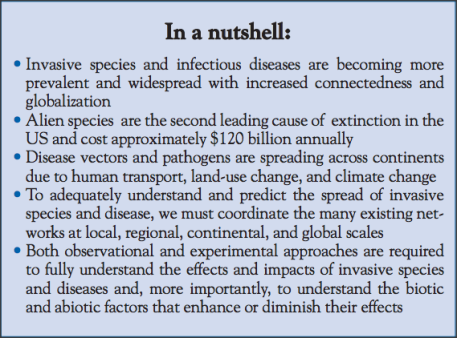
In addition to the ecosystemic impact of industrial agriculture and global circuits of capital, our highly mobile society and the consequent climate disruption from fossil-fueled globalization have worked to propel the spread of invasive species, diseases, and pathogens:
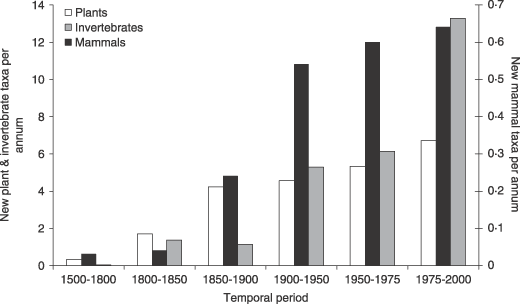
The following graph show the increase of invasive species since 1500 with an explosion in the last 100 years:
Below is a chart showing the increase in bacterial resistance for selected pathogens. “For example, Staphylococcus aureus resistant to methicillin has increased almost 70% since about 1975.” The dawning of an antibiotic apocalypse is upon us:
“FRONTLINE investigates the widespread use of antibiotics in food animals and whether it is fueling the growing crisis of antibiotic resistance in people. Plus an exclusive interview with the family of a young man who died in a superbug outbreak that swept through a hospital at the National Institutes of Health.”
Amplifying what some call peak antibiotics is the fact that in our capitalist economy, the perverse incentive for monetary profit discourages pharmaceutical companies from developing new antibiotics; there is no market for curing… only prolonging:
…Ebola emerged 40 years ago, and, Dr. Chan said, there were no vaccines or other remedies because it has traditionally been confined to poor African countries. A profit-driven pharmaceutical industry had no incentive to make products for countries that could not pay, she said.
The risks of neglecting health care in developing countries are global, Dr. Chan said, adding that “when a deadly and dreaded virus hits the destitute and spirals out of control, the whole world is put at risk.”… – link
The fragmented and “crapified” nature of America’s for-profit healthcare system has also factored into the fumbled response to Ebola’s invasion into America, as Yves Smith at Naked Capitalism explained recently:
…the statistics say compared to other developed countries, US processes and outcomes are at best mediocre using the best of some admittedly flawed metrics (look here), yet our costs are much higher than those of comparable countries. Furthermore, on Health Care Renewal we have been connecting the dots among severe problems with cost, quality and access on one hand, and huge problems with concentration and abuse of power, enabled by leadership of health care organizations that is ill-informed, incompetent, unsympathetic or hostile to health care professionals’ values, self-interested, conflicted, dishonest, or even corrupt and governance that fails to foster transparency, accountability, ethics and honesty…
…The US health care system is now heavily commercialized. Health care corporations, including pharmaceutical and biotechnology companies, are often lead by generic managers who subscribe to the business school dogma of the “shareholder value theory,” which seems to translate into putting short-term revenues ahead of all other goals. Thus they have been“financialized.” At least in the pharmaceutical and biotechnology sector, such financialization appears to now be global…
…from 1983 to 2000, the number of managers working in the US health care system grew 726%, while the number of physicians grew 39%, so the manager/physician ratio went from roughly one to six to one to one (see 2005 post here). As we noted here, the growth continued, so there are now 10 managers for every US physician…
There is little wonder why the Ebola outbreak caught the WHO so flat footed as they spent months making mealy mouthed statements but never coordinating an effective response. The Gates foundation is the WHO boss, not governments, and if they weren’t demanding action, then the desperate people affected by Ebola weren’t going to get any…
…The Bill and Melinda Gates Foundation has pledged an additional $50 million to fight the current Ebola epidemic but that too is problematic, as Director General Chan describes. “When there’s an event, we have money. Then after that, the money stops coming in, then all the staff you recruited to do the response, you have to terminate their contracts.” The WHO should not be lurching from crisis to crisis, SARS, MERS, or H1N1 influenza based on the whims of philanthropy. The principles of public health should be carried out by knowledgeable medical professionals who are not dependent upon rich people for their jobs.
The Gates are not alone in using their deep pockets to confound what should be publicly held responsibilities. Facebook founder Mark Zuckerberg announced that he was contributing $25 million to fight Ebola. His donation will go to the Centers for Disease Control Foundation. Most Americans are probably unaware that such a foundation even exists. Yet there it is, run by a mostly corporate board which will inevitably interfere with the public good…
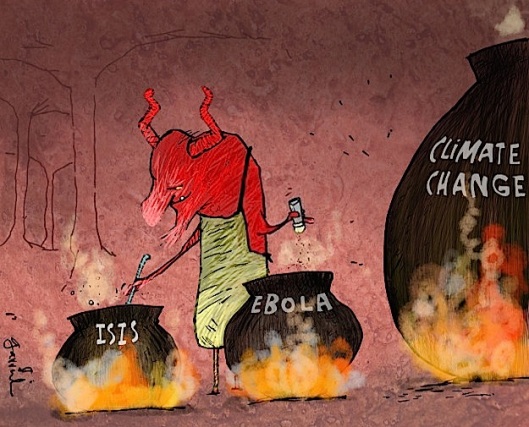
Essentially, both ISIS and the Ebola pandemic are crises of the corporate state’s own making. Vast sums of money have flowed into America’s war machine to fight the terrorist threat of ISIS, yet the specter of a global pandemic has elicited a much more belated and tepid reaction from the leaders of our brave new privatized and financialized system of government. As with climate change, it has become clear once again that the health of the world and its people cannot be trusted with these adherents of neoliberal capitalism, and as I stated in a previous blog post, the conspiracy is systemic and legalized. The virus of capitalist industrial civilization appears to be on an unstoppable trajectory of burning itself out within our children’s lifetime.
“It was a nice run for the biosphere, but it finally came down with a lethal disease, homeostasis lost, the pyramid of life reduced to the pancake of life.” ~ James
I’ve become rather jaded at the stream of ever-worsening environmental reports these days. Surely if we had some sort of techno-fix to halt the cascade of biospheric tipping points we have breached, we would have deployed them by now. Nevertheless, the carrot of a civilization-saving technological breakthrough is forever dangled before our eyes. By all accounts, we appear hellbent on doing everything humanly possible to maintain and perpetuate industrial civilization by deploying “earth-friendly” renewable energy technologies which, in the end, turn out to be nothing more than “reconstituted fossil fuels”.
The role that fossil fuels play in the creation, maintenance and support of alternative energy technologies is not discussed or analyzed at all by those peddling it to the masses who live with the hope of a “green” economy and carbon-neutral civilization. From the massive mining operations and manufacturing processes necessary to extract the rare earth metals essential in constructing wind turbines, solar panels, and electric car batteries to their daily maintenance, de-activation, and final discardment, the amount of fossil fuel energy embedded in the entire life cycle of such alternative energy technologies renders moot their benefits when compared to what is actually more effective in solving our energy and climate conundrum —reducing our consumption through energy efficiency improvements and waste reduction programs. Alternative energy technologies cannot replace our dependence on fossil fuels and are, in the final analysis, diverting us from coming to grips with a way-of-life that cannot go on for much longer. We have a consumption crisis.
Here is an excerpt from a must-see talk by engineer and energy analyst Ozzie Zehner, author of Green Illusions:
“Common knowledge presumes that we have a choice between fossil fuels and green energy, but alternative energy technologies rely on fossil fuels through every stage of their life cycle. Most importantly, alternative energy financing relies ultimately on the kind of economic growth that fossil fuels provide. Alternative energy technologies rely on fossil fuels for raw material extraction, for fabrication, for installation and maintenance, for back-up, as well as decommissioning and disposal. And at this point, there’s even a larger question: where will we get the energy to build the next generation of wind power and solar cells? Wind is renewable, but turbines are not. Alternative energy technologies rely on fossil fuels and are, in essence, a product of fossil fuels. They thrive within economic systems that are themselves reliant on fossil fuels.
Now, I’m no fan of fossil fuels. Fossil fuels are finite and dirty, but we use them for five principal reasons. Fossil fuels are dense. Their energy is storable, portable, fungible (which means they can be easily traded), and they are transformable into other products like pesticides, fertilizers, and plastics.
Now, these qualities cannot be measured in kilowatts, so what happens when we spend our precious fossil fuels on building alternative energy. Well then we get energy that is not dense, but diffuse. It’s not easily storable. It’s not portable. It’s not fungible. And it is non-tranformable.
Now to increase the quality of the energy, we then have to spend more fossil fuels to build batteries, to build back-up power plants, and other infrastructure. And of course this is incredibly expensive. Ultimately that expense represents the hidden fossil fuels behind the scene.
There’s an impression that clean energy can supply a growing population of high consumers. There’s an impression that alternative energy can displace fossil fuel use, but the evidence doesn’t show that.
As Ozzie Zehner states, fossil fuels are finite and dirty. If you look at the headlines, the geopolitical wrangling and wars that takes place over the extraction of fossil fuels are another nasty and destabilizing side-effect of our dependency on fossil fuels. America’s global network of bases and its military industrial complex are yet another hidden cost of our fossil fuel addiction. Does President Obama tell the people of America the real underlying reason for why we are again bombing Iraq?
The US military intervention, despite its “humanitarian” propaganda, is nevertheless part of clear political objectives that are to protect American diplomatic personnel stationed in Erbil (which is also home to a CIA base) and large multinational companies in the hydrocarbon/oil sector such as Mobil, Chevron, Exxon and Total exploiting the oil production in the region and having already invested more than $10 billion there, but the primary purpose above all is to keep the Iraqi regime ally, inherited from the American invasion. The United States did not intervene when Mosul fell and other regions and more than 200 000 refugees were on the road in the direction of Iraqi Kurdistan, but only when IS was threatening to conquer the Kurdish areas of the North and the capital Baghdad in the South. – link
Here we are once again back at war because we need that black goo lying beneath the ground that those lunatic terrorists are running around on. And it also doesn’t help that America has become a warfare state with the corporations and the über rich benefitting every time we crank up our war machine.
Among many others who have written about this subject, here are two people from The Fertile Ground Institute who have also looked into alternative energy technologies and come away with the same conclusion as Ozzie Zehner:
I agree with commenter ‘C 1 Max’ whose many thoughtful comments at Robert Scribbler’s site were summarily deleted.
As long as we ignore the limitations of technology and the unsustainable nature of our economic system, the battle is lost for mankind. The grave we are digging for ourselves will only get deeper and deeper, spurred on by our alternative energy fetishes and temples to technology.
“Cannot you see, cannot all you lecturers see, that it is we that are dying, and that down here the only thing that really lives is the Machine? We created the Machine, to do our will, but we cannot make it do our will now. It has robbed us of the sense of space and of the sense of touch, it has blurred every human relation and narrowed down love to a carnal act, it has paralyzed our bodies and our wills, and now it compels us to worship it. The Machine develops – but not on our lives. The Machine proceeds – but not to our goal. We only exist as the blood corpuscles that course through its arteries, and if it could work without us, it would let us die.”
~ E.M. Forster, “THE MACHINE STOPS”
Insects, birds, mammals, and fish have all been migrating to cooler zones for the past four decades in response to the cataclysmic climate disruption ignited by industrial civilization, but humans are the only organisms inhabiting this blue orb we call Earth who are not altering their behavior. They live within an energy cocoon that keeps them cool in the summer, warm in the winter, stuffed with massed produced food from mechanized factory farms, and entertained by a virtual world of digital imagery. As cracks and holes in the Earth’s biosphere grow ever larger, the natural response of capitalist carbon man ensconced within his protective energy shell is to try to put a price tag on what is being burned, i.e. fossil fuels, rather than deal with the deeper root cause of an unsustainable economic system and way of life which demands such exorbitant consumption of resources.
Our energy slaves feed us and control the climate for us while at the same time destroying the natural world that had enabled humans to create such an artificial environment. Detached from nature and enslaved by our own technological creations, we sleepwalk over the cliff of extinction. Our so-called progress will, in the end, disappear like a mirage in the scorching desert sun as nature is sacrificed to the machine of industrial civilization.
Throwing money into the maw of the ‘free market’ is the predictable modus operandi of technocapitalism’s indoctrinated disciples who believe such offerings will create a technofix, miraculously healing the planet. In the Star Trek TV series, the Ferengi were an extraterrestrial race whose culture was characterized by “a mercantile obsession with profit and trade, and their constant efforts to swindle unwary customers into unfair deals.” Just like the Ferengi species where profit is the first, last and only important factor, the high temples of private enterprise are commodifying and monetizing the atmosphere just as they have everything else in nature. The colonization of the public mind by capitalism is complete and overriding. We ignore unfolding geologic forces and instead put our faith in manmade market forces to our detriment.
In the final days of capitalist industrial civilization, the relentless and compulsive pursuit of profit and growth has subsumed any intelligent and realistic plans for survival. In fact, with the race amongst nations for nuclear technology and sophisticated weaponry, the requisite competitive economy to support such hi-tech militaries nullifies any attempts at reducing greenhouse emissions and pushes the world towards nuclear annihilation. As Kevin Lister, author of the forthcoming book The Vortex of Violence and why we are losing the battle against climate change, points out:
…The fundamental dilemma all nuclear weapons states face is that to maintain a credible nuclear force, be it a force of one or one thousand nuclear warheads on deployment, a massive military industrial complex must be maintained. As well as building the actual nuclear weapon systems, it must also provide the conventional defence screen consisting of fighter jets, patrols planes, anti-submarine warfare technology etc. In an ultimate irony, the purpose of these becomes to defend the nuclear forces to ensure a second strike can be launched rather than to defend people, because there is no defence against a determined nuclear attack. The military industrial complex that delivers this equipment must be continually fed with new streams of contracts at increasing values otherwise the industrial complex collapses. Thus a key objective in the initial gate document which justified to parliament the early procurement of material for Trident was that, “We must retain the capability to design, build and support nuclear submarines and meet the commitment for a successor to the Vanguard Class submarines.” In other words, we build Tridents to continue building Tridents.
The enormous cost of this needs to be covered by taxes, and for this some £500 billion of additional excess economic activity is needed which requires energy from fossil fuels and is the antithesis of making the urgent cut backs we need to tackle the soaring greenhouse gas overburden. Thus once the decision is made to proceed with Trident, it becomes impossible to make the climate change agreements to save the planet. In this context Trident is more dangerous than we ever first thought and it is the ultimate Faustian bargain.
Your commissioners have also failed to acknowledge in their report that the public spending that will be needed on Trident must be made at the same times as scarce public funds must be diverted to building a low carbon economy and mitigating the effects of climate change such as flooding and storm damage. This conflict will arise as tax receipts simultaneously drop through energy price rises.
The impossibility of meeting these conflicting challenges is the reason that much of the negotiations at climate change conferences takes place around the positions of the nuclear weapons states and their need to maintain large military industrial complexes and competitive and expanding economies to fund these…
…to build at huge expense a nuclear force whilst the nation is effectively bankrupt that will never provide secure protection from nuclear attack and merely encourage our competitors to reciprocate. It drives a race to the bottom where rational decisions on climate change can never be taken.
This nexus between global capitalism, the lucrative military-industrial complex, and the strategy of nuclear deterrence has locked the nations of the world into a trajectory of escalating anthropogenic climate disruption, environmental degradation and an ongoing arms race since World War II. Illustrative of this are the energy consumption levels of the U.S. DoD and war profiteering motives of defense contractors:
…The US military is the largest single consumer of energy in the world. If it were a country, the Department of Defense (DoD) would rank 34th in the world in average daily oil use, coming in just behind Iraq and just ahead of Sweden…
…Electricity usage by the military, which accounts for even more greenhouse gas emissions, is also gargantuan. In FY 2006, the DoD used almost 30,000 gigawatt hours of electricity at a cost of almost $2.2 billion. The DoD’s electricity use would supply enough electricity to power more than 2.6 million average American homes.
In fiscal year 2012, the DoD consumed about a billion gigawatt hours of site delivered energy at a cost of 20.4 billion dollars. While consuming that amount of energy, DoD emitted 70 million metric tons of CO2. And yet, total DoD energy use and costs are even higher simply because the energy use and costs arising from the contractors to support military operations both domestically and abroad are not included in DoD’s data…
…The increased propensity for war and conflict brought about by global warming is being exploited by the military-industrial complex which is planning on how to profit from it. Defense contractors are looking at climate change as a growth and profit opportunity due to the potential conflicts produced by food and water shortages. They are salivating over the potential profits to be made leading to increased stock market performance and, therefore, higher CEO compensation.
Defense contractors are setting their sights on a narrow-minded militarist approach. Indeed, the very companies most responsible for climate change are set to make a killing from its intensification. – link
Only one civilization in history has voluntarily uncomplicated/decomplexitized its society in the face of resource scarcity. According to Joseph Tainter, that civilization was the Byzantine Empire:
“After the Byzantine empire lost most of its territory to the Arabs, they simplified their entire society. Cities mostly disappeared, literacy and numeracy declined, their economy became less monetised, and they switched from professional army to peasant militia.”
…Because the human ape is such a competitive and vicious sort, there must be a constant “progress” in technology and development to prevent being eaten by or dominated by another nation. Evolution writ large. Without a doubt it will end soon and nothing shall remain but the Ozymandian technological skeletons of times gone by…
As a warming planet cooks our brains and scrambles our environment, the trigger finger of some mentally ill and agitated soul may just belong to someone sitting at the launch button of a nuke. As Albert Einstein said, ‘I know not with what weapons World War III will be fought, but World War IV will be fought with sticks and stones.’
For a glimpse into the life of someone who is actually doing the dangerous and solitary work of true investigative reporting, exposing the dark underbelly of Western imperialism and global capitalism, please read the recent blog post of Andre Vltchek and support his work.
Chomsky and Vltchek help us to realize that an array of powerful forces are using their wealth and influence to prevent us from seeing. We are allowed to see only as much as the gatekeepers of the public mind want us to see, and yet we are not relieved from using our capacities for sight. Reading Chomsky and Vltchek removes the scales from our eyes, at least temporarily, as they have managed to elude these gatekeepers, but at considerable risk, with a display of moral courage, civic responsibility, and extraordinary intellectual energy. I learn a lesson in civics from their vigilance: as citizens of constitutional democracies we retain the freedom, and hence possess a heavy responsibility to see for ourselves what is being done in our name…
It is late at night and you cannot sleep. Ebrie Lagoon is right behind the window of your hotel, but it is hardly visible at this hour. You are in Abidjan, Côte d’Ivoire, West Africa.
You are here because you were informed that the President of Ukraine, Petro Poroshenko, also known at ‘Chocolate King’, has been getting his cocoa from the fields of this country. You are also convinced by several of your sources, based all over the world, that his confectionary empire,Roshen, is receiving its basic product from some of the most terrible plantations in Côte d’Ivoire that are still using child labor. You decided to come here, to investigate…
“This, then, is the legacy we leave to future generations so that we can turn on our lights and computers or make nuclear weapons… Have we, the human species, the ability to mature psychologically in time to avert these catastrophes, or, is it in fact, too late?” ~ Dr. Helen Caldicott
Radical, wide-scale planning should have been executed decades ago in response to the Limits to Growth study. Instead, we carried on with business-as-usual as the natural world underwent cataclysmic, mass extinction level changes. Every day, the insanity of capitalist industrial civilization(CIC) is on full display as we entertain ourselves with the illusion of token political gestures towards “sustainability”. None of it changes our death march over the cliff of extinction. Nature died long ago with man’s discovery of fossil fuels which fed his terminal overshoot. Any isolated pockets of remaining wilderness are trampled underfoot, amounting to no more than a mere novelty destination commercialized by the tourist industry.
Enslaved to his own self-destructive technology, CIC continues to toxify and irradiate the planet, plasticize the oceans, and disrupt the chemical conditions that allow for life. A society that dehumanizes everything with the fetishization of technology and money will always see disaster as a money-making opportunity. Anthropogenic climate disruption is no exception. Competition amongst nations and corporations for economic/military supremacy, wealth, and power demands that the energy resources to be exploited first are those with the highest available ERoEI, i.e. fossil fuels. The charts bear out this cutthroat strategy and so do the actions of nation states who have made it a legal duty to maximize greenhouse gases. Giving up the competitive advantage of coal, oil, and gas ensures you will be eaten alive in the global economy. Thus nation states are locked into a capitalist race to the grave. The nasty greenhouse gas-emitting side effects of these fuels are simply another negative externality quietly pushed onto future generations. However, physical reality will eventually overtake a fake mass-media culture consumed by the idolatry of materialism and greed. The Earth doesn’t bail out a species that continuously spends more than it saves. Instead, the biospheric slate is wiped clean to make way for the next bout of evolutionary events.
Like radiation, GHG’s are seemingly invisible yet their effects are all too real. Because of the lag period involved in anthropogenic climate disruption, their devastating environmental costs will never be fully appreciated in time to avert disaster. Adding up the land, air, ice, and ocean warming data, a study from last year found that in recent decades the earth has been heating up at a rate of 250 trillion Joules per second. This is equivalent to:
Detonating four Hiroshima atomic bombs per second
Experiencing two Hurricane Sandys per second
Enduring four 6.0 Richter scale earthquakes per second
Being struck by 500,000 lightning bolts per second
Exploding more than eight Big Ben towers, with every inch packed full of dynamite, per second
For the Fox-news-befuddled masses, such analogies are meaningless because the threat is not in their face. In their conspiracy-addled minds, climate change is a socialist plot to ruin the American economy and undermine capitalism itself. To the genuflecting masses of capitalism, the mythical free market is seen as an all-powerful, self-regulating mechanism of the Earth, the Sun, and the Universe. Man-made constructs are inanimate and artificial, yet we cling to them as if they were immutable laws of nature.
Keeping industrial civilization chugging along in the face of planetary ecological collapse is eerily similar to the military doctrine of nuclear deterrence called M.A.D. (Mutually Assured Destruction), as commenter James explained:
Our competitive growth is MAD and considered on a geological time scale is only slightly slower than a sudden launch of nuclear missiles which may also eventually occur. We kid ourselves when we think that we’ll be fine as long as we never have a nuclear exchange, that sustainability is a possibility if we prevent nuclear war…
…This planet has the Big C, civilization, and it will torture its denizens as they struggle to maintain normalcy while the onslaught of malnutrition, decay and chaos drive them mad.
Do you think Hillary Clinton or Mitt Romney are going to ameliorate the conditions of your decline? Ever wonder what it’s like to be a human sacrifice?
Capitalist carbon man’s unwavering faith in the powers of technology ensures that Big C’s omnicidal, energy-slurping $46 trillion-dollar infrastructure(U.S.A. only) and its array of mechanized contraptions cranks onward, squeezing out the last drop of resources from a spent Earth. Human cannon fodder will continue to be shoveled into Iraq and the Middle East to keep the fossil fuel furnaces burning. America’s corporate-industrial-military-political-financial complex will protect its financial coffers at the expense of the destitute masses and a habitable planet. When it comes to money, there is no loyalty to anyone or anything in the land of the FEE and home of the bamboozled. Just like countless Wall Street predators who have passed through the revolving corporate/government door, former NSA chief Keith Alexander is now getting in on the action to exploit his national security credentials.
Collusion between big business, government and industry is hardly restricted to Japan. In every country, the health and safety of working people in their workplaces and their communities are routinely subordinated to the dictates of profit. Moreover, the past three decades of market restructuring have led to the systematic erosion of the limited regulations that previously existed. In many instances, regulatory bodies have been cut back or replaced by corporate “self-regulation”.
Fukushima is just one of the major disasters that have exposed the criminal character of capitalism. One year earlier, an explosion at the BP-run Deepwater Horizon oil rig in the Gulf of Mexico killed 11 workers and created the worst environmental catastrophe in US history. The Bush and Obama administrations fast-tracked the project, which proceeded without an environmental impact study, despite public concern and opposition. In the wake of the oil spill, the Obama administration acted as a virtual attorney for BP, assisting the energy giant to minimise the economic and political fallout. From the outset, the White House made clear that the disaster would not impede further offshore oil projects—including by BP.
The Japanese government, first under Prime Minister Naoto Kan, and now Prime Minister Yoshihiko Noda, has performed a similar service for TEPCO—providing a huge bailout for the company and limiting the payouts to small businesses and individuals whose lives have been devastated…
…The real lesson that should be drawn from the report’s revelations is the incompatibility between capitalism and even the most elementary needs of humanity for a healthy and secure environment….
Structuring a society to reward the most sociopathic and ruthless amongst us, create grotesque levels of inequality and political disenfranchisement, deify material wealth as the primary metric of success, privatize and profitize war, and use the planet as a garbage dump for toxic waste is a recipe for disaster.
Humans have thrown into the geological evolutionary processes of Earth several long-lived and very disruptive monkey wrenches. There are three which are noteworthy and will outlive us all in the deep time of planetary history:
Anthopogenic climate disruption will essentially last forever, according to Professor David Archer of Chicago University and his associates. He says “the climatic impacts of releasing fossil fuel carbon dioxide into the atmosphere will last longer than Stonehenge, longer than time capsules, far longer than the age of human civilization so far. Ultimate recovery takes place on timescales of hundreds of thousands of years, a geologic longevity typically associated in public perceptions with nuclear waste.”
Nuclear Waste from the production of nuclear power and nuclear bombs lasts essentially until the end of time. Coal-fired electric plants produce their own witch’s brew of radioactive waste as well. In the U.S. alone, roughly 2,000 metric tons of nuclear waste are produced every year with 70,000 tons now sitting at some 100 temporary sites across the country. A permanent disposal site has yet to be established to store the fatal stuff. The recent egregious, Homer Simpson-esque mishaps and incompetence at America’s only radioactive waste repository located in New Mexico don’t inspire any confidence that we can store this stuff safely even for a brief period, let alone for the thousands of years required. We’re too busy fracking around that fragile site to worry about any long-term consequences. Humans have sufficiently booby-trapped the planet that in the dying days of the Anthropocene, your chance of survival is the same as winning the Lotto.
A few of the deadly radioisotopes that can be found in nuclear waste are the following:
– uranium 238 (half-life 4.468 billion years)
– uranium 235 (half-life 700 million years)
– plutonium 244 (half-life 80 million years)
– iodine-129 (half-life 15.7 million years)
– neptunium-237 (half-life two million years)
– plutonium 242 (half-life 373,300 years)
– technetium-99 (half-life 220,000 years)
– plutonium-239 (half-life 24,000 years)
Depleted uranium is a byproduct of processing mined uranium for fuel in nuclear energy plants and as a component for nuclear bombs. Depleted uranium contains U-234, U-235, U-236, and U-238. Only two countries have acknowledged using depleted uranium in their weaponry, the US and UK, for its armor-piercing advantages. Only one country, Belgium, has banned its use. A couple of years ago, New Zealand put forth a bill to ban DU munitions, but it failed by one vote. The Dutch peace group PAX recently confirmed that the U.S. fired DU munitions into Iraqi civilian populations.
Once a DU shell impacts a target, it aerosolizes into a fine gas or mist which can then travel in the air for miles. These radioactive particles can get kicked up again and again by the wind or other disturbances after they have settled on the ground or in the sand. Once inhaled by humans, DNA is damaged and the ensuing cell mutations lead to cancer. For an example of the havoc depleted uranium has wreaked on the health of returning soldiers, watch this video. Investigative reporter Dr Nafeez Ahmedrecently reported how the World Health Organization tried to cover up the horrific, lingering effects of depleted uranium contamination in Iraq. For those Middle East countries, the use of these radioactive DU munitions by Western forces constitutes an under-the-radar nuclear scourge with cancers, birth defects, and chronic ill-health affecting generations upon generations into the distant future.
I suppose one could add plastics to the list of unimaginably long-lasting pollutants to the list. Microscopic particles of the stuff can be found at any beach and even in mountaintop lakes. And of course the scars from massive strip mining operations will remain as an indelible reminder of industrial civilization’s insatiable appetite for energy. Scientists didn’t declare this the Anthropocene Epoch for nothing; we have certainly left our mark like no other species before or since, literally terraforming the Earth into a planet inhospitable to ourselves. Perhaps aliens will pay a visit after the dust has all settled. They’ll surely shake their heads in disgust at the poisonous wreckage left behind by our fossil-fueled madness before zooming off into the night skies in search of a planet that has intelligent life.












 Collapse of Industrial Civilization