In lands where rivers split the soil, and borders draw a line,
Two cities share the sun and earth, yet fates do not entwine.
One thrives in ordered liberty, the other’s hope grows cold—
Not by gold or ancient myths, but by those for the power they hold.
The seeds of wealth are sown in fields where many voices speak,
Where laws are not the playthings of the cunning or the meek.
A council broad, a restless crowd, a parliament of dreams—
These birth the chance for newness, and the strength to mend the seams.
Yet power’s hand is seldom still; it grips the past with might,
And those who taste its honeyed wine will seldom yield the right.
They build their walls of privilege, their towers of decree,
And fear the storm of change that comes to set the many free.
For every age of rising light, a shadow stalks behind,
The fear of loss, the dread of change, the prison of the mind.
The press was silenced by decree, and rebels stormed the stage,
And all the while, the world awaits the birth of a lesser age.
But history is not a stream that flows in one fixed bed,
It twists with chance and accident, with dreams and with the dead.
A plague, a war, a merchant’s sail, a voice that dares to speak—
These turn the wheel of fortune’s game and lift the low, the weak.
No law of stone or blood or land shall set who will be blessed,
But only how we choose to bind the rulers and the rest.
For when the many shape the rules, and power’s chains are checked,
The soil of hope is watered deep, and futures intersect.
So let the lesson echo out: the world is what we make,
Not by the whims of gods or kings, but by the paths we take.
In every heart, a nation’s fate, in every mind, a key—
To open doors, to break the chains, and set the spirit free.
Let institutions not entomb, but nurture and renew,
For only where the many build can justice come to view.
The past is not our destiny, nor fate a final wall—
But in the hands of all who live, rests the power to rise for all.
And so the wheels keep grinding down the hungry crowds in pain.
As gilded halls ignore the cries and justice dies in vain.
The banquet’s set, the candles drip, the laughter starts to twitch,
At last, the table turns: the poor rise up to eat the rich.
Citizens of the First World live in ignorance of their country’s violent imperialistic history. As Joe Bageant said, “Americans are cultivated like mushrooms from birth to death, kept in the dark and fed horseshit.” Nonetheless, the average pleb in America should realize by now that they too will be treated no different from those in the Third World exploited by empire. As illustrated by a recent study, U.S. citizens are mere cardboard cutouts in a façade of democracy with essentially no voice in their government’s actions. The wealthy elite call the shots, determining crucial government policy and the law of the land. When all the propaganda and myths are swept aside, America is revealed to be nothing more than a heartless oligarchy; you and I are simply marketing statistics and consumers, pawns and cogs within capitalist industrial civilization.
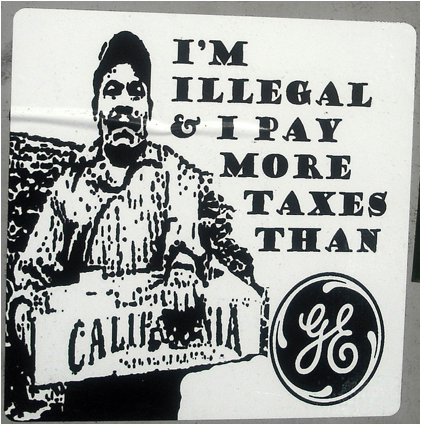
Empires weave their own self-serving and grandiose history while the vanquished are left to struggle for survival in the wreckage. A case in point is America’s current immigration crisis and its superficial analysis by the mainstream media which serves only to stoke racial fears amongst the ignorant masses while ignoring uncomfortable and disturbing root causes. The harsh reality is that America has a long history of carrying out covert and overt operations as well as instituting economic policies designed to exploit South and Central America, not to mention much of the rest of the world. One recent example was the 2009 coup of populist left-wing Honduran president Manuel Zelaya by elite military forces trained at the School of the Americas in Fort Benning, Georgia. Consider the following timeline of American intervention in Latin America since the 1950’s:
‘Free Trade’ for Corporations and Misery for Local Populations
Now consider the trade deals of NAFTA, CAFTA, and other “free trade” globalization schemes which have flooded our southern neighbors with cheap, subsidized produce from U.S. Big AG, decimating small farms and pushing millions off their land and into extreme destitution:
As part of neoliberal restructuring, Mexico would have to re-orientate its economy to the export rather than the domestic market. Mexico was already heavily dependent on trade with the US, but post-1982, Mexico’s dependency has become almost akin to that of a colony. US agricultural products – most notably corn – subsidised by American taxpayers now flooded the Mexican market, undercutting small domestic producers. For Mexican farmers the consequences have been ruinous and have devastated domestic production, a process which continues under the recent government of the National Action Party (PAN)…
…From the implementation of NAFTA in 1994 to 2000, 2 million farmers abandoned their lands. Fewer Mexicans now have access to health care and education than prior to 1980 as public spending has been cut as a result of ‘reforms’. By 2005 50 percent of the population had fallen below the poverty line, pushing some 3.3 million children under the age of 14 into work. Following the government’s agreement to exchange investment rights and trade barriers for loans and financial aid, Mexicans saw huge changes in their circumstances, such that by 1988 the cost of living had risen by 90 percent, while per capita income had fallen by some 50 percent. With the abandonment of social programmes, which alleviated at least some of the worst hardships, many communities in Mexico, with little or almost no help from the state, have had to fend for themselves…
…Much farming has since been replaced by agribusiness and large-scale meat farms, mostly foreign-owned. In recent years, widespread unemployment and the inability of farmers to gain an income from the land have meant that rural towns are being emptied of their inhabitants, leading to a tremendous population drain to the cities and the United States…Impoverished Mexican workers – employed primarily because they are cheaper to exploit than their US and Canadian counterparts – work to produce commodities which have no tangible benefit for their own society…
…The improved leverage of US power over Mexico’s economy is not solely an issue of having a workforce so ‘flexible’ that much of it is forced into sweatshop labour. The maquiladora belt functions effectively as an economic colony, with the local Mexican police, paid for by the Mexican taxpayer, providing the ‘security’ necessary for factories to operate unhindered by nuisance unions and human rights activists.
One of Mexico’s chief exports, then, is labour. Just as profits and goods leave the country, significant amounts of labour time are not reflected in the Mexican economy. Corporations benefit enormously from this win-win situation resulting in the continuing breakdown of society, a state of affairs reminiscent of a colonial economy, albeit without foreign control of what in any case is a pliant government. As a result, Mexican workers in the maquiladoras, notes Delgado-Wise, are little more than ‘manpower for foreign capital’.
While many of the poor seek work in factories owned by foreign companies or quit the countryside for work in the expanding metropolises, others cross into the US. If significant swathes of the arable land of northern Mexico are emptying, this is a trend connected intimately with free trade… – link
Militarizing the ‘Drug War’ and Arming Fascist Governments
So after destroying the means of survival for so many in Latin America, the poor and destitute turn to whatever means necessary in order to stay alive — crime, gangs, and the drug trade. The U.S. has reacted to this lawlessness by militarizing the “war on drugs”, providing even more weaponry and support to fascist governments who can then brutally squash any grassroots social movements which challenge the neoliberal capitalist order. It’s a vicious feedback loop in which the U.S. is forced to combat the very social disintegration of Latin America that U.S. economic policy has created. Thus, a fourth factor in America’s immigration crisis is the neocon militarization of the drug war and support of fascist governments aligned with U.S. corporate interests:
Narcotrafficking, like neoliberal capitalism, it seems, thrives in areas of severe poverty and unemployment where the civilian population is economically and politically disempowered and where state authorities are not powerful or willing enough to prevent the violent conflicts that narcotrafficking has produced. Additionally, for those who now have few opportunities in the traditional and legal sectors of the economy, narcotrafficking proves to be the only lucrative alternative…
…Civil society found itself vulnerable, impoverished and unable to rebuild the damaged and broken social services and infrastructure demolished by structural adjustment and neoliberal policy. Furthermore, the power and influence of the state have weakened in the last two and a half decades to the extent that in some areas drug traffickers operate quite freely and are immune to prosecution…
…With the authorities weakened, the line between the state and the narcotics industry is becoming increasingly blurred. A United Nations report estimated that between 50 and 60 percent of Mexican municipal government offices have been ‘captured or feudalised’ and coopted by narcotrafficking organisations. Mexican intelligence estimates that 62 percent of the Mexican police are presently under the control of the narco trade. According to rank and effectiveness, members of the police forces can receive anywhere between 5 to 70 thousand pesos monthly from cartels, a dramatic net increase on their state salaries. Of the 2.9 million arms given to the Mexican police forces, 57 percent are used in illicit activities.
Human Rights Watch reports that the military, in its purported struggle against the narcos, commits serious abuses against the civilian population, exposing its role rather as an institution of internal colonisation than one protecting society from violence. The same Mexican soldiers – potentially a force which could combat trafficking – are now deserting on a mass scale. Poor working conditions and pay led 217,000 Mexican soldiers to desert between 1993 and 2009. Among them, many leave the army to join the cartels and take their arms with them. One of the most powerful factions, the mercenary army, Los Zetas, was formed by deserters from an elite anti-drug squad of the Mexican army, taking with them their arms and training. Their sophisticated and professional tactics were developed, ironically, from training in the US by the DEA, the FBI and the US military in the war on drugs…
…Historian Miguel Tinker Salas has noted that in the case of Plan Colombia, military spending was intended to crush the strength of rural insurgents and guerrillas to offset the possibility of a popular rebellion, particularly as Colombia had among the worst levels of inequality in Latin America. In Mexico, maintaining a status quo which sees unprecedented levels of inequality and widespread poverty – exacerbated since the 1980s – is likely to involve the increasing use of force in order to quash the threat to the established order posed by social movements and popular revolt, all the more real as Mexico inches closer to collapse. Increasing attacks on organisers and activists of the anti-capitalist Zapatista initiative, La otra campaña, in Chiapas and the prolonged assault on inhabitants of Oaxaca in 2006 remind us that the state will always use military might to repress challenges to its authority and to the socio-economic order. US training of the Mexican military should be viewed in this light, bearing in mind that imperialism has two arms in Latin America – one military, the other economic.
Increasing poverty levels hardly seem to be a top priority for the leaders of the NAFTA signatories. For it is a state of affairs which benefits elites who have no interest in seeing ordinary Mexicans rise from poverty. Vast gaps between rich and poor may seem inexplicably cruel to outside observers, but within is a logic of which NAFTA was a clear expression. Rendering the population more desperate, reducing services and public spending, aggravating society’s vulnerability, rewards the powerful with greater political and economic dominance…– link
Climate Change and the Coffee Rust Fungus
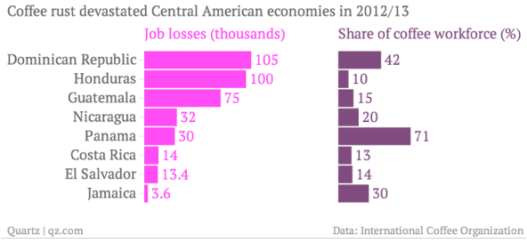
A fourth factor not discussed much is how climate change is wreaking havoc on the major South American crop of coffee which many rely upon for their livelihood and is the second most traded commodity in the world after oil. Coffee rust, known as “roya” in Spanish, first appeared in the region in the 1970s when climate change began to cause higher temperatures and excess rainfall favorable to the moisture-loving fungus. It has since mutated and spread throughout the region. Resistant coffee hybrids that scientists have created can’t keep up with the fast mutating rust fungus which seems to be growing stronger as climate change accelerates. For the past two years, the rust fungus called Hemileia vastatrix has destroyed 30% or more of the coffee harvest in Central America where coffee production employes one-third or more of the population in Guatemala, Honduras and Nicaragua :
All the coffee-producing countries of Central America have seen drops in production of 30% or more in each of the past two years. Some, such as Guatemala, report rising cases of chronic malnutrition in coffee workers’ children. Last week Oxfam cited coffee among other crops in a report that warned climate change was putting back the global fight against hunger “by decades”.
Nicaragua’s problem is particularly acute. Along with neighbouring Honduras, and Burma, it is already one of the three countries most affected by climate change, according to the 2013 Global Climate Risk Index. Nearly a third of its working population, about 750,000 people, depend on coffee directly or indirectly for a living. Coffee provides 20% of GDP. The Nicaraguan government is deeply worried: it has predicted that, because of falling rainfall and rising temperatures, by 2050 80% of its current coffee growing areas will no longer be usable.
This will mean disaster…
Warmer temperatures are also threatening a genetically diverse type of coffee called Arabica which is considered essential to the industry and comprises 70% of global coffee production. According to a recent study, by 2080 global warming will make two-thirds of today’s farms too hot to grow Arabica.
The three countries making up the largest percentage of child migrants that have been flooding the U.S. in recent times are Guatemala, Honduras, and El Salvador. These three countries also happen to be closely allied with the U.S. and its neo-liberal economic model. Nicaragua is an exception to its neighbors. Despite suffering similar losses to its coffee crop from rust fingus, Nicaraguan farmers did not fare as badly because they were supported by the programs of their socialist government, an anathema to America’s ruling oligarchs and neoliberal politicians:
In sharp contrast, Nicaragua, an equally poor country that receives far less U.S. aid because of our government’s hostility toward the Sandinistas, sends far fewer children across the U.S. border. Why? Since coming back into power in 2006, the Sandinistas have enacted strong programs designed to allow the poor to become self-sufficient.
The Immigration Issue: Red Meat for the American Masses
The only way to actually fix the immigration crisis is to address the root causes I have identified above. The response to date from the U.S. government has been to request billions in detention center and deportation funds, launch a PR campaign in the media of Central American countries to dissuade illegal immigration, and increase spending in law enforcement aid through CARSI (Central America Regional Security Initiative). Meanwhile, right-wing politicians fan the flames of racism and xenophobia with calls for militarizing the border to stop the hoards of swarthy barbarians at America’s doorstep. In reality, the current deteriorating social conditions in Central and South America are a direct result of the American corporatocracy and its rapacious economic system as well as anthropogenic climate disruption. The child migrants flooding across America’s border are, to a great degree, victims of U.S. foreign policy and climate change.
The . . . metamessage of our time is that the commodity form is natural and inescapable. Our lives can only be well lived (or lived at all) through the purchase of particular commodities. Thus our major existential interest consists of maneuvering for eligibility to buy such commodities in the market. Further, we have been taught that it is right and just—ordained by history, human nature, and God—that the means of life in all its forms be available only as commodities. . . . Americans live in an overcommodified world, with needs that are generated in the interests of the market and that can be met only through the market.
~ Stephen Fjellman, Vinyl Leaves:Walt Disney World and America
From the Amazonian tribe driven off its land by fossil fuel companies to the wage-enslaved city dweller dependent on mass-produced food and other commodities, no place on Earth has escaped the planet-wide reach of capitalist industrial civilization’s profit-extracting mechanisms. The oligarch’s of industry and banking shape public thought through an all-pervasive mass media monopoly, control legislation and regulation by pulling political purse-strings and commanding an army of lobbyists, sew death and mayhem with the global arms trade, sacrifice the next generation in resource wars, decimate ecosystems for short-term gain, manipulate and devalue currencies, create economic bubbles, and sell this entire vile process back to the masses as “progress” and “development” with measurements of inflated stock prices and skewed GDP figures. The untold human and environmental costs are now bursting at the seams with societal disintegration, epidemic mental illness, wide-scale resource depletion, industrial pollution and contamination, and the on-going collapse of the Earth’s biosphere.
If you’re wondering why there can never seem to be any significant action taken on climate change, don’t look for honest answers from those whose livelihood is tied to capitalism. If the true costs of the global industrial economy were calculated in terms of environmental damage, the ill-health effects on workers and the public, as well as the fraying of the Earth’s web of life, industries would find the costs too great to bear. The honest truth is that this ecocidal economic system would have to be dismantled for there to be any hope of humanity preserving a living planet and averting extinction.
“…big-time corporate capitalism is an omnicidal momentum. I mean, it just has one thing in mind, and it will destroy or weaken or co-opt anything in its way that is civic, that is democratic….corporations have been very clever A) in distracting people, especially young generation, with entertainment, with professional sports, turning them into spectators. Now you’ve got, you know, 24/7 entertainment. There’s no end to it. And they’ve also been very good in making people internalize a sense of powerlessness.” ~ Ralph Nader
Perhaps the three biggest crises facing civilization are unrestrained financialization of commerce and society, climate change, and peak oil (or peak net energy). Let’s take a quick look at how America is handling each of these crises:
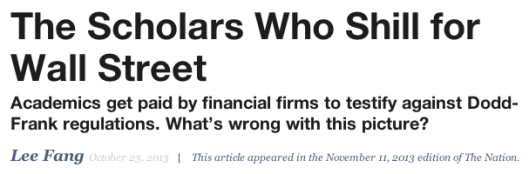
Employing paid shills for the financial industry is now simply standard operating procedure in the U.$.A.:
…Consumer advocates and independent analysts do their best to weigh in as well, but they are outgunned. Meanwhile, consulting firms dedicated to playing matchmaker between corporations and hired experts have flourished in the new regulatory environment. Director Charles Ferguson, whose film Inside Job highlighted the role of sponsored professors in supporting the deregulatory policies that led to the financial meltdown in 2008, says the business of economic consulting firms that work to “source” academics for expert testimony and regulatory filings “has been going on for quite a while, and it’s now quite a large industry.”…
Of course anthropogenic climate change, the existential threat of modern times, would seem to be a catastrophe deserving of mankind’s attention, would it not? Well, as you can see, the capitalist only views it as a public relations war:
An extensive study into the financial networks that support groups denying the science behind climate change and opposing political action has found a vast, secretive web of think tanks and industry associations, bankrolled by conservative billionaires.
“I call it the climate-change counter movement,” study author Robert Brulle, who published his results in the journal Climatic Change, told the Guardian. “It is not just a couple of rogue individuals doing this. This is a large-scale political effort.”
His work, which is focused on the United States, shows how a network of 91 think tanks and industry groups are primarily responsible for conservative opposition to climate policy. Almost 80 percent of these groups are registered as charitable organisations for tax purposes, and collectively received more than seven billion dollars between 2003 and 2010.
How about peak oil? Again, the energy industry has its PR machine in full swing touting America’s imminent energy independence along with many other myths, but commenter James of this blog cuts to the chase:
Now, which ponzi is most despicable, a religious or financial one? Both are based upon deceit and both serve primarily the enrichment of the scheme officialdom. One promises a payoff in eternal life while the other promises financial success. One examines your credit score while the other applies tick marks in you behavioral ledger of good and evil. Both systems of fleecing are based upon human fear and herd mentality. Society shuns the heretic of either ponzi and damnation awaits those that do not participate fully. Ponzis collapse when increasing numbers of fools, resources and energy can no longer be sucked into their cancerous growth schemes. The religious structures will be more enduring as they can always find plenty of poor dolts to give their last penny to gain a chance at the big after-life payoff. The financial schemers, faced now with meeting the absolutely unbelievable limits of growth will have to leave all those little nest eggs of promises, unhatched. The key is to convince the ponzi participants that the U.S. is the new Saudi Arabia, that fracking oil and natural gas is the future and we can get enough oil from shale to last a million years. “Just relax folks, you’re all gonna get your money back”. Not. What a miraculous world we live in.
As you can see, America is handling all three crises like a sleazy car salesman unloading a lot full of lemons.
And if anyone was spooked by the Snowden revelations of government spying, the implications of corporate espionage on social-change organizations that threaten to impede unfettered access to profits is truly terrifying.
Although I’m not a particularly religious person, all evidence does point to a civilization which has completely succumbed to the worship of Mammon:
…The fruits of such idolatry are clear: the injustice and unemployment and waste of human talents; the corruption of our political leadership and their collusion with immoral financial practices; the depredation and degradation of our natural environments and the exhaustion of our natural resources; the inevitable wars and other crises that arise from the systematic fostering of base human appetites and the refusal to compromise our ways of life, and pursue a more equitable sharing of the gifts bequeathed to us…
I would not blame anyone for wanting to seek comfort in a bottle or some other form of self-medication, but perhaps doing something more dramatic to escape this nightmarish reality of a thoroughly corrupted, money-worshipping society is in the cards. When your back is against the wall and you’ve lost faith in everything, then revolution is the antidote for the “pseudo-realities” that plague us.
“Because today we live in a society in which spurious realities are manufactured by the media, by governments, by big corporations, by religious groups, political groups… So I ask, in my writing, What is real? Because unceasingly we are bombarded with pseudo-realities manufactured by very sophisticated people using very sophisticated electronic mechanisms. I do not distrust their motives; I distrust their power. They have a lot of it. And it is an astonishing power: that of creating whole universes, universes of the mind. I ought to know. I do the same thing.” ~ Philip K. Dick
The specter of death, near-term extinction, haunts us as we silently endure the evil and decay all around us, going along just to get along in the belly of the American empire. One day pent-up anger and hunger will burst forth, pushing us into the streets. Blood and emotions will flow freely. Inept and crooked governments will fall. We’ll have nothing left to lose.
You almost have to feel sorry for the conservatives, tea partiers, and the whole menagerie of free market evangelists these days. Even a casual perusal of AM talk radio, along with the buffoonery and gas baggery of the hard right news shows, one can see evidence of collapsing narratives at every turn.
Our disintegrating social conditions demand a plausible explanation from the right, and any such explanation, ideologically, must be sure to exonerate capitalism and the free market system.
This is becoming increasingly hard to do, as the shrill and contradictory defenses put forth become less satisfying every time the story is told. The story evolves, the audience reactions carefully polled, and the messaging refined to try and adapt to a low information audience growing more skeptical by the minute. There are many versions of the same story, depending on who tells it and more importantly who is paying for it, but for this discussion we are interested in the narrative brought forth by the evangelical right, and their socially conservative stable mates, or in general, the fire and brimstone crowd accounting for something near half of the American population.
The operating theory of this cohort centers for the most part on morality, or lack thereof, as principal cause for our society’s collapse.
Rush Limbaugh provides a pathetic but typical example of this type of addled logic:
The reason all of these stats on income inequality don’t work anymore is because the baseline for the statistical start is the fifties. Now, what was happening in the fifties? Well, in the fifties we had this thing called a nuclear family. There was a mother, a woman. There was a father, a man. They had babies by engaging in coitus. Leave It To Beaver, Ozzie and Harriet — hell, even the Beach Boys, for crying out loud! They were seemingly clean and pure as the wind driven snow.
Anyway, then after the coitus in the bedroom, then little Beaver was born and then Wally, and there were 2.8 of the kids and little picket fence and (if the dad got a vice presidency), there were two cars in the garage, and mom — the female. I’ve gotta make that distinction. The mother was a woman, the wife of a man. She stays home, raises the kid, fixes breakfast, sends ’em off to school, talks to the PTA. There was all that. There was one breadwinner, and there was an economic boom going on at the same time, following World War II.
Incomes in America rose dramatically. Then something happened. The left didn’t like that arrangement. That was just bad. They didn’t fit in. They didn’t like the idea of coitus in the bedroom. They didn’t like coitus with someone the opposite sex, necessarily. They didn’t even like coitus as a means of producing a kid. In fact, most times they didn’t even like the kid. They wanted to have the abortion. So what happened was that the nuclear family became under assault by “progressive” forces of modernization.
So today, you can’t compare family income today to what it was in the fifties when the boom time ’cause the family’s not the same. You’ve got single women, single-parent families, fewer nuclear families. Incomes have been divided. It doesn’t work.
Who knew?
The root of American ethics and morality stems in part from its heavily Protestant and Calvinistic theological underpinnings, which we might well reduce to the “Puritan” ethic. There are several key components of this behavior, tracing back to the late 17th century:
1. Personal sacrifice fulfilled by austere living conditions.
2. Self-sufficiency and disdain of charity for one’s self.
3. Obsessive work ethic fueled by the notion that idleness is evil.
Of course there are others, but we can use these generalizations to continue. In addition we should mention that Calvinism utilizes the principle of predestination, or predetermination, a fundamental departure from modern evangelical Christianity.
The rollup of these centuries old dogmatic beliefs is a programing bias towards moral explanations for when things go wrong, and strong lifestyle choices that dictate high moral standards when times are normal, in order to stave off any potential (future) fall from grace. The modern evangelical right has conflated this DNA to represent a distorted view of Christianity leaning heavily on Capitalism-which has fascist underpinnings in its ultimate embodiment.
In the Flat Fields
A gut pull drag on me Into the chasm gaping we Mirrors multy reflecting this Between spunk stained sheet And odorous whim Calmer eye- flick- shudder- within Assist me to walk away in sin Where is the string that Theseus laid Find me out this labyrinth place
I do get bored, I get bored In the flat field I get bored, I do get bored In the flat field
What is often lost in our current infatuation with Enlightenment thinking is the degree to which the Pre-Enlightenment Church managed commerce, financing, and general market forces. In fact, the Church maintained an iron hand on issues such as usury, which was condemned and not distinguished from the “normal” practice of charging interest until the late 19th century.
In the age of Church hegemony, which lasted for centuries, it was considered immoral, and grossly so, to profit in any way through trade, charging interest, or commerce which resulted in a profit without actually performing any work. specifically, any rent seeking activity was forbidden.
Things that are considered commonplace today, such as raising prices for items needed in a disaster, (supply and demand) were thoroughly rejected by the Church and considered inconceivable during that time. Thomas Aquinas brought forth these concepts in the theory of Just Price in his Summa Theologica circa 1274 AD. Although this was clearly a Pre-Capitalist economy, much learning was put towards strict management of commerce dating back to the money changers being expelled from the temple in Biblical times- a theme oft repeated through the Dark Ages and well beyond.
For centuries, civilizations knew full well the dangers of markets and unconstrained commerce, and there is more than a passing connection between this realization and theology, present in virtually all religions throughout time.
This reality has been brought to the fore with the recent, and controversial, exhortation Evengelii Gaudiumfrom the Roman Catholic Pope. Pundits have been zeroing in on the more provocative aspects after his release of the document last month. I’ve read all 244 pages of it and I’m here to tell you that he has pretty well burned down the Christian right’s moralistic narrative along with a good bit of the more mainstream conservative cohort.
For those who have dismissed previous Papal exhortations (as well as any other messaging, written or otherwise delivered) as irrelevant and hypocritical drivel, and I count myself on this list, the recent missive is a shocker. Let’s take a look as some selected passages:
We can no longer trust in the unseen forces and the invisible hand of the market. Growth in justice requires more than economic growth, while presupposing such growth: it requires decisions, programmers, mechanisms and processes specifically geared to a better distribution of income, the creation of sources of employment and an integral promotion of the poor which goes beyond a simple welfare mentality. I am far from proposing an irresponsible populism, but the economy can no longer turn to remedies that are a new poison, such as attempting to increase profits by reducing the work force and thereby adding to the ranks of the excluded.
…
The need to resolve the structural causes of poverty cannot be delayed, not only for the pragmatic reason of its urgency for the good order of society, but because society needs to be cured of a sickness which is weakening and frustrating it, and which can only lead to new crises. Welfare projects, which meet certain urgent needs, should be considered merely temporary responses. As long as the problems of the poor are not radically resolved by rejecting the absolute autonomy of markets and financial speculation and by attacking the structural causes of inequality,[173]no solution will be found for the world’s problems or, for that matter, to any problems. Inequality is the root of social ills.
Now this passage in particular stands out, and is a recurring theme throughout the document. Inequality is the root of all social ills. Not moral misbehavior. Rush Limbaugh is positively foaming at the mouth with this conclusion. You see, the story as told has to exonerate Capitalism, so the explanatory focus is redirected to not just suggest, but to demand that the moral lapses of the populace are the sole causality of a world gone bad.
After all, the world was given to us with abundance, work hard, maintain high moral standards, and its abundance will never run out. No limits to resources, no environmental disasters, no exploitation, nothing but paradise, unless of course you take a bite of that apple.
Let’s go on:
Sometimes we prove hard of heart and mind; we are forgetful, distracted and carried away by the limitless possibilities for consumption and distraction offered by contemporary society. This leads to a kind of alienation at every level, for “a society becomes alienated when its forms of social organization, production and consumption make it more difficult to offer the gift of self and to establish solidarity between people.
Karl is that you?
Genuine forms of popular religiosity are incarnate, since they are born of the incarnation of Christian faith in popular culture. For this reason they entail a personal relationship, not with vague spiritual energies or powers, but with God, with Christ, with Mary, with the saints. These devotions are fleshy, they have a face. They are capable of fostering relationships and not just enabling escapism. In other parts of our society, we see the growing attraction to various forms of a “spirituality of well-being” divorced from any community life, or to a “theology of prosperity” detached from responsibility for our brothers and sisters, or to depersonalized experiences which are nothing more than a form of self-centredness.
This would seem to be a dig at modern “strip mall religiosity” as it is now de rigueur to have non denominational churches in strip malls, repurposed industrial buildings, etc, all which have superficial distorted messaging, often pronouncing how wealth is your divine right.
Today’s economic mechanisms promote inordinate consumption, yet it is evident that unbridled consumerism combined with inequality proves doubly damaging to the social fabric. Inequality eventually engenders a violence which recourse to arms cannot and never will be able to resolve. It serves only to offer false hopes to those clamouring for heightened security, even though nowadays we know that weapons and violence, rather than providing solutions, create new and more serious conflicts. Some simply content themselves with blaming the poor and the poorer countries themselves for their troubles; indulging in unwarranted generalizations, they claim that the solution is an “education” that would tranquilize them, making them tame and harmless. All this becomes even more exasperating for the marginalized in the light of the widespread and deeply rooted corruption found in many countries – in their governments, businesses and institutions – whatever the political ideology of their leaders.
…
Today in many places we hear a call for greater security. But until exclusion and inequality in society and between peoples are reversed, it will be impossible to eliminate violence. The poor and the poorer peoples are accused of violence, yet without equal opportunities the different forms of aggression and conflict will find a fertile terrain for growth and eventually explode. When a society – whether local, national or global – is willing to leave a part of itself on the fringes, no political programmes or resources spent on law enforcement or surveillance systems can indefinitely guarantee tranquility. This is not the case simply because inequality provokes a violent reaction from those excluded from the system, but because the socioeconomic system is unjust at its root. Just as goodness tends to spread, the toleration of evil, which is injustice, tends to expand its baneful influence and quietly to undermine any political and social system, no matter how solid it may appear. If every action has its consequences, an evil embedded in the structures of a society has a constant potential for disintegration and death. It is evil crystallized in unjust social structures, which cannot be the basis of hope for a better future. We are far from the so-called “end of history”, since the conditions for a sustainable and peaceful development have not yet been adequately articulated and realized.
So now we get to the money shot:
While the earnings of a minority are growing exponentially, so too is the gap separating the majority from the prosperity enjoyed by those happy few. This imbalance is the result of ideologies which defend the absolute autonomy of the marketplace and financial speculation. Consequently, they reject the right of states, charged with vigilance for the common good, to exercise any form of control. A new tyranny is thus born, invisible and often virtual, which unilaterally and relentlessly imposes its own laws and rules. Debt and the accumulation of interest also make it difficult for countries to realize the potential of their own economies and keep citizens from enjoying their real purchasing power. To all this we can add widespread corruption and self-serving tax evasion, which have taken on worldwide dimensions. The thirst for power and possessions knows no limits. In this system, which tends to devour everything which stands in the way of increased profits, whatever is fragile, like the environment, is defenseless before the interests of a deified market, which become the only rule.
And
One cause of this situation is found in our relationship with money, since we calmly accept its dominion over ourselves and our societies. The current financial crisis can make us overlook the fact that it originated in a profound human crisis: the denial of the primacy of the human person! We have created new idols. The worship of the ancient golden calf (cf. Ex32:1-35) has returned in a new and ruthless guise in the idolatry of money and the dictatorship of an impersonal economy lacking a truly human purpose. The worldwide crisis affecting finance and the economy lays bare their imbalances and, above all, their lack of real concern for human beings; man is reduced to one of his needs alone: consumption.
…
In this context, some people continue to defend trickle-down theories which assume that economic growth, encouraged by a free market, will inevitably succeed in bringing about greater justice and inclusiveness in the world. This opinion, which has never been confirmed by the facts, expresses a crude and naïve trust in the goodness of those wielding economic power and in the socialized workings of the prevailing economic system. Meanwhile, the excluded are still waiting. To sustain a lifestyle which excludes others, or to sustain enthusiasm for that selfish ideal, a globalization of indifference has developed. Almost without being aware of it, we end up being incapable of feeling compassion at the outcry of the poor, weeping for other people’s pain, and feeling a need to help them, as though all this were someone else’s responsibility and not our own. The culture of prosperity deadens us; we are thrilled if the market offers us something new to purchase. In the meantime all those lives stunted for lack of opportunity seem a mere spectacle; they fail to move us.
Just as the commandment “Thou shalt not kill” sets a clear limit in order to safeguard the value of human life, today we also have to say “thou shalt not” to an economy of exclusion and inequality. Such an economy kills. How can it be that it is not a news item when an elderly homeless person dies of exposure, but it is news when the stock market loses two points? This is a case of exclusion. Can we continue to stand by when food is thrown away while people are starving? This is a case of inequality. Today everything comes under the laws of competition and the survival of the fittest, where the powerful feed upon the powerless. As a consequence, masses of people find themselves excluded and marginalized: without work, without possibilities, without any means of escape.
Human beings are themselves considered consumer goods to be used and then discarded. We have created a “throw away” culture which is now spreading. It is no longer simply about exploitation and oppression, but something new. Exclusion ultimately has to do with what it means to be a part of the society in which we live; those excluded are no longer society’s underside or its fringes or its disenfranchised – they are no longer even a part of it. The excluded are not the “exploited” but the outcast, the “leftovers.
So this goes on in a similar vein, and this position does not bode well for the conservative narrative. We see capitalism explicitly blamed for inequality, and in turn inequality for societies ills, a disturbing cause and effect that is disruptive to the American status quo. Coming from a supposedly impartial and world recognized voice of moralistic guidance, this is particularly damning.
We have to ask given the (millennial) history of precisely just this set of teachings, where the hell have these people been for the last 400 years? Mired in child molestation cases, and other aspects of immeasurable hypocrisy, that’s where. Typically dispensing irrelevant teachings to a disinterested world, met with a yawn and the clink of coins in the Sunday collections basket, the cafeteria Catholics and faithful parishioners buy their penance on the free market of theology, shopping for workable edicts and morals they can live with, and leaving aside things that might prove troublesome.
And the Church, let’s not (yet) get all misty eyed that the new Pope has found his voice, that the Holy See can finally see after 400 years of Post Enlightenment blindness, because if we learned anything in the Dark Ages we learned the Church was an authoritarian, totalitarian institution, honed to perfection after centuries of practice, misappropriating Christianic themes in furtherance of its own power and hegemony. Restricting knowledge, capturing books, and distorting, twisting and interpreting discovery with a certain malleability of facts, and containing science to maintain its omnipotence.
It is worth noting that at its core, the Church operates as a corporatist entity, with significant focus on profits itself, poisoned if you will, by the very same sickness it chastises. So we might well leave the discussion here, hopeful that the new Papal vision will at least upset some belief systems, and file this under the category of good ideas for the wrong reasons, and move on to other superficial topics. Except that we have 2000 years of history here, history that resonates with this same message, repeated in many ways over and over again. We have a seminal event in the Enlightenment, which purported to shut down the fiefdoms, mysticism and fanciful explanations, replacing it with science and reason to wrest the power and authority from cloistered theocrats.
And this has failed.
None of the Post Enlightenment theories of political economy have provided satisfactory, sustainable solutions despite 400 years of trying. By most measures, they are in fact worse. The current fashionable trend to double down on technology as means of providing solutions is not working, and critical thinkers can see these measures are leading to cascading failure modes, with each technological “breakthrough” creating new and unanticipated failures of their own, with insufficient study as to unanticipated outcomes.
I had occasion last month to attend a talk by Chris Hedges, the first time I have heard him in person. The venue was in Santa Monica in a historic building now owned by the Women’s Club, a depression era wood structure with a whitewashed paint job, faintly reminiscent of a church. The venue was packed to the rafters, with the upstairs balcony fairly bulging under the weight of way more people wanting to see Hedges than the organizers anticipated. Everyone finally got in to the standing room only crowd. Hedges has found his voice, he is articulate in person, but powerful, vocally projecting in a way I’ve not seen him do in taped interviews where he seems more reflective and almost mournful. His message is a powerful force and it is clear his upbringing under a Presbyterian minister (his father) and his education in seminary converge to forge his style and messaging. The emotion and power left me somewhat stunned, I wasn’t prepared for the electricity in the room and palpable agitation of the attendees who know full well the truth in his message.
It might seem that these events conspire to ordain a germ of an idea, a small, kindled spark that suggests, almost horrifically, that the assemblage of the capitalist mode of production is not a just theory of economics or political economy. It is not merely an exchange of commodities or a clever and oblique system of exploitation. It is not just a mechanism for conflicting class structure or means for the landed nobility to hold down the masses.
It is a religion, a theology so all consuming that it transcends borders, boundaries, catechism and Koran. It extends to every denomination, to every corner of the earth with a deification and worship of commerce and consumption so deeply ingrained that there is no inoculation once infected. Its participants trapped in a purgatory analogous to opium dens, transient pleasure of consumption and accumulation, but in the 19th century opium dens most knew to advise a friend to retrieve them after several hours (or days) as they would be unable- and unwilling- to leave on their own.
In this version, no one is coming to get you out, there is no getting out. No one is free from the addictive vapors of consumption.
a) First of all because, as we have seen, capitalism, by defining itself as the natural and necessary form of the modern economy, does not admit any different future, any way out, any alternative. Its force is, writes Weber, ‘irresistible’, and it presents itself as an inevitable fate.
b) The system reduces the vast majority of humanity to ‘damned of the earth’ who cannot hope for divine salvation, since their economic failure is the sign that they are excluded from God’s grace. Guilty for their own fate, they have no hope of redemption. The God of the capitalist religion, money, has no pity for those who have no money . . .
c) Capitalism is ‘the ruin of being’, it replaces being with having, human qualities with commodified quantities, human relations with monetary ones, moral or cultural values with the only value that counts, money.
d) Since humanity’s ‘guilt’ – its indebtedness towards Capital – is permanent and growing, no hope of expiation is permitted. The capitalist constantly needs to grow and expand his capital if he does not wish to be crushed by his competitors, and the poor must borrow more and more money to pay their debts.
e) According to the religion of Capital, the only salvation consists in the intensification of the system, in capitalist expansion, in the accumulation of more and more commodities; but this ‘remedy’ results only in the aggravation of despair.
So in other words, the will of God is substituted by the will of the market. The Saints of Capitalism are not represented by iconography in dusty church alcoves, rendered in plaster bas relief, illuminated by flickering votive candles aligned in perfectly concentric rows, no, these saints are reproduced on our paper money, mass produced by photoengraved plates and scaled to feel, to touch, with every transaction to reacquaint and remind the heathen that this is the portal to eternal salvation.
Our cathedrals are not limestone structures of centuries production, flying buttresses soaring gracefully to the heavens, constructed of a scale to intimidate and instill perspective of scale between creator and subject, no these cathedrals are chrome and glass, with banal and endless rows of cubicles for the disciples to prosthelytize to the unwashed masses, “lift yourself, take our hand and elevate yourself to the glory of all the money is and can be”.
Consume or be consumed, the entire New Testament may be reinterpreted not as a warning of end times, not as a statement of worldly evangelism, but each parable and writing a searing indictment and prophetic warning of a planet destroying insidious religion about to rise. The Original Sin may well be reduced to being born into a world which requires you to sell your labor power for survival, the baptism a cleansing in preparation of a lifelong participation in commodity exchange- labor for goods.
There is no expiation in the religion of Capitalism, it is game theory analogous to Newcomb’s Paradox, a contrivance where an omniscient being gives you two choices, one of which is already made for you, and analyzes your strategy for utility maximization when you know that your choice is already predetermined- and you cannot change the outcome.
Capitalism has, throughout its history, built itself off the backs of the weak through dispossession, slavery, colonialism, technology and military power. Protecting the capitalist system into the 21st century, U.S. military served as the all-powerful proxy force of the global corporate elite. In the waning days of modern-day civilization, transnational corporations found even more ways to amass power and squeeze out every last penny from the Earth to the gods of capital. In the name of ‘free trade’, secretive agreements with alphabet soup-acronyms like TTP and TPIP were concocted to protect and expand profits as well as investor returns at the expense of all else, including the sovereignty of nations and the very habitability of the planet. Corporations became the new kings and queens, tsars and tsaritsas, bishops and popes. The last grab for what was left could now be done more swiftly while circumventing the laws of nations.
“…Capitalism has an inbuilt wondrous capacity of resurrection and regeneration; though this is capacity of a kind shared with parasites – organisms that feed on other organisms, belonging to other species. After a complete or near-complete exhaustion of one host organism, a parasite tends and manages to find another, that would supply it with life juices for a successive, albeit also limited, stretch of time.
A hundred years ago Rosa Luxemburg grasped that secret of the eerie, phoenix-like ability of capitalism to rise, repeatedly, from the ashes; an ability that leaves behind a track of devastation – the history of capitalism is marked by the graves of living organisms sucked of their life juices to exhaustion…” ~ Zygmunt Bauman
In a world of finite resources controlled by a tiny capitalist class, there would eventually only be two classes remaining – the über-wealthy or global elite and the vast underclass of disposable workers who eked out a subsistence existence. The wealth of society continued to be funneled upwards to the corporate overlords by way of deregulation, privatization, low or nonexistent tax rates, control of the legal system, and the cutting away of any last scraps of a social safety net.
Preoccupied by their digital screen devices and satiated on mass-produced junk food, the plebs never really noticed they were living in an open-air prison. In the meantime, the walls of a police state rose up to protect the sociopathic elite. As long as the ‘consumers’ were kept in a continual state of ‘amusement madness’ and on the treadmill of work exhaustion, there would be no time for contemplating the reality of climate change, the ever-widening wealth gap, the rise of a corporate fascist state, or the disappearance of the natural world.
“Living in an age of advertisement, we are perpetually disillusioned. The perfect life is spread before us every day, but it changes and withers at a touch.”
~ J. B. Priestley
This Ponzi scheme economy was so entrenched in the psyche of the general populace that essentially none questioned its validity, even in the face of increasingly chaotic weather and rising seas, mountains of toxic waste, lifeless oceans, epidemic industrial disease, and grotesque wealth maldistribution. The right to seek profit trumped the health and safety of humans, the stability of the environment, and the legal recourse of governments on behalf of their citizens. National borders were effectively erased and a global corporatocracy now ruled the planet. Ironically, the one world government feared by so many right-wing conspiracists had become reality without any protest from them.
Acid rain and erratic weather, the unintended consequences of half-baked geoengineering fixes, forced most food production into industrial greenhouses. Due to the chemical pollution levels in the environment, all water had to be treated before it was used for anything, and gas masks became ‘everyday outdoor wear’ like hats and umbrellas. Most stayed indoors to escape such hazards, immersing themselves in the artificial environments of virtual reality software. Zoos became the only sanctuaries for wildlife, their sperm safely kept frozen for the day humans might want to de-extinctify them. National parks were privatized and plastered with corporate logos. The ranks of the homeless and destitute swelled, but most soon found themselves living inside the cell of a private, for-profit prison where they toiled away as cheap labor contracted by the corporations. Such crises were always looked upon as business opportunities, a niche to fill in the profit-seeking mind of homo economicus. Commodification and commercialization of everything became completely normalized.
Taken to the extreme and turned into a rigid belief system, all ideologies can become dangerous. When the ethics of a society bow to laissez-faire capitalism, life in the U$A becomes a cruel joke:
Need I go further? The day that the movie ‘Idiocracy’ is looked upon as genius and prophetic, civilization will have become a parody of itself. I think that day has arrived.
On the eve of what could be WWIII and the further barbarization of the Middle East at the hands of the American Empire and its vassal states, I think it’s important we look behind the wall of pro-war corporate media and understand what the facts on the ground really are. The following essay is a reblog from a website I just discovered and it gets into the nitty-gritty of the blowback from America’s perverse foreign policy in regards to Syria. When a nation supports democracy in name only and crawls in bed with terrorists to carry out regime change, then an entire region eventually becomes destabilized and thrown back into the hands of those dark forces which America purports to be fighting against in its so-called “global war on terror”. In reality, the American corporate state would rather have foreign nations with brutal dictators installed who will carry out America’s bidding rather than a democracy which looks after the best interests of the local people. Why else would the U.S. have overthrown Prime Minister Mossadeq of Iran or become the strongman for the corrupt House of Saud if not for the black oily stuff to which we are so addicted? When it is said that “women are literally blacked-out in the public sphere” in Saudi Arabia, the connotations are quite literal. Below is a picture taken by a friend who has worked in Saudi Arabia. It depicts a department store advertisement display which has been altered to conform to their brutally misogynistic society.
‘Humanitarian concerns’ and ‘social justice issues’ are merely empty rhetoric used by our sociopathic leaders as cover for protecting the grossly unjust social hierarchy of global capitalism. Some call this “corporate feudalism” while others say it is endemic to capitalism. One only has to look at the growing global wealth disparity to know this is true. The elite are drooling for war while the world races towards catastrophic resource depletion, environmental apocalypse, collapse of industrial civilization, and a new Dark Age.
One important issue that was missing from his talk (and is missing in almost all discussions on Syria) is the threat to the rights of women if the Assad regime falls. This is no small issue. One thing that surprised me during my visit to Syria is how Western it was compared to other Arab and Muslim countries in the region. Women’s dress is not restricted in Syria and they play a very important public role in society when compared to other Arab countries. Muslim fundamentalists and suicide bombers in Syria do have a Sharia Law agenda that they want to impose on the country. This is not theory. All one has to do is look to neighboring Iraq to see the deterioration of women’s rights in the post-Saddam era. Women used to wear miniskirts, show their hair and walk without fear in Baghdad. Now the situation has completely reversed. Women are forced to cover and are expected to stay at home. If they do not abide by this social practice, they are publicly shamed, and, in more extreme forms of Sharia justice, are raped and murdered.
An Iraqi friend told me that when he returned to Baghdad after the war he was stunned that women were no longer even comfortable speaking to him in public for fear of being thought of as whores. His experience of the status of women in public before the war was the polar opposite of the reality that one is now faced with in Iraq.
One should also note that the situation in neighboring Turkey has taken a turn for the worse in recent years under the Sunni AKP government. The rate of violence against women has sky-rocketed. Wives, fiancés and girlfriends have been murdered by their male partners at a rate that is 1400 percent higher than 7 years ago. This is the same AKP government that is supplying their Sunni rebel ‘brothers’ in Syria with weapons.
There is a severe lack of discourse about what the consequences are for women if and when the Assad regime falls in Syria. It is clear why the Muslim extremists working in concert with Al-Qaeda in Syria do not talk about women in their fight for ‘democracy’. Women for them are marginal, servile and functional creatures who are to be neither seen nor heard in public life.
Christians, Kurds and Minorities
In the question and answer period after Mr. Landis’ you will note that there is a Syrian Christian man asking a question about the rights and status of Christians in Syria after a Sunni extremist takeover of the country. He is very concerned about this issue and he has good reason to be. Since the beginning of the so-called ‘revolution’ there have been many incidents of rebels killing Christians and bombing churches all over Syria. The chant of the fighters has been: “The Alawite and Christians to Beirut!” The intentions can’t be made any clearer. Nobody will be safe in Syria after Assad except orthodox Sunni Muslims. Mr. Landis made this very clear to the Christian man when he said that the solution for Turkey was ethnic cleansing. The reason there is no problem in Turkey with Christians is because there are no more Christians. They used to be 20% of the population. Those who were not killed or deported were forced to convert to Islam. All that is left of Christianity in Turkey are ancient Christian sites that are advertised to attract tourists to the country. Istanbul, which is still the seat of the Eastern Orthodox Church, barely tolerates what is left of the Christian community there. The Church has virtually no sovereignty and is at the mercy of the government and its flock has dwindled to almost nothing, when compared to its vibrant past.
If ethnic cleansing and forced conversion has been Turkey’s solution for diversity, take a look at the other country that is supplying weapons and Islamist fighters to topple Assad: Saudi Arabia. There is no country in the world that is as intolerant and anti-democratic as Saudi Arabia. Churches are illegal in that country. Women are literally blacked-out in the public sphere in dress. Saudi is also the only country in the world where women are not allowed to drive. Women are subservient to men in the name of extreme Islam and Bedouin tradition. If Turkey and Saudi are the main suppliers of weapons and training of the rebels in Syria, one needs to reflect on what kind of culture is intended to be put in place after the fall of the secular and tolerant regime that is currently hanging on to power.
The Kurdish issue is an extremely volatile issue in Syria. Assad extended greater freedoms and autonomy to the Kurds via political reforms passed after the initial protests had begun. The Kurdish leadership in Syria has already openly stated that if Syria is attacked by Turkey, they will fight on the side of Assad. This issue presents potentially grave consequences of blowback for Turkey. In recent days the Turkish Prime Minister stated that Turkey may need to invade northeastern Syria to crush the Kurds there if they get too powerful. This would mean that Turkey would be fighting its war with the Kurds on three fronts. It is already battling a guerrilla insurgency within its borders and regularly attacks Kurds in northern Iraq…. Read the entire essay
I’ve heard that 70% of American workers are “disengaged” or “checked out” at their job; in other words, they hate their work. This statistic is as good as any in illustrating the moribund nature of life in 21st century industrial civilization. No wonder zombie movies are so popular these days. In America’s 9 to 5, cog-in-the-corporate-wheel life, a majority of the population feels like the living dead, thoughtlessly going through the motions of slave-wage work in order to race home and crash in front of the boob tube with a microwaved dinner. Not much energy left in the day to do anything but drift to sleep while flipping through endless channels of Hollywood sitcoms, infomercials, and consumer-friendly corporate news. For the vast majority, the best hours of one’s life are spent performing this lifeless routine day in and day out. The banal and deadening existence of industrial civilization appears to be wearing on the masses, and a vague awareness of its unraveling seems to be understood on at least a subliminal level — another 100 species drops off the face of the Earth today, ice sheets and glaciers disappear at a rapid clip, weather patterns become erratic and unstable, street protests erupt in various countries, talk of pulling the plug on the money presses roils “the market”, etc.
Amongst the human chatter, some people rationalize such unusual events as acts of God, others as an illuminati conspiracy, while many believe it’s just the natural variability of the world and nothing to worry about. Forming a consensus on anything, let alone climate change, from such a divergent array of thinking in a global population of billions with different languages, governments, and cultures would be a feat of biblical proportions indeed. The hope of any significant portion of the population unplugging from industrial civilization and its carnival-like atmosphere can safely be called a pipe dream. Empire and the allure of industrial civilization entraps nearly all who enter.
Like puppets on a marionette string, the legions of indoctrinated consumers pursue the latest material object to fill a void left by everything industrial civilization destroyed. Those who step foot on this out-of-control treadmill find themselves on a trip to oblivion in which, quite literally, everything will be forgotten, as in ‘NTE’. Although jumping off this treadmill certainly has its benefits, in the bigger picture everyone gets carried over the cliff by the catatonic actions of the majority. There’s no escaping what has been called the greatest “bioevent” in geological history, from which a distinct record of our rampage through the fossil fuel carbon deposits will follow us into the Earth’s strata.
Talk of hardening communities to the effects of a destabilized and fast deteriorating climate will make the phrase “quality of life” a cynical joke; therefore, a redefining of “the good life” is essential in a future of climate chaos. The new definition certainly won’t include vacations in Miami, unless you plan on scuba diving. And the standard American dinner of meat and potatoes will likely change to simply having a stomach temporarily free from hunger pains after dining on insects, roasted rodent, and foraged weeds. And as far as a lifetime of gainful employment, everyone will be self-employed in the field of survivalism, i.e. “every man for himself.” Climbing up the “rungs of progress” will go into reverse, becoming a regress into medievalism. Of course remnants of Techno-fundamentalism will still exist, but they’ll mainly be confined to the realm of the world’s only remaining type of government – totalitarian technocracies.
There are quite a few who believe that we can hang on to some semblance of today’s global planet-killing civilization, but with so many vectors of collapse converging upon us we’ll be lucky if humans themselves survive in any significant number greater than zero. Throughout history, Empires have grown by stealing resources and energy from others. Ours is no different except that now the criminal elite have colonized the entire world under the guise of the “free market.” The school of neoclassical economics assumes unending supplies of cheap energy and resources for continued growth while ignoring waste and pollution, externalizing those costs upon the environmental commons. Money printing hasn’t solved or circumvented this false belief. It has only created phantom wealth in stock markets and asset bubbles. Today’s professional psychopaths in suits are no different than those in the past who took millions of lives with them to the grave, but this time it’s a mass extermination on a global scale — 7 billion people and counting, along with all other living things.
My internet is still down, but will hopefully be back up by tomorrow night so I can put out a few posts I was contemplating. In the mean time, an interesting excerpt from a new book by Roberto De Vogli, associate professor in global health at the University of California Davis and University College London.
Excerpt…
And of course it continues today as has been discussed in previous posts on this site. So much for the “free market”.
In order to understand why the world is locked into a blind stampede over a cliff, you have to understand how the world runs, i.e. its socio-economic system. A large percentage of the population doesn’t understand that the world is ruled by multinational corporations or that the citizenry are simply disposable pawns with no voice in their fate.
The capital that flows around the world, betting on essential staples of life and demanding that barbaric austerity measures be imposed upon the masses, is an entity of its own. It’s a massively destructive force that enslaves people and rips apart the environment. In the Banana Republic of America where a once thriving middle class was sold down the river, nearly half of workers will have a budget of $5 per day when they reach retirement age. Maybe McDonald’s will create a 99 cent meal to cash in on that starving demographic. Oh, they already have…
As far as the environment goes, it is a doormat for the creation of money:
When you have such an immovable supersystem of puppet governments and marauding transnational corporations running the show, radical movements questioning and trying to change the status quo are easily co-opted or crushed, a recent example being the Occupy movement. In a world where extinction of the human species is guaranteed by climate chaos and the myriad of other crises created by industrial capitalism, a slow and incremental regimen of change is not what is needed to stave off collapse. Unfortunately, the entrenched interests of the financial elite and the nation-states they control won’t allow for any sort of abrupt and profound transformation. As Professor Julian Cribb has correctly identified, a culture of money worship and the mass delusion of money’s illusory value is at the heart of the global crisis. The high priests of money are protected at the expense of all else:
Show me a democracy that has an impoverished public life and I will show you one dominated by oligarchs and plutocrats driven by profit maximization that will do anything to get over. Gangster activity is what it is. Scandal after scandal and when you get caught, you PAY MONEY, you don’t go to jail. Plutocrats wage class war, getting away with CRIMES (mortgage fraud, market manipulation, insider trading, securities fraud) every day. But get caught with a bag of weed in the hood and you are in the system, for LIFE. ~ Cornell West
For humans living under such a capitalist society, money determines whether you can eat or not, whether you have shelter or not, whether you can clothe yourself or not, or whether you can afford medical treatment or not. Quite literally, if you have no money in a capitalist society, you die. Money in today’s globalized capitalist system is everything.
When President Obama speaks about confronting climate change, he does so with the mindset of keeping the current capitalist power structure in place. Because of this self-defeating approach, everything he says is rendered useless rhetoric.
Putting aside the gross social inequalities and injustices of our current system, you tell me how we can avert disaster with the following realities:
Without changing the socio-economic system under which we live, no real solutions for the multiple civilization-ending crises we face can be properly addressed. There is an expiration date for this unending conversion of the natural world into fake symbols of wealth hoarded and squandered by a greedy few…
An interesting article came to my attention via a referral from The Big Picture. The economics editor of the Sydney Morning Herald, Ross Gittins, has written an article, The four business gangs that run the US, which is a review of Jeffrey Sachs book, The Price of Civilisation. Sachs should have entitled his book ‘The Price of Capitalism’. In order to protect corporate interests, the exploiters will always use their wealth to bribe the political system (such as campaign contributions and promises of lucrative positions in the private sector after leaving government posts). We are all familiar with feedback loops in terms of climate change,but there also exists one within our socio-economic system which is extremely destructive. I refered to this feedback loop as the government-corporate-lobbyist complex in my postGuns, God, and Greenback$.Sachs describes this pernicious feedback loop, which has accelerated wealth to the top 0.001%, as follows:
Sachs says…
Corporate wealth translates into political power through campaign financing, corporate lobbying and the revolving door of jobs between government and industry; and political power translates into further wealth through tax cuts, deregulation and sweetheart contracts between government and industry. Wealth begets power, and power begets wealth.
Sachs even uses the term corporatocracy to describe the four primary U.S. business sectors which have usurped our government:
1.) Military-Industrial-Complex
Sachs says…
As [President] Eisenhower famously warned in his farewell address in January 1961, the linkage of the military and private industry created a political power so pervasive that America has been condemned to militarisation, useless wars and fiscal waste on a scale of many tens of trillions of dollars since then.
2.) Wall Street-Washington complex
This group, comprised primarily of the big financial corporations (i.e. Goldman Sachs, JP Morgan Chase, Citigroup, Morgan Stanley), systematically worked to “capture” regulation and take control of the money system which, Sachs says, “paved the way for the 2008 financial crisis and the mega-bailouts that followed, through reckless deregulation followed by an almost complete lack of oversight by government”.
3.) Big Oil-transport-military complex
Sachs says…
Since the days of John D. Rockefeller and the Standard Oil Trust a century ago, Big Oil has loomed large in American politics and foreign policy. Big Oil teamed up with the automobile industry to steer America away from mass transit and towards gas-guzzling vehicles driving on a nationally financed highway system.
Now you know why America has a rail system that even the Bulgarians would be ashamed of, as Kunstler is fond of saying. Next time you fill up your tank, think of the perpetual oil wars in the Middle East as an externalized cost of subsidizing America’s car culture. Anita Dancs calculated the cost of securing our liquid fuel addiction back in 2010:
…Put all these numbers in perspective: The price of a barrel of oil consumed in the United States would have to increase by $23.40 to offset military resources expended to secure oil. That translates to an additional 56 cents for a gallon of gas, or three times the federal gas tax that funds road construction.
If $166 billion were spent on other priorities, the Boston public transportation system, the “T,” could have its operating expenses covered, with commuters riding for free. And there would still be money left over for another 100 public transport systems across the United States. Or, we could build and install nearly 50,000 wind turbines. Take your pick.
Sachs also reminds us that “Big Oil has played a notorious role in the fight to keep climate change off the US agenda. Exxon-Mobil, Koch Industries and others in the sector have underwritten a generation of anti-scientific propaganda to confuse the American people.”
4.) Healthcare Complex
Sachs says…
The key to understanding this sector is to note that the government partners with industry to reimburse costs with little systematic oversight and control. Pharmaceutical firms set sky-high prices protected by patent rights; Medicare [for the aged] and Medicaid [for the poor] and private insurers reimburse doctors and hospitals on a cost-plus basis; and the American Medical Association restricts the supply of new doctors through the control of placements at medical schools.
‘The result of this pseudo-market system is sky-high costs, large profits for the private healthcare sector, and no political will to reform.
We are the only industrialized country on Earth without universal healthcare. We pay more than anyone else and get less for the money spent. One of every five or six GDP dollars goes to feed this beast, but our life expectancy doesn’t reflect it:
Sachs says the elite take care of their own and have no concern for the plebs down below:
There is absolutely no economic crisis in corporate America. Consider the pulse of the corporate sector as opposed to the pulse of the employees working in it: corporate profits in 2010 were at an all-time high, chief executive salaries in 2010 rebounded strongly from the financial crisis, Wall Street compensation in 2010 was at an all-time high, several Wall Street firms paid civil penalties for financial abuses, but no senior banker faced any criminal charges, and there were no adverse regulatory measures that would lead to a loss of profits in finance, health care, military supplies and energy.
Ross Gittins concludes his review of Sachs’ book by briefly summarizing the path the elite took to amass their incredible wealth:
The 30-year achievement of the corporatocracy has been the creation of America’s rich and super-rich classes, he says. And we can now see their tools of trade.
It began with globalisation, which pushed up capital income while pushing down wages. These changes were magnified by the tax cuts at the top, which left more take-home pay and the ability to accumulate greater wealth through higher net-of-tax returns to saving.’
Chief executives then helped themselves to their own slice of the corporate sector ownership through outlandish awards of stock options by friendly and often handpicked compensation committees, while the Securities and Exchange Commission looked the other way. It’s not all that hard to do when both political parties are standing in line to do your bidding, Sachs concludes.
There was a comment that Darbikrash made on another website a year ago which pertains to this subject and clearly explains the corrupting influence that money has on government. Here is an excerpt:
















 Collapse of Industrial Civilization