The scientists and health officials had been saying for years that the world was due for another pandemic, but none were prepared for the one that hit the world in 2029 and lasted for two years. A warming planet had been doing strange things to the life cycle and spread of viruses and pathogens while industrial civilization had slowly been losing ground with the efficacy of its antibiotics and drugs. And it didn’t help that in a capitalist world, Big Pharma was more interested in the large pay-off of a drug like viagra than in the investment and development of the next generation of antibiotics. Rampant overuse and abuse of such medicines in the medical and agricultural fields had allowed pathogens to mutate and overcome man’s pharmaceutical weapons, jumping from the animal population to the human world.
With the unraveling of the industrial world already well underway at the time due to peak oil, massive unemployment, and bankrupt governments, conspiracy theories ran rampant about the source of this deadly pandemic that at its height would kill tens of millions per day. Once the total numbers were tallied, nearly two-thirds of the global human population were found to have been wiped out. Some thought it was a genetically engineered disease released by a rogue government scientist, or perhaps a germ weapon research project gone awry, while others thought it was a State sponsored terrorist act. Few accepted the fact that this plague was simply the disastrous outcome of our blind faith in technology as well as Nature’s inevitable push-back from centuries of human assault and incursion. Ironically, it was not specifically peak oil or climate change or financial ruin that quickly brought down the globalized hi-tech world, but the microbial world unseen by the naked eye. The meek had indeed inherited the Earth. With 5 billion people dead and the economy in disarray, greenhouse gases plummeted, but too little too late to stop all the positive climatic feedback loops that had long since been set into motion. Of course nearly all of the global elite managed to cocoon themselves from the general population, avoiding the lethal airborne virus. Mother Nature had finally pulled an ace out of her sleeve for which there was no available antidote. The initial symptoms of the virus were flu-like, but quickly lead to bleeding from every orifice and a rapid filling of the lungs with fluid, suffocating its victims. Young and old were affected equally. Hospitals, overwhelmed by the number of victims, became more like morgues. Centers were set up to incinerate the mountains of bodies piling up throughout the cities.
The African Flu Pandemic of 2029, which is believed to have originated in the war-torn jungles of the Congo, became better known as “The First Great Culling”. Proper sanitation and medical services never fully returned in any country, and a large migration of survivors away from cities ensued in subsequent years. This was really the watershed moment in modern times where myths of eternal progress, the superiority of mega-cities, and the triumph of man over nature were shattered. The desperate extraction of the most dirty and dangerous sources of fossil fuel came to an abrupt end. Regional differences and conflicts temporarily disappeared while teetering governments, too traumatized to think about anything other than their own internal problems, administered triage to their surviving population. Industrial civilization had suffered a major heart attack. This mass die-off was only the first wave of catastrophes that would befall the world. Weapons of mass destruction would soon be used again as the Earth’s remnant human population fought to gain control of the remaining habitable areas in the polar regions.
Rhetoric about ‘civil society’ and ‘global cooperation’ were quaint ideas of a bygone era, now horribly out-of-date in these post-apocalyptic days of struggling to eke out an existence in inhospitable, resource-depleted places. The global elite simply became more cutthroat in the face of this brutal reality. Technology came to be used more and more as a tool of control and oppression over the lower class who were more than willing to be slaves if it meant a full stomach and a place to sleep in one of the underground sanctuaries built to escape climate chaos. Vast geoengineering projects became mankind’s primary endeavor as he vainly attempted to restore what he had so thoughtlessly and methodically destroyed.
Because we have created our own processed environment of roads, cars, industry, buildings, malls, homes; because we live in a world designed by capitalism, a world of incessant advertising, sales and the desperate, frantic pursuit of material things; we rarely, if ever, experience an intimate connection with the natural world we are hoping to save.
On my downtime right now and trying to recoup from doomer fatigue, but the following story simply reinforces my belief that industrial civilization will die at its own hands while taking the rest of the living planet with it in a manmade greenhouse extinction event. Capitalism gives humans the perverse incentive to value death and artificial wealth over life and nature’s wealth. Note to self – must read everything by Peter Ward.
Those who have read my thoughts, sprinkled hither and thither around the internet, will perhaps be aware that I gave up, about one and a half years ago, when I realised that whatever mighty efforts activists might make, it was going to be impossible to save the biosphere. Daniel Drumright was about three months ahead of me.
Nobody who hasn’t fully encountered and absorbed that experience for themselves, in its true horror, has any idea what it really means, and for those who have yet to face it, you have my deepest compassion and sympathy.
There’s no point in going over the technical reasoning in detail. People either get it or they don’t. They can find all the information quite easily.
There are three big, obvious factors that most people do not understand; those are, first, the irreversible self-reinforcing positive feedbacks that Guy McPherson is listing, and second, the time lag, that what we have now is the result of what we did forty or so years ago, and what we get in the future will be the effects of what we have been doing ever since. The third is the astounding rate at which all the changes are happening, when compared with all previous similar or comparable events in Earth’s history. Whatever it is, it is ULTRA DRAMATIC on the geological time scale.
The doom scenario has been, and is being, comprehensively documented by xraymike on this blog. The trickle of folk who are going through the process of coming to terms with this hellish awakening has already grown into a cascade and will soon be millions, and I really have nothing to say to them, because I do not know what to say to them.
Once you get the insight regarding the Mass Extinction Event, it’s a bit like the Buddha’s Enlightenment Experience under the Bodhi Tree, only in reverse, so to speak.
Gautama pondered whether to keep his insight to himself and spend the rest of his days in bliss, or whether to teach others what he now knew, and he chose, out of compassion, to spend the remainder of his life wandering through India teaching his message.
But how do you teach how to cope with doom ? There’s nothing optimistic or pleasing or life-enhancing or joyful about imminent apocalypse. There’s just the anguish and distress involved with the demanding process of navigating your own psychology and emotional responses toward an impossible future.
Each individual IS an individual, as we see on NBL, with their own version of the mixture of belief and disbelief and their own political and philosophical and religious outlooks, and some have children and grandchildren and some are thinking of survival chances, some of suicide, some of resistance, and so on.
I have had more than a year to dwell upon my own position, and to watch the responses in my own being, and in the people whom I like and respect, and the voices I admire, who also grasp the profound and terrible tragedy facing us all. For a long time, there was commiseration, but then what ? Commiseration fatigue ? How can anyone commiserate with anonymous thousands, let alone millions ?
Again, there’s lots of speculation as to the detail of how the crash will play out and how societies will respond as they collapse. I’m not going to add much to that here, it’s all available elsewhere. We either get a die back, and a bottle neck, with a few survivors, or a complete die off and total extinction event. I think we get the latter, but even if it is the former, none of us are going to know any of those people, as to who they will be, or where or what becomes of them, so why does it matter ? And why would anyone choose to have to live through whatever horrendous circumstances they will have to endure, following the trauma of the ending of civilisation ? Perhaps some people will just happen to find themselves in such a situation. Who knows ?
Meanwhile, here we are. Peak just about everything, where we start the big slide down into the abysmal depths of whatever awaits us all… the biggest crisis that the human species has ever faced, 7 point something billion of us, with millions more arriving here every month. There is no discernible global leadership of any kind that comprehends our dire situation, only madmen and corruption and people locked in to dead cultural paradigms.
What does a dead cultural paradigm look like ?
Well, we’ve got Joseph Tainter to give us some clues from the historical record and maybe Heathcote Williams to bring us up to date with the contemporary scene
From what I understand of history, we can expect a hard swing toward fascist dystopia, as regimes try desperately to exert total control over everything, and hard swings from repressed populations and factions which reciprocate with resistance.
The future will be whatever it will be. Every day I walk up and down the Beach of Doom and kick at pieces of poisonous plastic flotsam and miscellaneous cosmic debris left by the virtual tide, and gaze at the orange purple bruises on the tangerine sky and sometimes I bicker and haggle with someone.
Yesterday it was Lidia at NBL to whom I am grateful for an insight into something or other.
You see, people can be very roughly divided into two groups. Those who primarily hold a religious, or spiritual, or romantic, or mythical world view. And those who primarily hold a scientific, or materialist, or rationalist world view.
Of course, this is a crude over-simplification, and speaking to any individual, you’ll soon find they hold all kinds of contradictory beliefs. But roughly, it’s Mythos and Logos, or Iain McGilchrist’s Right and Left Hemispheres.
So, Lidia was kind enough to describe her worldview, her welt anschauung, her cosmology, her mental conception of how reality is structured, her epistemology, her way of ‘knowing your place in the Universe’.
I hope she will forgive my using her as an example, and the exchange several days ago was only a brief re-run of a much longer version we had on the now defunct NTE ning, some months ago, so I think I do have a fairly full idea as to her thinking, but so as not to risk any personal offence, I’ll take the illustration away from Lidia, and apply it to any generic physicist or scientist or person with a similar belief system, of whom I have met very, very many. This will allow me some poetic license possibly, avoiding danger of maligning the good Lidia, I hope.
You see, according to this paradigm of reality, there is only physics. Everything is physics.
That means that everything is explained by physics. That means no mystery, because even if there is mystery, that’s only due to physics not yet explaining it. And once mystery is killed off, it’s relatives, cousins – things like awe, wonder, sanctity, sacredness, the numinous – easily shrivel and die too.
So, that reality ‘out there’, and this reality ‘in here’, is all meaningless, because it only means something if we impose some wishful magical thinking onto the physics, which, as objective scientists, we are not allowed to do.
And that reality ‘out there’ is just ‘stuff’, and it interacts with this reality ‘in here’, the brain, which again is just ‘stuff’. It’s all physics, it’s all physical stuff, and even though we don’t understand all of it – even don’t understand most of it, or, if pressed, hardly ANY of it, hahaha – in theory, physics can, and will, explain all of it, one day, so no problem.
So, it’s quite interesting to trace back where this story, this Logos story, comes from, and it’s quite easy to do, because it’s well documented and researched, and it goes back to Descartes and his radical scepticism, and the ideas given to him by an angel (Mythos) and his struggle to find anything, something, that he could not undermine by radical doubt, and his arrival at ‘I think, therefore I am’ and then the beginnings of modern science.
Given that the Church of Rome was the dominant power in Europe at the time, an accommodation had to be made between the rising power of science and the prevailing authority, and thus we got an expedient result, the division which gave the material world to the scientists and the spiritual world to the priests. That’s why there’s no God or spirits involved in physics. Which, you may say, is an excellent thing. But let us call it, for the moment, ‘a mixed blessing’.
Because, you see, if you follow the epistemology carefully, and look at it very closely, something absolutely amazing emerges.
Einstein said that our ordinary common senses give us ‘naive realism’. That is, grass is green, rocks are hard, and snow is cold. But physics, if it is true, tells us that this naive realism is all wrong, physics tells us that the reality is quite different, something completely different is actually going on, out there and in here.
Now, it’s all very well for someone like Einstein, or Niels Bohr, or Feynman, to come up with these ideas, as professional physicists, but what happens when this scientific worldview, this basically Cartesian worldview, is taught to us lesser mortals as part of the culture, and internalised as epistemology, and preached to us as ontology, and integrated into general social cosmology ?
This is where it gets really weird, a MOST extraordinary thing – because when I thought over what Lidia had told me, nowhere in the depiction and analysis is there anywhere for A HAPPY HEALTHY COMPLETE HUMAN BEING.
Isn’t that bizarre ? That human beings have come up with a teaching as to what the world is and what the totality of the Universe is, which does not even include the organism that WE ARE, AT ALL ?
I mean, that strikes me as exceptionally odd. Prior to Descartes, the cosmology was a sort of Divine Order, with the Heavens above and layers with angels and God at the pinnacle and so forth. And people were taught this, and their place in the social hierarchy of feudalism was essentially justified because the King was a sort of representative of God on Earth, and so on. So although we can scoff at the nonsense of it, at least at the time, if you were a peasant, you featured in the story.
If you were out in the fields with your ox and your plough and you were gazing at the distant rainbow and thinking about your dead grandfather and you heard the church bells peeling for a wedding in the village next door, all sorts of strange impressions could flicker through your mind, but basically you had a cosmology which placed God somewhere ‘up there’ and you ‘down here’ with a coherent pattern where your birth and living and death belonged with the landscape and the community and the larger reality.
Therefore, the map, the mental model ‘in here’, when projected and overlaid upon reality, had in it the human subject as its focal point, and because that’s what the human subject had been taught, a story was established featuring the ME.
But now, not only have they written God out, with Descartes and the Cartesian Paradigm of reality as the basis of modern science, but you’ve got a model, a cosmology, which has written US, as human beings, biological creatures, right out of the system altogether, as if they were not even involved !
And then people have internalised this model and taken it to be their own personal reality that they use to explain the world to themselves.
I wonder what that does for a person’s health ? I wonder what it does, when millions of people do something like that ?
The Christian Fundamentalists may be completely round the bend when it comes to LOGIC but maybe they just feel intuitively that what they are being offered by the people who argue against them, a worldview, a cosmology, which says NOTHING MEANS ANYTHING, and a worldview, a cosmology, which doesn’t have ANY PLACE where a happy healthy human, a biological human being, can even fit into it, is so sterile and horrible, that they intuitively reject it and are hostile to it ?
Because, if you look at anthropology or what Joseph Campbell said about myth, what a belief system provides for a tribal people is a safe mental refuge. When a person takes a mental excursion into fantasy and ponders the nature of their own life and identity, and the dream they had last night, and their relationships with the world around them and other folks, and the stars above and so forth, the whole purpose of the cosmology is to deliver them safely back unto THEMSELVES.
I mean, think of acid trips and ayauasca and mushrooms and vision quests and all that stuff, where you encounter visions of beings from other dimensions and the most mind-boggling experiences, the idea is to get back to start, square 1, more or less sane and intact.
The same applies to ordinary daydreams and fantasies and all our thinking about our ordinary experiences. How can we be sane and healthy, if our fundamental belief system does not even include a home base option anywhere within it ?
You know, who cares what the physics says. Primarily, we are human beings, biological animals, that cry when we are hurt and sad, and laugh when we are happy, and get sentimental about babies and kittens, and need clean water and food, etc. AND we need a meaningful Universe which has a place for US in it, with a STORY that makes sense as to why we exist…
You know, a story we can UNDERSTAND about who we are and what we are doing here.
At the moment, all these stories we are being told are crap because they are not accurate with the science, strictly speaking, since they can’t be; we can’t get any clear picture from the physicists as to the ultimate nature of all the quantum stuff and the Universe. In addition, these cultural stories are unsatisfactory at the human level when they LEAVE OUT the human being and pretend it’s all some sort of abstract empty machine.
What’s more, from what a large percentage of quantum physicists have plainly stated, you cannot leave the physicist out of the experiment because the observer EFFECTS the observation. Now, I recognize this is contentious, there is no consensus, and it’s not clear what this means. But !
So, what does a ‘good story’ look like ? Well, that’s hard… but I’m glad you asked.
I think this is a complicated and difficult problem, and here I am upon the Beach of Doom, with all of human history and culture, every idea that’s ever been recorded, washed up at my feet at the tide line, strewn and tangled and rotting and steaming…
Look at us, pitiful, confused Bonobos, asking ourselves questions we can’t answer, tearing ourselves and each other apart, trying to satisfy Maslow’s Hierarchy…
Is that what we are doing ? Well, the whistle has blown, the sirens are wailing, time is up, the NTE light is flashing, so there is not going to be some utopian Promised Land for the Bonobos to migrate to…
Xraymike was kind enough to point me to the definition of the word Humanistic:
1. A believer in the principles of humanism. 2. One who is concerned with the interests and welfare of humans.
“Humanism is a group of philosophies and ethical perspectives which emphasize the value and agency of human beings, individually and collectively, and generally prefers individual thought and evidence (rationalism, empiricism) over established doctrine or faith (fideism). The term humanism can be ambiguously diverse, and there has been a persistent confusion between several related uses of the term because different intellectual movements have identified with it over time.[1] In philosophy and social science, humanism refers to a perspective that affirms some notion of a “human nature” (contrasted with anti-humanism). etc…”
So let’s take that as a verbal anchorage.
I’d suggest that most human beings have a fundamental requirement, for their psychological, physiological, and social welfare, to understand ‘the world’ in a way that makes sense. So that, whenever they sit down and think things over, and run ideas through their head, they can confirm themselves and they can confirm ‘the world’ and feel okay.
Wouldn’t that be nice ? Look what we’ve got. It’s not THAT, is it.
Is it any surprise that some people want the Rapture or Alien abduction to get the hell out of this confusion ?
The epistemology that science teaches, following on from Descartes, has caused most of the damage to the biosphere over the last century or two, because nothing is sacred, everything is just dead stuff, in a dead machine, inhabited by ghostly meaningless meat robots, zeks, without any dignity or purpose of their own.
You marry that to Capitalism, an elite with power and greed as their motive, and give it to them as a tool, and hand them control of the Military, which was once meant to guard but gets turned into a predatory plundering machine.
Well. We are where we are. The lights will go out, one by one, and then a few million years of silence as the extremophiles have peace.
It could have been, might have been, a very different story, if we had all followed the example of, say, the Bishnois.
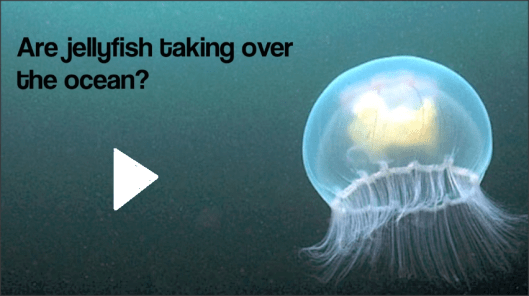
Alice Friedemann must be on the same wavelength as me. This subject of the proliferation of jellyfish caught my attention as well. Since she has done the legwork on this story, I will repost her essay below the following CBC Radio podcast with scientist Lisa-ann Gershwin:
“If jellyfish could wish for perfect conditions, these would include warming and turbid water, lack of predators and competitors, and any conditions that make it harder for other species to survive, like low oxygen or slightly more acidic water than usual. These are the very conditions we are creating at an alarming and increasing rate. And jellyfish are enjoying a renaissance like never before in history.” ~ Lisa-ann Gershwin
Alice Friedemann’s review of Stung!…
A book review of Lisa-ann Gershwin’s “Stung! On jellyfish blooms and the future of the ocean”
[ Xraymike79’s Note: The image above is purely for hyperbole. There are no jellyfish this size. The largest recorded jellyfish is the Lion’s mane jellyfish which can reach a diameter of 7 to 8 feet with tentacles 120 feet long. As Don Howe states below in the comments section: “The power of jellyfish is not in their size but in their vast numbers…”]
Move aside Steven King, jellyfish are worse than any of your demons, worse than any Grade-B monster that’s graced the silver screen. Unlike The Blob, which can be stopped by freezing, you can’t kill them. Not with chemical repellents or biocides or nets or electric shocks or introducing species that eat jellyfish like the striped sea slug. If you shoot, stab, slash, or chop off part of a jellyfish, it can regenerate lost body parts within two days. Not even the past 5 major extinction events which killed up to 90% of all life on earth, killed off the jellyfish.
Meanwhile they’re on a rampage, doing millions of dollars in damage clogging intakes of nuclear, coal, and desalination plants, killing millions of farmed fish, and destroying fishing nets with their sticky icky bodies.
The more we overfish, pollute, acidify and warm the ocean, create vast dead zones, and trawl ocean bottoms, the better the jellyfish do.
The oceans make the earth habitable for us. They generate most of the oxygen we breathe, stabilize temperatures, drive climate and weather, and absorb a third of the CO2 we’re emitting. Over 3 billion people depend on the oceans for their livelihoods; 2.6 billion depend on seafood as their main source of protein.
Most alarming of all, 40% of phytoplankton has died off globally since the 1950s – they’re not only at the base of the food chain, but they generate most of the oxygen we breathe, as well as absorb half of the carbon dioxide, and their increasing death rate will make the ocean get warmer even faster.
Why Jellyfish are taking over the world
Prolific, hard to kill, breed fast, and more – no wonder they’re so successful:
They’ve everywhere, spread around the world in ship ballast or sea currents.
Ubiquitous – from top to bottom of the ocean, from pole to pole, year-round.
Grow faster than other species to quickly take advantage of any food, and they’ll eat almost anything — copepods, fish eggs, larvae, flagellates. They eat past when they can keep consuming, spit food out, waste a great deal other creatures could have eaten. Even when they’re full, their tentacles keep capturing prey.
If there’s no food, jellyfish can consume their own body mass and get smaller and smaller until they find food again, and rapidly return to normal. Even when they grow smaller they can still reproduce.
Consume many times their body weight in high-value food but are of low-value themselves because they provide little energy, ounce for ounce, compared to the food they ate. So they have few predators.
When 2 weeks old they can lay 10,000 eggs a day that hatch 12-20 hours later
They reproduce many ways: massive orgies, fission, fusion, cloning, hermaphroditism, external fertilization, self-fertilization, copulation.
If they lose a body part, they can regenerate it within 2 days.
They are the “Last Man Standing” in eutrophication zones because they need less oxygen
Many species can tolerate any salinity level, from fresh water to salt water
They’ve survived ice ages, hothouse climates, all five mass extinctions, predators, competitors, and us.
Jellyfish in the oceans have been known to live over 10 years
Many of them avoid predators by long vertical migrations from the deep sea to the surface at night and back down again by daylight
They can wait a long time for the right conditions to bloom
Just as plants have seeds which can endure many years waiting for optimum conditions to grow, jellyfish have a seed-like state called a polyp that waits for good conditions, and can clone themselves to create armies of ‘seeds’ waiting to burst into jellyfish blooms seemingly overnight. Polyps don’t “grow up” to become jellyfish. They spawn what we think of as jellyfish – the medusa — which then mate sexually to produce polyps, which stick to rocks, shells, man-made structures, plastic, etc. Both the polyps and the medusa could be considered “immortal” – when a polyp dies it’s clones live on, and when the medusa form of jellyfish dies, it’s pieces turn back into polyps (though I wasn’t clear if all species or just some do this).
Jellyfish are at the top of the food chain
That seems so wrong– a primitive brainless blob? But jellyfish eat much larger clams, crabs, starfish, snails, and fast, smarter fish and squid.
They’re also at the top because not much wants to eat them.
Worse yet, they outcompete other sea life by devouring the eggs and larvae of species that would have grown up to eat jellyfish larvae. It’s a double whammy since these larvae never grow up, leaving a lot more food for jellyfish to consume. A jellyfish bloom can clear the water of all eggs, larvae, copepods, and small plankton in less than a day. This makes it almost impossible for some overfished species to make a comeback.
While the attention of everyone is turned towards the latest gun violence in America, the unprecedented flooding in Colorado speaks of a future of fire and flood which will cause untold damage and death as industrial civilization continues to employ its vast army of CO2-belching fossil fuel slaves. There’s no escaping climate chaos, whether you live on the coast or high atop a mountain in the middle of the country. The latest Colorado floods have reportedly damaged or destroyed 19,000 homes with 8 people confirmed dead so far and well over 1,000 persons unaccounted for as of today. Fracking wells are also leaking into the flooded waters.
You may be asking yourself how the Southwest is experiencing such floods when it has been in a mega-drought for the last quarter century. As the planet heats up from mankind’s greenhouse gases, evaporation increases. Higher temperatures effectively pump more energy into the atmosphere and intensify the hydrologic cycle of the planet. The moisture holding capacity of the atmosphere also increases with higher temperatures. Extremes of drought and flood are the end result, although it is believed by the end of the century that the effects of higher temperatures on evaporation are expected to outweigh precipitation, leading to drought becoming the more common climate condition. A hotter planet(milder winters and longer summers) also diminishes snowpack leading to less soil moisture and drier conditions which are at greater risk of drought, heat waves, and wild fires.
In Colorado, the recent floods were made worse by that state’s mega-fires which destroyed the plant life on the ground. The suppression of fires by man over the last century has also disrupted natural cycles, causing forests to become overgrown and dense. Drought-stressed trees have succumbed to bark beetle infestation and early snowmelt has fed the growth of underbrush to produce a tinderbox of fuel for monster infernos. A scorched landscape with no trees, bushes, and vegetation to hold in moisture allows the rainwater to simply flow unimpeded down the mountain slopes, quickly eroding the soil. The unparalleled amount of rainfall also overwhelms the Earth’s ability to absorb it. The graph below illustrates how remarkable the current flooding is. This graph is from one particular weather station in Boulder that has recorded daily precipitation over the last 120 years. Each red cross represents the amount of rainfall in a day and it is plotted according to how often that amount occurs over a given expanse of time from 1 to 10,000 years. Only a few measurements fall past the 10 year occurrence rate, while the amount of rain that fell one day this past week (120 millimeters or 4.8 inches) at this particular station is seen way above and beyond anything else recorded since 1893. Note that yesterday(Monday) Boulder Colorado hit 30.14 inches of annual rainfall which breaks the previous single year record set in 1995 of 29.93 inches. And the year is not yet over.
NOAA satellite image from the evening of September 11, 2013 showing the devastating storm system bearing down on Colorado:
A blocking pattern has set up over the western United States, drawing a conveyor belt of tropical moisture north from coastal Mexico. Blocking patterns form when the jet stream slows to a crawl, and weather patterns get stuck in place. When all that warm, wet air hit the Rocky Mountains, it had nowhere to go but up, pushed further skyward by the mountains themselves. By some measurements, the atmosphere at the time of the heaviest rains was among the most soaked it has ever been in Colorado…
…Why it will keep happening: Blocking patterns are fertile ground for extreme weather. A blocking pattern near Greenland was also to blame for steering Superstorm Sandy toward the east coast of the United States last fall. Persistent high pressure this year in the western United States has led to what is (so far) California’s driest year on record. That, in turn, fueled last month’s massive Rim Fire in Yosemite National Park, which grew to a size larger than New York City.
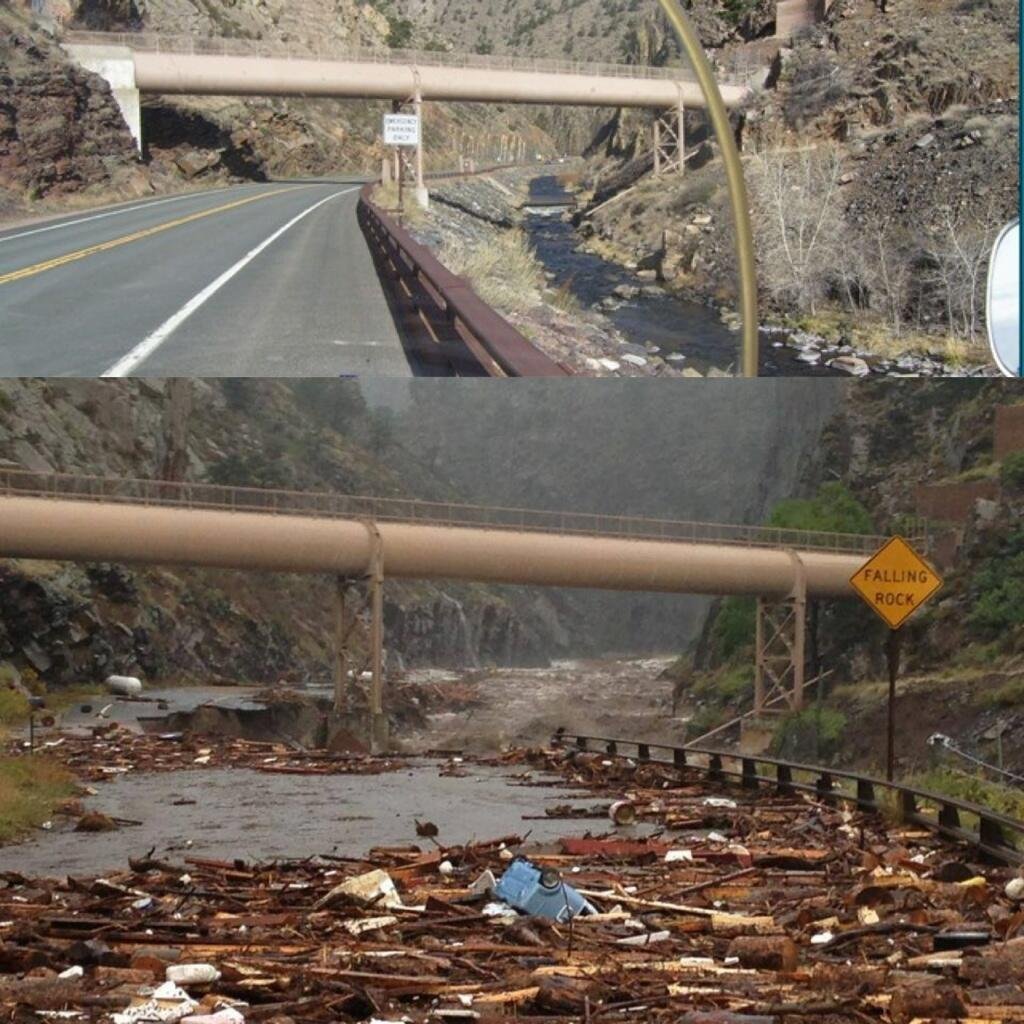
Big Thompson Canyon, Colorado Before (top) and After (bottom):
Historic, “unbelievable” rainfall in New Mexico on Thursday caused flooding in areas that typically have little to no flow at this time of year. An area in the Guadalupe Mountains received 11 inches in a 24-hour period. The state has been grappling with intense drought in 2013, and riverbeds that are usually dry have become treacherous. Carlsbad Caverns National Park closed on Thursday because of the flooding…
…Extreme rainfall events have become more frequent across the U.S. during the past several decades in part due to manmade global warming. Increasing air and ocean temperatures mean that the air is generally carrying more water vapor than it used to, and this moisture can be tapped by storm systems to yield rain or snow extremes. Trends in extreme precipitation events vary by region, though, and in general the biggest increases have taken place in the Midwest and Northeast. However, most parts of the U.S. have seen an increase in extreme precipitation events, according to the draft National Climate Assessment report that was released this past January. The report goes on to note that in the future, “increases in the frequency and intensity of extreme precipitation events are projected for most U.S. areas.
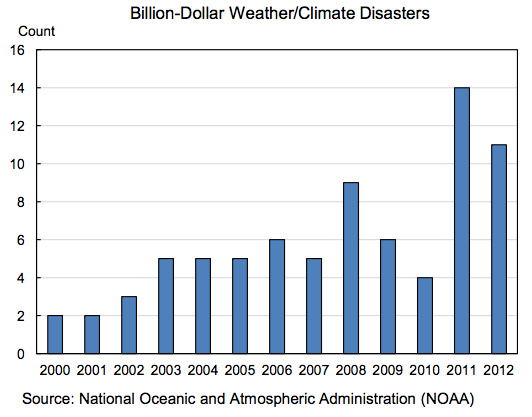
The global picture of weather disasters shows an upward trend according to Munich RE, one of the largest reinsurers in the world:
With all the evidence of climate chaos piling up daily, I’m having a hard time taking seriously a species that calls itself wise, yet worries more about things like erectile dysfunction and breast implants rather than the quickly fading habitability of planet Earth. We are blind to our own self-destruction.
In his hubris, mankind went about subduing, indexing, commodifing, and exploiting all of Earth. He paid very little heed to the consequences of the shrinking richness that once characterized the natural world. Everything had a price since money had become the sole criteria by which all things, animate and inanimate, were valued. From the anthropocentric perspective, if it didn’t serve people in some way or another, what good was it? If need be, man could use his superior intellect to fix or outright replace what he had permanently destroyed. “A better life through technology” became the law of the land. Just as with the accepted tenet of never-ending economic growth, there was the unquestioned belief of technological solutions for all manmade problems brought on by industrial civilization. Hence, bees dying from a chemically saturated environment could be genetically modified to survive in our toxic soup. Extinct flora and fauna could be brought back to life with bioengineering. Where we would put such resurrected organisms in a world overloaded with humans, other than in zoos or other tiny cutouts of artificial habitat, was a question never answered.
Man became so assured of himself and his technological abilities that he began to lose track of the steadily mounting environmental assaults promising to make Earth uninhabitable for all but a few heat-loving bacteria like thermophiles. In fact many denied outright that such dangers even existed. And those whose livelihood depended on maintaining business-as-usual were more than willing to pay public relations experts who could mold popular thought in favor of such a suicidal path. Most of the truly eco-aware humans, whose numbers were so small as to be inconsequential, spent all their time refuting the ignorance and propaganda of the masses, but to no avail. How could any root causes and solutions ever really be identified if the vast majority were kept at each other’s throats? The climate change deniers fought with the scientists; the capitalists fought with the environmentalists and steady state/degrowth alternative economists, the conspiracy theorists fought with the realists, and ad infinitum. Thus consumed with dissension the human species raced over the cliff of eco-apocalypse and human extinction.
She does not measure time in years, decades, or even centuries, but in millennia. She watches unamused by the tragicomedy of humankind. She is unmoved by the self-inflicted suffering and death that is and will be wrought by our own self-serving behavior. Gaia patiently awaits the extinction of man.
…The world was void,
The populous and the powerful was a lump,
Seasonless, herbless, treeless, manless, lifeless—
A lump of death—a chaos of hard clay.
The rivers, lakes and ocean all stood still,
And nothing stirr’d within their silent depths;
Ships sailorless lay rotting on the sea,
And their masts fell down piecemeal: as they dropp’d
They slept on the abyss without a surge—
The waves were dead; the tides were in their grave,
The moon, their mistress, had expir’d before;
The winds were wither’d in the stagnant air,
And the clouds perish’d; Darkness had no need
Of aid from them—She was the Universe.”
The Middle East is on the frontline of the multi-pronged crisis of overpopulation, resource depletion, and climate change. Fault lines in that region are widening as climate change exacerbates crop-destroying droughts, peak oil starves economies, and stressed populations scramble to survive. Advanced industrialized countries are buffered from the same fate only temporarily by their military and economic might. The oil-cursed Middle East also suffers from being in the crosshairs of industrial civilization’s insatiable appetite for the black stuff. Since the peak of conventional oil in 2005, the industrial world has not only turned to harder to extract and environmentally damaging unconventional sources of oil, but has also ramped up military intervention in order to keep the energy flowing. Access to resources has always been an underlying factor in all wars, but as climate change, resource depletion, and social disintegration escalate, the grip on foreign energy deposits by western powers becomes increasingly tenuous. Climate Change multiplies threats. Militarism and climate change feed off and drive each other:
The war machine of the American Empire is the single largest consumer of fossil fuels on the planet.
Our priorities are overwhelmingly skewed toward militarism in order to maintain the unsustainable, while the real threat of climate change grows ever stronger:
In the meantime, the false hope of technology maintains the illusion that our current way of life is inalienable. The industrialized monoculture farming that feeds the masses will quickly fade as synthetic fertilizers become too expensive to artificially replenish nutrient-depleted soils. Pesticides and antibiotics are losing their effectiveness as natural selection breeds super weeds and drug-resistant pathogens. Fresh water is also being sacrificed for fracking, tar sands production, and mountaintop mining. We appear to be systematically destroying any basis for future civilizations as we burn through what is left. “Forests precede mankind; deserts follow.”
Severe land degradation is now affecting 168 countries across the world, according to new research released by the UN Desertification Convention (UNCCD).
The figure, based on submissions from countries to the UN, is a marked increase on the last analysis in the mid-1990s, which estimated 110 states were at risk.
In an economic analysis published last week the Convention also warns land degradation is now costing US$490 billion per year and wiping out an area three times the size of Switzerland on an annual basis. – link
No techno-fix chicanery will bring back the melting polar caps or stop the series of runaway feedbacks loops unleashed from industrial civilization’s fatal attraction to fossil fuels. Our eyes simply don’t appreciate the full scale of climatic change now underway, eroding mankind’s food production, infrastructure, and socio-economic stability, in addition to degrading nature’s ecological resilience and biological diversity, both of which underpin all of mankind’s activities. The megatons of greenhouse gases expelled into the atmosphere by industrial activity everyday are as invisible to humans as the mountains of toxic plastic waste filling up the world’s oceans. Out of sight, out of mind until the effects become too obvious to ignore and too late to change. Overpopulation continues unabated and is in fact encouraged by the imperatives of economic growth; the environmental pressures are ignored as resources are methodically stripped and depleted to unrecoverable levels.
Despite the ingenuity and intelligence of the human race, we appear subject to the same rudimentary biological urges of the lowest single-celled organism which, if given favorable conditions, will uncontrollably multiply its numbers deep into overshoot territory until its food source is exhausted, finally extinguishing itself in a mass die-off. Environmental laws and initiatives appear to be no more than slight speed bumps in our one-way road to extinction. All this talk about curbing GHG’s, “going green”, and “saving the planet” are mere window dressings for our motorized hearse. Nice accoutrements, but the destination is still a grave.
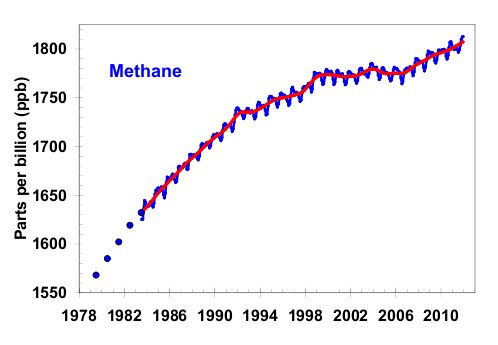
Although it’s my downtime right now before I go on another blogging binge, I could not resist posting about a particular article on methane(CH4) since it represents a large hole in current climate change scenarios — the ones which are essentially ignored by governments and their cadre of neoclassical economists. Thanks to ‘ulvfugl’ for alerting me to the Fairfax Climate Watchwhere this particular methane article was published.
Methane is being released into the atmosphere by various means such as through permafrost thawing and methane hydrate melting/venting, but this article zeroes in on a process called microbial methanogenesis or biomethanationwhich is the formation of methane by microbes known as methanogens.
The author deduces from ice-core paleorecords that rising CH4 levels are highly correlated with rising CO2 and temperature levels, and that CH4 rises exponentially in relation to the other two aforementioned factors. Favorable conditions are now in place for CH4 levels to continue climbing upward:
1.) Rising Temperatures
2.) Rising CO2 levels
3.) Increased Biomass Accumulation from elevated CO2 (CO2 fertilisation creates more organic matter which eventually decays to produce more methane.)
4.) Accelerated Hydrological Cycle (heavy rainfall and torrential flooding erode soil which sets the stage for methanogenesis). An interesting example is rice paddies: “Methane is just a natural byproduct of flooded rice fields—underwater microbes produce the global warming gas as they break down organic matter in the water—and a recent study published in Nature Climate Change found that as carbon dioxide levels and temperatures rise, rice fields emit more methane.” Unless you’ve been asleep for the past few months, you are aware of all the flooding going on around the world such as in the Far East of Russia.
Thus the insidious methane time bomb appears to be quietly going off without the human species taking notice of their own demise. Industrial civilization is adrift in hallucinatory technology masking the deterioration of that other world outside all our windows. A large and sudden methane pulse is not required for our extinction, but rather the slow and steady increase of methanogenesis.
“The potent greenhouse gas methane (CH4) is given short shrift in climate science, and that’s not even considering the methane hydrate or permafrost thaw issues. In fact, sustained methane levels from microbe-generated methane (microbial methanogenesis) could dwarf an Arctic methane hydrate pulse from the East Siberian Shelf.
Current climate models ignore this issue. They use a set of prescribed greenhouse gas levels to run their simulations, and they generally follow the same standardized prescriptions, the RCP scenarios. These RCP scenarios assume that today’s atmospheric methane level rises and falls only as a result of direct human activity. This activity is mostly things like methane-producing farming practices and methane releases from burning fossil-fuels.
But looking at the paleoclimate data for the past 800,000 years (when Earth fluctuated between a climate like today’s and a colder one that featured large continental ice sheets) shows that methane is closely tied to carbon dioxide levels and temperature…” Read the rest
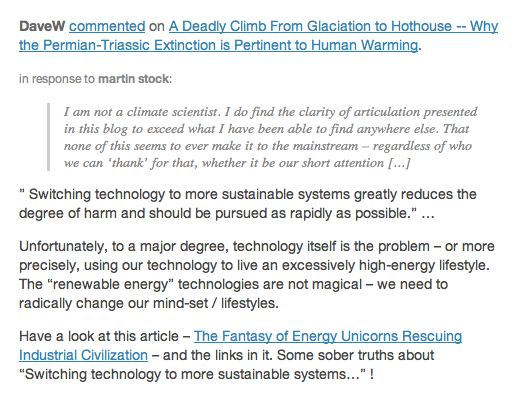
I was poking through my email looking for a reference article on China’s plundering of the oceans when I came across some comments made recently over at Scribbler’s site. Now before I get into a discussion on these comments, I need to say that I am not anti-technology per se, but there are very serious problems with technology as it’s utilized in the current socio-economic paradigm we have – capitalist industrial civilization. We have become a society in which techno-optimism is dangerously ingrained in our thinking and culture, especially in the United States. I just discovered the work of Dr. Michael Huesemann by way of an excellent interview he did on this subject. His book Techno-Fix: Why Technology Won’t Save Us Or the Environmentcame out just last year. I’m going to break down the Huesemann interview in a later post with all the salient points he makes.
Now to get to the comments, the first one sets a dire but realistic tone…
Viewed from a purely biological perspective, humans are following the optimal foraging theory whereby an organism exploits sources of food with the highest energy content first. In terms of humans and industrial civilization, the most energy dense source right now is fossil fuels. This partially explains why we see the following news-bite:
One of the big problems with so-called renewable energies is that, as I pointed out in the last post, intermittent and diffuse energy sources cannot support the current energy-intensive, high consumption way of life promoted and exercised by capitalist industrial civilization. This isn’t a matter of politics, it’s a matter of physics.
Yes there are too many of us. Just as with any organism which has overshot the carrying capacity of its environment, there will be no soft landing for humans when the laws of ecological balance cull our numbers. Modern man has dominated the Earth to the point of altering the biosphere on a planetary scale, destroying the once stable climate which allowed our clever (not wise) species to proliferate. Did humans think they could continue to rack up an ecological debt without consequences? Governments can print money, but the Earth cannot print forests, arable soil, healthy oceans, and clean air.
Rather than seek solutions to the root of the problem – our unsustainable mode of living and exploitive socio-economic system, techno-optimists will look to geoengineering for a fix which, even if such a “solution” would initially appear to “work”, will inevitably have unforeseen side-effects. Then other techno-fixes will be deployed to fix those unintended consequences, and so on.
So Scribbler responds to the above comment:
When, pray tell, are we going to suddenly be gifted with a sustainable system with which to apply our technology? From where I’m sitting, just the opposite is occurring. Governments are becoming more corrupt and totalitarian, printing money with abandon and hardening their surveillance state apparatus. The global human population is exceeding the growth estimates of the United Nations. Extreme weather events are accelerating. And yet business-as-usual persists with the requisite talk of growth and expansion in every economic periodical and newscast. Albedo management? What the hell is that – installing millions of snow-making machines in the Arctic? Since when has anyone on this site ceded to a “defacto business as usual mindset”? We’ve talked of nothing but changing the mindset of a system hellbent on converting every last bit of nature into digits on an accounting ledger for Wall Street.
Then the following comment:
Dave, you’re harassing a techno-optimist monkey in his self-imposed cage of normalcy bias and delusion. Don’t do that. He’ll just sling shit at you, as we’ll see:
He finds the reports “radically too pessimistic”. Did he check the backgrounds of those people behind the reports? Sorry, but I’ll take their decades of experience and education over Scribbler’s childlike foot-stomping of the bad news being too scary for his delicate ears to bear. And the cheap name-calling of “modern incarnation of Ludditism” is simply a scapegoat for avoiding root causes, as Dr. Huesemann explains:
Labels like Luddite distract from an objective and scientific examination of technologies and modern societies… What Luddites did in the past is irrelevant to our critical analysis of technologies today. Many technologies facilitate exploitation by creating a safe distance between exploiter and exploited…
To clarify for Scribbler what my previous post was about since he evidently did not read it or comprehend it, the post was not about saying that all energy technologies are bad, but an explanation of their limitations due to the reality of EROEI and the laws of Physics. As Kevin Moore noted, “Geochemistry overrides ideology.”
Now having said all of the above, I appreciate Scribbler’s climate tracking expertise and hope he continues his writings.
Through my experience on this website I’ve learned that the pro-fossil fuel/climate change skeptics share something in common with the pro-renewable energy/climate change realists. Neither wants industrial civilization to fade away. This is the fatal flaw shared by both – that industrial civilization with all its toxic trappings of materialism, instant gratification, and objectification of nature can continue with perhaps a few tweaks and modifications here and there. Nothing that the capitalist free market cannot correct, right? Others even fantasize with the idea that there will be some sort of a post-crisis prosperity. So-called “renewable energies” fit nicely into the greenwashing of capitalist industrial civilization. Ignoring the fact that abrupt climate change is well under way with multiple extinction-causing feedback loops having already been set into motion, the right course of action would have been a rapid downsizing and simplification of our mode of living:
We would also have to ignore the reality of the corporate state’s all-pervasive power. With its techniques of inverted totalitarianism, the corporate state has extinguished everything but the façade of democracy. Serving as the corporate mouthpiece, the mainstream media frames public discourse on socio-economic issues in very oversimplified terms while lumping the population into a very stark, cartoon-like dichotomy of Left versus Right. Thus there is never a substantive debate about our predicament; the dominant paradigm is never questioned except in small and obscure circles whose views never see the light of day. Refusing to acknowledge that fossil fuels are causing planetary ecocide and that renewable energy will not, by any stretch of the imagination, meet the high energy consumption levels of consumer capitalism are both fatal flaws of thinking. Neither group will admit that the root cause of the disease is our way of living. To do so would undercut their belief system, the principal tenants of which are that mankind’s superior adaptive capabilities and technological innovations will carry us through. Self-delusion on such a massive scale results in strange conspiracy thinking to emerge such as the following right-wing tripe:
Never mind that our government has become nothing more than a feeding trough and revolving door for corporations seeking market control and revenue streams. The people truly latched to the teat of government are those with the money to hire armies of lobbyists, bribe officials with lucrative private sector positions, ‘buy’ government contracts and game the system fully in their favor.
The Fantasy of Energy Unicorns Rescuing Industrial Civilization
The second law of thermodynamics states that energy flows or dissipates from concentrated forms to diffuse forms. Fossil fuels are very concentrated forms of energy, but renewables like wind and solar are very diffuse and intermittent energies. According to leading energy experts like Professor Charles Hall, the EROEI of renewable energy continues to be too low when compared with fossil fuels. Thus in the free market system, the lowest-priced energy (with environmental costs externalized) will always win out and be utilized.
“2013 EIA new plant capital costs of various energy technologies and
pumped storage for balancing intermittent renewables”
As Ted Trainer has shown, claims of renewables running the industrialized world are numerous and avoid any critical evaluation of their claims:
…Unfortunately people working on renewable energy technologies tend not to throw critical light on the difficulties and limits. They typically make enthusiastic claims regarding the potential of their specific technologies.
There are now several impressive reports claiming that renewable can meet world energy demand, and almost no literature questioning the claim…” – link
“..Trainer’s general point on technology is that the extent of ecological overshoot is already so great that technology alone will never be able to solve the ecological crises of our age, certainly not in a world based on economic growth and with a growing global population… – link
Trainer and other analysts identify several factors that limit large-scale renewable energy projects:
– Transmission losses: Distant solar thermal, photovoltaic farms, and wind farms must transmit their generated energy through long distance high-voltage direct current cables. The best places for harnessing wind power are usually in remote locations far from populated areas, but solar lends itself more to a model of decentralized electricity generation which can avoid transmission losses and the high cost of transmission lines.
– Embodied Energy Costs: The energy to produce the steel, mine the minerals and raw material, and manufacture the wind turbines and solar panels, then deliver and install them, and later repair and maintain them, finally disposing of them. In a recent study, Charles Hall and Pedro Prieto have found that such costs have been unaccounted for in the estimates of solar PV’s EROEI. Spain’s boom and subsequent bust in solar energy production was found to have generated an abysmal EROEI of 2.45 thermal units of energy output for 1 thermal unit invested, as poor as biofuels.
Just to make the silicon used to trap the sun’s rays on manufactured wafers requires the melting of silica rock at 3,000 Fahrenheit (1,649 Celsius). And the electricity of coal-fired plants or ultrapurified hydrogen obtained from fossil sources provide the heat to do that. It also takes a fantastic amount of oil to make concrete, glass and steel for solar modules…
…Prieto calculates, for example, that to replace all electricity made by nuclear and fossil fuels in Spain would take a solar module complex covering 6,000 sq. km of the country at the cost the entire Spanish budget (1.2 billion Euros in 2007). It would also require the equivalent of 300 billion car batteries to store the energy for night-time use.
Prieto is not alone in reaching such sobering conclusions. A 2013 Stanford University report, for example, calculated that global photovoltaic industry now requires more electricity to make silicon wafers and solar troughs than it actually produces in return. Since 2000 the industry consumed 75 per cent more energy than it put onto the grid and all during its manufacturing and installation process.
Moreover it won’t pay off this energy debt or energy consumed in its construction until 2016. As a consequence, ramping up of industrial solar production produces more greenhouse gases than it saves for nearly a decade… – link
– Plant Lifetime: 20 years is estimated for wind (Sharman, 2012) and 35 years for photovoltaic. To quote Kevin Moore, “Gaia pulverises everything in the long-term and converts it all into sediment (except certain partially degraded plastics, which seem destined to drift in the oceans for eternity).” Another factor perhaps not discussed much is the effect climate change will have on the variability and volatility of weather patterns where solar, wind, and other renewable energy projects are constructed. Wind, cloud, and rain patterns will be altered, rendering energy plants ill-suited to their originally targeted sites. The world’s energy infrastructure will be increasingly vulnerable to the ravages of climate chaos with more intense flooding, droughts, and shifting weather patterns. Hydroelectric power, solar farms, nuclear plants, and biofuel plantations are dependant on water to run and cool the turbines, clean the solar panels and mirrors, mine the uranium as well as cool the reactor core and spent fuel rods, and grow the biomass. Hotter temperatures will tax the electric grid because of increased electricity demand for cooling in the summer, reduction in the performance and capacity of transformers and above-ground transmission lines, and infrastructure damage from wildfires. Sea level rise will also wreak havoc with coastal erosion, storm surges and flooding.












 Collapse of Industrial Civilization