An achieved goal of capitalist industrial civilization was the systematic reduction of nature to a simple component of the economy. Landscapes of rivers, lakes, forests, and meadows were replaced by the concrete, steel, and asphalt of cityscapes. The build-up of toxic wastes and byproducts of industrial civilization were seen merely as external problems to be solved via engineering and technology. In the grand narrative of material progress, industrial man put himself at the center of the universe, the lead actor and hero who would always survive and triumph. He saw no problem with the complete subjugation of the wilderness, taking more from the land than was given back, and reducing biodiversity to a shell of its former self in the name of economic growth. The dominant mindset was summed up thusly…
“…nature is a malignant force with useful aspects that must be harnessed, and useless, harmful ones that must be shorn of their power. They spend their energy adapting nature to their purposes, instead of themselves to her demands. They destroy pests of crops and men, they build dykes and great dams to avert floods, and they level hills in one spot and pile them up in another. Their premise is that nature will destroy them unless they prevent it…” ~ Clyde Kluckhohn
In the collective consciousness of industrial civilization, man was exempt from falling victim to the 6th mass extinction. The future narrative of people in the modern age never included:
…that they would be among the last humans to walk the Earth.
…that their children would not live long enough to grow old.
…that all cultural, artistic, and scientific achievements of the human species would soon be forgotten in time, no longer practiced and appreciated.
Cocooned away from the elements as they were, few city dwellers noticed the creeping deterioration of the planet’s biosphere. Their artificial world, filled with the digital screens of computers, televisions, electronic billboards, and sundry other micro-computer devices, kept the public preoccupied with a constant stream of infotainment, celebrity gossip, sports, and political spectacles. The popular line of thought was that the natural world was too resilient to collapse from man’s activities; periodic efforts of environmental remediation would be all that was needed to keep business-as-usual afloat. Generational amnesia cast a false sense of security over the unwashed masses. Rivers and streams, once teeming with fish and aquatic life, were now laden with toxins, heavy metals, and plastics. Moose and bison no longer roamed the fragmented wilderness; the remaining few were set aside for bioengineering experiments in a last-ditch effort to save them. The whole web of life with all its keystone species from microbes and insects to large terrestrial and aquatic mammals was unravelling. Pests, viruses, and pathogens ran rampant in the new disorder of the planet. Scientists talked of tipping points, but no one really knew when such red lines in biospheric stability would be crossed or if they had already been breached. Like a runaway freight train, industrial civilization had indeed passed many tipping points long ago. Few thought there would be such an abrupt downward spiral, seemingly without warning. The first law of thermodynamics was being realized on a system-wide scale.
Modern man was thought to have been infinitely adaptive and clever, but the linear-thinking that dominated the culture was riddled with too many blind-spots to prevent its inevitable downfall. As long as the same economic system and mode of living persisted, no amount of new technology would solve the root problems. Since the mid 1970’s, the industrialized world had been living beyond the total carrying capacity of the Earth for decades and even created a day to recognize the transgression which would arrive a few days earlier each year. Various reports of imminent catastrophe were published, but to no avail. Everyone had their mental crutch to fool themselves into believing that the day of reckoning would never come. Some, like the fanatical zealots of religion, rejoiced that the end was upon us while others were paralyzed with fear and despair. The all-pervasive mainstream cult of money worship, consumption, and economic growth gave rise to other doomsday cults who heralded the end of time.
Mother nature took no prisoners; there was no escaping her ironclad laws. Mass starvation, war, and pestilence rapidly whittled the human population down to small pockets of survivors, but then even those few post-apocalyptic tribes soon declined and disappeared until the day arrived that only one human walked the Earth. One lone human survivor out of the billions that once were.
He survived the pandemic that wiped out roughly three-quarters of the global population. He survived the nuclear meltdown and craziness of the food wars and nuclear terrorism. And thus far he survived climate chaos by constantly moving. MRE’s were mass-produced for the general public and stored in most cities when the agricultural system started to show signs of imminent collapse. Even after all these years, the last human still found these warehouses of preserved food to be an invaluable source of sustenance, supplementing his diet with the occasional cockroach, rat, or wild pig.
How did the last man on Earth spend his time when not scavenging for food, water, and other essentials? He was on a search to find other humans of course. How could he have known that he was the sole survivor? Without electricity, there no longer existed any sort of global communication system. The one solar-powered/hand crank shortwave radio he had in his backpack had yet to pick up any signals, but he would religiously take it out every night to scan the frequencies for an hour or two. To break the deathly silence of the world, he would occasionally play the assorted music files that were on his wind-up mp3 player. He especially loved their sound inside the expansive corridors of old libraries he visited during his trek across the continent. With his life always in jeopardy, he found that a good book was the best form of escapism; compromising his health and safety with mind/mood-altering drugs was not an option in a world devoid of hospitals and medicine. And sex? Well, you’ll have to use your imagination for that. He certainly did. Such solitude, a prison cell of solitary confinement spanning the entire planet, would have driven most to madness and suicide, but he handled the loneliness day by day and with stoicism.
In his early years, he experienced a taste of working at a 9-5 job, driving a car and flying on jumbo jets, but he didn’t miss any of it really. He had been one of those who had read extensively about the unsustainability of the global economy and about the nature of ecological overshoot and collapse, and he had prepared for it. He held no illusions of a new civilization being reborn out of the ashes of capitalist industrial civilization. Capitalism, he knew, held too tight of a grip on modern man, and the psychological barriers of the masses prevented them from seeing the end of everything concerning the human experience …forever. As the weeks, months, and years passed by and he grew older, he began to reconcile with the idea that he was very likely the last person left alive. No need to leave any more messages on roof tops, in vacant parking lots, or over the empty airwaves. No one was listening. No one was coming. There really was no prospect of growing old gracefully in this new reality. He had yet to find some small pocket of unpolluted land that did not register on his Geiger counter. So he made a pact with himself and the pistol he carried that when his health and strength no longer allowed him to eke out an existence, he would not be alive when the wild dogs came for him.
“A man is like a novel: until the very last page you don’t know how it will end. Otherwise it wouldn’t be worth reading.” ~ Yevgeny Zamyatin, We.
——————————–
Everything is going to go.
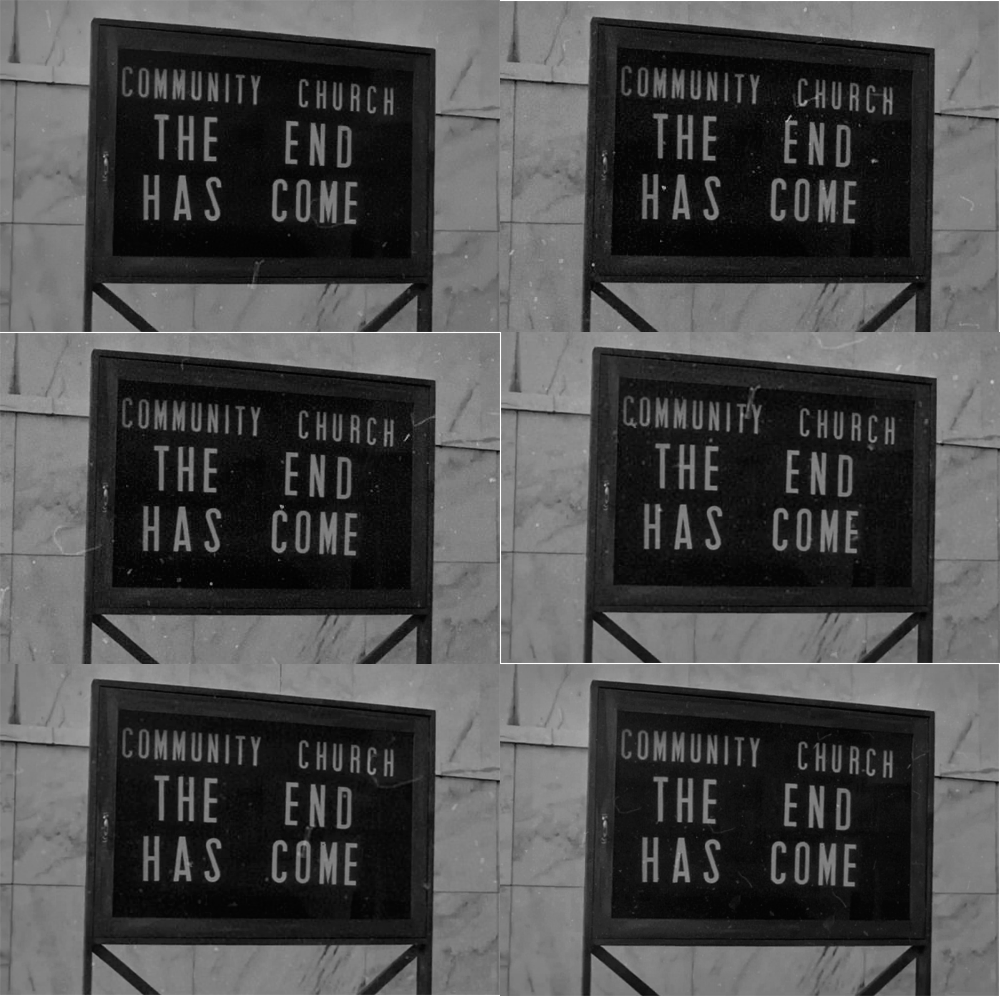
The End.
Let’s look back, where it started.
The Beginning…
The Sumerians, formerly hunters and gatherers, began settling in villages in the fertile valley of the Tigris and Euphrates rivers in the period from 8000 to 7500 B.C.
According to the theory of Denise Schmandt-Besserat, this is how writing began:
Archaeological studies of the period show evidence of grain cultivation in fields surrounding villages, the construction of communal silos for storing grain, and a rapid increase in population. In such a setting, individual farmers needed a reliable way to keep track of their goods, especially the amount of grain stored in shared facilities.
It seems they did it by maintaining stocks of baked-clay tokens—one token for each item, different shapes for different types of items. A marble-sized clay sphere stood for a bushel of grain, a cylinder for an animal, an egg-shaped token for a jar of oil. There were as many tokens, or counters, of a certain shape as there were of that item in the farmer’s store.
Thus, tokens could be lined up in front of accountants, who doubtless organized them according to types of goods and transactions. They could even be arranged in visual patterns to make estimation and counting easier.
This simple system of data storage persisted practically unchanged for almost 4,000 years, spreading over a large geographic area. Eventually, the growth of villages into cities and the increasing complexity of human activities, especially in southern Mesopotamia, forced a shift to a more versatile means of record keeping. This shift was marked by the appearance of elaborate tokens alongside the well-established system of simple counters. Though similar in size, material, and color and fabricated in much the same way as their plainer cousins, the new tokens bore surface markings and showed a greater variety of shapes.
The elaborate tokens were apparently used for manufactured products—the output of Sumerian workshops. Incised cones and rhomboids probably represented loaves of bread and vessels of beer. Disks and parabolic tokens marked with lines signified different types of fibers, cloths, and finished garments. Incised cylinders and rectangles stood for ropes and mats. Other tokens seem to have represented luxury goods, including perfumes and various kinds of metalwork.
The advent of complex tokens coincided with the emergence of powerful central governments and the construction of monuments and great temples, beginning around 3350 B.C. Art from that period shows the rise of a governing elite and the pooling of community resources for celebrating large festivals. The token system, extended to cover goods and services, played a key role in managing massive building projects and orchestrating large public events.
Temple excavations reveal that the Sumerians often kept sets of tokens in clay globes, or envelopes. Temple clerks marked the envelopes by pressing tokens into the soft clay before sealing and baking them, making visible the number and shape of tokens enclosed. Excavated specimens show circular imprints left by spheres and wedge-shaped imprints left by cones.
Once sealed in their clay cocoons, the tokens were hidden from view. It didn’t take long for busy bureaucrats to realize that once the clay envelopes were marked, it was no longer necessary to keep the tokens. In fact, the marks by themselves, impressed on a clay tablet, were sufficient.
Complex tokens couldn’t be stored in clay envelopes as conveniently as simple counters because they often left indecipherable impressions. Instead, perforations allowed such tokens to be strung together, with special clay tags apparently identifying the accounts. In this case, the shortcut that the bureaucrats discovered was to inscribe the incised pattern found on the surface of a complex token directly onto a clay tablet. For example, they could replace an incised ovoid token with a neatly drawn oval with a slash across it.
The result was a practical, convenient data storage system. A small set of clay tablets with neatly aligned signs was much easier to handle than an equivalent collection of loose tokens, and using a stylus for marking clay tablets was a lot faster than making an impression of every token.
Around 3100 B.C., someone had the bright idea that instead of representing, say, 33 jars of oil by repeating the symbol for one jar 33 times, it would be simpler to precede the symbol for a jar of oil by numerals—special signs expressing numbers. Moreover, the same signs could be used to represent the same quantity of any item.
The signs chosen for this new role were the symbols for the two basic measures of grain. The impressed wedge (cone) came to stand for 1 and the impressed circle (sphere) for 10.
In this way, the token system evolved into a kind of shorthand in which signs representing standard measures of grain, impressed on a clay tablet, came to represent not grain or any other specific commodity, but the concept of pure quantity. It was a revolution in both accounting and human communication. For the first time, there was a reckoning system applicable to any and every item under the sun.
Thus, “writing resulted not only from new bureaucratic demands but from the invention of abstract counting,” argued Schmandt-Besserat in How Writing Came About. “The most important evidence uncovered is that counting was not, as formerly assumed, subservient to writing; on the contrary, writing emerged from counting.”
Clay tokens became obsolete by 3000 B.C., replaced by pictographic tablets that could represent not only “how many” but also “what, where, when, and how.” With the introduction of a new type of stylus, pictographic writing developed into cuneiform notation. The resulting record-keeping system proved so efficient and convenient that it was used in the Near East for the next 3,000 years.
“The tokens were mundane counters dealing with foods and other basic commodities of everyday life, but they played a major role in the societies that adopted them,” concluded Schmandt-Besserat. “They were used to manage goods, and they affected the economy; they were an instrument of power, and they created new social patterns; they were employed for data manipulation, and they changed a mode of thought.
So once there was writing, there could be written stories, and one of the earliest we have is the glorious Epic of Gilgamesh. My favourite part is where Enkidu – who I see as representing the wild hunter gatherers and pastoralists who remain connected to wildlife and nature – is tempted by a prostitute to go to the bright neon lights of the city – the ‘lure of civilisation’ so to speak – the streets paved with gold, sex and drugs and rock & roll, something which must have happened to uncountable numbers of people over the millennia and which continues to this day as rural folk move into urban life in search of money and the buzz of ‘modern life’…
So then we have all of the world’s literature, one of the wonders of our species, the legacy of millions of minds and imaginations.
What would we be without that?
Fast forward several thousand years, of stories and cities and risings and vanishings of entire civilisations, to circa 1920 when we get a clear glimpse of something that joins the first city states of Sumeria to our own time today, using writing and the newly invented format of the dystopian novel.
‘’In a country constructed of glass, under complete surveillance…’’
Here we can already see the outlines of the NSA and Edward Snowden, as we look back past 9/11, past the Stazi, through 1984 and Brave New World, through the flames of the burning Reichstag the Sonderkommando arranging the corpses into neat piles to make smoke signals warning the coming generations – “Die now or, in four months time, you will know what makes time so precious.”
Nobody paid attention to Zamyatin; nobody paid attention to the smoke signals.
Enkidu always falls for temptation because he does not know any better, until it is too late…
The streets are never paved with gold, only blood, bones, tears and torment.
In a country constructed of glass, under complete surveillance and devoid of individuality, D-503 discovers he has a soul and is now in danger.
First there were a few hundred on the internet who discussed this and what to do.
It has grown to a few thousands, and now it grows faster and faster and soon, I suppose, millions.
And nobody knows what to do.
I was one of the first to face this matter head on without flinching.
This is the most amazing time in all of human history.
We have evolved since about a million or 2 million years or a couple of hundred thousand years depending upon how you define a human being exactly. And then we made the first cities about 6000 years ago and agriculture and civilisation and technology and writing and now we reach our peak, and destroy everything and become extinct and cause a mass extinction event of most of life on Earth.
That’s how I see it.
And just for a brief moment, we have all these things, computers, etc, and access to all this information. And we peer out into the Universe and try to understand why we are here and what’s going on…
And then we all vanish.
Every day I review this picture because every day people are questioning, and I am trying to reply.
Most people are unable to comprehend that this civilisation will collapse, with billions of people condemned to die prematurely, because it is too horrible to face. But it is absolutely inevitable, only a question of when, and exactly how it takes place.
It might be any time in the next 100 years which seems long and vague for humans, but is an instant in geological time, a millisecond, a nanosecond.
And then I think, going by previous mass extinction events, it takes about 10 million years for life to recover. But whatever it is, it will be nothing like us.
So the problem is, how does one live when one has this knowledge?
This terrible, TERRIBLE knowledge. Hahahaha, enough to make a strong man weep. Seriously. It is such a difficult matter each person has to solve for themselves and, if they have children, their predicament is made much worse.
But I think, live in the moment, striving to be as happy as you are able to be, because each moment is very precious and never returns.
And now, I think we come to write our last stories as our era draws to a close.
The Epic of Human Demise…
Everything is going to go.
So, if I did have children, anyone under thirty, say.
What could I possibly advise? This is very hard because I don’t want the responsibility and I don’t know what will happen, but I get a lot of emails from people who feel bad, and I feel obliged to reply and I feel obliged to say SOMETHING, and I can’t be dishonest or evasive…
So….
You don’t need much of anything.
Cut possessions and consumption to essentials.
Stay fit and healthy, physically, emotionally, mentally, spiritually.
Get a network of others who share same views. Be loyal and supportive.
Everyone is monitored, so develop in-group language, opaque to outsiders.
Share what needs to be shared, need to know, otherwise keep stuff to yourself, especially stuff that matters. One good person you can trust is the most valuable asset you can have, the more the better.
Most people can’t keep secrets. The more they want to, the more they feel compelled to tell someone.
Regard all MSM info with suspicion, as propaganda; nowadays it’s often downright lies.
Distribute important and interesting information as widely as possible.
Don’t be naive. Don’t be anybody’s fool; be your own best friend who you can trust.
It’s going to get much, much worse, so expect that you’ll be shocked. Don’t get knocked off-balance; roll with the punches, bounce back.
Learn stuff all the time, something new every day. There’s a technique to this, make it fun. Go over what you learned yesterday. Get a sense of pride and accomplishment.
Build self-esteem. Learn about ecology, nature, wildlife, the land, the past, what happened. Learn critical thinking. Don’t let anything slide by unnoticed…
Permaculture is good to learn, so is Tai Chi, Qi Gong, Aikido, even basic gardening, cooking, food preservation. One of the saddest thing with so many old people, like me, haha, who have skills – I have knowledge of hand tools used in woodwork and chairmaking with a direct line going back to their invention in Egypt 6000 years ago – is that all this is lost as we die off with no young people who are interested to hand it on to. It’s not just one generation’s knowledge. It’s taken centuries to learn this stuff… Nobody wants to know. Sigh.
Know your enemy.
Who are they?
Well, as far as I am concerned, they are these people. Not necessarily the individual names with the faces and addresses attached, but the whole idea that is acceptable and alright to behave in this way. The whole idea that it is acceptable and alright to live and conduct yourself and your affairs in this way:
We look back a couple of hundred years at the way certain people were behaving and we are shocked and disgusted, and yet we have the same kinds of people behaving in the same kinds of ways, in fact even WORSE, if you check out the actual damage they do.
These people are insane. They have always been with us, since the first cities of Sumeria, these accumulators of wealth and power, whose lust for money is never sated.
But what good will it do them when they inhabit a dead planet? Because that is what is happening and they are to blame, their greed, ignorance and stupidity is the direct cause of this oncoming catastrophe. Everything has to be turned into money, and what good will money be, when Earth is like Mars? Because that’s what is happening….
You’re going to have to mix with the enemy, to survive, but you don’t have to become them, or support them, or fraternise with them. Just disguise yourself and shapeshift your way through to get whatever you need. Ostracise anyone who is supporting The Machine.
Some people think that what matters is people and social reform and justice and that sort of thing. I’m not against those things, just that I don’t think they matter anymore, at least not to me personally. I think the only thing that matters is saving the other species for as long as possible and stopping the killing Machine as much as possible. Pretty much the Deep Green Resistance agenda.
But if you disagree, who cares? I don’t have time to debate and argue over crap. I’d rather see some action, someone fighting to save some fucking butterflies or something, than complaining about the bankers. Sooner or later, all those bankers, anyone who even looks like a banker, are going to be ripped limb from limb by hordes of enraged starving folk with machetes. They’ll deserve it. But that’s not my agenda.
It’s time to get apocalyptic, or get out-of-the-way.
I mean, we all know everything is going to shit. We all know that’s extremely depressing. We all know it makes you feel suicidal. Okay. That bits done. Sorted. Leave it behind.
Like an old jacket you used to wear. Familiar but worn out.
If you’re into suicide, do it. There’s too many of us. Otherwise, get a grip. Don’t go the way that they are currently on NBL, of endless ‘counselling’, because IMHO that’s another disaster. It’s for the people who enjoy self-indulgence and self-pity and the people who exploit them by selling their books. The only person who can sort yourself out is you, and you do it! Right here, right now.
The way I see it, the Roman Catholics had Confession, which was a means for their power pyramid to gather intelligence, much like the NSA and GCHQ are doing now.
People could ‘sin’ and then be absolved and go away and ‘sin’ again, and that became an habitual lifestyle. Remember, the Inquisition was the equivalent of the CIA and lasted for 400 years.
Then Freud and Jung came along and Heaven and Hell were replaced by The Unconscious. Instead of Confession, people lay on the couch and talked about their childhood and their dreams. Same deal really. The equivalent of the Inquisition was perhaps Bedlam, the lunatic asylum.
Basically, all the pyramid power structures that are not fighting to SAVE the biosphere – are there any that are ?? – are the enemy. That doesn’t leave many powerful allies.
It does leave billions of ordinary, rather powerless people who know they don’t like what’s happening. If I was Che Guevara, I’d say it was a perfect time for revolution. The only problem is that a social reform doesn’t fix an ecological crisis caused by exceeding the carrying capacity.
These people are plain evil. They have done nothing good for anybody ever, in their entire history. How does humanity rid itself of such a monstrosity that has caused death suffering and misery for millions and millions of innocent people ?
The problem is power. If the greatest power is corrupt and evil, then who or what will hold it to account for its actions? How can it be removed? How do you prevent it being replaced by something even worse? Only the mass of the people can do this, and they have to understand the problem. Usually they don’t, or they are betrayed by leaders. Any leader who cannot be corrupted will be assassinated.
And now we have the New Age, and all kinds of therapies and therapists and counsellors who’ll take your cash for a book and dvd and a private consultation if you can afford it. It’s just a new priesthood for a new religion, and NTE is a whole new business opportunity for a whole new industry to arise, and some people will spend the whole of the rest of their lives ‘coming to terms with’ whatever it is…
Well, I am a warrior, and that’s not my way of dealing with this. If you get damaged and hurt, you heal yourself as well and effectively and efficiently as you can. I know, because I’ve been through a lot of stuff and been battered all to hell. Be as kind and gentle to yourself as you can possibly be. But there’s no need to rely on someone who doesn’t know any better than you do. How can they, if they have not been through what you have been through, and are doing what they do to make money? There’s a danger in that.
People who are addicted to booze or video games or who are obese or who expect to be told what to do, whole sectors of society – well, what will happen to them? Zombie food?
The old, the children and babies, the pregnant mothers, the weak and disabled, people who rely upon medication for survival, the gentle and tender-hearted ones – what happens?
We know what happens, because it has happened before. We can look back at history and see what happened when societies collapsed. It’s not a new thing. Inform yourself.
Next comes next. We’re going to die anyway. So how are we going to live while we are alive? That’s the bit that matters.
I think Enkidu has to get out of the rotting poisonous city, escape, get back to what he was… find himself again… his soul, his power, his way of being.
Forgive the male tense. There must be a female version of Enkidu, but I have failed to find one. Suggestions in the comments, perhaps.
“It is said there are flowers that bloom only once in a hundred years. Why should there not be some that bloom once in a thousand, in ten thousand years? Perhaps we never know about them simply because this “once in a thousand years” has come today.”
~ Yevgeny Zamyatin.
The following blog entry is a guest post by award-winning satirical writer Scott Erickson. When I was initially contacted by Scott I was a bit wary until I read more about him and his writings at his website. He’s definitely ‘collapse-aware’ and is my kind of people. In a world where dystopic fiction has in many ways already become reality, we find ourselves to be a captive audience of the real world post-apocalyptic story playing out before our very eyes. Life is increasingly becoming stranger than fiction…
SATIRE CAN’T KEEP UP WITH REALITY
How long until Monsanto proposes genetic engineering of the human race?
By Scott Erickson
The hardest part about writing satire is trying to write things that are more absurd than what real life comes up with. I’ve heard this from a lot of comedy writers lately. There’s this idea that satire is dead because real life has become a satire of itself.
Here’s an example: Could anybody have invented the character of Sarah Palin? The vice presidential debate with her versus Joe Biden was one of the funniest things I’ve seen in my life.
Someday she’s going to be elected President. Which reminds me of the movie Idiocracy. It’s a pretty good satire about where we’re heading. Or have we already arrived?
The rest of this post is about a more personal example.
In the novel, our young protagonist Amy Johnson-Martinez encounters the evil corporation GloboChem. A spill of the agricultural chemical “GrowMagic” has led to a hospital full of sick babies.
Amy does some research into what “GrowMagic” is, and she is shocked – SHOCKED! – to discover that “GrowMagic” is actually ONE OF THE MOST POISONOUS AGRICULTURAL CHEMICALS EVER MADE. This is what she finds on the GloboChem website:
Our main product is HappySeeds™ which grow 73% of the world’s vegetables and grains. Most of those seeds are Magic-Ready HappySeeds™ that are genetically engineered to accompany GrowMagic™ “agricultural helper.” As happy farmers around the world say, “I need the miraculous GrowMagic™ to keep my Magic-Ready HappySeeds™ happy!” And since Magic-Ready HappySeeds™ are genetically designed to grow plants that don’t produce seed, farmers around the world are happy to come back and buy more HappySeeds™ year after year – which keeps GloboChem shareholders happy! GloboChem: Spreading happiness wherever it touches.
If you guessed that “GloboChem” is a thinly-disguised “Monsanto,” and that “GrowMagic™” is a thinly disguised “Roundup,” then good for you! You win 10 points and advance to the semi-finals.
Later in the story, things take a darker turn. Since weeds have evolved into super weeds that are increasingly resistant to agricultural chemicals, bolder measures are necessary. Thus, GloboChem’s spokesperson announces a radical new proposal:
Ladies and Gentlemen, some people would suggest that GloboChem has gone too far. I put it to you that we haven’t gone far enough. I am proud to announce that GloboChem has developed an innovative new product that will absolutely end all problems with human exposure to agricultural chemicals.
Our new product is a highly-advanced version of our famous ‘HappySeed’ technology. As you surely know, ‘Magic-Ready HappySeeds’ are genetically engineered to go with our ‘GrowMagic’ agricultural helper. I am proud to announce GloboChem’s brand-new product, which we call ‘HappyHuman.’ It will make human beings – people like you and me – able to withstand the ‘GrowMagic’ that brings us the clean and inexpensive food you serve to your loved ones. ‘HappyHuman’ will be available in capsule form – just one dose per month is all you’ll need to stay healthy and prosperous.
Each capsule contains specially-engineered radioactive isotopes that go throughout the body, miraculously altering the genetic code to change the cell chemistry in each and every cell. Then, our bodies can withstand the ‘GrowMagic’ that brings us attractive pest-free food at a reasonable price. In other words, it will make us able to withstand ‘GrowMagic’ 100 percent naturally!
I know what you’re all thinking. You’re thinking, ‘What about our household pets, our fuzzy kittens and puppies?’ I’m pleased to assure you that GloboChem will offer our supplement in a pet-friendly form, because GloboChem cares about your pets. In fact, we love them more than you do.
Yes, glyphosate is the key ingredient in the company’s GrowMagic™ label of herbicides. Sorry, I meant to write Roundup label of herbicides.
Don’t worry, though – the acceptable level of glyphosate is only rising a little bit. The EPA is increasing limits on allowable glyphosate in food crops from 200 ppm to 6,000 ppm. That’s not much – only 3,000%.
Yes, scientists have linked glyphosate to cancerous diseases.
Yes, a study by The Cornucopia Institute concluded that glyphosate “exerted proliferative effects in human hormone-dependent breast cancer.”
Yes, another study concluded that “glyphosate enhances the damaging effects of other food borne chemical residues and environmental toxins.”
According to GloboChem – sorry, I meant to write Monsanto – the public is okay with this. A two-month open comment period that began May 1st drew little public resistance. Yes, the comment period was only announced on a 3×5 card posted in the company’s break room, but if you really wanted to see it then you should have looked harder.
Later in The Diary of Amy, the story eventually takes an even darker turn. The public has so far resisted GloboChem’s plan to genetically alter the human race. But now the agricultural chemicals are not stopping the super weeds, despite applying them far above the recommended concentrations. And the economy is in a tailspin due to a sudden oil shortage. We have to act fast! Fortunately, GloboChem comes to the rescue:
Recently GloboChem, Inc. has received some “less than fully satisfied” feedback on our agricultural products. We are pleased to respond to this feedback and offer what appears to be the only viable solution.
Apparently our GrowMagic™ agricultural helper is becoming less effective over time, even by using heavier applications.
Some have claimed all along that this would happen, and that we have lied about it. That is true. But even though we lied once, that doesn’t mean we’re lying to you this time. Since we told the truth about our lying, that should make you trust us now.
But rather than engage in a useless discussion about “who said what when,” we must forge ahead, like the courageous nation that we are. America has never turned its back on a challenge, and these tough economic times mean we must not turn our back like never before.
We recently announced our new HappyHuman™ product and sought to receive congressional approval to market it. But public reception was less-than-positive and the congressional bill stalled in committee.
We believe that now is the time to pass the bill and rush HappyHuman™ to the American public. Only by genetically engineering a human race able to withstand our products can we preserve our American way of life.
We must increase the “magic” within GrowMagic™ to a level high enough to kill every form of life that has not been genetically modified to resist it. There is no other option.
We have consulted with economic experts that we paid, and confirmed the following: Either we go forward with HappyHuman™, or food prices will increase by one thousand percent and the United States agricultural system will collapse and we will all die.
In other words, the only way to sustain human life is to modify ourselves to resist killing the rest of it.
This was much funnier to me when I wrote it. Now, not so much.
I’m just wondering how long it is before I see such a press release in real life, or before I see such a plan being proposed by a GloboChem spokesperson. Sorry, I meant to write Monsanto spokesperson.
As the recent news stories below illustrate, extreme weather is on the rise and has been scientifically linked to human-induced climate change. I find it amazing than in the midst of the beginning stages of collapse of industrial civilization, many will attribute the disintegrating environment to natural phenomenon, biblical and other religious prophecy, or the lizard illuminati. I suppose the real reason behind America’s hi-tech surveillance panopticon is to keep the hungry and destitute masses from overrunning the walled compounds of the elite when climate change and peak net energy really kick into gear. These days the number of headlines pointing to environmental collapse are overwhelming; choosing one is like shooting fish in a barrel. The population of Atlantic Puffin bird, called the ‘marine canary in the coal mine‘, has reportedly been “losing body weight and dying of starvation, possibly because of shifting fish populations as ocean temperatures rise.” The Arctic, an essential temperature regulator for the planet, is melting fast and releasing a carbon time bomb:
Over hundreds of millennia, Arctic permafrost soils have accumulated vast stores of organic carbon – an estimated 1,400 to 1,850 petagrams of it (a petagram is 2.2 trillion pounds, or 1 billion metric tons). That’s about half of all the estimated organic carbon stored in Earth’s soils. In comparison, about 350 petagrams of carbon have been emitted from all fossil-fuel combustion and human activities since 1850. Most of this carbon is located in thaw-vulnerable topsoils within 10 feet (3 meters) of the surface.
But, as scientists are learning, permafrost – and its stored carbon – may not be as permanent as its name implies. And that has them concerned.
“Permafrost soils are warming even faster than Arctic air temperatures – as much as 2.7 to 4.5 degrees Fahrenheit (1.5 to 2.5 degrees Celsius) in just the past 30 years,” Miller said. “As heat from Earth’s surface penetrates into permafrost, it threatens to mobilize these organic carbon reservoirs and release them into the atmosphere as carbon dioxide and methane, upsetting the Arctic’s carbon balance and greatly exacerbating global warming.”
Current climate models do not adequately account for the impact of climate change on permafrost and how its degradation may affect regional and global climate…
…“The Arctic is warming dramatically – two to three times faster than mid-latitude regions – yet we lack sustained observations and accurate climate models to know with confidence how the balance of carbon among living things will respond to climate change and related phenomena in the 21st century,” said Miller. “Changes in climate may trigger transformations that are simply not reversible within our lifetimes, potentially causing rapid changes in the Earth system that will require adaptations by people and ecosystems.”…
Adaptation will likely not be possible by humans, and as far as our sprawling steal and concrete cities are concerned – they’re toast.
…“Some of the methane and carbon dioxide concentrations we’ve measured have been large, and we’re seeing very different patterns from what models suggest,” Miller said. “We saw large, regional-scale episodic bursts of higher-than-normal carbon dioxide and methane in interior Alaska and across the North Slope during the spring thaw, and they lasted until after the fall refreeze. To cite another example, in July 2012 we saw methane levels over swamps in the Innoko Wilderness that were 650 parts per billion higher than normal background levels. That’s similar to what you might find in a large city.”…
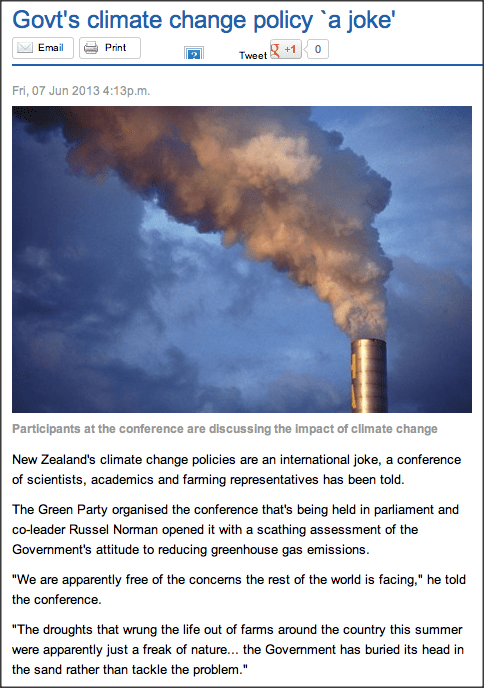
The next headline sums up the climate policy of all governments – a joke. Business-as-usual will continue until it ain’t so usual anymore. Insurance costs will skyrocket and the wrath of nature will roll back all the transient wealth humans have built up atop the backs of our fossil fuel slaves. Externalized costs will be paid back in the wreckage of a civilization which thought of itself as superior to and separate from the natural world.
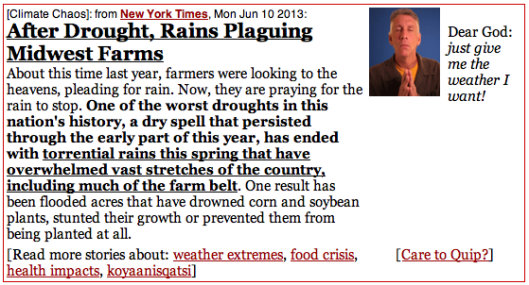
Reading the inklings of future trouble that the next three headlines portend, you’ll see global famine on the horizon:
We’re seeing more severe storms,” Vilsack said. “We’re facing more invasive species. More intense forest fire threatens communities each year. NOAA reported that 2012 was the second most intense year in our history for extreme weather events — droughts, flooding, hurricanes, severe storms, and devastating wildfire. NOAA also advised that last year was the warmest on record for the continental United States.”
He made it clear we can’t dismiss these changes as an aberration.
“The latest science tells us that the threat of a changing climate is new and different from anything we’ve ever tackled,” Vilsack said.
A historic multi-billion dollar flood disaster has killed at least eighteen people in Central Europe after record flooding unprecedented since the Middle Ages hit major rivers in Austria, the Czech Republic, Germany, Poland and Slovakia over the past two weeks. The Danube River in Passau, Germany hit the highest level since 1501, and the Saale River in Halle, Germany was the highest in its 400-year period of record. Numerous cities recorded their highest flood waters in more than a century, although in some locations the great flood of 2002 was higher. The Danube is expected to crest in Hungary’s capital city of Budapest on June 10 at the highest flood level on record, 35 cm higher than the record set in 2006. The flooding was caused by torrential rains that fell on already wet soils. In a 2-day period from May 30 – June 1, portions of Austria received the amount of rain that normally falls in two-and-half months: 150 to 200 mm (5.9 to 7.9″), with isolated regions experiencing 250 mm (9.8″). This two-day rain event had a greater than 1-in-100 year recurrence interval, according to the Austrian Meteorological Agency, ZAMG…
…The primary cause of the torrential rains over Central Europe during late May and early June was large loop in the jet stream that developed over Europe and got stuck in place…
…If it seems like getting two 1-in-100 to 1-in-500 year floods in eleven years is a bit suspicious–well, it is. Those recurrence intervals are based on weather statistics from Earth’s former climate. We are now in a new climate regime with more heat and moisture in the atmosphere, combined with altered jet stream patterns, which makes major flooding disasters more likely in certain parts of the world, like Central Europe. As I discussed in a March 2013 post, “Are atmospheric flow patterns favorable for summer extreme weather increasing?”, research published this year by scientists at the Potsdam Institute for Climate Impact Research (PIK) in German found that extreme summertime jet stream patterns had become twice as common during 2001 – 2012 compared to the previous 22 years. One of these extreme patterns occurred in August 2002, during Central Europe’s last 1-in-100 to 1-in-500 year flood. When the jet stream goes into one of these extreme configurations, it freezes in its tracks for weeks, resulting in an extended period of extreme heat or flooding, depending upon where the high-amplitude part of the jet stream lies. The scientists found that because human-caused global warming is causing the Arctic to heat up more than twice as rapidly as the rest of the planet, a unique resonance pattern capable of causing this behavior was resulting.According to German climate scientist Stefan Rahmstorf, “Planetary wave [jet stream] amplitudes have been very high in the last few weeks; we think this plays a role in the current German flooding event.
The biggest lie ever told is that we will be able to adapt to or mitigate a planet-wide shift in weather patterns, temperatures, and sea level rise on such a short time-scale as to be instantaneous in geologic records. Our fall – a tragicomedy of hubris, self-delusion, greed – will be more precipitous than our rise.
I’ll admit, I don’t really read far into any of the scientific analyses. They all point the same direction: massive discontinuity and unpredictability, what some describe as nonlinear. Armed as I am with only a modest science education, the most basic fact still able to be grokked by the masses is that we live on a water world, where oceans are both the base of the food chain and the creator/regulator of the air we land-based creature breathe. The oceans need not die in their totality before withdrawal of their support functions kills us, yet we behave as if it’s all expendable. We can’t even admit such basic biological mechanisms, so the oceans are simultaneously overharvested and used as dump sites for everything. Real smart, like the rest of collective mistakes.”
Hello fellow collapsitarians, train wreck rubberneckers, concerned citizens, and everyone in between. My time for respite from the horrors of capitalist industrial civilization has arrived wherein I let this site sit fallow for a couple of weeks. When I rail against capitalism, this doesn’t by default make me a proponent of communism or any other ‘ism’. Globalized capitalism is what has conquered the world and it happens to be the current ‘ism’ destroying the biosphere with the industrial efficiency and speed of a Nazi gas chamber. The time to have created another ‘ism’ which may have saved humans from omnicide has long since passed. We are hurdling towards the end of the Anthropocene and into a period I call ‘The Great Cleansing’, whereby Mother Nature scrubs the Earth of all the hubristic artifacts and baggage of modern man. Of course there will quite a bit of noxious material that she’ll have to deal with and absorb such as radioactive waste, plastics, and CO2, but what is a few million years of remediation when compared to the Earth’s age of nearly 5 billion years with perhaps another 7.5 billion to go until consumed by the Sun. Despite all the insults and neglect that she has suffered at our hands, she will probably allow a small tribe of humans to survive the bottleneck. It would be a shame for the Svalbard Global Seed Vault to have no beneficiaries, would it not?
What was our major downfall? I think we put too much faith in technology. Indeed we have used our big brains to solve many seemingly insurmountable obstacles, but we’ve put our technological cleverness on a pedestal at the expense of everything else. Technology has become the God of the 21st Century, the saviour for all of industrial civilization’s increasingly complex and insoluble problems. Granted, it has allowed man to search the stars and decode the DNA of life, but in the process it has clouded our memory of where we’ve come from, the womb from whence we were born. We’re just temporary visitors here with no preeminent right to rule the world above all other living things, and it looks increasingly like we have overstayed our welcome. While Homo sapiens are busy arguing about who or what is responsible for their current predicament, Mother Nature is slowly ramping up her fury. Geophysical forces on a planetary scale have been unleashed; they can no longer be contained by the scientific computations and laboratory tinkerings of mankind. The die has been cast and our fate sealed. No geo-engineering scheme or whiz-bang techno fix can contain her. As the Arctic melts away, followed by the Greenland ice sheet, and then the West Antarctic, our coastal cities will succumb to the sea. Jet streams and hydrologic cycles will transfigure themselves. Our once hospitable and stable seasons for agriculture will become erratic, the water sparse, and the land barren. The great oceanic currents will stall and break down, creating the anoxic and purple-hued waters of a ‘Canfield Ocean‘. As Paul said, the human race is “living in some kind of fantasy land, a land in which truth is avoided”, but a handful of us have peered into the abyss of the unfolding eco-apocalypse, and the stark reality of mankind’s own extinction has been seared into our brains.
How do we go on from here? …one day at a time. What once was important has become trivial. This would include all of the trappings and illusions of mainstream culture. Functioning in this “fantasy world” and going through the motions seems otherworldly and fake. We feel like blurting our what we know to those around us, but we can’t. There’s a straitjacket awaiting us at the nearest insane asylum. No one believes what the cold hard facts and trends have told us after we discarded the rose-tinted glasses society demands everyone wear. And why should they? It’s a traumatic experience to the psyche. Everything about the world you have been taught, all the myths of eternal progress and man’s place in the universe, comes crashing down in a thousand pieces.
So the question remains of how to live in a world of illusions and fakery. Gravitate towards that which is real. Shut off your TV and walk outside to breath in the summer air and run your fingers along the bark of an ancient tree, hike into the wilderness and watch the stars at night, spend one-on-one time with those close to you. They don’t need to know what you know; most will refuse to believe the facts even when meticulously laid out before their eyes. Leave them in their comfort zone, at least for a little while longer or until they become curious. A citizen of modern industrial civilization who confronts the horrific future awaiting their unsustainable way-of-living is like a drug abuser trying to deal with his self-destructive addiction. Both are under the spell of a very powerful force that does not let go until death. They are prisoners, mentally and physically. To talk about this dark subject, the collapse of industrial civilization and mankind’s impending extinction, join a group of like-minded people. Such clubs seem to be growing these days.
It’s a bit odd talking into the ether of the internet to people I will never meet or hear the voices of, but such a venue is really the only place a dissident voice can be heard in today’s atomized and one-dimensional society. For the reasons discussed above, I cannot speak of these disturbing topics to anyone else. This is my only outlet.










 Collapse of Industrial Civilization