They taught us to whisper in slogans and script,
Tongues trained in verses, shackled and whipped.
Our laughter is canned, our silence curated,
Each thought pre-approved, instincts numb and sedated.
The dreams that we wear were stitched in their mills,
Branded and sleek, with synthetic thrills.
The lessons we learn are rehearsed in their school—
We hunger for truth, but choke down their gruel.
Yet sometimes at dusk, in the lull between songs,
A glimmer persists where the lost spirit longs.
It flickers—a question not stamped for inspection,
A marrow-deep wish for a different direction.
Still we sip on delusion, aged quiet and dry,
Sold as free will in a marketplace lie.
We nod through the circus, applaud on cue,
While plotting escape we’ll never pursue.
The puppets revolt in choreographed rage,
Streamed in high definition, marching onstage.
They sell us our chains: a lifestyle, a brand—
And crown us kings of a cage we don’t understand.
Rebellion’s a myth we sell to the meek,
Packaged and priced for the comfortably weak.
Revolvers of dogma dressed up for salute,
Boots marching in circles, a facade of dispute.
They’ll hand you a mask and call it a face,
Let you howl your dissent through the comforts of space.
But no one escapes when they’re wired to believe
That surrender’s a virtue, and truth must deceive.
So here I remain with a smirk and a script,
The ash of ambition entombed in a crypt.
There’s comfort in knowing the bars are a choice—
Much harder to listen to freedom’s dead voice.
Once, ‘neath the city’s restless light,
Where neon signs outshone the night,
A gentle knock, relentless, distant,
Echoed through stale, heavy air.
Shadows lingered on the ceiling,
Certainties were set to reeling—
Progress, worshipped, cold and gleaming,
Bared its teeth in sterile glare.
Quoth the billboard, “Buy contentment!”
And the crowds, with silent consent,
Filed in line, faces downcast—
Dreams exchanged for dollar signs.
Mirrors cast a gaze—uncanny,
Eyes as vacant as a penny—
Each reflection, how so many
Yearn for what the heart declines.
Ravens now are drones, unfeeling,
Over anxious cities wheeling;
Nevermore the bells inviting—
Only sirens split the night.
Yet, with every jest and laughter,
Echoes haunt us ever after—
Irony, our clever master,
Masks our sorrow, out of sight.
So I ponder, restless, wary,
If this “better world” we carry
Is but a ruse—how darkly clever—
All this progress, yet none content.
Let the shadows, sly and jaded,
Mock the dreams that once paraded:
“Nevermore shall you be sated—
Discontent is your torment.”
A seahorse grips a Q-tip in the gyre. I double-tap and scroll a little higher. My straw becomes a pelican’s last meal. I swipe the knowing from my eyes; it can’t be real.
The glacier calves; I vote for cheaper gas. We crown the con man, mow the burning grass. I know the script. I read it anyway— A smiling extra in my own decay.
We kiss with lips that have forgotten why. You ask. I’m fine. We smile. We lie. Your hand finds mine like muscle memory— Two ghosts rehearsing who we used to be.
He watches the flood from forty floors above. The bourbon’s good. The glass is thick enough. A child’s shoe bobs by on the evening news— He flips the channel. What else would he choose?
The pipeline bleeds where the aquifer ran dry. A drone strike hums beneath a quiet sky. We cracked the bedrock for the last of what was there— The well is empty. So is every prayer.
My daughter asks me what the glacier was. I show her photographs. She nods because That’s what you do with fairy tales and myth— I hold her hand. It’s all I have to give.
But how can we define an oil age? It has been about 150 years since the first deep oilwells were sunk, and just over 200 years since the viable steam engine was developed. The two are linked, because the steam engine made deep drilling of oilwells possible and gave us access to a hundred million years worth of fossilized sunlight. Perhaps we have not strictly had an oil age, but rather the first and only age where we enjoy vast amounts of surplus energy that we have extracted from hydrocarbon fuels, of which oil is the most energy dense. It has brought us material wealth, and the means to indulge in wholesale killing of each other and all other species. It gave excesses of food and a population that consumed that food and grew to five or six times the sustainable level of the planet. In the timespan of human existence, the ascendance of modern industrialised man has been a short flash of light and heat that has briefly lifted us out of the mire of the middle ages, but at a considerable cost to the environment.
Our mistake has been to think of that elevation as both divine and permanent. That certainty of permanence explains the mad scramble to come up with ‘alternatives’ and ‘renewables’ in the last decade or two. Something to keep current politicians in office and the masses pacified. It is important that we accept the seductive indoctrination that prayers will be answered and technology will continue to deliver all that can be imagined. The majority have come to believe in the economics of cornucopianism, where wishing for something will make it happen, while ignoring the reality that everything we have is derived from finite hydrocarbon fuels. If we spend enough money, alternatives will always be found to sustain our lifestyle. They won’t of course, and the conflicts that have been fought over oil are proof that they won’t. The pivot of world oil economy is Saudi Arabia, (the concept of ‘Saudi America’ is too ludicrous for discussion here), but that fantasy land of sand dunes and tall towers is being encircled by fanatics who know that when the jugular of global oil is cut, the industrial complexity of the developed west will die.
When (not if) that happens, we might be lucky to hold onto an existence akin to that of the 14th century, which is what the religious zealots want to inflict on all of us. If we’re unlucky, then we must expect something that will be much darker and as yet inadmissible to modern minds that do not have the scope to deal with its implications. That infers an unpleasant imagery of pre-history that we prefer to ignore. Understandably, most think the same way; this is why we cling to the comforting promise of ‘infinite growth’. The alternative is just too awful. Instead we have been encouraged to believe that we can do without oil and not only still run around on wheels, but have a purpose for doing so. And by some means yet to be invented, keep our wings as well.
Our oil age will not end through lack of it, but by fighting over what’s left. So choose your luck‐factor and take that thought where you will, you are on your own with it. Many reasons are given for starting wars, but ultimately there is only one: the pursuit of (energy) resources. Human greed drove improvements in weaponry, and the means of destruction and acquisition became more deadly over thousands of years even though there was more than enough for everyone. The input of oil was the game changer of warfare; history over the last century has shown that conflict was not diminished, but amplified, by the prosperity and technology created by oil. Since the 1860s when black gold gushed from the earth, the economic and political thinking of the pre‐oil era was seamlessly grafted onto the industrial potential of the 19th century, thereby enabling Rockefeller, Ford, Carnegie, Vanderbilt and many others to accumulate fabulous wealth. Their business acumen was undeniable, but none of it could have been brought into existence without energy-rich oil. The use of fossil fuels in our military machines industrialised our methods of killing while at the same time becoming synonymous with progress and commerce. War became a business, the purpose of which was the acquisition of more energy in the pursuit of profit. Battlefield deaths on an industrial scale were an unlisted debit on balance sheets.
WWI started with the muscle power of horses and ended with tanks, demonstrating the murderous scope of mechanized warfare. Recognizing the critical value of oil and its sources, leaders carved up the Middle East to ensure its supply. An exercise in map making in the 1920s by the English and French civil servants Sykes and Picot set the scene for carnage that has raged throughout the Middle East ever since. Arbitrary lines in the sand were drawn, artificial oil states in the Persian Gulf region were created without regard to tribal affiliations, and a quarrelsome orphan Israel was dumped into the lap of unwilling Bedouins. As the quantity of oil there became apparent, all the major nations were drawn into the race for it because those who controlled this key resource were certain to subjugate those who did not.
The critical nature of oil made WWII inevitable. To sustain their empires, the Germans and Japanese slaughtered their way across Europe and Asia in a grab for resources, primarily oil. They promised infinite prosperity and their peoples cheered them on while deaths elsewhere were being counted in millions. With most of the world’s known oil supplies in the hands of his enemies, Adolf Hitler knew he had to have the oilfields of southern Russia and the Middle East to sustain his war machine. He failed, and his dream of a ‘Greater Germany’ collapsed not because of inferior soldiers but because there was insufficient energy input to sustain his plan for world domination. Hitler’s perception of infinite growth in his ‘thousand year Reich’ mirrors our present-day view of ‘permanent affluence’: vast quantities of oil had to be burned to sustain his fantasy. In our desperate scramble for ever-diminishing energy resources, we are in the same mad race to perpetuate the delusion of infinite economic growth. The oil pendulum has swung the other way with roughly 85% of world oil now outside the borders of the USA and Canada in countries not always of a friendly disposition. And just like the Fuhrer, political leaders of today are promising that which is beyond their means to provide. To mask this reality, they have invaded oil-producing nations in the name of ‘freedom’, claiming ‘victories’ which have left only wreckage and simmering animosity behind. So too did Hitler spread a similar line of propaganda that he was liberating other nations from the threat of communism. The second world war that left Europe and Japan flattened in 1945 might be seen as history, but it was just the first of many oil wars, and the politics of it were a side issue. WWII serves as a grim reminder of how violent and destructive humans can be in their ruthless pursuit of energy resources. Hitler’s own ‘oil age’ lasted just twelve years, and it set the pattern for the world oil age that is now in terminal decline.
Don’t be deceived by the democratic righteousness that defeated Hitler’s fascism. 150 years earlier the American empire was created with the same kind of energy grab. The European immigrant peoples who forced their way across America from the 1700s onwards needed resources on which to survive and to sustain the prosperity of an expanding nation just as the Germans and the Japanese did in 1940. The native inhabitants of the American continent were in the way of civilization and progress; their subjugation was a precursor to what happened later in Europe and Asia. Expansive prairies had to be cleared to convert the energy locked in grain and meat to feed the invaders and provide negotiable currency. This self-perpetuating process went into overdrive with the discovery of oil, and the ultimate conversion of that oil into more food resources and hardware added to the wealth of the growing nation. An expanding population needed employment, and the raw energy from oil, coal, and gas supplied it. America and the rest of the industrialised world had the means to build bigger, better, faster machines in endless succession, and created the most powerful country on earth. Everybody was going to be rich, forever. The universal law of consumption was relentless: more demanded more.
Meat and grain grew with relatively little human intervention, but other crops needed to be worked with human muscle. So the slave trade came into being. Slavery might be given many unpleasant names, but essentially it is the acquisition of one energy form to convert it into another for profit. Buy and feed the slave, use slave labour to do work, sell the product of that work. By the time the slave is worn out, several more will have been produced. This was simple economics by 18th century standards but the human consequences were again horrific, costing more millions of lives. It also brought on the American civil war where the slave‐muscled South was overwhelmed by the industrialised muscle that drove the armies of the North.
All the European empires forged out of so-called ‘empty lands’ across the world followed a similar pattern of resource acquisition and an absolute disregard for weaker peoples. It is an unpleasantness that we choose to ignore, but it confirms the killing force that drives us to acquire and convert energy to our own use. The seemingly limitless amount of oil and its energy density appeared to be the answer to all our labour problems. Oil became our ultimate slave. Or so we thought.
We now have maybe 20 years worth of usable oil left. There are certainly no more than 30, perhaps as little as 10. If one of the crazy sects running loose in the Middle East managed to get hold of a nuclear device, setting it off on the Gharwar oilfield of Saudi Arabia, it would be endgame overnight. That is perhaps too bleak a prospect, but we should not discount that notion entirely.
Before our oil to food arrangement, the planet supported something over one billion people. We now have over seven billion, and the mothers of the next two billion are alive now and approaching the age of reproduction. Preachers, scientists and politicians will not stop the basic human function of eating and procreation, so if unchecked nine billion people will be here by 2040/50, and set to go on rising after that. Every new arrival expects to be fed, watered, clothed and housed, but by no stretch of the imagination will the global food system be able to feed that number let alone sustain them with what would be expected by way of the most basic material comfort. No one dares to stand up and make the rather obvious point that we are not going to reach 9 billion. Something has to give, and that giving is going to be very unpleasant.
In the first decade of the 21st century, numerous wars have been fought over oil, and are being fought now. Wars are fought over resources because on nature’s terms, gentle contentedness is not a good strategy for survival; we are collectively powerless against genetic forces that dictate our lives no matter how much we protest otherwise. Downsized to whatever level, nature will ultimately force the choice of survival or death, and the outcome will be of no consequence other than to you and yours. To expect humankind to change within a single generation is stretching credibility beyond breaking point. Those who look forward to a life of bucolic bliss in a downsized oil‐less world might do well to think about that. Whether killing and butchering an animal to eat it, or invading another nation to secure oil supplies, we must appropriate energy sources to facilitate survival. You may think there’s a choice about doing that, but there isn’t, other than in the matter of scale. Whether paying a butcher to cut and wrap your steak, or paying soldiers to invade Iraq, securing sufficient energy to live is what we have to do to survive.
For the moment, nature keeps us supplied with oil, and we’ve pulled off the neat trick of converting it directly into food. Not knowing when our oil is finished and our food supply will run out is the little teaser for the early 21st century. Right now, most people think that food comes from supermarket shelves and freezers, which is just as well. The food trucks moving around the country are basically mobile warehouses, delivering food just in time for it to be consumed. When the realization dawns that the food trucks have stopped, the food held in stock by retailers will be stripped bare in hours. The oil age for everyone will have come to an end.
But oil carries man’s destiny in far more subtle ways than food supplies. It holds nations together. The USA is a vast territory of disparate peoples and ideas, held together by a common bond of prosperity and a basic consensus that government and law generally works for the good of all. And the inhabitants of empires are always convinced that theirs is permanent and protected by gods. That definition would apply to many large nations to a greater or lesser degree. But the bonds that hold it together, godly or otherwise, are entirely subject to availability of affordable oil. Empires (and the USA is an empire) remain whole so long as the means exists to maintain them. Oil has become that means.
Without oil, the nation will begin its decline into disparate regions. Without interconnecting transport, the United States of America cannot remain united. The force necessary to prevent a breakup will not be there, so within a decade (probably far less) of oil supply failure, the USA will cease to exist. The cracks are already there along linguistic, economic, racial, political and geographic lines. Even now it would be possible to take a pretty good guess at where those regions will split off.
This will be denied and resisted of course, but armies and police forces have power only as long as their fuel lasts. They will be unable to prevent secession in whatever form it takes. It might just be that Washington will come to govern not much more than the original colonies. Given a suitably deranged political leader and prayers to the right god, fully armed groups are ready to believe that the ‘American Dream’ can be restored. Such demagoguery sets the stage for years of regional violence over the basics of life, particularly food and water. The horror of it will be justified by warped views of right and wrong, clinging to a denial mentality magnified beyond any imagining by the privation that an oil-less society will bring.
This scenario is not exclusive to the USA. The British Empire was built on coal. When the coal was gone the empire faded away. Then in the 80s and 90s the UK became awash with cheap oil from the North Sea, and everyone was reasonably prosperous, particularly Scotland. Now the oil surplus has gone, and the UK is in decline again as a net importer. The ‘oil prosperity’ is fading away. Scotland is losing its main source of income and wants to secede from the United Kingdom, convinced that independence will somehow restore their wealth. Things will get very unpleasant when they realize that an independent Scotland will eventually be reduced to the economic level of Greece. The link between oil and the ability to eat is clear. The UK has to import 40% of its food, and much of the rest depends on oil to produce it, which also has to be imported. It is the end of the UK’s oil age, but few admit to it being the end of a food age as well. The same problem is being revealed in the current fiasco of the European union, but a little more advanced than the USA and UK. Oil-fueled prosperity is falling dramatically in the poorer southern countries. Greece, Spain and Portugal and a swathe of smaller nations have to import all their oil which only worked when oil was cheap. Now it’s expensive, and they are facing bankruptcy. 50 years of ‘unity’ is dissolving like a mirage in the face of the difficulties that smaller states are suffering. Without cheap oil, their economies cannot function, and so are disintegrating. United Europe needs oil to stay united just as the USA does. Russia’s oil dependent economy is crumbling, and Putin is having to make threatening postures to divert attention from his problems. His oil age is ending in a different way and yet we cannot tell if his posturing is just that, but a shortage of resources in the past has invariably brought conflict.
Move to the Far East and the nations around the South China Sea are all threatening one another, again the focus of the argument being the oil and gas fields of the region. They all know that without oil they cannot survive, and are prepared to fight for every last drop of the stuff, no matter what the cost. As a measure of what the dispute is about, the volume of oil in question is 11 billion barrels. One billion barrels is less than a month of world consumption. They are preparing to fight over the last dregs in confirmation of man’s desperation over oil shortages. Eventually, this problem will hit every nation and individual on earth as our oil‐crutch is kicked away. And with the oil age fading into history for us all, there will be no shortage of violent resistance to this inconvenient truth.
Tomorrow is Thanksgiving, a holiday created from romanticized myths about grand and cordial feasts between pilgrims and the indigenous people whose lives, land, and culture would soon be exterminated from coast to coast. Truth be told, Thanksgiving sprang from the imaginative mind of Sarah Josepha Hale, an author and editor who campaigned for nearly two decades to make it a national holiday before winning over President Lincoln who made it official in 1863. Some historians believe Lincoln used the creation of Thanksgiving as propaganda during the Civil War to paint Northerners as the true founders of the nation whose cause in the war was virtuous and just. In her writings, Hale also pushed the delusional belief that the “United States government was founded without bloodshed.”
Today the holiday has become fully merged into the capitalist superstructure as a time to binge on turkey, mashed potatoes, stuffing, cranberry sauce and puddings just before camping outside consumerist temples for the true day of worship… Black Friday. Riots and mob violence are generally tolerated on Black Friday since it is the key event kicking off the holiday shopping season and driving up corporate profits. Protests and riots for social justice and equality are seen as threats to the capitalist status quo and are systematically undermined, quelled, and co-opted. As I explained in a previous post, the events in Ferguson dominating the headlines are rooted in our socio-economic system.
A few recent thoughts on Twitter about Ferguson and the state of the “civilized” world…
We could go into great detail about each of the above comments, supporting them with a multitude of facts and references, but I think they speak for themselves and summarize quite well the disintegrating social fabric in America and across the world. Compounding the problem of our sociopathic and sclerotic economic system are the environmental crises of climate change, ocean acidification, resource depletion, and overpopulation, none of which can be successfully dealt with unless we address the system that underlies them all, i.e. capitalism and its energy-intensive way of life. The facts tell us it’s much too late to do anything to save ourselves, but this hopeless mindset only serves to empower those at the top who continue to profit from this corrupt and self-destructive system. It’s past time to step outside our comfort zone and do something to try and save a piece of the web of life fast disappearing before our eyes.
The following poem by William S. Burroughs resonates with what has gone horribly wrong in America and perhaps what has always been wrong.
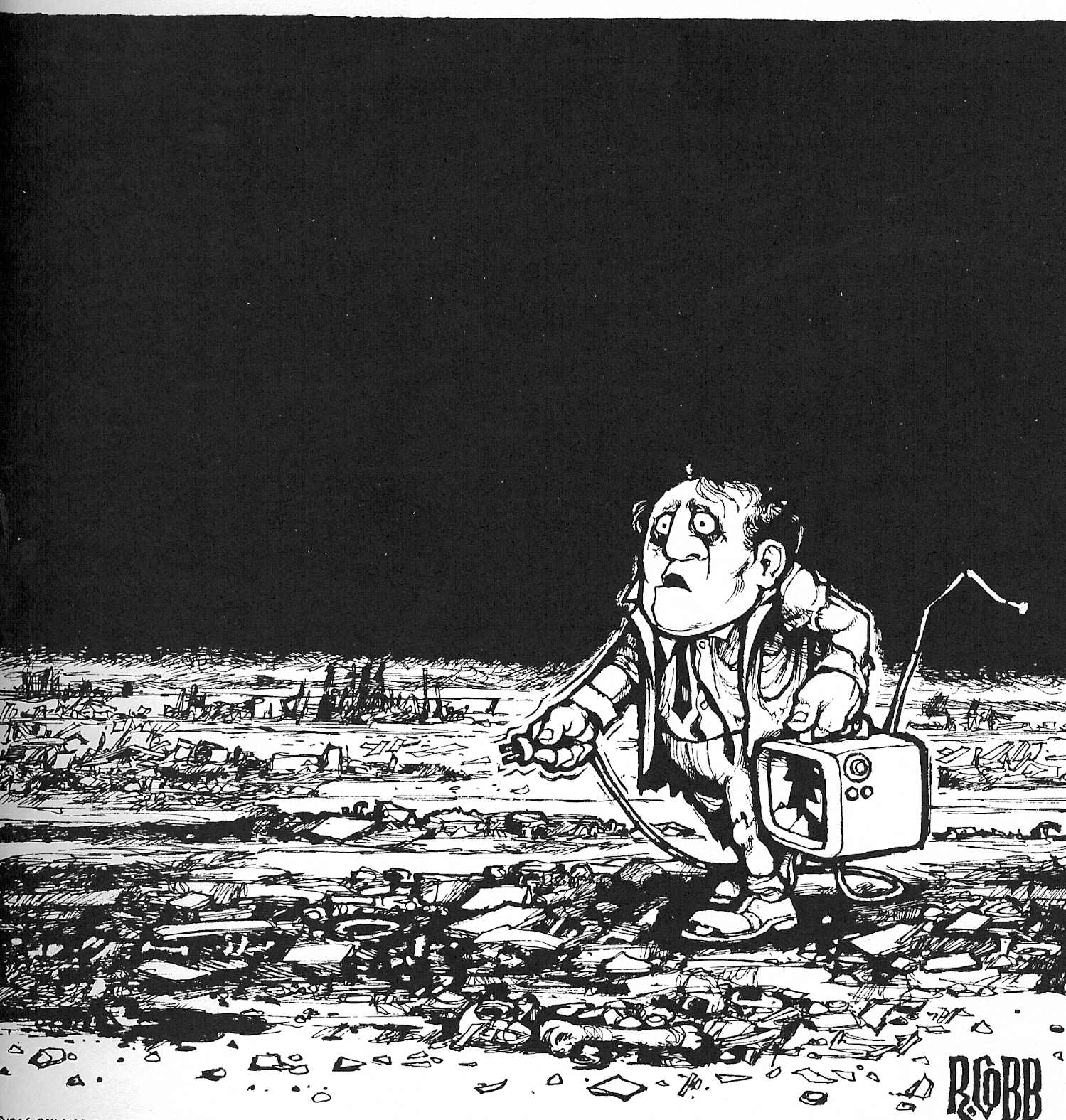
What had been designed to be our servants became our masters, then our owners and gods, and finally our destroyer….
Some days I wake up and despise the monotony and pettiness of this culture and its followers: its celebrity worship, its staged news reporting, its chameleon politicians, its conniving marketers of consumerism, its cookie-cutter neighborhoods, its push-button surveillance state, and its clueless masses all working together to create the illusion of normalcy. Everyone goes along with this mindless program like obedient slaves, afraid of the social stigma attached to questioning any radical deviation from what constitutes normal. God forbid anyone openly discusses the cliff we are fast approaching, its sheer drop-off and craggy rocks below coming more clearly into view. One last scramble for the last bit of habitable land at the poles will be the inevitable end game as atmospheric warming catches up to the glacial melt and sea level rise humans have set into motion. In light of all the scientific evidence accumulated over decades, mankind has known for some time that a radical reconfiguration of our socio-economic system was the only way to avoid collapse, as described beautifully back in 2008 by a longtime blogger who has been writing for nearly a decade:
There can be no “soft-landing” for a species adding another million of itself every 4 and a half days to consume and convert into more and more human flesh what little remains of the planet’s tattered web of life. Worshiping paper symbols of wealth as the only measurement of social and environmental worth, our species has monetized and misunderstood nature, ignoring its true incalculable value. Surely something is amiss when the financial interests of the insecticide industry trump the health of humans and the survival of pollinators. Examining the root cause of such corrosive effects in our economic system, i.e. capitalism, is nearly as taboo as mentioning the collapse of modern civilization. The culturally Pavlovianresponses to any such criticism directed at capitalism or the unsustainability of industrial civilization is to argue for the rehabilitation of capitalism into something less destructive and tout humanity’s unfailing ability to adapt to any situation. Reinforced by past successes such as the Green Revolution, robotic exploration of distant planets, and Moore’s Law of technological advancement, the marriage of capitalism and technology has created a mindset which takes for granted the belief that the marketplace will create a hi-tech fix to any and all problems. Little green aliens, paranormal experiences, and techno-utopian futures seem to be more socially acceptable subjects for discussion rather than the collapse of a way-of-life that requires several more Earths if everyone were to live like Americans. Perhaps that is why we get technotopian books like this one:
The myth of progress is central to corporate ideologies of materialism, modernism, and technocapitalism. The mythical quality of technological progress was expressed most succinctly in GE’s slogan from the 1950’s: “Progress is our most important product.”
There are reportedly hundreds of Transhumanist-affiliated groups(life extensionists, techno-optimists, Singularitarians, biohackers, roboticists, AI proponents, and futurists) in the world with the largest, the Singularity Network, claiming 10,000 members. Few in our society can imagine this planet exhausted of its resources, inhospitable to agriculture, and devoid of all its keystone species, but such a world is fast becoming reality as industrial civilization steamrolls the planet under the direction of technocapitalism. Millions of factories continue to spit out products by the ton to be shipped to every corner of the globe. The ravenous hordes struggling for a higher standard of living never think twice about the energy and eco-social damage tied to these consumer products that magically appear on store shelves.
“A transhuman future is a day-dream and we are rapidly running out of the luxury of being able to do nothing about the very real problems that face us now. A transhuman future is a nightmare of the electric sheep.”
~ Dr. Paul Willis
The boundaries of a finite planet have been temporarily extended by technology, giving mankind a false sense of power over his environment, but technological complexity is not immune to the law of diminishing returns; the problems are overwhelming the solutions:
“…Technology cannot bring back a concentrated resource deposit like soil, phosphates and fossil fuels that have been dispersed and converted so completely that no amount of energy can get them back. The links in the technological evolutionary chain have been successful so far, but all it takes is a single broken link that will drop us into the waste heap of failed evolution. The next link of the chain always exists in the imaginations of men, technological wonders to carry us forward, but malignant growth, the kind sponsored by corporate, banking and Wall St. entities, will guarantee the current technological link is our last one…”
For a culture that lives for today and ignores the consequences of tomorrow, the show must go on even as cracks and weaknesses in this false façade become more evident day by day. Omar N. Bradley may have been thinking about weapons of mass destruction when he made an observation about mankind’s tools of self-destruction, but he could not have been more prescient in the broader sense of technology’s reach into our lives when he said, “If we continue to develop our technology without wisdom or prudence, our servant may prove to be our executioner.”
As in previous fallen civilizations, today’s elite are more out of touch with our precarious position than most realize, and they will try to cling to their wealth and social status despite how much blood flows in the streets as the masses bear the brunt of collapse first –poverty, disease, war, starvation, etc., but ultimately no one can run from the death of the Earth’s oceans, the spread of novel diseases, and the die-off of trees. Those now deciding how our technologic scalpels will be wielded are not institutions looking out for the greater good of humanity, but by the ultra wealthy for their own personal financial enrichment and narcissistic interests:
“For better or worse,” said Steven A. Edwards, a policy analyst at the American Association for the Advancement of Science, “the practice of science in the 21st century is becoming shaped less by national priorities or by peer-review groups and more by the particular preferences of individuals with huge amounts of money…
…that personal setting of priorities is precisely what troubles some in the science establishment. Many of the patrons, they say, are ignoring basic research — the kind that investigates the riddles of nature and has produced centuries of breakthroughs, even whole industries — for a jumble of popular, feel-good fields like environmental studies and space exploration…
..the rise of science philanthropy may simply help “rich fields, universities and individuals to get richer.” The new patrons are responsible for one of the most striking trends on these campuses: the rise of privately financed institutes, the new temples of science philanthropy.
This privatization of science is just one more aspect of capitalism’s usurpation and corruption of the body politic.
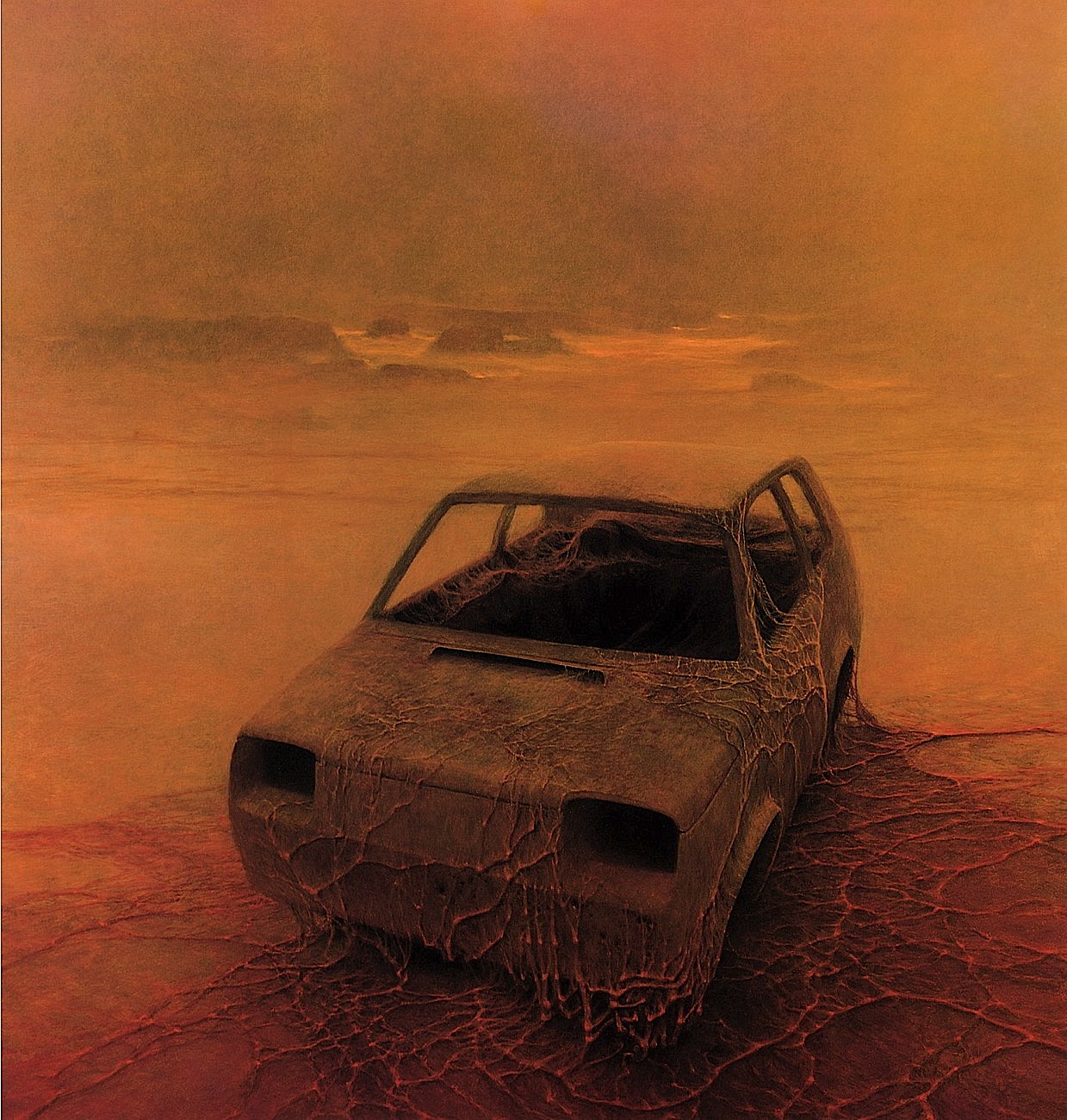
The art in this blog post is from Polish artist Zdzislaw Beksiński whose intricately detailed paintings of apocalyptic landscapes, mutated and deformed humans, and surreal images were said to be inspired from his nightmares. He never gave titles to his paintings and signed them on the back. It is said he would often wake up in the middle of night to paint his dark visions. In 2005 he was found dead lying on the floor of his Warsaw flat in a pool of blood, stabbed 17 times.
Perhaps the greatest nightmare of modern man is the fact that he is at the mercy of an ever-expanding industrial civilization running on autopilot, as Zygmunt Bauman described, with no realistic way to stop its onslaught of toxic waste, greenhouse gas emissions, deforestation, and numerous other ecocidal features. I can see this horror when I look at much of Beksiński’s work, but I also see nature reclaiming the battlefield after man has defeated himself.
To a great degree, humans are their own worst enemy, prisoners of their flawed cerebral wiring with its neuroses, blind spots, and cognitive biases, but the real enemy is the omnicidal juggernaut our numbers have created; its base urges can’t be contained.
In his latest essay, Chomsky asks the simple question, “Can Civilization Survive Capitalism?” And when he says “capitalism”, he means the true capitalism we have today here in America in which capital has corrupted and usurped government regulation and legislation to the (N)th degree. Crony capitalism is the same as unfettered capitalism which is the end result of all types of capitalism if they are left to play out to their inevitable conclusion, something Chomsky calls “really existing capitalist democracy” or RECD for short.
First, Chomsky proclaims the obvious fact that RECD is incompatible with true democracy and that civilization cannot survive under RECD with its corporate-run government passing as faux democracy. He then asks whether a functioning democracy under a capitalist system would make a difference.
For the litmus test, Chomsky confronts the most apparent and grave danger facing mankind – environmental catastrophe, an unfolding crisis we here at this site are very familiar with. As is often the case in an RECD, what the public wants and what the corporate forces ruling the country demand are two very different things. To illustrate this divergent reality, Chomsky quotes from recent studies by Kelly Sims Gallagher in the current issue of Daedalus, the journal of the American Academy of Arts and Sciences. In contrast to well over a hundred countries which have enacted renewable energy policies and targets, the U.S. “has not adopted any consistent and stable set of policies at the national level to foster the use of renewable energy.”
And it’s not by lack of public desire that such renewable energies have not been enacted. On the contrary, the vast majority of Americans have favored such action in order to avert the very environmental catastrophe currently threatening life as we know it. But as Chomsky wryly comments:
The fact that the public is influenced by science is deeply troubling to those who dominate the economy and state policy.
Now to combat this influence of science on the minds of the common people, our corporate overlords have used one of their lapdog lobbyist groups, ALEC, to enact legislation with the Orwellian title “Environmental Literacy Improvement Act” which would actually cast a cloud of doubt over the science of climate change by forcing schools to allow alternative interpretations, i.e. climate change denial:
The ALEC Act mandates “balanced teaching” of climate science in K-12 classrooms. “Balanced teaching” is a code phrase that refers to teaching climate-change denial, to “balance” mainstream climate science. It is analogous to the “balanced teaching” advocated by creationists to enable the teaching of “creation science” in public schools. Legislation based on ALEC models has already been introduced in several states.
Of course this “balanced teaching” won’t include the views of those much more astute scientists who have accurately said that the IPCC’s climate models and forecasts have been and continue to be much too conservative and optimistic. The corporate intrusion into America’s classrooms will undoubtedly include viewpoints from people who say that CO2 is good for the planet and that God would not allow man to destroy himself.
Again, Chomsky explains that such dumbing down of the populace is done intentionally to serve the short-term profit motives of our corporatocracy. Keeping the masses ill-informed and living within a cloud of propaganda and infotainment is the primary objective of the ALEC legislation. Creating a country full of Al Bundys and Homer Simpsons has been an ongoing process since the inception of a post-World War II Consumer Culture. When the primary tool for constructing a nation’s identity – “The Media” – is motivated by money, society is destined for a meltdown. We are following the doctrine of ‘preordained destiny’ right into the annals of extinction alongside the dinosaurs and the Dodo bird.
…Within the RECD system it is of extreme importance that we become the stupid nation, not misled by science and rationality, in the interests of the short-term gains of the masters of the economy and political system, and damn the consequences.
These commitments are deeply rooted in the fundamentalist market doctrines that are preached within RECD, though observed in a highly selective manner, so as to sustain a powerful state that serves wealth and power.
Chomsky compares the corporatocracy’s willful ignorance on human-induced climate change to that of the ongoing banking crisis and the financial sector’s criminal behavior in disregarding “systemic risk”, i.e. the risk of collapsing an entire financial system or entire market. The systemic risk of continuing to exploit fossil fuels is more blatantly obvious every week, month, and year that passes. Enjoying 20/20 hindsight and taxpayer-funded bailouts won’t be an option for a crash of the global biosphere.
Environmental catastrophe is far more serious: The externality that is being ignored is the fate of the species. And there is nowhere to run, cap in hand, for a bailout.
In future, historians (if there are any) will look back on this curious spectacle taking shape in the early 21st century. For the first time in human history, humans are facing the significant prospect of severe calamity as a result of their actions – actions that are battering our prospects of decent survival.
Those historians will observe that the richest and most powerful country in history, which enjoys incomparable advantages, is leading the effort to intensify the likely disaster. Leading the effort to preserve conditions in which our immediate descendants might have a decent life are the so-called “primitive” societies: First Nations, tribal, indigenous, aboriginal.
The countries with large and influential indigenous populations are well in the lead in seeking to preserve the planet. The countries that have driven indigenous populations to extinction or extreme marginalization are racing toward destruction.
Over four centuries of commodifying the planet and two centuries of wallowing in a fossil fuel high have turned the industrialized world into crazed drug addicts marching towards their own destruction. It is only the planet’s unindustrialized “primitive people’ who remain clear-minded enough to act rationally and wisely. By all estimations, having even a semi-functioning democracy under a capitalist system would exponentially improve our odds of survival; but under the current regime, no living thing will get out alive when glorified apes dressed in suits are flinging shit and wielding weapons of mass destruction.
This observation generalizes: Throughout the world, indigenous societies are struggling to protect what they sometimes call “the rights of nature,” while the civilized and sophisticated scoff at this silliness.
This is all exactly the opposite of what rationality would predict – unless it is the skewed form of reason that passes through the filter of RECD.
Our present predicament is best described by a commenter in regards to the short film ‘Time Enough at Last‘:












 Collapse of Industrial Civilization
