On my downtime right now and trying to recoup from doomer fatigue, but the following story simply reinforces my belief that industrial civilization will die at its own hands while taking the rest of the living planet with it in a manmade greenhouse extinction event. Capitalism gives humans the perverse incentive to value death and artificial wealth over life and nature’s wealth. Note to self – must read everything by Peter Ward.
Those who have read my thoughts, sprinkled hither and thither around the internet, will perhaps be aware that I gave up, about one and a half years ago, when I realised that whatever mighty efforts activists might make, it was going to be impossible to save the biosphere. Daniel Drumright was about three months ahead of me.
Nobody who hasn’t fully encountered and absorbed that experience for themselves, in its true horror, has any idea what it really means, and for those who have yet to face it, you have my deepest compassion and sympathy.
There’s no point in going over the technical reasoning in detail. People either get it or they don’t. They can find all the information quite easily.
There are three big, obvious factors that most people do not understand; those are, first, the irreversible self-reinforcing positive feedbacks that Guy McPherson is listing, and second, the time lag, that what we have now is the result of what we did forty or so years ago, and what we get in the future will be the effects of what we have been doing ever since. The third is the astounding rate at which all the changes are happening, when compared with all previous similar or comparable events in Earth’s history. Whatever it is, it is ULTRA DRAMATIC on the geological time scale.
The doom scenario has been, and is being, comprehensively documented by xraymike on this blog. The trickle of folk who are going through the process of coming to terms with this hellish awakening has already grown into a cascade and will soon be millions, and I really have nothing to say to them, because I do not know what to say to them.
Once you get the insight regarding the Mass Extinction Event, it’s a bit like the Buddha’s Enlightenment Experience under the Bodhi Tree, only in reverse, so to speak.
Gautama pondered whether to keep his insight to himself and spend the rest of his days in bliss, or whether to teach others what he now knew, and he chose, out of compassion, to spend the remainder of his life wandering through India teaching his message.
But how do you teach how to cope with doom ? There’s nothing optimistic or pleasing or life-enhancing or joyful about imminent apocalypse. There’s just the anguish and distress involved with the demanding process of navigating your own psychology and emotional responses toward an impossible future.
Each individual IS an individual, as we see on NBL, with their own version of the mixture of belief and disbelief and their own political and philosophical and religious outlooks, and some have children and grandchildren and some are thinking of survival chances, some of suicide, some of resistance, and so on.
I have had more than a year to dwell upon my own position, and to watch the responses in my own being, and in the people whom I like and respect, and the voices I admire, who also grasp the profound and terrible tragedy facing us all. For a long time, there was commiseration, but then what ? Commiseration fatigue ? How can anyone commiserate with anonymous thousands, let alone millions ?
Again, there’s lots of speculation as to the detail of how the crash will play out and how societies will respond as they collapse. I’m not going to add much to that here, it’s all available elsewhere. We either get a die back, and a bottle neck, with a few survivors, or a complete die off and total extinction event. I think we get the latter, but even if it is the former, none of us are going to know any of those people, as to who they will be, or where or what becomes of them, so why does it matter ? And why would anyone choose to have to live through whatever horrendous circumstances they will have to endure, following the trauma of the ending of civilisation ? Perhaps some people will just happen to find themselves in such a situation. Who knows ?
Meanwhile, here we are. Peak just about everything, where we start the big slide down into the abysmal depths of whatever awaits us all… the biggest crisis that the human species has ever faced, 7 point something billion of us, with millions more arriving here every month. There is no discernible global leadership of any kind that comprehends our dire situation, only madmen and corruption and people locked in to dead cultural paradigms.
What does a dead cultural paradigm look like ?
Well, we’ve got Joseph Tainter to give us some clues from the historical record and maybe Heathcote Williams to bring us up to date with the contemporary scene
From what I understand of history, we can expect a hard swing toward fascist dystopia, as regimes try desperately to exert total control over everything, and hard swings from repressed populations and factions which reciprocate with resistance.
The future will be whatever it will be. Every day I walk up and down the Beach of Doom and kick at pieces of poisonous plastic flotsam and miscellaneous cosmic debris left by the virtual tide, and gaze at the orange purple bruises on the tangerine sky and sometimes I bicker and haggle with someone.
Yesterday it was Lidia at NBL to whom I am grateful for an insight into something or other.
You see, people can be very roughly divided into two groups. Those who primarily hold a religious, or spiritual, or romantic, or mythical world view. And those who primarily hold a scientific, or materialist, or rationalist world view.
Of course, this is a crude over-simplification, and speaking to any individual, you’ll soon find they hold all kinds of contradictory beliefs. But roughly, it’s Mythos and Logos, or Iain McGilchrist’s Right and Left Hemispheres.
So, Lidia was kind enough to describe her worldview, her welt anschauung, her cosmology, her mental conception of how reality is structured, her epistemology, her way of ‘knowing your place in the Universe’.
I hope she will forgive my using her as an example, and the exchange several days ago was only a brief re-run of a much longer version we had on the now defunct NTE ning, some months ago, so I think I do have a fairly full idea as to her thinking, but so as not to risk any personal offence, I’ll take the illustration away from Lidia, and apply it to any generic physicist or scientist or person with a similar belief system, of whom I have met very, very many. This will allow me some poetic license possibly, avoiding danger of maligning the good Lidia, I hope.
You see, according to this paradigm of reality, there is only physics. Everything is physics.
That means that everything is explained by physics. That means no mystery, because even if there is mystery, that’s only due to physics not yet explaining it. And once mystery is killed off, it’s relatives, cousins – things like awe, wonder, sanctity, sacredness, the numinous – easily shrivel and die too.
So, that reality ‘out there’, and this reality ‘in here’, is all meaningless, because it only means something if we impose some wishful magical thinking onto the physics, which, as objective scientists, we are not allowed to do.
And that reality ‘out there’ is just ‘stuff’, and it interacts with this reality ‘in here’, the brain, which again is just ‘stuff’. It’s all physics, it’s all physical stuff, and even though we don’t understand all of it – even don’t understand most of it, or, if pressed, hardly ANY of it, hahaha – in theory, physics can, and will, explain all of it, one day, so no problem.
So, it’s quite interesting to trace back where this story, this Logos story, comes from, and it’s quite easy to do, because it’s well documented and researched, and it goes back to Descartes and his radical scepticism, and the ideas given to him by an angel (Mythos) and his struggle to find anything, something, that he could not undermine by radical doubt, and his arrival at ‘I think, therefore I am’ and then the beginnings of modern science.
Given that the Church of Rome was the dominant power in Europe at the time, an accommodation had to be made between the rising power of science and the prevailing authority, and thus we got an expedient result, the division which gave the material world to the scientists and the spiritual world to the priests. That’s why there’s no God or spirits involved in physics. Which, you may say, is an excellent thing. But let us call it, for the moment, ‘a mixed blessing’.
Because, you see, if you follow the epistemology carefully, and look at it very closely, something absolutely amazing emerges.
Einstein said that our ordinary common senses give us ‘naive realism’. That is, grass is green, rocks are hard, and snow is cold. But physics, if it is true, tells us that this naive realism is all wrong, physics tells us that the reality is quite different, something completely different is actually going on, out there and in here.
Now, it’s all very well for someone like Einstein, or Niels Bohr, or Feynman, to come up with these ideas, as professional physicists, but what happens when this scientific worldview, this basically Cartesian worldview, is taught to us lesser mortals as part of the culture, and internalised as epistemology, and preached to us as ontology, and integrated into general social cosmology ?
This is where it gets really weird, a MOST extraordinary thing – because when I thought over what Lidia had told me, nowhere in the depiction and analysis is there anywhere for A HAPPY HEALTHY COMPLETE HUMAN BEING.
Isn’t that bizarre ? That human beings have come up with a teaching as to what the world is and what the totality of the Universe is, which does not even include the organism that WE ARE, AT ALL ?
I mean, that strikes me as exceptionally odd. Prior to Descartes, the cosmology was a sort of Divine Order, with the Heavens above and layers with angels and God at the pinnacle and so forth. And people were taught this, and their place in the social hierarchy of feudalism was essentially justified because the King was a sort of representative of God on Earth, and so on. So although we can scoff at the nonsense of it, at least at the time, if you were a peasant, you featured in the story.
If you were out in the fields with your ox and your plough and you were gazing at the distant rainbow and thinking about your dead grandfather and you heard the church bells peeling for a wedding in the village next door, all sorts of strange impressions could flicker through your mind, but basically you had a cosmology which placed God somewhere ‘up there’ and you ‘down here’ with a coherent pattern where your birth and living and death belonged with the landscape and the community and the larger reality.
Therefore, the map, the mental model ‘in here’, when projected and overlaid upon reality, had in it the human subject as its focal point, and because that’s what the human subject had been taught, a story was established featuring the ME.
But now, not only have they written God out, with Descartes and the Cartesian Paradigm of reality as the basis of modern science, but you’ve got a model, a cosmology, which has written US, as human beings, biological creatures, right out of the system altogether, as if they were not even involved !
And then people have internalised this model and taken it to be their own personal reality that they use to explain the world to themselves.
I wonder what that does for a person’s health ? I wonder what it does, when millions of people do something like that ?
The Christian Fundamentalists may be completely round the bend when it comes to LOGIC but maybe they just feel intuitively that what they are being offered by the people who argue against them, a worldview, a cosmology, which says NOTHING MEANS ANYTHING, and a worldview, a cosmology, which doesn’t have ANY PLACE where a happy healthy human, a biological human being, can even fit into it, is so sterile and horrible, that they intuitively reject it and are hostile to it ?
Because, if you look at anthropology or what Joseph Campbell said about myth, what a belief system provides for a tribal people is a safe mental refuge. When a person takes a mental excursion into fantasy and ponders the nature of their own life and identity, and the dream they had last night, and their relationships with the world around them and other folks, and the stars above and so forth, the whole purpose of the cosmology is to deliver them safely back unto THEMSELVES.
I mean, think of acid trips and ayauasca and mushrooms and vision quests and all that stuff, where you encounter visions of beings from other dimensions and the most mind-boggling experiences, the idea is to get back to start, square 1, more or less sane and intact.
The same applies to ordinary daydreams and fantasies and all our thinking about our ordinary experiences. How can we be sane and healthy, if our fundamental belief system does not even include a home base option anywhere within it ?
You know, who cares what the physics says. Primarily, we are human beings, biological animals, that cry when we are hurt and sad, and laugh when we are happy, and get sentimental about babies and kittens, and need clean water and food, etc. AND we need a meaningful Universe which has a place for US in it, with a STORY that makes sense as to why we exist…
You know, a story we can UNDERSTAND about who we are and what we are doing here.
At the moment, all these stories we are being told are crap because they are not accurate with the science, strictly speaking, since they can’t be; we can’t get any clear picture from the physicists as to the ultimate nature of all the quantum stuff and the Universe. In addition, these cultural stories are unsatisfactory at the human level when they LEAVE OUT the human being and pretend it’s all some sort of abstract empty machine.
What’s more, from what a large percentage of quantum physicists have plainly stated, you cannot leave the physicist out of the experiment because the observer EFFECTS the observation. Now, I recognize this is contentious, there is no consensus, and it’s not clear what this means. But !
So, what does a ‘good story’ look like ? Well, that’s hard… but I’m glad you asked.
I think this is a complicated and difficult problem, and here I am upon the Beach of Doom, with all of human history and culture, every idea that’s ever been recorded, washed up at my feet at the tide line, strewn and tangled and rotting and steaming…
Look at us, pitiful, confused Bonobos, asking ourselves questions we can’t answer, tearing ourselves and each other apart, trying to satisfy Maslow’s Hierarchy…
Is that what we are doing ? Well, the whistle has blown, the sirens are wailing, time is up, the NTE light is flashing, so there is not going to be some utopian Promised Land for the Bonobos to migrate to…
Xraymike was kind enough to point me to the definition of the word Humanistic:
1. A believer in the principles of humanism. 2. One who is concerned with the interests and welfare of humans.
“Humanism is a group of philosophies and ethical perspectives which emphasize the value and agency of human beings, individually and collectively, and generally prefers individual thought and evidence (rationalism, empiricism) over established doctrine or faith (fideism). The term humanism can be ambiguously diverse, and there has been a persistent confusion between several related uses of the term because different intellectual movements have identified with it over time.[1] In philosophy and social science, humanism refers to a perspective that affirms some notion of a “human nature” (contrasted with anti-humanism). etc…”
So let’s take that as a verbal anchorage.
I’d suggest that most human beings have a fundamental requirement, for their psychological, physiological, and social welfare, to understand ‘the world’ in a way that makes sense. So that, whenever they sit down and think things over, and run ideas through their head, they can confirm themselves and they can confirm ‘the world’ and feel okay.
Wouldn’t that be nice ? Look what we’ve got. It’s not THAT, is it.
Is it any surprise that some people want the Rapture or Alien abduction to get the hell out of this confusion ?
The epistemology that science teaches, following on from Descartes, has caused most of the damage to the biosphere over the last century or two, because nothing is sacred, everything is just dead stuff, in a dead machine, inhabited by ghostly meaningless meat robots, zeks, without any dignity or purpose of their own.
You marry that to Capitalism, an elite with power and greed as their motive, and give it to them as a tool, and hand them control of the Military, which was once meant to guard but gets turned into a predatory plundering machine.
Well. We are where we are. The lights will go out, one by one, and then a few million years of silence as the extremophiles have peace.
It could have been, might have been, a very different story, if we had all followed the example of, say, the Bishnois.
Alice Friedemann must be on the same wavelength as me. This subject of the proliferation of jellyfish caught my attention as well. Since she has done the legwork on this story, I will repost her essay below the following CBC Radio podcast with scientist Lisa-ann Gershwin:
“If jellyfish could wish for perfect conditions, these would include warming and turbid water, lack of predators and competitors, and any conditions that make it harder for other species to survive, like low oxygen or slightly more acidic water than usual. These are the very conditions we are creating at an alarming and increasing rate. And jellyfish are enjoying a renaissance like never before in history.” ~ Lisa-ann Gershwin
Alice Friedemann’s review of Stung!…
A book review of Lisa-ann Gershwin’s “Stung! On jellyfish blooms and the future of the ocean”
[ Xraymike79’s Note: The image above is purely for hyperbole. There are no jellyfish this size. The largest recorded jellyfish is the Lion’s mane jellyfish which can reach a diameter of 7 to 8 feet with tentacles 120 feet long. As Don Howe states below in the comments section: “The power of jellyfish is not in their size but in their vast numbers…”]
Move aside Steven King, jellyfish are worse than any of your demons, worse than any Grade-B monster that’s graced the silver screen. Unlike The Blob, which can be stopped by freezing, you can’t kill them. Not with chemical repellents or biocides or nets or electric shocks or introducing species that eat jellyfish like the striped sea slug. If you shoot, stab, slash, or chop off part of a jellyfish, it can regenerate lost body parts within two days. Not even the past 5 major extinction events which killed up to 90% of all life on earth, killed off the jellyfish.
Meanwhile they’re on a rampage, doing millions of dollars in damage clogging intakes of nuclear, coal, and desalination plants, killing millions of farmed fish, and destroying fishing nets with their sticky icky bodies.
The more we overfish, pollute, acidify and warm the ocean, create vast dead zones, and trawl ocean bottoms, the better the jellyfish do.
The oceans make the earth habitable for us. They generate most of the oxygen we breathe, stabilize temperatures, drive climate and weather, and absorb a third of the CO2 we’re emitting. Over 3 billion people depend on the oceans for their livelihoods; 2.6 billion depend on seafood as their main source of protein.
Most alarming of all, 40% of phytoplankton has died off globally since the 1950s – they’re not only at the base of the food chain, but they generate most of the oxygen we breathe, as well as absorb half of the carbon dioxide, and their increasing death rate will make the ocean get warmer even faster.
Why Jellyfish are taking over the world
Prolific, hard to kill, breed fast, and more – no wonder they’re so successful:
They’ve everywhere, spread around the world in ship ballast or sea currents.
Ubiquitous – from top to bottom of the ocean, from pole to pole, year-round.
Grow faster than other species to quickly take advantage of any food, and they’ll eat almost anything — copepods, fish eggs, larvae, flagellates. They eat past when they can keep consuming, spit food out, waste a great deal other creatures could have eaten. Even when they’re full, their tentacles keep capturing prey.
If there’s no food, jellyfish can consume their own body mass and get smaller and smaller until they find food again, and rapidly return to normal. Even when they grow smaller they can still reproduce.
Consume many times their body weight in high-value food but are of low-value themselves because they provide little energy, ounce for ounce, compared to the food they ate. So they have few predators.
When 2 weeks old they can lay 10,000 eggs a day that hatch 12-20 hours later
They reproduce many ways: massive orgies, fission, fusion, cloning, hermaphroditism, external fertilization, self-fertilization, copulation.
If they lose a body part, they can regenerate it within 2 days.
They are the “Last Man Standing” in eutrophication zones because they need less oxygen
Many species can tolerate any salinity level, from fresh water to salt water
They’ve survived ice ages, hothouse climates, all five mass extinctions, predators, competitors, and us.
Jellyfish in the oceans have been known to live over 10 years
Many of them avoid predators by long vertical migrations from the deep sea to the surface at night and back down again by daylight
They can wait a long time for the right conditions to bloom
Just as plants have seeds which can endure many years waiting for optimum conditions to grow, jellyfish have a seed-like state called a polyp that waits for good conditions, and can clone themselves to create armies of ‘seeds’ waiting to burst into jellyfish blooms seemingly overnight. Polyps don’t “grow up” to become jellyfish. They spawn what we think of as jellyfish – the medusa — which then mate sexually to produce polyps, which stick to rocks, shells, man-made structures, plastic, etc. Both the polyps and the medusa could be considered “immortal” – when a polyp dies it’s clones live on, and when the medusa form of jellyfish dies, it’s pieces turn back into polyps (though I wasn’t clear if all species or just some do this).
Jellyfish are at the top of the food chain
That seems so wrong– a primitive brainless blob? But jellyfish eat much larger clams, crabs, starfish, snails, and fast, smarter fish and squid.
They’re also at the top because not much wants to eat them.
Worse yet, they outcompete other sea life by devouring the eggs and larvae of species that would have grown up to eat jellyfish larvae. It’s a double whammy since these larvae never grow up, leaving a lot more food for jellyfish to consume. A jellyfish bloom can clear the water of all eggs, larvae, copepods, and small plankton in less than a day. This makes it almost impossible for some overfished species to make a comeback.
Through my experience on this website I’ve learned that the pro-fossil fuel/climate change skeptics share something in common with the pro-renewable energy/climate change realists. Neither wants industrial civilization to fade away. This is the fatal flaw shared by both – that industrial civilization with all its toxic trappings of materialism, instant gratification, and objectification of nature can continue with perhaps a few tweaks and modifications here and there. Nothing that the capitalist free market cannot correct, right? Others even fantasize with the idea that there will be some sort of a post-crisis prosperity. So-called “renewable energies” fit nicely into the greenwashing of capitalist industrial civilization. Ignoring the fact that abrupt climate change is well under way with multiple extinction-causing feedback loops having already been set into motion, the right course of action would have been a rapid downsizing and simplification of our mode of living:
We would also have to ignore the reality of the corporate state’s all-pervasive power. With its techniques of inverted totalitarianism, the corporate state has extinguished everything but the façade of democracy. Serving as the corporate mouthpiece, the mainstream media frames public discourse on socio-economic issues in very oversimplified terms while lumping the population into a very stark, cartoon-like dichotomy of Left versus Right. Thus there is never a substantive debate about our predicament; the dominant paradigm is never questioned except in small and obscure circles whose views never see the light of day. Refusing to acknowledge that fossil fuels are causing planetary ecocide and that renewable energy will not, by any stretch of the imagination, meet the high energy consumption levels of consumer capitalism are both fatal flaws of thinking. Neither group will admit that the root cause of the disease is our way of living. To do so would undercut their belief system, the principal tenants of which are that mankind’s superior adaptive capabilities and technological innovations will carry us through. Self-delusion on such a massive scale results in strange conspiracy thinking to emerge such as the following right-wing tripe:
Never mind that our government has become nothing more than a feeding trough and revolving door for corporations seeking market control and revenue streams. The people truly latched to the teat of government are those with the money to hire armies of lobbyists, bribe officials with lucrative private sector positions, ‘buy’ government contracts and game the system fully in their favor.
The Fantasy of Energy Unicorns Rescuing Industrial Civilization
The second law of thermodynamics states that energy flows or dissipates from concentrated forms to diffuse forms. Fossil fuels are very concentrated forms of energy, but renewables like wind and solar are very diffuse and intermittent energies. According to leading energy experts like Professor Charles Hall, the EROEI of renewable energy continues to be too low when compared with fossil fuels. Thus in the free market system, the lowest-priced energy (with environmental costs externalized) will always win out and be utilized.
“2013 EIA new plant capital costs of various energy technologies and
pumped storage for balancing intermittent renewables”
As Ted Trainer has shown, claims of renewables running the industrialized world are numerous and avoid any critical evaluation of their claims:
…Unfortunately people working on renewable energy technologies tend not to throw critical light on the difficulties and limits. They typically make enthusiastic claims regarding the potential of their specific technologies.
There are now several impressive reports claiming that renewable can meet world energy demand, and almost no literature questioning the claim…” – link
“..Trainer’s general point on technology is that the extent of ecological overshoot is already so great that technology alone will never be able to solve the ecological crises of our age, certainly not in a world based on economic growth and with a growing global population… – link
Trainer and other analysts identify several factors that limit large-scale renewable energy projects:
– Transmission losses: Distant solar thermal, photovoltaic farms, and wind farms must transmit their generated energy through long distance high-voltage direct current cables. The best places for harnessing wind power are usually in remote locations far from populated areas, but solar lends itself more to a model of decentralized electricity generation which can avoid transmission losses and the high cost of transmission lines.
– Embodied Energy Costs: The energy to produce the steel, mine the minerals and raw material, and manufacture the wind turbines and solar panels, then deliver and install them, and later repair and maintain them, finally disposing of them. In a recent study, Charles Hall and Pedro Prieto have found that such costs have been unaccounted for in the estimates of solar PV’s EROEI. Spain’s boom and subsequent bust in solar energy production was found to have generated an abysmal EROEI of 2.45 thermal units of energy output for 1 thermal unit invested, as poor as biofuels.
Just to make the silicon used to trap the sun’s rays on manufactured wafers requires the melting of silica rock at 3,000 Fahrenheit (1,649 Celsius). And the electricity of coal-fired plants or ultrapurified hydrogen obtained from fossil sources provide the heat to do that. It also takes a fantastic amount of oil to make concrete, glass and steel for solar modules…
…Prieto calculates, for example, that to replace all electricity made by nuclear and fossil fuels in Spain would take a solar module complex covering 6,000 sq. km of the country at the cost the entire Spanish budget (1.2 billion Euros in 2007). It would also require the equivalent of 300 billion car batteries to store the energy for night-time use.
Prieto is not alone in reaching such sobering conclusions. A 2013 Stanford University report, for example, calculated that global photovoltaic industry now requires more electricity to make silicon wafers and solar troughs than it actually produces in return. Since 2000 the industry consumed 75 per cent more energy than it put onto the grid and all during its manufacturing and installation process.
Moreover it won’t pay off this energy debt or energy consumed in its construction until 2016. As a consequence, ramping up of industrial solar production produces more greenhouse gases than it saves for nearly a decade… – link
– Plant Lifetime: 20 years is estimated for wind (Sharman, 2012) and 35 years for photovoltaic. To quote Kevin Moore, “Gaia pulverises everything in the long-term and converts it all into sediment (except certain partially degraded plastics, which seem destined to drift in the oceans for eternity).” Another factor perhaps not discussed much is the effect climate change will have on the variability and volatility of weather patterns where solar, wind, and other renewable energy projects are constructed. Wind, cloud, and rain patterns will be altered, rendering energy plants ill-suited to their originally targeted sites. The world’s energy infrastructure will be increasingly vulnerable to the ravages of climate chaos with more intense flooding, droughts, and shifting weather patterns. Hydroelectric power, solar farms, nuclear plants, and biofuel plantations are dependant on water to run and cool the turbines, clean the solar panels and mirrors, mine the uranium as well as cool the reactor core and spent fuel rods, and grow the biomass. Hotter temperatures will tax the electric grid because of increased electricity demand for cooling in the summer, reduction in the performance and capacity of transformers and above-ground transmission lines, and infrastructure damage from wildfires. Sea level rise will also wreak havoc with coastal erosion, storm surges and flooding.
I’m coming off my two week blogging binge so posts will be light to nonexistent until I start up again in a few weeks. Studies have shown that inordinate time spent on the internet has harmful effects, both physiologically and psychologically; thus breaks from blogging and the morbid fascination with industrial civilization’s slow-motion train wreck are wise.
Occasionally I’ll scour YouTube for any interesting videos for this site and I found one.
Messing with global biospheric systems which have evolved over millions of years and expecting business-as-usual to continue is perhaps the greatest delusion of man. Civilization-ending runaway climate change could be right around the corner, and from just an intuitive level such a scenario seems all but inevitable. An abrupt change to our comfortable, normalcy-biased mode of living and thinking is very much in the cards – all the more reason for me to stop and smell the roses before there are no roses.
In a small way the plight of the British in 1940 resembles the state of the civilised world now. At that time we had had nearly a decade of the well-intentioned, but quite wrong belief that peace was all that mattered. The followers of the peace lobbies of the 1930s resembled the green lobbies now, their intentions were more than good, but wholly inappropriate for the war that was about to start.”
~ James Lovelock, The Vanishing face of Gaia
(quoted in ‘the end of more’)
Year 2013
In the early years of the twenty-first century, reports from the global scientific community started to take on a more dire tone as Arctic amplification melted the ice sheets and glaciers of the North Pole, deformed the jet stream, and altered oceanic currents. The Arctic treeline marched northward gaining footholds in land now unlocked from its frozen slumber. Animals, insects, viruses, and pathogens, which were driven by the warming planet to migrate northward, wreaked havoc on native species. Heatwaves also became more common in the lower latitudes where the bulk of humanity lived. Seasonal transitions became less gradual and more abrupt. Extremes of weather, flood and drought, started to occur more frequently and with greater destructive force. Perhaps the only business of Homo economicus to speak candidly about the reality of climate change was the insurance industry only because its business model could not hide or externalize the high costs of climate chaos. Humans had built their entire global civilization and profligate lifestyle upon the burning of rich, energy-dense fossil fuels. To change the course of this behemoth ship was well beyond the scope of any one nation or group of people. Talk of modern civilization running on so-called renewable energy ignored the fact that such alternative sources were only extenders of the faltering fossil fuel age, and such a transition was too late anyway. The seeds of our downfall had been sown over a century ago when man accepted the Faustian bargain of exploiting carbon-based energy whose power came with the price of a wrecked planet. The marketing ploys of “green” and “organic” were no fix for the unstoppable wave of eco-destruction unleashed by disaster capitalism. The leaders of all countries knew there was no politically viable way to stem the human population explosion which was also at the root of the ecological crisis.
We have become Vishnu and Shiva, the ancient Hindu gods of creation and destruction: As we create more of us, far more than we now understand the planet can sustain, we are creating our own destruction, both terrible and beautiful. Our scientists, exploring the frontiers of our knowledge of the world, have gathered enough data for us to understand that our consumption and proliferation have set in motion a planetary change in our relatively comfortable envelope of climate.
In the last few decades the climate of the Earth had defied all the overly conservative, human-centric estimates that were designed to maintain the suicidal path of business-as-usual. Of course most scientists were shocked at the rapidity with which the climate had spiraled out of control. Nations which were the major producers of the world’s food soon halted exports in order to feed their own frightened and hungry populations and stave off revolt. Those countries heavily reliant on imports for their sustenance quickly devolved into anarchy and killing fields. Politicians were the first to be done away with, drawn and quartered with their heads placed on spikes. The thin veneer of civilization dissolved under the brutal reality of power outages, food riots, and climate chaos. Some countries with nuclear plants suffered Fukushima-like meltdowns due to the loss of their power grid while others, who were able to keep a lid on the disaster by maintaining electrical power under a state of marshal law, carried out accelerated decommissioning of their reactors. Nevertheless, with the collapse of the electric grid large swaths of the Earth were rendered uninhabitable by leaking radiation and toxic rain. The sudden downward spiral of civilization was also punctuated by the detonation of a few nuclear bombs in countries like Pakistan where arsenals had fallen into the hands of radical groups. In the eyes of the believers, Armageddon had finally arrived.
Year 2087
For hundreds of miles north and south of the equator a death zone of searing heat, barren land, dry riverbeds, and lifeless ocean encircled the Earth, but a few places at the poles still held small pockets of human communities who practiced subsistence farming and fishing as well as the art of scavenging technology from the past. Even though the rusted steal hulks of factories, cars, airliners, ships, and other relics of CO2-spewing industrialization now lay motionless in fields of tall grass or at the bottom of the ocean, the effects of the CO2/methane bomb unleashed by modern man would last for millennia. Sea level rise and the chaotic weather of the planet had displaced all the elaborate infrastructure that had been built to take advantage of once predictable growing seasons, fertile soils, and river systems. Gaia had pulled the rug out from under man leaving him scampering for cover like bugs from beneath an overturned rock, and there was nowhere to run. The few humans who presently eked out an existence at the poles were simply the flotsam and jetsam of the great collapse. The coddled elite who had actually planned for this eco-apocalypse committed suicide long ago when their stash of fine wine ran out and their gold had no value to anyone.
Year 2127
The sound of human voices no longer filled the air. As a matter of fact, the sound of any living thing had vanished. Nearly all the monuments of human achievement and ingenuity had crumbled away like sand castles before a rising tide. Only a few ancient relics still stood like the pyramids in Egypt and long segments of the Great Wall of China. Not much remained of the “disposable society” of modern times except for a few large construction projects such as Hoover Dam. Repossession on the humans was the only option Gaia had for a species that had built up mountains of environmental damage with no intention of ever changing its omnicidal ways. The slate had to be wiped clean before the slow, million year process of remediation could begin…
Vast, flat expanses of viscous ooze, unbroken by waves, covered all of what once were vibrant oceans. Great belches of toxic hydrogen sulfide would occasionally break the calm of these oily, purple-colored plains stretching far into the horizon. The deadness of the these poisonous waters was mirrored by the stillness on the land which now was exposed to the full forces of UV radiation through a destroyed ozone layer. High overhead, thin wisps of clouds slowly moved along a pale green sky. A fetid, noxious smell filled the air and the silence of extinction was everywhere.
Techno-Narcissism Looking at the just-completed 5.5 million square foot mega-building in Chengdu China, one could hold the mistaken belief that there is no ever-worsening ecological crisis of Earth or that mankind’s dominion over nature, built on a once stable and predictable weather regime, is not in serious jeopardy. The report that just came out a few days ago describing America’s energy infrastructure as “a sitting duck in the face of climate change” can be applied to all of the world’s infrastructure as well. So why is humanity continuing to build ugly monstrosities that will be ripped apart by torrential flooding, epic hurricanes, and other continent-sized storms as described by James Hansen in his book “Storms of My Grandchildren”? Because it’s all about growth, and capitalist carbon man is propping up his “growth” with the Viagra drug of QE money printing and accounting fraud, but Mother Nature ain’t amused and will bobbitize man’s conceit in short order. Industrial civilization’s relentless construction of such projects under the pall of climate chaos is the height of foolishness. We seem to be saying, “Why worry about deadly air pollution, runaway climate change in the Arctic, and a dangerously deformed, agriculture-destroying Jet Stream when you can create an artificial ecosystem complete with its own “sun” and a man-made beach free from algae bloom pollution?”:
…But most impressive of all is the artificial sun. Being an industrial hub, Chendu is known for its rather serious smog problem, with air qualities ranking in the mid to high 100s (unhealthy for people with allergies or respiratory problems). Hence the reason for the 24 hour, 150-meter-long LED screen that serves as a stand-in for the horizon. While inside, people do not have to worry about grey skies preventing them from getting a little warmth and a possible tan.
With this last aspect, China may now lead the world in terms of creating buildings that are more akin to self-contained ecosystems than anything else. In addition to this being a major building milestone, this structure may represent the way of the future for a nation that’s running out of healthy spaces to put its people. It’s no secret that China, with roughly 1,354,040,000 people as of 2013, is severely overpopulated, but even more problematic is the fact that urban population densities and air and water pollution continue to grow apace, leading to hundreds of thousands of respiratory and pollution-related deaths a year.
As more people move to the city, air and water quality becomes more problematic, and more living space needs to be created, the only solution may be to build structures that contain all the facilities needed to make life complete. This would include sun, surf, air circulation and vacation spots – everything that makes indoor living feel like an outdoor experience.
The idea of building such self-contained super structures to house an overpopulated planet from the natural world we are fast destroying is a psychosis of epic proportions. It illustrates the extreme level of detachment industrial civilization has reached in relation to its dependence on a healthy and irreplaceable environment. With the exception of space colonies, insanity and hubris are rarely illustrated on such a grand scale. As a last-ditch effort to survive climate chaos, perhaps hermetically sealed ‘space’ colonies, complete with wall-to-wall and overhead display screens simulating what the ‘outside’ used to look like when we could actually go outside, are what we will soon be building right here on a wrecked planet.
Another behemoth construction plan that caught my eye is this one:
Deep beneath the Bohai Sea, Chinese engineers may soon begin boring the longest submarine tunnel on the planet. At an estimated 76 miles (123km) long, it would surpass the combined length of world’s two longest underwater tunnels—Japan’s Seikan Tunnel and the Channel Tunnel between the UK and France. To connect the bustling northern ports of Dalian and Yantai, the engineers will have to tunnel through two fault zones that have caused a slew of deadly earthquakes in the last century…
…Provincial leaders of Shandong and Liaoning hope the tunnel will stimulate economic growth by connecting China’s northern rustbelt region with the upper reaches of the wealthy eastern coast. A member of the Chinese Academy of Engineering projected annual revenue of $3.7 billion, largely from freight, meaning the project would potentially pay for itself in 12 years. And if that’s not rationale enough, there’s bonus of claiming another world record (the government seems to have a fondness for superlative infrastructure)…
…But depth and length are only part of the challenge—the Bohai Tunnel also will need to plan around two major fault zones…
…Throughout modern Chinese history, the Tanlu and Zhangjiakou Penglai fault zones have been the source of chronic seismic activity. The 1976 Tangshan earthquake, which killed between 250,000 and 650,000 people, is the most notorious, though as you can see in the map above, there have been others. Perhaps the most concerning historical earthquake for the tunnel engineers to consider is the 7.4-magnitude quake of 1969 that occurred under the bay itself.
What exactly is there to do about it? Li Sangzhong, a maritime geology professor at Ocean University of China, told Caixin that the solution was simply to reinforce the strength of the tunnels walls so that it could “withstand at least a magnitude eight earthquake.
Yes growth at any cost and through any tectonic fault line, especially if you can rack up a world record or two, is the undying belief of homo economicus. “Mine is bigger than yours” is the game being played by a species living high on the fumes of fossil fuels and lust of money… madness to the Nth degree. But of course this isn’t madness in the context of an organism simply exploiting an energy source to its full potential under the social cues of capitalism, now is it?
The Reality of Eco-Apocalypse
Despite AMEG’s(Arctic Emergency Methane Group) techno-narcissist support of geoengineering our way out of this environmental crisis, they are one of the more clear-minded groups of scientists when it comes to the severity of our civilization-ending predicament. Here are excerpts from a presentation given by AMEG at the “Davos Atmosphere and Cryosphere Assembly DACA13”, July 12, 2013:
We’re in the midst of a global extinction event and facing mass starvation, yet the world is building even more colossal monoliths to the failing God of global industrial capitalism. The superorganism of capitalist industrial civilization is suicidally barreling down a one-way road which cannot be diverted by the likes of passionate, yet small-numbered groups of activists and conscientious whistleblowers. This thing has a mind of its own and won’t go down for good until the annihilation of eco-apocalypse reshapes its megacities into moth-eaten hulks of concrete and steel.
The gasping beast fell down with a thunderous boom, and all was still and quiet over the war-ravaged Earth. The vanity of man laid claim to the land no longer.
I have yet to meet Guy McPherson, but with a blog entitled “Collapse of Industrial Civilization”, it appears inevitable. Who else on Earth has such an unvarnished view of the horror show modern man is orchestrating? Truth delivered up with no hidden agendas is a very bitter and difficult pill to swallow, but being a true radical means getting at the root of the problem irrespective of “ideological and/or theological prejudice“, or as Guy says…
For those wanting to keep abreast of the deteriorating habitability of the planet, Guy posts periodic updates to the unfolding climate chaos here.
There exists no high quality recording of Guy’s speech at the most recent “Age of Limits” conference that I know of. In order to review his talk I watched this clip and studied his powerpoint slides which he sent me and which are posted here.
I’m certain that many who attend Guy’s speeches don’t internalize all the information he sets forth, fore if they did, their language would lose all the culturally ingrained phrases of hope for any kind of eleventh hour rescue by our technology-worshipping society. If there were a fix, don’t you think we would have implemented it by now before setting off a list of unstoppable positive feedback loops, known and unknown? Hell, even the much-trumpeted cleanliness of natural gas has turned out to be a farce. A recent study shows methane release from natural gas production is much higher than was known.
We seem to be leaking greenhouse gases from every orifice. Yes Moore’s law and the illusion of infinite progress have brainwashed everyone into believing mankind is immortal, forever in control of primal earth forces. In 2000, Chris Bright of the Worldwatch Institute introduced the term “nemesis effect” which refers to the cumulative effect of multiple stressors and conditions that lead to unanticipated consequences. Taken as a whole, the information in Guy’s speech equates to a global nemesis effect which is taking the planetary biosphere past the threshold of human habitability.
After stating the “benefits to the biosphere” from the collapse of industrial civilization, he presented a brief history of climate science’s implication of man as the primary culprit of climate change:
Benefits to the Biosphere from the Collapse of Industrial Civilization
– will slow down climate chaos, but too late to stop it.
– will terminate human population overshoot which is proceeding currently at the rate of 217,000 per day (births minus deaths every single day).
– will slow or stop the 6th Great Extinction proceeding at a pace of roughly 217 species per day (conservative estimate).
– will terminate environmental decay such as the soil we wash away into the oceans, the air we foul, the water we pollute, and all the other consequences of industrial civilization.
Brief History of Climate Change Science and the Pinpointing of Human-Induced Climate Change
In 1847, George Perkins Marsh is credited with being the first person to have implicated human activity as the source of climate change.
In 1896, Swedish scientist Svante Arrhenius, considered the father of climate change science, predicted a 1 degree Celsius rise by the year 2,000. Few quote him today because he thought that a slight warming of the atmosphere would be a good thing for human agriculture. In the end, no such benefits will result from human-induced climate change due to the extreme weather swings and our oil-dependent agricultural system…
Last year, James Hansen (et al), pointed out that extreme weather events of all kinds (hot, cold, wet and dry) are becoming more frequent. In fact, their statistical analysis of historical data (as opposed to computer modelling of future events) demonstrated that extreme events (i.e. more than 3 standard deviation above or below average) are now ten times more likely than they used to be…
Our Oil-Dependent Agricultural System Spews CO2
Over the past 40 years, about 2 billion hectares of soil – equivalent to 15% of the Earth’s land area (an area larger than the United States and Mexico combined) – have been degraded through human activities, and about 30% of the world’s cropland have become unproductive. But it takes on average a whole century just to generate a single millimetre of topsoil lost to erosion.
Soil is therefore, effectively, a non-renewable but rapidly depleting resource.
We are running out of time. Within just 12 years, the report says, conservative estimates suggest that high water stress will afflict all the main food basket regions in North and South America, west and east Africa, central Europe and Russia, as well as the Middle East, south and south-east Asia.
Unfortunately, though, the report overlooks another critical factor – the inextricable link between oil and food. Over the last decade, food and fuel prices have been heavily correlated…
Past Predictions of Mass Extinction and Human Die-Off
Despite the rantings of wingnuts like Alex Jones, free-market ideologues, and conspiracy theorists, the following warning given in 1986 by Robert Watson, who was the director of NASA’s upper atmospheric program at that time, remains prescient…
A dramatic loss of ozone over antarctica proves the “greenhouse effect” is real and presages a gradual warming of the Earth that threatens floods, drought, human misery in a few decades and – if not checked – eventual extinction of the human species, scientists warned Tuesday…
Recent Findings of Hansen and the NASA scientists…
James Hansen, director of NASA’s Goddard Institute for Space Studies, warned Wednesday that human-made climate change could lead to the deaths of millions of species.
“If we continue with business as usual this century, we will drive to extinction 20 to 50 percent of the species on the planet,” he told Current TV host Eliot Spitzer. “We are pushing the system an order of magnitude faster than any natural changes of climate in the past.”
In a recently published study, Hansen and his team concluded that the drastic increase in record high temperatures in recent years could be directly traced to human-made climate change, particularly the increase in greenhouse gases…
Large-Scale Climate Assessment Projects
Guy then goes into some large-scale climate assessment studies which do not include data for:
(a) Positive Feedbacks (tipping points)
(b) Economic Collapse
Back in 1990, the U.N. Advisory Group on Greenhouse Gases warned:
Beyond 1 degree C may elicit rapid, unpredictable and non-linear responses that could lead to extensive ecosystem damage.
Our Dying Oceans and Back to the Future with Mass Extinctions
CO2 levels are now at 400ppm which does not account for methane and other greenhouse gases accumulating from human activity. CO2 has never exceeded 280 ppm in the last million years (based on actual readings of atmospheric chemistry from Antarctic ice-core data.) The last time greenhouse gases were at 400 ppm was three million years ago — a time when no humans existed. Humans have managed to radically alter the chemistry of the atmosphere to such a degree as to replicate pre-historic levels when no humans walked the Earth.
Phytoplankton has plummeted in the last century due to ocean warming and acidification:
A 2012 Science study found that the paceof ocean acidification today is ten times faster than during the PETM – the most rapid acidification event in the geologic record. Looking as far back as 300 million years, the study found that at current trends the projected rate of acidification of the world’s oceans will be the worst ever – worse than all the major extinctions of this time span: the end-Cretaceous, the end-Triassic, and even the end-Permian 250 million years ago, when 96% of marine species went extinct.
The current rate of (mainly fossil fuel) CO2 release stands out as capable of driving a combination and magnitude of ocean geochemical changes potentially unparalleled in at least the last ~300 million years of Earth history, raising the possibility that we are entering an unknown territory of marine ecosystem change.
Considering the projections of increasing temperatures from the numerous large-scale assessments listed above, we can logically predict that the remaining phytoplankton, the base of the food chain, will suffer catastrophically.
Can CO2 Emissions and Economic Growth Be Decoupled?
Even with the economic meltdown of 2008, carbon emissions only slowed temporarily, quickly rebounding in 2010.
What this implies is that only a complete collapse will prevent runaway climate change. Others seem to agree. A censored 2012 study [original paper here] by University of Utah professor Tim Garrett explains that energy efficiency gains actually accelerate global energy consumption and CO2 emission rates and that only collapse can stop this process:
…Taking [a] global perspective with respect to the economy, the implication is that efficiency gains will do the exact opposite of what most claim it will do. If technological changes allow global energy productivity or energy efficiency to increase, then civilization grows faster into the resources that sustain it. The consequence is that energy consumption and CO2 emissions accelerate.
CO2 emissions can be stabilized despite efficiency gains. But this is possible only if decarbonization occurs as quickly as energy consumption grows. At today’s consumption growth rates, this would require roughly one new nuclear power plant, or equivalent, to be deployed each day. Barring this, since wealth and energy consumption rates are linked, it can only be through an economic collapse that CO2 emissions rates will decline. If the size of civilization enters a long and profound decline then wealth, energy consumption and CO2 emissions will all decrease at roughly the same rate. If the collapse is sufficiently rapid then it may be possible to maintain atmospheric CO2 concentrations below levels that are normally considered dangerous.
Perhaps there is a way out of this admittedly grim sounding double-bind. But Jevons’ Paradox tells us that it will not be by way of increasing energy efficiency. Quite the opposite…
Although it “feels good to conserve energy,” he said, “there shouldn’t be any pretense that it will make a difference.”
These views, both radical and controversial, will be published this week in Climate Change, an online academic journal edited by renowned Stanford University climate scientist Stephen Schneider. Other research journals declined to publish Garrett’s research.
Garrett believes current options to potentially avert climate change — increased energy efficiencies, reduced population growth and a switch to power sources that don’t emit carbon dioxide, as well as underground storage of carbon dioxide from fossil fuel burning — are “not meaningful.”
“Fundamentally, I believe the system is deterministic,” Garrett said. “Changes in population and standard of living are only a function of the current energy efficiency. That leaves only switching to a non-carbon-dioxide-emitting power source as an available option.” Some economists are critical of his approach, but his solution is targeted to solve economic issues as “physics problems,” looking at civilization as one big problem instead of calculating individual problems based on population growth, increasing energy efficiency and other things.
“I end up with a global economic growth model different than they have,” he said. Garrett treats civilization as a “heat engine” that “consumes energy and does ‘work’ in the form of economic production, which then spurs it to consume more energy,” he said.
Ominous Signs of Disturbing a Fragile Planet
Following in the footsteps of Henry David Thoreau’s 1851 observations of flowering plants, Richard Primack, a professor of biology at Boston University, and his then-graduate student, Abe Miller-Rushing, observed the habits of the same species and found drastic changes:
…An analysis of Thoreau’s observations, those of another 19th-century naturalist and their own modern records indicate the first flowering date for 43 of the most common species has moved up by an average of 10 days. What’s more, species that aren’t shifting their flowering times in response to warmer springs are disappearing…
Recently, researchers at Penn State reconfigured the habitability zones for planets and Earth was calculated to be much further to the edge of what is called the ‘Goldilocks Zone’. The Goldilocks Zone is defined as…
…a narrow belt around a star where an orbiting planet would be warm enough to support life, but cool enough that life wouldn’t just go around bursting into flames all the time, a factor that can significantly delay evolutionary development. The term was introduced nearly two decades ago, and hasn’t been substantively updated since then.
Guy said that this suggests “relatively minor changes in the chemistry of the planet will produce significant impacts that might take us out of the habitable zone for humans.”
Back in 2010, researchers calculated the maximum wet-bulb temperatures reached in a high carbon dioxide emissions future climate scenario:
Reasonable worst-case scenarios for global warming could lead to deadly temperatures for humans in coming centuries, according to research findings from Purdue University and the University of New South Wales, Australia.
Researchers for the first time have calculated the highest tolerable “wet-bulb” temperature and found that this temperature could be exceeded for the first time in human history in future climate scenarios if greenhouse gas emissions continue at their current rate…
…”Whole countries would intermittently be subject to severe heat stress requiring large-scale adaptation efforts,” Huber said. “One can imagine that such efforts, for example the wider adoption of air conditioning, would cause the power requirements to soar, and the affordability of such approaches is in question for much of the Third World that would bear the brunt of these impacts. In addition, the livestock on which we rely would still be exposed, and it would make any form of outside work hazardous.”…
…”We found that a warming of 12 degrees Fahrenheit would cause some areas of the world to surpass the wet-bulb temperature limit, and a 21-degree warming would put half of the world’s population in an uninhabitable environment,” Huber said….
Since 1998, global surface air temperatures have flattened despite continued increases in greenhouse gases. Climate change deniers have used this as proof that there is no human-induced climate change happening. Where is all the heat going? Into the deep oceans…
…If extra heat is temporarily stored elsewhere thanks to natural climate variations, we won’t necessarily notice it.
But sooner or later it will inevitably emerge, which means that the current slowdown in warming may well be balanced by a period of rapid warming in a few years — nobody knows how many — from now. Scientists have always said that global warming would proceed in fits and starts, not in a smooth upward trend in temperatures…”
Another factor (global dimming or the aerosol effect from Asian industrialization) causing the dampening of current surface air temperatures in the last 15 years was mentioned in a previous post by David Wasdell:
…The effects of global dimming have been enhanced during this period [Asian Industrialization] by the mixing of more surface heat down to deeper ocean water, by the dominance of La Nina (cooler) conditions in the Pacific, and by a prolonged period of minimal solar radiation. The absence of temperature increase has also blocked all amplification from the temperature-dependent feedback mechanisms…
Unstoppable Feedback Loops
The following list of positive feedbacks are identified by Guy (with one added by me) as irreversible, although the last one appears to be hampered by the increasingly treacherous conditions that the resource extraction corporations are faced with as they try to set up shot in the melting and warming Arctic. I have added links to articles and essays, a few of which are very recent and add new information about these feedback loops (increased CO2 from hidden fires in the Amazon, boreal forest migration, and loss of top predators)
Standing on the Beach of Doom and waiting at the Last Chance Saloon for the waves to come in…Brace for Impact.
Irreversible Positive Feedback
1.) Methane hydrates are bubbling out the Arctic Ocean (Science, March 2010)
2.) Warm Atlantic water is defrosting the Arctic as it shoots through the Fram Strait (Science, January 2011)
3.) Siberian methane vents have increased in size from less than a meter across in the summer of 2010 to about a kilometer across in 2011 (Tellus, February 2011)
4.) Drought in the Amazon triggered the release of more carbon than the United States in 2010 (Science, February 2011)
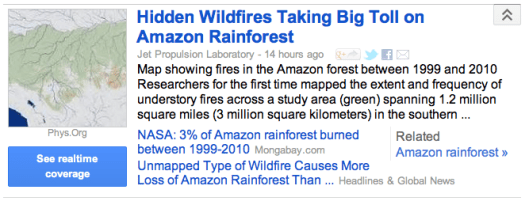
Using an innovative satellite technique, NASA scientists have determined that a previously unmapped type of wildfire in the Amazon rainforest is responsible for destroying several times more forest than has been lost through deforestation in recent years…
…In years with the most understory fire activity, such as 2005, 2007 and 2010, the area of forest affected by understory fires was several times greater than the area of deforestation for expansion of agriculture, according to Morton. The study goes further and fingers climate conditions – not deforestation – as the most important factor in determining fire risk in the Amazon at a regional scale…
…The new knowledge about the scope of understory fires could have implications for estimates of carbon emissions from disturbed forests. How experts account for those emissions depends on the fate of the forest – how it is disturbed and how it recovers.
“We don’t yet have a robust estimate of what the net carbon emissions are from understory fires, but widespread damages suggest that they are important source of emissions that we need to consider,” Morton said…
5.) Peat in the world’s boreal forests is decomposing at an astonishing rate (Nature Communications, November 2011)
…The planet’s boreal forests won’t expand poleward. Instead, they’ll shift poleward. The difference lies in the prediction that as boreal ecosystems follow the warming climate northward, their southern boundaries will be overtaken by even warmer and drier climates better suited for grassland.
And that’s a key difference. Grassland stores a lot of carbon in its soil, but it accumulates at a much slower rate than is lost from diminishing forests…
6.) Methane is being released from the Antarctic, too — over ten tens more carbon than parts of the Arctic (Nature, August 2012)
7.) Russian forest and bog fires are growing (NASA, August 2012)
8.) Cracking of glaciers accelerates in the presence of increased carbon dioxide (Journal of Physics D: Applied Physics, October 2012)
9.) The Beauford Gyre has apparently Reversed Course (U.S. National Snow and Ice Data Center, October 2012)
10.) Exposure to sunlight increases bacterial conversion of exposed soil carbon, thus accelerating thawing of the permafrost (Proceedings of the National Academy of Sciences, February 2013)
11.) Summer ice melt in Antarctica — highest level in 1,000 years and the most rapid melting has occurred in the last 50 years (Nature Geoscience, April 2013)
I would add one more here…
12.) The Disappearance of Top Predators accelerates CO2 emissions (Nature Geoscience, Feb 2013)
People play a big role in predator decline and our study shows that this has significant, global implications for climate change and greenhouse gases,” says Atwood.
“We knew that predators shaped ecosystems by affecting the abundance of other plants and animals but now we know that their impact extends all the way down to the biogeochemical level.
Reversible Positive Feedback?
13.) Arctic drilling was fast-tracked by the Obama administration during the summer of 2012
An astute reader has directed me to a couple of brilliant, just-released videos done by David Wasdell (produced by Envisionation) which bring into focus the rapid changes that are occurring in the Arctic and what the horrific implications are for the rest of the planet. I have watched both videos and posted an abbreviated version of them below. The original transcript of the two videos is here. We can see that even the worse case scenarios plotted by mainstream climate models have grossly underestimated what is happening in the Arctic. As Mr. Wasdell states, “The Arctic… is the fastest moving response to global warming and climate change anywhere on the planet.”
One of the reasons for the Arctic’s rapid temperature increase is that it is not being shielded by industrial pollutants that once came from the Northern Hemisphere. The aerosol effect is now coming primarily from the burning of poor quality coal in Asia(China and India). From roughly 1940 to 1980 there was a massive increase in power production during the Great Acceleration of the West. Remember the acid rain and smog from the 50’s and 60’s? In 1970, the U.S. Congress imposed acid emission regulations through the Clean Air Act which was strengthened two decades later in 1990. Sulfate and nitrate levels in precipitation decreased by some 40 percent since that time. This lifted the manmade protective aerosol shield, also called “global dimming”. Temperatures then started to rise again, but have leveled off since 1997 due to the recent industrialization of China and India, the effect of which has been to artificially cool down global temperature once more.
The effects of global dimming have been enhanced during this period [Asian Industrialization] by the mixing of more surface heat down to deeper ocean water, by the dominance of La Nina (cooler) conditions in the Pacific, and by a prolonged period of minimal solar radiation. The absence of temperature increase has also blocked all amplification from the temperature-dependent feedback mechanisms.
All of these eras(The Great Acceleration, The Clean Air Act, and Asia’s Industrialization) and their effect on global temperature are shown in the chart below:
Climate-change deniers are of course crowing and saying “Although carbon dioxide concentrations have gone on increasing, and emissions are running at a higher rate than when temperature was still rising, temperature has not changed. So obviously it is independent of carbon dioxide. So we can forget all about climate change and continue to use fossil energy without any worry about contributing to global warming!” That is a complete and utter myth!
Remember what happened after the Second World War? The same thing is happening today.
So what happens when Asia, specifically China, cleans up and improves its air quality? Global temperatures will rise again.
The Arctic Meltdown
Free from the effects of global dimming that heavy post WW II industrial activity produced in the northern hemisphere, the Arctic air is relatively clean, as compared to the rest of the world right now. The greenhouse effect from CO2 is therefore allowed to occur uninhibited at a much faster rate, setting off numerous positive feedback loops:
– increased Arctic temperature raises water-vapor concentration which in turn elevates the heating
– floating ice and land-based ice begin to melt and more sea and land surface is exposed to the sun’s rays, inducing further ice melt from the diminishing Arctic albedo effect
– the sea heats up from the disintegration of floating ice and the land heats up from diminishing ice cover
Hyper-exponential Increase of Temperature in the Arctic Area
The worst-case prediction by current climate models of an ice-free Arctic by about 2075 are way off mark because they employ crude linear extrapolations that do not account for complex, self-reinforcing feedback loops. the Arctic will actually experience its first occurrence of zero ice area at the end of September 2015 according to Wasdell’s studies.
Through the use of submarine-based sonar measurements and satellite data, a PIOMASS graph of yearly minimum Arctic ice volume or mass has been constructed which also shows the first occurrence of no floating Arctic sea-ice in 2015.
Another graph, known on the internet as the Arctic Death Spiral, shows the collapse in the total volume of Arctic ice measured in thousands of cubic kilometers. The center of the graph is zero and the values increase up to 30km3 as you move out from the center. Each year is represented from 1979 up to 2013 in a clockwise orientation. Each month of the year has its own color and is plotted in a clockwise fashion as well. Being the month with the least amount of ice cover, September is the innermost line represented by the color black.
You can see that September ice volume plunged from 7km3 in 2009 down to 3.3km3 in 2012. Indeed all months of each successive year are pulling downwards towards the center of zero ice volume. According to these calculations of total ice volume melt, the first year of an ice-free September moves up one year earlier to September 2014.
In the 1980’s, the mass of floating Arctic sea ice at the end of September was staying roughly stable. By the 1990’s it was losing about 4.5 thousand cubic kilometres per decade. In the 2000’s that moved up to about 7.8 thousand cubic kilometres per decade, while in the last three years the decadal rate has surged to around 13.8 thousand cubic kilometres. So we have another of these behaviours in which the smaller the mass becomes, the faster the rate of loss. The behaviour is not linear, it is represented by an exponential curve…
…And then there is one other thing to take into account:
Ice does not just melt and thin gradually to a wafer as would be implied in these projections. When it reduces to about 45 centimetres thick it begins to break up under the impact of waves and tides and storms. The result is a lot of brash, smaller broken pieces of ice. Now broken ice of this nature melts very much faster because warmer water and warmer air and solar energy can get round to its exposed surfaces. The melt-rate increases dramatically. These curves that we have been exploring take no account of this final break-up.
So, while we would expect the first occurrence of zero ice by the end of September 2014, there is a distinct possibility that under the impact of ice break-up (of which interestingly we were already seeing signs in March 2013) the Arctic Ocean could be ice free at the end of September in 2013.
Consequences and Implications
– Runaway Climate Change in the Arctic: The CO2 trigger has set off multiple factors such as the water-vapour feedback, the ice-albedo feedback and other positive feedback loops to exponentially accelerate ice loss in the Arctic as shown in the above graphs.
– Increasing Ice-Free Window: As mentioned earlier, September is the month with the least amount of ice and each successive year has seen a smaller and smaller volume of ice at that time. We are approaching the year when September will be ice-free, leaving the door open for the sun’s rays to heat up the ocean and further accelerate ice loss in the Arctic. This is like a burglar getting a foothold in a door that has been cracked open, allowing him to use his crowbar to fully pry open up the door that was once safely closed. An ice-free month of September that will soon open up in 2014 or 2015 will allow the sun’s solar energy to expand that ice-free window year after year after year.
– Accelerating Temperature: The expanding ice-free window described above will accelerate average temperatures upwards year after year after year, intensifying all feedback loops.
– Tundra Impact: Warmer Arctic temperatures flow over the land, melting tundra permafrost and releasing methane as well as activating bacteria which feed on exposed dead vegetation which in turn release even more CO2 and methane. The melting Tundra takes longer to refreeze in Autumn which further decreases snow cover. Melting Tundra releases warm waters which runs off into the northern seas, warming and desalinating shallow coastal surface waters.
– Methane Release: Wave energy, tidal behaviour and storm effects from a warming and increasingly ice-free Arctic are acting to disturb ancient methane deposits at the sea floor. These methane deposits are called “clathrates”, a combination of methane and ice crystals. The warmer the water gets, the more methane is allowed to reach the water’s surface and escape into the atmosphere. Fossil ice filled with ancient plant matter and detritus is also beginning to melt and release methane. The combination of Tundra methane and deep-sea methane escaping into the atmosphere further increases the greenhouse effect, enabling methane release to speed up and create an even more potent greenhouse effect. Thus another runaway feedback process has been activated.
– Melting Greenland Ice-Cap: The melting is accelerating and releasing water into the glacial cracks and down into the base of the ice sheet, enabling the calving of glaciers and discharge of icebergs into the sea.
…So the collapse of the ice-sheet could become exponential and could happen quite quickly. As that occurs, large quantities of cold fresh water are discharged into the North Atlantic and that can have significant effects on the drivers of the Gulf Stream, the thermohaline circulation. As that slows down (and we would expect it to under these conditions) then the heat that at presently comes via ocean currents to the north- western seaboard of Europe begins to decline. In a strange anomaly, the rate of change of temperature in north-west Europe will slow down as Arctic temperatures climb.
– Sea-Level Rise: The melting of the Greenland ice-cap would have catastrophic consequences for civilization and its large percentage of coastal urban centers. Up to about seven metres of global sea-level change could happen on a decadal basis. The West Antarctic ice field is also subject to melting and disintegration, although at a much slower pace than Greenland, which would act to raise sea levels even higher.
– Jet-Stream Behaviour: The energy of the Jet Stream is driven by the difference in temperature between the Arctic and the warm sub-tropical air of lower latitudes. As the Arctic warms and the temperature difference decreases, the jet stream around the North Pole begins to slow down and get sluggish or mangled. Colder northern air is being pulled south and warmer tropical air is being sucked up north to the Arctic, further warming the Arctic. This change in the jet stream causes “blocking patterns of extreme drought, extreme rain, extreme cold, extreme heat, and extreme unpredictability.”
And that is where the nub comes. With extreme unpredictability food production is disrupted in the bread-baskets of the northern hemisphere. We are talking about the corn and wheat-producing areas of North America and Europe, of Russia and the Ukraine, and across to the wheat and rice producing areas of northern China. We have already seen major loss of food production capacity in the northern hemisphere as a result of what has already taken place. Over the next few years that will accelerate significantly. There are economic issues; there are humanitarian issues; there are political issues that all stem from that instability. We are already seeing hedge funds and pension and other investment funds buying up future food in anticipation of future shortages and high prices that all stem from this phenomenon. That means it is going to be very difficult for the poorer countries of the world to buy food on the open market to enable their populations to survive. It will be even more difficult for the Aid agencies to buy up surplus food (which is in short supply and much more expensive) for distribution in conditions of humanitarian disaster. Because of the economic spin-off there will be financial destabilization in the wake of food shortages. That leads inevitably to political destabilization. So we have some really important issues to deal with that all stem from the implications of the phenomena we are now understanding in the terms of Arctic Dynamics.
– Impact on Global Dynamics: What we see in the Arctic – runaway climate change – could be in store for the rest of the planet which, at the moment, is still in stasis. Once the “aerosol effect” or “global dimming” of industrial pollution is removed, we will see further temperature increases. Other positive feedback loops which are specific to various regions of the world could come into play like they have in the Arctic.
The implications of jet-stream behaviour and Arctic dynamics could spin-off into our economics, into our food production, into abandonment of the poor, into the inability to sustain a population of 8, 9 or even 10 billion people, into our survival as a species. All this will inevitably follow unless we are able to intervene, to slow it down, to bring it to a halt and reverse it. Without that intervention, global dynamics hold a dark future for humanity and a dark future for the biosphere of which we are a part. It is time to take action, not only for the Arctic but for the whole global crisis in which we are all involved.
Contrary to what some may have you believe, future climate projections gleaned from current models have not accurately predicted how truly dire the future is for all living things on Earth. In order to get a true reading of what is in store for us, Prof Julie Brigham-Grette lead her team to a remote meteor crater in Russia where Lake El’gygytgyn rests. What makes this spot special is that this area has never been disturbed by glacier erosion, leaving behind a perfect sediment record of the Earth’s climate dating back millions of years.
Lake El’gygytgyn may be the only place in the world that has this incredible unbroken record of sediments going back millions of years,” said Prof Scott Elias, at Royal Holloway University of London. “When you have a very long record it is very difficult to argue with.
A 2011 study in the journal Paleoceanography showed that during the Pliocene Epoch [~ 4.6 to 2 million years ago] the Earth’s CO2 levels were at the level it is today (400ppm). At that time, temperatures were 8 degrees Celsius warmer in the Arctic summer than they are today. Humans have ramped up the CO2 level so high and in such a short period that the Earth’s climate system has not yet fully reacted to this drastic atmospheric change. This is what we call the climate lag time. In 2005, Hansen estimated the “climate lag time” to be between 25 to 50 years.
An article on this subject given to me by Gail from Wit’s End mentions the “climate lag time” as well:
There is a time lag of up to 30 years for the temperature to be forced up by the extra CO2 in the atmosphere, so the scientists’ findings give a clue to what to expect by the middle of the century…
When looking at these recent Lake El’gygytgyn findings, the NTE estimates of Guy McPherson don’t seem all that strange after all:
My feeling is we have underestimated the sensitivity, unless there are some feedbacks we don’t yet understand or we don’t get right in the models.”
Prof Robert Spicer, at the Open University and not part of the new study, agreed: “This is another piece of evidence showing that climate models have a systematic problem with polar amplification,” ie the fact that global warming has its greatest effects at the poles. “This has enormous implications and suggests model are likely to underestimate the degree of future change.“…
“I think we will feel the effects of climate change quickly – in years or decades – because changes in the Arctic sea ice bring changes in the circulation of the atmosphere and the oceans,” says Elias. ” Arctic sea ice keeps that entire region cool and when it melts, the dark ocean revealed absorbs even more heat.”
“Clearly the Arctic is warming very, very rapidly at the moment,” said Prof Peter Sammonds, at University College London. “And if all the sea ice goes, there is no good reason why it might come back again.
In other eco-apocalyptic news, the public (including JMG) are still asleep at the wheel:
It symbolizes that so far we have failed miserably in tackling this problem,” said Pieter P. Tans, who runs the monitoring program at the National Oceanic and Atmospheric Administration that reported the new reading.
Ralph Keeling, who runs another monitoring program at the Scripps Institution of Oceanography in San Diego, said a continuing rise could be catastrophic. “It means we are quickly losing the possibility of keeping the climate below what people thought were possibly tolerable thresholds,” he said.