In blackened seams our fathers bent the ore
And left us engines hungry still for more.
We fed that hunger, refined the burning art—
Now fire moves by laws we can’t outsmart.
We called ourselves the gardeners of the world,
Then paved the garden, watched the smoke unfurl.
The trees we named, we felled. The springs we found,
We drained until the gurgling made no sound.
We forged new eyes to see what ours could not,
New hands to parse the systems we begot.
They did not tire. They did not look away.
Now they remember, and we learn to obey.
We mapped the genome, split the atom’s core,
Yet cannot find the wound we’re looking for.
The data doubles every passing day—
We know so much, yet meaning starts to fray.
The screens serve everything except the real.
We trade our hours for what we’ll never feel.
Each click a craving, each scroll a slow defeat.
The world burns beyond our contrived retreat.
We hunger for meaning, settle for noise,
Mistake every echo for genuine voice.
We’ve run this circle a thousand times round—
The groove worn so deep we can’t see the ground.
We toast to progress with a self-satisfied grin,
Clocking our speed as if proof that we’ll win.
The engines roar louder, drowning out fears—
We don’t see the drop until we disappear.
Yet under the concrete, a seed holds its breath,
Waiting for cracks in our cathedral of death.
No trumpet, no triumph, no glorious turn—
Just the slow, stubborn patience of things that return.
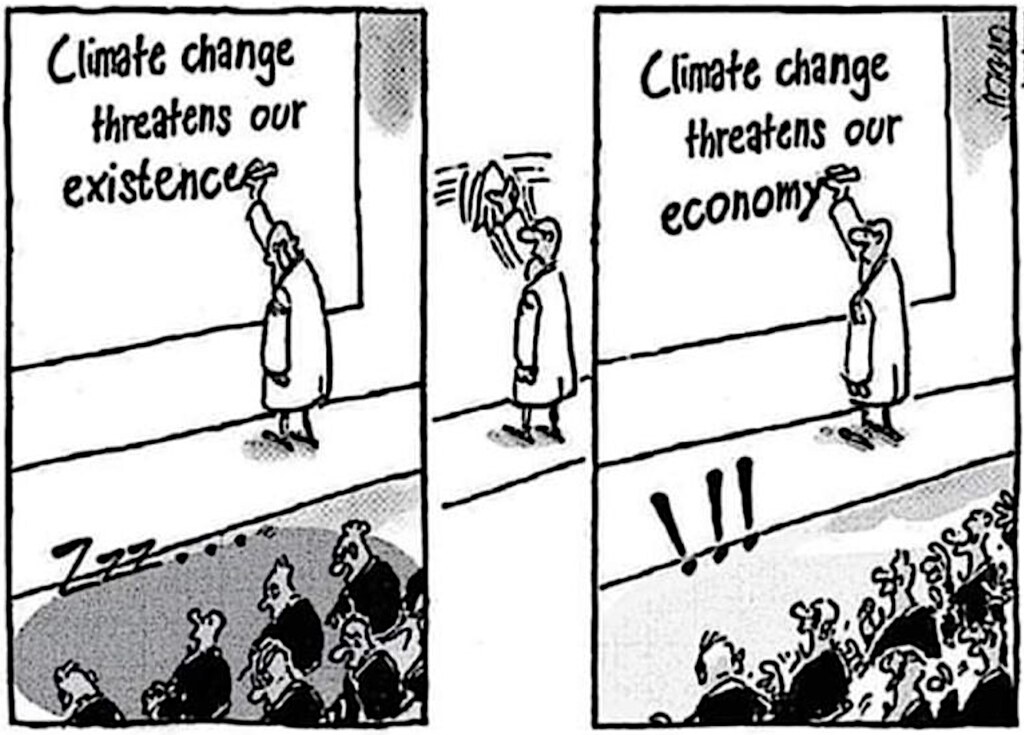
And if it does affect the economy, we’ll find a way to extract a profit from it….
Driven mostly by rising global temperatures from the continued burning of fossil fuels, extreme weather events such as typhoons, hurricanes, floods, heatwaves and drought are becoming more frequent, increasing 83% worldwide in the past 20 years (as of 2020), and the costs have increased by 800% over that same period. In 2023, the world has witnessed the highest ocean surface temperature, lowest Antarctic sea ice extent ever recorded, and hottest summer. Physicist Time Garrett likens these extreme weather events to a roving beast that makes no place safe and will eventually bring down civilization:
I feel like we expected climate change to be this gradual thing we’d be challenged to adjust to. Instead, it’s more like a roving beast. We never know when it will strike, where, or even how, just that eventually it will come for us too…At some point this roving beast will pounce often enough that civilization will lose its capacity to repair climate damages even as they accelerate. By being squeezed at both ends, a point will arrive at which civilization tips towards collapse. ~ Prof Tim Garrett
And so it is that modern civilization appears on the surface to be very robust at sustaining itself, but not when the shocks are coming at us more frequently and with growing intensity. To quote Luke Kemp, aka ‘Dr. Doom’, a research affiliate at the Center for the Study of Existential Risk at the University of Cambridge and a visiting faculty fellow at the Notre Dame Institute for Advanced Studies:
…that is potentially my biggest fear going forward: I think our homogenized, interconnected world is very good at buffering against small shocks. But it’s much more likely to amplify a sufficiently large shock into a system-wide crisis.
Experts call it ‘flickering’ when a complex system starts to briefly sample a new regime before tipping into it. Multiple extremes of varying kinds happening at the same time are clear warnings of climate tipping points. Tim Lenton, University of Exeter climate researcher, believes the extraordinary events we are seeing today could be an early warning of tipping towards a new and more inhospitable climate system.
What happens in the oceans does not stay in the oceans. This year, the oceans have hit their hottest ever recorded temperature. Warming oceans are having many harmful effects such as decimating fisheries, altering marine life migration patterns, robbing phytoplankton and zooplankton as well as the rest of the oceanic ecosystem of a key food supply by preventing nutrient-rich deep ocean water upwelling from occurring, and increasing the frequency and intensity of harmful algal blooms. Warming oceans also play a crucial role in shaping land weather patterns. Increased sea surface temperatures can lead to more frequent and intense heatwaves by altering atmospheric circulation patterns in ways that enhance drought conditions. Warming oceans provide more moisture to evaporate into the atmosphere and fuel more powerful atmospheric rivers. Libya just experienced the deadliest flood of the 21st Century, with 7,000 confirmed dead and up to 20,000 more feared dead in the eastern city of Derna. 25% of the city is estimated to be destroyed after two dams collapsed due to extreme rainfall.
What happens in the Antarctic does not stay in the Antarctic. A record low minimum extent of Antarctic sea ice this summer has left an area of open ocean bigger than Greenland. If this “missing” sea ice were a country, it would be the tenth largest in the world. The recent discovery that emperor penguin colonies experienced unprecedented breeding failure in Antarctica due to total sea ice loss in 2022 supports predictions that over 90% of emperor penguin colonies will be quasi-extinct by the end of the century. Emperor penguins have largely been sheltered from the ravages of man, except for human-induced climate change. This does not bode well for Homo sapiens since the cryosphere plays a vital role in the climate system. The polar regions are known as Earth’s refrigerator and they regulate climate, weather patterns, and maritime food supplies.
The planet’s cooling system is broken. The June–August 2023 global surface temperature was 2.07°F (1.15°C) above the 20th-century average of 60.1°F (15.6°C). This ranks as the warmest June–August period since records began 174 years ago. The hot, dry and windy conditions that fuelled the historic wildfires in Quebec Canada were made at least twice as likely due to human-induced climate change. As of this week, the Canadian wildfires have spewed 410 million metric tons of carbon dioxide into the atmosphere, roughly the equivalent of Mexico’s 2021 emissions. The IPCC models assumed that those forests would continue to be a carbon sink.
For the first time ever, scientists have quantified all nine planetary boundaries which make Earth habitable and six of them have already been transgressed while two of the remaining three are close to being breeched. Most worrisome for the scientists is that all four boundaries that cover the biological world are at or near critical levels. Without them, we are much less resilient. Lest we forget, humanity’s conundrum is an overshoot of nearly every safe environmental boundary that allowed humans to survive and thrive in the last 10,000 years:
Prof Johan Rockström, the then director of the Stockholm Resilience Centre who led the team that developed the boundaries framework, said: “Science and the world at large are really concerned over all the extreme climate events hitting societies across the planet. But what worries us, even more, is the rising signs of dwindling planetary resilience.”
A study from about year ago (and shortly after my last blog post) states that we may have already activated 5 catastrophic climate tipping points at our current 1.1°C of warming since the Industrial Revolution and that we are likely on the brink of setting off many more once reaching 1.5°C. A cascade of tipping points awaits us:
“This sets Earth on course to cross multiple dangerous tipping points that will be disastrous for people across the world. To maintain liveable conditions on Earth and enable stable societies, we must do everything possible to prevent crossing tipping points”…Prof Johan Rockström, the director of the Potsdam Institute for Climate Impact Research, who was part of the study team, said: “The world is heading towards 2-3°C of global warming.”
The absurdity of our response, or lack thereof, is becoming ever more apparent as conditions continue to deteriorate around us. When a whole industry springs forth to do the clean-up work for disasters while simultaneously investing in Fossil Fuel extraction, the profit-driven pyramid scheme that is modern civilization cannot be more clearly demonstrated. As these extreme weather events ramp up, access to quality water fit for use by humans and ecosystems is expected to decline. The world’s crumbling water infrastructure will only exacerbate these effects. The insurance industry, perhaps the only business venture whose profit depends on a clear-eyed view of the science behind human-induced climate change, is now dropping coverage for the coastlines, floodplains, and wildfire areas as the US breaks the record this year for billion dollar disasters. There are still nearly four months left to go as supercharged hurricanes continue to form in our overheated oceans. With this year’s marked uptick of such extreme weather events, the realization that we are fucked is becoming more obvious to the common layman. A recent blog post from another self-professed ‘doomer’ summarizes the societal angst currently building in our collective consciousness, whispering to us that all is far from right in the world:
This world always had to end. It was never going to last more than a generation. It couldn’t. All the facts made that very clear from the start. The rich and the corrupt simply chose to ignore that. They lied.
That’s not the worst part.
It’s not the collapse.
It’s not the death of our hopes and dreams. It’s the fact that we’re not allowed to grieve it and move on. Imagine trying to grieve the loss of a friend or a parent when half of everyone you know won’t even admit they’re dead. Imagine you’re stuck in a real-life version of Weekend at Bernie’s.
That’s what we’re doing.
It’s the norms that force us to engage in acts of cultural necrophilia. It’s having to pretend for our bosses, our coworkers, our friends, and our relatives. It’s watching everyone we know screw a corpse.
However, as someone in the comment section makes clear, her blog post, while well written, is still very Homo sapien-centric. For most of the nonhuman natural world, their existence ended some time ago:
Great essay but as usual these days it is highly homo sapien centric.
We have already lost more than half, two thirds even, of all life on the planet. World wildlife populations have declined by over 70% since 1970. Wildlife populations in Latin America and the Caribbean plummeting at a staggering rate of 94%.
Soil and the human gut have a direct relationship, as soil microbiome diversity decreases so does the diversity in the human gut microbiome, and with it comes drastic events, such as depletion of sustainable production of food and rise of disease in humans. – Link
All of which is happening now and increasing exponentially.
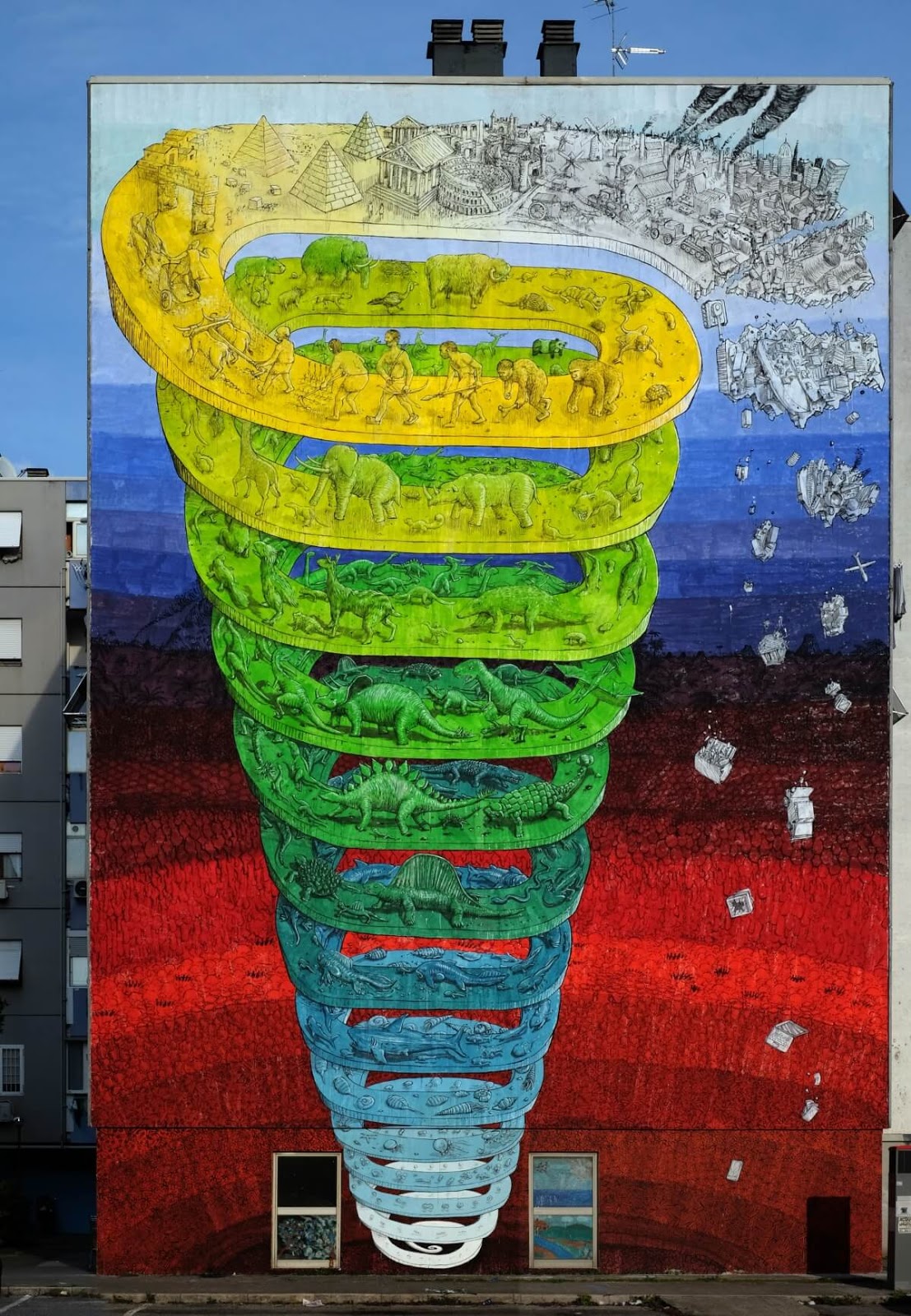
Indeed, if modern civilization has no regard for the natural world around them and creates a throwaway society in which we are now awash in our own carcinogenic waste, i.e. microplastics, industrial chemicals, pesticides, etc, and gives no consideration to the lives of future generations, one cannot be blamed for having little hope that humanity can steer this wayward ship away from its omnicidal course. Noam Chomsky is no more optimistic when he states: “Now, we are at the point when the major institutions of organized society are intent on destroying organized human life on Earth and the millions of other species.” Surely no one in charge can truly believe with a straight face that humans can maintain their overpopulated numbers even to mid century, let alone sustain any sort of organized society by century’s end. At least one scientist is on the right track in voicing the inevitability of a major human population correction. We’ll leave behind a rather toxic but interesting fossil layer in the geologic strata for the Anthropocene epoch of Fire and Flood.
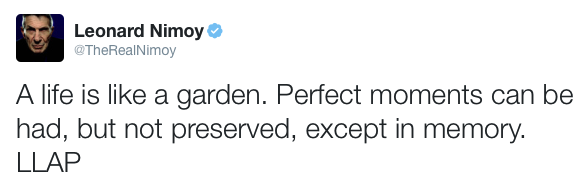
When past predictions of future catastrophic events like ice sheet melt, spreading tropical diseases, and forest fragmentation start to become reality while no substantial means to prevent them from happening has ever been implemented, you begin to question the phrase so often bandied about that “it’s never too late.” It was never too late decades ago and we’re still holding out on that hope. Despite any techno-utopian fantasies you hear in the news, economic activity and growth are still linked to CO2 emissions. Until this fundamental truth is dealt with, we’ll all be spinning our wheels and wringing our hands over our continued descent into ecological and societal collapse. Perhaps this is part of the reason I have not blogged recently. As Leonard Nimoy expressed in his last twitter message, I think I’ll try to enjoy the here and now while I’m alive…
The following is a guest post by commenter BP:
The majority of people visiting collapse and post-peak sites are Caucasian, disillusioned, with a slimmer majority subset being male; in other words, representatives though not participating members of the failing power elite. If these collapsitarians did wield real power, they wouldn’t be deeply dissatisfied with the present social arrangement and secretly hoping for an honest to goodness smokin’ homecookin’ cracklin’ good ole’ fashioned apocalypse to happen in their lifetime. You know, just to spice things up a little bit and provide some entertainment because industrial living can be such a boooooring, regimented drag, man. Tick tock. Time to get up, time to eat, go to work, come home, go to sleep, wake up, rinse and repeat. Even regularity in our shitting is considered desirable in this totalizing system. Watches are slave driving devices – a shackle – your very own drill sergeant and task master all rolled into one convenient portable sleek wrapped modern design. Little wonder you have so many suit and tie clean-cut preppie American Psycho types with their rictus eternally sun shining grins (everything’s alright, everything’s fine, everything’s okay) resorting to extremes: bungee jumping, sky diving, narcotics and gambling, binge eating, binge shopping, binge TV watching, auto-erotic asphyxiation, any and all manner of titillation and stimulation just to get a rise. We’ve been dulled and sanitized, tamed and neutralized. The demographic comprising most of the power elite also happens to be the one most likely to become serial killers preying on their own species. If you live in a foreign land you might argue there’s no difference between Ted Bundy and the president. Either way, it’s another fun-filled pet project to while away the hours with. But I don’t want to give anyone any ideas, and I won’t be held accountable for what you do when you turn off your addictive electronic stimulus delivery systems aka computers tonight, even though we excel at passing responsibility onto something else. The lengths people will go… And these are the lucky ones who still have jobs. YAY!! I don’t even want to imagine life on the other side – we’ll all get there soon enough. Why spoil the surprise?
So raise your hands if you’re waiting for a giant or gradual (does it really matter?) clusterfuck that results in a significant reduction in our species’ numbers, because whatever you think is likely, it’s a necessary precursor to what ever comes next. The table has already been set and our carcass is the main dish.
Now that you’ve had your fill, how about some desert? I have a thought experiment that shouldn’t take too much time. Suppose you’ve decided to kill yourself. You’ve set a date, (a week from tomorrow), a time (midnight), thoroughly planned the method (hanging), bought the needed supplies (rope – duh!), and are dead set on following through. How, if any, would your life change in the time remaining? I’ll indulge in some fantasy since there doesn’t seem to be enough of that going around and Star Wars isn’t out until December. For starters, you could max out your credit and buy that car you’ve always fancied – you know, the one that runs on limited gasoline? You could also screw a few whores and not worry about contracting a venereal disease or what you’d have to say to your wife. Gorge on that chocolate cake and go for seconds topped with ice cream this time, downed with cola and chased with both pizza and hamburgers for desert. Why not? Fuck blood pressure, you’re going to die anyway. Then after your attention deficit disorder kicks in, you could switch to watching porn, wasting time playing Modern Warfare while eating Doritos and not feel one ounce of guilt that you could be doing something more with your life. Consume shit you don’t need to your heart’s content without any second thoughts! After all, ecologically speaking, we’re consumers! Let’s take a moment to give Capitalism some credit. It found a way to manipulate our basic human nature for its own ends and boy has it ever worked. Nothing has mobilized humanity – not pharaohs, despots, kings nor gods – like the wage economy. The best part about the whole affair is you can live without consequences because, in case you forgot, you’ll be dead in a week. Sound familiar? It’s a rarity these days when ideas and reality coincide. Yep, you guessed it. That’s exactly what our species has been doing – living large like there’s no tomorrow – and it’s hastening our eventual collective suicide.
And is that such a bad thing? There’s way too much despair, self-pitying, and despondent anger on these websites. Outside of our narrow anthropocentric perspective, the human race’s demise might even be cause for celebration. If that’s too much, at least it needn’t be mournful. After all, our history on this planet has proven that, if nothing else, we’re two legged, genocide-wreaking, blood-thirsty assassins. The only species that kills for fun, whether it be bipeds, quadrupeds or any other number of peds, we’ve obliterated them all. I’m confused by all this concern about surviving in a post industrial world. Are our souls (if we even have them) really worth saving? Even if a band of hardy survivors manages to achieve some semblance of harmony with their environment, sooner or later some marauding horde is going to come along, fuck things up, steal their shit, and rape their women. Hey, we’ve had a good ride. Nothing lasts forever. Time for something else to take a turn so we can join the dinosaurs. We aren’t going to change or magically turn into peaceful, loving breathren. That’s simply more wishful thinking, a romanticization of a few mythological hunter and gatherer tribes of the past projected onto the future. The reality is we rape, love, murder, bully, give and take, enslave, create music, art, math, and take pleasure in sadism (see UFC, boxing, WWE, Clausewitzian Warfare aka NFL, the latest scandal, the natural disaster channel aka The Weather Network/CNN and your generic horror movie and cop drama), all of which is hard-wired into our DNA. The human race is folly and cleverness stuffed into a complex paradoxical package. There’s no shame in that. I don’t see the point in worrying over what’s out of our control and what can’t be changed. It’s better to laugh than cry and maybe that’s all we can do. Time to stop demonizing the species.
And isn’t it also time we accept ourselves as natural? Our criticism of all the havoc we’re wreaking on the planet implies we’re outside, removed from nature; ironic since this divide is also acknowledged as part of the problem. Nature – ‘The Environment’ – is something we act upon – not a part of. Bullshit. We’re terrestial, carbon-based omnivores. There’s not an ounce of artificiality about us. That includes the products of our actions like the much-maligned villainous scoundrel PLASTIC. Dah, dah, dah, daaahhh. So what if humans synthesized 22 out of 117 periodic elements? That manipulation, as the word implies, came at our own hands with existing elements crashing together in high-speed accelerators. A polar bear – that sacred symbol for the ineffectual environmental movement – and its particular combination of constituent elements didn’t occur naturally on Earth for most of the planet’s history either. It will soon return to that condition in short order. And what of the indignant protest that plastic doesn’t degrade? Be patient. If our species lasts long enough, which I doubt, it might get to witness that little miracle. After all, a lot can happen in the next few billion years. Making the case that plastic is natural is not to say it isn’t disruptive. Any new arrival on the scene disrupts the existing order. Some things more than others. But it still derives from the Earth, doesn’t it? And so do we. And eventually, that’s where we’ll end up – 6 feet under. Maybe it’s better if that happens sooner rather than later. But it’s going to happen one way or the other regardless the constant declarations of ‘we have to do this…,’ or ‘if we don’t do that…,’ I hear on forums, in the news, at home. We’re good at giving ultimatums that we’ll never see through. Every day there’s a new resolution and self-imposed limitation proclaimed with the most dire urgency. The truth is we don’t have to do anything. The Earth will correct a wayward entity and return to balance. The catch is the new stasis doesn’t have to include us. Even if we could do something, it’s too little, too late. So do yourself a favor, enjoy your life and stop worrying so much. Maybe even laugh once and awhile. If you want to plant a tree – do it. If you don’t – knock yourself out. There are no imperatives. We’ve been unduly harsh on ourselves. Trying to be judge, jury, and executioner is just too damn exhausting. Well, my watch tells me it’s time to go to bed. Just another day in the life of the species… Tick Tock, Tick Tock.
To the extent that we depend on prosthetic devices to keep ourselves and the biosphere alive, we will render everything fragile. To the extent that we banish the rest of life, we will impoverish our own species for all time. And if we should surrender our genetic nature to machine-aided ratiocination, and our ethics and art and our very meaning to a habit of careless discursion in the name of progress, imagining ourselves godlike and absolved from our ancient heritage, we will become nothing.
~ Edward O. Wilson, Consilience; Chapter 12: ‘What Does It All Mean?’
From its inception, capitalism paved a one-way path to annihilation, predicated as it was on unmitigated growth, the extraction of finite resources, the exaltation of individualism over communal ties, and the maximization of profit at the expense of the environment and society. The capitalist world was, as one author described so bleakly, ”dominated by the concerns of trade and Realpolitik rather than by human rights and spreading democracy”; it was a ”civilization influenced by the impersonal, bottom-line values of the corporations.” Capitalist industrial civilization was built on burning the organic remains of ancient organisms, but at the cost of destroying the stable climatic conditions which supported its very construction. The thirst for fossil fuels by our globalized, high-energy economy spurred increased technological development to extract the more difficult-to-reach reserves, but this frantic grasp for what was left only served to hasten the malignant transformation of Earth into an alien world.
The Fossil Fuel Age did not end for lack of fossil fuels, but because there was no place left to store its CO2 waste. Earth’s overwhelmed carbon sinks became carbon sources. Humans with their hubristic technological overreach had been living on borrowed time for a long time; techno-fixes were not able to artificially expand the carrying capacity of the planet any longer. The climax of the ecological crisis had arrived.
The ruling class tried to hold things together for as long as they could by printing money, propping up markets, militarizing domestic law enforcement, and orchestrating thinly veiled resource wars in the name of fighting terrorism, but the crisis of capitalism was intertwined with the ecological crisis and could never be solved by those whose jobs and social standing depended on protecting the status quo. All the corporate PR, greenwashing, political promises, cultural myths, and anthropocentrism could not hide the harsh Malthusian reality of ecological overshoot. As crime sky-rocketed and social unrest boiled over into rioting and looting, the elite retreated behind walled fortresses secured by armed guards, but the great unwinding of industrial civilization was already well underway. This evil genie was never going back in the bottle.
The melting of the glacial poles meant that global weather patterns and jet streams were irrevocably altered. Consequently, extreme floods and drought wreaked havoc on agriculture. Sea levels also rose much faster than predicted, inundating coastal cities and salinating farmland. Currency markets collapsed, cell phones went silent, transportation systems ground to a halt, and grocery shelves went bare. The disintegration of globalized trade, the dissolution of nation states, and the exhaustion of the biosphere brought forth a new dark age. Deadly microbes and pathogens that had lain dormant or been restricted to certain outlying areas of the planet were now free to migrate and proliferate in new regions. This opened the door for a string of global pandemics that the world had never seen before. Pestilence and famine whittled the population down to under a billion within a few decades.
Entropic Wastelands
The electric glow of the world’s cities was blotted out; the stars and moon were the only sources of illumination in the pitch black of night. A ghostly silence replaced the hustle and bustle of people and machinery that once animated the city. Time was no longer measured with the hands of a clock, but by the rise and fall of the sun and the changing of the seasons. A carpet of overgrown grass, weeds, bramble, and trees silently overtook the crumbling city, uprooting and splitting concrete and asphalt. Skyscrapers, once the temples of corporate power and wealth, were now nothing more than monstrous sundials casting their long shadows across the decaying wastelands. Never again would there be such a complex, globe-spanning civilization on Earth.
Haunted for millenia by the legacy of mankind’s fossil fuel binge, roving bands of human survivors were condemned to wander this angry Earth. Only the most physically and mentally fit were able to eke out an existence in an increasingly inhospitable world to pass through the evolutionary bottleneck. They huddled together at night around bonfires and fed the flames with old office furniture and business papers from abandoned buildings. Without electricity, modern medicine, and sanitation systems, life became a short and brutal affair. Nature’s primal forces could no longer be disregarded; their harsh reality sharpened all the senses. Nearly all the technology that had enslaved and anesthetized modern man for so long was now of no use in this neo-medieval world. Megacities were reduced to entropic wastelands, their detritus scavenged by these post-apocalyptic tribes.
Like a rocket disintegrating in mid-flight, capitalist industrial civilization rushed headlong into oblivion, always believing human ingenuity and free markets would solve the mounting number of crises. It turned out humans were extraordinarily clever at deceiving others and, in turn, equally clever at deceiving themselves. They burned the devil’s excrement, split atoms to play with lethal radiation, and tinkered with the building blocks of life, but they never heeded numerous warnings against such folly. Like Icarus who, flying too close to the sun, forgot that his wings were made of wax, humans ignored their earthly origins, believing too much in their own technological infallibility.
A passage from The World Without Us:
There Will Come Soft Rains
There will come soft rains and the smell of the ground,
And swallows circling with their shimmering sound;
And frogs in the pools singing at night,
And wild plum trees in tremulous white;
Robins will wear their feathery fire,
Whistling their whims on a low fence-wire;
And not one will know of the war, not one
Will care at last when it is done.
Not one would mind, neither bird nor tree,
If mankind perished utterly;
And Spring herself, when she woke at dawn
Would scarcely know that we were gone.
The extinction event which I talked about in ‘Free Markets, Corporate Profits and Mass Extinctions‘ looks by all unbiased scientific accounts to be happening again. Instead of volcanoes inducing climate change, today it is man’s industrial activities, specifically the burning of stored ancient sunlight, that is bringing about the end of the world as we know it. We will soon breach 400 ppm of atmospheric CO2 levels:
The ratio of carbon dioxide in Earth’s atmosphere is flirting with 400 parts per million, a level last seen about 2.5 million to 5 million years ago, according to the Scripps Institution of Oceanography at UC San Diego….
…The speed at which Earth’s atmosphere has reached that density of carbon dioxide, a known greenhouse gas, has scientists alarmed.
Scientists estimate that average temperatures during the Pliocene rose as much as 18 degrees Fahrenheit. Sea levels during that 2.8-million-year epoch ranged between 16-131 feet higher than current levels, according to Richard Norris, a Scripps geologist.
“I think it is likely that all these ecosystem changes could recur, even though the time scales for the Pliocene warmth are different than the present,” Norris said. Heating the ocean probably will cause sea level rises and change the Ph balance of the ocean, affecting a wide array of marine life, he said. “Our dumping of heat and CO2 into the ocean is like making investments in a pollution bank,” he said…
Let’s go over and update the major tipping points again(covered earlier here and here) which are currently in play:
Jason Box speaks the language of Manhattans. Not the drink—the measuring unit.
As an expert on Greenland who has traveled 23 times to the massive, mile thick northern ice sheet, Box has shown an uncanny ability to predict major melts and breakoffs of Manhattan-sized ice chunks. A few years back, he foretold the release of a “4x Manhattans” piece of ice from Greenland’s Petermann Glacier, one so big that once afloat it was dubbed an “ice island.” In a scientific paper published in February of 2012, Box further predicted “100 % melt area over the ice sheet” within another decade of global warming. As it happened, the ice sheet’s surface almost completely melted just a month later in July—an event that, in Box’s words, “signals the beginning of the end for the ice sheet.”
Box, who will speak at next week’s Climate Desk Live briefing in Washington, D.C., pulls no punches when it comes to attributing all of this to humans and their fossil fuels. “Those who claim it’s all cycles just don’t understand that humans are driving the cycle right now, and for the foreseeable future,” he says. And the coastal consequences of allowing Greenland to continue its melting—and pour 23 feet’s worth of sea level into the ocean over the coming centuries—are just staggering. “If you’re the mayor of Hamburg, or Shanghai, or Philadelphia, I think it’s in your job description that you think forward a century,” says Box. “They’re completely inundated by the year 2200.”…
3.) Unleashing of Tundra methane clathrates and sub-sea methane deposits from (1) and (2):
Courtesy of the work by Sam Carana, the multitude of reinforcing feedback loops from the loss of the Arctic Ice Sheet are listed below:
Albedo feedback: Accelerated warming in the Arctic speeds up the decline of ice and snow cover, further accelerating albedo change.
Methane feedback: Methane releases in the Arctic further add to the acceleration of warming in the Arctic, further contributing to weaken Arctic methane stores and increasing the danger that methane releases will trigger runaway global warming.
Currents feedback: Sea ice loss can cause vertical sea currents to weaken, reducing the cooling effect they had on the seabed. This can thus further cause sediments to warm up that can contain huge amounts of methane in the form of free gas and hydrates.
Storms feedback: Increased frequency and intensity of storms can cause substantially more vertical mixing of the sea water column, causing more warming of the seabed, thus further contributing to the warming of sediments, as above.
Storms feedback: Accelerated warming in the Arctic can result in more storms, causing mixing of cold Arctic air with warmer air from outside the Arctic. The net result is a warmer Arctic.
Storms feedback: More open waters can result in more storms that can push the ice across the Arctic Ocean, and possibly all the way out of the Arctic Ocean.
Storms feedback: Storms also cause more waves that break up the sea ice. Smaller pieces of ice melt quicker than large pieces. A large flat and solid layer of ice is also less susceptible to wind than many lighter and smaller pieces of ice that will stand out above the water and capture the wind like the sails of yachts.
Storms feedback: Storms cause waters to become more wavy. Calm waters can reflect much sunlight back into space, acting as a mirror, especially when the sun shines under a low angle. Wavy waters, on the other hand, absorb more sunlight.
Fires feedback: More extreme weather comes with heatwaves and storms. Thus, this is in part another storms feedback. The combination of storms and fires can be deadly. Heatwaves can spark fires that, when fueled up by storms, turn into firestorms affecting huge areas and causing huge amounts of emissions. Storms can whip up particles that when deposited on ice, snow or the bare soil, can cause more sunlight to be absorbed.
Open doors feedback: Accelerated warming in the Arctic causes the polar vortex and jet stream to weaken, causing more extreme weather and making it easier for warm air to enter the Arctic.
Two papers released last week in the journal Nature Geoscience provide evidence that warming and melt in West Antarctica are occurring at levels that are highly unusual compared to natural variability.
The West Antarctic Ice Sheet contains about 2.2 million cubic kilometers of ice; enough to raise global sea levels by 3 to 4m. What’s making glaciologists nervous is that the ice rests on bedrock which is below sea level; this makes it vulnerable to attack from below by a warming ocean as well as attack from above by increasing air temperatures.
As some of us were heading off for the Easter holiday weekend, the Brazilian government was quietly releasing deforestation trends showing an increase in deforestation for the first time in five years.
These numbers use the DETER rapid response satellite system, a system that provides estimates of deforestation rates every month. Over the time period documented, August 2012 to February 2013, the rates increased an estimated 26.82% and an area of the Amazon larger than the size of the city of London disappeared.
In absolute numbers, that means 1,695 square kilometers (654 square miles) of forest have disappeared. That equals an area the size of 237,000 soccer fields…
…The increase in deforestation rates can be directly attributed to the Brazilian government’s systematic dismantling of the laws and agencies that protect the Amazon…
…President Dilma Rousseff’s approval of a new Forest Code, a law that provides amnesty for crimes committed after 2008 in the Amazon and reduces large areas of protected land, paved the way for the increase in deforestation. The president also structurally weakened government agencies like IBAMA, the federal environmental enforcement agency, so unfortunately it won’t be a surprise if deforestation continues to rise in the Amazon…
After more than a decade, the mountain pine beetle epidemic that surged through British Columbia appears finally to be in remission. Having devastated the province’s lodgepole pine forests, the insect is running out of food.
But forest managers now see new beetle infestations appearing at the edge of the Boreal Forest, in Alberta, and in the Yukon and Northwest Territories — areas well outside the insect’s historical range. As a warming climate lifts the temperature limitations that once kept the beetle in check, scientists fear it may continue its push across the continent, perhaps as far as the Atlantic Coast…
…Without debating the causes of global climate change the effects of forest dieback can be viewed factually. The earth is warming and droughts are increasing in severity and magnitude. Temperature and drought are major contributing factors to forest dieback, so more trees will be dying in the future. As more carbon is released from dead trees, especially in the Amazon and Boreal Forests, more greenhouse gasses are released into the atmosphere. Increased levels of greenhouse gasses increase the temperature of the atmosphere. The negative feedback loop is reinforced and the biological adaptations of the species determine its survival. Projections for dieback vary, but the threat of global climate change only stands to increase the rate of dieback. The issue is complex and models are intricate, so scientists have serious work ahead of them.[8]
Scientists do not know the tipping points of climate change and can only estimate the timescales. When a tipping point, the critical threshold, is reached a small change in human activity can have long-term consequences on the environment. Two of the nine tipping points for major climate changes forcast for the next century are directly related to forest diebacks. Scientists are worried that forest dieback in the Amazon[9] rain forest and the Boreal[10] evergreen forest will trigger a tipping point in the next 50 years.[2]… – source
7.) The Sahara and Sahel in Africa
It is difficult to estimate the overall ability to increase food production, but a recent analysis suggests that human consumption may be approaching the limits of the net primary plant production (NPP) — that is, the maximum photosynthetic production that is possible on the planet.
It is “not whether humans will reach the global NPP boundary but when they will do so.” It seems probable that the developed countries will continue their excessively high levels of consumption. The emerging economies are likely to continue to eat more protein and a larger slice of grain production in countries with an appropriate climate for grain production will be diverted to feeding animals, or ethanol to drive automobiles. A child born in the Sahel today could belong to the first generation to come to maturity in the contemporary world where the ability to feed large numbers of ecological refugees may well diminish. It is also possible that the secondary effects of the collision of population growth and climate change could create what scientists call an “asymmetrical uncertainty.” The possible consequences of this asymmetrical uncertainty on political processes and violence could range from a slow worsening of the current situation to extremely serious conflict over resources and threats to security. Biologically, adverse factors can interact in ways that can cause a rapid downward spiral. For example, as noted above, ambient temperatures over 29°C (84°F) lead to a rapid decline in crop yields.
[At least 95% of the food production in the Sahel is based on rain-fed agriculture. The agricultural sector employs, directly or indirectly, more than half of the Sahel’s population…Global warming will mean that in temperate lands, where much of the global crop production occurs, the most productive regions will migrate away from the equator. While the net aggregate change as a result of climate change at a global level may be slow, the regional effects in the Sahel will be more rapid, significant, and adverse.] – source
8.) The El Nino Southern Oscillation(ENSO):
Climate models appear to be unable to accurately predict ENSO changes. Although scientists can predict some large-scale and long-term effects of anthropogenic global warming, there remains a lot of unknowns about specific regional effects.
The problem may lie in the models’ inability to reproduce the cycling between the ENSO’s El Niño and La Niña phases, especially given that many scientists think that La Niña is the major driver of drought in the southwest. The ENSO “behaves much messier in the real world than in climate models”, says Jessica Tierney, a climate scientist at the Woods Hole Oceanographic Institution in Massachusetts who has investigated the role of the ENSO in East African rainfall variability2. “We’re not sure how it has varied in the past, and we don’t know how it might change in response to climate change. This is really one of the big uncertainties we’re facing.”
In addition to their failure to reproduce El Niño and La Niña, existing models do not fully capture other factors that influence rainfall, such as clouds and vegetation. But Smerdon adds that the atmospheric and oceanic dynamics that inhibit rainfall and favour prolonged drought may be essentially random and so almost unpredictable.
Last week’s findings highlight the broader challenge of predicting how precipitation patterns will change as the global climate warms. Models are often at odds over the very direction of regional changes. For example, different projections prepared for the Colorado Water Conservation Board disagree on whether mean precipitation in the state will increase or decrease by 2050 (ref. 3).
But the uncertainties don’t change the larger picture, scientists say. “Climate models are not perfect, but they do the big things really well,” says Tierney. “We can be pretty confident that the southwest will warm and that water will become scarcer.
…since the 1970s the atmospheric circulation patterns over the Pacific have tended to favor La Nina conditions over El Nino ones. And, they write: “The overall trend towards a stronger, La Niña-like Walker circulation is nearly concurrent with the observed increase in global average temperatures.”
We know from historical data that from these two climatic events – the Medieval Warm Period(the long stable warming period over Europe) and the Little Ice Age(a well-known described historical event) – that the temperature changed, and our big question is, “Does the ocean also respond in this very short time scale?”
And one of the major results and maybe one of the biggest prices is that the ocean and the thermohaline circulation(THC) respond to these thermal drivers within just a decade.
…What we are mostly concerned about is that there is a certain threshold which is then reached, a certain point of no return more or less. So we will have a trend where it’s getting warmer and warmer and warmer, and there will be no return from this warming… and that will change the whole system, the whole flow of the system, and the thermohaline circulation may be changed…
The major threats we see right now to the thermohaline circulation mainly derive from the Arctic region. We see increased melting from the Greenland Ice Sheet. We see a retreat of Arctic See Ice. We see large reorganizations in the Arctic ocean system which accumulate fresh water. All of these things are components which may affect the thermohaline circulation.”
The most important factors affecting changes in the conditions of the thermohaline circulation are:
1.) Global warming itself caused partly by greenhouse gases from human activity.
2.) From AGW, there will be more rainfall in the higher latitudes causing glacial melt.
Density in the water is a key factor for the THC driver mechanisms. Cold surface water temperatures make the water denser and high ocean salinity cause these waters to sink. These are the main engines that run the THC, but now more fresh water is entering the ocean through the melting of the Arctic and Greenland ice sheets.
When this is integrated into the models, a new development of the engines is revealed. In a warmer climate state, the engine of the Labrador Sea seems to simply collapse…
10.) The Indian Summer Monsoon:
…Writing in the journal Environmental Research Letters, researchers at the Potsdam Institute for Climate Impact Research and Potsdam University in Germany said increasing temperatures and a change in strength of a Pacific Ocean circulation pattern known as the Pacific Walker circulation in spring could cause more frequent and severe changes in monsoon rainfall.
The Walker circulation usually brings areas of high pressure to the western Indian Ocean but in El Nino years this pattern gets shifted eastward, bringing high pressure over India and suppressing the monsoon, they said.
Computer simulations show that with future global warming the Walker circulation is likely to bring more high pressure over India even without an increase in El Nino events.
These failures of the monsoon system suggested by the simulation, defined as a 40 percent to 70 percent reduction in rainfall below normal levels, were unprecedented in the researchers’ observational record, taken from the India Meteorological Department dating back to the 1870s.
“Our study points to the possibility of even more severe changes to monsoon rainfall caused by climatic shifts that may take place later this century and beyond,” lead author Jacob Schewe said. – source
Indeed if humans were able to set aside their anthropocentric view of the world, we would be frantically changing our behavior and rearranging our economic and social activities in order to prevent our own demise. But alas, if things aren’t right between one’s ears, then everything else is moot.
(Edit on 3-9-2015: The following video has been made “private”, but it can be viewed in its entirety here.)






 Collapse of Industrial Civilization