A seahorse grips a Q-tip in the gyre. I double-tap and scroll a little higher. My straw becomes a pelican’s last meal. I swipe the knowing from my eyes; it can’t be real.
The glacier calves; I vote for cheaper gas. We crown the con man, mow the burning grass. I know the script. I read it anyway— A smiling extra in my own decay.
We kiss with lips that have forgotten why. You ask. I’m fine. We smile. We lie. Your hand finds mine like muscle memory— Two ghosts rehearsing who we used to be.
He watches the flood from forty floors above. The bourbon’s good. The glass is thick enough. A child’s shoe bobs by on the evening news— He flips the channel. What else would he choose?
The pipeline bleeds where the aquifer ran dry. A drone strike hums beneath a quiet sky. We cracked the bedrock for the last of what was there— The well is empty. So is every prayer.
My daughter asks me what the glacier was. I show her photographs. She nods because That’s what you do with fairy tales and myth— I hold her hand. It’s all I have to give.
Nate Hagens’ recent interview of Professor Peter Ward, entitled “Oceans – What’s the Worst that Can Happen?”, serves as a good overview of mankind’s destruction of the marine biosphere and our road to extinction. The title is a rather rhetorical question because very bad things have happened, are already happening, and even worse things are unavoidable and on the horizon despite hopes that humans will run out of ways to extract the dirtiest and most inaccessible fossil fuel deposits. We have seen how inextricably linked economic growth is to rising fossil fuel consumption, no matter the mounting disasters happening before our eyes and the steady stream of dire warnings issued from the scientific community. The most current of such warnings came from the UN last month, and it states that escalating synergies between disasters, economic vulnerabilities and ecosystem failures are increasing the risk of a “global collapse” scenario. Such a catastrophic scenario appears all but inevitable. Constricting fossil fuel consumption is like squeezing a balloon. If one country stops consumption, another takes up the slack. For example, efforts to cripple Russia’s fossil fuel exports for their unwarranted invasion of Ukraine don’t appear to be very effective since China and India have simply stepped in and increased their purchases. Rising oil prices have also more than offset a decline in Russia’s export volumes. Perhaps an unintended consequence of those higher energy prices will be the ripple effect through the economy, making food unaffordable for large swaths of the globe and destabilizing governments.
Getting back to the Peter Ward interview, the professor states matter of factly, “Every time we get into a car, it’s putting more of those CO2 particles into the atmosphere. And if this isn’t collective suicide by Homo sapiens, I don’t know what is.” Unfortunately for us, humans have created an unsustainable civilization supporting billions of people while at the same time destroying the very foundation upon which that system is dependent. Humans are by far outperforming the carbon-spewing volcanoes of past mass extinctions. Nicholas Money, renowned mycologist and author of many books, recently wrote:
Decades ago, Gerald Durrell, the famous conservationist, recognized that “the human race is in the position of a man sawing off the tree branch he is sitting on.” Thirty years after Durrell’s death, the human population has increased by 2 billion and the damage has intensified. The branch will snap now whether we keep sawing or not.
The timeline for extinctions is not known, but, sooner or later, the disappearing mammals will be joined by the other groups of animals. Almost everything will be leaving the metaphorical ark, creeping down the gangplank into oblivion. Millions of other species, seen and unseen, including plants, seaweeds, and fungi will be leaving, too. The tiniest of organisms will inherit the planet, but great gulps of the microbial world will also disappear in the depths of this planetary holocaust…
Exact dates are not known, but mankind’s final fate can be seen scrawled upon the familiar checklist for mass extinctions which we are quickly ticking off, one by one. As Ward points out, every time there has been a major disruption in Earth’s delicate biogeochemical carbon cycle, there has been a mass extinction. Today that disruption is happening on a timescale much faster than at any time in the past, even faster than the asteroid impact that killed off the dinosaurs. During the K-T extinction, the immediate impact of the asteroid killed only the large animals. It took thousands of years for the consequent climate change to kill off smaller organisms. Current trends are exponentially faster, not only with anthropogenic climate disruption incinerating the biosphere within a lifetime but also by a multi-pronged attack from other human activities such as chemical and plastic pollution, the global spread of invasive species, and humanity’s massive overdraw on the planet’s resources.
As pressures on Earth’s land grow and terrestrial resources look increasingly exhausted, governments and corporations are seeing the next big wins on, in and under the high seas. Whether it is mineral exploration, shipping, energy, tourism, desalination, cable laying, bioprospecting or more, ocean-based industries are picking up speed fast.
This “blue acceleration” has many people worried…With the power to profit from remote ocean resources growing rapidly, and the laws that govern their exploitation less than clear, we risk a free-for-all in the deep. “Our society has been based on the degradation of nature, destruction of nature,” says marine ecologist Enric Sala…
The new plunge into the ocean has come about in part because technologies – from ocean drilling and offshore wind turbines to desalination plants and factory trawlers – have made it possible. “A lot of offshore industries were unthinkable even just a few decades ago,” says Jouffray.
And so it goes, Homo sapiens onward march of eating the seed corn and leaving a husk of a planet for future generations …if there are to be any.
Back to Peter Ward and that checklist for mass extinction…The second step after a large release of heat trapping gasses is that Earth’s poles will start warming up much faster than the rest of the globe, melting the polar icecaps and reducing the heat differential between the equator and higher latitudes. A recent study found that the Arctic is heating up as much as seven times faster than the global average. The Antarctic is warming four times faster than the global average. This diminishing heat differential between the higher latitudes and the equator leads to the third step which is that ocean currents and atmospheric jet streams slow down and become stagnant and swampish. As professor Ward points out, swamps have a lot of nasty, toxic aspects to them such as hydrogen sulfide. This has happened to the oceans many times in Earth’s history with deadly consequences, the most recent being the PETM extinction which was associated with the largest deep-sea mass extinction event in the last 93 million years. Less than 5% of sea creatures survived. The oceans became a poisonous and miasmic brew of acidification, hypoxia and sulfide gases. Deep ocean upwellings injected hydrogen sulfide into the atmosphere, laying waste to plants and animals. This killer gas rose to the upper atmosphere and also attacked the ozone layer, allowing deadly ultraviolet radiation from the sun to amplify the destruction of plant and animal life. Fossil spores contained in strata from the PETM extinction show deformities consistent with damage from UV radiation. Major disruptions in the hydrologic cycle occurred with evidence of increased continental runoff. Land suffered extreme precipitation events. Dinoflagellates, tiny organisms that ooze toxins and create deadly algal blooms called ‘red tides’, flourished in the nearly 100°F surface water of the equator. Less than a third of the large animal species made it. Nearly all trees died. No ice existed on the planet during that time. Sea levels were around 300 feet higher than now.
“There is a pressing need to document and predict hypoxic episodes and hotspots of low oxygen in order to take protective actions for aquaculture, put in place precautionary measures for affected fisheries, and monitor the wellbeing of important fish stocks,” Limburg said.
“Without this understanding, we are in the dark about impacts that have large economic-ecological implications.”…
“These problems are getting worse because we are not solving the problems of nutrient run-off and our waters are continuing to warm.
Despite the horrors described thus far, what really scares Professor Ward is sea level rise. Ward believes that the volcano of mankind will sputter out before we reach the levels required for a full-fledged Canfield Ocean, and negative feedback loops in the climate system will pull Earth back from the brink. The “Canfield Ocean”, a sulfidic and partially oxic ocean, existed for more than 40% of Earth history, between the Archean and Ediacaran periods. It would take millennia to reach that state again, but humans are supercharging the process to get there by releasing into the ocean vast quantities of nutrients from agricultural fertilizer, soil erosion, industrial waste and sewage, in addition to the ever-growing release of CO2 and methane emissions. Humans have become a geologic force breaching most if not all of the planetary boundaries that make Earth hospitable for life. The mechanisms required for Earth to return to a dead, toxic planet may have already been irreversibly set into motion.
Getting back to Ward’s fear, the most recent report on sea level rise states that it is accelerating with an increase of one foot expected along U.S. coasts by 2050. And that is only if emissions are curbed now. Otherwise, expect up to 5 feet. The researchers say that one foot of SLR over the next three decades is equal to the total that occurred over the past century. Just one foot of vertical rise in sea level will swallow up 100 feet of shoreline if the slope is just 1% or more, a typical slope for most coastlines. To make matters worse, most coastal cities are sinking at a rate faster than the seas are rising. Thus within the next few decades, we could see several hundred feet of shoreline swallowed up along coasts of America and around the world, creating the largest human migration in history. Ward believes we’ll have six feet of sea level rise by 2080 which will destroy a big percentage of the world’s rice production, primarily through salinization. Rice is the number one food source for a majority of the world population today. Sea level rise alone could devastate global trade, not to mention the inevitable damage to ports from stronger storms. The latest IPCC report made it clear that parts of the planet are fast becoming uninhabitable:
Life in some locations on the planet is rapidly reaching the point where it will be too hot for the species that live there to survive, international climate experts said in a report Monday.
“With climate change, some parts of the planet will become uninhabitable,” said German scientist Hans-Otto Pörtner, co-chair of Working Group II for the Intergovernmental Panel on Climate Change (IPCC), which produced the report released in Berlin…
…Increased heat waves, droughts and floods are already exceeding plants’ and animals’ tolerance thresholds, driving mass mortalities in species such as trees and corals, according to the report…
…Sherilee Harper, a lead author on the North American chapter and an associate professor at the University of Alberta’s public health school, said she was personally struck by the effect climate change already is having on the “physical and mental health of many Americans.”
Peter Ward then brings up something I don’t remember hearing about global warming. The higher temperatures are disrupting the sperm fertility of organisms. Ward says it’s an existential threat to the amount of food we can produce. Recent studies show this to be true and the damage continues across generations:
…according to new research. New findings reveal that heatwaves damage sperm in insects – with negative impacts for fertility across generations. The research team say that male infertility during heatwaves could help to explain why climate change is having such an impact on species populations, including climate-related extinctions in recent years.
Nate and Peter then get into the societal ignorance preventing humans from addressing any serious problem, let alone the existential threat of anthropogenic climate disruption. Peter says, “How could we, as a species, take something as simple as masks and turn it into a political ploy where the level of ignorance will kill you, will kill you?!?” Nate then explains how social media algorithms are set up to highlight the most polarizing content in order to generate more user activity since their business model is based on user engagement. In order to keep users online, the social media platforms are also designed to be very addictive such as with the infinite scroll feature and the “like” button.
In 2017, Facebook’s former president, Sean Parker, said publicly that the company sought to consume users’ time as much as possible, and that the act was “exploiting a vulnerability in human psychology”…”That means that we needed to sort of give you a little dopamine hit every once in a while because someone liked or commented on a photo or a post or whatever… It’s a social validation feedback loop… You’re exploiting a vulnerability in human psychology…” – link
There is no fixing this dysfunctional social media ecosystem because it is operating exactly as intended. Our profit-driven economic system is rooted in inequality, exploitation, dispossession, and environmental destruction. And encouraging the public to turn off the horror show of climate chaos and biodiversity annihilation are essential for this system to continue. Exploiting tribal biases is a good way to keep the plebs fighting amongst themselves as the last dollar is extracted from a dying planet. Nate asks, “If we can’t have a discussion on what’s real or not with COVID, how are we going to have one about the ocean’s ecosystems and Earth systems and our collective future?” Indeed.
“We must now understand that our own well-being can be achieved only through the well-being of the entire natural world around us.” ~ Thomas Berry
As governments stared glass-eyed at what was unfolding in China earlier this year, the fragility of modern life’s interconnectedness was soon to be laid bare by a microscopic organism. Within a couple months of the onset of the coronavirus pandemic, airline travel from China had spread the novel virus to more than 60 countries. Despite decades of warnings about the inevitability of such an event, politicians had paid about as much lip service to preventing the next pandemic as they had to dealing with climate change. As has been warned by health experts, the best we can hope for is to blunt the effects of the COVID-19 disease on the global population; eradicating it will be futile. Something similar could be said of the legacy effects of our CO2 emissions which will haunt life on Earth for time immemorial.
A study from 2014 found the total number of infectious disease outbreaks has more than quadrupled between 1980 and 2010. Approximately 75% of all emerging infectious diseases originate from animals and chances for pandemics are increasing as humanity’s growing assault on the natural world disrupts what remains of the planet’s ecosystems. If you need further evidence that we are annihilating life on Earth, consider that the microscopic mite, among the oldest and most plentiful invertebrates on the planet and a keystone species in many ecosystems, is disappearing at least 1,000 times the natural rate. More novel zoonotic diseases will eventually be unleashed into the bloodstream of the globalized economy as corporations revive parasitic growth at the expense of a habitable planet. The coronavirus pandemic is a symptom of our unfolding Anthropocene Mass Extinction which is accelerating.
The current pandemic may well mark the beginning of the end for growth as we knew it. In the U.S. right now, there are 29 million unemployed and tens of thousands of small businesses that have closed during the pandemic will never reopen. In the Age of Environmental Breakdown, there can never be a return to normal. For the normal that industrial civilization has become accustomed to is the very thing ripping to pieces those white picket-fenced lives in suburbia. A Biden presidency may bring back some sense of sanity and order to those pursuing the illusion of the American Dream, but it won’t alter global civilization’s current trajectory toward an increasingly chaotic world of never-ending disasters. The synergistic effects of biodiversity collapse, climate change, and industrial pollution will act as a growing weight on the economy.
We just learned that Greenland’s ice sheets crossed a tipping point two decades ago and will never recover, as far as human timescales are concerned. Nothing will bring them back except another ice age, and humans have managed to erase the next one scheduled to have occurred some 50,000 years hence. 100,000 years will have past before the planet completely rids itself of the CO2 humans have loaded into the atmosphere. Second only to Antarctica in terms of ice volume, Greenland’s melt-off could eventually contribute 23 feet of global sea level rise. Antarctica’s ice sheets have also been found to be much more vulnerable to collapse than previously known, as rising atmospheric temperatures melt their surface and a warming ocean destabilizes them from below. Coastal erosion, flooding, and soil salinization from sea level rise are growing drags on the economy. About 40% of the global population lives near the coast and will account for the largest mass migration in human history. Indeed, billions of U.S. tax dollars are now being used in a new strategy to relocate entire neighborhoods from coastal regions persistently hit by flooding in recent years.
With the meltdown of the Earth’s cryosphere, we are witnessing a large-scale catastrophic disruption to a critical part of the Earth system under which all life has adapted. In particular, the relatively stable climate of the Holocene is what allowed for the development of agriculture and human civilization. We no longer live in that era; We have entered the chaos of the Anthropocene, a time of deadly climate disruption, social upheaval, mass extinction, and ultimately collapse of industrial civilization. With arctic amplification weakening jet streams, larger and more intense heat domes now form over geographic regions to help spark megafires, power grid blackouts, and heat-related deaths. In Phoenix AZ, a heatwave just obliterated a previous record of most days over 110°F (50 plus), and another record-breaking heatwave is on its way as I speak. California’s Death Valley just recorded the highest temperature on Earth since reliable records began. The six most recent years (2014-2019) and 2020 have been the hottest ever recorded, with each decade since 1980 being hotter than the previous.
Heatwaves aren’t just striking on land; they are also cooking the oceans. Increasingly severe and frequent marine heatwaves(MHWs) have surged by more than 50% in recent decades. Warming oceans help create more destructive and more frequent hurricanes and typhoons. They also threaten biodiversity and ecosystem function on a global scale. Scientists have observed that stony corals around the world are hunkering down into survival mode, exhibiting the same traits as they did prior to the last great extinction. Let that sink in for a moment…Yes, a relatively primitive organism with a rudimentary nervous system is actually preparing for a mass extinction while the so-called ‘Wise Ape’ blissfully carries on destroying his very own life-support systems.
“It was incredibly spooky to witness how corals are now exhibiting the same traits as they did at the last major extinction event,” said Professor David Gruber, a researcher and marine biologist with The Graduate Center, CUNY and Baruch College. “Corals seem to be preparing to jump across an extinction boundary, while we are putting our foot further on the pedal.”
Apparently, coral are not hampered by politics in their decision-making processes. These creatures of the primordial seas will likely outsurvive the Self-Absorbed Ape who has insulated himself in a technological cocoon of false security, oblivious to the harsh physical laws of nature indifferently working to take him down. Hell, scientists are now finding microplastics in every human tissue they examine, and the health effects are unknown. How’s that for forethought?
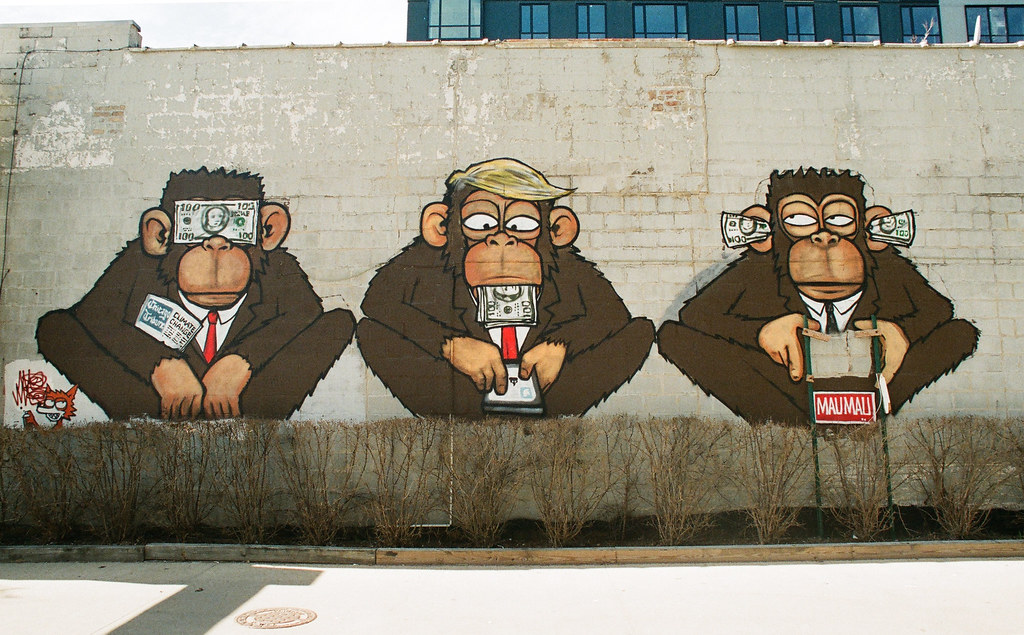
Scientists can issue warnings about our impending demise until they are blue in the face, and they have, but they and the public are at the mercy of economic, financial, and political forces beyond anyone’s power. Couple that with the fact that the average person on the street has a Trump-level of comprehension about these existential crises and is being bombarded on social media by fake news that plays on emotions and deep-rooted inter-group distrust. Cheap energy and the individualistic consumer culture have created an illusion of abundance and destroyed any sort of communal cooperation which was once the basis of everyday life. I’ve walked this Earth for over five decades and have seen a steady and continuous degradation of the natural world; corporate greenwashing is rampant. The growth in ‘green energy’ has not displaced fossil fuel fuel consumption to any great degree; fossil fuels still supply 84% of global energy consumption. Worse yet, just to maintain our current growth in energy consumption would require an unattainable expansion in alternative energies. If one connects all the dots on our current state, then there is no refuting this most clear-eyed of scientific assessments:
“Given the momentum in both the Earth and human systems, and the growing difference between the ‘reaction time’ needed to steer humanity towards a more sustainable future, and the ‘intervention time’ left to avert a range of catastrophes in both the physical climate system (e.g., melting of Arctic sea ice) and the biosphere (e.g., loss of the Great Barrier Reef), we are already deep into the trajectory towards collapse.”
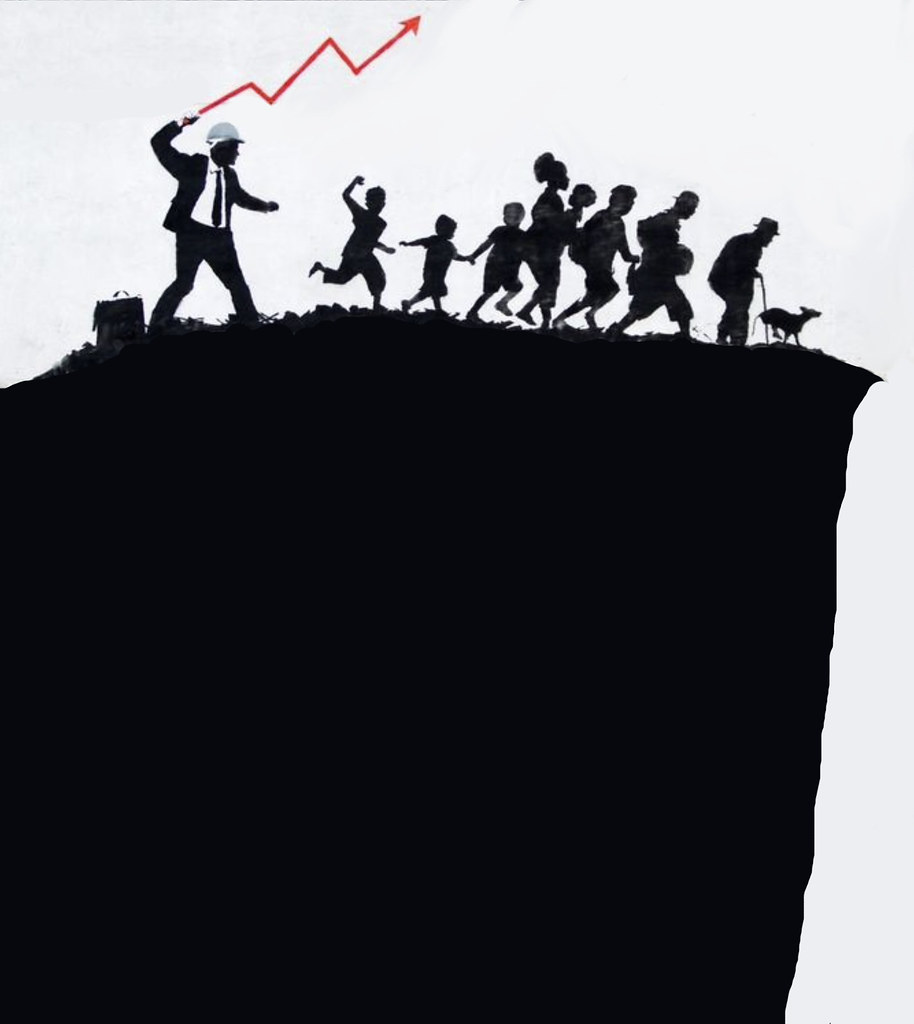
The end of the world is the ‘cha-ching’ of a cash register as the last vestiges of nature are converted to dollars. Lest we forget, 71% of global emissions come from just 100 companies and more than half of global industrial emissions since 1988 originated from 25 corporate and state-owned entities. While the ultra-wealthy reap the profits of a poisoned ecology, the rest of the world is left to take the brunt of consequences from a world that grows more dangerous by the day. Those living on the edge who lost their livelihood during this pandemic are the collateral damage of an out-of-control socio-economic system whose incompatibility with life on Earth becomes more evident with each passing year. There’s nowhere to escape for most people because, to one degree or another, we are all entrapped in this system. The immutable laws of biology, physics, and chemistry have set an expiration date on America’s non-negotiable way of life, ensuring that many more will soon fall victim to the short-term greed of capitalism. As Stephen Hawking warned, “Stupidity and greed will kill off humans.”





 Collapse of Industrial Civilization