On my downtime right now and trying to recoup from doomer fatigue, but the following story simply reinforces my belief that industrial civilization will die at its own hands while taking the rest of the living planet with it in a manmade greenhouse extinction event. Capitalism gives humans the perverse incentive to value death and artificial wealth over life and nature’s wealth. Note to self – must read everything by Peter Ward.
Those who have read my thoughts, sprinkled hither and thither around the internet, will perhaps be aware that I gave up, about one and a half years ago, when I realised that whatever mighty efforts activists might make, it was going to be impossible to save the biosphere. Daniel Drumright was about three months ahead of me.
Nobody who hasn’t fully encountered and absorbed that experience for themselves, in its true horror, has any idea what it really means, and for those who have yet to face it, you have my deepest compassion and sympathy.
There’s no point in going over the technical reasoning in detail. People either get it or they don’t. They can find all the information quite easily.
There are three big, obvious factors that most people do not understand; those are, first, the irreversible self-reinforcing positive feedbacks that Guy McPherson is listing, and second, the time lag, that what we have now is the result of what we did forty or so years ago, and what we get in the future will be the effects of what we have been doing ever since. The third is the astounding rate at which all the changes are happening, when compared with all previous similar or comparable events in Earth’s history. Whatever it is, it is ULTRA DRAMATIC on the geological time scale.
The doom scenario has been, and is being, comprehensively documented by xraymike on this blog. The trickle of folk who are going through the process of coming to terms with this hellish awakening has already grown into a cascade and will soon be millions, and I really have nothing to say to them, because I do not know what to say to them.
Once you get the insight regarding the Mass Extinction Event, it’s a bit like the Buddha’s Enlightenment Experience under the Bodhi Tree, only in reverse, so to speak.
Gautama pondered whether to keep his insight to himself and spend the rest of his days in bliss, or whether to teach others what he now knew, and he chose, out of compassion, to spend the remainder of his life wandering through India teaching his message.
But how do you teach how to cope with doom ? There’s nothing optimistic or pleasing or life-enhancing or joyful about imminent apocalypse. There’s just the anguish and distress involved with the demanding process of navigating your own psychology and emotional responses toward an impossible future.
Each individual IS an individual, as we see on NBL, with their own version of the mixture of belief and disbelief and their own political and philosophical and religious outlooks, and some have children and grandchildren and some are thinking of survival chances, some of suicide, some of resistance, and so on.
I have had more than a year to dwell upon my own position, and to watch the responses in my own being, and in the people whom I like and respect, and the voices I admire, who also grasp the profound and terrible tragedy facing us all. For a long time, there was commiseration, but then what ? Commiseration fatigue ? How can anyone commiserate with anonymous thousands, let alone millions ?
Again, there’s lots of speculation as to the detail of how the crash will play out and how societies will respond as they collapse. I’m not going to add much to that here, it’s all available elsewhere. We either get a die back, and a bottle neck, with a few survivors, or a complete die off and total extinction event. I think we get the latter, but even if it is the former, none of us are going to know any of those people, as to who they will be, or where or what becomes of them, so why does it matter ? And why would anyone choose to have to live through whatever horrendous circumstances they will have to endure, following the trauma of the ending of civilisation ? Perhaps some people will just happen to find themselves in such a situation. Who knows ?
Meanwhile, here we are. Peak just about everything, where we start the big slide down into the abysmal depths of whatever awaits us all… the biggest crisis that the human species has ever faced, 7 point something billion of us, with millions more arriving here every month. There is no discernible global leadership of any kind that comprehends our dire situation, only madmen and corruption and people locked in to dead cultural paradigms.
What does a dead cultural paradigm look like ?
Well, we’ve got Joseph Tainter to give us some clues from the historical record and maybe Heathcote Williams to bring us up to date with the contemporary scene
From what I understand of history, we can expect a hard swing toward fascist dystopia, as regimes try desperately to exert total control over everything, and hard swings from repressed populations and factions which reciprocate with resistance.
The future will be whatever it will be. Every day I walk up and down the Beach of Doom and kick at pieces of poisonous plastic flotsam and miscellaneous cosmic debris left by the virtual tide, and gaze at the orange purple bruises on the tangerine sky and sometimes I bicker and haggle with someone.
Yesterday it was Lidia at NBL to whom I am grateful for an insight into something or other.
You see, people can be very roughly divided into two groups. Those who primarily hold a religious, or spiritual, or romantic, or mythical world view. And those who primarily hold a scientific, or materialist, or rationalist world view.
Of course, this is a crude over-simplification, and speaking to any individual, you’ll soon find they hold all kinds of contradictory beliefs. But roughly, it’s Mythos and Logos, or Iain McGilchrist’s Right and Left Hemispheres.
So, Lidia was kind enough to describe her worldview, her welt anschauung, her cosmology, her mental conception of how reality is structured, her epistemology, her way of ‘knowing your place in the Universe’.
I hope she will forgive my using her as an example, and the exchange several days ago was only a brief re-run of a much longer version we had on the now defunct NTE ning, some months ago, so I think I do have a fairly full idea as to her thinking, but so as not to risk any personal offence, I’ll take the illustration away from Lidia, and apply it to any generic physicist or scientist or person with a similar belief system, of whom I have met very, very many. This will allow me some poetic license possibly, avoiding danger of maligning the good Lidia, I hope.
You see, according to this paradigm of reality, there is only physics. Everything is physics.
That means that everything is explained by physics. That means no mystery, because even if there is mystery, that’s only due to physics not yet explaining it. And once mystery is killed off, it’s relatives, cousins – things like awe, wonder, sanctity, sacredness, the numinous – easily shrivel and die too.
So, that reality ‘out there’, and this reality ‘in here’, is all meaningless, because it only means something if we impose some wishful magical thinking onto the physics, which, as objective scientists, we are not allowed to do.
And that reality ‘out there’ is just ‘stuff’, and it interacts with this reality ‘in here’, the brain, which again is just ‘stuff’. It’s all physics, it’s all physical stuff, and even though we don’t understand all of it – even don’t understand most of it, or, if pressed, hardly ANY of it, hahaha – in theory, physics can, and will, explain all of it, one day, so no problem.
So, it’s quite interesting to trace back where this story, this Logos story, comes from, and it’s quite easy to do, because it’s well documented and researched, and it goes back to Descartes and his radical scepticism, and the ideas given to him by an angel (Mythos) and his struggle to find anything, something, that he could not undermine by radical doubt, and his arrival at ‘I think, therefore I am’ and then the beginnings of modern science.
Given that the Church of Rome was the dominant power in Europe at the time, an accommodation had to be made between the rising power of science and the prevailing authority, and thus we got an expedient result, the division which gave the material world to the scientists and the spiritual world to the priests. That’s why there’s no God or spirits involved in physics. Which, you may say, is an excellent thing. But let us call it, for the moment, ‘a mixed blessing’.
Because, you see, if you follow the epistemology carefully, and look at it very closely, something absolutely amazing emerges.
Einstein said that our ordinary common senses give us ‘naive realism’. That is, grass is green, rocks are hard, and snow is cold. But physics, if it is true, tells us that this naive realism is all wrong, physics tells us that the reality is quite different, something completely different is actually going on, out there and in here.
Now, it’s all very well for someone like Einstein, or Niels Bohr, or Feynman, to come up with these ideas, as professional physicists, but what happens when this scientific worldview, this basically Cartesian worldview, is taught to us lesser mortals as part of the culture, and internalised as epistemology, and preached to us as ontology, and integrated into general social cosmology ?
This is where it gets really weird, a MOST extraordinary thing – because when I thought over what Lidia had told me, nowhere in the depiction and analysis is there anywhere for A HAPPY HEALTHY COMPLETE HUMAN BEING.
Isn’t that bizarre ? That human beings have come up with a teaching as to what the world is and what the totality of the Universe is, which does not even include the organism that WE ARE, AT ALL ?
I mean, that strikes me as exceptionally odd. Prior to Descartes, the cosmology was a sort of Divine Order, with the Heavens above and layers with angels and God at the pinnacle and so forth. And people were taught this, and their place in the social hierarchy of feudalism was essentially justified because the King was a sort of representative of God on Earth, and so on. So although we can scoff at the nonsense of it, at least at the time, if you were a peasant, you featured in the story.
If you were out in the fields with your ox and your plough and you were gazing at the distant rainbow and thinking about your dead grandfather and you heard the church bells peeling for a wedding in the village next door, all sorts of strange impressions could flicker through your mind, but basically you had a cosmology which placed God somewhere ‘up there’ and you ‘down here’ with a coherent pattern where your birth and living and death belonged with the landscape and the community and the larger reality.
Therefore, the map, the mental model ‘in here’, when projected and overlaid upon reality, had in it the human subject as its focal point, and because that’s what the human subject had been taught, a story was established featuring the ME.
But now, not only have they written God out, with Descartes and the Cartesian Paradigm of reality as the basis of modern science, but you’ve got a model, a cosmology, which has written US, as human beings, biological creatures, right out of the system altogether, as if they were not even involved !
And then people have internalised this model and taken it to be their own personal reality that they use to explain the world to themselves.
I wonder what that does for a person’s health ? I wonder what it does, when millions of people do something like that ?
The Christian Fundamentalists may be completely round the bend when it comes to LOGIC but maybe they just feel intuitively that what they are being offered by the people who argue against them, a worldview, a cosmology, which says NOTHING MEANS ANYTHING, and a worldview, a cosmology, which doesn’t have ANY PLACE where a happy healthy human, a biological human being, can even fit into it, is so sterile and horrible, that they intuitively reject it and are hostile to it ?
Because, if you look at anthropology or what Joseph Campbell said about myth, what a belief system provides for a tribal people is a safe mental refuge. When a person takes a mental excursion into fantasy and ponders the nature of their own life and identity, and the dream they had last night, and their relationships with the world around them and other folks, and the stars above and so forth, the whole purpose of the cosmology is to deliver them safely back unto THEMSELVES.
I mean, think of acid trips and ayauasca and mushrooms and vision quests and all that stuff, where you encounter visions of beings from other dimensions and the most mind-boggling experiences, the idea is to get back to start, square 1, more or less sane and intact.
The same applies to ordinary daydreams and fantasies and all our thinking about our ordinary experiences. How can we be sane and healthy, if our fundamental belief system does not even include a home base option anywhere within it ?
You know, who cares what the physics says. Primarily, we are human beings, biological animals, that cry when we are hurt and sad, and laugh when we are happy, and get sentimental about babies and kittens, and need clean water and food, etc. AND we need a meaningful Universe which has a place for US in it, with a STORY that makes sense as to why we exist…
You know, a story we can UNDERSTAND about who we are and what we are doing here.
At the moment, all these stories we are being told are crap because they are not accurate with the science, strictly speaking, since they can’t be; we can’t get any clear picture from the physicists as to the ultimate nature of all the quantum stuff and the Universe. In addition, these cultural stories are unsatisfactory at the human level when they LEAVE OUT the human being and pretend it’s all some sort of abstract empty machine.
What’s more, from what a large percentage of quantum physicists have plainly stated, you cannot leave the physicist out of the experiment because the observer EFFECTS the observation. Now, I recognize this is contentious, there is no consensus, and it’s not clear what this means. But !
So, what does a ‘good story’ look like ? Well, that’s hard… but I’m glad you asked.
I think this is a complicated and difficult problem, and here I am upon the Beach of Doom, with all of human history and culture, every idea that’s ever been recorded, washed up at my feet at the tide line, strewn and tangled and rotting and steaming…
Look at us, pitiful, confused Bonobos, asking ourselves questions we can’t answer, tearing ourselves and each other apart, trying to satisfy Maslow’s Hierarchy…
Is that what we are doing ? Well, the whistle has blown, the sirens are wailing, time is up, the NTE light is flashing, so there is not going to be some utopian Promised Land for the Bonobos to migrate to…
Xraymike was kind enough to point me to the definition of the word Humanistic:
1. A believer in the principles of humanism. 2. One who is concerned with the interests and welfare of humans.
“Humanism is a group of philosophies and ethical perspectives which emphasize the value and agency of human beings, individually and collectively, and generally prefers individual thought and evidence (rationalism, empiricism) over established doctrine or faith (fideism). The term humanism can be ambiguously diverse, and there has been a persistent confusion between several related uses of the term because different intellectual movements have identified with it over time.[1] In philosophy and social science, humanism refers to a perspective that affirms some notion of a “human nature” (contrasted with anti-humanism). etc…”
So let’s take that as a verbal anchorage.
I’d suggest that most human beings have a fundamental requirement, for their psychological, physiological, and social welfare, to understand ‘the world’ in a way that makes sense. So that, whenever they sit down and think things over, and run ideas through their head, they can confirm themselves and they can confirm ‘the world’ and feel okay.
Wouldn’t that be nice ? Look what we’ve got. It’s not THAT, is it.
Is it any surprise that some people want the Rapture or Alien abduction to get the hell out of this confusion ?
The epistemology that science teaches, following on from Descartes, has caused most of the damage to the biosphere over the last century or two, because nothing is sacred, everything is just dead stuff, in a dead machine, inhabited by ghostly meaningless meat robots, zeks, without any dignity or purpose of their own.
You marry that to Capitalism, an elite with power and greed as their motive, and give it to them as a tool, and hand them control of the Military, which was once meant to guard but gets turned into a predatory plundering machine.
Well. We are where we are. The lights will go out, one by one, and then a few million years of silence as the extremophiles have peace.
It could have been, might have been, a very different story, if we had all followed the example of, say, the Bishnois.
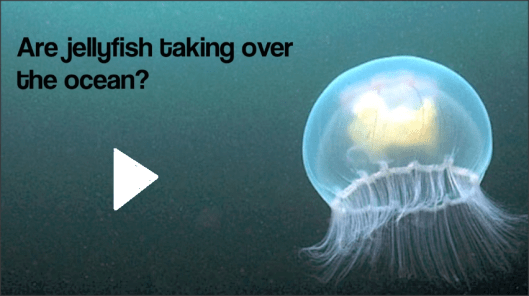
Alice Friedemann must be on the same wavelength as me. This subject of the proliferation of jellyfish caught my attention as well. Since she has done the legwork on this story, I will repost her essay below the following CBC Radio podcast with scientist Lisa-ann Gershwin:
“If jellyfish could wish for perfect conditions, these would include warming and turbid water, lack of predators and competitors, and any conditions that make it harder for other species to survive, like low oxygen or slightly more acidic water than usual. These are the very conditions we are creating at an alarming and increasing rate. And jellyfish are enjoying a renaissance like never before in history.” ~ Lisa-ann Gershwin
Alice Friedemann’s review of Stung!…
A book review of Lisa-ann Gershwin’s “Stung! On jellyfish blooms and the future of the ocean”
[ Xraymike79’s Note: The image above is purely for hyperbole. There are no jellyfish this size. The largest recorded jellyfish is the Lion’s mane jellyfish which can reach a diameter of 7 to 8 feet with tentacles 120 feet long. As Don Howe states below in the comments section: “The power of jellyfish is not in their size but in their vast numbers…”]
Move aside Steven King, jellyfish are worse than any of your demons, worse than any Grade-B monster that’s graced the silver screen. Unlike The Blob, which can be stopped by freezing, you can’t kill them. Not with chemical repellents or biocides or nets or electric shocks or introducing species that eat jellyfish like the striped sea slug. If you shoot, stab, slash, or chop off part of a jellyfish, it can regenerate lost body parts within two days. Not even the past 5 major extinction events which killed up to 90% of all life on earth, killed off the jellyfish.
Meanwhile they’re on a rampage, doing millions of dollars in damage clogging intakes of nuclear, coal, and desalination plants, killing millions of farmed fish, and destroying fishing nets with their sticky icky bodies.
The more we overfish, pollute, acidify and warm the ocean, create vast dead zones, and trawl ocean bottoms, the better the jellyfish do.
The oceans make the earth habitable for us. They generate most of the oxygen we breathe, stabilize temperatures, drive climate and weather, and absorb a third of the CO2 we’re emitting. Over 3 billion people depend on the oceans for their livelihoods; 2.6 billion depend on seafood as their main source of protein.
Most alarming of all, 40% of phytoplankton has died off globally since the 1950s – they’re not only at the base of the food chain, but they generate most of the oxygen we breathe, as well as absorb half of the carbon dioxide, and their increasing death rate will make the ocean get warmer even faster.
Why Jellyfish are taking over the world
Prolific, hard to kill, breed fast, and more – no wonder they’re so successful:
They’ve everywhere, spread around the world in ship ballast or sea currents.
Ubiquitous – from top to bottom of the ocean, from pole to pole, year-round.
Grow faster than other species to quickly take advantage of any food, and they’ll eat almost anything — copepods, fish eggs, larvae, flagellates. They eat past when they can keep consuming, spit food out, waste a great deal other creatures could have eaten. Even when they’re full, their tentacles keep capturing prey.
If there’s no food, jellyfish can consume their own body mass and get smaller and smaller until they find food again, and rapidly return to normal. Even when they grow smaller they can still reproduce.
Consume many times their body weight in high-value food but are of low-value themselves because they provide little energy, ounce for ounce, compared to the food they ate. So they have few predators.
When 2 weeks old they can lay 10,000 eggs a day that hatch 12-20 hours later
They reproduce many ways: massive orgies, fission, fusion, cloning, hermaphroditism, external fertilization, self-fertilization, copulation.
If they lose a body part, they can regenerate it within 2 days.
They are the “Last Man Standing” in eutrophication zones because they need less oxygen
Many species can tolerate any salinity level, from fresh water to salt water
They’ve survived ice ages, hothouse climates, all five mass extinctions, predators, competitors, and us.
Jellyfish in the oceans have been known to live over 10 years
Many of them avoid predators by long vertical migrations from the deep sea to the surface at night and back down again by daylight
They can wait a long time for the right conditions to bloom
Just as plants have seeds which can endure many years waiting for optimum conditions to grow, jellyfish have a seed-like state called a polyp that waits for good conditions, and can clone themselves to create armies of ‘seeds’ waiting to burst into jellyfish blooms seemingly overnight. Polyps don’t “grow up” to become jellyfish. They spawn what we think of as jellyfish – the medusa — which then mate sexually to produce polyps, which stick to rocks, shells, man-made structures, plastic, etc. Both the polyps and the medusa could be considered “immortal” – when a polyp dies it’s clones live on, and when the medusa form of jellyfish dies, it’s pieces turn back into polyps (though I wasn’t clear if all species or just some do this).
Jellyfish are at the top of the food chain
That seems so wrong– a primitive brainless blob? But jellyfish eat much larger clams, crabs, starfish, snails, and fast, smarter fish and squid.
They’re also at the top because not much wants to eat them.
Worse yet, they outcompete other sea life by devouring the eggs and larvae of species that would have grown up to eat jellyfish larvae. It’s a double whammy since these larvae never grow up, leaving a lot more food for jellyfish to consume. A jellyfish bloom can clear the water of all eggs, larvae, copepods, and small plankton in less than a day. This makes it almost impossible for some overfished species to make a comeback.
While the attention of everyone is turned towards the latest gun violence in America, the unprecedented flooding in Colorado speaks of a future of fire and flood which will cause untold damage and death as industrial civilization continues to employ its vast army of CO2-belching fossil fuel slaves. There’s no escaping climate chaos, whether you live on the coast or high atop a mountain in the middle of the country. The latest Colorado floods have reportedly damaged or destroyed 19,000 homes with 8 people confirmed dead so far and well over 1,000 persons unaccounted for as of today. Fracking wells are also leaking into the flooded waters.
You may be asking yourself how the Southwest is experiencing such floods when it has been in a mega-drought for the last quarter century. As the planet heats up from mankind’s greenhouse gases, evaporation increases. Higher temperatures effectively pump more energy into the atmosphere and intensify the hydrologic cycle of the planet. The moisture holding capacity of the atmosphere also increases with higher temperatures. Extremes of drought and flood are the end result, although it is believed by the end of the century that the effects of higher temperatures on evaporation are expected to outweigh precipitation, leading to drought becoming the more common climate condition. A hotter planet(milder winters and longer summers) also diminishes snowpack leading to less soil moisture and drier conditions which are at greater risk of drought, heat waves, and wild fires.
In Colorado, the recent floods were made worse by that state’s mega-fires which destroyed the plant life on the ground. The suppression of fires by man over the last century has also disrupted natural cycles, causing forests to become overgrown and dense. Drought-stressed trees have succumbed to bark beetle infestation and early snowmelt has fed the growth of underbrush to produce a tinderbox of fuel for monster infernos. A scorched landscape with no trees, bushes, and vegetation to hold in moisture allows the rainwater to simply flow unimpeded down the mountain slopes, quickly eroding the soil. The unparalleled amount of rainfall also overwhelms the Earth’s ability to absorb it. The graph below illustrates how remarkable the current flooding is. This graph is from one particular weather station in Boulder that has recorded daily precipitation over the last 120 years. Each red cross represents the amount of rainfall in a day and it is plotted according to how often that amount occurs over a given expanse of time from 1 to 10,000 years. Only a few measurements fall past the 10 year occurrence rate, while the amount of rain that fell one day this past week (120 millimeters or 4.8 inches) at this particular station is seen way above and beyond anything else recorded since 1893. Note that yesterday(Monday) Boulder Colorado hit 30.14 inches of annual rainfall which breaks the previous single year record set in 1995 of 29.93 inches. And the year is not yet over.
NOAA satellite image from the evening of September 11, 2013 showing the devastating storm system bearing down on Colorado:
A blocking pattern has set up over the western United States, drawing a conveyor belt of tropical moisture north from coastal Mexico. Blocking patterns form when the jet stream slows to a crawl, and weather patterns get stuck in place. When all that warm, wet air hit the Rocky Mountains, it had nowhere to go but up, pushed further skyward by the mountains themselves. By some measurements, the atmosphere at the time of the heaviest rains was among the most soaked it has ever been in Colorado…
…Why it will keep happening: Blocking patterns are fertile ground for extreme weather. A blocking pattern near Greenland was also to blame for steering Superstorm Sandy toward the east coast of the United States last fall. Persistent high pressure this year in the western United States has led to what is (so far) California’s driest year on record. That, in turn, fueled last month’s massive Rim Fire in Yosemite National Park, which grew to a size larger than New York City.
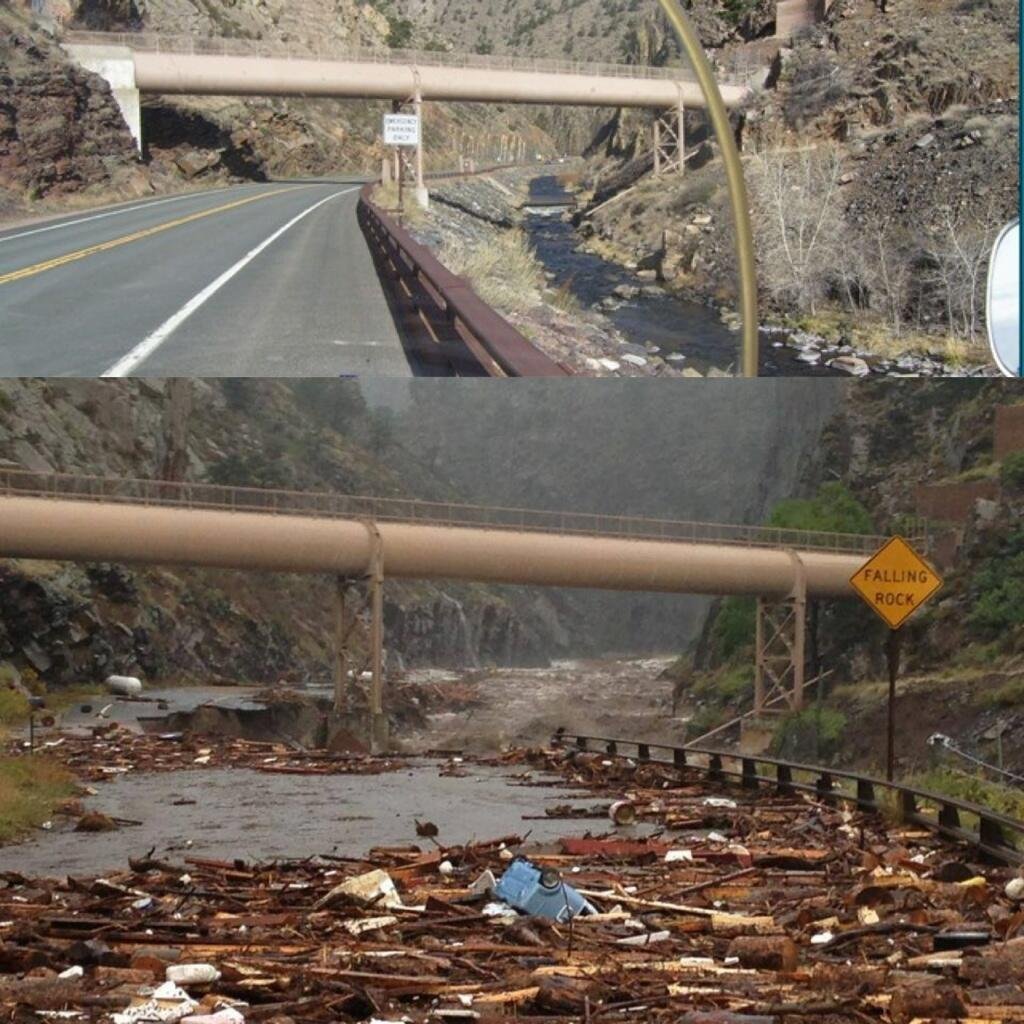
Big Thompson Canyon, Colorado Before (top) and After (bottom):
Historic, “unbelievable” rainfall in New Mexico on Thursday caused flooding in areas that typically have little to no flow at this time of year. An area in the Guadalupe Mountains received 11 inches in a 24-hour period. The state has been grappling with intense drought in 2013, and riverbeds that are usually dry have become treacherous. Carlsbad Caverns National Park closed on Thursday because of the flooding…
…Extreme rainfall events have become more frequent across the U.S. during the past several decades in part due to manmade global warming. Increasing air and ocean temperatures mean that the air is generally carrying more water vapor than it used to, and this moisture can be tapped by storm systems to yield rain or snow extremes. Trends in extreme precipitation events vary by region, though, and in general the biggest increases have taken place in the Midwest and Northeast. However, most parts of the U.S. have seen an increase in extreme precipitation events, according to the draft National Climate Assessment report that was released this past January. The report goes on to note that in the future, “increases in the frequency and intensity of extreme precipitation events are projected for most U.S. areas.
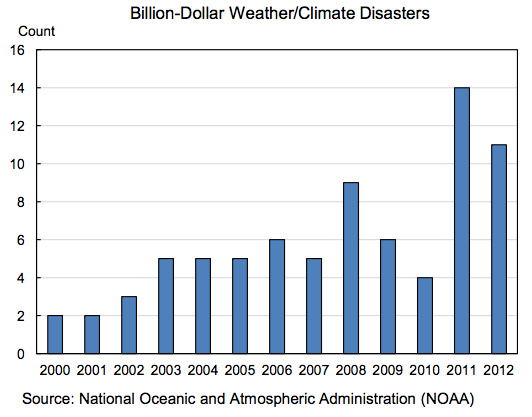
The global picture of weather disasters shows an upward trend according to Munich RE, one of the largest reinsurers in the world:
With all the evidence of climate chaos piling up daily, I’m having a hard time taking seriously a species that calls itself wise, yet worries more about things like erectile dysfunction and breast implants rather than the quickly fading habitability of planet Earth. We are blind to our own self-destruction.
The following blog entry is a guest post by award-winning satirical writer Scott Erickson. When I was initially contacted by Scott I was a bit wary until I read more about him and his writings at his website. He’s definitely ‘collapse-aware’ and is my kind of people. In a world where dystopic fiction has in many ways already become reality, we find ourselves to be a captive audience of the real world post-apocalyptic story playing out before our very eyes. Life is increasingly becoming stranger than fiction…
SATIRE CAN’T KEEP UP WITH REALITY
How long until Monsanto proposes genetic engineering of the human race?
By Scott Erickson
The hardest part about writing satire is trying to write things that are more absurd than what real life comes up with. I’ve heard this from a lot of comedy writers lately. There’s this idea that satire is dead because real life has become a satire of itself.
Here’s an example: Could anybody have invented the character of Sarah Palin? The vice presidential debate with her versus Joe Biden was one of the funniest things I’ve seen in my life.
Someday she’s going to be elected President. Which reminds me of the movie Idiocracy. It’s a pretty good satire about where we’re heading. Or have we already arrived?
The rest of this post is about a more personal example.
In the novel, our young protagonist Amy Johnson-Martinez encounters the evil corporation GloboChem. A spill of the agricultural chemical “GrowMagic” has led to a hospital full of sick babies.
Amy does some research into what “GrowMagic” is, and she is shocked – SHOCKED! – to discover that “GrowMagic” is actually ONE OF THE MOST POISONOUS AGRICULTURAL CHEMICALS EVER MADE. This is what she finds on the GloboChem website:
Our main product is HappySeeds™ which grow 73% of the world’s vegetables and grains. Most of those seeds are Magic-Ready HappySeeds™ that are genetically engineered to accompany GrowMagic™ “agricultural helper.” As happy farmers around the world say, “I need the miraculous GrowMagic™ to keep my Magic-Ready HappySeeds™ happy!” And since Magic-Ready HappySeeds™ are genetically designed to grow plants that don’t produce seed, farmers around the world are happy to come back and buy more HappySeeds™ year after year – which keeps GloboChem shareholders happy! GloboChem: Spreading happiness wherever it touches.
If you guessed that “GloboChem” is a thinly-disguised “Monsanto,” and that “GrowMagic™” is a thinly disguised “Roundup,” then good for you! You win 10 points and advance to the semi-finals.
Later in the story, things take a darker turn. Since weeds have evolved into super weeds that are increasingly resistant to agricultural chemicals, bolder measures are necessary. Thus, GloboChem’s spokesperson announces a radical new proposal:
Ladies and Gentlemen, some people would suggest that GloboChem has gone too far. I put it to you that we haven’t gone far enough. I am proud to announce that GloboChem has developed an innovative new product that will absolutely end all problems with human exposure to agricultural chemicals.
Our new product is a highly-advanced version of our famous ‘HappySeed’ technology. As you surely know, ‘Magic-Ready HappySeeds’ are genetically engineered to go with our ‘GrowMagic’ agricultural helper. I am proud to announce GloboChem’s brand-new product, which we call ‘HappyHuman.’ It will make human beings – people like you and me – able to withstand the ‘GrowMagic’ that brings us the clean and inexpensive food you serve to your loved ones. ‘HappyHuman’ will be available in capsule form – just one dose per month is all you’ll need to stay healthy and prosperous.
Each capsule contains specially-engineered radioactive isotopes that go throughout the body, miraculously altering the genetic code to change the cell chemistry in each and every cell. Then, our bodies can withstand the ‘GrowMagic’ that brings us attractive pest-free food at a reasonable price. In other words, it will make us able to withstand ‘GrowMagic’ 100 percent naturally!
I know what you’re all thinking. You’re thinking, ‘What about our household pets, our fuzzy kittens and puppies?’ I’m pleased to assure you that GloboChem will offer our supplement in a pet-friendly form, because GloboChem cares about your pets. In fact, we love them more than you do.
Yes, glyphosate is the key ingredient in the company’s GrowMagic™ label of herbicides. Sorry, I meant to write Roundup label of herbicides.
Don’t worry, though – the acceptable level of glyphosate is only rising a little bit. The EPA is increasing limits on allowable glyphosate in food crops from 200 ppm to 6,000 ppm. That’s not much – only 3,000%.
Yes, scientists have linked glyphosate to cancerous diseases.
Yes, a study by The Cornucopia Institute concluded that glyphosate “exerted proliferative effects in human hormone-dependent breast cancer.”
Yes, another study concluded that “glyphosate enhances the damaging effects of other food borne chemical residues and environmental toxins.”
According to GloboChem – sorry, I meant to write Monsanto – the public is okay with this. A two-month open comment period that began May 1st drew little public resistance. Yes, the comment period was only announced on a 3×5 card posted in the company’s break room, but if you really wanted to see it then you should have looked harder.
Later in The Diary of Amy, the story eventually takes an even darker turn. The public has so far resisted GloboChem’s plan to genetically alter the human race. But now the agricultural chemicals are not stopping the super weeds, despite applying them far above the recommended concentrations. And the economy is in a tailspin due to a sudden oil shortage. We have to act fast! Fortunately, GloboChem comes to the rescue:
Recently GloboChem, Inc. has received some “less than fully satisfied” feedback on our agricultural products. We are pleased to respond to this feedback and offer what appears to be the only viable solution.
Apparently our GrowMagic™ agricultural helper is becoming less effective over time, even by using heavier applications.
Some have claimed all along that this would happen, and that we have lied about it. That is true. But even though we lied once, that doesn’t mean we’re lying to you this time. Since we told the truth about our lying, that should make you trust us now.
But rather than engage in a useless discussion about “who said what when,” we must forge ahead, like the courageous nation that we are. America has never turned its back on a challenge, and these tough economic times mean we must not turn our back like never before.
We recently announced our new HappyHuman™ product and sought to receive congressional approval to market it. But public reception was less-than-positive and the congressional bill stalled in committee.
We believe that now is the time to pass the bill and rush HappyHuman™ to the American public. Only by genetically engineering a human race able to withstand our products can we preserve our American way of life.
We must increase the “magic” within GrowMagic™ to a level high enough to kill every form of life that has not been genetically modified to resist it. There is no other option.
We have consulted with economic experts that we paid, and confirmed the following: Either we go forward with HappyHuman™, or food prices will increase by one thousand percent and the United States agricultural system will collapse and we will all die.
In other words, the only way to sustain human life is to modify ourselves to resist killing the rest of it.
This was much funnier to me when I wrote it. Now, not so much.
I’m just wondering how long it is before I see such a press release in real life, or before I see such a plan being proposed by a GloboChem spokesperson. Sorry, I meant to write Monsanto spokesperson.
In his hubris, mankind went about subduing, indexing, commodifing, and exploiting all of Earth. He paid very little heed to the consequences of the shrinking richness that once characterized the natural world. Everything had a price since money had become the sole criteria by which all things, animate and inanimate, were valued. From the anthropocentric perspective, if it didn’t serve people in some way or another, what good was it? If need be, man could use his superior intellect to fix or outright replace what he had permanently destroyed. “A better life through technology” became the law of the land. Just as with the accepted tenet of never-ending economic growth, there was the unquestioned belief of technological solutions for all manmade problems brought on by industrial civilization. Hence, bees dying from a chemically saturated environment could be genetically modified to survive in our toxic soup. Extinct flora and fauna could be brought back to life with bioengineering. Where we would put such resurrected organisms in a world overloaded with humans, other than in zoos or other tiny cutouts of artificial habitat, was a question never answered.
Man became so assured of himself and his technological abilities that he began to lose track of the steadily mounting environmental assaults promising to make Earth uninhabitable for all but a few heat-loving bacteria like thermophiles. In fact many denied outright that such dangers even existed. And those whose livelihood depended on maintaining business-as-usual were more than willing to pay public relations experts who could mold popular thought in favor of such a suicidal path. Most of the truly eco-aware humans, whose numbers were so small as to be inconsequential, spent all their time refuting the ignorance and propaganda of the masses, but to no avail. How could any root causes and solutions ever really be identified if the vast majority were kept at each other’s throats? The climate change deniers fought with the scientists; the capitalists fought with the environmentalists and steady state/degrowth alternative economists, the conspiracy theorists fought with the realists, and ad infinitum. Thus consumed with dissension the human species raced over the cliff of eco-apocalypse and human extinction.
She does not measure time in years, decades, or even centuries, but in millennia. She watches unamused by the tragicomedy of humankind. She is unmoved by the self-inflicted suffering and death that is and will be wrought by our own self-serving behavior. Gaia patiently awaits the extinction of man.
…The world was void,
The populous and the powerful was a lump,
Seasonless, herbless, treeless, manless, lifeless—
A lump of death—a chaos of hard clay.
The rivers, lakes and ocean all stood still,
And nothing stirr’d within their silent depths;
Ships sailorless lay rotting on the sea,
And their masts fell down piecemeal: as they dropp’d
They slept on the abyss without a surge—
The waves were dead; the tides were in their grave,
The moon, their mistress, had expir’d before;
The winds were wither’d in the stagnant air,
And the clouds perish’d; Darkness had no need
Of aid from them—She was the Universe.”
The Middle East is on the frontline of the multi-pronged crisis of overpopulation, resource depletion, and climate change. Fault lines in that region are widening as climate change exacerbates crop-destroying droughts, peak oil starves economies, and stressed populations scramble to survive. Advanced industrialized countries are buffered from the same fate only temporarily by their military and economic might. The oil-cursed Middle East also suffers from being in the crosshairs of industrial civilization’s insatiable appetite for the black stuff. Since the peak of conventional oil in 2005, the industrial world has not only turned to harder to extract and environmentally damaging unconventional sources of oil, but has also ramped up military intervention in order to keep the energy flowing. Access to resources has always been an underlying factor in all wars, but as climate change, resource depletion, and social disintegration escalate, the grip on foreign energy deposits by western powers becomes increasingly tenuous. Climate Change multiplies threats. Militarism and climate change feed off and drive each other:
The war machine of the American Empire is the single largest consumer of fossil fuels on the planet.
Our priorities are overwhelmingly skewed toward militarism in order to maintain the unsustainable, while the real threat of climate change grows ever stronger:
In the meantime, the false hope of technology maintains the illusion that our current way of life is inalienable. The industrialized monoculture farming that feeds the masses will quickly fade as synthetic fertilizers become too expensive to artificially replenish nutrient-depleted soils. Pesticides and antibiotics are losing their effectiveness as natural selection breeds super weeds and drug-resistant pathogens. Fresh water is also being sacrificed for fracking, tar sands production, and mountaintop mining. We appear to be systematically destroying any basis for future civilizations as we burn through what is left. “Forests precede mankind; deserts follow.”
Severe land degradation is now affecting 168 countries across the world, according to new research released by the UN Desertification Convention (UNCCD).
The figure, based on submissions from countries to the UN, is a marked increase on the last analysis in the mid-1990s, which estimated 110 states were at risk.
In an economic analysis published last week the Convention also warns land degradation is now costing US$490 billion per year and wiping out an area three times the size of Switzerland on an annual basis. – link
No techno-fix chicanery will bring back the melting polar caps or stop the series of runaway feedbacks loops unleashed from industrial civilization’s fatal attraction to fossil fuels. Our eyes simply don’t appreciate the full scale of climatic change now underway, eroding mankind’s food production, infrastructure, and socio-economic stability, in addition to degrading nature’s ecological resilience and biological diversity, both of which underpin all of mankind’s activities. The megatons of greenhouse gases expelled into the atmosphere by industrial activity everyday are as invisible to humans as the mountains of toxic plastic waste filling up the world’s oceans. Out of sight, out of mind until the effects become too obvious to ignore and too late to change. Overpopulation continues unabated and is in fact encouraged by the imperatives of economic growth; the environmental pressures are ignored as resources are methodically stripped and depleted to unrecoverable levels.
Despite the ingenuity and intelligence of the human race, we appear subject to the same rudimentary biological urges of the lowest single-celled organism which, if given favorable conditions, will uncontrollably multiply its numbers deep into overshoot territory until its food source is exhausted, finally extinguishing itself in a mass die-off. Environmental laws and initiatives appear to be no more than slight speed bumps in our one-way road to extinction. All this talk about curbing GHG’s, “going green”, and “saving the planet” are mere window dressings for our motorized hearse. Nice accoutrements, but the destination is still a grave.
On the eve of what could be WWIII and the further barbarization of the Middle East at the hands of the American Empire and its vassal states, I think it’s important we look behind the wall of pro-war corporate media and understand what the facts on the ground really are. The following essay is a reblog from a website I just discovered and it gets into the nitty-gritty of the blowback from America’s perverse foreign policy in regards to Syria. When a nation supports democracy in name only and crawls in bed with terrorists to carry out regime change, then an entire region eventually becomes destabilized and thrown back into the hands of those dark forces which America purports to be fighting against in its so-called “global war on terror”. In reality, the American corporate state would rather have foreign nations with brutal dictators installed who will carry out America’s bidding rather than a democracy which looks after the best interests of the local people. Why else would the U.S. have overthrown Prime Minister Mossadeq of Iran or become the strongman for the corrupt House of Saud if not for the black oily stuff to which we are so addicted? When it is said that “women are literally blacked-out in the public sphere” in Saudi Arabia, the connotations are quite literal. Below is a picture taken by a friend who has worked in Saudi Arabia. It depicts a department store advertisement display which has been altered to conform to their brutally misogynistic society.
‘Humanitarian concerns’ and ‘social justice issues’ are merely empty rhetoric used by our sociopathic leaders as cover for protecting the grossly unjust social hierarchy of global capitalism. Some call this “corporate feudalism” while others say it is endemic to capitalism. One only has to look at the growing global wealth disparity to know this is true. The elite are drooling for war while the world races towards catastrophic resource depletion, environmental apocalypse, collapse of industrial civilization, and a new Dark Age.
One important issue that was missing from his talk (and is missing in almost all discussions on Syria) is the threat to the rights of women if the Assad regime falls. This is no small issue. One thing that surprised me during my visit to Syria is how Western it was compared to other Arab and Muslim countries in the region. Women’s dress is not restricted in Syria and they play a very important public role in society when compared to other Arab countries. Muslim fundamentalists and suicide bombers in Syria do have a Sharia Law agenda that they want to impose on the country. This is not theory. All one has to do is look to neighboring Iraq to see the deterioration of women’s rights in the post-Saddam era. Women used to wear miniskirts, show their hair and walk without fear in Baghdad. Now the situation has completely reversed. Women are forced to cover and are expected to stay at home. If they do not abide by this social practice, they are publicly shamed, and, in more extreme forms of Sharia justice, are raped and murdered.
An Iraqi friend told me that when he returned to Baghdad after the war he was stunned that women were no longer even comfortable speaking to him in public for fear of being thought of as whores. His experience of the status of women in public before the war was the polar opposite of the reality that one is now faced with in Iraq.
One should also note that the situation in neighboring Turkey has taken a turn for the worse in recent years under the Sunni AKP government. The rate of violence against women has sky-rocketed. Wives, fiancés and girlfriends have been murdered by their male partners at a rate that is 1400 percent higher than 7 years ago. This is the same AKP government that is supplying their Sunni rebel ‘brothers’ in Syria with weapons.
There is a severe lack of discourse about what the consequences are for women if and when the Assad regime falls in Syria. It is clear why the Muslim extremists working in concert with Al-Qaeda in Syria do not talk about women in their fight for ‘democracy’. Women for them are marginal, servile and functional creatures who are to be neither seen nor heard in public life.
Christians, Kurds and Minorities
In the question and answer period after Mr. Landis’ you will note that there is a Syrian Christian man asking a question about the rights and status of Christians in Syria after a Sunni extremist takeover of the country. He is very concerned about this issue and he has good reason to be. Since the beginning of the so-called ‘revolution’ there have been many incidents of rebels killing Christians and bombing churches all over Syria. The chant of the fighters has been: “The Alawite and Christians to Beirut!” The intentions can’t be made any clearer. Nobody will be safe in Syria after Assad except orthodox Sunni Muslims. Mr. Landis made this very clear to the Christian man when he said that the solution for Turkey was ethnic cleansing. The reason there is no problem in Turkey with Christians is because there are no more Christians. They used to be 20% of the population. Those who were not killed or deported were forced to convert to Islam. All that is left of Christianity in Turkey are ancient Christian sites that are advertised to attract tourists to the country. Istanbul, which is still the seat of the Eastern Orthodox Church, barely tolerates what is left of the Christian community there. The Church has virtually no sovereignty and is at the mercy of the government and its flock has dwindled to almost nothing, when compared to its vibrant past.
If ethnic cleansing and forced conversion has been Turkey’s solution for diversity, take a look at the other country that is supplying weapons and Islamist fighters to topple Assad: Saudi Arabia. There is no country in the world that is as intolerant and anti-democratic as Saudi Arabia. Churches are illegal in that country. Women are literally blacked-out in the public sphere in dress. Saudi is also the only country in the world where women are not allowed to drive. Women are subservient to men in the name of extreme Islam and Bedouin tradition. If Turkey and Saudi are the main suppliers of weapons and training of the rebels in Syria, one needs to reflect on what kind of culture is intended to be put in place after the fall of the secular and tolerant regime that is currently hanging on to power.
The Kurdish issue is an extremely volatile issue in Syria. Assad extended greater freedoms and autonomy to the Kurds via political reforms passed after the initial protests had begun. The Kurdish leadership in Syria has already openly stated that if Syria is attacked by Turkey, they will fight on the side of Assad. This issue presents potentially grave consequences of blowback for Turkey. In recent days the Turkish Prime Minister stated that Turkey may need to invade northeastern Syria to crush the Kurds there if they get too powerful. This would mean that Turkey would be fighting its war with the Kurds on three fronts. It is already battling a guerrilla insurgency within its borders and regularly attacks Kurds in northern Iraq…. Read the entire essay
His essay describes one way in which to find inner peace in a world of upheaval. Contemplating the world’s problems is maddening. Those delving into and obsessing over the subject of modern civilization’s collapse take on a sort of burden like that of the Greek mythological figure Atlas who carried the weight of the world on his shoulders as punishment. But we’re mere mortals, not Gods. Thus we must find methods with which to build our mental and emotional strength for weathering the coming chaos…
There’s all kinds of takes on philosophy. Nobody can say any one take is the right or the wrong. It’s a bit like music. You choose what appeals. Some stuff gets very popular and everybody tends to agree on the greats.
Along comes Derrida. Odd little fellow from the outside. Says something like, ‘Hang on, all philosophy is words. Are words ‘truth’ ? Of course not.’ Created something of an uproar at the time, the idea that Western philosophy is Logocentric, weighted towards words, which means it’s missing all the stuff that can’t be put into words. Like love, etc.
But this idea goes straight back to the earliest Buddhist recorded teachings, 2,200 years ago, 300 years after he died, written down in the Pali Canon, where the Buddha is interrogated, by Vachagotta and says that the truth that is most important cannot be put into words.
“Vaccha, this teaching … is profound, subtle, hard to see, hard to comprehend, beyond the sphere of mere logic, to be understood only by the wise.”
Derrida’s radical philosophy was part of the wellspring of the movement called postmodernism.
I’m going to shorthand my take on what that means, by saying we are story-telling animals, and that we construct both ourselves, as individual identities, and our cultures, and ‘the world’ as, or, out of, our stories, which are constantly on-going and in flux.
You can picture it this way. Neuro-chemistry, flashes of electrical activity in my brain synapses, forming word sequences, translated into finger movements on the keyboard, into symbols on the screen, into electrons down the wires, through the cables, to your screen, into your optical nerves, into your brain, the story moves and flows, just as it did, tens of thousands of years ago, as I sat across the campfire from you, relating my tale as you gazed into the embers, sound vibrations in air, beneath the vault of the starry night sky.
For those of us on the cutting edge of the doom story, we are expecting things to get extremely nasty. Some of the smartest people I know of, are expecting most of us, if not all of us, to die. If this comes as a shock to you, dear reader, perhaps you have not been paying close attention. Most people have not been paying much attention. Anyway, soon, seems likely, it’ll be impossible not to pay attention. So what happens then ?
The way I see it, all we have, is stories, all we are, are stories. Yes, there is more. All the ‘stuff’. The empirical measurable tangible tactile solid and not so solid material world.
Science can tell us stories about that. And then there is the other ‘stuff’, the spiritual stuff, that elusive, ethereal, contentious region, the numinous, the non-physical realities.
Here is where things have to get personal. What happens when disaster strikes ?
You see, it’s no good having facts and figures and making glib statements, and it’s no good saying you belong to a religion. Nothing is any good at all, is it, you only know what is any good, when the disaster actually happens.
I lived for some years on a street with a little shop across the road, where I used to go at least once a week to buy a few items. The woman who ran it made very little money and worked very long hours. One morning early, she was weeping. I asked what was the matter. Her two teenage nieces had been burned to death in a car crash on the motorway.
She composed herself, she carried on running the shop with quiet dignity, seven days a week, 7 a.m. until 7 p.m.
Most people reading this are probably Americans, a country with a history of a couple of centuries. China has a continuous history of several thousand years. Long ago, in the 700’s perhaps 36 million people died in war and famine, perhaps 15% of the population. Such events have recurred, again and again. Maybe there’s a reason they have recipes for duck feet soup and hundred year old eggs.
The Taoists have survived through countless appalling catastrophes where they have watched the empire collapse and the population crash. Bodhidharma brought Buddhism to China, and Buddhism and Taoism survived side by side for the last fifteen hundred years or so. For Westerners, these are quite strange belief systems, because they are quite unlike the three Abrahmic religions. What both of them have done is collected techniques that help a person to survive and cope with disaster. They learned what worked, and they learned it the hard way, and they kept the good bits. Western people, in general, know nothing about this. For all I know, modern Chinese people don’t either, because as far as I can tell, they are busy emulating Western culture.
I am by no means an expert, I know for sure there are people who know much more than I do, but I have had some very good teachers, and I have been studying a long time on my own. I have endured great suffering and faced periods of great adversity. There’s ways to deal with these things and to prevail. You can tap into absolutely astonishing sources of power that are completely unrecognised and unknown to Western culture and medicine.
We can hope for the best, of course, that the future is not as black as it looks. But the wise prepare for the worst, and the worst case is that there will be the nightmare scenario.
The kindest, softest, gentlest, the middle class civilised ones with nice manners, the decent considerate children from good homes, the girls who burst into tears if someone is angry with them, the boys who blush if you shout at them, the whole generation that has never seen a dead person. The period of my own lifetime, for Europeans, has probably been the easiest, most comfortable and prosperous episode in the entire history of the human species, abundant food, adequate health care, orderly justice, endless entertainment and access to education.
You see, the emotional trauma, the shock, the impacts upon the feelings of a total upheaval if and when this all comes to a gruesome end, are going to devastate the population. What can be done about this?
…I think it is important for everyone to listen to this tape, that’s why I decided to share it, as we appear not to have learned enough, yet, from the mistakes of the past.
There is nothing to be seen here, no photos, no motion pictures, no multimedia presentations, only sounds you can listen to.
Sounds of death, destruction, pain, fear, hate…
Fascism typically trains a class of brutalised thugs, attack dogs, that it releases upon the citizenry to terrify them into compliance. Decent people only need to see one mutilated beaten corpse to be shocked into submission. How to teach people to expect this, to be resilient, to bounce over the impacts, to be able to make autonomous decisions ?
Perhaps the easiest introduction, concerning Taoist philosophy and zen for Westerners, is Alan Watts. There’s plenty of his videos on youtube.
My basic thesis is this. You train yourself, gently but persistently and regularly. Your inner being, that is. You do this with determination and with discipline. It’s not a shallow or a frivolous thing, you treat it with all the seriousness that you can muster. It doesn’t need much time or very much effort. Say, fifteen minutes a day. Twice a day perhaps.
Here is a video of a qi gong exercise.
You can think of this as what you see, a physical display, but you can also think of it as what you don’t see. That is, that we are, or have, an invisible energy field. Consider Leonardo’s Vitruvian Man as cosmografia del minor mondo, cosmography of the microcosm.
The energy field is, partly at least, an electrical field that can be detected by standard instruments, I believe that the heart pulse can be detected from many metres distance.
But it must also be a qi field, which is much more mysterious and not understood, and little research has been done.
However, one can speculate, that certain movements are configuring or tuning this field, and altering its properties. One can further speculate that the ‘being’ that you are, that is, the Subtle Body, is changed.
So, the thesis is, that when the shocks start happening, words are no use. Ideas are no use. There is no instruction manual on the shelf that you can grab with a chapter ‘What to do in a crisis’ that you can quickly read up on, that tells you ‘how to be’. What you need is inner strength that goes much deeper than verbal intellectual knowledge. That’s what this Subtle Body thing is about.
So, you train yourself, and then wherever you are, and whatever is happening around you, internally, you are secure, you have a refuge, you have a resource, you have a place to turn, and as you learn, you discover how to heal yourself, and all manner of rewarding experiences, so that life becomes very rich and fulfilling, whatever the circumstances.
This is not something for the faint hearted. But it is not something for the brutalised either.
It’s not about being macho and tough. We are human beings, and as such, we can all be broken, because there’s limits to what the physical body can withstand. And there’s limits to what the inner being, emotionally, mentally, spiritually, psychologically, can endure.
I do happen to know something about this, so I can speak from first hand direct personal experience. I’m not bullshitting you. There is a way to deal with this, an art, a skill, and once you catch on to what it is, it becomes rather interesting, and there’s a positive feedback, ‘aha !’ moments, and you want more… damn thing takes on a life of its own. Effortlessly… Wu wei.
There is a choice to be made. If we extend the trends of what we see happening into the future, then it looks very clear, to me at least, that we are plunging into a mass extinction event, and that, en masse, there is not the political will or the leadership or the public awareness and insight to take any effective action to avoid this disaster. Imo, it is already too late, because so many of the causes have time lags before the full effects become apparent.
So the choice is, give in to the fear, apprehension, despair, anxiety, anger, and all the other responses that we see every day on NBL[Nature Bats Last], discussion of suicide and resignation and so forth.
Or, recognise that the Sun rises every morning, and each moment is a precious gift, and that life always was, always has been, always is, temporary. You are always falling towards the Abyss. There is a way to make the most of this, to be the most that you are. It’s not the way that most Westerners tend to think it is. Nothing dramatic. Something quiet and subtle that you do inside yourself. It’s not well-understood by science, but you don’t need to understand how it works to be able to do it.
This approach doesn’t care what your religion or beliefs or ideas are, because it’s not about words, it’s deeper, it’s more like eating or sex, closer to physical biology, more sensual, but it’s a bridge, it’s linked to the conscious mind, it’s not unconscious like the digestive system. The key seems to be the breath, which is both unconscious, on autopilot, like heart beat, but always available for conscious control if one wills it.
Ho hum, another war looks to be in the offing. Another chance for the geopolitical chess players and war profiteers of Empire to crank up the blood-soaked wheels of America’s military industrial complex. And yet another distraction to be played up by the corporate media for the unwashed masses. The myth of American exceptionalism seems to be wearing very thin these days with every metric of living standards collapsing well below other so-called developed nations. But now we have “humanitarian wars” to justify the bombing and killing. The ways in which mankind can twist logic and meaning to serve an ulterior motive is endless, but to my jaundiced eyes this Syria strike is just another rerun in the story of overextended and exhausted Empires.
While such human tragedies occupy our time, the foundation of anytype of viable civilization continues to crumble. My doctor asked me the other day if I had experienced any bouts of depression in the last 6 months, and I replied, “After I stopped reading the news my spirits lifted. To be informed and aware carries the heavy burden of sadness and depression.” With a slight snicker he replied, “There’s some truth to that.” He didn’t get it.
From an article today in the San Francisco Chronicle:
A new epoch?
..So complete is human domination of earth that scientists use the term “Anthropocene” to describe a new geological epoch.
The most obvious sign is climate change. People have altered the composition of the atmosphere by burning fossil fuels. But other human impacts, widely discussed by scientists, seldom reach the political arena.
Residues from 100 million tons of synthetic chemical compounds produced each year are so pervasive that they commonly appear in polar bear tissues, whale blubber and the umbilical cords of babies.
Each year, humans appropriate up to 40 percent of the earth’s biomass, the product of photosynthesis, earth’s basic energy conversion necessary to all life.
Humans have converted more than 40 percent of the earth’s land to cities or farms. Roads and structures fragment most of the rest.
Humans appropriate more than half the world’s fresh water. Ancient aquifers in the world’s bread baskets, including the Ogallala in the Great Plains, are being drained.
Only 2 percent of major U.S. rivers run unimpeded. California’s Sacramento-San Joaquin River Delta has been entirely re-engineered. The last time the Colorado River reached the Sea of Cortez was in 1998. The Nile, Indus and Ganges rivers have been reduced to a trickle.
Humans surpass nature as a source of nitrogen emissions, altering the planet’s nitrogen cycle.
A quarter of known mammal species, 43 percent of amphibians, 29 percent of reptiles and 14 percent of birds and elephants may be extinct within a decade.
A third of world fisheries are exhausted or degraded. Forty percent of coral reefs and a third of mangroves have been degraded. Most species of predator fish are in decline.
Ocean acidification, a product of fossil fuel burning, is dissolving calcifying plankton at the base of the food chain.
A garbage gyre at least twice the size of Texas swirls in the Pacific Ocean.
“We’re changing the ability of the planet to provide food and water,” Harte said.
Even scientists who doubt ecological collapse, such as Michele Marvier, chair of environmental studies at Santa Clara University, acknowledge that “humans dominate every flux and cycle of the planet’s ecology and geochemistry.”…
The conniving little games of corporate states and petty dictators continue to play out as our global ship sinks quickly into the dustbin of history. The unwashed masses will continue to be kept busy on the hamster wheel of “modern progress”, an overpowering and die-hard myth. The infinitely small percentage of people who are fully aware of our dilemma may continue to wring their hands in despair and self-torment while others lecture us with overly analytical psychobabble, but for myself, I have decided to embrace what is inevitable and savor each day as it comes like the last sand granules of a depleting hourglass.









 Collapse of Industrial Civilization