Post-Apocalyptic Musings

Tags

, , , , , , , , , , , , , , , , , , , ,

gasmask

Having conquered every last inch of Earth, humans now dream of spilling their burgeoning numbers out into distant planets, even whilst our own blue orb reels from climate chaos and our ever-growing consumption. Every iota of nature is now at the whim of the free market which sees no other path than to convert everything into a profit scheme. Thus a deadly game of musical chairs will be played out in the last days of capitalist industrial civilization as the foreign lands and water reservoirs of indigenous people are stolen to feed the mouths and gas tanks of cash-paying consumers in the First World. As the industrial world clamors for the last pockets of high-density energy sources to feed its energy-starved economic machine, desperate governments and businesses will continue to cut their country’s social safety net, throwing more and more people to the wolves. If you happen to live in a so-called developed country, you will have to run faster and faster on the cutthroat treadmill of the free market in order to stay afloat, lest you fall into the same boat as those of the malnourished and starving Third World. Wary of growing instability, governments will continue to strengthen their security and surveillance apparatus to control the growing unrest. For many, the confines of a prison cell may become the only place that a meal and secure place to sleep can be found. The last remaining chairs of this perverse game will be saved for the cosseted elite who sit at the top of the capitalist pyramid scheme. This social system may seem savage and ‘uncivilized’, but little has changed since the brutal reign of medieval kings up to today’s rule of international bankers and corporate overlords…

…The laws of survival for them are the same now as they were in mediaeval times, when eating above subsistence level was a privilege of those with the means to pay for it… The market economics of the Middle Ages has been brought into the twenty-first century, its brutal indifference unchanged in 500 years…

~ End of More

Thus we are headed for a modern Dark Age: a tyrannical corporate state wielding overwhelming fire power and surveillance capabilities, a collapsing biosphere with unpredictable weather patterns and superstorms, and a blissfully ignorant population eager to find a scapegoat. The time to avert disaster was decades ago, yet the public believes technology is a source of energy as well as a solution to every conceivable problem, that economic growth is a prerequisite to living on Earth, and that anthropocentric climate change is still debatable, if not an outright lie. Our house is on fire and we’re still watching TV. The exit doors have all been super-glued shut with hopium and MSM propaganda. There is no place to run; the deathtrap is foolproof.

media_manipulation_by_nickoiv-d5wr09w

Reality filtered through the most effective propagandist tool in history, i.e. the television, has made even climate change a boring non-event for the masses awash in disaster flicks and Hollywood CGI effects.

Some have predicted that we will embrace theocracy as our world falls apart and the myths of modern life can no longer be maintained. The wrath of climate chaos could be interpreted and used as a sign of retribution from God; some already declare such disasters as divine vengeance:

Snap 2013-08-17 at 14.27.02

In the absence of government, bishops ruled for decades and even centuries during the Middle Ages with religion as the law and morality system. It’s highly conceivable that the surviving populations will fall back on this authority when governments lose legitimacy, providing that the climate does not spiral too far out of control and allows some humans to reorganize into post-industrial communities. Of course there are other manmade booby traps lying in wait around the globe, as explained by a Guardian reader:

“A sudden cessation of industrial activity, besides financial collapse and the end of a regular and plentiful food supply, will affect every industry from nuclear and chemical to oil and electrical. Deep-sea oil wells, left to themselves when workers desert them to return home to their distressed families, will eventually escape into the oceans. With no-one willing or able to plug them, entire oil-fields will vent until depleted. Nuclear power stations, already the repository of all the nuclear waste of decades of power production will eventually meltdown and every molecule of radioactivity will ultimately escape into the biosphere, irradiating the entire planet to one degree or another while leaving much of it uninhabitable for hundreds of thousands of years. Poisoned water sources, from chemical leaks and spills as well as polluted underground aquifers created from frenetic and frantic fracking will add to the mess. Returning to even a medieval style of living will be impossible.”

When entire civilizations crumble, megalomaniacs come out of the woodwork to institute their warped agendas and visions of how the world should be. The luxuries and wealth of today’s corporate elite will simply be transferred to this new circle of self-proclaimed holy leaders – televangelists of the post-apocalyptic world. With electricity in short supply, low-tech forms of punishment such as execution by the wheel, quartering, and of course hanging would come back into fashion. Human muscle would make a comeback in a post-fossil fuel world. Given enough time and with the absence of our fossil fuel servants, large-scale human slavery would likely become acceptable again. If you think about it, the wage slaves of today toiling away in mindless, soul-crushing corporate slots are not that far off from forced labor in a rock quarry.

In the mean time, we’ll all be a captive audience to the onslaught of geoengineering schemes soon to commence once governments of the world figure out that food does not grow very well in a destabilized climate and that the 99% will not go quietly into the dark night of ecological overshoot. In a future of catastrophic sea level rise, the phrase “a rising tide lifts all boats” will not apply.

underwater museum mexico inertia man watching tv obese fast food junk fat lazy couch potato statue sculpture art

Techno-Optimism Vs. The Laws of Physics

Tags

, , , , , , , , , , , , , , , , , , ,

I was poking through my email looking for a reference article on China’s plundering of the oceans when I came across some comments made recently over at Scribbler’s site. Now before I get into a discussion on these comments, I need to say that I am not anti-technology per se, but there are very serious problems with technology as it’s utilized in the current socio-economic paradigm we have – capitalist industrial civilization. We have become a society in which techno-optimism is dangerously ingrained in our thinking and culture, especially in the United States. I just discovered the work of Dr. Michael Huesemann by way of an excellent interview he did on this subject. His book Techno-Fix: Why Technology Won’t Save Us Or the Environment came out just last year. I’m going to break down the Huesemann interview in a later post with all the salient points he makes.

Now to get to the comments, the first one sets a dire but realistic tone…

one

Viewed from a purely biological perspective, humans are following the optimal foraging theory whereby an organism exploits sources of food with the highest energy content first. In terms of humans and industrial civilization, the most energy dense source right now is fossil fuels. This partially explains why we see the following news-bite:

Snap 2013-08-14 at 08.35.16

One of the big problems with so-called renewable energies is that, as I pointed out in the last post, intermittent and diffuse energy sources cannot support the current energy-intensive, high consumption way of life promoted and exercised by capitalist industrial civilization. This isn’t a matter of politics, it’s a matter of physics.

Yes there are too many of us. Just as with any organism which has overshot the carrying capacity of its environment, there will be no soft landing for humans when the laws of ecological balance cull our numbers. Modern man has dominated the Earth to the point of altering the biosphere on a planetary scale, destroying the once stable climate which allowed our clever (not wise) species to proliferate. Did humans think they could continue to rack up an ecological debt without consequences? Governments can print money, but the Earth cannot print forests, arable soil, healthy oceans, and clean air.

Rather than seek solutions to the root of the problem – our unsustainable mode of living and exploitive socio-economic system, techno-optimists will look to geoengineering for a fix which, even if such a “solution” would initially appear to “work”, will inevitably have unforeseen side-effects. Then other techno-fixes will be deployed to fix those unintended consequences, and so on.

So Scribbler responds to the above comment:

Two

When, pray tell, are we going to suddenly be gifted with a sustainable system with which to apply our technology? From where I’m sitting, just the opposite is occurring. Governments are becoming more corrupt and totalitarian, printing money with abandon and hardening their surveillance state apparatus. The global human population is exceeding the growth estimates of the United Nations. Extreme weather events are accelerating. And yet business-as-usual persists with the requisite talk of growth and expansion in every economic periodical and newscast. Albedo management? What the hell is that – installing millions of snow-making machines in the Arctic? Since when has anyone on this site ceded to a “defacto business as usual mindset”? We’ve talked of nothing but changing the mindset of a system hellbent on converting every last bit of nature into digits on an accounting ledger for Wall Street.

Then the following comment:

3

Dave, you’re harassing a techno-optimist monkey in his self-imposed cage of normalcy bias and delusion. Don’t do that. He’ll just sling shit at you, as we’ll see:

4

He finds the reports “radically too pessimistic”. Did he check the backgrounds of those people behind the reports? Sorry, but I’ll take their decades of experience and education over Scribbler’s childlike foot-stomping of the bad news being too scary for his delicate ears to bear. And the cheap name-calling of “modern incarnation of Ludditism” is simply a scapegoat for avoiding root causes, as Dr. Huesemann explains:

Labels like Luddite distract from an objective and scientific examination of technologies and modern societies… What Luddites did in the past is irrelevant to our critical analysis of technologies today. Many technologies facilitate exploitation by creating a safe distance between exploiter and exploited…

To clarify for Scribbler what my previous post was about since he evidently did not read it or comprehend it, the post was not about saying that all energy technologies are bad, but an explanation of their limitations due to the reality of EROEI and the laws of Physics. As Kevin Moore noted, “Geochemistry overrides ideology.”

Now having said all of the above, I appreciate Scribbler’s climate tracking expertise and hope he continues his writings.

Energy Unicorns and Delusional Greenwashing of Industrial Civilization

Tags

, , , , , , , , , , , , , , , , , , , , , , , , , , ,

EmshweillerPaintingForTheHouseOnTheBorderland565

Clinging to the Status Quo

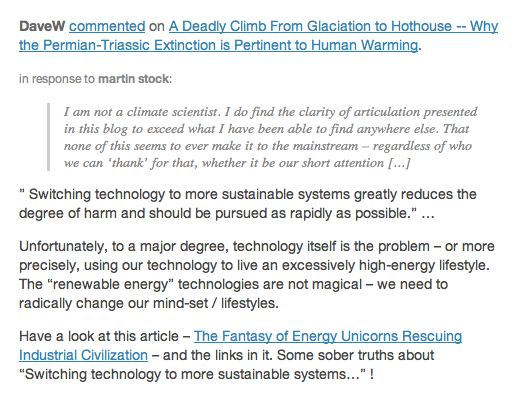
Through my experience on this website I’ve learned that the pro-fossil fuel/climate change skeptics share something in common with the pro-renewable energy/climate change realists. Neither wants industrial civilization to fade away. This is the fatal flaw shared by both – that industrial civilization with all its toxic trappings of materialism, instant gratification, and objectification of nature can continue with perhaps a few tweaks and modifications here and there. Nothing that the capitalist free market cannot correct, right? Others even fantasize with the idea that there will be some sort of a post-crisis prosperity. So-called “renewable energies” fit nicely into the greenwashing of capitalist industrial civilization. Ignoring the fact that abrupt climate change is well under way with multiple extinction-causing feedback loops having already been set into motion, the right course of action would have been a rapid downsizing and simplification of our mode of living:

Snap 2013-08-13 at 23.38.33

We would also have to ignore the reality of the corporate state’s all-pervasive power. With its techniques of inverted totalitarianism, the corporate state has extinguished everything but the façade of democracy. Serving as the corporate mouthpiece, the mainstream media frames public discourse on socio-economic issues in very oversimplified terms while lumping the population into a very stark, cartoon-like dichotomy of Left versus Right. Thus there is never a substantive debate about our predicament; the dominant paradigm is never questioned except in small and obscure circles whose views never see the light of day. Refusing to acknowledge that fossil fuels are causing planetary ecocide and that renewable energy will not, by any stretch of the imagination, meet the high energy consumption levels of consumer capitalism are both fatal flaws of thinking. Neither group will admit that the root cause of the disease is our way of living. To do so would undercut their belief system, the principal tenants of which are that mankind’s superior adaptive capabilities and technological innovations will carry us through. Self-delusion on such a massive scale results in strange conspiracy thinking to emerge such as the following right-wing tripe:

Snap 2013-08-04 at 10.19.32

Never mind that our government has become nothing more than a feeding trough and revolving door for corporations seeking market control and revenue streams. The people truly latched to the teat of government are those with the money to hire armies of lobbyists, bribe officials with lucrative private sector positions, ‘buy’ government contracts and game the system fully in their favor.

The Fantasy of Energy Unicorns Rescuing Industrial Civilization

The second law of thermodynamics states that energy flows or dissipates from concentrated forms to diffuse forms. Fossil fuels are very concentrated forms of energy, but renewables like wind and solar are very diffuse and intermittent energies. According to leading energy experts like Professor Charles Hall, the EROEI of renewable energy continues to be too low when compared with fossil fuels. Thus in the free market system, the lowest-priced energy (with environmental costs externalized) will always win out and be utilized.

Energy Costs

“2013 EIA new plant capital costs of various energy technologies and
pumped storage for balancing intermittent renewables”

As Ted Trainer has shown, claims of renewables running the industrialized world are numerous and avoid any critical evaluation of their claims:

…Unfortunately people working on renewable energy technologies tend not to throw critical light on the difficulties and limits.  They typically make enthusiastic claims regarding the potential of their specific technologies.

There are now several impressive reports claiming that renewable can meet world energy demand, and almost no literature questioning the claim…” – link

“..Trainer’s general point on technology is that the extent of ecological overshoot is already so great that technology alone will never be able to solve the ecological crises of our age, certainly not in a world based on economic growth and with a growing global population… – link

Trainer and other analysts identify several factors that limit large-scale renewable energy projects:

Transmission losses: Distant solar thermal, photovoltaic farms, and wind farms must transmit their generated energy through long distance high-voltage direct current cables. The best places for harnessing wind power are usually in remote locations far from populated areas, but solar lends itself more to a model of decentralized electricity generation which can avoid transmission losses and the high cost of transmission lines.

Embodied Energy Costs: The energy to produce the steel, mine the minerals and raw material, and manufacture the wind turbines and solar panels, then deliver and install them, and later repair and maintain them, finally disposing of them. In a recent study, Charles Hall and Pedro Prieto have found that such costs have been unaccounted for in the estimates of solar PV’s EROEI. Spain’s boom and subsequent bust in solar energy production was found to have generated an abysmal EROEI of 2.45 thermal units of energy output for 1 thermal unit invested, as poor as biofuels.

Just to make the silicon used to trap the sun’s rays on manufactured wafers requires the melting of silica rock at 3,000 Fahrenheit (1,649 Celsius). And the electricity of coal-fired plants or ultrapurified hydrogen obtained from fossil sources provide the heat to do that. It also takes a fantastic amount of oil to make concrete, glass and steel for solar modules…

…Prieto calculates, for example, that to replace all electricity made by nuclear and fossil fuels in Spain would take a solar module complex covering 6,000 sq. km of the country at the cost the entire Spanish budget (1.2 billion Euros in 2007). It would also require the equivalent of 300 billion car batteries to store the energy for night-time use.

Prieto is not alone in reaching such sobering conclusions. A 2013 Stanford University report, for example, calculated that global photovoltaic industry now requires more electricity to make silicon wafers and solar troughs than it actually produces in return. Since 2000 the industry consumed 75 per cent more energy than it put onto the grid and all during its manufacturing and installation process.

Moreover it won’t pay off this energy debt or energy consumed in its construction until 2016. As a consequence, ramping up of industrial solar production produces more greenhouse gases than it saves for nearly a decade… – link

Plant Lifetime: 20 years is estimated for wind (Sharman, 2012) and 35 years for photovoltaic. To quote Kevin Moore, “Gaia pulverises everything in the long-term and converts it all into sediment (except certain partially degraded plastics, which seem destined to drift in the oceans for eternity).” Another factor perhaps not discussed much is the effect climate change will have on the variability and volatility of weather patterns where solar, wind, and other renewable energy projects are constructed. Wind, cloud, and rain patterns will be altered, rendering energy plants ill-suited to their originally targeted sites. The world’s energy infrastructure will be increasingly vulnerable to the ravages of climate chaos with more intense flooding, droughts, and shifting weather patterns. Hydroelectric power, solar farms, nuclear plants, and biofuel plantations are dependant on water to run and cool the turbines, clean the solar panels and mirrors, mine the uranium as well as cool the reactor core and spent fuel rods, and grow the biomass. Hotter temperatures will tax the electric grid because of increased electricity demand for cooling in the summer, reduction in the performance and capacity of transformers and above-ground transmission lines, and infrastructure damage from wildfires. Sea level rise will also wreak havoc with coastal erosion, storm surges and flooding.

Creation is Subject to the Bondage of Decay

the_house_on_the_borderland_by_taisteng-d4a3l9p

Excerpt from House on the Borderland…

Snap 2013-08-13 at 05.31.34

The Point of Focus

Tags

, , ,

This blog entry is cross-posted at The Spiral Staircase.

Many traditional cultures regard the heart, situated at the center of the torso, as the body’s principal organ, having special processing powers directed to emotion. A heart-felt sensation is regarded as irreducible truth because emotions can’t be wrong. Indeed, the passions, as emotions are also called in their extremity, are something to be harnessed as motivation, at least until they run afoul and have to be restrained. For instance, a charismatic can inspire or inflame the passions and lead people along unwise paths.

In the modern industrial world, however, the eye and the perceptual faculty it provides has usurped the heart as the principal organ, at least in terms of cognition (ignoring the fact that the brain is the actual processor). The primacy of vision can even be seen (read: understood) in terms used to describe two major eras in Western history: The Dark Ages and The Enlightenment. Such visual metaphors stretch much further back in time, but the emergence from darkness into the light — the overarching story of modernity, religious salvation, and techno-utopianism — is clearly a central feature of Western thinking. For example, in the late 18th century, the U.S. incorporated symbology tracing back to Egyptian antiquity, namely, The Eye of Providence, into the Great Seal of the United States, which even now is displayed on currency shown at left (detail from the one dollar bill). It is noteworthy that, similar to emotional emanations of the heart, the eye is depicted with rays or beams shooting out in all directions, suggesting its other name, The All-Seeing Eye, its view being omnidirectional. That the function of the eye could be understood as both a receiver/processor and projector was apparently well-known long before modern physics revealed that the observer influences the observed by the mere act of observation.

Another version, one of many, actually, can be seen at right. Think of the eye’s function as the light on a miner’s hat, illuminating whatever the wearer brings into view. Much more than the heart, which is responsive and far less prone to intentional direction, the eye can cast its view upon whatever one elects at any moment, bringing the observed into awareness, into the mind, and into focus. (It’s no surprise then that poor eyesight — poor focus — makes for fuzzy thinking. Those who can’t see well uncorrected have diminished powers of observation.) This metaphor may be more accurate than the all-seeing eye for an important reason: a large percentage of information gathered by the eye is discarded. The eye’s narrow point of focus is a relatively small portion of the entire visual field; the rest is peripheral. If this were not so, conscious awareness would be subject to stimulus overload from just one perceptual channel. Other senses compete for attention (especially kinethesia), further limiting what can be brought into conscious awareness at any one time. This limitation is sometimes called the bandwidth of consciousness, a sort of built-in bottleneck. 

Another telling expression of the eye’s power of projection is found in the superhero genre, where good guys and bad guys alike frequently possess the ability to shoot lasers, x-rays, or power rays from their eyes. Everyone has experienced the similar if less hoary effect of a withering look (or the hairy eyeball), which may signal an underlying emotional state but is understood more commonly as an aggressive or intimidating behavior. With superpower eyebeams, eyelines drawn into illustrations connecting the viewers to objects of interest (familiar dotted lines used to track the viewer’s gaze) are thus amplified into beams of intense destructive power. The source of the power is unclear, as with most superpowers, but the fact that it is delivered by a look is an indication of the mythical power behind the eyes, which is known poetically as the window to the soul. 

It is not a difficult stretch to suggest that directionality, whether omnidirectional or pinpoint, also brings the world into being in the sense meant by New Age gurus and adherents to theories of quantum reality. At a more mundane level, each of us pursues interests that appeal to us and gain familiarity and expertise accordingly. Subjects that sustain one’s interest and focus are often later distorted through professional bias and cherry-picking support, as when a religious person turns to scripture for justification or a scientist relies solely on data to substantiate an argument or theory. This is also what’s meant by the old saw that to someone holding a hammer, everything begins to look like a nail to be pounded down. After a fashion, tools of thought can become weapons.

One could easily dismiss all this as mere perspectival diversity, where some interpret the world in one fashion while others take different approaches. However, I intuit that something deeper is going on, namely, that a sort of blindness develops when one learns how to see the world primarily or even exclusively from one perspective. Everything can’t be illuminated at once, so where one turns one’s attention and the habits of mind that develop from focused expertise can render the viewer/thinker fundamentally blind to other valid interpretations. More specifically, to the capitalist, the wholesale commodification of human activity as well as the world’s resources makes it so that the only possible view is in terms of money and/or profits. Such folks aren’t starry-eyed dreamers, they’re dollar-eyed gluttons. And to them, collateral effects such as increasing class tensions, social upheaval (and eventual regime/institutional collapse), pollution, resource degradation (e.g., overfishing or soil depletion), and climate change lie outside their scope/view, making denial easy to assert without lying outright. This doesn’t excuse conscientious blindness to reality, but if one is ever dumbfounded that others can’t see what seems glaringly obvious, this explanation might being to shed some light on why.

Addendum: Even in the portion of the blogosphere taking collapse as its subject, bloggers adopt highly idiosyncratic approaches that fit their styles, interests, and expertise. For an incomplete survey, let me summarize a few. (I could be wrong about some of these. Don’t hesitate to correct me.)

  • At The Collapse of Industrial Civilization, the focus seems to be chronicling the onset of collapse with copious citation of news reports and other blog entries. The news is sometimes cited as support when a summary or report of a scientific finding, but more often, the news is soundly derided because journalists in the MSM are obviously carrying water for the military-industrial-corporate complex.
  • At The Spiral Staircase, though not solely a doomblog, the focus lies with causes and available responses (even if only in attitude) related to the culture surrounding or giving rise to eventual collapse.
  • At Clusterfuck Nation, the focus is on exposing corruption at the heart of empire, with a healthy self-awareness on the part of the blogger and reticence to engage commentators in dialogue.
  • At now-defunct Deer Hunting with Jesus, the approach was a wickedly colorful combination of memoir and explanation of the redneck perspective, which accounts for a surprising percentage of the population that barely had a voice in the conversation until Joe Bageant appeared.
  • At Dark Ages America, the focus is chronicling the waning of empire, with special attention paid to the utter stupidity of the American public and mining cultural history for reasons how Americans in particular got to be such corrupt and incompetent buffoons.
  • At Nature Bats Last, with diverse content, many guest bloggers, and a robust commentariat, the focus is wide-angle, with the result that NBL is often in the vanguard with respect to recognizing developments and drawing sound conclusions.
  • At How to Save the World, the focus has shifted from organizing grass-roots, transitional, and intentional communities to a full-on retreat into inner life following the recognition that absolutely nothing is going to prepare us for or stem the tide coming in.
  • At TomDispatch.com, the focus lies with nonmainstream reporting on mostly American politics and society.
  • At TruthDig, commondreams, and elsewhere, (specifically) Chris Hedges reports primarily on political and military corruption and scandal.
  • At Club Orlov, the focus lies with comparisons to previous regime collapses and prepping.
  • At The Automatic Earth, the focus lies with financial analysis in light of anticipated upheavals.

There are many other blogs and bloggers who go unmentioned, but it’s clear that a huge amount of information is out there, hand-picked and curated from a variety of perspectives. In addition, the comments section behind each, if not populated by trolls and deniers, are often as worthwhile as the posts themselves. An odd sense of community comes from connecting (virtually) with others who share a perspective that still eludes the so-called great unwashed masses, who are still gorging themselves (typically through debt spending) on the bounty of the modern age. Whether by innate character or conditioning, some of us never required much by way of convincing. The science and larger historical trajectory becomes fundamentally clear upon even modest inquiry. Chronicling our descent only reinforces conclusions reached intellectually, namely, that the path before us is unavoidable. Dissenters may assert that conclusion is pessimistic, defeatist, fatalistic, or nihilistic (is there a continuum for negativity?), but with so much going wrong with the world, evidence overwhelms denial.

Nothing Hides Under the Sun

Tags

, , , , , , , , , , , , , ,

In keeping with what I said earlier, I’m taking a break for a couple weeks from in-depth blogging, but until then I will post or reblog articles that happen to catch my eye.

Has mankind triggered the trip switch for his own extinction? Looking at just the headlines below and the comment from the Chemist, I would say the answer is a resounding “Yes!” This conclusion brings me no pleasure, but immeasurable depths of angst and depression. The so-called “doomers” are perhaps the most humanistic amongst the population. They see things as they are, not what people hope them to be or what many idealize industrial civilization to be. Nothing hides under the Sun.

Snap 2013-08-01 at 11.17.43

and

Snap 2013-08-01 at 10.43.45

and

Snap 2013-08-01 at 10.48.47

and finally…

Snap 2013-08-01 at 11.19.56

…with the following noteworthy comment:

hh

Despite slowdown, global coal remains a planet-destroying monster

Sobering analysis of the Juggernaut that is coal. There’s that “If” word again:

“If we can’t divert that river, if we can’t find some way of urbanizing the developing world with low-carbon power, we are well and truly screwed.”

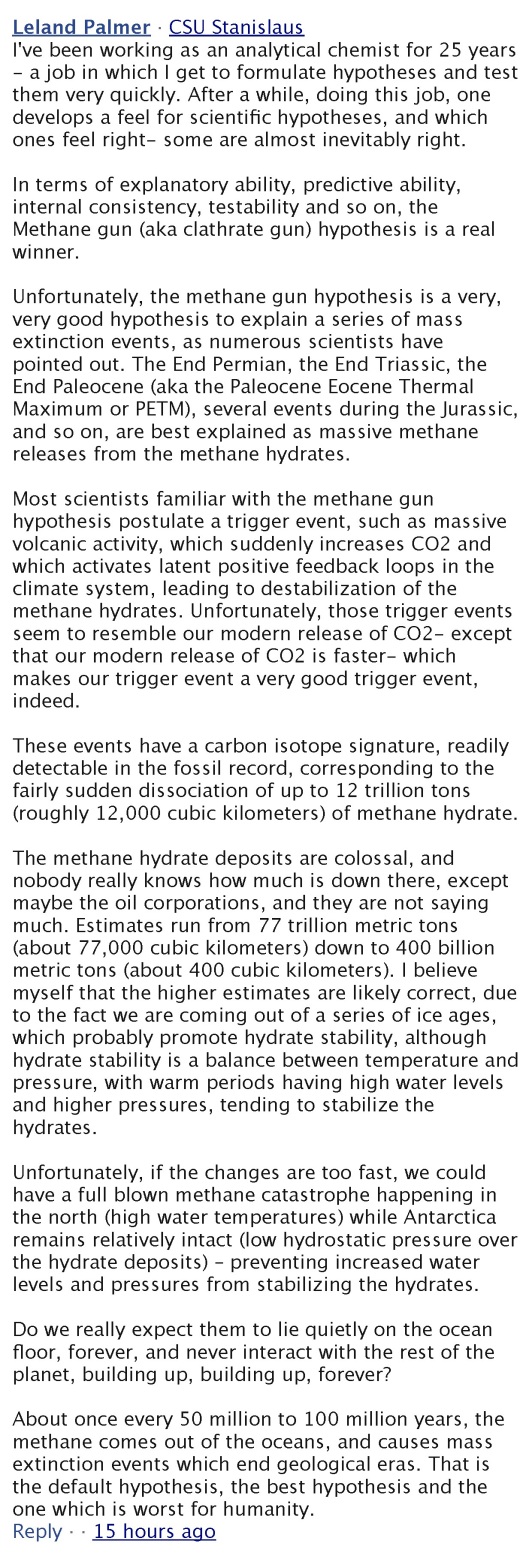
Kevin Moore may want to do a lesson here on thermodynamics, our growth and fossil fuel dependent economy, and the myriad other factors which come into play when hoping for change in a world of self-delusion and backstabbing.

Let me coin a new word here: “descendantcide” – the killing of our descendants.

More Wildfires = More Warming = More Wildfires

While we’re on the subject of methane and feedback loops, the fires are growing more destructive in the boreal regions of the North, in fact worse than at any time in the last 10,000 years. These fires decrease the region’s albedo effect by blackening the Earth’s surface and they peel away the insulating layer of lichen and moss on the forest floor, exposing the underlying permafrost to accelerated thawing and microbial decomposition of the soils. These infernos result in an immediate release of methane and CO2 from the fires themselves and later from the freshly exposed permafrost below.

greenman3610's avatarThis is Not Cool

obliquefire

Chris Mooney in Mother Jones:

Scientists have known for some time about the risk of large-scale carbon emissions from thawing permafrost. But in recent years, they’ve become increasingly attuned to an additional—and very worrisome—aspect of this threat. As climate change proceeds, larger and more intense wildfires are increasingly scorching and charring the forests of the north. While these fires have always been a natural and recurring aspect of forest ecosystems, they now appear to be undergoing a major amplification. And that, in turn, may further increase the threat of permafrost thawing and carbon releases—releases that would, in turn, greatly amplify global warming itself (and potentially spur still more fire activity).

“You have this climate and fire interaction, and all of a sudden permafrost can thaw really rapidly,” explains Jon O’Donnell, an ecologist with the National Parks Service’s Arctic Network. Scientists call it a “positive feedback,” and it’s one of the…

View original post 306 more words

“Reality Can Be Far Worse Than What’s Predicted.”

Tags

, , , , , , , ,

I’m coming off my two week blogging binge so posts will be light to nonexistent until I start up again in a few weeks. Studies have shown that inordinate time spent on the internet has harmful effects, both physiologically and psychologically; thus breaks from blogging and the morbid fascination with industrial civilization’s slow-motion train wreck are wise.

the-internet-trap

Occasionally I’ll scour YouTube for any interesting videos for this site and I found one.

Messing with global biospheric systems which have evolved over millions of years and expecting business-as-usual to continue is perhaps the greatest delusion of man. Civilization-ending runaway climate change could be right around the corner, and from just an intuitive level such a scenario seems all but inevitable. An abrupt change to our comfortable, normalcy-biased mode of living and thinking is very much in the cards – all the more reason for me to stop and smell the roses before there are no roses.

Misanthropy Redux

Tags

, , , , , , , , ,

BCh_dyRCYAA24aU

I have finally come to the conclusion without a shadow of a doubt that humanity is irredeemable. People are repulsed by my belief that our fate of extinction has been sealed. I no longer even use the caveat of “with business as usual” because business as usual always persists, no matter how dire the empirical evidence of global environmental collapse. No amount of anoxic dead zones, extinguished species, or toxic groundwater will curtail business as usual. In fact, humans spin off new business ventures like fish farming, animal cloning, and water purification in lieu of changing the status quo. A recent headline proves my point:

Snap 2013-07-24 at 21.47.28

It’s not just bad news for the polar bear,” said Gail Whiteman, a researcher at Erasmus University in the Netherlands and a co-author on the paper, published in Nature. “It’s a global economic time bomb.

The obliteration of the Arctic is just another milepost in mankind’s headlong race down the one-way road to oblivion. Notice that the above quote implies the economy is the primary yardstick for measuring human well-being. Everything is modeled into Dollar$ and Cents and nothing holds any intrinsic value except what humans, particularly those at the top of the exploitation pyramid, can extract from it. Don’t you think the economy should be re-examined for its supposed function as a “wealth-building” system if it’s killing the planet as well as the human species. But no, this sort of introspection will never take place; instead capitalist industrial civilization will roll onward crushing and pulverizing everything in its path until it runs out of energy and crosses a critical threshold without notice.

…Still, the situation is not hopeless, the authors said. Abating global warming buys time for intensive geo-engineering research into strategies for dealing with methane release, noted Dr. Wadhams…

Of course geo-engineering is the expected response when your economic system of eternal growth and expansion hits a little snag like planetary tipping points. In today’s disposable society, humans build and price things to be thrown away when they break; but since spare planets are hard to come by, out comes the box of amazing techno-gadgetry fixes to save the day. We’ve already terraformed and geo-engineered the Earth into a planet which looks to be transforming itself into a place inhospitable for most lifeforms. And we think we can unravel this Gordian knot? Are they going to geo-engineer a solution for the accompanying problem of ocean acidification as well? These sorts of schemes are always billed as “buying us time”, but buying time is simply a euphemism for delaying the executioner. Christ, humans really are eternal optimists! I think that a future headline from some alien race would be the following (just replace Mars with Earth):

mars

Yeah, that catastrophic event would not be an asteroid, but a bipedal organism called Homo economicus. So what are the options for humans domesticated into the life of industrial civilization? According to famed climate scientist James Hansen, we’re between a nuke and a hard place. He says nuclear energy is the best way to go to “preserve our lifestyles” while reducing carbon, and he gives his view on people who think “renewable” energy can fill the hole of our fossil-fueled civilization:

Can renewable energies provide all of society’s energy needs in the foreseeable future? It is conceivable in a few places, such as New Zealand and Norway. But suggesting that renewable will let us phase rapidly off fossil fuels in the United States, China, India, or the world as a whole is almost the equivalent of believing in the Easter Bunny and Tooth Fairy.”

James Hansen

So people like blogger Robert Scribbler can go pound sand when they accuse me of propagandizing for the fossil fuel industry. I’m just being realistic. People misinterpret my worldview as overly pessimistic, but Big-Busine$$ interests control the corrupt political machine, the jaded masses, and the corporate media shills; therefore, no solution can come from something so rotten. I’d love to be proven wrong. I’d love for nothing more than to wake up from what seems like a nightmare, but it looks like the fat lady is already starting to sing:

Snap 2013-07-24 at 23.58.02

I’m reminded of the recent farewell note by environmentalist Michael McCarthy who saw the endgame:

…People are doing this(ecocide). Let’s be clear about it. It’s not some natural phenomenon, like an earthquake or a volcanic eruption. It’s the actions of Homo sapiens. What we are witnessing is a fundamental clash between the species, and the planet on which he lives, which is going to worsen steadily, and the more closely you observe it – or at least, the more closely I have observed it, over the past 15 years – the more I have thought that there is something fundamentally wrong with Homo sapiens himself. Man seems to be Earth’s problem child. We humans have always thought ourselves different in kind from other creatures, principally for our use of language and our possession of consciousness, but there is another reason for our uniqueness, which is becoming ever clearer: we are the only species capable of destroying our own home. And it looks like we will…

[youtube:http://www.youtube.com/watch?v=IevgF_kmEbU%5D

The Silence of Extinction

Tags

, , , , , , , , , , , , , , , , , , , , , , , , ,

tumblr_mk7071fLoW1s5a74so1_500

In a small way the plight of the British in 1940 resembles the state of the civilised world now. At that time we had had nearly a decade of the well-intentioned, but quite wrong belief that peace was all that mattered. The followers of the peace lobbies of the 1930s resembled the green lobbies now, their intentions were more than good, but wholly inappropriate for the war that was about to start.”

~ James Lovelock, The Vanishing face of Gaia
(quoted in ‘the end of more’)

Year 2013

In the early years of the twenty-first century, reports from the global scientific community started to take on a more dire tone as Arctic amplification melted the ice sheets and glaciers of the North Pole, deformed the jet stream, and altered oceanic currents. The Arctic treeline marched northward gaining footholds in land now unlocked from its frozen slumber. Animals, insects, viruses, and pathogens, which were driven by the warming planet to migrate northward, wreaked havoc on native species. Heatwaves also became more common in the lower latitudes where the bulk of humanity lived. Seasonal transitions became less gradual and more abrupt. Extremes of weather, flood and drought, started to occur more frequently and with greater destructive force. Perhaps the only business of Homo economicus to speak candidly about the reality of climate change was the insurance industry only because its business model could not hide or externalize the high costs of climate chaos. Humans had built their entire global civilization and profligate lifestyle upon the burning of rich, energy-dense fossil fuels. To change the course of this behemoth ship was well beyond the scope of any one nation or group of people. Talk of modern civilization running on so-called renewable energy ignored the fact that such alternative sources were only extenders of the faltering fossil fuel age, and such a transition was too late anyway. The seeds of our downfall had been sown over a century ago when man accepted the Faustian bargain of exploiting carbon-based energy whose power came with the price of a wrecked planet. The marketing ploys of “green” and “organic” were no fix for the unstoppable wave of eco-destruction unleashed by disaster capitalism. The leaders of all countries knew there was no politically viable way to stem the human population explosion which was also at the root of the ecological crisis.

We have become Vishnu and Shiva, the ancient Hindu gods of creation and destruction: As we create more of us, far more than we now understand the planet can sustain, we are creating our own destruction, both terrible and beautiful. Our scientists, exploring the frontiers of our knowledge of the world, have gathered enough data for us to understand that our consumption and proliferation have set in motion a planetary change in our relatively comfortable envelope of climate.

Mary Ellen Harte

Highway to Hell

Year 2047

In the last few decades the climate of the Earth had defied all the overly conservative, human-centric estimates that were designed to maintain the suicidal path of business-as-usual. Of course most scientists were shocked at the rapidity with which the climate had spiraled out of control. Nations which were the major producers of the world’s food soon halted exports in order to feed their own frightened and hungry populations and stave off revolt. Those countries heavily reliant on imports for their sustenance quickly devolved into anarchy and killing fields. Politicians were the first to be done away with, drawn and quartered with their heads placed on spikes. The thin veneer of civilization dissolved under the brutal reality of power outages, food riots, and climate chaos. Some countries with nuclear plants suffered Fukushima-like meltdowns due to the loss of their power grid while others, who were able to keep a lid on the disaster by maintaining electrical power under a state of marshal law, carried out accelerated decommissioning of their reactors. Nevertheless, with the collapse of the electric grid large swaths of the Earth were rendered uninhabitable by leaking radiation and toxic rain. The sudden downward spiral of civilization was also punctuated by the detonation of a few nuclear bombs in countries like Pakistan where arsenals had fallen into the hands of radical groups. In the eyes of the believers, Armageddon had finally arrived.

ER80_Last_exit___part_One_by_OmeN2501[1]

Year 2087

For hundreds of miles north and south of the equator a death zone of searing heat, barren land, dry riverbeds, and lifeless ocean encircled the Earth, but a few places at the poles still held small pockets of human communities who practiced subsistence farming and fishing as well as the art of scavenging technology from the past. Even though the rusted steal hulks of factories, cars, airliners, ships, and other relics of CO2-spewing industrialization now lay motionless in fields of tall grass or at the bottom of the ocean, the effects of the CO2/methane bomb unleashed by modern man would last for millennia. Sea level rise and the chaotic weather of the planet had displaced all the elaborate infrastructure that had been built to take advantage of once predictable growing seasons, fertile soils, and river systems. Gaia had pulled the rug out from under man leaving him scampering for cover like bugs from beneath an overturned rock, and there was nowhere to run. The few humans who presently eked out an existence at the poles were simply the flotsam and jetsam of the great collapse. The coddled elite who had actually planned for this eco-apocalypse committed suicide long ago when their stash of fine wine ran out and their gold had no value to anyone.

tumblr_mpuroaxv1y1sxk3woo1_500

Year 2127

The sound of human voices no longer filled the air. As a matter of fact, the sound of any living thing had vanished. Nearly all the monuments of human achievement and ingenuity had crumbled away like sand castles before a rising tide. Only a few ancient relics still stood like the pyramids in Egypt and long segments of the Great Wall of China. Not much remained of the “disposable society” of modern times except for a few large construction projects such as Hoover Dam. Repossession on the humans was the only option Gaia had for a species that had built up mountains of environmental damage with no intention of ever changing its omnicidal ways. The slate had to be wiped clean before the slow, million year process of remediation could begin…

Vast, flat expanses of viscous ooze, unbroken by waves, covered all of what once were vibrant oceans. Great belches of toxic hydrogen sulfide would occasionally break the calm of these oily, purple-colored plains stretching far into the horizon. The deadness of the these poisonous waters was mirrored by the stillness on the land which now was exposed to the full forces of UV radiation through a destroyed ozone layer. High overhead, thin wisps of clouds slowly moved along a pale green sky. A fetid, noxious smell filled the air and the silence of extinction was everywhere.