In keeping with what I said earlier, I’m taking a break for a couple weeks from in-depth blogging, but until then I will post or reblog articles that happen to catch my eye.
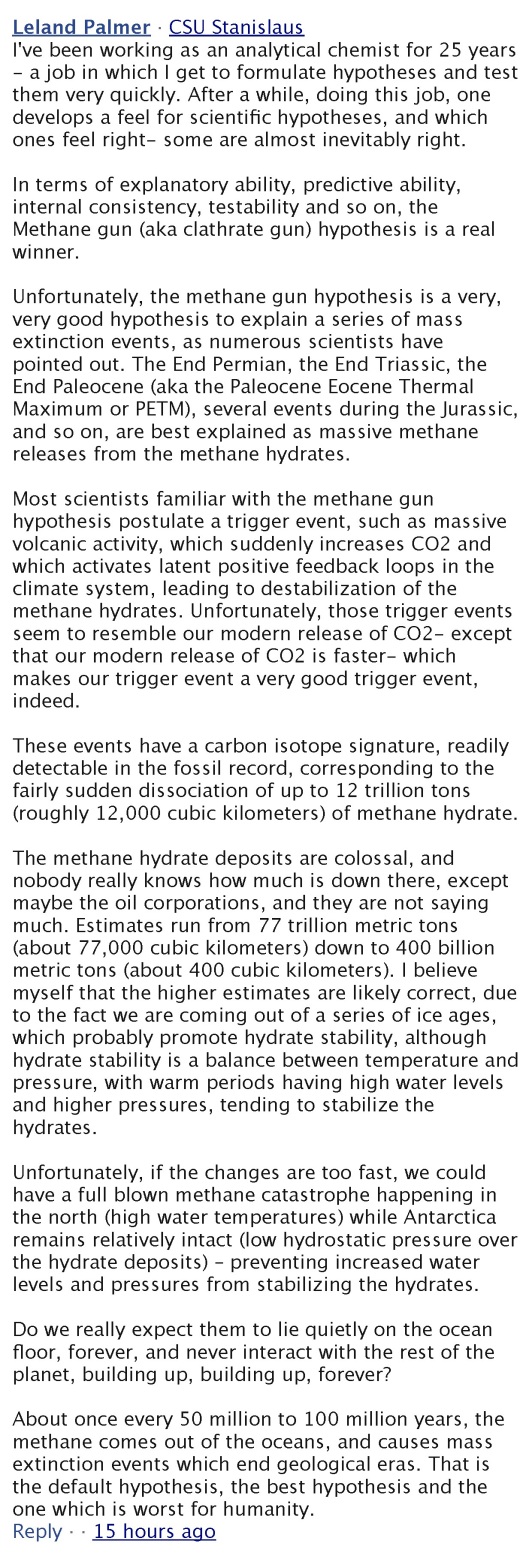
Has mankind triggered the trip switch for his own extinction? Looking at just the headlines below and the comment from the Chemist, I would say the answer is a resounding “Yes!” This conclusion brings me no pleasure, but immeasurable depths of angst and depression. The so-called “doomers” are perhaps the most humanistic amongst the population. They see things as they are, not what people hope them to be or what many idealize industrial civilization to be. Nothing hides under the Sun.
Sobering analysis of the Juggernaut that is coal. There’s that “If” word again:
“If we can’t divert that river, if we can’t find some way of urbanizing the developing world with low-carbon power, we are well and truly screwed.”
Kevin Moore may want to do a lesson here on thermodynamics, our growth and fossil fuel dependent economy, and the myriad other factors which come into play when hoping for change in a world of self-delusion and backstabbing.
Let me coin a new word here: “descendantcide” – the killing of our descendants.
While we’re on the subject of methane and feedback loops, the fires are growing more destructive in the boreal regions of the North, in fact worse than at any time in the last 10,000 years. These fires decrease the region’s albedo effect by blackening the Earth’s surface and they peel away the insulating layer of lichen and moss on the forest floor, exposing the underlying permafrost to accelerated thawing and microbial decomposition of the soils. These infernos result in an immediate release of methane and CO2 from the fires themselves and later from the freshly exposed permafrost below.
Scientists have known for some time about the risk of large-scale carbon emissions from thawing permafrost. But in recent years, they’ve become increasingly attuned to an additional—and very worrisome—aspect of this threat. As climate change proceeds, larger and more intense wildfires are increasingly scorching and charring the forests of the north. While these fires have always been a natural and recurring aspect of forest ecosystems, they now appear to be undergoing a major amplification. And that, in turn, may further increase the threat of permafrost thawing and carbon releases—releases that would, in turn, greatly amplify global warming itself (and potentially spur still more fire activity).
“You have this climate and fire interaction, and all of a sudden permafrost can thaw really rapidly,” explains Jon O’Donnell, an ecologist with the National Parks Service’s Arctic Network. Scientists call it a “positive feedback,” and it’s one of the…
I’m coming off my two week blogging binge so posts will be light to nonexistent until I start up again in a few weeks. Studies have shown that inordinate time spent on the internet has harmful effects, both physiologically and psychologically; thus breaks from blogging and the morbid fascination with industrial civilization’s slow-motion train wreck are wise.
Occasionally I’ll scour YouTube for any interesting videos for this site and I found one.
Messing with global biospheric systems which have evolved over millions of years and expecting business-as-usual to continue is perhaps the greatest delusion of man. Civilization-ending runaway climate change could be right around the corner, and from just an intuitive level such a scenario seems all but inevitable. An abrupt change to our comfortable, normalcy-biased mode of living and thinking is very much in the cards – all the more reason for me to stop and smell the roses before there are no roses.
I have finally come to the conclusion without a shadow of a doubt that humanity is irredeemable. People are repulsed by my belief that our fate of extinction has been sealed. I no longer even use the caveat of “with business as usual” because business as usual always persists, no matter how dire the empirical evidence of global environmental collapse. No amount of anoxic dead zones, extinguished species, or toxic groundwater will curtail business as usual. In fact, humans spin off new business ventures like fish farming, animal cloning, and water purification in lieu of changing the status quo. A recent headline proves my point:
It’s not just bad news for the polar bear,” said Gail Whiteman, a researcher at Erasmus University in the Netherlands and a co-author on the paper, published in Nature. “It’s a global economic time bomb.
The obliteration of the Arctic is just another milepost in mankind’s headlong race down the one-way road to oblivion. Notice that the above quote implies the economy is the primary yardstick for measuring human well-being. Everything is modeled into Dollar$ and Cents and nothing holds any intrinsic value except what humans, particularly those at the top of the exploitation pyramid, can extract from it. Don’t you think the economy should be re-examined for its supposed function as a “wealth-building” system if it’s killing the planet as well as the human species. But no, this sort of introspection will never take place; instead capitalist industrial civilization will roll onward crushing and pulverizing everything in its path until it runs out of energy and crosses a critical threshold without notice.
…Still, the situation is not hopeless, the authors said. Abating global warming buys time for intensive geo-engineering research into strategies for dealing with methane release, noted Dr. Wadhams…
Of course geo-engineering is the expected response when your economic system of eternal growth and expansion hits a little snag like planetary tipping points. In today’s disposable society, humans build and price things to be thrownaway when they break; but since spare planets are hard to come by, out comes the box of amazing techno-gadgetry fixes to save the day. We’ve already terraformed and geo-engineered the Earth into a planet which looks to be transforming itself into a place inhospitable for most lifeforms. And we think we can unravel this Gordian knot? Are they going to geo-engineer a solution for the accompanying problem of ocean acidification as well? These sorts of schemes are always billed as “buying us time”, but buying time is simply a euphemism for delaying the executioner. Christ, humans really are eternal optimists! I think that a future headline from some alien race would be the following (just replace Mars with Earth):
Yeah, that catastrophic event would not be an asteroid, but abipedal organism called Homo economicus. So what are the options for humans domesticated into the life of industrial civilization? According to famed climate scientist James Hansen, we’re between a nuke and a hard place. He says nuclear energy is the best way to go to “preserve our lifestyles” while reducing carbon, and he gives his view on people who think “renewable” energy can fill the hole of our fossil-fueled civilization:
Can renewable energies provide all of society’s energy needs in the foreseeable future? It is conceivable in a few places, such as New Zealand and Norway. But suggesting that renewable will let us phase rapidly off fossil fuels in the United States, China, India, or the world as a whole is almost the equivalent of believing in the Easter Bunny and Tooth Fairy.”
So people like blogger Robert Scribbler can go pound sand when they accuse me of propagandizing for the fossil fuel industry. I’m just being realistic. People misinterpret my worldview as overly pessimistic, but Big-Busine$$ interests control the corrupt political machine, the jaded masses, and the corporate media shills; therefore, no solution can come from something so rotten. I’d love to be proven wrong. I’d love for nothing more than to wake up from what seems like a nightmare, but it looks like the fat lady is already starting to sing:
I’m reminded of the recent farewell note by environmentalist Michael McCarthy who saw the endgame:
…People are doing this(ecocide). Let’s be clear about it. It’s not some natural phenomenon, like an earthquake or a volcanic eruption. It’s the actions of Homo sapiens. What we are witnessing is a fundamental clash between the species, and the planet on which he lives, which is going to worsen steadily, and the more closely you observe it – or at least, the more closely I have observed it, over the past 15 years – the more I have thought that there is something fundamentally wrong with Homo sapiens himself. Man seems to be Earth’s problem child. We humans have always thought ourselves different in kind from other creatures, principally for our use of language and our possession of consciousness, but there is another reason for our uniqueness, which is becoming ever clearer: we are the only species capable of destroying our own home. And it looks like we will…
In a small way the plight of the British in 1940 resembles the state of the civilised world now. At that time we had had nearly a decade of the well-intentioned, but quite wrong belief that peace was all that mattered. The followers of the peace lobbies of the 1930s resembled the green lobbies now, their intentions were more than good, but wholly inappropriate for the war that was about to start.”
~ James Lovelock, The Vanishing face of Gaia
(quoted in ‘the end of more’)
Year 2013
In the early years of the twenty-first century, reports from the global scientific community started to take on a more dire tone as Arctic amplification melted the ice sheets and glaciers of the North Pole, deformed the jet stream, and altered oceanic currents. The Arctic treeline marched northward gaining footholds in land now unlocked from its frozen slumber. Animals, insects, viruses, and pathogens, which were driven by the warming planet to migrate northward, wreaked havoc on native species. Heatwaves also became more common in the lower latitudes where the bulk of humanity lived. Seasonal transitions became less gradual and more abrupt. Extremes of weather, flood and drought, started to occur more frequently and with greater destructive force. Perhaps the only business of Homo economicus to speak candidly about the reality of climate change was the insurance industry only because its business model could not hide or externalize the high costs of climate chaos. Humans had built their entire global civilization and profligate lifestyle upon the burning of rich, energy-dense fossil fuels. To change the course of this behemoth ship was well beyond the scope of any one nation or group of people. Talk of modern civilization running on so-called renewable energy ignored the fact that such alternative sources were only extenders of the faltering fossil fuel age, and such a transition was too late anyway. The seeds of our downfall had been sown over a century ago when man accepted the Faustian bargain of exploiting carbon-based energy whose power came with the price of a wrecked planet. The marketing ploys of “green” and “organic” were no fix for the unstoppable wave of eco-destruction unleashed by disaster capitalism. The leaders of all countries knew there was no politically viable way to stem the human population explosion which was also at the root of the ecological crisis.
We have become Vishnu and Shiva, the ancient Hindu gods of creation and destruction: As we create more of us, far more than we now understand the planet can sustain, we are creating our own destruction, both terrible and beautiful. Our scientists, exploring the frontiers of our knowledge of the world, have gathered enough data for us to understand that our consumption and proliferation have set in motion a planetary change in our relatively comfortable envelope of climate.
In the last few decades the climate of the Earth had defied all the overly conservative, human-centric estimates that were designed to maintain the suicidal path of business-as-usual. Of course most scientists were shocked at the rapidity with which the climate had spiraled out of control. Nations which were the major producers of the world’s food soon halted exports in order to feed their own frightened and hungry populations and stave off revolt. Those countries heavily reliant on imports for their sustenance quickly devolved into anarchy and killing fields. Politicians were the first to be done away with, drawn and quartered with their heads placed on spikes. The thin veneer of civilization dissolved under the brutal reality of power outages, food riots, and climate chaos. Some countries with nuclear plants suffered Fukushima-like meltdowns due to the loss of their power grid while others, who were able to keep a lid on the disaster by maintaining electrical power under a state of marshal law, carried out accelerated decommissioning of their reactors. Nevertheless, with the collapse of the electric grid large swaths of the Earth were rendered uninhabitable by leaking radiation and toxic rain. The sudden downward spiral of civilization was also punctuated by the detonation of a few nuclear bombs in countries like Pakistan where arsenals had fallen into the hands of radical groups. In the eyes of the believers, Armageddon had finally arrived.
Year 2087
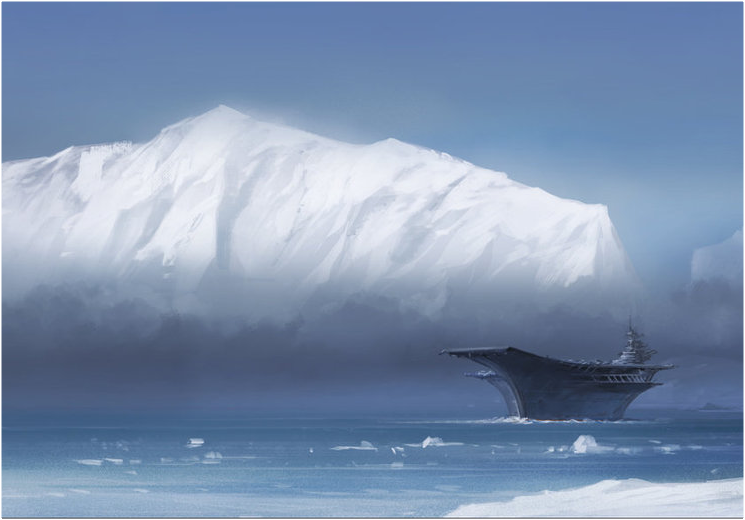
For hundreds of miles north and south of the equator a death zone of searing heat, barren land, dry riverbeds, and lifeless ocean encircled the Earth, but a few places at the poles still held small pockets of human communities who practiced subsistence farming and fishing as well as the art of scavenging technology from the past. Even though the rusted steal hulks of factories, cars, airliners, ships, and other relics of CO2-spewing industrialization now lay motionless in fields of tall grass or at the bottom of the ocean, the effects of the CO2/methane bomb unleashed by modern man would last for millennia. Sea level rise and the chaotic weather of the planet had displaced all the elaborate infrastructure that had been built to take advantage of once predictable growing seasons, fertile soils, and river systems. Gaia had pulled the rug out from under man leaving him scampering for cover like bugs from beneath an overturned rock, and there was nowhere to run. The few humans who presently eked out an existence at the poles were simply the flotsam and jetsam of the great collapse. The coddled elite who had actually planned for this eco-apocalypse committed suicide long ago when their stash of fine wine ran out and their gold had no value to anyone.
Year 2127
The sound of human voices no longer filled the air. As a matter of fact, the sound of any living thing had vanished. Nearly all the monuments of human achievement and ingenuity had crumbled away like sand castles before a rising tide. Only a few ancient relics still stood like the pyramids in Egypt and long segments of the Great Wall of China. Not much remained of the “disposable society” of modern times except for a few large construction projects such as Hoover Dam. Repossession on the humans was the only option Gaia had for a species that had built up mountains of environmental damage with no intention of ever changing its omnicidal ways. The slate had to be wiped clean before the slow, million year process of remediation could begin…
Vast, flat expanses of viscous ooze, unbroken by waves, covered all of what once were vibrant oceans. Great belches of toxic hydrogen sulfide would occasionally break the calm of these oily, purple-colored plains stretching far into the horizon. The deadness of the these poisonous waters was mirrored by the stillness on the land which now was exposed to the full forces of UV radiation through a destroyed ozone layer. High overhead, thin wisps of clouds slowly moved along a pale green sky. A fetid, noxious smell filled the air and the silence of extinction was everywhere.
Hello fellow realists. I haven’t spent much time in the last 14 months at Chris Martenson’s Peak Prosperity site, but I just listened to a podcast he made with climate scientist Dr. Mark A. Cochrane who gives an informative talk on extreme weather, the mangled jet stream, the overly conservative IPCC, the global climate debt, and other interesting topics on climate change. It’s worth your time. Martenson had originally relegated the talk of climate change and even Cochrane’s own climate change thread to the “Controversial Topics” forum at PeakProsperity.com, but Martenson has apparently become more accepting in the last year of the near 100% scientific consensus of climate change. Being a money man, it’s no surprise that Martenson would be nervous and reluctant to speak out on what capitalist industrial civilization is doing to the life support system of every living thing on the planet. To say that human-induced climate change is a “challenging issue” is perhaps the understatement of the millennium. The environmental conditions will continue to change and degenerate for the next 1,000 years even were we to halt all GHG emissions today. I’m sure homo economicus will find ways to profit from the eco-apocalypse just as he has profited from hunger, war, the prison industrial complex, the frantic exploitation of even dirtier and more dangerous fossil fuels, and every other ill that has befallen man. Thanks to Mike at DamnTheMatrix for originally posting this podcast.
[Warning on Dr. Cochrane’s statement that water vapor is the “main culprit” in causing global warming: See the comments section of this post.]
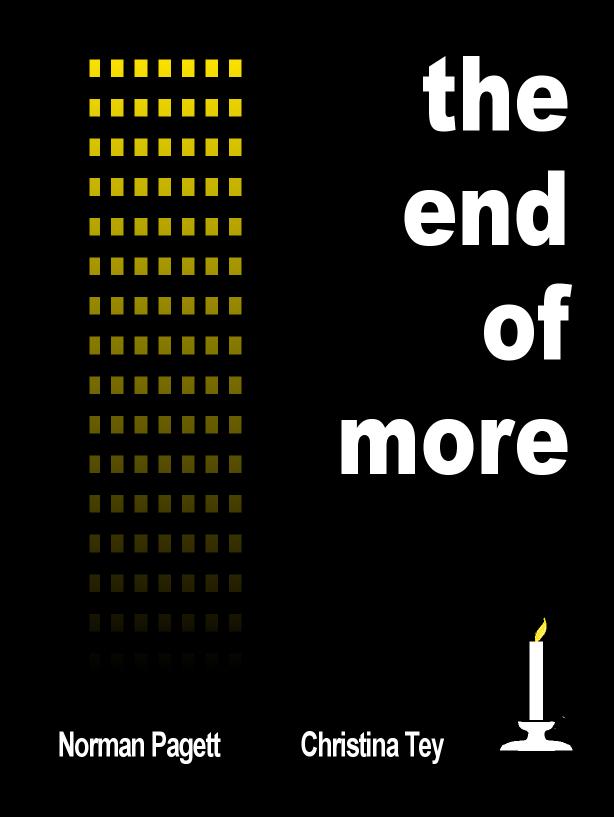
I’m currently reading the book “The End of More“(aka ‘Your Medieval Future’) which, if I remember correctly, had the working title of ScareCities, apparently in reference to what is going to happen to all the megacities of the world as we fall down the cliff of peak net energy and suffer a thousand cuts from a climate thrown out of balance. When I’m done with the book, I’ll post a review of it. It’s turning out to be a real page-turner. You can download the kindle book here for the U.S. and here for the UK. The authors state that the purpose of their book is to explain the evolutionary history of modern man and how he “has used all his ingenuity and his fighting skills to bring energy, food, water, and other natural resources to the brink of exhaustion.”
Here is an excerpt:
Kevin Moore is a frequent visitor here and leaves very erudite and informative comments. He’s written a few books that we may want to look into as well. Here are the links to a couple of them:
Before I get into a particular discussion on the new business opportunities afforded by a rapidly melting Arctic, I need to preface it with a short explanation and history of who wrote the article in question and what this group’s agenda is. The Council on Foreign Relations (CFR) was established after the First World War to formulate and plan the imperial ambitions of the U.S. as the world’s new superpower. The CFR is composed of top officials in the banking, manufacturing, commerce, and finance industries, as well as lawyers, university bureaucrats, and public figures from the media networks. CFR meetings are often held in secret. The primary funders of the CFR have been The Ford Foundation, the federal government, the Rockefeller Foundation, and the Carnegie Foundation. There exists a revolving door between positions held in the CFR and those in the government. The CFR represents the U.S. financial oligarchy and the wealthy elite of America. Lawrence H. Shoup wrote a seminal book on the CFR entitled ‘Imperial Brain Trust – Council on Foreign Relations’. I have a link to it under “Notes and Documents’ on the left side of this website. A quote from page 278 of that book best summarizes what the CFR is truly about:
A recent article by Shoup puts some familiar faces to the CFR with Democratic Party politician Dianne Feinstein and her husband finance capitalist Richard C. Blum, both members of the Council. In the following selection from that article, you can see how environmental protection is subverted for the financial interests of the power elite:
So now we go to the ecological catastrophe unfolding in the Arctic which the CFR and the ruling class see as simply another doorway through which capital accumulation can be carried out via environmental exploitation. The title of the CFR’s article is ‘The Coming Arctic Boom‘ published in the July/August 2013 edition of their journal ‘Foreign Affairs’.
In this deranged essay, the CFR gushes over the busine$$ opportunitie$ afforded by such a once-in-a-lifetime event as the melting of the Arctic:
[My comments are highlighted red and in brackets]
Yeah that’s who forms foreign policy for this country. The Mack Truck of climate chaos is barreling full speed ahead with mankind straight in its path, but all Homo Stupidicus can see are dollar signs.
And these scenarios take into account only what Hansen knows within his area of expertise. What are the global effects of the ongoing 6th mass extinction and loss of all those building blocks of life? Can man live without nature inside a glass bubble of his own making? We are surely conducting an experiment without precedent.
Forget for a moment that we can still emit about 530 gigatons of CO2 and still keep human warming in the ‘safe range’ of less than 2 degrees (Celsius) temperature increases this century. Forget for a moment how important to the sustenance of human civilization and the prevention of ever-worsening conditions this strict limit on carbon emissions is. Now think for a moment what will happen if Republicans in Congress and fellow conservatives aligned with fossil fuel companies across the country and around the world get their way.
Perhaps the most critical area in which industrial civilization has disconnected itself from nature is food production. Ask a city dweller where his food comes from and he’ll give you the name of a grocery store chain. Of course they know the food is produced somewhere outside the concrete jungle, but exactly where, by whom, and how are questions no one asks. And for the masses who are busy eking out a living on the treadmill of capitalism, the convenience of “fast food” often trumps all other considerations. The giant food manufacturers have spent considerable time tinkering with the three ingredients of sugar, salt, and fat in their processed food so as to reach a “bliss-point” for hooking the “consumer”. Thus in the process of commodifying, commercializing, and mass marketing our meals, we have lost the connection to nature fostered by food grown on a small-scale, sustainable manner. Nature Deficit Disorder appears to be rampant. As S. Roy Kaufman explains, industrialized food production has destroyed the human bond to the land:
Is “economy of scale and efficiency” really the best thing to pursue on the only planet humans have to live on? It turns out that in our quest to feed the most people at the lowest price, we have externalized a lot of costs which are now coming back to bite us in the ass. For example, bee pollination is priceless, but we are killing these insects off with our chemical pesticides and herbicides. The same goes for other plants, animals, and microbes which support the natural processes required to keep the land productive. As these creatures disappear from the landscape, we lose known and unknown ‘environmental services’ beneficial to man and the ecosystem. Industrial farming is a heavy user of CO2-emitting fossil fuels and contributes to a large percentage of the global warming we are experiencing. Biodiversity loss and destruction of crop yields are an inevitable consequence of a warming planet, even right down to the soil microbes. Pesticide and fertilizer run-off is polluting streams and rivers as well as creating massive dead zones in the ocean.
In the past century alone, over 50 per cent of the world’s wetlands have been lostbecause of the demands of agriculture. And of the more than 3500 species currently under threat worldwide, 25 per cent are fish and amphibians. – link
Industrial agriculture destroys biodiversity not only because it wipes out entire ecosystems and habitats, but because it favors genetically engineered monocultures. The following pictograph is a shocking illustration of how industrial agriculture has reduced the variety of foods we eat over the last century:
…Over the past hundred years, the variety of seeds planted has dwindled from hundreds to just a handful. Animal diversity is suffering a similar fate. Large commercial farms that focus on specific animals or plants to maximize yields and profits have caused the variety in our food supply to plummet.
Today, only 30 crops provide 95 percent of our food, and only four crops (maize, wheat, rice and potato) account for 60 percent of what we eat. We’ve lost three-quarters of the genetic diversity of crops in only 100 years. Now 1,500 of the 7,600 animal breeds are at risk of extinction.
Why should we care? Well, we need biodiversity to grow food, or in other words, to survive….
The Achilles’ heel of our monoculture crops is that they are vulnerable to small environmental changes. Dependency on such genetically uniform crops leaves modern society in danger of famine due to crop failure:
The lessons of the 1972 epidemic of ‘corn leaf blight’ have still not been learnt. The Committee on Genetic Vulnerability of Major Crops at the US National Research Council at the time posed the question: “How uniform genetically are other crops upon which the nation depends, and how vulnerable, therefore, are they to epidemics? The answer is that most major crops are ‘impressively genetically uniform and thus vulnerable and results from government legislative and economic policy’. – link
Another problem of the industrial agriculture complex has been the overuse of herbicides and pesticides to control weeds, insects, and viruses in order to maximize crop yield. It worked for a while but over the last couple decades the pests and pathogens have evolved to become immune to our chemicals: