He looked like an assassin ready to go to war,” said Jordan Crofter, a moviegoer who was unhurt in the attack early Friday, about a half-hour after the special midnight opening of “The Dark Knight Rises.
Just a half hour drive from Columbine is the city of Aurora Colorado in which the latest ritual blood bath has been carried out in a hail of bullets. 71 hit and 12 dead.
Clad in a gas mask, ballistic helmet, and body armor from the neck down to the legs, the gunman burst into a theater after tossing in a couple of gas canisters. Was this a terrorist act from some fundamentalist Middle East group? No, it came from 24-year-old American James Holmes, described as “shy”, “high-achieving” and from a “good family.” He was in fact a college graduate with a bachelor’s degree in neuroscience. Tom Mai, a retired electrical engineer, said “the mother told him Holmes couldn’t find a job after earning a master’s degree and returned to school.” Holmes even left his apartment booby-trapped, a sort of double tap assault for those hunting him.
What can be said of this most recent disturbed outcry from modern civilization’s youth? I see it as a reflection of the perverse and twisted culture which this young person was faced with, an atomized society which commodifies everything in its site and turns all it can into a financial transaction of some sort. What is worth preserving of a society which destroys the future of its offspring with mountains of social debt in the form of exorbitant college loans, a degraded and polluted environment, no option for meaningful work, a two-tier class system of haves and have-nots, a rising Security and Surveillance State, and a world at war for the last of the earth’s resources? Of course this is all normal for a country that glorifies sociopathic behavior:
…Sociopathic behavior becomes normalized and even glorified in business culture, and the businessmen who are less sociopathic get eaten alive by the more sociopathic ones.
The entirety of business sociopathy is glorified by the nation’s culture, in art, media, etc. as tens of millions of Americans long to be the next Bill Gates, who is nothing more than a White Crips/Bloods gang member with glasses and a high IQ.
Less sociopathic businessmen who try to act decent are destroyed and then, for their decency, are attacked in common culture as losers, failures and even scum. Women avoid them and their families look at the ground when someone brings up their name. At the individual level, people who try to play fair and be nice are told that they are displaying loser attitudes and ordered to harden up and act more sociopathic.
Capitalism is really the normalization, rationalization, glorification and even deification of sociopathy across society.
My only surprise is that we don’t see more of these meltdowns taking place in this bankrupt and systemically corrupt system of ours. If you read medical journalist Robert Whitaker, America’s rise in mental illness has gone up in lockstep with “our society’s increased use of psychiatric medications.”
Another factor for America’s escalating random violence is the entrenched gun culture. America was awarded the dubious honor of being the ‘most armed country in the world’ by Reuters back in 2007. And lest we forget, America is the largest arms dealer in the world.
Surely the lack of effective gun laws that would prevent such massacres also is worth mentioning, thanks to the legendary lobbying power of the NRA whose motto was best exemplified by their now deceased spokesman Charlton Heston who said you can pry the gun “from my cold, dead hands.” America just loves its guns:
If there was a fast and sudden collapse of the economy and industrial civilization, America might be one of the last places you’d want to find yourself due to the above reasons I have described.
This is a stellar interview with Matt Taibbi and Yves Smith worth watching from start to finish. They cover a lot of ground in a short time including the shredding of the social fabric by Wall Street malfeasance and the fact that your grandmother’s life is more endangered by a high-finance businessman in a suit and tie rather than the local purse snatcher on the street corner. Remember when Lloyd Blankfein admitted that some of their financial instruments were of no benefit to society?
Excerpt on the comparisons with Wall Street and the Mafia Dons:
BILL MOYERS: You’re describing a corrupt financial and political system. And both of you in recent writings, your current article in “Rolling Stone,” which is devastating on the scam that the “Wall Street learned from the Mafia,” and a recent column you wrote about the mafia state, you’re both using that metaphor to apply to our financial and political system. When I read your pieces, you’re not playing with words there. You mean it.
YVES SMITH: Yeah.
BILL MOYERS: Why do you mean it?
YVES SMITH: Well, the mafia, when it gets to be big enough, first thing it has services that people feel they need if they’re in a difficult situation. So, for example, loan sharking. If you really need money, they do have the money. And people enter into these loan shark deals even though they know it’s going to be very difficult to pay 20 percent or more interest and they’ll have their legs broken if they don’t pay back.
And the banks actually behave very much in that manner when they find people who really need money. So you see this with credit cards, you know, that, or, and with mortgages. That if you hit– it’s not this if you hit any tripwire, that, you know, become in arrears, the banks basically act in this very extortionate manner and don’t cut any breaks.
MATT TAIBBI: And I think that there’s also this, they are the mafia because of their vast criminality in Wall Street now is that it’s bribery, theft, fraud, bid rigging, price fixing, gambling, loan sharking. All of these things, it’s all organized.
I mean, the story I just wrote about, which was about the systematic rigging of municipal bond auctions, which affected every community in every state in the country and all of the major banks were involved, including Chase.
They were rigging the auctions that were designed to create a fair rate of return on the investments that towns were getting on their– the money they borrowed for municipal bonds. And this is not like something that the mafia does. This is what the mafia does. The mafia has historically, it’s one of their staple businesses, is bid rigging for construction or garbage or, you know, street cleaning services, whatever it is.
They’re doing exactly the same thing. The only thing that’s different is there’s no violence involved. But what their method of control is that they’re ubiquitous. They have this incredible political power that the mafia never had.
YVES SMITH: And they also have what amounts to an oligopoly. I mean, for many of these services, you have a great deal of difficulty going beyond the five biggest banks, you know? This is– it’s the consequence of too big to fail is that when, you know, some of the smaller players, again, you know, like– JPMorgan buying Bear Stearns.
In the crisis, when the smaller players got sick, they were merged into the bigger players. So now if you want– for a lot of these services, there aren’t that many players for you to go to. You really have no choice in– other than to deal with the big banks.
BILL MOYERS: Congress is paid to be informed and to hold these guys accountable. Why don’t they ask the kind of questions you’re dealing with here?
MATT TAIBBI: People refuse to look at these banks and think of them as organized crime organizations.
They in their eyes, organized crime is always either the Italian mafia or the Irish mafia. This isn’t what it looks like. But that is who they are. And I think that they’re treated with a kind of deference and respect, because traditionally that’s not who they were. They were these icons of finance who helped build this country.
But that’s not who they are anymore. And I think, it’s hard for people to wrap their heads around that and treat them the way they should be treated.
YVES SMITH: Well, I think people don’t want to think that there’s something wrong with leaders. And CEOs are leaders of the business community. If you really believe that CEOs of businesses that are really fundamental to the economy are corrupt, you have to think of a very serious restructuring of the business and financial system.
And even if people kind of intellectually might be willing to contemplate that, they don’t really want to go to what the implications are. So it’s much easier for them to block out that thought.
Critical to remember is that the key cause of the short-term, predatory behavior discussed above is what is called the ‘financialization’ of capitalism over the last several decades. In other words, the productive aspect of the economy, such as manufacturing and research and development, were replaced by manipulation of the economy with financial instruments and creating wealth-extracting bubbles. An example of a corporation becoming financialized is GE:
Since over half of GE’s revenue is derived from financial services, it is arguably a financial company with a manufacturing arm.
Examples of financial bubbles in our economy are the dot-com bubble, the commodities bubble, the housing bubble, the student loan debt bubble, the credit card debt bubble, or even more recently the gas fracking bubble:
…Chesapeake and its lesser competitors resemble a Ponzi scheme, overhyping the promise of shale gas in an effort to recoup their huge investments in leases and drilling. When the wells don’t pay off, the firms wind up scrambling to mask their financial troubles with convoluted off-book accounting methods. “This is an industry that is caught in the grip of magical thinking,” Berman says. “In fact, when you look at the level of debt some of these companies are carrying, and the questionable value of their gas reserves, there is a lot in common with the subprime mortgage market just before it melted down.” Like generations of energy kingpins before him, it would seem, McClendon’s primary goal is not to solve America’s energy problems, but to build a pipeline directly from your wallet into his.
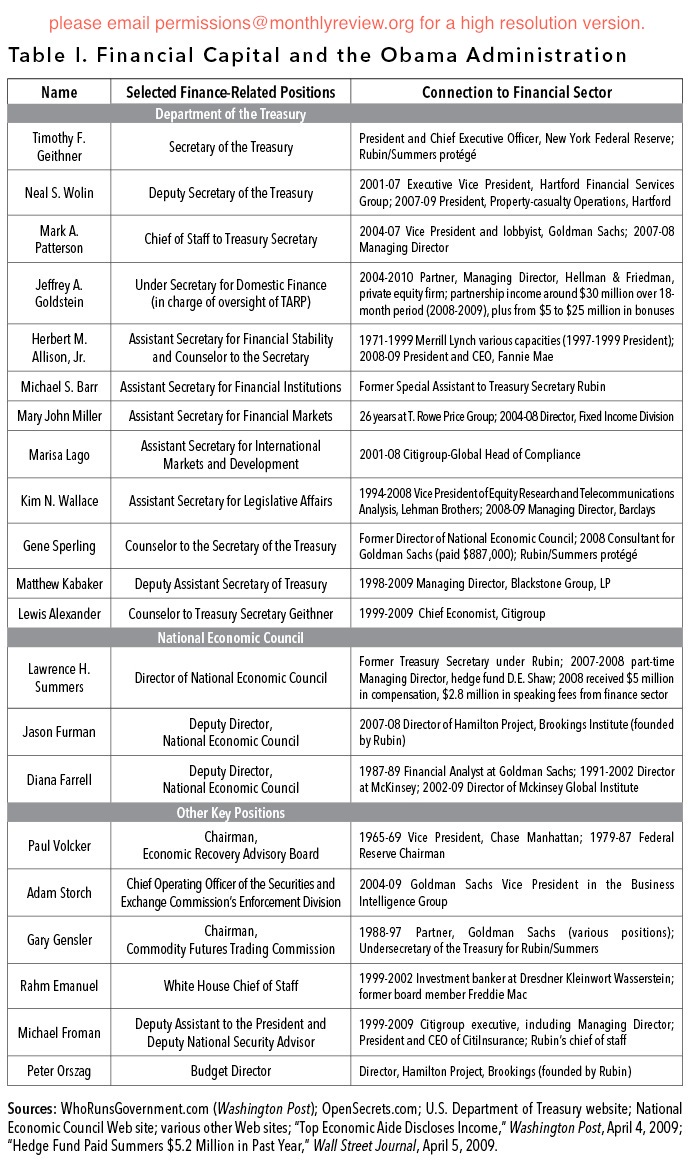
The numbers vary slightly on the internet as to the finance industry’s take of the total profits of the economy, but the overall trend has been an ever-increasing slice of the economic pie. Just before the financial meltdown of 2008, finance accounted for more than a third of total profit in the economy and it has come roaring back since then. The Free Market Economy has evolved from a supposed model of efficient use of capital for the benefit of production to the efficient funneling upwards of capital to the elite 1%. And of course there is the revolving door between the government and finance industry. The graph below shows the growth of the finance industry as a percentage of the total corporate profits since 1948:
American companies are now run by money men who have different priorities than those business leaders of the past. David Bollier explains:
We all know the story of enclosure as it applies to the commons. The lesser-known story is that businesses are enclosing themselves – aggressively cannibalizing their own internal productive capacities in order to maximize short-term profits.
Harvard business guru Clayton Christensen argues in Forbes magazine that business executives are so habituated to seeing the world through a scrim of financial abstractions that they are blindly undercutting their own long-term productive capacities. The problem is so pervasive, says Christensen, that “whole sectors of the economy are dying…”
Financialization could be called the degenerate, end-stage of capitalism where making money from money is the be-all and end-all of corporate decision-making.
Professor Wolff discusses with William Tabb this financialization of the economy in more detail here. Our economy has become a giant Ponzi scheme. This won’t end well.
…many of our official pronouncements – echoing those of most elite institutions and organizations – proudly and confidently insist that our future lies in “globalization.” Globalization – for lack of a better term – is, in actuality, the building out of a monoculture, a singular culture based upon basic presuppositions of modern political, economic and social theory.
Nature abhors monocultures. Nature abhors them so much that they do not exist in accordance with nature. They would be unknown but for modern man.
A monoculture is a single form of life – or, by extension, a single culture – that exists over a large expanse of space, even globally. Nature abhors monocultures because they are so susceptible to annihilation by one agent of destruction. In plant or animal life, for example, a single virus or bacteria, a single destructive fungus or disease, a single hostile predator or pest would wipe out an entire monoculture without the barest resistance. It is the very nature of nature to avoid monocultures – indeed, it cannot be otherwise since any form of monoculture cannot long exist in nature. Life in the natural realm is manifold and varied, precisely so that some life will weather the inevitable deadly challenges that arise. – Patrick J. Deneen
The following is an excellent essayby Chris Williams, a professor in the Dept of Chemistry & Physical Science, Pace Universityand author of Ecology and Socialism: Solutions to Capitalist Ecological Crisis (Haymarket Books, 2010). It goes well with my previous post on the corporatized Rio Earth Summit. In the last two decades only four out of ninety United Nation environmental sustainability pledges have been fulfilled, a pretty dismal failure by anyone’s standards. The four were: reducing ozone depletion, removing lead from gasoline, improving access to water supplies and boosting research for marine pollution. The reason for its epic failure is that the whole process of sustainability and scaling back ecologically destructive megatrends have been co-opted by our economic system, i.e. capitalism. The need for continuous growth and expansion into new markets is inherent in capitalism. It has come to define our culture and relationship with nature and our fellow man. As history has clearly shown, capitalism will be the death of us all if we allow this ethic-less system to define ourselves and to continue its rampant, unbridled destruction in the name of ‘development’ and profit.
Sometimes, the calendar of international conferences attended by global elites serves up potent lessons for the rest of us, when they shine a spotlight on the deliberately murky affairs of the people who run the system. As the 20 most powerful world leaders deliberate on economic issues in Los Cabos, Mexico for the G20 summit, representatives of the rest will be simultaneously converging on Rio de Janeiro to consider how to follow up on the original Earth Summit, 20 years ago this year.
At these seemingly separate gatherings, we in truth observe the two sides of the capitalist coin. Namely, how can the capitalist elite continue the necessary work of exploiting both humans and the natural world in the service of profit, while cloaking their intentions in the benign language of growth, development and sustainability? Fine words to cover nefarious ends. No doubt, as people’s livelihoods and world decay around them as a direct consequence of the system the elite oversee, and in response the flame of revolt is rekindled from Cairo to Athens, political elites in the two locations will reflect on the fact that it’s not getting any easier. From the other side, critics and commentators of the two conferences are missing an important and significant lesson when they consider them in isolation.
At the original Earth Summit in Rio, it was generally accepted that environmental questions could not be separated from economic ones. This year, the two conferences, occurring concurrently at different ends of the South American continent, bring to light how this thinking has been undermined. Furthermore, they indicate with geographical and political precision where the priorities of the global elite lie. While the most important world leaders hot-foot it to Mexico to discuss global economic development, they send low-level delegates to Brazil to discuss issues they deem less vital; to be exact, planetary ecological crisis.
Indeed, so desperate were the Brazilian organizers of Rio+20 to cajole the British premier to attend, they changed the date of the conference so as to avoid conflicting with the much more important and worthy 60th anniversary celebrations of the Queen of England’s ascension to the throne. An attempt that proved ultimately and embarrassingly futile, as British Prime Minister, David Cameron, chose to cling to the coattails of President Obama and other G20 leaders in Los Cabos, as they calculate, connive and concoct the further dismemberment and disenfranchisement of communities of workers and peasants around the world.
In a further sad irony, to enhance attendance at Rio, Brazil is providing flights courtesy of the Brazilian air-force to those countries too poor to send delegates. It’s hard to imagine that the countries who can’t afford to send delegates to an environmental conference will have the financial capacity to take action to preserve biodiversity and a stable climate without international funding and technology transfer. But the concept or even use of the word “transfer” is exactly what the United States delegation is trying to excise from any document emerging from Rio+20.
In Los Cabos, 20 people wielding enormous economic power gather to ensure that nothing stands in the way of the international accumulation of money by their respective corporations; that capitalist growth continues, uninterrupted by paltry considerations such as democracy. Scheming and plotting in Los Cabos, the 20 leaders will huddle, concerned that their plans have been exposed by the people of Greece. As they jet to Mexico, one of the first countries to be devastated by the neoliberal prescription of privatization, deregulation and cuts to social spending, the election results in Greece ring in their ears as a collective rebuke to austerity and unemployment. In unprecedented numbers, Greeks exercised their democratic rights by voting for a previously obscure and marginal left coalition, SYRIZA and against handing the welfare of their country over to unelected technocrats governing from afar. A vote, it should be emphasized, carried out in the teeth of apocalyptic warnings of doom from central bank acolytes of the 1%, desperate to stop the people voting ‘the wrong way’.
As for the Global South, capitalist economic development, particularly since its neoliberal mutation, has been a disaster of gigantic proportions as money and natural wealth are siphoned into Western financial institutions. According to Oxfam, gross capital flows to developing countries fell from $309 billion in 2010 to $170 billion in 2011. Last year, aid donations from major donors experienced the first decrease in 14 years, dropping by $3.4 billion; overall aid was $16 billion below what the G8 committed to delivering in 2009. The drop in aid, along with legal and illicit financial transfers out of the developing world, mean that for every dollar received in aid (much of it tied to the purchase of materials from the West), 7-10 dollars go out. In 2009 alone, the developing world saw $903 billion disappear overseas thanks to a rigged system from which the majority cannot benefit. While 16 of the 20 members of the G20 have seen inequality increase over the last 20 years, as complement to that process, is it any wonder that developing countries seem to be permanently ‘developing’ even as social and ecological conditions there also worsen?
The violent dispossession that characterized the bloody dawn of capitalism captured by Marx in his writings on the enforced removal of peasants in the 1500’s amid the first acts of privatization – the land enclosures, is repeated in contemporary form through land grabs; his writing has a remarkably contemporary ring to it: “Thus were the agricultural people, first forcibly expropriated from the soil, driven from their homes, turned into vagabonds, and then whipped, branded, tortured by laws grotesquely terrible, into the discipline necessary for the wage system.”
In the 20 years since the optimism of the first Earth Summit in Rio, carbon emissions have increased by 50% and, since 1950, while the rest of the world has seen an average increase in temperature of 0.70C, the arctic, due to various positive feedback loops, has experienced double that. Absent serious action, whereas the world is now on track for 20C of warming, the arctic is on course for a truly calamitous 3-60C. The June 16th 2012 special edition of The Economist pondered an ice-free arctic with a mixture of trepidation, casual racist indifference and a general leaning toward monetary excitement: “In the long run the unfrozen north could cause devastation. But, paradoxically, in the meantime, no arctic species will profit from it as much as the one causing it: humans. Disappearing sea ice may spell the end of the last Eskimo cultures, but hardly anyone lives in an igloo these days anyway. And the great melt is going to make a lot of people rich.” Yes, to The Economist, while the change may be “devastating” to ancient and indigenous cultures, along with cold-adapted species, a certain small subset of humans will become rich while ‘making a killing’ – in all senses of the phrase.
We and the land have certainly changed and the continuation planned by the capitalists and their political representatives has unquestionably become impossible, as further capitalist development begins to contradict not just human rights or a sense of social progress, but the thermodynamic laws of the universe, which underpin a stable biosphere, upon which all life ultimately depends.
To quote British journalist George Monbiot on the reasons for the failure of so many environmental conferences, “These summits have failed for the same reason that the banks have failed. Political systems that were supposed to represent everyone now return governments of millionaires, financed by and acting on behalf of billionaires. The past 20 years have been a billionaires’ banquet. At the behest of corporations and the ultra-rich, governments have removed the constraining decencies – the laws and regulations – which prevent one person from destroying another. To expect governments funded and appointed by this class to protect the biosphere and defend the poor is like expecting a lion to live on gazpacho.”
From the other side of the political spectrum, representatives of the US environmental organization, Environmental Defense Fund, writing in a New York Times op-ed concede that “As the Arctic becomes ice-free, we can expect that it will be drilled for oil”. But, nevertheless, despite two decades of failure, hold out hope that with just a little more effort and market reforms such as cap and trade, 10 years from now we’ll be okay “with determination and the right policies, by the time Rio+30 rolls around, optimism might be the order of the day.”
Now, socialists are often decried as Utopians. We are told, our ideas may sound good in theory, but humans living equitably with one another in a democratic system based on cooperation, in a society that lives in harmony with the natural world, will simply never work in practice. Is it more realistic to believe that the same system that got us to this point will extricate us? The message from the ‘realists’ seems to be that while we may well have covered the arctic in drilling rigs by then, just give it another 10 years and things will be fine. Going beyond the wrong-headed pronouncements of the EDF, UN Secretary-General, Ban Ki-moon managed a level of fervor that would have put Dr. Pangloss himself to shame, “Increasingly, we understand that, with smart public policies, governments can grow their economies, alleviate poverty, create decent jobs and accelerate social progress in a way that respects the earth’s finite natural resources.”
One has to ask, who are the real Utopians? To many people around the world, leftwing and explicitly socialist ideas, along with class-based revolt, are re-emerging as real alternatives precisely because our rulers quite clearly have no answer other than an extension of the market into whole new areas. Meena Raman of the Malaysia-based Third World Network, was unequivocal in her denunciation of the US’s role in derailing climate negotiations in Durban in 2002 and in Rio+20: “Given the US stance, we do not want President Obama or any US leader to come to Rio to bury what was agreed in 1992 in Rio. We cannot expect the US to show any leadership in truly wanting to save the planet and the poor. So it is better for President Obama to stay at home.”
Meanwhile, 105 scientific institutions are urging action at Rio on population and consumption “For too long population and consumption have been left off the table due to political and ethical sensitivities. These are issues that affect developed and developing nations alike, and we must take responsibility for them together,” said Charles Godfray, a fellow of the Royal Society. Except that population growth is a function of poverty and it is in fact the countries with the largest levels of consumption, such as the United States and Europe, that not only are the historical cause of the ecological crisis, but are helping to drive it to its logical conclusion – a cascading collapse of ecosystems – by advocating continual economic expansion and the generation of poverty through the promotion of financial and trade agreements that accentuate inequality. Capitalism is like a shark; just as these animals can never stop moving forward for fear of drowning, so capitalism must grow or die.
It’s important to understand why negotiators see the primary way to save the environment is through putting a price on it. This is the main thrust of the talks and accepted by all negotiating parties inside the conference, representing a major schism with the tens of thousands of protesters attending the Rio+20 People’s Summit who are being forcibly kept out of the deliberations by armed riot police.
The argument goes that only by giving natural resources “value” in monetary terms can the environment be protected. On the one hand, it’s easy to see the further privatization of every molecule of water, every tree and every piece of land as dovetailing beautifully with the desires of the corporations. Extending the “free” market to new areas for exploitation is a tried and true method to enhance profits. Those who run the corporations are not slow to catch on and self-advocate: “For companies this is enlightened self interest…Those who can afford water should pay. Water is essentially over exploited because we are not valuing it as an economic good. Introducing methodologies such as escalating tariffs, which some countries have already done, will help in terms of using water intelligently, often for the first time.” So said, Gavin Power, deputy director of the UN Global Compact, which is acting as an umbrella group for 45 of the most powerful CEO’s, from such well-known environmentally conscious concerns as Coca Cola, Glaxo-SmithKline, Nestle, Merck and Bayer, to ensure their voice is heard at Rio+20.
But advocacy for the “valuation” of natural resources occurs not just or even primarily because it coincides with what corporations want. Many of the people arguing for such quantization of nature genuinely believe it will help preserve biodiversity, slow climate change and reduce the pressure on natural resources.
More fundamentally, the need to place “fair value” on everything is part of the ideological foundation of capitalism. Within the philosophy of capitalism, if something does not have a price, it cannot have value. Hence, putting the correct price, otherwise known as internalizing the cost, of a natural good, is to make possible its rational exploitation and simultaneous conservation. To those mired deep within the labyrinth of a capitalistic value system, there is no contradiction between these two aims: the commodification of nature can be seen both as a way of making money from it, and as a way of saving it, as perfectly expressed by Ban Ki-moon.
The quantification of nature is the rational end-point of capitalism’s philosophical approach to nature and hence a practical approach to ‘saving nature’. The non-quantifiable, qualitative side of nature, the purely spiritual and awe-inducing beauty of watching a sunrise for example, is not only entirely absent, or under-appreciated, it is essentially unknowable. Hence, assuming you’re not prepared to advocate regulatory reforms to place limits on the operation of corporations and boundaries beyond which they cannot cross, or you’re not advocating revolution, then extending the market becomes the only option left, consequently the focus at Rio+20 on doing exactly that.
However, for those of us who truly want to see a better world, the extension of its commodification to every single particle of nature cannot be an answer. Taking our inspiration from the rising struggles of 2011 around the globe, it is imperative that we link up the movements of social resistance, and forge new alliances with organized labor and the disenfranchised of the planet to force regulatory changes onto those who would foist false solutions on us. Only by linking social and ecological change and fighting on both fronts, autonomous of mainstream political parties, while creating our own independent battle organizations, can we hope to make progress.
Ultimately, however, it is just as vital that fighters for social emancipation, human freedom and ecological sanity, recognize that capitalism represents the annihilation of nature and, thus, humanity. A system based on cooperation, real democracy, long-term planning, and production for need not profit, i.e., socialism, represents the reconciliation of humanity with nature. And its achievement will, as Marx pointed out, of necessity be much less violent than the process by which capitalism was born in the first place:
“The transformation of scattered private property, arising from individual labor, into capitalist private property is, naturally, a process, incomparably more protracted, violent, and difficult, than the transformation of capitalistic private property, already practically resting on socialized production, into socialized [common] property. In the former case, we had the expropriation of the mass of the people by a few usurpers; in the latter, we have the expropriation of a few usurpers by the mass of the people.”
We currently live in an age that has been characterized as the Anthropocene, the Age of Man, by some scientists to take into account how drastically human civilization has altered the biosphere on a geological time scale. Only by overthrowing capitalism and moving toward a cooperative, planned economy based on democracy and sustainability can we move toward an age characterized, after Epicurus, as the Oikeiotocene – The Age of Conformity to Nature.
In my post “The Vicious Price/Demand Cycle of Peak Oil & Blackouts in Greece” I mentioned the global land grabs occurring, primarily in Third World countries, by corporations and ‘developed’ countries in order to secure the resources to feed their nation’s citizens and extract profit. These resource appropriations take place at the expense of local, indigenous people who have farmed the land in a sustainable way for centuries if not thousands of years. The bottom line of these land grabs is to get control of the water resources connected to the land. The non-profit organization called GRAIN published an excellent article today explaining this theft in great detail. I highly recommend reading it in its entirety. Also worth reading is “The Land Grabbers: The New Fight Over Who Owns the Earth” by Fred Pearce, an excerpt of which was published today at Salon.com.
Although all the countries who practice industrial monoculture farming and factory farming are unsustainable and depleting their fresh water resources faster than they are being replenished by natural rainwater/snowmelt, Saudi Arabia is the most severe example:
…perhaps the situation is nowhere more dramatic than in the Middle East. Saudi Arabia has no rain or rivers to speak of, but possesses vast ‘fossil water’ aquifers beneath the desert. During the 1980s the Saudi government invested $40 billion of its oil revenues to pump this precious water to irrigate a million hectares of wheat. Later, in the 1990s, in order feed the growing industrial dairy farms that popped up across the desert, many farmers switched to alfalfa, a crop that needs even more water. It was clear that the miracle couldn’t last; the aquifers soon collapsed and the government decided to outsource its food production to Africa and other parts of the world instead. Some 60% of the country’s fossil water under the desert was squandered in the process. Gone and lost forever.
As Saudi Arabia uses its oil wealth to procure resources abroad, so is China doing the same with the wealth generated from its success as an exporter and the huge trade surplus it has built up:
More than 40% of the Earth’s land is used for human needs, including cities and farms; and with the population set to grow by a further two billion by 2050, that figure could soon exceed 50%. Rising demand for resource-expensive foods such as beef could mean it happens by 2025, Prof Barnofsky’s modelling suggests. “It really will be a new world, biologically, at that point,” he said. “I think that if we want to avoid the most unpleasant surprises, we want to stay away from the 50% mark.
Reading about these land grabs by resource hungry wealthy countries who practice industrialized farming makes me think of the following quote and how little time we have left before mass starvation on a global scale occurs:
I’ve written before about what exactly it means to have an unsustainable agricultural system: If our current system doesn’t change, then one day it will collapse, and millions — if not billions — will starve. This collapse won’t have been unprecedented; it may, in fact, be an almost inevitable part of a cycle of growth and devastation that humanity has been experiencing since the agricultural revolution, as described in a new book, Empires of Food, by the academic Evan D. G. Fraser and the journalist Andrew Rimas.
The book analyzes the agricultural system in places and time periods from Mesopotamia to Rome to the Middle Ages and beyond. It chronicles a disturbingly reliable pattern of agricultural innovation, expansion, and trade that accompanies periods of favorable weather (just as we’ve experienced for the past half-century) and then the horrific implosion of the food system (and the civilization that built it) that always follows because of soil erosion, overpopulation, and climate change. Economic troubles caused by unsound banking practices also usually figure prominently in the demise. Does any of this sound eerily familiar?
Concerning the real reason for the land grabs: Water
“The tensions in south western Ethiopia illustrate the central importance of access to water in the global land rush. Hidden behind the current scramble for land is a world-wide struggle for control over water. Those who have been buying up vast stretches of farmland in recent years, whether they are based in Addis Ababa, Dubai or London, understand that the access to water they gain, often included for free and without restriction, may well be worth more over the long-term, than the land deals themselves.
In recent years, Saudi Arabian companies have been acquiring millions of hectares of lands overseas to produce food to ship back home. Saudi Arabia does not lack land for food production. What’s missing in the Kingdom is water, and its companies are seeking it in countries like Ethiopia.
Indian companies like Bangalore-based Karuturi Global are doing the same. Aquifers across the sub-continent have been depleted by decades of unsustainable irrigation. The only way to feed India’s growing population, the claim is made, is by sourcing food production overseas, where water is more available.
And companies like Chayton Capital think that Africa is the best place to find that water. The message repeated at farmland investor conferences around the globe is that water is abundant in Africa. It is said that Africa’s water resources are vastly under utilised, and ready to be harnessed for export oriented agriculture projects.
The reality is that a third of Africans already live in water-scarce environments and climate change is likely to increase these numbers significantly. Massive land deals could rob millions of people of their access to water and risk the depletion of the continent’s most precious fresh water sources.
All of the land deals in Africa involve large-scale, industrial agriculture operations that will consume massive amounts of water. Nearly all of them are located in major river basins with access to irrigation. They occupy fertile and fragile wetlands, or are located in more arid areas that can draw water from major rivers. In some cases the farms directly access ground water by pumping it up. These water resources are lifelines for local farmers, pastoralists and other rural communities. Many already lack sufficient access to water for their livelihoods. If there is anything to be learnt from the past, it is that such mega-irrigation schemes can not only put the livelihoods of millions of rural communities at risk, they can threaten the freshwater sources of entire regions. (See Water mining, the wrong type of farmingandDeath of the Aral Sea)”
In the not-so-distant future, water will become “the single most important physical-commodity based asset class, dwarfing oil, copper, agricultural commodities and precious metals,” says Citigroup’s chief economist, Willem Buiter.
Hydro-colonialism?
The Nile and the Niger basins are only two of the examples of the massive give away of land and water rights. The areas where land grabbing is concentrated in Africa coincide closely with the continent’s largest river and lake systems, and in most of these areas irrigation is a prerequisite of commercial production.
The Ethiopian government is constructing a dam in the Omo river, to generate electricity and irrigate a huge sugarcane plantation; a project that threatens hundreds of thousands of indigenous people that depend on the river further downstream. It also threatens to empty the world biggest desert lake, Lake Turkana, fed by the Omo river. In Mozambique the government had signed off on a 30,000 hectares plantation along the Limpopo river which would have directly affected farmers and pastoralists now depending on the water. The project was revoked because the investor didn’t deliver, but the government is looking for others to take over. In Kenya, a tremendous controversy has arisen from the government’s plans to hand out huge areas of land in the delta of the Tana River with disastrous implications for the local communities depending on the delta’s water. The already degraded Senegal river basin and its delta have been subject to hundreds of thousands of hectares in land deals, putting foreign agribusiness in direct competition for the water with local farmers. The list goes on, and is growing by the day. This table shows a selection of the most important cases.
Peter Brabeck-Letmathe, the Chairman of Nestle, says that these deals are more about water than land: “With the land comes the right to withdraw the water linked to it, in most countries essentially a freebie that increasingly could be the most valuable part of the deal.”[8] Nestle is a leading marketer of bottled water under brand names including Pure Life, Perrier, S.Pellegrino and a dozen others. It has been charged with illegal and destructive groundwater extraction, and of making billions of dollars in profits on cheap water while dumping environmental and social costs onto communities. [9]
Asked at an agricultural investment conference whether it is possible to make money from water, Judson Hill of one of the private equity funds involved, was unequivocal: “Buckets, buckets of money,” he told a meeting of bankers and investors in Geneva. “There are many ways to make a very attractive return in the water sector if you know where to go.”
In the not-so-distant future, water will become “the single most important physical-commodity based asset class, dwarfing oil, copper, agricultural commodities and precious metals,” says Citigroup’s chief economist, Willem Buiter.[10] No surprise, then, that so many corporations are rushing to sign land deals that give them wide-ranging control over African water. Especially when African governments are essentially giving it away. Corporations understand what’s at stake. There are “buckets of money” to be made on water, if only it can be controlled and turned it into a commodity. (SeeVirtual water and Grabbing carbon credits?)
The secrecy that shrouds land deals makes it hard to know exactly what’s being handed over to foreign companies. But from those contracts that have been leaked or made public, it is apparent that the contracts tend not to contain any specific mention of water rights at all, leaving the companies free to build dams and irrigation canals at their discretion, sometimes with a vague reference to ‘respecting water laws and regulations’.[11] This is the case in the agreements signed between the Ethiopian government and both Karuturi and Saudi Star in Gambela, for example. In some contracts, a minor user fee is agreed upon for the water, but without any limitation on the amount of water that can be withdrawn. Only in rare cases are even minimal restrictions imposed during the dry season, when access to water is so critical for local communities. But even in instances where governments may have the political will and capacity to negotiate conditions to protect local communities and the environment, this is made increasingly difficult due to existing international trade and investment treaties that give foreign investors strong rights in this respect.[12]”
Stop the water grab
If this land and water grab is not put to an end, millions of Africans will lose access to the water sources they rely on for their livelihoods and their lives. They may be moved out of areas where land and water deals are made or their access to traditional water sources may simply be blocked by newly built fences, canals and dikes. This is already happening in Ethiopia’s Gambela, where the government is forcibly moving thousands of indigenous people out of their traditional territories to make way for export agriculture. By 2013, the government wants to remove 1.5 million people from their territories across Ethiopia.[13] As the bulldozers move into the newly acquired lands, this will become an increasingly common feature in Africa’s rural areas, generating more tensions and conflicts over scarce water resources.
But the impacts will run far beyond the immediately affected communities. The recent wave of land grabbing is nothing short of an environmental disaster in the making. There is simply not enough water in Africa’s rivers and water tables to irrigate all the newly acquired land. If and when they are put under production, these 21st century industrial plantations will rapidly destroy, deplete and pollute water sources across the continent. Such models of agricultural production have generated enormous problems of soil degradation, salinisation and waterlogging wherever they have been applied. India and China, two shining examples that Africa is being pushed to emulate, are now in a water crisis as a result of their Green Revolution practices. Over 200 million people in India and 100 million in China depend on foods produced by the over-pumping of water.[14] Fearing depleted water supplies or perhaps depleted profits, companies from both countries are looking now to Africa for future food production.
Africa is in no shape for such an imposition. More than one in three Africans live with water scarcity, and the continent’s food supplies are set to suffer more than any other’s from climate change. Building Africa’s highly sophisticated and sustainable indigenous water management systems could help resolve this growing crisis, but these are the very systems being destroyed by land grabs.
Advocates of the land deals and mega irrigation schemes argue that these big investments should be welcomed as an opportunity to combat hunger and poverty in the continent. But bringing in the bulldozers to plant water-intensive export crops is not and cannot be a solution to hunger and poverty. If the goal is to increase food production, then there is ample evidence that this can be most effectively done by building on the traditional water management and soil conservation systems of local communities. [15] Their collective and customary rights over land and water sources should be strengthened not trampled.
But this is not about combating hunger and poverty. This is theft on a grand scale of the very resources – land and water – which the people and communities of Africa must themselves be able to manage and control in order to face the immense challenges they face this century.
Going Further
Fred Pearce, The Landgrabbers: The new fight over who owns the Earth,
Eden Project, 2012.
Fred Pearce, When the rivers run dry: What happens when our water runs out? Eden Project, 2006
Farmlandgrab.org News and information on large-scale land grabs. Updated daily. Maintained by GRAIN as a research-sharing and monitoring project open to your contributions and participation.
The above montage of clips from the satirical movie ‘The Distinguished Gentleman‘, in which Freshman Congressman (and con man) Thomas Jefferson Johnson (Eddie Murphy) is schooled in the ways of Washington by legendary lobbyist Terry Corrigan (Kevin McCarthy), is as true today as it was back when that movie was made more than twenty years ago, so says Marty Kaplan. The following excerpts from the transcript of Bill Moyer’s latest report – Big Money, Big Media, Big Trouble – tells the sorry and sordid tale of our political economy/society. This Moyer’s interview with Kaplan, a true insider to our political and media complex, is quite extraordinary. He affirms what the general populace is unable to comprehend… that we live in a society in which the news media and government institutions are entirely owned by the corporate oligarchs. The government regulators are owned by the very companies they are charged with over-seeing by way of Wall Street’s army of lobbyists and the revolving door that exists between government and private sector positions. Actual news to inform the public on the state of affairs and issues affecting them is virtually nonexistent on the media airwaves.
…what’s really driving it, if you think of this as a symptom and not a cause, I think what’s really driving it is the absolute demonization of any kind of idea of public interest as embodied by government. And at the same time, a kind of corporate triumphalism, in which the corporations, the oligarchs, the plutocrats, running this country want to hold onto absolute power absolutely. And it’s an irritant to them to have the accountability that news once used to play.
…the notion of spectator democracy has, I think, extended to include the need to divert the country from the master narrative, which is the influence and importance and imperviousness to accountability of large corporations and the increasing impotence of the public through its agency, the government, to do anything about it. So the more diversion and the more entertainment, the less news, the less you focus on that story, the better off it is.
And the self-serving triviality of corporate-run ‘news’ media has become a self-reinforcing mechanism whereby stats are being kept of what is the most popular story which then gets kicked up to the top and influences what that corporate news channel reports on in the future. It’s all driven by ratings and profit rather than educating and informing people on facts and real issues. So Neil Postman was right… We are being entertained to death, literally. This nihilism plays right into the hands of those controlling the levers of power who would not benefit from a well-informed, well-eduated public. The vast majority of public discourse has been reduced to an echo chamber of the crap (divisive ‘wedge issues’, celebrity gossip, sensationalist stories, corporate propaganda, consumerist materialism, valorization of the predatory skills of the modern competitive capitalist, etc.) that fills the corporate-controlled airwaves.
…
BILL MOYERS: You wrote The Distinguished Gentleman 20 years ago. Could you write it today?
MARTY KAPLAN: Oh God, it still is the same. All you have to do is add a couple of zeros to the amount of money. And the same laws still apply. It is fabulous and miserable at the same time.
BILL MOYERS: Was Washington then, and is it now, the biggest con game going?
MARTY KAPLAN: It is the biggest con game going. And the stakes are enormous. And the effort to regulate them is hopeless, because the very people who are in charge of regulating them are the same people who are wholly-owned subsidiaries of the lobbies that run them.
BILL MOYERS: I have it on very good authority that a prominent Washington senator recently told a group of lobbyists in Washington, a room full of lobbyists, that they are the lifeblood of the city. And I thought, “Kaplan has to do a vampire movie now.” Right?
MARTY KAPLAN: Exactly. The connection between the legislators and the lobbyists is so intimate that it’s not even embarrassing for a senator to say that in front of a room. The culture is so hermetically sealed from the rest of the country that it doesn’t occur to them that there is something deeply outrageous and offensive and corrosive of democracy to admit that the money side of politics and the elected side of politics belong to each other.
BILL MOYERS: You wrestle with this, you and your colleagues at the Norman Lear Center, and all the time, on how, on what the system is doing to us. So let me ask you, “How did this happen in America? How did our political system become the problem instead of the answer?”
MARTY KAPLAN: Part of it is the nexus of media, money, and special interest politics. The citizens have given the airwaves to the station. We own the electromagnetic spectrum and for free we give out licenses to television stations. Those stations, in turn, use that spectrum to get enormous amounts of money from special interests and from members of Congress in order to send these ads back to us to influence us. So we lose it in both ways. The other day, the president of CBS, Les Moonves, was reported by “Bloomberg” to have said “Super PACs may be bad for America, but they’re … good for CBS.” I mean, there it is. This is a windfall every election season, which seems not to even stop ever, for the broadcast industry. So not only are they raking it in, they’re also creating a toxic environment for civic discourse. People don’t hear about issues. They hear these negative charges, which only turn them off more. The more negative stuff you hear, the less interested you are in going out to vote. And so they’re being turned off, the stations are raking it in, and the people who are chortling all the way to Washington and the bank are the ones who get to keep their hands on the levers of power. So one of the big reasons that things are at the pass they are is that the founders never could have anticipated that a small group of people, a financial enterprise and the technology could create this environment in which facts, truth, accountability, that stuff just isn’t entertaining. So because it’s not entertaining, because the stations think it’s ratings poison, they don’t cover it on the news.
BILL MOYERS: They don’t cover the news.
MARTY KAPLAN: They don’t cover politics and government in the sense of issues. They’re happy, occasionally to cover horse race and scandal and personality and crime and that aspect of politics. But if you look at a typical half hour of news, local news, because local news is one of the most important sources of news for Americans about campaigns. A lot—
BILL MOYERS: You and your colleagues have done a lot of research on local news.
MARTY KAPLAN: Yes, we’ve been studying it now since 1998. And each year it gets more depressing and it’s hard to believe. We, not long ago, did a study of the Los Angeles media market. We looked at every station airing news and every news broadcast they aired round the clock. And we put together a composite half hour of news. And if you ask, “How much in that half hour was about transportation, education law enforcement, ordinances, tax policy?” everything involving locals, from city to county. The answer is, in a half hour, 22 seconds.
BILL MOYERS: Twenty-two seconds devoted to what one would think are the serious issues of democracy, right?
MARTY KAPLAN: Yes. Whereas, in fact, there are three minutes about crime, and two and a half minutes about the ugliest dog contest, and two minutes about entertainment. There’s plenty of room for stuff that the stations believe will keep people from changing the dial.
BILL MOYERS: What is the irony to me is that these very same stations that are giving 22 seconds out of a half hour to serious news, are raking— and not covering politics, are raking in money from the ads that the politicians and their contributors are spending on those same papers.
MARTY KAPLAN: Yes, they’re earning hundreds of thousands and millions of dollars from the ads that they are being paid to run. And not even risking running a minute of news, which might actually check on the accuracy of an ad. Truth watches, they’re almost invisible now.
BILL MOYERS: So they will tell you, however, that they’re in the entertainment business. That they’re in the business to amuse the public, to entertain the public. And if they do these serious stories about the schools or about the highways or about this or that, the public tunes out. That the clicks begin to register as—
MARTY KAPLAN: It’s one of the great lies about broadcasting now. There are consultants who go all around the country and they tell the general managers and the news directors, “It is only at your peril that you cover this stuff.” But one of the things that we do is, the Lear Center gives out the Walter Cronkite award for excellence in television political journalism every two years. And we get amazing entries from all over the country of stations large and small of reporters under these horrendous odds doing brilliant pieces and series of pieces, which prove that you can not only do these pieces on a limited budget, but you can still be the market leader.
…
MARTY KAPLAN: Well, what’s really driving it, if you think of this as a symptom and not a cause, I think what’s really driving it is the absolute demonization of any kind of idea of public interest as embodied by government. And at the same time, a kind of corporate triumphalism, in which the corporations, the oligarchs, the plutocrats, running this country want to hold onto absolute power absolutely. And it’s an irritant to them to have the accountability that news once used to play.
BILL MOYERS: What do you mean by that? News challenges their assumptions, challenges their power?
MARTY KAPLAN: It used to be that the news programs that aired, believe it or not, had news on them. They had investigative stories.
But then somewhere in the 1980s, when 60 Minutes started making a profit, CBS put the news division inside the entertainment division. And then everyone followed suit. So ever since then, news has been a branch of entertainment and, infotainment, at best.
But there was a time in which the press, the print press, news on television and radio were speaking truth to power, people paid attention, and it made a difference. The— I don’t think the Watergate trials would have happened, the Senate hearings, had there not been the kind of commitment from the news to cover the news rather than cutting away to Aruba and a kidnapping.
BILL MOYERS: What is the basic consequence of taking the news out of the journalism box and putting it over into the entertainment box?
MARTY KAPLAN: People are left on their own to fend for themselves. And the problem is that there’s not that much information out there, if you’re an ordinary citizen, that comes to you. You can ferret it out. But it oughtn’t be like that in a democracy. Education and journalism were supposed to, according to our founders, inform our public and to make democracy work.
You can’t do it unless we’re smart. And so the consequence is that we’re not smart. And you can see it in one study after another. Some Americans think that climate change is a hoax cooked up by scientists, that there’s no consensus about it. This kind of view could not survive in a news environment, which said, “This is true and that’s false.” Instead we have an environment in which you have special interest groups manipulating their way onto shows and playing the system, gaming the notion that he said she said is basically the way in which politics is now covered.
It’s all about combat. If every political issue is the combat between two polarized sides, then you get great television because people are throwing food at each other. And you have an audience that hasn’t a clue, at the end of the story, which is why you’ll hear, “Well, we’ll have to leave it there.” Well, thank you very much. Leave it there.
BILL MOYERS: You have talked and written about “the straightjacket of objectivity.” Right? What is that?
MARTY KAPLAN: Well, the problem with telling the truth is that in this postmodern world, there’s not supposed to be something as truth anymore. So all you can do if you are a journalist is to say, “Some people say.” Maybe you can report a poll. Maybe you can quote somebody. But objectivity is only this phony notion of balance, rather than fact-checking.
There are some gallant and valiant efforts, like PolitiFact and Flackcheck.org that are trying to hold ads and news reports accountable. But by and large, that’s not what you’re getting. Instead the real straightjacket is entertainment. That’s what all these sources are being forced to be. Walter Lippmann in the 1920s had a concept called “spectator democracy” in which he said that the public was a herd that needed steering by the elites. Now he thought that people just didn’t have the capacity to understand all these complicated issues and had to delegate it to experts of various kinds.
But since then, the notion of spectator democracy has, I think, extended to include the need to divert the country from the master narrative, which is the influence and importance and imperviousness to accountability of large corporations and the increasing impotence of the public through its agency, the government, to do anything about it. So the more diversion and the more entertainment, the less news, the less you focus on that story, the better off it is.
BILL MOYERS: Are you saying that the people who run this political media business, the people who fund it, want to divert the public’s attention from their economic power? Is that what you’re saying?
MARTY KAPLAN: Yes.
Let us fight about you know, whether this circus or that circus is better than each other, but please don’t focus on the big change which has happened in this country, which is the absolute triumph of these large, unaccountable corporations.
This is about as dismal and effective a conspiracy, out in plain sight, as there possibly could be. So I don’t say that this is going to be solved or taken care of. What I do say is the first step toward it is at least acknowledging how toxic the situation has become.
…
BILL MOYERS: What you’re saying is that the political square is now a commercial enterprise, owned and operated for the benefit of the brand, CNN, Fox, all of those, right?
MARTY KAPLAN: That’s correct.
BILL MOYERS: How did it happen? How did we sell what belonged to everyone?
MARTY KAPLAN: By believing that what is, is what always has been and what should be. The notion that what goes on is actually made by people, changes through time, represents the deployment of political power. That notion has gone away. We think it’s always been this way. People now watching these CNN and Fox. They think this is how it works. They don’t have a sense of history. The amnesia, which has been cultivated by journalism, by entertainment in this country, helps prevent people from saying, “Wait a minute, that’s the wrong path to be on.”
BILL MOYERS: Amnesia, forgetfulness? You say that they’re cultivating forgetfulness?
MARTY KAPLAN: Absolutely.
…
BILL MOYERS: You made a very important speech not long ago at a media conference in Barcelona. And you tried and did draw the distinction between— you said the battle of the future is between big data and big democracy. In layman’s language, what is that?
MARTY KAPLAN: Big data, the age of big data that we’re supposed to be in, refers to the way in which, as we go on the internet, as we do all these media activities, watching television, which are at the center of our lives, we’re leaving a trail behind. We’re giving bits of ourselves up. And that set of bits is being collected and mined relentlessly.
So every time we buy a product or send an e-mail or vote how many stars to a restaurant, all this stuff creates a profile that companies buy and sell to each other. And that stuff is being used currently not only to market to us, to target ads toward us, but it’s also being used to profile us. There’s something called “web lining.” Which is similar to what used to be called “red lining.” The— that phenomenon, which is now illegal, in which people who were discriminated against because of the neighborhoods they live in. Right now—
BILL MOYERS: Banks drew a red line around impoverished neighborhoods that they would not then serve.
MARTY KAPLAN: Exactly. And so today imagine if you were to permit a private detective to follow you as you went to your drug store and bought a medication to help you with depression or as you made a phone call to a bankruptcy lawyer, because you needed one. Imagine if that kind of information could be put together and used against you to decide that you’re a bad credit risk or that maybe your insurance company should turn you down, because you suffer from this problem.
That kind of information, that kind of digital profiling is something which is emerging as a huge industry. And unless there are controls on it and constraints, as they have to some degree in Europe but not nearly enough even there, we are about to kiss goodbye our ownership of our privacy and also even the ownership financially of our information. We are the people who make Facebook and Twitter worth the billions of dollars that they’re worth, because we are giving up our information to them, which they are then selling and raising capital around.
BILL MOYERS: But in a libertarian era, what are the restraints and constraints against that? Where are they going to come from?
MARTY KAPLAN: Well, right now, the constraints in this country are voluntary. The Obama White House not long ago issued a digital code of conduct, which included privacy. In which they asked companies and companies did step up to it to say, “We’re not going to track people if they don’t want to be tracked.” And other such efforts to get people in control.
But what we do know, the record of just the past couple of months, is that company after company was doing stuff to us that’s astonishing, that we didn’t know about. The ways in which the apps that you use on your smartphones were vacuuming up information about you, your address book and all your pictures.
Stuff that you had no idea you had consented to, which in fact usually you had not, suddenly was all owned by other people, as well. You have not given permission, but that essential part of you is now not yours. That’s the name of the game now. This is baked into the business model of data mining, which is at the heart of so much of the digital economy.
BILL MOYERS: But that’s big data. You talked about big democracy.
MARTY KAPLAN: So at the same time as our data is being mined, there is this movement to protect people using technology to give them the power to say, “I’m not going to opt into this stuff.” We’re still at the beginning of this industry. And there has to be rules of the road. And part of those rules include my attention rights. My rights to control my identity, my privacy, and my ownership of information.”
BILL MOYERS: In your speech in Barcelona, you pointed to two simultaneous covers of TIME Magazine appearing the same week. One for the editions in Europe, Asia, and South Pacific, and it was about the crisis in Europe. The other, which appeared in the American edition, featured a cover about animal friendships. You use these two covers to illustrate the difference between what you call “push journalism” and “pull journalism.” What’s the difference?
MARTY KAPLAN: Push journalism is the old days, which seem no longer to apply in the era of the internet, in which an editor, a gatekeeper, says, “Here’s the package which you need to know.” All of that is ancient history now.
Instead, now, it’s all driven by what the consumer is pulling. And if the consumer says, “I want ice cream all the time.” And whether that ice cream is Lindsay Lohan, or the latest crime story, that’s what’s delivered. And as long as it’s being pulled, that’s what is being provided. So it’s quite possible that in the U.S., the calculation was made that the crisis in Europe and the head of Italy would not be a cover that one could use. But that pet friendships would be the sort of thing that would fly off the newsstand.
BILL MOYERS: So the reader is determining what we get from the publication?
MARTY KAPLAN: On a minute by minute basis, stories that the reader’s interested in immediately go to the top of the home page. There are actually pieces of software that give editorial prominence to stuff that people by voting with their clickers have said is of interest to them. No one is there to intervene and say, “Wait a minute, that story is just too trivial to occupy more than this small spot below the fold.” Instead, the audience’s demand is what drives the placement and the importance of journalistic content.
BILL MOYERS: So George Orwell anticipated a state as big brother, hovering over us, watching us, keeping us under surveillance, taking care of our needs as long as we repaid them with utter loyalty. Aldous Huxley anticipated a Brave New World in which we were amusing ourselves to death. Who’s proving the most successful prophet? Huxley or Orwell?
MARTY KAPLAN: Well, I think Huxley is probably right, as Neil Postman said in—
BILL MOYERS: The sociologist, yes.
MARTY KAPLAN: —in Amusing Ourselves to Death. That there’s no business but show business. And we are all equally guilty, because it’s such fun to be entertained. So you don’t need big brother, because we already have big entertainment.
BILL MOYERS: And the consequences of that?
MARTY KAPLAN: That we are as in Brave New World, always in some kind of stupor. We have continual partial attention to everything and tight critical attention on nothing.
…
According to stats from 2010 for TV viewing by adult Americans, we’re glued to the boob tube in our waking hours. This explains why having an intelligent conversation with most Americans is an impossible task. All they can do is regurgitate what has been constantly programmed into their heads.
• The average American watches 35:34 (hours/minutes) of TV per week
• Kids aged 2-11 watch 25:48 (hours/minutes) of TV per week (Q1 2010)
• Adults over 65 watch 48:54 (hours/minutes) of TV per week (Q1 2010)
And according to the latest Nielsen study, TV viewing is on the increase, notwithstanding a tiny drop in the number of households who own a TV:
…despite all the competition from cable TV, videogames, and the Internet, the average household watched 59 hours, 28 minutes of broadcast TV per week during the 2010-2011 season, setting a new record. Lanzano drew particular attention to the competition — or lack of it — from Facebook, noting that while the average person spends about 13 minutes a day on Facebook, they spend 297 minutes watching TV. “No wonder our friends at [General Motors] are making some changes,” he said. [Last month GM announced that it will stop placing ads on Facebook, after determining that they had little impact.]
Danny Schechter, journalist, author (Plunder: The Crime of Our Time), television producer and an independent filmmaker, has a new essay today describing the takeover of our political process by big money and the subsequent formation of what can only be called the ‘presidential electoral complex,’ an industry unto itself. This industry consists of armies of consultants and experts well-versed in perception management, public relations, advertising and marketing, and even psychological warfare. The facts don’t matter any more, only the public’s perception of it. And so politics is more about controlling the sentiment of the masses than anything else. Thus like the military industrial complex controlling foreign policy and America’s militarism, we can say that the Presidential Electoral Complex has also perverted the nation’s ability to hold true democratic elections which represent the will of the people. The tail is wagging the dog in both instances:
…one of Jimmy Carters’s advisers, Pat Cadell, …said in 1979 that just because you have been elected doesn’t mean you stop campaigning, He wrote in his “Initial Working Paper on Political Strategy,” “it is my thesis governing with public approval requires a continuing political campaign.”
Journalist Sidney Blumental, before he joined the Clinton White House, wrote The Permanent Campaign in 1980, revealing that political parties were dead and had been replaced by political consultants and other campaign professionals. (Disclosure: I helped get the book published by Beacon Press.)
In other words, politics had changed fundamentally: the old-style bosses were out and a new style media-driven system was in. Politics had also become a business with a whole retinue of advertising specialists, market researchers and pollsters.
Today, political journalist Joe Hagen labels this new army of experts for hire a “presidential electoral complex” – almost on the same scale as the military industrial complex. Their advice does not come cheap, with the tail today wagging the dog.
Any serious candidate hires his team and then has to raise millions to pay for it. When politics spawned a profession, the big money that’s transformed politics no longer went just to candidates but to the industry around them.
They also developed a stake in the fostering polarization and continuing crisis so that their counsel will be solicited more often. Increasingly political campaigns were run like military commands with centralized top-down direction, defensive and offensive strategies and tactics as well as psychological warfare. The campaign gurus are well schooled in the techniques of perception management.
This industry is bi-partisan with hired guns always shopping for the best deal irrespective of party. One-time dirty trickster Roger Stone who worked first for Richard Nixon ended up advising everyone from Al Sharpton to Donald Trump, to Libertarian Gary Johnson.
Some of these advisers step over the legal line like GOP operative Alan Raymond but few get caught. The New York Times reported In New Hampshire’s hotly contested 2002 Senate race, Democratic get-out-the-vote phone banks were jammed with incoming calls on Election Day. The Republican, John Sununu, won re-election by under 20,000 votes, and Allen Raymond, a Republican Party operative, went to jail for his role in the jamming.
Raymond has now written a book about his experiences, How to Rig an Election: Confessions of a Republican Operative. In it, he paints a picture of the corruption of modern politics that should leave no doubt about the creativity and cynicism of operatives like Raymond or the need for tough new election-reform legislation.
Wikipedia had two other examples of the focus on permanent campaigns:
“A famous example that illustrates just how strongly this mind-set has come to influence politics was during the Clinton Administration when pollster Dick Morris asked voters to help decide where Bill Clinton would go on vacation.
“In the words of columnist Joe Klein, ‘The pressure to “win” the daily news cycle – to control the news – has overwhelmed the more reflective, statesmanlike aspects of the office.’ (After getting caught in a sex scandal, Morris was fired by Clinton and later resurfaced as a pundit at Fox News.)
Many of the press secretaries and campaign managers work hard to contain mistakes. The bookshelves are filled with advice about how to do that. This is from an email promoting interviews with a campaign expert turned author:
“Every word and action on the campaign trail from a televised debate to a town meeting, to an innocent question from a voter to a pointed question from the media … all of these daily events call for immediate, strategic communication.
“Any blunder should be a wake-up call: communication has power. But as with any form of power, it needs to be harnessed effectively or it can all too often backfire.
“This year’s primaries were riddled with missteps and over-reaching. As the focus shifts from primaries to the general elections, Romney will have to walk the line between connecting to the audience and pandering. On the other hand, President Obama will be less under scrutiny for potential gaffes, but more for his inattention to issues that are brewing, followed by a dramatic game-changing address.
“‘However, this can all change in a split-second, as proven by the undeniable power of word choice,’ comments Helio Fred Garcia, President of the crisis management firm Logos Consulting Group and the Executive Director of the Logos Institute for Crisis Management & Executive Leadership.”
Garcia, who teaches now at NYU, discusses strategies that might be useful in a new book on the Power of Communication, or is it manipulation:
“– Leaders are judged on the fulfillment of expectations. Leaders must resist saying what merely sounds good in the moment and creating a say-do gap.
“– The only reason for communication is to change something – to influence the way audiences think and feel. Before you communicate, know what it is you want to change.
“– Facts do not speak for themselves. If we speak only facts, the audience will either not pay attention to those facts or will provide their own context to make sense of the facts, which could trigger a negative frame.
“– Communication is a continuation of business by other means. You need to engage your audience to enhance your position, thereby improving your competitive advantage.
“–Leaders must conquer the first mover advantage – a maneuver that prevents critics and adversaries from framing the situation. This has become increasingly more important in today’s world of social media.”
This same techniques are also used to sell war, as Mother Jones reported: “As long as the United States appears to be on the move against foreign adversaries, the question of whether any action is actually taken becomes of secondary interest. As Blumenthal suggested two decades ago, results and concrete proposals are less important than perception and image.”
Even as Blumenthal was partial to Hillary Clinton, who hired him for her unsuccessful primary campaign in 2008, The Economist noted that his description of a permanent campaign soon became President Obama’s prescription:
“Mr. Obama is currently deploying the formidable resources he built up during his campaign — including contact details for 10m donors, supporters and volunteers — to sell his policies. David Plouffe, the man who managed Mr. Obama’s presidential campaign, has sent millions of e-mails to encourage them to support the White House’s agenda.
“One of them contains as good a definition of the permanent campaign as any: ‘In the next few weeks we’ll be asking you to do some of the same things we asked of you during the campaign — talking directly to people in your communities about the president’s ideas for long-term prosperity.’ “Another, which includes a video of the president, asks supporters to put pressure on their congressman to pass Mr. Obama’s budget, by calling his or her office and reciting a little pro-Obama speech.”
The Republicans have learned these lessons too and now have more money than Democrats to invest in them. Politics is now a growing industry with money and politics more joined at the hip than ever and an interest in keeping the big money flowing into its bank account.”
Operating in concert with the Presidential Electoral Complex are the Army of Lobbyists representing the monied interests of corporations and the financial elite. Republican political operative and financial consultant Mallory Factor appeared on CurrentTV in April, saying no one party has access to the big donors and that Democrats and Republicans both rely on money. This video was available on YouTube, but has since been taken off. You can still see it here.
A couple weeks ago, Jennifer Granholm from CurrentTV aired an editorial video in which she says that “the super rich are monopolizing our democracy and effectively ruining the founding fathers’ vision of how the United States should operate, sending us back to an era that is more like a one-king rule than a real democracy.” She names Romney as the willing supplicant of the monied interests. She says the Democrats have been forced to play the same game, but I think she doesn’t go far enough: both parties are equally corrupt in my eyes. Anyone who still puts one iota of faith in our perverse, money-driven political system is just plain stupid.
Cenk Uyger did a better job of describing our systemically corrupt system back in November 2011. See also David Cohen’s excellent post: “The Idiot’s Guide To Buying A Congressman“.
Hope? Don’t make me laugh. If change was possible through our political system, they’d make it illegal.
“…A major point of contention is the claim that a “severe reduction in revenue growth” – linked to the growing numbers of users accessing the website on mobile phones rather than computers – was concealed.
Facebook, which is being sued as a company along with Mr Zuckerberg, other leading executives at the company and its lead underwriters – Morgan Stanley and Goldman Sachs – has denied the claims. Another lawsuit filed in California claims Facebook and its banks actively misled investors. The banks deny any wrongdoing.
However, the claim that Mr Zuckerberg was able to profit by selling his shares in the knowledge that the share value would likely decline, while others bought in without the benefit of the facts, has heightened the controversy.
It has even led to the term “Zucked” being coined to describe what happened to the investors who lost money.
The US Senate Banking Committee has announced it is to investigate the affair, after which its chairman, Senator Tim Johnson, will decide if public hearings should be held.”
What’s also not new is that Main Street continues to pour money into the stock market, only to see it funneled up to the well-connected wealthy investors and banks. As George Carlin always said, “It’s a big club, and you ain’t in it.” Wall Street is just one enormous and slippery greased palm:
Giving well-connected firms an inside track has been one of the ways that big Wall Street firms attract and keep big clients. These clients are powerful profit drivers, and banks tend to give their best customers the best deals.
“These people give them more money in fees and commissions than others,” said Ernest Badway, a former U.S. Securities and Exchange Commission enforcement attorney who is now a white-collar defense lawyer in New York and New Jersey.
“Because of that — they’re part of a great revenue stream — they’re going to try to give every single advantage that they can to those particular people,” he said.
Large institutions and wealthy investors have a symbiotic relationship with Wall Street bankers. “The retail guy is at the end of the queue,” Geisst said. “He can’t do anybody any favors.”
With that in mind, we have the largest tech IPO ever to debut on Wall Street:
Main Street investors reportedly made up 25% of Facebook’s 421 million shares in the initial public offering. That gives the average Joe a loss of more than $500 million, based on Facebook’s closing price of $33.03 a share Thursday. As of closing Friday (5-25-12), the stock price is now at $31.34 per share. Here’s Facebook’s performance compared to other big IPO’s over the last decade:
Once again, information was divulged to well-connected investors that the unwashed masses were not privy to or made aware of:
Regulators and congressional investigators have begun probes into what went wrong, looking into questions over information distributed ahead of the IPO. Morgan Stanley and other underwriters warned privileged clients that their analysts had grown sour on Facebook’s revenue growth potential. They failed to telegraph the same information to retail clients and the general public. Information affords a crucial trading edge on Wall Street.
What exactly was that information? It was that Facebook’s business model is severely flawed. Here is the fine print of its amended S-1 statement to the Securities and Exchange Commission before the IPO launched and which is at the heart of a massive lawsuit as reported here:
“We do not currently directly generate any meaningful revenue from the use of Facebook mobile products, and our ability to do so successfully is unproven. We believe this increased usage of Facebook on mobile devices has contributed to the recent trend of our daily active users (DAUs) increasing more rapidly than the increase in the number of ads delivered. If users increasingly access Facebook mobile products as a substitute for access through personal computers, and if we are unable to successfully implement monetization strategies for our mobile users, or if we incur excessive expenses in this effort, our financial performance and ability to grow revenue would be negatively affected.”
In other words, they don’t have a fucking business model to compete with Google or Apple on the Mobile market! Additionally, the prospects of Facebook’s future revenue stream is highly unlikely(a snowball’s chance in hell) to have justified its initial asking price:
For Facebook to actually be worth $125-$150 billion or more today, it would have to be worth $300-$400 billion in a few years’ time, otherwise it’s not worth buying. Facebook would have to earn $20 billion of profit to justify a $300-$400 billion valuation, 20 times the amount Facebook earned last year. Which means it’s going to have to find new revenue models. And we haven’t seen any evidence of that.
Espen Robak, the president of Pluris Valuation Advisors, has told The Atlantic it doesn’t make any sense. “Nobody knows what Facebook’s revenue and profit model is going to be. If their revenue and profit model stays the same, this valuation doesn’t make any sense. There’s no way they can just squeeze enough plain old ad revenue to justify these numbers. They must change. We don’t know what this is going to look like.”
“The move by GM, one of the largest advertisers in the U.S., puts a spotlight on an issue that many marketers have been raising: whether ads on Facebook help them sell more products. On Friday, Facebook is expected to sell shares in an initial public offering that could put a market value on the company of as much as $104 billion … The move by GM, one of the largest advertisers in the U.S., puts a spotlight on an issue that many marketers have been raising: whether ads on Facebook help them sell more products.
If one were to simply look at polls (half of America thinks that Facebook is just a passing fad while 57 per cent never bother clicking any ads), then you would have to come to the conclusion that the Facebook IPO was just another opportunity for those at the top to siphon off money from gullible ‘investors’. The debacle of the Facebook IPO is a perfect metaphor to sum up America: a nation that has been hollowed out and defrauded by a system that rewards and protects the monied interests of a small elite over the well-being of the rest of the nation.


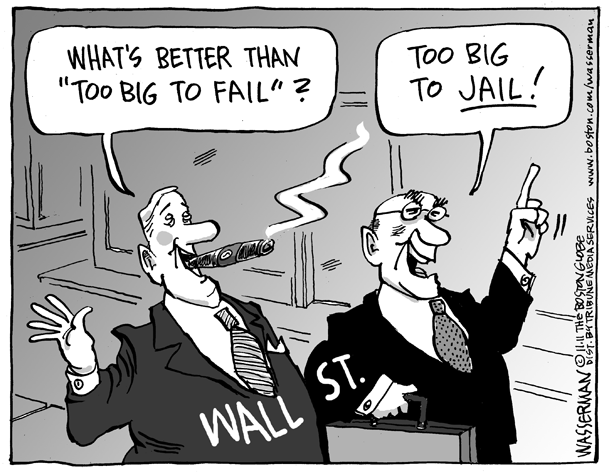


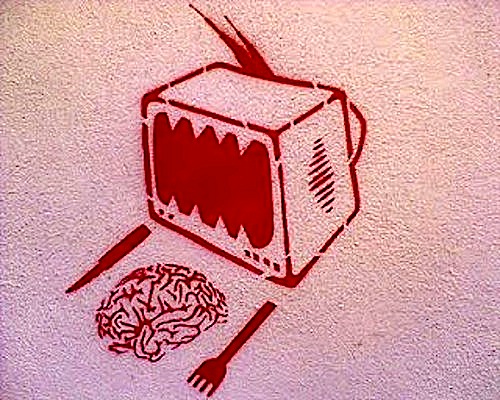




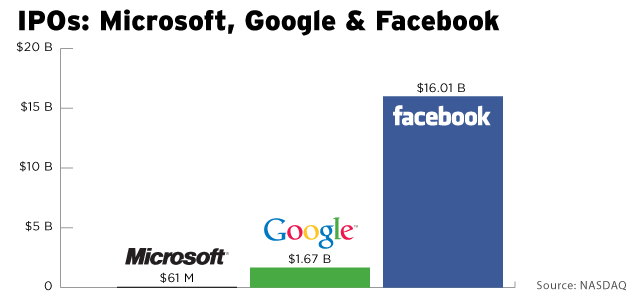

 Collapse of Industrial Civilization