With all the cataclysmic problems bearing down on mankind and his industrial civilization, one recurrent thought I have is, “Will humans ever get their act together?” I live in one of the more backward states of the union, so it comes as no surprise that we are at the forefront of the McDonaldization of society and the rejection of science. What a surprise for a state which ranks near the bottom of the nation’s education ranking. The latest evidence of this escapism from reality is AZ bill SB1213:
I’ve been told that during hard times like Depressions, or the current unravelling of industrial civilization, a lucrative job to have is fortune-telling, psychic reading, and similar hocus-pocus shenanigans which cater to peoples’ mental breakdown and flight into fantasy. So as the masses consult with palm readers in this time of slow-motion destruction, the sharks on Wall Street and our corporate overlords will continue to grab and pickpocket every last shred of wealth and revenue stream remaining on Main street. The Thieves in High Places will never go to jail because they’ve bought off all the branches of government and corporate personhood provides legal cover for their crimes.
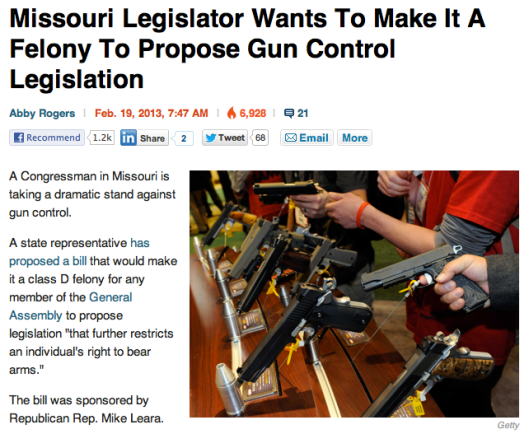
While the thought police are outlawing the reality of human-induced climate change, the ‘right to bear weapons of war’ crowd are doing the same.
According the head of the NRA, limiting the number of bullets a citizen can spray into the air is a threat to the well-being of society:
…Semi-automatic technology has been around for a hundred years. If you limit the American public’s access to semi-automatic technology, you limit their ability to survive…”
~ Wayne LaPierre
You can expect more and more of the above craziness to manifest itself in the coming years as reality, in the form of resource constraints and the ravages of unfettered capitalism, kicks into high gear and imposes itself on industrial civilization. I don’t mean to pick solely on the U.S. because this craziness is happening on a global scale wherever fossil fuel dependency has taken root and the Western way-of-life has been adopted. Nevertheless, America is the leader of this mass delusion. We’re even losing our sense of humor as we begin the great unwinding. How are we supposed to lampoon our leaders if they outlaw photoshopping?:
A war on satire cannot be a good omen for an Empire in decline.
Don’t you feel reassured of man’s ability to deftly navigate peak everything and climate chaos? If the human species doesn’t like something, it just legislates it out of sight and out of mind.
In my previous ‘arms industry’ posts (Guns, God, and Greenback$ as well as Guns ‘R U.S.), I alluded to the revolving door between the arms industry and the government and the corruption of politics by the money involved therein. In one of the most interesting interviews of 2012 aired today on DemocracyNow, arms industry analyst Andrew Feinstein, author of “The Shadow World: Inside the Global Arms Trade” and a former African National Congress member of Parliament in South Africa, sheds more light and insight on this very subject:
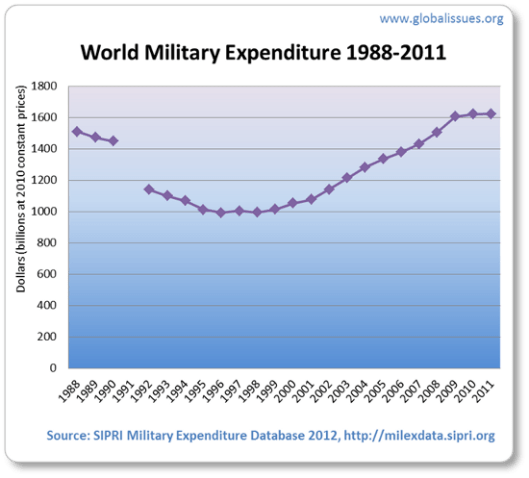
ANDREW FEINSTEIN: …The global arms trade is a $1.74 trillion-a-year business. That’s $250 for every person on the planet. And the profit motive behind the global arms trade is absolutely crucial. This is a business that is about big, big money. The trade contributes around 40 percent of all corruption in all global trade. So its impact on countries, on governments, on ordinary individuals in terms of the economic opportunity costs are absolutely massive.
Now, you will find that many spokespeople for the trade would try to distinguish between the legal or formal trade, on the one hand, and the illegal or illicit trade, on the other. I argue in the book that this distinction is a fallacy, that the boundaries are in fact extremely fuzzy and that the licit and the illicit are very closely intertwined, in addition to which the industry is largely protected because of its very close links to governments, to intelligence agencies, obviously to the military, and to lawmakers. So it is very seldom—even with the inadequate regulations that exist globally around the trade in weapons, it is very, very seldom that people who break those regulations are actually brought to book…
…Now, the situation that pertains at a global or international level has very many similarities with the domestic situation, particularly in the U.S., because let’s—let’s bear in mind while discussing this that the U.S. buys and sells almost as much weaponry as the rest of the world combined. So what happens in the U.S. is going to have enormous impact on the rest of the world. And what happens domestically, in terms of the ownership of weaponry within the U.S., really does, as I say, reflect the global trade in arms, in that we see it’s a $3.5 billion-a-year industry. And here we’re talking about smaller weaponry—about handguns, about assault rifles, semi-automatic weapons, the sorts that are used in the tragedy at Sandy Hook and all of the others that we’ve seen over the years throughout the U.S.
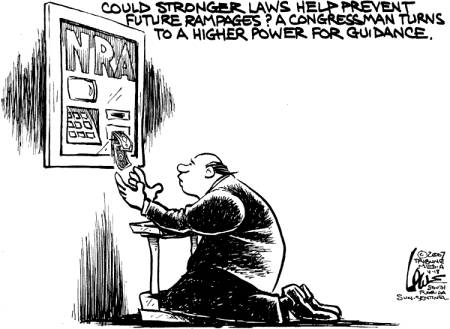
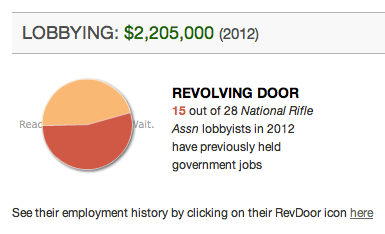
But the NRA, the gun sellers, the gun users seem to be afforded an extraordinary level of protection by government, by law enforcement authorities, just as happens on the global level. And part of this is because of the revolving door of people between, for instance, the NRA and government. Recent figures suggest that 15 of 28 officials in the NRA came from—sorry, lobbyists in the NRA came from important positions within government dealing with some of these same issues, so that the sorts of decisions being made by government are being informed disproportionately by those who want guns to be unregulated, by those who are making massive profits out the suffering of the victims of gun crime…
…let me make another point that I think is absolutely crucial about this and to understand where the NRA is coming from and, unfortunately, where the global trade in arms comes from, as well. And that is the linkages between politics and the gun lobby, and particularly, in terms of those linkages, money. One of the reasons that I focus on the global trade in arms in my work is because I saw, both in the context of South Africa, but also at a global level, the way in which money has come to pollute our politics. And the relationship between defense contractors on an international level and political parties and individual politicians are deep and profound. At a domestic level, the relationships between the NRA and specific elected representatives, not only in terms of money contributed, but also in terms of support given, are, again, profound. And unless we are able to break these linkages between money and politics that so pollute the way we are governed around the world, we will not be able to deal with some of the most intractable problems that face us as human beings —problems of the weaponization of the world, problems of climate change…
…I have not seen anywhere else in the world a gun lobby that has the same level of influence on its own government as the NRA does in the United States. My own assessment of what happened in July with the arms trade treaty is that the NRA, through the words of Mr. LaPierre and others, made clear to the Obama administration that it would make the president’s re-election a lot more difficult if he supported an international arms trade treaty. And I think it’s in that way that the NRA had such direct influence on the U.S. decision to effectively scupper negotiations for what in my opinion wouldn’t have been a strong-enough arms trade treaty, but would have been far better than any form of regulation that we have at the moment. So, yes, I think this is something of a unique situation, where a gun lobby has the extent of influence that it has in the United States of America…
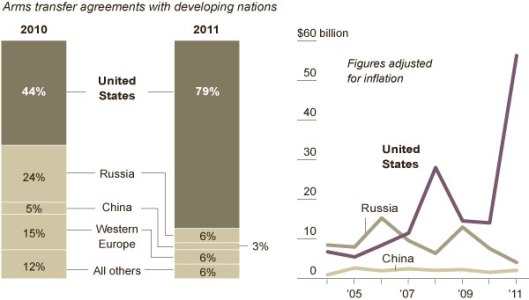
What I find most disturbing is that in an age of resource constraints and austerity measures aimed at the lower class, global sales from the arms industry are booming and that growth is coming primarily from the United States of America (aka ‘Guns ‘R U.S.’):
As was stated by Feinstein, the world-wide anti-corruption body, Transparency International, reports that the arms industry is one of the most corrupt business sectors, accounting for 40-50% of corruption in global trade.
Corruption plays a significant role in influencing arms procurement. But despite repeated scandals, this situation has been largely ignored by governments, NGOs and academics.” ~ Laurence Cockroft, Chairman of Transparency International’s UK chapter.
‘Commissions’ are the euphemism for bribes which are paid by manufacturers to governments and average at least 10% of contracts that run in the tens of $billions per year. Some reasons for the rampant corruption in the arms industry:
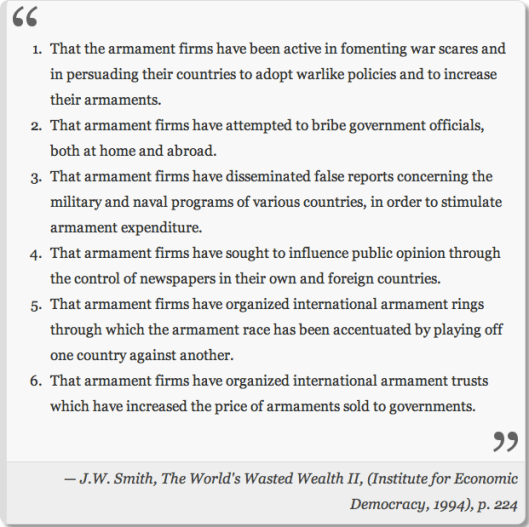
The merchants of death have only grown more powerful in recent times, and their horrific impacts to the well-being of humanity are as true today as they were after World War I when the League of Nations listed six primary criticisms of global arms dealers, as quoted by J.W. Smith:
Stung by the horrors of World War I, world leaders realized that arms merchants had a hand in creating both the climate of fear and the resulting disaster itself.
Americans need to understand that the NRA is very much a part of this global arms trade. If one follows the money, the reasons why the NRA is adamantly opposed to any sort of regulation on guns becomes painfully apparent. While the US domestic arms industry conveniently wraps itself and its profit motive behind the patriotic fervor of the Second Amendment and the colonial ghosts of Founding Fathers, the horrors of the Sandy Hook massacre are blamed on everything under the sun except for that which hides in plain sight — an unregulated, out-of-control global and domestic arms industry.
Obama’s history on gun control has been long on rhetoric and nonexistent on results. Politics was always the primary concern for him. Having studied Obama’s political behavior in Illinois, Ralph Nader said very discerningly in a recent speech that Obama is risk averse. He avoids confrontation with the powerful interests and caves in to their demands. From the too-big-to-fail banks to the for-profit healthcare insurance industry, Obama has shown himself to be a milktoast and socket-puppet of the corporate elite. Wow, what a surprise. Who knew you had to sell your soul to get into the White House? His tear-drenched words aside, Obama’s abysmal record speaks for itself:
…the president received a dismal review from the Brady Center to Prevent Gun Violence, one of the most visible gun-control advocacy groups.
“President Obama’s first-year record on gun violence prevention has been an abject failure,” the group wrote in a 2010 report, adding, “his campaign promises have gone unfulfilled and a year’s worth of opportunities to bring sanity to the gun issue have been lost.”
Should he want to bring forward legislation now, Obama faces a major obstacle: Congress. Even the Democratic-controlled Senate has shown little appetite to touch the controversial issue.
Multiple gun control bills have been introduced in recent years, but not a single one has advanced to a floor vote…. – link
And the ‘MericanPeople don’t wan’t nobody touchin’ their guns. Even after particularly horrific massacres of children, any uptick in favor of gun control quickly dies in the lesion-riddled brain of the United States of Amnesia:
With an economy predicated on growth, we’ll take it anyway we can, i.e. war and military Keynesianism. And the belief that every ‘Merican needs a gun is a part of that militarized American culture. Guns are the norm just like cars and televisions.
Clearly, increased gun availability has not protected America’s civil rights which have been whittled away in the age of the Security and Surveillance State. And it has not prevented the corporate takeover of the government either. I can, however, readily see that the profits of an active gun industry have been protected. This firearms industry then uses those profits to lobby state and federal legislatures for relaxation of restrictions on gun ownership and the de-criminalization of gun use – a familiar refrain in our government-corporate-lobbyist complex.
The NRA has spent 73 times what the leading pro-gun control advocacy organization, the Brady Campaign to Prevent Gun Violence, has spent on lobbying in the 112th Congress ($4.4 million to $60,000, through the second quarter of 2012), and 4,143 times what the Brady Campaign spent on the 2012 election ($24.28 million to $5,816). (One caveat on the data is that the NRA itself does a very poor job of accurately reporting its spending, and we must rely on its self-reports.)
As I pointed out in my last two blog entries, guns are a big and growing business for America, just like the metastatic growth of the military industrial complex over the last half century. The NSSF (the trade association for the gun industry), located just across the highway from Sandy Hook Elementary School in Newtown Connecticut, touts this fact in its 2012 Firearms and Ammunition Industry Economic Impact Report:
…During difficult economic times and high unemployment rates nationally, our industry has grown and created over 26,325 new, well-paying jobs over the past two years. Our industry is proud to be one of the bright spots in this economy.Take a look for yourself and see the impact we have nationally and on your home state.
The Firearms Industry Creates Jobs in America
United States companies that manufacture, distribute and sell sporting firearms, ammunition and supplies are an important part of the country’s economy. Manufacturers of firearms, ammunition and supplies, along with the companies that sell and distribute these products, provide well paying jobs in America and pay significant amounts in tax to the state and Federal governments.
Economic Impact of the Sporting Arms and Ammunition Industry in the U.S.
An Important Part of America’s Economy
Companies in the United States that manufacture, distribute and sell firearms, ammunition and hunting equipment employ as many as 98,752 people in the country and generate an additional 110,998 jobs in supplier and ancillary industries. These include jobs in companies supplying goods and services to manufacturers, distributors and retailers, as well as those that depend on sales to workers in the firearms and ammunition industry. [1]…
So the predictable outcome of a country awash in lethal guns would be more gun deaths. Oh that’s right, the NRA says “guns don’t kill people, people kill people.” Guns are just the handy instrument that is so effective for someone bent on maximum destruction. Is there political will to try to stop the toxic effects of this flourishing gun industry, a by-product of our war economy and militarized society? I doubt it. The sheer number of guns already in circulation will guarantee a continuum of grisly mass murders throughout the country far into the future. And as long as there’s money to be made from guns and weapons, nothing will ever really change:
“America isn’t a country. It’s a business. Now pay me my fucking money.” ~ Killing Them Softly
In the previous post, aubreyenoch commented on the toxic effects of our current socio-economic system, i.e. industrial capitalism. These “off balance liabilities” are a reality which persists despite the standard business-world practice of ignoring them. The last topic was guns; so lets look at how firearms have become an integral part of our economy. Reading the article ‘In America, guns are a boom, regulation a bust‘, we learn that America is driving the production and spread of guns here and abroad as well as propelling the creation of foreign gun industries:
…the Small Arms Survey, or SAS, an independent research group in Geneva, valued global small-arms sales for 2011 at $8.5 billion, more than double its 2006 estimate of $4 billion.
Although the increase partly reflects improved information gathering, the gun trade has undoubtedly expanded in recent years. The report identifies two primary sources: large government purchases for troops in Iraq and Afghanistan and increased spending by U.S. civilians.
Matt Schroeder, who heads the Arms Sales Monitoring Project at the Federation of American Scientists, says the U.S. “appetite for weapons” is one of the world’s largest and most diverse.
“There aren’t a lot of countries that are similar in terms of the quantities demanded and the types that are legally purchased here,” he said.
American small-arms purchases in 2009 accounted for 38 percent of the global total at $1.8 billion, more than 47 other leading importers combined, according to the SAS.
Private citizens provide the main source of demand for small arms around the globe. Of the 650 million firearms owned by civilians worldwide, more than 41 percent are in American hands.
It’s no surprise the United States has by far the highest proportion of guns per person, an estimated 89 civilian firearms per 100 residents…
And contrary to the popular fear by gun zealots that ‘Socialist’ Obama is going to take away their guns, he has not put forward any new gun laws and actually worked to relax regulations on the export of U.S. firearms abroad:
Despite decrying gun violence, however, Obama hasn’t pushed for gun control. His administration is also advocating new regulations that would make it easier to export weapons abroad.
Washington was chiefly responsible for the collapse of talks last summer on a UN arms trade treaty—a reflection of the vast political influence wielded by the U.S. gun lobby, which is spending tens of millions of dollars to ensure the highly lucrative industry keeps expanding…
Gun lobby groups have claimed credit for sinking United Nations negotiations over an international arms trade treaty last summer—when Amnesty International activists handed out bananas in New York’s Times Square, saying treaties regulate the global trade of fruit, but not guns and ammunition.
The talks concluded with no agreement on the draft text after the United States refused to sign, saying it needed more time to review the text.
Jeff Abramson, director of the Control Arms Secretariat, said the U.S. delegation’s actions were especially disappointing because the draft text satisfied all concerns Washington expressed during the negotiations.
“The best conclusion is that the Obama administration made a political decision to not deal with the treaty during an election cycle,” he said.
However, Abramson dismisses the NRA’s claim it “killed” the agreement, saying the strong American gun culture “makes it very difficult to have a rational conversation about regulations, even ones that do not impact U.S. law.”
Marsh agrees politics don’t fully explain the industry’s influence. Although gun owners who rushed out to buy more firearms after Obama’s first election may have contributed to the sales boom, the spending reflects a “much deeper, underlying trend” that dates back to 2001—and which he believes will continue for the foreseeable future.
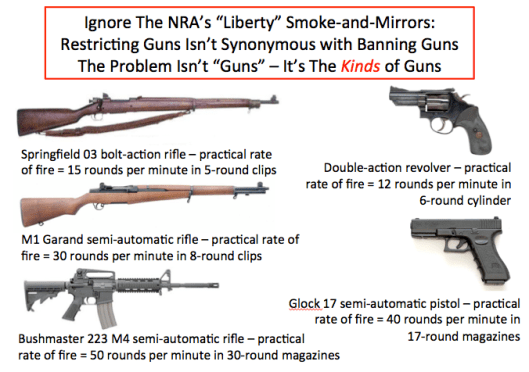
Now let’s look at some of the “off balance liabilities“. The flintlock pistols and muskets of bygone frontier days are a far cry from the firepower of today’s semi-automatic weapons, something the founding fathers did not envision:
It’s actually pretty fun, you’ve got the guns with Santa and everything and you get to hold them, just a fun family event,” said Scott Daugherty after taking a family photo with Santa as well.
This is the third year the gun club has offered this “Santa and machine guns” photo opportunity.
While some people find the idea of posing with Santa and guns inappropriate, the line out the gun club’s door proves gun aficionados love it.
“We got here about an hour early to make sure because last year the line was really crazy and we decided not to stay, so we figured we better come early this year, we were about third or fourth in line and we’re off to breakfast and ready to ship these pictures off to our family,” said a woman by the name of Abby on her way out.
Such a yuletide family event by Pax Americana in its twilight years:
I had to go back and look up the definition(wikipedia) of Christmas after seeing those photos. I have to wonder if this gun culture is reinforced by a country whose economy revolves around war and the militarization of our society. Maybe a previous President had a point when he said:
“We cannot be both the world’s leading champion of peace and the world’s leading supplier of the weapons of war.
Chart of Smith & Wesson revenues:
I’m sure this year will break records for gun sales. Oh, it already did:
And you think this species has a chance at long-term survival?
He looked like an assassin ready to go to war,” said Jordan Crofter, a moviegoer who was unhurt in the attack early Friday, about a half-hour after the special midnight opening of “The Dark Knight Rises.
Just a half hour drive from Columbine is the city of Aurora Colorado in which the latest ritual blood bath has been carried out in a hail of bullets. 71 hit and 12 dead.
Clad in a gas mask, ballistic helmet, and body armor from the neck down to the legs, the gunman burst into a theater after tossing in a couple of gas canisters. Was this a terrorist act from some fundamentalist Middle East group? No, it came from 24-year-old American James Holmes, described as “shy”, “high-achieving” and from a “good family.” He was in fact a college graduate with a bachelor’s degree in neuroscience. Tom Mai, a retired electrical engineer, said “the mother told him Holmes couldn’t find a job after earning a master’s degree and returned to school.” Holmes even left his apartment booby-trapped, a sort of double tap assault for those hunting him.
What can be said of this most recent disturbed outcry from modern civilization’s youth? I see it as a reflection of the perverse and twisted culture which this young person was faced with, an atomized society which commodifies everything in its site and turns all it can into a financial transaction of some sort. What is worth preserving of a society which destroys the future of its offspring with mountains of social debt in the form of exorbitant college loans, a degraded and polluted environment, no option for meaningful work, a two-tier class system of haves and have-nots, a rising Security and Surveillance State, and a world at war for the last of the earth’s resources? Of course this is all normal for a country that glorifies sociopathic behavior:
…Sociopathic behavior becomes normalized and even glorified in business culture, and the businessmen who are less sociopathic get eaten alive by the more sociopathic ones.
The entirety of business sociopathy is glorified by the nation’s culture, in art, media, etc. as tens of millions of Americans long to be the next Bill Gates, who is nothing more than a White Crips/Bloods gang member with glasses and a high IQ.
Less sociopathic businessmen who try to act decent are destroyed and then, for their decency, are attacked in common culture as losers, failures and even scum. Women avoid them and their families look at the ground when someone brings up their name. At the individual level, people who try to play fair and be nice are told that they are displaying loser attitudes and ordered to harden up and act more sociopathic.
Capitalism is really the normalization, rationalization, glorification and even deification of sociopathy across society.
My only surprise is that we don’t see more of these meltdowns taking place in this bankrupt and systemically corrupt system of ours. If you read medical journalist Robert Whitaker, America’s rise in mental illness has gone up in lockstep with “our society’s increased use of psychiatric medications.”
Another factor for America’s escalating random violence is the entrenched gun culture. America was awarded the dubious honor of being the ‘most armed country in the world’ by Reuters back in 2007. And lest we forget, America is the largest arms dealer in the world.
Surely the lack of effective gun laws that would prevent such massacres also is worth mentioning, thanks to the legendary lobbying power of the NRA whose motto was best exemplified by their now deceased spokesman Charlton Heston who said you can pry the gun “from my cold, dead hands.” America just loves its guns:
If there was a fast and sudden collapse of the economy and industrial civilization, America might be one of the last places you’d want to find yourself due to the above reasons I have described.




 The merchants of death have only grown more powerful in recent times, and their horrific impacts to the well-being of humanity are as true today as they were after World War I when the League of Nations listed six primary criticisms of global arms dealers, as quoted by J.W. Smith:
 From a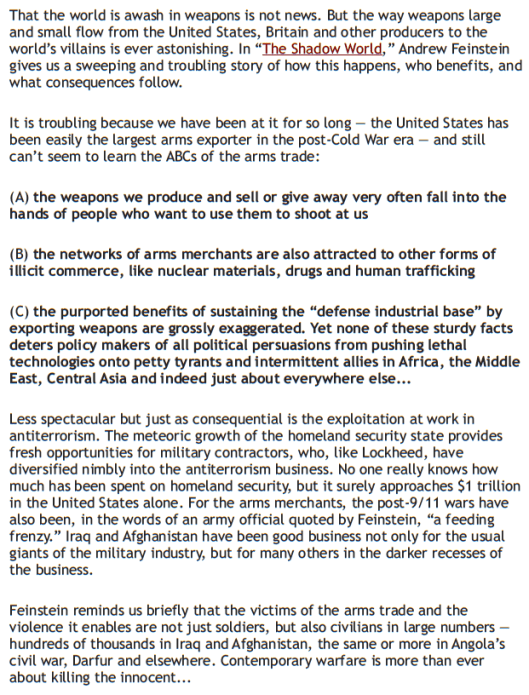






 Collapse of Industrial Civilization
