…So, with the most recent BLS data, 20% of the popular vote would be less than 48 million people. Of course, let’s be frank. Neither political party wants every American to vote. Voter suppression in both parties is as American as apple pie. The Republicans don’t want all of those people they have thrown under the bus to come to the polls. And, the Democrats don’t want all of those voters showing up that they endlessly lie to with empty promises. If one person-one vote democracy was really an intent under a system controlled by political parties, money couldn’t buy a politician, we would have a national voting day where everyone had the day off, we would have a system that truly educates people on issues rather than one of demagogy and lies, we would provide free public transportation to those unable to get to the polls themselves and numerous other incentives for people to vote. The smaller the turnout, the more the status quo benefits in a system of looting, pillaging, exploitation and corruption. Or so their perception goes… – link
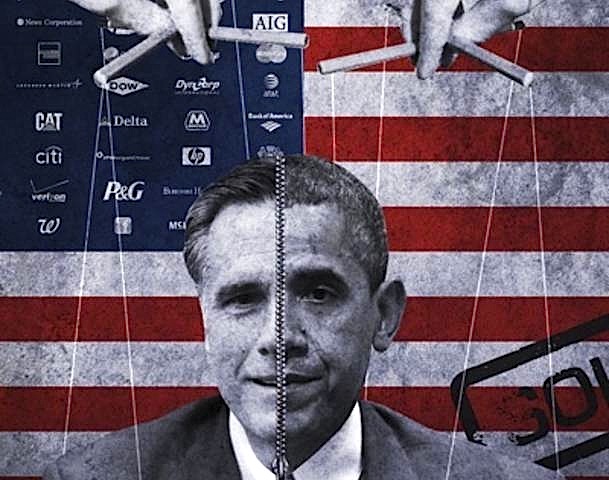
One thing is certain – both corporate puppets support the system that is killing you:
Post Script:
An important point was brought up by Alex Smith of EcoShock Radio about the numbers in this post. The list of top campaign contributors by Opensecrets does not include the dark world of Super PACs and other tax-exempt groups which can shield the identity of their donors – a billion spent on the presidential race. See the comments section of this post for further details.
Paul Street is one of the more insightful writers I follow and he has a new essay out which lists his version of the top threats to modern civilization. The conspicuous absence of these grave dangers from our political discourse prompts him to start off his article as follows:
The content and character of the 2012 U.S. presidential election does not bode well for the human race and other life on Earth. If the American people do not broaden the sphere of public concerns that matter far beyond the ones being discussed in this the latest big money-big media -major party-narrow spectrum-corporate-managed candidate-centered “electoral extravaganza” (Noam Chomsky’s phrase[2]), then there is not going to be a decent, desirable, or democratic future worth inhabiting. If we accept this and other such periodic U.S. elections as an adequate expression and spectrum of democratic politics and popular voice, we’re done for.
Well Paul, it is all corporate-funded theater and bread & circus for the mesmerized and pacified masses. What more would you expect from a society whose governing institutions and news media have been usurped by the greed of monied interests? Both mainstream parties are on the corporate dole, a situation best summed up by the following comment:
…America’s history has always been about the battle between plutocracy and democracy. Since WWII, we’ve built the military-industrial complex, we’ve allowed campaign funding to reach insane proportions, we’ve introduced the most effective means of propaganda ever created (the TV) into every home, and we’ve de-regulated Wall Street into a behemoth. We’ve allowed the corporate structure to infect our democracy at the deepest levels as well as most people’s personal lives in a fundamental way (health care and pharmaceuticals, banking and debt, the fact that most of the country has to shop at Walmart to be able to break even each paycheck, etc.).
The plutocrats have been routing democracy in a steady succession the past 50+ years. Our democracy is now a hollowed-out shell completely subservient to corporate interests at all levels. This is not crazy liberal talk – it’s simple reality. Citizens United was just the icing on the cake…
Number one on Paul Street’s list cannot be denied – climate change. Here’s what he writes about this civilization-ending problem which has been avoided at all costs by the mainstream media even after the devastation in New York:
Climate change is a threat multiplier. It will make unstable states more unstable, poor nations poorer, inequality more pronounced, and conflict more likely,” Huhne is expected to say in a speech to defence experts. “And the areas of most geopolitical risk are also most at risk of climate change.”
He will warn that climate change risks reversing the progress made in prosperity and democracy since the industrial revolution, arguing that the results of global warming could lead to a return to a “Hobbesian” world in which life is “nasty, brutish and short”.
And the U.S. military already acknowledged the threat of human-induced climate change to the stability of nation states in a 2007 report, National Security and the Threat of Climate Change. In recent years, congressional witnesses speaking on the dangers that climate change poses have been unequivocal in their warnings:
· On October 15, 2009, retired USAF General Charles F. Wald testified before the Senate Foreign Relations Subcommittee, reiterating the CNA finding, saying that “we must… now prepare to respond to the consequences of dramatic population migrations, pandemic health issues and significant food and water shortages due to the possibility of significant climate change” and that “Energy security and a sound response to climate change cannot be achieved by an increased use of fossil fuels.”
· In May, 2009, retired USN Vice Admiral Dennis McGinn in testimony before the Senate Foreign Relations Committee pointed to an “over reliance on fossil fuels” and said that “climate change has the potential to create sustained natural and humanitarian disasters on a scale and at a frequency far beyond those we see today.
So we should expect that a future of unstable climate which increasingly puts our food production in jeopardy will also lead to an increased risk of weapons of mass destruction being used by failing countries – desperate and angry fingers on the trigger of nukes. Homer-Dixon’s scenario on climate change and armed conflict is prescient. An article from 2007 reveals the inevitable truth about the energy-water-food-climate nexus and social breakdown:
…Homer-Dixon was writing more than 15 years ago about climate change leading to a rise in violent conflict and state failure.
Then, his pronouncements found only a small audience, and held little sway in the halls of power in Washington or New York.
Now, he is briefing UN Security Council members about his theories of “synchronous failure”, a much in-demand author of a bestseller warning of impending catastrophe, The Upside of Down.
…Homer-Dixon believes “major volatility” in nation-states and in the international order is the inevitable outcome of climate change. His theory rests on the premise that many nation-states are highly stressed and hopelessly addicted to energy, what he terms the “master resource”.
Climate change will be the factor that pushes many vulnerable states to the edge, and over it.
Some nations will find their resources overwhelmed as they struggle to cope with massive internal movements of people displaced as fertile land becomes unproductive and water shortages emerge.
…a rise in the Earth’s temperature of one to two degrees – will have significant impacts.
He says modern states are in a similar predicament to the declining Roman Empire.
The massive cost to Rome of maintaining and feeding its subjects, bureaucracy, militaries and cities required more and more energy. In the end, the energy could not be found, leading eventually to the collapse of a great empire.
Similarly, a “complex” globalised world is expending more and more energy to underpin societies reliant on relentless economic growth.
In what Homer-Dixon describes as an “astonishing statistic” he notes that the energy consumed in producing and transporting food around the world has risen 80-fold in the past century while the population has quadrupled to 6 billion over the same period.
Using a measure he called the “energy return on investment”, Homer-Dixon finds the search for energy is requiring an ever-increasing amount of resources at a time when demand for it is rising rapidly.
It is a situation that he says is fast becoming unsustainable. Oil will become too expensive, while nuclear energy requires a massive investment in money and energy, just to get it off the ground.
And he notes another dilemma. Fixing the effects of climate change will require massive amounts of energy in itself.
“Building sea barriers, moving huge numbers of people displaced by changing weather, building new infrastructure … all these types of things, the solutions to climate change, require lots and lots of energy.”
And as governments become incapable of discharging their basic responsibilities of statehood, the vacuum will be filled by chaos and conflict…
Number three and four on Paul’s list is mass poverty and inequality. He writes:
Perhaps we should mention that mass poverty and inequality stem from unfettered capitalism which has reached its full fruition in the buy-off of our government and the total corruption of regulatory, judicial, and legislative institutions by the profit-driven interests of multinational corporations. The social contract has been broken; the political discourse for the public has degenerated into meaningless wedge issues; and society has been atomized and isolated into ‘individual consumers’, a mere member of a marketing demographic whose only voice is to choose between product X or Y.
Number five on Paul’s list is the likelihood of another epic financial crisis. Our financial system is limping along, but its demise is written in stone. Without cheap energy, the underlying backbone of our economy, our growth-oriented system cannot survive for very much longer. As I said before, money is simply a token of energy exchange and has no intrinsic value of its own. If we now take into account our fossil fuel energy system’s external costs (environmental damage, ill-health costs, climate change destruction, resource wars such as Iraq, etc), then we’d be in debt up to our eyeballs. As I explained in this post, the net benefits of burning fossil fuels will eventually be negated by the net costs.
Number six on Paul’s list is “long-term structural employment and enforced obsolescence of tens of millions of formerly middle and working class Americans.” The worker is disposable, and long-term unemployment is endemic to capitalism. The corporate drive for maximizing profits is the primary goal and thus follows the policy of keeping worker numbers and their wages as low as possible. Automation, outsourcing of jobs, and employing part-time workers are some of the ways corporations suppress labor.
Paul lists number seven as “racism and racial inequality.”:
…Nobody raises a peep about racially disparate mass incarceration or segregated schools or black inner city neighborhoods with unemployment and poverty rates over 40 percent…
Looking back in history to the genocide of Native Americans and now to today with the ‘War on Terror’ and its related racism towards Muslims, the U.S. empire has always demonized anyone who stands in its way. Nationalism, racism and xenophobia always rise in times of economic downturns, no matter the country, when scapegoats are created to vent people’s anger and frustration as well as shift blame. Today is no different:
And the last one is U.S. militarism. I would rank this one much higher on the list and I’ve posted on this subject extensively, but the following video does a nice job of summing things up:
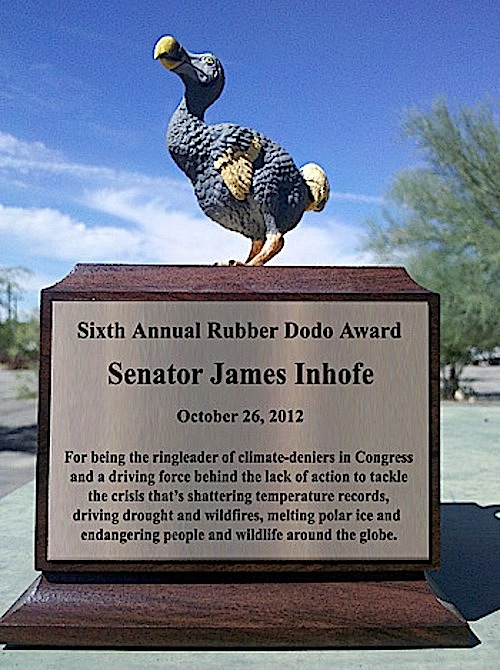
I heard about this dubious award via Your Medieval Future. Why did it take so long for this guy to get the award?…
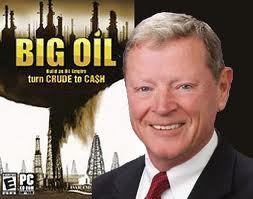
And here is Senator Inhofe’s politically polarizing response, spoken like a true anti-science zealot and mouthpiece for the fossil fuel industry:
I am truly honored that yet another radical environmental group has given me an award for my efforts to put a stop to President Obama’s far-left global warming agenda,” Senator Inhofe said. “The Center for Biological Diversity should be pleased to know that my award will have a prominent place in my office, along with all the others I have been proud to receive over the years. As the top Republican on the Senate Committee on Environment and Public Works, I have worked every day to expose the radical left’s extremist agenda aimed at ending American production of oil, gas, and coal because of the devastating consequences it will have on the American people.
Despite the fact that some of us are intelligent enough to see the coming collapse from unmitigated depletion of the earth’s non-renewable resources, overpopulation, climate disruption from the massive burning of fossil fuels worldwide, the human-induced 6th mass extinction, CO2-acidification of the oceans, and the resultant destruction of our modern industrial agriculture base, we are all lumped into the category of ‘radical left extremists‘ for recognizing such scientific realities. In Inhofe’s world, there is no environmental crisis and humans can adapt to whatever toxic sludge pile industrial civilization creates out of the planet. In a world where the true conservatives are those who want to keep the planet habitable for humans, people like Senator Inhofe will ensure that we all face the same fate as that of the extinct Dodo bird.
I think we can safely shorten that time span to no more than 50 years. Right now I’m with my family, so postings will be light to nonexistent until the beginning of October when I will essentially be in seclusion once again to read more often and study the state of the world. As I write this post, one particular story that stands out is the discovery by Russian scientists of ‘methane fields’ exceeding 1 kilometre escaping from the Laptev Sea, as elaborated upon by Arctic News. In the views of these scientists, methane plumes like the ones they are observing could be catastrophic to this planet’s climate. Other than some obscure website, is anyone talking about the destruction to our food supply that climate change will surely bring about? Make no mistake, this is real news as opposed to the MSM’s three-ring political circus or the perverse reporting of decadent Hollywood parties to toast the christening of a new luxury jaguar car.
Many scientists are saying that the only thing that will save us is global coordinated action and a Manhatten project of geoengineering to halt any further damage from our CO2 emissions and its catastrophic impact on the environment. Others have lamented the total failure of governments to look after the well-being of their people:
Fossil fuel companies are still making profits despite the fact that climate change is so clearly upon us. Our politicians are putting corporate interests above scientific warnings and failing in their duties to the public.”
– link
The Arab Spring and Occupy Wall Street were initially grassroots movements which evolved as a response to the gross social inequalities of neoliberal capitalism. Washington inadvertently created both movements through their push of the aforementioned economic policies which have made a few extremely wealthy at the expense of those country’s populations. In the near future, the issue of corporate profits over the environment will become a driving force for future social unrest and revolt.
In the end, our ill-conceived exchange of fossil fuels for a stable biosphere will be worse than a zero-sum game when you take into account the hell that climate change will wreak. On our present course, we will be left with an uninhabitable planet. We have only seen the beginning inklings of what human-induced disasters such as drought, ocean acidification, deforestation, and mass species extinction will mean to industrial civilization which has become completely delusional about its “victory” over nature:
Let us not, however, flatter ourselves overmuch on account of our human victories over nature. For each such victory nature takes its revenge on us. Each victory, it is true, in the first place brings about the results we expected, but in the second and third places it has quite different, unforeseen effects which only too often cancel the first. The people who, in Mesopotamia, Greece, Asia Minor and elsewhere, destroyed the forests to obtain cultivable land, never dreamed that by removing along with the forests the collecting centres and reservoirs of moisture they were laying the basis for the present forlorn state of those countries. When the Italians of the Alps used up the pine forests on the southern slopes, so carefully cherished on the northern slopes, they had no inkling that by doing so they were cutting at the roots of the dairy industry in their region; they had still less inkling that they were thereby depriving their mountain springs of water for the greater part of the year, and making it possible for them to pour still more furious torrents on the plains during the rainy seasons. Those who spread the potato in Europe were not aware that with these farinaceous tubers they were at the same time spreading scrofula. Thus at every step we are reminded that we by no means rule over nature like a conqueror over a foreign people, like someone standing outside nature — but that we, with flesh, blood and brain, belong to nature, and exist in its midst, and that all our mastery of it consists in the fact that we have the advantage over all other creatures of being able to learn its laws and apply them correctly.” ~ Frederick Engels
The Earth giveth and she taketh away. Short-sightedness, greed, and conceit are traits undeserving of long-term survival on this once generous but now scorned planet.
The following is an excerpt from an article published just yesterday by Vijay Prashad, chair of South Asian history and director of international studies at Trinity College and author of Arab Spring, Libyan Winter. To understand why those on the blunt end of American foreign policy feel compelled to lash out, you should read this:
Western support for Gaddafi not forgotten
…After 9/11, when the West wanted to outsource torture to prisons outside its direct control, Gaddafi (like Mubarak and Syria’s Assad) offered his services. In March 2004, the US opened a diplomatic mission in Tripoli, and the CIA opened up an office there as well. Later that month, Tony Blair came to Libya, the first British prime minister to visit the country since 1943, and he spent considerable time talking about commercial interests (to get Shell its oil concessions) and the “common cause” in fighting terrorism. Blair was excited to meet Gaddafi (the “Leader,” as the British faxes to Tripoli put it) in his tent because “journalists would love it. If this is possible, No. 10 would be grateful.” As quid pro quo, the British organized the “rendition” of LIFG [Libyan Islamic Fighting Group] militants into the hands of the Gaddafi regime. “This was the least we could do for you and for Libya to demonstrate the remarkable relationship we have built over the years,” wrote Sir Mark Allen, head of Britain’s MI6 to Gaddafi’s henchman Moussa Koussa on 18 March 2004. The specific matter here was the “safe arrival of Abu Abdallah Sadiq,” the nom de plume of Abdul Hakim Belhadj, former emir of LIFG and now leader of the al-Watan political party (and a crucial leader of the military part of the 2011 Revolution).
A comprehensive Human Rights Watch report, Delivered into Enemy Hands: US-Led Abuse and Rendition of Opponents to Gaddafi’s Libya, released last week details the stories of a number of the leading figures who were arrested around the world, tortured in US-run prisons in Afghanistan and elsewhere, and then delivered back to Libya. They were handed over to the Libyan authorities with full-awareness that they were going to be tortured or even killed. Belhadj and his wife, Fatima Bouchar (four months pregnant at the time), were picked up in Malaysia and allegedly tortured by the CIA in Bangkok, Thailand. Bouchar told Human Rights Watch, “They knew I was pregnant. It was obvious,” and yet, she, who had no affiliations with any militant groups, was chained up and given no food for five days. The couple were then taken to Libya. In one fax, the CIA thanks the Libyan security service for its “hospitality” and says that its visit was “very productive.” When the couple arrived in Libya, Moussa Koussa chillingly greeted Belhadj, “I’ve been waiting for you.”
In April 2012, Belhadj told the European Parliament, “All we seek is justice. We hope the new Libya, freed from its dictator, will have positive relationships with the West. But this relationship must be built on respect and justice. Only by admitting and apologizing for past mistakes can we move forward together as friends.” People like Belhadj stand for a social section that has had its dignity compromised by Western actions. A longing for dignity drives revolts. It is what compelled the rebellion against Gaddafi’s regime. It is what remains a major catalyst for unrest in the region against Western interests, particularly since there will be no apology for the rendition program or for the close, even servile, collaboration with the Gaddafi regime from, at least, 2003 to 2011. Gaddafi’s henchman, Moussa Koussa was spirited off on a British military plane in March 2011, payback for his services to MI6, and now lives in a comfortable bungalow in Doha, Qatar. Neither he, nor his friend Sir Mark Allen, nor the CIA’s Steve Kappes, will ever have to admit to what they did, apologize for it, or be charged with grave violations of international law.
The humiliations accumulate without outlet.
Libyan rage despite elections
The elections in July heralded an opening for Libya. The results were celebrated in the West, since it seemed that unlike Tunisia and Egypt, the Islamists had not garnered the fruits of the revolts. The neo-liberal sections, led by Mahmoud Jibril’s National Forces Alliance won a majority. Jibril had been the political face of the Libyan Diaspora. After a career in the Gulf, he returned to Libya in the 2000s at the urging of Saif al-Islam Gaddafi, who wanted to convert his country into a “Kuwait on the Mediterranean.” When things did not work out as planned, Jibril got frustrated. He had no political base. When the rebellion broke out, Jibril threw in his lot with it, and thanks to NATO intervention, was able to use his affinity with the West to put himself into a position of political power. His victory in the polls vindicated NATO, which now felt that it had its man in charge – open to sweetheart deals for Western oil companies and eager to push further the neo-liberal agenda that was constrained five years ago…
And in a recent article in the Hindu Times concerning the writings of the above author Vijay Prashad:
Over Libya, Prashad shows just how dirty western conduct has been. Libya, one of Africa’s wealthiest countries, was seriously harmed by U.N. sanctions imposed in 1992 for its alleged involvement in the bombing of a U.S. airliner over the Scottish village of Lockerbie in 1988 (a crime yet to be satisfactorily explained, even according to some of the families who lost loved ones in the attack). The chaos following the illegal invasion of Iraq in 2003, however, revived western fears over access to oil; George W. Bush and Tony Blair renewed links with Qadhafi, who while no saint himself was now easy prey for Libyan neoliberals — including his son Saif al-Islam, the politician Mahmoud Jibril, the oil corporations, and consultants like McKinsey.
Sensing likely exclusion from the spoils, the eastern region of Cyrenaica rebelled. This was the excuse the Atlantic powers wanted; Qadhafi had long alienated Saudi Arabia, which effectively pushed the Arab League into supporting the U.N. no-fly zone over Libya (only 11 of the 23 members attended the vote), and the west totally ignored the African Union’s strong mediation plan. Western officials’ wild claims of genocide and mass rape — still unproven — by government forces helped override Arab leaders’ doubts, and by the time the latter withdrew their support for the no-fly zone it was too late. Mahmoud Jibril emerged as prime minister of the new state. And a dead Qadhafi could tell no tales…
Sociologist Mahdi Darius Nazemroaya explains how the West uses an instrument called “CONTACT GROUPS” in order to facilitate the toppling of governments and secure the interests of multinational corporations and neoliberal capitalism.
Anybody who has studied how the US and NATO worked to topple the Jamahiriya in Libya knows that the US has tried to replicate the same regime-change mechanism in Syria.
The formation of multilateral contact groups supporting proxy oppositions has been a key to this process. What most people do not know is that the Americans’ contact group industry started in Somalia…
…The NTC [National Transitional Council] has privatized Libya’s assets and siphoned off its wealth under the management of Libyan-American neo-liberal economist turned “oil and finance minister” Ali Tarhouni. Libya’s oil is no longer in the hands of Libyans, who are now too busy fighting one another with RPG launchers, armored vests, and light infantry rifles, courtesy of NATO.
In Somalia and Libya what has replaced the ICU [The Islamic Court Union] and Jamahiriya is a never-ending state of “transition” and enclaves of guarded bureaucrats tied to Washington, Brussels, the IMF, and World Bank, who are detached from the violent reality in their countries.
Outside of these bureaucratic offices, the rule of law has crumpled and the streets are run by militias and thugs. The Libyan Islamic Fighting Group (LIFG) took over in Libya and Al-Shaabab ran wild in Somalia, both with the help of foreign fighters.
The word on the street is that all the candidates in the recent Libyan election were proxies of Western imperialism, and the winner appears to be hand-picked:
Libya’s national congress picked Mustafa Abu Shagour as prime minister on Wednesday, the US-trained optical engineer naming improved services and security as his priorities a day after suspected Islamist gunmen killed the US ambassador to Libya.
Abu Shagour defeated wartime rebel premier Mahmoud Jibril in a close second round vote by 96 votes to 94 in a contest that was shown live on national television.
As government chief he will be responsible for the day-to-day running of Libya’s oil-based economy while the national congress elected in July passes laws and helps draft a new constitution for the North African state…
The vote was overshadowed by the killing of the US ambassador to Libya, Christopher Stevens, and three other Americans in an attack on the US consulate and a safe house refuge in Benghazi.
“It makes security high on my priorities,” he said…
I wonder if he’ll follow in the footsteps of Iraq’s Prime Minister Nouri al-Maliki:
Paul Ryan, cool cat wannabe, loves Rage Against the Machine’s music, he says. He must not listen to the lyrics. Here’s what the band’s guitarist/activist Tom Morello has to say:
Ryan’s love of Rage Against the Machine is amusing, because he is the embodiment of the machine that our music has been raging against for two decades. Charles Manson loved the Beatles but didn’t understand them. Governor Chris Christie loves Bruce Springsteen but doesn’t understand him. And Paul Ryan is clueless about his favorite band, Rage Against the Machine.
And of course he had to recently disavow himself from his ethical and spiritual idol, Ayn Rand:
Such pompous, self-serving, and seemingly sociopathic behavior among the elite in capitalist America is nothing new. As a matter of fact, it seems to have always been the norm in American history:
I recently read a book by University of Maryland historian Terry Bouton,Taming Democracy, which is an account of the intense struggles over wealth and power that emerged in the earliest days of the United States. Bouton’s detailed research was focused on Pennsylvania, but he describes patterns that also appeared elsewhere in the infant republic.
The core of the story he tells is that the colonial coalition that made possible the political break with Britain fractured even while the Revolutionary War was still in progress, as wealthy interests in the colonies quickly had second thoughts about the democratic fervor that they had helped to set in motion and how it might jeopardize their ability to amass still more wealth….
…The story demonstrates that strong class consciousness and class-specific drivers of policy have been a major part of American politics since independence. A key part of that class struggle all along has been a strong sense among a wealthy elite of separateness from the non-wealthy, and of having a right to push hard for public policies that favor their own class even if they are clearly detrimental to others.
A major figure in Bouton’s account is the Philadelphia merchant and financier Robert Morris…
…An even more blatant ploy of using government to favor his own class’ interests at the expense of others concerned speculation in war debt. Amid poverty, scarcity of money, and uncertainty about government funding of debt, many holders of IOUs — who had furnished support to the war effort ranging from food to blacksmithing — sold them for cents on the dollar to speculators who hoped to redeem them eventually for much more than that.
Morris not only participated in this game but openly promoted it. He told the Continental Congress in 1782 that speculators should be encouraged to buy up the IOUs “at a considerable discount” and then have the government bring the pieces of paper “back to existence” by paying them off at top dollar.
This big transfer of wealth would provide the affluent with “those funds which are necessary to the full exercise of their skill and industry.” Bouton writes, “As Morris saw it, taking money from ordinary taxpayers to fund a huge windfall for war debt speculators was exactly the kind of thing that needed to be done to make America great.”
We have tended to whitewash such aspects of American history from our consciousness, for several reasons. One is the hagiography we customarily apply to the Founding Fathers. Another is that we lose sight of the connections between class consciousness of the past and that of today by euphemizing today’s version and espousing more subtle notions of trickle-down economics than the crude version that Morris espoused.
People of his economic stratum were known at the time as “gentlemen”; today they would more likely be called “job creators.” A further reason is Americans’ belief in the national myth that America is less stratified into classes, and exhibits more mobility between classes, than do other countries and especially the old countries of Europe. That myth has become increasingly distant from fact in recent decades…
For those who believe that class structure and the struggles therein do not exist in America, history shows that it has always been a part of our country, reasserting itself with a vengeance in recent times. With the elite having a lock on mass media and now the use of the empire’s security and surveillance state to squash dissenters, malcontents, and any challengers of the status quo, there does not seem to be any going back to a society embodied by a strong middle class, especially in an age where the economic pie is forever shrinking.
Jeffrey Sachs’ op ed piece entitled “America Has Lost the battle Over Government” in the Financial Times explains how the budget plans of our two corporate candidate stooges are strikingly similar and offer no real choice for the American citizen. With the modern-day instruments of mass media manipulation being the most sophisticated tool for mind control in the history of man, you are made to think that the current election is an epic struggle between the forces of good and evil, but the American’s fate of joblessness, dwindling social assistance programs, a permanently growing underclass, and the slide into an oligarchic Third World country has already been written in stone by the transnational capitalist forces and its corporate state. Crime will surely go up, lifespan expectancy will go down for the underclass, and the infrastructure of the nation will continue its trajectory into dilapidation and decay. Sacrificing your body in the Empire’s foreign resource wars and geopolitical games will be one of the only jobs available for our debt-ridden youth:
…Mr Ryan’s plan calls for federal revenues of 18.4 per cent of gross domestic product in 2016 and 18.5 per cent in 2020 (though his lower tax rates would probably put those targets out of reach). His budget outlays come in at 19.7 per cent and 19.5 per cent in 2016 and 2020, respectively. Of the total outlays in 2016, Mr Ryan targets “discretionary” programmes at 5.9 per cent of GDP; social security, 5 per cent; Medicare, 3.2 per cent; other mandatory spending, 3.7 per cent; and interest payments, 1.9 per cent.
Now consider Mr Obama’s budget unveiled in February. Federal revenues are targeted at 19.1 per cent of GDP in 2016 and 19.7 per cent of GDP in 2020, only about 1 percentage point above Mr Ryan’s revenue targets. In Mr Obama’s 2016 budget targets, discretionary spending is set at 5.9 per cent of GDP; social security, 5 per cent; Medicare, 3.2 per cent; other mandatory spending, 5.8 per cent; and interest payments, 2.5 per cent.
In fact, Mr Obama’s overall discretionary spending targets are essentially the same as Mr Ryan’s. Whether Mr Obama or Mr Romney wins, the “non-security” discretionary budget – for education, job skills, infrastructure, science and technology, space, environmental protection, alternative energy and climate change adaptation – is on the chopping block. Mr Obama’s budget would shrink non-security discretionary programmes from an already insufficient 3.1 per cent of GDP in 2011 to 1.8 per cent in 2020. That is the “liberal” alternative.
In bemoaning Mr Obama’s budget, I do not mean to equate it with Mr Ryan’s. Mr Ryan’s budget is nothing short of heartless in the face of the dire crisis facing America’s poor. It is also reckless, guaranteed to leave millions of children without the quality of education and skills they will need as adults. Yet the sad truth is that the Democrats offer no progressive alternative. Both parties are accomplices to the premeditated asphyxiation of the state. Viewed from an international perspective, the constricted range of the US fiscal debate is striking. Total US government revenues (combining federal, state and local governments) in 2011 came in at about 32 per cent of GDP. This compares with an average of 44 per cent in the EU and 50 per cent in northern Europe.
Many Americans will say that they are dodging the European curse by keeping taxation so low but they should look again. Northern Europe (Germany, the Netherlands, Denmark, Finland, Norway and Sweden) gets great value for its tax revenues: lower budget deficits, lower unemployment rates, lower public debt-to-GDP ratios, lower poverty rates, greater social mobility, better job training, longer life expectancy, lower greenhouse gas emissions, higher reported life satisfaction and greater macroeconomic stability.
America’s two political parties depend on wealthy contributors to finance their presidential campaigns. These donors want and expect their taxes to stay low. As a result, social divisions, broken infrastructure, laggard educational attainments, high carbon emissions and chronic budget deficits are likely to continue no matter who is elected, even though the public supports higher taxes on corporations and the rich…
Chris Hedges was back in court over the government’s appeal of Judge Forrest’s earlier injunction of the NDAA. As a matter of fact, the government has refused to comply with the injunction. Hedges states he and the other plaintiffs “will most likely have to continue this fight in an appellate court and perhaps the Supreme Court.” He also notes that no matter the results of the rigged U.S. elections, no meaningful change will come to the deteriorating lives of ordinary Americans:
…The corporate state has convinced the masses, in essence, to clamor for their own enslavement. There is, in reality, no daylight between Mitt Romney and Obama about the inner workings of the corporate state. They each support this section within the NDAA and the widespread extinguishing of civil liberties. They each will continue to funnel hundreds of billions of wasted dollars to defense contractors, intelligence agencies and the military. They each intend to let Wall Street loot the U.S. Treasury with impunity. Neither will lift a finger to help the long-term unemployed and underemployed, those losing their homes to foreclosures or bank repossessions, those filing for bankruptcy because of medical bills or college students burdened by crippling debt. Listen to the anguished cries of partisans on either side of the election divide and you would think this was a battle between the forces of light and the forces of darkness. You would think voting in the rigged political theater of the corporate state actually makes a difference. The charade of junk politics is there not to offer a choice but to divert the crowd while our corporate masters move relentlessly forward, unimpeded by either party, to turn all dissent into a crime…
A lot of Americans buy into this “cult of individualism” and anti-government sentiment which the elites of the corporate state artfully peddle in order to dismantle any remnants of a functioning government that might serve the common good of its citizenry. In this way, the corporate state has convinced the masses to cheer the destruction of government and its beneficial roles. But of course we cannot call our lobbyist-infested, corporate-controlled government an actual representation of the people’s interests. Just as our two-partied presidential election is an orchestrated illusion of democracy, so is the false dichotomy of government and corporations which are merely separated by a revolving door. The government has become, for the most part, a tool for wealth extraction by multinational corporations. During a period of multiple civilization-ending crises when leadership is in dire need, the degeneration of government from a socially beneficial entity into a puppet of Wall Street’s rapacious greed is the greatest tragedy of our time.
If Ayn Rand was alive today, she would believe that climate change was a conspiracy theory.
I want to preface this post by saying I don’t endorse either Wall Street stooge of our political system’s two-headed corporate hydra monster. The Democratic party fell sway to Big Money a long time ago. See ‘Death of the Liberal Class‘ by Chris Hedges. But I do want to focus on the party that doesn’t mince words or even pretend (at least not very well for those who read) to represent the greater good of society. The primary ideology of the Republicans (and faux Democrats) is neoliberal capitalism whose tenets are laid out here. If there ever was a time when ‘the greater good’ should be our primary objective, the time is now. We are facing an environmental crisis, financial crisis, economic system crisis, food crisis, energy crisis, wealth disparity crisis, etc. Oh, I should have mentioned we’re also facing the possible probable extinction of our own species. But the modus operandi that the our leaders rulers are following is not to solve any of the civilization-ending crises, but to do what Richard Heinberg described as the “Last Man Standing” strategy:
I thought that world leaders would want to keep their nations from collapsing. They must be working hard to prevent currency collapse, financial system collapse, food system collapse, social collapse, environmental collapse, and the onset of general, overwhelming misery—right? But no, that’s not what the evidence suggests. Increasingly I am forced to conclude that the object of the game that world leaders are actually playing is not to avoid collapse; it’s simply to postpone it a while so as to be the last nation to go down, so yours can have the chance to pick the others’ carcasses before it meets the same fate.
The elite 1% are playing a similar game against the 99% which I call “The Last Man Scrambling”. Paul Rosenberg’s latest essay discusses a 2006 book by Yale University political scientist Jacob S. Hacker who explains how the 99% are being financially eaten alive by what is termed the “risk-shift” – the systematic shifting of risk from large institutions onto the backs of citizens, including the most vulnerable among us, under the neoliberal rhetoric of “individuals taking personal responsibility”:
…The figures Hacker cited were staggering. First, regarding basic economic security: Personal bankruptcies increased from 300,000 in 1980 to 2 million in 2005 – a 567 per cent increase. The chance that an average American’s income will drop 50 per cent or more over a two-year period increased from 7 per cent in the 1970s to 17 per cent in 2002 – a 143 per cent increase. Long-term unemployment (more than 6 months) at the peak of the business cycle is triple what it was in the 1960s.
Second, regarding health security: The number of Americans without health insurance was 46.6 million, up from about 24 million in 1980. The decline was entirely due to cuts in employer-provided health coverage. Worse still, over 80 million Americans lack health insurance over some time during a two-year period.
Third, regarding retirement security: The percentage of large and medium-sized corporations offering traditional “defined-benefit” pensions, with a guaranteed monthly benefit for life, fell from more than 80 per cent in 1980 to less than a third in 2006. And 401(k)s that replaced them? There’s a reason folks call them 201(k)s now.
Fourth, the burden was particularly hard on families with children, whom conservatives claim to care about most. Their bankruptcy rates are twice that of childless couples.
These are just a few of the frightening figures Hacker cited, and in every case, he argued, the basic cause was the same: risk had been systematically shifted from large institutions most capable of handling it onto the shoulders of the most vulnerable. This was largely a result of a rhetoric of “personal responsibility”, but what was actually being shifted was not responsibility, but risk.
Rosenberg then ties this in with what Romney/Ryan have planned for the American plebs:
So what does all that have to do with Paul Ryan? Simple: Ryan’s infamous budget plan has many well-known problems with it, but it would also vastly intensify the Great Risk Shift, as Democratic strategist Mark Schmitt cogently pointed out in April 2011 (“The Ryan Plan: The Biggest Risk Shift Ever“).
“It’s not just that Ryan slashes spending,” Schmitt wrote, “he places the burden of risk on American families’ shoulders.” That’s precisely what the Great Risk Shift has done step-by-step over the past 30 years. With the Ryan plan, the process would be dramatically accelerated.
In one concise paragraph, Schmitt summarised Hacker’s point about the true value and function of the welfare state that America’s elites have been gradually dismantling since the 1970s:
The achievement of the New Deal and the Great Society was not primarily in providing benefits to the poor and the old, although that’s often how both liberals and conservatives talk about it now. What those programmes did best was to reduce risks for individuals by sharing them across society. Whether it was health insurance through Medicare and Medicaid, insurance against poverty in old age through Social Security, federal mortgage insurance that made homeownership possible, or the Federal Deposit Insurance Corporation that enabled people to save for the future with confidence, when government absorbed and shared some of the risks of life, individuals were able to take chances and make the most of their potential.
And, in contrast, he noted:
Today, though, the only risks we’re sharing are the wrong ones: Wealthy investors are protected by real or implicit guarantees such as “too big to fail,” while the risks that should be shared, through social insurance, are instead privatised – that is, pushed down the line onto us as individuals.
…By accepting and encouraging countries to pay for its oil in currencies other than the U.S. dollar, Iran has deliberately taken the same action that, I argue in Making the World Safe for Capitalism, led directly to the U.S. invasion of Iraq. In September 2000, Saddam Hussein announced that Iraq would no longer accept the “currency of its enemy”, the U.S. dollar, and from that time onwards any country that wanted to purchase oil from Iraq would have to do so in euros. I further argue that the motivation for the United States’ invasion of Iraq was to eliminate the threats a post-U.N. sanctions Iraq posed to the key underpinnings of American economic hegemony, and to install a pro-U.S. client state and permanent American military presence in the region. The book examines how a post-U.N. sanctions Iraq either directly threatened the ongoing success of American economic power, or provided enormous opportunities to extend it.
All the same considerations are in play with Iran, starting with Iran’s direct threat to the dollar as the dominant global reserve currency. But that is just one aspect of the much larger issue: that Iran openly defies U.S. neoliberal hegemony. Like Iraq pre-invasion, Iran is not a member of the WTO, has not had any dealings with the IMF since 1984, and does not have any debt with it or the World Bank. Like Iraq before it, and evidenced by China’s oil development contracts, the U.S. and its oil companies are cut out of any future oil development in Iran. Like a post-sanctions Iraq, Iran has the potential to be the dominant power in the region and to provide development assistance on a vastly different model to that imposed by the WTO, World Bank and IMF, against which so much of the Middle East is rebelling….
The article details how the BRIC countries and many other nations are circumventing the U.S. sanctions with Iran and using gold as well as other commodities to buy Iranian oil. The sanctions have pretty much been rendered worthless because so many countries are defying what was designed to isolate and starve Iran into submission.
He explains how the Petrodollar System works:
In a nutshell, any country that wants to purchase oil from an oil producing country has to do so in U.S. dollars. This is a long standing agreement within all oil exporting nations, aka OPEC, the Organization of Petroleum Exporting Countries. The UK for example, cannot simply buy oil from Saudi Arabia by exchanging British pounds. Instead, the UK must exchange its pounds for U.S. dollars. The major exception at present is, of course, Iran.
This means that every country in the world that imports oil—which is the vast majority of the world’s nations—has to have immense quantities of dollars in reserve. These dollars of course are not hidden under the proverbial national mattress. They are invested. And because they are U.S. dollars, they are invested in U.S. Treasury bills and other interest bearing securities that can be easily converted to purchase dollar-priced commodities like oil. This is what has allowed the U.S. to run up trillions of dollars of debt: the rest of the world simply buys up that debt in the form of U.S. interest bearing securities.
The flip-side of this are the countries that produce and export oil, in particular Saudi Arabia and the other Arab producers. The only way the system can possibly work is if oil producers refuse to accept anything other than U.S. dollars as payment for their oil. This they have done since the Nixon Administration’s manipulation of the OPEC oil crisis in the mid-1970’s, which succeeded in getting Saudi Arabia, traditionally the world’s dominant producer, to agree to accept only dollars for oil. The Saudis used their influence to get the rest of OPEC to agree as well. In return, the U.S. offered to militarily defend not so much Saudi Arabia, but the horrifically repressive monarchy that ruled it.[11]
But there was a kicker: Nixon and his Secretary of State Henry Kissinger also got the Saudis to agree to invest their mega oil profits in the U.S. economy. In addition to buying interest bearing U.S. government securities, the Saudis also invested in New York banks. Because the OPEC oil embargo had quadrupled global oil prices, the Saudis and other Arab producers suddenly had a great deal of money to invest. The money parked in those New York banks then became available to be loaned to the rest of the world, which faced major financial crises due to—yes, you guessed it—the sudden quadrupling of oil prices. By the year 2000 and Iraq’s dramatic switch to selling Iraq’s oil in euros, Saudi Arabia had recycled as much as $1 trillion, primarily in the United States. Kuwait and the United Arab Emirates recycled $200–300 billion.[12]
And because those loans were in U.S. dollars, they had to be paid back in U.S. dollars. When U.S. interest rates skyrocketed to 21 percent in the early 1980’s, interest on the loans also skyrocketed. This in turn precipitated a third world debt crisis, which was mercilessly exploited by Wall Street and the U.S. In this case, the exploitation came in the form of requiring countries to “structurally adjust” their economies along neoliberal lines in return for World Bank and IMF bailout loans. By 2009, the total debt owed on these bailouts and other loans was an astounding $3.7 trillion. In 2008, they paid over $602 billion servicing these debts to rich countries, primarily the United States.[13] From 1980 to 2004, they paid an estimated $4.6 trillion.[14]
The history of how this came about is fascinating, and I discuss it in detail in Making the World Safe for Capitalism. The short version is that from the 1944 Bretton Woods agreement which set up the International Monetary Fund and the precursors to the World Bank and World Trade Organisation, the dollar was accepted as the international currency for all trade. Crucially though, the dollar was backed up by gold, which was fixed at $35 an ounce. This meant the U.S. had to have enough gold on hand to back up any and all dollars it printed.
Faced with escalating costs from the Vietnam War, in the early 1970s Nixon abandoned the gold standard and replaced it with the petrodollar system described above. Almost simultaneously, he abolished the IMF’s international capital constraints on American domestic banks, which in turn allowed Saudi Arabia and other Arab producers to recycle their petrodollars in New York banks.
The petrodollar system, and U.S. ability to manipulate the dollar as the global reserve currency and hence global debt, has been the bedrock of American economic power...
…But as the article explains, since the financial crisis of 2008, the status of the dollar as the reserve currency of the world has been thrown into question and challenged by even formerly staunch U.S. allies. As the lifeblood of a country’s economy, i.e. oil, becomes increasingly hard to come by, the demands of an old ‘friend’, named Uncle Sam, will likely fall on deaf ears, especially when he’s now seen by the rest of the world as a drunken, pickpocketing buffoon swinging at shadows.
Sometimes, in order to move forward we must look back. I am reflecting once more on another man’s life and words, very prescient and witty words. I was reminded again of his legacy this morning after reading the Congressional Record honoring the life and accomplishments of Gore Vidal by US Congressman Steve Cohen who was brave enough to give it. Before we get to Gore, let’s talk a bit about mankind’s technological prowess in terms of lethal weaponry.
In the great expanse of Earth’s history, industrial civilization will be chronicled as a mere blip in geologic memory, but in the human scale of time perception, our self-inflicted demise by way of ecocide is slow and seemingly imperceptible. And so while we quietly commit self-extermination by breaching environmental tipping points, mankind’s annihilation may also arrive via the proliferation of weapons of mass destruction, facilitated by the ongoing advancement of technology:
Scott Kemp, an assistant professor of nuclear science and engineering at the Massachusetts Institute of Technology, says that the worry with SILEX laser technology “is that it is particularly suited for nuclear proliferation, even better than centrifuges. SILEX can also enrich fuel-grade uranium to weapons-grade in fewer steps than a … centrifuge.”
Kemp was until 2011 science advisor in the Office of the Special Advisor for Nonproliferation and Arms Control at the U.S. State Department.
Writing in the latest issue of the Bulletin of the Atomic Scientists, he says that before the plant is licensed the U.S. government or Congress should commission an independent inquiry into whether its benefits outweigh the added proliferation risk. Other U.S. nuclear scientists and arms control specialists have previously called for similar action….
A U.S. State Department assessment in 1999 of the SILEX technology and the plans to start commercial processing conceded that a laser enrichment facility “might be easier to build without detection and could be a more efficient producer of high enriched uranium for a nuclear weapons program.”…
“It seems likely,” the State Department said, “that success with SILEX would renew interest in laser enrichment by nations with benign intent as well as by proliferants with an interest in finding an easier route to acquiring fissile material for nuclear weapons.”
While there are still some details to sort out, it’s pretty clear that making weapons at home using 3-D printers from commonly available materials is going to become much more commonplace in the near future. In fact, as 3-D printing technology matures, materials feedstock improves, and designs for weapons proliferate, we might soon see the day when nearly everyone will be able to print the weapons of their choice in the numbers they desire, all within the privacy of their own homes.
“Through my work at NTI, I’m often asked, “What are the odds of nuclear use by a terrorist group?” Today, I received a letter from Warren Buffett, who is an adviser to NTI, describing the statistical chance of a nuclear, biological or chemical weapon attack in the United States. His letter said:”
If the chance of a weapon of mass destruction being used in a given year is 10 percent and the same probability persists for 50 years, the probability of the event happening at least once during that 50 years is 99.5 percent. Thus, the chance of getting through the 50-year period without a disaster is .51 percent — just slightly better than one in 200.
“If the probability of similar weapons being utilized can be reduced to 3 percent per year, the world has a 21.8 percent chance of making it through 50 years without an event. And if the annual chance can be reduced to 1 percent, there is a 60.5 percent chance of making it through 50 years.
Now back to the insightful and prophetic words of Gore Vidal:
JAY: Fascism in Germany wasn’t a coup; it was a many-year process. [crosstalk] feel normal. I’m not suggesting we’re living in an equivalent period, but there are lessons to be learned about.
VIDAL: But it is equivalent. I mean, don’t be shy of saying that. The response to the Reichstags Fire is precisely that to 9/11, which was invoked by this administration’s people. “And if we don’t fight them over there, we gotta fight ’em over here.” This little fool. How are they going to get here? Greyhound bus? I mean, he is so stupid himself that he assumes everybody else is equally stupid. If he had been really elected, I would say everybody else was stupid, but he wasn’t.
…
VIDAL: After all, you are in opposition to American media, and so am I. And we know how false it is, and how corrupt it is, and how engaged they are for mischief, making money for the ownership of the country. There’s nothing to be done about them. And no wonder, even when the American people might ever again, which I doubt, have an uncorrupted presidential election. 2000 was corrupted. 2004 was corrupted. I don’t think we’ll ever get to know the people’s voice, and the people have no voice because they have no information. That is why you’re doing useful work here. That’s why I’m chatting with you here. That could be useful, to tell them actually what happens around the world. That poor guy running for Congress, everybody jumped on him, particularly [inaudible] people. He suggested that our foreign policy might have had something to do with 9/11, that we were deeply disliked in the Muslim world for other reasons. It’s the same presidential, I guess. “Do you believe in evolution?” said this idiot. I mean, to reveal the leadership of the United States hasn’t made it to the 20th century, that our leadership is as ignorant as that. Five of them said, no, no, thinking little lord Jesus was going to vote for them.
JAY: It’s in these moments of crisis, like terrorist attack, that you start to see people’s colors.
VIDAL: Yellow.
JAY: In Britain as well, and I was really taken aback. After the bus London bombings, Ken Livingstone, ‘Red’ Ken Livingstone, was asked, was there any connection between these bombings and UK foreign policy, and he said there’s no connection whatsoever. This is just people that hate our way of life.
VIDAL: Yeah, that’s the new lie that they like to tell. Well, that’s Bush allover. “They just hate us.” Why? Nobody has to ask them why. He doesn’t know why. “Well, they envy us, our form of government.” Who envies us that can of worms we’ve got in Washington? And it’s been many years in the United States since I have seen a Norwegian coming to get a green card.
JAY: The economic structure of television makes what I’m going to ask difficult to accomplish. But do you think television journalists have learned anything from this last four years?
VIDAL: Well, they’ve always been lazy, and they’re not used to getting to the heart of problems, of matters. They’re not used to investigating anything. Socrates tells us that the unexamined life is not worth living, and that is an absolute truth. Those who want to examine life don’t go in for journalism, because they’re not allowed to. So they’ve got to be very careful. They have to think about tenure if they’re at a university. They’ve got to think about, you know, the publisher and advertisers. So it’s a difficult row to hoe, and we have no intellectual tradition of any kind in the United States. I even told Arthur Schlesinger, “You know, Arthur, one Schlesinger does not make a spring.” He was horrified.
…
VIDAL: …It’s when the news starts to break, how two presidential elections, 2000 and 2004, were stolen and The New York Times would not review the book written about it by Congressman Conyers, nor Washington Post, nor Wall Street Journal, the great instruments of news were silent. Well, they’re saying, “We don’t give a goddamn about the United States. Just stew in your own juice. Leave us alone. We have corporate figures to add up now, and we have certain things we want to put in place, and we may have a couple of candidates for you dumdums, but you probably won’t like them.” You know, I’ve been around the ruling class all my life, and I’ve been quite aware of their total contempt for the people of the country. And the Republican machine became so good at transmitting its own feelings about the world to the enemy, to the liberals, once anyone, any of the right wing hear what I just said, he’ll say, “Oh, the liberals have always hated America. We know that. They despise family values, because they’re only interested in gang bangs and drugs and so forth.” This is the way they deal. And whenever they have a real coward for president, like Bush himself, and you have a hero like Kerry, “Oh, he’s a coward. Didn’t you know that? We’ve got five guys who were in Vietnam with him.” What they do is whatever is their transgression, whatever are their faults, they lie and apply it to the other person. That confuses everything. If I were an average voter in the United States, I wouldn’t know who was telling the truth, whether Kerry really had run away and didn’t get purple hearts, or whether Junior, you know, had actually learned how to fly a plane.
JAY: And television news covers the lies like news.
VIDAL: Yes. It has a lock on it.
…
VIDAL: …There’s not anyone with an IQ above, you know, lowest room temperature who isn’t interested in something like this [truth in news]. Everybody is on to the con act of our media, that they are obeying bigger, richer interests than informing the public, which is the last thing that corporate America has ever been interested in doing. So I think, you know, the sky’s the limit to the amount of audience you can get. And one of the secrets is, aside from telling the truth which most people in America hate because they’ve been brought up on advertising, and they think the truth is just something irrelevant, irrelevant, you know. Everybody lies. You know, I love that line. So it’s alright to steal the election. Well, that isn’t what the world’s about. And I think it’s really come down to we’re going to be blown up one of these days. We have now acquired so many enemies with so much power in the world that, well, they’re going to take a couple of cracks at us. I would rather have Real News here telling us just where it was they struck, where it is, intelligence says they may strike again, and maybe why they’re doing it – we blew up their mosque, we killed their president, or whatever it was that set them off. What our fictional news does now, and this is–all it is is fiction, whether it’s CNN or CBS or NBC, it’s all fiction. The people making this junk know that. The viewers suspect it. But where are they going to turn to? Where are they going to find out? They can’t all go out and get a, you know, subscription to The Nation, which would help straighten them out, at least in print. So you’re going to be the only alternative, and the word will start to spread. Look at the speed with which, you know, just by telling jokes, John Stewart and company, got the attention of everybody. And now they say, well, most of the real news that the people know about they get from the satirizing of it that Stewart does. And very funny he is, too. In other words you build a better mousetrap, and the mouse will come to your door.
“…You can’t just go into Iraq and smash them to pieces and pretend that they are an enemy. They will become one if you knock down their houses and kill them. They get very grumpy, you know, when you do things like that to them. So he [Bush] managed to make a lot of enemies. We’re the ones the bombs are going to fall on… He’ll [Bush] be in his bunker in that awful place in Texas where he lives. He’ll be hidden away. He’ll be safe. It will be our cities that are going to get it when some of these suicide bombers get angry at us and blame us for his misdeeds… It was a coup d’état after 9-11. A bunch of ambitious hoods, from the oil and gas business mostly, decided now is the time to take over everything. And the neoconservatives were right there with them, and they wanted big armies in the Middle East to destroy countries they didn’t like. They wanted to get rid of Syria, Iraq, Afghanistan, Iran… they have a long list, they’ve still got it. I don’t think they’re going to have a chance to utilize it because we ran out of money…”








 Collapse of Industrial Civilization