I was going to post on that capitalism article I mentioned in my previous blog entry, but this video I was making on child labor took on a life of its own and demanded my entire Sunday.
Human rights organizations have documented child labor in USA. According to a 2009 petition by Human Rights Watch: “Hundreds of thousands of children are employed as farmworkers in the United States, often working 10 or more hours a day. They are often exposed to dangerous pesticides, experience high rates of injury, and suffer fatalities at five times the rate of other working youth. Their long hours contribute to alarming drop-out rates. Government statistics show that barely half ever finish high school. According to the National Safety Council, agriculture is the second most dangerous occupation in the United States. However, current US child labor laws allow child farmworkers to work longer hours, at younger ages, and under more hazardous conditions than other working youths. While children in other sectors must be 12 to be employed and cannot work more than 3 hours on a school day, in agriculture, children can work at age 12 for unlimited hours before and after school.” They would work two to three jobs depending on their age.
In my previous post I quoted Professor Charles Hall’s assertion that the current economic paradigm is ill-equipped to account for and address externalities such as resource depletion and environmental degradation. Peak oil as well as climate change/global warming are just two in a long list of biophysical constraints which neoclassical Keynesian economics, i.e. mainstream economics, overlooks:
…the crisis looming before us is likely to be, if anything, more terrible than the Great Depressions of 1873-93 and 1929-39. The continuing industrialization of agriculture and urbanization of population—by 2010, it is estimated, more than half the earth’s inhabitants lived in cities—has made more and more people dependent upon the market to supply them with food and other necessities of life. The existence on or over the edge of survival experienced today by the urban masses of Cairo, Dhaka, São Paulo, and Mexico City will be echoed in the capitalistically advanced nations, as unemployment and government-dictated austerity afflict more and more people, not just in the developed world’s Rust Belts but in New York, Los Angeles, London, Madrid, and Prague.
Left to its own devices, capitalism promises economic difficulties for decades to come, with increased assaults on the earnings and working conditions of those who are still lucky enough to be wage earners around the world, waves of bankruptcies and business consolidations for capitalist firms, and increasingly serious conflicts among economic entities and even nations over just who is going to pay for all this. Which automobile companies, in which countries, will survive, while others take over their assets and markets? Which financial institutions will be crushed by uncollectible debts, and which will survive to take over larger chunks of the world market for money? What struggles will develop for control of raw materials, such as oil or water for irrigation and drinking, or agricultural land?
Gloomy though such considerations are, they leave out two paradoxically related factors that promise further dire effects for the future of capitalism: the coming decline of oil—the basis of the whole industrial system at present—as a source of energy, and the global warming caused by the consumption of fossil fuels. Even if continuing stagnation should slow greenhouse gas-caused climate change, the damage already done is extremely serious. Elizabeth Kolbert, a journalist not given to exaggeration, called her soberly informative account Field Notes From a Catastrophe. The melting of glaciers threatens not only Swiss views but the drinking supplies of whole populations in such areas as Pakistan and the Andean watersheds; droughts have ravaged Australian and Chinese agriculture for years now, while floods periodically devastate the low-lying South Asian homes of tens of millions of people. The rolling parade of disasters is, unfortunately, only getting started. It will accompany a stagnant economy and only be exacerbated by the increased greenhouse-gas emissions that a return to true prosperity would bring… – essay adapted from Paul Mattick’s book ‘Business as Usual: The Economic Crisis and the Failure of Capitalism‘
The mandatory growth requirement of mainstream economics also precludes the concept of sustainability. I have not yet read the above referenced book ‘Business as Usual: The Economic Crisis and the Failure of Capitalism’, but a prominent socialist speaking of peak oil and global warming in the same paragraph is always intriguing. However, a brief critique of the book by a reader finds that Mattick does not go nearly far enough in incorporating these two realities into his analysis of our current crisis:
All mainstream institutions have subscribed to the near religious belief of the infallibility of the capitalist economy which itself is considered a self-regulating system governed by the “invisible hand” of the free market as explained by Adam Smith in The Wealth of Nations. Market ‘value’ is produced by the optimal use of capital, labor, and production. Mainstream economics operates under the assumption of a world with freely available and unlimited resources. It divides and reduces all resources into units of monetary value, not taking into consideration the value such resources hold in maintaining the ecological balance of the planet.
Isn’t it the height of hypocrisy that those wealthy nations trumpeting the superiority of the free market are also the same countries which dominate global resources and world markets by military superiority as well as the subversive and coercive tactics of their economic hitmen?
…war is integral to imperialism. Imperialism – and especially the imperialist powerhouse, the USA – needs the threat of war to sustain itself: ideologically, militarily, geo-politically and also financially. The arms and defence industry is a major part of the US economy. In 2011, the defence budget was a staggering $698 billion, or 4.8% of the US GDP (link). Add to that the cost of increased security concerns – for example, to combat the ‘terrorist threat’ within imperialist countries – and you have a major chunk of the economy being reliant on the continued existence of enemies within and without.
It’s a form of military Keynesianism to keep a faltering economy going. The further capitalism sinks into decline, the more irrational the drive to war becomes and the more ludicrous are the reasons presented by imperialism (weapons of mass destruction, nuclear capability, etc).
…a very naive view of how the world is run [is to hold the belief that] David Cameron, Barack Obama and Benjamin Netanyahu just ‘happen’ to be spending ‘too much’ on military, which on the surface seems deeply illogical at a time of official austerity. But, of course, the opposite is true: it is their way of staying in power.
Of course, we should fight against such ridiculous spending on increasingly refined machinery to exterminate humanity. But we should be clear why. – link
Moreover, America’s military has become a self-perpetuating industrial complex for profiting from war and instability.
Another problem with the world’s dominant economic system is that GDP is a misguided and inaccurate gauge for measuring the standard of living and well-being of the general populace:
…History shows that democratic forms are no proof against a slide into repressive forms. In Germany in the 1930’s, a declining standard of living contributed to the rise of the Nazi party; Hitler was democratically elected to the office of Chancellor (and then proceeded to establish himself as Fuehrer).
As America’s perpetual-growth economy faces the reality of ecological limits, as climate change imposes costs and decreased well-being on us, as food and energy and other resource prices increase because of the inexorable logic of a declining Energy Return on Energy Invested at the physical foundation of our economy, we face the prospect of a widespread decline in our standard of living. This dynamic lies at the root of this fact: Americans coming of age today are among the first generation who can’t be confident that they will be better off than their parents. By one widely used measure of well-being (the genuine progress indicator, which deducts loss of ecosystem services and other “disamenities” from the national accounts), the American standard of living has flatlined since the 1970s, despite continued strong growth in GDP.
Thus the cautionary lessons from Egypt and Tunisia. GDP is a measure of the commotion of money in an economy, not a measure of delivered well-being. If sustained or rising well-being is what is economically and politically desirable, we should measure it directly, instead of counting on GDP to do the job. And if we accept the idea of popular sovereignty—that governments rule with “the just consent of the governed,” as Jefferson put it in our Declaration of Independence—we must recognize that as the middle class goes, so goes the legitimacy of the regime in power. No system of government—despotic or democratic—fares well when the majority of its citizens experiences a declining standard of living… – link
For those who have not read Darbikrash’s last post, A Nation of Hustlers and Swindlers, it lays bare the big con game of capitalism. Similarly, the mechanic scenes in Oliver Stone’s U-Turn represent, for me, capitalism’s exploitive process of getting something for nothing:
I mentioned biologist Ernst Mayr in my last post and his views on man’s higher intelligence which, according to Mayr, is an extremely rare happenstance and not at all favored by natural selection; it is therefore a “lethal mutation”. It appears our “highly intelligent” species is bereft of the wisdom necessary to fully appreciate the consequences of our technological prowess, the ramification of which are truly global and are most certainly leading to our demise. Rather than fix the root causes of climate change, what do we do? We discuss building sea walls and bioengineering our way out of this mess. That’s insane linear thinking.
There was a debate in the mid 1990’s between Ernst Mayr and Carl Sagan concerning the probability of extraterrestrial life. In that exchange Mayr explains why the likelihood of higher intelligence is so rare.
Here is an excerpt:
…Adaptations that are favored by selection, such as eyes or bioluminescence, originate in evolution scores of times independently. High intelligence has originated only once, in human beings. I can think of only two possible reasons for this rarity. One is that high intelligence is not at all favored by natural selection, contrary to what we would expect. In fact, all the other kinds of living organisms, millions of species, get along fine without high intelligence. The other possible reason for the rarity of intelligence is that it is extraordinarily difficult to acquire. Some grade of intelligence is found only among warm-blooded animals (birds and mammals), not surprisingly so because brains have extremely high energy requirements. But it is still a very big step from “some intelligence” to “high intelligence.” The hominid lineage separated from the chimpanzee lineage about 5 million years ago, but the big brain of modern man was acquired less than 300,000 years ago. As one scientist has suggested (Stanley 1992), it required complete emancipation from arboreal life to make the arms of the mothers available to carry the helpless babies during the final stages of brain growth. Thus, a large brain, permitting high intelligence, developed in less than the last 6 percent of the life on the hominid line. It seems that it requires a complex combination of rare, favorable circumstances to produce high intelligence…
Our fossil fuel-driven technology coupled with an economic model of unlimited production has had unintended consequences, as pointed out by this blogger:
…Our needs went from necessity to contentment to luxury to superfluousness. For example, we needed efficient means of communication. We had the telephone. It improved and became more and more efficient in the form of better and better mobile phones. Today, we are wallowing in the quagmire of mobile phones discarded sooner than they are bought because our superfluousness makes our phones outdated too soon. The same is the case with a lot of other things like cars, TV, computer, and so on.
The impact of such discarded things or things sold secondhand on the environment is tremendous. Chomsky calls the impact an ‘externality.’ The impact is external and we are not aware of it directly. The impact caused by the ever-increasing number of vehicles on the environment is not known to us when we go to buy yet another new car for another member of the family. Even the transaction of a secondhand mobile phone has certain externalities. A lot of our activities today are marked by externalities.
The aggregate of such externalities will be the root cause of the extinction of mankind…
We will never solve the problem of our economy’s negative environmental externalities because accounting for such costs would destroy the system. However, the destructiveness of those very externalities will solve this problem for us by ending the existence of industrial civilization. To put it another way, the cost of giving up fossil fuels is exorbitant, but the cost of not doing so means the permanent end of mankind’s reign over the planet.
Without a doubt, we’ve become an arrogant species who thinks of itself as a force of nature to be reckoned with. Unfortunately for us, the real world of biophysical sciences says that we are not above the laws of the natural world and we’ll be dealt with accordingly. When organisms cannot adapt to their environments, they go extinct. When the activities of man alter the favorable atmospheric conditions for his existence, then he suffers the same fate of every life form that has disappeared from the face of the Earth. Intelligence served man well in his primitive state, offering flexibility against changing conditions, but on today’s technological scale that encompasses the entire planet, it’s cumulative effect has been to destroy.
According to Mayr, intelligence is a double-edged sword, serving as a tool for our survival or rapidly carrying out our own annihilation. Higher intelligence, As Mayr said, is a “lethal mutation”.
…So, with the most recent BLS data, 20% of the popular vote would be less than 48 million people. Of course, let’s be frank. Neither political party wants every American to vote. Voter suppression in both parties is as American as apple pie. The Republicans don’t want all of those people they have thrown under the bus to come to the polls. And, the Democrats don’t want all of those voters showing up that they endlessly lie to with empty promises. If one person-one vote democracy was really an intent under a system controlled by political parties, money couldn’t buy a politician, we would have a national voting day where everyone had the day off, we would have a system that truly educates people on issues rather than one of demagogy and lies, we would provide free public transportation to those unable to get to the polls themselves and numerous other incentives for people to vote. The smaller the turnout, the more the status quo benefits in a system of looting, pillaging, exploitation and corruption. Or so their perception goes… – link
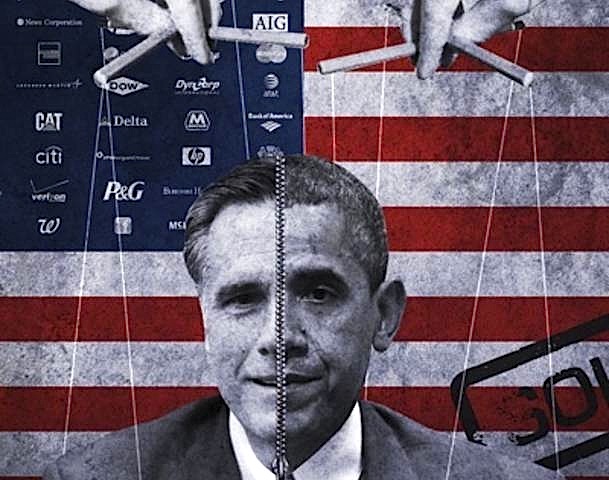
One thing is certain – both corporate puppets support the system that is killing you:
Post Script:
An important point was brought up by Alex Smith of EcoShock Radio about the numbers in this post. The list of top campaign contributors by Opensecrets does not include the dark world of Super PACs and other tax-exempt groups which can shield the identity of their donors – a billion spent on the presidential race. See the comments section of this post for further details.
Imagine a world where the elite’s professional frontmen, aka TV pundits and ‘talking heads’, framed the public debate and steered public opinion for a nation of 350 million people. In such a world, journalism became an infomercial formulated by such apparatuses as spin alley and fed to the masses as expert opinion and deep intellectual insight. Now imagine that virtually the entire nation voluntarily bought an electronic device for their home that would pipe all these fabricated talking points, along with the mind-numbing bread & circus entertainment, into their living space. We have, as Gore Vidal described, entered a digital fun house from which we cannot escape.
A novelty called television had begun to appear in household after household, it’s cold, grey distorting eye relentlessly projecting a fun house view of the world. Those who followed the ugly, new-minted word media began to note that often while watching television we kept fading in and out of the chamber of horrors… ~ Vidal
Occasionally an insightful article will be written which lifts, if only briefly, the veil of the American hologram and allows, for those brave enough to look, a glimpse of the conniving little man behind the curtain furiously working the levers to create the Great and Powerful Oz. Depending on how much you reveal of the dark truths lurking behind the curtain, you may eventually find yourself subject to unrelenting persecution and holed up in a dark solitary cell or some South American embassy situated in a vassal state. The long arm of Empire has a way of reaching those who cross her.
Lawyer and blogger Jonathan Turley is someone I frequently follow. Amongst his humorous work he also posts about serious subjects, one of which is the recently published The Pretense of Punditryby guest blogger Mike Spindell. In this post, Mr. Spindell sheds light on the inner workings behind the face of TV punditry that bombards you 24/7 and molds the conventional wisdom of the day.
What all of these shows have in common is that they are repeatedly populated by the same people, whether politicians, journalists, economists or political operators. This link gives the background of the truth of Sunday morning “journalism”. The casts rarely change and in all but the rarest of cases these guests make up what could be called our nation’s “Pundit Class”. They are seen as the “Serious People”, who lead America’s national debate on vital issues. I’ve been a “political junkie” since the age of ten. For many years I was misled into believing that these “Serious People” were really my intellectual betters when it came to public affairs and that political discussion must only exist within the ground rules of debate established by our “Pundit Class”. Beginning with the murder of JFK and in the ensuing disillusionment of the Sixties I’ve come to see that not only is this “Pundit Class” inherently corrupt, but only a rare few can barely be called intellectually informative. This group is in reality the paid propagandists of the elite 1% that rule this country and their main task is to limit the scope of our national debate.
The essay then goes into the recent plagiarism case of one of the “most esteemed members of the Pundit Class, Fareed Zakaria.” Zakaria, born in India and from the elite group of that country, is a courtier to the present Transnational Capitalism & Globalization that has been wreaking havoc on the working class and natural environment of every nation on earth.
“When Fareed Zakaria was suspended on Friday from Time and CNN, for plagiarism, this wasn’t merely justice, it was poetic justice: it rhymed. What it rhymed with was his own lifelong devotion to the global economic star system that he, as a born aristocrat in India, who has always been loyal to the aristocracy, inherited and has always helped to advance, at the expense of the public in every nation. He was suspended because, as a born aristocrat, who is a long-time member of the Council on Foreign Relations, the Trilateral Commission, the Bilderberg Group, and many other of the global aristocracy’s primary organizations, he is so well-connected that his writing-commissions are more than any one person can possibly handle, and he consequently cannot possibly actually write all that is attributed to him. He certainly cannot research it all.”
As a paid public relations person for the corporatocracy, Fareed Zakaria is armed with a cadre of writers who produce the carefully vetted, status quo viewpoints that he spoon feeds his millions of viewers. As Spindell points out, it was no surprise that a few days after the plagiarism accusations, an article appeared which exonerates Zakaria and brushes the case under the proverbial rug.
I think back to graduate schools papers I’ve written and wonder how I would have fared if I had “made a terrible mistake” in them through plagiarism. Would an investigation of my “isolated incident” and remorse have allowed me to continue in school? However, protecting Mr. Zakaria, one of the chosen, is not only important for his sake, but for the sake of these “News Entities” that rely so heavily on the “connected” pundit class to provide their“cogent” analysis of major issues.
How many other “Pundits” acting as the “serious” people are setting the parameters of the national debate through their appearances on Sunday Morning talk shows, News Channels, the PBS News Hour and it appears as paid guest speakers at supposedly meaningful conferences and conventions? The person who first came to mind as I read this article on Zakaria was Thomas Friedman. Friedman is a son of privilege who married into a billionaire family. He has been a champion of “Globalization”, which to me has always meant unbridled support for the multinational Corporatocracy…
…what is obvious and known about Friedman is that he is a pundit star, ranking with, or possibly above Zakaria in the firmament of “Serious People” who frame our national debate and dominate our national media. This is really nothing new in our country. In the past the “serious people” were the likes of Walter Lippman, and Scotty Reston. These past pundits and “cold warriors”, share a commonality with Zakaria and Friedman, in that they all serve(d) the interests of the Corporate and Monied Elite that run this country from behind the scenes. Indeed, I’m sure that you the reader could expand this very small list of those who are deemed acceptable to lead the “serious” discussion of our national/international issues.
I assert that the entire Liberal versus Conservative debate in this country is but a smokescreen that distracts us from the one most vital issue. Our nation and indeed the world is and has been controlled by an Elite representing those with most money and power. Their first allegiance is to themselves, their class and to the belief that they alone are fit to rule us all. Call it what you will, but to me it is the continuation of feudalism in modern guise. Just as in feudalism there were “Courtiers” who gladly did the bidding of their “Royal Masters”, in order to enrich their own lives. Most of the “Courtiers” were either born to, or became part of the elite, while maintaining the pretense of speaking for the benefit of all humanity…we are surrounded by experts, who in reality are propagandists purveying non-existent mythology to keep us in the thrall of the Elite…
Interestingly, Matt Taibbi has also written about the fraudster Thomas Friedman, hypnotist to the boob-tube worshipping consumers, here and here:
When some time ago a friend of mine told me that Thomas Friedman’s new book, Hot, Flat, and Crowded, was going to be a kind of environmentalist clarion call against American consumerism, I almost died laughing.
Beautiful, I thought. Just when you begin to lose faith in America’s ability to fall for absolutely anything—just when you begin to think we Americans as a race might finally outgrow the lovable credulousness that leads us to fork over our credit card numbers to every half-baked TV pitchman hawking a magic dick-enlarging pill, or a way to make millions on the Internet while sitting at home and pounding doughnuts— along comes Thomas Friedman, porn-stached resident of a positively obscene 11,400 square foot suburban Maryland mega-monstro-mansion and husband to the heir of one of the largest shopping-mall chains in the world, reinventing himself as an oracle of anti-consumerist conservationism.
Where does a man who needs his own offshore drilling platform just to keep the east wing of his house heated get the balls to write a book chiding America for driving energy inefficient automobiles? Where does a guy whose family bulldozed 2.1 million square feet of pristine Hawaiian wilderness to put a Gap, an Old Navy, a Sears, an Abercrombie and even a motherfucking Foot Locker in paradise get off preaching to the rest of us about the need for a “Green Revolution”? Well, he’ll explain it all to you in 438 crisply written pages for just $27.95, $30.95 if you have the misfortune to be Canadian.
I’ve been unhealthily obsessed with Thomas Friedman for more than a decade now. For most of that time, I just thought he was funny. And admittedly, what I thought was funniest about him was the kind of stuff that only another writer would really care about—in particular his tortured use of the English language. Like George W. Bush with his Bushisms, Friedman came up with lines so hilarious you couldn’t make them up even if you were trying—and when you tried to actually picture the “illustrative” figures of speech he offered to explain himself, what you often ended up with was pure physical comedy of the Buster Keaton/Three Stooges school, with whole nations and peoples slipping and falling on the misplaced banana peels of his literary endeavors…
Matt has also written about the master propagandist Fareed Zakaria here:
From a distance I’ve always vaguely admired the skills of Newsweek’s Fareed Zakaria, who is maybe this country’s preeminent propagandist. Any writer who doesn’t admire what this guy does is probably not being honest with himself, because being the public face of conventional wisdom is an extremely difficult job — and as a man of letters Zakaria routinely succeeds, or pseudo-succeeds, at the most seemingly impossible literary tasks, making the sensational seem dull, the outrageous commonplace, and rendering horrifying absolutes ambigious and full of gray areas.
Wheras most writers grow up dreaming of using their talents to stir up the passions, to inflame and amuse and inspire, Zakaria shoots for the opposite effect, taking controversial and explosive topics and trying to help rattled readers somehow navigate their way through them to yawns, lower heart rates, and states of benign unconcern. He’s back at it again with a new piece about the financial crisis called “The Capitalist Manifesto,” which is one of the first serious attempts at restoring the battered image of global capitalism in the mainstream press.
This writer has done work like this before, using a big canvas to rework an uncooperative chunk of history in the wake of a crisis. Zakaria is probably best known for his post 9/11 “Why Do They Hate Us?” article, a sort of masterpiece of milquetoast propaganda that laid the intellectual foundation for a wide array of important War on Terror popular misconceptions, not the least of which being the whole “They hate us for our freedom” idea. One of Zakaria’s central arguments in that piece was that poor struggling Arabs were driven to envious violence by the endless pop-culture reminders of American affluence and progress. It was just too much to take, seeing all those cool blue jeans and all that great satellite TV.
In one exchange in that piece Zakaria talks with an elderly Arab intellectual who scoffs at Zakaria’s suggestion that Arab cities should try to be more like globalization-friendly capitals like Singapore, Seoul and Hong Kong. The old Arab protests that those cities are just cheap imitations of Houston and Dallas, and what great and ancient civilization would want that?
I thought the old Arab’s comment was funny, but Zakaria imbued it with serious significance. “This disillusionment with the West,” he wrote, “is at the heart of the Arab problem.” And while witty Arab potshots at tacky southern strip-mall meccas like Houston were significant enough to put high up in Newsweek’s seminal piece about the root causes of 9/11, things like America’s habitual toppling of sovereign Arab governments and installation of ruthless dictators like the Shah of Iran were left out more or less entirely (Zakaria managed to write a whole section on the Iranian revolution without even mentioning that the Shah come to power thanks to a CIA-backed overthrow of democratically-elected Mohammed Mosaddeq, whose crime was ejecting Western oil companies from Iran)…
Just as American journalism has become a paid spokesman for the exploitive economic system controlling the world, so too has the entire economic profession been bought off: How The Federal Reserve Bought The Economics Profession…
The Federal Reserve, through its extensive network of consultants, visiting scholars, alumni and staff economists, so thoroughly dominates the field of economics that real criticism of the central bank has become a career liability for members of the profession, an investigation by the Huffington Post has found.
And for one more example, the Great Wall of Propaganda extends to our system’s need for perpetual war as well…
Surfing the net this evening brought me to some eerie photography by a man named Edward Burtynsky. This collection is from his 12 year project about modern man’s Oil Age. Here are a few of the pictures under the title ‘The End of Oil‘ from his epic work (others can be seen here):
Click for Enlarged Slideshow
Mass Consumerism befouled the planet.
I work with Native Americans and see the rampant alcoholism, unemployment, and poverty, but their condition in the globalized capitalist economy seems to be replicated with other native people of the world as this cartoonist depicts:
Perhaps we aren’t the be-all and end-all of human progress.
…many of our official pronouncements – echoing those of most elite institutions and organizations – proudly and confidently insist that our future lies in “globalization.” Globalization – for lack of a better term – is, in actuality, the building out of a monoculture, a singular culture based upon basic presuppositions of modern political, economic and social theory.
Nature abhors monocultures. Nature abhors them so much that they do not exist in accordance with nature. They would be unknown but for modern man.
A monoculture is a single form of life – or, by extension, a single culture – that exists over a large expanse of space, even globally. Nature abhors monocultures because they are so susceptible to annihilation by one agent of destruction. In plant or animal life, for example, a single virus or bacteria, a single destructive fungus or disease, a single hostile predator or pest would wipe out an entire monoculture without the barest resistance. It is the very nature of nature to avoid monocultures – indeed, it cannot be otherwise since any form of monoculture cannot long exist in nature. Life in the natural realm is manifold and varied, precisely so that some life will weather the inevitable deadly challenges that arise. – Patrick J. Deneen
The following is an excellent essayby Chris Williams, a professor in the Dept of Chemistry & Physical Science, Pace Universityand author of Ecology and Socialism: Solutions to Capitalist Ecological Crisis (Haymarket Books, 2010). It goes well with my previous post on the corporatized Rio Earth Summit. In the last two decades only four out of ninety United Nation environmental sustainability pledges have been fulfilled, a pretty dismal failure by anyone’s standards. The four were: reducing ozone depletion, removing lead from gasoline, improving access to water supplies and boosting research for marine pollution. The reason for its epic failure is that the whole process of sustainability and scaling back ecologically destructive megatrends have been co-opted by our economic system, i.e. capitalism. The need for continuous growth and expansion into new markets is inherent in capitalism. It has come to define our culture and relationship with nature and our fellow man. As history has clearly shown, capitalism will be the death of us all if we allow this ethic-less system to define ourselves and to continue its rampant, unbridled destruction in the name of ‘development’ and profit.
Sometimes, the calendar of international conferences attended by global elites serves up potent lessons for the rest of us, when they shine a spotlight on the deliberately murky affairs of the people who run the system. As the 20 most powerful world leaders deliberate on economic issues in Los Cabos, Mexico for the G20 summit, representatives of the rest will be simultaneously converging on Rio de Janeiro to consider how to follow up on the original Earth Summit, 20 years ago this year.
At these seemingly separate gatherings, we in truth observe the two sides of the capitalist coin. Namely, how can the capitalist elite continue the necessary work of exploiting both humans and the natural world in the service of profit, while cloaking their intentions in the benign language of growth, development and sustainability? Fine words to cover nefarious ends. No doubt, as people’s livelihoods and world decay around them as a direct consequence of the system the elite oversee, and in response the flame of revolt is rekindled from Cairo to Athens, political elites in the two locations will reflect on the fact that it’s not getting any easier. From the other side, critics and commentators of the two conferences are missing an important and significant lesson when they consider them in isolation.
At the original Earth Summit in Rio, it was generally accepted that environmental questions could not be separated from economic ones. This year, the two conferences, occurring concurrently at different ends of the South American continent, bring to light how this thinking has been undermined. Furthermore, they indicate with geographical and political precision where the priorities of the global elite lie. While the most important world leaders hot-foot it to Mexico to discuss global economic development, they send low-level delegates to Brazil to discuss issues they deem less vital; to be exact, planetary ecological crisis.
Indeed, so desperate were the Brazilian organizers of Rio+20 to cajole the British premier to attend, they changed the date of the conference so as to avoid conflicting with the much more important and worthy 60th anniversary celebrations of the Queen of England’s ascension to the throne. An attempt that proved ultimately and embarrassingly futile, as British Prime Minister, David Cameron, chose to cling to the coattails of President Obama and other G20 leaders in Los Cabos, as they calculate, connive and concoct the further dismemberment and disenfranchisement of communities of workers and peasants around the world.
In a further sad irony, to enhance attendance at Rio, Brazil is providing flights courtesy of the Brazilian air-force to those countries too poor to send delegates. It’s hard to imagine that the countries who can’t afford to send delegates to an environmental conference will have the financial capacity to take action to preserve biodiversity and a stable climate without international funding and technology transfer. But the concept or even use of the word “transfer” is exactly what the United States delegation is trying to excise from any document emerging from Rio+20.
In Los Cabos, 20 people wielding enormous economic power gather to ensure that nothing stands in the way of the international accumulation of money by their respective corporations; that capitalist growth continues, uninterrupted by paltry considerations such as democracy. Scheming and plotting in Los Cabos, the 20 leaders will huddle, concerned that their plans have been exposed by the people of Greece. As they jet to Mexico, one of the first countries to be devastated by the neoliberal prescription of privatization, deregulation and cuts to social spending, the election results in Greece ring in their ears as a collective rebuke to austerity and unemployment. In unprecedented numbers, Greeks exercised their democratic rights by voting for a previously obscure and marginal left coalition, SYRIZA and against handing the welfare of their country over to unelected technocrats governing from afar. A vote, it should be emphasized, carried out in the teeth of apocalyptic warnings of doom from central bank acolytes of the 1%, desperate to stop the people voting ‘the wrong way’.
As for the Global South, capitalist economic development, particularly since its neoliberal mutation, has been a disaster of gigantic proportions as money and natural wealth are siphoned into Western financial institutions. According to Oxfam, gross capital flows to developing countries fell from $309 billion in 2010 to $170 billion in 2011. Last year, aid donations from major donors experienced the first decrease in 14 years, dropping by $3.4 billion; overall aid was $16 billion below what the G8 committed to delivering in 2009. The drop in aid, along with legal and illicit financial transfers out of the developing world, mean that for every dollar received in aid (much of it tied to the purchase of materials from the West), 7-10 dollars go out. In 2009 alone, the developing world saw $903 billion disappear overseas thanks to a rigged system from which the majority cannot benefit. While 16 of the 20 members of the G20 have seen inequality increase over the last 20 years, as complement to that process, is it any wonder that developing countries seem to be permanently ‘developing’ even as social and ecological conditions there also worsen?
The violent dispossession that characterized the bloody dawn of capitalism captured by Marx in his writings on the enforced removal of peasants in the 1500’s amid the first acts of privatization – the land enclosures, is repeated in contemporary form through land grabs; his writing has a remarkably contemporary ring to it: “Thus were the agricultural people, first forcibly expropriated from the soil, driven from their homes, turned into vagabonds, and then whipped, branded, tortured by laws grotesquely terrible, into the discipline necessary for the wage system.”
In the 20 years since the optimism of the first Earth Summit in Rio, carbon emissions have increased by 50% and, since 1950, while the rest of the world has seen an average increase in temperature of 0.70C, the arctic, due to various positive feedback loops, has experienced double that. Absent serious action, whereas the world is now on track for 20C of warming, the arctic is on course for a truly calamitous 3-60C. The June 16th 2012 special edition of The Economist pondered an ice-free arctic with a mixture of trepidation, casual racist indifference and a general leaning toward monetary excitement: “In the long run the unfrozen north could cause devastation. But, paradoxically, in the meantime, no arctic species will profit from it as much as the one causing it: humans. Disappearing sea ice may spell the end of the last Eskimo cultures, but hardly anyone lives in an igloo these days anyway. And the great melt is going to make a lot of people rich.” Yes, to The Economist, while the change may be “devastating” to ancient and indigenous cultures, along with cold-adapted species, a certain small subset of humans will become rich while ‘making a killing’ – in all senses of the phrase.
We and the land have certainly changed and the continuation planned by the capitalists and their political representatives has unquestionably become impossible, as further capitalist development begins to contradict not just human rights or a sense of social progress, but the thermodynamic laws of the universe, which underpin a stable biosphere, upon which all life ultimately depends.
To quote British journalist George Monbiot on the reasons for the failure of so many environmental conferences, “These summits have failed for the same reason that the banks have failed. Political systems that were supposed to represent everyone now return governments of millionaires, financed by and acting on behalf of billionaires. The past 20 years have been a billionaires’ banquet. At the behest of corporations and the ultra-rich, governments have removed the constraining decencies – the laws and regulations – which prevent one person from destroying another. To expect governments funded and appointed by this class to protect the biosphere and defend the poor is like expecting a lion to live on gazpacho.”
From the other side of the political spectrum, representatives of the US environmental organization, Environmental Defense Fund, writing in a New York Times op-ed concede that “As the Arctic becomes ice-free, we can expect that it will be drilled for oil”. But, nevertheless, despite two decades of failure, hold out hope that with just a little more effort and market reforms such as cap and trade, 10 years from now we’ll be okay “with determination and the right policies, by the time Rio+30 rolls around, optimism might be the order of the day.”
Now, socialists are often decried as Utopians. We are told, our ideas may sound good in theory, but humans living equitably with one another in a democratic system based on cooperation, in a society that lives in harmony with the natural world, will simply never work in practice. Is it more realistic to believe that the same system that got us to this point will extricate us? The message from the ‘realists’ seems to be that while we may well have covered the arctic in drilling rigs by then, just give it another 10 years and things will be fine. Going beyond the wrong-headed pronouncements of the EDF, UN Secretary-General, Ban Ki-moon managed a level of fervor that would have put Dr. Pangloss himself to shame, “Increasingly, we understand that, with smart public policies, governments can grow their economies, alleviate poverty, create decent jobs and accelerate social progress in a way that respects the earth’s finite natural resources.”
One has to ask, who are the real Utopians? To many people around the world, leftwing and explicitly socialist ideas, along with class-based revolt, are re-emerging as real alternatives precisely because our rulers quite clearly have no answer other than an extension of the market into whole new areas. Meena Raman of the Malaysia-based Third World Network, was unequivocal in her denunciation of the US’s role in derailing climate negotiations in Durban in 2002 and in Rio+20: “Given the US stance, we do not want President Obama or any US leader to come to Rio to bury what was agreed in 1992 in Rio. We cannot expect the US to show any leadership in truly wanting to save the planet and the poor. So it is better for President Obama to stay at home.”
Meanwhile, 105 scientific institutions are urging action at Rio on population and consumption “For too long population and consumption have been left off the table due to political and ethical sensitivities. These are issues that affect developed and developing nations alike, and we must take responsibility for them together,” said Charles Godfray, a fellow of the Royal Society. Except that population growth is a function of poverty and it is in fact the countries with the largest levels of consumption, such as the United States and Europe, that not only are the historical cause of the ecological crisis, but are helping to drive it to its logical conclusion – a cascading collapse of ecosystems – by advocating continual economic expansion and the generation of poverty through the promotion of financial and trade agreements that accentuate inequality. Capitalism is like a shark; just as these animals can never stop moving forward for fear of drowning, so capitalism must grow or die.
It’s important to understand why negotiators see the primary way to save the environment is through putting a price on it. This is the main thrust of the talks and accepted by all negotiating parties inside the conference, representing a major schism with the tens of thousands of protesters attending the Rio+20 People’s Summit who are being forcibly kept out of the deliberations by armed riot police.
The argument goes that only by giving natural resources “value” in monetary terms can the environment be protected. On the one hand, it’s easy to see the further privatization of every molecule of water, every tree and every piece of land as dovetailing beautifully with the desires of the corporations. Extending the “free” market to new areas for exploitation is a tried and true method to enhance profits. Those who run the corporations are not slow to catch on and self-advocate: “For companies this is enlightened self interest…Those who can afford water should pay. Water is essentially over exploited because we are not valuing it as an economic good. Introducing methodologies such as escalating tariffs, which some countries have already done, will help in terms of using water intelligently, often for the first time.” So said, Gavin Power, deputy director of the UN Global Compact, which is acting as an umbrella group for 45 of the most powerful CEO’s, from such well-known environmentally conscious concerns as Coca Cola, Glaxo-SmithKline, Nestle, Merck and Bayer, to ensure their voice is heard at Rio+20.
But advocacy for the “valuation” of natural resources occurs not just or even primarily because it coincides with what corporations want. Many of the people arguing for such quantization of nature genuinely believe it will help preserve biodiversity, slow climate change and reduce the pressure on natural resources.
More fundamentally, the need to place “fair value” on everything is part of the ideological foundation of capitalism. Within the philosophy of capitalism, if something does not have a price, it cannot have value. Hence, putting the correct price, otherwise known as internalizing the cost, of a natural good, is to make possible its rational exploitation and simultaneous conservation. To those mired deep within the labyrinth of a capitalistic value system, there is no contradiction between these two aims: the commodification of nature can be seen both as a way of making money from it, and as a way of saving it, as perfectly expressed by Ban Ki-moon.
The quantification of nature is the rational end-point of capitalism’s philosophical approach to nature and hence a practical approach to ‘saving nature’. The non-quantifiable, qualitative side of nature, the purely spiritual and awe-inducing beauty of watching a sunrise for example, is not only entirely absent, or under-appreciated, it is essentially unknowable. Hence, assuming you’re not prepared to advocate regulatory reforms to place limits on the operation of corporations and boundaries beyond which they cannot cross, or you’re not advocating revolution, then extending the market becomes the only option left, consequently the focus at Rio+20 on doing exactly that.
However, for those of us who truly want to see a better world, the extension of its commodification to every single particle of nature cannot be an answer. Taking our inspiration from the rising struggles of 2011 around the globe, it is imperative that we link up the movements of social resistance, and forge new alliances with organized labor and the disenfranchised of the planet to force regulatory changes onto those who would foist false solutions on us. Only by linking social and ecological change and fighting on both fronts, autonomous of mainstream political parties, while creating our own independent battle organizations, can we hope to make progress.
Ultimately, however, it is just as vital that fighters for social emancipation, human freedom and ecological sanity, recognize that capitalism represents the annihilation of nature and, thus, humanity. A system based on cooperation, real democracy, long-term planning, and production for need not profit, i.e., socialism, represents the reconciliation of humanity with nature. And its achievement will, as Marx pointed out, of necessity be much less violent than the process by which capitalism was born in the first place:
“The transformation of scattered private property, arising from individual labor, into capitalist private property is, naturally, a process, incomparably more protracted, violent, and difficult, than the transformation of capitalistic private property, already practically resting on socialized production, into socialized [common] property. In the former case, we had the expropriation of the mass of the people by a few usurpers; in the latter, we have the expropriation of a few usurpers by the mass of the people.”
We currently live in an age that has been characterized as the Anthropocene, the Age of Man, by some scientists to take into account how drastically human civilization has altered the biosphere on a geological time scale. Only by overthrowing capitalism and moving toward a cooperative, planned economy based on democracy and sustainability can we move toward an age characterized, after Epicurus, as the Oikeiotocene – The Age of Conformity to Nature.
“Most people [Americans] have been reduced to a market demographic. They’re consumers, they’re not citizens. No matter how active they are within the system [employment, religion, government, etc.] the system is the problem.” – Joe Bageant
The ideology we have today permeating every aspect of life in America is neoliberal capitalism which takes its ultimate expression in the form of megacorporations or multi-national corporations whose tentacles of power and influence reach deep into government and other nations as well, considering that their wealth and budgets are larger than that of many small countries. Indeed in America the government and the corporate world are one, merely separated by a revolving door.
As long as you conform to what they have programmed you to be, an obedient consumer, then behavior which is in line with that mindset is deemed permissible or legal. Similar behavior which questions the consumer culture and the power structure behind it is deemed illegal and is either squashed or otherwise corralled through State violence and coercion. In an article in the early 1980s in which he referred to the American people as ‘consumer-depositors’ in thrall to the financial elite, Gore Vidal saw into this aspect of the system decades ago.
Consumerism as Hegemony:
By hegemony, Gramsci meant the permeation throughout society of an entire system of values, attitudes, beliefs and morality that has the effect of supporting the status quo in power relations. Hegemony in this sense might be defined as an “organizing principle” that is diffused by the process of socialization into every area of daily life. To the extent that this prevailing consciousness is internalized by the population it becomes part of what is generally called “common sense” so that the philosophy, culture and morality of the ruling elite comes to appear as the natural order of things.
It was Wall Street banks and hedge funds, not home buyers, who created the enormous demand for high-risk mortgages to pool, to securitize, and to turn into Ponzi-like gambling structures with names like CDOs, CDO squared and synthetic CDOs. It was the money-grubbing rating agencies that blessed these pieces of garbage with AAA ratings. As a result, trillions of dollars of worthless toxic assets polluted our financial system. When the bubble they induced burst, our system crashed, causing 8 million working people to lose their jobs in a matter of months due to no fault of their own. Anyone who still blames low-income home buyers, or regulations or Greece — or anyone other than Wall Street — should be checked for dementia.
This deregulation of capitalism into a more predatory and destructive form has occurred at the same time as our government has slowly militarized this nation’s domestic police force and turned our country into a Security and Surveillance State. We are paying for our own enslavement. The rapacious corporate forces that were behind the meltdown of our economy in 2008 are now backed in power by this strengthened Authoritarian State. The inverted totalitarianism that Sheldon Wolin talked about has come to fruition. The great irony is that this totalitarianism is not coming from some socialist revolution as feared by the far right, but from Neoliberal Capitalism, the very system that Fox news and the corporate mainstream media trumpet.
With the dawning of an age of depletion and peak resources, Consumerism and the antisocial behavior of neoliberal capitalism can no longer survive and are simply being propped up and enforced by the iron fist of the Corporate State. Peak oil had a hand in bursting Wall Street’s housing bubble. This scenario of an ever-growing oppresive State in the face of an energy-starved future bodes ill for the rest of us who are not so privileged to be sitting in ivory towers, oblivious to the coming storm. Author Brian Davey describes this disconnection with reality that the elite suffer from, ensconced as they are in their own world of narcissism and luxury:
…There is nothing new in the phenomena of power arrogance and hubris. Since the earliest civilisations, rulers have made decisions and overreached their power in the confident belief that they had God on their side. In more modern times our rulers have believed that nature rewards the fittest, in other words, them.
Irrespective of what point in history they emerge, the starting point of most elites is the comfortable assumption that, as things have typically gone right for them in the past, they will continue to go right in the future. This belief is compounded by the fact that for a long time it has been the “little people” who bear the costs while those higher up the food chain reap the benefits. Power means that they are effectively cocooned from the negative kick-back from their actions. Long before the rulers themselves are successfully challenged and fall — and this typically happens only in the final stages — millions of others have already lost out badly and immense damage has been done.
What we term hubris is the cruel arrogance that arises from a failure of bottom-up feedback in systems where vast social and geographical distances exist between the powerful and the powerless. The punishment of Nemesis, the Greek goddess who was supposed to re-impose limits on those who overstepped their power, typically befalls entire societies before it befalls the rulers. Today the vast distance that separates the global elite from ordinary people is magnified further by the high-power technologies of communications, transport, production and weaponry. Nemesis, when she comes, will be global….




 Collapse of Industrial Civilization