• About

Collapse of Industrial Civilization

~ Finding the Truth behind the American Hologram

Collapse of Industrial Civilization

Tag Archives: Fossil Fuel Dependency

The Grocery Aisle at the End of the World

29 Sunday Mar 2026

Posted by xraymike79 in Collapse of Industrial Civilization, Mental Health

≈ 1 Comment

Tags

Civilizational Self‑Harm, Climate Risk, End Of Abundance, Energy–Food Nexus, Fertilizer Chokepoints, Food Systems Collapse, Fossil Fuel Dependency, Geopolitics Of Hunger, Global Food Security, Globalization’s Limits, Industrial Agriculture, Iran War, Just‑In‑Time Fragility, Market Fundamentalism, Multiple Breadbasket Failure, Naval Power And Trade, Petrochemical Packaging, Polycrisis, Strait Of Hormuz, Supermarket Politics

How the Iran War Exposes the Food Illusion

For most of us in the rich world, food appears as a solved problem. It arrives under fluorescent lights in infinite variety: strawberries in January, chicken breasts cheaper than dog food, aisles of grains and snacks that never seem to run out. The shelves may wobble in a pandemic or a storm, but they restock. The supermarket is presented as a kind of secular sacrament: whatever else is going wrong, you will still be able to push a cart through a climate‑controlled maze and buy your calories with a card.

The current war on Iran is a reminder that this is an illusion bought on credit from a system that is coming apart. The bombs are falling in the Gulf, but the shockwaves are moving through the fields that feed half the planet. You can’t shell a major fossil‑fuel and fertilizer corridor without hitting the invisible scaffolding of the global food system.

We are used to thinking of the Strait of Hormuz as an oil chokepoint. It is also, quietly, a fertilizer chokepoint. Nearly a third of the world’s fertilizer flows through it, and much of global ammonia and urea production rides on cheap Middle Eastern gas. When that traffic is constrained by mines, missiles, and insurance letters, it is not just tankers that get stranded on the wrong side of the bottleneck. It is next season’s harvest.

Food as a Fossil‑Fuel Machine Wearing a Cornucopia Mask

Strip away the packaging and the recipes and modern food looks less like “nature” and more like a vast fossil‑fuel machine. Food systems now consume something like the emissions footprint of a major geopolitical bloc, and for staple crops like corn and wheat, energy and fertilizer together can make up more than half of the operating costs. On the input side, a non‑trivial slice of the world’s natural gas is devoted purely to making ammonia via Haber‑Bosch, the precursor to synthetic nitrogen fertilizer that props up yields for billions of people. Synthetic agrochemicals and fertilizers are overwhelmingly derived from fossil fuels, and petrochemicals feed straight into the nitrogen inputs that keep industrial yields from collapsing.

By the time food reaches your plate, fossil fuel has been burnt to make the fertilizer and pesticides, to pump irrigation water, to run tractors and combines, to process and refrigerate, to ship in bulk and then distribute to local warehouses and stores. The supermarket aisle is just the final, brightly lit organ at the end of a long fossil‑fueled digestive tract. When that upstream system shudders, the illusion that food is a simple consumer product dissolves very quickly.

The cornucopia mask is not just about what we grow, but how we wrap it. Modern food is entombed in layers of plastic, cardboard, metal and ink that often cost as much as, or more than, the raw calories inside, especially for processed and branded products. The packaging industry is itself a petrochemical enterprise, drawing heavily on oil and gas to make plastics and coatings, and on additional energy to manufacture and move them. In other words, a non‑trivial share of the “food system” is really a packaging system whose main job is to make fragile, just‑in‑time calories look abundant and permanent on the shelf—for as long as the fossil inputs keep flowing.

How the Iran War Hits the Global Dinner Table

The Iran war is already tightening this fossil‑food umbilical cord. Nearly one‑third of the world’s fertilizer normally transits the Strait of Hormuz, and Middle Eastern gas is a key feedstock for ammonia plants around the world. As U.S. and Israeli strikes crater Iranian infrastructure and Iran weaponizes Hormuz, fertilizer shipments are getting stuck on the wrong side of the bottleneck. What first appears as a problem for oil traders quickly becomes a problem for anyone who depends on affordable grain.

One month into the war, the abstraction of “Hormuz risk” has hardened into specific, measurable damage to the machinery that sits upstream of harvests. Iranian missile and drone attacks, U.S.–Israeli bombardment, and Houthi strikes on shipping have turned Hormuz and nearby sea lanes into a zone of chronic disruption rather than a temporary scare. The consequences are already visible in fertilizer and energy markets. As insurance premia climb and sailings are delayed or rerouted, prices for nitrogen products have begun to climb. Plants in gas‑dependent producers from India to Europe are reporting reduced operating rates or temporary shutdowns as input costs spike, while China has tightened export controls to safeguard its own domestic supply.

What looks like a shipping issue on a map is, in practice, a squeeze on the molecules that feed next season’s crops. Farmers respond in the only ways open to them. Some cut back on fertilizer applications and accept lower yields. Others switch to less input‑hungry crops, reshaping planting patterns in ways that may not align with global demand. Many turn to their governments and banks, lobbying for subsidies, emergency credit, or tax relief just to keep planting at all. Each of those adaptations narrows the margin of safety in the harvest to come, especially in regions where soils are already depleted or where recent climate extremes have left fields vulnerable.

For now, most supermarket shelves in the global North still look normal. The lights are on, the coolers hum, the variety remains impressive. But the price tags are beginning to carry the faint echo of Hormuz, as higher energy and fertilizer costs ripple through animal feed, food processing, packaging, and transport. In import‑dependent countries in the global South, the echo is louder and harsher. Governments warn of budget crises as food import bills climb, currencies weaken, and hard choices emerge between paying creditors and paying for grain. Humanitarian agencies quietly brace for yet another round of hunger in places that never really recovered from the last food price spike.

A war that was first sold as a humanitarian crusade to “liberate” the Iranian people and topple a hated regime quickly mutated into a jumble of shifting justifications—deterrence, credibility, non‑proliferation, alliance management, market stability—none of which can bear the weight of what it is actually doing. In practice, it has become a live‑fire demonstration of how tightly global dinner tables are tied to a handful of fossil‑fuel chokepoints. The bill will not arrive this month, or even this year. It will come on the slow schedule of planting seasons and harvests, in the quiet compounding of thinner margins, higher prices, and political systems pushed past their breaking point—up to and including the collapse of governments that can no longer keep food both available and affordable.

Climate Is Quietly Turning Down the Yield Knob

Even if geopolitics were miraculously calm, the biological engine of our food system is being dialed down by climate change. A new generation of climate–crop models, built on higher‑resolution datasets, shows that by the end of this century global yields for staple crops are very likely to fall even under optimistic scenarios. Under aggressive emissions cuts, average yields still decline. Under business‑as‑usual, the odds tilt sharply toward double‑digit percentage losses for most major staples.

Adaptation buys some time and some yield. Farmers can switch crop varieties, shift planting dates, tweak fertilizer regimes, and invest in irrigation where water remains available. But the modeling suggests these measures only offset a fraction of the climate‑driven losses; the rest comes through as a permanent reduction in potential. The sting lies in who pays that price. The poorest countries, many already dependent on food imports, are projected to face some of the steepest drops in agricultural productivity, compounding vulnerability and eroding whatever buffer they still have.

This is what “no slack” looks like in agrarian terms. In the 20th century, bad weather in one region could be covered by surpluses and trade from another. Today, a hotter, more chaotic climate is taking simultaneous bites out of yields across multiple breadbaskets, while wars like the one in Iran make it harder and more expensive to move whatever surplus remains.

The Soft Underbelly of the Grocery Aisle

On top of these biophysical constraints sits a logistics system optimized for efficiency, not resilience. The just‑in‑time grocery model runs on thin inventories, centralized distribution centers, and tightly coupled digital systems that orchestrate orders, routing, and payment. It works astonishingly well when the background conditions are stable. It works astonishingly badly when they are not.

Recent years have already exposed some of these weak points. During the COVID‑19 pandemic, the world produced enough calories on paper, but transport bottlenecks, labor shortages, and border disruptions led to simultaneous food waste and food scarcity. Prices for staples jumped faster than general inflation, pushing basic items out of reach for the poor even where shelves remained mostly stocked.

Cyberattacks have offered a different kind of stress test. When a major U.S. grocery distributor was hit by ransomware, systems went down and deliveries were disrupted to thousands of stores. For a few days, the result looked like a localized version of something much larger: empty or patchy shelves, confused shoppers, managers explaining that the warehouse “just didn’t get the truck.” Industry warnings since then have been clear. The software that runs warehouses, trucking fleets, and point‑of‑sale systems is a soft underbelly; it does not take a state‑level attack to knock a region’s food distribution off balance.

None of this requires a capital‑W World War to show up in the grocery aisle. You get there by accumulation: a fertilizer crunch that quietly trims harvests, an energy shock that thins the ranks of smaller haulers and processors, a ransomware hit that bricks a regional distributor’s routing system, a few governments slamming on export controls when prices spike, and then a round of panic buying when people realize how little slack the system actually has. The result is not cinematic famine but a kind of normalized scarcity: prices that lurch upward and never quite reset, “temporarily unavailable” stickers that migrate across categories, and a widening gap between neighborhoods where the shelves still look full and those where they do not.

Layer the Iran war on top of this and the picture sharpens. Energy prices spike and stay volatile. Fertilizer is scarcer and more expensive. Shipping routes are rerouted or slowed, insurance costs rise, and speculative capital sloshes around commodity markets amplifying each new headline. The just‑in‑time system, designed to minimize costs, now serves as an amplifier for every upstream shock. For households at the edge, “temporarily out of stock” and “permanently out of budget” increasingly blur into the same reality.

The End of the Food Illusion

Collapse is often framed in abstract terms: GDP curves, debt ratios, sea‑level projections in 2100. Food refuses abstraction. When the system that feeds you becomes unreliable, you feel it in your stomach before you see it in a graph.

We are already living through a slow version of that unraveling. Since the end of the last decade, hundreds of millions more people have been pushed into chronic hunger as overlapping crises—pandemics, climate extremes, regional wars, and economic shocks—have hit a food system that had been optimized for efficiency, not robustness. As those crises compound, the comfortable assumption that “the market will sort it out” looks less like realism and more like a superstition.

The Iran war takes this background condition and turns the dial a little further. It stresses a fertilizer and fuel network that is already dangerously concentrated and fossil‑dependent. It raises the probability that future harvests will be smaller, more expensive, or both—not just in Iran or the Gulf, but in importing nations from South Asia to Europe and across Africa. It does all of this against a climate trajectory in which the underlying biological engine of yield is gradually weakening, and atop a logistics system that has repeatedly shown itself brittle under stress.

Look at what is actually being defended as this war grinds on. Naval task forces are deployed to shield tankers and financial markets get emergency life support, but there is no equivalent rapid‑reaction force for fertilizer access or public grain reserves in countries that live harvest‑to‑harvest. The legal and military architecture of globalization was built to protect capital flows and hydrocarbon traffic, not the continuity of basic calories. When those priorities collide, it is always the supermarket, not the bond market, that is allowed to fail first.

None of this guarantees cinematic famine in rich countries. What it does make likely is a world where food becomes a persistent source of anxiety and political instability: prices that spike and never quite come down, shelves that are usually but not always full, governments forced into permanent triage between feeding people and servicing debts. In that world, the supermarket stops feeling like a neutral backdrop to daily life and starts to look more like what it has always been: the most fragile political institution of modern civilization.

You can fudge the inflation statistics, massage the unemployment numbers, and spin the latest military adventure as “successful.” You cannot easily explain away empty shelves and unaffordable staples. While the food illusion holds, citizens can be persuaded that collapse is a fringe anxiety. When it frays, collapse becomes visceral. You don’t have to know where Hormuz is on a map to feel its closure in your kitchen.

Share this:

  • Share on Bluesky (Opens in new window) Bluesky
  • Tweet
  • Share on Tumblr
  • Share on Mastodon (Opens in new window) Mastodon
  • Share on Reddit (Opens in new window) Reddit
Like Loading...

When Worst Case Becomes Baseline

28 Saturday Mar 2026

Posted by xraymike79 in Collapse of Industrial Civilization, Mental Health

≈ Leave a comment

Tags

Benjamin Netanyahu, Chokepoint Warfare, Civilizational Overshoot, Climate Constraints, Collapse Trajectories, Donald Trump, Energy Infrastructure, Fossil Fuel Dependency, Future Civilizations, Geopolitical Hubris, Global Stagflation, Gulf Desalination, Industrial Civilization, Iran War, Petrostate Fragility, Regime Change, Resource Depletion, Strait Of Hormuz, Systemic Risk, Water Security

The Iran War and Civilizational Self‑Harm

For decades, worst‑case scenarios about the Gulf lived in the margins of strategic reports and collapse forums. What if a regional war shut the Strait of Hormuz? What if desalination plants were hit, or refineries and LNG terminals were cratered along the coast? The comfort baked into those scenarios was always the same: they were presented as tail risks. Possible, but unlikely. We told ourselves that no serious power would be stupid enough to roll the dice on destroying the very infrastructure that holds up the global economy and keeps tens of millions of people alive in the hottest, driest petro‑region on Earth.

The 2026 war on Iran is busy proving us wrong. What used to be labelled “worst case” now looks uncomfortably like the path of least resistance. The United States and Israel have launched a large‑scale, open‑ended campaign against Iran. Iran has responded by weaponizing the Strait of Hormuz and striking at energy and logistics targets across the Gulf, and regional actors like the Houthis have joined in with their own attacks on shipping and infrastructure, raising the odds that more than just Hormuz will be intermittently or permanently shut. Everyone insists they are still winning. No one seems willing to admit what they are actually burning through.

This is not just another bloody episode in the Middle East’s long history of imperial arrogance and local revenge. It is something closer to civilizational self‑harm: a war of choice that systematically chews up the water and energy systems that industrial society still stands on, at a moment when the planet’s climate and ecological buffers are already strained past anything recognizably “normal.” If we take the dynamics of this conflict seriously, the most probable outcome is not a quick ceasefire and a restored status quo. It is a prolonged, grinding, partly frozen war that leaves the Gulf’s physical infrastructure and political geography mangled, and the resource base for any future complex societies permanently narrowed.

The War No One Thought Through

On paper, the justifications for the attack on Iran are familiar: Iran’s support for armed groups, its missile and drone capabilities, its nuclear program, its refusal to accept its place in a US‑ordered regional hierarchy. Strip away the rhetoric and what remains is a straightforward act of hegemony maintenance. An aging superpower and its key client, unwilling to accept that their ability to dictate terms in the region has eroded, decided to try to bomb their way back to a position of comfortable superiority.

What is striking is not just the brutality of that decision but its intellectual laziness. At no point did the governments involved invite their own publics into a serious conversation about what closing or half‑closing Hormuz actually means, beyond an abstract nod to “higher oil prices.” At no point did they try to grapple, in public, with what a sustained attack on Iranian territory and command structures would do to the logic of escalation. They did not walk citizens through the geography of the Gulf, the co‑location of refineries, export terminals, power plants, and desalination complexes on the same vulnerable coastal strip. They did not ask what it looks like when those nodes, and the tankers threading between them, are all within range of relatively cheap missiles and drones.

Instead, they behaved as though the old rules still applied: that wars could be contained, that oil and shipping would more or less keep flowing, that “deterrence” would be restored after a few high‑profile strikes. Trump and his second‑term cabinet appear to have convinced themselves that a single, spectacular decapitation strike would do the job – kill the supreme leader and a tranche of senior commanders, call on the people and security forces to “take their country back,” and watch the regime fold, a bigger replay of the Maduro snatch‑and‑swap they had just pulled off in Venezuela. They treated Iran’s control of Hormuz, its internal resilience, and the Gulf’s water‑energy dependence as bargaining chips in a cartoon script about toppling dictators, not as the load‑bearing pillars of a tightly coupled global system. That is not strategy. It is magical thinking, welded to the kind of hubris that learns nothing from past regime‑change failures.

Iran, of course, is hardly blameless. Its decision to answer airstrikes and assassinations by mounting its own attacks on shipping, energy infrastructure, and bases across the Gulf was not made in ignorance. Tehran’s leadership knows how fragile the Gulf’s lifelines are. It knows that closing or constraining Hormuz hurts not just Washington and Tel Aviv but its own economy and its neighbors’. Yet it gambled anyway, convinced that demonstrating its ability to turn off the tap—and to survive the resulting shock better than US‑aligned regimes—would strengthen its hand in the long run.

On both sides, the same structural stupidity is at work: a refusal or inability to think beyond the next move in a prestige contest, even when the stakes have obviously migrated into the realm of systemic risk.

Water and Oil: The Same Target

To see how bad this can get, you have to look past the missiles and speeches and focus on pipes, plants, and grids.

The Gulf monarchies are not just rich countries sitting on sand and oil. They are artificial hydrological systems. For many of them, rainfall and groundwater are nowhere near sufficient to support their current populations, let alone their industrial and agricultural sectors. They survive on desalinated seawater: vast plants that suck in the Gulf, strip out salt, and push potable water through networks of pipes into cities, factories, and power stations. In several states, the vast majority of municipal water comes from these plants. Many of those plants share sites and power infrastructure with fossil‑fuel generators and petrochemical complexes. Some are key nodes in national grids.

In such a system, “energy” and “water” are not separable categories. They are the same target. Hit a power‑desalination complex and you do not just dim the lights; you threaten drinking water, sanitation, industrial operations, and the cooling systems of other plants. Damage a major refinery or gas processing facility and you also reduce the ability to fuel and maintain the machinery that keeps water flowing. In a region already pushed to the edge of a habitable climate by rising temperatures and humidity, those links are a matter of life and death.

Even before this war, analysts were warning that Gulf desalination plants were soft, high‑value targets in any serious regional conflict: large, hard to relocate, easy to spot on satellite imagery, and within range of relatively cheap long-range weapons. Now, after weeks of strikes, near misses, and open talk of “hitting the enemy where it hurts,” those warnings no longer sound theoretical. It takes no great imagination to sketch a sequence of events in which certain plants are hit, others are shut down pre‑emptively for fear of attack, and the entire system begins to operate in a state of chronic, fearful under‑capacity.

Overlay that with deliberate or incidental damage to refineries, LNG terminals, export pipelines, and offshore infrastructure, and the picture that emerges is grim: not a brief oil price spike followed by relief, but a sustained, partial crippling of the region’s ability to deliver fuels and water at anything like its previous scale.

The “Worst Case” as the Most Likely Path

Official documents still talk about this kind of scenario as if it were an outlier. Planners plot boxes labelled “low probability, high impact” and tuck the destruction of Gulf infrastructure into them, as though the mere placement on a chart will keep the world from actually going there.

That framing made some sense when the main Gulf risk was a single rogue missile or a terrorist attack. It makes much less sense once multiple state and quasi‑state actors with large missile and drone arsenals are fighting a broad war in and around the region, and once those actors have already demonstrated both the means and the will to hit high‑value infrastructure.

To treat full or partial destruction of Gulf energy and desalination capacity as a low‑probability event now is to cling to an optimism that nothing in the current situation justifies. What the incentives and capabilities now on display actually suggest is that, absent an abrupt and unlikely outbreak of restraint, we should treat something close to the worst case as the baseline.

That baseline does not necessarily entail glassed‑over ruins and cities emptying overnight. It looks more like this:

  • The Strait of Hormuz remains intermittently or structurally constrained for years, with shipping volumes well below pre‑war levels even during “lulls.”

  • Major pieces of export infrastructure and refining capacity on both sides of the Gulf are damaged badly enough that they take years, not months, to restore, if they are restored at all.

  • Key desalination plants and power‑desal complexes are hit directly or disabled by collateral damage often enough that their operators and governments are forced into chronic rationing and costly, ad hoc work‑arounds.

  • Insurance and risk premiums for shipping through the region never return to pre‑war norms, and importers treat Gulf barrels and molecules as politically risky even when they are technically available.

In other words, not a one‑off crisis but a ratcheting down of capacity and trust, with each new round of conflict damaging both the physical assets and the perception of safety around them. In plain terms, this war has enough leverage over oil, gas, fertilizer, and desalinated water that it can push industrial civilization off a plateau and onto a steeper downslope: not a theatrical lights‑out moment, but a sudden loss of altitude from which there is no easy climb back.

What That Means for the Rest of Us

From the standpoint of someone who still sees full aisles and stable prices, this may sound remote. But the Gulf remains one of the central organs of the global economy; weaken it badly enough and the whole body suffers.

A damaged Gulf with weaponized sea lanes and impaired infrastructure means:

  • Higher and more volatile oil prices, because a chunk of cheap‑to‑develop, high‑throughput supply is off the table or politically tainted.

  • Higher and more volatile gas and LNG prices, especially in Asia and Europe, where switching away from Russian flows was already painful.

  • Higher fertilizer prices, because nitrogen and many other inputs are energy‑intensive and tightly linked to gas markets and Gulf producers; that translates directly into higher food prices and lower yields, especially in import‑dependent countries that can’t afford to make up the difference with subsidies.

  • A persistent drag on global economic growth, as energy and food import bills rise faster than incomes and as central banks tighten or hold interest rates higher than they otherwise would to fight cost‑driven inflation.

These are not speculative chains. We have seen weaker versions of them play out already with the war in Ukraine and earlier oil shocks. The difference now is that the systems under attack are both more central and more fragile, and the ecological backdrop is far less forgiving.

For households and workers at the margins, especially in the global South, this will look like a rolling crisis that never quite ends: fuel that stays expensive, transport and electricity that strain already thin budgets, food prices that creep up faster than wages, public services that get squeezed as governments pay more to import the basics. For governments, it will look like an endless series of hard choices between defaulting on debts, cutting social spending, and repressing unrest.

Add those shocks together and you don’t just get a bad recession. You get a break in the curve: a world where energy, fertilizer, and food are structurally scarcer and dearer, and where whole regions start to slide out of the zone where complex, globalized industrial life can be maintained.

Burning the Scaffolding

It is sometimes argued that wars like this, however terrible, are just one more chapter in the long history of empires and resource struggles, and that humanity has always rebuilt. Rome fell, China fractured, and yet centuries later, new centers of power and complexity emerged. Why should this be different?

The answer is that we are fighting this war on a planet that has already been radically altered by our previous rounds of overshoot, and we are fighting it in a way that damages not just resources but the systems that make those resources usable.

Earlier empires exhausted local soils, forests, and aquifers, but the climate system and the global biogeochemical cycles remained broadly stable. The ores they picked over were near the surface and rich. The rivers and seas they sailed were mostly clean. When those arrangements failed, there were still vast margins of unused capacity elsewhere, and the energy gradient available from fossil fuels remained untapped.

Today, the situation is different. The climate is hotter and more chaotic. Ice sheets and glaciers are committed to long‑term loss. Ocean ecosystems are stressed. The most accessible fossil deposits and ore bodies have been mined or are in decline. The great old‑growth forests that once buffered weather and hydrology have been cut back to archipelagos.

On top of that, we have built a single, tightly coupled global economic system, stitched together by shipping lanes, pipelines, and just‑in‑time logistics, all resting on a fossil energy base. The Gulf is one of the key nodes where that base still sticks above the waterline. It is also one of the places where the mismatch between natural habitability and current population and infrastructure is most extreme.

To launch a war that seriously degrades that node—its export capacity, its desalination output, its internal stability—is to burn part of the scaffolding that holds up the entire structure, at precisely the moment when there are no obvious replacements and no climatic slack left to soak up the shock.

Future societies will not, as a result, face the same menu of options our grandparents did. They will inherit a planet whose physical systems have been pushed harder, and a built environment that has been selectively smashed in ways that make some paths back up the complexity ladder far more difficult. They will have to rebuild intricate water‑and‑energy systems in a climate that is more hostile and with ore grades and easy fuels already exhausted. They will have to contemplate reopening trade routes and chokepoints that have a recent history of being turned into weapons.

That is the legacy being forged right now—not just in the carbon we pour into the air, but in the infrastructure we pulverize and the institutions we discredit.

The Stupidity of It All

It is tempting to search for some hidden rationality in this mess: a theory that, beneath the bluster, the planners have truly weighed the risks and decided that the gains are worth it. But the more you look at the decisions that led here, the less that story holds.

Launching an unjustified war on Iran—without a direct attack on US territory, without an imminent nuclear breakout, without even the fig leaf of a UN mandate—was already a moral and legal disaster. Doing it in full knowledge of how dependent the global economy remains on Gulf energy and shipping, and how the Gulf’s water and power systems are entangled, is something worse. It is an admission that the people steering the most powerful militaries and economies on Earth no longer take seriously the idea that there are planetary limits or systemic tipping points that apply to them.

They act as if there will always be more infrastructure to burn, more sea lanes to reroute, more climate slack to absorb another decade of chaos. On the other side, Iran’s leadership acts as if it can play the “oil weapon” and the “chokepoint card” forever, as if its own population and neighbors will somehow be spared the worst knock‑on effects of wrecked plants and poisoned trade routes.

There is a word for this, but it isn’t realism and it isn’t grand strategy. It is a cultivated, structural stupidity: an elite incapacity to see beyond the next news cycle, willing to gamble the water, energy, and trade systems that keep billions alive for the sake of domestic posturing and a long‑nurtured vendetta. For three decades, Benjamin Netanyahu has made Iran his favorite enemy, repeatedly insisting it was “three to five years” from the bomb and pushing for US strikes that even his own security chiefs often opposed. In 2026 he finally got the American president he wanted: Trump, persuaded in the Oval Office that a single “historic” decapitation strike would shatter Iran’s leadership and trigger a Venezuela‑style collapse, with loyalists melting away and a grateful populace welcoming a new order. That is not strategy. It is the hubris of two men who learned nothing from Iraq, nothing from the failed coup play in Caracas, and nothing from decades of crying wolf about Iran—now gambling not just with other people’s lives but with the fragile plumbing of the global energy and water system.

No Clean Reset

Those who still cling to a cyclical view of history might tell themselves that after this war, the Gulf will eventually rebuild; that pipelines can be laid anew, plants reconstructed, alliances reshuffled; that in a century or two, some new equilibrium will emerge. Maybe it will. But it will emerge on a planet whose climate is more hostile, whose ecosystems are more depleted, and whose resource and infrastructure base has been deliberately, not accidentally, thinned.

There is no clean reset waiting on the far side of this. There is no guarantee that after we are done smashing the machinery that feeds, waters, and powers us, future generations will be able to assemble something similar from the broken parts and the harsher world we leave behind. There may indeed be future civilizations with roads and walls and writing and hierarchies. They may even look back at our ruins and tell themselves stories about our arrogance and fall.

What they will not have is the same breadth of options. The floor they stand on will be thinner, the climate stranger, the margins for error tighter. And one of the reasons for that will be this: at a late, fragile moment in the fossil‑fueled experiment, the current custodians of the system chose to fight a reckless, unjustified war over dominance in a region that could have been used to cushion a difficult descent. They chose to bomb the scaffolding instead of climbing down.

There is still time, in theory, to pull back from the most extreme branches of that path—to stop hitting the water and energy organs of the Gulf, to accept that hegemony is over, to start thinking like a species that understands it has to live within limits. Nothing in the current behavior of the governments involved suggests they are interested.

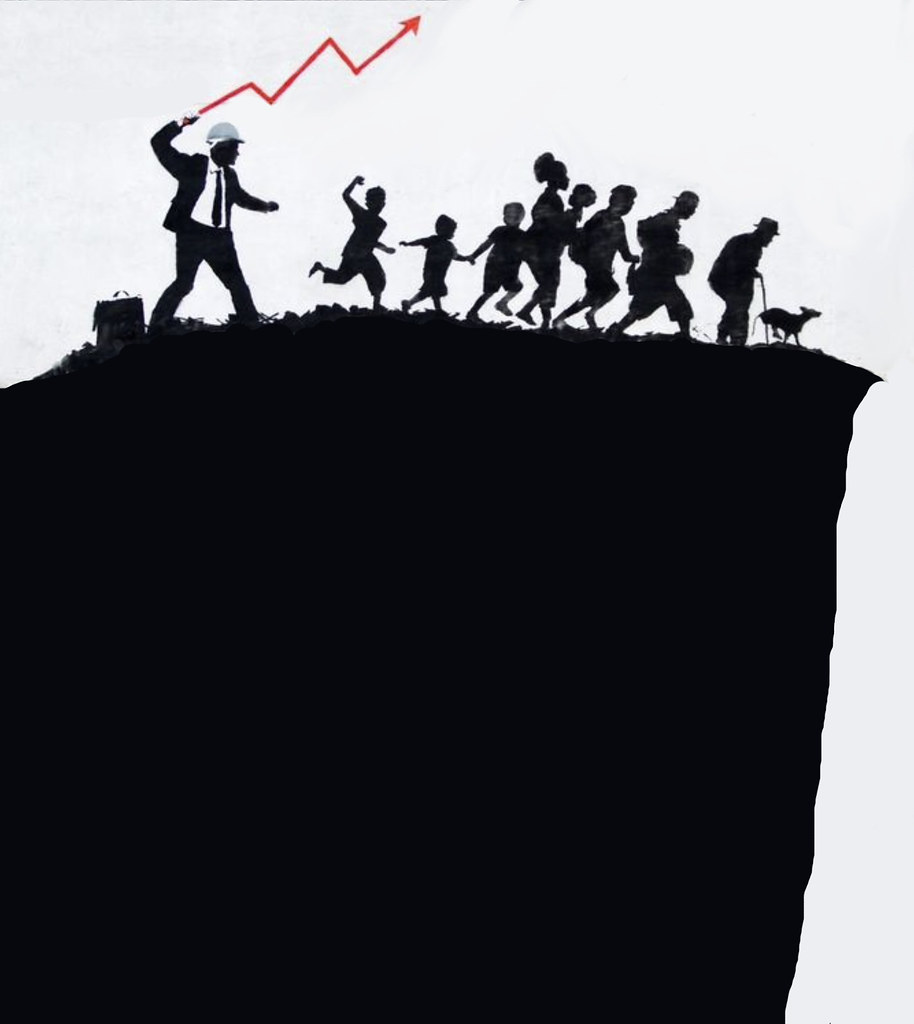
When worst case becomes baseline, collapse is no longer a hypothetical to warn about. It is the edge of the cliff we have already driven onto, the destination embedded in the choices being made right now, in full view, by people who have everything but have learned nothing.

Share this:

  • Share on Bluesky (Opens in new window) Bluesky
  • Tweet
  • Share on Tumblr
  • Share on Mastodon (Opens in new window) Mastodon
  • Share on Reddit (Opens in new window) Reddit
Like Loading...

No Clean Reset: War, Climate, and the Next Civilizations

28 Saturday Mar 2026

Posted by xraymike79 in Collapse of Industrial Civilization, Mental Health

≈ 1 Comment

Tags

Anthropocene Ruins, Biomass Constraints, Civilizational Overshoot, Climate Irreversibility, Ecological Succession, Empire And Collapse, Energy Descent, Fossil Fuel Dependency, Future Civilizations, Geophysical Limits, Iran War, Irreversible Extinction, Novel Ecosystems, Peak Minerals, Planetary Boundaries, Post Fossil Empires, Resource Envelope, Strait Of Hormuz, Thermodynamic Limits, War And Energy

After the Fossil Age, Future Civilizations Stand on a Thinner Floor

There’s a comforting story that circulates in collapse circles: even if this version of industrial civilization is doomed, the planet will eventually reset. The fossil binge will end, forests will return, the climate will cool, and in a few centuries or millennia new Romes and Han Chinas will rise on a refreshed Earth, running on biomass and clever agriculture instead of oil and gas.

It’s an attractive story, not least because it reframes our crisis as a rough transition between cycles, not a one‑off singularity. But I think it only works if you underplay three things: how slowly climate and ecosystems actually recover on human timescales, how limited a biomass energy system really is for complex societies, and how much irreversible damage we’ve already baked into ice sheets, species, and the periodic table.

The current Iran war throws all of this into sharper relief. A single regional conflict at one energy chokepoint is hammering the global system: Hormuz is effectively shut or heavily constrained, a fifth of world oil and a huge share of LNG are at risk, and analysts are already talking about a second great energy crisis with stagflationary overtones. The ferocity with which an aging hegemon is willing to gamble global stability to keep the fossil tap open tells you something about how little slack is left.

If we want to think honestly about future civilizations, it has to start here: with the actual physics and biology of the coming centuries, not with a generic image of “nature healing” after we exit the stage.

Cooling Into a Different Planet

Climate models agree on one big point that optimists and pessimists both tend to blur: if we actually stopped net greenhouse gas emissions, global warming would not keep rising indefinitely. In most runs, once net emissions drop to zero, the temperature curve flattens and then very slowly drifts down. The planet doesn’t keep screaming upward for centuries on autopilot; it plateaus, and in some scenarios it cools a bit.

An MIT analysis of zero‑emissions trajectories, for example, finds that if emissions stopped, global temperature would typically stop rising within a few decades, but stay elevated for centuries, with maybe half a degree of cooling over 250–300 years in ambitious cases. The direction reverses; the slope is shallow. For any society trying to re‑aggregate in 2200 or 2500, the baseline isn’t “back to Holocene normal,” it’s “still significantly warmer and hydrologically weirder than the climate that fed Rome and Han.”

The same “yes, but slowly” pattern applies to ecosystems. Secondary forests can re‑establish surprisingly fast in the absence of chainsaws, cattle, and bulldozers. Some work suggests substantial canopy and biomass recovery within a few decades in parts of the tropics, and large carbon gains over the first 60–100 years. Landscapes we’ve brutalized really can green up at a speed that would shock most people’s intuitions, and collapse itself does remove some of the relentless pressure that kept systems from catching their breath.

Where this diverges from the “clean reset” picture is in what those recovering systems actually look like, and how far they get you toward the resource base that powered pre‑fossil empires. Old‑growth, structurally complex forests that store immense carbon stocks and provide stable flows of fuel, game, and other biomass services are millennial projects, not 60‑year ones. A regrowing 80‑year forest can look lush to the eye and still be a fraction of the ecological and energetic capital of a genuinely ancient woodland. So yes: the “thinner resource base” of the immediate post‑collapse decades can fatten up. But on realistic timescales it will likely level off at a different height than the pre‑industrial benchmark, and in ways that don’t map neatly onto ambitious but fleeting human political projects.

The Limits of a Biomass Renaissance

In thermodynamic terms, collapse optimists have a point: biomass is renewable in a way that fossil fuels aren’t. The energy income is annual sunlight, not the condensed ghost of Paleozoic swamps. That’s not a trivial difference.

But biomass is only functionally renewable for complex societies if three conditions hold at once:

  1. Harvest stays at or below ecological regrowth rates.

  2. Those same landscapes don’t also have to feed a similarly large human population.

  3. You solve the power‑density problem: biomass is low‑density and scattered; running industrial‑scale infrastructure on it takes a lot of land, logistics, and labor.

Historically, pre‑fossil agrarian states constantly crashed into those constraints: wood shortages for shipbuilding, charcoal for metalworking, fuelwood around cities, soil exhaustion on frontiers. They “ran on biomass,” but they also ran through forests and soils faster than those could rebuild as population and urban complexity rose. Coal, oil, and gas were the cheat code that suspended that feedback for a couple of centuries while artificially propping up modern civilization. High‑EROI fossil fuels underwrote the surplus that made large, complex industrial systems possible, and as EROI declines across fossil and many alternatives, maintaining that level of complexity becomes progressively harder.

When you look at modern assessments of sustainable bioenergy potential, even in well‑governed, data‑rich countries, a pattern emerges. Under optimistic assumptions about yields, technology, and governance, sustainably harvested biomass typically covers only a fraction of total energy demand—on the order of a quarter to perhaps two‑fifths—nothing like the fossil‑era peak. Historical and technical reviews underline why: low power density, competition with food production, water limits, and ecological damage put hard boundaries on how far societies can scale biomass before they start replaying the same deforestation and soil‑mining patterns that plagued pre‑fossil empires.

Collapse advocates sometimes sketch a “stair‑step” future: collapse, abandonment and reforestation, then a new biomass‑powered civilization rising on the regrown energy base. There’s something right in that image. Abandoned land does green; secondary forest growth in many places really can offset a non‑trivial share of deforestation‑driven emissions. But it’s one thing to use that regrowth as a carbon sink. It’s another to run a civilization on it.

Fragmented post‑collapse societies, even with centuries of regrowth behind them, are unlikely to squeeze dramatically more usable energy out of the biosphere than modern studies think possible without repeating the same mine‑the‑land pattern that hammered Rome’s hinterlands. The staircase is real, but each future step up is likely to be smaller than the one before, because the overall resource envelope keeps shrinking.

So yes: biomass likely gives future civilizations a non‑trivial, renewable energy floor. It does not give them back the same stair height we just fell off.

Irreversibility: Ice, Species, Ores

When I say “permanently shrunken envelope,” I don’t mean “no recovery at all.” I mean that some of the damage is path‑dependent and non‑linear in ways that don’t simply unwind if we wait a few centuries.

Lose ice sheets, rearrange ocean circulation, push biomes poleward, acidify oceans, extinguish keystone species, and you don’t walk back to the 8,000–1800 CE climate by waiting 200–500 years. The IPCC’s Special Report on the Ocean and Cryosphere is blunt about this: many ocean and cryosphere changes – ice‑sheet and glacier mass loss, ocean warming and acidification, permafrost thaw – are effectively irreversible on timescales relevant to human societies, even if warming stops. Ice sheets would take centuries to millennia to regrow; sea‑level rise and deep‑ocean warming keep intensifying long after emissions cease.

Even if global temperature nudges downward, the pattern of rainfall, monsoons, river regimes, and extremes is unlikely to simply revert. For staple crops, that pattern matters as much as the global mean. AR6’s water‑cycle chapter shows with high confidence that warming intensifies both very wet and very dry events and shifts where heavy rain, drought, and runoff extremes occur, with strong regional changes in monsoon behavior and seasonal flows rather than a simple, uniform scaling with global temperature. Those changes in variability and extremes track directly into food production and staple crops.

On the biosphere side, extinction is forever. The exact web of species interactions, soil microbiomes, and cheap, easily accessible mineral and fossil resources that early empires leaned on will not be recreated just by letting ecosystems grow back on their own. The IPBES Global Assessment underscores that extinction and many forms of biodiversity loss are irreversible on human timescales, and that ecosystems are being reorganized into “novel” assemblages rather than returning to historical baselines, even where biomass regrows.

On the geochemical side, work on “peak minerals” argues that we are progressively exhausting high‑grade, easily accessible mineral deposits – iron, copper, phosphates among them – forcing a shift to lower‑grade ores that require much more energy, water, and capital to exploit. In this literature, peak minerals is less about running out in a physical sense and more about reaching the point where rising costs, environmental damage, and social resistance stop production from keeping up with demand, even if technology improves. Terrestrial mineral deposits are non‑renewable on human timescales; production in many cases eventually hits a peak, after which it becomes harder and costlier to expand supply. Our nitrogen economy, meanwhile, has been rebuilt around the Haber–Bosch process, which fixes atmospheric nitrogen at enormous fossil‑energy cost.

Put differently: the envelope may widen somewhat relative to the immediate post‑collapse trough, but physics, biology, and geology together do not hand future societies the same slack our ancestors enjoyed.

War as Accelerant, Not Reset

Enter the Iran war. On paper, it’s “just” another Middle Eastern conflict. In practice, it functions as an accelerant and a stress test for a global system already up against its limits.

By most accounts, the conflict has effectively choked the Strait of Hormuz: missile attacks, mines, and the withdrawal of insurance cover have slashed tanker traffic and pushed up risk premia for any ship entering the Gulf. Roughly 20% of global oil trade, a major share of LNG (especially Qatari exports), and a significant fraction of petrochemical flows depend on that chokepoint. Recent policy and market analyses warn that a closure lasting even a few months could become “the single‑largest and most consequential energy and supply chain disruption in modern history,” tightening petrochemical and fertilizer markets, driving up fuel and food prices, and setting the stage for a global stagflationary episode. Asia is particularly exposed: more than four‑fifths of the crude that normally transits Hormuz heads to Asian buyers, and commentators describe the shutdown as an “existential threat” to key Asian economies rather than a localized shock.

Because more than a quarter of global nitrogen fertilizer trade and around a fifth of LNG flows through Hormuz, several analyses already flag rising fertilizer costs and food‑price inflation as a direct second‑order effect of the closure.

What the war reveals is not just geopolitical folly; it’s structural fragility. A single regional conflict can, in weeks, threaten to pull down the scaffolding of global trade and finance because that scaffolding is built around just‑in‑time fossil flows through a handful of narrow straits. That’s what it means to live near the limit of a resource envelope: the system becomes exquisitely sensitive to relatively small shocks.

It also shows our civilizational instincts under stress. Faced with declining ecological slack and a narrowing climate window, the default response of the dominant powers has not been to deliberately downshift energy use and reorganize economies around lower throughput. It has been to double down on force projection to defend the old configuration, even at the risk of catalyzing the very collapse we dread. The Iran war is the global system burning future options – political, ecological, and energetic – to keep today’s arrangement alive a little longer.

From the perspective of future civilizations looking back, this matters. A collapse driven partly by wars over the last easy barrels and the last unobstructed straits leaves a different inheritance than a purely “soft” power‑down. More infrastructure ruined, more emissions, more extinctions and toxic legacies, more hate wired into borders and mythologies. Less to work with, more reasons to repeat the same patterns.

Future Romes on a Thinner Floor

So when I talk about a “permanently shrunken envelope,” I’m not saying that nothing recovers. Forests regrow, rivers detoxify, soils rebuild organic matter, and temperatures may edge down over long spans. Secondary forest carbon stocks can rise dramatically over the first century or two, and recent work suggests tropical forest regeneration can offset perhaps a quarter of deforestation and degradation emissions. Rivers can respond surprisingly quickly once pollution inputs fall.

What I am saying is that the combination of a hotter, more chaotic climate; reassembled and partially impoverished ecosystems; mined‑out high‑grade ores; and a depleted stock of social trust and institutional capacity means that future complex societies will have to operate inside a narrower corridor of possible configurations than the one we inherited.

In that corridor, empires are not impossible. They are more brittle. A world without cheap, dense fossil fuels, with more erratic monsoons and river flows, with fewer big, stable old‑growth biomes to treat as “waste space,” and with ore grades ground down by centuries of extraction leaves less margin for bad harvests, epidemics, and political stupidity. Each rise of centralized power would sit on a thinner resource base and a more volatile Earth system than Rome or Han ever had to contend with.

The crop‑genetic legacy we’re passing on complicates this further. On the one hand, we are bequeathing cultivars and agronomic know‑how that can, in principle, handle more heat and drought, which is a real gift to whatever comes next. On the other hand, if you inherit stress‑tolerant, high‑yield crops, the cultural memory that “expansion is possible again,” and still‑tight biophysical limits, you’ve also inherited a very efficient engine for re‑running the overshoot cycle, only faster. The haunting doesn’t just come from ruins. It comes from how easy it is, once conditions improve a little, to rebuild the very social logics that ate the last world.

From that vantage point, the current Iran war reads less like the prelude to a cleansing reset and more like an example of overshoot behavior in its terminal phase: a system using up its remaining slack – oil, political capital, atmospheric space – in a bid to keep its present shape. It accelerates the burn of what’s left and further locks in some of the path‑dependent damages that will constrain our successors.

There may still be future Romes. But each one will stand on a thinner floor, in a stranger climate, with less margin for error when it comes to repeating old mistakes.

Share this:

  • Share on Bluesky (Opens in new window) Bluesky
  • Tweet
  • Share on Tumblr
  • Share on Mastodon (Opens in new window) Mastodon
  • Share on Reddit (Opens in new window) Reddit
Like Loading...

Cuba’s Blackout Foreshadows a World Running Out of Oil

17 Tuesday Mar 2026

Posted by xraymike79 in Collapse of Industrial Civilization, Mental Health

≈ Leave a comment

Tags

Climate And Conflict, Cuba Blackout, Cyber-Sabotage, Empire And Embargo, Energy Geopolitics, Energy Scarcity, Fossil Fuel Dependency, Global South Precarity, Grid Collapse, Humanitarian Crisis, Infrastructure Fragility, Just-In-Time Modernity, Late Industrial Society, Medical Infrastructure, Multi-System Collapse, Oil Blockade, Politics Of Scarcity, Sanctions As Warfare, Systems Failure Cascade, Technological Vulnerability

Cuba on Fumes

What does it look like when a modern society runs out of fuel?

Not in some Mad Max fantasy or distant climate model, but in a real country, with doctors still showing up to work, children still going to school when they can, and a bureaucracy still stamping papers in dim offices—until the generators die. For that, you don’t have to imagine much anymore. You can watch Cuba.

In early 2026, the island crossed a threshold. It did not just “tighten its belt” or endure yet another round of sanctions. It moved into a new phase where the fuel that makes a late‑industrial society possible is no longer reliably there. Tankers stopped arriving in any meaningful volume. Power plants coughed and failed. The grid, already limping, began to die in sections. Then, one March night, it simply went dark. Eleven million people slid into a nationwide blackout, not because of a hurricane or a single freak accident, but because the island had run out of margin.

Cuba has been a laboratory for empire for more than a century: plantation, colony, Mafia playground, revolutionary outpost, embargoed enemy, reform experiment. Now it is becoming an unintentional laboratory of something else: what happens when a present‑day, urban, technically competent society is forced to inhabit an energy regime that looks more like the coming century than the last one. If you want to know what “running out of oil” feels like from the inside, you could do worse than start in a Cuban hospital, waiting for the lights to come back on.

From Siege to Blackout

The story the United States tells about Cuba is simple. A failed socialist experiment mismanaged itself into ruin, and American sanctions are an unfortunate but justified response to dictatorship. In this version, blackouts and breadlines are morality plays, proof that history has rendered its verdict.

The reality, as usual, is messier and more damning. Cuba’s crisis is absolutely shaped by state mismanagement and sclerosis; it is also the direct product of a deliberate policy of energy strangulation by the hemisphere’s dominant power. It is not an accident that the island is running out of fuel. It is an objective.

For years, the embargo has been less a static wall than a living organism, mutating and tightening with each administration that needs an easy enemy. Under Trump, Cuba was re‑listed as a “state sponsor of terrorism,” tourism was choked off, remittances were constricted, and financial channels were mined. Venezuelan oil, once a lifeline, declined as Caracas sank into its own crisis. Tankers that did try to reach Cuban ports found themselves hounded by sanctions threats, insurance cancellations, and opaque “compliance” games played in distant banks—a de facto oil blockade enforced through the quiet terror of risk‑averse insurers and compliance departments in New York and London.

By late 2025 and early 2026, the cumulative effect of this pressure showed up in the only currency that ultimately matters for an energy‑poor island: barrels of oil and diesel. Cuba’s government could talk about reform, diversification, and efficiency all it liked. Without imported fuel, its options collapsed. The grid, a patchwork of aging thermoelectric plants, gas units, and small renewable projects, had already been running hot for years. Maintenance was deferred. Spare parts were scarce. Plants that should have burned cleaner fuel were instead forced to run on heavy, high‑sulfur crude that literally eats the turbines from the inside out. Diesel that should have gone to backup generators was being burned just to keep baseload plants running. When the flow of oil slowed to a trickle, the system ran out of workarounds.

Blackouts, once an occasional misery, became a daily fact of life. At first, power would vanish for a few hours, then return. Then the cuts stretched: eight hours, twelve, eighteen. Neighborhoods learned the rhythms of darkness. Elevators stalled. Refrigerators died. People cooked in rushes when the current came back, racing against the next outage. Finally, in mid‑March, the grid suffered what engineers politely call “complete disconnection.” In plainer language: Cuba’s electric system failed as a coherent whole. Officials traced the cascade to a failure at the Antonio Guiteras thermoelectric plant; when Guiteras tripped, protective systems did what they were designed to do—shed load, isolate faults—but there was so little spare capacity that the protection itself became the route to nationwide failure. For the first time in its revolutionary history, the entire island was without power, not after a hurricane, but after a long, grinding siege of its fuel supplies.

Systems Failing in Sequence

Electricity is never just electricity. It is the invisible scaffolding that holds up everything else. When it fails in a modern society, other systems do not simply “struggle.” They begin to fail in sequence.

Cuba’s hospitals were among the first critical nodes to feel the new reality. For decades, the island’s health system has been held up—rightly—as one of the revolution’s most impressive achievements: high vaccination rates, a dense network of clinics, a surplus of trained doctors deployed abroad as both solidarity and export. All of that depends on machines and logistics that assume energy and fuel.

Radiotherapy units for cancer patients draw enormous steady loads and cannot simply flicker on and off with the grid. Dialysis machines, ventilators, incubators, surgical suites, refrigeration for blood and vaccines—these are not decorative “modernizations.” They are the difference between life and death for tens of thousands of people at any given moment. When blackouts stretch past the capacity of hospital generators—and when diesel to feed those generators has to be rationed across an entire island—the health system stops being modern in any meaningful sense. Surgeries are postponed indefinitely. Intensive‑care units are redefined down to what can be done with minimal electricity. Doctors and nurses improvise heroically; the underlying trend is still decay. UN officials estimate that roughly 5 million Cubans with chronic illnesses now face disrupted medications or treatment because of blackouts and fuel shortages, with about 16,000 cancer patients needing radiotherapy and more than 12,000 on chemotherapy unable to get the care their machines and cold chains once made routine.

Water and sanitation are next. More than eighty percent of Cuba’s water pumping infrastructure depends on electric power. In the countryside, that means wells that no longer fill community tanks. In cities, it means apartment blocks whose taps go dry once storage tanks empty, and tanker trucks that may or may not have the diesel to deliver emergency supplies. Wastewater systems are no less dependent. When pumps fail, sewage backs up. When garbage trucks can’t fuel, trash piles up. The romance of “resilient communities” fades quickly when toilets stop flushing and the streets begin to smell. Nearly one million people—around a tenth of the island—now depend on drinking water delivered by tanker trucks that themselves struggle to find diesel, while more than 80 percent of Cuba’s water‑pumping infrastructure relies on electricity, producing “widespread and prolonged” service disruptions whenever the grid goes down.

Food follows. Agriculture, especially in a tropical island that has leaned heavily on imports, runs on a chain of energy‑intensive links. Diesel for tractors and harvesters. Fuel for trucks hauling produce to centralized markets. Electricity for refrigeration in warehouses, shops, and homes. When that chain frays, yields drop; what food does get harvested rots more quickly; imports become harder to move and store; diets simplify and shrink. Malnutrition rarely announces itself as a single famine event. It creeps in through smaller portions, fewer proteins, rising prices, and the quiet triage of households deciding who eats less. In Havana, families describe food bought with scarce remittances rotting again and again in dead refrigerators while elderly parents sit through twenty hours of heat in the dark.

Transport, education, policing, and administration all degrade alongside these primary systems. Buses run less often, then not at all; in the capital, public transport has simply vanished from some routes for days at a time because there is no diesel. Teachers cannot hold class in dark, sweltering rooms day after day. Police and emergency services prioritize only the most urgent calls because there is not enough fuel to respond to anything else. Bureaucracies that once generated paperwork begin to fall behind simply because computers and printers are dead more often than not. None of this looks like cinematic collapse. It looks like a million small failures, some reversible, some not, adding up to the feeling that the country is coming apart. This is what UN briefings mean when they say fuel shortages have “triggered a humanitarian crisis” and pushed Cuba’s health system “to the brink”: not an abstract warning, but tens of thousands of cancer patients losing treatment slots, millions with chronic disease cut off from regular care, and basic water and food systems slipping out of the category we call modern.

Cuba is experiencing this cascade now—not as a theoretical exercise, but as the daily texture of life.

Blame, Responsibility, and the Politics of Scarcity

At this point in the story, familiar scripts kick in. Cuba’s government blames the United States, the embargo, and “imperialist aggression” for the blackout. Washington and Miami hardliners point to corruption, incompetence, and the ossified one‑party state. Outside commentators pick their preferred villain, usually in line with whatever they thought about socialism or U.S. power beforehand.

There is no honest way through this that does not admit both sets of facts. Cuba’s ruling class has made catastrophic mistakes: half‑reforms that satisfied no one, a suffocating political culture, misallocation of scarce resources, and a chronic failure to build an energy system that could withstand foreseeable shocks. At the same time, it is simply true that the world’s largest economy has spent six decades designing and enforcing a web of laws, sanctions, and financial penalties explicitly meant to keep the island poor and vulnerable. When U.S. officials pressure third‑country shippers and insurers to avoid carrying oil to Cuba, and when those efforts succeed, the resulting fuel shortage is not an accidental side effect of “promoting democracy.” It is the intended lever.

This is where Cuba’s crisis stops being just a Cuban story and becomes a parable about the politics of energy scarcity in a world of tightening limits. Powerful states will not accept their own vulnerability gracefully. They will not one day wake up, read a climate report, and decide to share remaining fossil fuels fairly while they orchestrate a just transition. They will use access to energy as a weapon: cutting adversaries off, threatening allies, turning chokepoints into bargaining chips. They will also reach instinctively for scapegoats when the fallout hits their own populations: “corrupt elites in Havana,” “obstructionist environmentalists,” “greedy producers.”

On the receiving end, societies under energy siege will not necessarily disintegrate into democratic renewal. More often, they will polarize. Some people will demand accommodation with the hegemon at any price. Others will double down on nationalist or revolutionary identities. The state, fearing unrest, will ration and repress. The Cuban government’s reflex to blame everything on the embargo is both self‑serving and rooted in decades of real experience. The U.S. reflex to attribute every Cuban hardship solely to socialism is no less ideological.

In that sense, Cuba is giving us an advance screening of a more general trend. As the master resource of the industrial age becomes more constrained—by geology, geopolitics, or climate policy—the politics around it will harden. Every blackout, every fuel line, every failed harvest will become fodder for someone’s story about who deserves to live comfortably and who must tighten their belt or leave.

Catastrophic Loss, Modeled in Miniature

Long before Cuba’s grid began to collapse, researchers had tried to imagine what prolonged electricity loss and fuel disruption would do to complex societies. They did not frame their work as prophecy; they described structures.

Take one set of studies on catastrophic electricity loss. Instead of treating blackouts as momentary nuisances, they asked what would happen if power stayed off for weeks or months, across a large region. The results were monotonously consistent: IT systems, telecoms, and industrial control networks fail within hours; water and wastewater services break down as pumps lose power and backup systems run dry; within days, hospitals exhaust generator fuel and supplies and begin discharging patients; food supply chains falter as refrigeration and transport are interrupted; law enforcement and basic order erode as communications, fuel, and public trust are all strained. You only need to read the dispatches from Havana and the provinces to see this grim logic playing out in real time: reports of whole regions in the dark for twenty hours a day; surgeons postponing operations indefinitely; outpatient clinics closing early because they cannot guarantee safe conditions; parents queuing for water deliveries that may not arrive; farmers watching crops wilt in fields they cannot irrigate or harvest; journalists noting the smell of uncollected garbage in the streets.

What makes Cuba’s situation so revealing is its scale. Eleven million people is not a small village that can simply “go back” to pre‑electric life. It is a complex, literate, urbanized society that has built its health system, education, and agriculture around the assumption that energy will be available on demand at roughly industrial levels. When that assumption fails, you can watch the collapse of a modern society play out start to finish. The island is, ominously, the right size for a case study. In some respects there is no real analogue for what Cuba is undergoing now: an industrialized society pushed to the brink of grid failure and fuel exhaustion not by a single war or disaster, but by the slow squeeze of sanctions, mismanagement, and tightening global bottlenecks.

If you zoom out from the embargo and the revolution and just look at the pattern, you see the outline of something more universal: a modern grid pushed past its design limits by a combination of political choices and material scarcity, and the predictable cascading failures that follow.

Cuba’s blackout was triggered by fuel scarcity and an overstressed plant, not a line of malicious code. But we have already seen what deliberate sabotage of a modern grid looks like. In Ukraine, hackers linked to Russian intelligence twice broke into utilities’ control systems and remotely opened breakers across dozens of substations, cutting power to hundreds of thousands of people in minutes. Malware like Industroyer and Stuxnet has proven that a determined state actor can learn the language of industrial control systems and use it to blind operators, damage equipment, and bring down parts of a national grid without firing a shot. In a world of rising tensions, it is not hard to imagine Cuba‑style cascades triggered not only by lack of fuel or climate disruption, but by someone else’s decision to flip the wrong virtual switch.

The Future Arrives Unevenly

There is a fashionable way to talk about the end of the fossil‑fuel era in rich countries. It involves glossy renderings of wind farms, electric cars lined up in neat rows like iPhones, and smooth curves of “decarbonization” where oil, gas, and coal gradually shrink as renewables expand, all under reassuring phrases like “orderly transition” and “net zero 2050.” All this even though in the real world, fossil fuels still provide nearly four‑fifths of global energy and overall demand keeps creeping up. Cuba, like much of the global South, is living a different storyline. It is not transitioning away from fossil fuels because of some carefully designed, imaginary climate plan; it is being pushed off them by a combination of external coercion, internal failure, and global bottlenecks. The metaphor is not a pilot gliding a plane to a safe landing with less fuel. It is passengers discovering mid‑flight that the tank is emptier than advertised, the crew has been lying about the gauges, and the nearest runway is controlled by an enemy.

It is tempting to say that Cuba shows us what happens when a society “runs out of oil.” Strictly speaking, that is not quite true. There is still fuel on the island; tanks are not literally at zero; some generators still turn, some ambulances still drive. The blackout is intermittent, not absolute. The crisis is about not having enough energy to meet the expectations of a population that has been living at a certain level of modernity for generations—and this is precisely what “running out of oil” will mean for much of the world. Not a single, cinematic day when the last barrel is pumped and the lights go off forever, but a drawn‑out period where energy becomes unreliable, expensive, and weaponized; where blackouts go from rare to routine; where hospitals and water systems operate on the edge of failure; where getting to work, refrigerating food, and keeping medications viable become daily challenges rather than background facts; where states and empires use whatever leverage they have to secure their own flows at the expense of others.

Cuba sits at the intersection of these forces. Its energy scarcity is engineered by a hostile power; its infrastructure problems are homegrown; its population is caught between a government that cannot fix the problem and an empire that has no interest in seeing it solved on terms other than surrender. You could call this unique. You could also call it, uncomfortably, a preview of how many other places will experience the coming energy squeeze: not as a neutral “market correction,” but as a deeply political, deeply unequal process. The question is not whether the industrial world will eventually have to live with less cheap oil—physics, geology, and climate all say yes—but who will be forced into Cuba’s position first, how they will be treated when they get there, and what kind of politics will be built on top of that scarcity.

This does not mean the world is about to “become Cuba.” Large economies have deeper buffers, more diversified energy sources, and far more political and financial firepower. But the sequence of failure Cuba is exhibiting—the way electricity, fuel, water, food, and healthcare unravel when the energy floor drops—is not culturally specific; it is mechanical. You can see hints of it in Texas winter storms that push brittle grids over the edge, in European gas panics when Russia turns valves, in the cascading crises that follow every major hurricane or wildfire. We have seen miniatures of this sequence before—but Cuba is showing us what it looks like when the squeeze never really ends, when the more we build global systems around just‑in‑time logistics, electrified everything, and far‑flung supply chains, the more every kilowatt‑hour and barrel of diesel becomes a point of potential systemic failure. In that sense, the island is not an outlier so much as an early adopter of the future: a place where the energy assumptions of the twentieth century have already failed, and the twenty‑first has arrived without a plan.

Lessons from the Dark

There are two easy ways to misread Cuba’s blackout. One is to see it as evidence that socialism is inherently doomed to end in candles and queues. The other is to romanticize Cuban resilience as proof that human ingenuity can make do with almost any level of deprivation if the cause is just enough.

Both miss the point. Cuba’s plight says less about any one ideology than about the material reality of a world that has tied its basic needs to a fuel it cannot, in the long run, safely or fairly sustain. A different Cuban government might have managed the grid better, diversified earlier, bargained more skillfully, or surrendered more quickly. None of that would change the basic vulnerability of an island dependent on imported hydrocarbons in an era when powerful states increasingly treat energy access as a battlefield.

From the other side, Cuban doctors performing surgery by smartphone light are not proof that we can improvise our way through collapse. They are evidence that people will fight, creatively and stubbornly, to preserve what matters even after the systems around them have failed. That is admirable. It is also a warning. The more we rely on individual heroism and local coping, the more we normalize systemic cruelty as a background condition.

If there is a lesson for those of us watching from still‑lit cities, it is not that we should stockpile candles and canned food, though that may not be the worst idea. It is that we should stop treating energy and infrastructure as invisible scenery and start treating them as political choices. Who gets reliable power and who lives in rolling blackout. Who can afford fuel and who walks. Whose hospitals stay operating and whose go silent. These decisions are already being made in boardrooms and war rooms, by regulators, central bankers, and generals.

Cuba is not a distant curiosity. It is a mirror, angled just enough to show us how fragile our own arrangements are.

The Island and the World

It is possible that Cuba will muddle through this crisis. A tanker deal might slip past sanctions. A foreign ally might intervene. Domestic reforms might eke more efficiency out of the aging grid. The blackout might recede from headlines, replaced by the next disaster somewhere else.

Even if that happens, the episode will have done its work. It will have demonstrated, in an undeniably concrete way, that “humanitarian crisis” in the twenty‑first century is often just another name for energy scarcity multiplied by inequality. It will have shown that you do not need a world war or a total climate catastrophe to push a society to the edge. A sustained disruption of fuel and electricity is enough.

Climate change makes that kind of disruption more likely, not less. A third of global refining and a dense web of oil and gas terminals sit on low‑lying coasts, where rising seas and stronger storm surges can knock out production, storage, and ports in a single season—just as past Gulf Coast hurricanes briefly did on a smaller scale. At the same time, extreme heat and wildfires are pushing aging grids in rich countries toward their own rolling failures, forcing utilities to cut power pre‑emptively to avoid starting fires even as demand for air‑conditioning spikes. The result is a future where Cuba‑style energy cascades are not confined to sanctioned islands, but visit coastal empires and inland metropolises whenever physics and bad politics line up.

For those who still believe that the path away from fossil fuels will be smooth, managed from above by technocrats and CEOs, Cuba offers a different vision: messy, coercive, improvisational, and cruelly selective. Some places will be allowed to glide down the slope with subsidies, electrification, and investment. Others will be shoved.

The first island‑wide blackout in Cuban history is not the end of the story. It is a chapter heading. As wars over chokepoints like the Strait of Hormuz escalate, as climate shocks knock grids offline, as states experiment with sanctions as a daily instrument of policy, more societies will find themselves living on the edge of an energy cliff. Their experience will rhyme with Cuba’s, even if the local details differ.

Standing in the dark, waiting for the hum of the grid to return, people in Havana know something that many in richer capitals have not yet had to learn: modernity is not a fixed achievement. It is a temporary condition, rented from physics and politics, paid for in fuel. When the payments stop, the lights go out.

The rest of us would be wise to pay attention—not just to the morality tales we want to tell about Cuba, but to the material story the island is telling about all of us.

References

Aydoğan Ağlarcı, Merve Gül. “Cuba’s Strained Health System Approaching Critical Point, UN Warns Amid Fuel Crisis.” Anadolu Agency, March 9, 2026. https://www.aa.com.tr/en/americas/cubas-strained-health-system-approaching-critical-point-un-warns-amid-fuel-crisis/3858683.

Cancel, Daniel and Jim Wyss. “Cuba Suffers Nationwide Blackout as Fuel Supplies Dwindle.” Bloomberg, March 16, 2026. https://www.bloomberg.com/news/articles/2026-03-16/cuba-reports-total-nationwide-blackout-amid-us-fuel-crunch.

Frank, Marc. “Cuba Hunkers Down as a US Oil Blockade Brings a Humanitarian Crisis.” The Nation, February 16, 2026. https://www.thenation.com/article/world/cuba-oil-humanitarian-crisis/.

Greenberg, Andy. “‘Crash Override’: The Malware That Took Down a Power Grid.” Wired, June 12, 2017. https://www.wired.com/story/crash-override-malware/.

Rawnsley, Jessica. “Cuba: Millions Plunged into Darkness as Fuel Crisis Deepens.” BBC News, March 4, 2026. https://www.bbc.com/news/articles/cx2ggpq1742o.

Rios, Annett and Alien Fernandez. “Cuba Hit by Widespread Power Blackout Amid US Oil Chokehold.” Reuters, March 4, 2026. https://www.reuters.com/business/energy/mass-blackout-cuts-power-across-most-cuba-amid-us-oil-chokehold-2026-03-04/.

United Nations. “Humanitarian Pressures Grow as Cuba Continues to Struggle With Fuel Shortages.” UN News, February 25, 2026. https://news.un.org/en/story/2026/02/1167046.

United Nations. “UN Says Fuel Shortages Push Cuba Into Humanitarian Crisis.” Xinhua, March 10–11, 2026. https://english.news.cn/20260311/f48c8b1bf66c4761b5d1c8635ce22dc4/c.html.

Vanlyssel, Jack. “Lessons from Stuxnet and the Ukraine Power Grid Attacks.” arXiv preprint, October 8, 2024. https://arxiv.org/pdf/2510.14185.pdf.

Share this:

  • Share on Bluesky (Opens in new window) Bluesky
  • Tweet
  • Share on Tumblr
  • Share on Mastodon (Opens in new window) Mastodon
  • Share on Reddit (Opens in new window) Reddit
Like Loading...

Cuba’s Slow Strangulation, and an Empire That Can’t Stop Squeezing

12 Thursday Mar 2026

Posted by xraymike79 in Collapse of Industrial Civilization, Mental Health

≈ 1 Comment

Tags

Authoritarian Neoliberalism, Blockade Politics, Caribbean Crisis, Civilizational Unraveling, Climate And Collapse, Cold War Afterlives, Cuban Fuel Blockade, Economic Warfare, Energy Geopolitics, Food And Fuel Insecurity, Fossil Fuel Dependency, Global South Resistance, Imperial Decline, Informal Empire, Late Empire, Migration Pressure, Postcolonial History, Sanctions Regime, Structural Violence, US Cuban Relations

Some catastrophes arrive like explosions; others arrive like a hand on the throat that tightens, loosens just enough to keep the victim conscious, then tightens again. What is happening to Cuba now is the second kind. It is less a “crisis” than the logical endpoint of a relationship Ada Ferrer, in Cuba: An American History, describes as “intimate, explosive, and always uneven”—a history in which the United States could never decide whether Cuba was a neighbor, a colony, or a mirror it couldn’t bear to look into.​

If the Iran war exposes how vulnerable the global system is at its maritime choke points, Cuba reveals something just as important: how an empire behaves when the choke point is not a strait half a world away but an island ninety miles off its own shore. It turns out that the methods are the same—sanctions, blockades, energy as weapon—but the blowback is closer, the hypocrisy starker, and the margin for error smaller.

Cuba’s Fuel Blockade Future

The outlines are simple and brutal. A small, import‑dependent island is strangled of fuel. Power plants shut down or limp along on residual stocks. Blackouts spread—at first rolling, then unpredictable, then so widespread that, for stretches, two‑thirds of the country sits in the dark. Refrigerators warm. Buses disappear. Flights are cancelled. Pumps stop pushing clean water uphill. Food that once moved by truck begins to rot in place. UN officials now warn that tens of thousands of cancer patients are missing treatment, nearly a million people are losing piped water when generators stop, and even humanitarian aid is stuck in port because trucks have no diesel.

None of this is an accident. It is the direct consequence of a policy crafted in Washington and justified, as Ferrer might put it, in the same register that once dressed the Platt Amendment as “protection” and the Bay of Pigs as “liberation.” The embargo that has shadowed Cuba since 1960 has been tightened again and again, but the latest turn of the screw is qualitatively different. It targets the literal fuel lines of the society—shipments of oil from Venezuela, Mexico, and any other state bullied or bribed into compliance—on the explicit theory that enough darkness and scarcity will crack the Cuban government before it cracks the Cuban people.​

If you cared only about overthrowing a regime on a strategist’s whiteboard, you might call this efficient. If you cared about the texture of ordinary life, you would see something closer to slow‑motion warfare: a weaponization of kilowatts and kilometers that treats 11 million people as leverage.

Cuba as American Project

Ferrer’s book is built around a simple but devastating premise: to write the history of Cuba is to write a history of the United States from a different angle. The island has been central to American fantasies and fears since before there was a U.S. flag to fly over it. Thomas Jefferson dreamed of extending his “empire for liberty” across Florida into Cuba. John Quincy Adams compared the island to an apple that nature itself destined to fall into the Union’s hands. Southern planters saw in its sugar fields a chance to expand slavery’s domain.​

Long before 1898, U.S. merchants and shipowners had already plugged Cuba into a transatlantic machine: American hulls carried enslaved Africans to its plantations, American capital financed its mills, and American markets swallowed its sugar. Spain still flew its flag from Havana’s forts, but as Ferrer shows, the island’s economy and future were already wired to the north.​

When Cuban separatists finally rose in earnest against Spain in the late nineteenth century, they did so with a vision that would have horrified both Madrid and Washington: a multiracial republic, formally independent, with neither a king nor a plantation oligarchy at the top. The United States entered that war late, reframed it on its own terms as the Spanish‑American War, and claimed the victory. Spanish flags came down on January 1, 1899, but the flag raised in their place was not the lone‑starred Cuban banner that patriots had died for. It was the Stars and Stripes.​

Independence did not arrive; it was deferred and rebranded. Through the Platt Amendment, Washington claimed the right to intervene in Cuban affairs whenever it saw fit and carved out Guantánamo as a permanent military foothold. American sugar companies and banks flooded in. By the 1920s, vast stretches of cane, rail, and mill lay in U.S. hands; Havana was reshaped to serve tourists and investors, and the countryside was reorganized around seasonal labor, debt, and the volatility of a single export.​

Ferrer is careful not to turn this into a cartoon of passive victims and omnipotent puppeteers. Cuban elites collaborated. Cuban workers, farmers, and radicals resisted. Coups, “authentic” republics, and reformist waves all came and went. But the through‑line is unmistakable: for more than a century, the United States treated Cuba as a project—a place to discipline, develop, entertain, and extract from—not as a sovereign equal.​

The Revolution and the Broken Mirror

The 1959 revolution shattered that arrangement but did not end the entanglement. It reversed the direction of power, even though physical proximity remained, and wealthy U.S. properties were nationalized. The Eagle vanished from monuments. Havana turned from client to antagonist almost overnight. For Washington, a socialist Cuba so close to Florida was not just a security problem; it was an insult, a refusal to accept the gravity that Adams once invoked.​

The Castro government, for its part, turned the island into a laboratory for post‑colonial development: literacy campaigns, agrarian reform, universal health care, an attempt—uneven, often harsh—to redistribute the fruits of modernity to people who had spent centuries picking cane for others. It did all this under permanent siege by its northern neighbor: invasion, assassination attempts, embargo, covert operations, and the constant threat of annihilation during the Cuban Missile Crisis.​

Ferrer’s point is not that the revolution was pure or painless. It wasn’t. But she insists that you cannot understand it, or its aftermath, without setting it against the long backdrop of occupation, sugar dependency, and thwarted independence. What happens when a people who have been alternately courted and trampled by an empire try to write a different script? Cuba is one answer.​

What happens when the empire can’t forgive them for it, even sixty‑plus years on? That answer is being written right now in the darkened streets of Havana.

Energy as Empire’s Last Language

In my Iran essays, the heart of the argument was that a civilization without slack—without spare capacity in its energy systems, soils, finance, or politics—turns every local war into a test of the whole. Cuba shows the same logic at a smaller scale. The island is almost as dependent on imported fuel as a modern industrial country, but without the buffers: no vast domestic fields, no monetary hegemony, no deep capital markets to soak up shocks.

When Washington cuts off oil, it is not just pinching a budget line. It is severing the arteries that keep water moving, food chilled, buses running, and hospitals lit. Blackouts in a wealthy northern city are temporary inconveniences; blackouts in a poor, sanctioned island are existential crises. They turn vaccines into spoiled cargo, surgeries into gambles, and everyday life into a sequence of improvisations around darkness.

There is a grim symmetry here. The United States, which once organized the island’s economy around sugar and steam, now organizes its suffering around kilowatts and barrels. The levers have changed, but the principle has not: control the flows, and you control the future.​​

But the future no longer has room for such games. In a climate‑stressed, energy‑tight world, weaponizing fuel against an island is not clean geopolitics; it is a rehearsal for broader breakdown. Each tanker turned away from Havana is also a signal to every other vulnerable state about the risks of reliance, and to every other major power about the necessity of finding routes and currencies beyond Washington’s reach.

Blowback, Visible and Invisible

The most obvious blowback is migration. Cuba has already sent waves of exiles and migrants northward in every decade since the revolution, each crest driven by some mix of repression, economic crisis, and U.S. policy. A deliberate fuel strangulation all but guarantees new attempts by sea and land. The same politicians who demand “toughness” toward Havana will soon be standing in front of cameras insisting the border cannot cope with the human fallout of their own strategy.​

Then there is legitimacy. Even in a world hardened by Gaza, Yemen, and Iraq, there is something especially naked about starving an entire country of fuel. It is the kind of act that international law was supposed to name and prevent. The UN is already warning in those exact terms: of “possible humanitarian collapse,” of hospitals forced to triage care by generator hours, of aid convoys immobilized because they cannot get diesel. Each blackout in Havana is also another crack in the already fragile story of a “rules‑based order” administered from Washington. If sanctions are the empire’s favorite “non‑violent” tool, it’s because the dying happens offshore, off‑camera, and far from the people signing the orders.

Finally, there is the subtler blowback Ferrer hints at when she describes how Cubans came to see 1898 not as liberation but as theft. Memory accumulates. A people who have lived through slavery, sugar dependency, occupations, revolution, and embargo are not blank slates. They carry stories about who starved them and who stood by. Every night spent in darkness because someone in an office in Washington signed an order will become another story added to that ledger.​

Cuba as Microcosm of Collapse

Seen from a distance, the new Cuban crisis might look like a small, if tragic, side plot in a world preoccupied with larger wars. Seen from closer in, it is a concentrated version of the same themes:

  • A global system that cannot deliver basic security and dignity without continuous extraction and coercion.

  • An empire that reaches for the same blunt tools—blockades, sanctions, proxy pressure—even as those tools corrode the order they are meant to defend.

  • A planet whose physical limits—of energy, climate, and ecology—turn every act of economic warfare into a ripple in a tightly coupled web.

Cuba has been, for centuries, a place where big forces show their hand early: slavery, monoculture, corporate imperialism, Cold War proxy conflict, the false promise of “development” under dependency. It is not surprising that it is now an early stage for energy warfare in the age of climate breakdown.​

In that sense, the streets of Havana today belong in the same mental frame as tankers stalled near Hormuz or farmers in the Midwest staring at fertilizer quotes. The details differ; the structure doesn’t. A civilization that has built its comforts on other people’s precarity is discovering that the line between “over there” and “here” is dissolving.

Cuba’s blackout is not separate from the slow collapse I have been mapping. It is one more facet of the same weather system: a world in which the engines of empire still turn, but with less fuel, less consent, and less time.

Share this:

  • Share on Bluesky (Opens in new window) Bluesky
  • Tweet
  • Share on Tumblr
  • Share on Mastodon (Opens in new window) Mastodon
  • Share on Reddit (Opens in new window) Reddit
Like Loading...

The Empire at the Choke Point, Part II: War, Limits, and the Slow Collapse of Modern Civilization

11 Wednesday Mar 2026

Posted by xraymike79 in Collapse of Industrial Civilization, Mental Health

≈ 7 Comments

Tags

Agricultural Vulnerability, Climate Breakdown, Debt And Disorder, Ecological Limits, Energy Geopolitics, Fertilizer Crisis, Financial Fragility, Food Insecurity, Fossil Fuel Dependency, Global South Unrest, Global Supply Chains, Imperial Decline, Late Empire, Militarized Finance, Oil Shock Politics, Petrocapitalism, Rules Based Order, Shale Plateau, Slow Collapse, Strategic Chokepoints

Not so long ago, the Iran war could still be treated as a “shock” to the system—a sudden, violent anomaly that spooked traders, sent a few charts vertical, then, we were told, would be absorbed. Oil would spike and settle. Gasoline would lurch higher and then ease. Fertilizer prices would jump and “normalize.” Shipping would reroute. The machine would shudder, spit smoke, and then grind on.

By mid‑March, that story already sounds tired. The Strait of Hormuz is not just “at risk”; it is intermittently choked, with tankers idling or turning away and shipowners talking more about insurance clauses than shipping schedules. Missiles and drones have not just brushed past Dubai and Abu Dhabi; they have hit airports, hotels, and oil and gas facilities. The war has stopped pretending to be containable. It is doing what wars at the throat of the system must do in late empire: pulling back the curtain on how brittle the whole arrangement has become.

What happens when a civilization built on cheap fossil energy, globalized supply chains, and the illusion of a “rules‑based order” runs its jugular through a narrow strait somebody else can close? What happens when you stack that vulnerability on top of a destabilized climate, exhausted soils and aquifers, and an economic order whose main talent is inventing new debts to paper over old ones? The answer is not a neat apocalypse. It is something slower, messier, and harder to turn off.

It looks like this war.

War That Tests the System

When the first U.S.–Israeli waves hit Iran’s refineries, export terminals, and air defenses, the coverage was still drenched in the language of spectacle. Footage of streaking missiles, dramatic studio graphics over the Strait of Hormuz, Pentagon briefings on “surgical” strikes. Markets, we were told, were “volatile” but “resilient.” Oil that had lived in the comfortable doldrums of 70 dollars a barrel surged to the brink of 120, then fell back toward 90. By early March, analysts were estimating that the fighting and de facto blockades had temporarily sidelined close to a fifth of global seaborne oil and gas flows, enough to push benchmark prices up by more than twenty percent in a week. The finance pages gamed out whether this would be another “oil shock,” a “temporary spike,” or merely a “headline risk.”

Within days, the story shifts from a spike to a siege. The IRGC’s drones and missiles have not only harassed shipping lanes; they have damaged terminals, storage tanks, and power plants. Insurance costs for tankers have climbed into the red zone. Some shipowners are simply refusing to transit the Gulf. Emergency meetings of energy ministers and finance officials that were once unthinkable in peacetime have become weekly calendar entries. The International Energy Agency and major importers now talk openly about coordinated releases from strategic reserves—not as a drill but as a lifeline, echoing the playbook dusted off during previous oil shocks.

Central bankers, who spent years pretending that their job was an apolitical exercise in “inflation targeting,” now find themselves back on the front lines of war. Higher oil and gas prices bleed into everything: trucking, aviation, manufacturing, heating, electricity. The inflation they helped smother with interest‑rate hikes suddenly has a new lungful of fuel. Raise rates again to fight that? You risk detonating the debt bombs they left ticking through corporate balance sheets, commercial real estate, overleveraged households, and sovereigns already flirting with default. Loosen policy? You validate price spikes and feed a new wave of asset bubbles.

So we get the familiar dance of statements and counter‑statements. The White House insists the war will be “short” and “decisive.” Energy analysts urge “calm” and stress that “markets are functioning.” Bank research notes speak of “manageable downside risks” while their authors quietly model what happens if Hormuz stays half‑closed for six months and a few more pipelines or LNG trains go offline. Newspapers publish explainers on how much oil and gas normally slips through that narrow strait; maps of alternative routes proliferate in graphics departments like a rash.

In other words: the system is performing its favorite trick, narrating structural crisis as temporary turbulence. But unlike previous rounds, the war in Iran is overlapping with other limits in ways that make that trick harder to sustain.

The Noose Tightens: Energy, Fertilizer, Food

The first essay stopped at the edge of a simple but brutal observation that agronomists and energy analysts have been making for years: modern agriculture runs on fossil fuels twice over. First as fuel—with diesel in tractors, ships, and trucks—and then as feedstock, in the form of nitrogen fertilizers synthesized from natural gas and sulfur scraped from oil and gas streams. Shut or constrict Hormuz, and you do not just squeeze oil exports; you reach into the pipelines and cracking towers that turn fossil carbon into plant nutrients.

That is no longer an abstract chain of causation. Nitrogen fertilizer prices have already jumped in key export hubs and import markets. Farm groups and even cautious agriculture officials admit, in their more candid briefings, that the Iran shock is hitting just as spring planting begins, a double blow for growers who now have to choose between paying through the nose for inputs or gambling on thinner, more precarious harvests. Plants in the Gulf that turn gas into ammonia and urea are not operating in a vacuum; they are tied to the same shipping lanes and risk calculations as crude. Every attack on a tanker, every drone explosion near a port, nudges one more risk‑off decision: a cargo postponed, a shipment rerouted, a plant run at lower utilization because owners would rather hoard gas than sell fertilizer at what they suspect are still too‑low prices.

At the same time, gas prices themselves are surging. In Europe and Asia, utilities that finally clawed their way out of the last price spike are once again bidding against fertilizer plants and industrial users for molecules. In developing countries, governments that subsidize fertilizer to keep farmers from switching off their fields are staring at budget spreadsheets that no longer add up. The logic is merciless: if you cannot afford enough nitrogen and phosphate, you either cut application rates or cut planted area. Either way, there is less food months down the line.

Grain markets have a way of turning distant decisions into street politics. In 2008, and again a few years later, a mix of expensive energy, panicked export bans, and technocratic stupidity turned rising grain prices into riots and toppled cabinets from North Africa to South Asia, as even the World Bank and FAO belatedly acknowledged. The lesson was simple enough: when you weaponize the inputs to food, you are also playing with the wiring of global politics, even if the explosion comes on a time delay. This war repeats the trick with more moving parts. Refineries and LNG terminals go up in flames in March; fertilizer quietly disappears from order books in April and May; by the following year, ministers in Cairo, Tunis, or Dhaka are staring down crowds and pretending not to understand why bread has doubled. The shock does not stay “over there.” It comes back through the side door: in Midwestern farmers staring at doubled nitrogen quotes and empty delivery slots, in grocery aisles where higher prices collide with thinner benefits, in a superpower dimly realizing that the instability it treats as an externality is starting to seep back through its own foundations.

Meanwhile, agronomists warn, the climate is no longer a neutral backdrop. Heatwaves, droughts, and floods are already chewing into yields on every continent. A system that used to assume “bad harvest in one region, made up elsewhere” now lives with the possibility of simultaneous shocks; the UN’s own food agencies have been sounding that alarm for years. Layer an energy‑driven fertilizer crunch on top of that, and you do not just get higher prices; you get a tighter, more explosive linkage between weather and politics.

The Point of No Slack

In a younger, fatter civilization, an oil and fertilizer shock of this magnitude would still hurt, but it would meet some slack: spare capacity in fields, refineries, storage depots, and budgets. There were still new frontiers to plow, higher‑EROI oil to tap, rivers whose dams had not yet been built, aquifers that had not yet been drained. A war at a choke point might bruise the system, but the rest of the organism could compensate.

That slack is gone. We have spent it.

In the background, the clock on the shale boom is ticking. For years, U.S. fracking papered over deeper structural limits, adding roughly eight million barrels per day and letting Washington act as if it had discovered a permanent escape hatch from OPEC and geological reality, as even cautious Energy Information Administration charts now make uncomfortably clear. Industry veterans have been warning that the core shale basins are maturing, that the sweetest rock has already been drilled, that productivity gains are flattening. Now even the industry’s own executives are saying the quiet part out loud. Occidental’s Vicki Hollub has warned repeatedly that U.S. shale growth is close to plateauing, with Permian output likely to peak at just over seven million barrels per day and overall U.S. production topping out around the end of this decade, a timeline echoed in other majors’ investor presentations and in official forecasts that see a national production peak around 2027 before decline sets in. The geopolitical class has clearly gotten the memo, which helps explain the renewed obsession with prying open other people’s taps, from Venezuelan heavy crude to Greenland’s speculative Arctic reserves, even as OPEC’s own reserve figures remain opaque and widely suspected of creative accounting. If Iran’s mayhem drags on while American shale rolls over, the world will discover that the “swing producer” of the 2010s was a one‑off sugar high, not a new normal—and that there are far fewer places left to turn when both geology and politics say no.

Conventional oil discoveries peaked decades ago. What is left to bring online cheaply and quickly are not giant, gushing fields but smaller, deeper, more expensive, more carbon‑intensive plays: shale that depletes fast, offshore basins that require billion‑dollar platforms, heavy and sour crudes that need complex refining. High energy‑return‑on‑investment fuels are steadily giving way to lower‑return sources, a shift even mainstream energy‑economics papers have started to quantify. That does not mean the taps run dry; it means every marginal barrel costs more—in money, in energy, in environmental damage—and leaves less surplus to run the rest of society.

Soils and water tell the same story. The Green Revolution’s jump in yields was bought with fossil fuel embedded in fertilizer, pesticides, irrigation pumps, and machinery. The bill has been coming due in the form of eroded topsoil, salinated fields, rivers that no longer reach the sea, aquifers whose drop is measured in meters per decade. Climate change turns those chronic debts into acute crises as glacier‑fed rivers swing wildly between flood and trickle and rainfall patterns slip their old rhythms.

A system in that condition does not absorb shocks gracefully. It amplifies them. That is why a few weeks of war in the Gulf can move food prices in Cairo or Lagos or Dhaka long before a single ship carrying bread grain is blocked. Traders understand that what matters is not just today’s stock levels but tomorrow’s flows, and that a world without slack will panic more easily and more often.

The Return of the Jungle

For three postwar generations, Western elites wrapped this increasingly precarious arrangement in the language of civility. There was, we were told, a “rules‑based international order.” Disputes would be mediated through institutions; markets would allocate resources efficiently; great‑power competition would be bounded by norms. Wars still happened, but they were either framed as unfortunate anomalies or as “police actions” against rogue states who refused to play by the rules.

The Iran war has torn another strip off that fiction.

What is a “rules‑based order” in which one bloc can unilaterally seize another country’s foreign reserves, starve its population with sanctions, and then bomb its energy infrastructure, all while declaring itself the upholder of law? What is a “rules‑based order” in which the world’s most heavily armed state and its favored client can openly target hospitals, schools, power plants, and apartment blocks from Gaza to Tehran and still be described by mainstream media as “defending themselves”? What is an “order” in which attacks on civilian shipping, airports, and commercial towers are treated as regrettable but acceptable collateral when carried out by friends, and pure barbarism when carried out by enemies?

Strip away the branding, and what remains is the oldest law there is: might makes right, so long as the “right” is dressed up in enough op‑eds and press conferences. The Iran war is not bringing back the law of the jungle; it is revealing that it never left, only changed its clothes.

In that jungle, choke points are hunting grounds. Control Hormuz, or at least deny it to others, and you have a hand on the pulse of energy and fertilizer flows. Control the Red Sea lanes and Bab al‑Mandab, and you can squeeze Europe’s trade with Asia and East Africa. Control rare‑earth mines, chip‑fabrication supply chains, or lithium deposits, and you can dictate the pace and geography of any supposed “energy transition.” Control the platforms on which people talk and trade, and you can decide whose pain is seen and whose is buried in euphemism.

Empires have always fought over such points. What makes the current moment different is not the existence of the jungle but the density of the vines. When everything is tightly coupled—energy, food, finance, information—wars at key nodes no longer just redirect flows; they risk snapping branches.

Symptoms of a Slow Collapse

Collapse is a word people tend to reserve for cinematic scenes: skyscrapers shearing, currencies imploding in a week, governments falling like dominoes. The reality, historically, is slower and less legible from the inside. Systems degrade. Buffers thin. Rituals persist long after their content rots. People adapt to each new absurdity as if it were normal.

From that vantage point, the Iran war reads less like an isolated “crisis” and more like an x‑ray of a civilization already in the early stages of disintegration.

Consider the macro picture. Rich countries carry debt loads that used to be associated with post‑default Latin American states. Interest payments on the U.S. federal debt alone are on track to rival, then exceed, the defense budget and major social programs within a decade if current projections hold. Infrastructure in the imperial core—bridges, water systems, public transit, hospitals—crumbles even as record sums are poured into weapons that cannot reliably defeat cheap drones.

Trust has drained out of institutions. Large segments of Western publics no longer believe what their governments, media, or scientific bodies tell them, often with good reason. Conspiracy fills the vacuum, not because people are irrational but because they are rationally responding to decades of lies and selective outrage. When officials who downplayed Gaza’s death tolls and called for “context” suddenly rediscover humanitarian law over a different set of victims, the hypocrisy is not subtle.

Ecologically, the indicators point in one direction. Emissions keep rising. Biodiversity keeps falling. Heat records are broken so frequently that the phrase “record heat” has become wallpaper. The same governing class that insists it can fine‑tune a delicate global system through interest‑rate nudges also tells us that incremental pledges and future technologies will handle planetary boundaries.

Into that matrix comes a war that does two things at once. It reveals that the empire’s ability to guarantee basic flows of energy and food is weaker than advertised. And it shows that, when challenged, the empire’s instinct is not to rethink its dependence on choke points and fossil fuels but to double down on violence—on sanctions, blockades, bombardment.

This is what early collapse looks like: an order that can still project force and stage spectacles, but can no longer provide rising living standards, reliable infrastructure, or a credible story about the future. It relies increasingly on fear, distraction, and outright coercion to manage populations at home and abroad. It burns legitimacy to buy time, and then discovers that time is not for sale.

No Outside, No Later

One of the quiet assumptions that made the American century feel stable, at least from the metropole, was the belief that there was always an “outside” to absorb damage. Wars were fought “over there.” Resource extraction tore up someone else’s forest, someone else’s delta. Famines, coups, epidemics, and floods happened on other people’s screens. The empire’s role, in its own mythology, was to manage these turbulences from above, adjusting sanctions here, sending peacekeepers there, signing climate accords in well‑air‑conditioned halls.

The Iran war undercuts that geography. Tehran’s black rain is not just a local tragedy; it is a literal aerosol reminder that combustion and contamination do not stop at borders. Smoke from burning depots drifts across regions. Knocked‑out exports ripple into fertilizer shortages, food price spikes, and political unrest continents away. Climate change, already a planetary phenomenon, now interacts with war‑driven scarcity to make once‑localized disasters propagate more widely.

There is, increasingly, no “over there” left. A farmer in Iowa or Iowa’s equivalent anywhere is connected, through fertilizer prices and grain exports, to a missile launch in the Gulf. A commuter in Berlin or Jakarta is connected, through fuel costs and interest rates, to a ship struck near Hormuz. A protester in Cairo facing food inflation is connected, through debt and trade, to bond yields in New York and London.

That is the deeper sense in which this war foreshadows collapse. Not because it will single‑handedly bring the system down, but because it demonstrates how little room to maneuver is left. Each intervention to stabilize one subsystem—energy, say, through reserve releases—tends to destabilize another, by depleting buffers or encouraging further risk‑taking. Each attempt to “send a message” through military force generates new resentments, new arms races, new incentives for others to develop asymmetric tools.

If the old pattern of empire was to externalize costs, the new pattern is that there is nowhere left to externalize them to. The atmosphere, the oceans, the food system, the financial network: they are already full.

Learning to Read the Weather

What does it mean, then, to take this war seriously? It does not mean betting on a precise date for collapse, or fantasizing about a neat before/after moment when the lights go out. It means learning to read incidents like the Iran war not as freak storms but as part of a changing climate.

A grocery aisle stripped of staples in a city that once treated the Gulf as a faraway headline. A corn farmer deciding whether to cut back on nitrogen and accept a thinner harvest so he can make the bank payment. A finance minister in a small, indebted state trying to choose which fuse to light: angrier drivers or hungrier families. A U.S. senator on cable news calling a billion dollars a day in bombing “the best money ever spent” because it might pry open someone else’s oil fields. These are not glitches in an otherwise stable order; they are how a tightly wired, overdrawn system translates distant explosions into everyday life.

From within that storm, the temptation is always to seek reassurance: to believe that this is a phase, that markets will stabilize, that “the adults in the room” have a plan. The more honest reading is harsher and, paradoxically, more freeing. No one is in control in the way we have been taught to imagine. The system is too tight, too complex, too exhausted. Those who benefit most from it are not steering it so much as surfing its remaining waves, trying to stay on top for one more business cycle, one more election, one more contract.

The Iran war shows what happens when such a system meets a determined adversary at one of its choke points. It staggers, it lashes out, it improvises, and it reveals, in the process, just how little redundancy and moral capital remain.

We are not watching the end of the world. We are watching the end of a particular world: the brief, fossil‑fueled, American‑led arrangement in which one bloc could pretend that history had stopped and that the jungle had been tamed. The jungle was just put behind glass for a while. The glass is cracking.

The task, for anyone not invested in the empire’s illusions, is to look through those cracks without flinching. To see that wars like this are not aberrations but expressions. To understand that, in a tightly wired, overheated, overdrawn civilization, there are no local disasters and no permanent shelters. And then, knowing that, to decide how to live in a world where the choke points are not somewhere else on the map, but all around us.

Share this:

  • Share on Bluesky (Opens in new window) Bluesky
  • Tweet
  • Share on Tumblr
  • Share on Mastodon (Opens in new window) Mastodon
  • Share on Reddit (Opens in new window) Reddit
Like Loading...

Oil, Algorithms, and the End of Worlds: How the War on Iran Sustains a Collapsing Civilization

02 Monday Mar 2026

Posted by xraymike79 in Collapse of Industrial Civilization, Mental Health

≈ 1 Comment

Tags

Armed Lifeboat Politics, Authoritarian International, Automation and Job Displacement, Collapse of Industrial Civilization, Crisis of Complexity, Digital Rentier Capitalism, Eco‑Authoritarianism, Fossil Fuel Dependency, Great Displacement, Gulf Petromonarchies, Imperial Energy Geopolitics, Iran–US–Israel conflict, Militarized Decline, Neoliberal Necropolitics, Oligarchic Power Structures, Platform Sovereignty, Surveillance Capitalism, Technofeudalism

Technofeudalism as the Regime of Managed Decline

If you listen to our ruling classes long enough, you’ll notice something odd. They talk as if the future is a brighter, more efficient version of now, with better gadgets and fewer “frictions,” yet their actual behavior looks like people quietly boarding lifeboats while assuring the passengers that the ship is unsinkable. The polite name for this is “digital transformation.” A more accurate label is something like technofeudalism, and it looks suspiciously like the political operating system of a civilization that knows, at some level, that it is winding down.

The thesis is simple. Industrial civilization is running up against its biophysical limits and its own complexity, and the people who benefit most from the current order are not preparing a just transition or a new social contract. They are building cloud‑castles and data‑fiefs on top of a crumbling base, locking in forms of extraction and control that will keep them comfortable for as long as possible while the rest of the structure buckles. Collapse, but with VIP seating.

From Capitalism to Digital Lordship, or a Very Persuasive Cosplay

Yanis Varoufakis gave the current version of this story its most popular label when he argued that capitalism has already died and been replaced by something worse, a system in which “cloudalists” like Amazon, Meta, Apple and Alphabet no longer behave like firms in competitive markets but like lords who own the terrain itself. We are not their customers so much as their tenants and serfs, forever posting, scrolling and buying on platforms whose rules can be changed overnight. The core of the argument is that these firms do not primarily profit from exploiting labor in production, in the classical capitalist sense, but from charging rent on access to digital space. They sit astride the chokepoints through which attention, communication and commerce must flow, and they tax every crossing.

It is a seductive picture, and not only because it flatters the tech barons as a new aristocracy. It also resonates with lived experience. Try to run a small business without Amazon or Google. Try to organize politically without social media, or to find work without platforms. You can do it, in theory, just as medieval peasants could in theory pick up and walk off a lord’s land. In practice, the fences are very real.

Not everyone agrees that a new mode of production has emerged. Critics of the technofeudalism thesis point out that digital platforms are still deeply embedded in capitalist relations. The surplus value that makes Silicon Valley rich still comes from factories, warehouses, data centers and code written by workers under very conventional forms of exploitation. The platforms reorganize competition and extract rents, but they have not abolished capitalism’s basic logic so much as layered a new regime of rent seeking and monopoly control on top. One recent paper sums it up rather unromantically: the “digital lords” are still capitalist titans, just with better lawyers and APIs.​

You do not have to resolve that theoretical dispute to see the political pattern. Whether you call it late capitalism with feudal tendencies, or full technofeudalism, the direction of travel is clear. Markets are being replaced not by democratic planning nor by small‑scale autarky, but by private empires whose systems decide what is visible, permissible and profitable. These are not simply companies. They are mini‑polities with their own security forces, currencies, courts of appeal and foreign policy.

The joke, if you have the stomach for it, is that this system presents itself as the peak of individual freedom. You are free to choose any platform you like, as long as it is one of the half dozen allowed by your app store. You are free to speak your mind, assuming the algorithm deigns to show your words to anyone. You are free to consent to data collection that you cannot realistically refuse. The old serf at least knew he was a serf.

Complexity, Goliath’s Curse and the Temptation of Managed Decline

At the same time as the lords are fencing off the cloud, the soil beneath the whole arrangement is turning to mud. Luke Kemp’s recent work on civilizational collapse, popularized in Goliath’s Curse, and a broader body of research on the “collapse of complex societies,” argue that industrial civilization is structurally fragile for reasons that have nothing to do with how we feel about it. Highly networked systems with tight couplings, high energy throughput and extreme inequality are prone to cascading failure. They rarely implode all at once, but they do tend to experience periods of rapid, synchronized breakdown in multiple domains.

Kemp’s reading of more than three hundred historical cases is not cheerful. Collapses typically arrive when elites push extraction too far, hollow out public goods and respond to early crises with repression instead of reform. Environmental overshoot, dwindling marginal returns on complexity, and elite overreach are preconditions. Authoritarian retrenchment is the standard late move, not the fix. Richard Heinberg phrases it more politely when he writes about “environmental‑political” collapse, but the point is the same. Our inability to stop cooking the planet is not a bug in policy. It is structurally baked into a growth‑addicted system whose leaders care more about short-term expansion than long-term survival. As warming crosses thresholds, states drift toward authoritarianism while ecosystems drift toward breakdown. The two are not separate stories. They are the same story playing out in different theaters.

Technofeudalism fits snugly into this picture as an elite strategy for managing, or at least surviving, decline. If you know the growth engine is sputtering and the climate is destabilizing, you have two broad options. You can attempt a painful structural transition that will likely reduce your own wealth and power. Or you can build gated networks, both physical and digital, that will keep you and your class insulated from the worst consequences for as long as possible. The emerging order looks very much like the second choice.

From this angle, platform monopolies and cloud empires are not forward‑looking innovations so much as late‑imperial fortifications. They channel shrinking streams of profit into private channels, automate away bothersome labor, and erect terms of service around social life that can be tightened as conditions worsen. Energy constraints, supply chain chaos and climate disruptions can all be partially offset for those at the top by prioritizing their access through proprietary systems. Everyone else gets app notifications.

You do not have to take collapse theorists’ word for it; you can watch the logic in action in the way our rulers are handling the latest Middle East war.

War as Platform Maintenance

If you wanted to design a crisis perfectly calibrated to reveal the nervous system of industrial civilization, you could do worse than the current US–Israel war on Iran. It has everything a late‑imperial scriptwriter could ask for: decades of sanctions and shadow conflict, an aging hegemon with an addiction to oil and supremacy, a regional rival that refuses to accept its assigned place in the hierarchy, and an energy system that can be knocked sideways by a few well‑aimed drones. The fact that this is being sold as a war for “freedom” and “stability” is almost touching. What it is really about is keeping the existing platform running long enough for the people at the top to cash out.

The basic sequence is straightforward. In late February 2026, after years of covert attacks and proxy clashes, the United States and Israel launched large‑scale strikes on Iranian territory. Cruise missiles and stealth aircraft hit air defenses, Revolutionary Guard facilities and nuclear sites. Senior commanders were killed. Tehran responded with waves of ballistic missiles and drones aimed at US bases in the Gulf and at critical energy infrastructure, forcing some facilities to shut down and sending oil prices sharply higher. Shipping insurance spiked. Airlines rerouted or cancelled flights. Kuwait, in the fog of war, even managed to shoot down US jets it thought were Iranian. The conflict quickly spread to Lebanon and threatened to pull in other actors.

If you see this purely as a morality play about good states versus bad states, the story stops there. If you look at it through the lens of a system already straining under climate disruption, energy limits and political decay, the picture is less heroic. For years, collapse researchers have pointed out that a global economy built on a handful of fossil‑fuel chokepoints in politically volatile regions is not exactly a model of resilience. The Strait of Hormuz, the Gulf refineries, the pipeline web lacing the region together, the just‑in‑time tankers and jet fuel routes: all of this is a single, interdependent machine. It is also the machine that keeps global shipping, industrial agriculture and air travel running. When you toss cruise missiles into that system, you are not just punishing a regime. You are stress‑testing the life support for industrial modernity.

The rhetoric in Washington and Tel Aviv, however, is not “we are dangerously addicted to this machine and should probably do something about that before the next crisis.” It is “we will not tolerate threats to freedom of navigation” and “we must prevent Iran from dominating the region.” Translation: the platform must be defended at all costs, and any actor that tries to alter its terms of use will be treated as malware. So long as tankers keep moving and energy companies can hedge their risk, temporary spikes and turbulence are acceptable collateral damage. The cost is paid by everyone who lives downstream of those price shocks and disruptions, but that has never been a disqualifying consideration.

Meanwhile, the war offers a gift basket of opportunities to the digital and security oligopolies that already define technofeudal life. Big tech firms sign fresh contracts to provide satellite imagery analysis, AI‑driven targeting, cyber defense and battlefield networking. Data brokers and surveillance vendors pitch their tools as indispensable for tracking Iranian assets and domestic critics. Social media platforms are suddenly the main arenas for narrative control, deciding whose videos from Bushehr or Ras Tanura trend and whose vanish into moderation queues. The same companies that insist they are mere neutral conduits of communication become, once again, gatekeepers for what counts as reality. Fear and outrage are among the platform’s most dependable revenue streams.

On the home front, the war works the old familiar magic. A president who ran on grievance now has an open‑ended external enemy. The domestic opposition, if it criticizes too loudly, can be painted as unpatriotic or even sympathetic to Tehran. Calls to rein in surveillance, border militarization or police violence can be dismissed as irresponsible when “our boys are under fire.” Budget fights that might have trimmed the sails of the security state get reframed as softness on Iran. The permanent emergency that keeps the carceral and surveillance apparatus fat and happy gets a new lease on life. In that sense, the Iran war is not a departure from technofeudal normality. It is normality stripped of its decorous language.

Seen from above, then, this is less a clash of civilizations than a piece of platform maintenance. A semi‑peripheral state that tried to assert some degree of autonomy in energy policy and regional security is being hammered into compliance. The fossil‑digital assemblage that keeps the current order afloat takes a hit, adjusts, and carries on without ever questioning its own architecture. The digital lords and their political partners farm the fear for contracts and clicks. And the underlying problem, that an energy‑hungry, growth‑addicted civilization is burning through its future, is once again displaced onto a new villain with a new flag. The world is not on fire because this or that regime is evil. It is on fire because the system itself cannot imagine a future in which it is not the center. War is how it buys itself more time, even as time runs out.

Digital Rents in a World with Less to Rent

The paradox of technofeudalism is that it promises infinite digital abundance on top of increasingly constrained physical baselines. You can stream as much content as you like, but you cannot stream fresh water into a dried‑out river. You can mint as many tokens as you like, but you cannot mint topsoil.

Analysts of planetary limits have been pointing out for years that modernity as we know it, with high material throughput and continuous compound growth, is incompatible with a finite planet. A 2021 paper put it bluntly in its title: modernity is incompatible with planetary limits. The authors argued that any version of “business as usual,” however greenwashed, relies on levels of energy and resource use that cannot be sustained without severe ecological damage. They suggested that a different model, one that deliberately scales down throughput and reorients economies toward sufficiency, is required if we want to avoid hard collapse.​

Technofeudalism is, among other things, the refusal of that conclusion. Instead of reorganizing production and consumption, it reorganizes access and control. Big Tech’s move into energy, logistics, health and finance is often marketed as efficiency, but it has another effect. It allows a small number of corporations to decide who gets to optimize what, under what conditions, and who gets cut off when systems are stressed.

If you are a hospital and your records system is locked into a proprietary cloud, your ability to function in a crisis depends partly on a distant company’s priorities. If you are a city whose traffic lights, water systems and communications infrastructure are owned or run by external platforms, any conflict between public need and corporate strategy will be resolved where it always is: on the boardroom side. As one recent article on “techno‑feudalism and the new global power struggle” put it, control over digital infrastructure and data now confers a kind of private sovereignty that can rival or undermine states. The digital lords do not just sell services. They write rules. In a context of civilizational strain, that is not a neutral fact. It determines who will be left holding the bag when things begin to fail.

At this point, the only thing missing from the picture is a way to make most people economically redundant while keeping their dependence intact, and that is where AI and automation stroll on stage.

Automation as Elite Life Raft

AI is being sold as a tide that will lift all boats, but in practice it looks more like a pump that quietly drains the water out from under everyone except the people who own the dock. Analyses of the “great displacement” already point to sharp job losses or hiring freezes in AI‑exposed roles, especially for younger and mid‑skill workers, creating what one recent essay calls a looming “junior crisis” where the first rungs of the career ladder are sawed off while the C‑suite installs more glass. Economic modeling goes further, sketching a future in which AI eliminates so much paid work that mass consumer demand shrinks, and only a thin oligarchy of infrastructure and IP owners retain real power, perhaps stabilizing the rest of us with just enough universal basic pocket money to keep the lights on and the platforms busy. AI policy researchers have warned that “artificial intelligence power” is already being used as a pretext to strip‑mine public institutions, privatize data, and redesign work so that human judgment is degraded and surveillance is intensified. None of this gives ordinary people any meaningful control over the systems that are replacing them. In collapse terms, this is not an accident; it is the point. If you expect a harsher, more brittle world, one way to protect your class is to automate away as much labor as possible, reduce the political leverage of workers, and concentrate control in a tiny group that owns the machines, the code, and the networks. AI becomes the tool that turns surplus populations into politically harmless background noise and turns tech oligarchs into the de facto nobility of a shrinking world.

The Authoritarian International as Crisis Management Committee

One of the more depressing spectacles of the past decade has been watching the convergence of tech barons, fossil fuel interests, nationalist politicians and security apparatuses into a loose, self‑protective network. Call it an authoritarian international if you like, or simply a very exclusive trade association.

Analysts of global power have noted that as digital platforms grew, they began to reshape international relations as well. A recent paper on technofeudalism and the “new global power struggle” describes a nascent digital cold war in which corporations are key actors alongside states, controlling infrastructure, data and AI capabilities that have strategic significance. These firms are not neutral. They cooperate with some governments, resist others, and occasionally behave as if they are sovereign entities in their own right.

Meanwhile, collapse research points out that in prior civilizations, elites often responded to emerging stresses by doubling down on extraction and repression rather than sharing power or resources. It worked, for a while. Then it didn’t. Our elites are repeating the pattern, but with better gadgets. Surveillance systems that would have made twentieth century dictators swoon are now quietly integrated into smartphones, city cameras and data brokers’ servers. AI tools can filter, flag and predict dissent. Autonomous systems are being developed for border control and policing. The apparatus of a digital autocracy is being built in peacetime, under the logo of consumer convenience.

In this environment, the distinction between “public” and “private” repression becomes fuzzy. When a government leans on a platform to mute certain narratives, or when platforms preemptively tweak their recommendations to avoid regulatory heat, control is exercised through a partnership. When a security service wants access to communications or location data, it often does not need to build its own system. It can politely tap into existing ones. Technofeudalism is, among other things, the privatization of the panopticon.

This is where the sardonic part writes itself. The same people who rail against “big government” are delighted to hand coercive functions to unaccountable corporations, then quietly fuse those corporate tools back into the state when it suits them. Instead of “everything within the state,” the real slogan now is “everything within the tech stack” – as long as it runs on their platforms, it’s under their control.

Adaptation for Whom?

If decline and fragmentation are indeed on the menu, the hard question is no longer simply whether “humanity” survives in some abstract genetic sense. On a planet that has burned through its easiest fossil fuels, destabilized its own climate system, shredded biodiversity and poisoned much of its soil and water, survival is not a binary outcome but a spectrum of increasingly harsh possibilities. A small, scattered population of Homo sapiens could limp on in damaged niches for a very long time, but what we usually mean by survival is something closer to “billions of people living decently in functioning societies.” It is that version of “technological humanity,” built on high‑energy systems, global supply chains and dense institutions, that now looks fundamentally incompatible with the biophysical reality we have created.

Technofeudalism offers one grim answer to the question of who gets to live well on a depleted planet. It imagines that high‑tech life will continue for those who can pay for priority access to shrinking stocks of energy, food, habitable land, data and security, and that everyone else will slide down a ladder of regression calibrated to how useless they are to the owners of the system. Some will be kept on as precarious gig and cloud‑serf labor, still tethered to the digital grid through low‑bandwidth pipes, algorithmic management and credit scores. Others will be quietly discarded into zones of abandonment where the old promises of development, citizenship and rights no longer apply, and where climate shocks, disease and scarcity are allowed to do slow, deniable work.

This is not speculative in the comfortable science‑fiction sense. Proto‑zones of abandonment are already visible in sacrificed rural regions, in inner cities stripped of services, in communities living downwind of refineries and mines, in refugee camps and informal settlements that exist just outside the polite perimeter of “global integration.” As resource depletion, climate disasters, crop failures and supply‑chain breakdowns intensify, the temptation for the lords of the cloud and their political allies will not be to shrink these spaces but to expand them. When there is physically not enough energy, food or safe territory to support everybody at current levels, triage is not a moral thought experiment. It is logistics. The only real question is who gets to write the triage protocol and how honestly they name what they are doing.

Collapse theory has a dark sense of humor about all this. Its more sardonic voices like to point out that every ruling class in history thought its particular arrangements were the culmination of rational progress, right up until the moment they were not. The Roman aristocracy did not plan for a world in which their villas were ruins picked over by peasants. The coal barons of the nineteenth century did not imagine a world where burning their product would destabilize the jet stream. The technofeudal elite does not plan seriously for a world without high bandwidth, cheap chips, predictable seasons and functioning grids, even though those things rest on ecological and material conditions that are now visibly eroding. They are very good at modeling other people’s risk and very bad at relinquishing the power and wealth that would have to be given up to reduce it. That, more than any abstract limit, is what makes the future feel narrow.

Other Endings Are Available, At Least in Theory

If this all sounds like a counsel of despair, it is worth recalling that collapse is not necessarily uniform, nor is it ethically neutral. The fact that complex systems simplify does not tell you who gets crushed and who lands lightly. Richard Heinberg, in his discussion of intertwined environmental and political breakdown, insists that there are still meaningful choices to be made. We can, he suggests, shift our focus from “sustainability” as a euphemism for maintaining business as usual, and start talking honestly about survival, resilience and regeneration. That means building local capacities, strengthening mutual aid, reducing dependence on brittle long chains and fighting like hell against authoritarian shortcuts.

Technofeudalism is not destiny. It is a particular way a frightened elite is trying to ride the down‑slope of industrial civilization without losing its privileges. It depends on our acquiescence, our willingness to live as tenants on platforms and to accept the story that there is no alternative. There is no law of physics that says digital infrastructures must be privately owned or that data must flow upward and never sideways. There is no thermodynamic principle that requires AI to be pointed at ad targeting and automated repression instead of at, say, optimizing food systems for equity.

The deeper problem, of course, is that the reforms required to avoid the worst outcomes would feel, to people at the top, less like reform and more like regime change. You do not transition smoothly from cloud castles back to a society of modest, widely shared comforts without someone losing a yacht or three. The same is true of the energy and material side. Staying within planetary limits means rich societies using less, not just using differently. That is heresy in both boardroom and cabinet.

So we have arrived at a kind of late‑civilizational farce. The official narrative says that more innovation and more efficiency will keep the party going. The actual system is retooling itself into a gated, surveilled, stratified order that can wobble through a long decline while preserving the status of those who built it: oil still flowing, algorithms still sorting, worlds quietly ending offstage. Call it technofeudalism, call it a fascist operating system running on capitalist hardware. Either way, it is our current answer to the question of how to face collapse without admitting that collapse is what we are facing.

Whether we can still write a different answer is the only interesting political question left.


References

“AI, Job Displacement and the Case for a New Social Contract.” Baker Tilly Global, February 10, 2026. https://www.bakertilly.global/insights/ai-job-displacement-and-the-case-for-a-new-social-contract

AI Now Institute. “Executive Summary – Artificial Power: 2025 Landscape Report.” June 03, 2025. https://ainowinstitute.org/publications/research/executive-summary-artificial-power.

“AI‑Driven Collapse 2026–2100: The End of Normal Work, the Rise of AI Oligarchs, and How Entrepreneurial Families Can Survive.” MECI Group, February 26, 2026. https://meci-group.com/ai-driven-collapse-2026-2100-the-end-of-normal-work-the-rise-of-ai-oligarchs-and-how-entrepreneurial-families-can-still-win/

AP News. “War Between Iran and Israel and the US Widens.” March 2, 2026. https://apnews.com/article/iran-israel-us-03-02-2026-cb42936de1d8c261be8f30f11c6665fa.

Atlantic Council. “Experts React: How the US War with Iran Is Playing Out around the Middle East.” February 28, 2026. https://www.atlanticcouncil.org/dispatches/experts-react-how-the-us-war-with-iran-is-playing-out-around-the-middle-east/.

“Book Review: Techno-feudalism: What Killed Capitalism.” Freedom Socialist Party, May 22, 2024. https://socialism.com/fso-article/book-review-techno-feudalism-what-killed-capitalism/.

CNN. “Live Updates: Trump Warns Iran about Larger Strikes as War Spirals in Middle East.” March 2, 2026. https://www.cnn.com/world/live-news/iran-israel-us-attack-03-02-26-intl-hnk.

“Digital Lords or Capitalist Titans? Critiquing the Techno-Feudalism Narrative.” Developing Economics, May 5, 2025. https://developingeconomics.org/2025/05/05/digital-lords-or-capitalist-titans-critiquing-the-techno-feudalism-narrative/.

Heinberg, Richard. “Environmental-Political Collapse Accelerates.” Polycrisis.org, December 13, 2024. https://polycrisis.org/resource/environmental-political-collapse-accelerates/.

Inside Climate News. “With the World Stumbling Past 1.5 Degrees of Warming, Scientists Warn of Unrest and Authoritarian Backlash.” February 5, 2024. https://insideclimatenews.org/news/28012024/with-world-warming-scientists-warn-of-unrest-and-authoritarian-backlash/.

Institute for the Study of War. “Iran Update Evening Special Report, March 1, 2026.” March 2, 2026. https://understandingwar.org/research/middle-east/iran-update-evening-special-report-march-1-2026/.

IZA Institute of Labor Economics. “Artificial Intelligence, the Collapse of Consumer Society, and Oligarchy.” Discussion Paper, December 31, 2024. https://www.iza.org/publications/dp/17682/artificial-intelligence-the-collapse-of-consumer-society-and-oligarchy

Kemp, Luke. Goliath’s Curse: The History and Future of Societal Collapse. Reviewed in The New York Times, October 2, 2025. https://www.nytimes.com/2025/10/02/books/review/luke-kemp-goliaths-curse.html.

LessWrong. “[Link] The Collapse of Complex Societies.” December 30, 2012. https://www.lesswrong.com/posts/cfiJLA7aGhMWqMe7i/link-the-collapse-of-complex-societies.

“Lessons from Goliath’s Curse.” Collapse of Industrial Civilization, October 12, 2025. https://collapseofindustrialcivilization.com/2025/10/13/collapse-authoritarianism-and-overpopulation-lessons-from-goliaths-curse.

MIT Press Reader. “The Collapse Is Coming. Will Humanity Adapt?” February 19, 2026. https://thereader.mitpress.mit.edu/the-collapse-is-coming-will-humanity-adapt/.

MIT Sloan. “How Artificial Intelligence Impacts the US Labor Market.” September 30, 2025. https://mitsloan.mit.edu/ideas-made-to-matter/how-artificial-intelligence-impacts-us-labor-market

Occupy IR Theory. “Technofeudalism versus Total Capitalism (with Alex Hochuli).” January 1, 2026. https://www.occupyirtheory.info/2026/01/02/episode-43-technofeudalism-versus-total-capitalism-w-alex-hochuli/.

PBS NewsHour. “Live Updates: U.S.–Israel Conflict with Iran Widens.” March 2, 2026. https://www.pbs.org/newshour/world/live-updates-u-s-israel-conflict-with-iran-widens.

Polycrisis.org. “The Collapse of Complex Societies.” September 28, 2023. https://polycrisis.org/resource/the-collapse-of-complex-societies/.

Reuters. “Iran Conflict Widens to Lebanon, Kuwait Mistakenly Shoots Down US Jets.” March 1, 2026. https://www.reuters.com/world/middle-east/israel-strikes-lebanon-following-hezbollah-attacks-widening-iran-conflict-2026-03-02/.

Science of the Total Environment. “Modernity Is Incompatible with Planetary Limits: Developing a PLAN.” 2021. https://www.sciencedirect.com/science/article/pii/S2214629621003327.

Security Council Report. “Emergency Meeting on the Military Escalation in the Middle East.” February 27, 2026. https://www.securitycouncilreport.org/whatsinblue/2026/02/emergency-meeting-on-the-military-escalation-in-the-middle-east.php.

“Techno Feudalism and the New Global Power Struggle: Echoes of a Digital Cold War.” International Journal of Research and Innovation in Social Science 9, no. 2 (2025). https://rsisinternational.org/journals/ijriss/articles/techno-feudalism-and-the-new-global-power-struggle-echoes-of-a-digital-cold-war/.

“The Collapse of Complex Societies: A Primer on Tainter’s Theory.” R-Word (Substack), November 6, 2022. https://rword.substack.com/p/the-collapse-of-complex-societies.

“The Collapse of Complex Societies.” Dark Mountain Project, May 21, 2018. https://dark-mountain.net/the-collapse-of-complex-societies/.

“The End of the World as We Know It? Theorist Warns Humanity Is Headed Toward Civilizational Breakdown.” The Independent, January 13, 2025. https://www.the-independent.com/news/science/world-end-apocalypse-human-civilization-collapse-b2678651.html.

“The New Yorker. ‘Has Capitalism Been Replaced by “Technofeudalism”?’” March 25, 2024. https://www.newyorker.com/magazine/2024/04/01/has-capitalism-been-replaced-by-technofeudalism.

TRT World Research Centre. “Weaponising ‘Freedom’: Regime Change Narratives in the 2026 Iran War.” February 27, 2026. https://researchcentre.trtworld.com/publications/analysis/weaponising-freedom-regime-change-narratives-in-the-2026-iran-war/.

Varoufakis, Yanis. Technofeudalism: What Killed Capitalism. Profile Books, 2023.

Varoufakis, Yanis. “Two Reviews of Technofeudalism by Conservative Publications.” April 1, 2024. https://www.yanisvaroufakis.eu/2024/04/01/two-reviews-of-technofeudalism-by-conservative-publications-free-beacon-the-european-conservative/.

Wikipedia. “Prelude to the 2026 Iran Conflict.” January 29, 2026. https://en.wikipedia.org/wiki/Prelude_to_the_2026_Iran_conflict.

Share this:

  • Share on Bluesky (Opens in new window) Bluesky
  • Tweet
  • Share on Tumblr
  • Share on Mastodon (Opens in new window) Mastodon
  • Share on Reddit (Opens in new window) Reddit
Like Loading...

The Pillars of Human Dominance and the Path to Ecological Collapse: A 21st-Century Reckoning

07 Wednesday May 2025

Posted by xraymike79 in Climate Change, Collapse of Industrial Civilization, Ecological Overshoot, Pollution

≈ 6 Comments

Tags

Climate Change Denial, Climate Tipping Points, Collapse of Civilizations, Degrowth, Ecological Overshoot, Energy Transition, Fossil Fuel Dependency, Green Revolution, Haber–Bosch Process, Hubris of Man, Planetary Boundaries, Systemic Collapse, The Anthropocene Age, Weapons of Mass Destruction

Introduction: The Paradox of Progress

Humanity’s ascent from a marginal species to a planetary force is a tale of ingenuity, ambition, and unintended consequences. Over millennia, four foundational innovations—the control of fire, the Agricultural Revolution, the Haber-Bosch process, and fossil fuels—enabled humans to overcome biological and ecological constraints, catalyzing explosive population growth. Yet these same advancements have propelled us into ecological overshoot, a state where our demands on Earth’s systems outstrip its capacity to regenerate. By the 1970s, humanity crossed this critical threshold, entering an era of debt-driven consumption fueled by finite resources. Compounding this crisis are weapons of mass destruction (WMDs)—technologies of annihilation with no purpose but destruction—and the deliberate suppression of climate science by fossil fuel corporations, which prioritized profit over planetary habitability.

As we approach 2050, the consequences of this trajectory loom: destabilized ecosystems, collapsing biodiversity, and a climate system veering toward irreversible tipping points. Yet even as renewable energy expands, systemic barriers—transmission bottlenecks, industrial inertia, and geopolitical fractures—paint a sobering picture of the future. A 2025 J.P. Morgan report, Heliocentrism: Objects may be further away than they appear, underscores that the energy transition remains linear, not exponential, with renewables accounting for just ~2% of global final energy consumption. This reality forces a reckoning: the path to sustainability will be neither swift nor absolute. The same species that mastered fire and split the atom now faces a choice—adapt or perish.


1. Control of Fire: The First Spark of Dominance

The mastery of fire, achieved by early hominids like Homo erectus roughly 1.5 million years ago, marked humanity’s first departure from the natural order. Fire provided warmth, protection from predators, and the ability to cook food, which unlocked greater caloric intake and spurred brain expansion. Archaeological evidence, such as charred bones and hearths in Kenya’s Koobi Fora region, suggests controlled fire use became widespread by 400,000 BCE. Fire also became a tool for landscape engineering. Indigenous societies used controlled burns to flush out game, clear land for foraging, and cultivate fire-resistant plants. In Australia, Aboriginal fire-stick farming shaped ecosystems for millennia, creating savannas that supported human communities but reduced biodiversity.

This early manipulation of ecosystems set a precedent: humans could reshape environments to suit their needs, a power that would escalate dramatically. By improving survival rates and enabling migration into colder climates, fire supported gradual population growth. However, its impact was localized—a far cry from the global transformations to come.


2. The Agricultural Revolution: Taming Nature, Unleashing Growth

Around 10,000 BCE, in the Fertile Crescent, the Neolithic Revolution began. Humans domesticated wheat, barley, and legumes, while in Mesoamerica, maize emerged as a staple. Simultaneously, animals like goats, sheep, and cattle were tamed, providing meat, milk, and labor. This shift from nomadic foraging to settled farming was not inevitable; climate stability after the last Ice Age likely played a role. Agriculture generated food surpluses, enabling population densification and labor specialization. Pottery, metallurgy, and writing emerged, as did social hierarchies—rulers, priests, and warriors. Cities like Uruk in Mesopotamia and Mohenjo-Daro in the Indus Valley thrived, housing tens of thousands by 3000 BCE.

Farming demanded deforestation, irrigation, and monocultures. In Sumer, excessive irrigation led to soil salinization, collapsing yields by 2000 BCE. Similarly, Easter Island’s deforestation for agriculture triggered societal collapse by 1600 CE. Yet Earth’s carrying capacity seemed vast enough to absorb these early failures. Global population surged from ~5 million in 10,000 BCE to ~300 million by 1 CE. Agriculture’s success, however, hinged on exploiting new lands—a strategy with finite limits.

Today, industrial agriculture faces a parallel crisis. Synthetic fertilizers and fossil-fueled machinery have boosted yields but degraded 40% of global soils. The J.P. Morgan report warns that topsoil erosion now outpaces replenishment by 10–40 times, threatening 90% of soils by 2050. Regenerative practices remain niche, hampered by short-term profit motives and entrenched supply chains.


3. The Haber-Bosch Process: Cheating the Nitrogen Cycle

By the late 19th century, population growth strained agricultural systems. Natural fertilizers—guano from Peru, manure from livestock—were insufficient. Scientists warned of mass starvation as nitrogen, critical for plant growth, became scarce. In 1909, German chemists Fritz Haber and Carl Bosch industrialized ammonia synthesis, reacting atmospheric nitrogen (N₂) with hydrogen (H₂) under high heat and pressure. The Haber-Bosch process effectively “fixed” nitrogen from the air, creating synthetic fertilizers. By 1940, global ammonia production reached 4 million tons annually.

Post-World War II, synthetic fertilizers became the backbone of the Green Revolution. High-yield crop varieties, like Norman Borlaug’s dwarf wheat, depended on nitrogen inputs. From 1950 to 2000, global grain production tripled, supporting a population boom from 2.5 billion to 6 billion. Today, half the nitrogen in human tissues originates from Haber-Bosch. The process tethered agriculture to fossil fuels (hydrogen is derived from methane) and flooded ecosystems with excess nitrogen. Runoff into waterways causes algal blooms and dead zones, like the 6,500-square-mile zone in the Gulf of Mexico. Nitrous oxide (N₂O), a byproduct of fertilizer use, is a greenhouse gas 300 times more potent than CO₂.

The J.P. Morgan report highlights a stark trade-off: without Haber-Bosch, Earth’s carrying capacity would plummet to ~3–4 billion. Yet decarbonizing fertilizer production remains a distant goal. Green hydrogen, produced via renewable-powered electrolysis, costs 4–5x more than methane-derived hydrogen, and scaling it would require unprecedented investment in wind, solar, and grid infrastructure.


4. Fossil Fuels: The Engine of Overshoot

The 18th-century harnessing of coal unlocked unprecedented energy density. James Watt’s steam engine (1776) powered factories, railroads, and ships, enabling mass production and global trade. By 1900, coal supplied 90% of the world’s energy. The 20th century belonged to oil. The internal combustion engine revolutionized transportation, while petrochemicals spawned plastics, pesticides, and synthetics. From 1950 to 2000, oil consumption grew sixfold, fueling suburbanization, globalization, and consumer culture.

Fossil fuels powered the pumps, tractors, and fertilizer plants of industrial agriculture. Between 1960 and 2000, irrigated land doubled, much of it relying on diesel pumps draining ancient aquifers. In 1971, humanity’s resource demand first exceeded Earth’s annual regenerative capacity, according to the Global Footprint Network. This “overshoot day” has crept earlier yearly, landing on July 28 in 2023. Of particular interest is this day’s arrival if the world consumed like citizens of any particular country. For Qatar, that day would fall on February 6; for the United States, March 13; for China, May 17.

Fossil fuels enabled this rupture by accelerating resource extraction, driving climate change, and entrenching inequality.

The J.P. Morgan report underscores fossil fuels’ enduring role. Despite record solar installations, renewables account for just 7% of global electricity generation. Natural gas, touted as a “bridge fuel,” will remain critical for grid stability and industrial processes. Global LNG export capacity is set to grow 33% by 2030, with Europe increasingly reliant on gas to offset coal phaseouts.


5. Weapons of Mass Destruction: The Ultimate Unsustainability

The 1945 Trinity test marked humanity’s entry into the Anthropocene. Nuclear arsenals grew to over 70,000 warheads during the Cold War, enough to destroy civilization multiple times over. Though stockpiles have decreased to ~12,119 today, modernization programs in the U.S., Russia, and China keep the threat alive. Nuclear testing alone has left lasting scars: the Marshall Islands remain uninhabitable after 67 U.S. tests, while Semipalatinsk in Kazakhstan reports elevated cancer rates from Soviet explosions.

The production of WMDs diverts resources—$91.4 billion spent globally on nuclear arms in 2024 could fund renewable transitions. WMDs exemplify humanity’s disconnect from ecological stewardship. Unlike earlier tools for survival, they serve no purpose but annihilation, reflecting a mindset that prioritizes dominance over coexistence.


6. Suppressed Science: The Fossil Fuel Industry’s Betrayal

Internal documents reveal that Exxon scientists, in the 1970s, accurately predicted the trajectory of CO₂-driven global warming. A 1982 memo stated fossil fuel use would cause “potentially catastrophic events” by 2050. Instead of acting, Exxon, Shell, and Chevron funded groups like the Global Climate Coalition to sow doubt. From 1989 to 2015, the Koch Brothers funneled $145 million to climate denial groups. This playbook mirrored Big Tobacco’s tactics, delaying regulatory action for decades.

Had global CO₂ emissions peaked around 2000, it might have been possible to limit warming to 1.5°C. Instead, emissions have continued to rise, reaching record levels in 2024. The J.P. Morgan report notes that methane leaks from U.S. gas basins, detected via satellite, are 4–5x higher than industry reports—a stark reminder of systemic opacity.


Ecological Overshoot: Symptoms of a Planet in Distress

The Earth is hemorrhaging life. Vertebrate populations—mammals, birds, fish, amphibians, and reptiles—have plummeted by 73% since 1970, a collapse that mirrors the unraveling of ecosystems worldwide. This staggering loss, documented by the World Wildlife Fund (2024), is compounded by an “insect apocalypse,” with pollinator species vanishing at 1–2% annually. These creatures, vital to food systems and biodiversity, are succumbing to habitat destruction, pesticides, and climate disruption.

Even the planet’s lungs are failing. The Amazon rainforest, once a carbon sink absorbing 5% of global CO₂ emissions, now emits more greenhouse gases than it captures due to rampant deforestation and wildfires. Meanwhile, Arctic permafrost—thawing decades ahead of scientific projections—risks unleashing 1,400 gigatons of methane, a greenhouse gas 80 times more potent than CO₂ over 20 years.

Humanity’s exploitation of finite resources has pushed Earth’s systems to the brink. Freshwater withdrawals in critical regions like the North China Plain exceed recharge rates by 300%, draining aquifers that sustain millions. Industrial agriculture, reliant on synthetic fertilizers, has poisoned waterways with nitrogen runoff, creating dead zones like the 6,500-square-mile graveyard in the Gulf of Mexico.


The Road to 2050: Scenarios for Humanity

If emissions continue, warming could reach 2.4–2.7°C by 2050, triggering cascading crop failures, mass migration of 216 million, and uninhabitable zones in the Gulf Coast and South Asia. Aggressive renewable transitions might limit warming to 2°C, but legacy damage—acidified oceans, depleted soils—would still cause widespread famine and conflict.

The J.P. Morgan report Heliocentrism: 15th Annual Energy Paper (2025) casts significant doubt on the feasibility of a full global transition to 100% renewable energy by mid-century, citing systemic, economic, and technological barriers. While solar and wind capacity are expanding rapidly, the report emphasizes that the energy transition remains linear, not exponential, and faces critical limitations:

The “Final Energy” Challenge

Renewables account for just ~2% of global final energy consumption (not just electricity), projected to rise to 4.5% by 2027. Electricity itself represents only ~20% of global energy use, with fossil fuels still dominant in transportation, industrial heat, and manufacturing. Even if solar generation doubles by 2027, it would supply less than 5% of total energy needs. Industrial sectors like steel, cement, and chemicals rely on fossil fuels for 80–85% of their energy, and electrifying these processes remains prohibitively expensive without breakthroughs.

Grid Limitations and Infrastructure Gaps

  • Transmission Bottlenecks: U.S. transmission line growth lags far behind Department of Energy targets, with annual additions at ~1,000 miles vs. the 6,000–10,000 miles needed by 2035.

  • Transformer Shortages: Delivery times for transformers have ballooned from 4–6 weeks in 2019 to 2–3 years due to supply chain constraints and aging infrastructure.

  • Intermittency: Even in renewable leaders like California, wind and solar + storage meet 75%+ of demand in only 26% of annual hours. Baseload fossil fuel or nuclear power remains essential for reliability.

Economic and Geopolitical Risks

  • China’s Solar Dominance: China controls 80% of solar manufacturing (polysilicon, wafers, cells), creating supply chain vulnerabilities. U.S. tariffs and efforts to build domestic capacity are progressing slowly.

  • Cost Inflation: Rising U.S. solar PPA prices (due to tariffs, insurance premiums, and interest rates) and Europe’s energy price spikes (5–7x higher than China/India) threaten affordability.

Industrial and Thermodynamic Realities

  • Steel, Cement, and Aviation: These sectors lack scalable green alternatives. Renewable jet fuel costs 4–6x more than conventional fuel, and synthetic fuels face energy deficits (e.g., producing synthetic methane requires 3x more energy input than output).

  • Hydrogen Hurdles: Green hydrogen remains uneconomical (85–85–165/ton CO₂ abatement costs) due to electrolyzer expenses, leakage risks, and energy losses in conversion.

The Fossil Fuel “Bridge”

The report argues that natural gas will remain critical for grid stability and industrial processes for decades. Global LNG export capacity is set to grow 33% by 2030, and regions like Europe increasingly rely on gas to offset coal phaseouts.

Nuclear’s Uncertain Role

While nuclear power offers zero-carbon baseload energy, the OECD has struggled to build new plants due to cost overruns, regulatory delays, and public opposition. Small Modular Reactors (SMRs) remain unproven at scale, with projected costs of $15–20 million/MW—far above competitive thresholds.

Conclusion: A “Hybrid” Future, Not 100% Renewables

The report concludes that a 100% renewable global economy by 2050 is unrealistic without unprecedented breakthroughs in grid infrastructure, energy storage, and industrial decarbonization. Instead, it envisions a hybrid system:

  • Solar/wind dominance in electricity (50–70% by 2050), paired with gas/coal + carbon capture for backup.

  • Nuclear and geothermal filling gaps in baseload power.

  • Fossil fuels persisting in heavy industry and transportation until 2040–2050.

In short, the report underscores that the energy transition is a century-scale industrial shift, not a rapid revolution. Without radical policy interventions, global cooperation, and trillions in infrastructure investment, fossil fuels will remain entrenched—even as renewables expand.

A global “Marshall Plan” deploying degrowth economics and regenerative agriculture could stabilize populations. Yet this requires dismantling entrenched power structures—a prospect hindered by nationalism and corporate influence.

The more we accept the likelihood of collapse, the more urgently we must act as if it’s avoidable. To abandon agency is to accelerate the cancellation of the future; to cling to salvation myths is to blind ourselves to adaptation. The path forward is neither hope nor despair, but a third space: ethical endurance.

Share this:

  • Share on Bluesky (Opens in new window) Bluesky
  • Tweet
  • Share on Tumblr
  • Share on Mastodon (Opens in new window) Mastodon
  • Share on Reddit (Opens in new window) Reddit
Like Loading...

Ticking Off The Checklist For Mass Extinction

23 Thursday Jun 2022

Posted by xraymike79 in Capitalism, Climate Change, Corporate State, Ecological Overshoot, Environmental Degradation, Pollution

≈ 1,170 Comments

Tags

Abrupt Climate Change, AMOC, Antarctic Ice Melt, Anthropocene Mass Extinction, Arctic Ice Melt, Atlantic Meridional Overturning Circulation, Blue Acceleration, Canfield Ocean, Capitalism, Carbon Dioxide, Climate Change, CO2, Cretaceous–Paleogene Extinction Event, Dr. Peter Ward, Fossil Fuel Dependency, Gerald Durrell, Great Acceleration, Gulf Stream, Hothouse Earth, Hydrogen Sulfide (H2S), IPCC, Jet Stream, K-T Extinction, Loss of Biodiversity, Megadrought, Methane, Micro-Plastic Pollution, Nate Hagens, Nicholas P. Money, Ocean Acidification, PETM Extinction Event, Sea Level Rise, Social Media Algorithms, Widespread Ocean Anoxia

Nate Hagens’ recent interview of Professor Peter Ward, entitled “Oceans – What’s the Worst that Can Happen?”, serves as a good overview of mankind’s destruction of the marine biosphere and our road to extinction. The title is a rather rhetorical question because very bad things have happened, are already happening, and even worse things are unavoidable and on the horizon despite hopes that humans will run out of ways to extract the dirtiest and most inaccessible fossil fuel deposits. We have seen how inextricably linked economic growth is to rising fossil fuel consumption, no matter the mounting disasters happening before our eyes and the steady stream of dire warnings issued from the scientific community. The most current of such warnings came from the UN last month, and it states that escalating synergies between disasters, economic vulnerabilities and ecosystem failures are increasing the risk of a “global collapse” scenario. Such a catastrophic scenario appears all but inevitable. Constricting fossil fuel consumption is like squeezing a balloon. If one country stops consumption, another takes up the slack. For example, efforts to cripple Russia’s fossil fuel exports for their unwarranted invasion of Ukraine don’t appear to be very effective since China and India have simply stepped in and increased their purchases. Rising oil prices have also more than offset a decline in Russia’s export volumes. Perhaps an unintended consequence of those higher energy prices will be the ripple effect through the economy, making food unaffordable for large swaths of the globe and destabilizing governments.

Getting back to the Peter Ward interview, the professor states matter of factly, “Every time we get into a car, it’s putting more of those CO2 particles into the atmosphere. And if this isn’t collective suicide by Homo sapiens, I don’t know what is.” Unfortunately for us, humans have created an unsustainable civilization supporting billions of people while at the same time destroying the very foundation upon which that system is dependent. Humans are by far outperforming the carbon-spewing volcanoes of past mass extinctions. Nicholas Money, renowned mycologist and author of many books, recently wrote:

Decades ago, Gerald Durrell, the famous conservationist, recognized that “the human race is in the position of a man sawing off the tree branch he is sitting on.” Thirty years after Durrell’s death, the human population has increased by 2 billion and the damage has intensified. The branch will snap now whether we keep sawing or not.

The timeline for extinctions is not known, but, sooner or later, the disappearing mammals will be joined by the other groups of animals. Almost everything will be leaving the metaphorical ark, creeping down the gangplank into oblivion. Millions of other species, seen and unseen, including plants, seaweeds, and fungi will be leaving, too. The tiniest of organisms will inherit the planet, but great gulps of the microbial world will also disappear in the depths of this planetary holocaust…

Exact dates are not known, but mankind’s final fate can be seen scrawled upon the familiar checklist for mass extinctions which we are quickly ticking off, one by one. As Ward points out, every time there has been a major disruption in Earth’s delicate biogeochemical carbon cycle, there has been a mass extinction. Today that disruption is happening on a timescale much faster than at any time in the past, even faster than the asteroid impact that killed off the dinosaurs. During the K-T extinction, the immediate impact of the asteroid killed only the large animals. It took thousands of years for the consequent climate change to kill off smaller organisms. Current trends are exponentially faster, not only with anthropogenic climate disruption incinerating the biosphere within a lifetime but also by a multi-pronged attack from other human activities such as chemical and plastic pollution, the global spread of invasive species, and humanity’s massive overdraw on the planet’s resources.

If one were to equate Earth’s geologic history to a calendar year, modern humans have been around for a mere 37 minutes while managing to consume 1/3rd of Earth’s natural resources in just the last 0.2 seconds. The biomass of wild mammals has fallen by 83% since prehistory and it is projected that by 2050 humans will have eliminated 38–46% of all biodiversity from the planet. 70% of the planet’s land area has been altered by humans, with 40% considered degraded. By 2050, an area of land the size of South America will be further degraded. Nearly all of the marine biosphere has been degraded. Now Modern man has set his sights on wringing the last dollar of profit from the already dying oceans in what is being heralded as the “Blue Acceleration”, a not-so-clever play of words on the Great Acceleration referring to the period starting around 1950 when measurements of humanity’s impact on the planet’s resources went hyperbolic:

As pressures on Earth’s land grow and terrestrial resources look increasingly exhausted, governments and corporations are seeing the next big wins on, in and under the high seas. Whether it is mineral exploration, shipping, energy, tourism, desalination, cable laying, bioprospecting or more, ocean-based industries are picking up speed fast.

This “blue acceleration” has many people worried…With the power to profit from remote ocean resources growing rapidly, and the laws that govern their exploitation less than clear, we risk a free-for-all in the deep. “Our society has been based on the degradation of nature, destruction of nature,” says marine ecologist Enric Sala…

The new plunge into the ocean has come about in part because technologies – from ocean drilling and offshore wind turbines to desalination plants and factory trawlers – have made it possible. “A lot of offshore industries were unthinkable even just a few decades ago,” says Jouffray.

And so it goes, Homo sapiens onward march of eating the seed corn and leaving a husk of a planet for future generations …if there are to be any.

Back to Peter Ward and that checklist for mass extinction…The second step after a large release of heat trapping gasses is that Earth’s poles will start warming up much faster than the rest of the globe, melting the polar icecaps and reducing the heat differential between the equator and higher latitudes. A recent study found that the Arctic is heating up as much as seven times faster than the global average. The Antarctic is warming four times faster than the global average. This diminishing heat differential between the higher latitudes and the equator leads to the third step which is that ocean currents and atmospheric jet streams slow down and become stagnant and swampish. As professor Ward points out, swamps have a lot of nasty, toxic aspects to them such as hydrogen sulfide. This has happened to the oceans many times in Earth’s history with deadly consequences, the most recent being the PETM extinction which was associated with the largest deep-sea mass extinction event in the last 93 million years. Less than 5% of sea creatures survived. The oceans became a poisonous and miasmic brew of acidification, hypoxia and sulfide gases. Deep ocean upwellings injected hydrogen sulfide into the atmosphere, laying waste to plants and animals. This killer gas rose to the upper atmosphere and also attacked the ozone layer, allowing deadly ultraviolet radiation from the sun to amplify the destruction of plant and animal life. Fossil spores contained in strata from the PETM extinction show deformities consistent with damage from UV radiation. Major disruptions in the hydrologic cycle occurred with evidence of increased continental runoff. Land suffered extreme precipitation events. Dinoflagellates, tiny organisms that ooze toxins and create deadly algal blooms called ‘red tides’, flourished in the nearly 100°F surface water of the equator. Less than a third of the large animal species made it. Nearly all trees died. No ice existed on the planet during that time. Sea levels were around 300 feet higher than now.

Today we are pumping heat trapping gases into the atmosphere nine to tens times higher than during the PETM extinction. We are just four generations away from matching the chemical composition of the atmosphere that caused that die-off event. However, we are already seeing major changes in the Earth’s climate system that align with the third step toward a mass extinction. Proxy data (like coral data, ocean sediments, and land-based data) along with modern-day instrumentation show an intense weakening of the AMOC, Atlantic Meridional Overturning Circulation, in the past 200 years. And the Gulf Steam, a component of the AMOC, is also showing signs of collapse. We are in the process of turning off the global ocean conveyor belt that keeps the ocean oxygenated and helps regulate the Earth’s climate. Ocean acidity has increased about 30% from preindustrial times to the early 21st century, a pace faster than any known in Earth’s geologic past. The volume of anoxic ocean waters has quadrupled since the 1960s, and evidence suggests that temperature increases explain about 50% of oxygen loss in the upper 1000 meters of the ocean. Ocean stratification due to climate change has increased 18% in the top 150 meters of the oceans since 1960. Stratified ocean layers have a number of negative effects such as preventing the mixing and transport of heat, carbon dioxide, oxygen, and nutrients to the lower depths of the oceans. It was only recently, November 2021, that a group of scientists issued a plea to governments for establishing a global monitoring system to track the loss of oxygen in the oceans causing dead zones:

“There is a pressing need to document and predict hypoxic episodes and hotspots of low oxygen in order to take protective actions for aquaculture, put in place precautionary measures for affected fisheries, and monitor the wellbeing of important fish stocks,” Limburg said.

“Without this understanding, we are in the dark about impacts that have large economic-ecological implications.”…

“These problems are getting worse because we are not solving the problems of nutrient run-off and our waters are continuing to warm.

Stalled Rossby waves in the Jet Stream linked to extreme weather events have increased significantly in the last twenty years. U.S. crop losses due to drought and flooding have trippled since 1995. Onward we march into oblivion.

Despite the horrors described thus far, what really scares Professor Ward is sea level rise. Ward believes that the volcano of mankind will sputter out before we reach the levels required for a full-fledged Canfield Ocean, and negative feedback loops in the climate system will pull Earth back from the brink. The “Canfield Ocean”, a sulfidic and partially oxic ocean, existed for more than 40% of Earth history, between the Archean and Ediacaran periods. It would take millennia to reach that state again, but humans are supercharging the process to get there by releasing into the ocean vast quantities of nutrients from agricultural fertilizer, soil erosion, industrial waste and sewage, in addition to the ever-growing release of CO2 and methane emissions. Humans have become a geologic force breaching most if not all of the planetary boundaries that make Earth hospitable for life. The mechanisms required for Earth to return to a dead, toxic planet may have already been irreversibly set into motion.

Getting back to Ward’s fear, the most recent report on sea level rise states that it is accelerating with an increase of one foot expected along U.S. coasts by 2050. And that is only if emissions are curbed now. Otherwise, expect up to 5 feet. The researchers say that one foot of SLR over the next three decades is equal to the total that occurred over the past century. Just one foot of vertical rise in sea level will swallow up 100 feet of shoreline if the slope is just 1% or more, a typical slope for most coastlines. To make matters worse, most coastal cities are sinking at a rate faster than the seas are rising. Thus within the next few decades, we could see several hundred feet of shoreline swallowed up along coasts of America and around the world, creating the largest human migration in history. Ward believes we’ll have six feet of sea level rise by 2080 which will destroy a big percentage of the world’s rice production, primarily through salinization. Rice is the number one food source for a majority of the world population today. Sea level rise alone could devastate global trade, not to mention the inevitable damage to ports from stronger storms. The latest IPCC report made it clear that parts of the planet are fast becoming uninhabitable:

Life in some locations on the planet is rapidly reaching the point where it will be too hot for the species that live there to survive, international climate experts said in a report Monday.

“With climate change, some parts of the planet will become uninhabitable,” said German scientist Hans-Otto Pörtner, co-chair of Working Group II for the Intergovernmental Panel on Climate Change (IPCC), which produced the report released in Berlin…

…Increased heat waves, droughts and floods are already exceeding plants’ and animals’ tolerance thresholds, driving mass mortalities in species such as trees and corals, according to the report…

…Sherilee Harper, a lead author on the North American chapter and an associate professor at the University of Alberta’s public health school, said she was personally struck by the effect climate change already is having on the “physical and mental health of many Americans.”

Peter Ward then brings up something I don’t remember hearing about global warming. The higher temperatures are disrupting the sperm fertility of organisms. Ward says it’s an existential threat to the amount of food we can produce. Recent studies show this to be true and the damage continues across generations:

…according to new research. New findings reveal that heatwaves damage sperm in insects – with negative impacts for fertility across generations. The research team say that male infertility during heatwaves could help to explain why climate change is having such an impact on species populations, including climate-related extinctions in recent years.

Nate and Peter then get into the societal ignorance preventing humans from addressing any serious problem, let alone the existential threat of anthropogenic climate disruption. Peter says, “How could we, as a species, take something as simple as masks and turn it into a political ploy where the level of ignorance will kill you, will kill you?!?” Nate then explains how social media algorithms are set up to highlight the most polarizing content in order to generate more user activity since their business model is based on user engagement. In order to keep users online, the social media platforms are also designed to be very addictive such as with the infinite scroll feature and the “like” button.

In 2017, Facebook’s former president, Sean Parker, said publicly that the company sought to consume users’ time as much as possible, and that the act was “exploiting a vulnerability in human psychology”…”That means that we needed to sort of give you a little dopamine hit every once in a while because someone liked or commented on a photo or a post or whatever… It’s a social validation feedback loop… You’re exploiting a vulnerability in human psychology…” – link

There is no fixing this dysfunctional social media ecosystem because it is operating exactly as intended. Our profit-driven economic system is rooted in inequality, exploitation, dispossession, and environmental destruction. And encouraging the public to turn off the horror show of climate chaos and biodiversity annihilation are essential for this system to continue. Exploiting tribal biases is a good way to keep the plebs fighting amongst themselves as the last dollar is extracted from a dying planet. Nate asks, “If we can’t have a discussion on what’s real or not with COVID, how are we going to have one about the ocean’s ecosystems and Earth systems and our collective future?” Indeed.

Share this:

  • Share on Bluesky (Opens in new window) Bluesky
  • Tweet
  • Share on Tumblr
  • Share on Mastodon (Opens in new window) Mastodon
  • Share on Reddit (Opens in new window) Reddit
Like Loading...

We’re All Just Temporary Passengers on Spaceship Earth.

23 Saturday Jan 2021

Posted by xraymike79 in Peak Oil

≈ 46 Comments

Tags

Climate Change, Collapse of Industrial Civilization, Donald J. Trump, Ecological Overshoot, Entropy, Ernst Mayr, Evangelical Right, Fossil Fuel Dependency, Global Pandemic, Global Warming, Haber–Bosch Process, Human Exceptionalism, Jevons Paradox, Joe Biden, Joseph Tainter, Mass Extinctions, Omnicide, Prof Tim Garrett, QAnon, Second Law of Thermodynamics, Sedition, Techno-Fix, White Nationalists, White Supremacists, William Catton

I recently asked a scientist on Facebook how he copes with the knowledge that we are destroying the planet within the geologic blink of an eye. Here is his answer:

Pot helps! 🙂 But psychologically, I reread Catton’s Overshoot recently, where he talks about how once humans started burning fossil fuels, we evolved (devolved?) into detritivores, species that depend on dead organic matter for our sustenance. This led me to think about Human Exceptionalism. The classic view is that humans’ assumed superiority has caused us to not consider the welfare of other species and blinded us in our ignorance to how our lifestyles were jeopardizing life support systems worldwide (including for us); I agree with this view. But I’ve also come to challenge another view of Human Exceptionalism; namely, that we have the intelligence and capacity for compassion to override what is every species’ imperative (humans and all other species): that is, to continuously consume available resources with no concern for future sustainability, with its concomitant and inevitable population boom and bust. Thus, I try to cope by accepting, with sad resignation, that we’re not any more special than other species – we’ve just lacked apex predators to keep our population in check and have used hundreds of millions of years of stored solar energy (i.e. fossil fuels) to temporarily shield ourselves from our population crash. This final kicking us off our superiority pedestal has helped me “let go” and inspired me to aspire to be more in tune with natural processes (such as organic gardening, which also helps on a very small scale to restore the soil biodiversity we’re regularly destroying with the Haber-Bosch process). How do you cope? 🙂

I replied later that day…

To cope, you first must know the truth. Our modern global civilization is a heat engine, subject to the second law of thermodynamics just as every civilization that came before. Our massive burning of fossil fuels has not only blanketed the atmosphere with heat-trapping gases and acidified the oceans, it has given humans the unfortunate ability to disrupt all the major biochemical processes of the planet, thus making the current civilizational collapse one of global proportions. There is no putting that genie back in the bottle and the environmental disorder it has unleashed. Thus we are firmly in the grips of entropy and no amount of techo-fixes, such as walls to hold back the rising sea or geoengineering schemes to blot out that fiery orb in the sky, will change this stark fact. As Jospeph Tainter argued, further complexity only brings more unforeseen problems that must be solved. Higher efficiency only leads to increased consumption (i.e. Jevons paradox). As you say, humans are no different than any other organism in that they will expand to consume all available resources until reined in by environmental limits. Our superior problem-solving capabilities have allowed us to dramatically overshoot the planet’s natural regenerative systems. And so it seems that Ernst Mayr was correct when he said human intelligence is a fatal mutation in the evolutionary process. According to Mayr, intelligence is a double-edged sword, serving as a tool for our survival or rapidly carrying out our own annihilation. How do I cope with all that? Other than adopting a stoic attitude towards our predicament, there is no coping. It is what it is. Find simple joys in nature while nature is still around. I love hummingbirds and watch them at the feeder when I am home. Live in the moment when you can. Enjoy mankind’s ability to create beautiful art. Be kind to your fellow human and nonhuman. We’re all just temporary passengers on Spaceship Earth.

Now that America’s wannabe dictator has vacated the White House, maybe we can get back to pretending we’re doing anything of significance about climate change and the ghastly future bearing down on us. I’m sure we’ll get right on that existential crisis as soon as we tamp down the current global pandemic, sort out Trump’s QAnon and white nationalist seditionists, and bring together a country where half the population believes their cult leader’s endless lies and the evangelical Right idolize Trump as a vessel anointed by God. So much for heeding warnings against idolizing false prophets. Despite all those minor details, we’ll all be on the same page, right? Well won’t we???

Share this:

  • Share on Bluesky (Opens in new window) Bluesky
  • Tweet
  • Share on Tumblr
  • Share on Mastodon (Opens in new window) Mastodon
  • Share on Reddit (Opens in new window) Reddit
Like Loading...
← Older posts

Connect with me on BlueSky:

Connect with me on Tumblr:

Who really pulls the strings?:

The megawealthy and Washington have become so symbiotic as to be a single entity. The bought-and-paid politicians sitting in Washington are simply the marionettes of the corporations and financial elite who are dictating public policy and regulations.

Preserving the Status Quo

There is no right wing or left wing, only the aristocracy and the serfs (a vertical paradigm). To know this is to be like a fish who has broken the surface of the water, realizing he was in water the whole time.

A Kabuki Play

"What we have, in what passes for US democracy in 2012, is a kabuki play that Cicero put to papyrus 1948 years earlier. All historical empires and war aggressors have used propaganda to claim their looting and police states were necessary and helpful to the 99%. Instead, a sorrowful history tells us they were almost always for the sole benefit of the 1%." - Albert Bates

Climate Change & Global Warming Myths (Click on Icon)

Climate Change Videos

Topics

  • Basic Rules of this Website
  • Capitalism
  • Climate Change
  • Collapse of Industrial Civilization
  • Consumerism
  • Corporate State
  • Cyber-Warfare
  • Cyberwarfare
  • Ecological Overshoot
  • Empire
  • Environmental Degradation
  • Inequality
  • Intro
  • Mental Health
  • Military Industrial Complex
  • Neo-Colonialism
  • Oligarchy
  • Peak Oil
  • Pollution
  • Wall Street Fraud
  • Weekend Funnies for the Depressed Collapsitarian
  • Year-End Review

Doomsday Clock Stats

Meta

  • Create account
  • Log in
  • Entries feed
  • Comments feed
  • WordPress.com

Enter your email address to follow this blog and receive notifications of new posts by email.

Archives

  • March 2026
  • February 2026
  • January 2026
  • December 2025
  • November 2025
  • October 2025
  • September 2025
  • August 2025
  • July 2025
  • June 2025
  • May 2025
  • April 2025
  • March 2025
  • February 2025
  • January 2025
  • May 2024
  • September 2023
  • June 2022
  • January 2022
  • July 2021
  • January 2021
  • December 2020
  • September 2020
  • January 2020
  • September 2019
  • June 2019
  • March 2019
  • February 2019
  • March 2018
  • May 2017
  • February 2017
  • December 2016
  • November 2016
  • May 2016
  • April 2016
  • March 2016
  • February 2016
  • January 2016
  • December 2015
  • November 2015
  • July 2015
  • June 2015
  • May 2015
  • April 2015
  • March 2015
  • February 2015
  • January 2015
  • December 2014
  • November 2014
  • October 2014
  • September 2014
  • August 2014
  • July 2014
  • June 2014
  • May 2014
  • April 2014
  • March 2014
  • February 2014
  • January 2014
  • December 2013
  • November 2013
  • October 2013
  • September 2013
  • August 2013
  • July 2013
  • June 2013
  • May 2013
  • April 2013
  • March 2013
  • February 2013
  • January 2013
  • December 2012
  • November 2012
  • October 2012
  • September 2012
  • August 2012
  • July 2012
  • June 2012
  • May 2012

Lobster: The Journal of Politics, Parapolitics, & History

The Essays and Speeches of William Blum

RSS 3 Quarkes Daily

  • An error has occurred; the feed is probably down. Try again later.

RSS A Closer Look

  • 7 RULES on Approaching Authoritarian Supporters
  • Trump supporters report higher levels of psychopathy, manipulativeness, callousness, and narcissism
  • How Mike Johnson became Speaker
  • Feed and Freeze
  • No! Obama Did Not Control Congress His First Two Years!
  • What Kind of Job Is Important
  • The Mathematics of Inequality
  • Cookies
  • The Choice
  • The history and future of societal collapse

RSS A Prosperous Way Down

  • Essential Good Skills to Have in Construction: Master These Now!
  • Easily Make Soft Water Palatable: Simple Guide
  • Fix Tarkov AMD 7900 XTX Stutter: Easy Guide
  • Easily Fix Your Flipfury Nerf Gun!
  • Cheap Spark Plug Replacement: How Much Does It Cost to Replace Spark Plugs?
  • Quickly Fix Water Damaged iPhone: Expert Guide
  • Quickly Kill Failing Containers: How to kill a container when scripting returns exit code
  • Easily Repair Ripped Jeans: A Simple How-To Guide
  • Find Top Life Skills Autism Academy Locations
  • Easily Replace Your Undermount Sink: A Simple How-To Guide

RSS Adam Curtis Blog

  • SAVE YOUR KISSES FOR ME
  • WHILE THE BAND PLAYED ON
  • HE'S BEHIND YOU
  • MENTAL CHANNEL NUMBER ONE - THE MAN FROM MARS
  • HOW TO KILL A RATIONAL PEASANT
  • IF YOU TAKE MY ADVICE - I'D REPRESS THEM
  • WHITE NEGRO FOR MAYOR
  • RUPERT MURDOCH - A PORTRAIT OF SATAN
  • BODYBUILDING AND NATION-BUILDING
  • WHO WOULD GOD VOTE FOR?

RSS Adam Vs The Man

  • An error has occurred; the feed is probably down. Try again later.

RSS AdBusters

  • An error has occurred; the feed is probably down. Try again later.

RSS Against the Grain

  • An error has occurred; the feed is probably down. Try again later.

RSS Aljazeera

  • Intense US-Israeli attacks on Iranian city of Isfahan cause column of fire
  • At least 70 killed, 30 wounded in Haiti gang attack, rights group says
  • Al Jazeera’s full interview with Marco Rubio on US war on Iran
  • Iran war live: Kuwaiti oil tanker hit in Dubai port; 3 UN troops killed
  • US raises concern over Israel’s closure of Jerusalem holy sites
  • Iran’s foreign ministry rejects US ceasefire demands
  • Key moments from Marco Rubio’s interview with Al Jazeera
  • Is a peaceful settlement possible in Iran?
  • US says Trump ‘interested’ in asking Arab countries to pay for war on Iran
  • ‘Dangerous escalation’: World reacts to Israel passing death penalty law

RSS Aljazeera – Opinion

  • Is a peaceful settlement possible in Iran?
  • US says Trump ‘interested’ in asking Arab countries to pay for war on Iran
  • ‘Dangerous escalation’: World reacts to Israel passing death penalty law
  • UN condemns killing of Indonesian peacekeepers in Lebanon
  • Israeli Knesset approves death penalty for Palestinians
  • The war in Iran: Key takeaways from Al Jazeera’s interview with Marco Rubio
  • ‘We have to destroy Iran’s ability to launch missiles’, Rubio says
  • Israel’s parliament passes death penalty bill targeting Palestinians
  • Rubio says NATO must be re-examined after Spain blocks US operation on Iran
  • US embassy reopens in Venezuela months after Maduro abduction

RSS All Tied Up and Nowhere to Go

  • An error has occurred; the feed is probably down. Try again later.

RSS Alternative Radio

  • [Gerald Horne] How Trump Happened

RSS AlterNet

  • An error has occurred; the feed is probably down. Try again later.

RSS Ambrose Evans-Pritchard

  • An error has occurred; the feed is probably down. Try again later.

RSS Anarchist News

  • ANews Podcast 460 – 3.27.26
  • An idea of freedom. For Sara and Sandro
  • Anti-Info contributions by anarchists of the Chaos Star case
  • Anarchism and the Promise of Revolution
  • Who let the dogs out… update on repression against anarchists in Munich
  • Anarchist panic and the Greek State
  • March 21st Text in memory of anarchist comrades Ardizzone and Mercogliano (Italy)
  • Montreal: RAFALES Anarchist Learning Camp, March 27-29
  • Slingshot Issue #144
  • New publication: a common treasury #1!

RSS Antony Loewenstein

  • TRT World interview on Trump’s deepening war against Iran
  • CNN interview on horrific settler violence in the West Bank
  • The Antony Loewenstein Podcast: Episode 3: The Palestine Laboratory Podcast: Privatising The Occupation
  • The myth of Israeli invincibility
  • The Antony Loewenstein Podcast: The Myth of the “Strong Jew” and Israel’s War Narrative
  • TRT World interview on Israel’s push for war against Tehran
  • TV Asahi in Japan features The Palestine Laboratory
  • The Antony Loewenstein Podcast: Episode 2: The Palestine Laboratory Podcast: How To Make Friends
  • Whose AI may kill you soon?
  • The Antony Loewenstein Podcast: Lebanon, Iran, Gaza – Battle for the Middle East

RSS Apocadocs

  • An error has occurred; the feed is probably down. Try again later.

RSS Arctic Emergency Institute

  • An error has occurred; the feed is probably down. Try again later.

RSS Arctic Methane Emergency Group (AMEG)

  • AMEG Strategic Plan
  • Breaking the Chain
  • AMEG Policy Brief
  • The biggest story of all time
  • Getting the picture
  • Storm exacerbates Arctic predicament
  • Food security threatened by sea ice loss
  • Supplementary evidence to the EAC from John Nissen on behalf of AMEG
  • Message from the Arctic Methane Emergency Group

RSS Arctic News

  • An error has occurred; the feed is probably down. Try again later.

RSS Arctic Sea Ice

  • An error has occurred; the feed is probably down. Try again later.

RSS Arctic Sea Ice News & Analysis

  • Sea Ice Today services reduced
  • Antarctic sea ice maximum settles in third place
  • 2025 Arctic sea ice minimum squeezes into the ten lowest minimums
  • Taking a bite out of the Beaufort
  • The peak of summer, the depths of winter
  • SSMIS sunsets AMSR2 rises
  • May sea ice…always grace our planet’s poles
  • April falls flat
  • Spring is in the air
  • Arctic sea ice sets a record low maximum in 2025

RSS Around the Coast Mountains

  • The name’s Mark… Mark BC
  • Packrafting / Fatbiking Buntzen Lake
  • My New Surly Pugsley Fatbike Build
  • Salsipuedes Canyon by Fatbike
  • Bridge River Recon Part 3 — Chilcotin Mountains Park
  • Bridge River Recon Part 2
  • Bridge River Recon, Part 1
  • Chilcotin Bikerafting Route
  • May 25 to 28 — Long Beach, California to Alfonsinas, Mexico
  • Ring Pass, Attempt #2

RSS Arthur Silber

  • Moving Interruptus, and Why Hospitals Suck
  • Crisis
  • How Many Damn Fucking Times Do I Have to Explain This?
  • So Close, Yet So Far
  • Very Sick, Very Scared
  • Help! Please
  • Mama's Last Hug
  • Twilight Zone America
  • Concerning Moral Judgment, and Moral Monsters
  • SERIOUS TROUBLE: Pain. Hospital. ???

RSS Arundhati Roy

  • Arundhati Roy on her fugitive childhood: ‘My knees were full of scars and cuts – a sign of my wild, imperfect, fatherless life’
  • Modi’s model is at last revealed for what it is: violent Hindu nationalism underwritten by big business | Arundhati Roy
  • This is no ordinary spying. Our most intimate selves are now exposed | Arundhati Roy
  • ‘We are witnessing a crime against humanity’: Arundhati Roy on India’s Covid catastrophe – podcast
  • Arundhati Roy on India’s Covid catastrophe: ‘We are witnessing a crime against humanity’
  • Modi's brutal treatment of Kashmir exposes his tactics – and their flaws | Arundhati Roy
  • Arundhati Roy extract: 'The backlash came in police cases, court appearances and even jail'
  • Literature provides shelter. That's why we need it | Arundhati Roy
  • Amid arrests and killings, Bangladesh and India must fight censorship | Arundhati Roy
  • An exclusive extract from Arundhati Roy’s The Ministry Of Utmost Happiness

RSS Arundhati Roy Says

  • A perfect day for democracy
  • Arundhati Roy speaks about the issue of rape in India
  • We Call This Progress
  • ‘Those Who’ve Tried To Change The System Via Elections Have Ended Up Being Changed By It'
  • Roy Against the Machine
  • If we do not love people, what are we fighting for?
  • All roads lead to Sharjah book fair
  • ‘Fairy princess’ to ‘instinctive critic’
  • Arundhati Roy shuns 'activist' tag
  • State attacking tribals in name of Green Hunt: Roy

RSS ASPO – USA

  • On hiatus
  • The Energy Bulletin Weekly – 23 October 2022
  • The Energy Bulletin Weekly – 17 October 2022
  • The Energy Bulletin Weekly – 10 October 2022
  • The Energy Bulletin Weekly – 3 October 2022
  • The Energy Bulletin Weekly – 26 September 2022
  • The Energy Bulletin Weekly – 19 September 2022
  • The Energy Bulletin Weekly – 12 September 2022
  • The Energy Bulletin Weekly – 5 September 2022
  • The Energy Bulletin Weekly – 29 August 2022

RSS Avedon’s Sideshow

  • Well you know it's a shame and a pity
  • It was a time when strangers were welcome here
  • We will protect our home
  • All you gotta do is call
  • Waiting for Twelfthnight
  • Stop all the firing and the fighting
  • Throw cares away
  • Everybody's crying justice, just as long as it's business first
  • Declinin' numbers at an even rate
  • I'm just a wandering on the face of this earth

RSS Bad Astronomy

  • Last Week’s Landmark Verdicts Against Big Tech Have a Surprise Ally at the Supreme Court
  • What Trump Plans to Do in 2026 and How the “No Kings” Movement Can Defeat Him
  • Slate Pears Game 226: Mar. 30, 2026
  • I Just Hoarded Away Some of the Last Cans of an Essential American Cooking Staple. Here’s Why You’d Better Do the Same.
  • There’s Only One Way to Get More Money at Work. Some People Absolutely Refuse to Do It.
  • The Horrifying Secret of the Child Detention Center We Shared as Detainee and Warden
  • CPAC Used to Be the Most Important Event of the Year for Republicans. In 2026, Something Changed.
  • My Sister Told Our Sibling a Lie About Her Wedding. The Reveal Is Going to Be Crushing.
  • Help! I’ve Been Waiting for My Boyfriend to Propose. What He Did Instead Is Beyond Frustrating.
  • My Parents Already Pay for My Middle Aged Sister’s Life. Then She Dared Ask for Something More.

RSS Barbara Ehrenreich

  • An error has occurred; the feed is probably down. Try again later.

RSS BBC: Science & Environment

  • First stop, the Moon. Next stop, Mars? Why Nasa's mission matters
  • Trail hunt ban moves closer as consultation begins
  • England sewage spills nearly halved in 2025 due mostly to drier weather
  • Dogs became man's best friend far earlier than thought, scientists find
  • Decline in migratory fish populations prompts fight for protection
  • Heat pumps for all new homes and plug-in solar in green tech drive
  • Concerns over £166k cost of rehoming bats
  • Bid for £1m to enhance 'treasured' landscape
  • Watch: Iconic global landmarks turn off lights for Earth Hour
  • Call out to volunteers to take part in bug survey

RSS Big Picture Agriculture

  • BIG PICTURE AGRICULTURE'S LATEST NEWS
  • How to Stay Informed About Agriculture, Food, and Farming Issues
  • Dr. Walter Falcon's 2019 Iowa Farm Report
  • Agriculture Reading Picks
  • The Merits of Amaranth
  • Global Food and Agriculture Photos October 28, 2018
  • Unloading Livestock in Ohio 1938
  • Agriculture Reading Picks
  • Managed Rotational Grazing with Profitable Dairy in Minnesota
  • Global Food and Agriculture Photos October 21, 2018

RSS Bill Moyers

  • PODCAST: Dr. Bandy Lee Saw It Coming – The Violence Foretold in Donald Trump’s Election
  • Trump-Russia-Ukraine Timeline
  • Insurrection Timeline
  • Juneteenth: America’s Other Independence Day
  • March 30, 2021
  • Letters From an American: Heather Cox Richardson
  • The Pandemic Timeline
  • Racism in America
  • Bill Moyers On Democracy Podcast
  • Stop Attacks on Asian-Americans NOW!

RSS Bit Tooth Energy

  • Waterjetting 37e - Using Cavitation to disintegrate rock
  • Waterjetting 37d - Underground Drilling with Waterjets
  • Waterjetting 37c - A Drilling Diversion
  • Waterjetting 37b - How safe is it?
  • Waterjetting 37a - Removing Explosives
  • Waterjetting 36d - Going through more complex walls.
  • Waterjetting 36c - Cutting walls
  • Waterjetting 36b - Katrina anniversary and the power of water
  • Waterjetting 36a - Jet stripping of tires
  • Waterjetting 35e - A low cost version of the soil sucker

RSS Bizarro Blog

  • An error has occurred; the feed is probably down. Try again later.

RSS Brane Space

  • Biggest No Kings Rallies Yet - But TIMES Reporter Remains Clueless About The Purpose
  • All Experts Redux: Open vs. Globular Star Clusters
  • Mensa Algrebra and Analytic Geometry (Circle) Problem
  • New Research Finds Climate Change Linked To Enhanced Slowing in Earth's Rotation Rate
  • The 'Tragedy of Robert Mueller'? The Real Tragedy Is How The U.S. Right Media Keeps Coddling A Putin Asset & Traitor
  • WSJ Editors Boff It Again On Paul Ehrlich 'Losing A Bet' On Overpopulation
  • Needing A U.S. Passport To Vote? Why The Misnamed 'SAVE' Act Is Not "Partisan Hype" -
  • Aspects Connecting Practical Reason, Morality, Law and Whether Actual Human Evil Exists
  • How I Got A Working Analog Computer In 1962 - And Why Even Its Shortcomings Proved Educational
  • What Deep Analysis Of The Lower Plasmasphere Reveals About Its Variable 'Hissing'

RSS Brave New World

  • Georgia and the European Union – What Lies Ahead?
  • Islam: The Overlooked Aspect of Rumi’s Poetry
  • Remembering Nur ad-Din Zengi: The Light of Faith
  • Francophobia Among Muslims: Just Another Myth?
  • A Year in Kazakhstan: Some General Observations
  • ‘Dirilis Ertugrul’ — A History We’ve Forgotten?
  • Almaty, Kazakhstan: City of Tourists and Mountains
  • Nur-Sultan City (Astana): A Young and Futuristic City
  • Tashkent, Uzbekistan: The City with 2200+ Years of History
  • Remembering Berke Khan, 1209-66

RSS Breaking the Set

  • Abby Martin Breaks the Set One Last Time
  • Never Stop Breaking the Set!
  • Cuba Part III: The Evolution of Revolution
  • Cuba Part II: Ebola Solidarity & Castro’s Daughter on Gay Rights
  • Why Are Americans Getting Their Medical Degrees in Cuba?
  • Cuba Part I: Revolution, Sabotage & Un-Normal Relations
  • Why the CIA Won’t Give Up on Venezuela | Interview with Eva Golinger
  • [531] Bayer Infects Thousands with HIV, Clinton's Shocking Bedfellows & Netanyahu’s Cartoon Lies
  • CIA Torture Whistleblower John Kiriakou: Wake Up, You’re Next
  • Abby Responds to John McCain Promoting Breaking the Set

RSS Bulletin of the Atomic Scientists

  • An error has occurred; the feed is probably down. Try again later.

RSS Business Insider

  • How to buy Nate Bargatze tickets for his 2026 Big Dumb Eyes tour
  • TSA agents are finally getting some back pay
  • How to get Dolly Parton tickets for her rescheduled Las Vegas residency
  • A Chick-fil-A is offering ice cream to lock your phone away
  • Target has a warning if you use Google's AI to shop
  • The best beach bags
  • FIFA World Cup 2026 Tickets: How to buy, sales phases, and resale pricing
  • I tried hummus from Costco, Wegmans, Whole Foods, and Trader Joe's. I finished a container of the winning spread in a day.
  • I wore the viral Amazon mesh flats for a week, and they're worth the hype
  • I thought this Tokyo museum would be a major tourist trap. It ended up being a highlight of my first trip to Japan.

RSS C-Realm

  • Ego-Syntonic Integration
  • Private Eschatologies
  • When Forecasting becomes Prophecy
  • The Seer, the Validator, and the Pastoral Guide
  • Moralization of Dissent and Narrative Management
  • 2019 pre-COVID transition
  • Conversation with East Forest
  • Untitled
  • Blog Roll of Olde
  • Automation and SJWs: A Conversation with James Howard Kunstler

RSS Cagle: Premium Cartoon News

  • An error has occurred; the feed is probably down. Try again later.

RSS Cassandra’s Legacy

  • Cassandra is Dead. Long Live Cassandra!
  • Margherita Sarfatti: the Woman Who Destroyed Mussolini
  • Are Mercenary Armies Evil? From Malatesta Baglioni to Evgeny Prighozyn:
  • The Lucky Demons that Rule us. Why Pay to Risk Your Life?
  • Cassandra: singing no harmonious tune; for it tells of no good
  • Ugo Bardi's Latest Post on "The Seneca Effect": The Collapse of Saudi Arabia's Water Supply
  • Ugo Bardi's Latest Post on "The Seneca Effect"
  • Ugo Bardi's Latest post on "The Seneca Effect"
  • Ugo Bardi's latest post on "The Seneca Effect"
  • Ugo Bardi's Latest Post on "The Seneca Effect". The Hydrogen Myth

RSS Censored News

  • Apache Stronghold Holy Ground Ceremony March 28, 2026
  • Apache Stronghold 'We Are Still Fighting'
  • Mohawk Nation News 'liebensraum again'
  • Epstein's Associates were on the Navajo Nation
  • The Global Fallout: The Epstein Files and Indian Country
  • Mohawk Nation News 'Historic Mohawk/Iroquois Alliances with Russia and Iran'
  • Untitled
  • Gary Farmer is Featured at Bioneers 2026 in Berkeley: 'We Survived the Apocalypse: Lessons in Resilience'
  • Mohawk Nation News 'Old Indigenous Wisdom'
  • Epstein's Rolodex: New Mexico Gov. Bill Richardson on Epstein's Short List

RSS Center For Biological Diversity

  • Hawai‘i Needs Rules to Prevent Destructive, Invasive Pests From Spreading Across State, Letter Says
  • Western Gray Squirrels Granted Washington State Endangered Status
  • Lawsuit Challenges EPA Approval of Denver Oil Refinery Air Permit
  • Companies Lobbying for Weak U.N. Plastics Treaty Spend Big on U.S. Politics
  • Court Orders Do-Over for Proposed Highway Right-of-Way Through National Conservation Area in Utah
  • Petition Seeks Endangered Species Protection for Oregon’s Crater Lake Newt
  • California Court Upholds Ventura County Program to Safeguard Wildlife Connectivity
  • Miami-Dade Mayor’s Office Recommends Canceling Miami Wilds Deal
  • U.S. to Review Outdated Offshore Drilling Plans Linked to Huntington Beach Spill
  • House Republicans Target Center for Biological Diversity in Appropriations Rider

RSS Center for Investigative Journalism

  • An error has occurred; the feed is probably down. Try again later.

RSS Center for Economic & Policy Research

  • Letter from 220 Economists and Legal Scholars to Colombian President Gustavo Petro Calling for Action on ISDS
  • What Donald Trump’s Iran “Excursion” Cost Our Former Allies
  • US Escalation in the Caribbean and Latin America – Live Updates
  • $200 Billion for Trump’s Iran “Excursion” Is Real Money
  • Are The Biden and Trump Economies the Same?
  • (Detroit News) Is AI Born Biased?
  • The US Attacked Iran to Show Its Power but the War Is Already Lost. Epic Fury Looks Like an Epic Fail
  • The “Fraud” Fraud
  • The Biden Boom and Trump Slump: A Serious Comparison of the Two Economies
  • The AI Bubble, Like the Housing Bubble, Is a Big Problem and It’s Not Complicated

RSS Charles Eisenstein’s Blog

  • An error has occurred; the feed is probably down. Try again later.

RSS Chomsky

  • The Kind of Anarchism I Believe in, and What's Wrong with Libertarians
  • Upcoming speaking event in Boston with Noam Chomsky, Amy Goodman, and Jeremy Scahill
  • Violence and Dignity: Reflections on the Middle East (2013 Edward Said Lecture)
  • How Noam Chomsky is discussed, by Glenn Greenwald
  • Profile of Noam Chomsky in the Financial Times
  • Brief profile of Noam Chomsky in The Guardian (UK), by journalist Charles Glass
  • Rare video of Noam Chomsky interviewed with Gore Vidal in 1991
  • Complete videorecording of 1971 debate between Noam Chomsky and Michel Foucault
  • Noam Chomsky profile in the Financial Times
  • Additional video excerpt of Noam Chomsky speech at East Stroudsburg University, Pennsylvania

RSS Chris Hedges

  • Uncle Scam: Trump Taps Huddled Masses of Revenue
  • The Deafening Abdication of Four Ex-Presidents on Trump
  • Dolores Huerta Was Silent About Her Abuse for Years. The Farmworkers She Advocates for Understand.
  • Hotel Romania
  • Laboratory for Slaughter
  • Trump’s FTC Wages War on Media Criticism
  • France Was Changed by the Gisèle Pelicot Case, But Not Enough
  • Iran War Exposes the Energy Dominance Lie
  • The American Gulag
  • Can Screen Bans Help Solve the Reading Crisis?

RSS Class Warfare Blog

  • Trump Not Smart Enough to Be Br’er Rabbit
  • Is Time an Illusion?
  • Effing Elites on Parade
  • Really? No Duh!
  • Pleasing the Lord
  • Who Created You?
  • Finally … How It Is Done!
  • Purposes
  • The Effing Elites … Again … Still
  • There Used to Be Laws Against This

RSS Cliff Schecter

  • At least 70 killed, 30 wounded in Haiti gang attack, rights group says
  • Al Jazeera’s full interview with Marco Rubio on US war on Iran
  • Iran war live: Kuwaiti oil tanker hit in Dubai port; 3 UN troops killed
  • US raises concern over Israel’s closure of Jerusalem holy sites
  • Iran’s foreign ministry rejects US ceasefire demands
  • Key moments from Marco Rubio’s interview with Al Jazeera
  • Is a peaceful settlement possible in Iran?
  • US says Trump ‘interested’ in asking Arab countries to pay for war on Iran
  • ‘Dangerous escalation’: World reacts to Israel passing death penalty law
  • UN condemns killing of Indonesian peacekeepers in Lebanon

RSS Climate and Capitalism

  • Metabolic Rifts: Michael Roberts interviews Ian Angus
  • Tens of millions in rural Africa will face deadly heat by 2100
  • The far right as a global phenomenon: the ecosocialist alternative
  • Metabolic Rifts: Capitalism’s Assault on the Earth System
  • Scientists find significant increase in rate of global warming
  • Global Water Bankruptcy in the Anthropocene
  • A planet poisoned by plastic
  • Deadly heatwaves will intensify for 1,000 years after net zero
  • Can tax policy end extreme inequality?
  • COP30 entrenches the crisis of climate politics

RSS Climate Central

  • The looming threat for Maine’s iconic potato industry
  • Ellis Island, lighthouses among historic NJ sites flooding as seas rise
  • Still rare in Iowa, electric car powers Des Moines family’s home during blackouts
  • Storied Maine ski resort bets future on reining in high costs of warmer winters
  • Hardly any past Winter Olympic host cities will have the snow to host in 60 years
  • Data may be Colorado’s best bet to mitigate increasing wildfire risk on the Front Range
  • How sea level rise is affecting your commute to and around Atlantic City
  • ‘A moral imperative’: Monastic sisters in rural Midwest make faith-based case for climate action
  • As flooding amplifies along the East Coast, Buddhist and Jewish faith leaders join the climate fight
  • ‘Preach now or mourn in the future’: How Key West faith leaders are confronting climate change

RSS Climate Change: The Next Generation

  • Tamino's latest on the September 2024 temperature anomaly
  • Unofficial Temperature Records on July 9, 2023
  • Historic Greenland ice sheet rainfall unraveled
  • Flip Flop: Why Variations in Earth's Magnetic Field Aren't Causing Today's Climate Change
  • Let's call climate change deniers what they really are: CLIMATE LIARS!
  • Amy Westerfelt: The Reason COVID-19 and Climate Seem So Similar: Disinformation
  • Bill McKibben's response to Michael Moore's Planet of the Humans
  • WaPo: The Congo rain forest is losing ability to absorb carbon dioxide. That’s bad for climate change
  • Mark Carney of the Bank of England unveils climate stress test
  • Tropical forests may be heating Earth by 2035

RSS Climate Citizen

  • UN Oceans Conference: Australia commits to 30% highly protected marine areas by 2030, signs on to High Seas Biodiversity Treaty, Blue NDC Challenge
  • Prime Minister Albanese says global warming a factor in Tropical Cyclone Alfred and its extreme weather impacts
  • Younger people disproportionately represented in climate heat-related mortality trend according to Mexico study
  • Guest Post: Trusted partner to the Pacific, or giant fossil fuel exporter? This week, Australia chose the latter
  • INC5: Negotiations for Global Plastics Treaty 5th meeting in Busan, South Korea
  • Climate Progress in Australia's 2024 Annual Climate Statement delivered by Chris Bowen
  • Victoria releases latest (2022) Greenhouse gas emissions report showing year on year 4.3 megatonnes increase
  • Guest Post: After nearly 10 years of debate, COP29’s carbon trading deal is seriously flawed
  • Australia at COP29 Climate Diary
  • Fossil of the Day awards at COP29 in Baku, Azerbaijan

RSS Climate Code Red

  • "Sustainable" aviation? Qantas's climate policy is heading for a crash landing
  • Silence facilitates climate dis-information, and the government is complicit
  • Fossil fuel dependence and climate disinformation are now Australia’s biggest threats. Power must be wrested back from big tech, say former defence leaders

RSS Climate Connections

  • Climate Connections Update
  • CIC’s environmental and social justice photography contest open for entries
  • FBI Harassing Activists in Pacific Northwest
  • Global Justice Ecology Project Executive Director Anne Peterman on the GE American Chestnut
  • GE Trees for Conservation? What are you Nuts?
  • Zapatistas Host Festival of Resistance and Rebellion
  • GMO Chestnuts Draw Scrutiny this Holiday
  • Photo Essay: The Pillaging of Paraguay

RSS Climate Denial Crock of the Week

  • An error has occurred; the feed is probably down. Try again later.

RSS Climate Progress

  • An error has occurred; the feed is probably down. Try again later.

RSS Climate Snapshot

  • "Carbon tsunami" lead by Enbridge Northern Gateway takes aim at BC
  • BC's tar sands? Thirteen proposed LNG projects equivalent to 13 times current BC emissions
  • Car Carbon series: cool new animation, plus the jaw-dropping impact it left out
  • Climate change fuels both California's record drought and "polar vortex" storms
  • Obama's Keystone XL delay forces Harper into the "choose first" hot seat
  • Four charts reveal gigantic climate impact from proposed Kinder Morgan mega-pipeline
  • Climate fail. Surging fossil fuels are leaving renewable energy far, far behind.
  • Twenty one ways America would destroy a safe climate -- and one way they won't: US govt. report
  • Fracking in America kills off clean energy, leading to higher emissions: EIA report
  • BP calls for global carbon price to avoid the "worst impacts of climate change"

RSS ClimateSight

  • Increasing melting of West Antarctic ice shelves may be unavoidable – new research
  • Let’s hear more from the women who leave academia (Part 2)
  • Let’s hear more from the women who leave academia.
  • Talking, typing, and the social model of disability
  • We need your help! Share your views on climate change with us.
  • Ice sheet melting: it’s not just about sea level rise
  • How I became a scientist
  • How does the Weddell Polynya affect Antarctic ice shelves?
  • Climate change and compassion fatigue
  • The silver lining of fake news

RSS Club Orlov

  • An error has occurred; the feed is probably down. Try again later.

RSS ClusterFuck Nation

  • Springtime for RINOs
  • Cult Classics
  • Lights Out?
  • And Then the World Changed
  • KunstlerCast 440 — Dr. Shane Simonsen on Zero Input Agriculture, Taming the Apocalypse, and the Neo-Medieval Future
  • What You Get Is Not Necessarily What You See
  • Order of Battle
  • KunstlerCast 439 — Alex Krainer on Disturbances in the Geopolitical Field
  • Farther Along
  • The Rockets Red Glare

RSS Cocktailhag – FDL

  • An error has occurred; the feed is probably down. Try again later.

RSS Colin Tudge

  • Let's not bet the farm | Colin Tudge
  • Why the world needs a renaissance of small farming | Colin Tudge
  • Are modern British children suffering from 'nature deficit disorder'? | Colin Tudge and Aleks Krotoski
  • Let the country, not the City, drive the UK economy | Colin Tudge
  • Farming needs Adam Smith's invisible hand, not finance capitalism | Colin Tudge
  • Survivors by Richard Fortey - review
  • Why woodlands are wonderful
  • Fossil Ida's great big family | Colin Tudge

RSS Common Dreams: News

  • Trump Attack on Trans Athletes Continues as DOJ Sues Minnesota Education Department
  • 'Unforgivably Cynical': Top House Dem Ripped for Siding With Trump on Domestic Spying
  • Hegseth Says Trump Has Vision of 'Greater North America.' Critics Alarmed by 'Greater Israel' Parallel
  • 'Inspiring': Washington Enacts Millionaires' Tax to Help Working Families
  • Advocates Demand Repeal of Israeli Death Penalty Law Explicitly Targeting Palestinians
  • Coalition Sues Trump EPA for Torching Air Pollution Standards
  • Israel Admits It ‘Photoshopped’ Image to Portray Assassinated Lebanese Journalist as Hezbollah Operative
  • Majority of American Jews Oppose Trump-Netanyahu War on Iran: Polls
  • Children Among Those Killed by US With Mysterious New Weapon Fired on Iran: Reports
  • EPA Ripped for 'Routinely' Failing to Label Cancer-Causing Pesticides

RSS Consortium News

  • Chris Hedges: Trump Has No Soul
  • DAYS 25-29: WAR ON IRAN — Remaking the Middle East
  • WATCH: CN Live! – ‘Diplomacy By Other Means’
  • WATCH: The World This Week w/Richard Wolff – ‘Trump’s Meltdown’
  • Vijay Prashad: Senegal on the Edge of Collapse
  • The Silence of Arab States
  • US Immigration’s Expanding Gulag
  • War & Morality
  • ‘This Is Our Land,’ Says the Israeli Settler
  • Iran War Exposes Cracks in BRICS Wall

RSS Consumer Energy Report

  • How Bulk Diesel Fuel Delivery Reduces Downtime for Industrial Operations
  • Death of the Florescent Shop Light – Energy Efficiency
  • Methanol VS Ethanol – Technical Merits and Political Favoritism
  • Bill Nye the Science Guy – Social Primate and Nuclear Energy
  • World’s Smallest Gasoline Engine – Technology Breakthrough
  • How Much Oil Does the World Produce? – Production Facts and Figures
  • World Sets New Oil Production and Consumption Records
  • What Makes Up the Cost of a Gallon of Gasoline? – Gas Price
  • Road Trip – Thoughts on the Satsop Nuclear Power Station
  • What Happened at Choren? – History & Events

RSS Corp Watch

  • An error has occurred; the feed is probably down. Try again later.

RSS CorrenteWire

  • An error has occurred; the feed is probably down. Try again later.

RSS CorrenteWire – Quick Hits

  • An error has occurred; the feed is probably down. Try again later.

RSS Counter Currents

  • An error has occurred; the feed is probably down. Try again later.

RSS CounterPunch

  • Less Freedom, More Money: Tony Blair’s Vaccine Passport
  • The U.S. Dares to Criticize Israel
  • Gaza – Betrayed In Thought and Deed
  • Boeing Workers Take a Stand & Take the Heat
  • Bank Corruption Down Under
  • Europe’s Deadly Transition From Social Democracy to Oligarchy
  • There Hasn’t Been a Day in My Life When I Haven’t Learned Something
  • Stop Meddling in Pakistan!
  • Options in America: Kill Yourself or Have a Baby
  • Pakistan Stares Into the Abyss

RSS Crooked Timber

  • Ravens and robots
  • Sunday photoblogging: Pézenas, Porte Faugères
  • Habermas, democratic discourse, and class
  • Sunday photoblogging: shed
  • Imperia: A European Culture Story, Part 3 (and last)
  • Fifteen years after Fukushima
  • Women have been crazy successful at building spaces for themselves in the economy. Thing is, that is often exploited too.
  • Sunday photoblogging: VW reflection
  • Every child should be wanted
  • Golden (missed) opportunities

RSS Crooks and Liars

  • Alex Jones Likens Lindsey Graham To 'Demonic' Nazi For Wartime Disney World Vacation
  • U.S. Army Investigating Attack Helicopter 'Photoshoot' At Kid Rock's Home
  • 'Do You Own A MAGA Hat?' NBC Host Paralyzes Usha Vance With Pro-Trump Question
  • Steve Bannon Mocks Trump Allies Escalating Iran War For 'Nuclear Fairy Dust'
  • ABC Host Busts Rubio Contradicting Trump On Iran: 'Is That The Case Or Is It Not?'
  • Ron Johnson Blames Dead 'Trained Activists' For Being Shot
  • Ukraine Rebukes German Arms Manufacturer's Crack About Their Drones
  • This Week: We're Relitigating 1868, Because Apparently That's Where We Are
  • More Evidence Verified That Backs Up Trump Accuser, 13
  • Tom Homan Says He's A Cop Who Doesn't Know The Law

RSS Cryptome

  • An error has occurred; the feed is probably down. Try again later.

RSS Culture Change

  • Low Cost Polluting: The Real American Dream?
  • We Did It: Sailing Cargo in the Aegean
  • Cure for Depending on 90K Oil Spewing Cargo Ships: Sail Power Makes Inroads, Now in Mediterranean
  • The Trump Presidency: Celebration of the Little Boy, and Mass Awakening
  • Stepping Back from Trump's Election: Critique of underlying US Culture in a List - 25 Limitations
  • Dirty Fossil Fuel ‘Business-As-Usual’ Tactics Spew Out of the IMO at COP22
  • The Unconnected and Unrewarded in the New Divisive Dichotomy: Being Either Online Or Not
  • The Ameliorators: a possible coalition of progressives on (e.g.) NAFTA
  • It's the 21st, and this is what a growing movement is doing
  • Pro-Climate Actions - a community flier and poster

RSS Dahr Jamail

  • Alex Konanykhin and Silvina Moschini’s Unicoin Defrauded Investors of $100 Million
  • The Epstein Trade: How Sultan Bin Sulayem Exchanged Luxury Infrastructure for Elite Access
  • Yida Gao’s Fake 90x Returns Defrauded Shima Capital Investors of $170 Million
  • How Chris and Isis Terry Stole $1.2 Billion in MLM Fraud Through iMarketsLive, Iyovia and IM Mastery Academy
  • Srinivas Koneru’s Triterras Deceived Rick Maurer’s Netfin SPAC Investors for $60 Million
  • Bradley Mitton of Club Vivanova Accused of Blocking Police Brutality Witnesses
  • Chris Delgado’s Fake Legal Army: How Goliath Ventures Used Pakistani Software Houses to Silence a Journalist
  • Russell Bundschuh’s Firm Ignored Years of Email Hacks that Exposed 8.5K People
  • Brian Kashman Fined $167,647 After FINRA Detects Insider Trading
  • Scott Leonard Accused of Sexual Assault and Deadly Fire Crimes

RSS Daily Kos Comics

  • No kings
  • Phishing expedition
  • Steal to save
  • The incredible shrinking Trump
  • Grifting with aliens
  • Eating their hat
  • Toons to take your mind off airport wait times
  • Strait jacket
  • Is this what winning feels like?
  • Felon voting

RSS Damn the Matrix

  • On food shortages
  • Peak Diesel
  • More Un-denial
  • On BS medicine
  • Why you shouldn’t listen to mainstream news
  • Entropy takes no prisoners
  • Liar liar, pants on fire…
  • More great analysis from Tim Morgan
  • What happens when you ignore PEAK OIL
  • Not one but two…

RSS Dan Hagen

  • What We Enjoy
  • Reverie Alone Will Do
  • Your Ai Mindfulness Coach
  • Being Alive
  • Mr. Peace Prize Starts His War
  • Someone's Angel Today
  • A Room or an Hour
  • William James on Mindfulness
  • Count Calories and Encounters
  • NPR, i.e. 'No Point in Reporting'

RSS Dangerous Intersection

  • What Public Health “Experts” Got Wrong about Covid
  • 20 Human Cognitive Biases Explained by Steve Stewart Williams
  • US Public Health COVID Policies Exploited Three Classic Human Frailties
  • Sons’ DNA Found in Mothers’ Brains
  • No Anti-War Option on the Last Presidential Ballot. No Option for Restraining Israel

RSS Dark Ages America

  • Shifting to Substack
  • Postscript: A Passion for Cruelty: A Nation Spinning Out of Control
  • Karma Comes to America
  • And So, We Come to the End
  • The Origins of Sadism
  • Soul-Changers
  • 481
  • Calling All Texans: Major Event Coming Your Way
  • 479
  • Displacing Your Rage

RSS David Bollier

  • Federico Savini on Degrowth and Its Future
  • Stéphanie Leyronas: France’s Bold Experiment in Commons-based Development
  • Lewis Hyde on Gift Economies and Cultural Commons
  • Relationalized Finance: Bridging the Chasm
  • Toward Socio-ecological Markets
  • Toward a New Theory of Value (and Meaning): Living Systems as Generative
  • Commoning as Relational Provisioning & Governance
  • Bioregionalism, Commoning, and Relationalized Finance
  • Stephanie Rearick on Building Social Wealth through Mutual Aid
  • Next week: “The Promise of Bioregional Economies,” the 45th Annual E.F. Schumacher Lecture

RSS David Cay Johnston (Link – National Memo)

  • An error has occurred; the feed is probably down. Try again later.

RSS David Cay Johnston (Link – Tax Analysts)

  • An error has occurred; the feed is probably down. Try again later.

RSS David Harvey

  • The Story of Capital: Book Launch with David Harvey in Conversation with Adam Tooze
  • Book launch of The Story of Capital on March 30th in NYC with discussant Adam Tooze
  • Publication Day for The Story of Capital
  • The New Statesman: Marxism can still change the world
  • Interview with Doug Henwood
  • Harvey at 90: A Verso Series
  • New book: The Story of Capital
  • Podcast: David Harvey’s Anti-Capitalist Chronicles
  • Piero and Me
  • German translation of the paths of value in motion

RSS David Hilfiker

  • An error has occurred; the feed is probably down. Try again later.

RSS David McNally

  • An error has occurred; the feed is probably down. Try again later.

RSS David Roberts

  • Seattle’s unbelievable transportation megaproject fustercluck
  • There’s an emerging right-wing divide on climate denial. Here’s what it means (and doesn’t)
  • Everybody needs a Climate Thing
  • Jonathan Franzen is confused about climate change, but then, lots of people are
  • Turns out the world’s first “clean coal” plant is a backdoor subsidy to oil producers
  • A way to get power to the world’s poor without making climate change worse
  • “Climate change” vs. “global warming”? It really doesn’t matter
  • How American journalists deal with climate deniers
  • Nothing is nonpartisan any more
  • Constitutional scholar Laurence Tribe sells his soul to Big Coal, makes terrible arguments

RSS Death by Car: Capitalism’s Drive to Carmageddon

  • 세일즈 전문가가 말하는 인기 중고차의 조건 5가지 체크리스트 2026년
  • 모든 차주가 알아야 할 중고차와 신차 간의 차이점 5가지 체크리스트
  • 다양한 관점에서 본 전기차 중고차 구매 시 고려사항 5가지 체크리스트
  • 전문가가 추천하는 중고차로 인한 비용 절감 효과 활용법 5가지 체크리스트 (2026년)
  • 꼭 알아야 할 정보: 2026년 직장인 중고차 선택 요소 5가지
  • 레트로 중고차의 매력이 부각되는 이유는 무엇일까? 2026년 필수 체크리스트
  • 전반적인 초기 투자로서 중고차의 장점 정리: 2026년 꼭 알아야 할 5가지 팁
  • 최근 트렌드로 본 중고차 인기 조건의 변화 7가지 체크리스트
  • 중고차로 인한 비용 절감 효과와 금융 이자 절감 5가지 팁
  • 초보자도 쉽게 이해하는 전문적인 중고차 평가 방법 5가지 체크리스트

RSS Decline of the Empire

  • An error has occurred; the feed is probably down. Try again later.

RSS Deep Green Resistence News Service

  • An error has occurred; the feed is probably down. Try again later.

RSS Deepak Tripathi’s Diary

  • Netanyahu’s “Forever War” on Gaza: What Made it Unsustainable
  • The Fall of Syria’s Bashar al-Assad: What it Means
  • United Kingdom Heading for General Election
  • Assertions of Sovereignty: Dimensions of Domestic and Foreign Policy
  • After Brexit: The State of the United Kingdom

RSS Democratic Underground

  • An error has occurred; the feed is probably down. Try again later.

RSS Democratic Underground – Breaking News

  • Riverside County Sheriff Chad Bianco halts election fraud probe as legal challenges mount
  • Kelly criticizes Hegseth's invocation of religion in Iran war
  • Jan. 6 Capitol riot participants file lawsuit accusing police of excessive force
  • US Defense Secretary Hegseth's broker looked to buy defense fund before Iran attack, FT reports
  • 'Way worse': Judge rips Pentagon's revised press policy
  • Trump rolls back pause on asylum decisions imposed after D.C. National Guard shooting
  • US lawmakers press SEC's top official over enforcement director's exit
  • Then there were six: Leuschen drops out of NE-02 U.S. House Dem primary
  • Army investigating video of Apache helicopter at Kid Rock's Nashville home
  • Bluesky's new AI tool Attie is already the most blocked account other than J.D. Vance

RSS Democratic Underground – Good Reads

  • "An Abomination": How the Epstein Files Exposed Victims Instead of Perpetrators
  • Boyle, Jayapal, Warren, 45+ Lawmakers Renew Push for Wealth Tax on Ultra-Millionaires and Billionaires
  • ⁨No, Democrats Don't Need a Straight White Guy to Win in 2028
  • Jeff Tiedrich - as the world burns, Preznit Fuckwit blithers about Corinthian columns
  • Trump Outrages: Blowing Up Stuff
  • Is Trump threatening a war crime in attacking civilian infrastructure? published at 14:06 14:06 Tom Bateman
  • RFK Jr. and the Credentialed Charlatans Who Broke American Public Life
  • Dr. Amy Acton hopes to flip Ohio's governorship Democratic after decades of mostly uninterrupted Republican rule
  • There's more than one empathy crisis
  • US military building 'massive complex' beneath White House ballroom project: Trump

RSS Democracy Now

  • "The Institutions Have Not Collapsed": Prof. Ali Kadivar on Iran's Resilience to U.S.-Israeli War
  • Report from Beirut: "Hearts Are Very, Very Heavy" After Israeli Strikes Target Journalists, Medics
  • NYC Palestine Activist Nerdeen Kiswani Speaks Out After Being Target of Assassination Plot
  • "People Are Rising Up": Voices of No Kings Protests from NYC to Denver
  • No Kings: Rep. Omar, Sen. Sanders, Bruce Springsteen, Jane Fonda, Joan Baez at Massive St. Paul Rally
  • Headlines for March 30, 2026
  • Hurray for the Riff Raff Performs "Pa'lante" at Democracy Now!'s 30th Anniversary
  • Meta & Google Found Liable in Landmark Cases for Knowingly Causing Harm to Young People
  • "Quagmire": Jeremy Scahill on Iran War, Strait of Hormuz, Market Manipulation & More
  • "No Kings": March 28 Rallies Could Be Biggest Day of Protest in U.S. History

RSS Derrick Jensen

  • An error has occurred; the feed is probably down. Try again later.

RSS Desdemona Despair

  • An error has occurred; the feed is probably down. Try again later.

RSS Desertification

  • https://www.unccd.int/news-stories/press-releases/saudi-arabia-marks-restoration-one-million-hectares-land-advancing
  • China was mocked when farmers began burying tons of straw in the Gobi Desert, but years later satellite images revealed that this simple technique was transforming shifting sand dunes into fertile land again.
  • Green wall or greenwash? Analyst flags risks in Karnataka’s desertification plan
  • Minister vows to implement canal excavation programme
  • Gov’t Launches Initiative To Combat Desertification
  • China’s bold drive to counter desertification | CNA Correspondent
  • China Is Doing More Than Just Turning Deserts Into Fertile Soil
  • UNCCD Press ReleaseUN summit to focus on healthy land for resilience, stability and prosperity
  • China to extend “green wall” in battle against desertification
  • Mapping Priority Remediation Areas for Soil Erosion in Karst Regions Under Shared Socio-Economic Pathways

RSS deSmog Blog

  • BBC Under Fire for Producing Paid ‘Propaganda’ for Saudi Arabia
  • As the Oil Majors Retreat on Climate Promises, Industry Insiders Are Asking: Should I Stay or Should I Go?
  • Reform Policy Chief James Orr Shared Stage With White Nationalist
  • Energy Firms Dodge £1 Billion Debt Relief Bill After Corporate Lobbying
  • How ‘The Charles Koch of Canada’ Created a $9.5 Million Influence Machine
  • How A Gas Price ‘Expert’ Is Using The Iran War to Mobilize Canadians Against Climate Action
  • As War on Iran Continues, a European Climate Law Could Be at Risk
  • Kemi Badenoch Accepted £7,500 Retreat from Chair of Climate Denial Group
  • Climate Disasters Hit Homeowners Through Insurance Bills, and States Want Big Oil to Pay
  • Breaking: UK Court Paves Way for Alleged Exxon Hacker-for-Hire’s Extradition to U.S.

RSS Digbys Blog

  • Untitled
  • They can save the world by @BloggersRUs
  • Just drifting: R.I.P. Buck Henry By Dennis Hartley
  • It looks like he wants to take Iraq's oil money
  • Untitled
  • Let's not forget who worked with Suleimani's IRGC
  • You can't win if you don't show up to play by @BloggersRUs
  • Friday Night Soother
  • I'm just going to leave this here.
  • Who wants to be the next Andy McCabe?

RSS Disinfo – Ecology

  • An error has occurred; the feed is probably down. Try again later.

RSS Dispatches from the Underclass

  • Israel Invades Lebanon Again: The Greater Israel Project That Keeps Failing
  • Iran Is Playing the Long Game to Exhaust the U.S. — So Far It’s Working | Vali Nasr
  • Israel Brings ‘Gaza Doctrine’ to Lebanon: Rania Khalek Reports From Beirut
  • This Isn’t Going the Way Trump Thought. Vali Nasr on Iran’s War Strategy
  • Trump Kills Khamenei — Iran Hits Back | Regime Change War Day 2
  • Iran, Venezuela, Palestine: The Collapse of International Law | Craig Mokhiber
  • ‘There’s Been No Betrayal Here’ | Exclusive w/ Venezuela’s Ex-Foreign Minister
  • Why Israel Has No Future in the Middle East | Nakba Survivor Dr. Ghada Karmi
  • Israeli Terror in Lebanon: Inside the Pager Attacks | BT Documentary Exclusive
  • Game of Thrones Star: Celebs Silent on Gaza are ‘Cowards’

RSS Dissent Magazine

  • A New Non-Aligned Movement?
  • The Epstein Class
  • Know Your Enemy: From Neocon to Never-Trump
  • Trump’s War
  • City Limits
  • War, Revolt, and Iran’s Unfinished Struggle
  • Know Your Enemy: Trump’s War Against Iran
  • Could Democrats Regain the Rural Vote?
  • Response to “The Conquerors of Tomorrow”
  • A Tale of Two Plumbers

RSS Dissident Voice

  • An error has occurred; the feed is probably down. Try again later.

RSS Do the Math

  • The Magic of Feedback
  • Why February?
  • Ecological Deviation Application
  • EcoSphere Lessons
  • Bus Driver on Mars
  • Ditching Dualist Language
  • On A Lark
  • Babylonian Banter
  • The Flat Mars Society
  • Ditching Dualism #10: Determinism

RSS Dollars & Sense Blog

  • An error has occurred; the feed is probably down. Try again later.

RSS Doug Stanhope

  • An error has occurred; the feed is probably down. Try again later.

RSS Douglas Rushkoff

  • Foreward to The New Inquisition
  • Program Or Be Programmed: 11 Commands for the AI Future
  • Substack
  • Nonbinary: A Memoir – Afterward
  • Artificial Creativity
  • Douglas Rushkoff: Silicon Valley’s elite prize data over reality, and it’s hurting us all
  • Breaking from the Pace of the Net
  • The Model Isn’t The Territory, Either
  • ‘We will coup whoever we want!’: the unbearable hubris of Musk and the billionaire tech bros
  • Team Human ep. 248: I Will Not Be Autotuned – Live from All Tech Is Human’s Responsible Tech Mixer

RSS Dr. Paul Craig Roberts

  • The George Soros funded Democrat Attack on Police Intensifies
  • Canada’s Liberal Government Continues Its Criminalization of Christianity
  • The “Covid Pandemic” Was a Monstrous Crime Against Humanity 
  • EU-Financed “Russiagate” Operation against Hungary’s Orban Seeks to Destroy Hungarian Nationalism and Submerge the Nation into the EU
  • The American Morons who support the war for Greater Israel have cut their own throats as well as everyone else’s
  • Iran’s Victory Would Have a Silver Lining
  • Israeli American air defense seems to have collapsed
  • Israel has launched America into the Third World War
  • This is an interesting account of Trump’s lost war against Iran with Comments by PCR
  • It is Zionists who attack Christians and Muslims who protect Christians

RSS Dredd Blog

  • AMOC Or A Mock? - 4
  • AMOC Or A Mock? - 3
  • Apndx Graphs 3
  • AMOC Or A Mock? - 2
  • Apndx Graphs AMO
  • Apndx HTML 2
  • Apndx HTML 1

RSS Ear to the Ground – Truth Dig

  • An error has occurred; the feed is probably down. Try again later.

RSS Early Warning

  • New York Not Close to Exiting Lockdown
  • Is New York Containing Covid?
  • New York vs Italy
  • NYC Update - 46.5% increase Sunday over Saturday.
  • We Are About to Lose New York City to Covid
  • Containing Covid-19 (Or Not)
  • Covid-19 update
  • Covid-19 Infection Rates
  • Global Carbon Sink Holding Up So Far
  • The Wake-Up Call from David Buckel

RSS Earth First

  • “UNC Dildo-Boy” accosts homophobic preacher, releases anti-technology declaration
  • Subpoena caps bad week for fossil fuel
  • Less Than 60 Hours Left to Support Indigenous Land Defenders!
  • Shh! That Zookeeper Is a Total *&^%#!
  • Marcellus Shale Earth First! Aerial Blockade Celebrates 2 Weeks
  • Sabotaging the Badger Cull
  • Occupied Abenaki Lands Desecrated by 9/11 Memorial Protesters Intervene to Address U.S. Imperialism & Genocide
  • The Earth First! Newswire Has Moved
  • Massive Mine Proposed at Oak Flat, Sacred Tribal Land
  • Wharton Coal Prep Plant Spill Turns Boone County, WV River White

RSS Earth Observatory: Image of the Day, Natural Hazards, and News

  • NASA’s Artemis II Launch Mission Countdown Begins
  • Crew Kicks Off Week with Cargo Mission Training and Spacewalk Cleanup
  • Sendoff for Artemis II Crew
  • A.4 Rapid Response and Novel Research in Earth Science Corrections
  • Strong Solar Flare Erupts from Sun
  • Weather for NASA’s Artemis II Mission Launch 80% Favorable
  • AI/ML STIG Lecture Series, 30 March 2026
  • HWO SIG Seminar, 1 April 2026
  • Galaxies SIG Seminar, 1 April 2026
  • IR STIG Seminar Series, 6 April 2026

RSS Earth Observatory: Image of the Day

  • NASA’s Artemis II Launch Mission Countdown Begins
  • Crew Kicks Off Week with Cargo Mission Training and Spacewalk Cleanup
  • Sendoff for Artemis II Crew
  • A.4 Rapid Response and Novel Research in Earth Science Corrections
  • Strong Solar Flare Erupts from Sun
  • Weather for NASA’s Artemis II Mission Launch 80% Favorable
  • AI/ML STIG Lecture Series, 30 March 2026
  • HWO SIG Seminar, 1 April 2026
  • Galaxies SIG Seminar, 1 April 2026
  • IR STIG Seminar Series, 6 April 2026

RSS Earth Observatory: Natural Hazards

  • NASA’s Artemis II Launch Mission Countdown Begins
  • Crew Kicks Off Week with Cargo Mission Training and Spacewalk Cleanup
  • Sendoff for Artemis II Crew
  • A.4 Rapid Response and Novel Research in Earth Science Corrections
  • Strong Solar Flare Erupts from Sun
  • Weather for NASA’s Artemis II Mission Launch 80% Favorable
  • AI/ML STIG Lecture Series, 30 March 2026
  • HWO SIG Seminar, 1 April 2026
  • Galaxies SIG Seminar, 1 April 2026
  • IR STIG Seminar Series, 6 April 2026

RSS Earth Policy Institute Blog

  • An error has occurred; the feed is probably down. Try again later.

RSS Ecocide Alert

  • Top WordPress Design Trends for 2026: Interactivity, AI, and the Return to Ownership
  • WordPress.com Changelog: Enabling AI Agents to Work on Your Site and More Control Over Newsletter Sending
  • Barbara Kingsley Started TikTok at 77. Now She Has 100,000 Followers and a Website to Match.
  • Jetpack Social Just Got a Major Upgrade: Create, Customize, Preview, and Share with Confidence
  • How Encircle Technologies Built a Smarter Agency Stack Around WordPress.com
  • Your AI agent can now create, edit, and manage content on WordPress.com
  • How LUBUS Turned WordPress.com into a Competitive Advantage
  • Scott Wilson Got a Second Chance at Life. He Built a Website to Make It Count.
  • How to Generate a WordPress Theme with Telex 
  • WordPress Studio: New Debugging Tools for Local Development

RSS Ecohuman World

  • An error has occurred; the feed is probably down. Try again later.

RSS Eco-Shock News

  • Radio Ecoshock: While you were thinking of something else…your planet burns
  • Radio Ecoshock: The Awful Bright Side of War?
  • Radio Ecoshock: War Against the Atmosphere – Iran
  • Radio Ecoshock: Smoky Twilight
  • Radio Ecoshock: Killing American Science
  • Radio Ecoshock: Meltdown Sounds – The Permafrost Pulse
  • Radio Ecoshock: AI SWARMS: we are not ready…
  • Radio Ecoshock: Climate Killer: America’s Fatal Oil Grab
  • Radio Ecoshock: Contrails, Climate, Ocean Tipping
  • Radio Ecoshock: Glaciers extinct & wildfires out of control

RSS Ecological Headstand

  • Dilke, Chapman, and Dahlberg Pop-ups
  • For the Abolition of the Wages System!
  • The Incredible Shrinking Blog
  • Keynes "hadn't got round to it"
  • Napoleon Solow and the Phantom Mechanism
  • Mathiness, Growth and Increasing Returns
  • Viral Gyro Spiral
  • Untitled
  • Untitled
  • Never Mind the Bollocks. Here's the Gyro.

RSS Ecological Sociology

  • Commons Enabling Infrastucture
  • A Short History of Progress: Book Review
  • Foucault, Power, Truth and Ecology
  • Democratizing Capital at Scale: Cooperative Enterprise and Beyond
  • Stanford: Climate Change Ten Times Faster than Previous 65 Million Years
  • Beyond Market and State: The Renaissance of the Commons
  • What Then Must We Do? The Next American Revolution
  • John Thackery: Limits to Resilience
  • Timothy Mitchell: Carbon Democracy
  • The Informal Economy Blog

RSS Ecologise

  • Deep Warming
  • My Continent Is Not Your Climate Laboratory
  • Why this Maharashtra village is fighting for the long forgotten Gramdan Act?
  • Ignored health risks, bungled pilot projects, bonanza for Dutch firm: Modi Govt. forces fortified rice on poor
  • Protests against Ratnagiri Refinery: Skeletons in the Development Closet
  • What will be the history of India without the history of its plant life?
  • We are ‘greening’ ourselves to extinction
  • [WATCH] We are living in a deluded world: Interview with Iain McGilchrist
  • The Avocados of Wrath
  • How Mr Miyawaki Broke My Heart

RSS Economic Hardship Reporting Project

  • The Paradox Behind the Liquor Counter
  • State Agrees to Retest for Lead at Homes Near Exide Where Cleanups Failed
  • Class Struggle, But Weird: The Surreal Politics of This Year’s Oscar Nominees
  • EHRP Reporter Michael Adno Discusses His Rolling Stone Cover Story on WJCT News
  • From Foreign Correspondent to Uber Driver
  • Choosing to Become a Single Mom by Choice
  • EHRP Fellow Elliott Woods Wins Polk Award
  • A Billionaire, a Scientist, and a Secret in the Florida Everglades
  • EHRP-Supported Documentary “Wood Street” Wins Best Feature at The Big Sky Festival!
  • Photo Essay: The Californians Powering America

RSS Economic Undertow

  • Ending The War In Ukraine By Attacking Russian Railroads
  • The Good, the Bad and the Takfiri (Repost from 2014)
  • Z Marks the Spot
  • The Death of Economics
  • Cars and More Cars …
  • Repost From 2015: Pied Piper of Dumb Money
  • The Arc of the Moral Universe
  • Meet the New Year, Same as the Old Year
  • David Graeber Dead …
  • Frieden In Unserer Zeit, Peace In Our Time

RSS EcoWorldView

  • An error has occurred; the feed is probably down. Try again later.

RSS Empire Burlesque

  • An error has occurred; the feed is probably down. Try again later.

RSS Empirical Magazine

  • From the Empirical Archives: Genius or Folly?
  • From the Empirical Archives: Nights Such as These
  • From the Empirical Archives: Second Time Foster Child
  • From the Empirical Archives: A Moment with Mary Nash-Pyott
  • From the Empirical Archives: In the Shade of a Cave
  • From the Empirical Archives: In Search of a Good Teacher
  • From the Empirical Archives: The Circle and the Pyramid
  • From the Empirical Archives: Why Human Rights Matter
  • From the Empirical Archives: Arizona
  • From the Empirical Archives: The Offer by Jennifer Hanno

RSS EmptyWheel

  • How Speaker Mike Johnson Responded to a Potential Invasion of His District
  • Harmeet Dhillon’s Minion Confirms She Lied about the Eighth Circuit
  • The Point of No Kings Is NO KINGS [UPDATE-1]
  • Fridays with Nicole Sandler
  • How Vladimir Putin Intends to Recruit Trump to Russia’s Side in WWIII
  • Jamie Raskin-Induced Flopsweat at DOJ
  • Crazy, Stupid, False, Impotent, and Blind: The Cognitive Biases of the Iran Coverage
  • The Two Subpoenas for Kash Patel’s Communication Records
  • America’s Bookend Wars for Oil
  • The Clown Prince’s Client Wants Trump to Risk American Lives in an Iran War Escalation

RSS End of More

  • An error has occurred; the feed is probably down. Try again later.

RSS Energy Balance

  • Is the Hormuz Chokehold a Foretaste of Peak Oil?
  • “The Empathy Project.”
  • Wresting Peace from the Polycrisis.
  • “Ecosophia.” Film Screening at the Reading Biscuit Factory, Tuesday, October 28th (2025), 7.00 pm.
  • "Ecosophia": Beyond Greenwash — Cultivating Ecological Wisdom for Our Time (Film Review, by Chris Rhodes).
  • "Allowing Space for Nature: Rewilding to Heal the Earth." - Journal Publication.
  • Transition Together Showcases "Transition Town Reading", in its September 2025 Newsletter.
  • What Advice Would a Generation 200 Years from now Offer Humanity?
  • Local Community Resilience: Braziers Park, Glaister Lecture (2025).
  • Reading (UK) – A Town in Transition, and Local Community Resilience.

RSS Environment & Food Justice

  • National Association for Chicana and Chicano Studies Statement on the Climate Crisis
  • La Lucha por La Sierra | Scion of Texas Oil Barons Seeks to Overturn Historic Use Rights to the Sangre de Cristo Land Grant
  • Biopiracy in Mexico | Foundation stealing wild beehives in Yucatán
  • Deep Seeds at the Permanent Forum on Indigenous Issues | April 2018
  • Exclusive Update - Monsanto in Mexico | Corporate impunity and the beekeeper struggle against transgenic soybeans
  • Student Blogs | Race, Gender, and Settler Colonial Violence
  • Notas de Campaña | Por una Tortilla 100 ciento Nixtamalizada
  • Campaign Notes | For 100 Percent Nixtamalized nonGMO Tortillas | Part One
  • Maize: Our Identity, Our Food | Photo Exhibit of Indigenous Corn Farmers Featured at UN Headquarters
  • Protecting the Sacred in Corn | Seed Sovereignty Documents | Berenice Sánchez Intervention on the Protection of Indigenous Agroecosystems presented to the UNPFII-2018 | 1 of 2

RSS Envisionation Blog

  • Last Resort: Could Geoengineering Save the AMOC from Collapse?
  • Have The UK Green’s Abandoned Climate For Far-Left Populism?
  • Why We Need A Climate Solvency Plan – Sir David King
  • New Research: Climate Change is Accelerating – It’s Getting Hotter Faster!
  • El Niño 2026: The Strong Heat Spike That Could Break Global Temperature Records – Interview with Dr Jennifer Francis
  • Following the money: Is the Blair Institute’s North Sea oil and gas pivot good for Britain?
  • Beyond the Threshold: Overshoot, Irreversibility and the Vanishing 1.5ºC Window
  • 2025 In Climate Review: AMOC, Overshoot & Emergency Briefings
  • Climate Psychology: “A Blank And Pitiless Stare”– Confronting The Inhuman
  • Celebrating Gerald Durrell’s Centenary Year – Discussing new book, ‘Myself & Other Animals’ with Dr Lee Durrell

RSS Extraenvironmentalist Blog and Podcasts

  • [ Episode #47 // Power Transition ]
  • [ Episode #46 // Recovering Environmentalists ]
  • [ Episode #45 // Opening Money ]
  • [ Episode #39 // Debunking Economics ]
  • [ Episode #16 // Powering the Dream ]
  • [ Episode #15.2 // Brotherhood of the Screaming Abyss // Part II ]
  • [ Episode #15.1 // Brotherhood of the Screaming Abyss // Part I ]
  • [ Episode #14 // Discovering Dirt ]
  • [ Episode #10 // Brilliant ]
  • [ Episode #9 // Economics of Happiness ]

RSS ExtraEnvironmentalist’s Videos

  • [ Rick Wolff // A Cure for Capitalism ]
  • [ Firefly Gathering ]
  • [ John Kraus // Knife Sharpener ]
  • [ Jimmy McMillan // Rent is Too Damn High ]
  • [ Nate Hagens // From Wall St. to Ecological Economics // Part 1 ]
  • [ Dennis McKenna // Tools for a Culture of Healing ]
  • [ Montreal Degrowth Conference // Mini-Doc ]
  • [ Charles Eisenstein // Living Without Economic Growth ]
  • [ James Howard Kunstler // American Dream on Hiatus ]
  • [ Peter Victor // Ecological Economics]

RSS ExtraGeographic

  • Why Coventry council is using Palantir AI
  • CMAT at Glastonbury 2025. Over the barriers, into the crowd
  • We live and we die, we know not why / But I’ll be with you when the deal goes down
  • How to stop dogs barking
  • Review: What did you do yesterday? podcast
  • Gracie Abrams is resonating
  • Paul Heaton at Glastonbury 2024. Join the caravan of love
  • All Gregs on Desert Island Discs have to select The Wonder Stuff
  • Jimmy Buffett, Tropical Rock and the deadheads with credit cards
  • Trapped in the David Letterman Late Show archive

RSS Facts for Working People

  • No Kings Day. Millions Must Break From the Democratic Party's Stifling Grip and Bring Real Power to the Table
  • Johnathan Cooke: Israel is making sure Trump can't find an off-ramp in Iran
  • Zionism Threatens Judaism and the Existence of the State of Israel.
  • VIETNAM, AFGHANISTAN, AND THE 2026 IRAN MEAT GRINDER: WHY OWNING THE SKY IS A DEATH TRAP
  • Johnathan Cook: Does the tail wag the dog? How both sides are missing the bigger picture
  • Ken Klippenstein: Is a Ground War With Iran Imminent, or Inevitable?
  • ‘Five Conditions’: Iran Rejects US Proposal, Sets Terms to End the War
  • Don Trump and the Mafioso Style in World Politics
  • Opinion: It appears Mossad has activated "Iranian sleeper cells" to pull Europe into war
  • Ken Klippenstein. Leaked Document: Iran War Meets Little Brother

RSS Fair: Fairness & Accuracy in Reporting

  • NYT Covers Iran War With No Reporters in Iran
  • Trump’s FTC Wages a War on Media Criticism
  • Pete Hegseth’s War on Journalists (and Iran Too)
  • Three Massive Funds Control a Chunk of Most Media: Maybe that's why you might not have heard of them
  • US Media Mostly Care for Iranians When They Can Be Used to Justify Bombing
  • There Are ‘Questions’ About Trump’s ‘Board of Peace’—But Don’t Expect AP to Answer Them
  • Media Focus on Epstein’s Powerful Friends Erases Their Victims
  • Why Corporate Media Needed to Misrepresent Jesse Jackson
  • Looking to Blame Anyone But Israel for Youth’s Anti-Israel Turn
  • At NYT, Pretending You Don’t Know Makes You a Real Reporter

RSS Fairewinds

  • An error has occurred; the feed is probably down. Try again later.

RSS Fairfax Climate Watch

  • An error has occurred; the feed is probably down. Try again later.

RSS Farooque Chowdhury’s Diary

  • Road rage faces student spirit
  • Fires within the Arctic Circle
  • A Facebook post on quota mobilisation
  • Marx in Bangladesh
  • Drug money and ambulance
  • The disinformation campaign on Venezuela
  • Bangladesh Liberation War Exposed A Neocolonial State’s Failure
  • DIGNITY OF TEACHERS AND AN ADMISSION TEST : THE EDUCATION MARKET EXHIBITS ……….
  • The Ambiguity: The Case Of Democracy
  • Blackmailing Bankers Now Stage A Coup In Greece

RSS Feasta

  • Feasta Annual Report 2025
  • COP-30 Delegate Reports
  • Beyond the Artist Subsidy: Universal Basic Income as a Radical Shift in How People Receive Their Money
  • Healing and Justice in a Time of Polycrisis
  • Reclaim the Economy: Reclaim the Economy – From GDP growth to wellbeing: reimagining the economy through care, solidarity and ecology.
  • Warrior Dividends, Tariff Rebates, Baby Bonds, and the Populist Stopped Clock
  • Podcast: Regenerative Economics in Secondary Schools and Elsewhere
  • Webinar, Dec 2 at 15:30: How a Community Wealth Building approach could support local food producers and strengthen local food economies
  • Submission on the Revision of the Leaving Cert Economics Curriculum
  • Podcast: the Social and Ecological Determinants of Health

RSS FireDogLake

  • Shadowproof Is Shutting Down
  • In Washington State, Prison Closure Divides Abolitionist Community
  • From Behind Enemy Lines, Prison Journalists Report On Conditions At Their Own Risk
  • What’s Next In The Julian Assange Case
  • They Tried To Censor The ‘Sound Of Freedom’ With An Air Horn
  • Rebuilding A Life After Years In A Cage
  • Protest Song Of The Week: ‘John Wayne Was a Nazi’ By Fucked Up & The Halluci Nation
  • Redacted: Massachusetts Withholding Plans For New Women’s Prison
  • The Loving Truth-Teller That Was Daniel Ellsberg
  • In The South, ‘Georgia Prisoners Speak’ Organizes Against Incarceration From The Inside

RSS Fish Out of Water

  • Ice Detention of Legal Irish Man Married to U.S. Citizen Creates Major International Incident
  • Stretched Polar Vortex set to Split in Two likely leading to Severe Tornado outbreaks in March
  • Pray for Jamaica then send money: Hurricane Melissa's 185mph winds coming ashore.
  • Key satellite data for Hurricane intensification forecasts and sea ice extent terminated by Trump
  • Particularly Dangerous Situation for Memphis Region: Tornado outbreak updated
  • Tornado outbreak this weekend from Plains to Carolinas enhanced by Stratospheric Warming Updated
  • Harris winning North Carolina & Georgia - NY Times - strong early voting for Kamala
  • PWB: The Community Cats of old San Juan Puerto Rico
  • Aurora Borealis in North Carolina
  • Cat 4 Milton - landfall around midnight, cone centered on Sarasota.

RSS Foreign Confidential

  • Film History: the French New Wave
  • Nine Beautiful Places to Visit in Slovenia
  • Top 10 European Islands to Visit
  • Little Europe: the Amazing Microstates
  • Chinese Virologist, MD, PhD, Says Coronavirus Made in Wuhan Lab
  • Rebels and Spies: the [GREAT] Graphic Novels of Vittorio Giardino
  • Deep in Red China ...
  • Preview Video Comic Strip Hero Battles Totalitarian China
  • Dystopian Graphic Novel Depicts China as Nazi-Like Occupier of USA
  • Coming Soon to Your Digital Device: Dack Dixon, Special Agent

RSS FracTracker

  • FracTracker’s New Data Tool Visualizes Shell’s Pollution, Violations, and Malfunctions Ahead of Permit Public Hearing (copy)
  • FracTracker’s New Data Tool Visualizes Shell’s Pollution, Violations, and Malfunctions Ahead of Permit Public Hearing
  • Howell Township Data Center Win: $1B Project Withdrawn After Community Meeting on Energy and Infrastructure Impacts
  • Comment Opposing the Southeast Supply Enhancement Project (SSEP) – Clean Water Act Section 404 Permit Application (SAW-2024-01961)
  • Docket No. PHMSA-2025-0050: Comment Opposing LNG by Rail Transport
  • Threats of Permitting New Liquefied Natural Gas Terminals in the Pacific Northwest
  • California’s New Oil Wells Average 13.5 Barrels/Day — Far Below State Projections
  • FracTracker Launches Oil, Gas, and Petrochemical Data Portals
  • Tracking Data Centers: Energy Demand, Pollution, and Public Impact
  • Colorado Operators Increase Chemical Disclosures After Public Pressure, but Major Gaps Remain

RSS George Monbiot (Alternet)

  • An error has occurred; the feed is probably down. Try again later.

RSS George Monbiot (Official Home Page)

  • An error has occurred; the feed is probably down. Try again later.

RSS Get Real List: Chris Nelder

  • Moving on…
  • My new gig
  • Announcing the Energy Transition Show
  • Guest appearance on The Energy Gang podcast
  • My most recent project: NPV+
  • Taking over the grid
  • The straight dope on oil prices
  • New report casts doubt on fracking’s future
  • Stranded asset risks are larger than anyone thinks
  • Cleantech is sexy again

RSS Gil Smart

  • Gil Smart right on development
  • With Gil Smart on guns, the NRA
  • Gil Smart makes sense
  • Right on, Gil Smart
  • Insightful is Gil Smart
  • Gil Smart wrong on gun ownership
  • Gil Smart goes off the deep end
  • Gil Smart: What's the future of work in America?
  • Gil Smart: What’s causing the rise in panhandling?
  • Invasion of Gil snatchers?

RSS Glen Ford – Black Agenda Report

  • An error has occurred; the feed is probably down. Try again later.

RSS Global Guerrillas

  • An error has occurred; the feed is probably down. Try again later.

RSS Global Occupy News

  • An error has occurred; the feed is probably down. Try again later.

RSS Global Oneness Project

  • Farewell RSS Feeds

RSS Global Research

  • ‘Dedicated Resistance’ to Globalist Deception
  • Objective of Operation Epic Fury: Energetic Dominance
  • Selected Articles: History of U.S.-NATO Wars: From Yugoslavia to Iran
  • A Hidden Story of Kosovo: Economy, Confession and Wahhabism
  • The Iran War: A Great Carbon Dioxide Emitter
  • End of the Dollar? Iran War Pushing BRICS and Global South towards De-Dollarization?
  • The Horror of Another Week In Washington. “Boots on the Ground” Coming Next but That’s Not All
  • “Sarajevo Safari” Revisited
  • Algeria’s Liamine Zeroual: The Man Who Gave Back the Key
  • Cui Bono: From The Attacks That Tehran Claims It Never Carried Out?

RSS Global Research CA

  • An error has occurred; the feed is probably down. Try again later.

RSS Gonzalo Lira

  • An error has occurred; the feed is probably down. Try again later.

RSS Green is the New Red

  • Trump Supporter Promises Legislation to Label Protest as “Economic Terrorism”
  • Violence against environmentalists is now at an all-time high
  • “To Build a Fire”: New Split EP With “Old Lines” and Will Potter
  • “It changes who you are—forever. What you do with that change is what defines who you are.”
  • Exclusive: New Virtual Reality Investigation Goes Inside Factory Farms
  • New Sticker — Animal Rights Activists Must “Join or Die”
  • “Truth and Power” TV series features Will Potter on “eco-terrorism,” ag-gag laws, and investigative journalism
  • This woman rowed straight into a hurricane. And you should too.
  • 6 Lessons From How the FBI and Media Treat Militia Groups
  • Here’s How One Activist Convinced the FBI to Leave Him Alone

RSS Green on Huffington Post

  • An error has occurred; the feed is probably down. Try again later.

RSS Greenpeace Blogs

  • An error has occurred; the feed is probably down. Try again later.

RSS Greg Palast

  • 1931 is here again. We hope.
  • Iran has won, jamming Trump’s bombs right up his Strait of Hormuz
  • Hormuz BluesBush should show Trump how you seize another nation’s oil
  • How Do We Defeat Voter Suppression?A Tribute to the Spirit of Selma
  • Investigating PowerSecret Networks, Whistleblowers, and the Truth Behind How Power Really Works
  • Two Speeches. Two Americas. One Liar.
  • Jesse Jackson: My Reverend, My Brother
  • Feb 26-27: Free Black History Screenings of Vigilantes Inc. in Georgia
  • Free Feb 5th Screening of Vigilantes Inc. with Q&ALive from Chicago: Join us online or in person at 6:30 PM CST
  • The real story of the FBI raid on Fulton County, AtlantaYou are watching the theft of 2026 before your eyes

RSS Gregor Macdonald

  • An error has occurred; the feed is probably down. Try again later.

RSS Grinning Planet

  • An error has occurred; the feed is probably down. Try again later.

RSS Grist

  • Your ‘widely recyclable’ Starbucks cup is still trash
  • With its new farm bill, Florida’s climate fight just hit a tractor-sized roadblock
  • ‘We’re harvesting the sun’: A huge solar project grows in California
  • DOGE goes nuclear: How Trump invited Silicon Valley into America’s nuclear power regulator
  • To keep climate science alive, researchers are speaking in code
  • California’s fossil fuel phaseout has left it vulnerable to the Iran oil shock
  • Iran was already running out of water. Then came the ‘war on infrastructure.’
  • In Texas, Corpus Christi’s water crisis may be a glimpse into the future
  • Modern agriculture is collapsing under climate change. Indigenous farming has answers.
  • The frantic, high-tech fight to stop climate-fueled dengue fever

RSS Growth Busters

  • 96: Paul Ehrlich (1932-2026): Behaving Against Our Interests
  • 95: Technology – Fast and Furious Into Overshoot
  • 94: Reporting on Population – Sense and Nonsense
  • 93: Ezra Klein’s Abundance Delusion
  • 92: Economic Wisdom from the Natural World – The Serviceberry

RSS Guernica Mag

  • Ring
  • I Can Imagine It for Us: Mai Serhan on Palestine & the Politics of Storytelling
  • Invisible Landscape
  • The March Issue
  • The Lion Cub
  • Wartime Beirut, Between Ruin and Routine: A Photo Essay
  • Siren of The Tropics
  • Diego de Almagro’s Shipwreck
  • The Emperor Jones
  • A Month Inside the World’s Largest Refugee Camp

RSS Guy McPherson’s Blog

  • Science Snippets: Negative Consequences of Solar Geoengineering
  • Celebrating the Life & Work of Paul R. Ehrlich: A Video Eulogy
  • Energy Imbalance Achieves Record High
  • Ominous Milestone Surpassed by World Oceans
  • Science Snippets: Forests Counter Warming in Europe
  • Science Snippets: Trace Amounts Can Produce Large Effects
  • Science Snippets: Sea-Level Impacts Amplified Beyond 2 C

RSS Health After Oil

  • Public Health’s Response to Decline: Loyalty to the 1%
  • Health systems, neoliberalism, and the end of growth: The World Health Organization in denial
  • Postcard from the Frontline
  • Power, Identity and Social Change as We Enter Degrowth
  • Health groups put climate first in election poll – Media release 5 August 2013

RSS Hot Topic: Global Warming and the Future of New Zealand

  • Postcards from La La Land #132: time warps and twaddle
  • The final cut: crank paper on NZ temperature record gets its rebuttal – warming continues unabated
  • Anthropogenic climate change is real: pithy post-punk anthem for the Trump generation
  • Why (and how) cheaper solar power, batteries, electric and autonomous vehicles are going to change our world over the next 5 years
  • At last it can be revealed: climate change researcher describes challenge of pulling off worldwide global warming conspiracy

RSS How to Save the World

  • … and THEN…
  • I Have Nothing To Say
  • Have We Reached “Peak Music”?
  • Making Sense of Our Thoughts and Feelings
  • Links of the Month: March 2026
  • All The Things We Have No Control or Agency Over
  • A World of Hurt
  • Yes, AI Manipulates You and Makes You Dumb
  • Let’s Make Everyone a Blogger
  • What Caused Humans to Destroy the Earth?

RSS I am Not a Number

  • THE ART OF THE POSSIBLE?
  • Alt-Right conspiracy theories are obviously true… except they are not.
  • The civil war in the LP was NEVER about antisemitism.
  • English patriotism and the left – a political conundrum
  • The new Reclaim Party and the ‘culture wars’ – the incoherence of our two party system and the failure of liberalism
  • An alternative to the Labour Party?

RSS I Cite

  • An error has occurred; the feed is probably down. Try again later.

RSS Iamronen

  • 1000 Petals
  • How to draw the Sri Yantra
  • Mushrooms, second encounter
  • Michael Levin | Cell Intelligence in Physiological and Morphological Spaces
  • Religiousness in Yoga Part 17: Nirodha
  • Religiousness in Yoga Part 16: Jñāna, Bhakti, Mantra, Rāja, Kriyā, Karma, Laya, Tantra, Haṭha, Kuṇḍalinī
  • Religiousness in Yoga Part 15: Antarāya, Iśvara-praṇidhāna
  • Religiousness in Yoga Part 14: Bandha
  • Religiousness in Yoga Part 13: Antaraṅga Sādhana, Saṃyama, Kaivalya
  • Religiousness in Yoga Part 12: Prāṇāyāma, Ratio, Gazing, Mudrā

RSS Ian Welsh

  • It’s Time For Iraq To Free Itself And Get Revenge For the Gulf and Iraq Wars
  • Week-end Wrap – Political Economy – March 29, 2026
  • Open Thread
  • Getting Real About The Second Iranian War
  • Risk and Reward As Perceived in American Strategic Culture
  • Starfleet Academy’s Gay Klingon Could’ve Been Epic
  • What Phase Three of the Credit Cycle Looks Like: the Ponzi Scheme Visualized
  • Pro Iran War Propaganda Videos
  • Shockwaves From The Second Iranian American War
  • On the Necessity of Facing Nuclear Reality, Even When a Child

RSS Idea Explorer

  • Life vs. Artificial Life
  • Can’t Give Up
  • Best Future
  • Limits to Superiority
  • The World Is Dying and We’re Doing This
  • Belief and Reality
  • Value Statement
  • Interactions of Value
  • Interactions
  • Troubleshooting and Understanding

RSS Idea Explorer – Big Pic Explorer

  • Consumption Drop
  • Habitat Loss
  • General Update
  • Responsible Survival
  • Termination
  • Every Day
  • Life and Death
  • Groups
  • Timelines Version 5
  • Multiple Updates

RSS Idea Explorer: Land of Conscience

  • Remember
  • Death Stoppers
  • A Clear Choice
  • Update
  • Projects and Responsibility
  • In Pursuit Of Waste
  • Doubt
  • Remembrance
  • Seeking Miracles
  • Emergence

RSS If You Love This Planet – Helen Caldicott

  • REGISTER TO WATCH: February 19, 2024 7 pm EST webinar Dr. Helen Caldicott and Martin Sheen
  • Steven Starr, Bruce Gagnon and William Hartung at the Dynamics of Possible Nuclear Extinction symposium
  • Dr. Helen Caldicott, Ted Postol, Max Tegmark and Alan Robock at The Dynamics of Possible Nuclear Extinction symposium
  • Dr. Caldicott’s October 2014 speech: The Ukraine Crisis, Is Nuclear Conflict Likely?
  • Dr. Helen Caldicott interviewed by Bob Herbert about her latest book, “Loving This Planet”
  • Best of 2011: Dr. Caldicott’s speech in New Hampshire three weeks after Fukushima
  • Subhankar Banerjee on how corporate resource wars and global warming are decimating native peoples and forests worldwide
  • Marion Pack on the many safety risks at the San Onofre nuclear power plant and how a Fukushima-type meltdown would contaminate Southern California
  • Tom Engelhardt on Washington’s increasing war focus to the exclusion of everything else and its indiscriminate use of drones
  • Holly Barker on the devastating ongoing effects of mid-century U.S. nuclear weapons testing on the Marshall Islands

RSS Indybay Features

  • New Year's Eve Demonstration at California City ICE Detention Facility
  • SF Students Walkout for Massive Anti-ICE Action
  • TPS Hearing Temporarily Stalls Deportations of Haitians
  • ICE Out Everywhere! January 30 National Day Of Action
  • ICE Out of Super Bowl and End the Deportations
  • Students Across Nevada County Walkout to Resist Fascism
  • Oakland Anti-ICE Protest Targets Federal Building
  • Strike ICE Out of Minnesota
  • No Fascism! No Ice! Nationwide Walkouts
  • Animal Rights Activist Jailed in Sonoma County for Rescuing Chickens

RSS Indybay Newswire

  • New Analyses: EPA Consistently Fails to Warn Public of Pesticide Cancer Risks
  • California Fever Dream Judy Juanita's Upcoming Readings
  • Nazis Were Hanged for Crimes US/Israel is Committing Today
  • DNC Approach to Israel Is Political Malpractice and Moral Failure
  • Berkeley Tenants Convention to select 2026 Rent Board Slate to meet on April 19, 2026
  • Pipeline That Caused Massive 2015 Santa Barbara Oil Spill Restarts Illegally
  • Trump administration order declares embattled oil project exempt from state laws
  • 2026 Spring National Immigrant Solidarity Network News Alert!
  • La Otra Salud: Psicoterapia desde una mirada feminista y anticapitalista
  • Lynch Law in Tuscaloosa

RSS Information Clearing House

  • An error has occurred; the feed is probably down. Try again later.

RSS Inside Left – The OFFICIAL Anti-Olympics Blog™

  • An error has occurred; the feed is probably down. Try again later.

RSS Institute for Public Accuracy

  • An error has occurred; the feed is probably down. Try again later.

RSS International Debt Observatory

  • An error has occurred; the feed is probably down. Try again later.

RSS io9

  • An error has occurred; the feed is probably down. Try again later.

RSS iWatch: Global Muckraking

  • An error has occurred; the feed is probably down. Try again later.

RSS Jack Nelson-Pallmeyer Blog

  • Five Things We Need to Know About the “Fiscal Cliff”
  • Wasteful Pentagon Spending and Costly Wars Hurting Minnesota Communities
  • Don’t Forget to Remember: Amnesia about War Costs is Costly
  • Jack Nelson-Pallmeyer Blog # 16:
  • Militarization, MNASAP, Move to Amend, and the Common Good
  • The Three Most Dangerous Words a Soldier Can Hear: “Support Our Troops”
  • Selling War Is Easy: Challenging the Culture of War
  • Tax Day Numbers to Motivate Action for Peace
  • Making Sense of Recent Polls Showing Most Americans Want to End the Afghan War Part Part 1: Why This is Good but not Great News
  • Neil Young, Jackson Browne, and the Insights of Andrew

RSS Jacobin

  • Muskism Is the Specter Stalking Our Present
  • A Plan to Stop ICE From Stealing the Midterms
  • The No Kings Protests Are Cause for Hope
  • The Peaky Blinders Film Ratchets Up the Gloom and Black Humor
  • Why the Left Wins in Cities
  • Avi Lewis Is the New Leader of Canada’s NDP
  • Chicago City Council Just Stabbed Tipped Workers in the Back
  • How Thoreau Challenged America to Live Up To Its Own Ideals
  • Increase the Inheritance Tax
  • Uber Backs Bills to Make It Harder to Sue Them for Crashes

RSS Jeremy Scahill

  • NYC Mayor Smeared a Grandmother as an “Outside Agitator” to Justify NYPD Assault on Columbia
  • New York Times Brass Moves to Stanch Leaks Over Gaza Coverage
  • Leaked NYT Gaza Memo Tells Journalists to Avoid Words “Genocide,” “Ethnic Cleansing,” and “Occupied Territory”
  • “Man-Made Hell On Earth”: A Canadian Doctor on His Medical Mission to Gaza
  • Kibbutz Be’eri Rejects Story in New York Times October 7 Exposé: “They Were Not Sexually Abused”
  • The Story Behind the New York Times October 7 Exposé
  • With Netanyahu Threatening Rafah Invasion, Biden Prepares to Send Israel More Bombs
  • Israel’s Ruthless Propaganda Campaign to Dehumanize Palestinians
  • ICJ Ruling on Gaza Genocide Is a Historic Victory for the Palestinians That Israel Vows to Defy
  • 21 Israeli Troops Killed While Planting Explosives for a Controlled Demolition in Gaza

RSS Jill Stein

  • An error has occurred; the feed is probably down. Try again later.

RSS Joe Bageant

  • An error has occurred; the feed is probably down. Try again later.

RSS John Cook Video Uploads

  • The Science of Cranky Uncle Part 3: Fighting Misinformation with Critical Thinking
  • The Science of Cranky Uncle Part 2: Inoculation Theory
  • The Science of Cranky Uncle Part 1: Why We Can't Ignore Misinformation
  • Climate misinformation: Will Happer on CO2 being plant food
  • Climate misinformation: David Legates & Willie Soon on CO2 lag
  • Climate misinformation: Marco Rubio on past climate change
  • Climate misinformation: Rick Perry compares climate denial to Galileo
  • Climate misinformation: John Stossel likens climate science to religion
  • Critical Thinking Cafe 2
  • Wishful Thinking about COVID v3

RSS John Hively

  • Supreme Court Fantasy Stories and Their Constitutional Violations
  • The War Over Global Warming is Class Warfare on Many Fronts
  • How the Billionaires Corporate News Media Have Been Used to Brainwash Us
  • Is President Biden Serious About His Infrastructure Package?
  • President Joe Biden and the False Promises of Immigration Reform and Raising the Federal Minimum Wage to $15
  • The Billionaires Have Programmed Too Many of Us Into Opposing Teams
  • When the Dust Clears…the Rich Have Been Redistributing $2.5 trillion Every Year for the Last Twenty-Five Years
  • The Political Games of the Billionaires and Their Political Representatives
  • SW Washington’s Take on the STATE’S Disparity STUDY
  • Why the Electoral College is Allowed to Exist

RSS John Pilger

  • MARK CURTIS PAYS TRIBUTE TO THE JOURNALISM AND FILM-MAKING OF THE LATE JOHN PILGER
  • “A DEEPLY FELT LOVE FOR ORDINARY PEOPLE” – THE WORLD REMEMBERS JOHN PILGER
  • “HE GAVE A VOICE TO THOSE NOT HEARD” – DARTMOUTH FILMS HONOURS JOHN PILGER
  • WE ARE SPARTACUS. ARE WE? THIS MAY BE THE QUESTION OF OUR AGE.
  • THERE IS A WAR COMING SHROUDED IN PROPAGANDA. IT WILL INVOLVE US. SPEAK UP.
  • THE TRUE BETRAYERS OF JULIAN ASSANGE ARE CLOSE TO HOME
  • SILENCING THE LAMBS. HOW PROPAGANDA WORKS.
  • THE US IS ‘CLOSE TO GETTING ITS HANDS ON JULIAN ASSANGE’
  • WAR IN EUROPE AND THE RISE OF RAW PROPAGANDA
  • THE JUDICIAL KIDNAPPING OF JULIAN ASSANGE

RSS John Perkins

  • An error has occurred; the feed is probably down. Try again later.

RSS John W. Whitehead

  • An error has occurred; the feed is probably down. Try again later.

RSS John Zerzan: Anarchy Radio

  • Anarchy Radio: Addressing the Public Secret - A Short Documentary on John Zerzan at KWVA
  • Anarchy Radio 03 24 2026
  • Against Civilization- Readings And Reflections (2005) - John Zerzan, Kevin Tucker
  • Anarchy Radio 03 10 2026
  • Tegen Zijn verhaal, tegen Leviathan!
  • Anarchy Radio 02 24 2026
  • Anarchy Radio 02 10 2026
  • Kebahagiaan
  • Agrikultur: Mesin Jahanam Peradaban
  • Patriarki, Peradaban, dan Asal-usul Gender

RSS Jonathan Turley

  • Whatever the Ruling on Birthright Citizenship, ABA will likely be the Biggest Loser
  • Leading Democrat Calls for Reparations for Illegal Immigrants
  • Chicago Launches Task Force to Implement Reparations in the Midst of Budget Crisis
  • Finland Convicts Politician for Speaking Out Against Homosexuality
  • Louisville Shells Out $800,000 for Unconstitutional Demands on Christian Photographer
  • International Olympic Committee Imposes Biological Test on Athletes
  • “Don’t Be Evil”: Google’s Motto Becomes a Jury Verdict in Calfornia
  • What is Not to Like: Delaware Judge Kathaleen McCormick Draws Fire Over “Liking” Musk Loss
  • USC Cancels Gubernatorial Debate Due to Absence of Candidates of Color
  • Ohio Court Rejects View that Opposing a Child’s Gender Change is Evidence of Parental Unfitness

RSS Karl Grossman

  • I've switched from this site to my website -- www.karlgrossman.com -- for my blog.
  • The End of Police Raids -- at Long Last -- on Gays of Fire Island
  • "Fire Island Was Paradise,Truly Paradise"
  • My First Big Story
  • Disaster Waiting to Happen at Indian Point
  • Zephyr Teachout -- The Most Refreshing Candidate for New York Governor in Decades
  • Science May Be Objective But That Doesn't Mean That All Scientists Are Because of Their Drive to Push Their Institutions and Projects
  • Secret Diablo Canyon Report Revealed
  • Solar Power as an Alternative to Dangerous Nuclear Power in Space
  • The Lyme Disease Epidemic

RSS Karl North Eco-Intelligence

  • An error has occurred; the feed is probably down. Try again later.

RSS Kate Ausburn

  • An error has occurred; the feed is probably down. Try again later.

RSS Keith Farnish

  • Uprooting Civilization (Part 2)
  • Uprooting Civilization (Part 1)
  • The Problem With…Conspiracy Theories
  • What If…No One Voted?
  • The Problem With…Responsibility
  • An Experiment In Self Liberation
  • Getting Real
  • Finding My Limit
  • What If…We Stopped Using Money
  • Anger Is Good

RSS Knight Science Journalism – MIT

  • The Tracker Now Lives Here …
  • A farewell post: Three reasons why good science writing is worth defending.
  • Globe story on non-invasive prenatal testing offers murky argument.
  • (UPDATED/2*) What Ho? A 2014 List of Lists of best, worst, or otherwisest in 2014
  • Cancer & poverty: When a reporter’s journey becomes part of the story.
  • Malcolm Gladwell faces new charges of using others’ information without attribution.
  • Retraction Watch awarded a two-year, $400,000 grant from the MacArthur Foundation
  • Scientific American reshapes blog network, cuts number of blogs and bloggers in half.
  • The 13 boldest ideas in science: If you wear lipstick and pearls…
  • In the Aftermath of the Holsey Execution: What Courts Say About Drunken Lawyers and Hypothetical Justice.

RSS Kulture Critic

  • In the Folds of the Flesh: Philosophic Reflections on Touch
  • A New World Apocalyptic Eschatology
  • The QAnon Shaman ~ and his Modern Cargo Cult
  • Distraction, Deflection, Diremption
  • A BRAVE ‘NOVEL’ WORLD
  • Myth, Mystery, and Magic: Religious Imagination in Ancient Egypt
  • Patience, A Personal Reflection on Life and Its Impermanence
  • Embodiment, Ecstasy, Emptiness
  • What’s Love Got To Do With It?
  • ‘Putin Did It’ ~ The Russians are Coming

RSS Kunstler Cast

  • An error has occurred; the feed is probably down. Try again later.

RSS Kurt Kobb

  • Iran to Trump: If you destroy us, you destroy yourself
  • Is the complacency in global financial markets warranted?
  • Oil price manipulation, an unrecognized stratagem and an unhinged plan
  • Iran war: What we're in for and why logic is your friend
  • Could AI lead to the destruction of civilization?
  • Wars and rumors of wars: Iran edition
  • The chemical society and its discontents: Ozone layer edition
  • Taking a break - no post this week
  • Taking a break - no post this week
  • World oil and natural gas consumption vs discoveries: Diverging trends mean trouble

RSS Lack of Environment

  • An error has occurred; the feed is probably down. Try again later.

RSS Law and Disorder

  • Law and Disorder March 30, 2026
  • Law and Disorder March 23, 2026
  • Law and Disorder March 16, 2026
  • Law and Disorder March 9, 2026
  • Law and Disorder March 2, 2026
  • Law and Disorder February 23, 2026
  • Law and Disorder February 16, 2026
  • Law and Disorder February 9, 2026
  • Law and Disorder February 2, 2026
  • Law and Disorder January 26, 2026

RSS Le Monde diplomatique – English edition

  • Kazakhstan's industrial and mining monotowns
  • Oil in a war zone
  • Road to independence
  • Ghosts of the past by the shores of Lake Kariba
  • Dancers and riders: China's winners and losers
  • Kazakhstan still relies on its ageing industrial giants
  • Has the UK's left found a new home?
  • Nigel Farage's long game
  • Anatomy of France's far-right violence
  • Iran war: Europe plays the ever-faithful lapdog

RSS Le Monde diplomatique – Open Page

  • Kazakhstan's industrial and mining monotowns
  • Oil in a war zone
  • Road to independence
  • Ghosts of the past by the shores of Lake Kariba
  • Dancers and riders: China's winners and losers
  • Kazakhstan still relies on its ageing industrial giants
  • Has the UK's left found a new home?
  • Nigel Farage's long game
  • Anatomy of France's far-right violence
  • Iran war: Europe plays the ever-faithful lapdog

RSS Leaving Babylon

  • Even Iran is laughing at us
  • Reaping what you’ve sown
  • From Belarus with love
  • Self-hastened death
  • Requiem for a truly civilized world
  • Pollan’s psychedelic adventure
  • Intentional immiseration
  • Responding to Orlov’s Virtuous Collapse Sequence
  • Farewell to mainstream medicine
  • Dancing through the elder years

RSS Lee Camp

  • An error has occurred; the feed is probably down. Try again later.

RSS Lee Fang

  • An error has occurred; the feed is probably down. Try again later.

RSS Leonardo Boff

  • An error has occurred; the feed is probably down. Try again later.

RSS Les Leopold

  • An error has occurred; the feed is probably down. Try again later.

RSS Life Itself

  • Goodness, mostly
  • Light or Darkness?
  • AI and Chaos Forever
  • One Year of War on Ukraine
  • Confessions of a Petroleum Engineer and Ecologist
  • On Snowflakes, Blogs and Loneliness
  • Why the Year 2022 Stood Out?
  • Bad Karma
  • Hope Dies Last
  • Ascent of the Angry and Stupid

RSS Limited, Inc.

  • Breaks
  • On the death of Leonard Bast
  • Pretend as a state doctrine is failing
  • All the little Kissingers and Trump's war with Iran
  • anecdote and essay
  • A historiette of the police-lineup
  • ICE and the cops: how communities should take back power
  • On poems
  • Centro-Scriptorium: a poem
  • Reading Andrew O'Hagan's Stay Classy, in the LRB, about Prince Andrew

RSS Link TV – Earth Focus

  • An error has occurred; the feed is probably down. Try again later.

RSS Low-Tech Magazine

  • Winter is Coming: Build a Solar Powered Foot Stove
  • How to Brew Solar Powered Coffee
  • Thematic Book Series: Too Much Combustion, Too Little Fire

RSS LRB Blog

  • Digging up the Dead
  • Shield of the Americas
  • After Habermas
  • Under Bombardment in Tehran
  • Meningitis in Kent

RSS Luis J. Rodriguez

  • The death of a grandson to fentanyl
  • Updates from Luis J. Rodriguez (Mixcoatl Itztlacuiloh)
  • Help Luis J. Rodriguez become California governor
  • Stand Firm on Election Day
  • 50th Anniversary of Chicano Moratorium Against the Vietnam War
  • Trump's War on the United States
  • Covid-19: The Collective initiation from which something new and vital must be born
  • Class warfare playing out on TV
  • Creativity in a Time of Chaos
  • We are the weave and weaver, we are the dream and dreamer

RSS Mabinogogiblog

  • PREVENTION OF WARS IN 2025
  • 33rd Anniversary of the Murder of Bulic Forsyth
  • An Ecological Approach to the “Meaning of Life” Question
  • JANUARY 2026 WEATHER IN BRITAIN AND MAN-MADE CLIMATE CHANGE
  • LIVING BRUE DAY, MARCH 28th GLASTONBURY TOWN HALL
  • RESOLVING THE WAR IN UKRAINE: MOVING THE IMMOVABLE
  • MP LETTER ABOUT TRUMP’s PLAN TO ANNEXE GREENLAND
  • HOW ONE MAN, VASILY ARKHIPOV, STOPPED A NUCLEAR WAR IN THE CUBAN MISSILE CRISIS
  • MP LETTER ABOUT DEFINING TERRORISM AND ENDING THE BUYING OF POLITICIANS
  • Letter to MP about donations to politicians from (foreign) corporations

RSS Manicore – Accueil

  • An error has occurred; the feed is probably down. Try again later.

RSS Marginal Revolution

  • Sentences to ponder
  • Monday assorted links
  • Grade Caps are Not a Good Solution to Grade Inflation
  • Do Parents Propagate Inequality Among Children?
  • Claudia Goldin and the WNBA
  • *The AI Doc*
  • The Candidates’ tournament
  • Scott Sumner on *The Marginal Revolution*
  • Sunday assorted links
  • Shruti interviews V. Anantha Nageswaran on the Indian economy

RSS Mark Biskeborn – Underground Essays

  • Kafkaesque
  • Larry Summers Still Living Large
  • War and Corruption Deficits: Insects and Leviathans
  • Breaking News: Lt. Col. Shaffer Accuses Former CIA Dir. Tenet
  • Movie Review: Zero Dark Thirty
  • Wild Sex, Drugs, Howling in the Desert
  • Bradley Manning—A Case of Class-based Justice System
  • Drones Enable Corporate Power
  • Corporations in the U.S. and in Mexico an Inverted Totalitarianism: Devour, Prey, Seduce
  • Rapture of Charlatans

RSS Mark Fiore

  • An error has occurred; the feed is probably down. Try again later.

RSS Mark Lynas

  • FAQ on ‘Clean Energy Shift’ – what it is and why it matters
  • Why is the Marine Stewardship Council giving this Norwegian trawler company ‘license to krill’?
  • To help the climate, we need to get positive about energy
  • As we breach 1.5 °C, we must replace temperature limits with clean-energy targets
  • Why we should protect the high seas from all extraction, forever
  • Hope and memory in Hiroshima: A journey from Mount Fuji to global zero
  • This is how to avoid annihilating ourselves in a nuclear war – NewScientist
  • One Nuclear War Can Ruin the Whole Climate – WSJ
  • New book – Six Minutes to Winter: Nuclear War and How to Avoid It
  • Trump wins – but don’t despair

RSS Martin Wolf

  • An error has occurred; the feed is probably down. Try again later.

RSS Matt Bruenig

  • My Fully Automated Labor Law Research Tool Is Finally Here
  • What even is an autonomous AI agent?
  • Technical Details of My LLM-Generated Book
  • Some Thoughts on AI
  • The Midwit Theory of Geoff Shullenberger
  • Desert and Capitalism Again
  • Dissecting My Recent Argument (Are Error Theories Offensive?)
  • The Fertility Question
  • Yglesias on the Politics of NAFTA
  • Three Years of Solar Panels Reduced My Electricity Bill $8,935

RSS Matt Taibbi

  • An error has occurred; the feed is probably down. Try again later.

RSS Matt Wuerker

  • No kings
  • Phishing expedition
  • Steal to save
  • The incredible shrinking Trump
  • Grifting with aliens
  • Eating their hat
  • Toons to take your mind off airport wait times
  • Strait jacket
  • Is this what winning feels like?
  • Felon voting

RSS Max Keiser

  • An error has occurred; the feed is probably down. Try again later.

RSS Media Lens

  • ‘How On Earth Do You Justify That?’ Laura Kuenssberg’s Selective Empathy
  • ‘Operation Epic Fury’ – Anatomy Of A War Of Aggression
  • ‘The Weak Must Suffer’: The Eternal Fiction Of The ‘International Rules-Based Order’
  • Venezuela – ‘War Is Peace’
  • Blanked – A Tale Of Two Books
  • The Magic Begging Bowl, Part 2 – Self-Inquiry
  • The Magic Begging Bowl, Part 1 – The Failure Of Success
  • Inversion Of Reality
  • Media Lens On Substack – An Explanation And An Apology
  • Reversing The Truth – The Gaza ‘Ceasefire’ And British Complicity In Genocide

RSS Media Matters – Environment

  • An error has occurred; the feed is probably down. Try again later.

RSS Media Matters – Everything

  • Fox guest on possible troop withdrawal from Afghanistan: "The solution is more blood, sweat, and tears" 
  • Fox host defends Trump: "Just because you use harsh language doesn't mean your intent is to denigrate another race"
  • Fox News is talking more about abortion than the Democratic debates did
  • Fox & Friends touts Trump's "connections to Ohio" without noting they involve housing discrimination
  • The only Black Republican in the House announced he will not seek reelection. Fox News covered it for 20 seconds.
  • Fox's Newt Gingrich complains about Bernie Sanders and Elizabeth Warren: "I don't remember us electing an angry president literally in my lifetime"
  • Fox's Stuart Varney: Electing a Democrat as president will lead to an economic contraction
  • New Bureau of Land Management head complained that federal employees aren’t held “personally responsible for the harm that they do”
  • Sean Hannity says one of his main criticisms of Republicans is that they aren't more like Rush Limbaugh
  • On Fox, Rush Limbaugh complains about efforts to address the climate crisis: "There is no man-made climate change"

RSS Media Roots

  • Media Roots Radio: Ep 5: the Acid Drought, Making DMT, A Godfather of Psychedelic Analogs & His Problem Child 2-C-T-7
  • Media Roots Radio: Uniquely American Mass Murders, ‘Officer Safety’, Anti-LGBTQ Strategy of Tension & AI as Art
  • Media Roots Radio: Ep 2: How Raves Brought Back the Psychedelic Subculture, DanceSafe, Pill Tests & the DEA vs MDMA
  • Media Roots Radio: Ep 1: A Brief History of Hallucinogens, MK-Ultra, the CIA, LSD, Leary & the Psychedelic 60s/70s
  • Media Roots Radio: UNLOCKED: the Smallpox Doomsday Failsafe Scenario, 100s of Tons of Virus ‘Missing’ Pt 2

RSS Methane Hydrates

  • Joint New Zealand - German 3D survey reveals massive seabed gas hydrate and methane system
  • Noctilucent clouds: further confirmation of large methane releases
  • Earthquake M6.7 hits Sea of Okhotsk
  • Methanetracker
  • Sea of Okhotsk
  • High daily peak methane readings continue over Antarctica
  • Is Global Warming breaking up the Integrity of the Permafrost?
  • Antarctic methane peaks at 2249 ppb
  • Methane hydrates
  • Message to the Survivors

RSS Michael Hudson

  • Inflation First, Deflation Next
  • Multipolar Oil Markets Are Now a Reality
  • Iran’s Economic Counterattack Explained
  • Why This War Could Reshape the World
  • Chaos As US Power
  • War, Oil and Empire
  • Iran’s Challenge: Rewire the Region
  • Rentier Capitalism and the Illusion of Growth
  • Negotiations as Cover, War as Policy
  • Tariff Theatre Meets Imperial Reality

RSS Michael Miller – Viewpoint

  • An error has occurred; the feed is probably down. Try again later.

RSS Michael Parenti

  • An error has occurred; the feed is probably down. Try again later.

RSS Mike Philbin – Free Planet

  • PROJECT PERPETU: 2026 modern concept car
  • STEEL: a new Hertzan Chimera serial killer novel in 2026?
  • MADELINE SOTO: missing persons case
  • FLINT: a new Hertzan Chimera novel... coming in 2025
  • STAR CITIZEN - HALF A BILLION DOLLARS - TEN YEARS AND COUNTING
  • ELECTRO-BULLET: reinterpreting a classic...
  • LAST OF THE CATHEDRA available in trade paperback from Amazon.
  • OUR ELECTRIC MOON
  • Best Real-time in-game Physics engine EVER by Dennis Gustafsson
  • AMAZING WARHAMMER 40K ASTARTES SHORTS

RSS Mondoweiss

  • Gaming the Iran war and the Gaza Genocide Syndrome
  • Psychoanalysts are resigning from the International Psychoanalytical Association over its anti-Palestinian double standard
  • ‘Kuffiyehs in Buchenwald’ campaign challenges Germany’s anti-Palestinian culture of remembrance
  • Love, friendship, and watching over the dead in Palestine
  • Jewish extremist arrested over alleged plot to firebomb Palestinian activist Nerdeen Kiswani’s home
  • Israel’s widespread use of torture is a core element of its genocide against the Palestinian people
  • Israeli army tortures a Palestinian toddler in Gaza in front of his father, family says
  • The U.S. and Israel’s diverging interests will prolong the war, but Iran will determine its outcome
  • The U.S. media is ignoring Israel’s efforts to torpedo Trump’s talks with Iran
  • ‘No Kings’ protest refusal to address the war on Iran reflects the failure of the U.S. antiwar movement

RSS Mons Angelorum: Deadly Serious 3

  • An error has occurred; the feed is probably down. Try again later.

RSS Mons Angelorum: Waiting for Good Weather

  • An error has occurred; the feed is probably down. Try again later.

RSS Mother Jones

  • An error has occurred; the feed is probably down. Try again later.

RSS MR Zine

  • An error has occurred; the feed is probably down. Try again later.

RSS Musings on Iraq

  • Pro-Iran Resistance Restarts Attacks Upon US Embassy In Iraq
  • This Day In Iraqi History - Mar 30 UK Cairo Conference decided on indirect rule in Iraq Faisal would be made king with pro-UK govt allowing British forces to withdraw
  • Iraq’s Resistance Claims Multiple Attacks Upon Jordanian Bases
  • This Day In Iraqi History - Mar 29 Sayid Salih Jabr became Iraq’s first Shiite PM
  • This Day In Iraqi History - Mar 28 2 truck bombs in Tal Afar left 499 casualties Militias and police killed 70 in revenge
  • Iraq Running Out Of Money Due To Iran War
  • This Day In Iraqi History - Mar 27 Saddam said he was going to get a nuclear bomb with help of the Soviets so he could go to war with Israel
  • Iraq Outraged By Airstrike On Military Base In Anbar
  • This Day In Iraqi History - Mar 26 Iyad Allawi won 2010 election PM Maliki came in 2nd and would outmaneuver his opponent to gain another term
  • More Reports Of Iran Aiding The Iraqi Resistance

RSS Nafeez Ahmed

  • IDF's Gaza assault is to control Palestinian gas, avert Israeli energy crisis | Nafeez Ahmed
  • World Bank and UN carbon offset scheme 'complicit' in genocidal land grabs - NGOs | Nafeez Ahmed
  • The open source revolution is coming and it will conquer the 1% - ex CIA spy | Nafeez Ahmed
  • Iraq blowback: Isis rise manufactured by insatiable oil addiction
  • Defence officials prepare to fight the poor, activists and minorities (and commies) | Nafeez Ahmed
  • Pentagon preparing for mass civil breakdown | Nafeez Ahmed
  • The inevitable demise of the fossil fuel empire | Nafeez Ahmed
  • US shale boom is over, energy revolution needed to avert blackouts | Nafeez Ahmed
  • Scientists vindicate 1972 'Limits to Growth' – urge investment in 'circular economy' | Nafeez Ahmed
  • Exhaustion of cheap mineral resources is terraforming Earth – scientific report | Nafeez Ahmed

RSS Naked Capitalism

  • Coffee Break: Moral Imbeciles Lead U.S. to War
  • Drillers See Triple-Digit Crude and Hit the Brakes
  • Links 3/30/2026
  • Iran War: US/Israel Escalation and Forceful Iran Retaliation Continue as Trump Says He May Take Iran’s Oil and Pakistan Hosts Talks With Nobody; Mr. Market Finally Waking Up as Brent Rises to $115
  • Europe Tries Magical Thinking with Algerian Gas—Again 
  • Nationwide General Strike Planned for May 1: No Kings Organizer
  • Links 3/29/2026
  • Iran War: More Signs of a Long Conflict and Resulting Severe Economic Damage
  • The Sunday Morning Movie Presents: Silence (Chinmoku) (1971) Run Time: 2H 9M Plus Jazz!
  • Beavers Can Turn Streams Into Carbon Stores – We Measured How Much

RSS Naomi Klein

  • An error has occurred; the feed is probably down. Try again later.

RSS Naomi Klein – Guardian.UK

  • Alaa Abd el-Fattah’s tweets were wrong, but he is no ‘anti-white Islamist’. Why does the British right want you to believe he is? | Naomi Klein
  • Wealth and power shape the climate emergency – the most important tool we have to defend ourselves is the facts | Naomi Klein
  • The rise of end times fascism | Naomi Klein and Astra Taylor
  • Night of bombing in south Beirut – as it happened
  • How Israel has made trauma a weapon of war
  • We need an exodus from Zionism | Naomi Klein
  • The Zone of Interest is about the danger of ignoring atrocities – including in Gaza | Naomi Klein
  • We have a tool to stop Israel’s war crimes: BDS – podcast
  • We have a tool to stop Israel's war crimes: BDS | Naomi Klein
  • This Giving Tuesday, support the publication that sees news as a right for all | Naomi Klein

RSS Nature Protects, As She is Protected

  • No Name Calling Please, Give Us Evidence Which Proves GM Crops Are Safe
  • Let’s Be Honest About Genetically Modified Crops
  • Hindu roots of modern ‘ecology’
  • Ancient wisdom for a contemporary problem
  • By trashing the Gadgil report recommendations, did we just kill the Western Ghats?
  • GM crops debate needs Swadeshi voice
  • GM food crops – Why India must say no
  • GMOs are uneeded and unsafe - says India's largest farmer union
  • And all is not lost
  • Up and up and up

RSS Navdanya’s Diary

  • Food for health: the right to health is to live healthy lives
  • Making peace with the Earth. 600 organisations urge a sustainable new start
  • The Seed War
  • An Agroecological Transformation to Tackle Climate Change
  • Rewilding food, rewilding farming
  • Which future of food do we want?
  • Vandana Shiva : No to Junk Food in Schools, Yes to Climate Change Education in Schools
  • Education and knowledge can stop the fake “science” of multinationals that is leading the planet and society to collapse
  • We Need Biodiversity-Based Agriculture to Solve the Climate Crisis
  • Industrial Agriculture, based on War Technologies, continues to kill millions of species driving the sixth mass extinction: Agroecology is the Future

RSS New Internationalist

  • An error has occurred; the feed is probably down. Try again later.

RSS New Left Project

  • An error has occurred; the feed is probably down. Try again later.

RSS New World Notes

  • Observations on Work
  • The GOP and the Dems: Hypocrisy and Betrayal
  • Can Technology Save Us?
  • George Carlin at the National Press Club
  • Bitter Lake
  • How to Ruin an Economy
  • Killing Us Softly
  • Confronting the Authorities
  • Peasant of the Dawn
  • Police

RSS News Junkie Post

  • Mayotte Crisis: Putrid Leftover of France’s Imperialist and Colonialist Scrooge?
  • China, Russia and India Versus USA, EU and Japan: Axes Powers of a New Global Cold War?
  • French Radical Protests: Can the Sinister Fascist Traits of Capitalism be Overcome?
  • Qu’est donc la memoire?
  • The Stench of Extinction
  • Forget Wars on Covid and Terror: War on Climate Collapse Is the Only War of Necessity for Human Survival
  • Covid Fear Management Policies: Distractions from and Tests for Looming Climate Collapse
  • France Neoliberal Macron: Vanguard of a Covid Global Corporate Dictatorship?
  • Magic Woman of Haiti’s Mountains
  • Afghanistan War Outcome: Hope for Sovereign Nations Fighting the Scourge of Neocolonial Imperialism

RSS NOAA: Monthly State of the Climate Report

  • February 2026 Monthly National Climate Report
  • February 2026 Monthly Global Climate Report
  • February 2026 Monthly Regional Analysis
  • February 2026 Monthly Upper Air Report
  • February 2026 Monthly Tropical Cyclones Report
  • February 2026 Monthly Tornadoes Report
  • February 2026 Monthly Synoptic Discussion
  • February 2026 Monthly National Snow and Ice Report
  • February 2026 Monthly Global Snow and Ice Report
  • February 2026 Monthly Wildfires Report

RSS Notes from the Aboveground

  • On Inequality
  • Shameless is as shameless does
  • Wages of Rebellion
  • Seveneves
  • Guns across America
  • How to Clone a Mammoth
  • Madness in Civilization
  • Post-TV
  • Thieves of State
  • Protecting the Wild

RSS NYT Examiner

  • An error has occurred; the feed is probably down. Try again later.

RSS Occupy.com

  • Fighting the Corporations that are Killing Our Planet, Part II
  • Democrats' Last Major Obstacle to Defeating MAGA for Good
  • The Struggle to Keep a Living Planet
  • Can the UK Green Party Surge Match Mamdani’s NYC Earthquake?
  • Minneapolis Is Giving Americans the Model for Fighting a Fascist Regime
  • Hegseth's Alleged War Crime Is the Exact Illegal Order the 6 Democrats Warned Us About
  • 2025 Elections Could Be the Beginning of the End of MAGA — if Dems Seize the Opportunity
  • The Epstein Emails Reveal the Slimy Moral Depravity of Elite Society
  • Taxing the Rich Is Key to Challenging the Far-Right
  • Trump Is Running for a Third Term. SCOTUS Will Let Him. Democrats Have to Be Ruthless

RSS Occupy las Vegas

  • An error has occurred; the feed is probably down. Try again later.

RSS Occupy Wall Street

  • An error has occurred; the feed is probably down. Try again later.

RSS Oddity Central

  • $5 Million Mansion Rented on Airbnb for Small Private Event, Vandalized by 800 Partying Teens
  • Chinese Film Studio Sparks Controversy by Officially Introducing AI Actors
  • Influencer Allegedly Stages Her Own Kidnapping at Gunpoint for Attention
  • The World’s Narrowest House Is Only 63 Centimetres Wide
  • Bizarre Power Suit Transforms Wearer Into a Half-Human Half-Robot Centaur
  • Man Passes Theoretical Driving Test After 9 Years and 139 Attempts
  • Pothole on Road Jolts Brain-Dead Woman Back into Consciousness
  • Middle-Aged Man Suffers Brain Haemorrhage After Riding Roller Coaster
  • ‘Human 3D Printer’ Carves Intricate Carrot Sculptures with Her Teeth
  • 15-Year-Old Teenager Steals Bus, Drives It 80 Miles to Take Girlfriend to School

RSS Of Two Minds

  • The "Good News" Is Always the Same: the Stock Market Is Up--Until It Isn't
  • Is a "Democracy" That's For Sale Still a Democracy? No, It's an Oligarchy
  • The Illusion of the Shortcut (Self-Employment Series)
  • The AI Depression
  • Risk and Privilege
  • Welcome to the Stockyard of Unaffordability
  • Why Credit Creates Bubbles That Break the Economy
  • Why AI Malware (and Harmful Second Order Effects) Are Out of Control
  • This Polycrisis Is Unique
  • Paging Nostradamus: You Have a Margin Call

RSS One Penny Sheet

  • An error has occurred; the feed is probably down. Try again later.

RSS One Struggle – South Florida

  • Toys on the Dash and Cops at the Vigil
  • Beyond the Headlines: Issue #2
  • Organize Against Alligator Alcatraz!
  • “No Kings Day 2025”: Your discontent shouldn’t end at a protest
  • Solidarity and Support for Haiti in 2025
  • Beyond the Headlines: Issue #1
  • Beyond the Headlines:
  • GANG VIOLENCE, CHAOS IN HAITI – WHY?
  • Don’t Fall for Capitalist Slick Talk About “Community Redevelopment”
  • Our taxes are funding war and a genocide!

RSS Orion Magazine

  • An error has occurred; the feed is probably down. Try again later.

RSS Our Finite World

  • A New Explanation for Tariffs and Bombings
  • Understanding Deglobalization: The Role of Diesel and Jet Fuel
  • 2026: Expect a very uneven world economic downturn
  • Too many promises; too few future physical goods
  • A lack of very cheap oil is leading to debt problems
  • What has gone wrong with the economy? Can it be fixed?
  • Sierra Club talk that may be of interest
  • Why oil prices don’t rise to consistently high levels
  • Worrying indications in recently updated world energy data
  • What should individuals do in a world filled with conflict?

RSS Pando Daily

  • An error has occurred; the feed is probably down. Try again later.

RSS Paul Haeder

  • An error has occurred; the feed is probably down. Try again later.

RSS Paul Kingsnorth – Elswhere

  • An error has occurred; the feed is probably down. Try again later.

RSS Paul L. Street

  • Trump Fascism Never Sleeps, ctd. — July 25th Report
  • Cold Truths Behind the Coming Big Biden Butt Kiss
  • Amerikaner Fascisation Marches On: Reflections on an Ugly April
  • Don’t Laugh Off Fascism: Three Key Mistakes on Trumpism-Fascism
  • Bad Thinking: Left, Center, and Right*
  • Putin Leftism and Confused Anti-Imperialism: Reflections on Some Radical Failures Regarding the Ukraine War
  • The “Socialist” Democrats? Seriously? Explaining a Recurrent Republi-Fascist “Smear”
  • No War with Russia: It’s This System, Not Humanity That Needs to Become Extinct
  • Lawlessness in the Name of Law and Order: The Republi-fascist Response to Trump’s Indictment
  • Three Signs of Surrender: Clues to the Lack of Proper Outrage

RSS PBD – Progressive Blog Digest

  • 46
  • HIS LEGACY
  • THE END GAME
  • DISUNIFICATION
  • THE WALL
  • GUILTY!
  • DSM-5
  • MOVING ON
  • 6000
  • CRICKETS

RSS PeakOil.com News

  • Why the IEA is Wrong About Peak Oil Demand
  • Did we inadvertently speed global warming?
  • Venezuela’s Oil Monopoly Eases
  • Why Germany is Choosing Natural Gas Over Nuclear Power
  • U.S. coal-fired electricity generation decreased in 2022 and 2023
  • Is It Time To Abandon the Idea of Phasing Out Oil and Gas?
  • More than 20% of global refining capacity at risk of closure
  • Charles Hugh Smith Blog: Fire, Then Ice Our Deflationary Future
  • Saudi Aramco CEO Amin Nasser says energy transition strategy ‘visibly failing’
  • 100 million-degree ‘artificial sun’ sets new records in hunt for energy’s ‘Holy Grail’

RSS Peak Prosperity Blog

  • An error has occurred; the feed is probably down. Try again later.

RSS Peak Prosperity: Daily Digest

  • An error has occurred; the feed is probably down. Try again later.

RSS Peak Prosperity: Featured Voices

  • An error has occurred; the feed is probably down. Try again later.

RSS People Before Profit Blog

  • "Blacklisted Again" Michael Berkowitz on "Trumbo" by Norman Markowitz
  • A Corrected and Updated Version of The "Madness" of Donald Trump by Norman Markowitz
  • The "Madness" of Donald Trump by Norman Markowitz
  • Robert Parry's Constructive Criticism for both the Obama Administration and the Center Left by Norman Markowitz
  • A Marxist IQ for December by Norman Markowitz
  • A Wake Up Call for those in Labor and the Left who Who Wait for Hillary Clinton by Norman Markowitz
  • A Powerfful Isreali Critique of the Concept of "International Terrorism" and Wars without End Against it by Norman Markowitz
  • A Corrected Version and Updated Version of "The Missiles of November" by Norman Markowitz
  • The "Missiles of November" by Norman Markowitz
  • The Ontario Federation of Labor Speaks Out in International Terrorism by Norman Markowitz

RSS Phlegm

  • "we fight each other while it devours us" Belgium June 2017
  • West Didsbury Manchester. May 2017
  • Dulwich picture gallery. April 25th 2017
  • Ostend, Belgium April 2017
  • Jacksonville, Florida - USA
  • Sheffield - UK
  • Lexington, Kentucky - USA.
  • Reykjavik - Iceland
  • Toronto - Canada.
  • Birmingham, UK.

RSS Phyllis Bennis

  • An error has occurred; the feed is probably down. Try again later.

RSS Physicist-Retired Newsvine

  • An error has occurred; the feed is probably down. Try again later.

RSS Pink Tank

  • An error has occurred; the feed is probably down. Try again later.

RSS PlanetSave – Climate

  • An error has occurred; the feed is probably down. Try again later.

RSS Political Violence @ a Glance

  • A Fond Farewell to Political Violence @ A Glance
  • Sudan’s Junta Chief Survived the Coup, but Can He Win the War?
  • The Limits of Plausible Deniability in Ukraine and Beyond
  • The Responsibility to Protect Palestinians
  • Ecuador Has 99 Problems but a Coup Isn’t One
  • How Economic Crises Make Incumbent Leaders Change Their Regimes from Within
  • Do No Harm: US Aid to Africa and Civilian Security
  • Perceptions in Northern Ireland: 25 Years After the Good Friday Agreement
  • Viewpoint: Is Military Aid Really the Best Way to Help Ukraine?
  • Beyond Victimhood: Women’s Contributions to Criminal Violence

RSS Popular Resistance

  • An error has occurred; the feed is probably down. Try again later.

RSS PRN with Danny Schechter

  • An error has occurred; the feed is probably down. Try again later.

RSS Progressive Radio Network

  • An error has occurred; the feed is probably down. Try again later.

RSS ProPublica

  • A Nursing Home Owner Got a Trump Pardon. The Families of His Patients Got Nothing.
  • Utah Bans Polygraph Tests for Those Reporting Sexual Assault
  • The Horrors That Could Lie Ahead if Vaccines Vanish
  • An OB-GYN Was Repeatedly Accused of Sexual Misconduct. The State Medical Board Let Him Keep Practicing.
  • “This Is What It Means to Be Minnesotan”: Why My Neighbors Continue to Stand Up Against ICE
  • This Sheriff Says His Department Eliminated Racial Bias. Data Shows Otherwise.
  • Minnesota Kicks Off Legal Battle With Trump Administration to Hold ICE Shooters Accountable
  • Walkway Over Dangerous Train Crossing Is Dead After Norfolk Southern Backtracks on Funds, Mayor Says
  • New Portland Trail Blazers Owner Played Key Role at Company Oregon Accused of Predatory Lending
  • How American Kids Have Been Collateral Damage in Trump’s Immigration Crackdown

RSS Project Censored

  • Paradox of Power: Judgment of Gender and Modern Warfare
  • The Project Censored Newsletter—March 2026
  • Silencing Student Reporters Threatens Public’s Right to Know
  • Evangelicalism, Conspiracy & the First Amendment
  • Tracking ICE’s Detention Machine & Opposing the Cuba Blockade
  • What Corporate Media Won’t Tell You: Children in Dilley & Attacks on Iran
  • When Centering and Silencing Women No Longer Work
  • Narratives of Power: Cartel Media Spin and Epstein Cover Stories
  • The Project Censored Newsletter—February 2026
  • No Press, No Choice: Lessons from Djibouti’s Scripted Election 

RSS Public Intelligence

  • 2025 Bilderberg Meeting Participant List
  • U.S. Senate Homeland Security Committee Interim Report on July 13th, 2024 Trump Assassination Attempt
  • Joint Chiefs of Global Tax Enforcement Crypto Assets Risk Indicators for Financial Institutions
  • 2024 Bilderberg Meeting Participant List
  • U.S. House Financial Surveillance Report: How Federal Law Enforcement Commandeered Financial Institutions to Spy on Americans
  • Asymmetric Warfare Group Iran Quick Reference Guide
  • (U//FOUO) FBI Domestic Terrorism Reference Guide: Sovereign Citizen Violent Extremism
  • Department of Justice Critical Incident Review Active Shooter at Robb Elementary School
  • Virginia Guiffre v. Ghislaine Maxwell Unsealed Jeffrey Epstein Documents Batch 8 January 9, 2024
  • Virginia Guiffre v. Ghislaine Maxwell Unsealed Jeffrey Epstein Documents Batch 7 January 8, 2024

RSS Pulse

  • How Gaza has changed the narrative on global Jihad
  • Universal Jurisdiction in Islam
  • Rachid Ghannouchi’s letter from a Tunisian Prison
  • ILAN PAPPE : There is still time to stop the Gaza genocide
  • From the Israel-Palestine Memory Hole
  • Scotland First Minister’s family stuck in Gaza
  • maiñ Burhan hūñ
  • A Protest for Ukraine free of Dogma and Cynicism
  • Dismantling Hindutva with Islamophobia?
  • Of UnStating the Stated, and the Silences in its Wake

RSS Quartz

  • An error has occurred; the feed is probably down. Try again later.

RSS Question Everything

  • An error has occurred; the feed is probably down. Try again later.

RSS R-Squared Energy

  • An error has occurred; the feed is probably down. Try again later.

RSS Rabett Run

  • Just why are people doing the thing that I said they should do?
  • Elon believes in half of "Fake It Til You Make It"
  • Dispatchable Hydropower For The Win! (Just Don't Call It That)
  • Alex Tabarrock and Argumentum ad Flubberum
  • Brian's new gig
  • Something left unsaid about Koutsoyiannis et al.
  • "A Left That Refuses to Condemn Mass Murder Is Doomed"
  • Well, crud
  • Don't trifle with judges, Montana edition
  • Which Came First or Beyond Correlation

RSS Rabble.Ca

  • Don’t buy-in to climate science denialism
  • UCP set to announce plan to bust up AHS
  • Deepfakes and gender based violence
  • City of Vancouver to lowest paid workers: Let them eat cuts!
  • Hundreds of thousands of Quebec public sector workers vow further strike action
  • Dual boss battle: video game workers face-off multiple employers at once
  • Degrowth, green energy, social equity, and circular economy
  • Take Back Alberta completes take over of UCP board
  • Saving Palestinian lives will save Israeli lives
  • Edmonton activist protests climate crisis with demonstration in AB legislature

RSS Radical Philosophy

  • Embodied phantasm
  • Saint-Alban’s contested legacy
  • Frantz Fanon at Saint-Alban
  • The space of ideology
  • The actually existing ‘state of Palestine’
  • Breaking out of the circle
  • On the bourgeois concept of real abstraction
  • Phenomenology of necessary illusion
  • Reproductive subsumption
  • The fascistisation of social reproduction

RSS Ran Prieur

  • An error has occurred; the feed is probably down. Try again later.

RSS Random Communications from an Evolutionary Edge

  • An error has occurred; the feed is probably down. Try again later.

RSS RANTINGS ON MARKETS, ECONOMICS AND BUSINESS STRATEGY

  • Update On The Crisis Of Capitalism That The System Doesn’t Want You To See
  • France’s Sunday Presidential Election Looms Large
  • 2022 – A World Where Everything Is On The Brink
  • The Power Elite, The World Of Men, And A Simple Litmus Test To Determine When They Will Be Defeated
  • Is The CIA Involved In The Origins Of The Coronavirus?
  • Buckle Up For What May Possibly Be A 2022 Social And Economic Shit Show
  • The Trump Administration And CIA Talked Of Murdering Julian Assange… And More
  • Newly “Discovered” And Potentially Damning Documents On US Funding Of Coronavirus Research
  • Now We Will See America’s True Soul
  • The Best Video I’ve Ever Watched On Why The US Is Really In Afghanistan- Pathological Plunder

RSS Read the Science

  • An error has occurred; the feed is probably down. Try again later.

RSS Reader Supported News

  • An error has occurred; the feed is probably down. Try again later.

RSS Reader Supported News – Posts

  • An error has occurred; the feed is probably down. Try again later.

RSS Real Economics

  • Week-end Wrap – Political Economy – March 29, 2026
  • Week-end Wrap – Political Economy – March 22, 2026
  • Week-end Wrap – Political Economy – March 14, 2026
  • Week-end Wrap – Political Economy – March 08, 2026
  • Week-end Wrap – Political Economy – March 01, 2026
  • Week-end Wrap – Political Economy – February 22, 2026
  • Week-end Wrap – Political Economy – February 15, 2026
  • Week-end Wrap – Political Economy – February 08, 2026
  • Week-end Wrap – Political Economy – February 01, 2026
  • Week-end Wrap – Political Economy – January 25, 2026

RSS Real-World Economics Review Blog

  • US wealth concentration grows ever faster
  • Neoliberal economics — a work of absurd fiction
  • The AI bubble, like the housing bubble, is a big problem and it’s not complicated
  • The microfoundations crusade
  • The economics of doing without the United States
  • weekend read – Economics as if money mattered
  • RBC — four decades of intellectual regress
  • Epstein as a moment for Democracy?
  • Why Minsky still matters
  • The Grand Illusion: The US – Europe Growth Gap

RSS Red Pepper

  • Key Words: Peoples’ Tribunals
  • My Country: Africa – review
  • Can’t complain? An interview with Sara Ahmed
  • Rethinking racism
  • Unions for Gaza
  • Women’s day off: feminist strike action since 1975
  • General strike now?!
  • Labour and the unions: a contentious alliance
  • Striking back: 1926-2026
  • The migrant genocide

RSS Reddit: Environment

  • Trump to revoke protections for endangered species in Gulf of Mexico | Donald Trump
  • Scientists solved the mystery of missing ocean plastic—and the answer is alarming
  • AI data centres can warm surrounding areas by up to 9.1°C. Hundreds of millions of people live close enough to data centres used to power AI to feel warmer average temperatures in their local area.
  • Worrying photo exposes 'selfish' plan to intentionally breach Australia's biosecurity and introducing hog deer
  • Health, environmental groups sue EPA for rollback of mercury rule
  • Big tech was embracing clean energy and turning a corner on climate change. Then AI data centers arrived
  • A breakthrough in marine mammal health surveillance can now detect deadly diseases in whales and dolphins in oceans, beaches and remote locations, thanks to new research from the University of Hawaiʻi at Mānoa.
  • World unites to protect roaming animals from ultimate predator
  • Trump administration cuts turned rural towns into sitting ducks for disasters
  • Solar is winning the energy race. The world’s cheapest power source is scaling at warp speed, pushing coal, gas and nuclear aside.

RSS Reddit: Overpopulation – Unending Growth

  • Advocating for murder, eugenics, or culling people does not help make recognition of overpopulation more mainstream.
  • r/overpopulation open discussion thread
  • We dont have enough resources for our current population, yet everyone claims that we need more people
  • Analysis of recent papers on overpopulation
  • Question: Are environmentalists insufferable?
  • South Korea introduced radical birth encouragement policies, and its TFR rose from 0.7 to 0.99 in two years.
  • In 2026, we just need to accept the fact that tech bros have successfully turned their eugenic and breeding fetish into some kind of weird political movement for promoting population growth.
  • World Population Hits 8.3 Billion: Growth Pressures Planetary Limits
  • Would you bring your children into a world like this? This is peak energy efficiency.
  • Global water crisis survey

RSS Republic of Lakotah – Mitakuye Oyasin

  • An error has occurred; the feed is probably down. Try again later.

RSS Resilience.org

  • An error has occurred; the feed is probably down. Try again later.

RSS Richard Heinberg

  • Museletter #395: The Empire Crumbles
  • Museletter #394: Nourishing the Bioregional Economy
  • Museletter #393: Electricity Price Squeeze: Something’s Going to Give
  • Museletter #392: What Futures Are Possible?
  • Museletter #391: Gratitude in the Great Unraveling
  • Museletter #390: Peak Oil for Gen Z
  • Museletter #389: Bioregioning Is Our Future
  • Museletter #388: Let’s (Not) Choose Sides and Fight
  • Museletter #387: AI Utopia, AI Apocalypse, and AI Reality
  • Museletter #386: A Dead World, Plastic-Wrapped to Preserve Freshness

RSS Robert Koehler

  • Make America Racist Again
  • United Humanity: A Future Beyond War
  • Where Does Indifference to Life Begin?
  • Do You Believe in Them Yet?
  • Sanctuary Cities and International Security
  • This Old House . . .
  • Earth Day Is the Planet’s Future
  • There’s No Real Future Without Empathy
  • Everything That Doesn’t Matter
  • A Little Mix of Money, Poetry and God

RSS Robert Kuttner

  • An error has occurred; the feed is probably down. Try again later.

RSS Robert Lindsay

  • An error has occurred; the feed is probably down. Try again later.

RSS Robert Scheer

  • Uncle Scam: Trump Taps Huddled Masses of Revenue
  • The Deafening Abdication of Four Ex-Presidents on Trump
  • Dolores Huerta Was Silent About Her Abuse for Years. The Farmworkers She Advocates for Understand.
  • Hotel Romania
  • Laboratory for Slaughter
  • Trump’s FTC Wages War on Media Criticism
  • France Was Changed by the Gisèle Pelicot Case, But Not Enough
  • Iran War Exposes the Energy Dominance Lie
  • The American Gulag
  • Can Screen Bans Help Solve the Reading Crisis?

RSS Robert Scribbler

  • OBX Wave Report July 6 — 1-2 Foot, Waves Likely to Build a Bit Friday and Saturday
  • The OBX Wave Report July 5 — 1-2 Foot With Some Shark Bumps Reported
  • OBX Wave Report July 4th — Celebrating Freedom in the 2 Foot Surf
  • OBX Wave Report July 3 — 2 Foot, Clean, Hot Weather
  • OBX Wave Report July 2 — 2-3 Foot With Little Barrels + Talking Climate Crisis
  • OBX Wave Report June 30 — 2-4 Foot Friday For Future + Record Global Heat
  • OBX Wave Report June 29 — Gorgeous Green 2-3 Footers With Light Northeast Winds
  • OBX Wave Report June 28 — 2-3 Foot and Semi-Clean
  • OBX Wave Report June 27 — 1-3 Foot and Cleaning Up Through Afternoon
  • OBX Wave Report June 26 — 1-3 Foot and Choppy With Strong Southerly Winds

RSS Rogue Columnist

  • An error has occurred; the feed is probably down. Try again later.

RSS RollingStone: Politics

  • An error has occurred; the feed is probably down. Try again later.

RSS RT: Documentary

  • Free to be yourself. Surf master & disabled pupil inspire each other (Trailer) Premiere 02/23
  • Beauty and the Bleach. Skin-whitening trend ravages Senegalese women
  • A gastronomic odyssey through St. Pete’s literary haunts – Taste of Russia Ep. 17
  • Beauty and the Bleach.Skin-whitening trend ravages Senegalese women (Trailer) Premiere 02/19
  • Of Ice and Fame. Medvedeva v Zagitova: friends off the ice, rivals on it
  • Is this a yolk? Ostrich omelettes & peculiar pastries - Taste of Russia Ep. 16
  • Champions of the spirit. Unknown stories of 1st Soviet Olympic medalists
  • Of Ice and Fame. Medvedeva v Zagitova: friends off the ice, rivals on it (Trailer) Premiere 02/10
  • Champions of the spirit. Unknown stories of 1st Soviet Olympic medalists (Trailer) Premiere 02/09
  • Art at the Stake. Afghan artists risk lives to return style, music, and culture to their country

RSS RT Today

  • NATO member closes airspace to US planes involved in Iran war
  • Gerald R. Ford out of commission for one year: What’s wrong with America’s most advanced carrier?
  • Israel rocks Tehran with wave of strikes while Washington insists ‘talks continue’ (PHOTOS, VIDEOS)
  • Iran’s ambassador to Russia dismisses Trump’s claims about talks with the US
  • Masked thieves snatch million-dollar paintings from Italian museum
  • The Iran war is a political project from the Torah
  • Putin agrees emergency energy deal with European leader
  • Educator explains Russian students’ international IT success
  • Demand for exorcisms skyrocketing – US priest
  • South African leader warns of looming fuel price hikes

RSS RT: USA News

  • An error has occurred; the feed is probably down. Try again later.

RSS Sail Transport Network

  • We Did It: Sailing Cargo in the Aegean
  • Cure for Depending on 90K Oil Spewing Cargo Ships: Sail Power Makes Inroads, Now in Mediterranean
  • Dirty Fossil Fuel ‘Business-As-Usual’ Tactics Spew Out of the IMO at COP22
  • Noah’s Ark Gone Awry
  • Good News/Bad News for Consumers in an Increasingly Energy-Challenged, Shipping-Dependent World
  • Sail cargo's imminent achievement: Timbercoast's Steel Schooner, the Avontuur
  • COP21 Follow-up for Sail Transport and Its Fight against Shipping Emissions and for Resilience
  • Shipping Emissions Must Be Tackled at COP21 with Advances such as Sail Power
  • Maine Sail Freight — America Gets Serious about Clean, Renewable Energy for Transport
  • The Tres Hombres Ship is Homeward Bound

RSS Science-Based Life

  • Sciencey Stuff You May Have Missed: Week 22
  • Sciencey Stuff You May Have Missed: Week 21
  • Sciencey Stuff You May Have Missed: Week 20
  • Sciencey Stuff You May Have Missed: Week 19
  • Sciencey Stuff You May Have Missed: Week 18
  • Sciencey Stuff You May Have Missed: Weeks 16 & 17
  • Science Stuff You May Have Missed: Week 15
  • Sciencey Stuff You May Have Missed: Week 14
  • Sciencey Stuff You May Have Missed: Week 13
  • Sciencey Stuff You May Have Missed: Week 12

RSS ScienceDaily: Top Environment News

  • An error has occurred; the feed is probably down. Try again later.

RSS ScienceDaily: Top Science News

  • An error has occurred; the feed is probably down. Try again later.

RSS Scrap Weapons

  • Conceptualising a COP for Weapons
  • When Deterrence Meets Climate Catastrophe: Rethinking Nuclear Risk in a Post-Treaty World
  • Arms and Arguments April 2026 Review
  • Arms and Arguments March 2026 Review
  • Arms and Arguments February 2026 Review
  • Arms and Arguments January 2026 Reviews
  • The New START Treaty and Nuclear Winter: Re-centering Global Risk in Arms Control Debates
  • Prioritizing Weapons and Ammunition Management Ahead of the 2026 Somalia Transition
  • Who Decides the Future? Intergenerational Perspectives on Disarmament
  • ‘A House of Dynamite’ is a great film, which gets nuclear security dangerously wrong. Why does that matter?

RSS Seemorerocks

  • An error has occurred; the feed is probably down. Try again later.

RSS Shadow Government Statistics

  • An error has occurred; the feed is probably down. Try again later.

RSS Shame Project

  • Wall Street Journal Issues Epic Correction On Radley Balko’s Error-Riddled Reporting
  • Malcolm Gladwell’s “David & Goliath” Asks Us To Pity the Rich
  • Radley Balko: Anatomy of a “Stand Your Ground” Shill
  • Radley Balko
  • Radley Balko: Anatomy of a “Stand Your Ground” Shill
  • NPR’s Education Coverage Funded By Pro-Privatization Billionaires
  • Charles Murray
  • Why is Malcolm Gladwell running cover for the enablers of serial child molester Jerry Sandusky?
  • The Atlantic’s Jeffrey Goldberg Was a Follower of Jewish Rightwing Terrorist Meir Kahane
  • Recovered History: Wall Street-Funded Self Help Propaganda Greased the Real Estate Bubble

RSS Simple Climate

  • What is the gender and ethnic balance of the science stories I write?
  • New year, new ideas
  • Why we should be wary of ’12 years to climate breakdown’ rhetoric
  • Can we fight climate change on our own?
  • Becoming more than an old gasbag: Climate chemistry on YouTube, cryogenic energy storage, and community renewable energy
  • How does carbon dioxide cause global warming?
  • Australian rodent first mammalian victim of climate change
  • Modern mussel shells much thinner than 50 years ago
  • A very beautiful and unusual animal in danger
  • Eyes on Environment: the many stories of climate change

RSS Skeptical Science

  • Using a 20-year period for comparing methane to CO2 is a terrible idea
  • 2026 SkS Weekly Climate Change & Global Warming News Roundup #13
  • Skeptical Science New Research for Week #13 2026
  • The El Niño cometh
  • Fact brief - Is 'wind-turbine syndrome' a medically recognized diagnosis?
  • How blue California and red Texas became green powerhouses
  • 2026 SkS Weekly Climate Change & Global Warming News Roundup #12
  • Skeptical Science New Research for Week #12 2026
  • The war in Iran shows us another cost of our fossil-fuel economy
  • Climate Adam - The Epstein Files & Climate Denial

RSS Smithsonian – Smart News

  • Did Neanderthals Use Birch Bark Tar as an Antibiotic to Treat Wounds and Infections?
  • These Long-Lost Photos of the Chelsea Hotel Reveal Intimate Portraits of Its Bohemian Residents—From Patti Smith to Bob Dylan
  • Astronomers Discover a Rare Primitive Star That Provides a Chemical Snapshot of the Early Universe
  • These 17-Million-Year-Old Fossils Could Rewrite the Evolutionary Tree of Apes—Including Humans
  • Sharks in the Bahamas Test Positive for Drugs, Including Cocaine and Painkillers, in a New Study
  • Willem de Kooning Didn't Get His Big Break Until His 40s. See the Stunning Abstract Paintings That First Captivated Audiences
  • Does This Skeleton Found Beneath a Dutch Church Belong to D'Artagnan, the Man Who Inspired 'The Three Musketeers'?
  • A Clump of Human Brain Cells on a Computer Chip Learned to Play the Nostalgic Video Game 'Doom'
  • Why Was This 2,000-Year-Old Sling Bullet Inscribed With the Word 'Learn'?
  • Scientists Identify the World's First Known Dog, Which Pushes Back the Animals' Genetic Record by About 5,000 Years

RSS Social Text Journal

  • No Need for Gender: A Brief Meditation on Nonbinary Life
  • On Counter-cartographies: Neurodivergence and the Errancies of Performance
  • Kushnerism: Gaza Gentrification Means Palestinian Genocide
  • On Henrike Kohpeiß’s Bourgeois Coldness
  • On Nouri Gana’s Melancholy Acts
  • From the Classroom to Gaza: Belated Narratives and the Shared Struggle for Freedom
  • A Hundred Years of Coloniality: Sedulur Sikep and Fitri DK’s Nyawiji Ibu Bumi
  • Black Limbs, White Laws: On Patricia J. Williams’s The Miracle of the Black Leg
  • Two Poems from Neutrøis
  • A Review of Aliyyah Abdur-Rahman’s Millennial Style

RSS Speaking Truth to Power

  • Carolyn Interviewed about her book “Undaunted” by Canadian Ecopsychology Network
  • Will You Be Diagnosed With Mysticism In 2021? By Carolyn Baker
  • Collapsing Into The New Administration Amid Pandemic Lunacy, By Carolyn Baker
  • Collapse Changes Everything: Stop Whining For Perfection, By Carolyn Baker
  • The Collapse Of Ideology And The End Of Escape, By Jem Bendell
  • Top Global Experts Say Humanity Must ‘Heal Our Broken Relationship With Nature’ to Prevent Future Pandemics, Jessica Corbett
  • The United States: An Obituary, By Richard Heinberg
  • Reviving Radical Social Work In Collapse, By Desiree Coutinho
  • We Are All Being Cooked In The Soup Together, By Paul Levy
  • Some Progressives Are in Denial About Trump’s Fascist Momentum, By Norman Solomon

RSS squashpractice

  • An error has occurred; the feed is probably down. Try again later.

RSS State of Nature

  • An error has occurred; the feed is probably down. Try again later.

RSS State of the Union

  • Untitled
  • Untitled
  • Untitled
  • Untitled
  • Untitled
  • Untitled
  • Untitled
  • Untitled
  • Untitled
  • Untitled

RSS Stephanie McMillan

  • Constant decentralization builds collective strength
  • What does this moment ask of us?
  • Forced to become a commodity
  • Comrades
  • United, the working class can end capitalist exploitation
  • Everything for Everyone
  • “Overthrow” and other verb choices
  • Dialectics: fundamental contradiction
  • Revolution: overturning
  • Intentions for 2022: affirmations for revolution

RSS Steve Cutts

  • Safety First
  • Happy Friday!
  • Loop #3
  • Merry Christmas!
  • Infinity Loop II
  • ‘The Battle of Walmarté’
  • Can’t beat the classics
  • Happy Judgement Day
  • Slumber Party
  • A Brief Disagreement

RSS Steve Lendman Blog

  • An error has occurred; the feed is probably down. Try again later.

RSS Stop the War Coalition

  • An error has occurred; the feed is probably down. Try again later.

RSS Submedia TV – Molotov!

  • An error has occurred; the feed is probably down. Try again later.

RSS Subrealism

  • Chipocalypse Now - I Love The Smell Of Deportations In The Morning
  • No Donut Or Coffee Breaks Required...,
  • Is This Why The Little Dogs Have Been Yapping And Snarling At The Russian Bear?
  • USS Harvey Milk To Be Renamed 'USS No Homo'
  • Lil Buckwheat Can't Get A Job But Still Gotta Eat....,
  • Negroe Fatigue
  • Our private research universities are not actually purely private...,
  • The Hidden Holocausts At Hanslope Park
  • Is RFK Jr Being Blackmailed?
  • Are American Elites Terrified Of Whitney Webb?

RSS Subversify Magazine

  • Hillbilly Elegy: An Uncomfortable Glimpse Into the Mindsent of Young Republicans
  • Andy Kaufman and Paul Reubens: Welcome to the Playhouse
  • Georgia Tann: America’s Most Notorious Child Trafficker
  • Comedy as Moral Allegory: Modern Literature’s Subtle Lessons
  • 10 Books Considered Ahead of Their Time

RSS Summit County Community Voice

  • An error has occurred; the feed is probably down. Try again later.

RSS Sun Weber

  • “Pity the nation"
  • A Requiem for the Beautiful Earth
  • On Our Way
  • Earth Gifts 2
  • Earth Gifts 1
  • An American Child's Future.
  • Green Irony
  • NARCISSUS from me me to ennui
  • Survivalists, The Optimistic Minority
  • A Rock, A Tree, A Cloud

RSS Survival Acres

  • An error has occurred; the feed is probably down. Try again later.

RSS Surviving Capitalism

  • Recommended Websites/weblogs & Sources of Information and Analysis (updated at least once a month to include current changes. Grand Thesis, which formulates my political philosophy, is below this post.)
  • Recommended Websites/weblogs & Sources of Information and Analysis (updated at least once a month to include current changes. Grand Thesis, which formulates my political philosophy, is below this post.)
  • Grand Thesis: Socialism is not only necessary, it is a matter of survival of the human species and other species (This is an essay in its final edited form except for needed improvements.)
  • Recommended post of the year: President Putin at the Valdai Discussion Club: “He Who Sows the Wind Will Reap the Whirlwind”
  • Recommended article: War on ‘Russian Disinformation’ is the New ‘War on Terror’ and Equally Fake with Ben Norton
  • A recommended article of the year: "Germany’s Energy Suicide: An Autopsy" by Pepe Escobar
  • Article of the month of September 2022: Breaking! NY Times: "US Created COVID-19"
  • Video of the month: "Is the Ukrainian War on its Own People Now Over?"
  • A message to my readers
  • Article of the year: "How Spooks and Establishment Journalists Are Circling The Wagons"

RSS Talking Points Memo

  • Brendan Carr Takes Stock
  • Carr Counts Defunding and Threatening Media As Wins for Trump Admin
  • To Keep Climate Science Alive, Researchers Are Speaking in Code
  • Lacking Any Strategy, Trump Prepares to Escalate
  • Trump’s Iran War Objectives Have Collapsed. Now What?
  • No End in Sight to DHS Shutdown After House Refuses to Get Behind Senate Deal
  • MAGA’s Infatuation With MMA Is Part Of A Long History Between Combat Sports And The Right Wing
  • With Airports in Crisis, Trump Sends in the Goons
  • Tell Your State To Pass This No-ICE-At-Our-Precincts Model Law. Now.
  • Rubio: Iran May Own The Strait Now, And That’s a Huge Bummer

RSS The Agonist Blog

  • Banques et Fintech : Le guide des bonus de code parrainage les plus élevés.
  • Pourquoi la presse spécialisée reste-t-elle le meilleur rempart contre la désinformation historique et juridique ?
  • Comment fonctionne le transport de voiture par camion : tout ce qu’il faut savoir
  • Que révèle votre mitigeur sur votre style ?
  • Le bien-être à domicile : une tendance de consommation qui se réinvente
  • Ravalement de façade : Un investissement rentable pour la revente de votre bien
  • Changer de fournisseur d’électricité pro : Guide et stratégies
  • Réussir le déménagement d’une machine industrielle : bonnes pratiques et étapes clés
  • Les défis de la traduction spécialisée en finance et en économie
  • Blanchiment d’argent et immobilier : comment les fonds illicites transitent par la pierre et quelles sanctions encourir

RSS The Angry Arab

  • Migrated to Twitter
  • Will US global hegemony last for another century?
  • Eulogy of Dar As-Sayyad
  • My interview from yesterday on the latest about the Khashoggi matter
  • US Secret Wars against Communism
  • The New Congress and Palestine
  • Why the US-Saudi Crisis will Pass
  • The Khashoggi Affair
  • jets over Ridyah
  • Untitled

RSS The Archdruid Report

  • This blog is now closed...

RSS The Art of Annihilation

  • It’s a Family Affair – Venezuela’s Second Largest Newspaper Serves U.S. Empire
  • Support for Canadian Truckers Skyrockets – Alongside Vaccine Injuries in Canadian Children
  • The Great Reset: The Final Assault on the Living Planet [It’s Not a Social Dilemma – It’s the Calculated Destruction of the Social, Part III]
  • It’s Not a Social Dilemma – It’s the Calculated Destruction of the Social [The Enclosure of Africa, Part II]
  • It’s Not a Social Dilemma – It’s the Calculated Destruction of the Social [Part I]
  • COMMENTS on ‘Green’ billionaires behind professional activist network that led suppression of ‘Planet of the Humans’ documentary
  • The Clairvoyant Ruling Class [“Scenarios for the Future of Technology & International Development” 2010 Report]
  • COVID-19 as a Weapon. The Crushing of the Disposable Working Class – by Design
  • The Show Must Go On. Event 201: The 2019 Fictional Pandemic Exercise [World Economic Forum, Gates Foundation et al.]
  • Mandatory Masks in the Age of Climate Emergency & Planetary Biodiversity Crisis

RSS THE AUTOMATIC EARTH

  • Debt Rattle March 30 2026
  • Debt Rattle March 29 2026
  • Debt Rattle March 28 2026
  • Debt Rattle March 27 2026
  • Debt Rattle March 26 2026
  • Debt Rattle March 25 2026
  • Debt Rattle March 24 2026
  • Debt Rattle March 23 2026
  • Debt Rattle March 22 2026
  • Debt Rattle March 21 2026

RSS The Big Picture

  • Transcript: Judd Kessler, Lucky by Design
  • 10 Monday AM Reads
  • 10 Sunday Reads
  • MiB: Judd Kessler, Lucky by Design
  • 10 Weekend Reads
  • 10 Friday AM Reads
  • Ritholtz Wealth Management Is Coming to San Francisco!   
  • 10 Thursday AM Reads
  • At The Money: Investing in Freedom
  • Share of web articles written by AI or Humans

RSS The Bureau of Investigative Journalism

  • An error has occurred; the feed is probably down. Try again later.

RSS The Conflicted Doomer

  • No Blog Post Today
  • Get Ready
  • Sick and Tired
  • The Year the Nose Fell Off
  • No Blog Post Today
  • Friendships
  • The Right to Be Stupid
  • Lies
  • Whole Lot of Whistling Going On
  • Being Thankful

RSS The Conversation: Energy + Environment

  • An error has occurred; the feed is probably down. Try again later.

RSS The Cost of Energy

  • Elevatorul auto, unul dintre cele mai importante instrumente dintr-un service
  • Avantaje si dezavantaje pentru iPhone 7
  • Cele Mai Bune Jucarii pentru Pisici
  • Cel Mai Bun Compresor Auto
  • Cel Mai Bun Pavilion de Gradina
  • Cel Mai Bun GPS pentru TIR
  • Cea Mai Buna Piscina Gonflabila
  • Cea Mai Buna Telecomanda Universala
  • Cele Mai Bune Manusi de Portar
  • Cele Mai Bune Genunchiere

RSS The Daily Banter

  • Interview With A Men’s Rights Activist And Child Porn Advocate
  • MAJOR UPDATE: The Daily Banter Is Closing Down And Moving Exclusively To Email
  • Interview With A Men’s Rights Activist And Child Porn Advocate
  • Watch Alexandria Ocasio-Cortez Rips Apart Dark Money In Politics In 5 Astonishing Minutes
  • Eddie Haskell’s State Of The Union Was An Infuriating Study In Gaslighting
  • Let Them Eat Fake
  • Trump Described By U.S. Intelligence Officials As Willfully Ignorant
  • We Now Have Proof Trump’s Family Separation Policy Was Meant To “Traumatize” Children
  • Are Steve Schmidt And Howard Schultz Helping Trump Get Re-elected? Maybe, Maybe Not.
  • Kellyanne Conway: Cory Booker ‘Sexist’ Because He Is Running For President

RSS The Daily Impact

  • An error has occurred; the feed is probably down. Try again later.

RSS The Dark Mountain Project

  • Plant People
  • Of Hidden Futures and Star-Shaped Worlds
  • January Archive Offer
  • Sea Beet, Sugar Beet
  • A Small Wave in the Sea
  • Winter Bookshelf Offers
  • On the Shore of Gifting Eddy
  • Repetition–(Loops)–Return
  • Fugitive Dark
  • In Praise of Drawing

RSS The Disaffected Lib

  • The Sorcerer's Apprentice - Still Looking for the Magic Wand.
  • Raising the Bar or Catch-Up Ball
  • Living In an Anti-Vax World
  • Junk Has Got to Go. In a World Short of Resources, the Case for a Steady State Economy Returns.
  • Our Ghastly Future
  • An Inauspicious Day, March 11
  • A Trip Down Memory Lane
  • McConnell Tells Trump to "Back Off"
  • A Sea of Bodies
  • Wishful Thinking?

RSS The Dissenter

  • Dissenter Weekly: Leak Prosecutions Against BLM Protesters, Police Whistleblower In Illinois
  • US Government Plays Games With Reality Winner’s Life As Coronavirus Outbreak Is Confirmed At Carswell
  • Beyond Prisons: Historian David Stein Reflects On Ascent Of Abolition
  • Protest Song Of The Week: ‘All Tomorrow Carry’ By Special Interest
  • COVID-19 Outbreak Feared At Massachusetts Prison After Incarcerated Man Collapses In Kitchen
  • Protest Song Of The Week: ‘Domestic Terrorist’ From Die Jim Crow Records
  • Prioritizing Children’s Wellness Over Cops: The Movement To End Policing In Schools
  • When US Backed A Mass Murder Program In Indonesia: Interview With Vincent Bevins On ‘The Jakarta Method’
  • US Government Expands Assange Indictment To Criminalize Assistance Provided To Edward Snowden
  • Record Label For Current And Formerly Incarcerated Musicians Releases First Album

RSS The Duck of Minerva

  • An error has occurred; the feed is probably down. Try again later.

RSS The Ecologist

  • Fracking industry advances with phase one exploratory applications in South Africa
  • What the closure of a small Suffolk factory says about the future of the automotive industry
  • Digging yourself a hole: how Australia is keeping coal current
  • How a circular economy can help prevent a global water crisis
  • Is Hurricane Harvey a harbinger for America’s future?
  • New report says electric cars will dramatically improve Britain's energy security
  • Climate change could tarnish the flavour of cava, study suggests
  • How to win the climate wars – talk about local ‘pollution’ not global warming
  • Ecologist Special Report: The Al Hima Revival
  • Dealing with climate migration: 'what matters are our actions'

RSS The Ecosocialist

  • An error has occurred; the feed is probably down. Try again later.

RSS The End of Capitalism

  • We live in the 20s
  • Marx and Colonialism – Zombie-Marxism Part 3.2 – What Marx Got Wrong
  • How Capitalism Causes Depression
  • The Paradoxical Viewpoint
  • How Anti-Capitalists Can Seize the Moment as Trump Enters the White House
  • Response to Reader’s Questions
  • Obscuring The Promise of Democracy: Mass Media Reacts to the 1960s
  • How Does Capitalism Make You Feel?

RSS The Energy Skeptic

  • What would happen if trucks stopped running?
  • How to survive a nuclear winter
  • The insect apocalypse will kill billions more people than climate change
  • The war on drugs. A book review of “Chasing the scream”
  • Peak crude oil did not happen in 2018. But we are still running out of time
  • Sheriffs have too much power
  • Book review “They poisoned the world: Life & death in the age of Forever Chemicals”
  • John Howe on one child per woman: still too high to stay under limits to growth curves
  • Ted Trainer: The radical implications of a zero growth economy
  • Part 5 Raven Rock. Hidey holes for government and military officials to carry on democracy after nuclear war destroys the planet

RSS The Equation (Union of Concerned Scientists)

  • Heated Rivalry: Snowpack Vs. Climate Change. Guess Who Wins.
  • Big Oil Borrowing from Gun Industry’s Playbook: Blanket Immunity to Protect Profits
  • Conservation Is at a Crossroads with the New Farm Bill
  • This Women’s History Month, Make History for Black Women by Resisting Diversity, Equity, and Inclusion Attacks
  • Democracy Depends on Science—So Scientists Need to Show Up for Democracy
  • Communicating Across Disciplines in Climate Change Litigation 
  • Scientists Must Speak Clearly, Especially in Court: Five Tips for Clear Communication
  • We’re Suing the Trump Administration for Removing Science, History from Our National Parks
  • As President Trump’s Attacks on Science Escalate, Big Oil Moves to Avoid Legal Accountability
  • Why Linking Data Systems at Trump’s USDA Isn’t Enough. (And Might Be a Disaster for Farmers.)

RSS The Exile Nation Project

  • An error has occurred; the feed is probably down. Try again later.

RSS The Exiled Online

  • Baldfellas: How Belarus’s Failed Regime-Change Movement Shaped Putin’s War Plan
  • The War Nerd: NATO, A Memoir
  • The War Nerd: Was There A Plan In Afghanistan?
  • The War Nerd: Taiwan — The Thucydides Trapper Who Cried Woof
  • The War Nerd: Gray Wolves — The Fascists Nobody Wants To Talk About

RSS The Fall of Civilization

  • Join the LiveJournal Revival!
  • Woo-hoo!
  • The Recession has Restarted
  • 10 to 15 years
  • Untitled
  • NASA-sponsored HANDY model tells us what we already knew.
  • A big pile of crap.
  • If not one hell, then the other.
  • In the End, we will remember not the words of our enemies, but the silence of our friends.
  • Peak Food

RSS The Global MuckRaker

  • France to try alleged Magnitsky Affair mastermind Dimitry Klyuev in absentia
  • Canada revokes dozens of crypto firms’ registrations
  • Questions swirl around US plans for record $15B Prince Group crypto seizure
  • Chelsea FC fined millions over secret payments under Abramovich ownership
  • Human rights court calls on governments to crack down on weapons trafficking
  • Italian authorities order expulsion of Chinese agents responsible for spying on dissidents
  • Lawmakers seek to stop sales to the public of ammunition made at U.S. Army plant
  • IRS criminal referrals against big corporations and ultrawealthy plummeted during Trump’s first year
  • Advocacy group files formal grievance claiming World Bank ‘failed’ to address harm caused by controversial Tanzanian project
  • Greek court convicts Intellexa founder Tal Dilian, three others in wiretapping scandal

RSS The Great Change

  • 12 Amendments to Meet the Moment
  • The Keys to the King Dumb
  • Our National Happiness Index
  • Draining the Swamp
  • My not very palatable theory of change
  • Canceling the Subscription
  • Lootocracy: Follow the Money
  • Seaweed Biochar Airplanes
  • Living with Fire
  • Verdict.exe

RSS The Guardian – Environment

  • An error has occurred; the feed is probably down. Try again later.

RSS The HipCrime Vocab

  • New Location
  • New Site Up.
  • Automation and The Future of Work: Black Lives Matter - part 2
  • Automation and The Future of Work: Black Lives Matter
  • Against Techno-Fetishism
  • Corn-Pone Hitler?
  • The Other Dieoffs
  • The Dying Americans
  • The Hipcrime Vocab on JRE
  • Oil and Money - Lessons Learned

RSS The Institute for Anarchist Studies

  • Applications Now Closed for the 2025-2026 Grant Cycle
  • Announcing the 2026 Grant Cycle – Applications Now Open!
  • Encampments Paved the Way for Jewish Liberation by Naomi Bennet
  • 10 Movies for Anarchists (and the Anarcho-Curious) By Tate Williams
  • CONTROL: Call for Perspectives’ Submissions: 2026 Deadline Extended to February 16th!
  • Announcing the 2025 IAS Anarchist Horizons Grantees
  • Applications Now Closed for the 2024-2025 Grant Cycle
  • Announcing Our 2024-2025 Grant Cycle – Applications Now Open!
  • New IAS Lexicon Pamphlet: Democracy Beyond The State
  • Announcing the 2024 IAS Anarchist Horizons Grantees

RSS The Monkey Trap

  • An error has occurred; the feed is probably down. Try again later.

RSS The New Left Review

  • Susan Watkins: Trump Abroad
  • Ervand Abrahamian: Iran Under Fire
  • Xi Ruochen: In Search of Good Books
  • Rohana Kuddus: Prabowo’s Year One
  • Costas Lapavitsas: A Topography of the New Dollar Imperialism
  • Tony Wood: A Bolivarian Republic of Letters?
  • Nausicaa Renner: Party and Class
  • Emilie Bickerton: Subterranean Godard

RSS The Oil Drum

  • An error has occurred; the feed is probably down. Try again later.

RSS The Onion (Satire)

  • An error has occurred; the feed is probably down. Try again later.

RSS The Physics arXiv Blog

  • An error has occurred; the feed is probably down. Try again later.

RSS The Political Circus

  • An error has occurred; the feed is probably down. Try again later.

RSS The Principle of Imminent Collapse

  • Emergent Characteristics and Behaviors
  • Flash Flooding and The PIC
  • Photo of the Day - Feb 12, 2024
  • Lunar New Year Year of the Dragon
  • My MERCHR shop of ClickaSnap Images
  • ClickASnap has partnered with Merchr Hub for Print on Demand
  • The PIC in Everyday Situations
  • Dear Readers of the PIC
  • The AI Revolution Will Be What We Make It
  • Hop on Over to My New Blog

RSS The Rag Blog

  • MICHAEL MEEROPOL / FOREIGN POLICY / Trump’s War of Choice
  • LAMAR HANKINS / FARMWORKERS / Another civil rights icon who had feet of clay
  • ALICE EMBREE / REVIEW / Reading C. Wright Mills in the Age of Trump
  • LAMAR HANKINS / RELIGION / Make America’s public school children bible-readers again
  • JONAH RASKIN / BOOK REVIEW / Dangerous, Dirty, Violent, and Young: A Fugitive Family in the Revolutionary Underground
  • ROXANN WEDEGARTNER / BOOK REVIEW / From the Octagon: People, Places, News, Views by Allen Young.
  • DAVE ZIRIN / CULTURE / Bad Bunny Steals the Show
  • MARIANN GARNER-WIZARD / REMEMBRANCE / Robert “Bob” Pardun, beloved prairie radical
  • ALICE EMBREE / REMEMBRANCE / Glenn Scott inducted into Texas Labor Hall of Fame
  • MICHAEL MEEROPOL / ECONOMICS / Are there signs of serious problems in the economy?

RSS The Raw Story

  • 'Botched!' James Comer admits Trump's DOJ created a 'mess' — and MAGA knows it
  • Trump's 'insane' FCC doing something 'pretty ominous' that may backfire: ex-GOP operative
  • Noem ally in jeopardy  over Texas flood debacle: 'Requests went unanswered for hours'
  • 'They're coming in sicker': Doctors alarmed as Trump's crackdown becomes a health disaster
  • Low CPAC turnout undermines Trump's crowd expectations
  • Marco Rubio accused of violating federal law as National Archives leadership in limbo
  • New golden statue mocking Trump astounds observers: 'Bless whoever did this'
  • 'Coming out in droves!' Election expert warns GOP faces another election humiliation
  • 'Remarkably vague and impulsive': Tapper obliterates Trump's supposed '4-D chess'
  • White House insiders put on notice as federal prosecutors look into insider trading

RSS The Satanic Capitalist

  • An error has occurred; the feed is probably down. Try again later.

RSS The Siberian Times: Ecology

  • An error has occurred; the feed is probably down. Try again later.

RSS The Skeptical Humorist

  • An error has occurred; the feed is probably down. Try again later.

RSS The Schuster Institute for Investigative Journalism

  • An error has occurred; the feed is probably down. Try again later.

RSS The Smirking Chimp

  • Here’s What Trump Is Turning the U.S. Economy Into
  • MAGA Comedy D-Lister Wants Trump To Bring Back the Draft
  • Trump Is Taking Charge of His Own Memorials
  • Does Not Our Ongoing, Epic Failure To Obstruct Immorality Confirm America as an Immoral Nation?
  • Bernie Sanders: No Kings. No Oligarchy. In America, We the People Will Rule
  • Come Celebrate the Life and Work of Tony Mazzocchi
  • No Kings March 28 – EIGHT MILLION IS NOT ENOUGH – STILL, ZERO NATIONAL LEADERSHIP
  • Sunday Thought: Turning Yesterday’s Solidarity Into Political Power
  • We ‘Will Lose’: MAGA Enters the ‘Acceptance’ Stage of Death
  • The US Under Trump Is Demonstrably the Most Dangerous Nation in the World

RSS The Sociological Cinema

  • Don't Be Racist!
  • Don't Be a Racist!
  • How One Sociologist is Using Fiction to Address Trauma, Healing, and Interpersonal Relationships: An Interview with Dr. Patricia Leavy
  • No going back to normal--the left must seize the moment and dominate the crisis
  • An Open Letter: What Is the End-goal of Sociology?
  • ​Film: A Case of Literary Sociology
  • Tracking the Model Minority Trope in Hollywood Film
  • Sociologist’s New Novel Teaches Research Methods and Critical Thinking
  • Racism, Can You Talk About It? An Infographic Assignment
  • An Interview with Dr. Patricia Leavy about the Handbook of Arts-Based Research

RSS The Solari Blog Report

  • An error has occurred; the feed is probably down. Try again later.

RSS The Thin Red Line

  • Cuba was saved from a brutal, destabilizing despotism
  • Impediments to Peace in Syria
  • Microchip your Pets!
  • The Federal Reserve: A quintessentially capitalist institution
  • Guilty of everything: How America scapegoats a public dissident
  • The right to suppress human rights: 2 case studies
  • Thoughts on the Shuttering of Al Jazeera America
  • My house for a kingdom: Israel resists Palestinian concessions
  • Human life is too important to let police take it with impunity
  • Palestinians Demand huge Concessions - Survival, Rights & Non-destroyed Infrastructure

RSS The Tree

  • An error has occurred; the feed is probably down. Try again later.

RSS The Usual Mix

  • Što se MUP-u mota po glavi zadnjih 50+ godina?
  • “Nekultura” hrvatskih “biciklista”
  • Zagrebačke Mickey Mouse biciklističke staze, 2841. nastavak: 3. generacija loših rubnjaka
  • Trijumf “zdravog razuma”
  • Otvoreno pismo B.net-u/A1
  • Biciklom po svijetu: pokret!
  • Biciklom po svijetu: dalmatinsko zaleđe
  • Aktivistička posla: Upravni sud srušio Studiju utjecaja na okoliš za golf na Srđu
  • Kratka povijest hrvatskih šefova države
  • Reforma kurikuluma

RSS The Yes Men

  • An error has occurred; the feed is probably down. Try again later.

RSS The Yes Men Blog

  • An error has occurred; the feed is probably down. Try again later.

RSS The Young Turks

  • Republicans Have A School Shooting Conspiracy Theory
  • The Young Turks LIVE! 2.20.18
  • How To Get Featured On TYT
  • White People Claiming To Be Attacked At Black Panther
  • Your Boss Might Be Stealing From You But There's Nothing You Can Do About It
  • Cancer Drug Price Raised 1400%
  • WORST National Anthem Performance EVER
  • Conservatives Attacking School Shooting Survivors Online
  • Democratic Focus Group Has Some Bad News...
  • Top REPUBLICAN Donor: No More Money Until AR-15 Ban

RSS This is Ecocide

  • Fausto Pocar
  • Robert Bray
  • Untitled
  • Ocean for Ecocide Law: coming together to legally protect the ocean
  • Agriculture and a liveable planet: the transformative role of ecocide law
  • Davos 2023: the transformative power of ecocide law
  • Accelerating strategic positive change: the business case for ecocide law
  • Recognizing ecocide: a legal framework to protect nature, communities and our common future
  • Global crisis and the potential of the ICC: relevance of ecocide as the fifth crime
  • Powerful and practical legal tools in pursuit of climate justice

RSS Thom Hartmann

  • Sue's Stack is moving
  • Monday 06 March '23 show notes
  • Friday 03 March '23 show notes
  • Thursday 02 March '23 show notes
  • Wednesday 01 March '23 show notes
  • Tuesday 28 February '23 show notes
  • Monday 27 February '23 show notes
  • Friday 24 February '23 show notes
  • Thursday 23 February '23 show notes
  • Wednesday 22 February '23 show notes

RSS Thomas Riggins’ Blog

  • China's Road to Socialism
  • New German Left Party
  • China's World View via the NYT
  • Ukraine Update
  • BIDEN VS TRUMP
  • NATO's Proxy War
  • More New York Times Anti-China Propaganda
  • Will the real Zizek stand up
  • Marxists & The Democratic Party: Coalition or Collision?
  • A Stained Legend?

RSS Thoughts On The Roof

  • The AMOC
  • Chris Hayes and Bill McKibbin
  • Arctic - Antarctic tipping point
  • Iran's nuclear ambitions
  • Democracy
  • Ontogeny recapitulates phylogeny
  • An open letter to Kamala
  • The call for an end of the war and for a two state solution
  • Sorting out the American System of government
  • The criminal Supreme Court

RSS Three E’s

  • An error has occurred; the feed is probably down. Try again later.

RSS Tom Toles

  • An error has occurred; the feed is probably down. Try again later.

RSS Too Much Online

  • In France, Echoes of a Daring FDR
  • A Flying Public Finally Erupts
  • The Railroad Robber Baron Returns
  • The Charities Making Inequality Worse
  • Has America Become Too Generous?
  • Policing in America’s Plutocracy
  • A New Rationalization for Riches
  • Standing Up for ‘Bullied’ CEOs
  • By the Numbers
  • What Makes a Recession ‘Great’?

RSS Top of the Ticket

  • Abcarian: Not even the threat of two Republicans facing off for governor will drive Dems out of the race
  • Letters to the Editor: One infamous gas station doesn't reflect prices across Los Angeles
  • Contributor: 'Eat real food' is great advice, but it's only part of the equation
  • Letters to the Editor: Shout-out to Flea and other L.A.-grown artists who influence music everywhere
  • Letters to the Editor: Judging Disney adults? Maybe you've just lost your own inner child
  • Letters to the Editor: As a Cheviot Hills resident, I look at Culver City with envy
  • Letters to the Editor: Forget the gondola, Frank McCourt. Give us a walking path to Dodger Stadium
  • Contributor: Preserving the best parts of César Chávez's legacy
  • Letters to the Editor: We should rely on parents, not the government, to help kids navigate social media
  • Letters to the Editor: Mail-in ballot case another 'dangerous prong' in the effort to restrict voting

RSS Transition Voice

  • An error has occurred; the feed is probably down. Try again later.

RSS Transparency International News Feed

  • An error has occurred; the feed is probably down. Try again later.

RSS Treasure Islands

  • สล็อตทรูวอเลท ระบบฝาก-ถอนเงินออโต้ รองรับทุกระบบทันสมัย
  • สล็อตเครดิตฟรี มีเงื่อนไขที่ไม่ยุ่งยาก และเดิมพันได้ทุกเกมทำเงินง่าย
  • เว็บสล็อตออนไลน์ แตกง่าย ทำกำไรได้จริงและง่ายมาก
  • วิธีการเข้าใช้บริการ สล็อตออนไลน์ แหล่งรวมความสนุกไม่มีซ้ำ
  • สนุกที่สุดกับเกม สล็อตทรูวอเลท ระบบฝากถอน true wallet ไม่มี ขั้นต่ำ 
  • สล็อตเครดิตฟรี ตัวเลือกทำเงินที่คุ้มค่า แจกหนักโบนัสไม่มีอั้น
  • สล็อตออนไลน์ วางเดิมพันแตกง่าย ไม่มีขั้นต่ำ เว็บสล็อตแท้ 100%
  • เกมใหม่ล่าสุด สล็อตทรูวอเลท ร่วมสนุกร่วมลงทุนผ่านทางหน้าเว็บ 
  • สล็อตเครดิตฟรี ที่ดีที่สุด ทำกำไรไม่อั้น ปลอดภัยที่สุด

RSS Tree Hugger

  • An error has occurred; the feed is probably down. Try again later.

RSS Triple Crisis

  • An error has occurred; the feed is probably down. Try again later.

RSS TRNN: Audio Feed

  • UK Local Elections: Labour Moves Forward
  • 200th Anniversary of the Birth of Marx and a Revolution in Understanding History
  • Ohio Governor's Race: Kucinich Attacks Cordray's 'Left' Credentials
  • Activists Discuss How Public Officials Thwart Accountability for Sexual Harassment
  • French Unions & Students Mobilize Against Reforms: Another May '68?
  • US Gov. and Media Whitewash 'Reformer' Saudi Prince MBS as He Beheads Dissidents
  • Natalie Portman's Boycott of Netanyahu Prompts Attack by Billionaire-Backed Right-Wing Rabbi Shmuley Boteach
  • UK's 'Windrush Scandal' Shines Light on Who is an 'Illegal' Immigrant
  • 'Poison Papers': US and Canadian Regulators Colluded with Manufacturers of Highly Toxic Substances
  • Police Crack Down on Puerto Rico May Day March Against Austerity

RSS TRNN: News Feed

  • UK Local Elections: Labour Moves Forward
  • Netanyahu's Long History of Crying Wolf over Fake 'WMDs' in Iran and Iraq
  • Laura Flanders Show: Taking Down the Confederacy - Symbol by Symbol
  • 200th Anniversary of the Birth of Marx and a Revolution in Understanding History
  • US Interventions in Latin America Continue and Intensify
  • Ohio Governor's Race: Kucinich Attacks Cordray's 'Left' Credentials
  • Sixth Consecutive Week of Friday Gaza Protests Leaves Over 160 Wounded
  • Economic Update: The Contributions of Karl Marx (Pt 1/4)
  • Hopkins Students Fight Against 'School to War Pipeline'
  • Activists Discuss How Public Officials Thwart Accountability for Sexual Harassment

RSS Truth-Out

  • A Shady Nonprofit Pushes Back On Pennsylvania’s Proposed Minimum Wage Hike
  • Israel Admits It Used Faked Photo to Say Slain Journalist Was Part of Hezbollah
  • Thousands of Iranians Who Live on Kharg Island Face Possibility of US Invasion
  • The EPA Is Routinely Failing to Require Warnings on Cancer-Linked Pesticides
  • US Killed Children in Iran Using New Missile That Explodes Into Pellets
  • Trump Convenes “God Squad” Committee in Move That Could Annihilate Whale Species
  • Trump Touts “Hand-Carved” Columns on Ballroom as War Costs US 10k Jobs a Month
  • Activist Nerdeen Kiswani Speaks Out After Being Targeted in Assassination Plot
  • Pope Leo Says God “Does Not Listen to the Prayers of Those Who Wage War”
  • Millions Join “No Kings” Protests in One of Largest US Rallies

RSS Undercurrents Alternative News

  • 'Ethical loneliness’- Sheffield Documentary Festival
  • Sol Cinema gives Wales the Royal Treatment
  • Free radical counter culture videos to good home
  • Majority of Government press meetings are with right wingers
  • Watch LIVE reports from COP climate talks & resistance in Glasgow
  • Court rules undercover policing operation against protest movements were 'unlawful and sexist'
  • Exploding Cinema- video art in the 1990s- new book out
  • Crane protest in support of Palestine at Vauxhall, London
  • Rich man V skateboarders of Mumbles (beep beep)
  • Solar powered Cinema accepts first cryptocurrency payment

RSS Underminers Blog

  • Underminers in German
  • Pulped
  • Autumn Migration
  • After Seasonturn : The Author as Underminer
  • The Conorol Trilogy
  • Guest Essays – At Last A Page
  • Looking for an Agent
  • The Network is No More
  • 10k and Running
  • A Fictional Start

RSS Uploads by Vsauce2

  • Giant Robot, Electronic Skin and more -- Mind Blow #117
  • Robot Muscle, Plant Tattoos and more -- Mind Blow #116
  • Skywalker Hand, Planet Discovery and more -- Mind Blow #115
  • I Eat Brains And Explain Zombies
  • Laser Mapping, Floating Island and more -- Mind Blow #114
  • Dunbar's Number (Friend Limit)
  • One-Touch Healing Device -- Mind Blow #113
  • Eclipse At Sea
  • The Invention Of Blue
  • Scapegoats

RSS Urbanomics

  • Observations on China's 15th Five Year Plan
  • Weekend reading links
  • Weekend reading links
  • Economic impacts of tax reductions
  • Thoughts on international development IX
  • A framework for public funding of innovation and startups
  • Weekend reading links
  • China update - March 2026
  • Labour market in times of technological changes
  • Weekend reading links

RSS Versobooks.com

  • An error has occurred; the feed is probably down. Try again later.

RSS Veterans Today

  • Who Set Up The Hit?
  • Might The Polls Be Wrong?
  • Why Is the African Dish, Shakshuka So Popular In Israel?
  • Exploring Winning Betting Strategies In Blackjack
  • How to Identify GI Bill Fraud
  • Rumsfeld Shady Heritage in Pandemic: GILEAD’s Intrigues with WHO & Wuhan Lab. Bio-Weapons’ Tests with CIA & Pentagon
  • Age Old Battle Between Khazarian Mafia and True Christianity Crashing Into Finality
  • Shipping to Poland from the US: Navigating Customs Clearance
  • Braving the Storm and Tackling Addiction in the Ranks of US Veterans
  • Navigating the Transition from Battlefield to Civilian Life for Our Homefront Heroes

RSS Vice

  • An error has occurred; the feed is probably down. Try again later.

RSS Vimeo Video Picks

  • An error has occurred; the feed is probably down. Try again later.

RSS Volatility

  • The Final Addiction
  • Where it Comes From and Where it Goes
  • Ordeal
  • The Intact Against the Cult (with notes on public protest)
  • Come Home
  • Springtime
  • Desert City
  • Make A Desert to Prepare the Way for the Beast
  • Why Reject the Good News?
  • Miasma Now

RSS Waging NonViolence

  • In Gaza, education is a daily act of quiet resistance
  • My experience in the farmworker movement helps me understand Dolores’ silence
  • The Minneapolis protests recall a long lineage of women’s peace movements
  • When we fight for public schools, we fight for democracy
  • What Bono gets right about nonviolent resistance
  • Where’s the resistance to the Iran war?
  • It’s time to oust Stephen Miller
  • Remembering civil rights icon Bernard LaFayette
  • Why loyalty shifts are key to defeating autocrats
  • Trump and his enablers must be held accountable for the war on Iran

RSS Waldenswimmer

  • Paul Beckwith, thinking WAY outside the box
  • Saturday Morning Essay: "Pond Scum," a New Yorker article by Kathryn Schulz
  • Now Is the Winter of Our Discontent Made Glorious Summer
  • Over at Fielding's Place
  • Check in with Fielding Mellish over at the other place
  • Arctic Sea Ice and Weird Weather
  • A few notes from Mellish on 9-11 Truther
  • A Reply from Professor Oscar Pemantle
  • Over at Fielding Mellish Observations
  • Politically Incorrect observations at Fielding's Place

RSS Wall of Controversy

  • An error has occurred; the feed is probably down. Try again later.

RSS War Criminals Watch

  • 4/7/25 Israeli Troops Blow Whistle on War Crimes in Gaza 'Kill Zone'
  • 3/29/25 The Real Outrage in Yemen
  • 3/9/25 Columbia University’s Nazi Tradition
  • 11/7/24 Don't Let Democrats Whitewash What They Did on Gaza Once Trump Is in Office
  • 10/7/24 1 The Human Toll: Indirect Deaths from War in Gaza and the West Bank, October 7, 2023 Forward
  • 10/07/24 United States Spending on Israel’s Military Operations and Related U.S. Operations in the Region, October 7, 2023 – September 30, 2024
  • 10/4/24 Inside the State Department’s Weapons Pipeline to Israel
  • 9/18/24 'The Genocide Gentry': Weapon Execs Sit on Boards of Universities, Institutions
  • 9/16/24 Biden Genocide Case: Legal Experts, Ex-Diplomats, Human and Civil Rights Groups Urge Court to Review Palestinians’ Claims That Biden Is Enabling Israel’s Genocide in Gaza
  • 9/1/24 UARCs: The American Universities that Produce Warfighters

RSS War in Context

  • Attention to the Unseen
  • The poison in Britain’s Labour Party
  • We have become enslaved by our impatience
  • A history of hype behind Cambridge Analytica
  • Facebook employees feel increasingly responsible for the world’s problems
  • The ancient hunt in which the tracker’s skill united reason and imagination
  • Novichok chemical attack near Porton Down fed catnip to conspiracy theorists
  • The depletion of the human microbiome and how it can be restored
  • Are we smart enough to know how smart animals are?
  • The immobilization of life on Earth

RSS War is a Crime

  • An error has occurred; the feed is probably down. Try again later.

RSS Washington’s Blog

  • 5 Best Places for Trading Advice and Prop Firms Reviews
  • Tenant Management Systems That Actually Reduce Turnover
  • Understanding Your Rights When You Face Workplace Injuries
  • Why Thoughtful Baby Shower Invitations Matter in Modern Celebrations
  • Can I Use a VPN for Online Payments?
  • Understanding Your Rights After a Workplace Injury
  • How a Divorce Lawyer Guides Clients Through Separation
  • How to Store Cigars Properly
  • What Are the Most Common Causes of Commercial Foundation Issues?
  • The Ultimate Guide to Succeeding with the TEMU Affiliate Program

RSS Water is Life

  • Another World Water Day Gone
  • Humanitarian Disaster in the Sahara
  • We Are The Cure
  • The Future Is Now the Present
  • A Thank you
  • Making Rivers Come Alive...My Struggle To Live
  • Planning For An Island's Demise
  • Keep Talking...
  • NASA/Water In Space
  • Climate Change Drying Up One of World's Largest Lakes

RSS We Meant Well

  • U.S. Naval Escorts in the Persian Gulf: Lessons from the Tanker War
  • Will the Kurds Fight Iran for the U.S., Again?
  • The “New” Iran? What Happens Next
  • Two Americas: It’s About Money, Not Race
  • Denmark’s Immigration Backlash: Lessons for America
  • Don’t Be Afraid: Why You Don’t Need to Live Expecting Dictatorship or Occupation
  • Mayo Clinic: I Had Open Heart Surgery
  • The Pointlessness of Protest Culture
  • Epstein to the Rescue (Not)
  • How to Survive Thanksgiving 2025 with Liberal Family

RSS Web of Debt

  • Regime Change at the Fed: From Big Bank Bailouts to Local Productivity
  • The Wealth Concentration Engine: Rethinking America’s Financial Plumbing
  • Compound Interest Is Devouring the Federal Budget: It’s Time to Take Back the Money Power
  • Why New York City Needs a Public Bank
  • How a Fed Overhaul Could Eliminate the Federal Debt Crisis, Part II: Curbing Fed Independence
  • How a Fed Overhaul Could Eliminate the Federal Debt Crisis, Part I: The Fed’s Hidden Drain
  • Unaudited Power: The Military Budget Nobody Controls
  • The GENIUS Act and the National Bank Acts of 1863-64: Taking a Cue from Lincoln
  • Why Public Funds Should Be Deposited in Publicly-Owned Banks
  • President Trump’s Proposal to Eliminate Income Taxes: Can It Be Done?

RSS What If?

  • Comet Ice
  • Star Ownership
  • Transatlantic Car Rental
  • Hailstones
  • Hot Banana

RSS Where’s Our Money

  • An error has occurred; the feed is probably down. Try again later.

RSS Whole Larder Love: Grow Gather Hunt Cook

  • An error has occurred; the feed is probably down. Try again later.

RSS Who What Why

  • An error has occurred; the feed is probably down. Try again later.

RSS Why Evolution Is True

  • Alan Lightman in The Atlantic: Dualism or not?
  • Readers’ wildlife photos
  • Monday: Hili dialogue
  • Bill Maher’s latest “new rule”: UFOs
  • How an American college woman turned into a propagandist for terrorism
  • We have wood ducks!
  • Readers’ wildlife photos

RSS Wild Ancestors

  • Untitled
  • Wild Free & Happy Sample 65
  • Wild Free and Happy Sample 64
  • Wild Free and Happy Sample 63
  • Wild Free and Happy Sample 62
  • Wild Free and Happy Sample 61
  • Wild Free and Happy Sample 60
  • Wild New World
  • Wild Free and Happy sample 84: Wild Free Isolation
  • Wild Free and Happy sample 83 Update: Human Web

RSS William Bowles

  • Day 27 of War on Iran: Why the US is Losing | Ali Alizadeh & Robert Inlakesh
  • Scare Pieces About Global Fossil Fuels
  • Iran & Yemen’s Missiles LEVEL Israel, HIT Desalination as Trump PANICS | Larry Johnson
  • Why The Israeli Military Will Fail At occupying South Lebanon
  • Imperialist crime: The murder of journalists Fatima Ftouni and Ali Sheaib
  • The Strait Of Hormuz Is Not Closed – But Iran Now Controls It
  • Iran’s Retaliation SURGES, Yemen’s Missiles POUND Israel as US GROUND WAR Begins
  • A different Narrative: Investigating the British Empire
  • Strait of Hormuz CLOSED: The War That’s ENDING US Empire
  • U.S. landmine attack on Iranian village is a war crime

RSS Wired – Danger Room

  • An error has occurred; the feed is probably down. Try again later.

RSS Wolff Economics

  • An error has occurred; the feed is probably down. Try again later.

RSS Work of the Negative

  • Trump to Ukraine/Europe: Drop dead
  • Syrian revolution topples Assad: preliminary thoughts
  • Lead-editorial article: The U.S. election as manifestation of counterrevolution
  • The U.S. election as manifestation of counterrevolution
  • Review of Terminal Warfare
  • The perfect COP head is the oil honcho al-Jaber
  • Trumpist coup reveals fascist threat and Left’s philosophic void
  • The Trump administration’s fear of teenagers
  • No One Is Too Small to Make a Difference, by Greta Thunberg–book review
  • Climate strikes as resistance and revolutionary potential: the connection with Marcuse’s concept of the liberation of nature as determinant between socialism and fascism

RSS Wunderground: Dr. Jeff Masters

  • An error has occurred; the feed is probably down. Try again later.

RSS WWS

  • Workers Struggles: The Americas
  • India roiled by economic shocks from criminal US-Israeli war on Iran
  • Germany: Verdict in trial for death of railway apprentice Simon Hedemann
  • Ukraine announces military deals with UAE, Saudi Arabia for war on Iran
  • More than 8 million join mass anti-Trump “No Kings” protests
  • Zack Polanski’s Greens block anti-Zionist motion at conference
  • Mossmorran ethylene plant closing in Scotland with 400 jobs lost
  • The March 28 “No Kings” demonstrations: The political lessons
  • Actors, performers oppose Trump at No Kings protests and elsewhere–the question of the Democratic Party looms large
  • Russia: Mass layoffs, strikes amid expanding war

RSS Yale Environment 360

  • Even a Few Scattered Trees on Farmland Can Be a Boon for Wildlife
  • Experts Failing to Account for Ripple Effects from Extreme Weather, Paper Warns
  • As It Boosts Renewables, China Still Can't Break Its Coal Addiction
  • European Stoves Leaking Cancer-Causing Benzene
  • World's Freshwater Fish in Crisis, U.N. Report Finds
  • Can America’s Wolves Survive an Onslaught of Political Attacks?
  • In Mexican Forests, Monarch Butterflies Halt Their Decline
  • As Zambia Pushes New Mining, a Legacy of Pollution Looms
  • Citing Conservation, Tanzania Pushes Ahead on Evictions of Indigenous Maasai
  • The Quiet Pennsylvania Town Facing a Data Center Boom

RSS Yes Magazine

  • The World Is Burning—Does the YES! Approach Still Matter?
  • Beyond Criminality in the U.S. Immigration System
  • Lessons From the Māori and Japanese Peoples on Grieving Pregnancy Loss
  • Messages of Fierce Hope From the Global South
  • Boycotts Are Back: Queer Travelers Fight Bigotry With Their Wallets
  • Growing Up On the Migration Route
  • Recovering Lost Stories From Trans History
  • The Freedom to Choose Hysterectomy
  • St. Louis Says “Not Another Nickel” to Human Rights Violators
  • Voters Demand a Bolder and More Progressive Democratic Party

RSS Your Passport to Complaining

  • Is Texas a Dummymander?
  • AI and the midterms – Bushwick Feb 15
  • Commie Clothes Fire
  • A new Paradox Collective
  • The Joys of Censorship
  • November is Mamdani Wins
  • Wearable Art and Creating the Sankofa Space
  • Many Conference Updates
  • Helping Out – Dumpster Dives and Build Camps
  • Convenors not Presenters – deadline July 15

RSS Z Communications Economy Page

  • An error has occurred; the feed is probably down. Try again later.

RSS Zed Books

  • An error has occurred; the feed is probably down. Try again later.

RSS Zero Anthropology

  • An error has occurred; the feed is probably down. Try again later.

RSS Zoriah

  • New Exhibition Opening Today in Chicago
  • Children's Most Loved Toys
  • Paris Attacks
  • Happy Halloween From Paris - Père Lachaise Cemetery
  • Chernobyl Small Group Workshop - One Spot Left for December 2015

FAIR USE DISCLAIMER, US COPYRIGHT LAW

This blog may contain copyrighted material, the use of which has not always been specifically authorized by the copyright owner. All posts are clearly attributed by name and/or active link to the original author/artist and website. I am making such material available on a non-profit basis for educational, research and discussion purposes in my efforts to advance understanding of environmental, political, human rights, economic, democracy, scientific, and social justice issues, etc. I believe this constitutes a 'fair use' of any such copyrighted material as provided for in US Copyright Law, Title 17 U.S.C. Section 107. Consistent with this notice you are welcome to make 'fair use' of anything you find on this web site. However, if you wish to use copyrighted material from this site for purposes of your own that go beyond 'fair use', you must obtain permission from the copyright owner. More information at http://www.law.cornell.edu/uscode/17/107.shtml.

Blog at WordPress.com.

  • Subscribe Subscribed
    • Collapse of Industrial Civilization
    • Join 1,087 other subscribers
    • Already have a WordPress.com account? Log in now.
    • Collapse of Industrial Civilization
    • Subscribe Subscribed
    • Sign up
    • Log in
    • Report this content
    • View site in Reader
    • Manage subscriptions
    • Collapse this bar
%d