
Tags
Absurdism, Albert Camus, Anti-progress nihilism, Capitalist realism, Climate Change, Clive Hamilton, Collapse of Industrial Civilization, Collapsology, Cosmopolitics, Dark Mountain Project, Dark Mountain’s “uncivilization”, Deborah Danowski, Deep Adaptation, Degrowth, Depressive realism, Dougald Hine, Eco-Apocalypse, Eduardo Viveiros de Castro, Ernest Becker, Ethical stewardship, Franco Berardi, Guy McPherson, Hans Jonas, Indigenous cyclical temporality, Intergenerational ethics, Jem Bendell, John Gray, Jonathan Lear, Martin Heidegger, Mental Health, Near-Term Human Extinction (NTHE), Paul Kingsnorth, Radical hope, Rebecca Solnit, Techno-optimism critique, Timothy Morton

Introduction
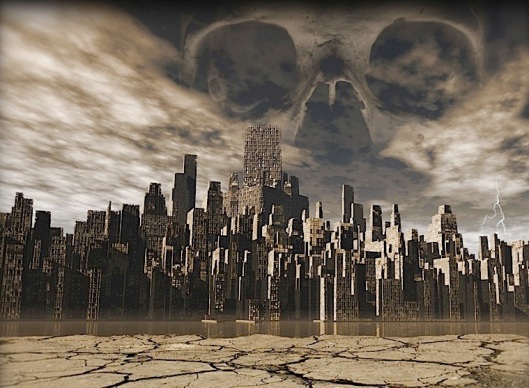
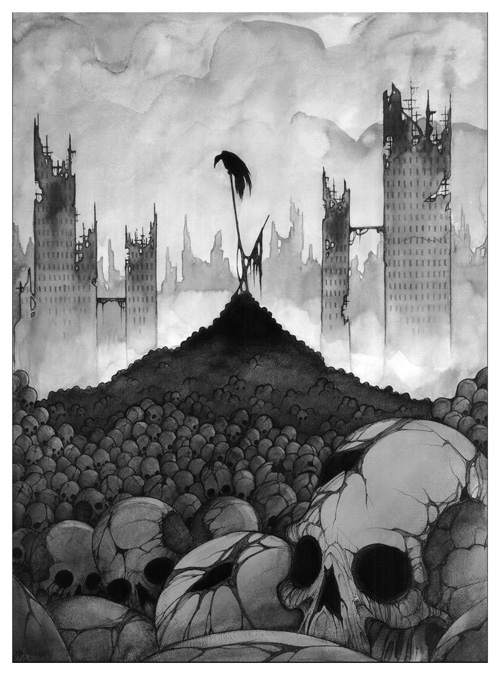
Picture a clock melting into a puddle of its own gears, each tick drowned out by flood sirens and fire alarms. This is our reality: a world where the future isn’t just uncertain—it’s expiring. We’ve traded constellation charts and sacrificial altars for climate models and computer forecasts, offering a front-row seat to our own funeral. The paradox? The more data we uncover about tomorrow, the less we trust it to exist. Once, humans etched hopes into cave walls and cathedrals. Now, we doomscroll through heat maps of burning continents, simulations of societal collapse, and videos of melting glaciers calving into the ocean. Knowledge, once a torch, has become a noose. We’re trapped in what philosopher Franco Berardi calls “the slow cancellation of the future,” where foresight doesn’t empower; it strangles. This isn’t mere pessimism. It’s a mutation of hopelessness unique to our age: living as if the apocalypse is a done deal. Time itself feels terminal, a patient on life support we’re asked to euthanize with every flight booked, every plastic straw used, every hamburger eaten. How do you make meaning when the horizon is a wall and living in the last days is not a possibility, but a certainty? How do we navigate existence when time itself feels terminal?
Part 1: The Evolutionary and Existential Roots of Future-Consciousness
Let’s begin at the dawn of humanity, when survival hinged on anticipating threats—predicting droughts, avoiding predators, navigating social strife. Cognitive scientists trace our obsession with the future to this evolutionary crucible. Those who could simulate hypothetical scenarios—a form of “mental time travel”—gained an edge, transforming Homo sapiens into Earth’s ultimate strategists. This ability to project ourselves forward isn’t just practical, but woven into the fabric of what makes us human.
Yet this gift is also a burden. Philosopher Martin Heidegger framed our relationship with time as fundamentally existential. In Being and Time, he argued that human existence is defined by Sein-zum-Tode (“being-toward-death”): our awareness of mortality forces us to grapple with life’s finitude. Far from morbid, Heidegger saw this anxiety as liberating—a confrontation with the “not yet” that compels us to shape meaning. When we fret about climate collapse or personal purpose, we’re not irrational; we’re exercising what he called “freedom toward possibility.”
Here lies the paradox: foresight evolved to ensure survival, yet it also traps us in a labyrinth of existential dread. Psychologist Ernest Becker, in his Pulitzer-winning The Denial of Death, posited that humans buffer this terror by constructing cultural “immortality projects”—religions, art, empires, even the quest for legacy—to outwit oblivion. Similarly, as climate philosopher Clive Hamilton observes, fixating on dystopian futures isn’t mere pessimism. It’s an attempt to “tame the chaos,” transforming paralyzing uncertainty into a narrative we can, however imperfectly, confront.
In essence: Our brains are time machines, oscillating between survivalist calculation and metaphysical vertigo. The same cognitive machinery that built civilizations also leaves us uniquely vulnerable to the weight of what might come. We are creatures of anticipation, forever balancing on the tightrope between ingenuity and anguish.
Part 2: Modern Philosophers on the Future, Responsibility, and the Weight of End-Time
We live in an age of compounding crises—climate tipping points, biodiversity collapse, pandemics that circle the globe in weeks. The future no longer feels like a horizon; it looms like a storm. How do we confront a world that seems to be writing its own epitaph? Modern philosophers, from the mid-20th century to today, have wrestled with this question, probing the tension between agency and despair.
Stewardship in the Age of Vanishing Tomorrows
Picture a lone hiker standing at the edge of a melting glacier, the ice groaning as it retreats—a sound like the Earth itself sighing. This is the Anthropocene’s haunting stage, where Heidegger’s “being-toward-death” morphs from personal mortality to planetary mortality. For Heidegger, anxiety about our individual end was a clarion call to live authentically, to craft meaning before the void. But today, the void has expanded. It’s no longer just my death we dread, but the death of coral reefs, of ice caps, of civilizations. The existential question shifts: How do we live authentically when the world itself feels terminal?
Heidegger’s philosophy, rooted in the 20th century’s industrial buzz, never grappled with the scale of collapse we now face. His focus on individual choice—choosing your “ownmost possibility” in the shadow of death—feels quaint, even myopic, when confronted with systems unraveling faster than any single life can span. Enter Hans Jonas, a philosopher who picked up Heidegger’s torch and carried it into the storm. In the 1970s, as the Cold War’s nuclear specter loomed, Jonas warned that humanity had become “a Prometheus unbound,” wielding godlike technological power without godlike wisdom. His response? An “imperative of responsibility”: Act so that the effects of your actions do not destroy the possibility of future life. Where Heidegger fixated on the individual’s confrontation with finitude, Jonas demanded we stretch our ethics across millennia. Imagine a relay race where the baton is the fate of humanity itself: Jonas insists we run our leg as if the next runner’s survival depends on our grip. His work bridges existential dread and collective action, arguing that the future isn’t an abstract concept but a right—one we’re ethically bound to protect.
Yet here’s the rub: How do we heed Jonas’s call in a world where the “future” feels like a flickering mirage? Imagine standing on a shore, watching the tide recede faster than you can chase it. The horizon blurs; what was once solid becomes a shimmering illusion. This is stewardship in the Anthropocene: the more we grasp for the future, the more it slips through our fingers. Jonas’s plea—act as if the future matters—collides with a world where headlines reduce tomorrow to a countdown clock. Carbon thresholds breached, extreme weather reducing communities to rubble, ecosystems unspooling like frayed rope. The absurdity is visceral. Why plant trees in a burning forest? Why write ethics for a world that might not read them?
But Heidegger’s ghost whispers a counterintuitive truth: the mirage itself is proof of water. Anxiety, he argued, isn’t just fear—it’s the tremor of freedom. Dread is the shadow cast by our agency, a reminder that we could act, even when we feel powerless. Our collective despair over climate collapse exists because we know we’ve authored it; the very fact that we grieve futures not yet lost is evidence of our complicity and our capacity to intervene. This is the knife’s edge Jonas asks us to walk. To feel the weight of responsibility while staring into the abyss of “too late.” To care for a future that may never arrive. It’s like loving someone terminally ill: Do you withdraw to spare yourself the pain, or lean in, knowing your presence might be the only grace they receive?
When we recoil at another oil spill, that revulsion isn’t passivity. It’s a moral compass spiking, a refusal to normalize the unacceptable. Even resignation, philosopher Jonathan Lear argues, can be a form of radical hope—a quiet commitment to endure, to keep the embers of possibility alive for a dawn we might not see. Our task is to dwell in the uncertainty, to let the mirage of a future guide us not as a delusion, but as a compass. The future flickers because it is alive, still unformed. And as long as it flickers, we have work to do. In the end, Jonas’s imperative isn’t about guarantees. It’s about living as if the question “What will become of us?” still matters; because the moment we stop asking it, the mirage dissolves and the tide never returns.
Part 3: The Age of Collapse – Implications for Future-Consciousness
The Paradox of Prediction
Modernity handed us crystal balls made from science and technology; but instead of clarity, we’re stuck in a hall of mirrors where every reflection screams collapse. Philosopher Franco “Bifo” Berardi calls this the “slow cancellation of the future”—a world where capitalism’s addiction to quarterly profits has turned tomorrow into a spreadsheet, a debt to be paid rather than a frontier to explore. Our tools for seeing the future are eroding our ability to imagine it. Berardi argues that financial capitalism’s obsession with endless growth and instant returns has shrunk the future to a “commodity,” something to mine, not mend. The result? “Depressive realism”: a grim consensus that dystopia is inevitable, data is destiny, and resistance is futile. It’s like watching a weather app predict a hurricane while you’re forbidden to board up the windows. The more we know, the less we do.
Enter Timothy Morton’s “hyperobjects”—monstrous, invisible forces like climate change that ooze across centuries and continents, too vast for any one person to grasp. Try picturing a single plastic straw choking an ocean, or CO2 from your commute melting a glacier in 2050. These hyperobjects don’t just overwhelm; they humiliate. They turn individual action into a cosmic joke: Why bother recycling when corporations are dumping toxic sludge? Berardi’s “cancelled future” and Morton’s “hyperobjects” are two sides of the same coin. One attacks our hope, the other our agency. Together, they trap us in a loop; we binge on apocalyptic forecasts because they confirm our helplessness, and our helplessness fuels the apathy that lets the crisis deepen. It’s a self-fulfilling prophecy labeled as “realism.” Buried in this paradox is a perverse kind of power. If depressive realism is a cage, it’s one we’ve built ourselves. Do we have the agency to dismantle it? What if we stopped letting the tools that measure the future decide its value? A cancelled future isn’t just a tragedy, it’s a theft. And the clock is ticking.
Albert Camus and the Art of Absurdist Alchemy
Picture Camus in a dim Parisian café, ash from his cigarette dusting the pages of The Myth of Sisyphus. He’s not writing about climate collapse or the end of mass extinction, he’s writing about us. To him, humanity’s plight is tragically comic: we’re ants building sandcastles on a shore being erased by the tide, scribbling sonnets into hurricanes. His infamous conclusion? “One must imagine Sisyphus happy.”
But what does that mean now? Sisyphus isn’t just pushing a boulder—he’s drafting climate legislation that’ll be gutted by lobbyists. He’s boycotting plastic while corporations continue dumping their poisonous products into the food chain. Camus’ genius was reframing futility as freedom: the rock will roll back, but the act of pushing it is where meaning is found. Absurdity isn’t a flaw in the system; it is the system. And rebellion, for Camus, isn’t about victory. It’s about dignity. The cliff’s edge isn’t just a metaphor, it’s the lived reality of activists chain-linking themselves to pipelines and scientists refining doomsday models. To hope feels delusional; to resign feels complicit. But Camus’ absurdism offers a third path: defiant pragmatism.
You don’t have to believe the boulder will stay atop the hill. You just have to find purpose in the struggle. We know the boulder might crush us, but we push anyway. Camus would nod: “There is no sun without shadow, and it is essential to know the night.” Your acts won’t “save the world.” But they suture the soul to something sturdier than hope or despair: the stubborn refusal to let collapse define you. The Question Camus Leaves Us: What if happiness isn’t the absence of dread, but the audacity to dance in its shadow? The cliff remains. The fog thickens, but somewhere in the abyss, a tattered flag defiantly stands.
John Gray’s Ice-Cold Shower:
Imagine waking up to a blaring alarm clock that screams, “Your species is a cosmic accident, and everything you love is temporary.” That’s John Gray in a nutshell, the philosopher who doesn’t just rain on humanity’s parade; he floods it. Gray isn’t here to coddle you with tales of redemption or progress. He’s the bartender who slides you a shot of nihilism and says, “Bottoms up.” For Gray, sustainability is a secular fairy tale, a bedtime story we tell ourselves to avoid staring into the void. Humans, he argues, are “stone-age predators” who stumbled into a god complex. We’re cavemen with nukes, primates playing with CRISPR like toddlers with matches. Climate collapse? Mass extinction? To Gray, these aren’t glitches—they’re the system working exactly as designed. Civilization, in his view, is a Rube Goldberg machine of hubris, destined to self-destruct because we’re hardwired to exploit, not evolve. His punchline? “Progress is a delusion; entropy always wins.” While Silicon Valley sells fantasies of Mars colonies and AI utopias, Gray chuckles at the irony; the same tools meant to “save” us (AI, geoengineering) are just newer, shinier ways to accelerate the crash.
But here’s the twist: Gray’s pessimism isn’t defeatist, it’s liberating. By dethroning humanity’s “specialness,” he forces us to confront a brutal truth: we’re not the protagonists of Earth’s story. We’re a flash-in-the-pan species, no more destined to rule than the dinosaurs. For Gray, accepting this is freedom. It means shedding the weight of salvation fantasies, no more savior complexes, no more guilt for failing to “fix” the unfixable. Critics call him a doomer, but Gray would shrug and say, “I’m a realist.” He’d point to history’s graveyard of empires and ideologies as proof. The Romans? Dust. The USSR? Gone. Capitalism? A self-cannibalizing corpse. Sustainability, he argues, is just the latest myth, a secular religion preaching that we can bargain with physics.
Part 4: The Tightrope
So who is right? The defiance of Camus or the nihilism of Gray? The answer lies in the question itself. These aren’t philosophies to adopt, but forces to navigate—like sailing a storm by adjusting the sails, not praying for calm. The absurdist’s laugh, the activist’s shovel, the pessimist’s sneer: they’re all survival tools. The real crisis isn’t choosing between hope and resignation. It’s the demand to hold both at once—to care deeply in a world that rewards detachment. As novelist Rebecca Solnit writes, “Hope is an axe you break down doors with, in an emergency.” Even if the emergency never ends.
The challenge is to balance foresight with ethical imagination. For instance, Indigenous philosophies offer models of intergenerational responsibility, as seen in the Seventh Generation Principle of the Iroquois. Similarly, the Buddhist concept of pratītyasamutpāda (interdependent co-arising) reframes collapse as a call to address systemic entanglement. For the Amazon’s Yanomami people, ecological collapse isn’t a terminus; it’s a call to renegotiate humanity’s pact with nonhuman life. Their work suggests that hopelessness stems not from the planet’s fragility, but from our failure to see beyond capitalism’s brittle timeline. Anthropologists Deborah Danowski and Eduardo Viveiros de Castro provide a radical counterpoint in their book, The Ends of the World (2017), where they contrast Western apocalyptic linearity with Indigenous cyclical temporality in which collapse is not an endpoint but a phase of renewal. The cultural movement Dark Mountain, co-founded by Paul Kingsnorth and Dougald Hine, rejects the myths of progress and techno-salvation, instead centering on “uncivilization”—a radical reimagining of humanity’s relationship with nature, progress, and storytelling. Jem Bendell’s Deep Adaptation philosophy confronts the inevitability of climate-driven societal collapse by urging radical shifts in how we live and think with what he calls the four R’s: abandon harmful systems (Relinquish), strengthen community resilience (Resilience), heal ecosystems (Restore), and foster equity and compassion (Reconcile). Rejecting techno-optimism and growth-obsessed capitalism, he advocates for emotional honesty and localized action to navigate crisis with dignity. His unflinching call to prepare for disruption has galvanized global movements reimagining survival through solidarity, not denial.
The human instinct to know the future is neither naively optimistic nor morbidly fixated; it is a testament to our capacity for reflection and responsibility. In an age of collapse, this instinct becomes a double-edged sword: it can fuel denial or galvanize action. Modern philosophers remind us that the future is not a fixed endpoint but a horizon of possibilities shaped by present choices. The challenge ahead is not to become fatalistic but to inhabit the present ethically—to weave new stories of resilience, interdependence, and humble co-creation. Drawing parallels with existentialist thought, Guy McPherson advocates for a similar “ethical living”—embracing honesty, compassion, and community despite impending doom. He urges individuals to find meaning in authenticity and connection rather than denial or despair. As the stakes of our foresight grow unimaginably high, the question shifts from “What will happen?” to “What will we become and how will we act in the face of what is happening?”




 Collapse of Industrial Civilization