I would like to believe that planetary tipping points do not exist and that the activities of 9 billion humans cannot “break the planet”, rendering it uninhabitable for future generations, but on just an intuitive level I feel this is wishful thinking. So it was with some surprise that I saw the following article:
A group of international ecological scientists led by the University of Adelaide have rejected a doomsday-like scenario of sudden, irreversible change to the Earth’s ecology.
In a paper in the journal Trends in Ecology and Evolution, the scientists from Australia, US and UK argue that global-scale ecological tipping points are unlikely and that ecological change over large areas seem to follow a more gradual, smooth pattern…
…A tipping point occurs when an ecosystem attribute such as species abundance or carbon sequestration responds rapidly and possibly irreversibly to a human pressure like land-use change or climate change.
Many local and regional-level ecosystems, such as lakes and grasslands, are known to behave this way. A planetary tipping point, the authors suggest, could theoretically occur if ecosystems across Earth respond in similar ways to the same human pressures, or if there are strong connections between continents that allow for rapid diffusion of impacts across the planet.
“These criteria, however, are very unlikely to be met in the real world,” says Professor Brook. “First, ecosystems on different continents are not strongly connected. Second, the responses of ecosystems to human pressures like climate change or land-use change depend on local circumstances and will therefore differ between localities.”
The scientists examined four principal drivers of terrestrial ecosystem change ? climate change, land-use change, habitat fragmentation and biodiversity loss ? and found they were unlikely to induce global tipping points.
Co-author Associate Professor Erle Ellis, University of Maryland, Baltimore County, says: “As much as four fifths of the biosphere is today characterised by ecosystems that locally, over centuries and millennia, have undergone human-driven regime shifts of one or more kinds. Recognising this reality and seeking appropriate conservation efforts at local and regional levels might be a more fruitful way forward for ecology and global change science.
I would have to disagree that ecosystems on different continents are not connected. The health of one ecosystem affects other ecosystems globally. For example, the loss of the Arctic and its albedo effect has global repercussions for climate patterns such as is discussed here:
…A difference in temperatures between the Arctic and areas to the south is usually the main driver of the wave flows, which typically stretch 2,500 and 4,000 km (1,550-2,500 miles) from crest to crest.
But a build-up of greenhouse gases in the atmosphere, blamed on human activities led by use of fossil fuels, is heating the Arctic faster than other regions and slowing the mechanism that drives the waves, the study suggested…
Being a human, I care not whether planet Earth will survive humanity, but whether we humans will survive the environmental onslaught of our own activities. Of course the Earth will continue on without us, but that’s an empty consolation for the human species whose time in history will soon be forgotten on a planet left uninhabitable for our children. So do planetary tipping points exist or can humans do whatever they like with no real world effect to the global biosphere? I guess we’ll soon find out. Keep in mind that there is no precedent in the past 2.5 million years for the kind of rapid, human-induced global warming the Earth has been undergoing since the onset of the industrial revolution. We are in uncharted territory.
I ran across this series on America’s water crisis by Vice Media. It was published just a few months ago so it’s recent; I highly recommend watching all three. For me, part three was the most riveting because I have relatives there and that state is my neighbor. As always, water is diverted to where the money is, and no amount of public protest or scientific studies and research will stop the juggernaut of elite monied interests, the natural environment and Main Street be damned.
On a related topic, another report has been published of one more climate feedback loop for us to worry about. This time biodiversity loss in the form of disappearing top predators will increase CO2 by a whopping 93%:
Add this factor of predator die-off to the long list of known and unknown feedback loops such as permafrost melt, clathrate methane release, the disappearing albedo effect, increased atmospheric water vapor, growing acidity and warming of the world’s oceans destroying this vital CO2 sink, and the global die-off of forests which negates yet another massive CO2 sink.
Does anyone really think we’ll be worrying about reduced labor capacity in 2050 due to climate change? Or will we be fighting just to find enough food to stay alive?
Well, yes they think that business-as-usual will continue and technological wizardry will solve any and all problems of a collapsing ecosystem. Mankind will be driving electric cars and taking trips to distant planets. Here’s some common sense advice for such foolish thinking:
What will life soon be like here on Earth. I’ll let blogger Copernicus describe it to you:
David Suzuki has forecast (‘It’s A Matter of Survival’, Harvard Univ. Press, 1991 with Anita Gordon) the first year of no seasons as 2040. However, if global warming is accelerating (much higher CO2 concentrations added each year, hence higher solar insolation by about 2 W/m^2 per year) then that date could arrive as early as 2025, if not sooner. What it will mean is that an essential thermal equilibrium will be reached in our planetary atmosphere so effectively, no more winters, summers or even intermediate (Spring, fall) seasons anywhere. That will also mark the emergence of much higher mean global temperatures, probably as high as 60-65F. Locally[Colorado], we can expect to see highs of 115F-120F and covering much larger areas for much longer (heat ‘waves’ will be more like heat seasons, lasting months.) Relatively cooler breaks, say with highs of 85-90, will likely appear in what used to be northern winters.
With the much more consistent high temperatures, pests of all types will proliferate, so we can expect to see more worm-parasite infestations for example, as well as dengue fever rivaling what we have now with West Nile Fever. Cholera, c. diff. and amoebic dysentery will also not be unheard of as our water resources continue to be used up and polluted, i.e. by fracking. All in all, it will be a world that few will enjoy living in, other than the very rich – who, unlike the rest of us – will be able to afford their own off the grid power stations, so won’t be rendered too uncomfortable when the main grids crash from over use.
Be happy as long as you are getting snow, even 2′ at a time, because it means that first year of no seasons is still a ways off!
The video below was produced several years ago, but is still prescient:
As I mentioned in my previous post, Capitalism, Population Growth, & Climate Change, I’m reading a book on the present and future effects of anthropogenic global warming to the American Southwest as well as the entire world.
The Southwest drought of the early 2000’s, accompanied by the massive bark beetle infestation, killed over 2.6 million acres of mostly piñon(pinyon) pine. Pinyon pines are an interesting tree, living for up to 800 years and producing a tasty edible nut considered to be a “super food”. Studies by Craig D. Allen (U.S. Geological Survey) tell us that climate change is making droughts, historically normal occurrences in the Southwest, a killer for that region’s trees which usually can withstand such events, but not under the prolonged higher temperatures that human-induced global warming brings. These sustained higher temperatures have been identified as the “critical factor in provoking widespread tree mortality.” With a 4°C increase in temp and all other factors remaining the same, a five fold increase in pinyon tree death has been estimated by recent studies. The problem with that estimate though is that all other factors will most certainly change: less snowfall will diminish the benefits of the albedo effect, more retained heat from the sun and altered rainfall patterns will dry out the soil and increase erosion, and elevated levels of dust in the air will also factor into this vicious feedback loop to shrink mountain snowpack and increase evaporation. Fires and insect infestation will be seasonal events of ever-increasing intensity. And the demise of desert cities like Phoenix, dependent on a shrinking Colorado River, will inevitably follow.
…The team developed a Forest Drought-Stress Index that combines the amount of winter precipitation, late summer and fall temperatures, and late summer and fall precipitation into one number.
“The new ‘Forest Drought-Stress Index’ that Williams devised from seasonal precipitation and temperature-related variables matches the records of changing forest conditions in the Southwest remarkably well,” said co-author Thomas W. Swetnam, director of the UA Laboratory of Tree-Ring Research.
“Among all climate variables affecting trees and forests that have ever been studied, this new drought index has the strongest correlation with combined tree growth, tree death from drought and insects and area burned by forest fires that I have ever seen.”…
…“Atmospheric evaporative demand is primarily driven by temperature. When air is warmer, it can hold more water vapor, thus increasing the pace at which soil and plants dry out. The air literally sucks the moisture out of the soil and plants.”…
…These trends, the researchers noted, are already occurring in the Southwest, where temperatures generally have been increasing for the past century and are expected to continue to do so because of accumulating greenhouse gases in the atmosphere… – lnk
Here’s what the benchmark drought of 2001-2002, a harbinger of future hi-temp droughts in the Southwest, did to pinyon trees:
From my post ‘Climate Tipping Points: The Global Die-Off of Forests‘, we know that forests all over the planet are dying and that mass die-offs of these areas are only a matter of time. The arid regions of the world like the U.S. Southwest are the most sensitive biomes on the planet and will be the first areas to exhibit catastrophic die-off from climate change.
This excerpt from the book I’m reading should scare the hell out of you (he’s talking about the 2001-2002 U.S. Southwest drought):
Does ‘industrial-capitalist carbon man’ give a fuck about trees? Certainly not if they get in the way of profit and ‘development’.
The Earth’s population of efficient Human termites continues to devour the planet out of house and home. Similar to the oil industry racing to the Arctic to suck out any newly revealed deposits of fossil fuels, we have mining companies racing to exploit a dying Amazon forest. Just like the vanishing ice sheets and glaciers of the Arctic and Antarctic, the trees of the Amazon are succumbing to a warming planet:
A study published today in the Proceedings of the National Academy of Sciences1 sheds light on the long-term effects of drought on the Amazon rainforest — giving clues about how the rainforest might be affected by global warming in the future. The researchers report that the severe drought that hit the rainforest in 2005 had lasting effects on the forest canopy, such that it remained damaged at least four years later…
…The latest analysis paints a grim picture for Amazonian rainforests should severe droughts become more frequent. Most Amazonian droughts are driven by warmer surface waters in the eastern Pacific Ocean, but the severe droughts of 2005 and 2010 seem to have been influenced by warmer sea-surface temperatures in the North Atlantic Ocean.
It could change the drought outlook in the next report from the Intergovernmental Panel on Climate Change, due in 2014…
After reading that, a wise caretaker of the Earth would step back and contemplate serious conservation efforts for preserving this critical environmental feature of the planet. Many have called the Amazon rainforest the “Lungs of the Earth”‘, a “jewel of the Earth”, the ”world’s largest pharmacy”, and a “biodiversity hotspot”. Those phrases sound like they refer to something that is highly regarded and vital. But in the world of industrial capitalism, the response is to do this:
…All together, mining companies will spend some $24 billion between 2012 and 2016 to boost production of iron ore, bauxite and other metals found in the Amazon basin, according to Brazil’s mining association, Ibram. Already, Brazil is attracting a fifth of all mining investment globally, and for many the Amazon represents the country’s greatest untapped potential.
“The Amazon will be our California,” said Fernando Coura, Ibram’s president.
The push by miners into the Amazon fits with Brazil’s broader strategy to tap the rain forest’s natural resources to drive economic growth. Brazil is building hydroelectric dams on Amazon rivers, improving roads between far-flung Amazon towns and connecting them to the national power grid. Legal changes and government-backed lending will help pave the way for more Amazon mines…
And so the unending destruction of the planet steamrolls onward in the name of “developement” and “progress”. The conversion of the real world into profitable commodities leaves in its wake a toxic and barren wasteland. For those whose eyes have been opened to such ecocide, how much more can you take before you simply become numb to it, zombified to the death and destruction inherent in our socio-economic system of industrial capitalism.
Gold Mining in the Amazon:
…One cannot disdain all other living beings, grind mountains to extract minerals, build roads without a thought for habitat fragmentation, design gardens to please only human aesthetics, or harvest monocultures that serve solely human needs, and expect one’s world to continue for long. There is room for humans at Earth’s banquet, but only those who have lived in place long enough to have learned the contours of their terrain, the language of their plant and animal neighbors and, more than anything, the needs of non humans… –Biodiversity and Sustainability Are Closely Linked to Language and Culture
Amongst all the drama of the fiscal cliff, the story that should have gotten front page space this week is that the Antarctic is melting much faster than previously thought. In my post ‘Burning the Candle at Both Ends‘, the recent finding that the Antarctic was indeed losing ice came as a revelation to many and dispelled the popular belief amongst the global warming ‘denialist’ crowd that the South Pole ice sheet was increasing. The situation has now gotten more dire:
What are the ramification of this? We’ve released another ticking methane time bomb and opened up one more pandora’s box of known and unknown feedback loops:
…Half the West Antarctic ice sheet and a quarter of the East Antarctic sheet lie on pre-glacial sedimentary basins containing around 21,000bn tonnes of carbon, said the scientists, writing in the journal Nature.
British co-author Prof Jemma Wadham, from the University of Bristol, said: “This is an immense amount of organic carbon, more than 10 times the size of carbon stocks in northern permafrost regions.
“Our laboratory experiments tell us that these sub-ice environments are also biologically active, meaning that this organic carbon is probably being metabolised into carbon dioxide and methane gas by microbes.”
The amount of frozen and free methane gas beneath the ice sheets could amount to 4bn tonnes, the researchers estimate…
And what will happen to coastal communities? If one were to perform a linear projection of sea level rise from recent records, then you would get the following results:
…Currently, sea level is rising at the rate of 3 mm each year. Given 1″ = 25 mm, this means by the end of the century a rise of 87 (yrs) x 3 mm / yr. = 261 mm or (261 mm/ 25 mm/in) = 10.44 inches – enough to wash away roughly one third of S. Florida and most of the sea level areas of the Atlantic coast…
…IPCC (2007) suggested a most likely sea level rise of a few tens of centimeters by 2100. Several subsequent papers suggest that sea level rise of ~1 meter is likely by 2100. However, those studies, one way or another, include linearity assumptions, so 1 meter can certainly not be taken as an upper limit on sea level rise…
…Hansen (2005) argues that, if business-as-usual increase of greenhouse gases continue throughout this century, the climate forcing will be so large that non-linear ice sheet disintegration should be expected and multi- meter sea level rise not only possible but likely. Hansen (2007) suggests that the position reflected in IPCC documents may be influenced by a “scientific reticence”…
…Perceived authority in the case of ice sheets stems from ice sheet models used to simulate paleoclimate sea level change. However, paleoclimate ice sheet changes were initiated by weak climate forcings changing slowly over thousands of years, not by a forcing as large or rapid as human-made forcing this century. Moreover, in a paper submitted for publication (Hansen et al., 2013) we present evidence that even paleoclimate data do not support the degree of lethargy and hysteresis that exists in such ice sheet models…
…The increasing Greenland mass loss in Fig. 1 can be fit just as well by exponentially increasing annual mass loss, a behavior that Hansen (2005, 2007) argues could occur because of multiple amplifying feedbacks as an ice sheet begins to disintegrate. A 10-year doubling time would lead to 1 meter sea level rise by 2067 and 5 meters by 2090. The dates are 2045 and 2057 for 5-year doubling time and 2055 and 2071 for a 7-year doubling time.
However, exponential ice loss, if it occurs, would encounter negative (diminishing) feedbacks. Our simulations (Hansen and Sato, 2012) suggest that a strong negative feedback kicks in when sea level rise reaches meter-scale, as the ice-melt has a large cooling and freshening effect on the regional ocean. Such a slowdown in the rate of sea level rise would be little consolation to humanity, however, as the high latitude cooling would increase latitudinal temperature gradients, thus driving powerful cyclonic storms (Hansen, 2009), and coastlines would be continually moving landward for centuries.
West Antarctic ice is probably more vulnerable to rapid disintegration than Greenland ice, because the West Antarctic ice sheet rests mainly on bedrock below sea level (Hughes, 1972). The principal mechanism for mass loss from West Antarctica is warming of the ocean, melting of West Antarctic ice shelves, and thus increased flux from the ice sheet to the ocean.
The several analysis methods compared by Shepherd et al. (2012) concur that the West Antarctic ice sheet mass imbalance has grown since 2005 from an annual mass loss of 0-100 Gt ice to a recent annual mass loss of 100-200 Gt ice (Fig. 4 of Shepherd et al.)…
There are roughly seven billion humans on Earth at this time, all of whom have a death sentence hanging over their head via anthropomorphic climate change. Perhaps this partly explains the recent popularity of zombies and the ‘walking dead’ in our culture. Forthright thoughts on this subject from a scientist commenting at the Arctic Sea Ice Blog:
The first signs have appeared of what will be a mass culling of the human population by way of famine in the decades to come:
…According to the Food and Agriculture Organisation in Rome, global wheat production is expected to fall 5.2% in 2012 and yields from many other crops grown to feed animals could be 10% down on last year.
“Populations are growing but production is not keeping up with consumption. Prices for wheat have already risen 25% in 2012, maize 13% and dairy prices rose 7% just last month. Food reserves, held to provide a buffer against rising prices, are at a critical low level. It means that food supplies are tight across the board and there is very little room for unexpected events,” said Abdolreza Abbassian, a senior economist with the FAO…
My youngest son, who is eight years old, shocked me last week with a certain question. I don’t talk about the subject matter of this blog to him for obvious reasons. He asked me whether in the future the world would become a sort of technological paradise or a destroyed planet. I couldn’t answer his question. I didn’t even want to try.
…we encounter another fact about our planetary life: the fragility of the balances through which the natural world that we know survives. In the field of climate, the sun’s radiations, the earth’s emissions, the universal influence of the oceans, and the impact of the ice are unquestionably vast and beyond any direct influence on the part of man. But the balance between incoming and outgoing radiation, the interplay of forces which preserves the average global level of temperature appear to be so even, so precise, that only the slightest shift in the energy balance could disrupt the whole system. It takes only the smallest movement at its fulcrum to swing a seesaw out of the horizontal. It may require only a very small percentage of change in the planet’s balance of energy to modify average temperatures by 2C. Downward, this is another ice age; upward, a return to an ice-free age. In either case, the effects are global and catastrophic.
~ Barbara Ward and Rene Dubos (Only One Earth: The Care and Maintenance of a Small Planet)
In my two posts about climate tipping points, I spoke of the Amazon forest and boreal forests as specific tipping points, but we can lump the planet’s entire collection of wood, forest and jungle ecosystems into one global system that will be decimated in the current human-generated climate armageddon. Man will realize he is just a temporary visitor of planet Earth, soon to be evicted by the cruel and unforgiving laws of nature. The following factors, now well underway, will obliterate the Earth’s tree ecosystems in the coming decades: massive pest outbreaks like that of the bark beetle into new regions whose climate zones have been altered, hotter and more severe droughts, the spread of invasive weedy plants which act as fuel for bigger and more devastating wildfires, and the spread of tree-killing diseases.
There are four recent articles in the news which describe how we are fast converting the world’s woods, forests, and jungles from massive carbon sinks into massive carbon emitters, ultimately to treeless wastelands:
These studies sound a warning bell that we can expect to see forest diebacks become more widespread, more frequent and more severe — and that no forests are immune,” Engelbrecht continued. “The ramifications of this scenario are diverse and, in many respects, dire: forest mortality will be accompanied by changes in species composition, changes in ecosystem function and losses of services and biodiversity.
Professor Frank Fenner’s prediction will invariably come to pass. And the intuition of the unwashed masses is correct – we are living in End Times:
But no ‘believers’ will be saved from this eco-apocalypse and no God will appear. The only thing visited upon mankind will be his own self-annihilation brought on by ignorance, hubris, and greed.
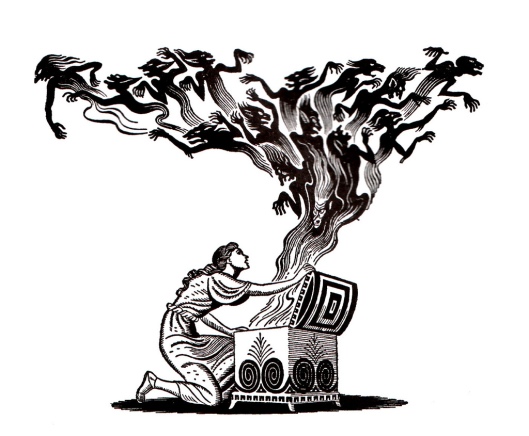
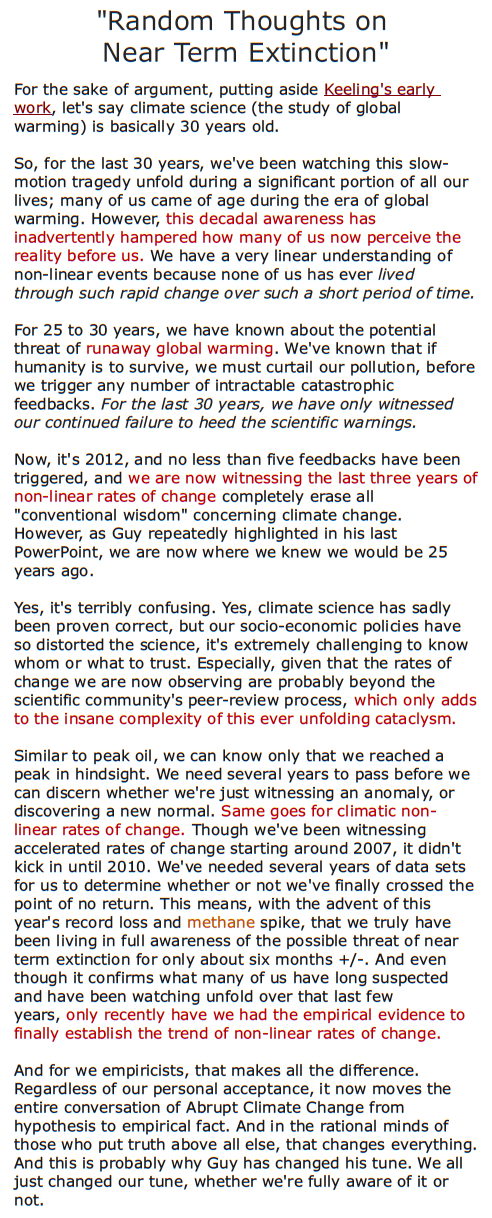
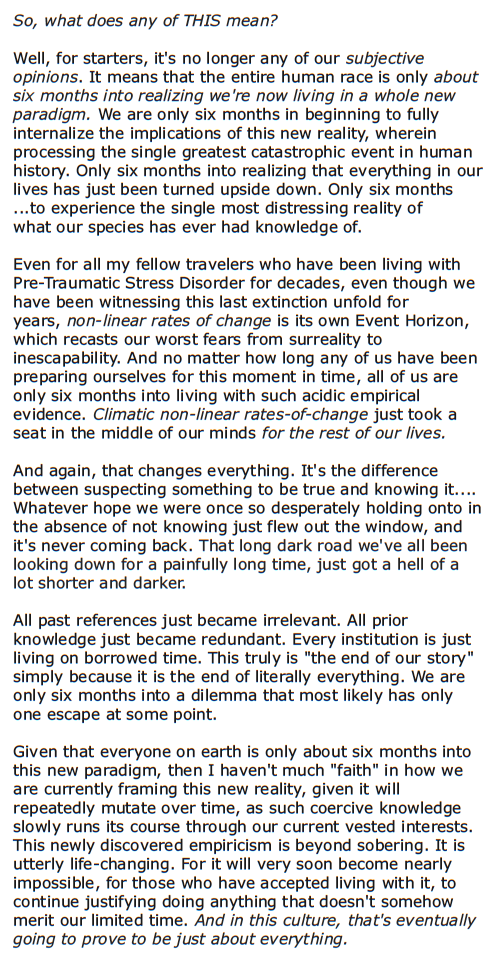
The following thoughts were emailed to me by Adam at speciesurvivalibrary and they appeared as a comment on the message board of Nature Bats Last dated November 28. The readers “found it quite moving”, as did I. Therefore, I compiled a video at the end to go along with Daniel’s articulate and resonating words. The scientific confirmations this year of the havoc industrial civilization has wrought to our one and only home have truly been life-altering for me, forcing me to question and re-evaluate everything. For those who have begun to internalize the cold reality of what lies in the not too distant future for mankind, the proverbial rug has been pulled out from under your world. We have unleashed Pandora’s box and the demons are methodically throwing off balance and unravelling the world we once knew, shattering the illusion of man’s dominion over nature.
A newly released study commissioned by the C.I.A. entitled Climate and Social Stress: Implications for Security Analysis highlights the vulnerabilities of our globalized economy to climate change. Of particular interest is the section on energy. To summarize:
1.) Oil is the most highly integrated commodity of globalized trade. Its tightly interconnected market was created in the aftermath of the OPEC embargoes of the 1970’s to prevent its manipulation by political actors. Its integration is said to be fully complete to the point that any disruption in the global oil system will cause an economic ripple effect throughout the world. Rapid oil consumption in China and India without a corresponding increase in production has left the oil market extremely tight (i.e. Peak Oil).
2.) Due to the facts stated above, any changes in climate could easily disrupt the world’s energy system. For example:
(a.) Tropical storms and sea-level rise can disrupt production, refining, and transport of petroleum since a large percentage of oil refining and processing are located in coastal areas vulnerable to such storms and floods. This is true in the U.S., Europe, China, and India. An example would be Hurricane Katrina and Rita in 2005 which disrupted oil and gas operations of off-shore rigs, coastal refining, and transport via sea ports and pipelines.
(b) Drought will cause oil refining disruptions since that process requires large amounts of water. If the drought is accompanied by higher temperatures, the scarcity of water will be exacerbated because the oil refineries will require even more cooling by water. A warming planet will also cause infrastructure damage (pipelines and drilling platforms) in Arctic operations due to collapsing earth from the melting of permafrost.
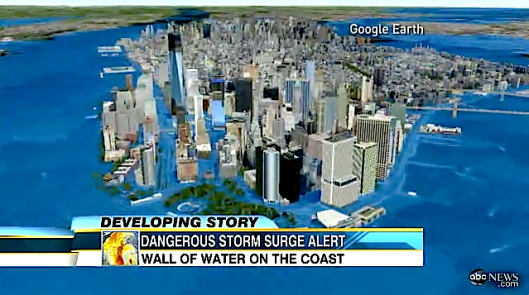
We are entering an era in which not only the global energy system is vulnerable, but the social, agricultural, and technological infrastructure is also at the mercy of climate disruptions. They were all designed around assumptions of moderately stable climate conditions, and as climate exceeds boundary thresholds, these infrastructures will break. As was demonstrated by Hurricane Sandy recently in New York/New Jersey with the power outages, gas shortages, and Nuclear plant shutdowns. The droughts this past summer in the U.S. midwest show the fragility of our food system whose development assumed fairly stable weather patterns and rainfall.
A quote from the study:
…The fundamental science of climate change suggests that continued global warming will increase with frequency or intensity (or both) of a great variety of events that could disrupt societies, including heat waves, extreme precipitation events, floods, droughts, sea-level rise, wildfires, and the spread of infectious diseases. Underpinning many of these extreme events is an acceleration of the global hydrological cycle. For each 1.8° F (1° C) increase in the global mean surface temperature, there is a corresponding 7 percent increase in atmospheric water vapor. Because warm air holds more water vapor than cool air, this leads to more intense precipitation. Essentially, warm air increases evaporation from the ocean and dries out the land surface, providing more moisture to the atmosphere that will rain out downwind. Water vapor is also a powerful naturally occurring greenhouse gas. As such it is the source of a very positive feedback to the coupled climate system that amplifies any external forcing by a factor of approximately 1.6…
We’ve passed a tipping point with the Arctic ice melt which has set off other feedback loops (Arctic amplification, methane release from permafrost melt, loss of the albedo effect, alteration of the Jet Stream, Greenland glacier melt, etc) and tipping points, some of which we are not even aware of, as the study acknowledges:
…there may be other processes in the Earth system, not yet identified, that have tipping points that could lead to abrupt climate change. Because of such gaps in knowledge, the possibility of such events occurring in the next decade or so cannot be totally discounted…
I would say “God help us” if the traditional farming lands -the bread baskets of nations- become dust bowls, but that’s exactly where we are headed with climate change and no miracle is going to fall out of the sky to save us.
Drought Disaster Designations Map (PDF, 504KB) Text-only (accessible) version Map shows designations due to drought across the country under USDA’s amended rule. Any county declared a primary (red) or contiguous (orange) disaster county makes producers in that county eligible for certain emergency aid.
The study talks about what it terms a “cluster of extreme events” resulting from large-scale climate processes, causing catastrophes in separate and distant areas of the globe. Trying to deal with such widespread and seemingly unrelated disruptions would quickly overwhelm the global community’s resources. An example given was in the year 2010 with the massive drought and forest fires in Russia and the epic floods in Pakistan:
…The two events were linked by more than just their proximity in time. The meteorological pattern that lead to the Russian heat wave, in which the large-scale upper-level wind flow developed a strong and persistent ridge, also contributed to the development of the meteorological pattern that resulted in the Pakistani floods —a downstream leading trough (Lau and Kim, 2012). The fact that these two extreme events corresponded in time with each other and with a single larger meteorological pattern was unusual but not totally unexpected. Circulation events like this one, which cause some event clusters, are known to occur but are not well resolved in current climate models…
…If climate events and extremes were independent in a statistical sense, the likelihood of a cluster or a compound event of any size could easily be estimated mathematically. But as the above example makes clear, extreme events in different parts of the world can be driven by common underlying forces and thus have an intrinsic relationship such that when one such event occurs, the likelihood increases that other extreme events linked to them by common causes will also occur. In statistical language, such events are called dependent.
The changing climate zones also enable the spread of tropical diseases and pests. Outbreaks of new virus strains would tax healthcare delivery systems:
…Climate events might also put stress on global health systems in various ways, most of them hard to predict. As discussed in the next chapter, climate change is expected to alter the ranges of disease vectors or pathogens in ways that expose large human populations to diseases to which they have not been previously been exposed. This could lead to a rapidly increasing demand for treatments and supplies that may not have been adequately stockpiled. If such health problems arise in combination with a disruption of supply chains for critical inoculations or medications, the potential for a severe health crisis could grow dramatically. Again, the effects might be felt far from the locations where the climate events occur. Climate events, especially when they occur in clusters, can also stress the capacity of international disaster response and humanitarian relief systems and thus cause harm in places that are not directly affected by the events but that need international assistance for other reasons…
“You can debate the specific contribution of global warming to that storm. But we’re saying climate extremes are going to be more frequent, and this[Hurricane Sandy] was an example of what they could mean. We’re also saying it could get a whole lot worse than that.”
Mr. Steinbruner, the director of the Center for International and Security Studies at the University of Maryland, said that humans are pouring carbon dioxide and other climate-altering gases into the atmosphere at a rate never before seen. “We know there will have to be major climatic adjustments — there’s no uncertainty about that — but we just don’t know the details,” he said. “We do know they will be big.”
The study was released 10 days late: its authors had been scheduled to brief intelligence officials on their findings the day Hurricane Sandy hit the East Coast, but the federal government was shut down because of the storm.
How ironic is that? The authors of this study had to postpone their meeting with U.S. intel authorities because of a climate chaos event.
Here’s what else is ironic…
…as the need for more and better analysis is growing, government resources devoted to them are shrinking. Republicans in Congress objected to the C.I.A.’s creation of a climate change center and tried to deny money for it. The American weather satellite program is losing capability because of years of underfinancing and mismanagement, imperiling the ability to predict and monitor major storms.
As is generally known by those studying the most important issue of our time, the forecasts by the IPCC are on the conservative side with scientists overly cautious not to include predictions which may be perceived as too pessimistic. A new study in the Science Journal shows that actually the more pessimistic climate models are much more accurate:
It’s important to note that the IPCC estimates do not fully take into account feedback loops and tipping points. Below is an excerpt from “Imperiled Life: Revolution against Climate Catastrophe” by Javier Sethness-Castro (2012):
…A 2009 study on climate change performed at the Massachusetts Institute of Technology–less optimistic and thus perhaps more realistic, for example, than the IPCC’s reports to date regarding the prospect of achieving significant carbon emission reductions in the near future–finds there indeed to be a chance that temperatures will increase 7.4°C (13°F) over preindustrial temperatures by the century’s end, with a 90 percent chance that the temperature increase would range between 3.5°C and 7.4°C (4.8°F-13°F).(75) The study’s authors are quick to clarify that even their decidedly bleak conclusions might be underestimates, as they, like the IPCC, donot fully account for the various feedback mechanisms that could arise given catastrophic climate change. NASA’s Dennis Bushnell, for his part, estimates that the average global temperature increase expected during this century once these feedbacks have been accounted for would amount to between 6°C and 12°C (10.5°F-21°F).(76) Warming of such apocalyptic proportions would be entirely horrific: it should be remembered that it was a 6°C (10.5°F) increase that triggered the end-Permian mass extinction.(77)
Though a matter of controversy among climatologists, there is reason to fear that overheating beyond these levels could induce a runaway greenhouse effect that would give rise to what Hansen terms “the Venus syndrome,” whereby climatic change abruptly delivers Earth to a state resembling that of Venus, where life simply cannot exist.(78)…
And another two news stories from the last few days with more ominous signs of possible acceleration into climate chaos:
I’m finding it harder to carry on with blogging about reality without compartmentalizing all this grim news into some dark recess of my brain, only to be unlocked at night when I read up on this subject. I live two lives – one in the fake world that we all mill around in like zombies in order to survive… and the other in this blog researching the coming apocalypse. No wonder the Apocadocs turned to humor to deal with this stuff.












 Collapse of Industrial Civilization