Main Street Face-plants over Facebook IPO

Tags

, , , , , , , , ,


It’s nothing new that Wall Street is corrupt and ridden with insider dealings, despite any proclamations or charade enforcement by the Securities and Exchange Commission. To quote Matt Taibbi, “the SEC and Wall Street have been in a wink-wink, nudge-nudge arrangement for years.” And watch this short video discussing the systemic fraud of Wall Street, the SEC, and the judicial system:

What’s also not new is that Main Street continues to pour money into the stock market, only to see it funneled up to the well-connected wealthy investors and banks. As George Carlin always said, “It’s a big club, and you ain’t in it.” Wall Street is just one enormous and slippery greased palm:

Giving well-connected firms an inside track has been one of the ways that big Wall Street firms attract and keep big clients. These clients are powerful profit drivers, and banks tend to give their best customers the best deals.

“These people give them more money in fees and commissions than others,” said Ernest Badway, a former U.S. Securities and Exchange Commission enforcement attorney who is now a white-collar defense lawyer in New York and New Jersey.

“Because of that — they’re part of a great revenue stream — they’re going to try to give every single advantage that they can to those particular people,” he said.

Large institutions and wealthy investors have a symbiotic relationship with Wall Street bankers. “The retail guy is at the end of the queue,” Geisst said. “He can’t do anybody any favors.”

With that in mind, we have the largest tech IPO ever to debut on Wall Street:
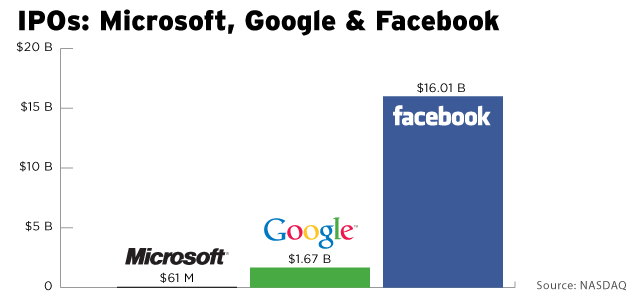
Main Street investors reportedly made up 25% of Facebook’s 421 million shares in the initial public offering. That gives the average Joe a loss of more than $500 million, based on Facebook’s closing price of $33.03 a share Thursday. As of closing Friday (5-25-12), the stock price is now at $31.34 per share. Here’s Facebook’s performance compared to other big IPO’s over the last decade:

Once again, information was divulged to well-connected investors that the unwashed masses were not privy to or made aware of:

Regulators and congressional investigators have begun probes into what went wrong, looking into questions over information distributed ahead of the IPO. Morgan Stanley and other underwriters warned privileged clients that their analysts had grown sour on Facebook’s revenue growth potential. They failed to telegraph the same information to retail clients and the general public. Information affords a crucial trading edge on Wall Street.

What exactly was that information? It was that Facebook’s business model is severely flawed. Here is the fine print of its amended S-1 statement to the Securities and Exchange Commission before the IPO launched and which is at the heart of a massive lawsuit as reported here:

“We do not currently directly generate any meaningful revenue from the use of Facebook mobile products, and our ability to do so successfully is unproven. We believe this increased usage of Facebook on mobile devices has contributed to the recent trend of our daily active users (DAUs) increasing more rapidly than the increase in the number of ads delivered. If users increasingly access Facebook mobile products as a substitute for access through personal computers, and if we are unable to successfully implement monetization strategies for our mobile users, or if we incur excessive expenses in this effort, our financial performance and ability to grow revenue would be negatively affected.”

In other words, they don’t have a fucking business model to compete with Google or Apple on the Mobile market! Additionally, the prospects of Facebook’s future revenue stream is highly unlikely(a snowball’s chance in hell) to have justified its initial asking price:

For Facebook to actually be worth $125-$150 billion or more today, it would have to be worth $300-$400 billion in a few years’ time, otherwise it’s not worth buying. Facebook would have to earn $20 billion of profit to justify a $300-$400 billion valuation, 20 times the amount Facebook earned last year. Which means it’s going to have to find new revenue models. And we haven’t seen any evidence of that.

Espen Robak, the president of Pluris Valuation Advisors, has told The Atlantic it doesn’t make any sense. “Nobody knows what Facebook’s revenue and profit model is going to be. If their revenue and profit model stays the same, this valuation doesn’t make any sense. There’s no way they can just squeeze enough plain old ad revenue to justify these numbers. They must change. We don’t know what this is going to look like.”

More telling is the fact that GM, one of the largest advertisers in the U.S., pulled out of online advertising with Facebook, saying the ads don’t work:

“The move by GM, one of the largest advertisers in the U.S., puts a spotlight on an issue that many marketers have been raising: whether ads on Facebook help them sell more products. On Friday, Facebook is expected to sell shares in an initial public offering that could put a market value on the company of as much as $104 billion … The move by GM, one of the largest advertisers in the U.S., puts a spotlight on an issue that many marketers have been raising: whether ads on Facebook help them sell more products.

If one were to simply look at polls (half of America thinks that Facebook is just a passing fad while 57 per cent never bother clicking any ads), then you would have to come to the conclusion that the Facebook IPO was just another opportunity for those at the top to siphon off money from gullible ‘investors’. The debacle of the Facebook IPO is a perfect metaphor to sum up America: a nation that has been hollowed out and defrauded by a system that rewards and protects the monied interests of a small elite over the well-being of the rest of the nation.

Setting Newt Gingrich Straight on Oil Shale and Shale Oil

Tags

, , , , , ,

Ed Hanox sets Newt Gingrich straight on the viability of oil shale/shale oil playing any part in making America “energy independent”.

” Newt Gingrich has rebounded from his embarrassing presidential campaign to take to the op-ed pages to slam President Barack Obama’s energy policy.

But Newt seems to be confusing oil shale with shale oil (and its close relative shale gas). The latter are conventional hydrocarbons (crude oil and natural gas) trapped within impermeable shale rock; the former is something quite different. Oil shale actually contains no “oil” at all, but rather a precursor hydrocarbon known as kerogen. Given enough time and pressure and kerogen will turn into hydrocarbons like crude oil. Exploiting oil shale means finishing the job Mother Nature started by pulverizing the shale rock, heating the crushed rock under pressure to release the kerogen and then processing it into usable shale oil (not to be confused with the shale oil mentioned earlier). It is a complex, expensive and energy-intensive process. In fact, the Energy Return on Investment (or EROI, an industry measure of production efficiency) for oil shale is typically about 2:1, meaning one unit of energy is used to produce two units of usable shale oil; by comparison the EROI for conventional crude oil averages 20:1, with some oil fields having a much higher EROI than that.

This is the main reason why oil shale deposits have often only been exploited when no other energy alternatives exist. The nation with the biggest reliance on oil shale today is likely tiny Estonia, where much of that country’s power comes from oil shale. But the oil shale power industry accounts for 91% of the water usage in Estonia, and is responsible for almost all of the country’s air pollution. And Estonia is using raw shale oil in their power plants. To use shale oil to produce gasoline, it needs to be processed further before being ready to use as a substitute for conventional crude oil in petroleum refining, all of which adds to the complexity and cost in using oil shale.

While the U.S. oil shale deposits may be three times larger than Saudi Arabia’s proven oil reserves, much of America’s oil shale is located in Utah, Wyoming and western Colorado; a fairly arid part of the nation. As mentioned earlier, the production of oil shale is a water-intensive process; between one and three barrels of water are needed for the production of just one barrel of oil shale. To exploit domestic oil shale at Gingrichian levels would mean either setting up a massive pipeline infrastructure to move water from wetter areas of the country to the oil shale, or taking that water from cities and farmers across Utah, Wyoming, and Colorado. These factors are likely the reasons why the National Oil Shale Association itself (the trade group set up to promote oil shale) discusses oil shale not as a way to get cheap and plentiful gasoline, but rather as a domestic “bridge fuel” for America to use in a decades-long project to move the country off a fossil fuel-based economy.

…”

With political stooges putting out misinformation to the gullible public, is it any wonder the average Joe has no idea what the fuck is going on. He is getting bombarded with propaganda and misinformation in all directions. Even military psy-op techniques are being used on his pea brain.

Military Industrial Complex Dominates America at the Expense of Everything Else

Tags

, , , ,

When you’re a Hammer, everything is a nail.

“…

RT: What would you say if someone in the Administration told you the US protects its economic interests with the help of military means?

CP: Let’s look at the so-called new pivot to Asia: we are beefing up our military deployments in the Western Pacific. But there is no threat to us in the Western Pacific! China is not going to invade the Unites States, North Korea’s missiles can’t reach the United States, American oil doesn’t come through the Strait of Malacca. So, what is the threat? How is it that this military deployment is protecting our interests? It’s an infatuation with empire, an infatuation with the exercise of power. It’s a legacy of the Second World War and of the Cold War. We have a big national security machine and that machine is powerful politically and our system looks for a way to make itself useful and so that’s what it does. But it is not clear to me that this is in the interest of the United States. The incentives in the system right now are for the production of tradable goods and the provision of tradable services to leave the US. The United States is not pursuing any of the policies necessary to reverse the incentives because its total focus is on geopolitical priorities.

RT: So, it’s all about the US bases and expanding the US military around the globe?

CP: It’s all about maintaining the primacy of the US national security establishment. 

RT: At the expense of the US economy?

CP: Yes.   …”

Why We Fight is a 2006 prize winning documentary film about the US military-industrial complex. The title refers to the World War 2 era eponymous propaganda movies commissioned by the U.S. Government to justify their decision to enter the war against the Axis Powers.

The film was first screened at the 2005 Sundance Film Festival on 17 January 2005, exactly forty-four years after President Dwight D. Eisenhower’s farewell address in which he warned the American people of the dangers from the “military-industrial complex”.


According to Jeremy Scahill, best-selling author of “Blackwater: The Rise of the World’s Most Powerful Mercenary Army”, there are around 630 companies on the US government’s payroll in Iraq. More shocking are the 170 mercenary corporations operating in Iraq. Despite repeatedly committing criminal violations, these companies have been immune from prosecution and have repeatedly been rewarded no-bid contracts. In the following interview, Scahill discusses the most recent stage of the military-industrial complex’s evolution and the escalating privatization of war.


If you weren’t cynical enough about the state of affairs in America, then this video will get you there:

Liberty through better Shopping & Consumerism as Hegemony

Tags

, , , , , , , , , , , , ,

“Most people [Americans] have been reduced to a market demographic. They’re consumers, they’re not citizens. No matter how active they are within the system [employment, religion, government, etc.] the system is the problem.” – Joe Bageant

The ideology we have today permeating every aspect of life in America is neoliberal capitalism which takes its ultimate expression in the form of megacorporations or multi-national corporations whose tentacles of power and influence reach deep into government and other nations as well, considering that their wealth and budgets are larger than that of many small countries. Indeed in America the government and the corporate world are one, merely separated by a revolving door.

As long as you conform to what they have programmed you to be, an obedient consumer, then behavior which is in line with that mindset is deemed permissible or legal. Similar behavior which questions the consumer culture and the power structure behind it is deemed illegal and is either squashed or otherwise corralled through State violence and coercion. In an article in the early 1980s in which he referred to the American people as ‘consumer-depositors’ in thrall to the financial elite, Gore Vidal saw into this aspect of the system decades ago.

Consumerism as Hegemony:

By hegemony, Gramsci meant the permeation throughout society of an entire system of values, attitudes, beliefs and morality that has the effect of supporting the status quo in power relations. Hegemony in this sense might be defined as an “organizing principle” that is diffused by the process of socialization into every area of daily life. To the extent that this prevailing consciousness is internalized by the population it becomes part of what is generally called “common sense” so that the philosophy, culture and morality of the ruling elite comes to appear as the natural order of things.

With government and corporations merging as one we now have what is called the Corporate State. Neoliberal capitalism is essentially unfettered, unrestrained capitalism, the very thing that caused the financial meltdown of 2008:

 It was Wall Street banks and hedge funds, not home buyers, who created the enormous demand for high-risk mortgages to pool, to securitize, and to turn into Ponzi-like gambling structures with names like CDOs, CDO squared and synthetic CDOs. It was the money-grubbing rating agencies that blessed these pieces of garbage with AAA ratings. As a result, trillions of dollars of worthless toxic assets polluted our financial system. When the bubble they induced burst, our system crashed, causing 8 million working people to lose their jobs in a matter of months due to no fault of their own. Anyone who still blames low-income home buyers, or regulations or Greece — or anyone other than Wall Street — should be checked for dementia.

This deregulation of capitalism into a more predatory and destructive form has occurred at the same time as our government has slowly militarized this nation’s domestic police force and turned our country into a Security and Surveillance State. We are paying for our own enslavement. The rapacious corporate forces that were behind the meltdown of our economy in 2008 are now backed in power by this strengthened Authoritarian State. The inverted totalitarianism that Sheldon Wolin talked about has come to fruition. The great irony is that this totalitarianism is not coming from some socialist revolution as feared by the far right, but from Neoliberal Capitalism, the very system that Fox news and the corporate mainstream media trumpet.

With the dawning of an age of depletion and peak resources, Consumerism and the antisocial behavior of neoliberal capitalism can no longer survive and are simply being propped up and enforced by the iron fist of the Corporate State. Peak oil had a hand in bursting Wall Street’s housing bubble. This scenario of an ever-growing oppresive State in the face of an energy-starved future bodes ill for the rest of us who are not so privileged to be sitting in ivory towers, oblivious to the coming storm. Author Brian Davey describes this disconnection with reality that the elite suffer from, ensconced as they are in their own world of narcissism and luxury:

…There is nothing new in the phenomena of power arrogance and hubris. Since the earliest civilisations, rulers have made decisions and overreached their power in the confident belief that they had God on their side. In more modern times our rulers have believed that nature rewards the fittest, in other words, them.

Irrespective of what point in history they emerge, the starting point of most elites is the comfortable assumption that, as things have typically gone right for them in the past, they will continue to go right in the future. This belief is compounded by the fact that for a long time it has been the “little people” who bear the costs while those higher up the food chain reap the benefits. Power means that they are effectively cocooned from the negative kick-back from their actions. Long before the rulers themselves are successfully challenged and fall — and this typically happens only in the final stages — millions of others have already lost out badly and immense damage has been done.

What we term hubris is the cruel arrogance that arises from a failure of bottom-up feedback in systems where vast social and geographical distances exist between the powerful and the powerless. The punishment of Nemesis, the Greek goddess who was supposed to re-impose limits on those who overstepped their power, typically befalls entire societies before it befalls the rulers. Today the vast distance that separates the global elite from ordinary people is magnified further by the high-power technologies of communications, transport, production and weaponry. Nemesis, when she comes, will be global….

Poor America

Tags

, , , , , , , ,

Continuing on the subject of inequality, or more aptly ‘gross’ inequality, I’d like to post the following documentary which came out a couple of months ago. My reaction to it is the same as it was then… shocking.

It is class warfare, and the 1% are kicking our ass. There’s no other responsible way to frame the debate so as to assuage the delicate sensibilities of those doing the exploiting while they look askance at the devastation from their perch of privileged class status and power. They may say they are just playing by the rules of the game, but they set the rules by controlling legislation and the levers of power under which the rest of us voiceless plebs must live.

For a look into the social destruction this economy of, for, and by the 1% has wrought on the rest of humanity, watch the video:


In reference to my previous post, If Nick Hanauer has the resources to pull strings and get his message out, more power to him. His message is made even more persuasive when it’s coming from someone of the 1%. Additionally, he mentions the moral component of his argument which also adds strength of character to his words. You never hear someone of his class talking about the ethics and morality of our rapacious system.

Paul in the UK, whose side are you on? TED is a Big Boy and he can take care of himself.

If they[TED] don’t want to be seen as a vector for their blue chip CEO delegates to muscle in on new ideas in the hope of preserving their corporate interest and would prefer to be perceived as a force for change rather than a cult, then they need to take themselves in hand.

In all honesty, I don’t see it happening of course. TED events are coming to resemble Old Time Religion revivals more than anything else.

Andrew Spong

Update:
As you can see from this interactive map at Slate, the number of Americans falling into poverty across the country is increasing, but it’s even worse than what’s depicted(see below):

hat tip: poverty trends

Slate‘s new map of the week plots the U.S. poverty rate by county with data from 2007 to 2010. At first, it reveals a straightforward story: The Great Recession made poverty worse. Everywhere.

As bad as the picture looks, though, it’s actually a rosy rendition.

Here’s the problem: The way poverty is measured is outdated and based on faulty assumptions…. read more

“Saying the wealthy create jobs is like saying squirrels created evolution.”

Tags

, , , , , , , ,

Alternet has more:
 

TED curator Chris Anderson seemed most concerned that “business managers and entrepreneurs would feel insulted” by some remarks about income inequality.

We’ve long heard complaints that TED is elitist. The annual conference in California costs $7,500 to attend and is nearly impossible to get into, even for those who can afford the price tag; it is widely considered to be “unofficially invite-only.”

Still, you’d be hard pressed to find someone who hasn’t gone down a TED video rabbit hole at least once. Snobby as they may be, those TED folks sure know how to pull together some fascinating speakers and share their talks online in a compelling way. [Continues at website…]

Yeah the wealthy create jobs… for the slave-wage labor in China and Mexico.

Yeah the wealthy create jobs… for the army of lobbyists who secure the elite’s interests by buying the politicians.

Yeah the wealthy create jobs… for the army of Security State goons who lock up the debt-ridden and unemployed former members of the now defunct Middle Class.

Andrew Haldane

Tags

, , , , ,

In my last post The Armageddon of the Financial Arms Race, I featured Andrew Haldane and one of his speeches, highly critical of the banking sector. I thought it odd that a top official in banking, the British version of Ben Bernanke, would be so forthright about the malfeasance and recklessness of the sector that he is a part of. Isn’t he supposed to be propagandizing for the banks and subservient to their interests like our own Ben Bernanke and his predecessor Greenspan? I looked a little deeper and found that those same thoughts have come to other Americans. Here is Justin Fox, editorial director of the Harvard Business Review Group and author of The Myth of the Rational Market: A History of Risk, Reward, and Delusion on Wall Street:

…Several times over the past couple years he has called into question the industry’s most basic philosophical and financial underpinnings. Which is an interesting thing for the executive director of financial stability at the Bank of England to be doing.

…Why isn’t anybody in the U.S. writing stuff like this? I don’t know of any official at the Fed or the bank regulatory agencies doing the kind of searching examination of how the world works that Haldane has become known for (maybe Ben Bernanke’s upcoming lecture series will be a start, but I doubt it) — and I don’t know of any non-government economists or journalists here doing it in quite the sweeping, convincing way he has, either (if I’m just missing out, let me know in the comments). I think part of it is politics. In the UK the notion that something was flawed about the way financial markets and big banks were organized seems to be universally shared, allowing Haldane to take that as a starting point and then leap into his investigations. In the U.S. there’s still a substantial minority (even among economists) that attributes all our problems to Fannie and Freddie, the Federal Reserve, or some other malign Washington force. Which makes it much harder to move forward with the discussion…

(3-14-2012)The Regulator Who Explained the World – Justin Fox 

The Armageddon of the Financial Arms Race

Tags

, , , , , , ,

In Paul Craig Robert’s latest essay he mentions that according to a May 18 Rob Urie CounerPunch article, the executive Director for Financial Stability at the Bank of England, Andrew Haldane (the UK’s version of Bernanke and the Federal Reserve), said the 2008 financial crisis will in the end cost the world economy between $60 trillion and $200 trillion in lost GDP.

recent speech by Haldane likens our current financial system to an arms race, creating ever-more systemic instability. Haldane describes three kinds of ‘arms races’ in banking and the financial markets (as explained by writer/investigator Nicholas Shaxson):

“….he said these arms races (I prefer to call them races to the bottom) are prevalent throughout human behaviour then adds:

“Finance is plainly no exception. In fact the very structure of finance means that these arms race type behaviours is even more prevalent than in other aspects of human behaviour.”

The arm’s race from the past relates to banks’ Return on Equity (ROE). This was:

“an arms race, not just a case of keeping up with the Joneses, but of keeping up with the Goldmans. If Goldman posted a ROE of 20 percent, everyone else felt they needed to leapfrog ahead. The simple way that leapfrogging was achieved was by taking on leverage. The result of this arms race on returns on equity was that everyone converged to a high ROE and therefore high leverage and therefore a high risk equilibrium, which sowed the seeds of crisis of the last 3-4 years.
. . .
(drawing on) Philippon and Reshev, important work on returns in finance and non-finance: for investment and universal banking this was a period that isn’t even close to any historical precedent, not even the 1920s.”

“Strong stuff, and there is a similar dynamic going on with top bankers’ pay – with the difference that whereas ROE fell off a cliff in the crisis; bankers’ pay hasn’t. Haldane and others have analysed this dynamic before (see this newspaper article and longer paper, for example), but it helps make his overall case here.

The next arms race, from the present, concerns high frequency trading. And here he produced some astonishing statistics:

“Those traders now dominate mainstream financial markets, accounting for between a half and three quarters of volumes transacted for example in the world’s major equity markets. One reason they dominate is that they submit huge volumes of quotes in the market, most of which are never exercised: the firms cancel them before they are ever exercised. For every order executed, 60 are cancelled.”

“My emphasis added. This is about stuffing the bandwidth full so that others can’t trade, and aggressively taking advantage of those fleeting moments of superiority. The Flash Crash of May 2010 is one example, but there have been hundreds of mini-crashes since then, he said. Here is another case of an arm’s race producing a public bad.

The third race is less intuitive, and concerns a flight to safety. In essence, investors in banks all want to have their claims secured against solid collateral, because of their fears about banks’ eventual solvency. But there is only so much collateral to go around.

“It, too, is an arms race: it too comes with a cost. It results in banks’ balance sheets being progressively more encumbered. They are signing away those assets to an increasing number of investors: those assets cannot be signed away indefinitely.”

“I think Haldane’s arguments need to be complemented with further discussions of arms’ races. Financial actors deliberately encourage arms’ races between jurisdictions. “Don’t tax or regulate us too much or we’ll fly off to London / Geneva / Singapore / Hong Kong / New York” the bankers cry, and regulators as a result fail to put in place those capital requirements or other regulatory devices to make the system safer. More on this kind of ‘competition’ here.

“So we have the regulators failing to regulate, leading to unhealthy arms races; and the bankers growing ever more powerful, and using an arms’ race between jurisdictions to tie the regulators’ hands, making them yet more powerful, and . . . so on. A circular race to the bottom. Where will it ever stop? We now have regulatory fatigue, and a public ground down by the sheer weight of awfulness spewing endlessly out of the financial sector.

“This is the trap the world has fallen into. We are in a downwards spiral. Who is going to break this dynamic?”

———————

In the Paul Craig Roberts essay mentioned at the beginning, Western civilization’s very survival has been put into question over our deregulated financial market. It’s clear in my mind where this phony world of paper is going. Unfortunately we are all being taken down the drain with it:

It is ironic that the outcome of financial deregulation in the US is the opposite of what its free market advocates promised. In place of highly competitive financial firms that live or die by their wits alone without government intervention, we have unprecedented financial concentration. Massive banks, “too big to fail,” now send their multi-trillion dollar losses to Washington to be paid by heavily indebted US taxpayers whose real incomes have not risen in 20 years. The banksters take home fortunes in annual bonuses for their success in socializing the “free market” banks’ losses and privatizing profits to the point of not even paying income taxes.

In the US free market economists unleashed avarice and permitted it to run amuck. Will the disastrous consequences discredit capitalism to the extent that the Soviet collapse discredited socialism?

Will Western civilization itself survive the financial tsunami that deregulated Wall Street has produced?

Ironic, isn’t it, that the United States, the home of the “indispensable people,” stands before us as the likely candidate whose government will be responsible for the collapse of the West.

Peak Oil: The Yoke on Future Growth

Tags

, , , , , , ,

Last week on Democracy Now I saw Krugman talking about why he did not believe the Fed monetary stimulus was enough and that we needed much bigger QE, but he’s been saying this for some time now. The problem with this view and Keynesian philosophy(and for that matter any mainstream economic ideology) is that it does not take into account resource depletion, namely the now blatantly evident constraint of industrial civilization’s keystone resource – oil. The lack of easy to get black gold now represents a real yoke on future growth as evidenced by persistently high gas prices and unemployment rates as well as national debt defaults:

…the economic and geopolitical turmoil we’ve been observing is exactly what Peak Oil would look like.  Oil production has stagnated, ceasing its endless growth that we were used to in previous decades.  Economic growth rates have also stagnated, causing problems with debt financing that have brought the Euro zone to the brink of collapse.  Austerity plans cause even more economic pain and fail to alleviate the debt problem, while stimulus plans fail to result in sufficient growth to overcome debt burdens, although they do mitigate the impact on the lower classes who suffer most.  Any amount of world economic growth feeds directly into an increased global demand for oil, which quickly runs into our inability to increase global oil production, raising oil prices.  With great respect for Krugman’s opinion that Keynesian economics offers the way out of our current mess, he has not yet addressed the negative feedback loop between stimulus, growth, and oil prices.

And over at Steve Keen’s Debt Watch, Dick Burkhart sums up the situation nicely:

Hudson is right on the need for debt write down, but he misses what is really driving this. Namely, the imminent end of global economic growth due to the maxing out of critical resources like oil (peak oil) and other resource and ecosystem degradation. It is growth that pays back debt; otherwise debt just means a redistribution of consumption to the wealthy. This was why usury was once a mortal sin, because it meant debt slavery. We are getting perilously close to that already and the solution is exactly as it was in biblical times: the “jubilee year” (the ancient version of debt forgiveness).

Peak Oil means that the situation will only get worse, so that the debt crisis in Greece will be but a foretaste of much bigger crises to come. The solution will be either inflation or default or some combination of these. The 1% would prefer inflation but the 99% will revolt against inflation or its austerity equivalents, as in Greece. Default, though causing disruption and hardship in the short run, is also far better economically in the long run because it frees the workers to use the fruits of their labor to support better things for society , both personal and public goods, than luxuries for an affluent minority.

In the future GDP should be downsized by design, to match decline in productive capacity, but chaotic downsizing seems more likely at this point, as the powers that be are so afraid that they don’t even want to talk about it.

This is why we humans will really have no choice but to live within our means as that pertains to the limits of the earth’s natural capital. Peak oil, as well as the peak of other resources, has set a yoke on all future growth in the industrialized countries. The elite who run the economy already knew this, hence the call for austerity, but since that has been getting push back from the 99%, they are now trumpeting a different path: growth. 

Without restructuring a society run by global neoliberal capitalism funneling all wealth up to the 0.1 percentile, there can be no long-lasting resolution to this conundrum of peak oil, peak debt, and the disenfranchised 99% who are quickly falling into a life of no upward mobility, 1000 plus applicants for any available job, and a future of abject poverty and collapsing social services. For these reasons, friction between growing social unrest and an escalating authoritarian State seems inevitable.

Image

Hello world!

Tags

, ,

Still getting my house in order here which will take another week. I want to thank Chris Martenson for letting me run wild at the CM forums for so long. I was able to learn quite a bit there and the experience was invaluable. Here’s to the future and the unknown unknowns, as Rummy would say.