Exporting China’s Population to Africa

Tags

, , , , , , , , ,

The environmental disaster that has been unleashed by China’s industrialization over the last several decades has polluted not only its air and water, but also its soil. In fact, the soil has been degraded to such a degree that perhaps as much as 40% of China’s land is unusable for agriculture, as explained in the Guardian:

Scientists told the Guardian that this is likely to prove a bigger long-term problem than air and water pollution, with potentially dire consequences for food production and human health.

Zhou Jianmin, director of the China Soil Association, estimated that one-tenth of China’s farmland was affected. “The country, the government and the public should realise how serious the soil pollution is,” he said. “More areas are being affected, the degree of contamination is intensifying and the range of toxins is increasing.”

Other estimates of soil pollution range as high as 40%, but an official risk assessment is unlikely to be made public for several years….

China’s worst soil contamination is from arsenic, which is released during the mining of copper, gold and other minerals. Roughly 70% of the world’s arsenic is found in China – and it is increasingly coming to the surface with horrendous consequences.

“When pollution spills cause massive die-offs of fish, the media usually blames cadmium, but that’s wrong. Arsenic is responsible. This is the most dangerous chemical,” he said. The country’s 280,000 mines are most responsible, according to Chen.

But the land – and food chain – are also threatened by lead and heavy metals from factories and overuse of pesticides and fertilisers by farmers. The risks are only slowly becoming well known. The Economic Information Daily reported this week that pollution ruins almost 12bn kilograms of food production each year, causing economic losses of 20 billion yuan.

Chen estimated that “no more than 20% of China’s soil is seriously polluted”, but he warned that the problem was likely to grow because 80% of the pollutants in the air and water ended up in the earth….

“If we don’t improve the quality of farmland, but only depend on increasing investment and improving technology, then – regardless of whatever super rice, super wheat and other super quality crops we come up with – it will be difficult to guarantee the sustainable development of our nation’s agriculture.”

Isaac Asimov once said the following:

“Right now most of the world is living under appalling conditions. We can’t possibly improve the conditions of everyone. We can’t raise the entire world to the average standard of living in the United States because we don’t have the resources and the ability to distribute well enough for that. So right now as it is, we have condemned most of the world to a miserable, starvation level of existence. And it will just get worse as the population continues to go up… Democracy cannot survive overpopulation. Human dignity cannot survive it. Convenience and decency cannot survive it. As you put more and more people onto the world, the value of life not only declines, it disappears. It doesn’t matter if someone dies. The more people there are, the less one individual matters.”


If you take all of China’s environmental problems in total, you come to the conclusion that they are fouling their nest to such a degree that they can no longer support a large percentage of their population which is “still growing at an absolute rate of some 10 million additional inhabitants per year, despite its government’s efforts to stabilize it, through its one child per couple policy.” This simple fact would lead one to think that China’s one-child policy would be enforced even more harshly, especially in a cratering world economy. Yesterday I saw a gruesome news story on MSNBC which supports that assertion:

… She was blindfolded, thrown on a bed, and forced to sign a document that she couldn’t read with the blindfold still on her eyes. Then two shots were injected into her belly. Thirty hours later, on the morning June 4, she gave birth to a dead baby girl.

Feng is one of the many Chinese women who have been forced to have abortions under China’s strict one-child-only policy started in late 1970s to contain the country’s fast growing population, which has now topped 1.3 billion people….

The combination of enormous environmental degradation, the one-child policy, and rampant economic growth have all factored into forcing China to export its population to foreign lands, namely Africa, in order to deal with the crisis of environmental overshoot. The following article from the Asia Times is drawn from the report “300,000,000 Million Reasons: What China Really Wants In Africa” by Cedric Muhammad, CEO of Africa PreBrief.  

While a cottage industry of “China-in-Africa” experts has emerged over the past five years, on balance their explanations of why a magnetic like pull exists between the two continents is unsatisfactory. Certainly no one denies an array of state-to-state economic and geopolitical incentives recognized by both sides. After all, the simplified resources-for-infrastructure win-win is rather obvious.

Yet and still neither of those benefits – Africa’s gain of badly needed dams, roads, pipelines and bridges and China’s receipt of desperately needed oil and minerals – is as compelling as the widely rumored and highly plausible determination that China’s mainland can only sustain 700 million persons. Therefore at least 300 million to 500 million of its current 1.2 billion population must go elsewhere. The “elsewhere” is Africa if we are to believe French authors Serge Michel and Michel Beuret, who quote an anonymous Chinese scientist in their book China Safari.

I am among those who accept the only 700 million can stay/300 million must leave hypothesis, but I find the explanation for this sorely inadequate. The reason provided for the necessary exodus of 300 million out of China is environmental degradation and in particular water scarcity – so many rivers have been polluted in China that the resource no longer exists in ample supply to satisfy the needs of a desperate Chinese population.

While lack of water is certainly a major issue (see California; Syria-Turkey; and Darfur disputes for proof) the Earth is still a very large place. Why Africa would be the destination of choice for hundreds of millions of persons fleeing a country plagued by simultaneous drought and flood, is not answered by the environmental degradation theory.

As serious as China’s population pressures and environmental woes are, there must still be a more compelling internal and external force driving individuals out of China. There must exist an irresistible motivation shaped by circumstance that draws and drives an enormous mass of Chinese into Africa.

We believe that force can be found coming from an unsuspecting source – the Chinese “one-child” policy.

Though Mao Zedong did state that “revolution plus production can solve the problem of feeding the population” and thought that China’s large population was more asset than liability, that thinking was replaced by efforts at social engineering that the Chinese government now credits with preventing 400 million births, thus keeping the Chinese population from otherwise reaching a level of 1.7 million today.

But people don’t neatly fit into the cardinal or ordinal nature of numbers, nor does their dynamism accept the rigid confines of static public policy. There have been real and unpredictable consequences on the thinking of generations of Chinese families and children living under these regulations – consequences that are now spilling over into Africa.

The pattern of history shows that people vote with their feet as much as they do by ballot and there are many illustrative examples which shed light on the Chinese “one-child” experience. One of the best available is the analogy painted by McGill University professor and economist Reuven Brenner, who years ago likened the experience of Jews living in Europe with what Chinese endure today, writing in an article “China: A Neurotic Prosperity”:

“What can be the point of reference to predict consequences of China’s current childbearing pattern, adjusted over the last decades to one-kid or you’re-out-of-your-apartment policy? To make any reliable analyses, one needs at least two points, so as to draw a straight line as a first approximation.

Fortunately for observers, though unfortunately for those who had to adjust to such social engineering, there is not much new under the sun. There has been a government in the past who passed similar regulations. The year was 1726. The place, Austria.

The Viennese court, under anti-Semitic pressures, fearing a large increase in Jewish population – a fear that by itself suggests that the Jewish birth rate at the time was relatively high – introduced a regulation. Only the eldest son of a Jewish family could marry. The younger boys could not. This regulation introduced into the Austrian empire, including Bohemia, Moravia, parts of what became later Germany, and Alsace, led to the instant migration of young Jewish generation to Eastern Europe, to Poland, to Rumania. Whereas within the Austrian Empire the Jewish birth rates dropped, in Eastern Europe they did not.

How did Jewish parents, who stayed, adapt to the regulation? As one would expect: they had less children, invested more in their education and health, and probably spoiled them much more than would have been otherwise the case. One can speculate that this regulation was the origins of the myth of the neurotic Jewish mothers, and the by now tradition of driving Jewish kids to excellence – true, occasionally, to neurotic excellence.

Will Chinese mothers and kids react in a similar fashion? At least this point of reference suggests a positive answer. Thus one unintended consequence of the one-child regulation will be prosperity driven by kids who will grow up to be very ambitious entrepreneurs.”

There are two intriguing features in this portion of Brenner’s thesis that resonate with us. The first is a comparison of regulatory 18th-century Europe with family planning policies of 20th-century China. The second is the possibility that entrepreneurship may be a more pronounced tendency of children living under such policies.

The regulations on the Jewish birth rate are not a perfect analogy but useful to our understanding of the Chinese experience under “one-child” policy, because they illustrate an incentive for Chinese to migrate elsewhere in pursuit of a greater quality of life and in order to broaden their personal and professional network which has been confined – in a familial context.

Africa represents a land of opportunity for the Chinese migrant. And history shows it is often strong kinship-based ethnic groups whose economic opportunities are more limited at “home” who become the “stranger-traders” abroad, for better or worse. This has certainly happened in parts of Africa where the Chinese represent a valuable link to manufactured goods and novel services unavailable in agrarian and peasant-like societies in Africa.

It is a link that the Jewish community played not only when they migrated into Eastern Europe as Brenner describes but also by the thousands who migrated from Alsace into the American South servicing the Mississippi Delta plantation economy as dry goods peddlers.

Far more important than the quality of the state-to-state negotiation between China and African governments covered ad nauseum by the chattering class, is the on the ground navigation of a swarm of Chinese entrepreneurs – running away from an old reality as much as they are chasing a new one. 

Disaster Capitalism and its Aftermath

Tags

, , , , , , , , , , , , , ,

I first heard about Peter Van Buren through a guest post by Jesselyn Radack on Glenn Greenwald’s blog discussing another case of Obama’s ever-widening war on whistleblowers:

Today, I’m not writing about the Espionage Act being used to chill journalists and whistleblowers, but something equally as troubling: the assault on whistleblowers’ First Amendment rights, illustrated by the creepy case of Peter Van Buren.

Van Buren is a Foreign Service Officer with the State Department who wrote a book critical of U.S. reconstruction projects in Iraq, We Meant Well: How I Helped Lose the Battle for the Hearts and Minds of the Iraqi People (Metropolitan Books 2011). He also maintains a personal blog at www.wemeantwell.com….

Here is Peter discussing the outright corruption of what I call our military-media-congressional complex:


And another interview he did recently with Eliot Spitzer on CurrentTV:


Van Buren has a sardonic, humorous writing style with many of his posts which makes them enjoyable to read. As Van Buren explains in the following blog entry, the vast black hole that is Iraq continues to milk American citizens dry through the privatization of war via guns-for-hire eager to project America’s increasingly militarized foreign policy. Besides having our pocketbooks raided by this outsourcing of war for profit, these paid mercenaries aren’t the best of ambassadors for spreading good will and a positive image for America, if there ever existed such a thing from our naked grab for resources by way of military invasion. But in a land of such high rhetoric and such low character, when you need someone to carry out the dirty work of our economy, extrajudicial assassins are a President’s best friend. A case in point is the infamous war profiteer Blackwater, then changed to Xe, and now metamorphosized into Academi (still operating with the testosterone-laced, self-righteous warrior-of-God mentality):

God’s WillAcademi and Mercs at State 

June 14, 2012

I wrote recently about the return of Blackwater to the State Department, with the mercenary guns-for-hire company changing its name once again (now called Academi in a homage to bad spelling) and buying an existing contract to put it back into the State Department’s world.

It gets creepier, as government seems to get these days.

Slam Dunk on Inman

Academi now boasts two celebrities on its Board of Directors, former attorney general John Ashcroft and retired admiral Bobby Inman. Ashcroft of course is Mr. Homeland Security, the guy who set in motion the smorgasbord of unconstitutional wiretapping, spying and detentions without trial that followed 9/11. He is also the guy who was so offended by the marble statues at the Department of Justice that he had them draped to hide classical nude details.

From a State Department-Blackwater love fest perspective, Inman is a slam-dunk. Inside Foggy Bottom, Inman is permanently associated with the up-armoring of embassies abroad through the 1985 “Inman Report,” a call to arms that resulted in the moated, blast-proof, unapproachable fortress embassies America promotes its image through today. The Report was also the catalyst for the establishment of the part of the State Department which titularly oversees the deployment of mercenaries, everyone’s favorite Bureau of Diplomatic Security, DS. Inman’s word is gospel to DS, so his appearance on the Academi Board is no accident.

Small World

Keeping the circle of life theme going, Academi’s CEO Ted Wright used to be president of mega-contractor KBR, the firm Dick Cheney worked for and the firm that made billions running the backstage logistics portion of the Iraq and Afghan crusades. One of Academi’s VPs worked for Queen Noor of Jordan, and has ties to the Bush dynasty. It is indeed a small world.

More creepiness?

Academi, on its “pro shop” web site, sells God’s Will T-shirts, pictured above. Just the thing for the budding merc crusader to wear while gunning down Muslims for profit. Jeez, and people wonder why we’re not winning.

A Devil’s Bargain

In the days since 9/11, State has undergone a fundamental shift, one that has required the organization to make a Devils’ Bargain with mercenaries like Academi. Prior to 9/11, State’s policy was generally to evacuate embassies in countries at war, reinserting diplomats when things quieted down to the point that diplomacy was again possible. This strategy worked well for some 220 years of American history.

After 9/11, State felt compelled to out-macho the military, to prove its manliness in the testosterone-fueled Bush (and now Obama) years. This meant opening and/or keeping open embassies in the midst of shooting wars, originally just in Iraq and Afghanistan, but now spread alongside America’s increasingly one-tune foreign policy of belligerence to places like South Sudan, Yemen and elsewhere in drone land. The US military, already stretched thin by endless war, has neither the forces nor the interest in guarding State’s pasty pseudo warriors, and so the Department of State is forced to turn to private armies, like Academi, mercenaries, to enable its macho posture abroad.

I saw groups like Blackwater in action in Iraq, often alongside our own military. The mercs were what our military would be like without the NCO corps to enforce discipline, a frat house with guns, lots of guns. While State makes wordplay out of claiming to supervise its mercs, overpaid, ‘roided ‘dudes with guns named Smitty, J-Dub, Spider and the like take little notice when requested to follow the laws of war in protecting diplomats so far out of their environments. It is a situation that isn’t just likely to go wrong, it is one that practically demands to devolve into crisis.

The solution is straightforward. State should understand and admit that it is neither equipped, trained nor needed for combat situations. State should take a step back from adventures that assure its role as negotiators, diplomats, public diplomacists and the like will be misunderstood at best, and refocus its resources away from spending billions on private armies. Until then, State is forced into bed with creepy organizations like Academi, and will suffer for it.

How are things in Iraq these days in the aftermath of our implementation of disaster capitalism? … just peachy. This video best describes the privatization of the Iraqi economy and its oil that is presently going on:

Filling the Skies with Industrial Killing Machines

Tags

, , , , , , , , , , , , , , , ,

What to talk about… Well I could talk about the presidential cufflinks that JP Morgan’s Jamie Dimon wore to Capital Hill this week. The oligarchs like to show who really runs the show. …Or I could talk about the Fed’s new study showing the evisceration of the Middle Class. Do we really need them telling us how badly we’ve been screwed? …Or the traumatized people of Greece hoarding canned food. We’re all preppers now.

I’d rather talk about something that’s going to create blowback for the U.S. down the road that will make 9-11 look pedestrian by comparison – Drone warfare. Not only are these mindless killing machines causing worldwide anger outside the ivory towers in which our plutocrats sit, but this technology is being turned inwards on the Empire’s own peasants, i.e. you and me. Take a look at this DoD Current and Future U.S. Drone Activities Map. And would you trust these guys operating such weapons?

Before I get to the main article of this post, take a look at how commonplace and ‘user-friendly’ these deadly drone weapons are fast becoming:

Switchblades in the Sky 

The US military has issued soldiers in Afghanistan with a new class of lightweight unmanned drone known as the Switchblade, which can be carried in a backpack and used on the battlefield in place of an air strike.

The Switchblade, manufactured by the AeroVironment Corporation in Monrovia, California, weighs just under six pounds (2.7kg) and can be rapidly launched and sent over the nearest ridge to circle above the battlefield before being sent to zero in on the enemy – usually the chest or head of an enemy combatant.

The weapon, which commanders have dubbed the “Flying Shotgun”, has been widely tested by the US Army, US Marines and US Air Force. It has proved so effective that AeroVironment has announced more than US$14m (£9m) worth of Switchblade systems and related engineering contracts in the past 10 months….

While drone strikes from fixed-wing aircraft have a chain of command that stretches from Afghanistan to the United States, with multiple steps to avoid civilian casualties or friendly fire casualties, these ultra-light, portable drones bring the decision to kill down to the level of platoon commander or even individual soldier….

“Technology is moving at lightning speed and policy is moving at glacial speed,” said PW Singer, the author of Wired for War, a critical analysis of the military use of robotic technologies. “This tech is proliferating, with more than 50 countries now building, buying and using military robotics. The cat is already out of the bag.

These weapons will be as ubiquitous as guns with no more than a single person necessary to operate it. I can imagine these things getting into the hands of people who will want to use them in places other than “battlefields” in order to terrorize a population, but this scenario is already a reality since the U.S. has declared the entire planet a battlefield in its War on Terror. That’s not something we had to really worry about with tanks and jet fighters, but this drone technology is cheap and readily available. The larger drones like the Predator and Reaper require a network of people to operate and keep in the sky, but the smaller ones like the Switchblade do not. Nonetheless, both have the same thing in common – the ability to kill without proper forethought, reason, evidence, or moral compunction. Drones can and do kill innocent people remotely, leaving the operators of the device free from the scene of carnage and the brutal reality of what they have committed. And as you will read, what is even more frightening is that future plans call for drones to be completely autonomous, preprogrammed to find and kill targets using predetermined criteria.

…US major Bryan Callahan say(s) that drone pilots are taught ‘early and often’ to compartmentalise their lives, to separate the time they spend firing missiles on battlefields from the time they spend at home. This is perhaps the essence of the problem. The idea that we can separate ourselves off (at the personal and political level) from the economic, political, moral and human consequences of our actions has been taken to a new level by this new way to wage war.

Here is that article from The New Left Project:

 Drones: The Lethal Idiot in the Sky

Drone Warfare: Killing by Remote Control, by Medea Benjamin, OR Books, 2012.

The United States, the most prolific user of drones to carry out targeted killings, asserts its attacks are legally justified as it is engaged in a global war against Al Qaeda and associated terrorist groups. By this rationale, the CIA would be justified in dropping a Hellfire missile on a suspected terrorist in an apartment in Hamburg, a restaurant in London or a mosque in upstate New York. Why stop at merely dropping bombs in poor countries dominated by people of color? (page 135)

Medea Benjamin, co-founder of the women-led peace group CODEPINK, presents a readable, enlightening and alarming account which spells out the many reasons why drones are such an abomination. She explains the history of drones; the vast sums expended in lobbying by the arms corporations, and returned in lucrative government contracts; the secrecy in which the CIA and the Joint Special Operations Command (JSOC) conduct the undeclared wars in Pakistan, Yemen and Somalia; the crucial role of private contractors such as Academi (formerly Xe, and before that Blackwater) in operating the drone wars; and the moral dimension by which Obama and his henchmen flatter themselves with the words of Thomas Aquinas in pursuing what they present as “just war”.

The book returns again and again to the stories of the victims – both the “targets”, denied due process, and the thousands of innocent civilians who are being killed, maimed or their lives shattered under the shadow of the killer drones. People like Malik Gulistan Khan, a member of a local pro-government peace committee in Pakistan, killed, along with four members of his family in the first drone strike of the Obama presidency, on 23 January 2009. Or Roya, a 13-year old Afghan girl who became the family breadwinner after US missiles killed her mother and brothers following the 2001 invasion.

Gravesites throughout Asia and the Middle East are filled with testaments to drone attacks gone bad. And drones are not named Predators and Reapers for nothing. They are killing machines. With no judge or jury, they obliterate lives in an instant, the lives of those deemed by someone, somewhere, to be terrorists, along with those who are accidentally – or incidentally – caught in their cross-hairs. Think how terrifying it must be to live under the constant threat of a drone attack. Sometimes you’d see them flying menacingly overhead; sometimes they’d disappear but you could still hear their frightening, buzzing sound. (page 28)

The book’s publication coincides with much huffing and puffing about Barack Obama’s drone war policy, prompted by revelations last month in the New York Times about the president’s personal involvement in picking out targets from the “kill list”, presented to him at the weekly counterterrorism briefing (“Terror Tuesday”). As Dennis Perrin argued during the 2008 Obama presidential campaign,[1] no one can be surprised at the sight of another Democrat president eagerly outdoing his GOP predecessor and rivals in advancing the technological frontiers of industrial-scale death and destruction. Especially as BHO was a noisy advocate of drone strikes during that same campaign.

Even a casual observer will be aware that drones represent a particular, and particularly disturbing, shift. Obama’s weapon of choice in his ever-expanding, but undeclared and secret wars, is attracting increasing opposition from unlikely quarters, including the Telegraph’s Peter Oborne and former CIA counter-terrorism chiefs.

Drones, or Unmanned Aerial Vehicles (UAVs), are presented by the White House, and by a faithful media, as a new generation of smart weapons, able to spot, target and kill terrorists in remote areas in Afghanistan and Pakistan (and Yemen, and Somalia, and Gaza, and Libya, and the Philippines, the list goes on) while being controlled remotely from the safety of an Air Force base in the US. Yet, as Benjamin documents in her book, drones are anything but smart.

Of course, by themselves, drones are simply an assembly of metal and high-tech electronics, unable – for the moment – to do anything on their own. They rely on humans to launch, fly, navigate, spy, target and kill. In fact, as Benjamin notes, it takes 168 people to keep a single Predator in the air for 24 hours, while the Global Hawk surveillance drone needs 300: some on the ground, in the minority of cases where drones are deployed in a declared battle zone, but most, and more often than not, in bases hundreds and usually thousands of miles away. They collate “intelligence” from various sources, and analyse the 1500 hours of video and 1500 still images which the drones beam back each day. Finally, they make life or death decisions to launch Hellfire missiles from drones on the basis of the real-time images of people fed from the same drones’ spy cameras. Those people may or may not be the targets who got the presidential thumbs down that Tuesday, may or may not be engaged in hostile activity, may or may not be male or female, may or may not be 17 or 75, may be carrying an Improvised Explosive Device or simply walking the dog. The drone doesn’t know. The pilot on a 12 hour shift, sitting watching hour upon hour of blurry blobs on a screen at Creech Air Force base in Nevada, doesn’t know either. Far from being smart, the drone is more like a lunatic with a loaded gun.

What then is driving the shift towards drones? The first thing to understand is the big money that “cheap” drones represent for the weapons manufacturers, the military, the CIA, the JSOC and the private contractors. At $5 million for a Predator and $28.4 million for each Reaper, drones look cheap by comparison to fighter jets which can cost ten times as much. But, according to Benjamin, a drone costs between $2000 and $3500 every hour it is in the air, while usage has shot up – USAF drone flying missions alone increased by 3000 per cent between 2001 and 2010. Add in the cost of Hellfire missiles ($68000 a pop), and the unknown sums in the “black budget” of the CIA, which runs much of the drone war in Pakistan and Yemen, and it’s easy to see why drones are so popular among the military-industrial complex and their friends in Washington. Weapons manufacturers such as General Atomics Aeronautical Systems, which has benefited more than any rival from the drone boom, have adopted the “freebie marketing” business model from manufacturers of printers and razors.

 Global spending on the research and manufacture of drones is expected to total more than $94 billion between 2011-2020. (page 32)

Competition for that money, most of which goes from federal US budgets to American corporations, is understandably fierce, and drives a relentless wave of technological innovation. Take for example, Boeing’s Phantom Ray, a fighter-sized drone which flies itself – autonomously, in the industry jargon. Or the General Atomics Gray Eagle, which “thinks for itself”, according to a GA press release quoted in the book. Benjamin makes clear that the way is clear for larger, faster, more autonomous drones which will, in the near future, be targeting not only unarmed civilians but conventional aircraft and other military forces of traditional enemies like Iran and China. Their increasing autonomy also heralds a generation of drones that not only fly by themselves, but use software to make the kill decision without any human intervention whatsoever. Meanwhile, pressure is building on the Federal Aviation Administration, not least from the White House in the form of the 2012 FAA Reauthorization Bill, to extend the integration of drones into US airspace beyond areas such as the Mexican border, where surveillance drones have been deployed at a cost of over $7000 for each undocumented immigrant or smuggler caught. Police departments across the country are queuing up to get their hands on the new toy.

Politically, back in the USA, the far-off drone wars play very well. A recent poll put support for Obama’s counter-terrorism policy at 83 per cent among all voters, and no less than 77 per cent among his liberal base. In embracing drone war, Obama has eschewed the messy business of capturing supposed terrorists (all that Guantanamo and rendition business didn’t look good, not that he has closed the former or discontinued the latter), in favour of quick kills which present no risk to American troops and, crucially, leave no evidence behind. As many have pointed out, carefully constructed election-year coverage plays his killer drones up rather than down, which testifies to their political utility.

So far, so depressing. Powerful forces are propelling us into the Drone Age. What to do about it? Benjamin is not without her critics, who accuse CODEPINK of being in the orbit of the Democratic Party. And certainly, there is a whiff of liberal, “awareness raising” activism throughout this book. But Benjamin’s closing chapters set out the serious opposition that is building to the Drone Age, both in the US and internationally. Corporations, governments and universities around the world are complicit in the drone wars, and the book closes with extensive references and links to sources of further information and groups engaged in direct action. A model for the fight against drones, Benjamin argues, is the campaign to ban landmines in the 1990s, which credits its success to “several factors”:

  • It had a clear message and goal. Signature states agreed to six major commitments, among them the destruction of their mine stockpiles within four years and their mine areas cleared within ten years.
  • It had a campaign structure that was non-bureaucratic and strategy that was flexible.
  • It put together an “unusually cohesive and strategic partnership” of non-governmental organizations, United Nations agencies, and governments.
  • There was a favourable international context.

Benjamin’s sources concede that the forces pushing drones are probably too powerful, and have too much to gain, for a ban on all drones to be a realistic prospect. But the fight to stop the new generation of “autonomous” drones can be won, and needs to start now.

Further information

www.thebureauinvestigates.com

www.codepink.org

www.dronecampaignnetwork.org.uk

www.dronewarsuk.wordpress.com

www.reprieve.org.uk

www.droneswatch.org

The Ethos of Capitalism: The Straitjacket of Our Demise

Tags

, , , , , , , , , , , , , , , , , , ,

A recurrent theme in the reality based community is the continued assertion that infinite growth cannot happen on a finite planet. This simple statement seems to be quite self-evident to those announcing it, yet the powers that be cannot seem to be able to wrap their head around it. We live in a society awash with advertisements that seek to sell you something at some price. Capitalism commodifies everything and its ethos of mandatorily attaching some arbitrary, imagined worth to all things has permeated every aspect of our lives, our ethics, and our value system. We are a society that projects a cost/price analysis on everything, including relationships with fellow humans. According to ‘Save the Children’ charity chief executive, Justin Forsyth, half a billion children over the next 15 years will suffer long-term mental and physical harm due to stunted growth by malnutrition. Surely if we valued the future life of our grandchildren more than profit, then we would not allow such a thing to happen. If our own children’s future is not valued enough to save them from our greed and shortsightedness, then why would the environment be treated any differently, despite its importance to the survival of every living thing on the planet. The scientist James Lovelock once said that Green is the color of mold and corruption. If we cannot separate the needs of capitalism from the needs of our planet, then every last bit of resources and life-sustaining gift from the earth will be chopped up into tradable, sellable units and thrown into the gaping jaws of the free market. Philosopher Leonardo Boff notes:

The fundamental defect in the UN’s document for Rio+20 is the total absence of a new vision or new cosmology that would create the hope of the «future that we want», the motto of the great gathering. As such, it belies a promising future.

To those who drafted it, the future depends on the economy. There is little value in the adjectives they attach to it: sustainable or green. The green economy in particular constitutes a great assault on the last bastion of nature: transforming into merchandise and putting a price on everything that is common, natural, vital and indispensable to life, such water, the soil, fertility, jungles, genes, etcetera. That which pertains to life is sacred and must not be passed to the sphere of business. Instead, it becomes part of the market place, under the categorical imperative: take all you want, make business with everything, especially with nature and with her goods and services.

This is the supreme egocentrism and arrogance of the human being, or, as it is also called, anthropocentrism. Human beings see the Earth as a warehouse of resources only for them, without realizing that we are not the only ones who inhabit the Earth, nor do we own her; we do not feel that we are part of nature, but outside and above her, as her «lords and masters». We forget, however, that there exists a whole visible community of life (5% of the biosphere) and quadrillions of quadrillions of invisible microorganisms (95%) that guarantee the vitality and fecundity of the Earth. They all belong to the Earth/condominium and have the right to live and coexist with us. Without interdependent relationships with them, we could not even exist. The Rio+20 document does not take any of this into account. We can then safely say that with that document there is no salvation. It opens a path towards the abyss…

This straitjacket of capitalism will not release its grip on civilization until the needs of this ever-consuming, ever-growing, ever-alienating economic system kills its host. Gil Smart gives insight into this dead-end thinking taking us all over the cliff in his short writing called Faith of our fantasies:

…we face a coming era of constrained resources. Fiscal resources; energy; environmental resources. Continual growth, the type we have conditioned to believe as natural and inevitable, is neither.

I read Megan McArdle’s stuff in the Atlantic, where recently she opined about Europe’s changing demographics (i.e. fewer births, more oldsters) and how this makes robust growth more difficult. She got a letter in return from someone questioning the premise – saying that perpetual growth isn’t possible. This was her response:

Whether or not continuous economic growth is possible, or desirable, the fact remains that modern economies are predicated on the assumption that it will happen. Both individuals and governments have planned for a future in which incomes steadily rise, allowing people to enjoy lengthy retirements, advanced health care, independent living, and of course, repayment of the massive debts that almost everyone has accumulated over the past few decades.
If that growth doesn’t materialize, the shock will be enormous. Generational battles over things like pensions have occurred in the context of rising incomes; they will become bitter indeed if young and old are fighting over a shrinking economic pie. The most brutal shock will of course be over debt. If incomes fall, debt will become an ever larger burden. But if countries default, they will merely shift the shock to someone else — too often, to pensioners at home or abroad.
However laudable Europe’s demographic decline may be from an environmental point of view, it will be an economic disaster for many who expected a stable, prosperous future.

Get it? This is the idea on which we’ve staked our future. And if the idea’s wrong?

Well. I guess that means you’re up shite creek, then.

If we plow blindly down this path, infused with the faith that what we want is what will actually happen – we’re doomed. But not charging down this path requires a fundamental restructuring of the way we think – not bloody likely in this society. Or maybe any society.

Well, Mr. Smart, along with a restructuring of our way of thinking will also be required a restructuring of society. And the elite who sit atop our current social hierarchy of capitalism, benefiting the most from its exploitation and theft, will not let go of the power they hold until it’s ripped from their cold, dead hands, whether by an angry mob or the wrath of an abused and ravaged Mother Earth.

Hydro-Colonialism

Tags

, , , , , , , , , , , , , , ,

In my post “The Vicious Price/Demand Cycle of Peak Oil & Blackouts in Greece” I mentioned the global land grabs occurring, primarily in Third World countries, by corporations and ‘developed’ countries in order to secure the resources to feed their nation’s citizens and extract profit. These resource appropriations take place at the expense of local, indigenous people who have farmed the land in a sustainable way for centuries if not thousands of years. The bottom line of these land grabs is to get control of the water resources connected to the land. The non-profit organization called GRAIN published an excellent article today explaining this theft in great detail. I highly recommend reading it in its entirety. Also worth reading is “The Land Grabbers: The New Fight Over Who Owns the Earth” by Fred Pearce, an excerpt of which was published today at Salon.com.

Although all the countries who practice industrial monoculture farming and factory farming are unsustainable and depleting their fresh water resources faster than they are being replenished by natural rainwater/snowmelt, Saudi Arabia is the most severe example:

…perhaps the situation is nowhere more dramatic than in the Middle East. Saudi Arabia has no rain or rivers to speak of, but possesses vast ‘fossil water’ aquifers beneath the desert. During the 1980s the Saudi government invested $40 billion of its oil revenues to pump this precious water to irrigate a million hectares of wheat. Later, in the 1990s, in order feed the growing industrial dairy farms that popped up across the desert, many farmers switched to alfalfa, a crop that needs even more water. It was clear that the miracle couldn’t last; the aquifers soon collapsed and the government decided to outsource its food production to Africa and other parts of the world instead. Some 60% of the country’s fossil water under the desert was squandered in the process. Gone and lost forever.

As Saudi Arabia uses its oil wealth to procure resources abroad, so is China doing the same with the wealth generated from its success as an exporter and the huge trade surplus it has built up:


With forests and fish stocks declining, water demand rising and lack of action on climate change, humanity’s path is anything but sustainable, the UN warns. (BBC)

More than 40% of the Earth’s land is used for human needs, including cities and farms; and with the population set to grow by a further two billion by 2050, that figure could soon exceed 50%. Rising demand for resource-expensive foods such as beef could mean it happens by 2025, Prof Barnofsky’s modelling suggests. “It really will be a new world, biologically, at that point,” he said. “I think that if we want to avoid the most unpleasant surprises, we want to stay away from the 50% mark.

Reading about these land grabs by resource hungry wealthy countries who practice industrialized farming makes me think of the following quote and how little time we have left before mass starvation on a global scale occurs:

Is Our Agricultural System About to Collapse

I’ve written before about what exactly it means to have an unsustainable agricultural system: If our current system doesn’t change, then one day it will collapse, and millions — if not billions — will starve. This collapse won’t have been unprecedented; it may, in fact, be an almost inevitable part of a cycle of growth and devastation that humanity has been experiencing since the agricultural revolution, as described in a new book, Empires of Foodby the academic Evan D. G. Fraser and the journalist Andrew Rimas.

The book analyzes the agricultural system in places and time periods from Mesopotamia to Rome to the Middle Ages and beyond. It chronicles a disturbingly reliable pattern of agricultural innovation, expansion, and trade that accompanies periods of favorable weather (just as we’ve experienced for the past half-century) and then the horrific implosion of the food system (and the civilization that built it) that always follows because of soil erosion, overpopulation, and climate change. Economic troubles caused by unsound banking practices also usually figure prominently in the demise. Does any of this sound eerily familiar?

What follows are excerpt from the GRAIN article:

Concerning the real reason for the land grabs: Water

“The tensions in south western Ethiopia illustrate the central importance of access to water in the global land rush. Hidden behind the current scramble for land is a world-wide struggle for control over water. Those who have been buying up vast stretches of farmland in recent years, whether they are based in Addis Ababa, Dubai or London, understand that the access to water they gain, often included for free and without restriction, may well be worth more over the long-term, than the land deals themselves.

In recent years, Saudi Arabian companies have been acquiring millions of hectares of lands overseas to produce food to ship back home. Saudi Arabia does not lack land for food production. What’s missing in the Kingdom is water, and its companies are seeking it in countries like Ethiopia.

Indian companies like Bangalore-based Karuturi Global are doing the same. Aquifers across the sub-continent have been depleted by decades of unsustainable irrigation. The only way to feed India’s growing population, the claim is made, is by sourcing food production overseas, where water is more available.

“The value is not in the land,” says Neil Crowder of UK-based Chayton Capital which has been acquiring farmland in Zambia. “The real value is in water.” [1]

And companies like Chayton Capital think that Africa is the best place to find that water. The message repeated at farmland investor conferences around the globe is that water is abundant in Africa. It is said that Africa’s water resources are vastly under utilised, and ready to be harnessed for export oriented agriculture projects.

The reality is that a third of Africans already live in water-scarce environments and climate change is likely to increase these numbers significantly. Massive land deals could rob millions of people of their access to water and risk the depletion of the continent’s most precious fresh water sources.

All of the land deals in Africa involve large-scale, industrial agriculture operations that will consume massive amounts of water. Nearly all of them are located in major river basins with access to irrigation. They occupy fertile and fragile wetlands, or are located in more arid areas that can draw water from major rivers. In some cases the farms directly access ground water by pumping it up. These water resources are lifelines for local farmers, pastoralists and other rural communities. Many already lack sufficient access to water for their livelihoods. If there is anything to be learnt from the past, it is that such mega-irrigation schemes can not only put the livelihoods of millions of rural communities at risk, they can threaten the freshwater sources of entire regions. (See Water mining, the wrong type of farming and Death of the Aral Sea)”

In the not-so-distant future, water will become “the single most important physical-commodity based asset class, dwarfing oil, copper, agricultural commodities and precious metals,” says Citigroup’s chief economist, Willem Buiter.

Hydro-colonialism?

The Nile and the Niger basins are only two of the examples of the massive give away of land and water rights. The areas where land grabbing is concentrated in Africa coincide closely with the continent’s largest river and lake systems, and in most of these areas irrigation is a prerequisite of commercial production.

The Ethiopian government is constructing a dam in the Omo river, to generate electricity and irrigate a huge sugarcane plantation; a project that threatens hundreds of thousands of indigenous people that depend on the river further downstream. It also threatens to empty the world biggest desert lake, Lake Turkana, fed by the Omo river. In Mozambique the government had signed off on a 30,000 hectares plantation along the Limpopo river which would have directly affected farmers and pastoralists now depending on the water. The project was revoked because the investor didn’t deliver, but the government is looking for others to take over. In Kenya, a tremendous controversy has arisen from the government’s plans to hand out huge areas of land in the delta of the Tana River with disastrous implications for the local communities depending on the delta’s water. The already degraded Senegal river basin and its delta have been subject to hundreds of thousands of hectares in land deals, putting foreign agribusiness in direct competition for the water with local farmers. The list goes on, and is growing by the day. This table shows a selection of the most important cases.

Peter Brabeck-Letmathe, the Chairman of Nestle, says that these deals are more about water than land: “With the land comes the right to withdraw the water linked to it, in most countries essentially a freebie that increasingly could be the most valuable part of the deal.”[8] Nestle is a leading marketer of bottled water under brand names including Pure Life, Perrier, S.Pellegrino and a dozen others. It has been charged with illegal and destructive groundwater extraction, and of making billions of dollars in profits on cheap water while dumping environmental and social costs onto communities. [9]

Asked at an agricultural investment conference whether it is possible to make money from water, Judson Hill of one of the private equity funds involved, was unequivocal: “Buckets, buckets of money,” he told a meeting of bankers and investors in Geneva. “There are many ways to make a very attractive return in the water sector if you know where to go.”

In the not-so-distant future, water will become “the single most important physical-commodity based asset class, dwarfing oil, copper, agricultural commodities and precious metals,” says Citigroup’s chief economist, Willem Buiter.[10] No surprise, then, that so many corporations are rushing to sign land deals that give them wide-ranging control over African water. Especially when African governments are essentially giving it away. Corporations understand what’s at stake. There are “buckets of money” to be made on water, if only it can be controlled and turned it into a commodity. (See Virtual water  and Grabbing carbon credits?)

The secrecy that shrouds land deals makes it hard to know exactly what’s being handed over to foreign companies. But from those contracts that have been leaked or made public, it is apparent that the contracts tend not to contain any specific mention of water rights at all, leaving the companies free to build dams and irrigation canals at their discretion, sometimes with a vague reference to ‘respecting water laws and regulations’.[11]  This is the case in the agreements signed between the Ethiopian government and both Karuturi and Saudi Star in Gambela, for example. In some contracts,  a minor user fee is agreed upon for the water, but without any limitation on the amount of water that can be withdrawn. Only in rare cases are even minimal restrictions imposed during the dry season, when access to water is so critical for local communities. But even in instances where governments may have the political will and capacity to negotiate conditions to protect local communities and the environment, this is made increasingly difficult due to existing international trade and investment treaties that give foreign investors strong rights in this respect.[12]

Stop the water grab

If this land and water grab is not put to an end, millions of Africans will lose access to the water sources they rely on for their livelihoods and their lives. They may be moved out of areas where land and water deals are made or their access to traditional water sources may simply be blocked by newly built fences, canals and dikes. This is already happening in Ethiopia’s Gambela, where the government is forcibly moving thousands of indigenous people out of their traditional territories to make way for export agriculture. By 2013, the government wants to remove 1.5 million people from their territories across Ethiopia.[13] As the bulldozers move into the newly acquired lands, this will become an increasingly common feature in Africa’s rural areas, generating more tensions and conflicts over scarce water resources.

But the impacts will run far beyond the immediately affected communities. The recent wave of land grabbing is nothing short of an environmental disaster in the making. There is simply not enough water in Africa’s rivers and water tables to irrigate all the newly acquired land. If and when they are put under production, these 21st century industrial plantations will rapidly destroy, deplete and pollute water sources across the continent. Such models of agricultural production have generated enormous problems of soil degradation, salinisation and waterlogging wherever they have been applied. India and China, two shining examples that Africa is being pushed to emulate, are now in a water crisis as a result of their Green Revolution practices. Over 200 million people in India and 100 million in China depend on foods produced by the over-pumping of water.[14] Fearing depleted water supplies or perhaps depleted profits, companies from both countries are looking now to Africa for future food production.

Africa is in no shape for such an imposition. More than one in three Africans live with water scarcity, and the continent’s food supplies are set to suffer more than any other’s from climate change. Building Africa’s highly sophisticated and sustainable indigenous water management systems could help resolve this growing crisis, but these are the very systems being destroyed by land grabs.

Advocates of the land deals and mega irrigation schemes argue that these big investments should be welcomed as an opportunity to combat hunger and poverty in the continent. But bringing in the bulldozers to plant water-intensive export crops is not and cannot be a solution to hunger and poverty. If the goal is to increase food production, then there is ample evidence that this can be most effectively done by building on the traditional water management and soil conservation systems of local communities. [15] Their collective and customary rights over land and water sources should be strengthened not trampled.

But this is not about combating hunger and poverty. This is theft on a grand scale of the very resources – land and water – which the people and communities of Africa must themselves be able to manage and control in order to face the immense challenges they face this century.

Going Further

Fred Pearce, The Landgrabbers: The new fight over who owns the Earth,
Eden Project, 2012.
Fred Pearce, When the rivers run dry: What happens when our water runs out? Eden Project, 2006
Transnational Institute (TNI), March 2012 The global water grab: A primer
Oakland Institute, December 2011 ‘Landgrabs leave Africa thirsty
Farmlandgrab.org News and information on large-scale land grabs. Updated daily. Maintained by GRAIN as a research-sharing and monitoring project open to your contributions and participation.

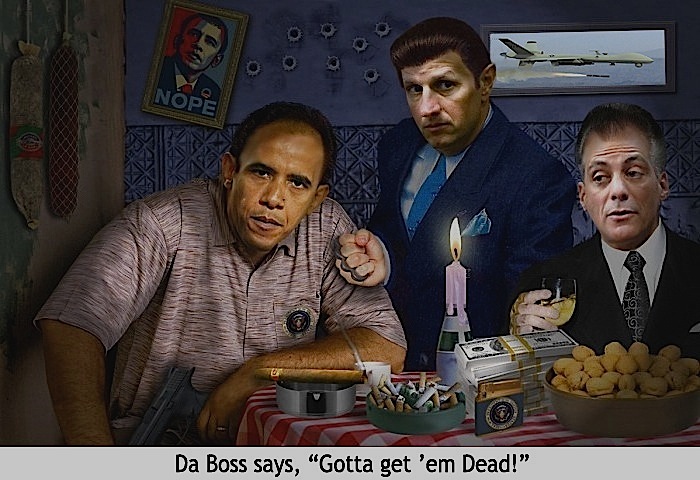
“Get ’em Dead!”

Tags

, , , , , , , , , , , , , , , , , ,

Apparently the Mafia gang in the oval office decided it would be a good idea to employ the same tactics used by those they decide to ‘off’. As in the days of yore when Romans would usurp a foreign army and incorporate the best of that foe’s weapons and tactics, so it is that the American Empire follows in the footsteps of its long deceased predecessor, the Roman Empire. It’s called the “double tap” — sending in a second predator drone strike shortly after the first responders come to the scene of the initial assassination strike to rescue any survivors or retrieve the dead, including the mourners of resultant funerals held days later. This is a policy of treating the population as guilty by association, exterminating any and all who might be linked, however remotely, with the intended target:

According to the NYT, the Administration assumed that, “people in an area of known terrorist activity, or found with a top Qaeda operative, are probably up to no good” and therefore all military age males in a strike zone could be targeted. A former senior counterterrorism official calls earlier drone targeting, “guilt by association.” Of signature strikes in Pakistan, a senior (apparently still-serving) official joked “that when the C.I.A. sees ‘three guys doing jumping jacks,’ the agency thinks it is a terrorist training camp.” And one of Obama’s top political advisors, David Axelrod, was attending targeting meetings, injecting a political taint on the program…

There is no due process for a “suspicious” person to be marked for death by drone. Ask George Zimmerman about that. The only requirement is vague and ethereal intelligence information which, if it’s as reliable as the Iraq WMD intel, appears by all accounts to be radicalizing the affected population tenfold. This boomerang effect will inevitably please our Military Industrial Complex’s constant search for new enemies to grind into profits of war. Death by Drone smacks of a street thug mentality similar to some cheesy gangster movie script. Francine Prose notes :

As drama, the scene is reminiscent of great moments in cable TV: Tony Soprano and his colleagues deciding whom to whack, The Wire’s Avon Barksdale and Stringer Bell conferring on which of their child employees must be eliminated. But it’s one thing to see murders planned on television and quite another to read that this planning session is occurring in the White House Situation Room in January, 2010, and that President Obama has assumed the grim responsibility of casting the final vote on every death sentence that this jury (so obviously outside traditional legal channels) is handing down…

..[consider] the following quote from Michael Leiter, former Director of the National Counterterrorism Center:

You can pass a lot of laws,” Mr. Leiter said, “These laws are not going to get Bin Laden dead.

Get Bin Laden dead? With its execrable grammar, its calculated thuggishness, and, for all that we have been reading about the assumption of personal responsibility, its euphemistic avoidance of what is really at issue (to get dead is not the same as to kill, and it’s never laws but people who get other people dead), the quote suggests a new dispensation in which our government, at the highest level, has given Tony Soprano license to ignore the rule of law and murder actual human beings, some of them harmless civilians. Shouldn’t we feel more frightened than reassured by the knowledge that the leader of our country holds himself accountable for every one of these deaths?

How Far Gone Are We? …. We’re living in a FantasyLand, Completely Detached from Reality

Tags

, , , , , , , , , , , , , , , , , , , ,


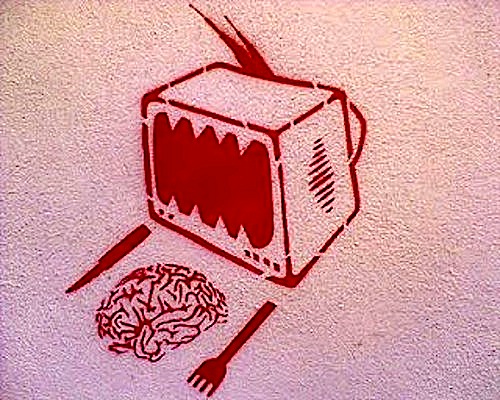
The above montage of clips from the satirical movie ‘The Distinguished Gentleman‘, in which Freshman Congressman (and con man) Thomas Jefferson Johnson (Eddie Murphy) is schooled in the ways of Washington by legendary lobbyist Terry Corrigan (Kevin McCarthy), is as true today as it was back when that movie was made more than twenty years ago, so says Marty Kaplan. The following excerpts from the transcript of Bill Moyer’s latest report – Big Money, Big Media, Big Trouble – tells the sorry and sordid tale of our political economy/society. This Moyer’s interview with Kaplan, a true insider to our political and media complex, is quite extraordinary. He affirms what the general populace is unable to comprehend… that we live in a society in which the news media and government institutions are entirely owned by the corporate oligarchs. The government regulators are owned by the very companies they are charged with over-seeing by way of Wall Street’s army of lobbyists and the revolving door that exists between government and private sector positions. Actual news to inform the public on the state of affairs and issues affecting them is virtually nonexistent on the media airwaves.

…what’s really driving it, if you think of this as a symptom and not a cause, I think what’s really driving it is the absolute demonization of any kind of idea of public interest as embodied by government. And at the same time, a kind of corporate triumphalism, in which the corporations, the oligarchs, the plutocrats, running this country want to hold onto absolute power absolutely. And it’s an irritant to them to have the accountability that news once used to play.

…the notion of spectator democracy has, I think, extended to include the need to divert the country from the master narrative, which is the influence and importance and imperviousness to accountability of large corporations and the increasing impotence of the public through its agency, the government, to do anything about it. So the more diversion and the more entertainment, the less news, the less you focus on that story, the better off it is.

And the self-serving triviality of corporate-run ‘news’ media has become a self-reinforcing mechanism whereby stats are being kept of what is the most popular story which then gets kicked up to the top and influences what that corporate news channel reports on in the future. It’s all driven by ratings and profit rather than educating and informing people on facts and real issues. So Neil Postman was right… We are being entertained to death, literally. This nihilism plays right into the hands of those controlling the levers of power who would not benefit from a well-informed, well-eduated public. The vast majority of public discourse has been reduced to an echo chamber of the crap (divisive ‘wedge issues’, celebrity gossip, sensationalist stories, corporate propaganda, consumerist materialism, valorization of the predatory skills of the modern competitive capitalist, etc.) that fills the corporate-controlled airwaves.

BILL MOYERS: You wrote The Distinguished Gentleman 20 years ago. Could you write it today?

MARTY KAPLAN: Oh God, it still is the same. All you have to do is add a couple of zeros to the amount of money. And the same laws still apply. It is fabulous and miserable at the same time.

BILL MOYERS: Was Washington then, and is it now, the biggest con game going?

MARTY KAPLAN: It is the biggest con game going. And the stakes are enormous. And the effort to regulate them is hopeless, because the very people who are in charge of regulating them are the same people who are wholly-owned subsidiaries of the lobbies that run them.

BILL MOYERS: I have it on very good authority that a prominent Washington senator recently told a group of lobbyists in Washington, a room full of lobbyists, that they are the lifeblood of the city. And I thought, “Kaplan has to do a vampire movie now.” Right?

MARTY KAPLAN: Exactly. The connection between the legislators and the lobbyists is so intimate that it’s not even embarrassing for a senator to say that in front of a room. The culture is so hermetically sealed from the rest of the country that it doesn’t occur to them that there is something deeply outrageous and offensive and corrosive of democracy to admit that the money side of politics and the elected side of politics belong to each other.

BILL MOYERS: You wrestle with this, you and your colleagues at the Norman Lear Center, and all the time, on how, on what the system is doing to us. So let me ask you, “How did this happen in America? How did our political system become the problem instead of the answer?”

MARTY KAPLAN: Part of it is the nexus of media, money, and special interest politics. The citizens have given the airwaves to the station. We own the electromagnetic spectrum and for free we give out licenses to television stations. Those stations, in turn, use that spectrum to get enormous amounts of money from special interests and from members of Congress in order to send these ads back to us to influence us. So we lose it in both ways. The other day, the president of CBS, Les Moonves, was reported by “Bloomberg” to have said “Super PACs may be bad for America, but they’re … good for CBS.” I mean, there it is. This is a windfall every election season, which seems not to even stop ever, for the broadcast industry. So not only are they raking it in, they’re also creating a toxic environment for civic discourse. People don’t hear about issues. They hear these negative charges, which only turn them off more. The more negative stuff you hear, the less interested you are in going out to vote. And so they’re being turned off, the stations are raking it in, and the people who are chortling all the way to Washington and the bank are the ones who get to keep their hands on the levers of power. So one of the big reasons that things are at the pass they are is that the founders never could have anticipated that a small group of people, a financial enterprise and the technology could create this environment in which facts, truth, accountability, that stuff just isn’t entertaining. So because it’s not entertaining, because the stations think it’s ratings poison, they don’t cover it on the news.

BILL MOYERS: They don’t cover the news.

MARTY KAPLAN: They don’t cover politics and government in the sense of issues. They’re happy, occasionally to cover horse race and scandal and personality and crime and that aspect of politics. But if you look at a typical half hour of news, local news, because local news is one of the most important sources of news for Americans about campaigns. A lot—

BILL MOYERS: You and your colleagues have done a lot of research on local news.

MARTY KAPLAN: Yes, we’ve been studying it now since 1998. And each year it gets more depressing and it’s hard to believe. We, not long ago, did a study of the Los Angeles media market. We looked at every station airing news and every news broadcast they aired round the clock. And we put together a composite half hour of news. And if you ask, “How much in that half hour was about transportation, education law enforcement, ordinances, tax policy?” everything involving locals, from city to county. The answer is, in a half hour, 22 seconds.

BILL MOYERS: Twenty-two seconds devoted to what one would think are the serious issues of democracy, right?

MARTY KAPLAN: Yes. Whereas, in fact, there are three minutes about crime, and two and a half minutes about the ugliest dog contest, and two minutes about entertainment. There’s plenty of room for stuff that the stations believe will keep people from changing the dial.

BILL MOYERS: What is the irony to me is that these very same stations that are giving 22 seconds out of a half hour to serious news, are raking— and not covering politics, are raking in money from the ads that the politicians and their contributors are spending on those same papers.

MARTY KAPLAN: Yes, they’re earning hundreds of thousands and millions of dollars from the ads that they are being paid to run. And not even risking running a minute of news, which might actually check on the accuracy of an ad. Truth watches, they’re almost invisible now.

BILL MOYERS: So they will tell you, however, that they’re in the entertainment business. That they’re in the business to amuse the public, to entertain the public. And if they do these serious stories about the schools or about the highways or about this or that, the public tunes out. That the clicks begin to register as—

MARTY KAPLAN: It’s one of the great lies about broadcasting now. There are consultants who go all around the country and they tell the general managers and the news directors, “It is only at your peril that you cover this stuff.” But one of the things that we do is, the Lear Center gives out the Walter Cronkite award for excellence in television political journalism every two years. And we get amazing entries from all over the country of stations large and small of reporters under these horrendous odds doing brilliant pieces and series of pieces, which prove that you can not only do these pieces on a limited budget, but you can still be the market leader.

MARTY KAPLAN: Well, what’s really driving it, if you think of this as a symptom and not a cause, I think what’s really driving it is the absolute demonization of any kind of idea of public interest as embodied by government. And at the same time, a kind of corporate triumphalism, in which the corporations, the oligarchs, the plutocrats, running this country want to hold onto absolute power absolutely. And it’s an irritant to them to have the accountability that news once used to play.

BILL MOYERS: What do you mean by that? News challenges their assumptions, challenges their power?

MARTY KAPLAN: It used to be that the news programs that aired, believe it or not, had news on them. They had investigative stories.

But then somewhere in the 1980s, when 60 Minutes started making a profit, CBS put the news division inside the entertainment division. And then everyone followed suit. So ever since then, news has been a branch of entertainment and, infotainment, at best.

But there was a time in which the press, the print press, news on television and radio were speaking truth to power, people paid attention, and it made a difference. The— I don’t think the Watergate trials would have happened, the Senate hearings, had there not been the kind of commitment from the news to cover the news rather than cutting away to Aruba and a kidnapping.

BILL MOYERS: What is the basic consequence of taking the news out of the journalism box and putting it over into the entertainment box?

MARTY KAPLAN: People are left on their own to fend for themselves. And the problem is that there’s not that much information out there, if you’re an ordinary citizen, that comes to you. You can ferret it out. But it oughtn’t be like that in a democracy. Education and journalism were supposed to, according to our founders, inform our public and to make democracy work.

You can’t do it unless we’re smart. And so the consequence is that we’re not smart. And you can see it in one study after another. Some Americans think that climate change is a hoax cooked up by scientists, that there’s no consensus about it. This kind of view could not survive in a news environment, which said, “This is true and that’s false.” Instead we have an environment in which you have special interest groups manipulating their way onto shows and playing the system, gaming the notion that he said she said is basically the way in which politics is now covered.

It’s all about combat. If every political issue is the combat between two polarized sides, then you get great television because people are throwing food at each other. And you have an audience that hasn’t a clue, at the end of the story, which is why you’ll hear, “Well, we’ll have to leave it there.” Well, thank you very much. Leave it there.

BILL MOYERS: You have talked and written about “the straightjacket of objectivity.” Right? What is that?

MARTY KAPLAN: Well, the problem with telling the truth is that in this postmodern world, there’s not supposed to be something as truth anymore. So all you can do if you are a journalist is to say, “Some people say.” Maybe you can report a poll. Maybe you can quote somebody. But objectivity is only this phony notion of balance, rather than fact-checking.

There are some gallant and valiant efforts, like PolitiFact and Flackcheck.org that are trying to hold ads and news reports accountable. But by and large, that’s not what you’re getting. Instead the real straightjacket is entertainment. That’s what all these sources are being forced to be. Walter Lippmann in the 1920s had a concept called “spectator democracy” in which he said that the public was a herd that needed steering by the elites. Now he thought that people just didn’t have the capacity to understand all these complicated issues and had to delegate it to experts of various kinds.

But since then, the notion of spectator democracy has, I think, extended to include the need to divert the country from the master narrative, which is the influence and importance and imperviousness to accountability of large corporations and the increasing impotence of the public through its agency, the government, to do anything about it. So the more diversion and the more entertainment, the less news, the less you focus on that story, the better off it is.

BILL MOYERS: Are you saying that the people who run this political media business, the people who fund it, want to divert the public’s attention from their economic power? Is that what you’re saying?

MARTY KAPLAN: Yes.

Let us fight about you know, whether this circus or that circus is better than each other, but please don’t focus on the big change which has happened in this country, which is the absolute triumph of these large, unaccountable corporations.

This is about as dismal and effective a conspiracy, out in plain sight, as there possibly could be. So I don’t say that this is going to be solved or taken care of. What I do say is the first step toward it is at least acknowledging how toxic the situation has become.

BILL MOYERS: What you’re saying is that the political square is now a commercial enterprise, owned and operated for the benefit of the brand, CNN, Fox, all of those, right?

MARTY KAPLAN: That’s correct.

BILL MOYERS: How did it happen? How did we sell what belonged to everyone?

MARTY KAPLAN: By believing that what is, is what always has been and what should be. The notion that what goes on is actually made by people, changes through time, represents the deployment of political power. That notion has gone away. We think it’s always been this way. People now watching these CNN and Fox. They think this is how it works. They don’t have a sense of history. The amnesia, which has been cultivated by journalism, by entertainment in this country, helps prevent people from saying, “Wait a minute, that’s the wrong path to be on.”

BILL MOYERS: Amnesia, forgetfulness? You say that they’re cultivating forgetfulness?

MARTY KAPLAN: Absolutely.

BILL MOYERS: You made a very important speech not long ago at a media conference in Barcelona. And you tried and did draw the distinction between— you said the battle of the future is between big data and big democracy. In layman’s language, what is that?

MARTY KAPLAN: Big data, the age of big data that we’re supposed to be in, refers to the way in which, as we go on the internet, as we do all these media activities, watching television, which are at the center of our lives, we’re leaving a trail behind. We’re giving bits of ourselves up. And that set of bits is being collected and mined relentlessly.

So every time we buy a product or send an e-mail or vote how many stars to a restaurant, all this stuff creates a profile that companies buy and sell to each other. And that stuff is being used currently not only to market to us, to target ads toward us, but it’s also being used to profile us. There’s something called “web lining.” Which is similar to what used to be called “red lining.” The— that phenomenon, which is now illegal, in which people who were discriminated against because of the neighborhoods they live in. Right now—

BILL MOYERS: Banks drew a red line around impoverished neighborhoods that they would not then serve.

MARTY KAPLAN: Exactly. And so today imagine if you were to permit a private detective to follow you as you went to your drug store and bought a medication to help you with depression or as you made a phone call to a bankruptcy lawyer, because you needed one. Imagine if that kind of information could be put together and used against you to decide that you’re a bad credit risk or that maybe your insurance company should turn you down, because you suffer from this problem.

That kind of information, that kind of digital profiling is something which is emerging as a huge industry. And unless there are controls on it and constraints, as they have to some degree in Europe but not nearly enough even there, we are about to kiss goodbye our ownership of our privacy and also even the ownership financially of our information. We are the people who make Facebook and Twitter worth the billions of dollars that they’re worth, because we are giving up our information to them, which they are then selling and raising capital around.

BILL MOYERS: But in a libertarian era, what are the restraints and constraints against that? Where are they going to come from?

MARTY KAPLAN: Well, right now, the constraints in this country are voluntary. The Obama White House not long ago issued a digital code of conduct, which included privacy. In which they asked companies and companies did step up to it to say, “We’re not going to track people if they don’t want to be tracked.” And other such efforts to get people in control.

But what we do know, the record of just the past couple of months, is that company after company was doing stuff to us that’s astonishing, that we didn’t know about. The ways in which the apps that you use on your smartphones were vacuuming up information about you, your address book and all your pictures.

Stuff that you had no idea you had consented to, which in fact usually you had not, suddenly was all owned by other people, as well. You have not given permission, but that essential part of you is now not yours. That’s the name of the game now. This is baked into the business model of data mining, which is at the heart of so much of the digital economy.

BILL MOYERS: But that’s big data. You talked about big democracy.

MARTY KAPLAN: So at the same time as our data is being mined, there is this movement to protect people using technology to give them the power to say, “I’m not going to opt into this stuff.” We’re still at the beginning of this industry. And there has to be rules of the road. And part of those rules include my attention rights. My rights to control my identity, my privacy, and my ownership of information.”

BILL MOYERS: In your speech in Barcelona, you pointed to two simultaneous covers of TIME Magazine appearing the same week. One for the editions in Europe, Asia, and South Pacific, and it was about the crisis in Europe. The other, which appeared in the American edition, featured a cover about animal friendships. You use these two covers to illustrate the difference between what you call “push journalism” and “pull journalism.” What’s the difference?

MARTY KAPLAN: Push journalism is the old days, which seem no longer to apply in the era of the internet, in which an editor, a gatekeeper, says, “Here’s the package which you need to know.” All of that is ancient history now.

Instead, now, it’s all driven by what the consumer is pulling. And if the consumer says, “I want ice cream all the time.” And whether that ice cream is Lindsay Lohan, or the latest crime story, that’s what’s delivered. And as long as it’s being pulled, that’s what is being provided. So it’s quite possible that in the U.S., the calculation was made that the crisis in Europe and the head of Italy would not be a cover that one could use. But that pet friendships would be the sort of thing that would fly off the newsstand.

BILL MOYERS: So the reader is determining what we get from the publication?

MARTY KAPLAN: On a minute by minute basis, stories that the reader’s interested in immediately go to the top of the home page. There are actually pieces of software that give editorial prominence to stuff that people by voting with their clickers have said is of interest to them. No one is there to intervene and say, “Wait a minute, that story is just too trivial to occupy more than this small spot below the fold.” Instead, the audience’s demand is what drives the placement and the importance of journalistic content.

BILL MOYERS: So George Orwell anticipated a state as big brother, hovering over us, watching us, keeping us under surveillance, taking care of our needs as long as we repaid them with utter loyalty. Aldous Huxley anticipated a Brave New World in which we were amusing ourselves to death. Who’s proving the most successful prophet? Huxley or Orwell?

MARTY KAPLAN: Well, I think Huxley is probably right, as Neil Postman said in—

BILL MOYERS: The sociologist, yes.

MARTY KAPLAN: —in Amusing Ourselves to Death. That there’s no business but show business. And we are all equally guilty, because it’s such fun to be entertained. So you don’t need big brother, because we already have big entertainment.

BILL MOYERS: And the consequences of that?

MARTY KAPLAN: That we are as in Brave New World, always in some kind of stupor. We have continual partial attention to everything and tight critical attention on nothing.


According to stats from 2010 for TV viewing by adult Americans, we’re glued to the boob tube in our waking hours. This explains why having an intelligent conversation with most Americans is an impossible task. All they can do is regurgitate what has been constantly programmed into their heads.

• The average American watches 35:34 (hours/minutes) of TV per week

• Kids aged 2-11 watch 25:48 (hours/minutes) of TV per week (Q1 2010)

• Adults over 65 watch 48:54 (hours/minutes) of TV per week (Q1 2010)

And according to the latest Nielsen study, TV viewing is on the increase, notwithstanding a tiny drop in the number of households who own a TV:

REPORT: THE INTERNET POSES NO CHALLENGE TO TV — YET 

despite all the competition from cable TV, videogames, and the Internet, the average household watched 59 hours, 28 minutes of broadcast TV per week during the 2010-2011 season, setting a new record. Lanzano drew particular attention to the competition — or lack of it — from Facebook, noting that while the average person spends about 13 minutes a day on Facebook, they spend 297 minutes watching TV. “No wonder our friends at [General Motors] are making some changes,” he said. [Last month GM announced that it will stop placing ads on Facebook, after determining that they had little impact.]

An Economic and Social System that Undermines Life Itself

Tags

, , , , , , , , , , , , ,

It’s important to keep in mind that at the root of industrial civilization’s problems is an economic system called capitalism which requires infinite growth at the expense of our global life support system, the earth. The end game is a spent and destroyed environment in which a small global elite control the overwhelming percentage of the planet’s extracted wealth while the vast majority of the world’s population exist in squalor and debt peonage. The social hierarchy of our system can be visualized as a large pyramid with the wealthiest of society represented as the eye of a thin needle sitting atop the massive base that represents the rest of humanity. It seems the only impediment to capitalism is its own unstoppable path to self-destruction. For the power that accumulated capital wields has taken over all aspects of societal behavior – cultural, spiritual, political, legal, and analytical – to the detriment of us all.

Of Birds, Rivers And Greed By Farooque Chowdhury

“…About two years ago, WWF, the international organization involved in the area of ecology, said in its Living Planet report: A second planet will be required by 2030 to meet our needs as over-use of Earth’s natural resources and carbon pollution have become critical. If all human being in this world used resources at the same per capita rate as the US or the UAE, four and a half planets would be needed. More than 70 countries were exhausting their freshwater sources at an alarming, unsustainable rate. About two-thirds of these countries experience water scarcity ranging from moderate to severe. In 2007, the world’s 6.8 billion humans were living 50% beyond the planet’s threshold of sustainability. The report highlighted the rich-poor ecological gap. In 1970-2007, an index of biodiversity showed a world decline of almost 30%. In the tropics, it was alarming: 60%.

No brain with logic will claim that the acts are isolated from the world economic system: capitalism. “From the outset,” Joe Bageant, author of the book about working class in America Deer Hunting with Jesus: Dispatches from America’s Class War , writes, “capitalism was always about the theft of the people’s sustenance. It was bound to lead to the ultimate theft – the final looting of the source of their sustenance – nature.” (“Our Plunder of Nature will End up Killing Capitalism and Our Obscene Lifestyles”, Countercurrents , July 13, 2010 )

“The main feature of capitalism is the seductive assertion that you can get something for nothing in this world.” (ibid.) Owners of this system, the capitalists, Joe continues, “hate any sort of cost.” They, he describes, “remain unimpressed by global warming, or melting polar ice caps, or Southwestern desert armadillos showing up in Canada , or hurricanes getting bigger and more numerous every year.”

These are the elites in control of the world environment in continents and countries. “Just before the economy blew out,” according to Joe, “these elites held slightly less than $80 trillion. After the blowout/bailout, their combined investment wealth was estimated at a little over $83 trillion. To give some idea, this is four years of the gross output of all the human beings on earth.”

This massive money power takes hold of political power. Owning this unimaginably monstrous money-political power system they put their footprint on ecology that is changing the planet’s environment irreversibly.

This system, the masters of the system in the center, in the periphery, in between the center and the periphery, try their best to maximize profit by minimizing cost, by appropriating labor, robbing nature, grabbing everything within their reach, putting costs on public. Pollution, destruction of ecology and ruination of nature thus creep into public domain – a human concern.

Acts of the masters are turning into crime, crime against the planet, against posterity, against humanity.

The World Future Council leaders said: “These are crimes against the future … These are crimes that will not only injure future generations, but destroy any future at all for millions of people.”

The Council has called for appointing “ombudspersons for future generations”, “guardians appointed at global, national and local levels whose job would be to help safeguard environmental and social conditions by speaking up authoritatively for future generations in all areas of policy-making. This could take the shape of a parliamentary commissioner, a guardian, a trustee or an auditor, depending on how it best fits into a nation’s governance structure.”

But questions are there: How far the ombudspersons can act where power structure, economy and political power is of, by and for polluters, grabbers, eco-murderers? If they can act, then, why do environment law/court/ministry/inspectors, depending on arrangement in countries, can’t act? What will happen if polluters grab that proposed holy post as have happened in countries by different lobbies/interests/gangs? What’s the guarantee that the proposed holy persons’ observations/edicts/verdicts will be implemented? Are not there instances of trampling/violation of all basic, fundamental, moral, ethical, human, natural, principled rights/practices/conventions/laws/rules around the world, in countries?

Out of their sense of urgency the WFC leaders’ suggestion sounds nice, but not functional. It’s detached from reality, the socio-economic-environmental -political reality.

What’s the reality?

An answer is provided by Fred Magdoff and John Bellamy Foster in their seminal analysis What Every Environmentalist Needs to Know about Capitalism: A Citizen’s Guide to Capitalism and the Environment (2011): Capitalism is a system that must continually expand, a system that, by its very nature, will eventually come up against the reality of finite natural resources, a system geared to expansionist growth in the search for profits that will inevitably transgress planetary boundaries.

By its very nature the system stands against ecology and environment as its only concern is profit, nothing else. Standing for environment will lead to questioning the ever hungry system.

Pushing 1 billion persons down to extreme poverty, and enriching a few, whose consumption is threatening the planet is one of the major “contributions” of the system. Other than the hungry and starved, there are energy poor, electricity poor, water poor, information poor, basic rights poor, safety poor, they are the poor masses deprived of honor and dignity, and there are the food rich, energy rich, electricity rich, water rich, information rich, luxury rich, power and privilege rich, resource rich, consumption rich, the rich few controlling everything.

Imbalance and inequity at this level can’t sustain environment and ecology. The first one, imbalance and inequity, is linear, ever expanding while the later one, environment and ecology, demands diversity, tolerance, consideration, accommodation. Observance related to environment turns hollow and chattering if this aspect of political economy is ignored…

Wisconsin a Case Study of Divide and Conquer: Money in Politics Brainwashes the Exploited

Tags

, , , , , , , , , , , , ,

I was looking for an analysis of the Wisconsin recall election results of Scott Walker, and the best, most incisive one I found is reprinted with permission below. The bold emphasis and links in the article are mine. The Big Money behind Walker controlled the narrative of the recall election by framing the problem of the economy as a choice between costly, corrupt and selfish unionized state workers versus a wasteful state government attempting to streamline itself and cut costs for the taxpayer. Absent in that polarizing message by the Corporatists was their real agenda of dismantling worker’s rights at the altar of the free market, shipping jobs oversees to exploit the cheapest of labor pools. Also absent was the Corporatist’s agenda of cutting the taxes on the wealthiest of society’s elite while dismantling and privatizing social/public services. Interestingly, the only two unions that backed Walker, the fire fighters and the police, were exempted from Walker’s anti-collective bargaining law. Also of note is Obama’s absence from supporting the workers in Wisconsin. As explained in my post, Obama: Figurehead for the Corporatocracy, this betrayal should come as no surprise. Divide and conquer is a very effective strategy to destroy the workers who have been subject to indoctrination of Neoliberal policy since Ronald Reagan. The myth of the wealthy being job creators still works, and the public doesn’t have a clue about the evils of privatization. The class war continues with the wealthy effortlessly manipulating the levers of power and mainstream media to their advantage…


Behind the defeat in the Walker recall election

June 6, 2012

Gov. Scott Walker’s anti-recall campaign sold the lie that greedy public sector workers and their unions were costing the taxpayers exorbitant amounts for high wages and lavish pensions.

The recall election in Wisconsin was won by organized Big Money. Lots will be said by many pundits about various aspects of the election, but the most important issue is how Big Money or the 1 percent were able to shape the electoral environment. Looking at that question exposes how capitalist democracy operates.

It also helps to answer the question being asked by many—why do people vote against their own interests?

In his victory speech, Wisconsin Gov. Scott Walker said he wanted to first of all thank God for his abundant gifts. This was not only an appeal to the religious right-wing but also an attempt to give praise to the billionaires whose gifts brought him the election victory.

On Jan. 18, 2011, Walker told billionaire Diane Hendricks that his strategy was to go after collective bargaining rights for public employees first and then get a Right to Work for Less law, in a strategy which he explicitly described as divide and conquer. She gave him over $500,000 during just a three month period in 2012. Hendricks’ ABC Supply Inc., the nation’s largest wholesale distributor of roofing, windows and siding paid no state income taxes in 2010.

Just a few weeks later, on Feb. 23, 2011, Walker told someone who he believed to be billionaire David Koch that he had a bat in his office which could be used to achieve his goal of union busting.

Although pay for teachers had been capped since 1993 and public sector unions were not on the offensive, the goal of Walker and his backers in 2011 was to eliminate these unions. Unions for public employees are the last sources of significant power for organized labor as well as for the interests of unorganized workers.

Tens of millions of dollars were pumped into Walker’s campaign to win the recall election. Much of it came from the super wealthy outside of Wisconsin. This money created the slick right-wing Madison Avenue ads that inundated every household.

The rich put their money into this fight because they saw it as part of their class war against the workers. This was a referendum on slashing workers’ rights, especially public workers. It was played out in Wisconsin but finance capital saw that it would have national ramifications.

Role of the Democratic Party

The recall effort itself was the result of the efforts of hundreds of thousands of workers who gathered one million signatures to recall Walker. When they filed those petitions on Jan. 17, it was crystal clear that they wanted this election to be about basic labor rights—the right to bargain, the right to have a contract and the right to have union recognition including long established union security clauses providing for dues.

The Democratic Party took over the message and shifted it to a blander mixture with a focus on corruption. The national Democratic Party essentially ran away from the Wisconsin battle in a way that once again shows that they have no interest in supporting labor’s cause. President Obama did not come to the state to support the fight for basic rights. His absence served as another example from a long list of unfulfilled campaign promises—that he would walk on union picket lines after he became president and that he would fight to get labor laws passed with fairer terms for union elections—the Employee Free Choice Act—and more.

Role of labor

The ranks of labor were pushing for a battle in the electoral arena. Public unions put significant money and organizational resources into the fight. These unions included the teachers unions, firefighters, AFSCME (state city and county workers), SEIU and others.

However, two locals in Milwaukee—police and fire unions—endorsed Walker in the recall, while no statewide unions did. It is important to remember that Walker exempted these unions from any of the negative effects of his anti-collective bargaining law. Firefighters, of course, are workers that all of labor should support, and this local union betrayal was especially odious because an African American firefighter and union leader was a candidate for lieutenant governor. Instead of a message that public workers have rights that everyone should have, the anti-labor story is that if anyone has a wage, a right or a pension that others do not have, then we should take it away from them.

While Walker is most known for his initial attack against the public sector unions, the construction trades also joined the recall effort in a more significant way than in almost any other previous fight. The statewide Operating Engineers Local 139, with about 9,000 members, previously had endorsed Scott Walker for governor in 2010 on the promise that he would not support Right to Work legislation while delivering a larger budget for bridges and infrastructure. Walker’s flip on that overcame reservations about the Democratic candidate who, as a Mayor of Milwaukee, bargained hard against them on major contracts.

Union leaders had come together as a coalition and chosen Democratic Party politician Dane County Executive Kathleen Falk as their candidate in the recall primary. The time limits imposed by the state’s election process required quick action, but the union leaders’ lack of involvement among the hundreds of thousands of activists who had put the recall on the ballot was a signal of things to come. Falk was defeated in the recall primary by Milwaukee Mayor Tom Barrett (who had previously been defeated by Walker in 2010).

No thought was given to having a truly independent candidate with a real program addressing workers’ needs. Eventually, the labor leaders deferred to the regular Democratic Party pundits and confined the campaign to a shifting message that did not resonate with people.

Support for labor from the most oppressed communities

Organizations and leaders in the African American and Latino communities—some of the most oppressed sectors of the population—campaigned hard to get rid of Scott Walker. Early reports reveal that record numbers were mobilized to vote.

SEIU had organizers working in poor communities for some time to help mobilize action and exert power on a number of issues.

Democrat Barrett’s concession speech

When Barrett took the podium to announce that he had lost the race, he stressed that now is the time to “work together” with Walker. This is typical “good form” for a Democratic Party leader but poison for labor. Now is not the time to work with union busters; now is the time to organize even more diligently against them.

He talked about “democracy”—but not workers democracy. He called on people to stay engaged with city and state politics.

Why did some workers vote for Walker?

Without a doubt some people are wondering: What were they thinking! Why did they vote for Walker?

The Walker campaign focused on taxes and make-believe figures on job creation. Their message was that greedy public sector workers and their unions were costing the taxpayers exorbitant amounts for high wages and lavish pensions that others don’t have.

Walker constantly refers to “union bosses” and his allies frequently refer to “union thugs” or “union goons”. These terms turn reality on its head. If he were speaking the truth, he would be talking about the captains of finance who are his bosses and who are financing and directing his actions.

When Walker’s Wisconsin budget bill was passed, it increased spending in FY 2013 on prisons while imposing $792 million in aid cuts to school districts, $250 million in cuts to the university system and $71.6 million in cuts to technical colleges. In addition, nearly $500 million was cut from Medicaid programs, eliminating necessary important components of health care. At the same time, these financial bosses have gotten Walker and the legislature to approve $1.6 billion in corporate tax breaks over the next 10 years. Profits have increased—but not jobs.

That is their program, and they sell it by vilifying labor. In areas reached mostly by right-wing radio and governed by right-wing elites from the pulpit to the County Board, the Big Lie works. It is a Big Lie that has been in development since the 1940s and especially since the 1960s. As corporations move production overseas, the ruling class spins the story in a way to blame unions here for “pricing themselves out of the market.” They spin the story to divide workers in the United States from workers abroad.

In 2012 so far, General Electric has moved its medical equipment division headquarters from Waukesha, Wisconsin to Shanghai, China. The Thermo-Fisher Corporation is planning to move nearly 1,100 jobs from Wisconsin to Mexico.

In the race for maximum profits at any cost and the race to shove workers down to the lowest level of rights and pay on a world scale, they have refined the Big Lie technique and used it on a mass scale.

The truth about public services such as education, health care, child welfare and transportation is never told. These services are rights that were won through struggle—and which would never be provided by private companies that only care about profit.

The truth about public workers is never told—that their pay is modest, that most do not qualify for social security and their only pension is what the union has been able to win in a contract or through legislation.

Instead of a message that public workers have rights that everyone should have, the story is that if anyone has a wage, a right or a pension that others do not have, then we should take it away from them. And at the same time ignore the vast wealth of the CEOs. Ignore the vast profits made by the banks and the holders of state and local government bonds who get their interest payments first from every state budget while programs for the people get cut.

The principal blame for the election result in Wisconsin is not with the workers of Wisconsin but with the rich who spin this message and who control the levers of power in that state and around the country.

The road not taken: This is what democracy could have looked like

In March of last year, when Walker threw down the gauntlet and signed the “Budget Bill” killing many collective bargaining rights, labor leaders opted to move the struggle from the streets into the electoral arena.

Many experienced labor activists, including some leaders in the Madison area, know that workers have greater power in the streets because of the way money controls elections. On Feb. 22, 2011, the 97 unions of the South Central Federation of Labor of Wisconsin, representing 45,000 workers, unanimously passed a resolution calling for the preparation for a general strike.

A general strike would have electrified workers everywhere. It could have begun as a one day strike in Wisconsin cities with the greatest union strength and then expanded in terms of both days and areas covered. Millions of workers across the country who were upset with cutbacks, layoffs, privatization and more would have been inspired to take action.

Shutting down the state would have been a quicker and more definite blow to Walker and could have resulted in a defeat for Walker as compared to the defeat for labor experienced in the recall election.

General strikes are feared by the ruling class. In reference to a Philadelphia teachers strike—Jan. 8 to Feb. 28, 1973—William Usery, director of the Federal Mediation Service, said that “We came within an eyelash this year of having a test of the effectiveness of the general strike as a weapon in the United States—a weapon that has at times paralyzed the economies of France and Italy.” He went on to say that if labor had engaged in the general strike that many had called for—and if they had won—then “there would have been enormous pressures to do it again—and again—and again.”

That is the fear of the ruling class. If workers exercise their power, there could be no stopping them. No rights would be out of reach.

The Democratic Party is doing all it can to orient people to the November presidential election and away from struggle. Almost without exception labor leaders are focused on that election.

Rank-and-file members can learn a lot from this experience in Wisconsin. Labor’s hope lies not in the electoral arena but in solidarity and action on the job and in the community.”

The Nuclear Bomb of Cyberspace

Tags

, , , , , ,

For those not fully aware of the new weapon of choice in the 21st century, I’m posting about it to open your eyes to the possible future chaos of cyber-warfare, a Pandora’s box that was officially opened with the admission by the U.S. government that they were behind the Stuxnet virus. It anonymously targets, infects, and sabotages industrial facilities such as nuclear and chemical plants. Many internet security experts, such as Mikko Hypponen, have warned that the introduction of this cyber weapon by the U.S. is something we will regret because we are the most internet-connected economy of the world. Here is a 60 minutes report on it from a few months ago:


Something silent and wicked this way comes

A dark truth behind humanity’s technological progress is the ability to conduct war in terrifyingly fresh ways, going far beyond sticks and stones to express power.

Today, war is conducted by unmanned robotic planes in the skies, their operators sitting thousands of miles away. Missiles, bullets, and bombs have become more ingenious in their ability to vaporize bodies and buildings. Nuclear bombs, horrifying specters which could abruptly end humanity entirely, lay waiting in hidden silos and undetectable submarines peppered around the world.

During the last few years, cyber-warfare has become the newest weapon in an arsenal of ways for nation-states to overpower each other. This latest instrument has mainly been focused on the west Asian region, the epicenter being Iran.

In the past four years alone, Iran has been directly attacked by three cyber-weapons, each designed to cause havoc and siphon off data in their own unique ways. Stuxnet, Duqu, and Flame, the latest of the three, have astonished the cyber-security industry. For experts, the coding and function of these viruses have signified the beginnings of an “early age of cyber-warfare”, one that could become “a common trend in everyday life” in the near future….

Flame: Elevating Cyber-warfare

Flame, discovered this May, is a much more spectacular weapon.

“Flame is a sophisticated attack toolkit, which is a lot more complex than previously encountered malware such as Duqu…[and is] about 20 times larger than Stuxnet,” explained Vitaly Kamluk, Chief Malware Expert of the computer security company Kaspersky Lab that identified the malware.

“[It] has very advanced espionage functionality, including intercepting network traffic, taking screenshots, and recording audio conversations, and this functionality can be extended with the help of additional modules, which can be created by the perpetrators any time. All the gathered data are sent to the authors of Flame via the Internet. Based on the way it works and how it is being deployed, Flame can be classified as a cyber-weapon,” he wrote to Al-Akhbar.

Furthermore, Kamluk noted that Flame can manipulate Bluetooth in order to collect information from nearby devices and even turn the device to service as a beacon.

The malware was first discovered by Kaspersky Lab in the beginning of May after it was contacted by the United Nation’s International Telecommunications Union (ITU) to investigate reports that a virus was deleting and stealing large amounts of information from computers in the Iranian Oil Ministry and the Iranian National Oil Company.

Further investigations have found that although less than a thousand computers were infected, most were concentrated in the west Asian region. According to Kamluk, the top seven countries and areas listed are Iran, the West Bank, Sudan, Syria, Lebanon, Saudi Arabia, and Egypt.

Despite limited infections so far, Kamluk acknowledged that the general public should be concerned.

“Anyone can fall a victim of cyber-attack and even if you are not the prime target of cyber-attack, then perhaps some of your friends or relatives are. Infecting you might be a slightly easier way for attackers to hit a more important target that you might know,” he wrote. “Flame is the next stage in the uncovering of cyber-weapons developed with the support of [a] nation-state.”

“We believe that [we] are in the early age of cyber-warfare. We have just started discovering a cyber-weapon that was created several years ago. It may take some more years for it to become common trend in everyday life…

With everything going on in the world right now showing how unstable our global civilization is, the unleashing of this cyber-warfare simply adds a whole new dimension of fragility to the system. Like Drone technology, these Trojan horse viruses are affordable technology to those wishing to cause chaos, as pointed out by John Robb:

The technologies used in these system aren’t just available to big countries (like nuclear technology is).  This is tech anybody can use and configure in new ways.  In some cases, like Stuxnet and Flame, the software itself is freely available, and is now being analyzed and copied by people all across the world.

The demonstration of these technologies in warfare takes them out of the realm of science fiction and makes them real.  It also goads any country with even a modest budget to develop their own.

Another worry is that the opening of this box is occurring at the very same time the global financial system is coming unglued.   In an environment like that, almost all countries will become hollow states.  Hollow versions of what they once were. These technologies, in the hands of a hollow state, scream repression.

So, that’s where we are.

Good luck.