I’m being more selective in my reading these days since I’m not so interested anymore in the minutia of the everyday happenings concerning industrial civilization’s decline. Certainly if the planetary tipping points continue to be breached by an economy dependent on infinite growth, then all these social issues everyone frets about will be meaningless anyway.
I read a very good article on urban decay by the Rogue Columnist this evening called ‘Growthgasm!‘ which reminded me of a very recent trip to one of my old stomping grounds in Phoenix, the Metrocenter Mall. Not too long ago when I was a teenager this was quite a popular hang-out, filled with thousands of shoppers on any given day. Today it has become a veritable ghost town. On my visit I saw no more than a few dozen customers within this expansive mall. Many of the shops are now vacant and locked-up. As you can see from the pictures below that I took, the empty building casts an eerie feeling of abandonment and lifelessness. The few tenants that remain are desperate to attract customers and some have posted employees outside their doors to try to make a hard sale and entice passersby to come in.
If you are a reader of this blog, then you’ll know I’m not a fan of the mass consumerism that was spawned after World War II, but in my younger days I was a reluctant participant growing up in that environment. Since the bursting of America’s last big bubble, the suburban utopia that this nation built for itself through the Great Ponzi Scheme of Sprawl is decaying. Those who can flee, the affluent who have managed to hold on to their economic well-being, are moving to newer ‘exurbs’ to be with others in their social status and to insulate themselves from the spreading poverty:
…suburbs facing the highest burdens of the new poverty will be least able to meet them because of the economic recession and the spatial retreat of the better off. Just as many white Americans fled the cities for the suburbs in the 1960s, leaving the cities behind with declining tax revenues and fewer job opportunities, there is new cycle of exodus of the well-to-do from inner-ring metropolitan suburbs. As the better-off retreat, the provision of amenities and essentials from parks to schools to garbage pickup, heavily funded by property taxes, are bound to flounder for those left-behind.
One recent study conducted by Sean Reardon and Kendra Bischoff of Stanford University documented the spatial sorting by income that is going on, with the wealthy flocking together in new exurbs as well as gentrifying pockets of urban centers. In 1970 — the high-water mark of a more homogeneous suburban America — only 15 percent of families in metropolitan areas lived in socio-economically segregated neighborhoods categorized as affluent or poor. In 2007, that figure was 31.7 percent.
The replacement of America’s middle-class suburbs, however flawed, by wealthier exurbs and secondhand suburban remnants is a leading symptom of America’s 21st-century reinvention as a society of stark class divisions, spatial segregation and inherited social status…
So will the suburbs of a country whose transportation and infrastructure was built on cheap oil become the favelas of the first world? It certainly seems inevitable in a world where class lines are growing deeper, high unemployment is intractable, and the age of cheap fossil fuels has drawn to a close.
Surfing the net this evening brought me to some eerie photography by a man named Edward Burtynsky. This collection is from his 12 year project about modern man’s Oil Age. Here are a few of the pictures under the title ‘The End of Oil‘ from his epic work (others can be seen here):
Click for Enlarged Slideshow
Mass Consumerism befouled the planet.
I work with Native Americans and see the rampant alcoholism, unemployment, and poverty, but their condition in the globalized capitalist economy seems to be replicated with other native people of the world as this cartoonist depicts:
Perhaps we aren’t the be-all and end-all of human progress.
George Monbiot recently penned an interesting article entitled ‘We were wrong on peak oil. There’s enough to fry us all‘ which clearly shows that he is clueless about what the definition of Peak Oil is. George, you are an influential writer; so please read the following explanation when writing future articles about oil:
Peak Oil is the term used to describe the point when worldwide production of conventional crudeoil peaks in volume, which is expected to result in increased oil prices due to a decline in the availability of cheap and easily accessible oilsources. The low hanging fruit, as it were, has been plucked.
In Monbiot’s article, he never mentions EROI or EROEI which basically is the energy you get back after investing/expending a certain amount of energy to retrieve that barrel of oil. There are a lot of resources that explain this, but I recommend Chris Martenson’s crash course, Chapter 17b, since that was the first place that taught me.
Monbiot, along with the typical business-as-usual oil analysts, misses the fact that conventional crude production has been flat since 2004 and declares that all the Peak Oil experts were wrong. He makes the mistake of lumping crude oil extraction, a conventional source, with the more generic term of ‘liquid fuels’ which include unconventional sources like deep-sea drilling, tar sands, shale oil, liquefied coal, and biofuels. The conventional sources of oil have higher EROI’s than the harder-to-get unconventional sources. This means that as we turn more and more to the difficult-to-extract sources, we get less bang for the buck because we are spending an increasing amount of our economy’s limited resources on obtaining that critical energy. Less net energy means a smaller budget for societal complexity, thus, a return to a simpler society. And the trip down the net energy ladder is an exponential, not linear, descent. Even though Monbiot completely misunderstands what Peak Oil is and that we have indeed reached it, he at least realizes what will result from our scraping of the bottom of the EROI barrel — a global ecological catastrophe. And that is something that all peak oil deniers fail to acknowledge.
Peak Oil never meant we would run out of oil; it just meant that we would get the easy stuff first and then be forced to spend ever more to get what’s left. This means more oil spills, polluted groundwater, and damage to our planet than occurred when the black stuff flowed abundantly from easily accessible areas in the earth’s crust.
Worldwide, the average EROI of oil is down to 20:1 from its original value of 100:1 eighty years ago. In the 1930s, it took about one barrel of energy to extract 100 barrels of energy. By 1970, with deeper wells and greater energy expenditures for pumping and processing the oil, the EROI of domestic oil had fallen to 40:1. Today U.S. oil is produced at an EROI of about 14:1. Globally, it takes the energy in one barrel of oil to extract 20 barrels of oil. This means that our oil-fuelled economy simply has less capacity to generate wealth than it did back then, because we have to increase the share of the energy that used to be dedicated to producing goods and services back into extracting more energy.
Even more troubling than oil’s 20:1 global average is the figure for new oil, just 5:1. It takes a lot of energy to drill five miles under the ocean and pump crude back to a refinery, or to cook tar sands to extract a usable fuel. The energy wellspring at the heart of our economy no longer gushes a torrent of wealth; it is a smaller, much-diminished stream. – source
Fortunately, there was at least one commenter of George’s article at the Guardian who understands all this:
George, peak cheap oil has come and gone. Hubbert’s sphere was the low-hanging fruit. EROEI with what remains means a permanent era of high energy prices: this is, put simply, the difference between charging folk to pick-yer-own strawberries and paying workers to harvest them from treetops (health & safety precautions included).
Studying this phenomenon, in 2007-8 I predicted a downward staircase pattern whereby oil would spike repeatedly every 1-3 years; this would burst economic bubbles and create recession and demand destruction. The latter would calm the price back down and then the cycle would repeat itself. I see no reason at all to alter that forecast…
I noticed that Dave Cohen also did a Monbiot write-up explaining the naivety of George in his jumping on the bandwagon of the corporate fossil fuel PR team. Human bias runs through 99% of mankind’s discourse; so the sooner you learn to question everything, the better off you will be in learning to discern the truth from self-serving ulterior motives.
David Cameron could be replaced by any number of heads of state. The externalization of costs is intrinsic to capitalism and not something that can be changed without radically altering what we know to be this current economic system. I’ll be on sabbatical for a few weeks, so I won’t be analyzing too much, but Monbiot just put out an essay that deserves some commentary when I get more time.
David Hilfiker is someone I’ve quoted before, but I haven’t revisited his website until recently. I’m glad to find that he’s still producing. His work is licensed under a creative commons, so I’m re-publishing a recent essay of his worth reading:
If we can’t fix something, does it make sense to try?
It’s too late to prevent climate change; it already happening, and much worse is coming. The powerful forces of consumerism, a capitalist economic system, government, the power of the corporations, and the influence of the media create a web that we will not untangle without profound changes in our society. If we can’t actually solve the problems of global warming and climate change, if the results are going to be tragic, where do we find hope? How do we respond? Paradoxically, responses are popping up everywhere. Something new is afoot.
I sometimes teach classes about the environmental crises facing us and the devastation they’ll cause. One of the basic messages of the course is that preventing climate change is no longer possible. It’s already here and much more is inevitable. I explain at the beginning of the course that the forces arrayed against environmental sanity are simply too strong for the usual political or personal fixes to be effective. And until we understand what we’re up against, we can’t react effectively. American consumerism, the structure of our government, the nature of our economic system, the power of the corporations, and the dominance of media are a tightly interwoven web that is virtually invulnerable to human attack. I warn class members that the first two-thirds of our time together will be depressing, but I ask them to hang in there with me until our last sessions when we can begin to talk about what hope might look like.
But they never do hang in there. By the third or fourth session, each class has, in one way or another, resisted or outright refused to continue examining the web and has insisted on asking, sometimes angrily, what we can do about it.
But to ask “What can we do about it?” usually means “What can we do to fix it?” When I respond that there’s nothing we can do to fix it, there’s near rebellion within the class. Where’s the hope, then? What good does it do to understand it if we can’t fix it? Why should we do anything at all?
Every class so far has responded this way. It seems built in, programmed. You may have similar feelings as you read on. What’s going on?
The Positive Outlook as Problem
Our country’s historical optimism and positive outlook are blinding us to the painful future that awaits us. We Americans have an unshakeable faith in progress, in our capacity to overcome obstacles. “Things’ll turn out,” we remind each other. “Look at the bright side,” we say. Even when things clearly won’t work out, even when there is no bright side, it’s rude to say so in mixed company.
This official optimism is thoroughly grounded not only in the Enlightenment thinking that suffuses the West but also in our particular history as a nation. The colonization of the Americas, the taming of the frontier, and the growth of an affluent middle class all required confidence unwarranted by the chances of success. But the eventual success reinforced our native optimism. Until the last fifty years, our experience has been that as a nation we can accomplish whatever we set our minds to.
We’ve been understandably proud of our can-do attitude. We attribute much of our success to our optimism and willingness to forge on against seemingly insuperable odds. We have risen above nature, we believe, and are no longer subject to it. Our intellect and our technology will ultimately solve any problem. Anything less than a positive outlook is considered “defeatist” or “needlessly depressing.” We shouldn’t be “quitters.” Optimism is part of the American creed. It’s official.
So what’s the matter with that?
The circumstances of our history have changed dramatically and our persistent optimism is obscuring reality, shrouding what’s really happening and diverting us from our real work. The United States is the only industrialized country, for instance, where there is no national, politically effective response to our environmental future. The most benign bill to establish a system of cap-and-trade of carbon emissions didn’t stand a chance in Congress. Of the 65 Republicans who agreed to answer the question (most refused an interview), “only five said they believed a ‘significant amount’ of climate change was due to human activity.”[1] As we’ll see, there are political and economic reasons for this stance, but it could not dominate the public discussion except for our official optimism that, really, we can manage anything that happens.
Global Climate Change
The environmental challenges we face are overwhelming, any one of which could rise to the top of our list of concerns under the right circumstances:
climate change
the loss of farmland the size of Nebraska around the world every year
the decimation of ocean fisheries from overfishing
the loss of biological diversity with an estimated rate of species extinction 1000 times the rate of normal loss
the pollution of air and water, the long-term effects of which (cancer, fetal abnormalities, cognitive dysfunction, and so on) often take decades to reveal themselves, and
the loss of freshwater, which will almost certainly lead to 21st century resource wars
Any of these is a profound threat to our civilization, but the most immediate and most on our minds is climate change, so I’ll stick with that. Carbon Emissions, Tipping Points, and Likely Outcomes
Most readers will know a fair amount about global climate change, recognize that it’s primarily the result of carbon dioxide (CO2) emissions from human activity, and accept the scientific consensus of an ominous future if carbon emissions are not controlled. To recapitulate briefly, climate change is the result of a drastic rise greenhouse gases—CO2, methane, nitrous oxide and others—unlike any the Earth has seen in 200,000 years. Sunlight can pass unchanged through this layer of gases, but the warmth produced when it strikes the Earth can’t pass back out. So the Earth has warmed an average of 0.7º Celsius (C) or 1.0º Fahrenheit (F) above the baseline that had been consistent for millennia.
What some are just beginning to acknowledge is that the battle to prevent climate change is already lost. Even some mainstream TV has dropped the conditional. It’s no longer “possible” or “some-scientists-say” climate change or “if” or “when” climate change occurs. With rising oceans; frightening changes in disease distribution; the increasing occurrence of record-setting heat waves and droughts; and record floods, hurricanes and tornados; the climate is changing fast. As environmentalist Bill McKibben writes in his book Eaarth, we live on a new planet … and we won’t get the old one back.
Given the current forty percent increase in the concentration of greenhouse gasses, the unwillingness of major polluters like China and the United States even to consider real changes, and how long it will take to reach sustainable levels of emissions even after major polluters have sincerely committed themselves to radical action, CO2 emissions won’t even begin to decrease anytime soon, and certainly not before further, even more dangerous, destabilization of the climate.
Reports from the UN’s Intergovernmental Panel on Climate Change (IPCC) warn that if we don’t keep the total temperature rise below 2º C, the risks will be too great to accept. Unfortunately, because of CO2’s long half-life in the atmosphere, just the CO2 we’ve already emitted commits us to a rise of 1.5º C.
One must understand, however, that the IPCC’s estimates and predictions are very conservative. Their mandate is to carefully present data that is unassailable, but individually many scientists on the panel are more forthcoming and, in general, deeply pessimistic. For them, the science is bad enough, but the practicalities are worse. We’ll examine those practicalities below.
The End of the Long Summer
There’s a further dark cloud on the horizon that—in keeping with our innate optimism—has been only minimally publicized. The last 11,700 years have been a period of unusual climatic stability, labeled by one author “The Long Summer.”[2] Without this stability, many scientists believe, agriculture and the establishment of our civilizations would have been unlikely. But in the last 120,000 years, no other stable period like this has occurred. The normal has been wild swings in climate with temperature changes of up to 10º C in as little as fifty years, perhaps fewer.
Scientists aren’t yet sure what has given us the long summer, but, given the much more common instability in our history, they fear that even small temperature changes will tip us out of this fragile balance and into almost unimaginable scenarios. The details (when and how bad) are unknown but could include: sea level rises of twenty feet or more that inundate Florida and much of the tip of Manhattan; an uninhabitable tropical belt and American Southwest; the loss of the Amazon rainforest; and the deaths of even billions of people from hunger, thirst, and the resultant political instability.
Unfortunately, this is not science fiction. How could it happen? One reason we can’t make reliable specific predictions is that “positive feedback loops” are one of the big unknowns that science doesn’t yet understand well. The loss of albedo (the fraction of the sun’s rays reflected away from the Earth) that causes the Arctic’s melting ice is well known. Ice reflects most sunlight harmlessly back into space, but the darker, ice-free water absorbs it, warming the sea. As warming shrinks the ice cap, less ice and more open sea causes further warming, melting the ice cap even faster. That’s a positive feedback loop, a destructive spiral.
A potentially more ominous example comes from the massive amounts of methane stored in the arctic permafrost, frozen Siberian peat bogs, and vast deposits under ocean beds. Molecule for molecule methane is twenty times more potent a greenhouse gas than CO2 although its much smaller concentrations in the atmosphere make it, currently, less important than CO2. When the permafrost or peat bogs begin to melt, however, the methane is released, intensifying the greenhouse effect, warming the earth, further melting the permafrost and round we go. There’s so much methane locked in the permafrost and peat bogs that once serious amounts begin to be released, all bets about climate future are off. The even greater amounts of methane under ocean beds are very sensitive to the temperature of the water just above them; even a small change could cause large “burps” of methane release, which are believed to have caused dramatic warming and mass extinctions earlier in Earth’s geological history.
There are many other known positive feedback loops:
Oceans are a major sink for CO2, but as they warm they can’t hold as much CO2.
Rain forests sequester huge amounts of CO2, but as the tropics warm, they dry out and release all that carbon, further warming the Earth.
Ocean plankton, small plants responsible for approximately half of the Earth’s photosynthesis,[3] metabolize CO2, taking the carbon with it when it dies and sinks to the bottom. Warming seas reduce not only the amount of ocean plankton but also its metabolism, decreasing CO2 uptake, increasing the concentration in the atmosphere and creating another vicious feedback loop.
The timing of such feedback loops and the resultant sudden rise in temperature can’t yet be predicted, but their likelihood renders the IPCC’s gradual curve hopelessly conservative. Even more worrisome are the still unknown feedback loops in this complex organism that is Earth.
Such feedback loops will be important in the end of the long summer. Rising temperatures will almost certainly push the climate off the perch it’s balanced on. How soon? According to the geological record, even the current 0.7º C rise has previously been enough to bump the earth off balance. And once that happens, it’s a whole new ballgame. The Earth itself becomes the major player—and the illusion of human control of the environment will dissipate quickly.
No amount of optimism can change the reality that we live on a new planet.
Political and Social Realities That Will Make Change Very Difficult
So far what I’ve said will be not be news to anyone who has made it their business to study these matters. The nation’s response to this frightening reality, however, has been muted. Some individuals have changed their lifestyles considerably to reduce their carbon footprint; some states have followed the leads of California and New England in passing laws to limit CO2 emissions. But the federal government has done virtually nothing.
If we don’t understand the reasons behind this minimal response, we will either continue in our blind optimism or descend into despair. Even most national environmental groups still talk—publicly at least—about avoiding the coming tragedy if we do such and so: if the people were to push hard enough, if politicians could be convinced, if the media were to wake up, and so on. But these environmentalists have apparently not been talking to the political or social scientists, for the “ifs” aren’t going to happen. Few of the writings on climate change (or other environmental crises, for that matter) have taken political and/or economic realities, consumerism, the power of modern media, or the influence of the corporations into account,[4] which is something like ignoring sexual desire when considering overpopulation.
Each of these forces is powerful in itself. But it is their interaction that creates the impenetrable web that will make escalating climate change inevitable.
A small diversion: As a physician I’m in the habit of being precise with my language, and I’m quite aware that, logically, nothing in the future is inevitable. But climate change has already happened and given the physics of CO2 and the time it will take to reduce emissions once the world agrees to reduce them significantly, much more climate change is utterly certain. But I’m saying something more. What I mean is that given this web of forces, calamitous climate change is as certain as human predictions get. There will be no world-wide binding agreement to reduce emissions in the foreseeable future. Only a literal miracle or a momentous breakdown in the social and economic order soon would be enough to open new possibilities.
Given the precarious position of our economy, the dysfunction of our politics, and the coming environmental realities, of course, such a breakdown is likely eventually, say within 50 years, if not sooner. But when it eventually happens and the requisite changes are eventually made, it will be too late to prevent widespread suffering.
The danger is that recognition of the inevitability of this catastrophe can lead to despair and inaction. My purpose is not to snuff out hope but to open our eyes. Gar Alperovitz has written that within human history change is “as common as grass.” And we must prepare ourselves for that moment, ready to take advantage of it to limit the coming catastrophe as much as possible. And until those changes can occur we must find ways of acting that will relieve as much suffering as possible.
Let’s begin to tease the web apart.
Consumerism
Although the majority of Americans recognize the reality of climate change and want governmental action, there has been no sustained popular demand for a change in policy. Why not?
Most Americans are deeply committed to their material lifestyle. The unspoken reality is that any effective challenge to climate change will require a radical transformation of that material lifestyle. Environmentalists and their organizations generally want to avoid this “inconvenient truth,” but the energy for indoor temperatures to our satisfaction, transportation of food, importation of goods from distant lands, personal transportation, manufacturing and much else all guzzle fossil fuels and emit CO2. A sustainable level carbon emissions—ie a level that the natural earth could recycle without rises in atmospheric CO2 levels—would be about two tons of CO2 for each person in the world per year. The average American uses 20 tons. As China, India and other poor countries develop economically, it’s utterly unrealistic—to say nothing of unjust—to expect them to keep to a 2-ton limit unless the Western world reduces its consumption accordingly.
What would 2 tons per year for the average American look like? It’s difficult to imagine, but for starters it would mean:
no air travel (period)
mostly local transportation on foot or bicycle (or the not-yet-existent) adequate public transportation
vegetarian, if not vegan, diets
only locally produced food … even in the winter
no air conditioners … even in the South
elimination of individual ownership of luxuries (and many other things we consider necessary), for instance, TVs, computers or washing machines
reducing the average size of our homes by at least a third, if not a half (or having others share our space)
and so on
Virtually no national environmental group acknowledges publically that a truly sustainable lifestyle will require such drastic changes. In Al Gore’s otherwise excellent and important film, Inconvenient Truth, we are left with the impression that changing to CFL light bulbs, driving a Prius, recycling, and buying carbon offsets would be enough. Well, no, it won’t be enough. In this sense those opposing carbon limitations are absolutely right: our “way of life” will have to change. Polls may show that most Americans are concerned about the environment, but how many will voluntarily vote for such changes until absolutely forced to?
This consumerism is powerfully encouraged by media advertising. Corporations and the US government are powerful purveyors of consumerism. Only economic reality (that is, major declines in personal incomes) will force a possible (though not guaranteed) loosening of the vise-like grip of American consumerism. But consumerism is only one element of the web.
The Capitalist Economic System
Our current economic system has been a direct cause of our environmental crises. Absent government intervention, capitalism’s fundamental theory precludes a significant reduction in carbon emissions. Think about these basic assumptions of capitalism:
Self-interest should be the primary economic motivator.
Monetary profit is the only goal.
The value of everything is measured by money.
Who gets what is determined by how much money they have.
Property is private and—within broad legal limits—owners can do anything they want with their property, regardless of the suffering it may cause others.
I am not exaggerating; these assumptions are recognized in basic economic textbooks. While individual owners and corporations serving a local area may, and fortunately often do, ignore some of the assumptions for the sake of the wider community, large publicly-held corporations adhere to them rigorously. But if we examined these assumptions carefully, most of us would find each one immoral as a basis for our behavior. Who of us, for instance, believes that pure self-interest, defined as monetary profit, should be one’s goal, especially one’s sole goal?
How does capitalism lead inexorably to environmental devastation? First, the problem of “externalities” is well recognized. An externality is a cost of producing a product that is foisted onto someone else in order to sell the product at the cheapest price. Environmental costs, for instance, are usually externalized. When a coal-fueled electric plant discharges CO2 into the air, for instance, the company doesn’t pay for the cost of the resulting damage; the rest of us do. The public thus subsidizes electricity generation from fossil fuels which allows the companies to lower their prices. If companies had to pay the full cost of their production, however, wind and solar power would be more than competitive, and we’d have much more of it.
Competition will force externalization of environmental costs upon even the CEO who is truly concerned about the environment. If the company were to buy the expensive equipment necessary to sequester the CO2, its electricity would be priced out of the market. It’s not necessarily greed (although it sometimes is); it’s not necessarily an unconcerned management (although it sometimes is). The problem is built right into capitalism and wouldn’t change significantly if you or I were the CEO. The morally right decision would too often run a company out of business.
A second, related, built-in characteristic of capitalism is that businesses must grow to survive; growth generally requires higher and higher levels of consumption fueled by powerful advertising that increases consumer desire and the sense that luxury items are actually necessities. Consumer desire increases, creating growth and the increased consumption of natural resources.
Third, the private nature of property legally inhibits the government from many of the regulations that could limit greenhouse gas emissions.
Adam Smith, the first theorist of capitalism, recognized another problem. Extremes of inequality are built into free-market capitalism. Under capitalism, government intervention is required through some kind of redistribution of income, for instance, progressive taxation. Free-market theorists claim that in material terms the market “lifts all boats.” Even if this were true, it’s clear that in practice the freer the market, the greater the inequality. Inequality ultimately destroys democracy because of the power of the wealthy and the powerlessness of the poor. The wealthy not only have massively disproportionate influence on government, they also control the media, which can obscure what’s actually happening politically. This demoralizes the population who consequently won’t become active and work to change policy. This has become especially obvious in the United States over the last thirty years.
The theory of capitalism loudly trumpeted by those in power, constrains government from “interfering in the market,” but that “interference” is, in fact, the only way to control capitalism’s built-in environmental devastation.
Corporations and Their Structure
Their wealth and power give corporations commanding influence over attempts at environmental sanity. Whole communities can be held hostage to a corporate threat to abandon the area, destroying jobs. Corporate political contributions and lobbying provide overwhelming influence over politicians. Their immense size allows them power over the structure of the economy, for instance, over economic agreements among and within countries.
Much of the corporate impact on the environment is exacerbated by the legal structure of the corporation. Small or local businesses tend to moderate capitalism’s underlying assumptions through loyalty to employees, concern about environmental impact on the local community, and rigorously honest behavior. But the “owners” of large corporations are many thousands of investors—whether working-class individuals through their retirement funds, wealthy individuals, or other corporations—who have bought stocks for the sole purpose of financial returns. Management has only one mandate, to maximize profits, which leads to the pure capitalism described above. Regardless of the environmental consciousness of the management, corporate managers are constrained from any other concern except the best interests of the stockholders, the bottom line.
Since the late 1800s, corporations have, notoriously, had most of the legal rights of individuals. Outside narrow legal limits, the right to free speech, for instance, allows the most blatantly exploitative advertising, which pushes the conspicuous consumption at the heart of global climate change. The right to free speech also allows corporations to offer essentially unlimited financial support to advancing a particular political position. The corporate right to privacy prevents routine public examination of the internal records which could hold them accountable for their practices; such accountability could have prevented the operational “shortcuts” that led to the Gulf oil disaster. The corporate right to equal protection before the law makes the efforts of West Virginians to prevent mountain-top removal much more difficult. And so on. We are so used to these individual rights being afforded to corporations that—except when their most egregious behavior leads to disasters—we hardly think about it.
But corporations are not persons.
They are immortal.
They are wealthy beyond imagination and collectively have dominance over the economic lives of millions of voters.
No live person or group of persons has actual legal responsibility for their actions. Shareholders cannot be held accountable for even illegal behavior by the corporation. Corporate managers have no personal responsibility for corporate actions that might hurt, or even kill, others, as long as the action is technically legal. True, the corporation may go bankrupt, but the worst actual persons can suffer is the loss of their investment.
As inanimate “persons” corporations feel no sense of moral responsibility, for instance, to their communities.
The power of corporations has not always been so overwhelming. Those of us of a certain age can remember
when unions were strong enough to successfully stand up to employers,
when CEO salaries were “only” forty times their employees;’ not six hundred,
when their impact upon democracy was not so detrimental, and
when it was possible to get elected without corporate support.
But in the late 1970s—after media became crucial to getting elected and campaign costs skyrocketed—the business community developed new and powerful tactics. Previously, individual companies or industries had lobbied for their own interests, often at cross-purposes with one another. But, as documented by Jacob Hacker and Paul Pierson in Winner-Take-All Politics, in the 1970s, several national business associations (such as the Chamber of Commerce and the Business Roundtable) organized their members to act in concert. Within only two or three years the impact on government had become profound, forcing Democrats—who controlled the presidency and both houses of Congress in the late 1970s—to reduce corporate and capital gains taxes and preventing them from passing labor and consumer-protection legislation. While there have been important exceptions, virtually no one gets elected and no bill gets passed if the corporations are united and strongly opposed. And even when they lose the vote in Congress, the corporate lobbying presence at every step of the way assures their influence in writing the details of the laws, writing the regulations, pressuring the regulatory agencies, and assuring their own impact in enforcing the law. Corporations can lose the election and win the wars. An obvious example is the failure of even the Democrats—despite vast popular support—to agree on minimal tax increases on the wealthy.
Corporations provide the cheap goods and encourage the consumerist culture of more. They own the media and are thus powerful influences on the cultural and political beliefs of the consumer.
Media
Progressives will sometimes respond to these concerns by suggesting that, when economic conditions turn bad enough, the middle class will soon start voting for the 99%. And virtually every progressive essay on either the environment or economic inequality will eventually suggest new legislation or a constitutional amendment that could change things for the better. And there is no shortage of workable ideas: public financing of campaigns, tax rates as progressive as they were thirty or fifty years ago, a Tobin tax that would put a minuscule tax (perhaps ¼ of one percent) on stock transactions, powerful cap-and-trade legislation, and so on. The ideas are endless, and they are all good ones that would indeed improve the situation markedly. What those who suggest these ideas usually ignore or vastly underestimate, however, is the power of advertising and, thus, the media, to influence our thinking.
We are all aware of the power of advertising to keep us addicted to consumerism. We can be sold things we don’t need, don’t really want, and certainly can’t afford … even if they are collectively destroying us. As individuals, however, most of us believe that we are immune to the effects of advertising. But advertisers would not spend over $3 billion a year in the US alone if it were not effective. A hundred years of psychological research has provided the industry the tools to influence us well underneath our conscious radar. Even media content that’s not technically advertising is, for the most part, a powerful advertisement for a consumerist lifestyle as we watch the way that the mostly affluent characters in the dramas live.
Also often missed is the ability of a well-funded advertising campaign to sway voters’ preferences and their understanding of an issue. Polls suggest that less than 5% of people know much about political issues or how politics work. In our ingnorance, it’s not difficult for the media to use the same techniques used to sell us new cars in order to sell us political opinions and policies. A good example is the sophisticated advertising campaign against that majority of Americans who, at the beginning of the campaign, supported required caps on carbon emissions. At the end of the advertising campaign, however, large swaths of the population viewed the bill as damaging to the economy, certain to raise prices, and devastating to employment. The bill, toothless as it was, didn’t stand a chance against the media.
Other than poorly funded public radio and television, the national media are large corporations themselves, almost always owned by other corporations. Like most corporations, media claim to be strongly pro-environment. But their impact on global climate change has been devastating.
Yes, it’s true that American voters could radically change the system to reduce carbon emissions, but they won’t … at least until things get much worse. Against the propaganda, fear techniques, and commitment to consumerism, the likelihood of a majority of the electorate demanding the very painful change necessary is extraordinarily low. And when it does finally happen, it will be far too late to prevent truly catastrophic change.
Government
Only government—when it is functioning as government—can mandate limits on carbon emissions or regulate the many other changes necessary. With a democratic government, a nation’s people decides what the majority wants and creates laws to make it possible.
The government could modify the economic system to force the internalization of environmental costs or alleviate inequality. It could drastically reduce the political power of corporations through public financing of campaigns and limitations on corporate lobbying. Government could control the power of media by breaking up the oligopoly, reinstating the fairness doctrine, mandating balanced coverage of political issues, and requiring a certain percentage of public service programming. It could eliminate economic subsidies for oil companies or corporate farming. And it could use its “bully pulpit” to enlist the support of the population in reducing our material consumption. Needless to say, little of this will happen anytime soon.
Perhaps the most dangerous and successful tactic of the far right over the last forty years has been to convince most of us—liberals and conservatives alike—that the federal government is incompetent at its best and malevolent at its worst. Considering the government a negative force, voters have been willing either to “starve the beast” by supporting tax cuts and reducing government impact or to withdraw from the democratic process completely. As the government becomes weaker, of course, it becomes less capable of providing services effectively, which makes voters even less willing to invest in it, a vicious circle of emasculation. As government loses its public support, however, the corporations and the 1% remain by far the strongest kids on the block.
Like the corporations, government is also firmly committed to economic growth fueled by consumerism. George W Bush’s notorious comment after 9/11, “Go shopping,” is emblematic. What the public learns is that “growth” (ie material growth) is necessary to the American way of life … which is true if increasing material wealth is essential to the American way of life.
The government’s unwillingness to face climate change is typified by President George HW Bush’s statement twenty years ago at the first Earth Summit: “The American way of life is not negotiable.”
Unfortunately, the founders of our country deliberately and explicitly designed the Constitution to prevent radical change. The presidential system (rather than a parliament led by a prime minister) and the two separate houses of Congress (one of which is elected to two-year terms, the other to staggered six-year terms) means that the president often belongs to a different party from the legislature and/or that the legislature itself is divided. Since the consent of both houses of Congress and the president is almost always necessary, controversial change is seriously hampered. An amendment to the Constitution requires two-thirds vote of each house of Congress, plus ratification by 75% of state legislatures. The filibuster—while not established by the Constitution—is a matter of Senate rules. This requirement of a supermajority can hamstring the Senate … as it has, most notably since the last presidential election.
This governmental structure makes blocking change much easier than creating change. With its power to block legislation, the minority can control and paralyze government, as the Republican Party is now doing. While government has the technical capacity to make the needed changes, in fact, it is virtually impotent in the face of the wealthy and the corporations.
The “impossibility” of making change with the usual means
So, that’s the web of forces blocking the way to environmental sanity. The political histories of DDT and tobacco teach us that it can take decades after a scientific consensus is reached to create adequate regulation. And those political struggles were before the corporations developed their extraordinary power. Each strand in the web is supported by each of the others, making any one element virtually impervious to change from below. I’ve taken these many paragraphs outlining these forces because I really do mean that change is not possible within the current social, economic, and political structure of our country. Despite our native optimism, many of us know this: voting, political organizing, running pro-environment candidates, lobbying, recycling campaigns, running for office, or anything else we have imagined have not fundamentally challenged these dominant forces and won’t until other powerful forces confront them.
I’m sure I sound like an utter cynic or nihilist. But I’m not emphasizing the inevitability of tragedy out of cynicism, perverseness or sensationalism. Nor do I have a secret roadmap to a solution that I’m about to reveal. Rather, I think we need to consciously face up to what most of us at some level really know. Only this will allow meaningful hope and appropriate response.
How Do We Respond to the Coming Tragedy?
Despair, grief, even cynicism and apathy are normal responses to the coming tragedy. We must not push them aside but recognize their reality and allow ourselves to grieve. And we must help each other navigate through these painful waters.
But we must also remember that what’s coming makes it even more important to find hope within our grief and act with courage and decisiveness. We can’t make it all better, but we have been given the opportunity to participate in what is perhaps the greatest human struggle in recorded history. We are witness to a time in history like no other, and we can make a difference. Helen Keller once said, “I rejoice to live in such a splendidly disturbing time.” [5]
What can we do? One response is to continue our work to reduce carbon emissions even in the face of the lost opportunity to prevent climate change. One of the great tasks before us is to alleviate as much as possible the human suffering that is coming. Because there will be so much pain, even our seemingly small response—reducing our own consumption, educating others about the realities of what we face, working for (even minimal) political change, or forcing an oil company to slow down (or even back down from) some planned expansion—anything that slows the process down even minutely will still have profound impact on this greatest of all challenges.
Another important task will be to mitigate the impact of the climate change that will occur. Two obvious examples are the Dutch strengthening of their dikes and the prior preparations to relocate residents of South Pacific islands that will soon be inundated. One impact of climate change will be a disruption in the economy. Such disruptions always impact the poor most heavily so any work for justice is also an important response to climate change. Creating structures that will give the best chances for survival in a post-carbon world (local sustainability, learning basic skills, farming and farmers markets, for example) will be important.
Until recently many environmentalists have resisted such work for mitigation for fear of relaxing societal pressure to reduce carbon emissions. It’s a legitimate point, but since complete prevention is no longer an option, mitigation must be part of any response we make.
Such responses may feel puny and insufficient to us who are used to fixing things. We will need each other’s help to work through those feelings of despair and hopelessness.
Localization
As one important kind of reaction, the localization movement is particularly important. Even small responses by individual citizens, small cities, or regions with common interests are crucial to the survival of our civilization. In any ecological niche, diversity and complexity give the needed resilience against threats. But the modern obsession with efficiency has destroyed much of that complexity. In her book The End of the Long Summer, Dianne Dumanoski points out that “the electronics industry has relied on specialized semiconductor chips made by [only] two companies who manufacture them in the same industrial park” in Taiwan.[6] A small earthquake or terrorist strike could wipe them out.
But local initiatives to create, grow or manufacture what is absolutely needed in the immediate area mean that many separate locations within the world are supplying necessities, offering a functional diversity that, like any ecology, offers stability in the face of multiple threats. Protest against local environmental damage can provide an opportunity for social and political change that tends to unite the community. Democracy, too, can be localized through the intimacy of town meetings or individual meetings with elected officials who are more likely to be neighbors than bureaucrats. Jobs that are localized, that is, tied to local needs—in hospitals, schools, garbage collection, and so on—can’t be exported abroad.
This localizing of power, production and social connection is well underway. In his book Blessed Unrest, Paul Hawken describes his lecturing on environmental issues in the mid-1990s. He noticed that, at the end of his talks, people would often come up, describe their (mostly) local environmental or political projects, and hand him their business cards. Soon he had thousands of cards. Wondering what this meant, he started researching such small groups around the world. He estimates that there may be over a million such groups from the massive Sierra Club to individual young people selling local produce in the farmers’ market. If we Include not only the social justice groups, indigenous rights groups and those with no official standing that Hawken recognizes but also the many direct-service nonprofits, there are millions around the world. Hawken points out that the first group formally created to meet the needs of others was the Society for Abolition of the Slave Trade organized in England in 1787. Now they are countless. And their explosive growth continues, spreading inexorably.
These are not, Hawken stresses, an organized movement, with any kind of central leadership. Their goals are often quite different from one another, sometimes working at cross-purposes. They come into existence and may disappear. But they’re part of a spiritual awakening that’s happening around the globe.
The Earth’s Immune System
Hawken likens this loose network to the human immune system, which has usually been characterized in top-down military images, but, in fact … there’s nobody in charge. There are different parts to the immune system that actually work independently, and within each of those parts there are millions of individual elements that do their job with considerable independence. The immune system is only minimally coordinated and comprises diverse, disordered and imprecise entities … and yet without it we’d die in a matter of days.
Like the immune system, these countless organizations in this global web may have little individual power to cure the earth’s sickness, and there’s no guarantee of any individual’s or group’s positive impact. You might think that—given the vast and powerful forces aligned against them—their uncoordinated efforts would have only minor impact. But Hawken’s work suggests that the whole may be much greater than the sum of its parts.
The city of Cleveland, for instance, is experimenting with worker-owned cooperatives that supply laundry to hospitals and educational institutions, creating local jobs that pay reasonable wages and are not going to move away. Hawken has long lists of other examples, for instance, small local banks that have sprung up to meet the financial needs of the community (and have been relatively immune from the 2008 crash, largely because their loans were made on a personal basis); they are a good example of functional redundancy. Volunteer organizations form free clinics, social service organizations, or foot patrols to protect the neighborhood. Credit unions and other co-ops (with about 120 million members across the country), 10,000 worker-owned firms, and community- or customer-owned businesses have all begun to change the face of capitalism.
These millions of organizations may be something like an ant colony. No single ant grasps the big picture or needs to direct the group’s effort, but following a few simple innate principles, the shortest route to the food is located, the anthill is built. Perhaps these few simple principles of the global movement are care for the Earth, care for one another, and care for future generations.
Hawken subtitles his book How the Largest Movement in the World Came into Being and Why No One Saw It Coming.
Its grass-roots origins, minimal ideology and loose coordination give this movement a resilience that no top-down organization could ever have; you can’t kill it by co-opting the leadership … because there isn’t any overall leadership. Its use of modern communications technology give the whole a power never before available to dispersed groups. The “movement” constantly grows and renews itself; one organization may disappear because of whatever, but others take its place. Those that are small with few resources by necessity use their resources efficiently and work with profound dedication. They are familiar with local conditions. They go with whatever works rather than ideology, so they tend to be far less polarizing than national politics. Unlike most larger organizations, they’re much more able to switch their activity in response to the actual conditions on the ground. They can make mistakes, even disappear, without seriously undermining the whole.
The current international order won’t last forever; it never does. As Alperovitz writes, the details are never clear in advance, but fundamental political, economic, and social change is routine in world history. The upheavals of the last decade are only the foreshocks. And we’re right in the middle of that now. What will happen when the current order falters? Could it be that a new order has been developing, unnoticed, right under our nose? The Polish union Solidarity had its political uprising, but after that was crushed, it continued organizing, providing needed services that the government couldn’t handle, developing a powerful base. It became almost a shadow government, so that, when the Polish government collapsed in the 1980s, Solidarity was there to pick up the pieces.
Hope
Do I think that these organizations are going to save the environment? No, I don’t. Do I think that they will topple the current order, bring about justice, and restore human rights? Possibly, but not anytime soon.
Then what about hope? If the future is so bleak, where does one find hope? My response is: Hope for what? What do you want to be able to hope for? Hope that we’ll prevent climate change? Hope that our lifestyle will survive? Hope that our grandchildren will inherit the same Earth we’ve known? I don’t know where to find that kind of hope except in illusion.
But if we hope to ameliorate the worst of climate change, if we hope to prepare ourselves so that the damage is minimized, or if we hope to create new structures that provide for local communities, then there is reason for hope. If, at a personal level, we hope for fulfilling and deeply meaningful work; if we hope for joy in participating with others for the general good; if we hope for community; in fact, if we hope for any of the most important things in life, then there’s hope and a lot of it.
Let me offer one possible scenario. The collapse, whether it comes now or in fifty years, will be painful, one we probably can’t imagine now … not just from the environment but from financial instability, inequality, resource wars and so on. In the rubble of all that, some new order will have to develop. It could be fascist totalitarianism, but it could also be the fundamental rebuilding we are hoping for. After the economic collapse of the Great Depression, Franklin Roosevelt picked up ideas and small projects that had been lying around and working on a small scale. He expanded them into national programs. As our future new order is built, it may also be the ideas lying around, the already existent small structures we’ve created that will be picked up. And they could form the basis for a new society. For that, it’s reasonable to hope.
Given the uncertainty of the future, we can’t know what’s going to be picked up and what will disappear. But we do know that loving others, having compassion for our neighbor, prioritizing the poor, caring for the Earth, and following our deepest yearnings are both needed now and must be the hallmarks of the new society that will survive. Anything based on those values is worth doing.
So we follow the leadings we’re given: OccupyingOurLocalCommunity, personal recycling, getting arrested to stop the XL pipeline, putting pressure on politicians to stop mountaintop removal, teaching adult education, fostering community-supported agriculture, growing our own food, supporting large national organizations, working for a constitutional amendment, lobbying political representatives, running for office, and on and on. It may be that we continue to do the very same things we’re doing now. Those things that are not going to change the immediate future may well be part of the coming new order. If our understanding of reality deepens and is not blinded by optimism, we are less susceptible to being blown away by our failure to fix the crisis or the criticism that what we’re doing won’t make any difference. Perhaps our preparation will ameliorate the future crisis and lessen much suffering. Perhaps our preparations will be taken up as building blocks for a new society. We live under fewer illusions. We cannot hope to get the same Earth back, but we can hope to soften what’s coming. We can find hope in the process, in the community, in our work together. These are hopes we can count on.
I’ll be going on sabbatical for a while, so I’ll leave you with a further discussion of the failings of Capitalism. Any talk of growth is simply another version of the capitalist system. In order to ensure the survival of our species, we must break from that paradigm. It’s as simple as that. Below are excerpts of an essay which hits on the major problems of our current economic system. I’ll post again when I can, but the next two weeks will be sporadic.
… Harmony in the world—among its people and between humans and the rest of the ecosystems—is not possible in the context of capitalism. Capitalism, a system that has been in existence for some 500 years (merchant capitalism for approximately 250 years and industrial capitalism for about 250 years)—a relatively short time in the 150,000 year history of anatomically modern humans—has shown that it fosters interpersonal relations and metabolic interactions with the earth that are detrimental to achieving a harmonious existence. This is a result of capitalism’s basic characteristics and the relationships it creates as it normally functions. The purpose of capitalism is not to satisfy human needs and preserve the environment. There is only one purpose and driving force—ultimately responsible for both its dynamic periods and its crises and long periods of slow growth (stagnation)—and that is the accumulation of capital without end. The capitalist system has a number of basic characteristics and also fosters specific human characteristics and relationships. Here are ten key aspects of capitalism:
It has to grow (or else it is in crisis) and its very logic and motivating force impels growth.
It has no other driving force than the accumulation of ever greater amounts of capital.
Through the creation of so-called “externalities” (or side effects) it wreaks damage on humans as well as the ecosystem and the life support systems needed by humanity and other species. In Paul Sweezy’s words: “As far as the natural environment is concerned, capitalism perceives it not as something to be cherished and enjoyed but as a means to the paramount ends of profit-making and still more capital accumulation.”1
It promotes the use of nonrenewable resources without regard to the needs of future generations, as if there was no end to them, and abuses even renewable resources such as ocean fisheries and forests.
It creates vast inequality in income, wealth, and power both within and between countries. Not only class, but race, gender, and other inequalities are built into its laws of motion.
It requires and produces a reserve army of labor—people precariously connected to the economy, most kept in poverty or near poverty—so that labor is available during economic upswings and workers can easily be fired when not needed by businesses.
It promotes national economic and political competition and imperialism, leading to wars for domination and access to resources.
It fosters and rewards those particular human traits that are useful for thriving or even just existing in such a possessive-individualist society—selfishness, individualism, competition, greed, exploitation of others, consumerism—while not allowing the full expression of those human characteristics needed for a harmonious society (cooperation, sharing, empathy, and altruism).
It leads to the breakdown of human health since people operate in a hierarchical society, with many working under dangerous and physically debilitating conditions or in jobs that are repetitive and boring—while subject to job loss or fear of losing their job. (There are many adverse long-term health effects following the loss of one’s job.)2
It leads to the breakdown of healthy communities as people become more solitary in outlook and behavior and indigenous culture is replaced by the dominant national or international capitalist culture and outlook. People become dedicated to obtaining more for themselves and their families and depending less on reciprocal relationships with others.
The growth imperative of capitalism deserves special attention because it is one of the major stumbling blocks with respect to harmony between humans and the environment. Accumulation without end means using ever greater quantities of resources—without end—even as we find ways to use resources more efficiently. An economy growing at the very meager rate of 1 percent a year will double in about seventy-two years, but one growing at 2 percent a year, still a low rate, will double in size in thirty-six years. And when growing at 3 and 4 percent, economies will double in twenty-four and eighteen years respectively. China recently has seen recorded growth rates of up to 10 percent, meaning economic output doubles at a rate of approximately every seven years! Yet, we are already using up resources far too fast from the one planet we have—depleting the stocks of nonrenewable resources rapidly and misusing and overusing resources that are theoretically “renewable.” If the world’s economy doubles within the next twenty to thirty years this can only hasten the descent into ecological, and probably societal, chaos and destruction.
Thus capitalism promotes the processes, relationships, and outcomes that are precisely the opposite of those needed for an ecologically sound, just, harmonious society.
…
Rational and useful alternative solutions to any problem depend upon a realistic analysis and diagnosis as to what is causing it to occur. When such analysis is lacking substance the proposed “solutions” will most likely be useless. For example, there are people fixated on nonrenewable resource depletion that is caused, in their opinion, by “overpopulation.” Thus, they propose, as the one and only “solution,” a rapid “degrowth” of the world’s population. Programs that provide contraceptives to women in poor countries are therefore offered as an important tool to solving the global ecological problem. However, those concerned with there being too many people generally do not discuss the economic system that is so destructive to the environment and people or the critical moral and practical issue of the vast inequalities created by capitalism. Even the way that capitalism itself requires population growth as part of its overall expansion is ignored.
Thus, a critical aspect almost always missing from discussions by those concerned with population as it affects resource use and pollution is that the overwhelming majority of the earth’s environmental problems are caused by the wealthy and their lifestyles—and by a system of capital accumulation that predominantly serves their interests. The World Bank staff estimates that the wealthiest 10 percent of humanity are responsible for approximately 60 percent of all resource use and therefore 60 percent of the pollution (most probably an underestimate). Commentators fixated on nonrenewable resources and pollution as the overriding issues cannot see that one of their main “solutions”—promoting birth control in poor countries—gets nowhere near to even beginning to address the real problem. It should go without saying that poor people should have access to medical services, including those involving family planning. This should be considered a basic human right. The rights of women in this respect are one of the key indicators of democratic and human development. But how can people fixated on the mere population numbers ignore the fact that it is the world’s affluent classes that account for the great bulk of those problems—whether one is looking at resource use, consumption, waste, or environmental pollution—that are considered so important to the survival of society and even humanity?
In addition to the vast quantity of resources used and pollution caused by wealthy individuals, governments are also responsible. The U.S. military is one of the world’s prime users of resources—from oil to copper, zinc, tin, and rare earths. The military is also is the single largest consumer of energy in the United States.5
While capitalism creates many of the features and relationships discussed above, we must keep in mind that long before capitalism existed there were negative societal aspects such as warfare, exploitation of people and resources, and ecological damage. However, capitalism solidifies and makes these problems systemic while at the same time creating other negative aspects.
Living in Harmony with the Planet
It is certain that there is no way to reach a truly harmonious civilization with an economic system in which decisions are made by private individuals based on how much capital will be accumulated as well as personal greed and consumerism. In such a society “[s]ocial relations became but reflections of the dominating force of society’s capitalist economics.”6Hierarchical class structures are solidified—with workers (blue and white collar), small business owners (this includes farmers and craftspeople working on their own or in small units), and owners and managers of large businesses. The relationship of a worker to a business manager or owner reflects differences of wealth and power in the workplace and in the world outside. And the worker and the boss have differing interests. The boss is trying to maximize profits while the worker is trying to get more income and better working conditions. Because of the motive force of capitalism and the procedures, practices, and approaches embedded in its DNA, there is no way to reform or modify the system to accomplish the goals of sustainability, harmony, or ecological civilization. Capitalism, in its very essence, is anti-sustainability, anti-harmony, and anti-ecology. For Marx capitalism generated an “irreparable rift” in the metabolism of nature and society, requiring the “restoration” of this basic metabolism essential to life—a restoration that necessitated a more harmonious social order beyond capitalism.7
No one can predict the details of any future civilization. But, to be ecological and socially sustainable—basic requirements for harmonious society—an economy will need to have the sole purpose of satisfying basic human material and nonmaterial needs (which, of course, includes a healthy ecosystem) for all people. As with many pre-capitalist societies, economics will need to be submerged within human relationships and must be under control of the people…
I mentioned in my last post “Things are Heating Up for Heads on a Pike” that Las Vegas is building another straw below the existing water intake pipes which are in danger of going dry due to a sinking water line in the Colorado River and Lake Mead. Since Vegas gets 90% of its drinking water from the river, its evaporation and depletion puts in jeopardy not only that city but also the 38 million people in the Southwest dependent on the river. If you read the article I linked to, then you’ll know Vegas has been plagued by all sorts of problems like cave-ins and floodings in the construction of this new, longer straw to suck out what remains of a river in critical condition from severe drought and over-usage, both of which are exacerbated by global warming:
The Lake Mead surface level has dropped about 100 feet in elevation since the lake was full in 2000, bureau spokeswoman Rose Davis said. It is about half-full today — displaying a distinctive white mineral “bathtub ring” between the low and high water lines. – source
———————
…water authority General Manager Pat Mulroy has described the third intake project as a race against time. The problem is there is nothing very speedy about construction on this scale.
The finished, 20-foot diameter intake pipe will allow the authority to draw up to 1.2 billion gallons of water a day from Lake Mead even if the surface drops another 90 feet.
It also will give the authority access to the deepest part of the lake, where the coolest, cleanest water is found. – source
The German-buit machine used to dig this new water intake looks like something out of a science fiction movie, over 600 feet long and costing $25 million:
The $25 million tunnel boring machine was designed and built in Germany specifically for the third intake project.
“It’s the BMW of TBMs,” McDonald joked.
The machine crossed the globe on a container ship. It took 61 tractor-trailers to deliver it in pieces from the Port of Long Beach, Calif., to the job site at Lake Mead.
Fully assembled, the machine is the length of two football fields and weighs more than three Boeing 747 jetliners. The cutter head, a ridged platter 231/2 feet tall and studded with disks made from a special alloy, weighs 150 tons all by itself. – source
This project doesn’t come cheap at a cost of $800 million dollars. Now I find it rather humorous when the Vegas customers get their new water bills, causing them to fly off the handle and grab a pitch fork:
A couple of weeks ago, the Las Vegas Valley Water District got an earful from customers about a steep rate hike on businesses.
On Thursday, it was the Southern Nevada Water Authority’s turn.
A handful of angry business owners and residents attacked the rate increase during the authority board’s monthly meeting, and many more people have called and sent letters about their ballooning bills.
The barrage of complaints and concerns prompted Clark County Commissioner Steve Sisolak to issue an unusual apology of sorts: He didn’t understand what he was voting for when he voted for the rate hike earlier this year.
“I was under a totally different impression when we passed this increase,” Sisolak said.
He said he had no idea that the new infrastructure surcharge he helped approve would boost the monthly bills for some businesses, churches and nonprofits by 200 percent or more. He thought most people would have to pay a flat monthly increase of about $5.
If he didn’t know then, he certainly does now…
…Sisolak and others are trying to speed up a planned review of the charge, which was originally supposed to be done as part of a larger planning process over the next year and half by a new citizens committee being assembled.
Sisolak said some water customers may not be able to wait that long.
“What I’m hearing from the business community is they’re not going to make it 18 to 20 months,” he said.
McAnallen said something needs to be done. The business owners he is talking to can scarcely afford the current surcharge, which is slated to last for the next three years. If no other solution is found by 2016, the charge will have to be doubled to cover the authority’s debt load, he said.
Authority officials have acknowledged that the surcharge affects businesses more than residents, but they said the new fee is necessary to pay down roughly $2.5 billion in construction debt and finish funding an $800 million intake being built to keep water flowing to the valley even if Lake Mead continues to shrink.
Such projects used to be paid for with the spoils of growth, namely connection charges from new homes and commercial buildings. When growth stopped, so did the water authority’s primary source of construction money.
It’s not just business owners who are complaining about the surcharge.
While the average single-family home saw its bill go up by about $5, some older homes with larger lots and water lines took a bigger hit.
Lifelong Las Vegas resident Mary Joy Alderman lives in a 60-year-old downtown home that sits on an acre of land served by a 1-inch water meter. She said her bill just jumped to about $36 though she has slashed her monthly water use to around 1,000 gallons – less than a tenth of what the average home consumes – and doesn’t water her landscaping at all…
Did you read that:
“Such projects used to be paid for with the spoils of growth, namely connection charges from new homes and commercial buildings. When growth stopped, so did the water authority’s primary source of construction money.”
Now this falls in line with the analysis that suburbia is one giant Ponzi scheme, as argued here.
Now I want to go back and talk also about one of those heads that belongs on a pike. One of the major problems facing industrial civilization and mankind is the failure to be honest with ourselves. And that problem is compounded when you are not given the facts of your predicament. The captains of industry who benefit from business-as-usual like to keep the public in the dark and brain-washed about free-market capitalism, a dogma that has brought the planet to its knees and the continued existence of the Homo-Sapien species into question. Gina Rinehart, the richest woman in the world, is a case in point:
Addressing a libertarian think-tank in Perth last July, the British climate change sceptic Christopher Monckton urged Australians to create a home-grown version of Rupert Murdoch’s Fox News. The “super-rich”, he said, should invest in the media, install like-minded commentators and give the country “a proper dose of free-market thinking.
Lord Monckton’s visit was part-funded by one of his biggest Australian fans, Gina Rinehart, the multi-billionaire iron ore magnate. A year on, Ms Rinehart – the country’s wealthiest individual – is on the verge of becoming its newest media mogul, a prospect that is sending a chill through newsrooms, boardrooms and the corridors of government…
…Rinehart never gives interviews. But her values – pro-free market, cheap foreign labour and tax concessions for mining, and anti-government regulation, red tape and climate change science – are well known…
“She regards journalists as either socialists or communists,” says Paul Barry, an investigative journalist and author. “Not only does she know nothing about the media business, but she doesn’t understand or sympathise with the media.
“I think she would be considerably worse than Rupert Murdoch as a proprietor, not least because she’s coming into a newspaper [group] with an entirely opposite stance to the one she would like it to take.”
This lady’s mindset sounds almost cartoonish in its prejudice and ideological bent. Firstly, she can’t possibly understand what freedom of the press means other that the dictate of ‘freedom to buy the press’ and convert it into a mouthpiece for her wealth-extraction agenda. Secondly, Mrs Rinehart and her ilk don’t acknowledge the reality that capitalism cannot exist without the ability to pollute freely and externalize as much costs as possible onto the environment and communities in which she does not reside. But as I said in Tuesday’s post, the über wealthy will not be spared from escalating climate chaos. Thirdly, capitalism cannot exist without cheap and plentiful fossil fuels of which we are starting to scrape the bottom of the barrel as evidenced by more extreme and environmentally destructive measures such as tar sands, deep-sea drilling and gas fracking. Fourthly, capitalism depends on infinite growth to survive, as explained here. Euan Mearns talked about the death of capitalism recently at the 2012 ASPO meeting. Jeremy Grantham also sees the problems with capitalismcoming down to debt, politics, environmental damage, and inhumanity.
Capitalism ultimately leads to barbarism and heads on a pike for those not willing to face harsh certainties.
I posted a snarky comment over at the Rogue Columnist, but I’m really beginning to think that it’s not far off from what will be a reality in the not too distant future. Read just the following two articles to see what I mean. The estimates of water loss to the Colorado River will be much greater than predicted in my post “When The River Runs Dry“. Las Vegas is already frantically constructing another straw at a lower height to capture water from the river.
…The heat in Colorado is one ingredient that along with unusually dry conditions and strong winds is creating one of the worst wildfire seasons on record in the Rocky Mountain State. The High Park Fire has already burned 83,000 acres, making it one of the largest fires in state history. More than 1,800 personnel are currently battling the blaze, which has already cost at least $31.5 million, according to a U.S. Forest Service website. Another wildfire began on Tuesday and threatened the city of Boulder, causing staff at the National Center for Atmospheric Research to be evacuated.
According to a recent Climate Central analysis, Colorado was the 20th-fastest warming state between 1970 and 2011, with average temperatures increasing by about 0.5°F per decade. Arizona, which is also grappling with hot weather and wildfires, was the fastest-warming state, with an increase of about 0.6°F per decade.
The heat is not just affecting the West, however. The High Plains and even the South have been sweating it out under a dome of high pressure, which is causing a broad area of sinking air. As air sinks it warms, and this also inhibits the formation of showers and thunderstorms that could offer some heat relief.
During the June 18-to-24 period, 731 daily high temperature records and 798 daily warm low temperature records were set or tied in the U.S., compared to 154 record cold daily high temperatures and 131 record cold daily low temperature records, according to the National Climatic Data Center.
Between June 19-25, there were 14 all-time high temperature records set or tied, along with two all-time overnight warm low temperature records. There were no all-time cold temperature records set or tied during the same period.
In a long-term trend that demonstrates the effects of a warming climate, daily record-high temperatures have recently been outpacing daily record-lows by an average of 2-to-1, and this imbalance is expected to grow as the climate continues to warm. According to a 2009 study, if the climate were not warming, this ratio would be expected to be even. Other studies have shown that climate change increases the odds of extreme heat events and may make them warmer and longer lasting.
Bill Deger, a meteorologist for AccuWeather in State College, Pa., posted a comprehensive rundown of some of the more noteworthy heat records in the West and the High Plains.
“A couple of 113-degree readings in Kansas on Monday nearly claimed the top spot for the hottest temperature on planet earth. Only six other observing stations in the Middle East were hotter on Monday, with Makkah, Saudi Arabia, leading the pack at a blistering 117,” Deger noted. “A cooperative weather station near Tribune, Kan., which set an all-time record high of 109 on Sunday, turned around and beat the new record by a full 2 degrees on Monday.”
Deger wrote that Galveston, Texas had its earliest 100-degree day in any calendar year since at least 1875.
The heat is slowly building east, and records may fall during the next few days in cities such as Chicago, St. Louis, and Kansas City. The heat wave should reach the Mid-Atlantic states by the end of the week as well…
And new research on soil erosion and the dying forests in the Southwest…
(June 27, 2012) — New research concludes that a one-two punch of drought and mountain pine beetle attacks are the primary forces that have killed more than 2.5 million acres of pinyon pine and juniper trees in the American Southwest during the past 15 years, setting the stage for further ecological disruption.
The widespread dieback of these tree species is a special concern, scientists say, because they are some of the last trees that can hold together a fragile ecosystem, nourish other plant and animal species, and prevent serious soil erosion.
The major form of soil erosion in this region is wind erosion. Dust blowing from eroded hills can cover snowpacks, cause them to absorb heat from the sun and melt more quickly, and further reduce critically-short water supplies in the Colorado River basin.
The findings were published in the journal Ecohydrology by scientists from the College of Forestry at Oregon State University and the Conservation Biology Institute in Oregon. NASA supported the work.
“Pinyon pine and juniper are naturally drought-resistant, so when these tree species die from lack of water, it means something pretty serious is happening,” said Wendy Peterman, an OSU doctoral student and soil scientist with the Conservation Biology Institute. “They are the last bastion, the last trees standing and in some cases the only thing still holding soils in place.”
“These areas could ultimately turn from forests to grasslands, and in the meantime people are getting pretty desperate about these soil erosion issues,” she said. “And anything that further reduces flows in the Colorado River is also a significant concern.”
I’ve been at this blogging for about six weeks now, reading and researching industrial civilization’s demise. The more one goes back and looks at the wholesale destruction we have done and continue to do to this planet, and in turn ourselves, the more you come to realize how blind and foolish we have been. Entire ecosystems have been wiped off the face of the earth and whole environmental systems altered beyond their normal evolution. In place of forests, jungles, and deserts, we have constructed vast tracts of monoculture industrial farming, endless vistas of cookie cutter suburbia, thousands upon thousands of miles of asphalt roads, parking lots, and concrete paths, and cathedral-like malls for the citizenry to partake in the consumption of goods made by someone we’ll never meet and shipped from lands we may never visit.
What underpinned the creation of this entire edifice of modern man in less than two centuries? The power to transform the earth in our image came from cheap, energy-dense fossil fuel, i.e. oil. So highly dense in energy is oil that just one barrel of it equates to the labor of one man working forty hours a week for twelve years. Was all of this frenetic, ant-like labor worth it if, at the end of the day, we find that all of that effort to be for nought, cleared away by an escalating, civilization-ending climate chaos? It seems that we went to a party and drank so much of the intoxicating drinks offered to us that we ended up killing ourselves from the overdose and subsequent poisoning. For those sitting at the top of the capitalist hierarchy, do they not fully understand that a world thrown out of balance will not spare the elite sitting behind their barb-wire walled and guarded mansions? Is the desperate clawing at low EROEI fossil fuel sources worth the expense of further, unmitigated environmental destruction just to eke out a few more decades of what is inevitably a self-destructive system? What will we be left with but a completely poisoned and pillaged planet with no resources left to construct an alternative that might replace the current bankrupt system.
Right now we are in the intoxication phase, blind to the self-imposed eradication that comprises our present course in energy policy. So blind are the elite that they are willing to lie and propagandize in order to make sure the plans go forth. Having poisoned the biosphere, oceans, and land, the only place left seems to be deep beneath the ground beyond everyone’s sight where the remaining life-giving reservoirs of water rest.
“Civilization exists by geological consent, subject to change without notice.” — Will Durant
I just saw a very somber, but beautiful mini-documentary about the Colorado River called Chasing Water by photo journalist Pete McBride. It is the highest utilized river on the planet relative to irrigation and human consumption. Once hailed as a wonder of the world and North America’s greatest estuary, the Colorado River Delta is now a barren wasteland:
In 1922, the great naturalist Aldo Leopold canoed through the delta, which he described as “a milk and honey wilderness” and a land of “a hundred green lagoons.” It was home back then to deer, quail, raccoon, bobcat, jaguar and vast flocks of waterfowl, and its 2-million-acre expanse was a crucial stopover on the Pacific flyway, providing respite and feeding grounds for millions of migratory birds as they journeyed across the western Americas.
Fisheries in the upper Gulf of California depended on the Colorado delta too. The totoaba, a relative of white sea bass that could grow to more than 250 pounds, would migrate from the upper gulf to spawn in the delta’s brackish estuaries. For at least 1,000 years, the indigenous Cucapá, the “people of the river,” fished and farmed in the delta, keying their lives to the river’s ebb and flow.
Today, the Colorado delta is a shadow of its former self. Once one of the planet’s most vital aquatic ecosystems, it is now one of the most threatened. A low-altitude flight over the region reveals a desiccated landscape of salt flats and cracked earth. There is little sign of a living river because the river is gone; in all but the wettest years, it disappears into the desert sands a short distance south of the border.
Its waters are siphoned off by several states, the lion’s share going to California. According to a study last year by the Bureau of Reclamation, the reliability of this water flow is not going to hold up into the future. Quoting from a recent article in the National Geographic, the results of the study are profound:
Last year the Bureau of Reclamation finalized their first assessment of climate change impacts on Colorado River flows, concluding they would most probably decline by 8.7% by 2060. That’s a loss of 1,300,000 acre-feet, the entire annual capacity of the canal diverting water to Los Angeles, Orange, and San Diego counties.
In simple terms, increased temperatures mean that every living thing will need more water to survive. This includes all the lawns we water and all the crops we grow with Colorado River water.
Reclamation hasn’t put these two numbers together yet in a public document, but the result is profound. The climate change impact on Colorado River water translates into a decrease in supply and an increase in demand totaling a deficit of 1,800,000 acre-feet. Keep in mind, this is just the average, not the worst case. Moreover this is just the deficit created by climate change, and does not account for the inevitable increase in water demand by a growing regional population.
In his book Dead Pool, author James Lawrence Powell says that the Bureau of Reclamation and politicians used flagrant exaggerations of not only construction costs, but also water flows in order to facilitate the building of dams along the Colorado River. Taxpayers were left with the bill for overpriced dams which delivered water costing far more than the value of the crops it fed. The massive Western water projects amounted to what Powell calls a “a kind of hydraulic Ponzi scheme.”
The Bureau’s Colorado River Compact promised more water to the various states than what the river could realistically deliver because its water-flow projections were based on measurements of a period before 1922 during the ‘wet years’ when the river’s annual flow averaged 21 million acre-feet (MAF).
Even though current Colorado River allocations are based on a presumed annual flow of 16 MAF, historical records taken partially from tree-ring studies show the Colorado River to have an average of only 14.6 MAF per year over the last four and a half centuries. If you couple these findings with that of the climate change predictions discussed above, then unless there is some new miracle for conserving a massive amount of water, a mass exodus of the population from the Southwest seems likely over the next several decades. Making matters worse, the Southwest is the fastest growing region in the country. Climate change has already had a visible effect on the Southwest’s water supply, says Powell:
The flow of the Colorado River during the twenty-first century dropped so much faster than the experts thought possible that by 2004, Lakes Powell and Mead together held 20 MAF less than their worst-case forecast. …Including the relatively wet 2005, the average inflow to Lake Powell during the first eight years of the twenty-first century is down by an average of 40 percent [from the twentieth-century average].
Othersare already seeing the handwriting on the wall with climate refugees here in the U.S.:
No one has a crystal ball. But it is now predicted that the Southwest will experience a permanent drought, far worse than the 1930s Dust Bowl. That may cause massive population migration in a breathtakingly short period of time (in the next four decades), as the arable water supply from Kansas to California dries up. University of Arizona studies indicate that if greenhouse gases continue to go unchecked, the overused Colorado River – which supplies municipal and agricultural water to seven western states – may be reduced to half of its current flow under a plausible worst-case scenario.
…Millions of displaced Americans could be on the move. They will not be the first climate refugees in the world, nor the last, but they certainly will be knocking on our door.
This is a stellar interview with Matt Taibbi and Yves Smith worth watching from start to finish. They cover a lot of ground in a short time including the shredding of the social fabric by Wall Street malfeasance and the fact that your grandmother’s life is more endangered by a high-finance businessman in a suit and tie rather than the local purse snatcher on the street corner. Remember when Lloyd Blankfein admitted that some of their financial instruments were of no benefit to society?
Excerpt on the comparisons with Wall Street and the Mafia Dons:
BILL MOYERS: You’re describing a corrupt financial and political system. And both of you in recent writings, your current article in “Rolling Stone,” which is devastating on the scam that the “Wall Street learned from the Mafia,” and a recent column you wrote about the mafia state, you’re both using that metaphor to apply to our financial and political system. When I read your pieces, you’re not playing with words there. You mean it.
YVES SMITH: Yeah.
BILL MOYERS: Why do you mean it?
YVES SMITH: Well, the mafia, when it gets to be big enough, first thing it has services that people feel they need if they’re in a difficult situation. So, for example, loan sharking. If you really need money, they do have the money. And people enter into these loan shark deals even though they know it’s going to be very difficult to pay 20 percent or more interest and they’ll have their legs broken if they don’t pay back.
And the banks actually behave very much in that manner when they find people who really need money. So you see this with credit cards, you know, that, or, and with mortgages. That if you hit– it’s not this if you hit any tripwire, that, you know, become in arrears, the banks basically act in this very extortionate manner and don’t cut any breaks.
MATT TAIBBI: And I think that there’s also this, they are the mafia because of their vast criminality in Wall Street now is that it’s bribery, theft, fraud, bid rigging, price fixing, gambling, loan sharking. All of these things, it’s all organized.
I mean, the story I just wrote about, which was about the systematic rigging of municipal bond auctions, which affected every community in every state in the country and all of the major banks were involved, including Chase.
They were rigging the auctions that were designed to create a fair rate of return on the investments that towns were getting on their– the money they borrowed for municipal bonds. And this is not like something that the mafia does. This is what the mafia does. The mafia has historically, it’s one of their staple businesses, is bid rigging for construction or garbage or, you know, street cleaning services, whatever it is.
They’re doing exactly the same thing. The only thing that’s different is there’s no violence involved. But what their method of control is that they’re ubiquitous. They have this incredible political power that the mafia never had.
YVES SMITH: And they also have what amounts to an oligopoly. I mean, for many of these services, you have a great deal of difficulty going beyond the five biggest banks, you know? This is– it’s the consequence of too big to fail is that when, you know, some of the smaller players, again, you know, like– JPMorgan buying Bear Stearns.
In the crisis, when the smaller players got sick, they were merged into the bigger players. So now if you want– for a lot of these services, there aren’t that many players for you to go to. You really have no choice in– other than to deal with the big banks.
BILL MOYERS: Congress is paid to be informed and to hold these guys accountable. Why don’t they ask the kind of questions you’re dealing with here?
MATT TAIBBI: People refuse to look at these banks and think of them as organized crime organizations.
They in their eyes, organized crime is always either the Italian mafia or the Irish mafia. This isn’t what it looks like. But that is who they are. And I think that they’re treated with a kind of deference and respect, because traditionally that’s not who they were. They were these icons of finance who helped build this country.
But that’s not who they are anymore. And I think, it’s hard for people to wrap their heads around that and treat them the way they should be treated.
YVES SMITH: Well, I think people don’t want to think that there’s something wrong with leaders. And CEOs are leaders of the business community. If you really believe that CEOs of businesses that are really fundamental to the economy are corrupt, you have to think of a very serious restructuring of the business and financial system.
And even if people kind of intellectually might be willing to contemplate that, they don’t really want to go to what the implications are. So it’s much easier for them to block out that thought.
Critical to remember is that the key cause of the short-term, predatory behavior discussed above is what is called the ‘financialization’ of capitalism over the last several decades. In other words, the productive aspect of the economy, such as manufacturing and research and development, were replaced by manipulation of the economy with financial instruments and creating wealth-extracting bubbles. An example of a corporation becoming financialized is GE:
Since over half of GE’s revenue is derived from financial services, it is arguably a financial company with a manufacturing arm.
Examples of financial bubbles in our economy are the dot-com bubble, the commodities bubble, the housing bubble, the student loan debt bubble, the credit card debt bubble, or even more recently the gas fracking bubble:
…Chesapeake and its lesser competitors resemble a Ponzi scheme, overhyping the promise of shale gas in an effort to recoup their huge investments in leases and drilling. When the wells don’t pay off, the firms wind up scrambling to mask their financial troubles with convoluted off-book accounting methods. “This is an industry that is caught in the grip of magical thinking,” Berman says. “In fact, when you look at the level of debt some of these companies are carrying, and the questionable value of their gas reserves, there is a lot in common with the subprime mortgage market just before it melted down.” Like generations of energy kingpins before him, it would seem, McClendon’s primary goal is not to solve America’s energy problems, but to build a pipeline directly from your wallet into his.
The numbers vary slightly on the internet as to the finance industry’s take of the total profits of the economy, but the overall trend has been an ever-increasing slice of the economic pie. Just before the financial meltdown of 2008, finance accounted for more than a third of total profit in the economy and it has come roaring back since then. The Free Market Economy has evolved from a supposed model of efficient use of capital for the benefit of production to the efficient funneling upwards of capital to the elite 1%. And of course there is the revolving door between the government and finance industry. The graph below shows the growth of the finance industry as a percentage of the total corporate profits since 1948:
American companies are now run by money men who have different priorities than those business leaders of the past. David Bollier explains:
We all know the story of enclosure as it applies to the commons. The lesser-known story is that businesses are enclosing themselves – aggressively cannibalizing their own internal productive capacities in order to maximize short-term profits.
Harvard business guru Clayton Christensen argues in Forbes magazine that business executives are so habituated to seeing the world through a scrim of financial abstractions that they are blindly undercutting their own long-term productive capacities. The problem is so pervasive, says Christensen, that “whole sectors of the economy are dying…”
Financialization could be called the degenerate, end-stage of capitalism where making money from money is the be-all and end-all of corporate decision-making.
Professor Wolff discusses with William Tabb this financialization of the economy in more detail here. Our economy has become a giant Ponzi scheme. This won’t end well.





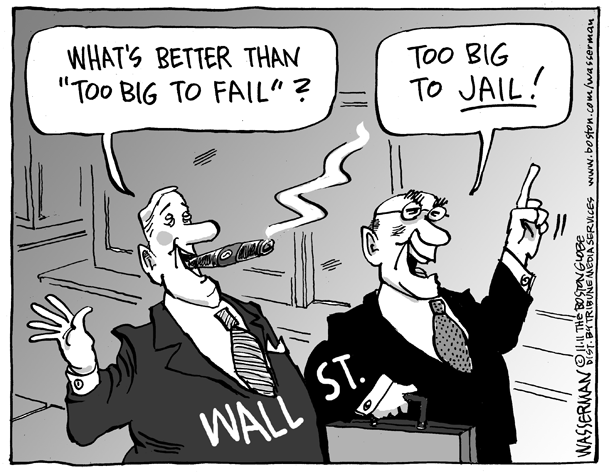
 Collapse of Industrial Civilization