Upon the shore, the sails unfurled—a shadow split the sand,
The Arawaks, open-handed, met the strangers on their land.
But steel and hunger answered gifts; the blade betrayed the hand,
And memory’s first encounter bled sorrow through the land.
The victors chisel chronicles, their glory set in stone,
Yet deep beneath the monuments, lost voices weep alone.
History’s map distorts the truth—its borders, blurred and planned;
The silenced and forgotten ones still haunt this stolen land.
A nation’s myth is mortared with the bones of those bereft,
Each monument to progress built on conquest and on theft.
Can gold and glory balance out the suffering and the pain,
Or does the ledger overflow with loss that can’t be named?
The color line, a scar across the centuries of blight,
Millions bound in bondage, stripped of dignity and right.
Yet whispers stoked resistance, hope burning out of sight,
Their courage, fierce and quiet, set darkened fields alight.
The poor and desperate, shipped away, indentured, whipped, and sold,
Their hunger turned to labor, their resistance crushed, controlled.
Class lines hardened—fortunes swelled as hope was overthrown,
The promise of equality a seed that’s never grown.
The memory of nations is not the memory you knew,
For nations are not families, nor interests shared by you.
The past is not a single tale, but conflict, clash, and strife,
A struggle for compassion in the shadowed halls of life.
If history is but a tool for those who hold the reigns,
Then every page that’s left unturned perpetuates the chains.
But hidden in the margins are the moments that resist,
The fugitive, the rebel, and the dreamers who persist.
To mourn the victims is not all, nor to condemn the strong,
But seek the fleeting moments when the powerless belonged.
In every age, a spark of justice flickers, faint but clear—
A lesson waits in listening, for those who choose to hear.
So let us read with skeptic’s eye, with empathy and doubt,
To find the threads of common cause that history leaves out.
For justice is not handed down, nor progress preordained—
It lives in acts of memory, in all that’s lost and gained.
And so the ledger closes—not with peace, but with a scream,
A continent’s inheritance: the violence of the dream.
Beneath our cities’ towers, the bones still shape the land,
And sorrow carves its memory where monuments now stand.
The silence of the vanished, the cries that went unheard,
Are buried in our language, in every history’s word.
Yet from the ash and shadow, a question will demand:
Who dares to claim the future, with blood upon your hand?
In lands where rivers split the soil, and borders draw a line,
Two cities share the sun and earth, yet fates do not entwine.
One thrives in ordered liberty, the other’s hope grows cold—
Not by gold or ancient myths, but by those for the power they hold.
The seeds of wealth are sown in fields where many voices speak,
Where laws are not the playthings of the cunning or the meek.
A council broad, a restless crowd, a parliament of dreams—
These birth the chance for newness, and the strength to mend the seams.
Yet power’s hand is seldom still; it grips the past with might,
And those who taste its honeyed wine will seldom yield the right.
They build their walls of privilege, their towers of decree,
And fear the storm of change that comes to set the many free.
For every age of rising light, a shadow stalks behind,
The fear of loss, the dread of change, the prison of the mind.
The press was silenced by decree, and rebels stormed the stage,
And all the while, the world awaits the birth of a lesser age.
But history is not a stream that flows in one fixed bed,
It twists with chance and accident, with dreams and with the dead.
A plague, a war, a merchant’s sail, a voice that dares to speak—
These turn the wheel of fortune’s game and lift the low, the weak.
No law of stone or blood or land shall set who will be blessed,
But only how we choose to bind the rulers and the rest.
For when the many shape the rules, and power’s chains are checked,
The soil of hope is watered deep, and futures intersect.
So let the lesson echo out: the world is what we make,
Not by the whims of gods or kings, but by the paths we take.
In every heart, a nation’s fate, in every mind, a key—
To open doors, to break the chains, and set the spirit free.
Let institutions not entomb, but nurture and renew,
For only where the many build can justice come to view.
The past is not our destiny, nor fate a final wall—
But in the hands of all who live, rests the power to rise for all.
And so the wheels keep grinding down the hungry crowds in pain.
As gilded halls ignore the cries and justice dies in vain.
The banquet’s set, the candles drip, the laughter starts to twitch,
At last, the table turns: the poor rise up to eat the rich.
I beg you not to crush me for the sin of being slight, Let not my fragile form decree the measure of my right. I beg you not to scorn me—no malice have I earned, You don’t curse the tide for turning nor the moth for being burned.
But I know it’s in your nature, you were shaped by colder hands, Taught that strength is only proven by the wreckage where you stand. No one showed you tenderness, no balm to soothe your blade, To beg for grace feels futile when the world in blood is made.
So why would you show mercy when there’s glory to be claimed? No requiem for shadows, no lament for the unnamed. But if you must, then grant me this: be deliberate and be swift— Let the world not taste my trembling nor the wind my hollow rift.
My existence leaves no imprint on the ledger of this earth, Neither curse nor benediction from the moment of my birth. But the atoms that composed me will return to dust and dew, And tonight, perhaps, the stars will dim as one light leaves their view.
But how can we define an oil age? It has been about 150 years since the first deep oilwells were sunk, and just over 200 years since the viable steam engine was developed. The two are linked, because the steam engine made deep drilling of oilwells possible and gave us access to a hundred million years worth of fossilized sunlight. Perhaps we have not strictly had an oil age, but rather the first and only age where we enjoy vast amounts of surplus energy that we have extracted from hydrocarbon fuels, of which oil is the most energy dense. It has brought us material wealth, and the means to indulge in wholesale killing of each other and all other species. It gave excesses of food and a population that consumed that food and grew to five or six times the sustainable level of the planet. In the timespan of human existence, the ascendance of modern industrialised man has been a short flash of light and heat that has briefly lifted us out of the mire of the middle ages, but at a considerable cost to the environment.
Our mistake has been to think of that elevation as both divine and permanent. That certainty of permanence explains the mad scramble to come up with ‘alternatives’ and ‘renewables’ in the last decade or two. Something to keep current politicians in office and the masses pacified. It is important that we accept the seductive indoctrination that prayers will be answered and technology will continue to deliver all that can be imagined. The majority have come to believe in the economics of cornucopianism, where wishing for something will make it happen, while ignoring the reality that everything we have is derived from finite hydrocarbon fuels. If we spend enough money, alternatives will always be found to sustain our lifestyle. They won’t of course, and the conflicts that have been fought over oil are proof that they won’t. The pivot of world oil economy is Saudi Arabia, (the concept of ‘Saudi America’ is too ludicrous for discussion here), but that fantasy land of sand dunes and tall towers is being encircled by fanatics who know that when the jugular of global oil is cut, the industrial complexity of the developed west will die.
When (not if) that happens, we might be lucky to hold onto an existence akin to that of the 14th century, which is what the religious zealots want to inflict on all of us. If we’re unlucky, then we must expect something that will be much darker and as yet inadmissible to modern minds that do not have the scope to deal with its implications. That infers an unpleasant imagery of pre-history that we prefer to ignore. Understandably, most think the same way; this is why we cling to the comforting promise of ‘infinite growth’. The alternative is just too awful. Instead we have been encouraged to believe that we can do without oil and not only still run around on wheels, but have a purpose for doing so. And by some means yet to be invented, keep our wings as well.
Our oil age will not end through lack of it, but by fighting over what’s left. So choose your luck‐factor and take that thought where you will, you are on your own with it. Many reasons are given for starting wars, but ultimately there is only one: the pursuit of (energy) resources. Human greed drove improvements in weaponry, and the means of destruction and acquisition became more deadly over thousands of years even though there was more than enough for everyone. The input of oil was the game changer of warfare; history over the last century has shown that conflict was not diminished, but amplified, by the prosperity and technology created by oil. Since the 1860s when black gold gushed from the earth, the economic and political thinking of the pre‐oil era was seamlessly grafted onto the industrial potential of the 19th century, thereby enabling Rockefeller, Ford, Carnegie, Vanderbilt and many others to accumulate fabulous wealth. Their business acumen was undeniable, but none of it could have been brought into existence without energy-rich oil. The use of fossil fuels in our military machines industrialised our methods of killing while at the same time becoming synonymous with progress and commerce. War became a business, the purpose of which was the acquisition of more energy in the pursuit of profit. Battlefield deaths on an industrial scale were an unlisted debit on balance sheets.
WWI started with the muscle power of horses and ended with tanks, demonstrating the murderous scope of mechanized warfare. Recognizing the critical value of oil and its sources, leaders carved up the Middle East to ensure its supply. An exercise in map making in the 1920s by the English and French civil servants Sykes and Picot set the scene for carnage that has raged throughout the Middle East ever since. Arbitrary lines in the sand were drawn, artificial oil states in the Persian Gulf region were created without regard to tribal affiliations, and a quarrelsome orphan Israel was dumped into the lap of unwilling Bedouins. As the quantity of oil there became apparent, all the major nations were drawn into the race for it because those who controlled this key resource were certain to subjugate those who did not.
The critical nature of oil made WWII inevitable. To sustain their empires, the Germans and Japanese slaughtered their way across Europe and Asia in a grab for resources, primarily oil. They promised infinite prosperity and their peoples cheered them on while deaths elsewhere were being counted in millions. With most of the world’s known oil supplies in the hands of his enemies, Adolf Hitler knew he had to have the oilfields of southern Russia and the Middle East to sustain his war machine. He failed, and his dream of a ‘Greater Germany’ collapsed not because of inferior soldiers but because there was insufficient energy input to sustain his plan for world domination. Hitler’s perception of infinite growth in his ‘thousand year Reich’ mirrors our present-day view of ‘permanent affluence’: vast quantities of oil had to be burned to sustain his fantasy. In our desperate scramble for ever-diminishing energy resources, we are in the same mad race to perpetuate the delusion of infinite economic growth. The oil pendulum has swung the other way with roughly 85% of world oil now outside the borders of the USA and Canada in countries not always of a friendly disposition. And just like the Fuhrer, political leaders of today are promising that which is beyond their means to provide. To mask this reality, they have invaded oil-producing nations in the name of ‘freedom’, claiming ‘victories’ which have left only wreckage and simmering animosity behind. So too did Hitler spread a similar line of propaganda that he was liberating other nations from the threat of communism. The second world war that left Europe and Japan flattened in 1945 might be seen as history, but it was just the first of many oil wars, and the politics of it were a side issue. WWII serves as a grim reminder of how violent and destructive humans can be in their ruthless pursuit of energy resources. Hitler’s own ‘oil age’ lasted just twelve years, and it set the pattern for the world oil age that is now in terminal decline.
Don’t be deceived by the democratic righteousness that defeated Hitler’s fascism. 150 years earlier the American empire was created with the same kind of energy grab. The European immigrant peoples who forced their way across America from the 1700s onwards needed resources on which to survive and to sustain the prosperity of an expanding nation just as the Germans and the Japanese did in 1940. The native inhabitants of the American continent were in the way of civilization and progress; their subjugation was a precursor to what happened later in Europe and Asia. Expansive prairies had to be cleared to convert the energy locked in grain and meat to feed the invaders and provide negotiable currency. This self-perpetuating process went into overdrive with the discovery of oil, and the ultimate conversion of that oil into more food resources and hardware added to the wealth of the growing nation. An expanding population needed employment, and the raw energy from oil, coal, and gas supplied it. America and the rest of the industrialised world had the means to build bigger, better, faster machines in endless succession, and created the most powerful country on earth. Everybody was going to be rich, forever. The universal law of consumption was relentless: more demanded more.
Meat and grain grew with relatively little human intervention, but other crops needed to be worked with human muscle. So the slave trade came into being. Slavery might be given many unpleasant names, but essentially it is the acquisition of one energy form to convert it into another for profit. Buy and feed the slave, use slave labour to do work, sell the product of that work. By the time the slave is worn out, several more will have been produced. This was simple economics by 18th century standards but the human consequences were again horrific, costing more millions of lives. It also brought on the American civil war where the slave‐muscled South was overwhelmed by the industrialised muscle that drove the armies of the North.
All the European empires forged out of so-called ‘empty lands’ across the world followed a similar pattern of resource acquisition and an absolute disregard for weaker peoples. It is an unpleasantness that we choose to ignore, but it confirms the killing force that drives us to acquire and convert energy to our own use. The seemingly limitless amount of oil and its energy density appeared to be the answer to all our labour problems. Oil became our ultimate slave. Or so we thought.
We now have maybe 20 years worth of usable oil left. There are certainly no more than 30, perhaps as little as 10. If one of the crazy sects running loose in the Middle East managed to get hold of a nuclear device, setting it off on the Gharwar oilfield of Saudi Arabia, it would be endgame overnight. That is perhaps too bleak a prospect, but we should not discount that notion entirely.
Before our oil to food arrangement, the planet supported something over one billion people. We now have over seven billion, and the mothers of the next two billion are alive now and approaching the age of reproduction. Preachers, scientists and politicians will not stop the basic human function of eating and procreation, so if unchecked nine billion people will be here by 2040/50, and set to go on rising after that. Every new arrival expects to be fed, watered, clothed and housed, but by no stretch of the imagination will the global food system be able to feed that number let alone sustain them with what would be expected by way of the most basic material comfort. No one dares to stand up and make the rather obvious point that we are not going to reach 9 billion. Something has to give, and that giving is going to be very unpleasant.
In the first decade of the 21st century, numerous wars have been fought over oil, and are being fought now. Wars are fought over resources because on nature’s terms, gentle contentedness is not a good strategy for survival; we are collectively powerless against genetic forces that dictate our lives no matter how much we protest otherwise. Downsized to whatever level, nature will ultimately force the choice of survival or death, and the outcome will be of no consequence other than to you and yours. To expect humankind to change within a single generation is stretching credibility beyond breaking point. Those who look forward to a life of bucolic bliss in a downsized oil‐less world might do well to think about that. Whether killing and butchering an animal to eat it, or invading another nation to secure oil supplies, we must appropriate energy sources to facilitate survival. You may think there’s a choice about doing that, but there isn’t, other than in the matter of scale. Whether paying a butcher to cut and wrap your steak, or paying soldiers to invade Iraq, securing sufficient energy to live is what we have to do to survive.
For the moment, nature keeps us supplied with oil, and we’ve pulled off the neat trick of converting it directly into food. Not knowing when our oil is finished and our food supply will run out is the little teaser for the early 21st century. Right now, most people think that food comes from supermarket shelves and freezers, which is just as well. The food trucks moving around the country are basically mobile warehouses, delivering food just in time for it to be consumed. When the realization dawns that the food trucks have stopped, the food held in stock by retailers will be stripped bare in hours. The oil age for everyone will have come to an end.
But oil carries man’s destiny in far more subtle ways than food supplies. It holds nations together. The USA is a vast territory of disparate peoples and ideas, held together by a common bond of prosperity and a basic consensus that government and law generally works for the good of all. And the inhabitants of empires are always convinced that theirs is permanent and protected by gods. That definition would apply to many large nations to a greater or lesser degree. But the bonds that hold it together, godly or otherwise, are entirely subject to availability of affordable oil. Empires (and the USA is an empire) remain whole so long as the means exists to maintain them. Oil has become that means.
Without oil, the nation will begin its decline into disparate regions. Without interconnecting transport, the United States of America cannot remain united. The force necessary to prevent a breakup will not be there, so within a decade (probably far less) of oil supply failure, the USA will cease to exist. The cracks are already there along linguistic, economic, racial, political and geographic lines. Even now it would be possible to take a pretty good guess at where those regions will split off.
This will be denied and resisted of course, but armies and police forces have power only as long as their fuel lasts. They will be unable to prevent secession in whatever form it takes. It might just be that Washington will come to govern not much more than the original colonies. Given a suitably deranged political leader and prayers to the right god, fully armed groups are ready to believe that the ‘American Dream’ can be restored. Such demagoguery sets the stage for years of regional violence over the basics of life, particularly food and water. The horror of it will be justified by warped views of right and wrong, clinging to a denial mentality magnified beyond any imagining by the privation that an oil-less society will bring.
This scenario is not exclusive to the USA. The British Empire was built on coal. When the coal was gone the empire faded away. Then in the 80s and 90s the UK became awash with cheap oil from the North Sea, and everyone was reasonably prosperous, particularly Scotland. Now the oil surplus has gone, and the UK is in decline again as a net importer. The ‘oil prosperity’ is fading away. Scotland is losing its main source of income and wants to secede from the United Kingdom, convinced that independence will somehow restore their wealth. Things will get very unpleasant when they realize that an independent Scotland will eventually be reduced to the economic level of Greece. The link between oil and the ability to eat is clear. The UK has to import 40% of its food, and much of the rest depends on oil to produce it, which also has to be imported. It is the end of the UK’s oil age, but few admit to it being the end of a food age as well. The same problem is being revealed in the current fiasco of the European union, but a little more advanced than the USA and UK. Oil-fueled prosperity is falling dramatically in the poorer southern countries. Greece, Spain and Portugal and a swathe of smaller nations have to import all their oil which only worked when oil was cheap. Now it’s expensive, and they are facing bankruptcy. 50 years of ‘unity’ is dissolving like a mirage in the face of the difficulties that smaller states are suffering. Without cheap oil, their economies cannot function, and so are disintegrating. United Europe needs oil to stay united just as the USA does. Russia’s oil dependent economy is crumbling, and Putin is having to make threatening postures to divert attention from his problems. His oil age is ending in a different way and yet we cannot tell if his posturing is just that, but a shortage of resources in the past has invariably brought conflict.
Move to the Far East and the nations around the South China Sea are all threatening one another, again the focus of the argument being the oil and gas fields of the region. They all know that without oil they cannot survive, and are prepared to fight for every last drop of the stuff, no matter what the cost. As a measure of what the dispute is about, the volume of oil in question is 11 billion barrels. One billion barrels is less than a month of world consumption. They are preparing to fight over the last dregs in confirmation of man’s desperation over oil shortages. Eventually, this problem will hit every nation and individual on earth as our oil‐crutch is kicked away. And with the oil age fading into history for us all, there will be no shortage of violent resistance to this inconvenient truth.
The following video message is from Dr. Erik Pianka, an esteemed American biologist, one of the world’s most accomplished field ecologists, and author of the classic 1983 book Evolutionary Ecology. This video was made roughly four years ago. Not much has changed in the interim other than everything getting progressively worse —more people, more cars, more garbage landfills, more greenhouse gas emissions, more ocean acidification, more extinctions, etc…
To save the habitability of the Earth, many enlightened environmentalists and thinkers have proposed a radical but simple solution which calls for a reconfiguration of modern society into a much lower energy-intensive way of life with food production localized and resources socialized —just the opposite of what is now happening in our no-holds-barred global capitalist system. However, the time for a transition was decades ago before we had gone so far into overshoot that world powers are now scrambling to lay claim to the melting Arctic, carving up Africa for its land and water while unleashing a pandemic, and contaminating the dwindling aquifers with fracking waste. Our so-called leaders are too busy constructing an omnipresent spying Panopticon to bother noticing the gathering storm of climatic hellfire and brimstone. When harsh reality finally assert itself, such human folly will have created unfathomable catastrophes.
Farming is never going to go back, regardless of how much rain we get next year, to the way it was in the ’70s and ’80s. It’s a long-term era of scarcity.
California is much bigger than it was when these reservoirs were built, 40 or 50 years ago. There’s more water going to cities and the environment now. That boom era of California farming, I think everyone recognizes, is just a thing of the past.
They used to flood-irrigate everything here. When I was a kid, growing up, you’d walk outside in the middle of summer, six or seven months since the last rain, and it would be humid outside because there’d be so much irrigation going on. You hardly ever see anything flood-irrigated anymore. That time, that’s just not coming back.
The solution is not the techno-utopian fantasy of cold fusion. Even if cold fusion was a realistic possibility, the creation of unlimited amounts of ultra-cheap energy wielded in the hands of techno-capitalist man would surely spell disaster for any last vestiges of life that might have survived the omnicide of capitalist industrial civilization and the age of fossil fuels. A good steward of the Earth’s resources and web of life would never have perpetuated the 6th mass extinction and defiled the planet that gave birth to his kind while arrogantly naming himself Homo sapiens (Latin: “Wise man”).
Capitalist carbon man acted like a bull in a china shop, throwing his weight around and blindly destroying everything in his path. Now he wants to invent even more disruptive tools with which to save himself from the very techno-nightmare that he has already created? He treated the biosphere like a buyosphere, and money was his God. His epitaph was inscribed long ago by Oscar Wilde who perceptively said, “They know the price of everything and the value of nothing.”
Tragically, humans had their chance in a magnificent paradise and they blew it in spades.
Over the ages, a number of empires have exploited and looted the resource-rich lands of Africa. At its height, the Roman Empire stretched from Scotland in the northern hemisphere to the deserts of Africa in the south. The Romans stripped their North African territory of its trees, making it their breadbasket of grain production. Originating in central Africa, malaria was likely spread to the center of the Roman Empire on their cargo ships. Passengers on their boats could have carried malaria in their bloodstream before becoming symptomatic, and water barrels on board could have harbored mosquito larvae. In fact, the DNA work of Dr. Robert Sallares has proven that the most lethal form of malaria helped topple ancient Rome. Fast forwarding to today, the blow-back from industrial agriculture and transnational corporate land grabs in Africa has now reached the shores of the hegemonic American Empire in the form of a deadly tropical disease called Ebola.
The Roman Empire seized fertile African land by brute force, but in modern times capitalist industrial civilization takes over Third World countries with the stroke of a pen. Structural adjustment loans by such tools of western power as the IMF and World Bank are signed requiring privatization of the economy and government cuts in social spending. Vast tracks of forests are cleared for mining or monoculture crop production such as palm oil. Subsistence farmers are dispossessed of their ancestral lands and forced to migrate to cities in search of work. Deprived of adequate healthcare and the opportunity to earn a livable wage, these urban poor live in squalor and are driven to hunt in the surrounding forests for a cheap source of protein known as bushmeat. Fruit bats, a keystone environmental species, have been identified as an Ebola virus host that has spread the disease through bushmeat consumption, habitat destruction, and human encroachment. Thus the neoliberal agenda of ‘developed’ nations has acted to create the atmosphere from which this pandemic arose.
Due to the long history of exploitation by outside powers, native Africans are justifiably wary and prone to conspiracy theories involving intervention by Western institutions as well as their own governments which have been, to a great degree, corrupted by the resource curse. These unpleasant facts are, of course, never mentioned by the MSM because it might spark a flicker of moral compunction in the ‘developed’ world which has ended up with so much of Africa’s wealth in the form of rare earth minerals used inside electronic devices, gold and diamonds in jewelry, or petrol pumped into vehicles. The horrific realities behind conflict minerals are always kept out of sight and out of mind by the next consumer diversion.
The following video is a brilliant lecture by Rob Wallace, evolutionary biologist and public health phylogeographer, discussing the epidemiologic links between the current Ebola outbreak and the socioeconomic policies of capitalist industrial civilization.
“Pathogens routinely trace society’s inequalities and expropriations like water traces cracks in ice… Ebola represents such a case. The shifts in land use in the Guinean region where the new strain apparently emerged are connected to the kinds of neoliberal structural adjustments that, alongside divesting public health infrastructure, open domestic food production to global circuits of capital… [The corporate agribusiness land acquisitions in Africa] are markers of a complex policy-driven faith change in agroecology…that undergirds Ebola’s emergence here.” ~ Rob Wallace
In biology there is a phenomenon known as the Allee effect which occurs when a species declines to a critical population threshold, becoming too spread out over a large area to find a mate for reproduction and thereby making a crash to extinction all but inevitable. The Allee effect applies to infectious diseases as well, and if you can knock down an outbreak below an infection threshold through such methods as vaccinations or proper sanitation, then the outbreak can burn out on its own. However, as Rob Wallace wryly states, “…structural problems can render emergency responses null and void, no matter how much Bill Gates pays out.” In other words, we may have destroyed the ecosystem’s natural ability to keep such pathogens in check and from expanding out of control in the future:
“…commoditizing the forest and neoliberal dispossession may have lowered the region’s ecosystemic threshold to a point that no emergency intervention can drive the pathogen population low enough to burn out on its own. The pathogen will continue to circulate with the potential to explode. In short, neoliberalism’s shifts aren’t just a background upon which such emergencies take place. It is the emergency as much as the virus itself. And history has demonstrated this time and again. Faith changes and social organization, for better and for worse, change epidemiologies. Domesticated livestock served as sources for human diphtheria, influenza, measles, mumps, plague, pertussis, rotavirus, tuberculosis, sleeping sickness, etc. Ecological changes brought about upon landscapes by human intervention selected for spill-overs of cholera from algae, malaria from birds, and dengue fever and yellow fever from wild primates… We can pretend otherwise for Ebola, but in protecting the rationals for institutions and policies that likely brought about such outbreaks, if as byproducts of a greater economy alone, we will surely only compound the problem. If not by Ebola this year, then perhaps something else next.”
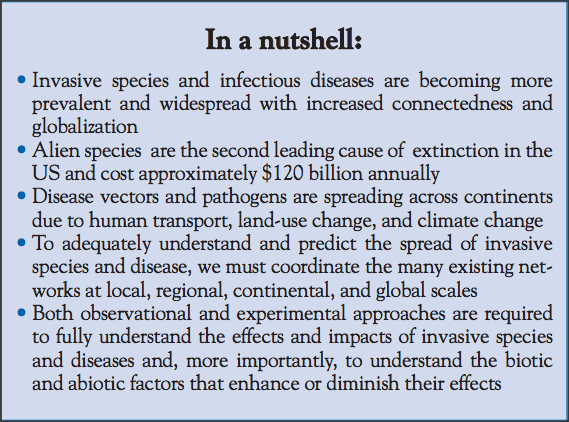
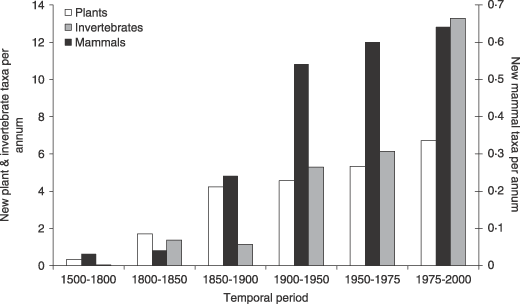
In addition to the ecosystemic impact of industrial agriculture and global circuits of capital, our highly mobile society and the consequent climate disruption from fossil-fueled globalization have worked to propel the spread of invasive species, diseases, and pathogens:
The following graph show the increase of invasive species since 1500 with an explosion in the last 100 years:
Below is a chart showing the increase in bacterial resistance for selected pathogens. “For example, Staphylococcus aureus resistant to methicillin has increased almost 70% since about 1975.” The dawning of an antibiotic apocalypse is upon us:
“FRONTLINE investigates the widespread use of antibiotics in food animals and whether it is fueling the growing crisis of antibiotic resistance in people. Plus an exclusive interview with the family of a young man who died in a superbug outbreak that swept through a hospital at the National Institutes of Health.”
Amplifying what some call peak antibiotics is the fact that in our capitalist economy, the perverse incentive for monetary profit discourages pharmaceutical companies from developing new antibiotics; there is no market for curing… only prolonging:
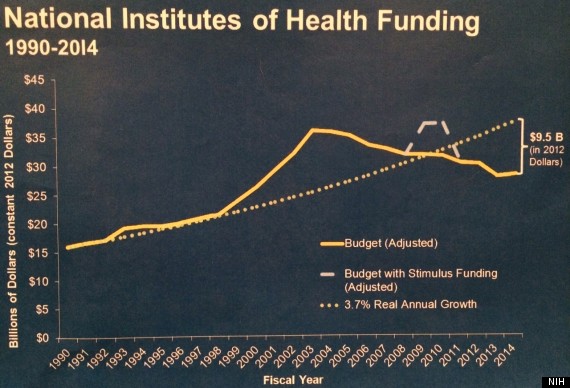
…Ebola emerged 40 years ago, and, Dr. Chan said, there were no vaccines or other remedies because it has traditionally been confined to poor African countries. A profit-driven pharmaceutical industry had no incentive to make products for countries that could not pay, she said.
The risks of neglecting health care in developing countries are global, Dr. Chan said, adding that “when a deadly and dreaded virus hits the destitute and spirals out of control, the whole world is put at risk.”… – link
The fragmented and “crapified” nature of America’s for-profit healthcare system has also factored into the fumbled response to Ebola’s invasion into America, as Yves Smith at Naked Capitalism explained recently:
…the statistics say compared to other developed countries, US processes and outcomes are at best mediocre using the best of some admittedly flawed metrics (look here), yet our costs are much higher than those of comparable countries. Furthermore, on Health Care Renewal we have been connecting the dots among severe problems with cost, quality and access on one hand, and huge problems with concentration and abuse of power, enabled by leadership of health care organizations that is ill-informed, incompetent, unsympathetic or hostile to health care professionals’ values, self-interested, conflicted, dishonest, or even corrupt and governance that fails to foster transparency, accountability, ethics and honesty…
…The US health care system is now heavily commercialized. Health care corporations, including pharmaceutical and biotechnology companies, are often lead by generic managers who subscribe to the business school dogma of the “shareholder value theory,” which seems to translate into putting short-term revenues ahead of all other goals. Thus they have been“financialized.” At least in the pharmaceutical and biotechnology sector, such financialization appears to now be global…
…from 1983 to 2000, the number of managers working in the US health care system grew 726%, while the number of physicians grew 39%, so the manager/physician ratio went from roughly one to six to one to one (see 2005 post here). As we noted here, the growth continued, so there are now 10 managers for every US physician…
There is little wonder why the Ebola outbreak caught the WHO so flat footed as they spent months making mealy mouthed statements but never coordinating an effective response. The Gates foundation is the WHO boss, not governments, and if they weren’t demanding action, then the desperate people affected by Ebola weren’t going to get any…
…The Bill and Melinda Gates Foundation has pledged an additional $50 million to fight the current Ebola epidemic but that too is problematic, as Director General Chan describes. “When there’s an event, we have money. Then after that, the money stops coming in, then all the staff you recruited to do the response, you have to terminate their contracts.” The WHO should not be lurching from crisis to crisis, SARS, MERS, or H1N1 influenza based on the whims of philanthropy. The principles of public health should be carried out by knowledgeable medical professionals who are not dependent upon rich people for their jobs.
The Gates are not alone in using their deep pockets to confound what should be publicly held responsibilities. Facebook founder Mark Zuckerberg announced that he was contributing $25 million to fight Ebola. His donation will go to the Centers for Disease Control Foundation. Most Americans are probably unaware that such a foundation even exists. Yet there it is, run by a mostly corporate board which will inevitably interfere with the public good…
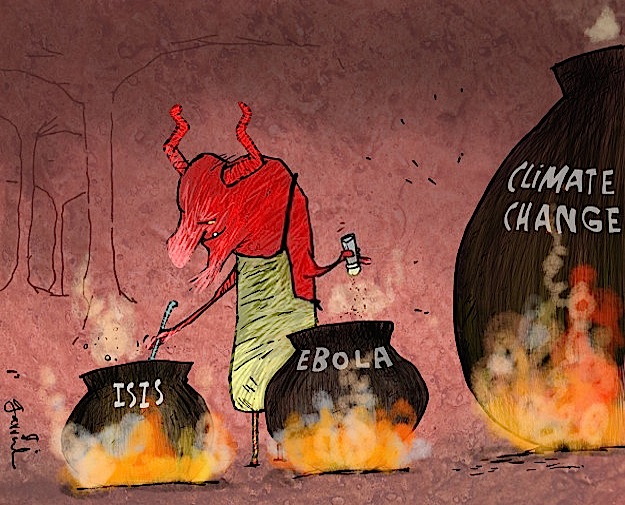
Essentially, both ISIS and the Ebola pandemic are crises of the corporate state’s own making. Vast sums of money have flowed into America’s war machine to fight the terrorist threat of ISIS, yet the specter of a global pandemic has elicited a much more belated and tepid reaction from the leaders of our brave new privatized and financialized system of government. As with climate change, it has become clear once again that the health of the world and its people cannot be trusted with these adherents of neoliberal capitalism, and as I stated in a previous blog post, the conspiracy is systemic and legalized. The virus of capitalist industrial civilization appears to be on an unstoppable trajectory of burning itself out within our children’s lifetime.
“It was a nice run for the biosphere, but it finally came down with a lethal disease, homeostasis lost, the pyramid of life reduced to the pancake of life.” ~ James
Championing the rapacious conversion of the Earth into dead commodities and its peoples into soulless consumers, the adherents of capitalism have succeeded in entrenching their ideology into the minds of the vast populations as the only viable economic system and way of life. Mesmerized by the electronic gadgetry of the digital age and singing the praises of the “free market”, atomized citizens blissfully hack away at the tree of life that supports them. The bio-destructive power of capitalist industrial civilization stamps out the poetry of nature, silencing entire ecosystems. This essay by Kenn Orphan describes the mindless march towards self-destruction and the redemption that comes by bearing witness to it.
“Extinction is the rule. Survival is the exception.” – Carl Sagan
We are all witnesses to the Great Dying, a sixth mass extinction, the last one being 65 million years ago which wiped out the dinosaurs. This is not hyperbole; it is a defining feature of our age.
Countless species are falling prey to the wealthy’s indifference, militarism and folly everyday. As in ancient civilizations, the wealthy and the privileged are generally the last to feel the pain of collapse, yet are most often the root cause. And compared to the mass of humanity we share this planet with, and as a result of rapacious exploitation and plunder, Americans, and westerners in general, are the wealthy and the privileged of modern civilization.
Despite overwhelming evidence of crashing ecosystems, many of us living in the twilight years of the American empire seem oblivious to the canaries in the coal mine. Every…
“Mother nature is a brutal bitch, red in tooth and claw, who destroys what she creates.”
~ Ernest Becker, The Denial of Death
The root of the problem
Despite modern man’s unparalleled ability to gather and synthesize mountains of data on climate change and other growing dangers, he is helpless to stop the inevitable and well-worn trajectory that all previous complex societies have followed. This time, however, is different in that the scale of environmental overshoot is planet-wide – the world’s oceans are becoming too acidic to sustain life, the soil too eroded and degraded to grow food, and the atmosphere too polluted with heat-trapping gasses. As the green mantle of the Earth is swallowed up in the geologic blink of an eye, eon-long processes of plant and animal evolution are stopped dead in their tracks. Of all the horrors modern civilization has brought forth, the most damaging and longest-lasting legacy is the wholesale loss of genetic and species diversity. Global ecocide is certain suicide.
Faith in technology and “free market” capitalism to solve the planet’s ills has already proven to be a very dangerous and faulty belief. Politicians are always looking for easy solutions to complex problems, and they see technology as the mechanism by which to reconcile endless growth on a finite planet. Public Relations and greenwashing are all-pervasive. Science has been privatized to the highest bidder. Essentially, those who are anti-environmental and those who claim to be environmentalists are both proponents of the same omnicidal death machine. One recognizes that fossil fuels are indispensable to industrial civilization while discounting or refuting anthropogenic climate disruption(ACD). The other acknowledges the reality of ACD but falsely believes that “renewable energy technologies” can harmlessly supplant carbon-based energy sources. In both cases, neither can accept that the root of the problem is capitalist industrial civilization. Neither the anti-greens nor the faux environmentalists are willing to give up their globetrotting airline flights, sprawling suburbia and car culture, oversized McMansions, overprocessed fast food, virtual world of cyberspace and all the rest of their energy-intensive, unsustainable way of living:
…This“standard of living”is a product of an alienated society in which consumption for the sake of consumption is the new god. In a grow-or-die economy, production and consumption must keep increasing to prevent economic collapse. This need for growth leads to massive advertising campaigns to indoctrinate people with the capitalist theology that more and more must be consumed to find “happiness” (salvation), producing consumerist attitudes that feed into an already-present tendency to consume in order to compensate for doing boring, pointless work in a hierarchical workplace. Unless a transformation of values occurs that recognises the importance oflivingas opposed toconsuming,the ecological crisiswillget worse. It’s impossible to imagine such a radical transformation occurring under capitalism, whose lifeblood is consumption for the sake of consumption…
…As Murray Bookchin argues,“If we live in a ‘grow-or-die’ capitalistic society in which accumulation is literally a law of economic survival and competition is the motor of ‘progress,’ anything we have to say about population causing the ecological crisis is basically meaningless. Under such a society the biosphere will eventually be destroyed whether five billion or fifty million people live on the planet”[“The Population Myth”inWhich Way for the Ecology Movement?, p. 34]… – link
Civilization is not in of itself evil; the problem lies in how it is organized and functions. Capitalism encourages the unregulated growth of gigantic corporations that exploit the environment and people, create economic disparity, promote hyper-consumerism, and usurp and corrupt governments. In addition to using military might for exploiting foreign resources and pools of labor, capitalism encourage war for the sole purpose of profit, i.e the military industrial complex. It also encourages overpopulation by the gross maldistribution of wealth:
…There is an inverse relationship between per capita income and the fertility rate — as poverty decreases, so do the population rates. When people are ground into the dirt by poverty, education falls, women’s rights decrease, and contraception is less available. Having children then becomes virtually the only creative outlet, with people resting their hopes for a better future in their offspring. Therefore social conditions have a major impact on population growth. In countries with higher economic and cultural levels, population growth soon starts to fall off. Today, for example, much of Europe has seen birth rates fall beyond the national replacement rate. This is the case even in Catholic countries, which one would imagine would have religious factors encouraging large families.
To be clear, we are not saying that overpopulation is not a very serious problem. Obviously, population growth cannot be ignored or solutions put off until capitalism is eliminated. We need to immediately provide better education and access to contraceptives across the planet as well as raising cultural levels and increasing women’s rights in order to combat overpopulation, which only benefits the elite by keeping the cost of labour low in addition to fighting for land reform, union organising and so on. However, the “population explosion” is not a neutral theory, and its invention and continual use is due to its utility to vested interests. We should not be fooled by them into thinking that overpopulation is the main cause of the ecological crisis, as this is a strategy for distracting people from the root-cause of both ecological destruction and population growth: namely, the capitalist economy and hierarchical social relationships it requires. – link
Ferguson is only a small spark before the conflagration
Those communities that are the most discriminated against and disenfranchised will be the first to erupt in violence as the social fabric is stretched to the breaking point. The city of Ferguson, Missouri experienced ‘white flight’ since 1990 which changed its demographics, creating a majority of African-American residents but with whites still dominating the institutions governing the city. The racially charged social unrest in Ferguson has its roots in the rapacious system of capitalism. Several policies and effects of neoliberal capitalism worked to drain wealth and opportunity away from Ferguson: “outsourcing of American industry, the housing bubble and credit crunch, and education reform and privatization”. In addition, the militarization of local law enforcement and targeting of African-Americans with fines to fund the police department is another tactic of rogue capitalism preying upon the poor:
Emerson Electric, the dominant employer in the area, offshored its production little by little over time to foreign factories with cheap labor.
Many African-Americans bought homes in Ferguson during the housing bubble, only to become underwater in their mortgages in the credit crash and Great Recession that followed. As of 2013, 49% of homes in the Ferguson zip code were underwater.
Mortgage lenders targeted predominantly black and Hispanic areas for the highest-risk, highest-cost types of mortgage loans, such as adjustable-rate mortgages and loans with high prepayment penalties. This led to higher-than-average default rates, according to the Housing Commission established by the Bipartisan Policy Center in Washington, D.C.
The mayor of Ferguson and its all-white city council then collaborated to keep property values low around the historic district for reinvestment and redevelopment.
On the basis of its state test scores, the impoverished Normandy School District where Michael Brown attended was declared a failure and its accreditation was pulled by the state. Because of this, Normandy School District was obligated to pay for the transfer of its students to other wealthier schools. (This is one of the schemes of the privatization of education and “school shopping” that the state is using rather than funding and providing resources to these schools.) The costs of student transfer bankrupted Normandy School District, so the state then dissolved the district and created a new one which it exempted from accreditation so that students would no longer be allowed to transfer out to other better-funded schools. The pipeline from such poverty-stricken, failed educational systems to prisons–many of which are for profit–is direct.
The militarization of the domestic police force in the U.S. has been occurring for several decades and is in line with the ever-increasing militarism of America’s foreign policy. With the entire globe now treated as a battlefield in the ‘War on Terror’, summary executions can be carried out by remote-controlled drone aircraft. Americans have now joined the ranks of those in South America, the Middle East and the rest of the Third World who have been exploited by the neo-coloniali exploitation of U.S. corporations over the last century. As the economy fails to ‘improve’ and global unrest becomes more frequent, the brutality of a fascist corporate state will reveal itself right here at home in more overt ways. The growing police state in America is the response by those planning to protect their elite positions at the top of the capitalist hierarchy in this corrupt state of ever-widening wealth disparity, resource depletion, and environmental collapse:
…Combat in large cities is central to the military doctrine that is being developed by the US armed forces. This is spelled out in a document entitled “Megacities and the United States Army: Preparing for a complex and uncertain future,” which was released in June by the Army’s Strategic Studies Group and endorsed by its chief of staff, Gen. Raymond Odierno.
Predicting that it is “highly likely that megacities [described as metropolitan areas with populations of more than 10 million] will be the strategic key terrain in any future crisis that requires U.S. military intervention,” the report reveals that the Pentagon has conducted “case studies” and “field work” in preparation for such interventions in: Dhaka, Bangladesh; Lagos, Nigeria; Bangkok, Thailand; Mexico City, Mexico, Rio de Janeiro and Sao Paulo, Brazil … and New York City.
Describing the conditions that it anticipates will require US military intervention, the report warns, “As inequality between rich and poor increases … Stagnation will coexist with unprecedented development, as slums and shanty towns rapidly expand alongside modern high-rises. This is the urban future.”
“Radical income disparity,” is further described as the foremost “driver of instability” in these far-flung urban areas.
In other words, the Pentagon brass is seeking to prepare the US military for directly counterrevolutionary interventions aimed at quelling popular revolts that it sees as the inevitable consequence of the unprecedented social inequality created by world capitalism in crisis… – link
As reported by Cyrano’s Journal Today, the Obama administration’s call to review U.S. government funding of military equipment for local/state police departments is simply a PR ploy to calm the nerves of uneasy Americans. In reality, the U.S. government will work to normalize and standardize the militarization of domestic law enforcement:
…The aim of the Obama administration’s review—beyond being a public relations exercise—will be to cut down on such unprofessional displays and make the use of domestic military police more systematic, widespread and regular. In this it will be similar to the administration’s reviews of its domestic spying programs, each of which has only resulted in the extension of illegal spying by the US intelligence agencies.
Far from acting as a restraining influence on local police departments, the federal government has been the most active facilitator of police militarization. In June, the American Civil Liberties Union released a report entitled “War comes home: The Excessive Militarization of American Policing,” which concluded that “the federal government has justified and encouraged the militarization of local law enforcement.”…
To add insult to injury, the Ferguson police made it a practice to feed off the poor by filling its coffers with millions of dollars in fines and court fees that it collected by specifically targeting and harassing African-Americans. I seldom quote ZeroHedge here because it is pro-capitalist and attributes all social and economic problems to Federal Reserve monetary policies rather that correctly placing the blame on the inherent workings of capitalism, but I did read an informative article from them on the scale of poverty that is affecting not only Ferguson, but all major metropolitan areas in the U.S.:
The biggest concern, however, is that Ferguson is merely the canary in the coalmine. According to Brookings, within the nation’s 100 largest metro areas, the number of suburban neighborhoods where more than 20 percent of residents live below the federal poverty line more than doubled between 2000 and 2008-2012. Almost every major metro area saw suburban poverty not only grow during the 2000s but also become more concentrated in high-poverty neighborhoods. By 2008-2012, 38 percent of poor residents in the suburbs lived in neighborhoods with poverty rates of 20 percent or higher. For poor black residents in those communities, the figure was 53 percent.
A long history of colonialism, slavery, and racism underlies the economic, political, and social disenfranchisement of African-Americans today in communities like Ferguson. Their exploitation has been institutionalized, and thus deemed acceptable.
We’re just an extra in this global reality freak show
The world certainly appears to becoming much more unstable with Russia and the Ukraine flirting with nuclear war, barbaric decapitations at an all time high in the perpetually destabilized Middle East, the failure of Japan’s ice wall to stop its radioactive clusterfuck fallout, redneck commando wannabes of America’s local police departments running roughshod over those they are sworn to “protect”, the Wall Street Casino Royale reaching all-time highs as average Americans get new lone shark PayDay loans to pay their previous lone shark PayDay loans, and our corporate overlords celebrating even higher profits while paying even less taxes. And while this circus of humanity plays out, both poles continue their meltdown with new outgassings of methane promising to wipe us out with one monstrous belch.
The techno-utopians will continue their crusade to save mankind from himself. The free market fundamentalists will seek comfort in the fantasy that Adam’s Smith’s invisible hand will fix everything. The climate change deniers will continue to rationalize the increasingly destabilized biosphere as a new normal that has happened before. The things we know that should be done to save ourselves are only philosophical narratives running in our head, never to see the light of day. All you can do is watch it all unfold because this reality freak show is global and you’re just an extra in it, whether you want to be or not. After all, I don’t think any of us are completely free from some sort of delusion. If we were, we wouldn’t be human.
“People who call themselves supporters of Israel are actually supporters of its moral degeneration and ultimate destruction.” ~ Noam Chomsky
There are a number of Israelis, such as Sahar Vardi and Uri Avnery, who strongly reject the occupation of Palestinian lands and the militarization of Israeli society. Although they recently lost their exemption status from military service, an ultra-orthodox sect of Judaism known as the Haredi whose numbers comprise 10% of the Jewish state are also opposed to war and the violent land grabs of Israeli settlers. There are others as well, but their voices are suffocated by powerful forces which have no interest in ever finding a peaceful solution to the Israeli/Palestinian crisis.
“…not only does Israel now occupy 80% of the area of historic Palestine, but it – via the water company Mekarot – also takes 80% of the water resources from the 20% of the land that is left to the Palestinians…” – link
Looking back into history, one finds that the current right-wing ruling Likud party of Israel has roots in the Irgun Zvai Leumi (Hebrew for “National Military Organization”), a terrorist Jewish organization which played an integral part in the establishment of Israel:
“…The Irgun has been viewed as a terrorist organization or organization which carried out terrorist acts. In particular the Irgun was branded a terrorist organisation by Britain,the 1946 Zionist Congressand the Jewish Agency. The Irgun believed that any means necessary to establish the Jewish State of Israel, including terrorism, was justifiable.
The Irgun was a political predecessor to Israel’s right-wingHerut (or “Freedom”) party, which led to today’s Likud party. Likud has led or been part of most Israeli governments since 1977.” – link
“This Dahiya doctrine, developed at Tel Aviv University, calls for disproportionate force against civilians and civilian infrastructure to extract the maximum pain from those civilians, to make them stop the resistance–an absolute collective punishment crime against humanity.”
– link
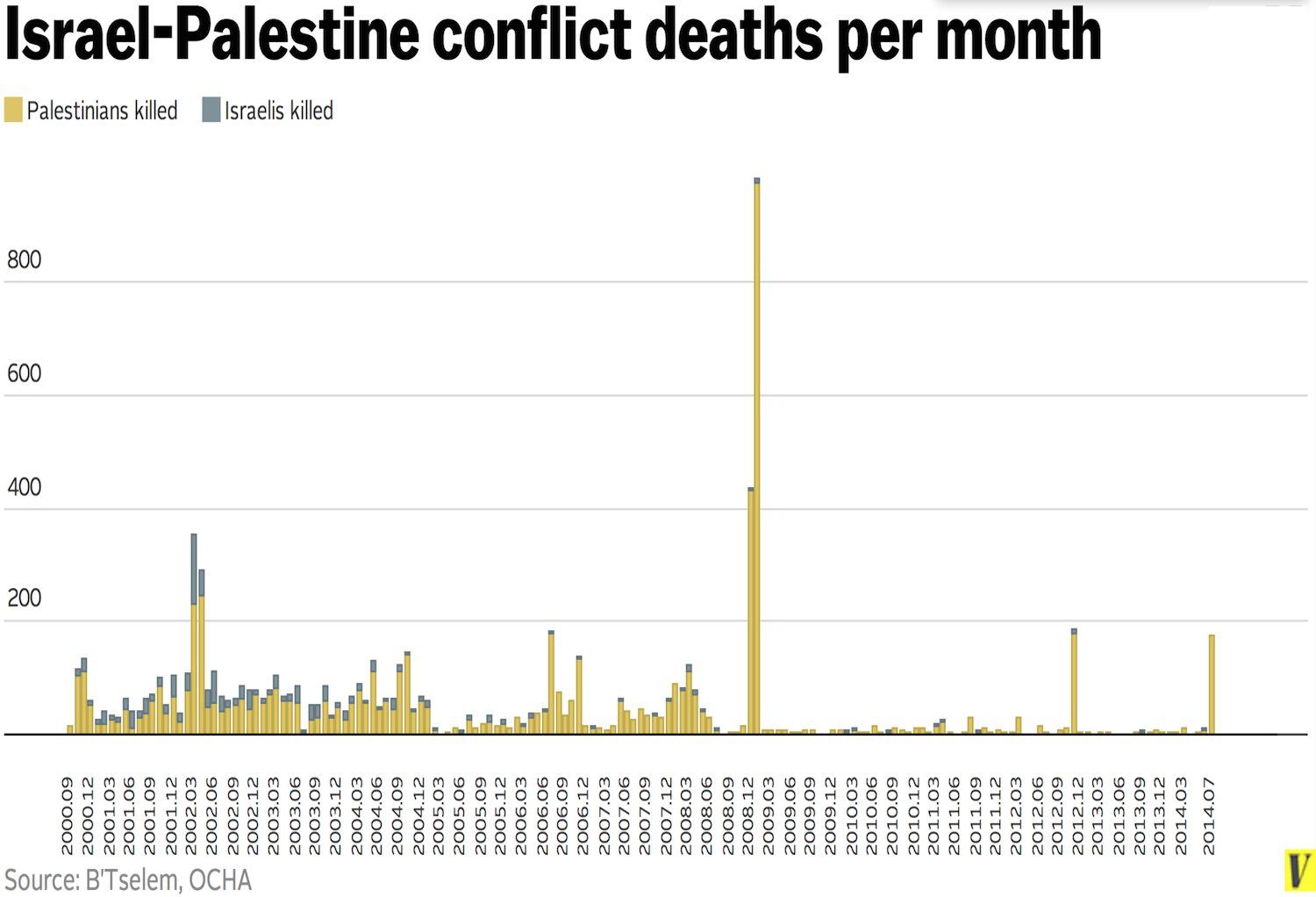
The thousands of primitive Qassam rockets fired by Hamas have killed 28 people and injured 1,900 since 2001, whereas Israeli hi-tech missiles have killed thousands and injured tens of thousands of Palestinians in the same time period as the following chart illustrates:
(Click to Enlarge)
The chart above does not have the complete death toll as of today, so a few thousand more Palestinians and a few dozen Israelis must be added to the body count. As the popular saying goes, war carried out by the state is simply terrorism with a bigger budget.
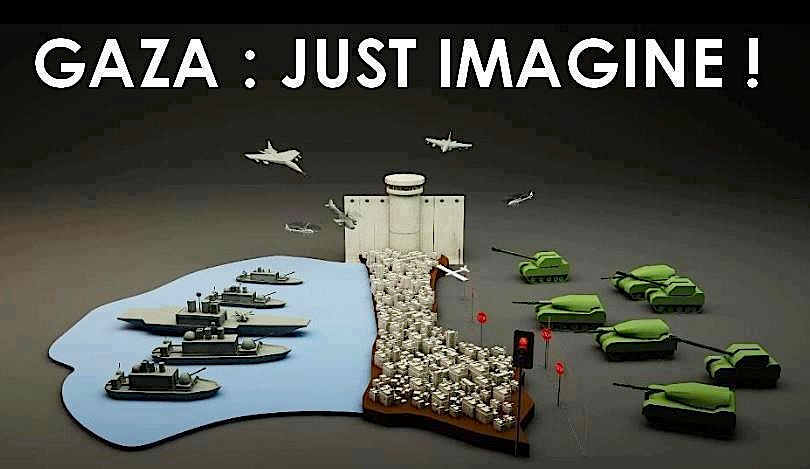
Just as America pursued a westward expansion of its territory with the ideology of manifest destiny and implemented the Indian Removal Act of 1830 which removed native people by force, if necessary, from desirable territories within state borders and herded them into less valuable land, so too is Israel pursuing a similar strategy. Palestinians have been isolated into two areas, the Gaza Strip (including East Jerusalem) and the West Bank. The Gaza Strip is sealed off on its land borders with Israel by concrete and steel walls, a double wire fence, watchtowers and checkpoints, and sensors and buffer zones. This Israel–Gaza barrier is equipped with state-of-the-art surveillance technology and manned by armed Israeli police. To complete the land enclosure of Gaza at its southern border, a steel wall that will extend 60 feet deep into the ground is being erected by Egypt with the help of American and French money and expertise. Last year, the Egyptian military resorted to flooding Gazan smuggling tunnels with sewage. The Israeli navy controls all ingress and egress from Gaza ports, while Israeli drones and fighter jets rule the Gazan skies. The West Bank is similarly ghettoized and in the process of being walled off. Ironically, Israel has exiled the Palestinians to the very same sort of ghettos that confined and segregated the Jews for centuries in Europe and later in the Nazi-occupied countries.
…ghettoization is itself the aim, having been implemented for the past 65 years. In other words, the aim – unfolded with the advent of time -has been to concentrate the Palestinians in reserves, after most of their land had been robbed of them. And if they desert and move abroad, it’s of their own free will. A direct planning and ideological line stretches between the enclaves in which the Palestinian citizens of Israel live and those of the West Bank and the Gaza Strip.
This is the real Israeli historical compromise. It is not with the Palestinians, but with the dictates of reality and among the various Zionist ideological currents. The crowded, offensive reservations – the creation of which is violence, pure and simple – are a compromise between the craving to eject the Palestinians from their land and the recognition that regional and international conditions do not permit it.
~ Amira Hass, Palestinian ghettos were always the plan
The Israeli navy uses different tactics of torture to punish the fishermen for persistently fishing, including shooting with live ammunition (on numerous occasions injuring fishermen), shelling, shooting with high-powered water cannons [all of which is simultaneously designed to damage the boats and equipment], at gunpoint forcing fishermen to strip naked and (after a long wait in the cold air) to jump into freezing waters and swim over 50m to the waiting naval ship before hauling the fishermen up, blindfolding and handcuffing them, and abducting them to Israel for interrogation unrelated to issues of fishing. – link
Due primarily to the blockade and previous Israeli airstrikes on power plant infrastructure, electricity generation has in recent years been severely curtailed to less than half of normal demand in Gaza. Loss of energy to waste treatment plants has caused “up to 90 million liters of partially treated sewage to discharge into the Mediterranean Sea every day.” The current Israeli bombardments on July 29, 2014 have now left Gaza in an even more dire condition:
“If there were one attack that could be predicted to endanger the health and well-being of the greatest number of people in Gaza, hitting the territory’s sole electricity plant would be it,” said Eric Goldstein, deputy Middle East and North Africa director. “Deliberately attacking the power plant would be a war crime.” – link
Most wars are started under false pretenses and Israel’s current “mowing of the lawn” is no different, as Fair.org reported, but Israel has the backing of a super power to legitimize its sadistic war crimes. Western media outlets parrot the crudest of Israeli propaganda. As America’s number one recipient of military and economic aid, Israel has proven itself an integral linchpin of the American empire:
“Israel’s demonstration of its military prowess in 1967 confirmed its status as a ‘strategic asset,’ as did its moves to prevent Syrian intervention in Jordan in 1970 in support of the PLO. Under the Nixon doctrine, Israel and Iran were to be ‘the guardians of the Gulf,’ and after the fall of the Shah, Israel’s perceived role was enhanced. Meanwhile, Israel has provided subsidiary services elsewhere, including Latin America, where direct US support for the most murderous regimes has been impeded by Congress. While there has been internal debate and some fluctuation in US policy, much exaggerated in discussion here, it has been generally true that US support for Israel’s militarization and expansion reflected the estimate of its power in the region.
The effect has been to turn Israel into a militarized state completely dependent on US aid, willing to undertake tasks that few can endure, such as participation in Guatemalan genocide. For Israel, this is a moral disaster and will eventually become a physical disaster as well. For the Palestinians and many others, it has been a catastrophe, as it may sooner or later be for the entire world, with the growing danger of superpower confrontation.” ~ Noam Chomsky
Last month, Robert Fisk wrote that the current Israeli/Palestinian conflict is about land and Nafeez Ahmed wrote that it is about Gaza’s gas reserves. I say it’s about land and resources, but it’s also about war profiteers feeding the military industrial complex with endless conflict. From the gas chambers of the Holocaust to today’s slow and systematic genocide of the Palestinian people, it’s about man’s inhumanity to man and the vicious cycle of history repeating itself.
For over a third of Israel’s income
Comes from its exporting its weapons,
And since it’s cultivating its deadly fruit
In its Gazan hot house at a profit,
Then why would it see the need for peace?
‘Operation Cast Lead’ in 2009
Boosted Israeli Arms sales
To a record 6 billion dollars.
It killed 1,471 Palestinians.
‘Operation Pillar of Defense’
The second large scale operation in Gaza
Was launched in November 2012
And Israel’s weapons sales that year
Set a new all time record
Of 7,000, 000,000 dollars,
While 169 Palestinians lay dead.
In ‘Operation Protective Edge’
Over a thousand would die in July 2014,
And whatever its final body count
The price will have been considered worth it
By the thriving Israeli arms business.
As Israel ruthlessly destroys the besieged Gaza Strip,
Elbit Systems, its largest developer of military technology
And its drone-maker, benefits from the bloodshed.
Since 8 July, 2014, when Israel began its latest offensive,
US-traded shares of Elbit Systems,
Climbed 6.1 percent
According to Bloomberg Business Week.
Israel’s three-week long massacre
Of 1,200 Palestinians in Gaza,
Including nearly 300 children,
“Has pushed Elbit’s stock close to the highest level since 2010
While its valuation on a price-to-earnings basis
Is near the most expensive in five years.”
Israel, in other words,
Makes bloodshed its business.
At some point in your life you realize that you’re running out of time, that your health and energy level are slipping, and that your time here on Earth is extremely fragile and transient. You begin to question and re-evaluate what’s important to you. Most still go to their grave with the belief that life will go on for their descendants in a world of never-ending technological “advancements” and improvements in society. A few reading this blog understand the myth of human progress and that mankind is sleepwalking towards a very dark fate. How could there be any other outcome when we have never really heeded the precautionary principle of environmentalism and, in fact, flagrantly disregarded it? Occasionally a scientist will candidly speak the truth. Recently, Jason Box did just that when he tweeted “we’re f’d” if just a small fraction of floor carbon is released from the Arctic. Some of us realize what dire straits we are in and all we can really do is watch with a sort of morbid fascination as this dystopian future unfolds before our eyes. A “grim meathook future” is the inevitable result of a society that worships money, materialism, militarism, and technology.
For an articulate and heartfelt expression of the angst of the modern age, I highly recommend reading the blog post Everyone I know is brokenhearted. The author, Josh Ellis, doesn’t mention climate change at all, but he does hit on every other aspect of capitalist industrial civilization and its soul-crushing, alienating culture. Judging from the number of Facebook “likes”, now at 21K and counting, he has really struck a nerve with people. Perhaps it’s fitting and somewhat ironic that Josh has spent much time in the desert megacity of Las Vegas, the ultimate man-made mirage of capitalist decadence.
All the genuinely smart, talented, funny people I know seem to be miserable these days. You feel it on Twitter more than Facebook, because Facebook is where you go to do your performance art where you pretend to be a hip, urbane person with the most awesomest friends and the best relationships and the very best lunches ever. Facebook is surface; Twitter is subtext, and judging by what I’ve seen, the subtext is aching sadness.
I’m not immune to this. I don’t remember ever feeling this miserable and depressed in my life, this sense of futility that makes you wish you’d simply go numb and not care anymore. I think a lot about killing myself these days. Don’t worry, I’m not going to do it and this isn’t a cry for help. But I wake up and think: fuck, more of this? Really? How much more? And is it really worth it?
In my case, much of it stems from my divorce and the collapse of the next relationship I had. But that’s not really the cause. I think that those relationships were bulwarks, charms against the dark I’ve felt growing in this world for a long time now. When I was in love, the world outside didn’t matter so much. But without it, there is nothing keeping the wolf from the door…














 Collapse of Industrial Civilization