A recurrent theme in the reality based community is the continued assertion that infinite growth cannot happen on a finite planet. This simple statement seems to be quite self-evident to those announcing it, yet the powers that be cannot seem to be able to wrap their head around it. We live in a society awash with advertisements that seek to sell you something at some price. Capitalism commodifies everything and its ethos of mandatorily attaching some arbitrary, imagined worth to all things has permeated every aspect of our lives, our ethics, and our value system. We are a society that projects a cost/price analysis on everything, including relationships with fellow humans. According to ‘Save the Children’ charity chief executive, Justin Forsyth, half a billion children over the next 15 years will suffer long-term mental and physical harm due to stunted growth by malnutrition. Surely if we valued the future life of our grandchildren more than profit, then we would not allow such a thing to happen. If our own children’s future is not valued enough to save them from our greed and shortsightedness, then why would the environment be treated any differently, despite its importance to the survival of every living thing on the planet. The scientist James Lovelock once said that Green is the color of mold and corruption. If we cannot separate the needs of capitalism from the needs of our planet, then every last bit of resources and life-sustaining gift from the earth will be chopped up into tradable, sellable units and thrown into the gaping jaws of the free market. Philosopher Leonardo Boff notes:
The fundamental defect in the UN’s document for Rio+20 is the total absence of a new vision or new cosmology that would create the hope of the «future that we want», the motto of the great gathering. As such, it belies a promising future.
To those who drafted it, the future depends on the economy. There is little value in the adjectives they attach to it: sustainable or green. The green economy in particular constitutes a great assault on the last bastion of nature: transforming into merchandise and putting a price on everything that is common, natural, vital and indispensable to life, such water, the soil, fertility, jungles, genes, etcetera. That which pertains to life is sacred and must not be passed to the sphere of business. Instead, it becomes part of the market place, under the categorical imperative: take all you want, make business with everything, especially with nature and with her goods and services.
This is the supreme egocentrism and arrogance of the human being, or, as it is also called, anthropocentrism. Human beings see the Earth as a warehouse of resources only for them, without realizing that we are not the only ones who inhabit the Earth, nor do we own her; we do not feel that we are part of nature, but outside and above her, as her «lords and masters». We forget, however, that there exists a whole visible community of life (5% of the biosphere) and quadrillions of quadrillions of invisible microorganisms (95%) that guarantee the vitality and fecundity of the Earth. They all belong to the Earth/condominium and have the right to live and coexist with us. Without interdependent relationships with them, we could not even exist. The Rio+20 document does not take any of this into account. We can then safely say that with that document there is no salvation. It opens a path towards the abyss…
This straitjacket of capitalism will not release its grip on civilization until the needs of this ever-consuming, ever-growing, ever-alienating economic system kills its host. Gil Smart gives insight into this dead-end thinking taking us all over the cliff in his short writing called Faith of our fantasies:
…we face a coming era of constrained resources. Fiscal resources; energy; environmental resources. Continual growth, the type we have conditioned to believe as natural and inevitable, is neither.
I read Megan McArdle’s stuff in the Atlantic, where recently she opined about Europe’s changing demographics (i.e. fewer births, more oldsters) and how this makes robust growth more difficult. She got a letter in return from someone questioning the premise – saying that perpetual growth isn’t possible. This was her response:
Whether or not continuous economic growth is possible, or desirable, the fact remains that modern economies are predicated on the assumption that it will happen. Both individuals and governments have planned for a future in which incomes steadily rise, allowing people to enjoy lengthy retirements, advanced health care, independent living, and of course, repayment of the massive debts that almost everyone has accumulated over the past few decades.
If that growth doesn’t materialize, the shock will be enormous. Generational battles over things like pensions have occurred in the context of rising incomes; they will become bitter indeed if young and old are fighting over a shrinking economic pie. The most brutal shock will of course be over debt. If incomes fall, debt will become an ever larger burden. But if countries default, they will merely shift the shock to someone else — too often, to pensioners at home or abroad.
However laudable Europe’s demographic decline may be from an environmental point of view, it will be an economic disaster for many who expected a stable, prosperous future.
Get it? This is the idea on which we’ve staked our future. And if the idea’s wrong?
Well. I guess that means you’re up shite creek, then.
If we plow blindly down this path, infused with the faith that what we want is what will actually happen – we’re doomed. But not charging down this path requires a fundamental restructuring of the way we think – not bloody likely in this society. Or maybe any society.
Well, Mr. Smart, along with a restructuring of our way of thinking will also be required a restructuring of society. And the elite who sit atop our current social hierarchy of capitalism, benefiting the most from its exploitation and theft, will not let go of the power they hold until it’s ripped from their cold, dead hands, whether by an angry mob or the wrath of an abused and ravaged Mother Earth.
In my post “The Vicious Price/Demand Cycle of Peak Oil & Blackouts in Greece” I mentioned the global land grabs occurring, primarily in Third World countries, by corporations and ‘developed’ countries in order to secure the resources to feed their nation’s citizens and extract profit. These resource appropriations take place at the expense of local, indigenous people who have farmed the land in a sustainable way for centuries if not thousands of years. The bottom line of these land grabs is to get control of the water resources connected to the land. The non-profit organization called GRAIN published an excellent article today explaining this theft in great detail. I highly recommend reading it in its entirety. Also worth reading is “The Land Grabbers: The New Fight Over Who Owns the Earth” by Fred Pearce, an excerpt of which was published today at Salon.com.
Although all the countries who practice industrial monoculture farming and factory farming are unsustainable and depleting their fresh water resources faster than they are being replenished by natural rainwater/snowmelt, Saudi Arabia is the most severe example:
…perhaps the situation is nowhere more dramatic than in the Middle East. Saudi Arabia has no rain or rivers to speak of, but possesses vast ‘fossil water’ aquifers beneath the desert. During the 1980s the Saudi government invested $40 billion of its oil revenues to pump this precious water to irrigate a million hectares of wheat. Later, in the 1990s, in order feed the growing industrial dairy farms that popped up across the desert, many farmers switched to alfalfa, a crop that needs even more water. It was clear that the miracle couldn’t last; the aquifers soon collapsed and the government decided to outsource its food production to Africa and other parts of the world instead. Some 60% of the country’s fossil water under the desert was squandered in the process. Gone and lost forever.
As Saudi Arabia uses its oil wealth to procure resources abroad, so is China doing the same with the wealth generated from its success as an exporter and the huge trade surplus it has built up:
More than 40% of the Earth’s land is used for human needs, including cities and farms; and with the population set to grow by a further two billion by 2050, that figure could soon exceed 50%. Rising demand for resource-expensive foods such as beef could mean it happens by 2025, Prof Barnofsky’s modelling suggests. “It really will be a new world, biologically, at that point,” he said. “I think that if we want to avoid the most unpleasant surprises, we want to stay away from the 50% mark.
Reading about these land grabs by resource hungry wealthy countries who practice industrialized farming makes me think of the following quote and how little time we have left before mass starvation on a global scale occurs:
I’ve written before about what exactly it means to have an unsustainable agricultural system: If our current system doesn’t change, then one day it will collapse, and millions — if not billions — will starve. This collapse won’t have been unprecedented; it may, in fact, be an almost inevitable part of a cycle of growth and devastation that humanity has been experiencing since the agricultural revolution, as described in a new book, Empires of Food, by the academic Evan D. G. Fraser and the journalist Andrew Rimas.
The book analyzes the agricultural system in places and time periods from Mesopotamia to Rome to the Middle Ages and beyond. It chronicles a disturbingly reliable pattern of agricultural innovation, expansion, and trade that accompanies periods of favorable weather (just as we’ve experienced for the past half-century) and then the horrific implosion of the food system (and the civilization that built it) that always follows because of soil erosion, overpopulation, and climate change. Economic troubles caused by unsound banking practices also usually figure prominently in the demise. Does any of this sound eerily familiar?
Concerning the real reason for the land grabs: Water
“The tensions in south western Ethiopia illustrate the central importance of access to water in the global land rush. Hidden behind the current scramble for land is a world-wide struggle for control over water. Those who have been buying up vast stretches of farmland in recent years, whether they are based in Addis Ababa, Dubai or London, understand that the access to water they gain, often included for free and without restriction, may well be worth more over the long-term, than the land deals themselves.
In recent years, Saudi Arabian companies have been acquiring millions of hectares of lands overseas to produce food to ship back home. Saudi Arabia does not lack land for food production. What’s missing in the Kingdom is water, and its companies are seeking it in countries like Ethiopia.
Indian companies like Bangalore-based Karuturi Global are doing the same. Aquifers across the sub-continent have been depleted by decades of unsustainable irrigation. The only way to feed India’s growing population, the claim is made, is by sourcing food production overseas, where water is more available.
And companies like Chayton Capital think that Africa is the best place to find that water. The message repeated at farmland investor conferences around the globe is that water is abundant in Africa. It is said that Africa’s water resources are vastly under utilised, and ready to be harnessed for export oriented agriculture projects.
The reality is that a third of Africans already live in water-scarce environments and climate change is likely to increase these numbers significantly. Massive land deals could rob millions of people of their access to water and risk the depletion of the continent’s most precious fresh water sources.
All of the land deals in Africa involve large-scale, industrial agriculture operations that will consume massive amounts of water. Nearly all of them are located in major river basins with access to irrigation. They occupy fertile and fragile wetlands, or are located in more arid areas that can draw water from major rivers. In some cases the farms directly access ground water by pumping it up. These water resources are lifelines for local farmers, pastoralists and other rural communities. Many already lack sufficient access to water for their livelihoods. If there is anything to be learnt from the past, it is that such mega-irrigation schemes can not only put the livelihoods of millions of rural communities at risk, they can threaten the freshwater sources of entire regions. (See Water mining, the wrong type of farmingandDeath of the Aral Sea)”
In the not-so-distant future, water will become “the single most important physical-commodity based asset class, dwarfing oil, copper, agricultural commodities and precious metals,” says Citigroup’s chief economist, Willem Buiter.
Hydro-colonialism?
The Nile and the Niger basins are only two of the examples of the massive give away of land and water rights. The areas where land grabbing is concentrated in Africa coincide closely with the continent’s largest river and lake systems, and in most of these areas irrigation is a prerequisite of commercial production.
The Ethiopian government is constructing a dam in the Omo river, to generate electricity and irrigate a huge sugarcane plantation; a project that threatens hundreds of thousands of indigenous people that depend on the river further downstream. It also threatens to empty the world biggest desert lake, Lake Turkana, fed by the Omo river. In Mozambique the government had signed off on a 30,000 hectares plantation along the Limpopo river which would have directly affected farmers and pastoralists now depending on the water. The project was revoked because the investor didn’t deliver, but the government is looking for others to take over. In Kenya, a tremendous controversy has arisen from the government’s plans to hand out huge areas of land in the delta of the Tana River with disastrous implications for the local communities depending on the delta’s water. The already degraded Senegal river basin and its delta have been subject to hundreds of thousands of hectares in land deals, putting foreign agribusiness in direct competition for the water with local farmers. The list goes on, and is growing by the day. This table shows a selection of the most important cases.
Peter Brabeck-Letmathe, the Chairman of Nestle, says that these deals are more about water than land: “With the land comes the right to withdraw the water linked to it, in most countries essentially a freebie that increasingly could be the most valuable part of the deal.”[8] Nestle is a leading marketer of bottled water under brand names including Pure Life, Perrier, S.Pellegrino and a dozen others. It has been charged with illegal and destructive groundwater extraction, and of making billions of dollars in profits on cheap water while dumping environmental and social costs onto communities. [9]
Asked at an agricultural investment conference whether it is possible to make money from water, Judson Hill of one of the private equity funds involved, was unequivocal: “Buckets, buckets of money,” he told a meeting of bankers and investors in Geneva. “There are many ways to make a very attractive return in the water sector if you know where to go.”
In the not-so-distant future, water will become “the single most important physical-commodity based asset class, dwarfing oil, copper, agricultural commodities and precious metals,” says Citigroup’s chief economist, Willem Buiter.[10] No surprise, then, that so many corporations are rushing to sign land deals that give them wide-ranging control over African water. Especially when African governments are essentially giving it away. Corporations understand what’s at stake. There are “buckets of money” to be made on water, if only it can be controlled and turned it into a commodity. (SeeVirtual water and Grabbing carbon credits?)
The secrecy that shrouds land deals makes it hard to know exactly what’s being handed over to foreign companies. But from those contracts that have been leaked or made public, it is apparent that the contracts tend not to contain any specific mention of water rights at all, leaving the companies free to build dams and irrigation canals at their discretion, sometimes with a vague reference to ‘respecting water laws and regulations’.[11] This is the case in the agreements signed between the Ethiopian government and both Karuturi and Saudi Star in Gambela, for example. In some contracts, a minor user fee is agreed upon for the water, but without any limitation on the amount of water that can be withdrawn. Only in rare cases are even minimal restrictions imposed during the dry season, when access to water is so critical for local communities. But even in instances where governments may have the political will and capacity to negotiate conditions to protect local communities and the environment, this is made increasingly difficult due to existing international trade and investment treaties that give foreign investors strong rights in this respect.[12]”
Stop the water grab
If this land and water grab is not put to an end, millions of Africans will lose access to the water sources they rely on for their livelihoods and their lives. They may be moved out of areas where land and water deals are made or their access to traditional water sources may simply be blocked by newly built fences, canals and dikes. This is already happening in Ethiopia’s Gambela, where the government is forcibly moving thousands of indigenous people out of their traditional territories to make way for export agriculture. By 2013, the government wants to remove 1.5 million people from their territories across Ethiopia.[13] As the bulldozers move into the newly acquired lands, this will become an increasingly common feature in Africa’s rural areas, generating more tensions and conflicts over scarce water resources.
But the impacts will run far beyond the immediately affected communities. The recent wave of land grabbing is nothing short of an environmental disaster in the making. There is simply not enough water in Africa’s rivers and water tables to irrigate all the newly acquired land. If and when they are put under production, these 21st century industrial plantations will rapidly destroy, deplete and pollute water sources across the continent. Such models of agricultural production have generated enormous problems of soil degradation, salinisation and waterlogging wherever they have been applied. India and China, two shining examples that Africa is being pushed to emulate, are now in a water crisis as a result of their Green Revolution practices. Over 200 million people in India and 100 million in China depend on foods produced by the over-pumping of water.[14] Fearing depleted water supplies or perhaps depleted profits, companies from both countries are looking now to Africa for future food production.
Africa is in no shape for such an imposition. More than one in three Africans live with water scarcity, and the continent’s food supplies are set to suffer more than any other’s from climate change. Building Africa’s highly sophisticated and sustainable indigenous water management systems could help resolve this growing crisis, but these are the very systems being destroyed by land grabs.
Advocates of the land deals and mega irrigation schemes argue that these big investments should be welcomed as an opportunity to combat hunger and poverty in the continent. But bringing in the bulldozers to plant water-intensive export crops is not and cannot be a solution to hunger and poverty. If the goal is to increase food production, then there is ample evidence that this can be most effectively done by building on the traditional water management and soil conservation systems of local communities. [15] Their collective and customary rights over land and water sources should be strengthened not trampled.
But this is not about combating hunger and poverty. This is theft on a grand scale of the very resources – land and water – which the people and communities of Africa must themselves be able to manage and control in order to face the immense challenges they face this century.
Going Further
Fred Pearce, The Landgrabbers: The new fight over who owns the Earth,
Eden Project, 2012.
Fred Pearce, When the rivers run dry: What happens when our water runs out? Eden Project, 2006
Farmlandgrab.org News and information on large-scale land grabs. Updated daily. Maintained by GRAIN as a research-sharing and monitoring project open to your contributions and participation.
It’s important to keep in mind that at the root of industrial civilization’s problems is an economic system called capitalism which requires infinite growth at the expense of our global life support system, the earth. The end game is a spent and destroyed environment in which a small global elite control the overwhelming percentage of the planet’s extracted wealth while the vast majority of the world’s population exist in squalor and debt peonage. The social hierarchy of our system can be visualized as a large pyramid with the wealthiest of society represented as the eye of a thin needle sitting atop the massive base that represents the rest of humanity. It seems the only impediment to capitalism is its own unstoppable path to self-destruction. For the power that accumulated capital wields has taken over all aspects of societal behavior – cultural, spiritual, political, legal, and analytical – to the detriment of us all.
“…About two years ago, WWF, the international organization involved in the area of ecology, said in its Living Planet report: A second planet will be required by 2030 to meet our needs as over-use of Earth’s natural resources and carbon pollution have become critical. If all human being in this world used resources at the same per capita rate as the US or the UAE, four and a half planets would be needed. More than 70 countries were exhausting their freshwater sources at an alarming, unsustainable rate. About two-thirds of these countries experience water scarcity ranging from moderate to severe. In 2007, the world’s 6.8 billion humans were living 50% beyond the planet’s threshold of sustainability. The report highlighted the rich-poor ecological gap. In 1970-2007, an index of biodiversity showed a world decline of almost 30%. In the tropics, it was alarming: 60%.
No brain with logic will claim that the acts are isolated from the world economic system: capitalism. “From the outset,” Joe Bageant, author of the book about working class in America Deer Hunting with Jesus: Dispatches from America’s Class War , writes, “capitalism was always about the theft of the people’s sustenance. It was bound to lead to the ultimate theft – the final looting of the source of their sustenance – nature.” (“Our Plunder of Nature will End up Killing Capitalism and Our Obscene Lifestyles”, Countercurrents , July 13, 2010 )
“The main feature of capitalism is the seductive assertion that you can get something for nothing in this world.” (ibid.) Owners of this system, the capitalists, Joe continues, “hate any sort of cost.” They, he describes, “remain unimpressed by global warming, or melting polar ice caps, or Southwestern desert armadillos showing up in Canada , or hurricanes getting bigger and more numerous every year.”
These are the elites in control of the world environment in continents and countries. “Just before the economy blew out,” according to Joe, “these elites held slightly less than $80 trillion. After the blowout/bailout, their combined investment wealth was estimated at a little over $83 trillion. To give some idea, this is four years of the gross output of all the human beings on earth.”
This massive money power takes hold of political power. Owning this unimaginably monstrous money-political power system they put their footprint on ecology that is changing the planet’s environment irreversibly.
This system, the masters of the system in the center, in the periphery, in between the center and the periphery, try their best to maximize profit by minimizing cost, by appropriating labor, robbing nature, grabbing everything within their reach, putting costs on public. Pollution, destruction of ecology and ruination of nature thus creep into public domain – a human concern.
Acts of the masters are turning into crime, crime against the planet, against posterity, against humanity.
The World Future Council leaders said: “These are crimes against the future … These are crimes that will not only injure future generations, but destroy any future at all for millions of people.”
The Council has called for appointing “ombudspersons for future generations”, “guardians appointed at global, national and local levels whose job would be to help safeguard environmental and social conditions by speaking up authoritatively for future generations in all areas of policy-making. This could take the shape of a parliamentary commissioner, a guardian, a trustee or an auditor, depending on how it best fits into a nation’s governance structure.”
But questions are there: How far the ombudspersons can act where power structure, economy and political power is of, by and for polluters, grabbers, eco-murderers? If they can act, then, why do environment law/court/ministry/inspectors, depending on arrangement in countries, can’t act? What will happen if polluters grab that proposed holy post as have happened in countries by different lobbies/interests/gangs? What’s the guarantee that the proposed holy persons’ observations/edicts/verdicts will be implemented? Are not there instances of trampling/violation of all basic, fundamental, moral, ethical, human, natural, principled rights/practices/conventions/laws/rules around the world, in countries?
Out of their sense of urgency the WFC leaders’ suggestion sounds nice, but not functional. It’s detached from reality, the socio-economic-environmental -political reality.
What’s the reality?
An answer is provided by Fred Magdoff and John Bellamy Foster in their seminal analysis What Every Environmentalist Needs to Know about Capitalism: A Citizen’s Guide to Capitalism and the Environment (2011): Capitalism is a system that must continually expand, a system that, by its very nature, will eventually come up against the reality of finite natural resources, a system geared to expansionist growth in the search for profits that will inevitably transgress planetary boundaries.
By its very nature the system stands against ecology and environment as its only concern is profit, nothing else. Standing for environment will lead to questioning the ever hungry system.
Pushing 1 billion persons down to extreme poverty, and enriching a few, whose consumption is threatening the planet is one of the major “contributions” of the system. Other than the hungry and starved, there are energy poor, electricity poor, water poor, information poor, basic rights poor, safety poor, they are the poor masses deprived of honor and dignity, and there are the food rich, energy rich, electricity rich, water rich, information rich, luxury rich, power and privilege rich, resource rich, consumption rich, the rich few controlling everything.
Imbalance and inequity at this level can’t sustain environment and ecology. The first one, imbalance and inequity, is linear, ever expanding while the later one, environment and ecology, demands diversity, tolerance, consideration, accommodation. Observance related to environment turns hollow and chattering if this aspect of political economy is ignored…
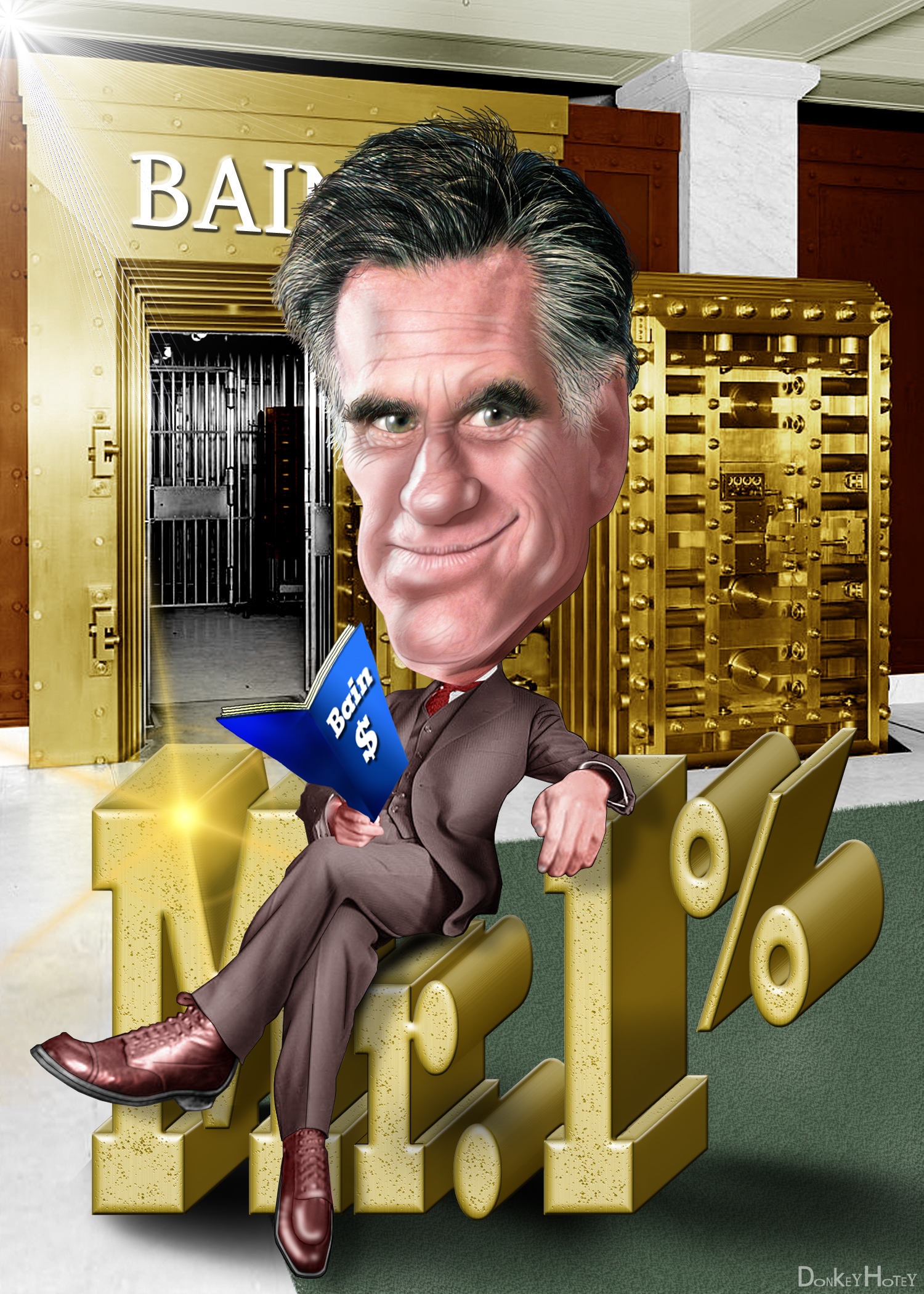
I was looking for an analysis of the Wisconsin recall election results of Scott Walker, and the best, most incisive one I found is reprinted with permission below. The bold emphasis and links in the article are mine. The Big Money behind Walker controlled the narrative of the recall election by framing the problem of the economy as a choice between costly, corrupt and selfish unionized state workers versus a wasteful state government attempting to streamline itself and cut costs for the taxpayer. Absent in that polarizing message by the Corporatists was their real agenda of dismantling worker’s rights at the altar of the free market, shipping jobs oversees to exploit the cheapest of labor pools. Also absent was the Corporatist’s agenda of cutting the taxes on the wealthiest of society’s elite while dismantling and privatizing social/public services. Interestingly, the only two unions that backed Walker, the fire fighters and the police, were exempted from Walker’santi-collective bargaining law. Also of note is Obama’s absence from supporting the workers in Wisconsin. As explained in my post, Obama: Figurehead for the Corporatocracy, this betrayal should come as no surprise. Divide and conquer is a very effective strategy to destroy the workers who have been subject to indoctrination of Neoliberal policy since Ronald Reagan. The myth of the wealthy being job creators still works, and the public doesn’t have a clue about the evils of privatization. The class war continues with the wealthy effortlessly manipulating the levers of power and mainstream media to their advantage…
Gov. Scott Walker’s anti-recall campaign sold the lie that greedy public sector workers and their unions were costing the taxpayers exorbitant amounts for high wages and lavish pensions.
The recall election in Wisconsin was won by organized Big Money. Lots will be said by many pundits about various aspects of the election, but the most important issue is how Big Money or the 1 percent were able to shape the electoral environment. Looking at that question exposes how capitalist democracy operates.
It also helps to answer the question being asked by many—why do people vote against their own interests?
In his victory speech, Wisconsin Gov. Scott Walker said he wanted to first of all thank God for his abundant gifts. This was not only an appeal to the religious right-wing but also an attempt to give praise to the billionaires whose gifts brought him the election victory.
On Jan. 18, 2011, Walker told billionaire Diane Hendricks that his strategy was to go after collective bargaining rights for public employees first and then get a Right to Work for Less law, in a strategy which he explicitly described as divide and conquer. She gave him over $500,000 during just a three month period in 2012. Hendricks’ ABC Supply Inc., the nation’s largest wholesale distributor of roofing, windows and siding paid no state income taxes in 2010.
Although pay for teachers had been capped since 1993 and public sector unions were not on the offensive, the goal of Walker and his backers in 2011 was to eliminate these unions. Unions for public employees are the last sources of significant power for organized labor as well as for the interests of unorganized workers.
Tens of millions of dollars were pumped into Walker’s campaign to win the recall election. Much of it came from the super wealthy outside of Wisconsin. This money created the slick right-wing Madison Avenue ads that inundated every household.
The rich put their money into this fight because they saw it as part of their class war against the workers. This was a referendum on slashing workers’ rights, especially public workers. It was played out in Wisconsin but finance capital saw that it would have national ramifications.
Role of the Democratic Party
The recall effort itself was the result of the efforts of hundreds of thousands of workers who gathered one million signatures to recall Walker. When they filed those petitions on Jan. 17, it was crystal clear that they wanted this election to be about basic labor rights—the right to bargain, the right to have a contract and the right to have union recognition including long established union security clauses providing for dues.
The Democratic Party took over the message and shifted it to a blander mixture with a focus on corruption. The national Democratic Party essentially ran away from the Wisconsin battle in a way that once again shows that they have no interest in supporting labor’s cause. President Obama did not come to the state to support the fight for basic rights. His absence served as another example from a long list of unfulfilled campaign promises—that he would walk on union picket lines after he became president and that he would fight to get labor laws passed with fairer terms for union elections—the Employee Free Choice Act—and more.
Role of labor
The ranks of labor were pushing for a battle in the electoral arena. Public unions put significant money and organizational resources into the fight. These unions included the teachers unions, firefighters, AFSCME (state city and county workers), SEIU and others.
However, two locals in Milwaukee—police and fire unions—endorsed Walker in the recall, while no statewide unions did. It is important to remember that Walker exempted these unions from any of the negative effects of his anti-collective bargaining law. Firefighters, of course, are workers that all of labor should support, and this local union betrayal was especially odious because an African American firefighter and union leader was a candidate for lieutenant governor. Instead of a message that public workers have rights that everyone should have, the anti-labor story is that if anyone has a wage, a right or a pension that others do not have, then we should take it away from them.
While Walker is most known for his initial attack against the public sector unions, the construction trades also joined the recall effort in a more significant way than in almost any other previous fight. The statewide Operating Engineers Local 139, with about 9,000 members, previously had endorsed Scott Walker for governor in 2010 on the promise that he would not support Right to Work legislation while delivering a larger budget for bridges and infrastructure. Walker’s flip on that overcame reservations about the Democratic candidate who, as a Mayor of Milwaukee, bargained hard against them on major contracts.
Union leaders had come together as a coalition and chosen Democratic Party politician Dane County Executive Kathleen Falk as their candidate in the recall primary. The time limits imposed by the state’s election process required quick action, but the union leaders’ lack of involvement among the hundreds of thousands of activists who had put the recall on the ballot was a signal of things to come. Falk was defeated in the recall primary by Milwaukee Mayor Tom Barrett (who had previously been defeated by Walker in 2010).
No thought was given to having a truly independent candidate with a real program addressing workers’ needs. Eventually, the labor leaders deferred to the regular Democratic Party pundits and confined the campaign to a shifting message that did not resonate with people.
Support for labor from the most oppressed communities
Organizations and leaders in the African American and Latino communities—some of the most oppressed sectors of the population—campaigned hard to get rid of Scott Walker. Early reports reveal that record numbers were mobilized to vote.
SEIU had organizers working in poor communities for some time to help mobilize action and exert power on a number of issues.
Democrat Barrett’s concession speech
When Barrett took the podium to announce that he had lost the race, he stressed that now is the time to “work together” with Walker. This is typical “good form” for a Democratic Party leader but poison for labor. Now is not the time to work with union busters; now is the time to organize even more diligently against them.
He talked about “democracy”—but not workers democracy. He called on people to stay engaged with city and state politics.
Why did some workers vote for Walker?
Without a doubt some people are wondering: What were they thinking! Why did they vote for Walker?
The Walker campaign focused on taxes and make-believe figures on job creation. Their message was that greedy public sector workers and their unions were costing the taxpayers exorbitant amounts for high wages and lavish pensions that others don’t have.
Walker constantly refers to “union bosses” and his allies frequently refer to “union thugs” or “union goons”. These terms turn reality on its head. If he were speaking the truth, he would be talking about the captains of finance who are his bosses and who are financing and directing his actions.
When Walker’s Wisconsin budget bill was passed, it increased spending in FY 2013 on prisons while imposing $792 million in aid cuts to school districts, $250 million in cuts to the university system and $71.6 million in cuts to technical colleges. In addition, nearly $500 million was cut from Medicaid programs, eliminating necessary important components of health care. At the same time, these financial bosses have gotten Walker and the legislature to approve $1.6 billion in corporate tax breaks over the next 10 years. Profits have increased—but not jobs.
That is their program, and they sell it by vilifying labor. In areas reached mostly by right-wing radio and governed by right-wing elites from the pulpit to the County Board, the Big Lie works. It is a Big Lie that has been in development since the 1940s and especially since the 1960s. As corporations move production overseas, the ruling class spins the story in a way to blame unions here for “pricing themselves out of the market.” They spin the story to divide workers in the United States from workers abroad.
In 2012 so far, General Electric has moved its medical equipment division headquarters from Waukesha, Wisconsin to Shanghai, China. The Thermo-Fisher Corporation is planning to move nearly 1,100 jobs from Wisconsin to Mexico.
In the race for maximum profits at any cost and the race to shove workers down to the lowest level of rights and pay on a world scale, they have refined the Big Lie technique and used it on a mass scale.
The truth about public services such as education, health care, child welfare and transportation is never told. These services are rights that were won through struggle—and which would never be provided by private companies that only care about profit.
The truth about public workers is never told—that their pay is modest, that most do not qualify for social security and their only pension is what the union has been able to win in a contract or through legislation.
Instead of a message that public workers have rights that everyone should have, the story is that if anyone has a wage, a right or a pension that others do not have, then we should take it away from them. And at the same time ignore the vast wealth of the CEOs. Ignore the vast profits made by the banks and the holders of state and local government bonds who get their interest payments first from every state budget while programs for the people get cut.
The principal blame for the election result in Wisconsin is not with the workers of Wisconsin but with the rich who spin this message and who control the levers of power in that state and around the country.
The road not taken: This is what democracy could have looked like
In March of last year, when Walker threw down the gauntlet and signed the “Budget Bill” killing many collective bargaining rights, labor leaders opted to move the struggle from the streets into the electoral arena.
Many experienced labor activists, including some leaders in the Madison area, know that workers have greater power in the streets because of the way money controls elections. On Feb. 22, 2011, the 97 unions of the South Central Federation of Labor of Wisconsin, representing 45,000 workers, unanimously passed a resolution calling for the preparation for a general strike.
A general strike would have electrified workers everywhere. It could have begun as a one day strike in Wisconsin cities with the greatest union strength and then expanded in terms of both days and areas covered. Millions of workers across the country who were upset with cutbacks, layoffs, privatization and more would have been inspired to take action.
Shutting down the state would have been a quicker and more definite blow to Walker and could have resulted in a defeat for Walker as compared to the defeat for labor experienced in the recall election.
General strikes are feared by the ruling class. In reference to a Philadelphia teachers strike—Jan. 8 to Feb. 28, 1973—William Usery, director of the Federal Mediation Service, said that “We came within an eyelash this year of having a test of the effectiveness of the general strike as a weapon in the United States—a weapon that has at times paralyzed the economies of France and Italy.” He went on to say that if labor had engaged in the general strike that many had called for—and if they had won—then “there would have been enormous pressures to do it again—and again—and again.”
That is the fear of the ruling class. If workers exercise their power, there could be no stopping them. No rights would be out of reach.
The Democratic Party is doing all it can to orient people to the November presidential election and away from struggle. Almost without exception labor leaders are focused on that election.
Rank-and-file members can learn a lot from this experience in Wisconsin. Labor’s hope lies not in the electoral arena but in solidarity and action on the job and in the community.”
Danny Schechter, journalist, author (Plunder: The Crime of Our Time), television producer and an independent filmmaker, has a new essay today describing the takeover of our political process by big money and the subsequent formation of what can only be called the ‘presidential electoral complex,’ an industry unto itself. This industry consists of armies of consultants and experts well-versed in perception management, public relations, advertising and marketing, and even psychological warfare. The facts don’t matter any more, only the public’s perception of it. And so politics is more about controlling the sentiment of the masses than anything else. Thus like the military industrial complex controlling foreign policy and America’s militarism, we can say that the Presidential Electoral Complex has also perverted the nation’s ability to hold true democratic elections which represent the will of the people. The tail is wagging the dog in both instances:
…one of Jimmy Carters’s advisers, Pat Cadell, …said in 1979 that just because you have been elected doesn’t mean you stop campaigning, He wrote in his “Initial Working Paper on Political Strategy,” “it is my thesis governing with public approval requires a continuing political campaign.”
Journalist Sidney Blumental, before he joined the Clinton White House, wrote The Permanent Campaign in 1980, revealing that political parties were dead and had been replaced by political consultants and other campaign professionals. (Disclosure: I helped get the book published by Beacon Press.)
In other words, politics had changed fundamentally: the old-style bosses were out and a new style media-driven system was in. Politics had also become a business with a whole retinue of advertising specialists, market researchers and pollsters.
Today, political journalist Joe Hagen labels this new army of experts for hire a “presidential electoral complex” – almost on the same scale as the military industrial complex. Their advice does not come cheap, with the tail today wagging the dog.
Any serious candidate hires his team and then has to raise millions to pay for it. When politics spawned a profession, the big money that’s transformed politics no longer went just to candidates but to the industry around them.
They also developed a stake in the fostering polarization and continuing crisis so that their counsel will be solicited more often. Increasingly political campaigns were run like military commands with centralized top-down direction, defensive and offensive strategies and tactics as well as psychological warfare. The campaign gurus are well schooled in the techniques of perception management.
This industry is bi-partisan with hired guns always shopping for the best deal irrespective of party. One-time dirty trickster Roger Stone who worked first for Richard Nixon ended up advising everyone from Al Sharpton to Donald Trump, to Libertarian Gary Johnson.
Some of these advisers step over the legal line like GOP operative Alan Raymond but few get caught. The New York Times reported In New Hampshire’s hotly contested 2002 Senate race, Democratic get-out-the-vote phone banks were jammed with incoming calls on Election Day. The Republican, John Sununu, won re-election by under 20,000 votes, and Allen Raymond, a Republican Party operative, went to jail for his role in the jamming.
Raymond has now written a book about his experiences, How to Rig an Election: Confessions of a Republican Operative. In it, he paints a picture of the corruption of modern politics that should leave no doubt about the creativity and cynicism of operatives like Raymond or the need for tough new election-reform legislation.
Wikipedia had two other examples of the focus on permanent campaigns:
“A famous example that illustrates just how strongly this mind-set has come to influence politics was during the Clinton Administration when pollster Dick Morris asked voters to help decide where Bill Clinton would go on vacation.
“In the words of columnist Joe Klein, ‘The pressure to “win” the daily news cycle – to control the news – has overwhelmed the more reflective, statesmanlike aspects of the office.’ (After getting caught in a sex scandal, Morris was fired by Clinton and later resurfaced as a pundit at Fox News.)
Many of the press secretaries and campaign managers work hard to contain mistakes. The bookshelves are filled with advice about how to do that. This is from an email promoting interviews with a campaign expert turned author:
“Every word and action on the campaign trail from a televised debate to a town meeting, to an innocent question from a voter to a pointed question from the media … all of these daily events call for immediate, strategic communication.
“Any blunder should be a wake-up call: communication has power. But as with any form of power, it needs to be harnessed effectively or it can all too often backfire.
“This year’s primaries were riddled with missteps and over-reaching. As the focus shifts from primaries to the general elections, Romney will have to walk the line between connecting to the audience and pandering. On the other hand, President Obama will be less under scrutiny for potential gaffes, but more for his inattention to issues that are brewing, followed by a dramatic game-changing address.
“‘However, this can all change in a split-second, as proven by the undeniable power of word choice,’ comments Helio Fred Garcia, President of the crisis management firm Logos Consulting Group and the Executive Director of the Logos Institute for Crisis Management & Executive Leadership.”
Garcia, who teaches now at NYU, discusses strategies that might be useful in a new book on the Power of Communication, or is it manipulation:
“– Leaders are judged on the fulfillment of expectations. Leaders must resist saying what merely sounds good in the moment and creating a say-do gap.
“– The only reason for communication is to change something – to influence the way audiences think and feel. Before you communicate, know what it is you want to change.
“– Facts do not speak for themselves. If we speak only facts, the audience will either not pay attention to those facts or will provide their own context to make sense of the facts, which could trigger a negative frame.
“– Communication is a continuation of business by other means. You need to engage your audience to enhance your position, thereby improving your competitive advantage.
“–Leaders must conquer the first mover advantage – a maneuver that prevents critics and adversaries from framing the situation. This has become increasingly more important in today’s world of social media.”
This same techniques are also used to sell war, as Mother Jones reported: “As long as the United States appears to be on the move against foreign adversaries, the question of whether any action is actually taken becomes of secondary interest. As Blumenthal suggested two decades ago, results and concrete proposals are less important than perception and image.”
Even as Blumenthal was partial to Hillary Clinton, who hired him for her unsuccessful primary campaign in 2008, The Economist noted that his description of a permanent campaign soon became President Obama’s prescription:
“Mr. Obama is currently deploying the formidable resources he built up during his campaign — including contact details for 10m donors, supporters and volunteers — to sell his policies. David Plouffe, the man who managed Mr. Obama’s presidential campaign, has sent millions of e-mails to encourage them to support the White House’s agenda.
“One of them contains as good a definition of the permanent campaign as any: ‘In the next few weeks we’ll be asking you to do some of the same things we asked of you during the campaign — talking directly to people in your communities about the president’s ideas for long-term prosperity.’ “Another, which includes a video of the president, asks supporters to put pressure on their congressman to pass Mr. Obama’s budget, by calling his or her office and reciting a little pro-Obama speech.”
The Republicans have learned these lessons too and now have more money than Democrats to invest in them. Politics is now a growing industry with money and politics more joined at the hip than ever and an interest in keeping the big money flowing into its bank account.”
Operating in concert with the Presidential Electoral Complex are the Army of Lobbyists representing the monied interests of corporations and the financial elite. Republican political operative and financial consultant Mallory Factor appeared on CurrentTV in April, saying no one party has access to the big donors and that Democrats and Republicans both rely on money. This video was available on YouTube, but has since been taken off. You can still see it here.
A couple weeks ago, Jennifer Granholm from CurrentTV aired an editorial video in which she says that “the super rich are monopolizing our democracy and effectively ruining the founding fathers’ vision of how the United States should operate, sending us back to an era that is more like a one-king rule than a real democracy.” She names Romney as the willing supplicant of the monied interests. She says the Democrats have been forced to play the same game, but I think she doesn’t go far enough: both parties are equally corrupt in my eyes. Anyone who still puts one iota of faith in our perverse, money-driven political system is just plain stupid.
Cenk Uyger did a better job of describing our systemically corrupt system back in November 2011. See also David Cohen’s excellent post: “The Idiot’s Guide To Buying A Congressman“.
Hope? Don’t make me laugh. If change was possible through our political system, they’d make it illegal.
Two blog posts caught my eyes this weekend, one on our parasitic war economy and the other on the parasites readying their blueprint to bleed the masses dry. A related article to the first story lays out Obama’s pre-election connections to one of the primary recipients of tax dollars feeding the Military Industrial Complex – General Dynamics, as mentioned also by John Hively here.
In regards to the second blog post on the elite’s blueprint for squeezing the life out of the rest of us, austerity is a failed option because it attempts to preserve the paradigm of perpetual economic growth in a world of depleted resources, and it’s designed to preserve the social hierarchy of the capitalist system. Dr. Dan Bednarz at Health After Oil talks about this in his latest essay:
Socioeconomically, reaching the limits to growth means the impossibility of repaying accumulated debt and that massive unemployment will worsen under current institutional conditions. Politically we are witnessing governments not only caught up in a contraction of tax and revenue bases, but utterly failing and concomitantly repressing their citizens so as to maintain –and deepen- class inequalities and support for too big to fail private entities. This is the antithesis of resilience…
Until recently energy was cheap and seemed limitless, as did other natural resources; climate change risks remain “political,” not corporeal and existential. The overexploitation of natural resources and population growth should be apparent and frightening, but they are not; and wastes and pollution continue to be –from a grossly misguided economic growth point of view- “externalized” or “discounted” for future generations to gag on….
Her hypocrisy–she claims to have great concern and sympathy for poor African schoolchildren, whose plight she compares with the problems of comparatively well-off Greeks–is frankly nauseating in light of the IMF’s contribution to African suffering and misery. The agency’s so-called structural adjustment programs, akin to austerity for Europeans, have forced African nations to slash spending on healthcare, food, and education, and to boost exports of raw materials and privatization of industries by multinational corporations, resulting in dramatically increased national debts. Not for nothing do critics of the IMF and its partner in exploitation in the name of assistance, the World Bank, speak of Africa’s new “overlords.”
But one suspects that there is more to the Lagarde affair than mere hypocrisy. The IMF managing director’s Africa reference can be seen as a telling slip of the tongue that calls attention to her true aim–the strategic objective of the global elites whose interests she serves–which is the permanent pauperization of the middle classes of the industrialized world. The objective isn’t to raise Africa up to the level of Europe–not even close to that. Rather, the elites seek to lift Africa only marginally while bringing the West down–meaning, the workers who have become too prosperous and too politically powerful in the eyes of the powers that be–closer to the level of the impoverished inhabitants of the resource-rich continent that was ravaged by imperialism and colonialism. A global leveling off is the real goal. Grinding Greece down is the beginning of what is intended to be a grand restructuring for purposes of creating a new world order in which a few privileged population segments will labor in well-paying, favored industries, including high technology and finance, with decent benefits and opportunities for advancement and upward mobility, while the great masses of workers will be condemned to toil like drones, or serfs, in deadening, dead-end jobs that will barely pay subsistence wages and little or no benefits of any kind.
Hence, the seemingly irrational, international obsession with promoting austerity during times of depression and recession. For the IMF and its backers, mass unemployment isn’t a problem to be solved; it’s a strategy to bemanaged. Degrees of joblessness that have not been seen since the Great Depression are meant to become the new normal; meaningful social safety nets and social services, things of the past.
Already, the argument can be made that “we are all Greeks.” Absent a reversal of the trend, unless the IMF’s iron heel is broken before it can complete its crushing mission, we will soon all be Africans … and Asians … and Latin Americans … anything but the middle class Americans and Europeans we once were … as social services are dismantled and workers rights are shredded in the name of “reform.”
Now on to the two blog posts I mentioned at the beginning:
“More than a decade after George W Bush launched it, the “war on terror” was supposed to be winding down. US military occupation of Iraq has ended and Nato is looking for a way out of Afghanistan, even as the carnage continues. But another war – the undeclared drone war that has already killed thousands – is now being relentlessly escalated.”
The drone wars are all about raising corporate profits, for General Dynamics and other master’s of war. They have President Obama on a leash. He is their good little boy in the white house, ordering the murder of innocent people for profits. Sure, there might be a terrorist that he gets now and then, but the terrorists aren’t his targets; Wall Street analysts tell corporate CEO’s what their profit targets will be every quarter, and every drone strike is intended to push up those profits to reach Wall Street expectations. The more drone strikes, the more drones need to be built, the more profits are obtained, and all at tax payer expense.
That means the drone wars are all about redistributing income from working people to the rich via higher corporate earnings, rising dividends and soaring share prices. The drone wars also mean the president, like President Bush before him, is the terrorist.
Coming soon to your state: The anti-union, education-cutting, free-market-leaning, divide-and-conquer playbook of Wisconsin Gov. Scott Walker.
According to a leading conservative activist, the Walker agenda in Wisconsin is the new conservative game plan for all states in the union. That was the key message delivered at a rally Friday evening in Madison by Tim Phillips, national president of Americans for Prosperity, the conservative nonprofit started with money from the billionaire industrialists Charles and David Koch. “The Wisconsin approach to changing and making state government better is the new model for the country,” he said. “You are the model for the country.”
Here a video of Phillips’ remarks:
Since taking office in January 2011, Walker has slashed collective bargaining rights for public-employee unions, cut funding to public schools by $800 million, signed a controversial voter ID bill that critics say discriminates against students and minorities, and approved a divisive redistricting bill that benefitted his fellow GOP lawmakers. Walker managed to eliminate a $3.6 billion deficit, but did so, his critics say, at the expense of workers’ rights, teachers and students, and the public sector as a whole. In a January 2011 conversation with billionaire businesswoman Diane Hendricks, a top donor of his, Walker admitted that his plan was to “divide and conquer” the unions in Wisconsin. Walker’s agenda has turned Wisconsin into the most polarized state in America.
This agenda, AFP’s Tim Phillips insisted, is the new model for state governments. “Today every other governor in the country and every state legislator in the country is watching Wisconsin,” he said. “Because the Wisconsin approach to changing and making state government better is the new model for the country. You are the model for the country. For fiscal prosperity and economic freedom and getting the state moving again. You’re the model!”…
You better believe that the financial elite who run this country do have OWS and any other social movement under 24/7 surveillance. Anything that strives to change the status quo of neoliberal capitalism will be undermined and crushed, whether through covert actions or co-optive schemes. Social justice, the environment, and the very habitability of planet earth are not on the agenda of the 1%’ers.
Michael Parenti’s son, Christian, gives the methods by which the capitalist power structure controls rising social movements:
Parenti starts by noting a paradox within the capitalist system. “Capitalism needs poverty,”(2) states Parenti unequivocally, arguing that without enough poor people around workers start demanding better conditions and higher wages. However, at the same time, capitalism is threatened by too much poverty. Poverty, he argues, tends to breed dissatisfaction, which makes revolt more likely. The question is “How do you have poverty and manage the threat of poverty?”(3) The answer, for Parenti, is by expanding social control mechanisms through the criminal justice system. The buildup of prisons and policing in the last two decades is not a result, as some might have it, of corporations expanding into the criminal justice system for profits.(4) Rather, the growth comes from an increasing need by the capitalist class (in collusion with the state) for greater social control, a growth necessary to keep the poor from revolting. Prisons, mandatory sentencing, and the “war on drugs” become the means by which the state is able to subdue the working class and keep poverty at a level that maximizes profits while minimizing dissent. Here we see a clear example of “hard-line” social control.
Parenti also describes a second, softer tactic of social control, mainly co-optation. He briefly describes the way that workers’ movements in the 1960s were co-opted by turning their leaders into administrators of low income housing and social services. This co-optation happened at a time when the Unites States was economically strong enough to absorb the poor in order to legitimize the system. However, the economic crisis in the 1970s put an end to this tactic and brought with it the harder modes of social control. Parenti concludes that, “In a class society, rule comes down to two things, as Machiavelli said. The prince has two choices. He can either treat men [sic] well or crush them. . . . Sometimes economic conditions are plush enough that people can be treated well, but more often then not, in a capitalist society, the ruling class, through the state, must crush and intimidate people to reproduce their system. And that is what the criminal justice system is all about.”(5)
And tying together the previous post about Drones and the earlier post about the State’s oppressive security and surveillance apparatus, we have this essay which contains a perfect example of how the Corporate State crushes dissent:
“…I see other things coming even sooner, caused by the same ruling elite’s insatiable greed and lust for power, and by the same political system’s actions in support of their goals.
First there is the accelerating march towards a police state, which began in earnest during the first year of the Bush/Cheney administration with the attack on the World Trade Center and the Pentagon, the passage of the cynically named USA PATRIOT Act, and the launching of the so-called War on Terror, but which has been carried forward to a place I could never have imagined by Bush’s successor, Barack Obama. Today, police in America ride around with fully automatic M-16s in their squadcars, routinely taser people, including children, the elderly and the disabled, for minor offenses, and when confronted with a peaceful and permitted political demonstration, respond in full military SWAT gear, complete with guns, pepper spray, clubs, tear gas, and undercover agents who deliberately try to incite violence.
Just yesterday, long-time Latino activist Carlos Montes, 64, was arrested in Los Angeles during a joint LAPD/FBI SWAT-team midnight raid on his house. The charge: possessing illegal weapons. But Montes possessed only licensed guns in his home. The catch was, the FBI, which was clearly after Montes, a retired Xerox salesman, for political reasons, conveniently told local police that he was not allowed to register firearms because of a (get this!) 1969 felony conviction for allegedly throwing a coke can at a cop (Montes says he never threw such a can). Note that the police knew all about that conviction when Montes first registered his guns. He has not been in trouble with the law since then. Clearly he could have simply been informed that his gun registrations were invalid, and the guns had to be turned in. Why Montes, who has remained politically active and a critic of the government, was really arrested in this Gestapo-like manner became clear when an FBI agent hopped in the car with him right after he was picked up, and said, “I am from the FBI and I want to talk to you about the Freedom Road Socialist Organisation.” Montes is now facing a possible 22 years in jail for possessing legally registered guns that the LAPD has known for years that he had in his home, and that nobody ever cared about before. (I had to learn about this from the British newspaper the Guardian. The corporate media in America have covered up this outrageous political bust.)
America today is crawling with secret police–local, state and federal. They’re all connected too, through 72 so-called Fusion Centers that receive federal funds, but remain insulated from any kind of public oversight. Our phones and our internet communications are monitored automatically by National Security Agency super-computers that look for key words like “airport, exercise, flu, blizzard, bridge, or fundamentalism,” any of which prompt closer attention to what we are saying or writing.
Meanwhile, the president has claimed the right to detain–in secret, without charge–any American he deems to be a threat, and to hold such people indefinitely, without any recourse to lawyer or trial. He is even claiming the right to execute such captives. So much for the Fourth Amendment, as well as the First, Second, Fifth, Sixth, Seventh and Eighth!
While I don’t think we live in a police state yet (having lived in China for two years, and visited there as a journalist over four other years, I know what a real one looks and feels like), but all the elements for one have been put in place and await only the throwing of a switch.
In the vision I clearly have, I feel strongly that someone, whether Obama or Romney, or whoever follows him, will throw that switch. When power is available to political leaders, they inevitably avail themselves of it. It’s just a question of time.
But there is another vision I have too. It has to do with America’s increasing international lawlessness and bellicosity. As the nation turns increasingly to technology for its aggressive purposes, through the use of armed robotic drones, and through internet attacks on purported “enemies,” it not only opens the door to others to do the same to us; it virtually assures that we will be attacked ourselves in like manner to what we are doing.
It was one thing to be the world’s superpower when being a superpower meant having the biggest ICBMs and the most nuclear warheads — weapons that required an enormous military budget and a massive industrial base. Drone technology and internet “weapons” are something else altogether. As Israel has demonstrated with its Stuxnet virus, a very small nation can easily construct a weapon of tremendous destructive power. Iran demonstrated its own capability in that area by using computer savvy to take control of a sophisticated US surveillance drone flying over its airspace, actually stealing it electronically, landing it, and now, apparently, back-engineering it. And remotely-piloted drones are not particularly complex technologically. Basic ones can be purchased off the shelf in any hobby shop.
How long will it be before foreign predator drones begin flying over US airspace, taking out targets without leaving any clue as to who was the attacker? How long before other countries begin destroying American power systems, industrial sites or military command centers using internet-based computer viruses?
This is a game that many people can play, and I predict that it will not be long before we Americans will rue the day this country began playing it….”
One of the more loathsome trends that has taken root since Neoliberal policies were embraced in the last few decades is the commodification of the imprisoned to line the pockets of prisons-for-profit corporations. In our deteriorating economy, this predatory business model has been a lucrative venture, especially for Corrections Corporation of America (CCA) which is the largest Wall Street traded company of its kind extracting profit from our prison-industrial-complex.
With states desperate for cash, CCA has taken advantage of the situation and swooped in to offer this deal:
Corrections Corporation of America, the nation’s largest operator of for-profit prisons, has sent letters recently to 48 states offering to buy up their prisons as a remedy for “challenging corrections budgets.” In exchange, the company is asking for a 20-year management contract, plus an assurance that the prison would remain at least 90 percent full, according to a copy of the letter obtained by The Huffington Post.
The move reflects a significant shift in strategy for the private prison industry, which until now has expanded by building prisons of its own or managing state-controlled prisons. It also represents an unprecedented bid for more control of state prison systems….
And Corrections Corporation’s offer of $250 million toward purchasing existing state prisons is yet another avenue for potential growth. The company has billed the “corrections investment initiative” as a convenient option for states in need of fresh revenue streams: The state benefits from a one-time infusion of cash, while the prison corporation wins a new long-term contract. In addition, supporters of prison privatization have argued that states can achieve cost savings through outsourcing, as prison corporations give fewer benefits to employees.
“We believe this comes at a timely and helpful juncture and hope you will share our belief in the benefits of the purchase-and-manage model,” reads the letter from Harley Lappin, CCA’s chief corrections officer, who was a former director of the Federal Bureau of Prisons.
CCA made almost 2 billion in profits in 2010.
You can bet that when such a capitalist model gets applied to the handling and rehabilitation of prisoners, strange things happen. Louisiana is one state that has embraced the prisons-for-profit business model at the local level. Charles Blow’s article in the New York Times entitled “Plantations, Prisons, & Profits” talks about a devastating eight-part series published in The Times-Picayune of New Orleans and identifying Louisiana as the prison capital of the planet. Here are some shocking facts:
“Louisiana is the world’s prison capital. The state imprisons more of its people, per head, than any of its U.S. counterparts. First among Americans means first in the world. Louisiana’s incarceration rate is nearly triple Iran’s, seven times China’s and 10 times Germany’s.”
• One in 86 Louisiana adults is in the prison system, which is nearly double the national average.
• More than 50 percent of Louisiana’s inmates are in local prisons, which is more than any other state. The next highest state is Kentucky at 33 percent. The national average is 5 percent.
• Louisiana leads the nation in the percentage of its prisoners serving life without parole.
• Louisiana spends less on local inmates than any other state.
• Nearly two-thirds of Louisiana’s prisoners are nonviolent offenders. The national average is less than half.
The incarceration statutes in that state were purposefully strengthened (10 years for writing a bad check) so as to keep the prison cells full and the revenue stream from state tax dollars flowing in. Consequently, more money is spent on imprisonment, thereby leaving less funds available for prisoner rehabilitation programs. The for-profit incarceration business is thus assured a steady stream of profit from a revolving door of recidivism.
Louisiana is the starkest, most glaring example of how our prison policies have failed. It showcases how private prisons do not serve the public interest and how the mass incarceration as a form of job creation is an abomination of justice and civility and creates a long-term crisis by trying to create a short-term solution.
As the paper put it: “A prison system that leased its convicts as plantation labor in the 1800s has come full circle and is again a nexus for profit.”
Today, the U.S. prison system delivers profits to both government corporations and private enterprises in several ways:
1) Through the use of inmate labor to produce goods and services in federal and state prisons
2) Through the contracting of this labor to private companies at below-market wages and
3) By privatization of the prisons and detainment centers themselves. Given these perverse incentives to maintain a high inmate population, is it any wonder that the number of prisoners and the length of their sentences — Americans comprise 5 percent of the world’s total population but 25 percent of the world’s prison population — have skyrocketed since privatization began in 1984?
Number of inmates. 1920 to 2006.[1][2] (absolute numbers) General U.S. population grew only 2.8 times in the same period, but the number of inmates increased more than 20 times.
The Presidency is a figurehead position for American Empire which constitutes a conglomerate of corporations(examples and more examples, and also here) backed up by our global network of military bases. When it comes to the desires and well-being of the average Joe in America’s hinterland (everywhere else outside the “Washington Beltway”), the Presidency merely serves as a glorified public spokesman for the monied elite, just as the election process was about empty PR to win that corporate-collaborator government position. And to help the Commander-in-Chief orchestrate this massive con job of pulling the wool over the collective eyes of the nation’s 99%, he has the help of a servile corporate mass media which, for the most part, acts as a mouthpiece for the various corporate industrial complexes— military, financial, energy, food, pharmaceutical, prison, etc. The greatest con job by the American ruling elite over the last several decades was convincing and fooling the 99% that they live in a “classless society” and that Neoliberal Capitalism was not robbing them blind. If you view the scripted charade,faux democracy politics of today in this harsh light of reality, then you won’t be so disappointed by all the campaign promises that not only failed to materialize, but which went in the complete opposite direction of the very propaganda we were sold.
Take for instance the widening wealth gap in America which at this time is as large and deep as the Grand Canyon. How did Obama live up to his pre-election rhetoric of the defender of the average working stiff?:
Saez, who’s known for his work on the income gap, has highlighted a surprising and discouraging fact: during the post-recession period of 2009 and 2010, the rich snagged a greater share of total income growth than they did during the boom years of 2002 to 2007.
In other words, inequality has been even more pronounced under Obama than it was under George W. Bush….
Here’s how Saez’s math breaks down, for the curious: In the 2009-2010 period, a time of modest economic growth, the top 1 percent of U.S. earners captured 93 percent of all the income growth in the country.
Got that? Now compare it to how the mega-rich made out during the Bush upswing years of 2002 to 2007. During that time, the top 1 percent of earners captured just 65 percent of all the income growth.
That means the rising tide has lifted fewer boats during the Obama years — and the ones it’s lifted have been mostly yachts.
How about his promises of safeguarding the economy from monopolization and financialization by the “Too-Big-To-Fail” Banks?
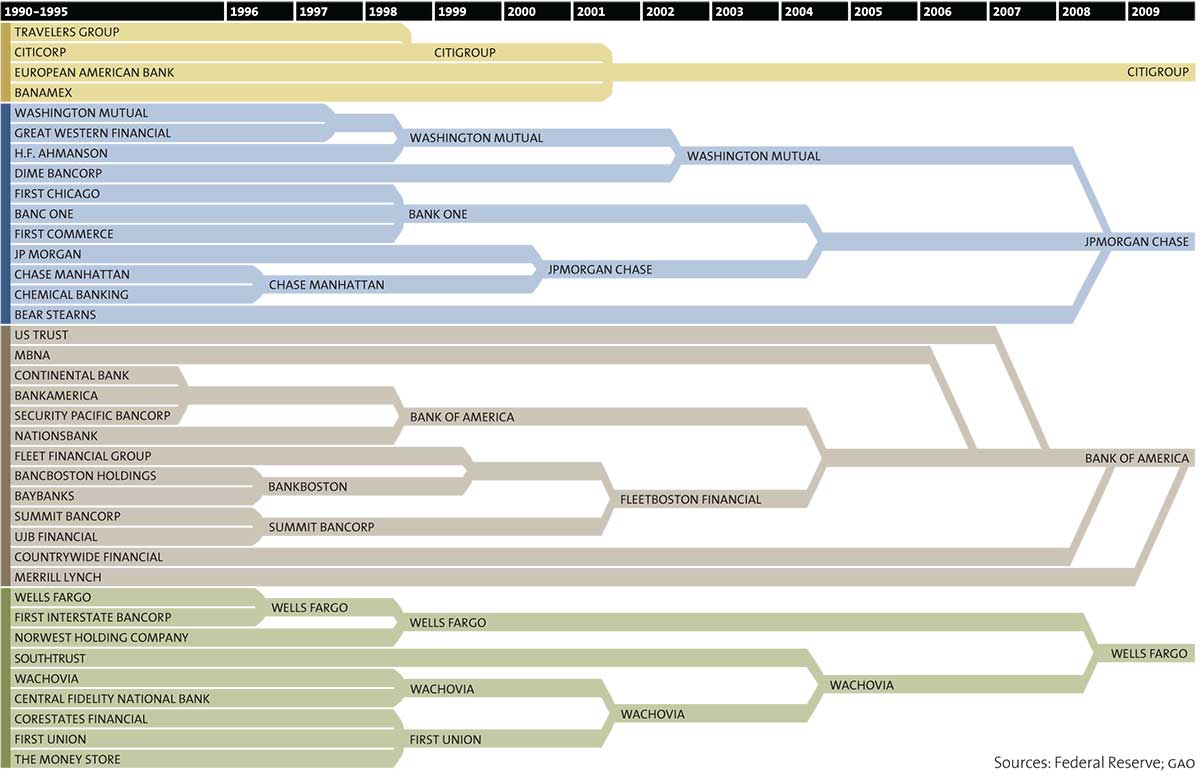
Five banks – JPMorgan Chase & Co. (JPM), Bank of America Corp. (BAC), Citigroup Inc., Wells Fargo & Co. (WFC), and Goldman Sachs Group Inc. – held $8.5 trillion in assets at the end of 2011, equal to 56 percent of the U.S economy, according to central bankers at the Federal Reserve.
Five years earlier, before the financial crisis, the largest banks’ assets amounted to 43 percent of U.S. output. The Big Five today are about twice as large as they were a decade ago relative to the economy, sparking concern that trouble at a major bank would rock the financial system and force the government to step in as it did in 2008 with the Fed-assisted rescue of Bear Stearns Cos. By JPMorgan and with Citigroup and Bank of America after the Lehman Brothers bankruptcy, the largest in U.s. history.
‘Market participants believe that nothing has changed, that too-big-to-fail is fully intact,” said Gary Stern, former president of the Federal Reserve Bank of Minneapolis.
“Obama, in 2008 the outsider, in 2012 must defend a governing record that looks like George W. Bush on steroids:
Suppression of news of serious war-crimes, including assassination of war correspondents, by prosecution of whistle-blowers like Bradley Manning and Julian Assange
Corruption of the Justice Department, NSA, FBI and CIA to cover an ongoing criminal enterprise involving some $5 trillion in long-term graft from no-bid contracts going to the 1% — $50,000 per average US family, being extracted in taxes, inflation, bank defaults, student loans and diminished public services
Conspiring with local police and mayors to quash and evict the Occupy movement
Pursuing murderous US wars in Iraq and Afghanistan in Orwellian opposition to international law
Expanding US wars and armed attacks into more and more countries, despite treaties after both world wars that make use of military unlawful unless a country’s government attacks first (Kellogg-Briand and UN Charter)
Expanding terrorist-by-definition drone wars on Libya, Pakistan, Somalia, and Yemen (now spending more on drone operations than the entire budget of the CIA)
Calling for more illegal wars on Syria and Iran while darkly hinting of an official first strike policy for use of nuclear weapons
Torpedoing the nuclear non-proliferation and disarmament negotiations and ramping up new nuclear weapon design, testing, and deployment
Suppression of news from Fukushima, including ordering EPA to halt air and food sampling and working with other countries towards the same ends
Assassination of Americans upon the non-reviewable dictate of the president
Maintaining the Bush-era torture prisons and black sites
Maintaining illegal rendition as official policy
Control-drown/waterboarding anyone deemed a “terrorist” and extending sensory deprivation to local jails and State prisons despite all US and international case law finding this to be torture
NDAA 2012 and 2006 Military Commissions Act that state the president can dictate any person as a “terrorist suspect,” and then disappear them without challenge or recourse
Signing presidential executive order saying the US government can seize any resource, any person, at any time for “national defense”
Minting his own Alberto Gonzales continuing criminal enterprise rubber stamp — Eric Holder
Siding with Exxon, BP and the Koch brothers to accelerate climate- and ocean-destroying pollution; and
Torpedoing the climate talks in Copenhagen, Cancun and Durban. “
If I remember correctly, Obama ran as a Left-wing Progressive, a populist to change the system. Looking at his record since taking office, you would have to conclude that the Far Right is the New Left. …and the Left of yesteryear is certainly long since dead, suffocated and murdered by the Corporate State over the last several decades. Don’t take this rant as an endorsement for Romney, aka Mr. 1%… The Right has gone so far in that direction that they’ve fallen off a cliff.
“…A major point of contention is the claim that a “severe reduction in revenue growth” – linked to the growing numbers of users accessing the website on mobile phones rather than computers – was concealed.
Facebook, which is being sued as a company along with Mr Zuckerberg, other leading executives at the company and its lead underwriters – Morgan Stanley and Goldman Sachs – has denied the claims. Another lawsuit filed in California claims Facebook and its banks actively misled investors. The banks deny any wrongdoing.
However, the claim that Mr Zuckerberg was able to profit by selling his shares in the knowledge that the share value would likely decline, while others bought in without the benefit of the facts, has heightened the controversy.
It has even led to the term “Zucked” being coined to describe what happened to the investors who lost money.
The US Senate Banking Committee has announced it is to investigate the affair, after which its chairman, Senator Tim Johnson, will decide if public hearings should be held.”



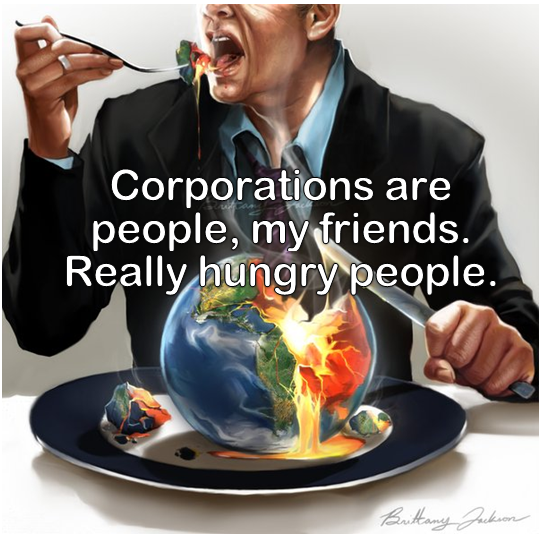





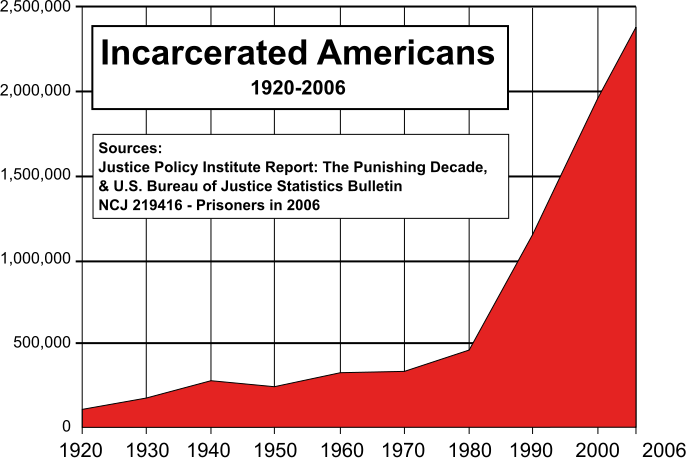


 Collapse of Industrial Civilization