Besides making the occasional video, I will soon be expressing myself in the art of editorial cartoons which is my true passion. I’ve featured some great ones on this blog: David Horsey, Tom Toles, and Matt Wuerker. Editorial cartoons are interesting to me because they can give an entire synopsis in one shot, and if done effectively, they will stick in your mind and make you think about the issue. There’s a reason why despotic governments don’t like articulate cartoonists. Without a doubt, the best editorial cartoonists are some of the most informed people. You have to be knowledgable about world events and issues in order to produce art that will convey meaningful social commentary. So this is something I want to start doing since I do have the artistic skills. Let’s see if I can pull it off.
Agriculture and Climate Change is a blog that I just started following. Last night while on the net I was looking at her collection of editorial cartoons and saw one that pretty much sums up the state of modern industrial civilization’s relationship with the Earth. It’s done by Turkish cartoonist Kürşat Zaman whose work I’ve never seen.
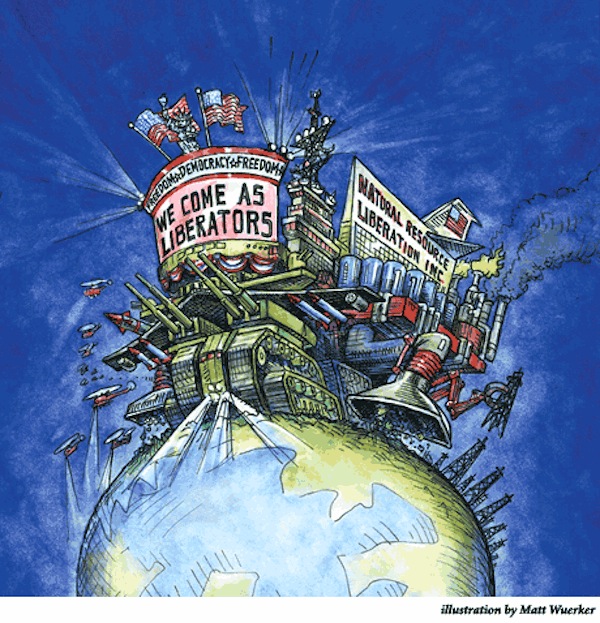
It reminds me a little of an M. Wuerker cartoon from several years ago concerning the resource-sucking war machine of the American Empire:
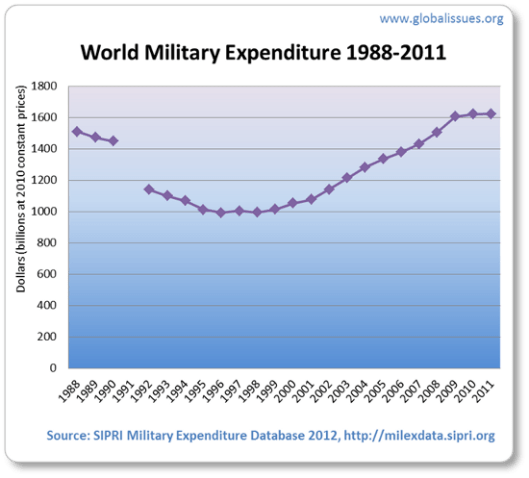
Has anyone checked their wallet recently? For most, that Ponzi-scheming, resource-plundering American war machine, aka Military Industrial Complex, has relieved you of some major coinage over the years. For others, it has exterminated their country, if not their life.
Back to the Turkish cartoonist Zaman, here is another of his that struck me:
I interpret this one on several different levels. The first message that came to me was America’s prison industrial complex and the fact that America is number one in locking people up:
…According to California Prison Focus, “no other society in human history has imprisoned so many of its own citizens.” The figures show that the United States has locked up more people than any other country: a half million more than China, which has a population five times greater than the U.S. Statistics reveal that the United States holds 25% of the world’s prison population, but only 5% of the world’s people. From less than 300,000 inmates in 1972, the jail population grew to 2 million by the year 2000. In 1990 it was one million. Ten years ago there were only five private prisons in the country, with a population of 2,000 inmates; now, there are 100, with 62,000 inmates. It is expected that by the coming decade, the number will hit 360,000, according to reports…
I also thought about the fact that America is basically an open-air prison with this country having become a pervasive Security and Surveillance State and all branches of its government usurped by elite monied interests. As the corrupt Boss Tweed said in the movie ‘The Gangs of New York’, “The appearance of law must be upheld, especially when it’s being broken.”
Are we going to wage an all-out war on reality while the natural world crumbles beneath our feet? By all available evidence – yes. The corrosive and corrupting effect of capital is working its Voodoo magic behind the scenes to ensure that industrial civilization will not go away quietly in the night, but will hang on to the bitter end. In response to anyone challenging the primacy of fossil fuels, Big Oil says “From my cold, dead hands!’.
According to a new report by geoscientist J. David Hughes, the cost of tar sands appears to outweigh any imagined benefits:
An EROEI of less than 3:1 for 80% of tar sands and the U.S. is counting on that for a large percentage of its oil ‘needs’, currently 24%? And the fossil fuel industry/government sock-puppet PR machine is touting this as a viable source of energy to prop up our vacuous, corporate manufactured, McDonaldized culture.
My internet is still down, but will hopefully be back up by tomorrow night so I can put out a few posts I was contemplating. In the mean time, an interesting excerpt from a new book by Roberto De Vogli, associate professor in global health at the University of California Davis and University College London.
Excerpt…
And of course it continues today as has been discussed in previous posts on this site. So much for the “free market”.
In order to understand why the world is locked into a blind stampede over a cliff, you have to understand how the world runs, i.e. its socio-economic system. A large percentage of the population doesn’t understand that the world is ruled by multinational corporations or that the citizenry are simply disposable pawns with no voice in their fate.
The capital that flows around the world, betting on essential staples of life and demanding that barbaric austerity measures be imposed upon the masses, is an entity of its own. It’s a massively destructive force that enslaves people and rips apart the environment. In the Banana Republic of America where a once thriving middle class was sold down the river, nearly half of workers will have a budget of $5 per day when they reach retirement age. Maybe McDonald’s will create a 99 cent meal to cash in on that starving demographic. Oh, they already have…
As far as the environment goes, it is a doormat for the creation of money:
When you have such an immovable supersystem of puppet governments and marauding transnational corporations running the show, radical movements questioning and trying to change the status quo are easily co-opted or crushed, a recent example being the Occupy movement. In a world where extinction of the human species is guaranteed by climate chaos and the myriad of other crises created by industrial capitalism, a slow and incremental regimen of change is not what is needed to stave off collapse. Unfortunately, the entrenched interests of the financial elite and the nation-states they control won’t allow for any sort of abrupt and profound transformation. As Professor Julian Cribb has correctly identified, a culture of money worship and the mass delusion of money’s illusory value is at the heart of the global crisis. The high priests of money are protected at the expense of all else:
Show me a democracy that has an impoverished public life and I will show you one dominated by oligarchs and plutocrats driven by profit maximization that will do anything to get over. Gangster activity is what it is. Scandal after scandal and when you get caught, you PAY MONEY, you don’t go to jail. Plutocrats wage class war, getting away with CRIMES (mortgage fraud, market manipulation, insider trading, securities fraud) every day. But get caught with a bag of weed in the hood and you are in the system, for LIFE. ~ Cornell West
For humans living under such a capitalist society, money determines whether you can eat or not, whether you have shelter or not, whether you can clothe yourself or not, or whether you can afford medical treatment or not. Quite literally, if you have no money in a capitalist society, you die. Money in today’s globalized capitalist system is everything.
When President Obama speaks about confronting climate change, he does so with the mindset of keeping the current capitalist power structure in place. Because of this self-defeating approach, everything he says is rendered useless rhetoric.
Putting aside the gross social inequalities and injustices of our current system, you tell me how we can avert disaster with the following realities:
Without changing the socio-economic system under which we live, no real solutions for the multiple civilization-ending crises we face can be properly addressed. There is an expiration date for this unending conversion of the natural world into fake symbols of wealth hoarded and squandered by a greedy few…
I mentioned earlier that I’d talk about my reading list. I’ve got a few books I’ll review for this site. The one I’m reading currently is about how the U.S. Southwest, where I live, will be affected by anthropogenic climate change. The book is ‘A Great Aridness‘ by William deBuys.
A few excerpts from the intro:
As deBuys mentions in his intro, the housing market in the Southwest, in particular Phoenix, took a hit in 2008 but is expected to get back on the [population] growth track in the near future.
I will go so far as to say that not only growth but capitalism itself may be in part dependent on a growing population,” Pacific Investment Management Co.’s Bill Gross wrote. – link
Capitalism is fueled by population growth. More people = more consumption = increased GDP and tax revenues.
Elliott D. Pollack, CEO of the economic and real estate consulting firm Elliott D. Pollack & Co., said Arizona’s economic growth depended on adding 100,000 people every year. The population boom fueled growth in “people–serving” jobs, such as doctors, real estate agents and salespeople, he said.
Pollack said he doesn’t expect Arizona to return to the job growth of 2007, just before the crash, until 2015.
“It will be almost a lost decade,” he said. – link
The following satellite pictures tell the tale of the exploding population in Phoenix, even coining a new phrase to describe such explosive growth suburbs as “Boomburbs“…
In the early twentieth century, when big American cities spawned satellite cities, those satellites were often downscaled mimics of the cities they surrounded. Like New York City, for example, its suburb Newark, New Jersey, had its own downtown. In the second half of the twentieth century, however, a different kind of satellite city emerged: a populous suburb with no central business core. “Boomburbs”—suburbs with populations of 100,000 or more that have maintained double-digit growth over decades—are primarily a phenomenon of the southern and western United States….
…Like much of the American Southwest, southern Arizona is arid, and agriculture depends on irrigation. As a result, cultivated fields—rectangles of green and brown—contrast with the pale tan of the naturally bare desert soil. In the 1989 image, most of the land east of Chandler is agricultural. Between 1989 and 2009, however, most of the fields give way to the blue-gray colors of buildings and pavement. In 2009, only a small number of agricultural fields remain, mostly east and south of Route 202. Because many of the United States’ boomburbs occur in the arid Southwest, planning for their water needs is particularly challenging for metropolitan and municipal governments. – link
Getting back to the book’s theme of climate change and the U.S. Southwest, a ballooning population is running headlong into a future characterized by a “new form of desertification… [brought on by] industrial society’s abuse of the atmosphere.” Radical transformation of our corporate-monopolized economy is the only way that climate change can effectively be dealt with. This would, however, appear all but impossible when any form of true government oversight and responsiveness to the citizens has been thoroughly corrupted and sidelined by corporate interests. According to a review in Truth-Out, deBuys illustrates in detail how corporate power is preventing any such changes:
…Of all his stories documenting the choppy and chaotic effects of global warming in the Southwest, especially the rising temperatures and the plagues of droughts, fires, and bark beetles killing thousands of acres of forest trees, I found the natural history and political drama of Mount Graham the most compelling. This is an example where political corruption and higher temperatures collude in unleashing the decline and fall of the Southwest…
…DeBuys sums up both the science and the biopolitics (ruthless politics) sealing our fate. He sees the triumph of corporate power as a resurrection of the 1520 Requerimiento, Spain’s legal justification for the enslavement and murder of the resisting indigenous people to clear the way for Spanish plunder and political control in the Southwest and Latin America. Indeed, the Requerimiento marked “the momentum of Spain’s imperial impulse,” no different than “the momentum of contemporary climate change today.”
The connection of past colonialism with its present variety, triggering and making global warming possible, is an insight into and a lesson on how the future is likely to be…
There are two major differences between the avarice of the Gilded Age Robber Barons and that of today’s all-powerful multinational corporations. Firstly, the corporations of today are much more omnipotent and control society through a form of despotic rule called ‘inverted totalitarianism‘. As Montana Governor Brian Schweitzer exclaimed last summer, “They were pikers compared to what we’re doing now.” Secondly, an egregious wealth gap and the political disenfranchisement of the worker do characterize both periods, but now the world must contend with climate chaos along with a host of other environmental problems, any one of which can bring down modern civilization.
Thanks Mike. There is a very significant – and most likely suppressed, ignored, or flippantly dismissed source of scientific literature. Very few Americans are prepared to learn much from indigenous (read: backward) peoples. The first citation is my favorite and I was first alerted to it by Vandana Shiva since much of this literature has so far focused on India but I know of other examples from Africa, the Middle East, and native North and South America. It is a fairly standard and widely accepted fact among ethnobotany experts. I’ve attached one pdf for your perusal:
That said, share these citations with your reader. (if you do not have access) I can track down my pdf copies and email them to you, but it’ll have to wait till I get back to my campus computer; I don’t think I have any of those sources at home.
Best regards, and keep sharing as much of my work as you see fit; nice blog by the way! If you all need anything else, please let me know…
I [also] wanted to explain what I know about Zapotec women’s use of plants and herbs for various treatments because some of the abortifacients have other applications.
The Zapotecs use several tall weedy shrubs to small trees, prototypically Solanum lanceolatum, sosa and/or berenjena. yàg-guièdz-zân [`tree/shrub´ + `disease´ + `child birth´], are included here. The fruits are yellow to orange when mature; the name refers to the use of the plant as medicine to treat post-partum weakness and pain; for example, a woman in labor is referred to as mén̲w-zân(`person´ + `childbirth´), disease is guièdz; the woman is bathed in an infusion of the leaves, beginning 15 days after the birth.
It also works as an abortifacient if you drink as tea: three tablespoons three times (se friega `it scours´ the uterus). It is also used to treat wounds and cáncer, i.e., a badly infected wound. In that case, boil, use the whole plant; mix with gordolobo (Gnaphalium spp., Asteraceae) and hierba de cáncer (blàg-chòg, prototypically Tournefortia spp., Boraginaceae) or with canfor; also for swelling (guì); wash with the infusion; it is “hot” (nzæ̌æ); two widely recognized varieties are “smooth” yàg-guièdz-zân-zhǐil and “spiny” yàg-guièdz-zân-guièts. The smooth variety is the best medicine; a very large and very spiny variety grows in neighboring communities, but is not named and is not used as medicine. I hope that is not too much detail, but you did ask.
Devon G. Peña, Ph.D. 2013 NACCS Scholar Professor American Ethnic Studies, Anthropology, and Program on the Environment University of Washington EMAIL| dpena@uw.edu UW OFFICE| 206-543-1507 MOBILE| 206-228-4876 NGO WEBSITE| The Acequia Institute BLOGS| Environmental and Food Justice and History and Politics of Mexican Immigration
“Memory is a moral obligation, all the time.” – J. Derrida
Native cultures appear to have much more knowledge than ‘techno-fix carbon man’ gives them credit for.
I wanted to comment on XrayMike’s excellent and provocative post “Earth to Humans”, as well as some of the follow up comments, but the response got a little lengthy so I am guest posting my remarks.
This linkage between capitalism and the economy, labor exploitation, environmental sustainability, population growth and various and sundry other issues is so complex that it defies deterministic explanation.
Attempts to assign single variable responsibility to any culture, economic system or similar set of circumstances are inherently flawed. These phenomena are overdetermined, which is to say that they contain dialectic influence between each other, which is in effect multi-variable causality. Very difficult to resolve, and there are but two fields that can do this (dynamic, non linear interactions), mathematics and philosophy. It is interesting that the field of philosophy was the first to resolve these methods, in the absence of mathematical tools.
Dialectic philosophy can mean many things, but in this context it is the ever changing relationship of causality between a political economy and the environment, population growth, and resources.
To cite an example, I’m reminded of an excellent PBS special that I saw a few months ago, “The Dust Bowl” which provides ample (and contemporary) illustration of the interaction between capitalism and the environment.
The Dust Bowl was the worst man made environmental disaster in recorded history, and illustrates the nebulous and overdetermined link between population, capitalism, and the political economy.
Hard on the heels of the Great Depression, the ‘30’s brought the convergence of several influential factors to the travesty of population settlement in the American Great Plains. Fueled with the intoxicant of Manifest Destiny, the dynamics of the era were remarkable, as simultaneously and with varying degrees of import, we saw the following:
1.) A ceaseless expansion of population from the East and South westward into the Plains and onwards to the Pacific. There were many factors contributing to this westward expansion, but central was the fresh memory of the Mexican-American war, the ongoing dispute over the Oregon border with the British empire, and other land grab type concerns on the part of the US Government. By now the native Americans were suitably marginalized by the offshoot of Manifest Destiny, namely, the machinations of Accumulation by Dispossession, the time honored means to justify a good old fashioned land grab. What was left was a State sponsored occupation of these territories under the Lockean theory of ownership by virtue of land cultivation.
2.) To accomplish this, we had a series of “Homestead Acts”, legislation which essentially gave away land parcels in the Great Plain regions ranging from 160 acres (circa 1860) initially, then gradually expanded to 640 acres (circa 1930). Basically free land for any who might ask. These were typically settled by families, who raised sufficient numbers of children to work the land plots as productive farms, it being key to the number of family members relative to the size of the plot. These small independent farms were decidedly non-capitalist, although they did contain internally, strong elements of class structure, mostly feudal class. This arrangement (homesteading) was preferred by the capitalists of the North, as they were concerned about the Southern states rampant success with large scale plantations using slaves, (circa 1860) as the Northerners (with the Industrial Revolution now underway) could not compete with free slave labor. They knew full well in a few decades time that these independent homesteaders would be subsumed into the capitalist mode of production with the emergence of new factories and the spectre of large scale competition from massive factory farms, ultimately rendering the small family farmer obsolete.
3.) What these farmers did not know was that the arid land in the Great Plains had evolved over the centuries to include a ground cover of prairie grass, a drought tolerant plant that covered the vast majority of this enormous land mass East of the Rockies.
4.) At the same time, Industrialization of the Northern states and Great Lakes regions began to take hold to a very significant scale, and the transition to mechanized farming was begun in earnest. Companies like John Deere, Caterpillar, and many others began where Eli Whitney had left off, and brought massive mechanization to the farm business. Capital again plays a multi-faceted role, exhibiting it’s curious ability to simultaneously fund the enormous factories (modes of production, including entire supply chains) and at the same time to fund the customer base as well. And the customer base was the small 160 acre farmer run by a traditional family. So how does this work, how does a dirt poor farmer obtain a piece of capital equipment? Why he borrows the money of course, and this era has the interesting attribute of the emergence of a third arm of Capitalism, the Money Lending Capitalist, to the retail farm sector. They borrow the money using the Government supplied Homestead Act land as collateral. The same money lending capitalists also lent money to the John Deere’s of the world to expand the mode of production, and lending to large scale factory farmers at the same time. But perhaps most interesting to me anyway, was the legacy of farm equipment manufacturer John Deere, who during this period filled the role of Money Lending Capitalists, as they built scores of community based local dealerships and get this, gave out the tractors to whoever wanted one (for a small monthly payment of course). This circular monetary flow is a critical illustration to how capital works, funding both expansive modes of production, as well as the customer base. It also illustrates the ingrained tension between separate money lending capitalists (such as banks) and industrial capitalists, (in this case John Deere) as Deere wanted desperately to control the financing of their equipment, using both the machines and the land as collateral. How can you lose?
The irony though is how the recipients of these “factory” loans from John Deere perceived the fleecing of their surplus value, unlike the banks which were largely reviled during and after the Great Depression, especially by the farm community, the reputation of John Deere rose like a shooting star, with it’s fanatical customer base ever grateful for the “neighborly” largesse the corporation showed, even as it was repossessing failed farms. Those suckers never knew what hit them.
5.) If this was not enough, the world was undergoing a massive shortage of wheat production, largely due to the loss of Russian wheat farming, which was having a few problems of its own what with Stalin’s antics. At the time, Russia was the largest producer of wheat in the world, and this capacity suddenly went off line. This prompted a near panic in the ‘30’s, with the US government facing the very real possibility that it could not access sufficient wheat to feed its population, and as such offered incentives to homesteaders to grow wheat with highly subsidized wheat pricing.
Hopefully the point is made that these five factors combine simultaneously to unleash a set of conditions that results in the worst man made environmental disaster ever recorded. No one single factor is to blame, rather the interaction at precisely the right time and exactly the right proportion was needed to create this disastrous result. Dialectic reasoning allows one to consider these multiple factors that are constantly interacting and changing, and to assess the system as a whole, as well as to derive meaning.
The small farmer, flush with opportunity to provide for his family and at the same time to raise his standard of living significantly, went with the program and borrowed money to buy farm equipment. At the turn of the last century, these types of purchases were made by collective, as any fool knew that a small farmer did not need expensive capital equipment that was used 2 weeks a year for harvest and then sat idle for the remainder. These machines were shared, and where possible, harvests were time phased to allow a harvester or combine for example, to serve a number of nearby farms. One of the key attributes of the early and mid 20th century was the atomization of collective groups into individual consumers, effectively turning them away from collective sharing into not just stand alone consumers, but consumers competing with each other (for status) as well as capitalist aspirations. (A Dodge in every garage)
What with all these new tractors, what is one to do but to start tearing up the ground and plant, you guessed it, wheat. So all that centuries old prairie grass was quickly dispensed with, and one got about the business of rutting up the earth as fast as possible to plant wheat in order to get some of the subsidized wheat pricing in order to buy some consumer goods. At first, it was a “bumper” crop, so named as the bounty was often so large as to weigh down the bumper of the vehicle when it went to market.
Now all that was missing was an inflection point, and this came in the form of a massive drought which commenced in 1930 and lasted for more than a decade. Now that the prairie grass was removed by damaging farming practices (largely by tractor) over millions and millions of acres of land, there was no ability to retain any moisture, nor to hold and maintain topsoil.
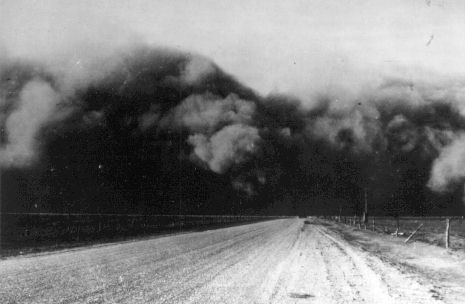
And then the winds began.
In November, 1933, the Great Plains were besieged with truly incomprehensible wind storms that lifted up the newly exposed top soil and blew it hundreds, and in some cases thousands of miles. This went on with great frequency, often several times a week for 5, 6 , 7 years. The clouds were truly frightening and the dust permeated every pore of a house, caused massive lung infections and death (mostly of children), and resulted in the slaughter of millions of cattle as they had no food to eat. Large trenches were dug in farm fields, starving cattle herded into the trenches and shot to death by the hundreds of thousands. It was common to run a rope from the kitchen porch to the barn, as during the daytime dust storms it was impossible to see the “arm in front of your face” and people could get lost and die in their own backyard. The density of the black was described as “two midnights in a jug” hence the title of this post.
So how does one interpret this calamity? Is this a natural result of population growth, a symbol of man’s disrespect for the environment, a reveal of the vagaries of capitalism, or as some might say, an example of government intervention gone wrong. All have credible narratives around them, but the right answer is neither in the singular, the right answer considers that these effects occurred in synchronization with each other, and all had varying degrees of causality. All the listed factors are contributors, as well as some not listed.
But the illustrative lesson of the Dust Bowl may be distilled down to several key contributors, one of which might be the notion that man acting in his own best interests does not in fact benefit society as a whole. If farmers all around you practice destructive farming, and you do not, you are affected, and so are other non participants. These types of discussions lead to a thought domain characterized by John Rawls (Theory of Justice) and Robert Nozick’s (Anarchy, State, and Utopia) wherein the principle of side rights of the individual is broached effectively.
This type of thinking is an essential step to recognizing that governance and political philosophy have moved on substantially from Adam Smith’s Wealth of Nations. Particularly, the realization that “side rights” or the influence of a neighbor reducing your utility while in pursuit of his so called “liberty” is an intellectual dead end and is contradictory to the principle of any meaningful freedom. So is the prospect of being forced to sell your labor power for sustenance, to those that would exploit you- the very antithesis of freedom. Modern conservatives do not acknowledge side rights, principally because they are stuck with a paradigm where ostensibly the government is to blame for all that is wrong.
In fact, the opposite is often the case, and history illustrates many examples where government intervention, central planning, and other types of consolidated (as in not local) government edicts were essential to provide corrective action. We can again look to the Dust Bowl for evidence, as we have another contemporary example. These settlers were fiercely independent and reliably self sufficient, every bit what the modern libertarian would strive for, yet only with substantial government intervention were the ravages of the Dust Bowl finally mitigated through, among other initiatives, government demonstrated upgraded farming practices that rectified the environmental damage precluding it from happening again. After nearly a decade of this self realized environmental disaster, the settlers were, literally, begging for government support and guidance to get back on their feet.
This also occurred in the late 19th century, with the start of the Progressive Era and the time of the Robber Barons, wherein the population begged and demanded that the capitalists of the day be brought to heel. This worked until the ‘20’s and the Gilded Age, when Capital shed the chains of progressive influence, and once again blew the place up with the 1929 Crash, which brings us full circle back to the Dust Bowl.
Yes, everyone will die, every empire will fall, every monetary system will collapse, and ultimately we will in fact consume all of the finite resources on our planet. To this ultimate end, no one can offer a panacea, not Marxism, not Communism, and certainly not Capitalism, all will ultimately collapse if for nothing else but lack of resources. But it is our lot to Reason, it is human to better oneself.
We have been infected with a malaise that has altered our very DNA, it has damaged our ability to reason, it has blinded us to the contradictions that are self evident, it has promoted false consciousness, and it has denied the very discussion of alternatives.
Why, then, are radicals so hesitant to talk about what a different system might look like? One of the oldest and most influential objections to such talk comes from Marx, with his oft-quoted scorn toward utopian “recipes” for the “cookshops of the future.” The moral of the quote, supposedly, is that a future society must emerge from the spontaneous dynamics of history, not from the isolated imaginings of some scribbler. This isn’t without some irony, since two years later Marx the scribbler wrote his own little cookshop recipe in his Critique of the Gotha Program — it involved labor tokens, storehouses of goods, and an accounting system to determine how much workers would get paid.
As it happens, Marx’s comment was a riposte to a negative review he’d received in a Paris newspaper run by devotees of the philosopher Auguste Comte, criticizing Marx for offering no concrete alternative to the social system he condemned. (That’s why, in the original quote, he asks wryly if the recipes the reviewers had hoped to see happened to be “Comtist” ones.) To grasp the context, you have to understand that like many utopian writers of the era, Comte proffered scenarios for a future society that were marked by an almost deranged grandiosity, featuring precise and fantastically detailed instructions on practically every facet of daily life. It was this obsessive kind of future-painting that Marx was really taking aim at.
(…)
Maybe the most fundamental reason the Left has been suspicious of such visions is that they have so often been presented as historical endpoints – and endpoints will always be disappointing. The notion that history will reach some final destination where social conflict will disappear and politics come to a close has been a misguided fantasy on the Left since its genesis. Scenarios for the future must never be thought of as final, or even irreversible; rather than regard them as blueprints for some future destination, it would be better to see them simply as maps sketching possible routes out of a maze. Once we exit the labyrinth, it’s up to us to decide what to do next.
There is much ongoing dialogue on how to fold some of the more contemporary concepts of political philosophy into actionable lifestyle choices, and I am a big fan of these types of discussions- even if they do turn circular (which they often do). But nevertheless, initiatives like Richard Wolf’s worker funded exchanges wherein surplus value is distributed to workers, and managers are elected democratically, and (as in the excerpt above) centrally planned command economies are hybridized by using free market demand signals to inform production volumes and regional needs. Reintroducing class consciousness as a repetitive topic of discussion reinforcing where and when exploitation occurs is another example.
The major impediment of any refined approach to political philosophy is not so much what we don’t know, it’s discarding the nonsense that we do know.
I think the circumstances on Easter Island although not capitalistic, were similar to what happened in the Dust Bowl, one factor was inadequate and (at times) inappropriate command level decisions. I think if you trace most of the pre-capitalist failures of societal endeavors you will find similar themes, improper or missing command authority, reliance on principles of self liberty over common good, lack of class consciousness, etc.
Capitalism just adds rocket fuel to a fire that is already smoldering.
Hello dominant life form of planet Earth. Yes, that means you Homo Sapiens. I’ve watched as over the millennia you evolved from a primitive ape-like hominid species, surviving purely by instinct, to the technology-wielding, sophisticated-thinking creature of today. Truly, the planet became your smorgasbord and you have partaken freely. As a matter of fact, you have very nearly emptied the planet’s entire refrigerator and cupboards and are now preparing to lick your plate clean. I’ve been throwing up some warning signs, especially this past year, to try to get your attention and perhaps make you reconsider your current omnivorous appetite. After all, you do share the planet with other life forms who have been hoping someone or something will put an end to your callous industrial rampage. I’ve even set in motion a sort of evolutionary check-and-balance, a doomsday device if you will, in the form of atmospheric heat-trapping gases, ensuring your demise just in case you don’t get the message of behavior modification. In other words, your dominant socio-economic paradigm of capitalism is fatally flawed.
Your voracious appetite for the world’s natural resources — fish, timber, potable water, arable land, minerals, et al. — continues unabated. And after consuming them, you leave behind mountains of waste and destruction. Does it always take a crisis before you creatures take action? Instead of waiting until you suffocate to death in a world of hypoxic oceans and dead forests, try listening to those lone voices of dissent screaming for your attention:
Look, I have news for you. The human economy does not take precedence over the Earth’s natural ecological processes which have evolved over millions of years to provide you with clean water, clean air, fertile land, and productive plant and animal life. All of these priceless necessities have been given to you at no charge to your accounting ledger. I guess free lunches are something no human can refuse, but the bill will come due no matter how you try to hide it by pushing it off onto the environment and future generations. In a planet without a stable biosphere, your glimmering metropolises with their megalithic concrete and steel structures reaching heavenward are nothing more than fleeting sand castles to be washed away by the next rogue wave of a surging sea… Sandy was just a warm-up event. Perhaps a new ‘Dust Bowl’ event and heat waves down under demanding a new color code on the weather map and droughts rendering useless a nation’s hydroelectric power will do the trick. I suppose as long as the $tock exchanges of the world are operable, your “business as usual” scheme of perpetual growth and converting all the natural world into capitalist symbols of wealth will carry on its merry way right over the edge of global extinction. And you thought the “fiscal cliff” was something to worry about?
As a mentor and intellectual peer of this site said recently, “tribes and societies that did master effective class consciousness thrived, for a very long time. Those that didn’t, don’t.” At today’s massive scale of production and consumption, the human and environmental exploitation characterized by modern industrial capitalism undermines the long-term existence of mankind along with every other living organism on the planet. Capitalism shoehorns everything into its profit-seeking regime, no matter if that means global genocide on a scale never heretofore seen:
…Actually, the more I reflect on it, the clearer I see the logic, the rationale, behind the bankers’ and the capitalists’ push for privatization. It is not just more profits they are after, not just share price or corporate valuation; no! They are after mass extermination, genocide on a grand scale – of the world’s needy, the under-funded, the unwanted, the uncivilized, the savages and the barbarians, the commies and the Islamists, in short, elimination of all of the Others.
The big boyz have seen all the data and crunched all the numbers, and it is clear to them – the earth is running out of resources, Mars is -50 C all of the time, and we can no longer afford to carry all of this excess baggage here on the planet — all of these miserable, thankless, do-nothing mouths to feed. So the plan is brilliant. You reduce the number from 7+ billion by at least 33% without firing one shot. You simply privatize all natural resources and then price access so that the bottom third of the globe’s population cannot afford it. And so, they die; it will be the biggest die-off of the Anthropocene epoch…
An interesting article came to my attention via a referral from The Big Picture. The economics editor of the Sydney Morning Herald, Ross Gittins, has written an article, The four business gangs that run the US, which is a review of Jeffrey Sachs book, The Price of Civilisation. Sachs should have entitled his book ‘The Price of Capitalism’. In order to protect corporate interests, the exploiters will always use their wealth to bribe the political system (such as campaign contributions and promises of lucrative positions in the private sector after leaving government posts). We are all familiar with feedback loops in terms of climate change,but there also exists one within our socio-economic system which is extremely destructive. I refered to this feedback loop as the government-corporate-lobbyist complex in my postGuns, God, and Greenback$.Sachs describes this pernicious feedback loop, which has accelerated wealth to the top 0.001%, as follows:
Sachs says…
Corporate wealth translates into political power through campaign financing, corporate lobbying and the revolving door of jobs between government and industry; and political power translates into further wealth through tax cuts, deregulation and sweetheart contracts between government and industry. Wealth begets power, and power begets wealth.
Sachs even uses the term corporatocracy to describe the four primary U.S. business sectors which have usurped our government:
1.) Military-Industrial-Complex
Sachs says…
As [President] Eisenhower famously warned in his farewell address in January 1961, the linkage of the military and private industry created a political power so pervasive that America has been condemned to militarisation, useless wars and fiscal waste on a scale of many tens of trillions of dollars since then.
2.) Wall Street-Washington complex
This group, comprised primarily of the big financial corporations (i.e. Goldman Sachs, JP Morgan Chase, Citigroup, Morgan Stanley), systematically worked to “capture” regulation and take control of the money system which, Sachs says, “paved the way for the 2008 financial crisis and the mega-bailouts that followed, through reckless deregulation followed by an almost complete lack of oversight by government”.
3.) Big Oil-transport-military complex
Sachs says…
Since the days of John D. Rockefeller and the Standard Oil Trust a century ago, Big Oil has loomed large in American politics and foreign policy. Big Oil teamed up with the automobile industry to steer America away from mass transit and towards gas-guzzling vehicles driving on a nationally financed highway system.
Now you know why America has a rail system that even the Bulgarians would be ashamed of, as Kunstler is fond of saying. Next time you fill up your tank, think of the perpetual oil wars in the Middle East as an externalized cost of subsidizing America’s car culture. Anita Dancs calculated the cost of securing our liquid fuel addiction back in 2010:
…Put all these numbers in perspective: The price of a barrel of oil consumed in the United States would have to increase by $23.40 to offset military resources expended to secure oil. That translates to an additional 56 cents for a gallon of gas, or three times the federal gas tax that funds road construction.
If $166 billion were spent on other priorities, the Boston public transportation system, the “T,” could have its operating expenses covered, with commuters riding for free. And there would still be money left over for another 100 public transport systems across the United States. Or, we could build and install nearly 50,000 wind turbines. Take your pick.
Sachs also reminds us that “Big Oil has played a notorious role in the fight to keep climate change off the US agenda. Exxon-Mobil, Koch Industries and others in the sector have underwritten a generation of anti-scientific propaganda to confuse the American people.”
4.) Healthcare Complex
Sachs says…
The key to understanding this sector is to note that the government partners with industry to reimburse costs with little systematic oversight and control. Pharmaceutical firms set sky-high prices protected by patent rights; Medicare [for the aged] and Medicaid [for the poor] and private insurers reimburse doctors and hospitals on a cost-plus basis; and the American Medical Association restricts the supply of new doctors through the control of placements at medical schools.
‘The result of this pseudo-market system is sky-high costs, large profits for the private healthcare sector, and no political will to reform.
We are the only industrialized country on Earth without universal healthcare. We pay more than anyone else and get less for the money spent. One of every five or six GDP dollars goes to feed this beast, but our life expectancy doesn’t reflect it:
Sachs says the elite take care of their own and have no concern for the plebs down below:
There is absolutely no economic crisis in corporate America. Consider the pulse of the corporate sector as opposed to the pulse of the employees working in it: corporate profits in 2010 were at an all-time high, chief executive salaries in 2010 rebounded strongly from the financial crisis, Wall Street compensation in 2010 was at an all-time high, several Wall Street firms paid civil penalties for financial abuses, but no senior banker faced any criminal charges, and there were no adverse regulatory measures that would lead to a loss of profits in finance, health care, military supplies and energy.
Ross Gittins concludes his review of Sachs’ book by briefly summarizing the path the elite took to amass their incredible wealth:
The 30-year achievement of the corporatocracy has been the creation of America’s rich and super-rich classes, he says. And we can now see their tools of trade.
It began with globalisation, which pushed up capital income while pushing down wages. These changes were magnified by the tax cuts at the top, which left more take-home pay and the ability to accumulate greater wealth through higher net-of-tax returns to saving.’
Chief executives then helped themselves to their own slice of the corporate sector ownership through outlandish awards of stock options by friendly and often handpicked compensation committees, while the Securities and Exchange Commission looked the other way. It’s not all that hard to do when both political parties are standing in line to do your bidding, Sachs concludes.
There was a comment that Darbikrash made on another website a year ago which pertains to this subject and clearly explains the corrupting influence that money has on government. Here is an excerpt:
In my previous ‘arms industry’ posts (Guns, God, and Greenback$ as well as Guns ‘R U.S.), I alluded to the revolving door between the arms industry and the government and the corruption of politics by the money involved therein. In one of the most interesting interviews of 2012 aired today on DemocracyNow, arms industry analyst Andrew Feinstein, author of “The Shadow World: Inside the Global Arms Trade” and a former African National Congress member of Parliament in South Africa, sheds more light and insight on this very subject:
ANDREW FEINSTEIN: …The global arms trade is a $1.74 trillion-a-year business. That’s $250 for every person on the planet. And the profit motive behind the global arms trade is absolutely crucial. This is a business that is about big, big money. The trade contributes around 40 percent of all corruption in all global trade. So its impact on countries, on governments, on ordinary individuals in terms of the economic opportunity costs are absolutely massive.
Now, you will find that many spokespeople for the trade would try to distinguish between the legal or formal trade, on the one hand, and the illegal or illicit trade, on the other. I argue in the book that this distinction is a fallacy, that the boundaries are in fact extremely fuzzy and that the licit and the illicit are very closely intertwined, in addition to which the industry is largely protected because of its very close links to governments, to intelligence agencies, obviously to the military, and to lawmakers. So it is very seldom—even with the inadequate regulations that exist globally around the trade in weapons, it is very, very seldom that people who break those regulations are actually brought to book…
…Now, the situation that pertains at a global or international level has very many similarities with the domestic situation, particularly in the U.S., because let’s—let’s bear in mind while discussing this that the U.S. buys and sells almost as much weaponry as the rest of the world combined. So what happens in the U.S. is going to have enormous impact on the rest of the world. And what happens domestically, in terms of the ownership of weaponry within the U.S., really does, as I say, reflect the global trade in arms, in that we see it’s a $3.5 billion-a-year industry. And here we’re talking about smaller weaponry—about handguns, about assault rifles, semi-automatic weapons, the sorts that are used in the tragedy at Sandy Hook and all of the others that we’ve seen over the years throughout the U.S.
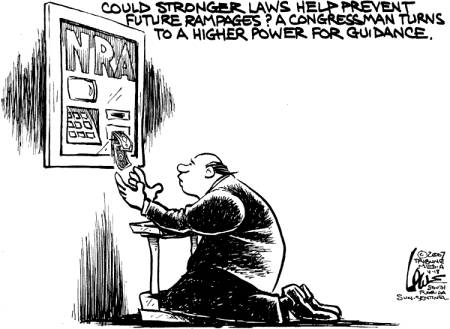
But the NRA, the gun sellers, the gun users seem to be afforded an extraordinary level of protection by government, by law enforcement authorities, just as happens on the global level. And part of this is because of the revolving door of people between, for instance, the NRA and government. Recent figures suggest that 15 of 28 officials in the NRA came from—sorry, lobbyists in the NRA came from important positions within government dealing with some of these same issues, so that the sorts of decisions being made by government are being informed disproportionately by those who want guns to be unregulated, by those who are making massive profits out the suffering of the victims of gun crime…
…let me make another point that I think is absolutely crucial about this and to understand where the NRA is coming from and, unfortunately, where the global trade in arms comes from, as well. And that is the linkages between politics and the gun lobby, and particularly, in terms of those linkages, money. One of the reasons that I focus on the global trade in arms in my work is because I saw, both in the context of South Africa, but also at a global level, the way in which money has come to pollute our politics. And the relationship between defense contractors on an international level and political parties and individual politicians are deep and profound. At a domestic level, the relationships between the NRA and specific elected representatives, not only in terms of money contributed, but also in terms of support given, are, again, profound. And unless we are able to break these linkages between money and politics that so pollute the way we are governed around the world, we will not be able to deal with some of the most intractable problems that face us as human beings —problems of the weaponization of the world, problems of climate change…
…I have not seen anywhere else in the world a gun lobby that has the same level of influence on its own government as the NRA does in the United States. My own assessment of what happened in July with the arms trade treaty is that the NRA, through the words of Mr. LaPierre and others, made clear to the Obama administration that it would make the president’s re-election a lot more difficult if he supported an international arms trade treaty. And I think it’s in that way that the NRA had such direct influence on the U.S. decision to effectively scupper negotiations for what in my opinion wouldn’t have been a strong-enough arms trade treaty, but would have been far better than any form of regulation that we have at the moment. So, yes, I think this is something of a unique situation, where a gun lobby has the extent of influence that it has in the United States of America…
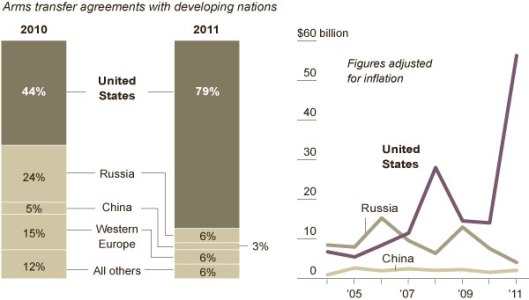
What I find most disturbing is that in an age of resource constraints and austerity measures aimed at the lower class, global sales from the arms industry are booming and that growth is coming primarily from the United States of America (aka ‘Guns ‘R U.S.’):
As was stated by Feinstein, the world-wide anti-corruption body, Transparency International, reports that the arms industry is one of the most corrupt business sectors, accounting for 40-50% of corruption in global trade.
Corruption plays a significant role in influencing arms procurement. But despite repeated scandals, this situation has been largely ignored by governments, NGOs and academics.” ~ Laurence Cockroft, Chairman of Transparency International’s UK chapter.
‘Commissions’ are the euphemism for bribes which are paid by manufacturers to governments and average at least 10% of contracts that run in the tens of $billions per year. Some reasons for the rampant corruption in the arms industry:
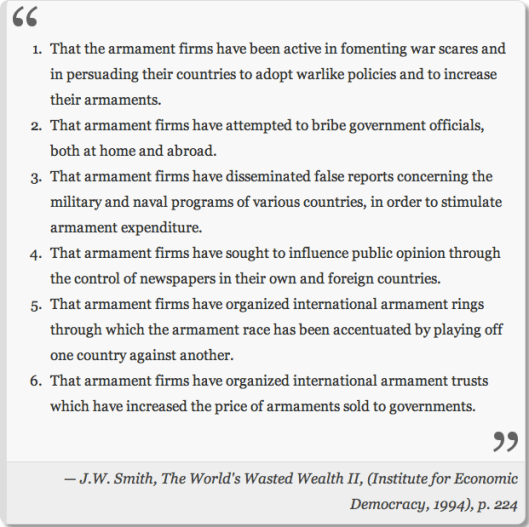
The merchants of death have only grown more powerful in recent times, and their horrific impacts to the well-being of humanity are as true today as they were after World War I when the League of Nations listed six primary criticisms of global arms dealers, as quoted by J.W. Smith:
Stung by the horrors of World War I, world leaders realized that arms merchants had a hand in creating both the climate of fear and the resulting disaster itself.
Americans need to understand that the NRA is very much a part of this global arms trade. If one follows the money, the reasons why the NRA is adamantly opposed to any sort of regulation on guns becomes painfully apparent. While the US domestic arms industry conveniently wraps itself and its profit motive behind the patriotic fervor of the Second Amendment and the colonial ghosts of Founding Fathers, the horrors of the Sandy Hook massacre are blamed on everything under the sun except for that which hides in plain sight — an unregulated, out-of-control global and domestic arms industry.













 The merchants of death have only grown more powerful in recent times, and their horrific impacts to the well-being of humanity are as true today as they were after World War I when the League of Nations listed six primary criticisms of global arms dealers, as quoted by J.W. Smith:
 From a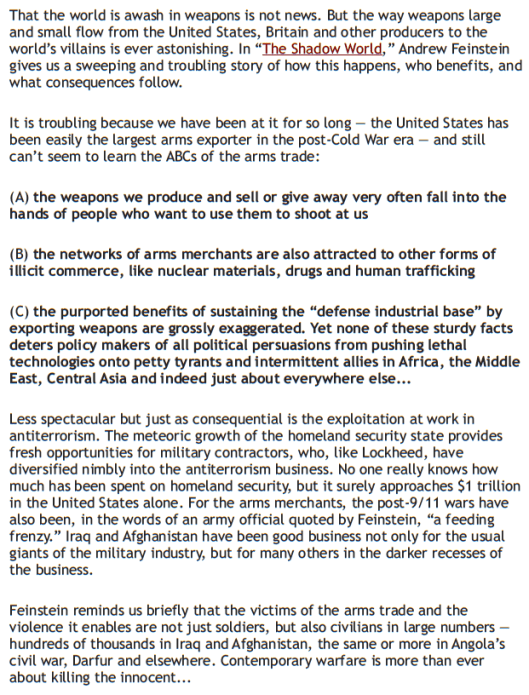

 Collapse of Industrial Civilization