As mankind spirals towards its own self-manufactured demise, I look with a jaundiced eye at daily events in the news and at the bread-and-circus infotainment that fills the American hologram. The mass media is replete with misinformation on the state of the world, so I wasn’t too surprised by the recent words of wisdom(sarcasm) from Kathleen White (Distinguished Senior Fellow-in-Residence & Director, Armstrong Center for Energy & the Environment); nevertheless, I felt compelled to set aside a partially completed essay on capitalism and technology in order to express some of my thoughts about White’s essay on the benefits of fossil fuels to humanity:
“…Fossils fuels also augment food supply. Fertilizer derived from natural gas has increased agricultural productivity by 40-60 percent. According to economist Indur Goklany, without fossil fuels, an area equivalent to U.S., Canada, and India combined would have to be converted into crop land to meet global food demand. Fossil fuel-based fertilizer, pesticides, and mechanized substitutes for animal power have saved vast natural ecosystems from conversion to cropland. And the increased atmospheric concentration of man-made CO2 has enhanced plant growth.”
[You fail to consider that without fossil fuels, mankind would not have been enabled to overpopulate the planet to such a degree as to require so much farmland.You also fail to say that the negatives of climate change swamp (no pun intended) any supposed benefits of a warming planet. As we are already seeing, the effects of epic droughts and floods are wreaking havoc on farmers. Good luck trying to move the agricultural industry northward where the soils are extremely poor. Famine and mass extinction are the inevitable outcome of industrial civilization’s destabilizing activities on the planet.]
“Although combustion of fossil fuels releases pollutants, that environmental damage can, and is, undergoing dramatic reversal far quicker than could the conversion of natural ecosystems to croplands. The prosperity supported by fossil fuel energy allows investment in effective technologies to reduce and eliminate harmful pollution.”
[CO2 and other GHG levels are increasing every year, having gone parabolic in the last 100 years. This reality paints a bleak picture for the future of humanity. Far from being mitigated, environmental damage is accelerating everywhere one looks from the acidification of the oceans to the die-off of forests and jungles. The simple fact is that renewable energy cannot replace fossil fuel based energy at the rate the world is consuming, as European actions have recently indicated. Only a wholesale reconfiguration of the economy and our way of life will enable solutions to the environmental crisis. Rather than taking this courageous and self-reflective approach, society is putting its proverbial head in the sand concerning climate change. The public already finds the subject of climate change difficult enough to understand without having to wade through a constant onslaught of misleading articles such as yours.]
“Renewable energy still provides a sliver of global demand. Despite the billions of dollars in subsidies, retail prices are still 2-3 times higher than fossil fuels. Renewable energy from wind and solar remain diffuse, intermittent and parasitic on fossil fuels for back-up. Nuclear fission provides energy comparable or superior to fossil fuels, but the public remains resistant to broad use.”
[Yes, capitalist industrial civilization cannot be run on renewables so that is why we need to be talking about powering down and living within the carrying capacity of the planet rather than maintaining the status quo. Nuclear has the little problem of making vast swaths of the planet uninhabitable from radiation contamination, as evidenced by such catastrophes as Chernobyl and Fukushima. Nuclear energy also leaves behind tons of radioactive waste that must be stored away for thousands of years. These sort of factors tend to scare the public. With global sea levels rising and storms becoming more destructive, the world’s nuclear plants, which are mostly situated along waterways and oceans for coolant purposes, are in jeopardy. Get it?]
“Energy-dense, abundant, imperishable, versatile, reliable, portable and affordable, fossil fuels provide 85 percent of the world’s energy because they are superior to the current alternatives. And hundreds of millions still await the benefits of affordable energy. Until energy sources comparable or superior to fossil fuels are fully available, policies to reduce emissions of CO2 should proceed with caution lest they prematurely jettison the well-springs of mankind’s greatest advance — the blessings of which literally light up the holiday season.”
[The “well-springs of mankind’s greatest advance” are soon to be jettisoned into the dustbin of history and extinction as we have already tripped multiple tipping points in the earth’s biosphere such as the Polar ice melt and many others. Hundreds of millions will never experience the energy-intensive lifestyles of developed countries since climate chaos will put a halt to human expansion within this century. Fossil fuels have allowed industrial civilization to far overshoot the environment; for the rest of the world to live like Americans, we would need more than 4 Earths.]
The . . . metamessage of our time is that the commodity form is natural and inescapable. Our lives can only be well lived (or lived at all) through the purchase of particular commodities. Thus our major existential interest consists of maneuvering for eligibility to buy such commodities in the market. Further, we have been taught that it is right and just—ordained by history, human nature, and God—that the means of life in all its forms be available only as commodities. . . . Americans live in an overcommodified world, with needs that are generated in the interests of the market and that can be met only through the market.
~ Stephen Fjellman, Vinyl Leaves:Walt Disney World and America
From the Amazonian tribe driven off its land by fossil fuel companies to the wage-enslaved city dweller dependent on mass-produced food and other commodities, no place on Earth has escaped the planet-wide reach of capitalist industrial civilization’s profit-extracting mechanisms. The oligarch’s of industry and banking shape public thought through an all-pervasive mass media monopoly, control legislation and regulation by pulling political purse-strings and commanding an army of lobbyists, sew death and mayhem with the global arms trade, sacrifice the next generation in resource wars, decimate ecosystems for short-term gain, manipulate and devalue currencies, create economic bubbles, and sell this entire vile process back to the masses as “progress” and “development” with measurements of inflated stock prices and skewed GDP figures. The untold human and environmental costs are now bursting at the seams with societal disintegration, epidemic mental illness, wide-scale resource depletion, industrial pollution and contamination, and the on-going collapse of the Earth’s biosphere.
If you’re wondering why there can never seem to be any significant action taken on climate change, don’t look for honest answers from those whose livelihood is tied to capitalism. If the true costs of the global industrial economy were calculated in terms of environmental damage, the ill-health effects on workers and the public, as well as the fraying of the Earth’s web of life, industries would find the costs too great to bear. The honest truth is that this ecocidal economic system would have to be dismantled for there to be any hope of humanity preserving a living planet and averting extinction.
“…big-time corporate capitalism is an omnicidal momentum. I mean, it just has one thing in mind, and it will destroy or weaken or co-opt anything in its way that is civic, that is democratic….corporations have been very clever A) in distracting people, especially young generation, with entertainment, with professional sports, turning them into spectators. Now you’ve got, you know, 24/7 entertainment. There’s no end to it. And they’ve also been very good in making people internalize a sense of powerlessness.” ~ Ralph Nader
Perhaps the three biggest crises facing civilization are unrestrained financialization of commerce and society, climate change, and peak oil (or peak net energy). Let’s take a quick look at how America is handling each of these crises:
Employing paid shills for the financial industry is now simply standard operating procedure in the U.$.A.:
…Consumer advocates and independent analysts do their best to weigh in as well, but they are outgunned. Meanwhile, consulting firms dedicated to playing matchmaker between corporations and hired experts have flourished in the new regulatory environment. Director Charles Ferguson, whose film Inside Job highlighted the role of sponsored professors in supporting the deregulatory policies that led to the financial meltdown in 2008, says the business of economic consulting firms that work to “source” academics for expert testimony and regulatory filings “has been going on for quite a while, and it’s now quite a large industry.”…
Of course anthropogenic climate change, the existential threat of modern times, would seem to be a catastrophe deserving of mankind’s attention, would it not? Well, as you can see, the capitalist only views it as a public relations war:
An extensive study into the financial networks that support groups denying the science behind climate change and opposing political action has found a vast, secretive web of think tanks and industry associations, bankrolled by conservative billionaires.
“I call it the climate-change counter movement,” study author Robert Brulle, who published his results in the journal Climatic Change, told the Guardian. “It is not just a couple of rogue individuals doing this. This is a large-scale political effort.”
His work, which is focused on the United States, shows how a network of 91 think tanks and industry groups are primarily responsible for conservative opposition to climate policy. Almost 80 percent of these groups are registered as charitable organisations for tax purposes, and collectively received more than seven billion dollars between 2003 and 2010.
How about peak oil? Again, the energy industry has its PR machine in full swing touting America’s imminent energy independence along with many other myths, but commenter James of this blog cuts to the chase:
Now, which ponzi is most despicable, a religious or financial one? Both are based upon deceit and both serve primarily the enrichment of the scheme officialdom. One promises a payoff in eternal life while the other promises financial success. One examines your credit score while the other applies tick marks in you behavioral ledger of good and evil. Both systems of fleecing are based upon human fear and herd mentality. Society shuns the heretic of either ponzi and damnation awaits those that do not participate fully. Ponzis collapse when increasing numbers of fools, resources and energy can no longer be sucked into their cancerous growth schemes. The religious structures will be more enduring as they can always find plenty of poor dolts to give their last penny to gain a chance at the big after-life payoff. The financial schemers, faced now with meeting the absolutely unbelievable limits of growth will have to leave all those little nest eggs of promises, unhatched. The key is to convince the ponzi participants that the U.S. is the new Saudi Arabia, that fracking oil and natural gas is the future and we can get enough oil from shale to last a million years. “Just relax folks, you’re all gonna get your money back”. Not. What a miraculous world we live in.
As you can see, America is handling all three crises like a sleazy car salesman unloading a lot full of lemons.
And if anyone was spooked by the Snowden revelations of government spying, the implications of corporate espionage on social-change organizations that threaten to impede unfettered access to profits is truly terrifying.
Although I’m not a particularly religious person, all evidence does point to a civilization which has completely succumbed to the worship of Mammon:
…The fruits of such idolatry are clear: the injustice and unemployment and waste of human talents; the corruption of our political leadership and their collusion with immoral financial practices; the depredation and degradation of our natural environments and the exhaustion of our natural resources; the inevitable wars and other crises that arise from the systematic fostering of base human appetites and the refusal to compromise our ways of life, and pursue a more equitable sharing of the gifts bequeathed to us…
I would not blame anyone for wanting to seek comfort in a bottle or some other form of self-medication, but perhaps doing something more dramatic to escape this nightmarish reality of a thoroughly corrupted, money-worshipping society is in the cards. When your back is against the wall and you’ve lost faith in everything, then revolution is the antidote for the “pseudo-realities” that plague us.
“Because today we live in a society in which spurious realities are manufactured by the media, by governments, by big corporations, by religious groups, political groups… So I ask, in my writing, What is real? Because unceasingly we are bombarded with pseudo-realities manufactured by very sophisticated people using very sophisticated electronic mechanisms. I do not distrust their motives; I distrust their power. They have a lot of it. And it is an astonishing power: that of creating whole universes, universes of the mind. I ought to know. I do the same thing.” ~ Philip K. Dick
The specter of death, near-term extinction, haunts us as we silently endure the evil and decay all around us, going along just to get along in the belly of the American empire. One day pent-up anger and hunger will burst forth, pushing us into the streets. Blood and emotions will flow freely. Inept and crooked governments will fall. We’ll have nothing left to lose.
An excellent essay which pinpoints the underlying causes of societal disintegration and the breakdown of traditional social support systems. Capitalism destroys local community and sustainability in order to bring all resources (human and otherwise) into the global “free market”. People, cultures and ecosystems are then fed into the conveyor belt of profit extraction as they become commodities in the labor market, consumerist culture, and natural resource market. The onslaught has been global and its destruction is seen everywhere, especially in the rise of mental illness in America:
“…We are today disengaged from our jobs and our schooling. Young people are pressured to accrue increasingly large student-loan debt so as to acquire the credentials to get a job, often one which they will have little enthusiasm about. And increasing numbers of us are completely socially isolated, having nobody who cares about us….”
“The rising popularity of the consumerist life-model has been imported from the West or rather imposed by the globalization of Western standards… conspicuous consumption had been cut off from the task to satisfy survival needs and put in the service of positional rivalry and cut-throat competition for social standing, renown and prestige.”
~ Prof. Zygmunt Bauman
Addiction is big business and obscuring its roots is its ideological handmaiden. Despite the incessant chanting that everything that happens to you is solely your fault, social ills do have social roots.
We need not lay this “personal responsibility” mantra solely at the feet of neoliberal ideologues, for such beliefs pervade capitalist society, even among those who are critical of capitalism’s excesses. New age philosophy, for example, routinely blames the individual for all manner of personal misfortunes and overemphasizes personalities at the expense of collective effort.
An episode of Oprah that featured Nelson Mandela saw Oprah Winfrey repeatedly tell the former president that he had accomplished so much by himself; she was oblivious to his protestations that he could not have brought an end to apartheid except as part of the collective movement of which he was a part. On the personal level, a friend still angrily recounts an incident…
“One of my psych professors told me that people tell stories to cope with their fears. All art and myths are just creations to give us some sense of control over the things we’re scared of. Afraid of dying? Create reincarnation. Afraid of evil? Create a benevolent God who sends evil doers to Hell. I’ve treated soldiers with PTSD by having them draw pictures of what happened over there.”
~ Ben in American Horror Story
Seething just below industrial civilization’s thin veneer of normalcy lies an ocean of grim reality – overpopulation, peak oil, poverty and starvation, hormone-altering pollution and cancer clusters, nuclear radiation from the mishaps of distant countries, pandemics from mutagenic viruses, climate chaos, mass extinction, etc. Working to suppress the fear of such real-world nightmares is an assortment of psychological and cultural defense mechanisms such as the myth of technological progress, religious dogma, Madison Avenue propaganda, and the unconscious tricks of self-deception we are all vulnerable to (emotional detachment, rationalization, retreating into fantasy, etc.). All the while and in the background is the constant hum of the global consumerist machine churning out endless promises of satisfaction and happiness if only you buy this or that product. Most have bitten the fruit of materialism and swallowed whole the false truism that human progress is always on an upward trajectory with science and human ingenuity solving all problems. Citizens of ‘developed’ countries are blissfully unaware their life of leisure and comfort is supported by dozens and dozens of energy slaves working day and night all year long, year after year. Grocery store shelves brimming with food, a high animal protein diet, personalized auto transport in and out of sprawling suburbs, globetrotting air travel, and a machine-dependent society powered at the convenient flip of a switch have all been made possible by a fast-depleting source of cheap, energy-dense fossil fuels.
We were born into this energy-rich cocoon of modern industrial civilization with each successive generation growing more and more accustomed to its skyscrapers, concrete sidewalks, asphalt roads, and cacophony of automation until it is now all simply taken for granted. Restless and agitated, we no longer are connected to the natural cycles of the seasons, the rising and setting of the sun and moon, and nature’s own biological clock which measures time with the migration of animals, the blooming of plants, birth and death. Instead, time is measured in quick sound-bites on TV, the hours in a workday, the quarterly profits of corporations, and the microseconds of high-frequency stock trading. Time is money, and the bottom line reigns $upreme. Social and environmental consciousness has been paved over with consumer icons, and the future is a barcode stomped stamped into your forehead. Industrial civilization’s coveted energy resources, frantically ripped out of the ground and burned up into the atmosphere, have irrevocably disrupted the stability of a climate that has allowed life to flourish. The Earth itself has been thrown off kilter and its natural clock has been broken. Plants are blooming when they shouldn’t, succumbing to invasive pathogens and insects, and withering from drought or unusual cold snaps. Animals are migrating north earlier and earlier and dying off from disease and starvation in a warming world. People are losing their homes to freak storms and rising tides. The word “extinction”, when uttered in a public forum, is treated as mere hyperbole, and the fragility of the biosphere is neither acknowledged nor truly appreciated.
“…The so-called Holocene climate is “the only state of the Earth system that we know for sure can support contemporary society” (Stephen et al. 2011, 739). It is the linchpin of humanity’s life-support system and stands at the core of its safe operating space (Rockström et al. 2009). It can even be argued that keeping the Holocene climate resilient is an essential system function not just for human society but for the planetary system as a whole (Lovelock 2000)…”
~ Jörg Friedrichs, The Future Is Not What It Used to Be
“…there is no worldwide plan on how to move forward to avoid an extinction event. As a consequence, except for a few scientists, the world community will be shocked by the carnage because nobody anticipates it really happening. Otherwise, the governments of the world would be furiously working on solutions, but they are not…”
~ Robert Hunziker, Looming Danger of Abrupt Climate Change
Ah, but Peter Ward just said humans are more than “average” and won’t go extinct:
“Species don’t age out of existence, species are killed off, lose competition, they go extinct because they’re driven to extinction. It’s not inherent. It’s not within them.
So if we keep track of Mother Earth and do some good engineering then we’re not going to go extinct. But extinction and misery are two different things. Not going extinct doesn’t mean you’re not going to be miserable, and by misery I mean, wholesale, enormous human mortality.”
Do some “good engineering”? Christ, Peter Ward has fallen for the technological progress myth just as has scientist Natalia Shakhova, a leading expert on the East Siberian Arctic Shelf.
Technology has not created a utopian nirvana; it has created a capitalist dystopia:
“…The inability of most developing countries to meet the basic needs of its population, whilst somehow being swept up in the euphoria of new technologies that cater to more individualistic needs and pursuits (not all socially useless or destructive), has its origins in flawed governmental policies that have defined progress as the quest for productivity gains and economic growth rather than human development. Policy-makers in the developing world adopted a fundamentally invalid economic system that has led to the crisis of capitalism the world is experiencing and the questioning of the perpetual growth mantra. These decision-makers have put their faith in consumption-led growth with its emphasis on technology, and abdicated their responsibility to meeting people’s basic needs and protecting natural resources. This approach is rooted in the Western economic model of the past two to three centuries, when a minority saw the world as their oyster and plundered other countries to create prosperity. As such economic growth through externalizing cost, underpricing resources and promoting relentless consumption has become the world’s one and only economic model, a recipe for disaster in Asia…
…Despite the rhetoric about the pressing need for development and the emphasis on primary education, health care and even resources management, the Washington Consensus has exclusively focused on economic growth. It has advocated broad trade liberalization through privatization and the increase of foreign direct investments, amongst other structural adjustment strategies, as a “first stage policy reform” for developing countries to boost economic growth. The promotion of this set of policies is primarily driven by the desire to secure markets for multi-national companies and Western economies. Local elites benefited from it too…
…From the standpoint of this economic paradigm, the relentless pursuit of technological innovation is supposed to solve global challenges such as poverty and even resources depletion. In reality, technological progress has, in many instances, accelerated resources depletion rather than reduce it. Technological innovation might have served the needs of the global population in terms of productivity and efficiency but not in terms of sustainability.
Forestry technology, for example, allowed harvesting on hitherto unimaginable scales. Whilst cutting trees was mainly done by hand until World War II, advance in engineering led to the development of small and powerful chainsaws, hence transforming the logging industry. Lumberjacks can now cut down trees between a hundred and a thousand times faster than they could with axes. Fisheries are another sector where the lack of strong policies has allowed people and companies to exploit the oceans thanks to technology.
To go further deep into this model’s misconception of the role of innovation, one must cast doubt on the contention that green technology will come to the rescue and create a more sustainable environment. “Greening” the economy by just producing more so-called “green” consumption is actually an intellectual lie. Zero-emission vehicles will remain toys for the rich because they require exotic material and thus will keep being expensive. In addition, they do not address the issues of externalized costs, which more and more cars will impose on Asian cities. This problematic can be extended for a whole range of consumer goods where “greening” and “innovation” are used to camouflage the reality, which is the pursuit of producing more goods cheaply and encouraging relentless consumption….”
~ Chandran Nair, The Myth of Technological Progress
Capitalism certainly feeds off the overpopulation crisis. More people means more potential customers, more consumption, and more profit. I searched in vain to find an article explaining how capitalism would solve the crisis of overpopulation, I found this video by Yaron Brook who appears to be a very ardent supporter of laissez-faire capitalism and Ayn Rand. I recommend watching the video for the sheer amusement of watching this guy execute every mental gymnastic trick he can think of to delude himself into believing that overpopulation is a nonissue. No more land? No problem, we can stuff more people out on the oceans or up in outer space. Of course he too also grasps at the quixotic techno-fix of the future.
I see China is worried about the economic ramifications of its barbaricsocial engineering project:
It’s a “free market” and the military industrial complex sees a lucrative future in war, famine, pestilence, and natural disasters. Overpopulation will provide more cannon fodder for when America’s war economy goes into hyperdrive for the last remaining resources on the planet. America’s captive pool of dirt cheap labor will be stitching the uniforms.
“…when denial threatens society, the Earth’s ecosystems, and a sustainable future, it has become not only a delusion, but a dangerous pathology… Possibly some Romans did the same as Attila the Hun marched into Rome, or some Chinese may have sipped tea as Genghis Khan marched his Mongol hordes into their cities…” ~ Haydn Washington
After discovering the website Media Roots a few years ago, I worked with its owner Abby Martin on a small project connected with my ‘Graffiti Philosophy’ video. If I remember correctly, I believe Abby worked for a short time as a newscaster for mainstream media in southern California, but became disenchanted and quit. From my brief experience, she struck me as nothing but sincere and dedicated to the cause of social change. Besides her TV work with RT, she is no different from you or I. I’m aware that RT serves as a “soft-power tool to improve Russia’s image abroad,” but it has also been extremely effective in providing alternative viewpoints to American corporate hegemony. Some of the more discerning readers of this blog have expressed exasperation at the incompleteness of Guy McPherson’s recent interview with investigative journalist Abby Martin. I thought it was rather short and could have been expounded upon if sufficient time were allowed.
No one in my immediate social circle really believes that humans will be extinct by 2030, but if I say circa 2100, then that seems to be sufficiently far enough off in the future for most to safely agree with me. With amplifying positive feedbacks loops just starting to kick into gear, the climate could spiral completely out of control within a short time span as expressed recently by the concern of a number of scientists overcatastrophic and abrupt climate change. After all, we humans are doing things to the planet that have never been done before at such a rapid pace, so the ‘unknown unknowns’ are sure to surprise us.
We all know what our response should be — should have been — in response to climate change, resource depletion, and environmental destruction, but all the evidence points to the system perpetuating itselfuntil it crashes like a speeding train with its conductor sound asleep. I personally think we need an entirely new socio-economic system that is completely counter to the current ecocidal paradigm. We know that corporate espionage against activists is insidiously preventing any sort of large-scale grassroots movement from forming and that the power of mass manipulation by corporate media is unprecedented in the history of civilization, so what are we, the few awake amongst us, to do. Some still feel it is worthwhile to invest time in the current political carnival with the ‘hopes’ of effecting incremental change while others feel that any meaningful decisions should have taken place decades ago. Still others feel our fate could never have been altered to any great degree due to biological imperatives and human psychology, and some humanely ask for mankind to save what biological diversity it can in these last days of the Anthropocene Age. In any event, our descendants will have quite a mess to deal with, that is if they are lucky enough to have been left with a planet that accommodates any sort of human population.
So we get to the purpose of this post. Suspend your jaded cynicism for a moment. Abby Martin, a dedicated activist, artist, and investigative journalist, has agreed to an internet interview for this site concerning the previously described state of the world. Abby has interviewed quite a few intelligent people including many we quote here, so this has the potential to be interesting. I’ve been told Brutus has an essay in the draft format and have asked him to hold off until next week. Help me formulate some intelligent questions for Abby. What questions should she have asked Guy? Does she believe in the possibility of humans going extinct? What does she envision the future to be? Has she ever been censored on RT? Hopefully, Guy McPherson and others will join in once the final interview is published. If you don’t want to post your questions here, send them to me at collapsitarians@gmail.com.
You almost have to feel sorry for the conservatives, tea partiers, and the whole menagerie of free market evangelists these days. Even a casual perusal of AM talk radio, along with the buffoonery and gas baggery of the hard right news shows, one can see evidence of collapsing narratives at every turn.
Our disintegrating social conditions demand a plausible explanation from the right, and any such explanation, ideologically, must be sure to exonerate capitalism and the free market system.
This is becoming increasingly hard to do, as the shrill and contradictory defenses put forth become less satisfying every time the story is told. The story evolves, the audience reactions carefully polled, and the messaging refined to try and adapt to a low information audience growing more skeptical by the minute. There are many versions of the same story, depending on who tells it and more importantly who is paying for it, but for this discussion we are interested in the narrative brought forth by the evangelical right, and their socially conservative stable mates, or in general, the fire and brimstone crowd accounting for something near half of the American population.
The operating theory of this cohort centers for the most part on morality, or lack thereof, as principal cause for our society’s collapse.
Rush Limbaugh provides a pathetic but typical example of this type of addled logic:
The reason all of these stats on income inequality don’t work anymore is because the baseline for the statistical start is the fifties. Now, what was happening in the fifties? Well, in the fifties we had this thing called a nuclear family. There was a mother, a woman. There was a father, a man. They had babies by engaging in coitus. Leave It To Beaver, Ozzie and Harriet — hell, even the Beach Boys, for crying out loud! They were seemingly clean and pure as the wind driven snow.
Anyway, then after the coitus in the bedroom, then little Beaver was born and then Wally, and there were 2.8 of the kids and little picket fence and (if the dad got a vice presidency), there were two cars in the garage, and mom — the female. I’ve gotta make that distinction. The mother was a woman, the wife of a man. She stays home, raises the kid, fixes breakfast, sends ’em off to school, talks to the PTA. There was all that. There was one breadwinner, and there was an economic boom going on at the same time, following World War II.
Incomes in America rose dramatically. Then something happened. The left didn’t like that arrangement. That was just bad. They didn’t fit in. They didn’t like the idea of coitus in the bedroom. They didn’t like coitus with someone the opposite sex, necessarily. They didn’t even like coitus as a means of producing a kid. In fact, most times they didn’t even like the kid. They wanted to have the abortion. So what happened was that the nuclear family became under assault by “progressive” forces of modernization.
So today, you can’t compare family income today to what it was in the fifties when the boom time ’cause the family’s not the same. You’ve got single women, single-parent families, fewer nuclear families. Incomes have been divided. It doesn’t work.
Who knew?
The root of American ethics and morality stems in part from its heavily Protestant and Calvinistic theological underpinnings, which we might well reduce to the “Puritan” ethic. There are several key components of this behavior, tracing back to the late 17th century:
1. Personal sacrifice fulfilled by austere living conditions.
2. Self-sufficiency and disdain of charity for one’s self.
3. Obsessive work ethic fueled by the notion that idleness is evil.
Of course there are others, but we can use these generalizations to continue. In addition we should mention that Calvinism utilizes the principle of predestination, or predetermination, a fundamental departure from modern evangelical Christianity.
The rollup of these centuries old dogmatic beliefs is a programing bias towards moral explanations for when things go wrong, and strong lifestyle choices that dictate high moral standards when times are normal, in order to stave off any potential (future) fall from grace. The modern evangelical right has conflated this DNA to represent a distorted view of Christianity leaning heavily on Capitalism-which has fascist underpinnings in its ultimate embodiment.
In the Flat Fields
A gut pull drag on me Into the chasm gaping we Mirrors multy reflecting this Between spunk stained sheet And odorous whim Calmer eye- flick- shudder- within Assist me to walk away in sin Where is the string that Theseus laid Find me out this labyrinth place
I do get bored, I get bored In the flat field I get bored, I do get bored In the flat field
What is often lost in our current infatuation with Enlightenment thinking is the degree to which the Pre-Enlightenment Church managed commerce, financing, and general market forces. In fact, the Church maintained an iron hand on issues such as usury, which was condemned and not distinguished from the “normal” practice of charging interest until the late 19th century.
In the age of Church hegemony, which lasted for centuries, it was considered immoral, and grossly so, to profit in any way through trade, charging interest, or commerce which resulted in a profit without actually performing any work. specifically, any rent seeking activity was forbidden.
Things that are considered commonplace today, such as raising prices for items needed in a disaster, (supply and demand) were thoroughly rejected by the Church and considered inconceivable during that time. Thomas Aquinas brought forth these concepts in the theory of Just Price in his Summa Theologica circa 1274 AD. Although this was clearly a Pre-Capitalist economy, much learning was put towards strict management of commerce dating back to the money changers being expelled from the temple in Biblical times- a theme oft repeated through the Dark Ages and well beyond.
For centuries, civilizations knew full well the dangers of markets and unconstrained commerce, and there is more than a passing connection between this realization and theology, present in virtually all religions throughout time.
This reality has been brought to the fore with the recent, and controversial, exhortation Evengelii Gaudiumfrom the Roman Catholic Pope. Pundits have been zeroing in on the more provocative aspects after his release of the document last month. I’ve read all 244 pages of it and I’m here to tell you that he has pretty well burned down the Christian right’s moralistic narrative along with a good bit of the more mainstream conservative cohort.
For those who have dismissed previous Papal exhortations (as well as any other messaging, written or otherwise delivered) as irrelevant and hypocritical drivel, and I count myself on this list, the recent missive is a shocker. Let’s take a look as some selected passages:
We can no longer trust in the unseen forces and the invisible hand of the market. Growth in justice requires more than economic growth, while presupposing such growth: it requires decisions, programmers, mechanisms and processes specifically geared to a better distribution of income, the creation of sources of employment and an integral promotion of the poor which goes beyond a simple welfare mentality. I am far from proposing an irresponsible populism, but the economy can no longer turn to remedies that are a new poison, such as attempting to increase profits by reducing the work force and thereby adding to the ranks of the excluded.
…
The need to resolve the structural causes of poverty cannot be delayed, not only for the pragmatic reason of its urgency for the good order of society, but because society needs to be cured of a sickness which is weakening and frustrating it, and which can only lead to new crises. Welfare projects, which meet certain urgent needs, should be considered merely temporary responses. As long as the problems of the poor are not radically resolved by rejecting the absolute autonomy of markets and financial speculation and by attacking the structural causes of inequality,[173]no solution will be found for the world’s problems or, for that matter, to any problems. Inequality is the root of social ills.
Now this passage in particular stands out, and is a recurring theme throughout the document. Inequality is the root of all social ills. Not moral misbehavior. Rush Limbaugh is positively foaming at the mouth with this conclusion. You see, the story as told has to exonerate Capitalism, so the explanatory focus is redirected to not just suggest, but to demand that the moral lapses of the populace are the sole causality of a world gone bad.
After all, the world was given to us with abundance, work hard, maintain high moral standards, and its abundance will never run out. No limits to resources, no environmental disasters, no exploitation, nothing but paradise, unless of course you take a bite of that apple.
Let’s go on:
Sometimes we prove hard of heart and mind; we are forgetful, distracted and carried away by the limitless possibilities for consumption and distraction offered by contemporary society. This leads to a kind of alienation at every level, for “a society becomes alienated when its forms of social organization, production and consumption make it more difficult to offer the gift of self and to establish solidarity between people.
Karl is that you?
Genuine forms of popular religiosity are incarnate, since they are born of the incarnation of Christian faith in popular culture. For this reason they entail a personal relationship, not with vague spiritual energies or powers, but with God, with Christ, with Mary, with the saints. These devotions are fleshy, they have a face. They are capable of fostering relationships and not just enabling escapism. In other parts of our society, we see the growing attraction to various forms of a “spirituality of well-being” divorced from any community life, or to a “theology of prosperity” detached from responsibility for our brothers and sisters, or to depersonalized experiences which are nothing more than a form of self-centredness.
This would seem to be a dig at modern “strip mall religiosity” as it is now de rigueur to have non denominational churches in strip malls, repurposed industrial buildings, etc, all which have superficial distorted messaging, often pronouncing how wealth is your divine right.
Today’s economic mechanisms promote inordinate consumption, yet it is evident that unbridled consumerism combined with inequality proves doubly damaging to the social fabric. Inequality eventually engenders a violence which recourse to arms cannot and never will be able to resolve. It serves only to offer false hopes to those clamouring for heightened security, even though nowadays we know that weapons and violence, rather than providing solutions, create new and more serious conflicts. Some simply content themselves with blaming the poor and the poorer countries themselves for their troubles; indulging in unwarranted generalizations, they claim that the solution is an “education” that would tranquilize them, making them tame and harmless. All this becomes even more exasperating for the marginalized in the light of the widespread and deeply rooted corruption found in many countries – in their governments, businesses and institutions – whatever the political ideology of their leaders.
…
Today in many places we hear a call for greater security. But until exclusion and inequality in society and between peoples are reversed, it will be impossible to eliminate violence. The poor and the poorer peoples are accused of violence, yet without equal opportunities the different forms of aggression and conflict will find a fertile terrain for growth and eventually explode. When a society – whether local, national or global – is willing to leave a part of itself on the fringes, no political programmes or resources spent on law enforcement or surveillance systems can indefinitely guarantee tranquility. This is not the case simply because inequality provokes a violent reaction from those excluded from the system, but because the socioeconomic system is unjust at its root. Just as goodness tends to spread, the toleration of evil, which is injustice, tends to expand its baneful influence and quietly to undermine any political and social system, no matter how solid it may appear. If every action has its consequences, an evil embedded in the structures of a society has a constant potential for disintegration and death. It is evil crystallized in unjust social structures, which cannot be the basis of hope for a better future. We are far from the so-called “end of history”, since the conditions for a sustainable and peaceful development have not yet been adequately articulated and realized.
So now we get to the money shot:
While the earnings of a minority are growing exponentially, so too is the gap separating the majority from the prosperity enjoyed by those happy few. This imbalance is the result of ideologies which defend the absolute autonomy of the marketplace and financial speculation. Consequently, they reject the right of states, charged with vigilance for the common good, to exercise any form of control. A new tyranny is thus born, invisible and often virtual, which unilaterally and relentlessly imposes its own laws and rules. Debt and the accumulation of interest also make it difficult for countries to realize the potential of their own economies and keep citizens from enjoying their real purchasing power. To all this we can add widespread corruption and self-serving tax evasion, which have taken on worldwide dimensions. The thirst for power and possessions knows no limits. In this system, which tends to devour everything which stands in the way of increased profits, whatever is fragile, like the environment, is defenseless before the interests of a deified market, which become the only rule.
And
One cause of this situation is found in our relationship with money, since we calmly accept its dominion over ourselves and our societies. The current financial crisis can make us overlook the fact that it originated in a profound human crisis: the denial of the primacy of the human person! We have created new idols. The worship of the ancient golden calf (cf. Ex32:1-35) has returned in a new and ruthless guise in the idolatry of money and the dictatorship of an impersonal economy lacking a truly human purpose. The worldwide crisis affecting finance and the economy lays bare their imbalances and, above all, their lack of real concern for human beings; man is reduced to one of his needs alone: consumption.
…
In this context, some people continue to defend trickle-down theories which assume that economic growth, encouraged by a free market, will inevitably succeed in bringing about greater justice and inclusiveness in the world. This opinion, which has never been confirmed by the facts, expresses a crude and naïve trust in the goodness of those wielding economic power and in the socialized workings of the prevailing economic system. Meanwhile, the excluded are still waiting. To sustain a lifestyle which excludes others, or to sustain enthusiasm for that selfish ideal, a globalization of indifference has developed. Almost without being aware of it, we end up being incapable of feeling compassion at the outcry of the poor, weeping for other people’s pain, and feeling a need to help them, as though all this were someone else’s responsibility and not our own. The culture of prosperity deadens us; we are thrilled if the market offers us something new to purchase. In the meantime all those lives stunted for lack of opportunity seem a mere spectacle; they fail to move us.
Just as the commandment “Thou shalt not kill” sets a clear limit in order to safeguard the value of human life, today we also have to say “thou shalt not” to an economy of exclusion and inequality. Such an economy kills. How can it be that it is not a news item when an elderly homeless person dies of exposure, but it is news when the stock market loses two points? This is a case of exclusion. Can we continue to stand by when food is thrown away while people are starving? This is a case of inequality. Today everything comes under the laws of competition and the survival of the fittest, where the powerful feed upon the powerless. As a consequence, masses of people find themselves excluded and marginalized: without work, without possibilities, without any means of escape.
Human beings are themselves considered consumer goods to be used and then discarded. We have created a “throw away” culture which is now spreading. It is no longer simply about exploitation and oppression, but something new. Exclusion ultimately has to do with what it means to be a part of the society in which we live; those excluded are no longer society’s underside or its fringes or its disenfranchised – they are no longer even a part of it. The excluded are not the “exploited” but the outcast, the “leftovers.
So this goes on in a similar vein, and this position does not bode well for the conservative narrative. We see capitalism explicitly blamed for inequality, and in turn inequality for societies ills, a disturbing cause and effect that is disruptive to the American status quo. Coming from a supposedly impartial and world recognized voice of moralistic guidance, this is particularly damning.
We have to ask given the (millennial) history of precisely just this set of teachings, where the hell have these people been for the last 400 years? Mired in child molestation cases, and other aspects of immeasurable hypocrisy, that’s where. Typically dispensing irrelevant teachings to a disinterested world, met with a yawn and the clink of coins in the Sunday collections basket, the cafeteria Catholics and faithful parishioners buy their penance on the free market of theology, shopping for workable edicts and morals they can live with, and leaving aside things that might prove troublesome.
And the Church, let’s not (yet) get all misty eyed that the new Pope has found his voice, that the Holy See can finally see after 400 years of Post Enlightenment blindness, because if we learned anything in the Dark Ages we learned the Church was an authoritarian, totalitarian institution, honed to perfection after centuries of practice, misappropriating Christianic themes in furtherance of its own power and hegemony. Restricting knowledge, capturing books, and distorting, twisting and interpreting discovery with a certain malleability of facts, and containing science to maintain its omnipotence.
It is worth noting that at its core, the Church operates as a corporatist entity, with significant focus on profits itself, poisoned if you will, by the very same sickness it chastises. So we might well leave the discussion here, hopeful that the new Papal vision will at least upset some belief systems, and file this under the category of good ideas for the wrong reasons, and move on to other superficial topics. Except that we have 2000 years of history here, history that resonates with this same message, repeated in many ways over and over again. We have a seminal event in the Enlightenment, which purported to shut down the fiefdoms, mysticism and fanciful explanations, replacing it with science and reason to wrest the power and authority from cloistered theocrats.
And this has failed.
None of the Post Enlightenment theories of political economy have provided satisfactory, sustainable solutions despite 400 years of trying. By most measures, they are in fact worse. The current fashionable trend to double down on technology as means of providing solutions is not working, and critical thinkers can see these measures are leading to cascading failure modes, with each technological “breakthrough” creating new and unanticipated failures of their own, with insufficient study as to unanticipated outcomes.
I had occasion last month to attend a talk by Chris Hedges, the first time I have heard him in person. The venue was in Santa Monica in a historic building now owned by the Women’s Club, a depression era wood structure with a whitewashed paint job, faintly reminiscent of a church. The venue was packed to the rafters, with the upstairs balcony fairly bulging under the weight of way more people wanting to see Hedges than the organizers anticipated. Everyone finally got in to the standing room only crowd. Hedges has found his voice, he is articulate in person, but powerful, vocally projecting in a way I’ve not seen him do in taped interviews where he seems more reflective and almost mournful. His message is a powerful force and it is clear his upbringing under a Presbyterian minister (his father) and his education in seminary converge to forge his style and messaging. The emotion and power left me somewhat stunned, I wasn’t prepared for the electricity in the room and palpable agitation of the attendees who know full well the truth in his message.
It might seem that these events conspire to ordain a germ of an idea, a small, kindled spark that suggests, almost horrifically, that the assemblage of the capitalist mode of production is not a just theory of economics or political economy. It is not merely an exchange of commodities or a clever and oblique system of exploitation. It is not just a mechanism for conflicting class structure or means for the landed nobility to hold down the masses.
It is a religion, a theology so all consuming that it transcends borders, boundaries, catechism and Koran. It extends to every denomination, to every corner of the earth with a deification and worship of commerce and consumption so deeply ingrained that there is no inoculation once infected. Its participants trapped in a purgatory analogous to opium dens, transient pleasure of consumption and accumulation, but in the 19th century opium dens most knew to advise a friend to retrieve them after several hours (or days) as they would be unable- and unwilling- to leave on their own.
In this version, no one is coming to get you out, there is no getting out. No one is free from the addictive vapors of consumption.
a) First of all because, as we have seen, capitalism, by defining itself as the natural and necessary form of the modern economy, does not admit any different future, any way out, any alternative. Its force is, writes Weber, ‘irresistible’, and it presents itself as an inevitable fate.
b) The system reduces the vast majority of humanity to ‘damned of the earth’ who cannot hope for divine salvation, since their economic failure is the sign that they are excluded from God’s grace. Guilty for their own fate, they have no hope of redemption. The God of the capitalist religion, money, has no pity for those who have no money . . .
c) Capitalism is ‘the ruin of being’, it replaces being with having, human qualities with commodified quantities, human relations with monetary ones, moral or cultural values with the only value that counts, money.
d) Since humanity’s ‘guilt’ – its indebtedness towards Capital – is permanent and growing, no hope of expiation is permitted. The capitalist constantly needs to grow and expand his capital if he does not wish to be crushed by his competitors, and the poor must borrow more and more money to pay their debts.
e) According to the religion of Capital, the only salvation consists in the intensification of the system, in capitalist expansion, in the accumulation of more and more commodities; but this ‘remedy’ results only in the aggravation of despair.
So in other words, the will of God is substituted by the will of the market. The Saints of Capitalism are not represented by iconography in dusty church alcoves, rendered in plaster bas relief, illuminated by flickering votive candles aligned in perfectly concentric rows, no, these saints are reproduced on our paper money, mass produced by photoengraved plates and scaled to feel, to touch, with every transaction to reacquaint and remind the heathen that this is the portal to eternal salvation.
Our cathedrals are not limestone structures of centuries production, flying buttresses soaring gracefully to the heavens, constructed of a scale to intimidate and instill perspective of scale between creator and subject, no these cathedrals are chrome and glass, with banal and endless rows of cubicles for the disciples to prosthelytize to the unwashed masses, “lift yourself, take our hand and elevate yourself to the glory of all the money is and can be”.
Consume or be consumed, the entire New Testament may be reinterpreted not as a warning of end times, not as a statement of worldly evangelism, but each parable and writing a searing indictment and prophetic warning of a planet destroying insidious religion about to rise. The Original Sin may well be reduced to being born into a world which requires you to sell your labor power for survival, the baptism a cleansing in preparation of a lifelong participation in commodity exchange- labor for goods.
There is no expiation in the religion of Capitalism, it is game theory analogous to Newcomb’s Paradox, a contrivance where an omniscient being gives you two choices, one of which is already made for you, and analyzes your strategy for utility maximization when you know that your choice is already predetermined- and you cannot change the outcome.
Even with all the environmental reports I read about the numerous species man is pushing off the face off the Earth, the biospheric havoc he is wreaking, and the violence he inflicts upon his fellow man, I still find the idea of human extinction surreal when I flip on the TV and see commercials for Viagra, breast augmentation, and ‘Hoveround’ power wheelchairs. I mean, we’ve managed to walk on the moon and send out exploratory space crafts and robots to other planets, yet we cannot even manage ourselves adequately enough here at home to keep from irrevocably fouling things up?!? How can that be? That we can achieve such feats of genius, but end up shooting ourselves in the proverbial foot with greenhouse gases just seems like one enormous and macabre cosmic joke to me. Doesn’t it strike you as tragically humorous? Oh, but the word is that we humans would be crazy if we didn’t reach deep down into our bag of technological tricks, if only for one last desperate time, to try to fix this doozy of a problem we’ve gotten ourselves into. Why not? We’ve already FUBARED the planet as it is, what with the chain of climate feedback loops irretrievably out of the genie’s bottle, making any mitigation and adaptation plans a day late and a dollar short. Faith in technological progress is certainly a myth that will not go down easily. We’ll keep trying to right this plane even as it does barrel rolls into the side of a mountain. What a horrible accounting error humans made by ignoring depletion and pollution in their calculations. Governments pretended that peak oil and global warming were simply figments of our imagination. If only their jobs didn’t depend on maintaining such an epic falsehood. Who knew 9 billion humans would become the next deposit of fossil fuels.
We had other things on our mind though, didn’t we. Money and the ability to generate it became the raison d’être for humans. Saving the environment simply was not profitable, unless you could convert it into some sort of tourist attraction. Wealthy people could hop on a CO2-belching airline and traipse around in those “protected areas” with their safari hat on and an assortment of modern electronic paraphernalia to record the momentous occasion, not too dissimilar to those annual climate change conferences the industrial world would put on. Humans always were great at maintaining appearances, even if it did cost them an entire civilization that spanned the planet. They were so good at detaching themselves from their surroundings that they could literally monitor a species into extinction while calling the whole process conservation. How’s that for self-delusion! As long as someone was getting paid, no one really cared about the end results. Biostitutes indeed!
So one could say that the human path to extinction was paved in greenbacks, if not gold. Nobody dared whisper that all the wealth humans had built up and accumulated over the last several hundred years since the industrial revolution was simply a grand illusion, a phantasmagoria of the fossil fuel age. It is said that there are two things certain in this world, but actually there are three: death, taxes, and ecological balance. Man may exploit, pollute, exterminate, and plunder all he wants, but in the end Mother Nature will always claw back what was taken without forethought or reflection. The first mistake made by man was to proclaim dominion over nature. From that point onward many other bonehead maneuvers were orchestrated by humans, but perhaps the biggest one was when they gave personhood to an economic entity devoid of feelings, morals, or conscience. How could anyone seriously think corporations were people??? Homo sapiens must suffer from an inferiority complex to have labeled its kind “wise”.
So this is my second eulogy to man, my first being ‘The Short Story of Carbon Man and Industrial Civilization‘. There are no Hollywood happy endings or cliff-hanger climaxes. Mother Earth will slowly take back what was stolen while billions of tiny humans scurry around to higher ground and find ways to temporarily hold off the gathering forces, but no mercy will be given to those who brushed off decades of warnings and prescient predictions. There will be no miracles here for a species that believes itself separate from and above the natural world.
In Memory of Man
2,000,000 B.C. – 2060 A.D.
He who once dominated the Earth with his technology and ingenuity,
but whose overwhelming numbers and psychopathic leaders
As media spin and political rhetoric of the corporatocracy diverge further and further from reality, modern society appears more and more to have been lifted from the pages of dystopian fiction. While the majority of the population succumbs to a serial-bubble economy, a disintegrating social safety net, and extreme weather, The elite are wasting scarce resources in an effort to hold together the cracking and buckling foundation of our sprawling industrial civilization. It’s in the short-term interest of the elite to construct a police state that will protect the gamed system they have created for themselves even though we know such short-sightedness sets us all up for a more spectacular fall. Capitalism has enslaved the world to the lifelong pursuit of little bits of paper and metal in order to buy the mass-produced products and food that have become essential to the survival of billions of people. Money and the illusion of material wealth are now perceived as more important than preserving the habitability of the planet. We live in a pathological dystopia of money worship.
Punch-drunk on fossil fuels, humans have been more destructive than a bull in a china shop; the true cost of fossil fuels continues to be externalized and downplayed as ever more ecological debt racks up, revealing itself in an increasingly destabilized biosphere and collapsing web of life. Sadly, the ‘climate emergency‘ has become yet another excuse for the elite to accelerate their looting by treating CO2 emissions as one more capitalist market tool — tax/trading policies as well as the costly and impractical capture and storage of carbon. In the end, any such market schemes will fail due primarily to the harsh consequences of human ecological overshoot and the complexity trap modern civilization has created for itself.
“…Societies struggling with the dilemmas of complexity are vulnerable from two directions. First, systems that are too tightly coupled or too efficient are fragile; they lack resilience. Thus they risk being toppled by a cascade of failure. That is how region-wide electrical outages propagate. The failure of one sector brings down another and another until the grid itself fails, and once down it takes a heroic effort to get it up and running again.
Second, they are exposed to simultaneous failure. When formerly separate problems coalesce into a problematique, a nexus of interlocking problems, the society does not face one or two discrete challenges, as in simpler times, but instead a swarm of simultaneous challenges that can overwhelm its capacity to respond, thereby provoking a general collapse.
Take climate change as a current example. To address this overall problem will require us to surmount a host of challenges in many different sectors (e.g., agriculture, forestry, public health, energy production, infrastructure and so on) not only in one country or economy but in every country—to varying degrees…”
In the geological blink of an eye — 20, 40, 60, or 80 years from now, ghostly ruins will be all that remains of the most technologically advanced civilization that once spanned the globe. I don’t believe there will appear any sort of Hail Mary invention to solve the gauntlet of problems facing mankind — peak fossil fuels, climate change, ocean acidification, keystone species extinction, water scarcity, peak antibiotics, chemical pollution, nuclear proliferation, overpopulation, capitalism, and the complexity trap. Just a few weeks ago, a drill was conducted between Canada, the U.S., and Mexico in order to simulate a large-scale electric grid failure:
“…The vulnerability of our power grid due to solar flares or electromagnetic pulse (EMP) is getting new attention. Our system of interconnected power generation, transmission facilities, and distribution facilities are more vulnerable to cyber attacks than ever before. It would cost $3.6 trillion to fix everything, and would not be completed until 2020.
Smart grid systems make the power grid more accessible to cyber hackers so the upgrade can increase the risk. Electric car charging stations are essentially an accessible computer that cyber hackers can access the power grid. Right now, America has relatively few electric car charging stations, but we will be seeing a significant increase in government and privately funded vehicle charging station projects…
…It is estimated that a long-term failure of the power grid would likely be so catastrophic to society that casualties would be in excess of 60% of the population, according to the Chairman of the EMP Commission. With the grid vulnerable to solar flares, cyber attacks, EMP’s and weather related events it is important that we have supplies in stock to reduce the waiting time for overseas shipments and manufacturing delays. Currently we lack the inventory.
When, not if, the power grid fails, not only will the citizens of the U.S.A. be at risk of interrupted supplies of water, fresh food, fuel and the shut down of communications, but our very own military will suffer the same affects. Civil unrest would inevitably overwhelm the police department’s ability to respond…”
“A massive and “serious” cyber attack on the U.S. homeland is coming, and a natural disaster, the likes of which the nation has never seen is also likely and on its way.”
…”Energy officials worry a lot these days about the stability of the massive patchwork of wires, substations and algorithms that keeps electricity flowing. They rattle off several scenarios that could lead to a collapse of the power grid — a well-executed cyberattack, a freak storm, sabotage.
But as states, led by California, race to bring more wind, solar and geothermal power online, those and other forms of alternative energy have become a new source of anxiety. The problem is that renewable energy adds unprecedented levels of stress to a grid designed for the previous century.
Green energy is the least predictable kind. Nobody can say for certain when the wind will blow or the sun will shine. A field of solar panels might be cranking out huge amounts of energy one minute and a tiny amount the next if a thick cloud arrives. In many cases, renewable resources exist where transmission lines don’t.
“The grid was not built for renewables,” said Trieu Mai, senior analyst at the National Renewable Energy Laboratory.
The frailty imperils lofty goals for greenhouse gas reductions. Concerned state and federal officials are spending billions of dollars in ratepayer and taxpayer money in an effort to hasten the technological breakthroughs needed for the grid to keep up with the demands of clean energy”…
The electric grid truly is the Achilles heel of industrial civilization:
…”Outside of the electricity industry, few fully understand the centrality of the grid to life in America today. The most graphic realizations occur when the grid goes down. It’s not just a matter of light and comfort in our homes. Without electricity, citizens may have no access to potable water, sewage treatment, safe food, fuel supplies, traffic control, or health care…
…Not only is the electrical grid central to modern life, but the grid also has multiple vulnerabilities that make keeping it safe a very difficult task. Weather outages are common, although some, such as an ice storm, can do enormous damage. A January 1998 ice storm destroyed much of Hydro-Québec’s massive 765-kV transmission system, blacking out more than 3 million Canadians, causing 30 fatalities, and leaving many customers in the dark for weeks. Tropical storms, such as 2005’s Hurricane Katrina, can also cause long-term and widespread destruction.
Human error can also take down the grid in a hurry, as was the case with the massive August 2003 blackout that turned off power for 55 million people in the Northeast, Midwest, and Canada…
…The 2003 blackout also highlighted another chilling aspect of grid failure: the propensity of the system to suffer from a cascading failure. Because of the grid’s interconnectedness, grid failures can spread quickly, concatenating across the system. This same effect occurred during the 1965 blackout that slammed most of the eastern U.S., an event that began with a simple hardware failure in Canada.”…
…”Unfortunately, the world’s nuclear power plants, as they are currently designed, are critically dependent upon maintaining connection to a functioning electrical grid, for all but relatively short periods of electrical blackouts, in order to keep their reactor cores continuously cooled so as to avoid catastrophic reactor core meltdowns and fires in storage ponds for spent fuel rods….
What do extended grid blackouts have to do with potential nuclear catastrophes? Nuclear power plants are designed to disconnect automatically from the grid in the event of a local power failure or major grid anomaly; once disconnected, they begin the process of shutting down the reactor’s core. In the event of the loss of coolant flow to an active nuclear reactor’s core, the reactor will start to melt down and fail catastrophically within a matter of a few hours, at most. In an extreme GMD [geomagnetic disturbance], nearly every reactor in the world could be affected…
If an extreme GMD were to cause widespread grid collapse (which it most certainly will), in as little as one or two hours after each nuclear reactor facility’s backup generators either fail to start, or run out of fuel, the reactor cores will start to melt down. After a few days without electricity to run the cooling system pumps, the water bath covering the spent fuel rods stored in “spent-fuel ponds” will boil away, allowing the stored fuel rods to melt down and burn [2]. Since the Nuclear Regulatory Commission (NRC) currently mandates that only one week’s supply of backup generator fuel needs to be stored at each reactor site, it is likely that, after we witness the spectacular nighttime celestial light show from the next extreme GMD, we will have about one week in which to prepare ourselves for Armageddon.”…
The Energy Skeptic reports that Russia is on a crusade to spread these ticking time bombs all around the world.
Despite mounting evidence of our grim reality, the world’s psychopathic leadership remains willfully deaf, dumb, and blind to the unfolding global ecocide and humanicide. A persistent sounding of the alarm by a tiny minority of the population only seems to have irritated and offended those in the elite class who are pressing the fossil-fueled industrial machine onward, full steam ahead. However, it’s not a cliff we are headed towards because surely the psychopaths would have hidden their parachutes underneath their business suits. There will be no Bottleneck for humans because we’re headed toward the black hole of extinction from which nobody gets out alive. Yes, they’ll be a few hangers-on for a brief period until there is only one lone straggler… and then darkness for the human species along with 99% of all other life. We’re doomed by a pathocracy:
…from Greek pathos, “feeling, pain, suffering”; and kratos, “rule”
A totalitarian form of government in which absolute political power is held by a psychopathic elite, and their effect on the people is such that the entire society is ruled and motivated by purely pathological values.
A pathocracy can take many forms and can insinuate itself covertly into any seemingly just system or ideology. As such it can masquerade under the guise of a democracy or theocracy as well as more openly oppressive regimes…
Kevin Moore, a frequent commenter on this site, has provided us with an excellent summation of current factors which clearly spell extinction for the “wise” ape. Certainly if a reasonable person in charge studies his list, they would want to turn this ill-fated ship around before it quite literally takes everyone down into a deep, watery grave. On the contrary, Kevin points out that they are “throwing the compass and fishing gear overboard” and “boring holes in the hull while distributing all the rations for immediate consumption.” I’m afraid those who have managed to work their way into political positions are forbidden from making any decisions jeopardizing business-as-usual; but as the memes go, there is no business on a dead planet nor is there a planet B. The least these politicians and corporate heads could do is be honest with their own children by telling them their future is not as important as the short-term profits to be had right now by ripping up the Earth’s last remaining resources and fouling the biosphere. If they cannot be truthful to their own offspring, how could we expect them to be forthright and unbiased with us?
At any rate and for posterity’s sake (however brief that may be), here is Kevin’s detailed and ‘hopium-free’ list:
Yesterday I sent out an email to a long list of people concerning the meeting I had with the local council’s climate change officer, during which I pointed out we are in the early stages of complete meltdown of planetary systems. And ‘nobody’ is at all bothered.
Here is what I sent as a summary of the meeting: .
I raised the following points with Colin Comber, New Plymouth District Council climate change officer, at our meeting on Friday, 29th November, 2013. On most points he had nothing to say.
1. The forcing factor for methane has been raised from 23 times CO2 to 34 times CO2. Even that multiplier understates the warming potential in the short term, and a figure of at least 100 times should be used for methane bursts.
2. Recent methane bursts in the East Siberian Sea have resulted in 2000ppb, which is equivalent to over 200ppm CO2 in the short-term, making the total global CO2 equivalence 600ppm (at least). The extraordinarily high concentration of greenhouse gases has resulted in rapid temperature increases in the Arctic (up around 1C since 2006, despite the huge amount of energy involved in melting ice.).
3. 2012 saw the lowest ever summer ice area.
4. The current Arctic ice area is hovering around two standard deviations below the historic average, but much of the ice is thin and new, making 2013 the lowest stable ice volume ever.
5. Atmospheric CO2 hit 400ppm earlier this year. It troughed at 393ppm (photosynthesis cycle) and is on its way up; it is anticipated to reach 403ppm April-May 2014.
6. The heat forcing of current atmospheric CO2 is equivalent to around 400,000 Hiroshima-sized bombs being exploded every day.
7. The present level of atmospheric CO2 is 40% above the pre-industrial level and corresponds to a sea level 23 meters above current; the reason we don’t have an immediate sea level rise is the thermal lag of warming deep oceans and converting ice into water. Such a level of CO2 has not been experienced any time in the evolution of humans over the past 2 million years. Indeed, for much of our recent history the CO2 level was around 180ppm and there were thick ice sheets as far south as central England.
8. The IEA has announced we are on track for a rise in average temperature of 3.5oC by 2035. Such a temperature rise puts temperatures beyond anything experienced in human history and most of the Earth into an uninhabitable zone. Interestingly, NZ governments quote the IEA as the best source of information when it comes to energy but completely ignore the IEA when it comes to unwelcome information about climate. The IEA is talking about a runaway greenhouse gas situation.
9. Acidification of the oceans [due to absorption of anthropogenic CO2 from the atmosphere] is proceeding at an unprecedented rate, leading to stress of organisms dependent on bicarbonate cycle for shell formation. Industrial activity is altering the chemical and biological composition of the oceans at a rate faster than that of the great Permian Extinction Event which wiped out 95% of life on Earth. Continuation on the current path of burning fossil fuels will render the oceans uninhabitable to most existing marine species, and then wipe out most terrestrial species.
10. I was personally shocked to see millions of jellyfish on a local beach recently. Although my observation has no scientific significance it is indicative of the ‘death of the oceans’ I have been reading about; we are transforming the oceans back to some primeval form, similar to that of 600 million years ago, wiping out the species (turtles, sunfish etc.) that feed on jellyfish and loading the oceans with toxins. I had previously noted the paucity of sea life in rock pools compared to 30 years ago (this is presumably not from over-collection, since the beach has been designated a maritime protection zone).
11. Whereas the previous five mass extinction events (other than the one that wiped out dinosaurs) were due to natural volcanic activity, the present mass extinction event is due to industrial activity and emissions from industrial activity.
12. An unknown amount of radiation is leaking from the crippled Fukushima reactors into the Pacific Ocean. People on the west coast of the US are now extremely concerned, particularly since mass deaths of sea life are now being frequently reported.
13. Australia recently reported the highest ever October temperatures (corresponding with the earliest severe wildfires).
14. Typhoon Haiyan was the biggest storm ever to make landfall and resulted in unprecedented damage. This was due to extraordinarily hot sea water associated with ocean warming. An excellent essay on Nature Bats Last highlighted the fact that prior to the Second World War people in the region lived without the ‘benefits’ of civilization, and when storms smashed things up they just picked up the pieces and rebuilt their huts, got water from lakes and rivers, and went back to fishing from small boats: now they are unable to do any of that because all the natural, sustainable systems have been ruined or covered with concrete and asphalt, and industrial civilization resulted in a population explosion that resulted in far more victims than there would have been if development had not occurred.
15. If we imagine the Earth totally covered with industrial civilization (no land available for food production) it is clearly not sustainable. 90% covered by civilization is not sustainable. Nor is 80%. Not even 50% is sustainable. The current level of civilization utilises about 43% of the primary production of the Earth and has resulted in a 0.85C rise in average temperature. That 0.85C rise is already having catastrophic effects (meltdown of the Arctic, super-storms etc.)
16. The fact that we already have meltdown (lowest Arctic ice, extraordinary storms, death of corals etc.) at 0.85C above the long-term average indicates that we are already in overshoot with respect to population and resource consumption. Despite the fact that we have reached the meltdown stage, governments persist with policies predicated on increased population and increased resource use, which is completely insane. NPDC [New Plymouth District Council] advocates the same kind of insanity on a daily basis.
17. The previously proposed ‘safe’ level of temperature rise of 2C is not safe at all, and was only ever an arbitrary number. But climate specialists now admit that warming cannot be restricted to 2C anyway, and that we are on track for a 4C or 6C rise in average temperature, i.e. a largely uninhabitable planet in a matter of decades, probably by 2060, which would be within the normal lifespan of children living today. If the International Energy Agency is correct, the Earth will be largely uninhabitable by 2040.
18. Nothing whatsoever is being done to curtail emissions. International negotiations are a farce predicated on ‘kicking the can down the road’ for as long as possible. NPDC policy, mirroring that around the world, is geared to increasing CO2 emissions, via increased population, increased use of concrete, increased dependence on internal combustion engines, etc. I quoted the incident I had witnessed of two petrol-powered vehicles being used to deposit and level gravel on a path in Pukekura Park when one person with a wheelbarrow could have done the job (and 50 years ago that was how the job was done); meanwhile, the mulching machine in operation in the park prior to our meeting would have consumed more energy in a few hours than the electric bikes the council promotes would save in a year.
19. Extraction of conventional oil peaked over 2005 to 2008, and the economic system is now being propped up by desperation measures centered around fracking, deep-sea drilling, extraction from tar sands, etc. as well as consuming ever greater amounts of energy, such activities increase the emissions associated with fossil fuel extraction, thereby exacerbating the climate catastrophe.
20. We cannot look to John Key* or Jonathan Young** or Andrew Little*** for leadership on environmental issues: they are simply opportunists acting as agents of global corporations and money-lenders; they implement policies favourable to global corporations and money-lenders which entail trashing the environment, generally as quickly as possible.
21. Currently, NPDC is fully committed to destroying the futures of the young people living in the district and elsewhere via resource depletion and environmental collapse, as indicated by the huge display in the council foyer which announces that NPDC spends 2c of every dollar collected promoting economic growth. (Economic growth equates to increased resource consumption and increased emissions.)
22. The present economy has no future because of energy depletion and because it is increasing the level of pollution, both locally and globally. Continuation on the present path of searching for and burning fossil fuels results in an uninhabitable planet within decades. Drastically reducing fuel consumption leading to total abandonment of fossil fuels is the only sane option. (It may be too late for that, but it is still the only sane option.)
23. This is not a matter of priorities. Surely there can be no priority higher than ensuring the next generation has a habitable planet to live on. The system ignores the most important priority of all, and therefore the system is INSANE.
24. Everyone within the system pretends nothing is wrong and that the system has a future even when a modicum of rational thought indicates it doesn’t (infinite growth on a finite planet is mathematically impossible.)
25. The composition of the new council give us no reason for optimism and many reasons for extreme pessimism.
26. The main reason the general populace of the district continues to ‘behave badly’ -purchase and use oversized vehicles, cover land with concrete and asphalt, consume at unsustainable levels etc.- is because they are encouraged to by NPDC. The only message they get from the council is that everything is rosy (when the reverse is the case and we are mightily close to collapse).
27. The overuse of internal combustion engines is causing severe health problems globally and within the district. Coupled with consumption of junk food, mechanized transport is causing obesity and other diseases. Consumerism is generating a freak society, and each week that passes the ‘freak show’ becomes more bizarre.
28. There is a culture of ‘spend, spend, spend’ amongst council officers, with utterly ridiculous projects being undertaken. Apart from being totally unnecessary, these concrete and steel projects put additional CO2 into the atmosphere and bring forward abrupt climate change and an uninhabitable planet, are financially crippling the district, and pushing those on low fixed incomes ‘off the cliff’.
29. I pointed out that I spoke with Gary Bedford, regional environment officer, prior to returning to NP in 2006, and raised the matters of Peak Oil and Abrupt Climate Change; he ‘did not want to know’ and has done nothing whatsoever to protect the district. Indeed, he is on record as making absurd statements such as: “Climate change will be good for Taranaki.” I wish to have a follow-up session with him.
30. I have been proven right on practically everything I said in 2006 and subsequently to variously composed councils since 2006. Council officers have been proven consistently wrong. But it makes no difference how often council officers are proven wrong, nothing in the system changes and the insanity continues.
31. NPDC has been provided with the most accurate data and analysis available over many years (particularly my submission to the draft plan 2013), and NPDC has ignored it all. Hence, everything that matters has gotten worse and will continue to get worse by the day.
32. As far as I can establish, Colin Comber is the only council officer in a position to challenge the nonsense churned out by the bulk of the administration, in so far as all the policies advocated by senior council officers result in increased emissions and an ever faster meltdown of the global and local environment. I pointed out to him that he has ‘sat on his hands’ since our first meeting (around 6 years ago) and everything has gotten worse as a consequence.
Notes:
*John Key: NZ Prime Minister.
**Jonathan Young: MP for the city
***Andrew Little: List Labour MP for the city (MMP system).
Andre Judd: recently elected (October 2013) mayor of the city.
What is particularly interesting for me is that Jonathan Young, Andrew Little and Andrew Judd all have copies of my most recent book ‘The Easy Way’ (which details most of what is discussed on CoIC and NBL etc.) and that I had several sessions with Andrew Little on the content of TEW, and numerous sessions with Andrew Judd prior to his election.
Old habits die hard, but if you’re a smoker and you’ve got stage 3 cancer staring you in the face, the only two options are to radically change your behavior or die with your bad habits. We’ve already destroyed the Earth’s air conditioner which has altered the Jet Streams, unlocked the methane monster, and set off various other positive feedback loops ushering in a new normal of extreme weather. As a result, humans no longer enjoy a stable climate within which to cultivate food and can no longer depend on feshwater supply from seasonal snow melt. Yes, it’s rather a bit too late, but why keep digging when the hole you are in is already way too deep?
Once in a while in that vast nothingness of the internet I’ll happen across a blog from someone who has something of substance to say. I have also learned that Dmitry Orlov is likely discontinuing any more ‘collapsitarian’ blog posts. Probably not a good subject to dwell on when you have an infant son. In ‘Dmitry flicks it in‘, Harry Willis reminds us that America has been the epicenter of capitalism, always for sale to the highest bidder and now home to a new growth industry – Doomsaying:
[Excerpt]
“…David Halberstam’s book The Fifties was, I think, very enlightening in this regard. We are the home of the chain hotel (Holiday Inn), the chain restaurant (McDonald’s and all its followers), the Big Box stores (Wal-Mart, CostCo), the mega-hardware store (Home Depot, Lowe’s), the strip mall, the suburban housing tract, and most importantly, the concept that corporate power should be concentrated in huge holding companies that own very diverse and large businesses. On this latter point, whether Americans realize it or not, every meal they eat out, every processed food they buy at the market, every sundry (detergent, household necessities) they purchase wherever, every drug and almost everything else they routinely buy is sold to them by about 10 huge holding companies. And all communications are essentially owned by 6 large corporations, so everything you ingest with your ears and eyes is also owned by a corporate cartel.
These huge companies are multinational in character, with much of their business (and payroll) located overseas. They are nominally American, but the sinking mass of the American middle and lower classes here are more or less of marginal relevance to them, and only to the extent that Americans form part of their customer base. The American booboisie needs to be manipulated because the U.S.A. is still nominally a democracy, de jure, although de facto it is what Sheldon Wolin calls an “inverted totalitarian state,” one where the government is owned by Big Business. We are not going to “vote” our way out of this situation, as Russell Brand, among numerous others (including Dmitry Orlov, most definitely) seems to get.
America is a corporate headquarters and tax haven which executes its business plans by means of a huge standing army, which does not often just stand around. We got this way because (a) power always tends to concentrate in fewer and fewer hands, even in a liberal democracy, since as money aggregates it can get rid of legal impediments such as high taxation and anti-trust laws, and (b) because America was the most innovative and naturally-blessed (our peerless real estate) nation on Earth. We also benefitted mightily from intellectual immigration to this country, made possible by the double-digit IQs in charge of Nazi Germany.
I don’t think the United States is going to collapse in the sense that the Collapsarian community talks and writes about. For one thing, the emphasis is too much on Peak Oil. I’ve written before that I think Peak Oil represents a kind of deus ex machina for anti-American wish fulfillment. Some sensitive souls, such as James Kunstler, Dmitry Orlov and many others, are so appalled by the grisly ugliness of the American crapscape, with its chain everything and grotesque proliferation of hideous suburban grids, that they long for some way to predict confidently that it must fall of its own weight. That’s where Peak Oil comes in: you posit that an economy runs on cheap energy, especially petroleum in the American economy, and this gives you a means of assuring everyone that it will all be over soon and an anodyne vision of Norman Rockwell’s neighborhoods will materialize peacefully out of the formless void.
No, I don’t think so. The lower 90% of the American populace has no way to go but down, until it reaches a rough parity with the hard-working masses in Asia who, after all, have many of the same employers as the Americans. The American multi-nationals are indifferent to the fate of their so-called “countrymen,” indifferent to the environment (mountain top removal, fracking, pesticide and fertilizer flushes into the Gulf and oceans, plastic waste, soil erosion, CO2 emissions) and essentially react only when conditions become so dire that the American “platform” is threatened. We’re inflating bubbles again through money printing to retard this natural contraction, and when the bubbles pop (again), we’ll have nother “crisis” which will in fact simply be another step-phase down after the gooey soap is cleaned up. I think that’s how we’ll get there, in a ratchet fashion. We will even adapt to oil high prices, as in fact Americans have done since the 2008 financial crisis began. Americans drive 3% fewer miles now per year than they did 5 years ago, despite increases in population and the “recovery.” Gasoline usage is way down, as people shift to fuel-efficient cars and just leave the car keys on the table in the hallway. Or by the oil can fire under the bridge.
The dramatic immiseration of the American people (thanks, Rob Urie) since 2008 has made catastrophe prediction and doomsaying one of America’s chief growth industries, and many, many writers and speakers have gotten in on the act. But it’s not especially lucrative. Owning one of the Big Corporations is better for that, so the doomsayers drop out and flick it in. It’s always nice to go over to Mom’s house.”
Economic and cultural coercion are readily apparent in our society. And if those don’t work, the corporate state also has policies of overt force – military and law enforcement. You could call this arrangement an ‘open air prison’ or the more apt phrase for America would be ‘inverted totalitarianism’ in which the prisoners aren’t fully aware of their own shackles, transfixed as they are by mass media manipulation, the consumer culture, and the trappings of our high-energy way of life. Is there any wonder that a post apocalyptic scenario holds a certain amount of perverse romanticism for those yearning to escape capitalist modernity?


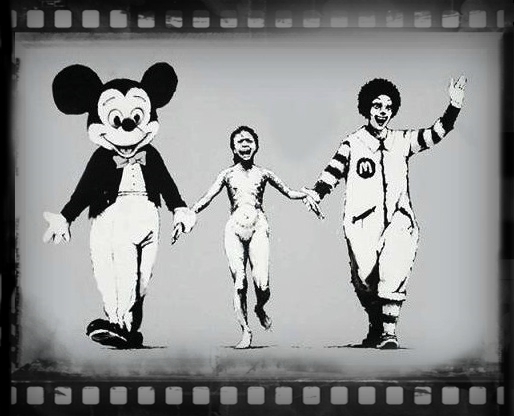
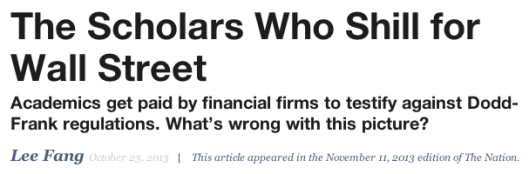









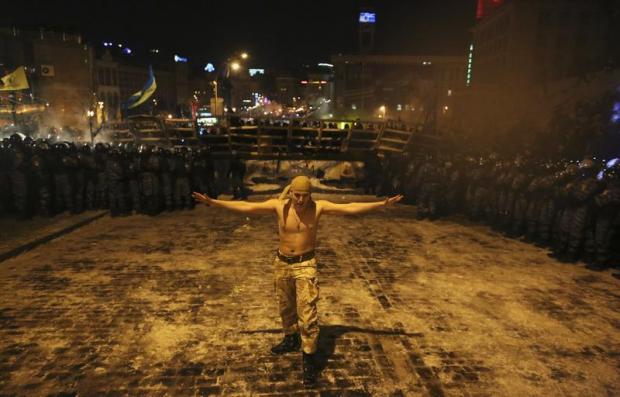



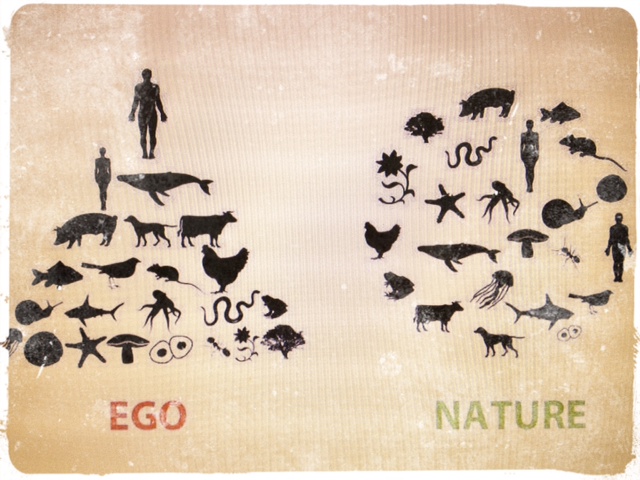





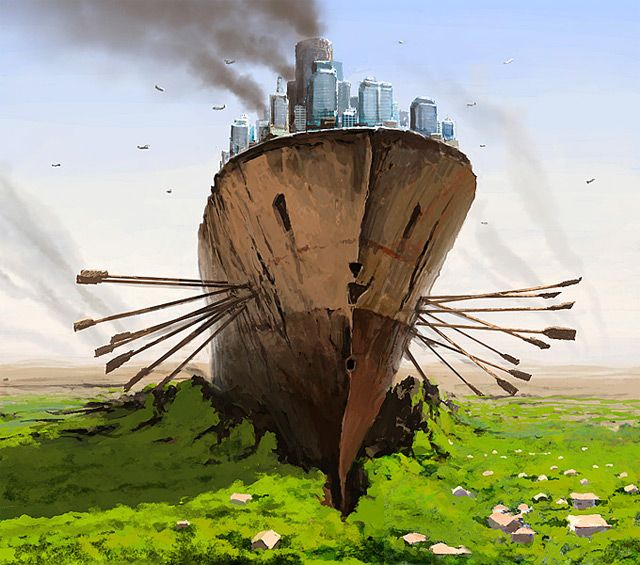

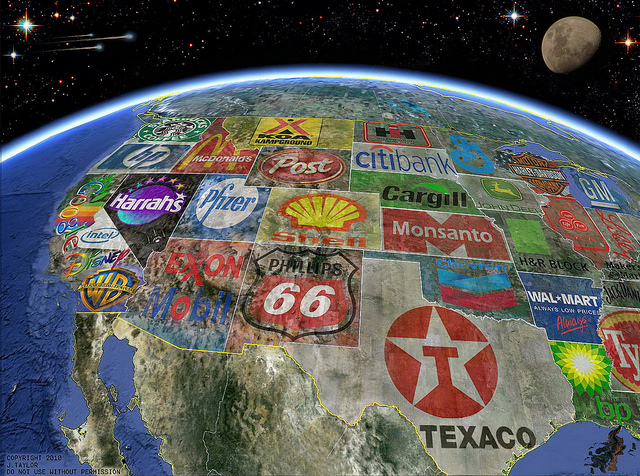

 Collapse of Industrial Civilization