
Tags
Amazon Deforestation, Anastassia Makarieva, Antonio Nobre, Biodiversity Hotspot, Brazil Rainforests, Cantareira Reservoir System, Capitalism, Climate Change, Climate Tipping Points, Collapse of Industrial Civilization, Drought in the Amazon Basin, Ecological Overshoot, Environmental Collapse, François-René de Chateaubriand, Global Risks 2015 Report, Mayan Civilization, Medicinal Plants, Peak Water, Roman Empire, São Paulo Water Crisis, The Biotic Pump Theory, Victor Gorshkov, World Economic Forum (WEF)
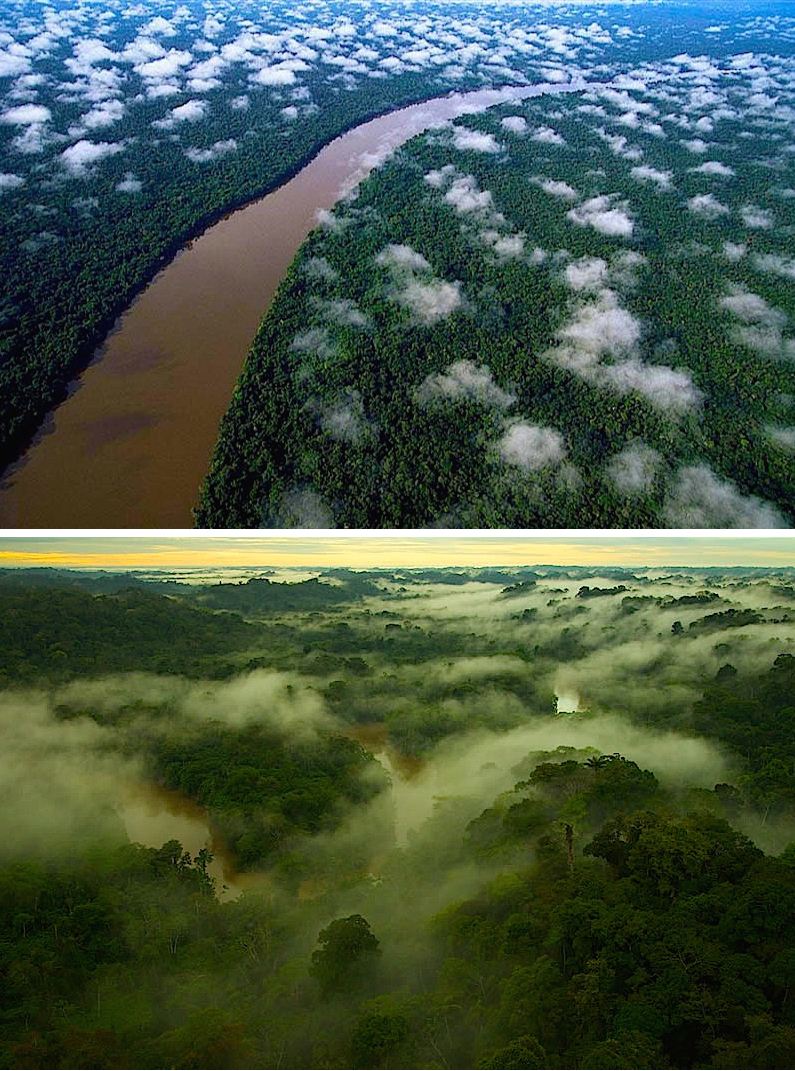
As Goes the Amazon, So Goes the World
Thought to be up to 100 million years old and home to more species than any other ecosystem on Earth, the Amazon rainforest is a magical place, but your average soft-bellied city dweller of industrial civilization would last no more than a week there, likely succumbing to yellow fever, malaria, flesh-eating parasites, venomous snakes, and an endless array of creepy-crawlies. Nearly one-third of the planet’s biodiversity is found in the Amazon, including ancient indigenous tribes, hundreds of animal species, 16,000 tree species, 2.5 million species of insects, and new discoveries happening all the time. With a treasure trove of medicinal plants, many of which have yet to be discovered, the Amazon is known to many as the world’s largest pharmacy. 70% of all drugs introduced in the U.S. in the last few decades were derived from nature, and 70% of plants identified as containing anti-cancer characteristics are found only in tropical rainforests.
The Amazon discharges one-quarter of the Earth’s freshwater and plays a critical role in the Earth’s carbon cycle and climate, absorbing 1.5 billion tons of carbon every year through photosynthesis. Additionally, the Amazon’s 400 billion trees are responsible for producing 20% of the Earth’s oxygen and generating the region’s heavy rains needed to irrigate crops, fill reservoirs, and generate hydropower. A single large rainforest tree is the equivalent of a standing lake releasing up to 317 quarts (300 liters) of water each day through evapotranspiration (evaporation and plant transpiration). The importance of the Amazon rainforest in regulating not only South America’s climate but also that of the entire world cannot be overestimated. Like the Earth’s cryosphere, the Amazon and other rainforests are essential geographic features of the planet that help regulate the climate and provide habitat for unique wildlife. As with the melting polar regions, the loss of the Amazon to capitalist “resource development” will prove to be a self-destructive act for all of mankind.
 The Biotic Pump Theory
In 2006, two Russian scientists, Victor Gorshkov and Anastassia Makarieva, used basic physics to theorize that condensation from forests, not temperature gradients, is what creates the low atmospheric pressure over land masses necessary for pulling moist air currents from the coasts to the continental interiors. Forests drive the water cycle on land. After two years and major pushback from the established meteorological community, their paper was finally published in the journal Atmospheric Chemistry and Physics and to this day has withstood refutation.
Gorshkov and Makarieva argue that meteorologists have long-missed an important driver of winds: condensation, and most importantly condensation caused by the major evaporation that occurs over forests. While scientists have long noted that deforestation also brings a drop in precipitation, no one could adequately explain the mechanism behind this. But Gorshkov and Makarieva argue that forests drive winds through “persistent condensation,” bringing in rain from the oceans. Put simply: no forests, no rain…
“During condensation water vapor disappears from the gas phase. Air pressure depends on the number of air molecules and is reduced by condensation. Areas with persistent condensation become zones of low pressure that suck in the air from the surrounding regions. Forests ensure both a store and a flux of moisture on land and thus create such persistent low pressure zones on land. This causes moist winds to blow from the ocean to land,” they explain.
Put another way, regions with lots of rainfall “set up a positive feedback in which they bring in moisture from elsewhere,” according to Sheil, who adds that, “Forests maintain the highest evaporation of moisture of any land cover.”…
…if the biotic pump turns out to be true, it would not change the fact that the climate is changing and herculean efforts are needed to mitigate both the causes and the impacts, whether that focuses on greenhouses gas emissions, forests, or, as it happens, both, since forests ability to store carbon is just one of the many services they provide. – Link
A more in-depth explanation of the biotic pump theory can be found in these two videos here and here.
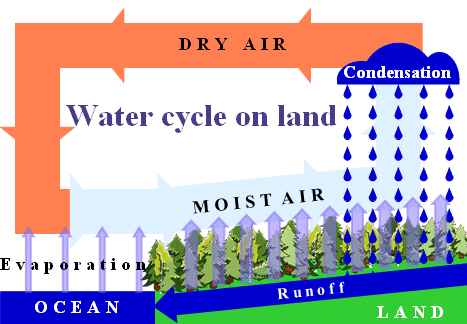
The biotic pump hypothesis explains what is behind the so-called “flying clouds of the Amazon” which carry moisture inland from the Atlantic ocean until they hit the Andes mountains and turn southward, dumping rain onto central and southern Brazil. Antonion Nobre, Brazil’s top climate scientist, is a proponent of the theory that forests function as biotic pumps for atmospheric moisture.
…As long ago as 2009, Antonio Nobre, one of Brazil’s leading climate scientists, warned that, without the ‘flying rivers’, the area that produces 70% of South America’s GNP would be desert.
In an interview with the journal Valor Economica, he said: “Destroying the Amazon to advance the agricultural frontier is like shooting yourself in the foot. The Amazon is a gigantic hydrological pump that brings the humidity of the Atlantic Ocean into the continent and guarantees the irrigation of the region.”
“Of course, we need agriculture”, he said. “But without trees there would be no water, and without water there is no food.
“A tonne of soy takes several tonnes of water to produce. When we export soy we are exporting fresh water to countries that don’t have this rain and can’t produce. It is the same with cotton, with ethanol. Water is the main agricultural input. If it weren’t, the Sahara would be green, because it has extremely fertile soil.”
Like other climate scientists, Nobre thinks the role of the Amazon rainforest in producing rain has been underestimated. In a single day, the Amazon region evaporates 20 billion tonnes of vapour – more than the 17 million tonnes of water that the Amazon river discharges each day into the Atlantic. – Link
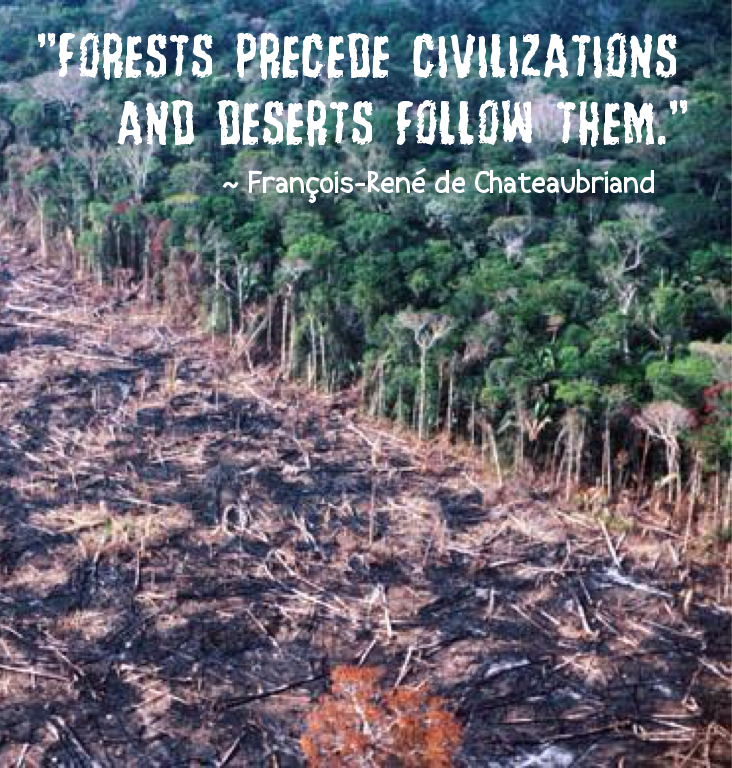
In 1980, just 3% of the Amazon rainforest had been cut down, but today the total loss has grown to about 25%, and in the last five months of 2014 the assault on the Amazon has intensified with October registering a staggering increase of 467% in deforestation. Although agriculture and illegal logging constitute the majority of cleared land, a growing percentage over the last 13 years has been for gold mining, a process that is particularly damaging to the environment due to the toxic brew of chemicals left behind. The double whammy of deforestation and anthropogenic global warming continues to weaken the Amazon. Remember that the Amazon suffered two 100-year droughts within 5 years in 2005 and 2010 and failed to recover since then. Other studies have confirmed that the Amazon appears to becoming more unstable in response to the large-scale environmental impact of rising CO2 and the cumulative effects of land degradation by humans. A study that came out just last month indicates a tipping point of 30-50% deforestation of rainforests in the Amazon and Central Africa which could lead to global effects.
…“What this study shows is that there are additional, independent effects of deforestation on climate.”
Lawrence’s report is a peer-reviewed summary of existing research, and she found that deforestation, even at small, localized levels, can change the climate. “Farmers in one place are connected to farmers in another. Countries are connected to each other,” Lawrence said. “We don’t want to wait until the climate system has shifted so we can measure it on the ground.”
She said there is a possible “tipping point” of 30 to 50 percent deforestation for the Amazon and Central Africa. Deforestation beyond that could invite disaster.
“Tropical deforestation on many scales influences local, regional and even global climate. Deforestation-driven changes to water availability and climate variability could have strong implications for agricultural production systems and food security in some regions,” the report says… – Link
If we add up the harmful effects of climate change and deforestation to the Amazon, then the tipping point may have already been breached. According to the Global Risks 2015 report by the World Economic Forum (WEF), water has for the first time displaced all other concerns to become the number one threat:
“Droughts, floods, glacial melt, unpredictable precipitation, runoff, groundwater supplies and water quality will all reflect an increasing instability as long-standing rainfall patterns change and weather extremes increase,” said Ganter.
The interconnecting risks regarding water, food, energy and climate change will be one of the overarching megatrends to shape the world in 2030, according to Ganter. – Link
São Paulo, Brazil: Repeating the Mistakes of the Mayans
 A wall mural in São Paulo painted by Brazilian artists Mundano and Fel depicting a boat on a cracked riverbed
São Paulo, a megacity of 20 million people in southeastern Brazil, is suffering its worst drought in 84 years since the summer rains failed to materialize a year ago. Only recently did water officials finally admit how serious the crisis was and that they had covertly rationed water by manipulating flow pressure in various parts of the city under the guise of “maintenance work”. Cantareira, the city’s largest water reservoir, is currently down to just 5.4% of its capacity and officials have implemented plans for pumping a third dead volume that represents the “rock bottom” of the reservoir. And this crisis isn’t just confined to São Paulo. Ninety-three other Brazilian cities affecting 3.9 million people are rationing water due to the lack of rain.
As of 1-22-2015:

Without water to run their hydroelectric power plants which provide 80-90% of the country’s electricity, Brazil has been forced to turn to more expensive and dirtier thermal plants burning natural gas, coal, diesel fuel and biomass. In turn, electricity rates have jumped 60% and Brazil’s CO2 emissions will undoubtedly increase. The rains may come again sporadically but I think the Brazilians have permanently broken the region’s biotic pump. What’s next for the wealthiest city in Latin America? Water wars will likely erupt for the last drop of moisture from a once-magnificent rainforest mowed down for hamburger-cattle, soybeans, and short-term profits.
Keeping the lights on and maintaining this current way of life is becoming increasingly tenuous as capitalist carbon man eats away at the last vestiges of a dying biosphere. Modern-day Brazil and the entire industrialized world are repeating the same mistake made by past civilizations such as the Mayans who cleared their forests for agriculture and development:
…In the first study, published Tuesday in the Proceedings of the National Academy of Sciences, researchers from Arizona State University analyzed archaeological data from across the Yucatan to reach a better understanding of the environmental conditions when the area was abandoned. Around this time, they found, severe reductions in rainfall were coupled with a rapid rate of deforestation, as the Mayans burned and chopped down more and more forest to clear land for agriculture. Interestingly, they also required massive amounts of wood to fuel the fires that cooked the lime plaster for their elaborate constructions—experts estimate it would have taken 20 trees to produce a single square meter of cityscape…
…Because cleared land absorbs less solar radiation, less water evaporates from its surface, making clouds and rainfall more scarce. As a result, the rapid deforestation exacerbated an already severe drought—in the simulation, deforestation reduced precipitation by five to 15 percent and was responsible for 60 percent of the total drying that occurred over the course of a century as the Mayan civilization collapsed. The lack of forest cover also contributed to erosion and soil depletion…
…The collapse is especially intriguing because it seemingly occurred at “a time in which developed a sophisticated understanding of their environment, built and sustained intensive production and water systems and withstood at least two long-term episodes of aridity,” says B.L. Turner, the lead author of the ASU study. In other words, the Maya were no fools. They knew their environment and how to survive within it—and still they continued deforesting at a rapid pace, until the local environment was unable to sustain their society.
One of the lessons of these complementary studies, says climate modeler Robert Oglesby of the University of Nebraska, who worked on the second paper, is that our reshaping of the environment can often have unintended consequences—and we may not have any idea of what they are until it’s too late… – Link
One could safely say all human endeavor is at the mercy of the natural world and the vagaries of the weather. The ebb and flow of the mighty Roman Empire, along with its downfall, aligned with shifts in the climate, according to tree ring research:
…When [lead researcher] Büntgen showed the data to historians and archaeologists, they pointed out remarkable consistencies with what we know of past societies. At times of social stability and prosperity, like the rise of the Roman Empire between 300 B.C.E. and 200 C.E., Europe experienced warm, wet summers ideal for agriculture. Similar conditions accompanied the peak years of medieval Europe between 1000 C.E. and 1200 C.E.
The study also showed that climate and catastrophe often line up. In the 3rd century C.E., for example, extended droughts matched the timing of barbarian invasions and political turmoil. Around 1300 C.E., on the other hand, a cold snap combined with wetter summers coincides with widespread famines and plague that wiped out nearly half of Europe’s population by 1347… – Link
Believing that somehow things are different this time around and that our technological prowess will save us, few today pay much attention to the history of man’s folly and the overreach of past civilizations. The brutal reality is that nothing has changed since then except for the epic degree of capitalist carbon man’s hubris and the scale of his overshoot which has now reached global proportions, guaranteeing that no one will be spared, neither rich nor poor, wretched nor innocent. Meanwhile, our fearless leaders took a page out of The Onion the other day and got together to agree that “climate change is real and not a hoax” while inserting the caveat that humans are still not the cause. Did that really just happen?…Don’t let this surreal world get you down. We’re simply spectators observing the tragicomedy of the human race.
 Collapse of Industrial Civilization
Reblogged this on GarryRogers Nature Conservation and commented:
This article discusses how deforesting the Amazon Basin and other regions could lead to the fall of modern civilization.
LikeLike
In 2010 I spent 10 weeks camped out at a Buddhist temple in Cabreuva, Sao Paulo state, Brazil. In 2012 I returned and spent 10 days couch surfing a friends apartment in Sao Paulo, Brazil. In the top 10 of the largest cities on the planet with 20 million people in the city and surrounding suburbs the potential human calamity of a drought there is much more than anyone can understand unless you have been there.
The largest city that I have ever visited, looking off a 21st floor hotel balcony in 2010 all I could see was cityscape to the horizon. Imagine the topography and urban culture of San Francisco California, but more than 20 times the population, and you get a feel for Sao Paulo Brazil.
LikeLike
“Believing that somehow things are different this time around and that our technological prowess will save us, few today pay much attention to the history of man’s folly and the overreach of past civilizations.”
Historian A.J. Toynbee pointed out how the bulk of civilizations commit suicide, the remaining few on the list of civilizations are murdered.
He became disfavored because he did not flatter civilization.
Our president in the SOTU address bragged about us being number one in producing the poisons that are destroying us.
Freud said civilization itself can does go insane from time to time (Agnotology: The Surge – 15).
The Amazon debacle you reveal, and the addiction to oil are evidence that civilization is committing suicide.
LikeLike
As usual, Heinberg’s is a voice of reason and calm. This is a comprehensive take on our energy situation.
http://www.resilience.org/stories/2015-01-21/our-renewable-future
LikeLike
Desertification goes all the way back to the Sumerian civilization. China’s expanding desert sends wafts of particles into Korea on a regular basis. Whereas past civilizations forsook these wastelands to marginal nomads and emptiness, modern societies build cities and import water (see Las Vegas or Arizona). Eventually, that will fail, but imagine how detached from reality people are when they build an ice hockey rink in the middle of a desert.
LikeLike
No forests, no bees, no ocean life…..No humans
LikeLike
From RawStory…
Vice founder Shane Smith on sea level rise: Why the f*ck aren’t we freaking the f*ck out?
The comments on this story at Reddit are entertaining:
LikeLike
Must watch video here(ClimateCrocks):
The comments on this video at Reddit are entertaining as well:
LikeLike
The oceans are warming so fast, they keep breaking scientists’ charts
NOAA once again has to rescale its ocean heat chart to capture 2014 ocean warming
LikeLike
Good piece. Rainfall distribution will be extremely important in determining the future habitability of the planet, just as it has been in the past.
Here in Scotland we lost the lush forests of the early Holocene but got more rather than less rain, resulting in much of the country being covered in a desert of peat bog.
LikeLike
Hey Mike: another great essay! i came across two articles on the same subject in different locations regarding sea-level rise and polar ice melt.
The first one is already posted above (the Rignot video) and here’s the other one:
http://phys.org/news/2015-01-lakes-beneath-ice-greenland-weeks.html
[begins]
Two lakes beneath the ice in Greenland, gone within weeks
Researchers who are building the highest-resolution map of the Greenland Ice Sheet to date have made a surprising discovery: two lakes of meltwater that pooled beneath the ice and rapidly drained away.
One lake once held billions of gallons of water and emptied to form a mile-wide crater in just a few weeks. The other lake has filled and emptied twice in the last two years.
Researchers at The Ohio State University published findings on each lake separately: the first in the open-access journal The Cryosphere and the second in the journal Nature.
One lake once held billions of gallons of water and emptied to form a mile-wide crater in just a few weeks. The other lake has filled and emptied twice in the last two years.
Researchers at The Ohio State University published findings on each lake separately: the first in the open-access journal The Cryosphere and the second in the journal Nature.
Ian Howat, associate professor of earth sciences at Ohio State, leads the team that discovered the cratered lake described in The Cryosphere . To him, the find adds to a growing body of evidence that meltwater has started overflowing the ice sheet’s natural plumbing system and is causing “blowouts” that simply drain lakes away.
“The fact that our lake appears to have been stable for at least several decades, and then drained in a matter of weeks—or less—after a few very hot summers, may signal a fundamental change happening in the ice sheet,” Howat said.
The two-mile-wide lake described in Nature was discovered by a team led by researcher Michael Willis of Cornell University. Michael Bevis, Ohio Eminent Scholar in Geodynamics and professor of earth sciences at Ohio State, is a co-author of the Nature paper, and he said that the repeated filling of that lake is worrisome.
[there’s more]
The real threats are unseen by most and therefore not even considered as such.
We’ll all be “so surprised” when suddenly seas wash into coastal cities and don’t recede, when summer heat becomes so stifling that it’s hard to breathe and impossible to cool off, when the electrical grid (which is breaking down faster than we can keep up with repairs and maintenance) fails for extended periods of time until it finally doesn’t come back, and when disease outbreaks overwhelm our medical system (among many others).
Keep up the good work.
LikeLike
Frightening. SLR will inundate our cities much faster than expected.
LikeLike
“It’s easy to imagine a future in which growing numbers of cities have their frail and long-neglected infrastructures knocked out by disasters and then are left to rot, their core services never repaired or rehabilitated. The well-off, meanwhile, will withdraw into gated communities, their needs met by privatized providers.”
Naomi Klein, The Shock Doctrine
Substitute “ruling class” for “well-off” and “fortress cities” for “gated communities” and I think that might be pretty close to what the near future will look like; for a little while anyway.
“…no one will be spared, neither rich nor poor, wretched nor innocent.”
Just my opinion
LikeLike
In the ’80s, this was called the Evapo-transpiration Cycle,I am not sure why we needed a team of Russians to tell us what my father told me in the ’50s. Oh, that’s right, he left school at 14, but he just read a lot. No university education to box his head in. Just so long as they don’t tell us that Rain follows the Plough.
LikeLike
Reblogged this on Joe's Notepad.
LikeLike
The U.S. has caused more global warming than any other country. Here’s how the Earth will get its revenge.
LikeLike
Nature Bats Last
LikeLike
The bigga badda boom clock has been hacked.
LikeLike
Nice work again xraymike.
Brazil’s worst drought in history prompts protests and blackouts
Lights go out, internet is cut for days, and agriculture is suffering as crisis spreads from São Paulo to Rio de Janeiro and beyond
http://www.theguardian.com/world/2015/jan/23/brazil-worst-drought-history
LikeLike
You beat me to it.
LikeLike
This is what I find really frightening. I can’t quantify it with links, or studies, or careful observations, but I also can’t escape the feeling that as the global situation deteriorates there is a corresponding rise in extremist reactionary politics.
Oh sure, political theater has always been rife with ignorance and pandering to the low-minded and meanest of emotions, but I think that as collapse gathers speed in the years to come there is a very good probability that increasingly desperate people will do increasingly desperate things to hang on to what little is left of their former lives. Including but not limited to turning to “leaders” who promise a return to past glories no matter what the cost in blood.
What will bite first, or bite hardest? Climate chaos? Food and water shortages? The energy crisis? Financial collapse? Or the breakdown of civil society as Jim Kunstler’s so-called “corn-pone nazis” start rounding up environmentalists for the gas chambers?
LikeLike
Corn-pone Nazis, that’s a good one! We have a lot of them around here who think their guns will protect them from the tyrannical guvment. Stupid people are more intuitive, because they don’t use the thinking area of their brain. They sense something is wrong, but are controlled by propaganda machines of the corporate elites. Guns won’t protect you from climate change.
LikeLike
Another few iterations of technological evolution and we’ll be cooked. Another few product cycles to replace obsolete, worn-out or just plain unfashionable technology and extinction will be ours, even for a population of 500 million. We’re a growth machine, the heat engine from hell, a destroyer and as I’ve said many times, a cancer. Relative consciousness in the human brain will be short-lived, the technological hollow-point is already spinning towards its mind-shattering destination. No time to react, we must take the hit. Perhaps we’ll lie crumpled for a while, breathing, heart beating without thoughts or words before finally expiring. Expiration means no further distribution of essential oxygen and food or removal of waste. A turning of the body into a gaseous toxic sludge before complete disintegration. Those humans that relied absolutely upon the evolved technological organs of the body will likely perish, those in cities where the greatest concentration of soon-to-be deprived citizens reside. No trash collection, no sewer, no water, no electric, no food, or perhaps for a while, but increasingly failing, and then you die, perhaps by the violence and disease that such conditions will provide. Some that move beyond the body or make plans to move beyond the technological body while the body still provides them with energy and resources to do so, may have a statistically much higher chance of surviving. Look to nature for the skills you’ll need, deception, food production and storage (fat), water filtration, mobility, lethal defenses in case of violent confrontation, as much medical acumen as can be learned and supplies.
Ask yourself this question, “Am I more interested in the psi of footballs in the NFL or the fact that most of the world’s coastal cities will soon be flooded?” Most people will be quite surprised at the absolute impotence of science and technology, miracles, government, and/or Harry Potter to deliver them from evil and hardship. Former Energy Secretary James Schlesinger said “We have only two modes – complacency and panic.” We’re about to close the door on complacency, so prepare for the panic. Our “leaders” have been nurturing our complacency, which enriches them, while preparing for our panic with a reduction in freedoms, surveillance, militarized police, drones in the skies, and refugee camps. The terrorists from the Middle East are simply a sparring partner leading up to a bigger fight. What can make us forget our domestic animosities? Vlad Putin, the Russian Bear? ISIS killing babies? They’ll find something and panic amongst the simple citizens will become a focused animosity against an unfortunate scapegoat. If I could send only one message to those buffoons it’s this, “WON’T WORK”, at least not beyond the very short term, but, hey, maybe they really don’t care.
LikeLike
Lol. As far as I’m concerned your twisted responses to our absurd situation are the most legitimate. I do not believe that TPTB will last very long once things get really out of hand. Once it is obvious that we will never be able to go back, the praetorian guard will simply dispatch them. It will be like the last years of the western Roman Empire. I submit an example of what I think will be a common strategy by enraged testosterone fueled home grown terrorists/freedom fighters in N America in the near future and probably the rest of the world too. Knowing what I do, I think I’ll just go for a walk in the woods when the time comes.
Another power tower blasted
http://www.tempo.com.ph/2015/01/another-power-tower-blasted/
LikeLike
It was just a matter of time before the consequences of getting one’s medical advice from celebrities caught up with society. I’m afraid this is just the beginning because the cult minded usually double down when the evidence refutes their world view. It’s 2015, who would have thunk we would see this 30 – 40 years ago? Not me.
Measles outbreak spreading beyond Disneyland visitors
http://www.latimes.com/local/orangecounty/la-me-0118-measles-outbreak-20150118-story.html#page=1
LikeLike
“…and still they continued deforesting at a rapid pace, until the local environment was unable to sustain their society.”
That’s what “civilisation” always has done and always will do: exceed the carrying capacity of the landbase.
Like a cancer, “civilisation” is inherently expansionistic. Humans can deindustrialise and “decivilise” or face extinction. Those are really the only options available.
Just my opinion
“Human beings will be happier – not when they cure cancer or get to Mars or eliminate racial prejudice or flush Lake Erie but when they find ways to inhabit primitive communities again. That’s my utopia“.
Kurt Vonnegut
LikeLike
i don’t think it’s a matter of “or” anymore Richard (- just my two cents).
LikeLike
You could certainly be right but I’m just not ready to accept it as a certainty quite yet. I think there may still be a chance there could be pockets of survivors.
For reasons unknown it might even be possible for some to survive the massive methane release that’s almost certainly coming soon.
I just don’t know.
“Eat thou and drink ; to-morrow thou shalt die. Surely the earth, that ‘s wise being very old, needs not our help.” – D. G. Rossetti, 1870, from a sonnet in “House of Life.”, page 76
But that’s always been true. I still think it wouldn’t hurt for those who are able and knowledgeable to prepare.
“…chance favors only the prepared mind.” – Louis Pasteur, Lecture, University of Lille (7 December 1854)
LikeLike
Richard,
I wish that when the topic of “pockets of survivors” comes up the conversation wouldn’t just stop there. It’s like hitting a brick wall.
There is so much to unpack within that phrase, yet I believe for most people they have a fantasy in their heads that they’ve build (much like a Hollywood movie) in how they perceive those survivors living.
Do you think it’s a world that either you or or offspring would enjoy living?
I realize that for many born in the future, just as is true today, there will be no context of a past that no longer exists. It will be similar to how in the movie Soylant Green the character of Sol would regals his roommate Thorn with tales of the past. Thorn has no interest in the tales Sol tells, he’s bored by them. It’s only when he sees the videos while Sol is undergoing euthanasia (before becoming Soylant) that Thorn realizes what the world has lost.
For those hooked up to the iPhones, etc. etc the same can be said. For most young people they don’t have any reference to the past, have no appreciation for it and think that we’ll be heading out to Mars to live courtesy of Richard Bransome (as Rob Lowe gleefully said in the commentary of the film “I Melt With You”, a film that is not for the faint of heart).
LikeLike
Of course it’s like a brick wall, and what’s beyond it is unknown. There’s really no way of knowing who will survive or exactly what conditions they’ll be dealing with. What they will do depends upon who and where they are and what options are available to them.
There’s simply no way to “unpack” the phrase. Too many unknowns. Anything we say at this point is at least 95% speculation. I suppose it’s quite possible that the situation might turn out to be similar to any of a number of “post apocalyptic” movies. I personally have no definite preconceptions. I can only imagine the possibilities to a very limited degree.
Enjoy? I’m 68. If civilisation collapsed tomorrow I’d probably be dead within a matter of days or even hours. I’m the sole caregiver for my father who is 92 and has Progressive Supranuclear Palsy. I am far to dependent upon the technologies of the culture I have been conditioned to.
As for “offspring“, mine, like I, are already too old to adapt to a world sans all the “modern conveniences“. But isn’t it just possible that the young could be educated, prepared as best as possible for what’s coming? The collapse is coming and it can’t be stopped. If there’s a hurricane coming, a tornado, blizzard or any “natural disaster“, for which advanced warning can be given, people prepare. There have to be steps that could be taken to give survivors an edge, however thin. But no. That will never happen. At least not on any large scale. It’s basically left up to individuals, those with the knowledge and resources, to do whatever they can at a micro level.
I certainly can’t say with any certainty how much of “history” will be lost. So much of it is revisionist bullshit that much has been effectively lost anyway. Perhaps there’s been enough preserved by some of the “first people” that can be passed on. The world that’s being lost isn’t, in my opinion, one worth saving anyway.
The “context” that needs to be recovered is one from a time other than now anyway; prior to the Neolithic revolution.
While you’re probably right about most young people, I imagine there are some who can still manage to think critically.
“Human beings will be happier – not when they cure cancer or get to Mars or eliminate racial prejudice or flush Lake Erie but when they find ways to inhabit primitive communities again. That’s my utopia“. – Kurt Vonnegut
Just my opinion
LikeLike
Lake Urmia: how Iran’s most famous lake is disappearing
New research shows Iran’s most famous lake has shrunk by nearly 90% since the 1970s. Scientists urge action
http://www.theguardian.com/world/iran-blog/2015/jan/23/iran-lake-urmia-drying-up-new-research-scientists-urge-action
LikeLike
Same happening in Russia too, Apneaman. Did you see this:
http://robinwestenra.blogspot.co.nz/2015/01/russia-sounds-alarm-as-lake-baikals.html
Russia sounds alarm as Lake Baikal’s water levels drop
Water in Lake Baikal Drops to Dangerously Low Levels Due to Droughts
LikeLike
And yet if you’ve been reading Orlov he seems to side step Climate Change most of the time in his writing regarding the current ongoing situation with the US vs Russia. His content leaves me with the impression that Russia is well situated to survive what ever NATO (read the US) is throwing at her. Only how can she be well situated if she’s facing the repercussions of Climate Change. Sometimes it sounds to me as if Orlov sees Russia as a kind of Shangri-La of Lost Horizon fame.
Personally I don’t get it. If Russia is a place to consider for the future why is Orlov still living in the USA at this point?
I find myself similarly confused when Tom Lewis states, “It’s not the end of the world as we know it.” That phrase gets bandied around quite often and usually it obfuscates the more complex underlying events unfolding. As far as I’m concerned it sure is the end of the world as we know as is evidenced by the ongoing drought in Brasil, New Zealand and California.
It’s just not the end of the world.
And the conflicting messages regarding the California drought come from the most unexpected places for instance the Peak Prosperity folks.
Doug Parker: The Status Of The Drought In The U.S. West
There’s reason for hope, but no end yet in sight
http://www.peakprosperity.com/podcast/90272/doug-parker-status-drought-us-west
LikeLike
Agree 100% on Orlov, etc.
Orlov seems to be a cheerleader for Putin, hmmm…
LikeLike
Deforestation (2001-2013) in Latin America(Brazil/Amazon) compiled from Global Forest Watch:
LikeLike
This should turn out well.
US Trainers To Deploy To Ukraine
http://www.defensenews.com/story/defense/land/army/2015/01/21/ukraine-us-army-russia/22119315/
LikeLike
Duck and Cover
LikeLike
Pingback: Stars and civilization | Rebalancing Acts
Arctic greening can cause earlier seasonality of Arctic amplification
Abstract
As global temperatures rise, vegetation types will change, particularly in the northern high latitudes. Under a warming scenario, shrub and grasslands over the Arctic are expected to shift to boreal forests. This study compares the impact of such a change in Arctic vegetation type with that of CO2 doubling on the seasonality of Arctic warming. Even though vegetation is changed throughout the year, the effect of the surface albedo change is maximum in boreal summer when the incoming solar radiation is largest. Evapotranspiration changes are also maximized in the summer, when the photosynthesis rate is highest. As a result, when Arctic vegetation change is considered in addition to doubled CO2, Arctic amplification is maximized earlier in the annual cycle.
http://onlinelibrary.wiley.com/doi/10.1002/2014GL061841/abstract
LikeLike
An Arctic ice cap’s shockingly rapid slide into the sea
“Just since 2012, a portion of the ice cap covering the island has thinned by a whopping 160 feet….”
“Put another way, the ice cap’s vertical expanse dropped in two years by a distance equivalent to the height of a 16-story building.”
http://www.washingtonpost.com/news/energy-environment/wp/2015/01/23/an-arctic-ice-caps-shockingly-rapid-slide-into-the-sea/
LikeLike
Mass Death of Seabirds in Western U.S. Is ‘Unprecedented’
…”This is just massive, massive, unprecedented,” said Julia Parrish, a University of Washington seabird ecologist who oversees the Coastal Observation and Seabird Survey Team (COASST), a program that has tracked West Coast seabird deaths for almost 20 years. “We may be talking about 50,000 to 100,000 deaths. So far.”…
…One Die-Off Among Many
The gruesome auklet deaths come just as scientists around the globe are seeing a significant uptick in mass-mortality events in the marine world, from sea urchins to fish and birds. Although there doesn’t appear to be a link to the virus that killed tens of millions of sea stars along the same shores from California to Alaska over the past 18 months, some scientists suspect a factor in both cases may be uncharacteristically warm waters….
LikeLike
Correct answer by jrwreno on Reddit:
The moment I read that they are determining the birds died from starvation….I immediately knew that this is due to warmer coastal waters prohibiting phytoplankton blooms in the region.
There is a terrifying uptick in phytoplankton blooms….disappearing……blooms that are typically so large, they can be seen from high aerial photographs.
Phytoplankton is the base of the marine food chain…..if we are having sudden bloom failures, this has the potential to wipe out an entire coastal marine ecosystem.
Warm coastal waters are a curse. Phytoplankton require a cold to warm water transition zone, with the cold water bringing nutrients from the bottom to the surface….allowing for the right conditions for a ‘greenbelt’ of phytoplankton to bloom and kick-start that local marine ecosystem.
This is happening is so many places, it should be giving everyone night sweats.
We also seem to forget……phytoplankton are responsible for a significant role in producing a good portion of the worlds oxygen….while also locking up CO2 when the plankton can bloom out. The world depends on phytoplankton locking up Co2, just like the world depends on the huge Northern deciduous forests to bloom in spring, with fresh leaf generation locking up enormous amount of CO2 from the atmosphere. Without those blooms existing, we simply continue to have more atmospheric CO2 saturation, which the ocean continues to absorb…..acidifying it even more…..
God this is depressing and I am dizzy.
LikeLike
Tropic of Chaos: Climate Change and the New Geography of Violence
Lockdown America: Police and Prisons in the Age of Crisis
Available as free downloads here:
https://nyu.academia.edu/ChristianParenti/Books
LikeLike
“Edward Abbey compares capitalism with cancer: growth for the sake of growth. This panel considers the violent legacies of capitalism’s exploitation and appropriation of nature. It inquires into how views of natural systems as separate from human systems–political, social, and economic– may be part of the problem we face in confronting climate change.”
LikeLike
Doomy stories are now fighting for market share.
……………………………………………………………………
Hottest Year’ Story Obscures Bigger News: Ocean Warming Now Off The Charts
http://thinkprogress.org/climate/2015/01/22/3614256/hottest-year-ocean-warming/
LikeLike
Peter Ward briefly mentioned the Deccan Traps in one of his videos.
Gas spewing volcanic traps are as slow as crippled slugs compared to
techno carbon man.
……………………………………………………………………………………
New, tighter timeline confirms ancient volcanism aligned with dinosaurs’ extinction
“The results support the idea that the Deccan Traps played a role in the K-Pg extinction, and challenge the dominant theory that a meteorite impact near present-day Chicxulub, Mexico, was the sole cause of the extinction”
http://www.princeton.edu/main/news/archive/S41/89/26O49/index.xml?section=topstories
LikeLike
Good work.
LikeLike
That theory was in vogue for years before becoming disfavored by the current consensus developed a few years ago: “A panel of 41 international experts, including UK researchers from Imperial College London, the University of Cambridge, University College London and the Open University, reviewed 20 years’ worth of research to determine the cause of the Cretaceous-Tertiary (KT) extinction, which happened around 65 million years ago. The extinction wiped out more than half of all species on the planet, including the dinosaurs, bird-like pterosaurs and large marine reptiles, clearing the way for mammals to become the dominant species on Earth.
The new review of the evidence shows that the extinction was caused by a massive asteroid slamming into Earth at Chicxulub (pronounced chick-shoo-loob) in Mexico.” (journal Science).
The back story to the scientific conclusion is the institutional denial involved in perpetuating and now resurging the old theory
(State Crimes Against Democracy, with links).
LikeLike
A very rare Earth element found abundantly in asteroids is deposited precisely at the K-T boundary layer all over the globe in global layers that date to ~65-66mya: “One key piece of evidence was the abundance of iridium in geological samples around the world from the time of the extinction. Iridium is very rare in Earth’s crust and very common in asteroids. Immediately after the iridium layer, there is a dramatic decline in fossil abundance and species, indicating that the KT extinction followed very soon after the asteroid hit.” (Science Daily, “Asteroid killed off the dinosaurs, says international scientific panel”, 3/4/10).
A recent paper from a science journal:
“The theory that an asteroid rapidly killed off the dinosaurs is widely recognized, but until recently dinosaur fossils from the latest Cretaceous–the final stanza of dinosaur evolution–were known almost exclusively from North America. This has raised questions about whether the sudden decline of dinosaurs in the American and Canadian west was merely a local story.
The new study synthesizes a flurry of research on European dinosaurs over the past two decades. Fossils of latest Cretaceous dinosaurs are now commonly discovered in Spain, France, Romania, and other countries.
By looking at the variety and ages of these fossils, a team of researchers led by Zoltán Csiki-Sava of the University of Bucharest’s Faculty of Geology and Geophysics has determined that dinosaurs remained diverse in European ecosystems very late into the Cretaceous.
In the Pyrenees of Spain and France, the best area in Europe for finding latest Cretaceous dinosaurs, meat and plant-eating species are present and seemingly flourishing during the final few hundred thousand years before the asteroid hit.” (Science Daily, 1/13/15).
The Social Darwinists, pro-Eubonics intellectuals, and genieologists can’t handle the fact that abiotic dynamics are far more important to evolution, and have been active for far, far longer than the more recent biotic evolutionary dynamics (On The Origin of Genieology – 2).
Darwin was infected with racism: “Lastly, I could show fight on natural selection having done and doing more for the progress of civilisation than you seem inclined to admit. Remember what risks nations of Europe ran, not so many centuries ago, of being overwhelmed by the Turks, and how ridiculous such an idea now is! The more civilized so-called Caucasian races have beaten the Turkish hollow in the struggle for existence. Looking to the world at no very distant date, what an endless number of the lower races will have been eliminated by the higher civilized races throughout the world.” – Charles Darwin (1881 letter)”
That type of racism fed the Social Darwinism Movement’s errors for a long time, even leading to Eubonics.
They do not like evidence that abiotic cosmic and quantum mechanical events had more of an impact on extinction than natural selection did.
They don’t see evolution as a whole, but as a narrow slice of time following the advent of carbon based life emerging on Earth.
“It ain’t what they call rock and roll.” – Dire Straits, Sultans of Swing
LikeLike
LOL … “Eugenics” not “Eubonics” … sorry!
LikeLike
Burning wood pellets releases as much or more CO2 per unit than coal.
Green Energy or New Source of CO2 Emissions?
“…as wood pellet manufacturing booms in the southeastern U.S., scientists and environmental groups are raising significant questions about just how green burning wood pellets really is. The wood pellet industry says that it overwhelmingly uses tree branches and other waste wood to manufacture pellets, making them a carbon-neutral form of energy. But Critics contend pellet manufacturers frequently harvest whole hardwood trees that can take a long time to regrow. many environmentalists and scientists believe current industry practices are anything but carbon-neutral and threaten some of the last remaining diverse ecosystems in the southeastern U.S., including the Roanoke River watershed surrounding the Ahoskie, N.C., plant and longleaf pine ecosystems near the large Enviva wood pellet mill in Cottondale, Fla.”
http://e360.yale.edu/feature/wood_pellets_green_energy_or_new_source_of_co2_emissions/2840/
LikeLike
In BC, the forestry industry has been trying to do somethings with the dead trees (“bugwood”) from the huge pine beetle infestation of the last decade. Manufacturing wood pellets is one option for harvesting the dead trees, but there have been tragic unintended consequences.
How a beetle outbreak may have caused two sawmill explosions in B.C.
http://globalnews.ca/news/1608707/how-a-beetle-outbreak-may-have-caused-two-sawmill-explosions-in-b-c/
LikeLike
The Magical Fairy Tale of Energy Independence
The U.S. cannot drill or frack its way to “energy independence.”
http://www.blueridgenow.com/article/20150124/ARTICLES/150129996?p=all&tc=pgall
LikeLike
California Drought Worsening During Height of Rainy Season
The Western U.S. winter rainy season has reached its halfway point, and there is only bad news to report for drought-beleaguered California. November through March marks the period when California receives its heaviest rains and snows, thanks to the wintertime path of the jet stream, which dips to the south and brings wet Pacific low pressure systems to the state. The rainy season started out promisingly, with several December storms bringing precipitation amounts close to average for the month over much of the state. Troublingly, though, record-warm ocean temperatures off of the coast meant that the December storms were unusually warm. This resulted in snow falling only at very high elevations, keeping the critical Sierra snow pack much lower than usual. The jet stream pattern shifted during January 2015, bringing disastrously dry conditions to the state. January usually brings 4.19″ of rain to San Francisco, but no rain at all has fallen in January 2015 in the city–or over much of Central California. The dryness has been accompanied by near-record warmth at higher elevations in the Sierras, with temperatures at Blue Canyon and South Lake Tahoe averaging nearly 8°F above average for the month of January. As a result, the snowpack in the Sierras–a critical reservoir of water that is used throughout the rest of the year–is abysmally low, running about 30% of normal for this time of year. California’s eight largest reservoirs are 33% – 86% below their historical average, and the portion of the state covered by the highest level of drought expanded in mid-January–a very ominous occurrence for the height of the rainy season…
LikeLike
The local lake/reservoir which supplies water to the City of Santa Barbara is extremely low. It is currently, as of today’s data, at 28% capacity. 54,749 Acre Feet, capacity is 193,305 Acre Feet. The last time it was this low, other than when the lake filled originally behind the dam, was in 1991 when it dropped to 29,000 acre feet.
Thankfully the water in my tap comes from a different source.
LikeLike
Arsenal2105 at Reddit says: “We should wish that a collapse never happens.”
My response:
Since when did wishing change reality? If stating facts is a crime, then we surely are doomed. It’s a scientific fact that mass die-offs have increased one event per year for the last 70 years:
http://www.upi.com/Science_News/2015/01/14/Mass-die-offs-among-fish-birds-and-invertebrates-on-the-rise/1961421267818/
It’s a fact that scientists have admitted the Earth’s cryospheric regions are in terminal decline:
http://climatecrocks.com/2015/01/22/the-fuse-is-blown-glaciologists-jaw-dropping-account-of-a-shattering-moment/
It’s a scientific fact that the Amazon rainforest, the “lungs of the Earth”, is destabilizing and has never recovered from the global warming-induced droughts of 2005 and 2010:
https://collapseofindustrialcivilization.com/2015/01/22/forests-precede-us-deserts-follow/
It’s a fact that global human population overshoot continues apace in the face of environmental collapse:
http://www.worldometers.info/
You can continue to “wish” for a nice future, but the the facts state otherwise.
LikeLike
I think it’s good of you to take the time to wander over to Doomer elementary school and provide them with some free advanced Doomer lessons. Hell a conversation or two with you is like skipping a few grades.
I thought the comment from rad_change was very interesting and unintentionally hilarious.
“I’ve thought about this for a while. If a community like /r/Collapse were available 50 years ago, we could realistically start something that could alter history in a positive way, in the long term”
I guess rad never heard of the hippy’s. Why would he though, since most of them were assimilated into the corporate Borg and history has re branded all of them as nothing but drug taking sex freak malcontents. The winners get to write the history.
LikeLike
What is “practical” now for modern industrial civ is impractical for the survivability of future generations. No fixes, only radical change…yesterday.
LikeLike
Droughts in Brazil and California Connected (Study Cited)
Study: If a tree falls in Brazil…? Amazon deforestation could mean droughts for western U.S.
http://www.princeton.edu/main/news/archive/S38/31/66M12/index.xml?section=topstories
LikeLike
More insanity from Brazil.
Brazil official: No water rationing in Rio before July
http://news.yahoo.com/brazil-official-no-water-rationing-rio-july-191734457.html
Rio De Janeiro Is Breaking One Big Promise That Helped It Land The 2016 Olympics
http://www.businessinsider.com/rio-de-janeiro-is-breaking-one-big-promise-that-helped-it-land-the-2016-olympics-2015-1
LikeLike
No one can externalize costs (economic jargon for destroying the landbase), move on when there’s too much entropy build up, find some new virgin dumping ground, and expect there to be no consequences. In reality, homo colossus is using the earth as one giant entropy sink on hyperdrive. We’re fooling ourselves when we talk about ‘cleaning up’ or ‘restoring’ damaged ecosystems, usually with public tax subsidies, I should add. These places never return to their original condition; they’re more like a sick parody of their former states.
When we talk about population problems, we need to include all the consumption aspects, and these include the population of machines and trinkets we’ve suffocated ourselves with that demand exorbitant amounts of energy.
Of course, world leaders will seek to perpetuate the system as long as they can and people will likely continue along their normal path, hoping and wishing for the best, because it worked in the past. Problems arose and were circumvented, at least temporarily. Short-term, this is adaptive; long term, it’s disaster.
The world system is in crisis. Rising costs of inputs (raw materials), remuneration (labor), and consequences (pollution/devastation) are hurting the ability of the system to accumulate and concentrate profit, which is a major reason why speculation in the phantom world of derivatives and variations of this electronic circus have skyrocketed. Dealing with this myriad of converging problems requires further taxation, but that will undermine either consumer demand or raise production costs, depending on who’s targeted. But nations must do it or risk outright rebellion. In most industrial nations, people have grown up cultivated to expect ‘free’ access to social services, healthcare, and education. Nations will also pour more into security because they must realize this defunct liberal agenda is unsustainable. There’s no way out, which is why it’s a crisis. All the methods for lowering costs have been tried: ZIRP, QE, relocation to areas with significant rural populations who are forced to urban centers where a low wage represents an increase in income, relocation to virgin land. The world is now full – full of cities which are full of people protesting for improved labor conditions, surrounded by their junk and their pollution. You can only export it for so long before it cycles back home. There will be no easy ride down. I appreciate Heinberg’s recent article, but he’s being coy with regard to the prognosis.
LikeLike
Excellent summation. Thanks for commenting. Tweeted a link to it.
Posted your comment on Reddit as well.
LikeLike
A political party outside the power circle was just voted into Greece’s executive branch. Avowedly anti-capitalist, they promise to rescind their promise to pay their debt to the European Union. This is a blatant rejection of the world system. It remains to be seen whether his Solon-style response to decline will improve matters enough to assuage an embittered and desperate public. With population levels still high, a series of enivironmental challenges shared by the rest of humanity, and a world system that would seek to isolate It, Greece is treading into lonely water with few models outside the scale of a nation state to guide them. Cuba is transitioning, mostly because the US is desperate for growth; North Korea is an isolated dictatorship, and the elite in the rest of the countries are increasing their exclusion from the rest of their respective societies, all the while our race is still striving to extort every last drop that we can squeeze out of the planet. Can a people on this scale of magnitude become collectively self-reliant and live well but more simply on a lot less without participation in the world system (mass exploitation, exports to core areas)? They are clearly correct that capitalism has failed them.
While I think they have little choice, I’m pessimistic they can avert this crisis. Owing to their ancient heritage and less demographic diversity, they have a better chance at achieving collective action; the government need spend less effort on solidarity convincing everyone that they are Greek and a country. Nevertheless, I’m doubtful of the scale and whether their measures could go far enough, or if it’s simply a fool’s task to begin with. I suspect the last. If nothing else, a grouping of people this large needs to secure its territory which requires a central authority to mobilize people, a method of resourcing them (conventionally through taxation) and an ample surplus to support the whole endeavour. And how to feed these people on their own land with no imports would be a monumental task; potential conflict with world order could result if and when they seek to create trade with their immediate neighbours. I suspect they must try. Going rogue would have been difficult during the best of times. And these aren’t the best of times, especially for nation states.
There are well over 300 cities with populations of over one million people world-wide. The accelerated demand on the planet is unprecedented.
Whether Greece eventually fractures is a chasm of an opening of an open question at this point. The neo-nazi party received only a small fraction of the vote, but they will be watching events unfold with rabid attention. Next time, there’s no guarantee there will even be a vote. Although I understand the enthusiasm an observer like Russell Brand has for this event, I can’t share in it.
LikeLike
I have walked through ancient forests in Northern California and Oregon where the species living in the treetops have never set foot on the ground. Where there is an entire ecosystem living in the treetops of ancient forests, plants, lichens, mosses, mammals, birds, which only live in the tops of trees in the ancient forests. I have climbed into and lived in the tops of these forests trying to prevent their destruction to no avail.
i have walked through these same ancient forests after they have been logged out, 2000 year old redwood trees cut, sat on their stumps with my hands in their oozing sap. These trees were tiny saplings 2000 years ago, growing in the shade of trees 2000-4000 years older than they were, which were growing in the mulch of trees 2000-4000 years older than them.
The damage is irreversible. The age of these ancient forests is long before humans stepped foot onto this continent. What has been destroyed, what I have seen destroyed, cannot be repaired by Man.
LikeLike
It’s sad, tragic. Few in this culture have the capacity to truly appreciate what you describe. Short-term thinking is our downfall. As Peter Ward remarked, “No one is thinking in terms of Deep Time.”
LikeLike
I tried, because I love Nature, I tried for many years to stop the front edge of the destruction of the ancient forests.
I joined Earth First! in 1990 and went to protest the logging during Redwood Summer in the ancient Redwood Forests. For 10 years off and on I protested. I was part of the Warner Creek road blockade, and appear (my photo) in the movie Pickaxe and If a Tree Falls. Unfortunately my friends decided burning structures down was the method to use to stop the destruction of the planet. I saw their actions as just another human folly, more destruction based upon a misguided ideology. Many of my friends went to jail for Arson, Use of a Destructive Device, Conspiracy, Terrorism, etc. I left the Earth First movement in disgust in the year 2000. My voice against Arson was like a Voice Crying in the Wilderness (Edward Abbey). I did not go to jail, as I was not directly involved, but I knew everyone that was. They would not listen to reason.
From my point of view they set back the radical environmental movement at a time when it was imperative to reach out to the general public, their actions were nothing other than what I was against to begin with.
Now I grow a garden, and work at a nursery helping people grow their plants and vegetables. Knowing that about 100,000 years ago scientists through DNA research believe that Homo Sapiens was reduced to a few hundred in population, and these few hundred individuals gave rise to all of us. It could happen again, what ever natural disaster happened then to reduce the population to a few hundred individuals. I personally think that Homo Sapiens is the driving force behind the current mass extinction, and we (as Homo Sapiens) may not survive it ourselves.
Though there will probably be the few that make it through. Hopefully they will retain some wisdom of what not to do in the future.
LikeLike
Jensen’s book ‘Deep Green Resistance’ makes a strong argument for the strategic use of violence against key bottleneck infrastructure in an effort to bring it all down before a plausible threshold of irreversible damage is done. One could argue that threshold is, if not here, fast approaching. It is a wrenching read for those on the fence. I reconciled myself to inaction with the mental proviso that I won’t get in the way of anyone who decides to take the initiative. Whereas rivers of blood start with dreams of utopia, each day charts a new depth of destruction and loss. While nuclear meltdowns are patiently waiting their cue, and would be hastened with a defunct grid, it’s probably better to take the medicine sooner than later. Even though the arguments are compelling, I just can’t do it. I won’t go into them all here. For those interested, the whole book is a well-reasoned plea for action.
LikeLike
When babies can’t get formula and diapers and doggies can’t get meaty chunks, then environmentalists (the catalytic variety) will be hunted like witches and burned for interfering with JIT delivery of the necessities of life. I don’t think “collapsing it now” is a choice although it sure makes those making the suggestion feel mighty powerful. There is an immune system in this technological body known as the military, police and various other agencies. They will make sure the cancer can eat right up until there isn’t enough energy to maintain their policing organizations and then individual citizens carrying AR-15s will be given orders to shoot any environmentalist on sight. This will continue until the commercial blood pressure drops to zero and most of the population is left holding an empty bag.
LikeLike
Meaty Chunks? Imagine the rage when there are no JIT delivery of disposable feminine hygiene products available.
Ann Coulter for president 2020
Ann Coulter Wants “Torture As a Televised Spectator Sport”
http://www.democraticunderground.com/discuss/duboard.php?az=view_all&address=104×5667832
Coulter’s next book will be, The Malleus Maleficarum 2.0: Enhanced interrogation for Un American Activities.
LikeLike
The very first Earth First! action I was on in 1990 we were shot at in the dark by a security guard, I remember clearly the sound of the high powered pistol rounds (probably .357) zipping past my head.
I have been injured. People have been killed here in the US, and especially in Brazil and other countries. Many people have gone to jail. I have read, a lot, and find anyone who is a contemporary writer espousing violence as a means for social change is often not one who is involved in any way at all with social change. As is typically described as an “armchair”.
Trying to get the “system” or “state” to change with the tools which the “system” or “state” has a monopoly on is a foolhardy endeavor. The “system” or “state” has a monopoly on legitimized violence.
Ultimately, in my view, it will be a culmination of Earth destroying practices which tips our “civilization” to the breaking point, and hopefully with this kind of train wreck in motion calamity of human folly people will wake up and see for themselves that the way in which we have been living must be changed.
LikeLike
As a general rule, violence is the province of patriarchy. It usually means two opposing, prominently male, hierarchies engaging in lethal confrontations leaving the one or the other in control without fundamentally changing the hierarchic structure or the way it functions.
It is nothing more than, as George Carlin called it, “the big dick syndrome”.
That said, there will be no recourse to be found for the general population within the “system”. There will be no governments with which to seek redress of grievances. There will be no laws to be invoked in order to stop the criminal psychopaths who now control virtually all Earth’s vital resources. The “laws” will be written by and for them.
We have come to the moment when the pathocracy is very nearly ready to stop pretending it is something other than a totalitarian ruling class and blatantly declare themselves masters of the world. The charade of “democracy” and “freedom” will soon be dropped completely. The effort to disguise the reality of the oligopoly will end and a totalitarian global plutocracy will reign.
The pathocracy is becoming so confident of success that they are allowing the charade of civil society to dissolve. Their contempt for the People is becoming more evident every day and their true intent more clear.
The control of america and, in fact, most nations of the world has been completely surrendered to the money power.
There is no “american empire”. There is the global empire of the international banking cartel. The united states of america is simply the “superpower” du jour, now an unmitigated rogue state, being used as both the sharp end of the stick, to back everyone into a corner, and a blunt instrument to beat them into submission.
The “new world order”, which most people apparently consider to be just another wacko “conspiracy theory”, seems to be shaping up quite nicely.
The nations of Earth are being steadily reduced to “third world” status.
The rapidly accelerating effects of global warming will soon render much of the planet increasingly hostile to human habitation.
Over the next few decades, I think many major cities and population centers will begin to experience massive infrastructure failures. These collapsed essential systems will not be repaired or replaced and the cities will be left to rot. The general populations will be thrust into increasing poverty and chaos.
The ruling class will retire to select fortified locations, guarded by privatised armies and served by private providers. From these castellated control centers they will administer a single world government, with a single, all electronic, global currency and economy, all of which will be enforced and protected by a single privatised world military force.
Earth, for a while, will become a third world planet.
Just my opinion
LikeLike
“Man has lost the capacity to foresee and to forestall. He will end by destroying the earth.”
Albert Schweitzer
LikeLike
“I will fight no more forever” in the surrender speech of Chief Joseph of the Nez Pierce.
Trying to fight Capitalism, Communism, Socialism, Colonialism, all the modern “Ism” “States” is like trying to survive being stuffed through a meat grinder, or a wood chipper. The biological organism of the “state” will send out it’s antibodies to render defenseless any incursion against it.
Ultimately the only force which will take down a “state” is it’s own collapse and demise through over exploiting of it’s natural resources, and while the “state” attempts to grow geographically to obtain other natural resources other “states” prevent it from doing so. Now that the “state” has become global, albeit a multitude of “states”, this brings us into a new era of destruction of the natural environment.
Put the new Napoleon (Putin) into the mix and things might get Jiggy soon.
LikeLike
I grow increasingly convinced that this insanity will simply play itself out, to its logical conclusion, with no effort made to even mitigate the outcome.
Humans will simply drive themselves to extinction, along with the majority of Life on the planet.
LikeLike
Yes, just because we are aware of what we are doing, doesn’t mean we can stop the process of burnout or extinction any more than we can stop the passage of time.
LikeLike
Another very good essay, Mike.
I have had more modem problems, so no internet for the last several days. Catching up. Spectators at the tragicomedy…About sums it up.
LikeLike
Someone started a parody Twitter account of the ISIS leader, Mawlana Baghdadi.

Quite funny…
LikeLike
H/T Colorado Bob:
The Amazon Is Burning
A stunning data visualization from InfoAmazonia shows where forest fires have occurred in the Amazon rain forest between January 2012 and December 2014 using satellite data collected by NASA.
While the full visualization shows a complete timelapse over the past two years, the clip below shows fires in January and February of 2014. The small red and yellow dots popping up show where fires cropped up during this time, with the red dots representing any fires hotter than 116 degrees Fahrenheit and the yellow dots representing particularly high-intensity fires. The static orange and yellow patches on the map show how frequently fires occur — the brighter the yellow, the more frequent the fires.
Read more: Link
LikeLike
Older, but Important article because of what’s happening today:
Brazil’s stunted generation
The fossil record suggests that one response to a warmer world is for many species to become smaller as nutritious food becomes scarcer. Within living memory this became a tragic reality in Brazil.
LikeLike
Not exactly the end of the world, (yet) but an indication of what’s to come with an increasing amount of people with little or no access to health care, failing antibiotic’s, malnutrition, superstition, migration, and who knows what nasties are waiting to come out of the permafrost and deep jungles.
……………………………………………………………………………………..
Disney measles outbreak grows to nearly 80 in 7 states, Mexico
“Measles is so contagious that if one person has it, 90% of the people close to that person who are not immune will also become infected,”
http://www.upi.com/Top_News/US/2015/01/24/Disney-measles-outbreak-grows-to-nearly-80-in-7-states-Mexico/1901422122916/
LikeLike
“…watch as old Arctic ice silently pours through the Fram Strait, like a hunted animal bleeding to death” – Poles apart
LikeLike
Global phytoplankton decline over the past century
In the oceans, ubiquitous microscopic phototrophs (phytoplankton) account for approximately half the production of organic matter on Earth. Analyses of satellite derived phytoplankton concentration (available since 1979) have suggested decadal-scale fluctuations linked to climate forcing, but the length of this record is insufficient to resolve longer-term trends. Here we combine available ocean transparency measurements and in situ chlorophyll observations to estimate the time dependence of phytoplankton biomass at local, regional and global scales since 1899. We observe declines in eight out of ten ocean regions, and estimate a global rate of decline of ,1% of the global median per year. Our analyses further reveal interannual to decadal phytoplankton fluctuations superimposed on long-term trends. These fluctuations are strongly correlated with basin-scale climate indices, whereas long-term declining trends are related to increasing sea surface temperatures. We conclude that global phytoplankton concentration has declined over the past century; this decline will need to be considered in future studies of marine ecosystems, geochemical cycling, ocean circulation and fisheries…
LikeLike
Great post. Great blog. Will be back 🙂
PS typo alert:
“Water wars will likely erupt for the last drop of
moistermoisture from a once-magnificent rainforest mowed down for hamburger-cattle, soybeans, and short-term profits.”LikeLike
Thanks. Will correct it this evening.
LikeLike
Items lost in the Stone Age are found in melting glaciers
Mittens, shoes, weapons, walking sticks – lost in the high mountains of Norway thousands of years ago – are now emerging from melting ice.
http://sciencenordic.com/items-lost-stone-age-are-found-melting-glaciers
LikeLike
Worth following…

LikeLike
Mikey boy, this is probably, likely or mostly, assuredly maybe the best post you ever made. You did all the leg work for my interest in south america, sw u.s. and plankton. I can never exrpess my graditude enough, except to thank you and keep up the good work.
LikeLike
1-20-2015
Company chops down rainforest to produce ‘sustainable’ chocolate
Aiming to be the world’s largest purveyor of sustainable cacao, a company is developing a plantation in the Amazon that scientists say comes at the expense of primary forest
LikeLike
Carbon Sequestration May Not Work Says Study, Plans to store carbon dioxide in the rocks may be on shaky ground…
LikeLike
The only thing that will “work” is restoring Gaia and all its Life to their natural state. And if we won’t make any effort to help in that process, Nature will do it in spite of us.
Just my opinion
LikeLike
https://www.google.ca/webhp?sourceid=chrome-instant&ion=1&espv=2&ie=UTF-8#q=unkown%20black%20goo%20kills%20west%20coast%20birds
LikeLike
Richard Heinberg pisses me the fuck off.
I have long been unallowed to comment there. He’s a fucking goof nerd.
China’s pigs eat half the soy grown in Argentina and Brazil.
A large portion goes to Germany to burn in their solar-produced automobiles, along with palm oil.
Anthony Barnosky says crop and pasture land has so far caused 80% of species extinction, yet extreme weather will only result in more food demands.
South american field hands suffer genetic damage working with gmo glyphosate soaked crops.
http://www.scientificamerican.com/article/hunger-for-meat-plows-up-brazils-cerrado-plains/
http://fortune.com/2015/01/23/uruguay-jose-mujica-economy-capitalism/
http://aciar.gov.au/files/mn-158/s6_3-new-crop-s_america.html
http://gulfnews.com/business/opinion/time-is-right-for-biodiesel-to-claim-its-place-1.1439254
http://www.cifor.org/library/3776/soybean-and-oil-palm-expansion-in-south-america-a-review-of-main-trends-and-implications/
LikeLike
Heinberg still has books to sell Robert, so he can’t seem too radical. Happened to me at Resilience.org and a few sub reddits too. The reddit moderator/dictator thought some of the stories I posted were offensive and/or off topic, so I told them to go fuck themselves. The PC generation has been trained up well. Invoking PC is just a secular cry of blasphemy. It stops debate in it’s tracks.
LikeLike
the happy version
LikeLike
“the Amazon contains 28,000 megatons of stored forest carbon”
Murder in the Rainforest
At the U.N.’s latest climate talks, indigenous tribes showed again that they’re frontline allies in the climate fight. So why aren’t we protecting them?
…The outlines of Antún’s murder were grimly familiar to indigenous activists. The spread of logging, agriculture and extractive industry into once remote forests has sparked social conflict under the tropical canopies of Amazonia, Africa and Asia. Rising native resistance is met with repression and violence, the screams from which don’t often reach the outside world. The situation is especially bad in the northwest Amazon. News of José Antún’s death in Ecuador follows the September killing of four Peruvian indigenous anti-logging activists near the Brazil border. The group’s slain leader, Edwin Chota, had also planned to travel to Lima and use his famed energy and eloquence to help sound the indigenous alarm. Two of the widows faced down threats from local loggers to attend in his name.
This jungle violence isn’t just a human tragedy or a local environmental story — it is global climate politics. The first days of the Lima summit — known as COP 20, for the twentieth session of the Conference of Parties to the U.N. Framework Convention on Climate Change — saw the publication of data that quantifies, for the first time, the exact size of the climate impact made by indigenous populations as front-line guardians of imperiled rainforests. The size of this impact, a kind of negative carbon footprint, is staggering. Nowhere is this more true than in the Amazon that begins just over the mountains from the just-concluded negotiations.
“The territories of Amazonian indigenous peoples store almost a third of the region’s aboveground carbon,” said Woods Hole Research Center scientist Wayne Walker. “That is more forest carbon than is contained in some of the most carbon-rich tropical countries, including Indonesia and the Democratic Republic of the Congo.”
Walker is an author on a new peer-reviewed study, “Forest Carbon in Amazonia,” slated for publication in the journal Carbon Management. The report, released at the start of COP 20, details how preserving carbon-rich forests and protecting indigenous rights are two sides of the same climate coin. Designated indigenous territories in the Amazon contain 28,000 megatons of stored forest carbon, according to the study, which statistically unpacks the close correlation between titled indigenous land and the integrity of carbon-storing tropical rainforests...
LikeLike
Tropic of Chaos quote
In Vietnam it was called “winning hearts and minds,” or in the cheeky
military argot of the time, “WHAMing the peasantry.”
Such militarized “social work” can involve real economic development
and progressive political reforms to win actual support.
Or it can mean genocidal, society-destroying total war at the grassroots,
as in “draining the sea to catch the fish.”
In Guatemala during the 1980s, that approach allowed government forces to
put to the torch more than four hundred Indian villages.
They were simply wiped out, their inhabitants killed, raped,
detained, scattered.
LikeLike
Hell, I can’t even remember if we did this one. Getting harder to keep up with it all.
………………………………………………………………………………………
Will humankind survive the century?
Stanford professor Paul Ehrlich on why he thinks there’s a 90% chance we all die off before 2065
http://www.msnbc.com/msnbc/watch/will-humankind-survive-the-century-382779971582
LikeLike
Ocean warming melting one of the largest glaciers of Antarctica
http://www.laprensasa.com/309_america-in-english/2920488_ocean-warming-melting-one-of-the-largest-glaciers-of-antarctica.html
LikeLike
Latest in São Paulo drought: Paulistano elites digging wells in their gardens to be able to wash their Porsches.
http://m.oglobo.globo.com/brasil/elite-paulistana-recorre-pocos-artesianos-para-driblar-crise-hidrica-15145612
LikeLike
“Only Noah can refill these dams,” one water company insider in São Paulo said as Brazil faces water crisis.
http://www.independent.co.uk/environment/nature/brazil-drought-its-a-really-dry-january-in-the-south-american-country-with-rainfall-is-at-its-lowest-level-since-1930-10000734.html
LikeLike
I didn’t expect to start off with a laugh when I went to the article.
‘God is Brazilian. He will make it rain.’ said the minister.
LikeLike
And God said, “I made the rainforests to give you rain, and you destroyed them for money. You will now suffer the consequences of your heathenism!”
Would that not be a more realistic response?
LikeLike
There is no “fixing” capitalism.
Capitalism is the concentration of monetary wealth which inevitably leads to concentration of political power.
http://www.dailykos.com/story/2013/12/07/1260881/-Capitalism-Was-Never-Designed-To-Help#
LikeLike
LikeLike
Found a fun chart over at http://arctic-news.blogspot.com/ this morning. The time is over for analyzing and criticizing the human growth juggernaut which shows few signs of sentience and even fewer signs of slowing growth. In order to slow carbon release into the atmosphere, which is impossible IMO we would all have to deindustrialize to a level that would make North Korea seem like a paradise. Not going to happen without a brutal dictatorship with repressive army and secret police. Something like Kim Jung Un with a Christian Fundamentalist twist. The technological humanoma will continue growing right up until the human death rate begins to exceed the birth rate and the industrial enterprise disintegrates. It seems that we are inching towards a type of internment, trapped within police states that control the passions of helpless citizens while catering to those lucky enough to be well-placed within the governement-industrial-military triangle. We will still be trying to increase economic “growth” as the veil of methane silently envelopes us. The wet-bulb temperatures in the Southeast United States should make that area unliveable while most of the West is a desert and the Mid-West can no longer grow cereal grains. The East Coast will be subject to flooding and/or devastating summer and winter storms. How’s it going to feel to be dirt poor when the challenges to survival grow exponentially? The sheep are already incarcerated and are currently being sheared. Next will come the slaughter.
LikeLike
How the CIA made Google
Inside the secret network behind mass surveillance, endless war, and Skynet—
part 1
View at Medium.com
LikeLike
doen’t mean we don’t try
d
fyi
with apologies to russ, i’m not very good at world policy
we can’t get rid of capitalism and corruption by definition of capture and crime
we valued homes as money and lost. we have to value carbon charred soil to reduce C02 six times more efficiently than the current nation state currency system. this creates new soil for organic food. that’s what Monsanto and the pipeline enemies ar fighting about.
we have to value soil as 100% private carbon sequestration tax dividends to bio-char soil resources and a organic food carbon-world currency pricing mechanism using nuclear thorium expertise to clean up uranium waste and clean up green energy both which would pay carbon taxes 100% payable to the private citizen world wide. The government and corporations can scramble for the grandfathered nation state currencies. Both nuclear and green energy must come under world wide open regulation using a 10 year sliding world currency regime. this will combine the carbon energies of dreamy hippies and their opportunist pals. So a world valuation of green clean nuclear energy to clean up dangerous nuclear waste and use an organic food world carbon pricing fiat to kick Monsanto and Cargill right in the balls. or something like that. praying to Naomi Klein ain’t gonna save us.
It’s like Lovelock and Hansen say, if your not saying your for 100% private bio-char tax dividends, then you’re against it. just make it a world wide direct deposit currency, it’s not hard,
A Minute Or So In Listen to Dr. Thomas J. Goreau:
http://www.ecoshock.info/2015/01/the-engines-of-life-hit-stall-speed.html?utm_source=feedburner&utm_medium=feed&utm_campaign=Feed%3A+EcoshockNews+%28Ecoshock+News%29
LikeLike
oh, i forgot, that means everybody would want to work
LikeLike
Koch brothers set $889 million budget for 2016
http://www.usatoday.com/story/news/politics/2015/01/26/koch-brothers-network-announces-889-million-budget-for-next-two-years/22363809/
LikeLike
Someone must supply the riches of São Paulo:
São Paulo prepares US$321mn project to redirect water from rivers in Rio de Janeiro and Minas Gerais states.
http://www.bnamericas.com/news/waterandwaste/sao-paulo-readies-cantareira-lifeline-tender1
LikeLike
We are literally breaking polar bear penises now
Talk about a low blow: In case you weren’t convinced that humans are just the worst, new research shows we’re not content to merely melt polar bear habitat by rollin’ coal — we are literally giving the beleaguered species a kick in the dick. The Arctic’s high concentration of chemical pollutants known as PCBs makes polar bear baculums — a.k.a. penis bones a.k.a. bear boners a.k.a. bruin bananas a.k.a. ursine upright citizens — go soft…
LikeLike
“Mark my words, you plutocrats, denialists, fossil-fuel hacks and science charlatans – your time will come when you will be backed against the wall by the full wrath of billions who have suffered from your greed and stupidity, and I’ll be first in line to put you there.” —Mourning Our Planet: Climate Scientists Share Their Grieving Process
LikeLike
I felt a real chill when I read that comment. I deplored the denialists calling for the execution of climate scientists, and I deplore his comments. Execution of individuals is not going to solve it. The problem is far too large. But it doesn’t matter what I think. Our civilisation’s history is soaked in blood. Having read both of the ‘Climate Wars’ books, it seems to me that the probability is that this century will be flowing with it.
LikeLike
At Newly Discovered Water Temple, Maya Offered Sacrifices to End Drought
Ancient people sacrificed offerings to water god at edge of sacred pool.
Nestled in a quiet forest in Belize, a deep aquamarine pool holds ruins from a time when the ancient Maya turned to a “drought cult,” archaeologists suggest, and hurried sacrifices to a water god to try to stave off the fall of their civilization.
At the Cara Blanca site in Belize, archaeologists report the discovery of a water temple complex: a small plaza holding the collapsed remnants of a lodge and two smaller structures. The main structure rests beside a deep pool where pilgrims offered sacrifices to the Maya water god, and perhaps also to the demons of the underworld…
…Drought Cult
But it would seem that Chaak and the evil gods of the underworld set the Maya up for their fall, with the rain they gave and then withheld. Penn State anthropologist Douglas Kennett and colleagues have reported that stalagmite records show that high rainfall likely led to a Maya population boom that lasted until A.D. 660. That in turn set up their kingdoms for a fall when the rain stopped.
Repeated droughts unseated the Maya kings, their cities collapsing starting around A.D. 800 throughout Central America. The rain shortfall may have also sparked a “drought cult” of people who, eager to placate Chaak, left a spate of sacrifices at caves and cenotes across the suddenly desperate Maya realm. (Learn more about Chaak, the ancient Maya rain god, in “Secrets of the Maya Otherworld” in National Geographic magazine.)…
…Moyes sees the water shrine offerings as more likely dating to the era just before the collapse of the ancient Maya civilization, rather than afterward.
“In the big picture, I do agree this was likely a shrine where ritual practices took place that point to times getting tough for people,” Moyes says. “When you start getting down to actual drought, we are starting to see sacrifices picking up across the Maya world.”
LikeLike
Pingback from http://www.blckdgrd.com:
LikeLike
Pingback: News & Analysis update | Peak Oil India | Exploring the coming energy crisis and the way forward
The Great Death Project (GDP) is underway again this morning cranking out technological wonders for good little girls and boys. “The tumor is massive, larger than ever before.” “Yes, Doctor, and it’s still growing, its metabolism is incredible and voracious, a hybridoma from hell. I’m afraid it’s just matter of time now.” “Will you tell the patient?” “No, no use now, there are no signs of remission and it has spread into all of the vital organs. They wouldn’t understand” Dr. answers his cell phone. “Hello,…………….no, no, I said go long Prison Corporation, the Undertaker Fund, and AR-15 R US, now hurry.” GDP, everybody’s doing it.
LikeLike
Five days a week without water in Sao Paulo proposed…
1-27-2015
Sabesp may adopt a rotation of 5 days without water per week, says director
Measure is studied where reduction of flow at Cantareira is necessary.
Announcement was made during a visit to the treatment station in Suzano.
The Sabesp may adopt rotation of five days without water per week if the volume of rain does not increase the Cantareira System, said the director of metropolitan company, Paul Massato Yoshimoto, visit Suzano, beside the governor of Sao Paulo State, Geraldo Alckmin (PSDB). The measure would be adopted in an extreme situation…
~~~~~~~~~~~~~~~~~~
São Paulo: water tankers are the new normal
Author: Jan Rocha
Published on: Mon Jan 26, 2015
How long can the authorities dither over the growing water crisis affecting Brazil’s southeast?
São Paulo, 25 January. Two nights ago, driving up one of São Paulo´s main streets, Consolação, we passed two huge water tankers, trundling along in the midst of the cars.
We are used to seeing water tankers ( caminhões pipa) in news stories about the drought- ridden Northeast, delivering precious water to poor communities, but here, in the centre of São Paulo?
The next day I saw a tanker outside the school my children used to go to, here in Perdizes, a middle class district. I have a feeling water tankers are going to become a common sight, as we face the worst drought ever. Our taps run dry around 5pm every day, sometimes earlier. And they stay dry till early morning. When the water comes, it is not transparent but milky-white, probably from the large amounts of chlorine being used to kill whatever lurks in the lowest, previously untapped “dead volume” of the depths of the reservoir, from where the water now has to be pumped. More and more restaurants, hospitals and health centres, schools and factories are drilling artesian wells. Water tanks are selling like hot cakes, as people seek ways to store water for the dry periods.
The water crisis, which the authorities insist on calling “the hydric resources crisis” hoping it does not sound as bad, is now the main topic of conversation everywhere. After months of being played down, it is the front page story. The unthinkable, frightening, possibility that a megacity like São Paulo, with its 20 million people, might simply run out of water through a combination of climate change and drought, exacerbated by official incompetence and lack of planning, is looming. Socially-minded business leader Oded Grajew, coordinator of the NGO Rede Nossa São Paulo, and founder of the Ethos Institute, likened it to the Titanic. The orchestra is still playing, but for how long? (See his warning here)
This is summer, when it is supposed to rain day after day, week after week. But so far we have had only a fraction of the normal downpours. And when it has rained, with sudden thunderstorms, the result is chaos. Flash floods, and over a thousand trees crashing down, blocking streets and knocking out power lines.
It is not just here in São Paulo that things are bad. In the other big states of the southeast, Rio de Janeiro and Minas Gerais, the rivers and reservoirs are also at an all-time low.
TV news shows scenes of dried up river beds and carcasses of dead cows – not, as viewers are used to seeing, in the semi-arid region of the northeast – but here in the normally lush countryside around Brazil’s largest cities. Market gardeners will soon run out of water for irrigating their crops.
The São Paulo water company, Sabesp, blames the calamity entirely on the lack of rain. But for years there had been warnings that the water supply was not keeping up with the expanding population, that there were leakages of over 30%, that vegetation around the reservoirs and springs was not being protected. Nothing was done. Instead São Paulo´s two main rivers, the Tiete and the Pinheiros, were allowed to become open sewers, like the giant Billings Reservoir, which will now be used to substitute the exhausted Cantareira Reservoir, down to 5% of its capacity.
All last year, Governor Geraldo Alkmim refused to acknowledge the crisis, so as not to harm his chances for re-election. He still denies the indisputable fact that most people in the city now have no water at night, sometimes no water for days. Rationing, whatever it is called, is happening. Most of the population are affected by it. The absence of any official information about how this is being implemented, let alone any contingency plans should the water run out completely, is deeply worrying.
This is the state government we are talking about. But the federal government is just as bad. It has only now begun to acknowledge that the drought is also causing an energy crisis, because 70% of Brazil’s power comes from hydroelectric dams. In the midwest and southeast many dam reservoirs are down to 10% capacity.
A crisis meeting was held in the presidential palace in Brasilia on January 24. The environment minister, Izabella Teixeira, was chosen to announce the decisions. Now, surely, she would announce that Brazil will turn to other renewables, like wind, solar and biomass, all of which this country has in abundance? And surely, being environment minister, she would stress the need for conservation, for protecting the reservoirs with trees to stop soil erosion and squatters´ invasions? And, aware of the connection between Amazon deforestation and rain patterns in the rest of Brazil, she would announce a complete stop to ‘desmatamento’ (deforestation) ?
No, none of that. The minister said the federal government would fund a project for the transfer of water from another river basin to Cantareira, which will take at least a year to finish. Calculations show that unless it rains torrentially in the next two months of summer, São Paulo´s reservoirs will run completely dry within 4 to 5 months.
To solve the energy crisis, and avoid the risk of more power cuts, the government will continue to rely on the energy generated by costly, polluting thermoelectric plants, powered by gas or coal (coal!). A campaign to save energy will be launched.
While the authorities dither, still reluctant to spell out the full impact of the situation, still saying things like: “but God is Brazilian” and “São Pedro´s (St Peter´s) aim must get better”, the crisis has forced Brazilians to appreciate what a precious resource water is. People who never thought twice about wasting water, taking long showers, letting taps run, now save, reuse, conserve. All sorts of movements, groups, blogs, and sites have sprung up with ideas and tips on saving water.
And, ultimate proof of how serious the situation has become, the water crisis will be one of the themes of Carnaval next month. The X-9 samba school will parade with floats full of giant taps with their tongues hanging out, and the figure of a sleeping São Pedro, indifferent to the pleas for rain. Maybe that figure should be Governor Alkmim.
LikeLike
“I know we are heading to a collapse,” he said.
Brazilian Drought Leaves Carnival Awash in Doubt
Water Shortages Put a Damper on Some Cities’ Plans; Others Go With the Flow
…In São Paulo, Brazil’s biggest metropolis, where reservoir levels have plunged, city council member Gilberto Natalini has called on the state governor and mayor to cancel Carnival and all other large-scale, water-guzzling public events for the foreseeable future. “It would be like dancing samba on a funeral,” Mr. Natalini said…
…“Cariocas love Carnival, and the suspension of this is unthinkable,” said Ms. Pires, using the slang term for Rio de Janeiro residents.
Indeed, Carnival has survived wars, revolutions, military dictatorships, economic depressions and previous natural disasters, including major droughts as recently as 2001, 2002 and 2005.
But even limited downsizing of Carnival could deal an embarrassment to Brazil’s beleaguered political leaders, who have been excoriated for playing down the crisis and the risk of rationing, even as millions of residents experienced spot shortages and officials furtively lowered nightly water pressure levels in certain areas.
An editorial last Sunday in the newspaper Folha de S. Paulo, headlined “Criminal Omission,” stated that even a miraculous rainfall couldn’t offset “years of ineptitude, negligence and demagoguery” in water management. Bickering and finger-pointing between the rival political parties that run the federal government and some state governments also has hindered the search for solutions.
But under increasing public pressure and media scrutiny, the authorities are belatedly acknowledging the drought’s severity and stepping up their response. On Tuesday, the state of São Paulo’s water authority, Sabesp, began informing customers on its Web page which days and times their water pressure would be reduced.
As for Mr. Natalini, the São Paulo council member, he plans to spend Carnival completing a rainwater-capture system for his home. “I know we are heading to a collapse,” he said.
If Brazil somehow escapes calamity, he added, he will go to the shrine of Our Lady of Aparecida in São Paulo state “to light a candle for our patron saint.”
LikeLike
Taiwan
Increased water rationing looms as drought persists
http://focustaiwan.tw/news/aeco/201501140035.aspx
Vice premier stresses urgency of rationing water as drought strikes
http://www.chinapost.com.tw/taiwan/national/national-news/2015/01/27/427517/Vice-premier.htm
LikeLike
Drought: Destroyer Of Civilizations
………………………………………………..
Two-hundred-year drought doomed Indus Valley Civilization
http://www.nature.com/news/two-hundred-year-drought-doomed-indus-valley-civilization-1.14800
Drought Led to Collapse of Civilizations, Study Says
http://news.nationalgeographic.com/news/2013/10/131024-drought-bronze-age-pollen-archaeology/
LikeLike
Drought is climate change’s greatest threat to civilization because it destroys two essentials for life–-food & water.
http://dissidentvoice.org/2014/10/too-hot-too-cold-global-warming/
LikeLike
Choke Point: Index finds fresh water in American farm regions, just as in other major food-producing nations, is in precarious condition.
http://www.circleofblue.org/waternews/CPX/
LikeLike
Lessons From The Last Time Civilization Collapsed
AUGUST 19, 2014
…The evidence that a prolonged shift in climate was a factor in bringing down the Mediterranean Bronze Age comes from a number of studies, including one published in 2013, showing that cooling sea surface temperatures led to lower rainfall over inland farming areas. Pollen analysis from sea sediments also indicates a fairly rapid transition to a drier climate during this period that includes the Late Bronze Age collapse.
What followed were drought, scarcity and desperation…
…For Cline, climate change — along with the famines and migration it brought — comprised a “perfect storm” of cataclysms that weakened the great Bronze Age “global” culture. But the final blow, the deepest reason for the collapse, may have come from within the very structure of that society.
The world of the Egyptians, Assyrians and Babylonians was complex, in the technical meaning of the word. It was a system with many agents and many overlapping connections. That complexity was both a strength and weakness. Cline points to recent research in the study of so-called complex systems that shows how susceptible they can be to cascades of disruption and failure from even small perturbations. Perhaps, Cline says, the Bronze Age societies exhibited the property called “hypercoherence” where interdependencies are so complex that stability becomes ever harder to maintain.
Thus complexity itself may have been the greatest threat to late Bronze Age civilization once the pressures began. And it is that fact, more than anything else, that speaks to the dangers we face today. As Cline wrote in the Huffington Post:
So, what exactly is the lesson Cline thinks we should take away from 1177 B.C.? In an email to me, Cline wrote:
But are we advanced enough to do anything with our understanding?
LikeLike
LikeLike
Technology’s False Hope
…Whether we believe that innovation and technology ultimately make the world better or worse, there is now overwhelming evidence that they are unsustainable in any case. Between economic over-extension, energy over-dependence, and the ruination of our atmosphere and other environments by our civilization and its technologies, it is now almost inevitable that we will soon see a collapse that will make the Great Depression, and perhaps even the five previous great extinctions of life on Earth, look like nothing…
LikeLike
Hard to see much “resilience” going on in a 6°C+ world, but magazines need hope to sell.
LikeLike
That and no one who knows (Dave knows), knows what the hell to do. I would love to “live a life of excellence” as McPherson suggests except I don’t know what the fuck that means. Going through the motions is all that is left for the burnt children. I still do things I enjoy which helps distract me from the doom, but it’s always there, lurking and taunting me, “Go ahead make some plans, start a new romance or get another dog; maybe you will have just enough time left to get really attached before you get to watch them suffer.” Sometimes I think that’s why Mike Rupert checked out early; he did not want to see/feel all the suffering. I could never do that while my mom is alive.
LikeLike
Capitalism is the religion of the USA and its pulpit is open 24/7 in our living rooms
Twelve years ago Harvey Cox, professor of religion at Harvard, wrote an article titled “The Market as God” (Atlantic Monthly, March 1999, 18-23). Cox wrote that capitalism has become the new religion. A friend advised Cox to read the business pages if he wanted to know what was going on in “the real world.” Taking his friend’s advice, Cox, a theological scholar, reported that he was surprised to discover that most of the concepts he ran across on the financial pages were quite familiar. Behind descriptions of market reforms, monetary policy and ups and downs of the Dow, and ultimately salvation through the advent of free markets, Cox marveled at the comprehensive nature of business theology– an entire theology comparable in scope to that of Thomas Aquinas. In place of God, The Market was at the apex of the Wall Street religion. Like God, The Market possesses divine attributes that are not always readily apparent to us mortals but which must instead be trusted and affirmed by faith.
In October of 1998, a few months before this article was written, Alan Greenspan, testified his own faith before Congress. A leading hedge fund had just lost billions of dollars, shaking faith in the market and thus faith in God. This failure precipitated calls for new federal regulation. [Would that they had. Instead and despite these obvious warnings, Bill Clinton less than a year later signed “The Bank Modernization Act of 1999” into law.] Greenspan, a true believer, said that he believed that regulation would only impede these markets, and that they should continue to be self-regulated [manipulated by CEOs who profit from their manipulations].
TWO WALL STREET PROPHETS
Is there any prophet from the New Apostolic Movement who is more fanatical in his faith and loyalty to God than Jim Cramer or Alan Greenspan and their fanatical faith and loyalty to The Market?
True faith, Saint Paul (and the tailors from The Emperor’s New Clothes) tell us is the evidence of things unseen. Once upon a time prophets and soothsayers would inform the people as to the mood of the gods and whether this was an auspicious time to start a war or begin a trip. Today The Market’s mood is reported to us from the pages of the Wall Street Journal and from the mouths of seedy Market pundits speaking from the pulpit of television like Jim Cramer, a man whose enthusiasm for The Market bears closer resemblance to Elmer Gantry than a business man. These prophets of The Market’s mood are the high priests who interpret its mysteries for us. As Cox points out, those who act against their admonitions risk damnation (loss of value of their stock portfolios).
The big difference between The Market as religion and traditional religions according to Cox is “that the Creator appoints human beings as stewards and gardeners but, as it were, [God] retains title to the earth. Other faiths have similar ideas. In the Market religion, however, human beings, more particularly those with money, own anything they buy and—within certain limits—can dispose of anything as they choose. The Market prefers a homogenized world culture [golden arches, Howard Johnson’s, etc.] with as few inconvenient particularities as possible.”
At the conclusion of his brilliant article Cox points out the most extreme difference between The Market and more traditional religions: ”All of the traditional religions teach that human beings are finite creatures and that there are limits to any earthly enterprise. A Japanese Zen master once said to his disciples as he was dying, “I have learned only one thing in life: how much is enough.” He would find no niche in the chapel of The Market, for whom the First Commandment is “There is never enough.” Like the proverbial shark that stops moving, The Market that stops expanding dies. That could happen. If it does, then Nietzsche will have been right after all. He will just have had the wrong God in mind.“
I don’t know about you, but you can count me among those who would be happy to see the shark stopped and that is why several years ago I sold all my Wall Street stock.
LikeLike
The Market God
The Religion of the Market as an analytical framework received its broadest public exposure through a 1999 article published by Harvard Divinity School professor Harvey Cox in The Atlantic Monthly, entitled “The Market as God” (Cox 1999). Cox notes that the vocabulary and symbolism of contemporary economics seem quite familiar to one acquainted with the study of religion. “The lexicon of The Wall Street Journal and the business sections of Time and Newsweek,” he writes, “bear a striking resemblance to Genesis, the Epistle to the Romans, and Saint Augustine’s City of God” (Cox 1999: 18). He likens “chronicles about the creation of wealth, the seductive temptations of statism, captivity to faceless economic cycles, and ultimately, salvation through the advent of free markets” to the “myths of origin, legends of the fall, and doctrines of sin and redemption” known to theologians. He refers to the market as a “postmodern deity—believed in despite the evidence,” and likens apostles such as Alan Greenspan to Paul of Tarsus, telling us that “true faith is the evidence of things unseen.”
Cox goes on to note the market religion’s salvific sacraments, its calendar of entrepreneurial saints, and its eschatology, in short, “an entire theology, which is comparable in scope if not in profundity to that of Thomas Aquinas or Karl Barth” (Cox 1999: 18, 20). Comparing it to Christianity, he notes that both systems call upon believers to accept on faith what is obscured from human eyes, promising that by exercising this faith then true understanding will eventually come. In both systems, future promise is held out as an explanation and compensation for present suffering.
While Cox acknowledges that historically speaking markets are nothing new, the elevation of the market to divine status is. Previously “there were other centers of value and meaning,” so the market “operated within a plethora of other institutions that restrained it” (Cox 1999: 20). He follows Karl Polanyi in attributing the market’s rise in status to a “Great Transformation” that began only during the past two centuries or so (Polanyi 1957), an analysis also supported by Loy (1997: 278). Once a somewhat “insecure” deity, like Zeus, the market has come to resemble the Yahweh of the Hebrew Bible, “not just one superior deity contending with others but the Supreme Deity, the only true God, whose reign must now be universally accepted and who allows for no rivals” (Cox 1999: 20).
Cox cites the Catholic doctrine of transubstantiation and suggests that the market religion has maintained the sacrament while reversing it: sacred things (like land, water, air, and even the human body) are transformed into profane ones so that they can be commodified and put up for sale. Critics of this trend (such as those who oppose the commercialization of genetic material) are labeled as followers of “old religions,” doomed to obsolescence just like the pagans of medieval Europe. Musing that were the True Cross to be discovered today, “it would eventually find its way to Sotheby’s,” Cox notes that the Market “is not omnipotent—yet. But the process is underway and gaining momentum” (Cox 1999: 22).
The market religion is, in Cox’s analysis, properly categorized as one of the revealed religions. Prophecy is carried out by the financial media which keep us informed of the market deity’s mood swings—whether it is “jubilant,” “apprehensive,” etc. “On the basis of this revelation,” then, “awed adepts make critical decisions about whether to buy or sell” (Cox 1999: 22). Anyone who questions or fails to go along with these decisions, whether individuals or governments, risks marginalization as a heretic and is threatened with damnation. (And in most cases, one might add, bullied into compliance and submission by the powers that be.)
Cox shares Loy’s skepticism that the traditional religions will rise to meet the challenge posed by this new faith. “Most of them seem content to become its acolytes or to be absorbed into its pantheon,” he writes, “much as the old Nordic deities, after putting up a game fight, eventually settled for a diminished but secure status as Christian saints” (Cox 1999: 23). Like other analysts mentioned below, however, Cox does not see the new market religion as necessarily either invincible or enduring…
https://www.academia.edu/9387078/The_Religion_of_the_Market_Reflections_on_a_Decade_of_Discussion
LikeLike
http://wp.me/p5dUI4-s2
LikeLike
An excellent synopsis of what others have observed, as well. Leaving aside the ethics of property rights, the implementation of which serves a hierarchically based mode of accumulation, it is not a coincidence that the market – the principle mechanism for the assymetric transfer of resources – should be cloaked in mysticism and fetish. It’s an effective way to justify and rationalize an inherently unequal system.
If you still have a television and are willing to subject yourself to the emotional manipulation of mass marketing and the spin of a particular self-serving worldview found in dramas, competive prize winning capitalist reality and gaming shows, a survey of the content is instructive. Look at what much of the advertising is pushing to sell: unessentials. Not limited to North America, although particularly acute, is a large mass of voracious industrial consumers who produce nothing of their own. Service jobs in a communication industry like a cellphone company is twice removed from what is relevant to a future of scarcity. One, these jobs produce nothing; two, the product in itself is a luxury. So we come full circle to a luxurious way of life that breeds a large parasitical class, people like Vanna White or Kardashian, who support the legitimacy of the state by validating and representing an idealized and unrealistic lifestyle. It is little wonder these societies employ a potent military in order to ensure a continuous flow of resources from other places and to enforce an abstract payment in terms of money, which is never just recompense for those compelled to destroy the land base on which they rely for survival. The military is also subject to fetish.
LikeLike
Native Leaders Are Being Killed in the Amazon Because They Want the Right to Live
1-28-2015
Imagine a United States that was still at war with its native tribes. Imagine that the Indian reservations that dot the American landscape had no respected boundaries and that Apaches were encamped in eastern Arizona, Mohawks inhabited the Green Mountains of Vermont and the Lakota still hunted on the Great Plains.
Now imagine that all these tribes want is land of their own and to be treated like human beings, and instead of honoring that desire, American companies level Arizona, strip mine the Green Mountains and burn the Great Plains. In the process, the native peoples of these lands are systematically ignored, brutalized and then murdered in ways that are as horrific in their details as they are for their regularity.
In South America, no imagination is required. This is happening right now…
LikeLike
Escape from nature, the great human saga, destined to end when the substrate is gone and the tools are motionless. Humans will want to go home, but home will be gone. Nothing but the techno-fossils to remind them of their folly, if there is a mind remaining. They would not or could not resist their basic programming to reproduce, take territories and accumulate wealth and any suggestion to limit such activities is in contradiction to their thermodynamically written constitutions. If the methods of control were as simple as those found in the cell, or if the finite resource base had been much smaller, perhaps we would have had a chance, but to circumscribe a human’s God given right (thermodynamic rights) to the pursuit of happiness (dopamine) only incites rebellion against those suggesting limits, as it is usually those in control of resources that suggest limits for others. It should be quite a fight as various nations conspire to grab as much of what remains for themselves and the long heard cheer of growth, growth, growth begets the horrific moans of those suffering in the crossfire of greedy demons fighting to maintain their grandiose lifestyles and warped self-images.
LikeLike
The science is clear: Forest loss behind Brazil’s drought – CIFOR Forests News Blog
http://blog.cifor.org/26559/the-science-is-clear-forest-loss-behind-brazils-drought#.VMqTN2TF_xh
LikeLike
Brazil’s leading climate scientist, Dr Antonio Donato Nobre, is calling for a wartime effort to restore the Amazon and reverse the drought effects caused by its deforestation which equates to 184 million football fields worth of rainforest:
…So concerned is Dr Nobre about what is happening that he believes only a virtual war effort can save the rainforest. His battle plan – with ignorance the first enemy to overcome − has five steps:
1. Popularising forest science: On the basis that knowledge is power, scientific facts about the role of the forest in creating a friendly climate, and the effect of deforestation in leading to an inhospitable climate, must become common knowledge.
2. Zero deforestation: The harm deforestation does to human beings and the economic losses it causes should be compared with that of tobacco, Dr Nobre argues. When Brazil introduced a new Forest code that scaled back protection, the consequences of changed land use on the climate were never discussed by the politicians. While economic growth and market demand create pressures that leads to deforestation, planning weaknesses foster the invasion and occupation of forested areas − and all these loopholes must be sealed urgently.
3. An end to fires, smoke and soot: Using fire as a tool for clearing land is a deeply ingrained habit that must be stopped. The fewer sources there are of smoke and soot, the less damage will be done to the formation of clouds and rain, resulting in less damage to the green-ocean rainforest.
4. Recover and regenerate forest: Stopping deforestation is not enough to reverse threatening climate trends. “We must regenerate, as widely as possible, all that has been changed and destroyed,” Dr Nobre says. Reforestation on such a scale implies a reversal of land use in vast areas that are now occupied − difficult in the current scenario − and land zoning technologies will be needed.
5. Governments and society need to wake up: In 2008, when the global financial bubble burst, governments around the world took just 15 days to decide to use trillions of dollars of public funds to save private banks and avoid what threatened to become a collapse of the financial system. The climate crisis has the potential to be immeasurably worse than any financial crash, yet still there is procrastination − despite the abundance of scientific evidence and of viable, creative and appealing solutions.
http://www.climatenewsnetwork.net/disaster-looms-amazon-rainforest-destruction-continues/
LikeLike
has the potential? Another qualifying phrase at the end of an otherwise dire interview. Same thing for every dire scientific paper in the last 30-40 years too. Why even bother with the science at all if all warnings go unheeded except by a doomy few? How about TPTB can not maintain profits and control without it.
“This might seem like an inconsistency to y’all, but you have to understand that in America there are two different types of science. There’s science that is profitable for corporations, which is good and righteous and rock solid. That’s the Smartphone, the water heater, the GPS, the 700 channels on the 62 inch flat screen, the boner pills, and so on and so on. And then there’s the science that costs corporations money, which is fraudulent, con-artist mumbo jumbo. Under that second definition are things like climatology, pollution measurements, oceanography, and other disciplines that might fuck up the profit margins of energy producers and manufacturers.”
http://ruminator.co.nz/american-political-batshit-climate-change/
H/T Ugo B
LikeLike
He ends his rant with…
“I hate to break this to you, but in order for anything to really change regarding American policy on climate, something really terrible is going to have to happen. I mean really terrible, like we’re going to have to lose Florida, or Manhattan is going to have to go below sea level. There’s too much money involved and our system is too easily rigged for it go any other way.”
…as if bad things aren’t already happening. In other words, capitalism will bury us as the system ekes out every last dime on the way down:
LikeLike
Experts Concerned Phosphorus and Nitrogen Fertilizers Could Be Harmful to Planet
“Too much carbon dioxide may not be the only thing that is not good for our planet. Experts believe that the increase in phosphorous and nitrogen being used in industrial fertilizers could be worse.”
“Stephen Carpenter, director of the Center for Limnology at the University of Wisconsin-Madison, says Western agriculture requires using far more fertilizer than farmers actually need to produce adequate crops. ”
http://www.techtimes.com/articles/27240/20150118/experts-concerned-phosphorus-and-nitrogen-fertilizers-could-destroy-the-planet.htm
Commissioners approve rezoning of Koch land
” Garfield County commissioners have given approval to rezoning requests on land for Koch Nitrogen, making way for an expansion project at the Enid facility.
The expansion is worth about $1.3 billion.”
http://www.enidnews.com/news/commissioners-approve-rezoning-of-koch-land/article_f8c0daac-a5bf-11e4-90e1-9f2a34f4aabc.html
LikeLike
Apparently, the “Lifeboat New Zealand” strategy might not be among the wisest of escape options for well heeled doomers like Nichole Foss, and fleeing white criminal elites. Trapped on a soon to be desert island with some of the most ruthless guilty white folk on the planet and 600,000 hungry Maori just itching for some old school payback. Sounds like a plan.
Areas on track for driest January on record
http://www.stuff.co.nz/national/65544122/areas-on-track-for-driest-january-on-record
LikeLike
New Zealand’s Farmers Call for Drought Declaration
http://www.thepigsite.com/swinenews/38748/new-zealands-farmers-call-for-drought-declaration
Council seeks declaration for Otago drought
http://www.radionz.co.nz/news/regional/264905/council-seeks-declaration-for-otago-drought
New Zealand: Second severe drought in three summers likely
http://www.businessinsurance.com/article/20150121/NEWS09/150129976
LikeLike
That’s a tribe called “Formerly Middle Class” or FMC for short. They’re hungry, very hungry and “banker” is on the menu. If you listen closely you can hear them say, “WHERE ARE THE F’ING BANKERS! AHHHRRRR.
Don’t underestimate Nichole, why do you think those guys were running out of the woods.
LikeLike
I’m guessing the US military budget plus the security state budget (one and the same in reality) combined must be around a trillion and a half per year at the very least. Does anyone actually know? Quite a feat with the new minimum wage economy and plunging tax revenues across the board……….
White House To Request $534B Base Defense Budget To Boost Spending In 2016
http://www.ibtimes.com/white-house-request-534b-base-defense-budget-boost-spending-2016-1797264
…………………………………………………………………………….
The level of complexity is astounding and the foundational structures: institutions, skilled people and massive physical infrastructure, must be constantly maintained. In truth it is a corporate project, so it must grow or die. I offer this piece from last year to contrast with the Orwellian illusion of omnipotence.
America’s Homegrown Terror
Plagued by poor infrastructure, climate denialism, and a patchwork of unregulated fracking wells and nuclear waste sites, the U.S. is poised to topple itself with self-inflicted wounds.
http://fpif.org/americas-homegrown-terror/
LikeLike
Turning forests into deserts method no. 23.
Clear the land for roads and mechanical transportation needs and then for good measure salt them during the winter so no one slips. Water will be the method necessity in the future. Too bad there won’t be much life within it.
LikeLike
Hey here’s something I just came across that happened right here in my backyard back in October. Maybe you or someone else had already posted about this previously so forgive me if this is redundant.
Mike, you might find it interesting to listen to the author of Techno Fix which was on Sunday. Oddly enough he was partnered with John Michael Greer, who still hasn’t taken the time to learn about bio-chemistry and why his ideas won’t be panning out in a world that moves to 4C and up to 6C above average.
It’s so funny to listen and hear what these speakers are promising people is a possible future. As Lidia has said “they nibble around the issue” and never really take a bite out it.
TECHNO-UTOPIANISM & THE FATE OF THE EARTH
October 25-26 2014, Great Hall of the Cooper Union
7 E. 7th St. at Third Avenue, NYC
You can listen to all the audios here at this link:
http://ifg.org/techno-utopianism-teach-in/
I find this interesting for a few reasons but two come immediately to mind.
1) Back in 2006 I organized a 3 day event called “Local Solutions to the Energy Dilemma” featuring 50 speakers from around the world including such luminaries as Geoff Lawton, Mike Ruppert and Derrick Jensen as well as many local people who were involved with a variety of aspects of food, energy, etc., etc.
There was only a small group of us putting this event together which came out of a previous event organized by Jenna Orkin called Petrocollapse. We were unable to interest people in attending (they had to pay) and only a last minute save by the Wallace Fund allowed the event to even occur. It was my first real awareness of how deeply ingrained sociopaths are in our society (a topic for another day) and how they could be waving a red flag right at us and we won’t see them or do anything to stop them.
At the time we began working on the event there was nothing else schedule to happen in NYC of such magnitude. Well, never let it be said that no good deed goes unpunished. At some point in February Leslie Cagen, she of the Climate March organizers and working in her role as peace organizer decided that a march against the war in Iraq was necessary to occur on the exact same weekend.
For those interested parts of that 3-day conference appear in the film “Escape From Suburbia.”
So cutting to the chase turnout was miniscule inside while thousands (many of whom arrived in their SUVs from outside the city) were on the streets outside. Few, if any even heard of the concept of Peak Oil or had any concern about it. So much for being ahead of the curve.
Well, time was of the essence (only in ways I hadn’t fully understood) and we hadn’t even had any to address the issue of Climate Change at the event, mostly on my part because I fully accepted that the situation wasn’t anything to be concerned about for at least a century down the road. (More laughs please).
Well, what I find funny about this latest event is that there seems to be no speaker on the issue of population. Why? Why? Why do we insist on continuing to ignore this elephant in the room? The question is rhetorical.
A prior interaction I had with Vandava Shiva on that topic resulting in her lashing out at me (in front of an auditorium full of people) in that haughty, arrogant way she has so often displayed when discussing GMOs. A Bette Davis moment. With a wave of her hand she dismissed the topic as not being worthy of consideration. Plenty of land to produce good healthy food to feed us all. Screw any other species. We humans are at the center of it all. You’d think she’d know from her background in biology that feeding 7 billion of us would result in there being 14 billion at some point, but this basic mathematical equation seems to elude “Great Minds” such as hers.
2) As with the Climate March which occurred in September 2014 this event seems to have had little to none of a ripple effect on any of my neighbors or local people out here in Queens.
Now, with gas prices at the pump so low (and MSM continues to repeat this over and over and over again) any attempt to raise up the concept of Peak Oil is futile, well beyond futile. I have attempted to do so with a few people just to see the reaction. The entire concept was reacted to with disbelief and disdain.
We humans, what a bunch. George Carlin knew his audience well.
It’s similar to when I did my Economic presentation at the summer 2008 NOFA conference and most thought I was wack job to say we are due for a crash. I gave and give no dates (which frustrates people, if only Mike Ruppert would have/could have stopped himself from continuing to make these predictions, much like Gerald Celente has done year after year after year after year), but low and behold look at what occurred just a few weeks following my talk.
By the by regarding the Paul Beckworth and Peter Ward videos you shared a while back. If these guys want to bring up the topic of geoengineering as a way to deal with Climate Change then they ought to be responsible enough to start addressing the issue of population and offering a geoengineering solution to that particular peccadillo. Personally I’m not a fan of embarking on this road.
What I’d really appreciate though is if they included in their list of geoengineering options the following methods which have been proven to be 99 – 100 percent effective unlike the methodologies and technologies they feel are ready and waiting to be used. For men to get a vasectomy or have yourself castrated and for woman to get your tubes tied or have a hysterectomy.
I realize two of my recommendations are rather severe choices, but hey if we’re willing to take a shot on untested technology to suck up all that carbon then why shouldn’t humans be willing to make some pretty drastic choices. My own preference for people to choose is to have vasectomies and tubes tied and to take in children who already exist either as a foster child or to adopt them.
LikeLike
Population control destroys the technology myth, the idea that our growth and progress are open-ended, that we’re headed for the nirvana of unlimited wealth, growth and immortality. Scientists are the high priests of the technological endeavor and will not work against their own fame and fortune. If we can just do a little geo-engineering and continue to convince ourselves of our omnipotence, then the happy dopamine continues to drip and the large corporations and shareholders use the last of the fossil fuels to enrich themselves while convincing everyone else that everything’s going to be all right. Population control will come, it always does, but it won’t be a willful thing. Maybe Beckwith realizes putting a check on population growth and the distasteful institutional control mechanisms needed to enforce it, are too problematic, especially since the methane time bomb could explode at any time.
Have you ever noticed that people can easily get on board if there’s a profit to be made, but things that don’t profit someone are much more difficult to accomplish. We’ll never voluntarily put a halt to population growth just as we can’t voluntarily shrink our economies for the benefit of the environment. We, like all others, are a greedy species. The only difference is that evolution lulled us into tool-use to eat up large deposits of dead organic matter (to energize tools) and live organic matter
(ecosystem) to energize ourselves.
LikeLike
Iceland rises as its glaciers melt from climate change
http://phys.org/news/2015-01-iceland-glaciers-climate.html
LikeLike
I’ve been working tons of overtime at my job so I have not been able to write a post that has been percolating in my mind for the last few days. I’ll work on it this weekend. It’s a second essay on the Sao Paulo water crisis. There are three major factors that make up this manmade disaster:
1.) global warming and extreme blocking patterns in the weather caused by Arctic amplification and a mutating jet stream
2.) government corruption and gross mismanagement of water resources
3.) rampant deforestation of the Amazon rainforest
All three have converged to bring about the downfall of Latin America’s largest city.
This will be the subject of my next post.
LikeLike
Thanks for the update and don’t work too hard 😉
Pre-industrial workers had a shorter workweek than today’s
http://groups.csail.mit.edu/mac/users/rauch/worktime/hours_workweek.html
LikeLike
The entire series is worth watching (5 short videos), but this last one especially from the 5 min. mark to about 9 min. really hits home.
http://www.aftenposten.no/webtv/serier-og-programmer/sweatshopenglish/SWEATSHOP-ep-5—What-kind-of-life-is-this-7800875.html?paging=§ion=webtv_serierogprogrammer_sweatshop_sweatshopenglish
LikeLike
An airport is a giant mall with airplanes. Consumers are given special privileges for passing international borders through extra purchasing power at duty free shops – there’s always an incentive to by more shit you don’t need. The things that are considered more essential are available at exorbitant prices, like toothpaste.
There is a whole host of wolves ready to extort the unwary, naive or exhausted traveller. Hotel room minibars have beer that would cost 4 x cheaper at the local market.
Of course cigarettes and most other consumer products are addictive. In the rapacious logic of capitalism it encourages further purchases.
Condos are zoos with security guards. The only difference in these “gated communities” is the people don’t want to leave their cages. The domesticated won’t renounce their indoctrinated rituals until their house burns and fire singes their hair. People aren’t free. Any system or society devoted to a singular cause is fanatical and insane and tyrannical.
With words like “gated communities” or “collateral damage,” the chances of the majority of people being honest with themselves and the predicament of humanity is nil. Only humans can convince themselves that shit smells good.
LikeLike
Human civilizations have grown and gone into remission many times. But now we experience the last lethal metastasis where the consuming cancer has grown into every nook and cranny to eat and disrupt the ecosystem. Greek politicians, with their bloated populations should not promise more growth, but rather excise themselves from the neoplasm, institute population and consumption controls, and get ready for the biggest and baddest “remission” that will ever occur. They’d better instill resilient living and “help thy neighbor” policies as the tempest gathers strength. With a population in massive overshoot and a rapidly diminishing resource base removed from the market by wealthy investors, we should see a rapid deterioration of conditions. The elite’s view of the common man is well-known. Between Henry Kissinger’s “useless eaters” and John McCain’s “low-life scum” the next logical step is a massive genocide. But who knows for sure. Perhaps we’ll only have to put up with some really nasty and grinding austerity as the death process proceeds.
LikeLike
I’ve been giving some thought to the genocide question, not that my armchair musings will make an iota of difference to the ultimate outcome.
The premise is fairly simple: Once you accept that we are in a massive and global ecological overshoot, encompassing over-population, over-consumption and overflowing waste products, and once you accept that overshoot on this scale is inevitably followed by collapse, then really the only question remaining that human ingenuity might be able to influence in any way whatsoever is: By what mechanism will the population ultimately be reduced to the long-term (albeit degraded) carrying capacity of the Earth?
Can we engineer the deaths of six or seven billion people in a way that is even remotely humane? Or in a way that at least won’t make the wholesale destruction of our habitat any worse than it already is?
One option is incinerating all of the worlds most densely populated urban areas with nuclear weapons. Obviously that would have some nasty side effects, not least of which is nuclear winter and a massive pulse of radiation into the environment. And while a lucky few million or so would be vaporized in an instant there would be many millions more who will suffer terrible and agonizing deaths in the resulting firestorms and from radiation sickness.
Another option is pandemic. Depending on the pathogen used the deaths might be relatively humane, but again there are some serious drawbacks. It takes time for disease to spread, both in the body and in the population, which raises the possibility of widespread panic in the streets. Then there is the problem of disposing of the bodies. Billions of diseased bodies rotting all at once might make life impossible for the few remaining survivors.
If nothing is done at all to intervene or otherwise alter the trajectory of collapse then global famine is probably the most likely way the population will be reduced. Starving to death is another terrible and agonizing way to die, with widespread cannibalism being an almost certain outcome. Not very humane at all.
Perhaps some lessons can be taken from the Nazi holocaust, turning our industrial infrastructure to the task of eliminating people. It would be a massive undertaking, shipping people by the hundreds of millions to the extermination camps, killing them in the most efficient way possible, and then incinerating the bodies. Perhaps the many hundreds of coal fired power plants around the world could be re-purposed as crematoria, although the resulting emissions might prove to be an unacceptable burden on the climate.
At any rate, any reduction of the population that does not also reduce or otherwise make redundant our fossil fueled infrastructure will run the risk of not actually solving the problem. Keep in mind that within roughly one human lifetime the global population has doubled twice, from 1.5 billion to 6 billion and counting. Even if we were able to reduce the population back to 1.5 billion in a relatively humane and sanitary way, then what guarantee is there that we won’t be right back where we started in a few short decades?
LikeLike
i really like the compassionate genocide idea, especially if 7 billion corpses just dry up and blow away, like in The Andromeda Strain movie, but i’m pretty sure we’ll just stick the old tried and true methods of murder and mayhem.
LikeLike
Who is going to run the world while the elites population cull is under way? Will nuclear power plant and nuclear waste workers get a special dispensation certificate and badge in the mail pre-cull?
BY ORDER OF THE GLOBAL ELITE: DO NOT CULL UNDER ANY CIRCUMSTANCES. It would need to apply to their families as well, lest they sabotage the whole thing because they are upset about the kids and spouse being culled. Refineries, petrol-chemical plants, dams and a bunch of other stuff needs 24/7 monitoring and adjusting along with frequent maintenance. Without millions of people, in many different countries going to work everyday to do these things the world would quickly turn into one big Super Fund site.
LikeLike
There is a well respected, left-leaning newspaper in São Paulo doing some really good investigative reporting on the water crisis there. As far back as the 1970s there was an environmental professor at the university warning that this water crisis would happen right about now. The water company Sabesp and the government chose to ignore his warning and not plan for this eventuality. In fact, they covered up the problem. The newspaper I’m gettin this information from only releases these articles on tablets like the i-tablet. I’m getting my wife to translate for me. There are a few more articles I want to get tomorrow.
LikeLike
Dr Gabor Maté – Why Capitalism Makes Us Sick
LikeLike
my wife worships this guy, his stream of thought, no notes, pacing back and forth style, is as beguiling and as understated as a dancing viper before it strikes. very effective. his basic idea is that people used to get drunk and high together every now and then as a community and not in isolation from each other, or so my wife tells me.
LikeLike
Excellent. Thank you. Johann Hari, the British journalist who disgraced himself by misattributing his quotes, has written a book on addiction that may interest you. Here is a link to a Huff Post article written by Hari to punt his book:
http://www.huffingtonpost.com/johann-hari/the-real-cause-of-addicti_b_6506936.html
LikeLike
Yemen Is Tearing Itself Apart Over Water
http://www.newsweek.com/2015/01/30/al-qaida-plans-its-next-move-yemen-300782.html
LikeLike
Solution for São Paulo water crisis? Divert water from another area hit by drought
Feb 1, 2015
2015 began heavy for Brazilians. Adjustments in the economy, energy crisis and the water crisis, which affects not only São Paulo, but also the other states in the Southeast region.
As the population gets confusing answers from the authorities, ways are sought to prevent the largest city in Brazil from collapsing….
LikeLike
Confusing info from the media too. No matter where the drought is that they are writing about, there is always an underlying current that it is temporary. They are always comparing it to a 20th century drought. Sorry kids, there is no comparison. This drought is just getting started and it will probably out last humanity. Enjoy your Brazilian hardwood flooring.
LikeLike
“I wake up every morning and do a rain dance,”
said Jason Burnett, mayor of Carmel-by-the-Sea.
http://www.wsj.com/articles/california-drought-intensifies-in-january-1422822938
LikeLike
Pingback: Praying to the Gods for Rain | Collapse of Industrial Civilization