As is generally known by those studying the most important issue of our time, the forecasts by the IPCC are on the conservative side with scientists overly cautious not to include predictions which may be perceived as too pessimistic. A new study in the Science Journal shows that actually the more pessimistic climate models are much more accurate:
It’s important to note that the IPCC estimates do not fully take into account feedback loops and tipping points. Below is an excerpt from “Imperiled Life: Revolution against Climate Catastrophe” by Javier Sethness-Castro (2012):
…A 2009 study on climate change performed at the Massachusetts Institute of Technology–less optimistic and thus perhaps more realistic, for example, than the IPCC’s reports to date regarding the prospect of achieving significant carbon emission reductions in the near future–finds there indeed to be a chance that temperatures will increase 7.4°C (13°F) over preindustrial temperatures by the century’s end, with a 90 percent chance that the temperature increase would range between 3.5°C and 7.4°C (4.8°F-13°F).(75) The study’s authors are quick to clarify that even their decidedly bleak conclusions might be underestimates, as they, like the IPCC, donot fully account for the various feedback mechanisms that could arise given catastrophic climate change. NASA’s Dennis Bushnell, for his part, estimates that the average global temperature increase expected during this century once these feedbacks have been accounted for would amount to between 6°C and 12°C (10.5°F-21°F).(76) Warming of such apocalyptic proportions would be entirely horrific: it should be remembered that it was a 6°C (10.5°F) increase that triggered the end-Permian mass extinction.(77)
Though a matter of controversy among climatologists, there is reason to fear that overheating beyond these levels could induce a runaway greenhouse effect that would give rise to what Hansen terms “the Venus syndrome,” whereby climatic change abruptly delivers Earth to a state resembling that of Venus, where life simply cannot exist.(78)…
And another two news stories from the last few days with more ominous signs of possible acceleration into climate chaos:
I’m finding it harder to carry on with blogging about reality without compartmentalizing all this grim news into some dark recess of my brain, only to be unlocked at night when I read up on this subject. I live two lives – one in the fake world that we all mill around in like zombies in order to survive… and the other in this blog researching the coming apocalypse. No wonder the Apocadocs turned to humor to deal with this stuff.
I mentioned biologist Ernst Mayr in my last post and his views on man’s higher intelligence which, according to Mayr, is an extremely rare happenstance and not at all favored by natural selection; it is therefore a “lethal mutation”. It appears our “highly intelligent” species is bereft of the wisdom necessary to fully appreciate the consequences of our technological prowess, the ramification of which are truly global and are most certainly leading to our demise. Rather than fix the root causes of climate change, what do we do? We discuss building sea walls and bioengineering our way out of this mess. That’s insane linear thinking.
There was a debate in the mid 1990’s between Ernst Mayr and Carl Sagan concerning the probability of extraterrestrial life. In that exchange Mayr explains why the likelihood of higher intelligence is so rare.
Here is an excerpt:
…Adaptations that are favored by selection, such as eyes or bioluminescence, originate in evolution scores of times independently. High intelligence has originated only once, in human beings. I can think of only two possible reasons for this rarity. One is that high intelligence is not at all favored by natural selection, contrary to what we would expect. In fact, all the other kinds of living organisms, millions of species, get along fine without high intelligence. The other possible reason for the rarity of intelligence is that it is extraordinarily difficult to acquire. Some grade of intelligence is found only among warm-blooded animals (birds and mammals), not surprisingly so because brains have extremely high energy requirements. But it is still a very big step from “some intelligence” to “high intelligence.” The hominid lineage separated from the chimpanzee lineage about 5 million years ago, but the big brain of modern man was acquired less than 300,000 years ago. As one scientist has suggested (Stanley 1992), it required complete emancipation from arboreal life to make the arms of the mothers available to carry the helpless babies during the final stages of brain growth. Thus, a large brain, permitting high intelligence, developed in less than the last 6 percent of the life on the hominid line. It seems that it requires a complex combination of rare, favorable circumstances to produce high intelligence…
Our fossil fuel-driven technology coupled with an economic model of unlimited production has had unintended consequences, as pointed out by this blogger:
…Our needs went from necessity to contentment to luxury to superfluousness. For example, we needed efficient means of communication. We had the telephone. It improved and became more and more efficient in the form of better and better mobile phones. Today, we are wallowing in the quagmire of mobile phones discarded sooner than they are bought because our superfluousness makes our phones outdated too soon. The same is the case with a lot of other things like cars, TV, computer, and so on.
The impact of such discarded things or things sold secondhand on the environment is tremendous. Chomsky calls the impact an ‘externality.’ The impact is external and we are not aware of it directly. The impact caused by the ever-increasing number of vehicles on the environment is not known to us when we go to buy yet another new car for another member of the family. Even the transaction of a secondhand mobile phone has certain externalities. A lot of our activities today are marked by externalities.
The aggregate of such externalities will be the root cause of the extinction of mankind…
We will never solve the problem of our economy’s negative environmental externalities because accounting for such costs would destroy the system. However, the destructiveness of those very externalities will solve this problem for us by ending the existence of industrial civilization. To put it another way, the cost of giving up fossil fuels is exorbitant, but the cost of not doing so means the permanent end of mankind’s reign over the planet.
Without a doubt, we’ve become an arrogant species who thinks of itself as a force of nature to be reckoned with. Unfortunately for us, the real world of biophysical sciences says that we are not above the laws of the natural world and we’ll be dealt with accordingly. When organisms cannot adapt to their environments, they go extinct. When the activities of man alter the favorable atmospheric conditions for his existence, then he suffers the same fate of every life form that has disappeared from the face of the Earth. Intelligence served man well in his primitive state, offering flexibility against changing conditions, but on today’s technological scale that encompasses the entire planet, it’s cumulative effect has been to destroy.
According to Mayr, intelligence is a double-edged sword, serving as a tool for our survival or rapidly carrying out our own annihilation. Higher intelligence, As Mayr said, is a “lethal mutation”.
Bloomberg Businessweek’s rendition of the toll taken on the President dealing with the stress of the next four years. King Romney was the alternative cover:
…the road ahead for President Obama as he faces the fiscal cliff and crucial decisions for the future of the economy, business, and defense,” writes Businessweek. “The opposition remains considerable, and no matter how successful he is, the hardest job in the world will take its toll.
…and the fate of the human species (you wouldn’t expect Bloomberg Businessweek to mention this, would you?):
Train wrecks, even one that appears to be happening in slow motion, usually are ‘shocking’. Great speech by Chomsky, especially the climate change segment:
…maybe humans are somehow trying to fulfill a prediction of great American biologist who died recently, Ernst Mayr. He argued years ago that intelligence seems to be a lethal mutation. He—and he had some pretty good evidence. There’s a notion of biological success, which is how many of you are there around. You know, that’s biological success. And he pointed out that if you look at the tens of billions of species in human—in world history, the ones that are very successful are the ones that mutate very quickly, like bacteria, or the ones that have a fixed ecological niche, like beetles. They seem to make out fine. But as you move up the scale of what we call intelligence, success declines steadily. When you get up to mammals, it’s very low. There are very few of them around. I mean, there’s a lot of cows; it’s only because we domesticate them. When you get to humans, it’s the same. ‘Til very recently, much too recent a time to show up in any evolutionary accounting, humans were very scattered. There were plenty of other hominids, but they disappeared, probably because humans exterminated them, but nobody knows for sure. Anyhow, maybe we’re trying to show that humans just fit into the general pattern. We can exterminate ourselves, too, the rest of the world with us, and we’re hell bent on it right now…
…organisms that do quite well are those that mutate very quickly, like bacteria, or those that are stuck in a fixed ecological niche, like beetles. They do fine. And they may survive the environmental crisis. But as you go up the scale of what we call intelligence, they are less and less successful. By the time you get to mammals, there are very few of them as compared with, say, insects. By the time you get to humans, the origin of humans may be 100,000 years ago, there is a very small group. We are kind of misled now because there are a lot of humans around, but that’s a matter of a few thousand years, which is meaningless from an evolutionary point of view. His argument was, you’re just not going to find intelligent life elsewhere, and you probably won’t find it here for very long either because it’s just a lethal mutation. He also added, a little bit ominously, that the average life span of a species, of the billions that have existed, is about 100,000 years, which is roughly the length of time that modern humans have existed.
With the environmental crisis, we’re now in a situation where we can decide whether Mayr was right or not. If nothing significant is done about it, and pretty quickly, then he will have been correct: human intelligence is indeed a lethal mutation. Maybe some humans will survive, but it will be scattered and nothing like a decent existence, and we’ll take a lot of the rest of the living world along with us.
So is anything going to be done about it? The prospects are not very auspicious. As you know, there was an international conference on this last December. A total disaster. Nothing came out of it. The emerging economies, China, India, and others, argued that it’s unfair for them to bear the burden of a couple hundred years of environmental destruction by the currently rich and developed societies. That’s a credible argument. But it’s one of these cases where you can win the battle and lose the war. The argument isn’t going to be very helpful to them if, in fact, the environmental crisis advances and a viable society goes with it…
By all accounts, we appear to be racing toward our own expiration date.
…So, with the most recent BLS data, 20% of the popular vote would be less than 48 million people. Of course, let’s be frank. Neither political party wants every American to vote. Voter suppression in both parties is as American as apple pie. The Republicans don’t want all of those people they have thrown under the bus to come to the polls. And, the Democrats don’t want all of those voters showing up that they endlessly lie to with empty promises. If one person-one vote democracy was really an intent under a system controlled by political parties, money couldn’t buy a politician, we would have a national voting day where everyone had the day off, we would have a system that truly educates people on issues rather than one of demagogy and lies, we would provide free public transportation to those unable to get to the polls themselves and numerous other incentives for people to vote. The smaller the turnout, the more the status quo benefits in a system of looting, pillaging, exploitation and corruption. Or so their perception goes… – link
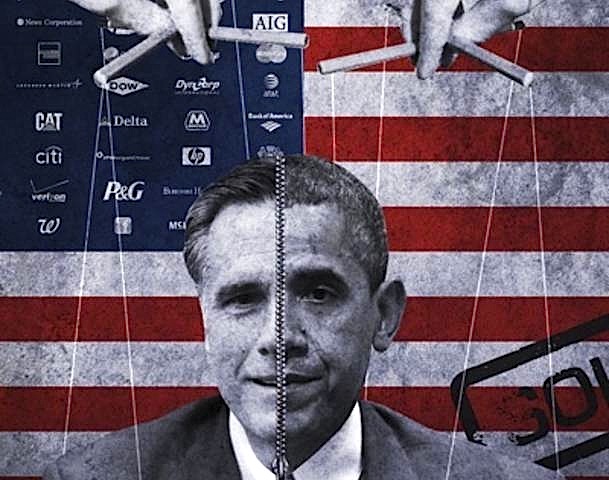
One thing is certain – both corporate puppets support the system that is killing you:
Post Script:
An important point was brought up by Alex Smith of EcoShock Radio about the numbers in this post. The list of top campaign contributors by Opensecrets does not include the dark world of Super PACs and other tax-exempt groups which can shield the identity of their donors – a billion spent on the presidential race. See the comments section of this post for further details.
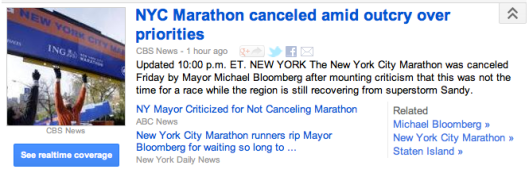
A nice example of the disconnection from reality that the elite reside within was exhibited this past weekend between NY Mayor Bloomberg and the survivors of the recent apocalyptic manifestation of human-induced climate change. Apparently the New York climate refugees that Sandy left in its wake felt that diverting much-needed resources to a marathon run was a little heartless and misappropriated as far as priorities were concerned:
What’s wrong with these people? Don’t they know that acknowledging the historic and unprecedented nature of such monster storms will disrupt this big fossil fuel-burning party we have going on here at planet Earth. For Christ’s sake, these new Frankenstorms are just the free market’s way of weeding out the wheat from the chaff. So what if the sea levels are rising faster than expected?!? If you can’t afford a walled fortress that can withstand future climate chaos along with the sky-high insurance premiums that go along with living in such vulnerable seaside spots, then move inland along with the rest of the uncompetitive and undeserving peons. In such a dog-eat-dog world, the wealthy will retreat behind their strongholds, complete with small farms and an army of private security guards to fend off the starving masses.
Some people like to comfort us with the idea that the economy will collapse long before we humans can continue burning all that coal and other carbon energy into the atmosphere. I guess such bloggers forget about all those pesky feedback loops and ecological tipping points we have already unleashed which will come to fruition no matter what we do at this point, or the fact that global dimming by sun-blocking aerosols is masking an additional 2 degrees of warming by some estimates. That kind of thinking – expecting a complete economic collapse to avoid the worst of what is already in the climate change pipeline – is just as hopelessly delusional as those who put their faith in a techno-fix like geoengineering or believe that God would not allow humans to destroy themselves.
Paul Street is one of the more insightful writers I follow and he has a new essay out which lists his version of the top threats to modern civilization. The conspicuous absence of these grave dangers from our political discourse prompts him to start off his article as follows:
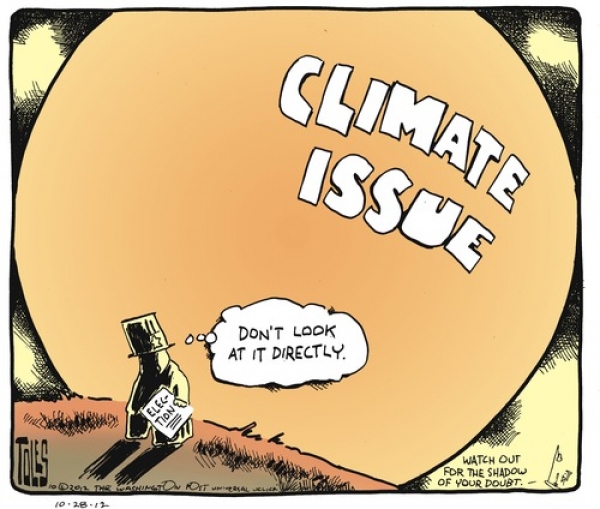
The content and character of the 2012 U.S. presidential election does not bode well for the human race and other life on Earth. If the American people do not broaden the sphere of public concerns that matter far beyond the ones being discussed in this the latest big money-big media -major party-narrow spectrum-corporate-managed candidate-centered “electoral extravaganza” (Noam Chomsky’s phrase[2]), then there is not going to be a decent, desirable, or democratic future worth inhabiting. If we accept this and other such periodic U.S. elections as an adequate expression and spectrum of democratic politics and popular voice, we’re done for.
Well Paul, it is all corporate-funded theater and bread & circus for the mesmerized and pacified masses. What more would you expect from a society whose governing institutions and news media have been usurped by the greed of monied interests? Both mainstream parties are on the corporate dole, a situation best summed up by the following comment:
…America’s history has always been about the battle between plutocracy and democracy. Since WWII, we’ve built the military-industrial complex, we’ve allowed campaign funding to reach insane proportions, we’ve introduced the most effective means of propaganda ever created (the TV) into every home, and we’ve de-regulated Wall Street into a behemoth. We’ve allowed the corporate structure to infect our democracy at the deepest levels as well as most people’s personal lives in a fundamental way (health care and pharmaceuticals, banking and debt, the fact that most of the country has to shop at Walmart to be able to break even each paycheck, etc.).
The plutocrats have been routing democracy in a steady succession the past 50+ years. Our democracy is now a hollowed-out shell completely subservient to corporate interests at all levels. This is not crazy liberal talk – it’s simple reality. Citizens United was just the icing on the cake…
Number one on Paul Street’s list cannot be denied – climate change. Here’s what he writes about this civilization-ending problem which has been avoided at all costs by the mainstream media even after the devastation in New York:
Climate change is a threat multiplier. It will make unstable states more unstable, poor nations poorer, inequality more pronounced, and conflict more likely,” Huhne is expected to say in a speech to defence experts. “And the areas of most geopolitical risk are also most at risk of climate change.”
He will warn that climate change risks reversing the progress made in prosperity and democracy since the industrial revolution, arguing that the results of global warming could lead to a return to a “Hobbesian” world in which life is “nasty, brutish and short”.
And the U.S. military already acknowledged the threat of human-induced climate change to the stability of nation states in a 2007 report, National Security and the Threat of Climate Change. In recent years, congressional witnesses speaking on the dangers that climate change poses have been unequivocal in their warnings:
· On October 15, 2009, retired USAF General Charles F. Wald testified before the Senate Foreign Relations Subcommittee, reiterating the CNA finding, saying that “we must… now prepare to respond to the consequences of dramatic population migrations, pandemic health issues and significant food and water shortages due to the possibility of significant climate change” and that “Energy security and a sound response to climate change cannot be achieved by an increased use of fossil fuels.”
· In May, 2009, retired USN Vice Admiral Dennis McGinn in testimony before the Senate Foreign Relations Committee pointed to an “over reliance on fossil fuels” and said that “climate change has the potential to create sustained natural and humanitarian disasters on a scale and at a frequency far beyond those we see today.
So we should expect that a future of unstable climate which increasingly puts our food production in jeopardy will also lead to an increased risk of weapons of mass destruction being used by failing countries – desperate and angry fingers on the trigger of nukes. Homer-Dixon’s scenario on climate change and armed conflict is prescient. An article from 2007 reveals the inevitable truth about the energy-water-food-climate nexus and social breakdown:
…Homer-Dixon was writing more than 15 years ago about climate change leading to a rise in violent conflict and state failure.
Then, his pronouncements found only a small audience, and held little sway in the halls of power in Washington or New York.
Now, he is briefing UN Security Council members about his theories of “synchronous failure”, a much in-demand author of a bestseller warning of impending catastrophe, The Upside of Down.
…Homer-Dixon believes “major volatility” in nation-states and in the international order is the inevitable outcome of climate change. His theory rests on the premise that many nation-states are highly stressed and hopelessly addicted to energy, what he terms the “master resource”.
Climate change will be the factor that pushes many vulnerable states to the edge, and over it.
Some nations will find their resources overwhelmed as they struggle to cope with massive internal movements of people displaced as fertile land becomes unproductive and water shortages emerge.
…a rise in the Earth’s temperature of one to two degrees – will have significant impacts.
He says modern states are in a similar predicament to the declining Roman Empire.
The massive cost to Rome of maintaining and feeding its subjects, bureaucracy, militaries and cities required more and more energy. In the end, the energy could not be found, leading eventually to the collapse of a great empire.
Similarly, a “complex” globalised world is expending more and more energy to underpin societies reliant on relentless economic growth.
In what Homer-Dixon describes as an “astonishing statistic” he notes that the energy consumed in producing and transporting food around the world has risen 80-fold in the past century while the population has quadrupled to 6 billion over the same period.
Using a measure he called the “energy return on investment”, Homer-Dixon finds the search for energy is requiring an ever-increasing amount of resources at a time when demand for it is rising rapidly.
It is a situation that he says is fast becoming unsustainable. Oil will become too expensive, while nuclear energy requires a massive investment in money and energy, just to get it off the ground.
And he notes another dilemma. Fixing the effects of climate change will require massive amounts of energy in itself.
“Building sea barriers, moving huge numbers of people displaced by changing weather, building new infrastructure … all these types of things, the solutions to climate change, require lots and lots of energy.”
And as governments become incapable of discharging their basic responsibilities of statehood, the vacuum will be filled by chaos and conflict…
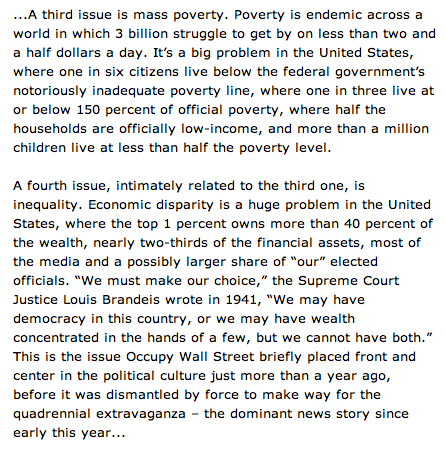
Number three and four on Paul’s list is mass poverty and inequality. He writes:
Perhaps we should mention that mass poverty and inequality stem from unfettered capitalism which has reached its full fruition in the buy-off of our government and the total corruption of regulatory, judicial, and legislative institutions by the profit-driven interests of multinational corporations. The social contract has been broken; the political discourse for the public has degenerated into meaningless wedge issues; and society has been atomized and isolated into ‘individual consumers’, a mere member of a marketing demographic whose only voice is to choose between product X or Y.
Number five on Paul’s list is the likelihood of another epic financial crisis. Our financial system is limping along, but its demise is written in stone. Without cheap energy, the underlying backbone of our economy, our growth-oriented system cannot survive for very much longer. As I said before, money is simply a token of energy exchange and has no intrinsic value of its own. If we now take into account our fossil fuel energy system’s external costs (environmental damage, ill-health costs, climate change destruction, resource wars such as Iraq, etc), then we’d be in debt up to our eyeballs. As I explained in this post, the net benefits of burning fossil fuels will eventually be negated by the net costs.
Number six on Paul’s list is “long-term structural employment and enforced obsolescence of tens of millions of formerly middle and working class Americans.” The worker is disposable, and long-term unemployment is endemic to capitalism. The corporate drive for maximizing profits is the primary goal and thus follows the policy of keeping worker numbers and their wages as low as possible. Automation, outsourcing of jobs, and employing part-time workers are some of the ways corporations suppress labor.
Paul lists number seven as “racism and racial inequality.”:
…Nobody raises a peep about racially disparate mass incarceration or segregated schools or black inner city neighborhoods with unemployment and poverty rates over 40 percent…
Looking back in history to the genocide of Native Americans and now to today with the ‘War on Terror’ and its related racism towards Muslims, the U.S. empire has always demonized anyone who stands in its way. Nationalism, racism and xenophobia always rise in times of economic downturns, no matter the country, when scapegoats are created to vent people’s anger and frustration as well as shift blame. Today is no different:
And the last one is U.S. militarism. I would rank this one much higher on the list and I’ve posted on this subject extensively, but the following video does a nice job of summing things up:
Rising sea levels, monster storms, hordes of fleeing climate refugees, crop-destroying droughts and floods, hellacious forest fires, dying ocean sea life, rogue geoengineering projects, and distraught scientists – the beginnings of these are all taking shape as climate change starts to kick into gear, putting into question the future of the human race. Ten years earlier, the effects of a storm like that of Sandy were foretold in a report entitled “Nation Under Siege” by Architecture 2030, a “non-profit, non-partisan and independent organization, established in response to the climate change crisis by architect Edward Mazria in 2002.” As Inside Climate News reports, the most disturbing part in this study is a 3-D map of New York (pictured below), illustrating the effects of a 3-meter (9.8-foot) rise in sea level: “Lower Manhattan, the East Village neighborhood and the FDR Drive underwater. That’s exactly what Sandy’s 3-meter storm surge delivered.”
In a recent post, I mentioned that one of the world’s premier insurers, Munich Re, was pricing in the rise of climate change disasters. Speaking from an Australian perspective, a very astute and sobering comment was made on this very subject of the insurance industry and climate change damage. Note that in addition to the ineffective carbon trading scheme, this is the best response we are likely to ever get from our ‘free market capitalist system’ (bold emphasis is mine):
We can take it as a given that nothing of scale will be done about climate issues until the bells toll at a deafening level. Sort of like a heavy cigarette smoker puffing his life away in spite of getting a clear diagnosis of very ill-health.
Meanwhile the insurers, Swiss Re(the big one), and Munich Re, set their numbers folk on the problem and come up with a price(premium) for geographically weak areas around the planet. The price for living in say, flood prone Manhattan, will be determined by these numbers. Fire risk, no problem, theft, no problem – but acts of nature, well the historical data is on our side, to a degree where no one can dispute it, as is the call of the world’s foremost climate experts, which governments ought not argue with. Consequently the premium for flood and tempest will be high – Indeed very high. Do you want this element of our insurance coverage? – and by all means try another insurer. They will tell you the same thing. A bit like going to bat for a fair priced earthquake cover in Christchurch at the moment, let alone in the decades to come.
As a result governments, both local and Federal, will have to become insurers of last resort – putting them in position where they too can face bankruptcy, like all of the other insurers who failed to crunch the numbers.
More than likely this is how the business-as-usual world, will approach the climate problem.
Structurally it is already happening in Australia in a quiet way, where CSIRO (Commonwealth Scientific and Industrial Research Organisation) have passed their climate models over to state governments, who in turn have passed the buck to local councils about the risks of rubber stamping building permits in storm and tempest prone coastal areas. Ergo, rate hungry local shires can be bankrupted in a trice from several directions. For one, the landowners claim they trusted the shire permit system – yet the insurers(if they take on the bet), have a clear path to recover their losses. Given that shires defied expert opinion from the country’s foremost climate authority, insofar as they were handed their projections, yet ignored them.
On the one hand some commentators might take these real world scenarios as leading indicators of how we are traveling in the climate fix – but the reality suggests they are trailing indicators at best. An after-the-event pricing for climate problems.
As for a global fix on climate – well insurers are leaving politicians in their wake. Coming up with real world pricing models, and all that.
As for the unwashed millions around the world – well there’s no money in them.
An interesting adjunct to this may be found in Australia’s refugee policy, where currently it appears to be suffering quite some stress. Yet it fails to include climate refugees in the decades to come. Say Bangladesh, where a small rise in sea level will have twenty million people on the move – begging questions from the UN – how many millions will Australia take.
Ian Angus observes on the website Climate and Capitalism that the masses will be left to fend for themselves like the survivors of Katrina:
As Naomi Klein wrote in the same year, in The Shock Doctrine, “It’s easy to imagine a future in which growing numbers of cities have their frail and long-neglected infrastructures knocked out by disasters and then are left to rot, their core services never repaired or rehabilitated. The well-off, meanwhile, will withdraw into gated communities, their needs met by privatized providers. ”
In short, now we all live in New Orleans.
Though the cost of Sandy to the Northeast is a small fraction of the total cost incurred by Katrina, this time climate change hit the seat of power and money in America rather than the poverty-stricken plebs of New Orleans who were quickly written off.
Even further back than the above study was one done ten years ago entitled “The Metro East Coast: Climate Change and a Global City.” One of the authors of that report and a senior research scientist at NASA Goddard Institute for Space Studies who heads the Climate Impacts Group is Cynthia Rosenzweig. She was on Democracy Now yesterday speaking about the forewarnings New York had been given:
CYNTHIA ROSENZWEIG: New York City—when we started over 10 years ago, we really started looking at New York City. New York City is actually—our estuary is shaped like a funnel. And hurricane winds and storms go counterclockwise, as we all know now. And when we have that arm, that strong arm of the storms, coming around, slamming right into our—the cone of our—the funnel of our estuary, we said over—over 10 years ago, we showed the maps of how vulnerable Lower Manhattan, Long Beach, parts of Staten Island, the low-lying areas—we’ve been telling people for over 10 years that these are the areas that we need to protect. We need to plan and protect them.
We’re also vulnerable because we have so much infrastructure. And, you see, we can’t think about our infrastructure in silos. “Oh, here’s the transportation system. Here’s the power. Here’s the water.” All of those three are interdependent. And we know now so strongly that when one goes out, especially the power, there’s cascading effects throughout all the systems…
Writing on Dissident Voice, Robert Hunziker comments on another Democracy Now interview from this week concerning the vulnerabilities of New York:
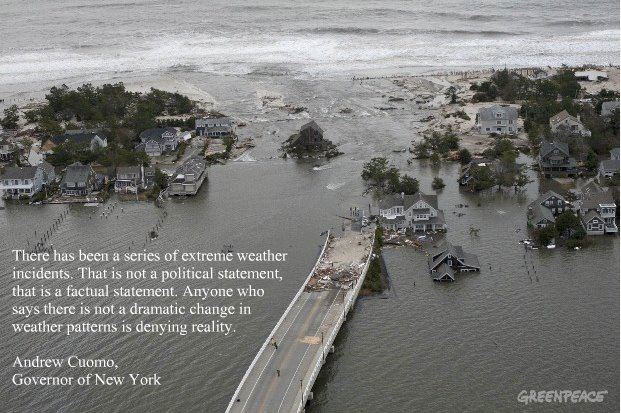
Here are a few pictorial commentaries from the net on Sandy:
And a perverse reaction from the barbarians at a Romney rally when a climate activist tries to break the silence on climate change:
No, it’s not dystopian fiction anymore; it’s terrifyingly real. Time to contemplate our existence on this little blue orb and decide what’s worth fighting for.
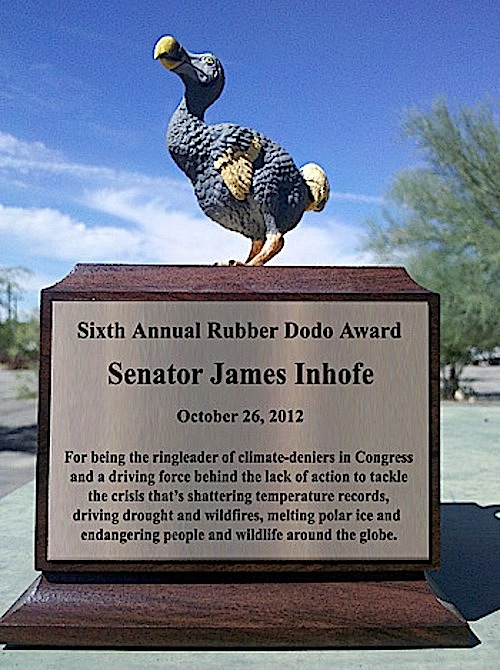
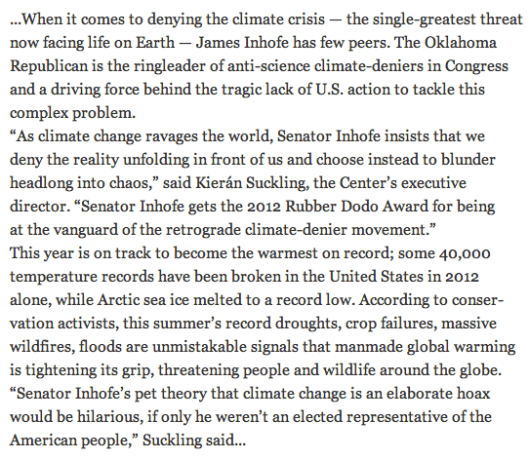
I heard about this dubious award via Your Medieval Future. Why did it take so long for this guy to get the award?…
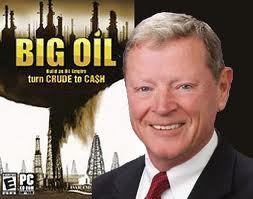
And here is Senator Inhofe’s politically polarizing response, spoken like a true anti-science zealot and mouthpiece for the fossil fuel industry:
I am truly honored that yet another radical environmental group has given me an award for my efforts to put a stop to President Obama’s far-left global warming agenda,” Senator Inhofe said. “The Center for Biological Diversity should be pleased to know that my award will have a prominent place in my office, along with all the others I have been proud to receive over the years. As the top Republican on the Senate Committee on Environment and Public Works, I have worked every day to expose the radical left’s extremist agenda aimed at ending American production of oil, gas, and coal because of the devastating consequences it will have on the American people.
Despite the fact that some of us are intelligent enough to see the coming collapse from unmitigated depletion of the earth’s non-renewable resources, overpopulation, climate disruption from the massive burning of fossil fuels worldwide, the human-induced 6th mass extinction, CO2-acidification of the oceans, and the resultant destruction of our modern industrial agriculture base, we are all lumped into the category of ‘radical left extremists‘ for recognizing such scientific realities. In Inhofe’s world, there is no environmental crisis and humans can adapt to whatever toxic sludge pile industrial civilization creates out of the planet. In a world where the true conservatives are those who want to keep the planet habitable for humans, people like Senator Inhofe will ensure that we all face the same fate as that of the extinct Dodo bird.


 I’m finding it harder to carry on with blogging about reality without compartmentalizing all this grim news into some dark recess of my brain, only to be unlocked at night when I read up on this subject. I live two lives – one in the fake world that we all mill around in like zombies in order to survive… and the other in this blog researching the coming apocalypse. No wonder the Apocadocs turned to humor to deal with this stuff.









 Collapse of Industrial Civilization