In a previous post, New C.I.A.-Commissioned Report on Climate Change Stresses to Civilization, we were given a window into dangers created by human-induced climate change. Now we learn that President Obama has axed that program. Why study the ultimate existential threat to industrial civilization when you can just build more weapons to fight the social instability and wars brought on by abrupt, chaotic and extreme weather patterns. This mindset would be in keeping with the American ruling establishment’s practice of treating the symptoms rather than the root cause – ignoring the fact that we, aka industrial ‘civilized’ humans, are the destabilizing force of the biosphere and the primary cause behind climatic disasters to civilization. We’ve pumped so much CO2 into the atmosphere that it has now gained an intractable foothold as a driving force behind possible runaway climate change.
Excerpt…
CURWOOD:…One of the more startling scientific reports presented at Doha — based, so far, on preliminary data – suggests that emissions from the melting Arctic are heading for a tipping point that could lead to runaway warming...
CURWOOD: Now we understand that the CIA has shut down its center for climate change and security – why did they have the center in the first place, do you think?
ROMM: Well, there has been increasing awareness in the intelligence community and the Pentagon that global warming and climate change was going to have an impact on US national security interests. Whether it is military bases that are seeing sea level rise or countries that are subject to worse droughts and famines, so, you know, I think many countries around the world had come to the view that climate change was going to have a big impact on security.
CURWOOD: Why shut this unit down now?
ROMM: Apparently the unit didn’t have much support when Panetta left and General Petraeus took over at the CIA. Petraeus was very focused on terrorism, and there’s a lot of congressional Republicans, who, you know, deny climate science and therefore attack any action by the federal government to study climate change and its impacts.
CURWOOD: Some suggest that the CIA shutting down its Center for Climate Change and Security is a budget matter. What’s your analysis?
ROMM: Well, I think that everyone knows that budgets are under duress. We have this fiscal cliff, in all likelihood, discretionary spending, even for intelligence, is going to be cut. Some were saying that the CIA was trying to make nice with Congressional Republicans and not continue this center that kind of annoyed them.
I hope that’s not the case, because, this is a matter of pretty basic science and it would be a shame if our intelligence organization, whose job is to sift through the facts and be completely separate from ideological spin, it would be a shame if they were getting pressured to not look at science and facts…
ROMM: Closing the center was absolutely a mistake. If the intelligence apparatus in this country with its $75 billion dollar budget can’t have a small center to study one of the gravest threats facing the world, that’s a pretty sad state of affairs…
~~~~~~~~~~~~~~~~~
That’s a pretty sad state of affairs. The weapons of mass destruction have been in plain site all along…
Listen to the real reasons…
…Our national security has been reduced, in large part, to energy security which has led us to militarizing our access to oil through establishing a military presence across the oil-bearing regions of the world and instigating armed conflict in Iraq and sustaining it in Afghanistan…
Zobama and Zomney had lunch Thursday afternoon to compare notes on how best to accelerate the growth of our death-dealing economy and bring on the Eco-Apocalypse of the planet. Their plans suffered a small setback in 2008 when the speculator vultures and moneychanger vampires over-engorged themselves on the working stiffs whose blood supply is still critically low.
The success thus far on the progress of zombification of the planet was discussed, with lavish praise going to the fossil fuel industry for their superb job in keeping the working stiffs hopelessly addicted to the ancient black elixir and hopelessly confused about the end results of such an addiction.
Both agreed that soon the living arrangements on the planet will be perfect for zombies and the few remaining humans will quickly fall prey to a lifeless and uninhabitable environment suitable only for the ranks of the undead.
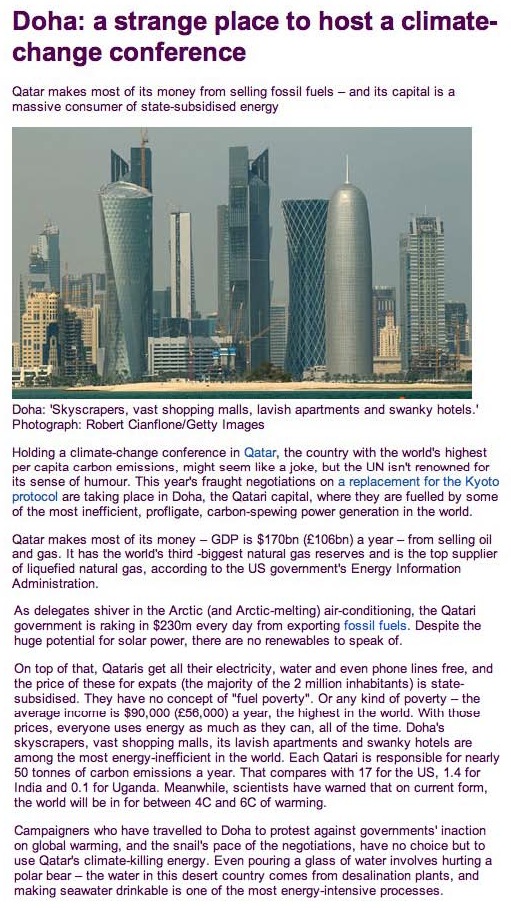
If you’re not really going to do anything about our omnicidal alteration of the planet, then it would make sense that you would host such a climate talk charade in the most profligate, fossil-fuel dealing, energy-gorging city on the planet – another irony for the ages as this blog below points out. Isn’t that like holding an alcoholics anonymous meeting inside a liquor store?
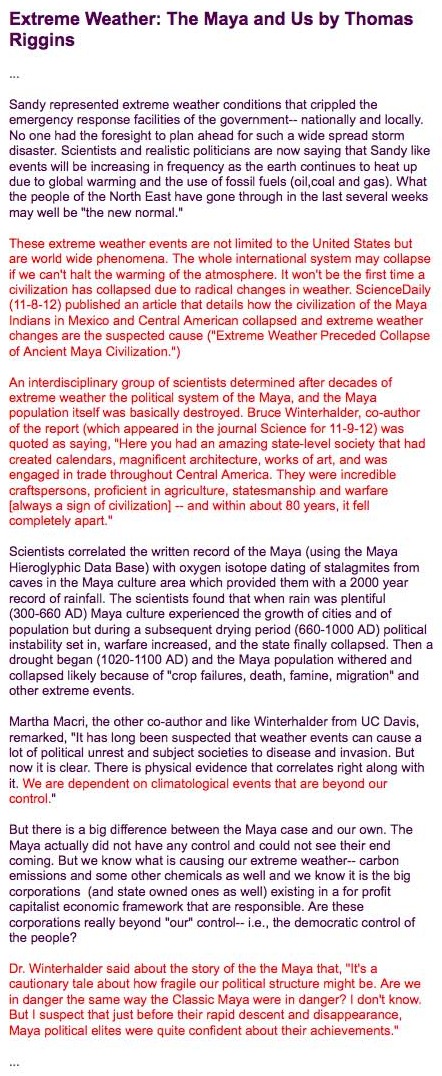
In Guy McPherson’s talk which was the subject of my last post, he said that those living in the inner part of the American Empire, the Great Plain States, would be in a whole lot of trouble in the coming decades. To elaborate on that statement, read the article below to see how things are literally fading away, soon to give new meaning to the term “dry county” (emphasis in red by the energy skeptic):
And history repeats itself, despite all our fancy techno-gadgetry and state-of-the-art instruments giving us unparalleled warning signs of our impending demise. The ApocoDocs recently quipped something to the effect of, “If we can foresee the collapse, then we can prevent it. Right? RIGHT!”
When you have at your disposal all the tools and knowledge to avert your own death, but collectively choose not to utilize them, that just makes it all the more tragic:
Now if that story doesn’t illustrate to you the ingrained, institutionalized insanity of the people running the show, I don’t know what will. I told you in a previous post they think the planet is one big ShamWow towelette for man’s endless flow of waste. A commenter on the above story gives a laundry list of examples illustrating how humans are complete failures at managing waste, concluding with the following statement:
…Unfortunately, industrial humans have always “managed” their wastes by throwing it away. This works well in a world with low population, or with a largely poor population that can’t object to living in someone else’s toilet. In the modern world, though, “away” is going away. (It’s worth noting that it does NOT have to be this way. Current conditions pertain because it is convenient/profitable, not because responsible waste management is impossible. But that’s another topic entirely.)
Hofmeister is proposing that we apply the same approach that we use for other industrial wastes – one which is failing, which preferentially exploits the poor, and is damaging our planetary life support system – to CO2. This is not a recipe for success or even survival – this is apologia for continuing business as usual.
Gail from Wit’s End referred me to Guy McPherson’s presentation above. I just finished watching it a few minutes ago. Here are my thoughts on the talk.
This is the big wild card which may well bring everything down since the IPCC assessments and climate models either don’t factor in these feedback effects or, if they do, don’t do it with much accuracy. For example, the Arctic is melting three times faster than predicted and that will have implications for the entire planet. The Arctic melt, as well as Greenland melt, makes all global climate change predictions unreliable. Another example just came across the news today:
Doha, Nov 27 (Prensa Latina) The rapid increase in temperature in the Arctic has caused a loss of ice in the subsoil of the region, a fact that should be considered in climate models, experts said today. If the “permafrost” melts, it will free all the carbon accumulated for centuries, said Kevin Schaefer, of the United Nations Environment Programme (UNEP) at the 18th Conference on Climate Change held in Doha, Qatar.
“Once it starts happening, the process is irreversible. There is no way to recapture the carbon released. And the process wil continue for centuries, due to the organic matter being very cold and descomposing slowly”, said the scientist.
This excess of carbon released into the atmosphere was never included in the projections of global warming, which is why the UNEP recommends that the Intergovernmental Group of Experts on the Evolution of the Climate specifically take into account the growing impact of permafrost thawing on global warming…
All of these uncertainties should give everyone pause because it means that the most dire predictions could very well be correct, as Guy points out in his talk.
Towards the end of the video, the camera spanned the auditorium and I could see all the empty seats. There were perhaps a few dozen people in attendance of Guy’s talk. That’s a sad commentary on society, but it also points to something else – catastrophe fatigue or the normalization of catastrophe. The slow and steady stream of doomsday news along with the popularizing of such themes in mainstream entertainment and pop culture has served to desensitize people to catastrophe and violence:
Guy doesn’t really talk explicitly about the link between capitalism and the environmental crisis. He should. Capitalism feeds off of crisis. As they say, capitalism is crisis. It is the primary root cause of the civilization-ending eco-collapse we are facing:
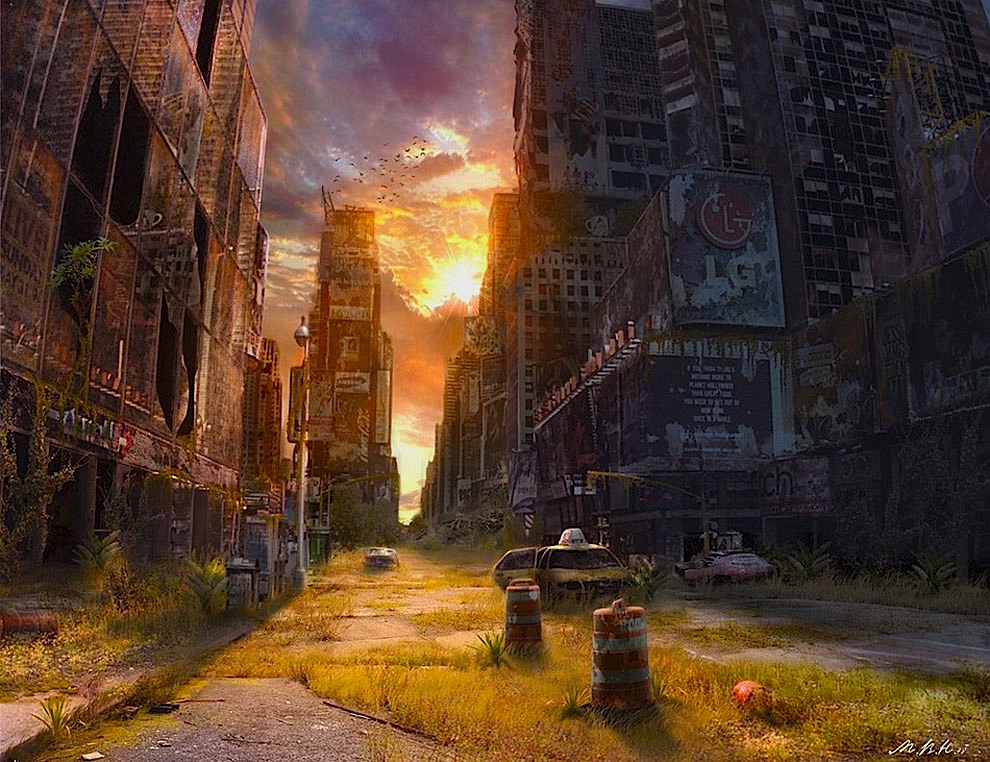
I thought I’d post a few pictures of what the world will look like before the end of this century. Artists have the intuitive imagination to conjure up such visions the general public can only imagine through Hollywood zombie flicks which seem to be all the rage these days. Why do I feel this vision is inevitable? Just look at the daily news to see what I mean:
It used to be that the mentally insane, flailing their arms and talking to invisible people in the streets, were the ones ranting and raving about the end of the world, but now it’s scientists who, in an attempt not to offend the beliefs of the scientific illiterati and free-market faithful, downplay their findings as much as possible. Optimism bias infects even the scientific community.
…we are the most tragic species. We not only destroy all of the world around us, we are aware of doing it but unable to stop ourselves. We have faith and hope that things will get better, that we can turn around at the last second what we’ve screwed up over years and decades. Which of course is nothing but an excuse to keep on screwing up. All courtesy of our optimism bias.
What better exemplifies the delusional optimism of man than the belief that he could hide out in a bunker to survive the ravages of a nuclear war? I’ll tell you what tops that fantasy – the belief that man can continue to do what he has done and expect the planet to unfailingly absorb all the environmental assaults we can throw at it via the endless growth of capitalist production and consumption. The planet is not some massive ShamWow towelette for man’s nonstop flow of excrement.
Of all the findings in the 2012 edition of the World Energy Outlook, the one that merits the greatest international attention is the one that received the least. Even if governments take vigorous steps to curb greenhouse gas emissions, the report concluded, the continuing increase in fossil fuel consumption will result in “a long-term average global temperature increase of 3.6 degrees C.”
This should stop everyone in their tracks. Most scientists believe that an increase of 2 degrees Celsius is about all the planet can accommodate without unimaginably catastrophic consequences: sea-level increases that will wipe out many coastal cities, persistent droughts that will destroy farmland on which hundreds of millions of people depend for their survival, the collapse of vital ecosystems, and far more. An increase of 3.6 degrees C essentially suggests the end of human civilization as we know it.
To put this in context, human activity has already warmed the planet by about 0.8 degrees C — enough to produce severe droughts around the world, trigger or intensify intense storms like Hurricane Sandy, and drastically reduce the Arctic ice cap. “Given those impacts,” writes noted environmental author and activist Bill McKibben, “many scientists have come to think that two degrees is far too lenient a target.” Among those cited by McKibben is Kerry Emanuel of MIT, a leading authority on hurricanes. “Any number much above one degree involves a gamble,” Emanuel writes, “and the odds become less and less favorable as the temperature goes up.” Thomas Lovejoy, once the World Bank’s chief biodiversity adviser, puts it this way: “If we’re seeing what we’re seeing today at 0.8 degrees Celsius, two degrees is simply too much.”
At this point, it’s hard even to imagine what a planet that’s 3.6 degrees C hotter would be like, though some climate-change scholars and prophets — like former Vice President Al Gore in An Inconvenient Truth — have tried. In all likelihood, the Greenland and Antarctica ice sheets would melt entirely, raising sea levels by several dozen feet and completely inundating coastal cities like New York and Shanghai. Large parts of Africa, Central Asia, the Middle East, and the American Southwest would be rendered uninhabitable thanks to lack of water and desertification, while wildfires of a sort that we can’t imagine today would consume the parched forests of the temperate latitudes.
In a report that leads with the “good news” of impending U.S. oil supremacy, to calmly suggest that the world is headed for that 3.6 degree C mark is like placing a thermonuclear bomb in a gaudily-wrapped Christmas present. In fact, the “good news” is really the bad news: the energy industry’s ability to boost production of oil, coal, and natural gas in North America is feeding a global surge in demand for these commodities, ensuring ever higher levels of carbon emissions. As long as these trends persist — and the IEA report provides no evidence that they will be reversed in the coming years — we are all in a race to see who gets to the Apocalypse first.
Enjoy industrial civilization’s fossil fuel blow-out sale while it lasts. This is a one-time-only, circus-like ‘liquidation event’. Everything must be commodified regardless of ecological loss or intrinsic value to the web of life. The Human species won’t want to miss these deals! There will be no returns or exchanges available as we are going out of business for good due to bankruptcy proceedings with Mother Earth. All life forms and resources on the planet must go!!!
I find it interesting that we are living in a time where the average person can, with a little research every night, have a good idea of what is going on globally with the economy, the environment, and societal structures. But with that knowledge comes the realization that you are essentially powerless to change the big picture. And so it is with our slide into a truly barbaric future. Having avoided any news this past week, I slept well. Tonight, however, is a different story as I start back into reading up on the latest world events and perspectives from prominent authors. It’s a real horror show developing these days.
We know that our ‘political economy of aristocracy‘ is a major impediment in moving away from our fossil fuel-based system and creating a socially just society, but the elite will do whatever is within their power to hold onto their place in the capitalist hierarchy:
…It is in any individual’s self-interest to preserve that in which they are most invested; but the rich pose a particular danger because their self-interest often leads them to attempt to protect and preserve entire modes of economic activity that society needs to move past in order to avoid colliding with the limitations of natural resources inherent in any specific mode of technology. No more clear example can be imagined that the Koch family interest pouring hundreds of millions and billions of dollars into conservative think tanks and political lobbies that not only deny global climate change, but also actively oppose the development of clean energy technologies. But a more instructive example may be the Walton family interests, which seek to avoid the development of public understanding of how the Wal-Mart business model shifts much of its employment costs onto the government – a modern twist on the methods by which the wealthy “pauperize the multitudes” identified in the Founders’ political economy of aristocracy…
Professor David McNally has an insightful new essay spelling out the machinations of capitalism which the elite have and will continue to carry out in order to preserve the status quo and gross inequality of our political economy. Some excerpts:
…Of course it is better for businesses if there is lots of demand for their goods. But the purpose of a capitalist enterprise is not to make sales; it is to make profits. The ability of firms to accumulate, invest, grow and beat out their competitors depends on profitability. And once capitalism gets into a systemic crisis of the sort that broke out in 2008, profitability cannot be restored without enormous destruction. There are two key mechanisms by which this happens.
The first involves destroying excess or unproductive capital. If firms in one industry after another are forced into bankruptcy and/or gobbled up by the competition, those that remain will eventually restructure and reorganize themselves to produce at lower cost (and higher profits). Having bought up bankrupted assets on the cheap, and having taken over the market shares of failed companies, they will be in a position to invest again.
The second capitalist mechanism for exiting a crisis involves driving down working people’s living standards. Put simply, by devaluing human life and the costs of reproducing people – via lower wages and benefits and reduced “social wages” (the public services available by way of pensions, social assistance, health care and education) – capital reduces its costs of doing business. And it is the latter strategy, reducing the costs of reproducing people, that has dominated thus far.
The reason for this is simple. In addition to funneling trillions of dollars to bail out the financial sector, the world’s central banks, particularly those in the Global North, have lowered borrowing costs to just a hair above zero. This means that faltering companies can stay alive by borrowing money that is virtually free. That is why there has been nothing so far like the wave of corporate bankruptcies witnessed during the Great Depression or across the 1980s. And because such a wave of bankruptcies would once again rock the financial system, nothing like it should be expected in the short term.
That leaves austerity as the capitalist class’ principal strategy. Here, they have racked up considerable success. Not only have public services been drastically curtailed, so have living standards generally. In the U.S., median incomes contracted more than four percent during the “recovery” since 2010 and have now declined to where they stood in 1995. That represents the elimination of all wage gains in the past 17 years. In the U.K., meanwhile, living standards have been pushed 13 percent below their 2008 levels.[4] Now, all of this may be bad for “the economy” in the abstract: reduced incomes mean less spending and less employment. But we don’t live in an economy in the abstract. We live in a capitalist economy whose imperative is profit. And reduced incomes are highly functional for capital.
To that end, governments everywhere have embarked on programs designed to increase the precariousness of everyday life. They know that insecurity makes it harder for workers to fight back, and so they are using every weapon in their arsenal to render workers less comfortable, confident and secure. They are attacking labour rights, undermining job security, driving down wages, benefits and social entitlements, and relying heavily on migrant labourers. Indeed capital’s ideal precarious worker for the age of austerity is the migrant who enters a country bound to a single employer, with no rights to live and stay beyond the length of their employment contract. In Canada, the proportion of entrants admitted under the Temporary Foreign Worker Program is skyrocketing, and the same is true for similar programs elsewhere.
Not surprisingly, austerity and growing precariousness have done wonders for corporate profits, which have risen persistently since 2009. However, in the absence of significant destruction of capital, those profits are sitting idle rather than being invested in new means of producing wealth. By early 2012, U.S. corporations were sitting on nearly $2 trillion in cash, a record amount. European firms were doing the same, holding around two trillion euros. And that is the dilemma capital faces at the moment. Austerity has boosted profitability, but it has not made investment attractive. Moreover, the lack of a new investment boom sets limits to just how high profits can rise (indeed, by mid-2012 corporate earnings seemed once again to be faltering). Consequently, the system keeps spinning its wheels unable to acquire the traction required for a sustained recovery and expansion.
And so, the capitalist class and their governments continue to do what they know best: enforce ever-greater sacrifices on working people. Greece, of course, is the center of the austerity storm. Pensions there have been cut in half, wages slashed by a third. Homelessness is soaring and soup kitchens struggle to keep up with those in need of food. Suicide rates have risen alarmingly. Notwithstanding all that, the “troika” – the European Central Bank, the IMF and the European Commission – demand more blood. Already, the Greek government has tabled a budget for 2013 that will cut billions more from pensions, wages and social benefits, notwithstanding their own forecast that the Greek economy will contract once again by nearly five percent. The whole purpose of these cuts is to prove to international capital that Greece will abide by the discipline of financial markets and that, should it receive new “loans” from the troika, it will use this money only to pay back global banks. Perish the thought that some of these funds might find their way to teachers, nurses or pensioners. Indeed, to say the money is “loaned” to Greece is entirely false: these funds enter a special account through which they are channelled directly to banks. And for that purpose the Greek people are being bled dry.[5]…
We now see the corporate elite in America, the beneficiaries of taxpayer bailouts, off-shore tax havens, government contracts, as well as near zero Fed loans, sharpening their blades to cut the throats of the American people:
The corporate CEOs who have made a high-profile foray into deficit negotiations have themselves been substantially responsible for the size of the deficit they now want closed.
The companies represented by executives working with the Campaign To Fix The Debt have received trillions in federal war contracts, subsidies and bailouts, as well as specialized tax breaks and loopholes that virtually eliminate the companies’ tax bills.
The CEOs are part of a campaign run by the Peter Peterson-backed Center for a Responsible Federal Budget, which plans to spend at least $30 million pushing for a deficit reduction deal in the lame-duck session and beyond.
During the past few days, CEOs belonging to what the campaign calls its CEO Fiscal Leadership Council — most visibly, Goldman Sachs’ Lloyd Blankfein and Honeywell’s David Cote — have barnstormed the media, making the case that the only way to cut the deficit is to severely scale back social safety-net programs — Medicare, Medicaid, and Social Security — which would disproportionately impact the poor and the elderly.
Yet the CEOs are not offering to forgo federal money or pay a higher tax rate, on their personal income or corporate profits. Instead, council recommendations include cutting “entitlement” programs, as well as what they call “low-priority spending.”
Many of the companies recommending austerity would be out of business without the heavy federal support they get, including Goldman Sachs and JPMorgan Chase, which both received billions in direct bailout cash, plus billions more indirectly through AIG and other companies taxpayers rescued.
Just three of the companies — GE, Boeing and Honeywell — were handed nearly $28 billion last year in federal contracts alone. A spokesman for Campaign To Fix The Debt did not respond to an email from The Huffington Post over the weekend…
Now this brings me to Chris Hedges’ last essay which I just read tonight. He’s becoming more apocalyptic as time goes on. Chris knows what I know: we are headed towards a hellish future in which a tiny elite will try to hang on to their wealth and power at the expense of everyone else, including the planet. High tech weaponry and surveillance technology will be used to enslave and control the masses while maintaining capitalism’s grip on society:
…The impending collapse of the international economy, the assaults on the climate, the resulting droughts, flooding, precipitous decline in crop yields and rising food prices are creating a universe where power is divided between the narrow elites, who hold in their hands sophisticated instruments of death, and the enraged masses. The crises are fostering a class war that will dwarf anything imagined by Karl Marx. They are establishing a world where most will be hungry and live in fear, while a few will gorge themselves on delicacies in protected compounds. And more and more people will have to be sacrificed to keep this imbalance in place…
…As the world breaks down, this becomes the new paradigm—modern warlords awash in terrifying technologies and weapons murdering whole peoples. We do the same in Afghanistan, Iraq, Pakistan, Yemen and Somalia.
Market forces and the military mechanisms that protect these forces are the sole ideology that governs industrial states and humans’ relationship to the natural world. It is an ideology that results in millions of dead and millions more displaced from their homes in the developing world. And the awful algebra of this ideology means that these forces will eventually be unleashed on us, too. Those who cannot be of use to market forces are considered expendable. They have no rights and legitimacy. Their existence, whether in Gaza or blighted postindustrial cities such as Camden, N.J., is considered a drain on efficiency and progress. They are viewed as refuse. And as refuse they not only have no voice and no freedom; they can be and are extinguished or imprisoned at will. This is a world where only corporate power and profit are sacred. It is a world of barbarism…
Evil unencumbered by the slightest conscience seems to me to be what has been described above. By comparison, the droogs in ‘A Clockwork Orange’ appear quaint.
In my previous post I quoted Professor Charles Hall’s assertion that the current economic paradigm is ill-equipped to account for and address externalities such as resource depletion and environmental degradation. Peak oil as well as climate change/global warming are just two in a long list of biophysical constraints which neoclassical Keynesian economics, i.e. mainstream economics, overlooks:
…the crisis looming before us is likely to be, if anything, more terrible than the Great Depressions of 1873-93 and 1929-39. The continuing industrialization of agriculture and urbanization of population—by 2010, it is estimated, more than half the earth’s inhabitants lived in cities—has made more and more people dependent upon the market to supply them with food and other necessities of life. The existence on or over the edge of survival experienced today by the urban masses of Cairo, Dhaka, São Paulo, and Mexico City will be echoed in the capitalistically advanced nations, as unemployment and government-dictated austerity afflict more and more people, not just in the developed world’s Rust Belts but in New York, Los Angeles, London, Madrid, and Prague.
Left to its own devices, capitalism promises economic difficulties for decades to come, with increased assaults on the earnings and working conditions of those who are still lucky enough to be wage earners around the world, waves of bankruptcies and business consolidations for capitalist firms, and increasingly serious conflicts among economic entities and even nations over just who is going to pay for all this. Which automobile companies, in which countries, will survive, while others take over their assets and markets? Which financial institutions will be crushed by uncollectible debts, and which will survive to take over larger chunks of the world market for money? What struggles will develop for control of raw materials, such as oil or water for irrigation and drinking, or agricultural land?
Gloomy though such considerations are, they leave out two paradoxically related factors that promise further dire effects for the future of capitalism: the coming decline of oil—the basis of the whole industrial system at present—as a source of energy, and the global warming caused by the consumption of fossil fuels. Even if continuing stagnation should slow greenhouse gas-caused climate change, the damage already done is extremely serious. Elizabeth Kolbert, a journalist not given to exaggeration, called her soberly informative account Field Notes From a Catastrophe. The melting of glaciers threatens not only Swiss views but the drinking supplies of whole populations in such areas as Pakistan and the Andean watersheds; droughts have ravaged Australian and Chinese agriculture for years now, while floods periodically devastate the low-lying South Asian homes of tens of millions of people. The rolling parade of disasters is, unfortunately, only getting started. It will accompany a stagnant economy and only be exacerbated by the increased greenhouse-gas emissions that a return to true prosperity would bring… – essay adapted from Paul Mattick’s book ‘Business as Usual: The Economic Crisis and the Failure of Capitalism‘
The mandatory growth requirement of mainstream economics also precludes the concept of sustainability. I have not yet read the above referenced book ‘Business as Usual: The Economic Crisis and the Failure of Capitalism’, but a prominent socialist speaking of peak oil and global warming in the same paragraph is always intriguing. However, a brief critique of the book by a reader finds that Mattick does not go nearly far enough in incorporating these two realities into his analysis of our current crisis:
All mainstream institutions have subscribed to the near religious belief of the infallibility of the capitalist economy which itself is considered a self-regulating system governed by the “invisible hand” of the free market as explained by Adam Smith in The Wealth of Nations. Market ‘value’ is produced by the optimal use of capital, labor, and production. Mainstream economics operates under the assumption of a world with freely available and unlimited resources. It divides and reduces all resources into units of monetary value, not taking into consideration the value such resources hold in maintaining the ecological balance of the planet.
Isn’t it the height of hypocrisy that those wealthy nations trumpeting the superiority of the free market are also the same countries which dominate global resources and world markets by military superiority as well as the subversive and coercive tactics of their economic hitmen?
…war is integral to imperialism. Imperialism – and especially the imperialist powerhouse, the USA – needs the threat of war to sustain itself: ideologically, militarily, geo-politically and also financially. The arms and defence industry is a major part of the US economy. In 2011, the defence budget was a staggering $698 billion, or 4.8% of the US GDP (link). Add to that the cost of increased security concerns – for example, to combat the ‘terrorist threat’ within imperialist countries – and you have a major chunk of the economy being reliant on the continued existence of enemies within and without.
It’s a form of military Keynesianism to keep a faltering economy going. The further capitalism sinks into decline, the more irrational the drive to war becomes and the more ludicrous are the reasons presented by imperialism (weapons of mass destruction, nuclear capability, etc).
…a very naive view of how the world is run [is to hold the belief that] David Cameron, Barack Obama and Benjamin Netanyahu just ‘happen’ to be spending ‘too much’ on military, which on the surface seems deeply illogical at a time of official austerity. But, of course, the opposite is true: it is their way of staying in power.
Of course, we should fight against such ridiculous spending on increasingly refined machinery to exterminate humanity. But we should be clear why. – link
Moreover, America’s military has become a self-perpetuating industrial complex for profiting from war and instability.
Another problem with the world’s dominant economic system is that GDP is a misguided and inaccurate gauge for measuring the standard of living and well-being of the general populace:
…History shows that democratic forms are no proof against a slide into repressive forms. In Germany in the 1930’s, a declining standard of living contributed to the rise of the Nazi party; Hitler was democratically elected to the office of Chancellor (and then proceeded to establish himself as Fuehrer).
As America’s perpetual-growth economy faces the reality of ecological limits, as climate change imposes costs and decreased well-being on us, as food and energy and other resource prices increase because of the inexorable logic of a declining Energy Return on Energy Invested at the physical foundation of our economy, we face the prospect of a widespread decline in our standard of living. This dynamic lies at the root of this fact: Americans coming of age today are among the first generation who can’t be confident that they will be better off than their parents. By one widely used measure of well-being (the genuine progress indicator, which deducts loss of ecosystem services and other “disamenities” from the national accounts), the American standard of living has flatlined since the 1970s, despite continued strong growth in GDP.
Thus the cautionary lessons from Egypt and Tunisia. GDP is a measure of the commotion of money in an economy, not a measure of delivered well-being. If sustained or rising well-being is what is economically and politically desirable, we should measure it directly, instead of counting on GDP to do the job. And if we accept the idea of popular sovereignty—that governments rule with “the just consent of the governed,” as Jefferson put it in our Declaration of Independence—we must recognize that as the middle class goes, so goes the legitimacy of the regime in power. No system of government—despotic or democratic—fares well when the majority of its citizens experiences a declining standard of living… – link
For those who have not read Darbikrash’s last post, A Nation of Hustlers and Swindlers, it lays bare the big con game of capitalism. Similarly, the mechanic scenes in Oliver Stone’s U-Turn represent, for me, capitalism’s exploitive process of getting something for nothing:
This will be my last post until after Thanksgiving break.
I featured Professor Charles Hall in EROEI and the Collapse of Empires and here he is again with another interesting talk on energy and EROEI to clear away all the bullshit headlines about America becoming the “New Saudi Arabia”. Our economy simply cannot grow anymore without energy inputs that have a high EROEI. Of course you also have to take into account the environmental externalities of fossil fuels which are writing the epitaph on our tombstones – “Homo Sapiens had more fossil fuels than brains. Mother Nature tried to warn them, but their addiction was too strong and their propaganda too pervasive.”
…Many experts now believe that, absent the discoveries of numerous new giant oilfields or breakthroughs in development of alternative fuels, oil demand will persistently push global prices to unaffordable levels, shackling economic growth indefinitely.
Even if discoveries somehow keep pace with demand, extracting oil from increasingly harsh conditions, such as beneath the Arctic Ocean or other deep ocean waters, will put upward pressure on prices.
Despite the potentially huge economic consequences, no full-scale, multinational energy conservation effort has been launched to buy time for development of alternatives, such as electric cars, that would ease pressure on oil supplies and prices.
When oil prices eclipsed $100 a barrel in 2011 and early this year, they were edging toward the “breaking point” – the threshold where economies can no longer expand, said Charles Hall, a professor in the School of Environmental Sciences and Forestry of the State University of New York. Hall, a co-author of the book “Energy and the Wealth of Nations: Understanding the Biophysical Economy,” said that the economy has stalled in the past when U.S. energy costs have approached 13 percent of the gross domestic product.
Annual global expenditures on raw energy have climbed to an estimated $8 trillion to $9 trillion, exceeding 10 percent of the $70 trillion world gross domestic product. Those figures, however, omit the succession of price up-charges along the manufacturing, marketing and delivery chain for energy-related components of goods and services.
“I don’t think the economy is ever going to grow again . . . not on a sustained basis,” Hall said in an interview…
…“The first half of the age of oil saw this rampant expansion of industry, transportation, trade, agriculture,” said Colin Campbell, an 81-year-old retired Irish petroleum geologist who founded the peak oil movement. “The population went up six times in parallel over 100 to 150 years . . . triggered by the cheap, easy energy that made everything possible.
“Now we face the second half, which is about to dawn, which just undermines this whole world system under which we’re now living,” he said. “Naturally, no one wants to admit that.”... – link
…Also, the elite don’t want to admit that the game they control is over. Capitalism is finished. We won’t have to fret about what will replace this economic system which people believe is irreplaceable because the system is self-destructing and taking all of us with it.
And about those environmental externalities that are sealing our fate in the annals of extinct species…
In a devastating speech at Bristol University Tuesday November 6th, 2012, Dr. Kevin Anderson accused too many climate scientists of keeping quiet about the unrealistic assessments put out by governments, and our awful odds of reaching global warming far above the proposed 2 degree safe point.
In fact, says Anderson, we are almost guaranteed to reach 4 degrees of warming, as early as 2050, and may soar far beyond that – beyond the point which agriculture, the ecosystem, and industrial civilization can survive.
All this comes from one of the world’s top climate scientists, plugged in to the latest research and numbers. Kevin Anderson is from the UK’s premier climate modeling institution, the Tyndall Centre for Climate Change Research, and the University of Manchester. He delivered the speech “Real Clothes for the Emperor, Facing the Challenges of Climate Change” at the Cabot Institute of the University of Bristol in Britain.
His estimates are backed up by recent reports from the International Energy Agency, and now the global accounting firm PricewaterhouseCoopers. I also quote from Joe Romm’s blog at thinkprogress.org, and a comment by Lewis Cleverdon from Wales, in the Transition blog at transitionculture.org. – link
Did anyone really think there would be no consequences for this?:
Things have been getting quite dark here lately with all the collapse scenarios casting an ever-growing shadow into the increasingly hard-to-believe fairy tale world of carbon man. As Jb said:
…All around me I see people desperately trying to satisfy their self-worth through consumption. I keep telling myself that I should stop trying to explain the connection between petroleum and the mirage of western civilization, but the headlights keep getting bigger and brighter…
So to lift the spirits of myself and other fellow collapsitarians, a few funnies are in order. The first one is billed as “one of the funniest GIF’s you’ll ever see“, and I must admit I busted my gut when I saw it this evening. What with all that Super PAC dark money rounded up by Karl Rove and his plutocratic cronies, King Romney was convinced he had bought his way into the White House:
It makes sense that Mitt Romney and his advisers are still gobsmacked by the fact that they’re not commandeering the West Wing…
…Team Romney has every reason to be shellshocked. Its candidate, after all, resoundingly won the election of the country he was wooing.
Mitt Romney is the president of white male America.
Maybe the group can retreat to a man cave in a Whiter House, with mahogany paneling, brown leather Chesterfields, a moose head over the fireplace, an elevator for the presidential limo, and one of those men’s club signs on the phone that reads: “Telephone Tips: ‘Just Left,’ 25 cents; ‘On His Way,’ 50 cents; ‘Not here,’ $1; ‘Who?’ $5…
…Romney and Tea Party loonies dismissed half the country as chattel and moochers who did not belong in their “traditional” America.
The next one up is a Romanian TV ad for gasoline. Sorry for being sexist, but I thought it was humorous. Apparently French maids are a universal fixture in the male libido. From the Business Insider:
American gasoline brands tend to advertise their products with images of cars driving on the open road, stats about mileage, and CGI animations of pumping pistons.
That wouldn’t fly in Romania, judging by this new ad for Eastern European petrol brand Rompetrol. In the Romanian imagination, Rompetrol unleashes a bevvy of dancing French maids who clean out your firing chambers.
Now you would think that the most powerful four-star bureaucrat and top spy in the American military industrial complex would know that he might come under scrutiny at any time and therefore keep his missile under lock and key, only to be deployed in the proper circumstances. But apparently his trigger is no more restrained than that of America’s bloated and bomb-happy war machine:
The book title is perfect…now that we know the general was “all in” Ms. Broadwell. Kinda casts a questionable light on the objectivity of the author, don’t you think?
Bloomberg Businessweek’s rendition of the toll taken on the President dealing with the stress of the next four years. King Romney was the alternative cover:
…the road ahead for President Obama as he faces the fiscal cliff and crucial decisions for the future of the economy, business, and defense,” writes Businessweek. “The opposition remains considerable, and no matter how successful he is, the hardest job in the world will take its toll.
…and the fate of the human species (you wouldn’t expect Bloomberg Businessweek to mention this, would you?):
Train wrecks, even one that appears to be happening in slow motion, usually are ‘shocking’. Great speech by Chomsky, especially the climate change segment:
…maybe humans are somehow trying to fulfill a prediction of great American biologist who died recently, Ernst Mayr. He argued years ago that intelligence seems to be a lethal mutation. He—and he had some pretty good evidence. There’s a notion of biological success, which is how many of you are there around. You know, that’s biological success. And he pointed out that if you look at the tens of billions of species in human—in world history, the ones that are very successful are the ones that mutate very quickly, like bacteria, or the ones that have a fixed ecological niche, like beetles. They seem to make out fine. But as you move up the scale of what we call intelligence, success declines steadily. When you get up to mammals, it’s very low. There are very few of them around. I mean, there’s a lot of cows; it’s only because we domesticate them. When you get to humans, it’s the same. ‘Til very recently, much too recent a time to show up in any evolutionary accounting, humans were very scattered. There were plenty of other hominids, but they disappeared, probably because humans exterminated them, but nobody knows for sure. Anyhow, maybe we’re trying to show that humans just fit into the general pattern. We can exterminate ourselves, too, the rest of the world with us, and we’re hell bent on it right now…
…organisms that do quite well are those that mutate very quickly, like bacteria, or those that are stuck in a fixed ecological niche, like beetles. They do fine. And they may survive the environmental crisis. But as you go up the scale of what we call intelligence, they are less and less successful. By the time you get to mammals, there are very few of them as compared with, say, insects. By the time you get to humans, the origin of humans may be 100,000 years ago, there is a very small group. We are kind of misled now because there are a lot of humans around, but that’s a matter of a few thousand years, which is meaningless from an evolutionary point of view. His argument was, you’re just not going to find intelligent life elsewhere, and you probably won’t find it here for very long either because it’s just a lethal mutation. He also added, a little bit ominously, that the average life span of a species, of the billions that have existed, is about 100,000 years, which is roughly the length of time that modern humans have existed.
With the environmental crisis, we’re now in a situation where we can decide whether Mayr was right or not. If nothing significant is done about it, and pretty quickly, then he will have been correct: human intelligence is indeed a lethal mutation. Maybe some humans will survive, but it will be scattered and nothing like a decent existence, and we’ll take a lot of the rest of the living world along with us.
So is anything going to be done about it? The prospects are not very auspicious. As you know, there was an international conference on this last December. A total disaster. Nothing came out of it. The emerging economies, China, India, and others, argued that it’s unfair for them to bear the burden of a couple hundred years of environmental destruction by the currently rich and developed societies. That’s a credible argument. But it’s one of these cases where you can win the battle and lose the war. The argument isn’t going to be very helpful to them if, in fact, the environmental crisis advances and a viable society goes with it…
By all accounts, we appear to be racing toward our own expiration date.
















 Collapse of Industrial Civilization